
Jane Brocket's Blog, page 40
June 7, 2012
matters of taste
I've just read Virginia Woolf by Alexandra Harris which is the very first book about VW to make me actually want to read her novels (all the others have just made me feel vaguely guilty and lacking for not having read them, although I could happily read her diaries and letters over and over). AH's book has a cleverly light touch; inevitably it skims over a great deal (it's only short), but it draws out major themes and reasons to read the novels with great economy and style. It is also beautifully produced; while the cover suggests the title is part of series (it has a rather generic, plain look), inside there is lovely, thick, cream-coloured paper and very tasteful typefaces which make it a pleasure to hold and read.
I always think of VW as the height of very controlled, often highly refined intellectual taste, although I know this is something of an over-simplification. But the question of taste and what constitutes 'good' and 'bad' taste, who defines this, and whether it's true or not, fascinates me. (My other reading at the moment is Barnaby Rudge which has an exciting excess of many varieties of taste all thrown together).
So I watched In the Best Possible Taste with Grayson Perry which was funny and affecting, and not at all patronising. I'm not so keen on Grayson Perry's travels with his teddy, Alan Measles (a little derivative perhaps), but this was much more free and natural and direct. The resulting tapestries are on show here; it has to be said that Perry does some amazing things with textiles.
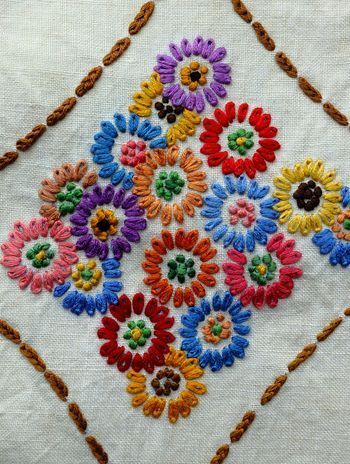
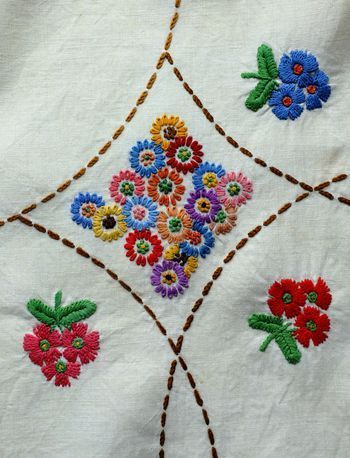
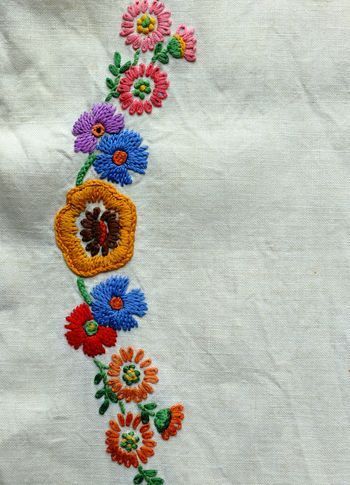
[Details from a vintage hand-embroidered tablecloth which I bought for next to nothing a couple of weeks ago. It's very much to my taste, but would no doubt be considered tasteless by some.]


June 5, 2012
reality
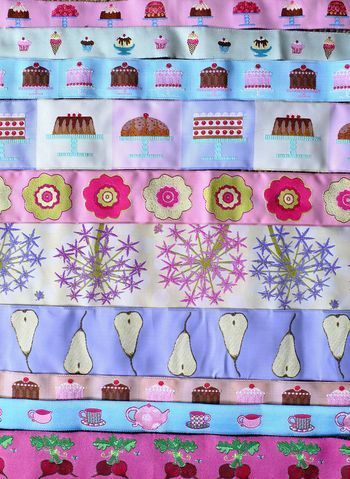
[ribbons by Laura Foster Nicholson]
Real life is claiming me. Real people, real conversations, real books, real colour, real making, real dirty, muddy hands. It's not that what I do here isn't really meaningful to me, it's just that there are phases when I can't drag or force myself to the computer to blog. And if I can't do it with with gusto and willingness, it doesn't work. (For me, anyway; I see there is yet another 'why can't people be honest and show us the whole of their lives instead of just the nice, pretty bits' conversation taking place amongst bloggers, but I'm afraid I made my mind up long ago, and am sticking to my original decision that this is a tidy, colourful, and generally positive corner of my world).
Instead of writing about doing, I've been doing.
:: I am on a greenhouse mission and now have trays and pots of cosmos, marigolds, nasturtiums ready to plant in the spots we've cleared in the garden. I have grown sweet peas, morning glory, black-eyed Susan, and cup and saucer plants (cobaea scandens) which are all healthily rampant and climbing madly indoors and out. There are dahlias in pots for planting out today, now that it's warmed up, and there are lilies inside to avoid the disgusting lily beetle. The greenhouse smells very greenhousey due to the unmistakable, pungent aroma of the many tomato plants, and there are chillis, basil, and lots of geraniums to add more smells and colour. It also has a radio, plenty of watering cans to trip over, and sense of calm. It's already pretty much as I imagined it would be: rather messy and earthy, not at all fancy, and getting fuller by the day.
:: I'm writing a second quilting book which will be published next year. I like writing quilt books enormously; it's wonderful to be able to immerse myself in fabric, textures, colour and to sort, and cut, and play, and sew, and to call it work. It also keeps me away from the computer.
:: I have family around all day, every day, which is quite unusual after years of being alone at home during the school terms. Phoebe is on study leave (you wouldn't believe how long this is) and is more than half way through her GCSEs. She claims I distract her, but I have to say she's a welcome distraction for me when she bounces into my study and virtually demands to be distracted from the Cold War, coastal erosion, and Spanish verbs. Alice works in batches of very long days and then has odd times off, often weekdays. And Tom is due home from university for a long summer holiday after a very good first year (it all turned out well there); although he'll be working, he'll be here a good deal. So the house is full, and I'm enjoying the company. It won't be long before it's very quiet again.
:: I'm reading books. James M Cain (The Postman Always Rings Twice and Double Indemnity are both brilliantly dark and twisted), F Scott Fitzgerald (The Great Gatsby which I felt I should re-read ahead of the coming Gatsby mania - I admire it but I can't say it's the best American novel of the C20 etc as I fail to connect with the characters), Margery Allingham (Mystery Mile because it's set on Mersea Island which I plan to visit). And the very entertaining and informative Underground, Overground by Andrew Martin which has made me want to visit quite a few Tube stations. Sad, but true. Now I'm onto Barnaby Rudge and wondering once again why it's so underrated.
:: Then there's radio to do (BBC Radio Berkshire), wine tastings, friends to see, swim and walk with, meals to eat and rubbish TV to watch as a family, and lazy moments in the garden. Real, full, interactive, noisy life which I love.
May 31, 2012
charleston

I'm also a Friend of Charleston. I joined last year after several years of disappointment when trying to book tickets for the annual Charleston Festival. There is priority booking for Friends (it also means you can get into the house for free) and, sure enough, it worked; I managed to get two tickets for the Annie Leibovitz event yesterday (and two more for another event later this week).
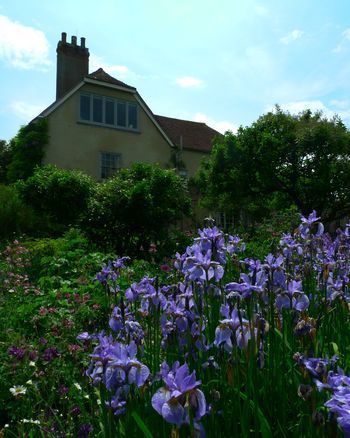
I always enjoy visiting Charleston. Although it's something of a shrine to the Bloomsbury group (an aspect which can sometimes make me feel uncomfortable), it's a place of great creativity and inspiration, and the guides who take you round the house are wonderfully informative and often suitably Bloomsberryish.
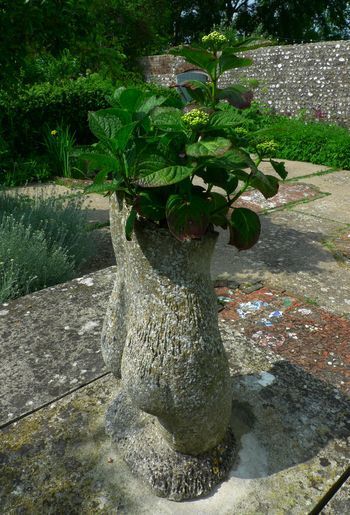
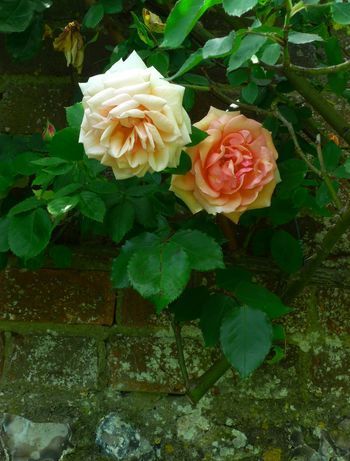
I particularly like the garden which is a mix of formal lines and wildly informal planting. It has evolved, but is maintained as an artist's garden, as well as an inviting sitting-outside-and-reading and family garden.
AL was there to talk about her book Pilgrimage, which is the anitithesis of her usual high-concept celebrity potraiture: no assignment, no people, no artificial lighting, and the photos are taken with a small digital SLR camera. So different are the photographs, my friend managed to walk round the exhibition of in the Charleston Gallery without even realising they were the photos we'd come to hear about (and I suspect there were a lot of people in the audience who thought they'd be treated to stories about celebritities and extravagant shoots).
Annie Leibovitz spoke well, showed a huge number of images from the book, and was very persuasive when discussing her 'pilgrimage' to small, historical museums and famous writers'/artists' houses in the US and England. But I just couldn't be persuaded by the photos themselves. And if the photographs can't persuade without a commentary, I'm not sure they are achieving their objective.
(Here are two contrasting reviews: Washington Post and NY Times).
May 27, 2012
tate to tate
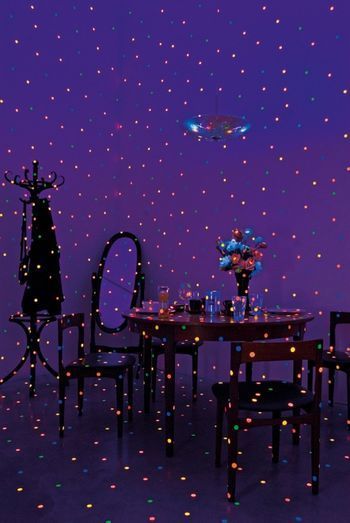
[I'm Here, but Nothing (2000) Yayoi Kusama]
If you are a Tate Member you can get into any Tate exhibition you like, when you like (queues permitting). Despite this fantastic passport to art, I have irregular spates of going to the Tate, and hadn't been for a while until Friday, when I decided I wanted to see all the major exhibitions at both Tate Britain and Tate Modern in one day and go on the Tate boat that runs along the river between the two. I was spurred on by the fact that the Boetti exhibition was just about to close, so I visited this, the Hirst, and the Kusama, hopped on the boat and saw the Picasso and Modern British Art and the Migrations exhibitions, and wandered through the Patrick Keiller work. It sounds mad to see so much in one day, especially when there are people who think you look at just one painting for a long time on a visit to a gallery, but it was wonderful to have the chance to amass so many images and so much visual stimulation, then to sail and walk along the river thinking about them.
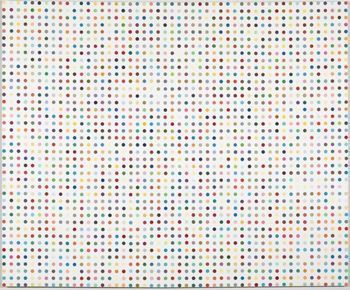
[Anthraquinone-1-Diazonium Chloride (1994) Damien Hirst]
I find I can look at a lot of conceptual art in a very short time. Call me shallow or call the work shallow, but it doesn't take too long to see what's being said and work out whether it was worth saying in the way the artist chose. For this reason, it was good to see the three Tate Modern shows together. So many spots (Kusama, Hirst), so many deliberate shocks (Kusama, Hirst), so many stamps and labels (Kusama, Boetti), so much work delegated to others by the artist (Boetti, Hirst), so much repetition (all three), so much order vs disorder (all three), so little humour (only Boetti). I was utterly taken by Boetti, but I was left cold by Hirst, and struggled to understand Kusama.
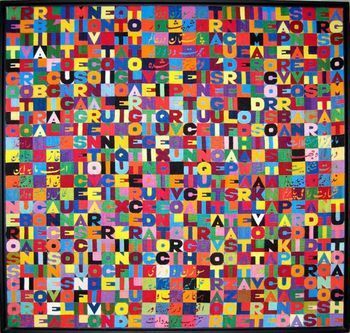
[one of Boetti's beautiful embroideries]
Being a member also means access to the fantastic Members' Room way up on the sixth floor of Tate Modern with amazing views over the river and St Paul's and the wobbly bridge. The room is so cool and minimal, I reckon you take your laptop and work from there. I swear there were a few people doing exactly that, and they can't all have been art critics.
Then the Tate Boat takes 17 minutes to go from Tate to Tate, and it's a great little journey under the bridges that I have so often walked over, and with historically layered views of London from a new view point, with a glimpse of a very separate world of the river (I never realised there's a RNLI station by Embankment).
Tate Britain has had a major re-hang and now has a 'walk through C20 art' in the rooms previously occupied by the Victorians. There are still plenty of wilting Pre-Raphaelites and solid, upright Victorians but in new groupings and, in some places, on freshly painted, deep scarlet walls. The Emigrations exhibition is a little too loose and earnest, I feel, and trying too hard. There's a real mish-mash in there, but a few gems. The Picasso exhibition is also attempting a great deal: to evaluate the impact of Picasso on C20 British artists and to show what he did while he was here. Instead, it succeeds in demonstrating (yet again) what a genius he was, and how he could turn his hand to everything, art-wise. There seems to be no genre he couldn't master then dominate, and unfortunately, most of the British artists pale in comparison. I'm not a Picasso aficionado by any means, but most of his worked simply looked better than the rest.
So there we have it, an art-filled day out. The highlights were Boetti in one Tate, and Picasso in the other, and the boat inbetween.
[In case you're wondering and in the interests of full disclosure, I saw the Patrick Keiller commission but didn't take much in. My eyes were glazing over by this point.]
May 25, 2012
fun direction*
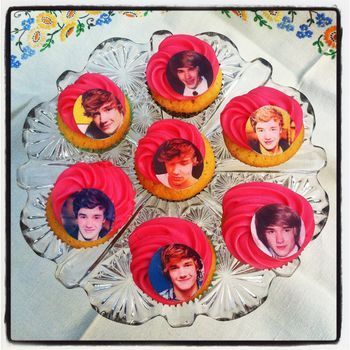
Exam revision requires creative baking distractions. Someone here is very keen on One Direction so I bought her some cake toppers featuring the fizzogs of the five band members, plus a pack with just Liam Payne toppers (above). I hadn't realised an 18 year old boy could have so many hair styles in so few years. He looks sweeter than ever framed by swirls of bright pink buttercream.
[When Tom was at home, tin foil was the basis of many distractions. So I find the foil reviews on Amazon very funny - and very close to the truth.]
* to rhyme with 'wun' ie 'one' as said by many people in Yorkshire. Of course, the band's name give rise to plenty of feeble parental jokes eg No Direction, Wrong Direction etc.
May 24, 2012
candid camera
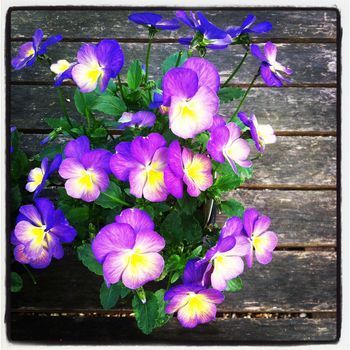
[Instagram photo no. 2]
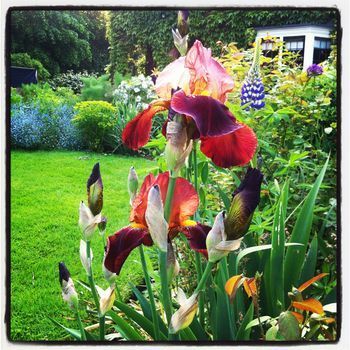
I think back to the times when having a roll of film developed and printed involved a great deal of expense and faff, not to mention the high probability of failure/glare/blur in the photos that came back, and I wonder how anyone can be sniffy about the wonders of phone cameras, Hipstamatic, and Instagram. I have just taken my first Instagram pics and I know that the younger me would have loved to play with this app on a phone, to be able to delete rubbish photos, to take multiple shots, to learn through practice, as opposed to having 24 photos to last a two-week holiday or an entire summer.
[Instagram photo no. 5]
I listened to the recent discussion on Radio 4's Front Row about the newly refurbished and now re-opened Photographers' Gallery, and it goes without saying that someone mentioned the truism that 'we are all photographers now'. But what they didn't say is that while this may be true, it deosn't necessarily mean we are all good photographers now. There is still a place for brilliant, challenging, supremely talented photographers who will always rise above the camera phone/Boots' snaps level and create timeless images.
But for everyone else, access to cheap, easy, workable cameras and apps is a gift than enhances daily life. It doesn't turn us all into artists, but it gives us the chance to look, observe, record our lives and world in a way that we couldn't have done a few years ago. I am constantly amazed by the quality of so much amateur photography on the internet; it's an amazing, endless, colourful, inspirational exhibition of images.
Yesterday evening, I took my first Instagram photos. I hadn't realised how different this app is to Hipstamatic. It's incredibly simple and straightforward (and the centre of the picture you have in the viewfinder appears in the centre of the photo, unlike the problems of distortion that happen with Hipstamatic). It's easy to use, has lots of options, and has the capacity to generate a number and quality of photos we could only have dreamed about when we were using little Kodak Instamatics. Sometimes it's too easy to forget how far we have come, and to take things for granted: cheap flights, Google, modern quilting fabric, fresh coriander in supermarkets, core ice creams, and digital photography.
[Lottie who blogs here knows exactly what she's doing with ]
May 23, 2012
i'd almost forgotten...
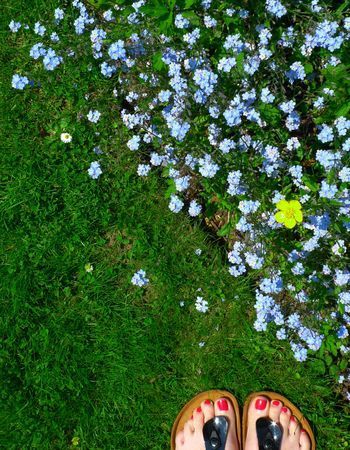
...what it feels like to have bare feet, to paint my toe nails, to wear Bireknstocks, to feel warm from top to toe. I stood next to the forget-me-nots that have invaded the garden for the past few years (but are very welcome) to remind myself that I shouldn't forget that it will happen. Eventually.
(Great weather for the Chelsea Flower Show, but I imagine everyone and everything is wilting in there this week. I'm pleased Cleve West won Best in Show; a couple of years ago I saw his allotment which is amazing: beautiful, artistic, and productive. He's written about his allotment in his book Our Plot, a lovely book which mixes practical gardening advice with a personal story and plenty of anecdotes about the allotment community.
We stopped going to the Chelsea Flower Show years ago when it became too commercialised and crowded, so I like the sound of the Chelsea Fringe, the new, alternative show, and I'd really like to see the Edible Bus Stop Garden and the Edible Front Gardens.)
May 21, 2012
posy ring
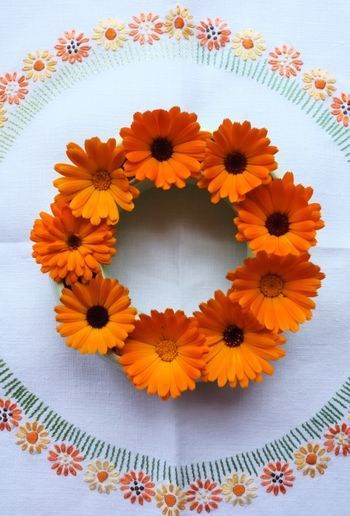
I love looking at eBay and discovering things I never even knew existed. Like posy rings, which I assume are for displaying flowers like this. But who knows, maybe I've got it all wrong and you are supposed fill them with pot pourri or sweets or marbles or something. Or maybe they are dog bowls for dogs on a diet.
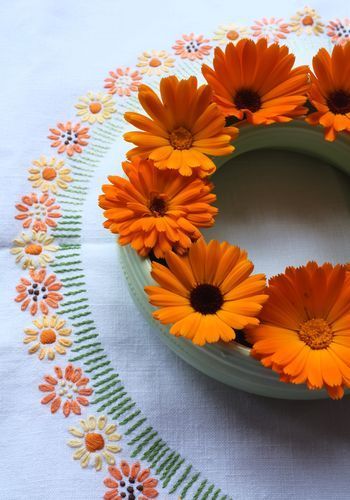
I use mine this way, though. It's very useful as it means you can put flowers on the table and still carry on a conversation without having to dodge tall flowers in tall vases.
The marigolds are from the garden. They are really glowing at the moment.
May 18, 2012
analysing freud
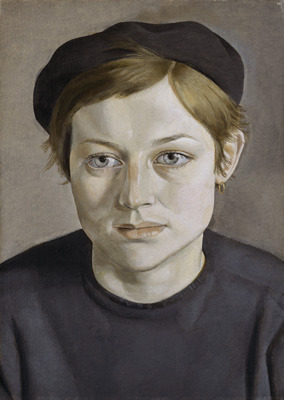
[Girl with Beret 1951-52, Manchester City Art Galleries]
I went to the Lucian Freud exhibition this week, although I wasn't sure what I'd think about the paintings. I find I get tired of reading about the media's favourite artists (Freud, Emin, Hirst) and then think I'm tired of their work, too, even though I haven't actually seen much of it for real; overexposure in the press leads to underexposure to the actual art. (The only way I came to appreciate Hockney, who never shies away from the media, was through seeing his work years ago at Salt's Mill, and again at the wonderful NPG exhibition in 2006. )
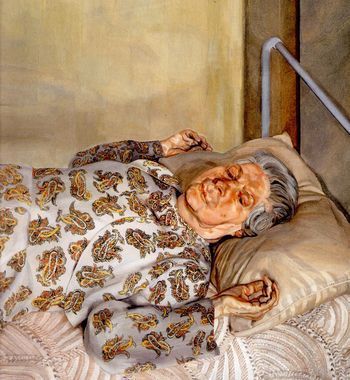
[The Painter's Mother Resting 1975-6, private collection]
Well, I am flabbergasted by Freud, and very pleased I went. The NPG has a monumental body of work on show, and some monumental bodies too. The paintings are raw, revealing, and pitiless. As Freud matures, the canvases get bigger, the sitters get older, the gaze becomes ever more penetrating. From pale, young, smooth skin in the early head-only portraits, he moves to huge, full-body paintings seen from all sorts of viewpoints and angles, some ordinary, some ungainly and awkward, and all challenging to the viewer. Freud becomes more forensic and more unforgiving; he paints the 'landscape' of the body and reveals all the undualtions, contours, crevices, but there is nothing picturesque about them. Instead, flesh begins to look like meat: veined, fatty, lean,and in places bluishly old, greenishly mouldy, pinkishly fresh. There is undoubtedly an aura of death in life, the suggestion of organic matter than will not last and will eventually rot. Looking round the rooms, you are totally drawn by 'attraction of repulsion' (Dickens' phrase), and immersed in the balance and fight between the warmth of life and the coolness of death.
Like it or not, this is the way we all go, and this exhibition is the place to come when you are fed up with the airbrushed, waxy, taut, stretched, death-defying skin that we are being told we should aim to achieve as we age. But for Freud the older, less classically beautiful faces and bodies are so much more interesting, and I couldn't agree more.
[Walking around, I saw a bloke who looked just like Brad Pitt. Then I realised it was Brad Pitt, with Angelina Jolie not far behind. Nice to see people who are horribly overexposed in the press doing something in a completely fuss-free, private way. And no-one bothered them at all.]
May 14, 2012
quilt pile-up
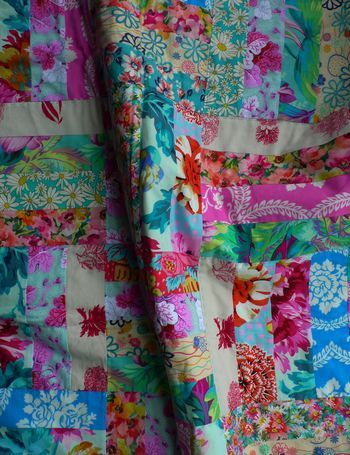
[Beach Huts Quilt]
When I give talks to groups about quilt-making, I'm often asked what I do with all my quilts. The answer is that I prefer to have a pragamtic approach to quilts, ie I like to use them.
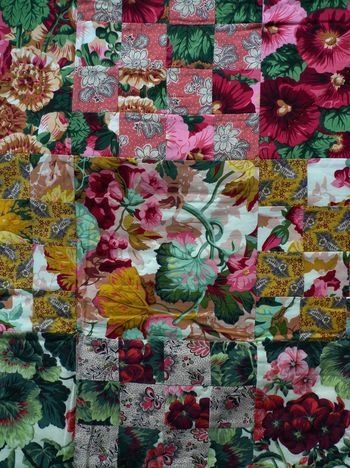
[Chintz Quilt]
But when I make quilts for a book, I have to keep them looking as smart as possible for a minimum of twelve months after publication in case they are needed for displays or talks or events. And this now means that I have a very large number of quilts in boxes and cupboards that I still daren't use - just as recently as March I was pleased I hadn't let the quilts shown in The Gentle Art of Quilt-Making be used on an everyday basis as I took lots of them to Cambridge and showed them off.
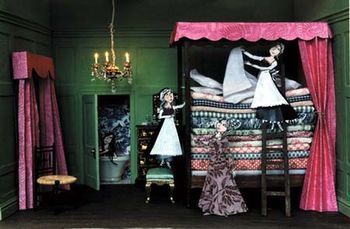
[illustration from my favourite edition of The Princess and the Pea by Lauren Child, available from the brillliant Illustration Cupboard]
Nor have I sold any quilts - perhaps I should - with the result that the ratio of quilts to beds/settees/chairs is one that the princess with the pea would recognise (if they were out on display0. So when I have to go through my quilts for whatever reason, it's nice to revisit the ones I don't see too often, such as those in the photos. Although I prefer to use quilts, there is something very enjoyable about bringing them out and retracing individual stories, the initial inspiration, where the fabrics came from, how easy/difficult they were to make, what I was thinking about while I stitched. Of course, these are the things that make quilts fascinating whether they are in or out of the cupboard, so in a way I like having a pile to look at afresh every so often. Especially as I know that one day this will be in use/given away/sold, and there will be a fresh pile-up to replace it.
Jane Brocket's Blog

- Jane Brocket's profile
- 27 followers

