
readability
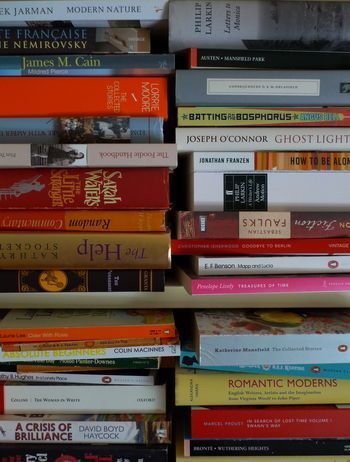
[bookshelves in the hall - awaiting sorting]
Another year, another Booker brouhaha. Another fuss about who wins, who judges, who argues with whom. But who cares? It's a well known fact that most of the novels on the list will only sell a few hundred copies - maybe more if they make the short list - and that only the winner will ever sell in its thousands. This year, however, the proceedings have been enlivened by a debate about 'readability' and whether it is compatible with literary excellence.
Well, of course it is. As if impenetrability, convolution, obfuscation, and verbal posturing could ever trump clarity, fluency, subtlety, and deft use of language (not to mention those old-fashioned virtues of plot and characterisation). I don't subscribe the Clever, Clever School of Novel-Writing, but I do like a really clever novel, one that demands and holds my attention, that opens up a new world and a new way of thinking and seeing. It doesn't have to be over-researched (you can see where the joins are when a novelist won't let go of hard-earned historical details) or under-written (so many modern novels are cool to point of frigidity), but anything that has come from a fertile, flexible imagination and is written in a continuous stream of creativity will always be more readable than a piece of prose that tries too hard.
I think some on the Booker panel are confusing readability with low-brow. It's as if anything that is easy can't have any artisitic or literary merit. It's an opinion that is influenced by academic criticism which is couched in language that is used to impress but not elucidate. It must be much harder to write a really convincing and illuminating piece of serious literary criticism in simple, direct language, which is why we have this mad lexicon, most of which no-one truly understands (hermeneutics, exegesis, diagesis, mimesis all have everyday substitutes).
It has become a sign of weakness to admit to liking readable books. We are supposed to put away our childish, Enid Blyton reading habits, and move away from books that suck us in on the first page and hold us in their thrall until we reach the last. Yet there are plenty of readable books that are also 'hard' and 'difficult' which succeed in doing this. And there are many wonderful, not-so-difficult books that are the epitome of readability, yet I would never class them as less worthy or less excellent, simply because the prose flows and we are swept along by it.
People really do care about readability. They also care about good books, and want to read the best of contemporary fiction. But we are being short-changed by literary snobs who think they know better and encourage this elitist nonsense. Give me a Dorothy Whipple or an Elizabeth Taylor any day while I wait for more literary prize-winners to become readable.


Jane Brocket's Blog

- Jane Brocket's profile
- 27 followers

