Roy Christopher's Blog, page 17
June 30, 2021
How Bo Burnham Cured My FOMO
Millennials be like, Bo Burnham did a thing.
Once a bright, shiny reflection of the zeitgeist, in Inside (Netflix, 2021) he’s the mirrorball in his darkened, one-room studio, reflecting only the dim light from his laptop screen.
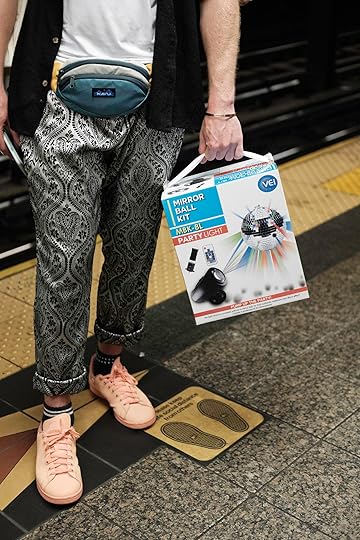 Mirror Ball Kit: street photo by Adalena Kavanagh.
Inside operates on the level of what Seanbaby at Cracked calls “the Ready Player One of philosophy”: “You create this elaborate world of fantastic bullshit around yourself where your ordinary whiteness suddenly becomes the most important trait a hero can have.” Burnham does that, and then admits that he’s doing it, and then admits that he’s doing that, and then admits that he’s doing that, and so on. It’s like starving in a feedback loop. It’s like taking a shower when you’re thirsty.
I hate to put Burnham on blast because I know that to create something—to truly create something—is to open yourself up, to make yourself vulnerable. To deliberately open yourself up as an act of creation, as he has done here, is several steps further out, making him several steps more vulnerable. I also know that paratexts like this review are just part of the show. I started writing this to excise the feeling Inside gave me, and if that isn’t a testament to its importance, then never mind the rest.
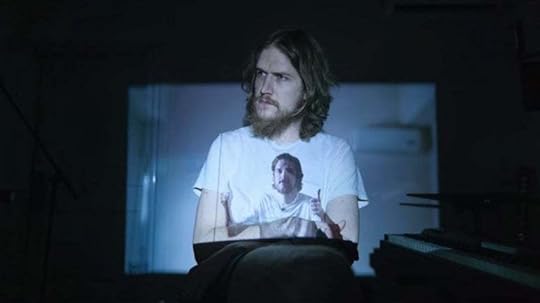
If Inside is about anything, it is about depression. It is also in itself depressing, but there’s no denying Burnham’s talent. Even with the curtain pulled back, the technical aspects of the special and Burnham’s command of them are simply staggering. In lesser hands, this would be like… Well, it would be like the internet.
As for the “content,” as he insists on calling it here, missing is that definitively Bo moment where the whole thing leaps to a level no one else can touch, up where it becomes so meta you get a nosebleed, out where French theorists fear to tread. He’s not Charlie Kaufman. He’s not even Andy Kaufman. The most relevant Kaufman here is William Kaufman. In his book The Comedian as Confidence Man (1997), Kaufman coined the condition “irony fatigue.” It’s the juxtaposition of earnest critique with the escape hatch of the joke. Kaufman argues that one cannot be a Crusader for Truth and be just kidding about it at the same time. As for Burnham, you can’t be this sincere about detached irony for very long before that context collapses too.
Maybe I just grew out of it.*
Bo Burnham still might be the voice of the millennial generation, but on Inside, he’s dangerously close to being the internet version of Weird Al Yankovic. That’s fine, but he’s so much better than that.
-royc.
P.S. Subscribe to Adalena’s newsletter. It’s a welcome inbox interruption of brains and beauty.
My wife, a millennial herself, did suggest that I was too old for this special.

June 22, 2021
Summer Reading List, 2021
After a two-year absence, it's the return of the Summer Reading List! This year we have reading recommendations from newcomers Carla Nappi, Maria Abrams, John Morrison, and Drew Burk, and from SRL veterans Lance Strate, Steven Shaviro, Lily Brewer, Ashley Crawford, Alex Burns, Joseph Nechvatal, Peter Lunenfeld, Paul Levinson, Howard Rheingold, and myself. We picked out a big pile of great books to take with you back out into the world.
Read on!
[Note: All book titles link to the book on IndieBound where you can order it online or find it at your local bookstore.]

Wu Ming [trans. by Shaun Whiteside] Manituana (Verso, 2009): A collective of unknown communal Italian writers, writing a detailed and graphic re-depiction of the struggle for American Independence? Yeah. That’s a solid work. Bloodshed and peace treaties. Native Americans speaking three languages at once and others counting coup. Nothing delves into the meat of history better at times than a profound work of historical fiction. These folks are the crème de la crème. Or rather, la panna.. della panna.
Diana Walsh Pasulka American Cosmic: UFOs, Religion, and Technology (Oxford University Press, 2019): I don’t know, I haven’t read it yet. But to have an American philosopher write a work that references Immanuel Kant and the French scientist Jacques Vallée (played by Francois Truffaut in Close in Encounters of the Third Kind) in the same work seems like Summer Reading material to me. Now whether these materials are of terrestrial origin…. That’s a whole other question.
Audre Lorde Sister Outsider: Essays and Speeches (Crossing Press, reprint Edition 2007): An Afro-American Lesbian Feminist who sought to undue structures of self-hate and to restore a liberation politics of self-love and self-care seems as prescient and important today as when she first penned the work in 1984.
Rickey Gates Cross-Country: A 3,700 Mile Run to Explore Unseen America (Chronicle Books, 2020): American Quixotes don’t come around that often. Rickey Gates is a well-known trail-runner and as Quixotic as they come. In this beautiful work and struggle— wandering across the American landscape from the South Carolina coast to San Francisco Bay— he sought to commune with common people and ordinary life to wander and dream and confront his own delirium as he overcame heartache and dehydration in the Nevada desert.
Sylvain Tesson [trans. by Frank Wynne] The Art of Patience: Seeking the Snow Leopard in Tibet (Penguin Press, July 2021): Many have written about Tibet, only a true philosopher-poets knows how to turn the art of waiting into a lesson on stillness and wonder sitting in a frozen-desert landscape at 15,000 feet elevation, hallucinating mystical creatures at -20 celsius and partaking in the splendors of the void. Having thoroughly enjoyed reading this Prix Renaudot-winning work in French several years ago, this translation by Frank Wynne will be a generous poetic offering in sharing the work of a travel-writer and adventurer to a larger reading public.
Paul Fournel [trans. by Allan Stoekel] Need for the Bike (University of Nebraska Press, 2003): Fournel heralds from the poetic Oulipo group including the likes of Georges Perec and Jacques Roubaud. And while the Oulip group might need no introduction, Fournel is lesser known, however, and his wielding of words to express the art of taking up a quasi-mystical practice of cycling will serve any reader well both in the arts of poetry but also in how to truly live and experience the joys and suffering on what the French only refer to as “le vélo.”

First and foremost, I would recommend the posthumously published first volume of writing by Christine Nystrom, entitled The Genes of Culture: Towards a Theory of Symbols, Meaning, and Media, edited by Carolyn Wiebe and Susan Maushart (Peter Lang, 2021). Nystrom was a colleague and collaborator of Neil Postman, and one of the foundational media ecology scholars of the late 20th century, her work focusing on language and symbolic communication, culture, and human relationships. Her work is absolutely brilliant, and at the same time highly accessible.
Second on my list is a very significant addition to philosophical thought regarding the human condition by Corey Anton, entitled How Non-Being Haunts Being: On Possibilities, Morality, and Death Acceptance (Fairleigh Dickinson UP, 2020). This insightful and wide ranging work incorporates rhetorical theory, psychology, systems theory, and phenomenology in a multidisciplinary tour de force.
A bit more down to earth, and relevant for educators and parents as well as scholars, is The Arts and Play as Educational Media in the Digital Age by Robert Albrecht and Carmine Tabone (Peter Lang, 2020). The need to step outside of our digital and electronically media environments, at least temporarily, has never been greater, and this book offers a practical guide and theoretical rationale for doing so.
Given the current state of things, we all could use a little help when it comes to financial investments, even for those of us whose funds do not extend beyond TIAA/CREF retirement accounts. For this reason, I am pleased to recommend Christopher Mayer’s How Do You Know? A Guide to Clear Thinking About Wall Street, Investing, and Life (Institute of General Semantics, 2021). Mayer not only provides sound and knowledgeable financial advice, but also a popular introduction to general semantics that can be applied to any human activity or concern.
Finally, what is life without a little poetry? Dale Winslow’s second collection of poems, Seeing the Experiment Changes It All (Neopoiesis Press, 2021) is an exciting and deeply meaningful volume that is perfect for those sunny summer days, and equally so for those cold winter nights.

In past years, I could imagine the summer as some kind of a coherent thing. It was when I didn't have to prep courses and grade papers all week. It was a time for being outside, for planning trips, maybe. Bit of a rest, bit of freedom. I understood what June was meant to feel like, and July, and August. I knew what kind of thing the summer was, because I felt like I understood what it wasn't. There was a rhythm, and then a release, and a new rhythm to take its place. If you had asked me what I planned to read over the summer, in past years, I would have been able to tell you a story that I believed at the time.
This year, as I sit to write this, I can't tell that story. It seems that these 1.25 years (and counting) of pandemic time have decomposed my sense of rhythm and normalcy such that I have no sense of what the summer is meant not to be, and thus I have no sense of summer. (My days, work, and internal weather are consistently inconsistent, are reliably unpredictable and irregular.) I'm in my house, still. I'm masking up even when it's optional, still. I'm not sure where the summer is, as a time-space I'm reaching to inhabit. And still, I'm reading, and what I can tell you is what I'm swimming around with right now.
Always, the comic books. This is what I tend to read before bed, and right now that looks like all things Loki-related, anything by Jeff Lemire, the second part of Neil Gaiman's Norse Mythology series (Dark Horse, 2021), Jupiter's Legacy (Image, 2020) and Karmen, (Image, 2021), but that will explode out into a big colorful cloud as issues of other series that I follow are released over the summer. I just finished James Albon's The Delicacy (Top Shelf, 2021), which I highly recommend for any comic lovers who enjoy reading and thinking about food.
And speaking of food, the pandemic has brought a change in where I get my groceries: more farm share home delivery is available where I live, now, and as the summer produce rolls in I'm spending more time working in my kitchen. The pandemic has also changed how I cook and read about food: I tend to read recipes not as guides to make particular dishes but as collections of lessons in how to process the materials I have at hand. I'm often in my kitchen these days, processing garlic scapes or turnips or rhubarb, dehydrating tomatoes or ramps, without a clear idea of what I'm ultimately going to do with them. Glass jars and bottles of powders and things are scattered across my counter and fridge shelves, and they'll eventually find their way into various experiments. It's a mad science lab in there. For inspiration, I'm currently reading in Magnus Nilsson's Faviken: 4015 Days, Beginning to End (Phaidon, 2020), Nik Sharma's The Flavor Equation (Chronicle, 2020) and Season (Chronicle, 2018), and Nick Balla and Cortney Burns' Bar Tartine (Chronicle, 2014) for inspiration on magicking with the dehydrator, Niki Segnit's books, and anything Melissa Clark or Ottolenghi for help with basics. I may wind up writing about this, as part of a kind of freaky wild hybrid housekeeping manual and collection of very short fictions. We'll see.
Soon, I'll be reading Linda Rui Feng's new novel Swimming Back to Trout River (Simon & Schuster, 2021) and Carrie Jenkins' Victoria Sees It (Strange Light, 2021), and finishing Josh Berson's The Human Scaffold (University of California Press, 2021) and Dominic Pettman's Peak Libido (Polity, 2020): four recent books by brilliant scholar-friends whom I find endlessly inspiring. And I'll be looking for new scifi, after recently enjoying Nino Cipri's Finna (Tor.com, 2020) and Defekt (Tor.com, 2021), Rivers Solomon's Sorrowland (MCD, 2021), and Tamsyn Muir's first two books in The Locked Tomb Trilogy (Tor.com, 2020). I'll be rereading George Saunders' A Swim in a Pond in the Rain (Random House, 2021), Robert Hass's A Little Book on Form (Ecco, 2018), and getting back into ghazals.
As a teacher I've fully embraced ungrading as part of my pedagogy for a couple of years, now, and I'm currently reading Susan Blum's Ungrading (West Virginia University Press, 2020) with a collective of other women as we think together about how to refine an ungrading methodology in our classes.
And for a project I'm working on, I'm continuing to swim around in two ponds that are shaping my work at the moment: books on Tarot, Lenormand cards, and other forms of cartomancy; and books on paleobotany, invertebrate paleontology, and bog bodies. Rot and goddesses. Goddesses and rot. That's my current jam.

Rivers Solomon Sorrowland (MCD, 2021): This could be described as a gothic or magic realist novel, but it has the alienating feel of the best science fiction. Vern is a young albino Black woman, living alone with her twin babies in the woods, caught between the repressive Black nationalist commune from which she fled, and the racist terror that characterizes the larger American society. The novel is overwhelmingly harsh and distressing, but it also ultimately about resistance and overcoming. It is continually, astonishingly inventive, continually surprising the reader as it reaches from the tiniest details of sheer survival in the wilderness, through a cold look at American political and economic realities, and all the way through them to a hard-won cosmic perspective. Sorrowland is by far the most powerful work of speculative fiction that I have come across in a good while.
K. Allado-McDowell Pharmako-AI (Ignota Books, 2021): This book is a collaboration between its listed human author, and the software program GPT-3, the most advanced computer system yet devised for generating meaningful prose. The human author provides prompts, and the computer takes off from there, elaborating on the prompts, and occasionally changing its tack as the author gently intervenes. The focus, provided by the human author, is more or less New Age-y, with lots of talk about how we have to understand our position in the universe, about how we need to listen to the plants and other life forms surrounding us, about transcending self and language and creating "hyperspatial art," and so on. I personally don't find the subject matter all that interesting (though I would not necessarily want to argue against it, either). But the book is powerfully disturbing nonetheless, because it almost makes sense. Sentence by sentence, it is fairly lucid and rational in its own terms. At times, it veers in directions I can't quite follow -- but when this happens, it doesn't feel like an aberration that I know how to characterize. It is not delirious or raving, nor is it dogmatic or overly closed off, nor is it avant-garde, nor is it nonsensical in a dadaist manner. Instead, it hovers just beyond meaning, suggesting a kind of alien sensibility that we cannot quite make contact with, or a sort of intelligence that somehow subsists even though we know that GPT-3 is not conscious or intentional, and that a different human interlocutor would lead it off in quite different directions.
Carl Neville Eminent Domain (Repeater, 2020): This is a near-future, alternative-reality novel. It takes place in a Great Britain where a successful revolution in the 1970s and 1980s not only defeated Margaret Thatcher, but eliminated capitalism altogether and sent the royal family and all its upper-class minions and enablers into permanent exile. The result is the People's Republic of Britain (PRB), a semi-utopia where work is minimized and shared equally, ecologically sensitive policies are a matter of course, drug- and music-fueled hedonism is widespread, and most political decisions are managed through decentralized cybernetic networks. There is also a shady bureaucracy that hasn't quite given up secret control, and a certain degree of menace from foreign enemies (especially the United States, whose President seems like an odd combination of Donald Trump, Elon Musk, and a GPT-3 style language processor). The novel manages the feat of showing off all the society's hidden imperfections and problems, while at the same time convincing us that it is nonetheless far better than actually-existing conditions in the UK or anywhere else. You can neither scoff at this utopia as being impossibly perfect, nor cynically dismiss it as being as bad as what it replaced -- and this is in itself an astonishing triumph of utopian writing. At the same time, it has a compelling plot, and it is narrated through a blend of voices and styles in a way that really conveys a sense of altered-for-the-better consciousness, without being overly arty or incomprehensible. (This novel is actually part of a diptych, alongside the parallel dystopian-UK vision of Resolution Way [Repeater, 2016]).
Nino Cipri Finna (Tor.com, 2020) and Defekt (Tor.com, 2021): These are two short narratives (novellas) set in the same science-fictional environment, one in which an Ikea-like chain of furniture stores has colonized the multiverse, and it is up to a small band of plucky employees not only to fight inter-dimensional monsters, but also to resist the humiliations and deprivations imposed upon them by management. Fast-paced, hilarious, and unapologetically queer. In short, these books are irresistible fun.
During the summer months, I am drawn to any work that involves the sea, beaches, or large bodies of water. Especially now that I live in land-locked Colorado.
Michael McDowell's The Elementals (Valancourt Books, reprinted in 2014) includes some of my favorite elements: Victorian houses wasting away on the shore, a family mystery, and evil spirits. What more could you want?
Alma Katsu's The Deep (G.P. Putnam's Sons, 2020) is a historical fiction novel about the Titanic and its sister ship, the Britannic. Katsu blends a paranormal element into the book that makes it appeal to horror and history fans alike.
Shea Ernshaw's The Wicked Deep (Simon & Schuster, 2018) tells the story of a coastal town haunted by three witches. Once a year, the witches try to lure teenage boys into the sea in order to exact their revenge. The book is technically a young adult read; however, I found it to be the perfect, light read for a summer day. Plus, witches!

Andrey Mir Postjournalism and the Death of Newspapers (independently published, 2020): Easily the best media theory book I've read in 40 years. I'm not as pessimistic as Mir, but his capacity to tie together the birth of newspapers and their reliance on advertising to the pummeling both are taking now by the screens of social media, and everything media in between, is brilliant, crucial, fascinating, and peerless.
Rob Sheffield Dreaming the Beatles (Dey Street, 2017): Just the best book on the Beatles ever written, teeming with insights that will surprise you, delight you, and confirm what you already knew in your heart of hearts.
Sergio Pistoi DNA Nation: How the Internet of Genes is Changing Your Life (Crux, 2019): Everything you need to know about how the marriage of DNA and social media is something to be prized and feared.
John Stith Pushback (Reanimus, 2018): A crackling, punch-in-the-face, vivid mystery by an underrated master of science fiction.
Elizabeth Hirst Distant Early Warning (Renaissance, 2021): This zombie novel has life, pizzazz, and soul. Somewhere between The Call of the Wild and The Walking Dead, and by no means either, but well worth your read.

Isabel Wilkerson The Warmth of Other Suns: The Epic Story of America’s Great Migration (Random House, 2010): Between 1916 and 1970, nearly six million African Americans migrated to the North, West, and Midwestern states, many seeking industrialized work and the promise of a better life. Journalist Isabel Wilkerson tells the story of this monumental event and the complex social and political dynamics that surrounded it.
Frank Kofsky Black Nationalism and the Revolution in Music (Pathfinder Press, 1970): A classic study of Jazz in the 60s and its interrelationship with the Black freedom movement. Written from a Marxist perspective, Kofsky explores the ways in which music and culture intersect with race and capitalism.
Nathaniel Mackey Atet A.D. (City Lights, 2001): A beautiful, bizarre, and compelling novel about a working Jazz band. Atet A.D. not only captures the Blues-rooted emotional tone of the Black musical tradition its use of surrealistic imagery makes it a truly unique work of fiction.
Claude “Paradise” Gray and Giuseppe “u.net” Piptone No Half Steppin’: An Oral and Pictorial History of New York City Club the Latin Quarter and the Birth of Hip-Hop (WaxPoetics, 2017): As the booker for luminary Hip-Hop club, the Latin Quarter, and cofounder of X-Clan/The Blackwatch Movement, Paradise Grey is a key figure in our culture’s development. No Half Steppin’ tells a thrilling and informative history of the Latin Quarter and Hip-Hop’s golden era from the people who were there.

With City at the Edge of Forever: Los Angeles Reimagined (Viking, 2020) coming out in paper back in a few weeks, I’ve been trying to keep up with recent books on Southern California. Three that I’m looking forward to are: novelist Sesshu Foster and artist Arturo Ernesto Romo's ELADATL: A History of the East Los Angeles Dirigible Air Transport Lines (City Lights, 2021), a speculative tech rewriting of the Eastside; moving on to DTLA (as real estate types rebranded downtown) and the Westside, there’s Susanna Phillips Newbury's The Speculative City: Art, Real Estate, and the Making of Global Los Angeles (University of Minnesota Press, 2021); and lastly, Ronald Brownstein’s revisiting of the city’s cultural imaginary across media in Rock Me on the Water: 1974, The Year Los Angeles Transformed Movies, Music, Television, and Politics (Harper, 2021).
Next year, I’m co-teaching a seminar and studio on environmentalism and social justice in Southern California, and one book that everyone has recommended to me as a way to get deeper into contemporary ecological thinking is Robin Wall Kimmerer’s Braiding Sweetgrass: Indigenous Wisdom, Scientific Knowledge, and the Teaching of Plants (Milkweed Editions, 2015).
Finally, because it sounds like a fundamental book to not just understand the present but to move into a better future, I’ve got a copy of Heather McGhee's The Sum of Us: What Racism Costs Everyone and How We Can Prosper Together (One World, 2021).
Kate Crawford's Atlas of AI: Power, Politics and the Planetary Cost of Artificial Intelligence (Yale University Press, 2021) is the result of 10 years of research into AI and its extractive political economy: a more cautionary and critical perspective on the utopian visions of AI and data industries in the early 21st century. Donald MacKenzie's sociology of finance research has influenced me: his latest book Trading At The Speed of Light: How Ultrafast Algorithms Are Transforming Financial Markets (Princeton University Press, 2021) is the best history yet of how high-frequency algorithms and firms have shaped online trading brokerages and indexes: a necessary counter to the 2021 frenzy in meme stocks, Reddit forums, and Robinhood trading apps. Hartmut Rosa's Resonance: A Sociology of Our Relationship to the World (Polity Press, 2021) is one of the most detailed analyses of how we cope (or not) with a world defined by increased social acceleration and disconnection. Yuval Elmelech's Wealth (Polity Press, 2020) details the microfoundations, macrofoundations, and the causal processes of wealth, financialization and intergenerational cumulative advantage, explaining how the 1% have benefited from economic inequality. Kean Birch and Fabian Muniesa's edited collection Assetization: Turning Things Into Assets in Technoscientific Capitalism (MIT Press, 2020) explains how assets can be capitalized and traded as a revenue stream: the intellectual property portfolio goal of today's neoliberal universities.
Joe Henrich The Secret of Our Success (Princeton University Press, 2017): This is the interdisciplinary study of human cooperation that I called for in my 2005 TED talk.
Antonin Artaud (Trans. by Peter Valente and Cole Heinowitz) Succubations & Incubations: Selected Letters of Antonin Artaud (1945-1947) (Infinity Land Press, 2020): This selection of letters from Artaud’s consummate work, Suppôts et Suppliciations [Henchmen and Torturings] translated into English for the first time, provides a vivid, uniquely intimate view of Artaud’s final years. Translated by Peter Valente & Cole Heinowitz with an introduction by Jay Murphy and wonderfully illustrated by Martin Bladh and Karolina Urbaniak.
Yoko Ono and John Lennon John & Yoko/Plastic Ono Band (Thames & Hudson, 2020): The history of the Plastic Ono Band Ono-Lennon conceptual art project that ended up as two ‘solo’ music albums in 1970: one by Yoko Ono and and one by John Lennon. My review is up on Whitehot Magazine of Contemporary Art.
Blake Gopnik Warhol: A Life As Art (Ecco, 2020): An amazingly in-depth new biography of the life and work of Andy Warhol. My review has been published at Whitehot Magazine of Contemporary Art.
Julia Frey Venus Betrayed: The Private World of Édouard Vuillard (Reaktion Books, 2021): Fascinating detailed biography of French painter Édouard Vuillard. My full review has been published at Whitehot Magazine of Contemporary Art.

Blake Butler Alice Knott (Riverhead, 2020)
Jeff VanderMeer Hummingbird Salamander (MCD, 2021)
On September 29, 2020, reviewing Blake Butler’s stunning Alice Knott for the Atlanta Journal-Constitution, critic Jeff Calder made a somewhat startling correlation between Butler’s book and author Jeff VanderMeer. “What we do have is Butler’s ‘gnarl,’ so to speak, a location of puzzling quantum glitch where he and his contemporaries, like Annihilation author Jeff VanderMeer, allow themselves to flourish.”
Throwing the current Czar of the ‘Weird,’ or ‘New Weird’ – VanderMeer, in alongside the Heir Apparent of the ‘Experimental’ – Butler, was a risky gambit indeed. But it was also a remarkably astute observation.
Calder went on to note that: “In 1971, the critic George Steiner wrote, ‘We stand less on that shore of the unbounded which awed Newton, than amid tidal movements for which there is not even a theoretical model.’ In tomorrow’s fiction today, the uncertainty of such a model may, in fact, be the model. We don’t yet have a Theory of Everything to resolve discrepancies between the subatomic world and sidereal motion – you know, the bigger picture.”
Calder suggested that the realm where Butler and VanderMeer could meet was a form of literary Interzone: “This place is the forbidden mine of American letters, where our hands run along the phosphor seams of H.P. Lovecraft and… Thomas Pynchon; we guide ourselves to the surface, where, as Butler puts it, even the wind seems different.”
Both VanderMeer’s Hummingbird Salamander and Alice Knott are essentially ‘crime’ novels, but that’s where their similarities end. Hummingbird is an out-and-out riff on the detective genre, and it is also Vandermeer’s most mainstream novel to date. There is nary a hint of the ‘weird’ that Vandermeer has built his career on to date, and that lack strips the novel of the odd frisson that he has become renowned for. In that regard Hummingbird sits in sharp contrast with Vandermeer’s other ‘detective’ novel, the truly bizarre Finch from 2009 with its noir-ish talking mushrooms. Indeed, Hummingbird by contrast borders on the banal – it’s an out-an-out eco-thriller, a great beach read with only the briefest of hints of the imposing environmental Armageddon that Vandermeer usually wields with such force.
Alice Knott is also a great read, but in a very different way. Butler wants his readers to consume language like a drug, a psychedelic, hallucinatory drug that is not always palatable. It begins with an art theft of immense scale and then charts the increasing derangement of the arts patron whose work has been stolen. Alice is definitely for the brave of heart, a not always-easy narrative that rewards in multiples.
But Calder got something right when he suggested a literature of the ‘gnarl,’ and “a location of puzzling quantum glitch.” Although this doesn’t apply to Hummingbird, it did with Vandermeer’s Annihilation and it most certainly does with Butler’s Alice Knott. Whether they be ‘gnarl’ or ‘glitch,’ these are welcome literary mutations indeed.

Roisin Kiberd The Disconnect: A Personal Journey Through the Internet (Serpent's Tail, 2021): "What if I'm addicted to the medium, and not the message?" Roisin Kiberd asks in the last chapter of The Disconnect. She makes the point, accurate by all estimates, that the internet and all of its attendant technologies of wares both hard and soft were built by men, for men. Her book further proves that men are not the best critics of that technology. Ellen Ullman, Zizi Papacharissi, danah boyd, Alice Marwick, Annallee Newitz, Patricia Lockwood, Anna Weiner, and Kiberd herself, just to name a few, are our real guides. In addition, Kiberd's writing is as personal as it is critical. You're not likely to read about Jaron Lanier's online-dating activities or Cal Newport's energy-drink experiments in their books, but those internet-adjacent experiences---as well as many others---are all here in stark detail.
B.R. Yeager Negative Space (Apocalypse Party, 2020): This is fiction from some scary area that feels all too real. This is conjuring something from somewhere else and then having to confront it without proper weaponry Yeager's storytelling style puts you right in the heads of most of the characters but keeps you out of some very important ones, thereby making some things intimately known while simultaneously increasing your exposure to the unknown. It's all liminal, interstitial, awakening the latent evil in the cracks of the everyday.
Joshua Chaplinsky The Paradox Twins (Clash Books, 2020): Three books in one, The Paradox Twins tells the story of a family fraught like any other, paralyzed by paradox, and weighed down by legacy. Chaplinsky's allusions to the many films of Stanley Kubrick, especially 2001: A Space Odyssey (1968), are subtle at times, over-the-top at others, yet always perfectly suited for the scene and story.
Lauren Beukes Afterland (Mulholland Books, 2020): In Afterland's post-apocalyptic world, the men are all but gone. Before you decide that Lauren Beukes has found the key to utopia, there are plenty of problems. For one, virus-induced, post-apocalyptic tribalism leads to an overnight state of complete anomie. It's as if Children of Men were Children of Women, but with Beukes' unique style and ample abilities, it's so much more than that.
Terry Miles Rabbits (Del Rey, 2021): A few years ago, as I was on a Blue Line train on my way to Midway in Chicago, I was reading Tade Thompson's Rosewater (Apex, 2016) and listening to Hole's Celebrity Skin (DGC, 1998). At the exact moment that I read the phrase "all dressed in white" on page 57 of Rosewater, Courtney Love sang the same phrase in my ears on the song "Use Once & Destroy." A few months later, I was clearing some records off my iPod to add a few new things, including the newly released Jay-Z record, 4:44 (Roc Nation, 2017). When I finally stopped deleting files and checked the available space, it was 444 MB. A few minutes later, while reading the latest Thrasher Magazine (July, 2017), I happened to notice the issue number: 444. Welcome to Rabbits, a book about a game of synchronicities and discrepancies. Jumping tracks on the train of meanings behind things, it's a wild ride to the end of the world. You might already be playing the next iteration.
The Return of The Summer Reading List!
After a two-year absence, it’s the return of THE SUMMER READING LIST! For those unfamiliar, I’ve been asking my friends and mentors for summer book tips since 2003, and then I compile them for your convenience. It’s kind of a big deal.
This year we have reading recommendations from newcomers Carla Nappi, Maria Abrams, John Morrison, and Drew Burk, and from SRL veterans Lance Strate, Steven Shaviro, Lily Brewer, Ashley Crawford, Alex Burns, Joseph Nechvatal, Peter Lunenfeld, Paul Levinson, Howard Rheingold, and myself. We picked out a big pile of great books to take with you back out into the world.
(Your to-be-read stack will thank you.)
In other news, I have a brief excerpt from my novel-in-progress, Hope for Boats up on Malarkey Books site.
And I have a book of poems called Abandoned Accounts coming out next month! More on those – and several other things – soon.
Hope you’re well,
-royc.
May 11, 2021
Use Your Allusion: A Writing Exercise
I’ve been busy writing, and I’ve been thinking a lot about paraphrasing and its ugly sibling, plagiarism. While endemic to hip-hop, the practice of interpolation also hotly debated. In writing practice, riffing on the work of another is not widely accepted but can be quite helpful.
While some still consider the interpolation of rap lyrics an act of biting, others see such a move as metaphorical and central to the art form and indeed historical African oral traditions. In the use of allusive appropriation in hip-hop, a practitioner must make something new while still adhering to the traditions of hip-hop. In this way, lyrical allusions can be viewed a lot like the musical samples over which they’re spoken. The tension between biting and innovating has been around since the beginning of recorded rap. The lyrics to the Sugarhill Gang’s 1979 hit, “Rapper’s Delight,” were lifted straight from the streets. The fact that those verses belonged originally to Grandmaster Caz and the Cold Crush Brothers is the oldest bit of rap lore. David Drake writes, “Hip-hop, an art poised in the balance between repetition and novelty, is really an oral tradition. The purpose of rhymes are to freeze that which is temporal and ephemeral, creating patterns and imprinting them in the cultural memory.” One person’s clever quip is another’s cliché. Novelty is as cognitive as it is cultural.
My most used example of this practice comes from Eminem. In his 2000 song “The Way I Am,” he says,
I am whatever you say I am
If I wasn’t, then why would I say I am?
His words have their direct meaning in response to his treatment in the news media at the time, but they also allude to the 1987 rap song, “As the Rhyme Goes On” by Eric B. & Rakim. In the earlier song, Rakim raps,
I’m the R to the A to the K-I-M
If I wasn’t, then why would I say I am?
The line has also been flipped by Nas (on both “Got Ur Self a…” and “You’re Da Man”) and Jay-Z (on “Supa Ugly”). Allusions as such pose a communicative problem in that they employ and require shared knowledge. At least a passing familiarity with the Eric B. & Rakim song interpolated by Eminem heightens its meaning, gives it another layer of significance and signification.
They’re also a great way to learn and improve your craft. Ursula Le Guin once said that while musicians practice by playing another’s music, we expect writers to just bust out with their own work from the start. Kathy Acker used to rewrite great novels as a writing practice, some of which ended up in her published books. You can write and rewrite whatever you want in your practice.
You can use allusions and interpolations yourself as a writing exercise. Take your favorite bar (or line from a poem or book), find the central idea, and flip it. For example, on Public Enemy’s “Welcome to the Terrordome,” Chuck D raps,
When I get mad,
Put it down on a pad,
Give you something that you never had
I rewrote that like this:
I lace the white page
When I write with rage
It might not be quite as forceful or have as much impact as Chuck’s version, but it’s mine.
Another way to approach this is by recontextualizing a lyric. You can use a bar as a jumping off point or you can introduce a bar with your own, giving the latter new meaning. This is common in hip-hop and a common exercise in improvisations of all sorts.
On the song, “Get Off My Dick and Tell Yo’ Bitch to Come Here,” a less family-friendly Ice Cube raps,
All I got is hard dick and bubblegum
Just ran out, my last stick, is where I’m comin’ from
Several other rappers have interpolated this line: Fabolous on “Bubble Gum,” Blueface on “Disrespectful,” Big L on “7-Minute Freestyle,” Jay-Z on “Show You How,” Bun B “Pourin’ Up,” and Gucci Mane on “Killin’ It,” among others.
On my piece-in-progress, “A Song Called Quest,” I re-introduced the second line with this one,
All this dynamite is getting quite cumbersome
Just ran out, my last stick, is where I’m comin’ from
Changing the first line gives the second line a whole new context and meaning by changing what the word “stick” is referring to.
This is a good writing exercise for loosening up, for expanding your practice, or just for getting better at paraphrasing. It can also be applied as an advanced technique for hiding messages or references in your work. As in the Eminem example above, if you don’t know the Rakim lyric, you’re not in on the reference. You get left out. An allusion like this is a great place nod to your network and to hide information from your enemies. Try it!
This post borrows from my book Dead Precedents: How Hip-Hop Defines the Future (Repeater Books, 2019) and references the previous newsletter excerpt from my book-in-progress The Medium Picture. I’ll have more thoughts to share from the latter soon, as well as other project announcements!
If you happen to try the exercise above, feel free to share. I’d love to see what you come up with.
Hope you’re well,
-royc.
https://roychristopher.com/April 28, 2021
The Rules of the Road
As we head back out into the world on and in various vehicles, I thought I’d bring this little list back out. It’s about staying safe on the streets, but each rule is an allegory that applies to many things.
I was walking to the UT campus in Austin one day, and I was almost mowed down by a guy on a bicycle. I was crossing a street, in the crosswalk, where I clearly had the right of way, but he rang his bell and blew by right in front of me, running the stop sign on the corner. I’d already been conceiving this post in my head and that was the last close call. Being a frequent rider of bikes on the streets of many cities, as well as a frequent pedestrian, I have come to realize that people aren’t just inconsiderate, a vast majority of us — whether on foot, behind the wheel, or in the saddle — simply do not know what to do when confronted with each other on the road. So, I hereby give you The Rules of the Road.
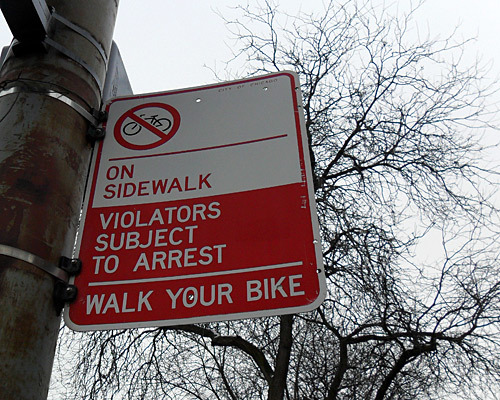
1. Beware of Bicycles: A lot of people on bicycles don’t know that they’re not supposed to ride them on the sidewalks and in crosswalks. They just don’t. To me, the hierarchy of the road goes Feet, Bicycles, and then Cars, but not everyone agrees with me. Keep this in mind. Also remember that sometimes cyclists are just trying to get away from speeding cars and out of harm’s way. Often the sidewalk is the only (somewhat) safe place to be.
2. Obey the Law: The laws for pedestrians are more clear-cut and better-known than those for bicycles. Follow them and keep yourself safe.
3. Stay Off the Roads Whenever Possible: Cars will kill you. They won’t mean to, but you’ll still be dead. Stay away whenever possible.
On a Bicycle:1. Assume You are Not Welcome: No matter what the signs or laws say, motorists do not want you on the road. Keep this in mind and ride accordingly. Obey the laws, observe the lanes, be aware, and keep in mind that they can kill you.
2. Do Not Switch Roles: If you cross in a crosswalk or “become a pedestrian” for any reason, do it for real: get off your bike and walk it. This simple move could save your life.
3. Respect the Pedestrians: Remember that in most cases, sidewalks are for walking. In areas of high pedestrian traffic, bicycles should react as such (see rule #1).
4. When in Doubt, Get off the Road and Walk.
In a Car:1. Assume Cyclists are Idiots: Give them as much leeway as you can manage. In a lot of cases, they know not what they do. Just treat all of them like the loose cannons some of them are, and remember that you can kill them with one misstep.
2. Slow Down: In most situations where you’re likely to meet a cyclist or a pedestrian in your car, you shouldn’t be going very fast. As a frequent pedestrian and cyclist, I find cars careening frighteningly fast through neighborhoods, near institutions with frequent and large pedestrian traffic, and cyclists in the mix as well. Slow down, especially in these cases.
3. Know the Law: Right of way is a lost art. In most cases, you’re the last in line, but will be yielded to by others (i.e., cyclists and pedestrians) because you’re driving a lethal weapon. Keep this in mind when you mingle with the unprotected.
——–
These few ideas don’t cover everything, but they do address a lot of the issues I’ve confronted trying to get from A to B on foot and wheels. Let’s keep an eye out and try to keep each other safe out there.
April 21, 2021
Seeds for Sense: A Top Five List
I was digging through an old notebook today, looking for some notes on my book-in-progress, The Medium Picture. Instead I found this Year-End Top-Ten List of ideas from 2003. I’d been thinking about a few core concepts that I always seem to return to, and I thought more of them were on here. I felt like I had a second imprinting between the end of my 20s and my mid-30s, but perhaps it wasn’t as tenacious as I thought.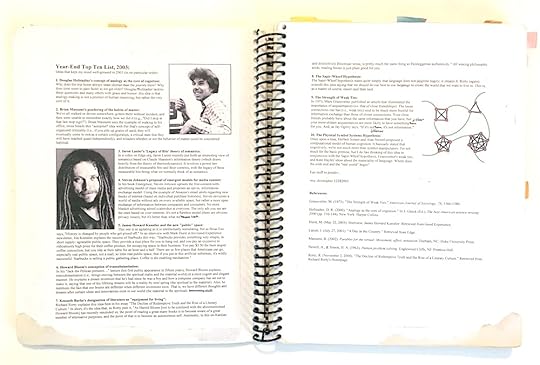
Imprinting, which could also be on this list, is the idea that at certain phases of life, we are more impressionable than at others, so the experiences we have during those times imprint us for life. The most common example is sexual imprinting during puberty as described by B.F. Skinner. That’s when we figure out what we find attractive in others, lovers, or potential mates. It can also happen with all sorts of other interests and tastes.
I went back to graduate school in my late 20s, and recently I thought I’d been returning to the concepts I learned then over and over. It turns out that while a few of those ideas have stuck around, several more have emerged in the meantime. I got sidetracked by these again. They’re all in the book anyway.
Here’s an updated top-five list:
1. The Essential Tension:I don’t remember when I came across this one, but I use it all the time. Thomas Kuhn, who gave us the idea of paradigm shifts, was a philosopher of science. His essential tension set out to explain the optimal spot for the advancement of scientific theory. That is, a taut spot between tradition and innovation. If your theory is too traditional, then you’re not adding anything to the field. If your theory is too innovative, then no one will know what you’re talking about. I’ve used it to explain everything from sampling in hip-hop to what it takes to get good writing done.
2. Boundary Objects:As posited by Susan Leigh Star and James R. Griesemer in 1989, boundary objects help translate differences between different communities or fields. Boundary objects can be “artifacts, documents, terms, concepts, and other forms of reification around which communities of practice can organize their interconnections” (p. 105). Star (1989) outlined a set of criteria for such objects as follows (the brief descriptions are my own):
Modularity: Something for everyone.Abstraction: Limits information to what is useful.Accommodation: Maintains usefulness for all.Standardization: No surprises.3. Structuration:The field of sociology has been pretty adept at studying how societies work and how individuals interact. It has been less successful at bridging the two. It’s a problem of things making since at the macro-scale and things making sense at the micro-scale but the two contradicting each other somewhere in between. It’s a problem of the bottom-up and the top-down not quite meeting in the middle. British sociologist Anthony Giddens set out to fix this with his theory of structuration. Structuration is the idea that a system’s parts amount to a whole system, that the trees and their attendant processes add up to a functioning forest. Giddens aimed to apply this idea to sociology thereby bridging the micro- (individuals or “agents”) and the macro- (society or “structure”) scales of his field. Structuration theory states that the actions of individuals culminate into social practices (from the bottom-up) and societal authority enforces rules and mores (from the top-down). The two form a feedback loop in the middle. For example, if someone breaks a rule, they might be reprimanded. If everyone breaks a rule, the rule gets adjusted. Through this ongoing process, society is constituted, a culture emerges.
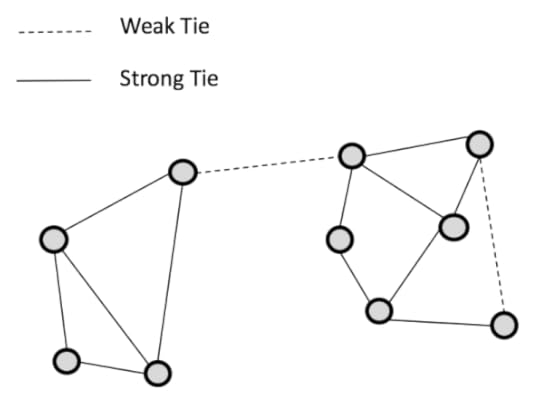
4. The Strength of Weak Ties:This was on the 2003 list, and still it persists. In 1973, Mark Granovetter published an article that illuminated the importance of acquaintances (vs. that of close friendships). The loose connections one has (i.e., weak ties) tend to be much more fruitful for information exchange than those of closer connections. Your close friends probably have about the same information that you have, but your more-distant acquaintances are more likely to have something different for you. And, as Jay Ogilvy once said, “If it’s not different, it’s not information.”
5. Affordance Theory:I know this one is worn down from use, but I’ll be damned if it isn’t worn for a reason. As developed by James J. Gibson, an affordance is a perceived use provided by the environment: chairs and tables support weight, handles are for holding, pulling, or pushing, etc. It’s one of those simple concepts that quickly gets complex as it is applied and is generative of other ideas—as the most interesting ideas are.
Ideas like these often seem like common sense, and though that seems like a bad thing, it’s actually a really good sign. The best theories are the ones that are latent in the everyday. Once we name them, we can better control them. Once they become a part of our vocabulary, we can better define our world.
References:
Gibson, James J. (1966). The Senses Considered as Perceptual Systems. London: Allen and Unwin.
Gibson, James J. (1979). The Ecological Approach to Visual Perception. Boston: Houghton-Mifflin Harcourt.
Granovetter, Mark. (1973). “The Strength of Weak Ties.” American Journal of Sociology, 78, 1360-1380.Kuhn, Thomas. (1977). The Essential Tension. New York: Routledge.
Skinner, B. F. (1938). The Behavior of Organisms. Cambridge, MA: B.F. Skinner Foundation.
Star, Susan Leigh (1989). The Structure of Ill-structured Solutions: Boundary Objects and Heterogenous Distributed Problem Solving. Working paper, Department of Information and Computer Science, University of California, Irvine.
Star, Susan Leigh & Griesemer, James R. (1989). Institutional Ecology, ‘Translations’ and Boundary Objects: Amateurs and Professionals in Berkeley’s Museum of Vertebrate Zoology, 1907-39. Social Studies of Science, 19: 387.
April 9, 2021
Spring Writing Round-Up
Substack is wack, so we’re trying a new platform.
For our test run of this new newsletter, I thought I’d round up all of the stuff I’ve published on various websites the last month or so. I’ve managed to get a few poems, short stories, a book excerpt, and even a collage published recently. You may have seen some of this, but chances are you haven’t seen all of it.
Here we go:
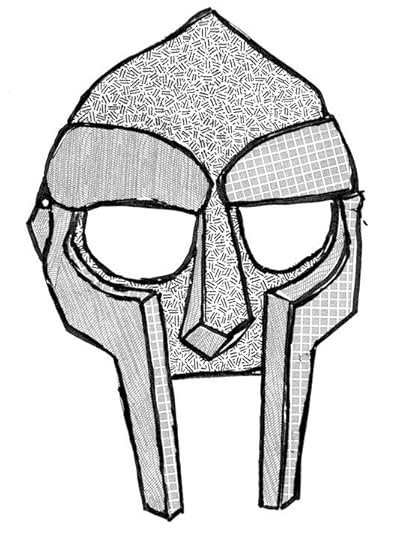
I have two poems in the April issue of Anti-Heroin Chic .My MF DOOM security-envelope collage (above) was featured in Shadows of Tomorrow: DRO CUP’s DARK SIDE OF THE DOOM Pink Floyd/DOOM Mash-up & Visual Album (MF DOOM Tribute) on The Witzard.I have a poem in the inaugural issue of Sledghammer Lit.Four new poems in Close to the Bone‘s March 4.4 showcase.My short story “Dutch,” about a band that doesn’t exist but is very real, is up on Revolution John .And an excerpt from my book-in-progress, Post-Self: Journeys Beyond the Human Body, is available on Malarkey Books .In addition, I sold my first piece of fiction last week! I have a short story called “Hayseed, Inc.” in Cinnabar Moth’s forthcoming Winter Anthology. I am now a professional maker-upper of stuff!
I’ll be back next time with something just for you next time. There’s so much more to come.
Hope you’re well,
-royc.
P.S. If you missed any of the old newsletters, I moved them all over here.
Mitch Hedberg: Different Ingredients
Sixteen years ago today, we lost one of the funniest voices and best visionaries humanity has ever given us. The odd-angled comedy of Mitch Hedberg remains unparalleled.
There’s no way to do him justice, but years ago I attempted to pay tribute to the man. This piece originally appeared on Vulture (née Splitsider) in 2013.
Deep in the desert of Death Valley, there sits a sleepy little resort called Panamint Springs. The cottages and modest restaurant there are a part of no town, connected to no power grid. For several years, the normally quiet cacti and climes were invaded once a year in the peak of heat for four days by a loose band of comedians and their friends. In the summer of 2005, there were seventy-three of us.
On June 5th, the Sunday night of this four-day party, comedian Emery Emery read a newspaper article about Pope John Paul II, but instead of the Pope’s name, he inserted fellow comedian Mitch Hedberg’s, both of whom had died only months before.
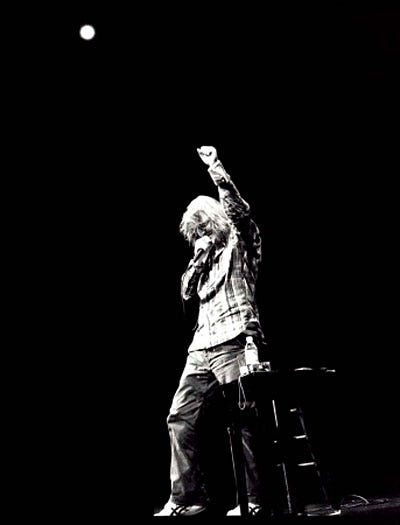 a.image2.image-link.image2-943-718 { padding-bottom: 131.25%; padding-bottom: min(131.25%, 942.375px); width: 100%; height: 0; } a.image2.image-link.image2-943-718 img { max-width: 718px; max-height: 942.375px; } Mitch Hedberg, 1968-2005
People wept and knelt on cobblestones as the news of his death spread across the square, bowing their heads to a man whose long and down-to-earth comedy was the only one that many young and middle-aged fans around the world remembered. For more than ten minutes, not long after his death was announced, the crowd simply applauded him...
“The world has lost a champion of human freedom and a good and faithful servant of God has been called home,” President Bush said at the White House. “Mitch Hedberg was himself an inspiration to millions of Americans and to so many more throughout the world.”
When Emery finished, he said that it’s sad that people know so much about people like the Pope and not enough about people like Mitch. To which fellow comedian and party-organizer Doug Stanhope replied, “But then we wouldn’t need Mitch.”
Then the power went out.
Then everyone there started chanting, “Mitch! Mitch! Mitch!...” and scattered throughout the darkness of the desert.
 a.image2.image-link.image2-484-714 { padding-bottom: 67.75%; padding-bottom: min(67.75%, 483.735px); width: 100%; height: 0; } a.image2.image-link.image2-484-714 img { max-width: 714px; max-height: 483.735px; }
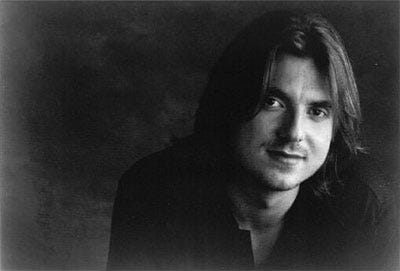
 Among the roster of beloved, recently deceased comedians—Patrice O’Neal, Mike DeStefano, and Greg Geraldo come immediately to mind—no one haunts us like Mitch Hedberg. He was a superstar in stand-up comedy when he died in late March of 2005. His widow, Lynn Shawcroft, was in attendance at the party in the desert shortly thereafter. Quoting one of his unused notebook pages, she asked me several times that week, “Do you believe in Gosh?”—a joke that later became the name of Mitch's one posthumous CD. Mitch’s laidback, sometimes self-conscious delivery and brain-backwards observations, as well as his propensity for constantly breaking character and the fourth wall of theatre, connected him to his audiences more directly than many other comedians of his time. He often reacted to his own jokes as if he were in the audience and commented on the audience’s reactions, stating that a joke was funnier than they acted, or that one joke was the same as another with "different ingredients.” Many of his shows were similar to those of a touring arena-rock band, where the audience sings along. His fans would wait for jokes that they were familiar with and yell out the punch lines as Mitch said them. Though his style was reminiscent of comedian Steven Wright, his humble and humane presence made him beloved by everyone who saw him.
Mitch’s former tour manager and friend Greg Chaille described a dream he had after Mitch’s death:
I dipped into a very deep sleep early this morning. I had a dream that I was riding in the back of a pickup with Mitch. I don’t remember who was driving but we were moving pretty good on a clear and sunny day. He was sitting on the driver’s side facing forward, and I was on the back wheel hump on the passenger side.
I just kept looking over at him thinking, “I knew he was still around.” He would just look over at me and smile a knowing smile, like “I know what I’m doing, it’s all okay. Everything is alright.”
I was so happy that Mitch was sitting across from me I started to cry. I reached over to hug him and then I woke up.
I was at a bar in Seattle called Lynda’s with Chaille and several other comedians on the two-year anniversary of Mitch’s passing, and we all went around the table telling our favorite Mitch jokes.
"Last week I helped a friend stay put,” started one comedian. “It's a lot easier than helping someone move. I just went over to his house and made sure that he did not start to load shit into a truck."
“I had my hair highlighted because I thought some strands were more important than others,” offered someone else.
"An escalator can never be broken, it can only become stairs,” added another. “Escalator temporarily stairs! Sorry for the convenience!" everyone finished in unison.
“I think Pringles original intention was to make tennis balls,” I chimed in, “but on the day the rubber was supposed to show up a truckload of potatoes came. Pringles is a laid back company, so they just said ‘fuck it, cut ‘em up!’”
During the blackout in the desert, Chaille built a bonfire in the campground across the road from the Panamint Springs resort. We all soon reconvened there, clumsily finding our way through the dark desert where Mitch’s spirit still lingered. Shortly after his death, comedians from all over the country gathered in Los Angeles to honor Mitch’s memory. “If I didn't get a chance to say hello,” friend and fellow comedian Doug Stanhope wrote on his website after the show, “it's because it was hard to talk.”
“If you would like to hear a loud tone, press 2. If not, leave a message.”
– Mitch's outgoing voicemail message.
When his CD Do You Believe in Gosh? was released in 2008, the “One Nation Under Gosh” shows celebrated Mitch in comedy clubs in Seattle, Cincinnati, Minneapolis, New York City, Hollywood, and Austin, proving that his spirit lives on on comedy stages nationwide.
 a.image2.image-link.image2-477-642 { padding-bottom: 74.25%; padding-bottom: min(74.25%, 476.685px); width: 100%; height: 0; } a.image2.image-link.image2-477-642 img { max-width: 642px; max-height: 476.685px; } Mitch Hedberg and Doug Stanhope, March 15, 2005.
“Nobody has asked me how Mitch lived,” Stanhope wrote of Mitch not long after his death. “And Mitch lived like a motherfucker. More than most any of us will live. That isn't sad or tragic. Mitch was the kind of comic that was funny even when nobody was looking. It wasn't just for the stage, the ego, or the random congratulations. He was funny when he was alone.” Doug told me that his phone had never rang like it did when Mitch died, every caller eager to find out about Mitch's demise.
“I don't know how Mitch died,” Stanhope concludes. “I know how Mitch lived, and he lived brilliantly and by his own rules. The number of years next to his name is trivia. The contents of those years is inspiration.” Here’s hoping his spirit continues to inspire, haunting our hearts and heads with laughter.
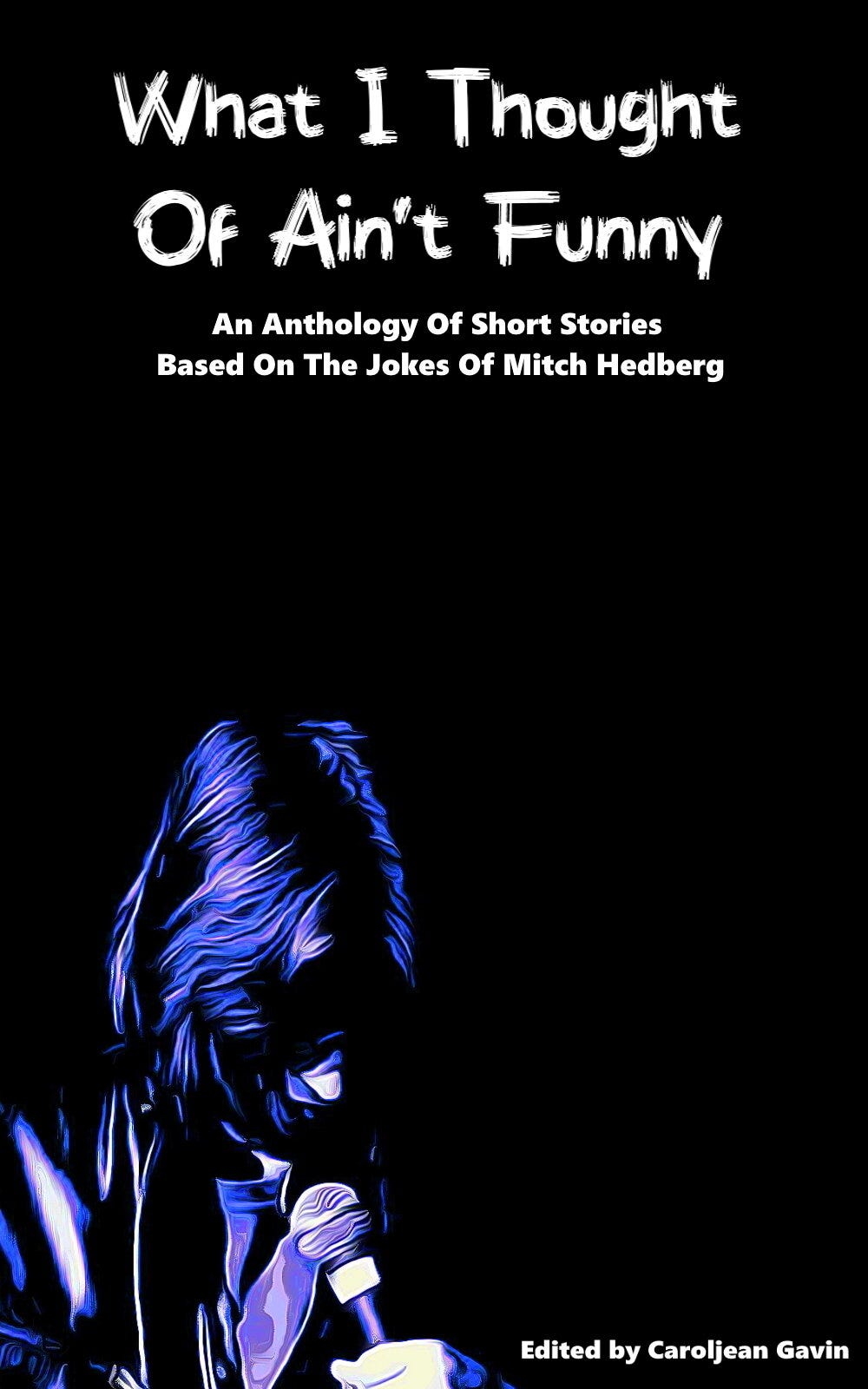
For more Hedberg-inspired reading, check out the Malarkey Books anthology, What I Thought of Ain’t Funny, edited by Caroljean Gavin: 17 short stories based on the jokes of Mitch Hedberg.
 a.image2.image-link.image2-1600-1000 { padding-bottom: 160%; padding-bottom: min(160%, 1600px); width: 100%; height: 0; } a.image2.image-link.image2-1600-1000 img { max-width: 1000px; max-height: 1600px; }
 Mitch Hedberg passed on March 29, 2005. Here’s to his humor and lasting memory.
Crash Worship: Examining the Wreckage
First up, a new online literature journal called Sledgehammer Lit launched today, and I have a poem up there! It’s called “San Diego,” and it will also be in my collection of poems coming out in July in Close to the Bone’s First Cut series of chapbooks. Check it out.
Next, the excerpt below is from my book-in-progress, Post-Self: Journeys Beyond the Human Body (Repeater Books, 2022). This bit went up on the Malarkey Books website last week, but I thought I’d share it with you here. It’s from Chapter 2, “Machine: The End of an Error.”
Planned as a short volume, Post-Self is an exploration of the human body and the ways it might be transcended. Possible escapes include machines, drugs, dreams, and death. Using extreme music and film as points of departure, it digs deep into the darkest thoughts of the most dissatisfied minds, minds that want to leave their bodies behind.
Enjoy!
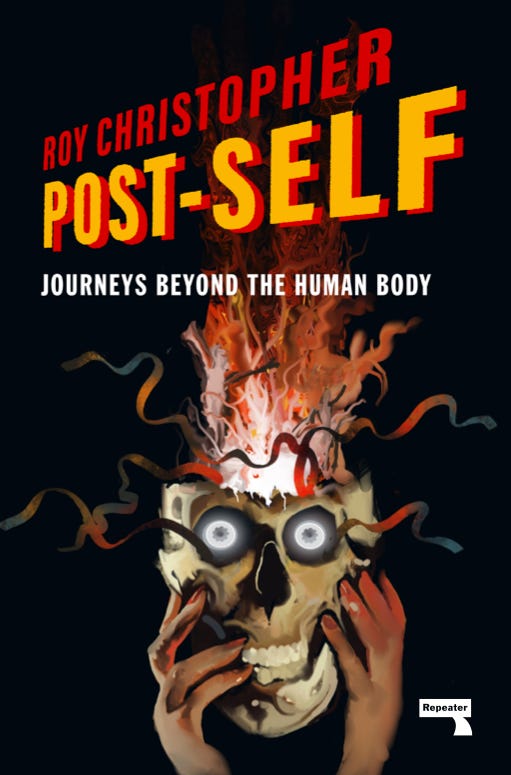 a.image2.image-link.image2-775-511 { padding-bottom: 151.66340508806263%; padding-bottom: min(151.66340508806263%, 775px); width: 100%; height: 0; } a.image2.image-link.image2-775-511 img { max-width: 511px; max-height: 775px; } Post-Self: Journeys Beyond the Human Body (Repeater Books, 2022). Cover by Johnny Bull.
“Nothing of us will survive. We will be killed not by the gun but by the glad-hand. We will be destroyed not by the rocket but by the automobile…”
— Ettil In Ray Bradbury’s “The Concrete Mixer”
“Hear the crushing steel
Feel the steering wheel”
— The Normal, “Warm Leatherette”
I ordered the seven-inch of Jawbox’s 1993 single, “Motorist,” as soon as I knew it was available. The lyrics, even for a Jawbox song, were striking. “Accidental, maybe,” ponders J. Robbins, “restraints too frayed to withhold me.”[i] Paul Virilio once wrote that whenever we invent a new technology, we also invent a new kind of accident.[ii] We might never again invent a technology that is so prone to accidents as we have with the automobile. Hearing Jawbox play “Motorist” live again reminded me of the wreckage of artifacts piled up in my head around the song.
Over Zach Borocas’ lurching beat and Kim Coletta’s chugging bass, as well as his and Bill Barbot’s dual, dueling guitar feedback, Robbins yells, “when you examined the wreck, what did you see? Glass everywhere and wheels still spinning free.” I remember immediately thinking of the 1973 J.G. Ballard novel, Crash. In the simplest of terms, Crash is about a group of people who fetishize car crashes. Most of them have been in actual accidents, but they also stage their own. They are sexually aroused by the impact as well as the aftermath, the energies and the injuries.
Though I hadn’t read it, I thought Robbins had. I found out recently that the song is actually about a car accident that happened in Chicago while Jawbox was on tour some 30 years ago. While back in town during the last night of the band’s 2019 summer reunion tour, Robbins told the story on stage at the Metro. In light of this new information, I’ve tried to rewire my interpretation of the song. In my head Jawbox’s “Motorist” remains connected to Ballard’s Crash.
Compare Robbins’ singing, “cracked gauges carry messages for me. Calls and responses you can't see” to Ballard writing, “In front of me the instrument panel had been buckled inwards, cracking the clock and speedometer dials. Sitting here in this deformed cabin, filled with dust and damp carpeting, I tried to visualize myself at the moment of collision, the failure of the technical relationship between my own body, the assumptions of the skin, and the engineering structure which supported it,” or “The wounds on my knees and chest were beacons tuned to a series of beckoning transmitters, carrying the signals, unknown to myself, which would unlock this immense stasis and free these drivers for the real destinations set for their vehicles, the paradises of the electric highway.”[i] This motorized mysticism, the idea that technology enables and endures unintended uses and conjures and communicates unintended messages runs parallel to the cult of the car. Scriptures superimposed on the roads. Messages, transmitters, signals, all performing a discourse of dread, a dialogue of deadly trauma.
Automobile-accident numbers are routinely trotted out in comparison to whatever disaster is threatening human lives at the time. Gun violence, viral plagues, and various cancers are all measured at least annually against the deaths we inflict driving these vehicles. As Zadie Smith writes in The Guardian, quoting Ballard himself, “Like the characters in Crash we are willing participants in what Ballard called ‘a pandemic cataclysm that kills hundreds of thousands of people each year and injures millions.’ The death-drive, Thanatos, is not what drivers secretly feel, it’s what driving explicitly is.”[iv] When we hear the statistics, we might worry for a second, noting those we know who’ve passed away on the road or been maimed by molded metal, but we soon continue our car-enabled commutes undeterred.
 a.image2.image-link.image2-670-1000 { padding-bottom: 67%; padding-bottom: min(67%, 670px); width: 100%; height: 0; } a.image2.image-link.image2-670-1000 img { max-width: 1000px; max-height: 670px; } Collage by Roy Christopher.
Death isn’t the only Freudian trope that these stories stir up. Sex is wound into the car accident as well, both as pornography and as intimacy. “When Ballard called Crash the first ‘pornographic novel about technology’,” Smith continues, “he referred not only to a certain kind of content but to pornography as an organizing principle…” We might not enjoy pornography or admit that we do, but we all understand it as a concept. It’s meaning is not a mystery. In Crash, it acts as a skewed skeuomorph. As Ballard writes, it is “as if the presence of the car mediated an element which alone made sense of the sexual act.”[v] And aren’t cars always already sexualized? The metaphor is close at hand: pistons and spark plugs, revving and thrusting, hands gripping curves and contours galore.
The jutting juxtaposition of body parts and auto parts and the blending of bodily fluids and engine oils might be more disturbing when thought of as intimacy than as pornography.[vi] “The real shock of Crash is not that people have sex in or near cars,” Smith writes, “but that technology has entered into even our most intimate human relations.” Consider the difference between the phrase “fucking the car” and “making love to the car.” It’s not the violence of the sex act but the intimate presence of technology there that chafes our sensibilities. It’s not the sexual appropriation of a mechanical contrivance but the emotional possibility of love that bothers us. “Traditional warnings against the evils of mediation reach an ironic zenith in this portrait of ‘the most terrifying casualty of the century: the death of affect’,”[vii] Dominic Pettman notes grimly. With sex and technology crammed together in this context, we can’t decide if it’s better or worse to care.
No matter how you feel about them, car-crashes and sexual encounters force one thing on everyone: exposure. From fender benders to total immobility, no one wants to get caught in the act, caught with their pants down, in flagrante delicto. Ballard himself described Crash as a forced look in the mirror. “You can see your reflection in the luminescent dash,” Daniel Miller sings on The Normal’s Crash-inspired track, “Warm Leatherette.”[viii] “Seduced reflection in the chrome,” Siouxsie Sioux adds on the Creatures’ Ballardian “Miss the Girl.”[ix] “New way to see what’s laid plain in front of me,” Robbins wails on “Motorist.” “Nothing better than a look at what I shouldn’t see.”
No one wants to get caught with their body thrown clear at odd angles, the contents of their car strewn, the whole of their very lives lying limp on the pavement. Every illicit tryst implies its own exit strategy. On “Motorist,” Robbins concludes, “Turn your back, just drive on past, because nothing is better than getting out fast.”
Look hard and then look away. The fastest car is the getaway.
Uncanny Cartographies
It’s been over a decade. A decade without Ballard. It should be more noticeable. Like filling an empty pool with emptiness, to paraphrase China Miéville.[x] A void of perspective, crumbling and gaping at our heels. Everyone should feel it. It goes without saying, but I’ll say it anyway: This is the way, step inside.
His work has been translated to the screen by directors with styles as varied as Steven Spielberg (Empire of the Sun) and David Cronenberg (Crash). He was interviewed by countless talented writers, including Jon Savage, V. Vale, Will Self, Richard Kadrey, John Gray, Simon Sellars, and Mark Dery. His influence is found in sound from Joy Division, The Jesus and Mary Chain, Sisters of Mercy, K.K. Null, and Gary Numan to Madonna, Radiohead, Trevor Horn, Cadence Weapon, and Danny Brown, as well as the aforementioned Creatures and The Normal. His writing and thinking are broad enough to elude categories and focused enough to remain absolutely singular. His work gerrymanders genre distinctions, defining and defying its own boundaries as it goes. I think of him in the same way I think of Octavia E. Butler, Thomas Pynchon, Don DeLillo, and Samuel R. Delany: as giants beyond genre.
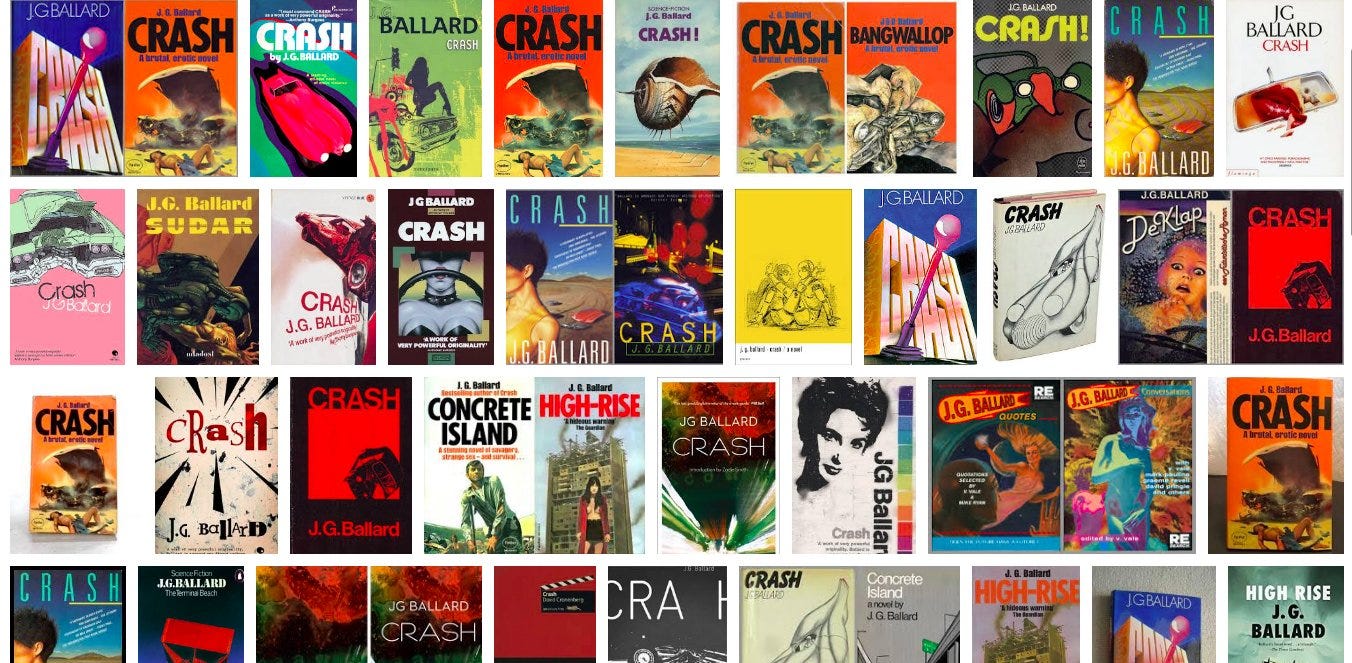 a.image2.image-link.image2-663-1352 { padding-bottom: 49.03846153846153%; padding-bottom: min(49.03846153846153%, 663px); width: 100%; height: 0; } a.image2.image-link.image2-663-1352 img { max-width: 1352px; max-height: 663px; } Various Ballard Crash covers.
“I suppose we are moving into a realm where inner space is no longer just inside our skulls but is in the terrain we see around us in everyday life,” Ballard said in 1974:
We are moving into a world where the elements of fiction are that world—and by fiction I mean anything invented to serve imaginative ends, whether it is invented by an advertising agency, a politician, an airline, or what have you. These elements have now crowded out the old-fashioned elements of reality.[xi]
Since then a lot of mental offloading and cognitive outsourcing has occurred, our inner thoughts texture-mapped onto every surface. In that meantime some of Ballard’s children have emerged in mongrel forms and curtained corners of mass media. Think Wild Palms or Jackass or the ever-blurring lines between reality and show, news and entertainment. “It’s not news,” he wrote, “it’s entertainment news. A documentary on brain surgery is about entertainment brain surgery.” Inversely, Ballard collaged and kludged together the sets of his own Atrocity Exhibition out of internal organs: “[T]he nervous systems of the characters have been externalized, as part of the reversal of the interior and exterior worlds. Highways, office blocks, faces, and street signs are perceived as if they were elements in a malfunctioning central nervous system.”[xii] Michel de Certeau once wrote, “books are only metaphors of the body.”[xiii] Ballard often seemed to be crash-testing that idea.
The transmedia spread of everted inner space is nowhere more evident than on the internet. William Gibson said as much in his novel Spook Country.[xiv] Michel de Certeau wrote elsewhere, “what the map cuts up, the story cuts across.”[xv] These are maps of different terrain and stories of a different cut. As Simon Sellars points out, unlike the cyberpunks who followed him, Ballard’s maps of these near futures weren’t as celebratory as they were cautionary: Dangerous Curves Ahead. Slow Down.[xvi]
Post-Self will be out on Repeater Books in March of 2022.[i] J. Robbins, “Motorist.” On “Motorist” b/w “Jackpot Plus” [7” single]. Recorded by Jawbox. Washington, DC: Dischord Records, 1993.
[ii] Paul Virilo, “The Museum of Accidents,” trans. Chris Turner, International Journal of Baudrillard Studies 3, no. 2, 2006.
[iii] J.G. Ballard, Crash: A Novel. London: Jonathan Cape, 1973, p. 68; 44.
[iv] Zadie Smith, “Sex and Wheels: Zadie Smith on J.G. Ballard’s Crash.” The Guardian, July 4, 2014.
[v] Ballard, 1973, p. xii.
[vi] For examples regarding David Cronenberg’s 1996 film adaptation, see Martin Barker, Jane Arthurs & Ramaswami Harindranath, The Crash Controversy: Censorship Campaigns and Film Reception. London: Wallflower Press, 2001.
[vii] Dominic Pettman, After the Orgy: Toward a Politics of Exhaustion, New York: SUNY Press, 2002, p. 80. Pettman is quoting from Andrea Juno, 1984.
[viii] Daniel Miller, “T.V.O.D.” b/w “Warm Leatherette” [7” single]. Recorded by The Normal. London: Mute Records, 1978. Daniel Miller and a friend had written a screenplay based on Ballards’ Crash. When they couldn’t get it made, Miller condensed it into the song “Warm Leatherette.” Of course, this single, as auspicious as it turned out to be, was made much more popular by Grace Jones when she covered it in 1980.
[ix] Siouxsie Sioux & Budgie, “Miss the Girl” b/w “Hot Springs in the Snow” [7” single]. Recorded by The Creatures. London: Wonderland, 1983.
[x] China Miéville. (2008). Introduction. In J. G. Ballard, Miracles of Life: Shanghai to Shepperton, an Autobiography. New York: Liveright, pp. ix-xiv.
[xi] Quoted in J. G. Ballard. (2012). Extreme Metaphors: Collected Interviews. Simon Sellars & Dan O’Hara, Eds. London: Fourth Estate, p. 62; see also Ballard (1985), Crash: A Novel. New York: Vintage, p. 4-5.
[xii] J. G. Ballard. (1970). The Atrocity Exhibition. London: Jonathan Cape, p. 76.
[xiii] Michel de Certeau. (1984). The Practice of Everyday Life. Berkeley, CA: University of California Press, p. 140.
[xiv] William Gibson. (2007). Spook Country. New York: Putnam, pp. 63-64.
[xv] de Certeau, 1984, p. 129.
[xvi] Simon Sellars. (2018). Applied Ballardianism: Memoir from a Parallel Universe. Falmouth, UK: Urbanomic.
Dead Precedents: How Hip-Hop Defines the Future
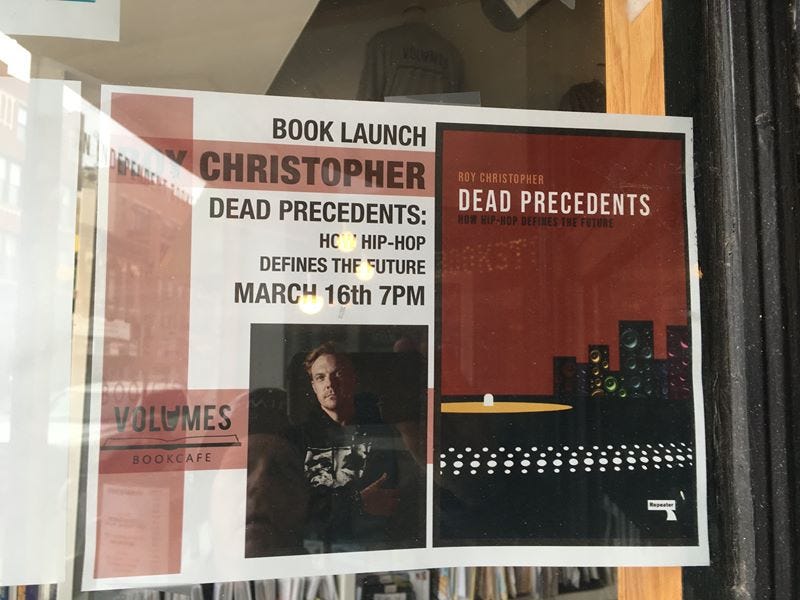
This week marks the two-year anniversary of the publication of my book Dead Precedents: How Hip-Hop Defines the Future from Repeater Books! In celebration, here are some pictures from the book’s release, the Preface from the text, and some information on a related forthcoming project. Enjoy!
 a.image2.image-link.image2-600-800 { padding-bottom: 75%; padding-bottom: min(75%, 600px); width: 100%; height: 0; } a.image2.image-link.image2-600-800 img { max-width: 800px; max-height: 600px; }
 We launched Dead Precedents properly at Volumes Bookcafé in Chicago with readings by me, Krista Franklin, and Ytasha Womack.
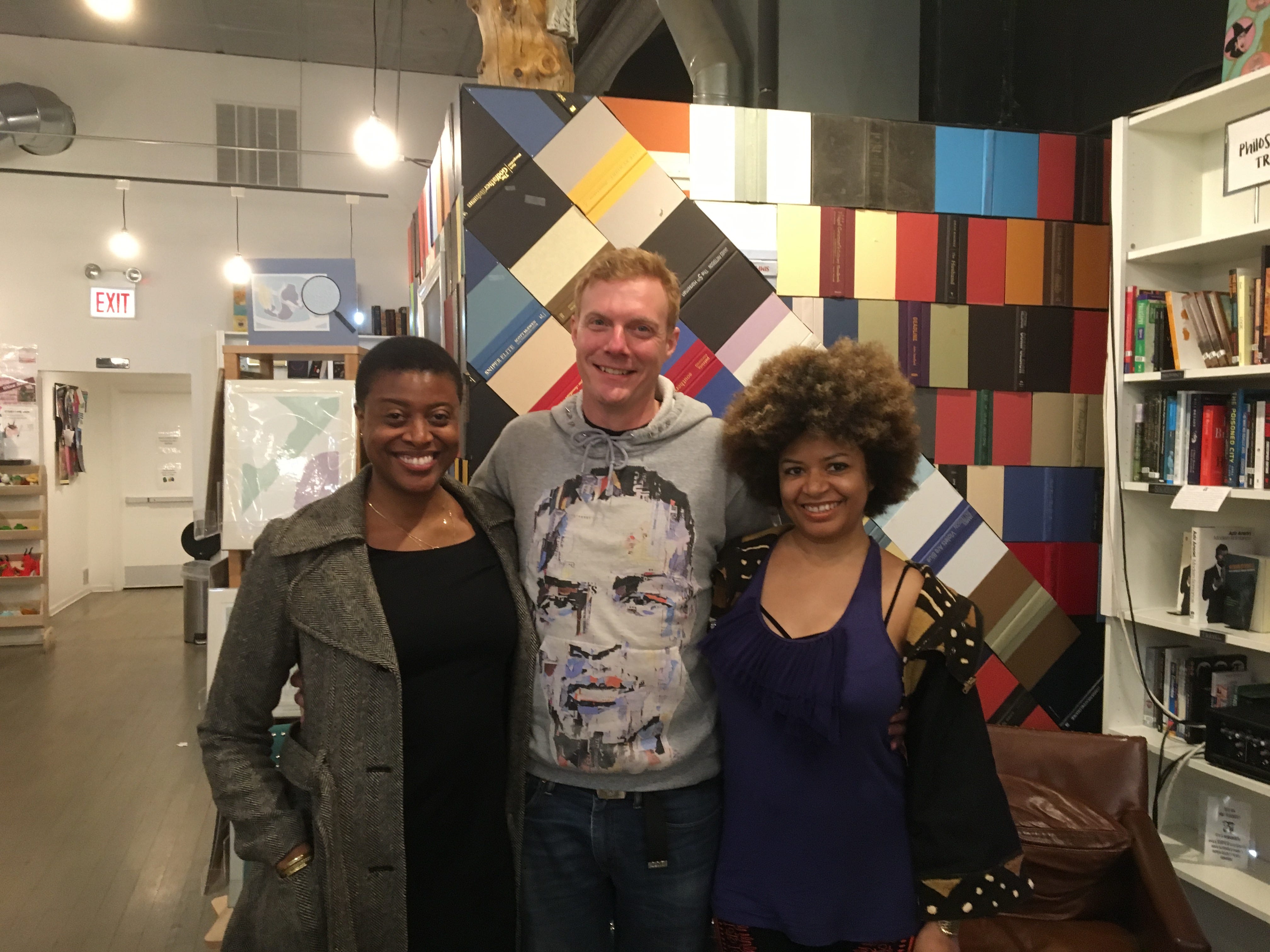 a.image2.image-link.image2-1092-1456 { padding-bottom: 75%; padding-bottom: min(75%, 1092px); width: 100%; height: 0; } a.image2.image-link.image2-1092-1456 img { max-width: 1456px; max-height: 1092px; } Krista Franklin, me, and Ytasha Womack. Photo by Lily Brewer.
Ytasha and I went on to do a talk at the Seminary Co-op in Hyde Park, and I spoke at SXSW again, this time specifically about the ideas in Dead Precedents.
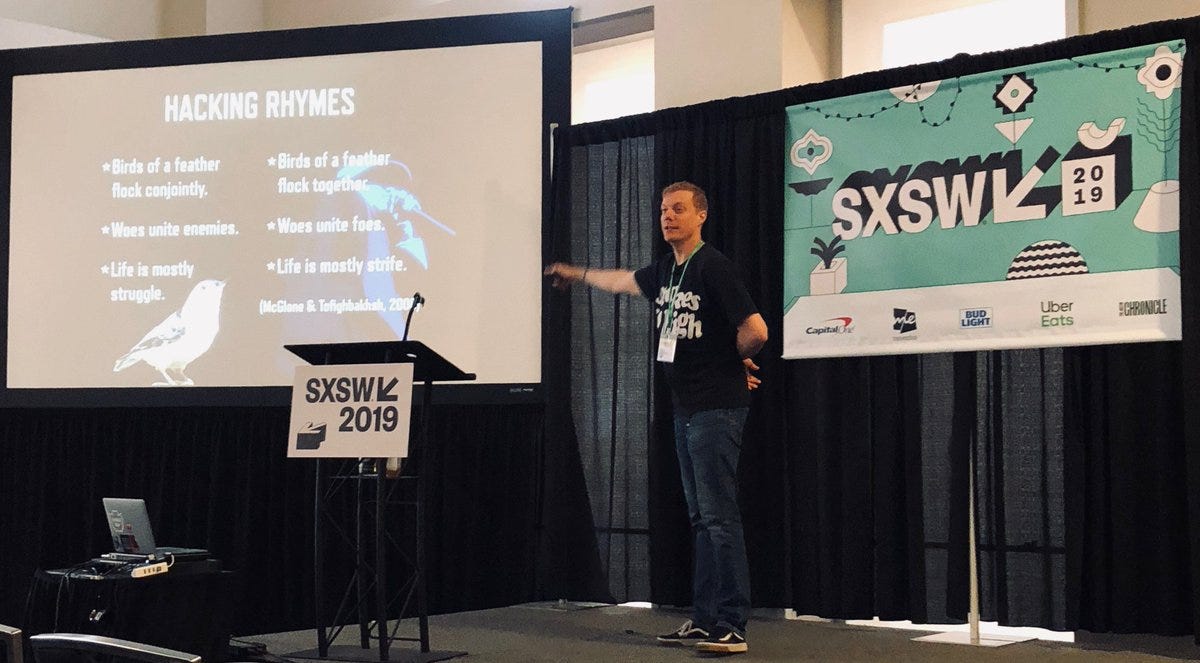 a.image2.image-link.image2-663-1200 { padding-bottom: 55.25%; padding-bottom: min(55.25%, 663px); width: 100%; height: 0; } a.image2.image-link.image2-663-1200 img { max-width: 1200px; max-height: 663px; } Talkin’ beaks and rhymes at SXSW. Photo by Matt Stephenson.
 a.image2.image-link.image2-600-800 { padding-bottom: 75%; padding-bottom: min(75%, 600px); width: 100%; height: 0; } a.image2.image-link.image2-600-800 img { max-width: 800px; max-height: 600px; } As Pecos B. Jett called it, “Biz Marquee!“
A couple of months later, I ventured to my adopted home in the Pacific Northwest. I got to speak at Powell’s City of Books in Portland with Pecos B. Jett. I was even on TV!
Next up was a fun chat at the Elliott Bay Book Company in Seattle with Charles Mudede.
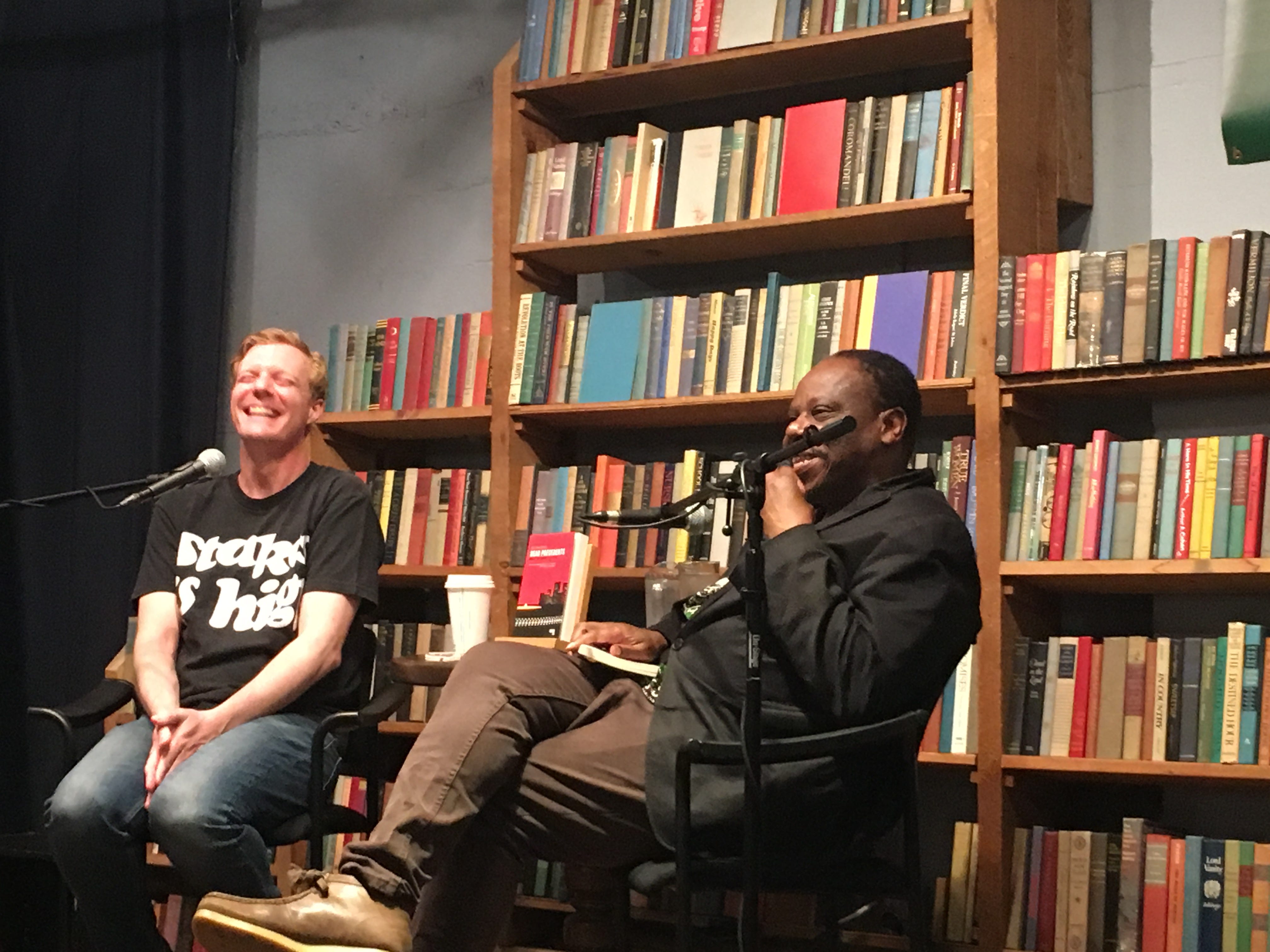 a.image2.image-link.image2-1092-1456 { padding-bottom: 75%; padding-bottom: min(75%, 1092px); width: 100%; height: 0; } a.image2.image-link.image2-1092-1456 img { max-width: 1456px; max-height: 1092px; } Me and Charles Mudede yuckin’ it up at Elliott Bay. Photo by Lily Brewer.
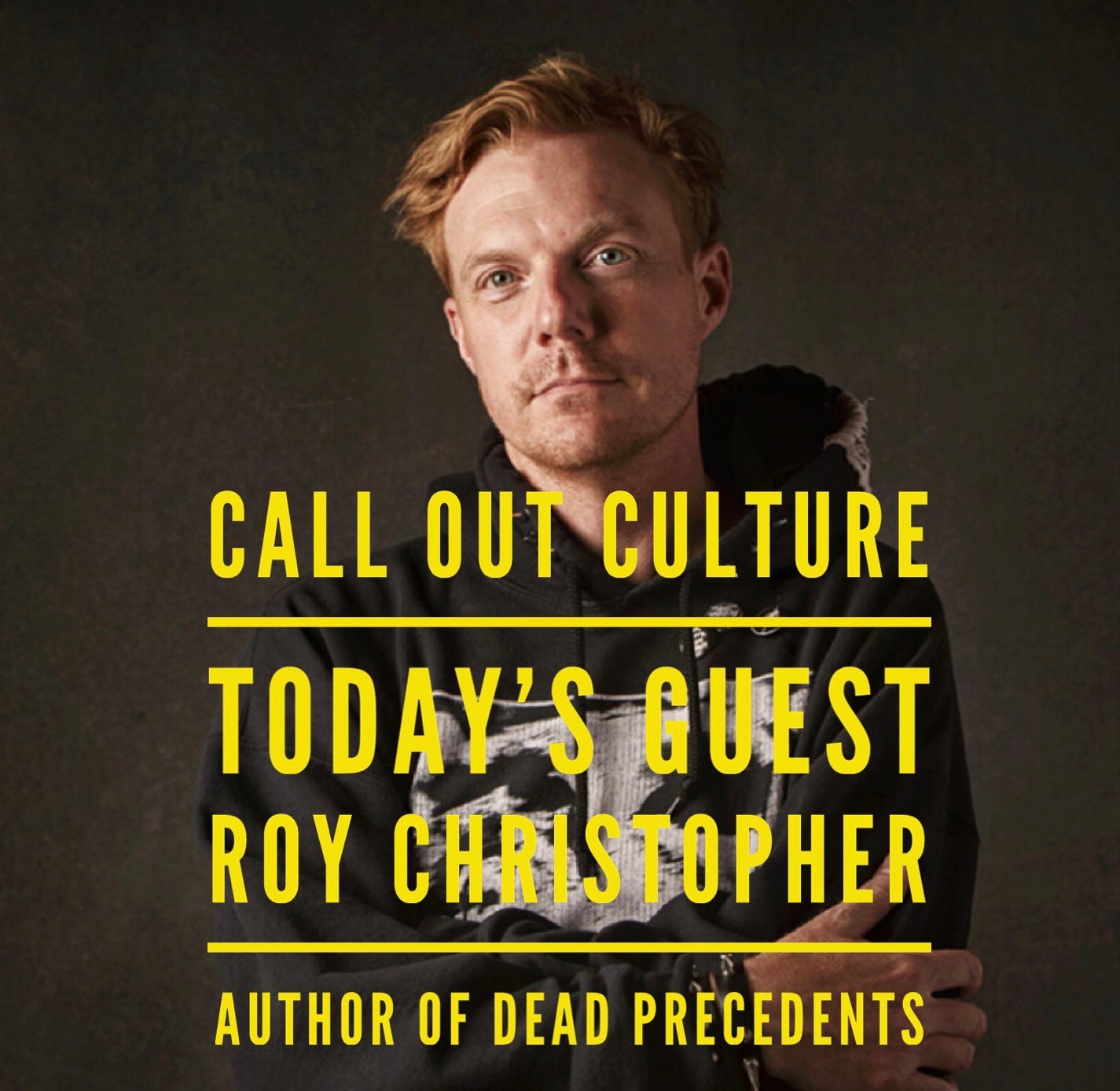
I was also on my favorite Hip-hop podcast, Call Out Culture with my mans Alaska, Zilla Rocca, and Curly Castro.
 a.image2.image-link.image2-1388-1425 { padding-bottom: 97.40350877192982%; padding-bottom: min(97.40350877192982%, 1388px); width: 100%; height: 0; } a.image2.image-link.image2-1388-1425 img { max-width: 1425px; max-height: 1388px; }
 I know Amazon is wack, but Dead Precedents was also a #1 New Release in both their Rap Music and Music History & Criticism categories.
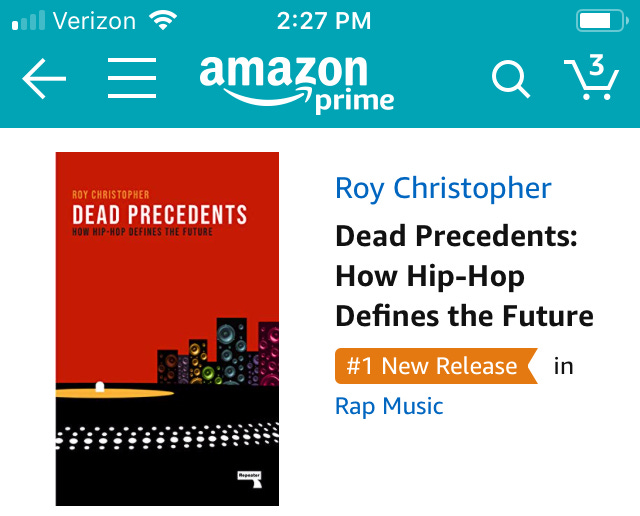 a.image2.image-link.image2-516-640 { padding-bottom: 80.625%; padding-bottom: min(80.625%, 516px); width: 100%; height: 0; } a.image2.image-link.image2-516-640 img { max-width: 640px; max-height: 516px; } Take that, Beastie Boys Book!
Many thanks to all the people who bought the book, said nice things about it, came out to hear me talk about it, gave me rides, put me up at your home, or spread the word. There are too many people I owe to list here, but I appreciate all of you who have supported me and this book in any way.
If you’re interested in more about hip-hop, cyberpunk, and Afrofuturism, a bunch of my friends and colleagues and I have put together a new book called Boogie Down Predictions: Hip-Hop, Time, and Afrofuturism.
“How does hip-hop fold, spindle, or mutilate time?” Harry Allen, Hip-Hop Activist and Media Assassin asks. “In what ways does it treat technology as, merely, a foil? Are its notions of the future tensed…or are they tenseless? For Boogie Down Predictions, Roy Christopher's trenchant anthology, he's assembled a cluster of curious interlocutors. Here, in their hands, the culture has been intently examined, as though studying for microfractures in a fusion reactor. The result may not only be one of the most unique collections on hip-hop yet produced, but, even more, and of maximum value, a novel set of questions.”
 a.image2.image-link.image2-783-1456 { padding-bottom: 53.777472527472526%; padding-bottom: min(53.777472527472526%, 783px); width: 100%; height: 0; } a.image2.image-link.image2-783-1456 img { max-width: 1456px; max-height: 783px; } Art by Edwin Pouncey a.k.a. Savage Pencil.
Boogie Down Predictions comes out in October from Strange Attractor Press. You can preorder it now though!
What follows is the brief essay that serves as the Preface to Dead Precedents. If you don’t know, now you know.
“Space, that endless series of speculations and origins — of rebirths and electric spankings — is here not so much a metaphor as it is a series of fragmented selves, a place of possibilities and debris and explorations and atmosphere.”
— Kevin Young, The Grey Album: On the Blackness of Blackness
“Let us imagine these hip-hop principles as a blueprint for social resistance and affirmation: create sustain- ing narratives, accumulate them, layer, embellish, and transform them.”
— Tricia Rose, Black Noise: Rap Music and Black Culture in Contemporary America
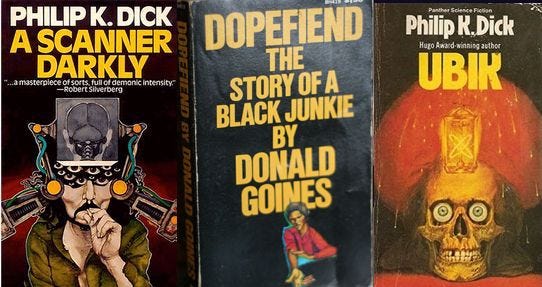
Several years ago, on one of my online profiles under “books” I listed only Donald Goines and Philip K. Dick. If you don’t know them, Donald Goines wrote about himself and his associates and their struggles as street hustlers, pimps, players, and dopefiends. Philip K. Dick wrote about the brittleness of reality, its wavy, funhouse perceptions through drugs and dreams. Goines wrote sixteen books in five years and Dick wrote forty-four in thirty. Both were heavy users of mind-altering substances (heroin and amphetamines, respectively), and both helped redefine the genres in which they wrote. They interrogated the nature of human identity, one through the inner city and the other through inner space.
 a.image2.image-link.image2-374-706 { padding-bottom: 52.952029520295206%; padding-bottom: min(52.952029520295206%, 373.84132841328415px); width: 100%; height: 0; } a.image2.image-link.image2-374-706 img { max-width: 706px; max-height: 373.84132841328415px; }
 While I am certainly a fan of both authors, I posted them together on my profile as kind of a gag. I thought their juxtaposition was weird enough to spark questions if you were familiar with their work, and if you weren’t, it wouldn’t matter. I had no idea that I would be writing about the overlapping layers of their legacies so many years later.
To retrofit a description, one could say that Goines’ books are gangster-rap literature. They’re referenced in rap songs by everyone from Tupac and Ice-T to Ludacris and Nas. In many instances, Dick’s work could be called proto- cyberpunk. The Philip K. Dick Award was launched the year after he died, and two of the first three were awarded to the premiere novels of cyberpunk: Software by Rudy Rucker in 1983 and Neuromancer by William Gibson in 1985.
[Ed note: If you’re interested, wrote a bit about the connections between hip-hop and literature for Literary Hub for the book’s release.]
When cyberpunk and hip-hop were both entering their Golden Age, I was in high school. One day I was walking up my friend Thomas Durdin’s driveway. By the volume of the AC/DC sample that forms the backbone of Boogie Down Productions’ “Dope Beat,” I knew his mom wasn’t home. Along with the decibel level, I was also struck by how the uncanny pairing of Australian hard rock and New York street slang sounded. It was gritty. It was brash. It rocked. De La Soul’s 1996 record, Stakes is High, opens with the question, “Where were you when you first heard Criminal Minded?” That moment was a door opening to a new world.
I didn’t realize it then, but that new world was the twenty- first century, and hip-hop was its blueprint.
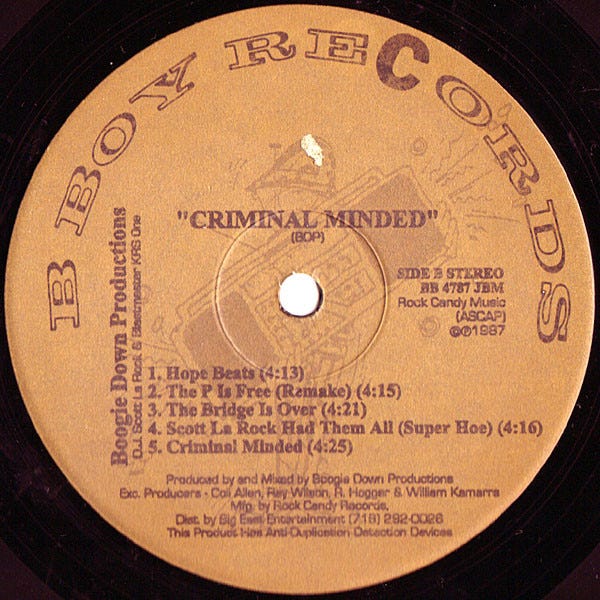 a.image2.image-link.image2-712-712 { padding-bottom: 100%; padding-bottom: min(100%, 712px); width: 100%; height: 0; } a.image2.image-link.image2-712-712 img { max-width: 712px; max-height: 712px; } Boogie Down Productions Criminal Minded, side B, track 1: “Hope Beats.”
I distinctly remember that the label on the record spinning around on Thomas’s turntable incorrectly named the song “Hope Beats.” An interesting mistake given that DJ Scott La Rock was killed just months after the record came out, prompting KRS-One to start the Stop the Violence movement. Where Criminal Minded is often cited as a forerunner of gangster rap, KRS-One was thereafter dedicated to peace. I’d heard hip-hop before, but the unfamiliar familiarity of the “Back in Black” guitar samples in that song make that particular day stick in my head.
Long before hip-hop went digital, mixtapes—those floppy discs of the boombox and car stereo—facilitated the spread of underground music. The first time I heard hip-hop, it was on such a tape. Hiss and pop were as much a part of the experience of those mixes as the scratching and rapping. We didn’t even know what to call it, but we stayed up late to listen. We copied and traded those tapes until they were barely listenable. As soon as I figured out how, I started making my own. We watched hip-hop go from those scratchy mixtapes to compact discs to shiny-suit videos on MTV, from Fab 5 Freddy to Public Enemy to P. Diddy, from Run-DMC to N.W.A. to Notorious B.I.G. Others lost interest along the way. I never did.
A lot of people all over the world heard those early tapes and were impacted as well. Having spread from New York City to parts unknown, hip-hop became a global phenomenon. Every school has aspiring emcees, rapping to beats banged out on lunchroom tables. Every city has kids rhyming on the corner, trying to outdo each other with adept attacks and clever comebacks. The cipher circles the planet. In a lot of other places, hip-hop culture is American culture.
Though their roots go back much further, the subcultures of hip-hop and cyberpunk emerged in the mass mind during the 1980s. Sometimes they’re both self-consciously of the era, but digging through their artifacts and narratives, we will see the seeds of our times sprouting. We will view hip-hop not only as a genre of music and a vibrant subculture but also as a set of cultural practices that transcend both of those. We will explore cyberpunk not only as a subgenre of science fiction but also as the rise of computer culture, the tectonic shifting of all things to digital forms and formats, and the making and hacking thereof. If we take hip-hop as a community of practice, then its cultural practices inform the new century in new ways. “I didn’t see a subculture,” Rammellzee once said, “I saw a culture in development.”
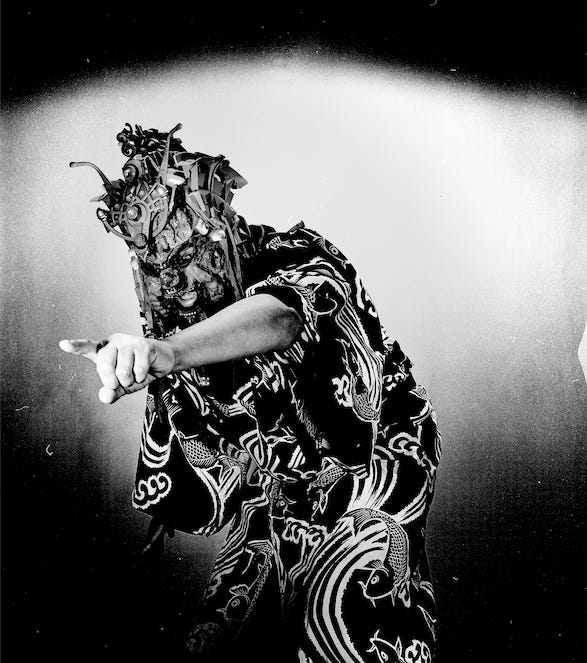 a.image2.image-link.image2-797-705 { padding-bottom: 112.94718909710393%; padding-bottom: min(112.94718909710393%, 796.2776831345826px); width: 100%; height: 0; } a.image2.image-link.image2-797-705 img { max-width: 705px; max-height: 796.2776831345826px; } The Equation: RAMMELLZEE. Photo by Timothy Saccenti.
The subtitle of this book could just as easily be “How Hip-Hop Defies the Future.” As one of hip-hop culture’s pioneers, Grandmaster Caz, is fond of saying, “Hip-hop didn’t invent anything. Hip-hop reinvented everything.” To establish this foundation, we will start with a few views of hip-hop culture (Endangered Theses), followed by a brief look at the origins of cyberpunk and hip-hop (Margin Prophets). We will then look at four specific areas of hip-hop music: recording, archiving, sampling, and intertextuality (Fruit of the Loot); the appropriating of pop culture and hacking of language (Spoken Windows); and graffiti and other visual aspects of the culture (The Process of Illumination). From there we will go ghost hunting through the willful haunting of hip-hop and cyberculture (Let Bygones Be Icons). All of this in the service of remapping hip-hop’s spread from around the way to around the world and what that means for the culture of the now and the future (Return to Cinder).
The aim of this book is to illustrate how hip-hop culture defines twenty-first-century culture. With its infinitely recombinant and revisable history, the music represents futures without pasts. The heroes of this book are the architects of those futures: emcees, DJs, poets, artists, writers. If they didn’t invent anything but reinvented everything, then that everything is where we live now. Forget what you know about time and causation. This is a new fossil record with all new futures.
It’s a wild ride! You can find out more about Dead Precedents on my website.
As always, thanks for reading, responding, and sharing.
Hope you’re well,
-royc.