David Allan Hamilton's Blog, page 11
February 5, 2021
Write A Novel In 3 Days? Madness...
[image error] Michael Moorcock has written tons of stories in multiple genres. When he writes, he can crank out a new draft in a few days. A few days?!? What kind of voodoo sorcery is this, you ask?
Moorcock's standard approach may look quite familiar to those of us who plot. Here's an outline of his basic approach:
1. Plan and prepare before you start: characters, settings, themes, possible plot developments. This is no time to be a "pantser". Planning is key.
2. Make your plot a Quest: It's the most popular, time-tested and versatile plot there is. Yhat our hero is looking for something. Your villain is too. Grab a sidekick and go on that quest. It’s a race against time to see who’ll get there first. Watch Star Wars A New Hope, Indiana Jones, or any Michael Bay movie to see how it works.
3. Make something happen every few pages: Divide the action up into four sections and then divide those four sections up into six chapters. At the end of each section, throw in a plot twist - a big surprise.
4. Make a list of some images to use: These will keep the literary types happy. Think about setting, signage, creatures, common themes. Go through your list and drop these in to your writing as you go.
5. Prepare an overall structure: This is the framework for your story. I use a roadmap to guide me from one section/scene to the next. The key here is: know where your story is going. Remember, no pantsing.
6. Think about the timing of the story’s events: From start to finish, how long will your story take? Know that before you begin, then make sure to divide up your framework accordingly. Start with a mystery - something strange happening to your hero, then every time she solves that one, a new one appears. This is the basis of the quest.
Once he's mapped out a story like this, he thinks about it in his mind, validates it with others, and then prepares for a 3 day writeathon. The ability to write well and write quickly takes practice, but I've seen it in my own writing which started off at a snail's pace, but recently has picked up. When I'm writing, I can write about 10,000 - 12,000 words per week, so it still takes a couple months to finish a draft, but that's better than taking a year.
Moorcock's standard approach may look quite familiar to those of us who plot. Here's an outline of his basic approach:
1. Plan and prepare before you start: characters, settings, themes, possible plot developments. This is no time to be a "pantser". Planning is key.
2. Make your plot a Quest: It's the most popular, time-tested and versatile plot there is. Yhat our hero is looking for something. Your villain is too. Grab a sidekick and go on that quest. It’s a race against time to see who’ll get there first. Watch Star Wars A New Hope, Indiana Jones, or any Michael Bay movie to see how it works.
3. Make something happen every few pages: Divide the action up into four sections and then divide those four sections up into six chapters. At the end of each section, throw in a plot twist - a big surprise.
4. Make a list of some images to use: These will keep the literary types happy. Think about setting, signage, creatures, common themes. Go through your list and drop these in to your writing as you go.
5. Prepare an overall structure: This is the framework for your story. I use a roadmap to guide me from one section/scene to the next. The key here is: know where your story is going. Remember, no pantsing.
6. Think about the timing of the story’s events: From start to finish, how long will your story take? Know that before you begin, then make sure to divide up your framework accordingly. Start with a mystery - something strange happening to your hero, then every time she solves that one, a new one appears. This is the basis of the quest.
Once he's mapped out a story like this, he thinks about it in his mind, validates it with others, and then prepares for a 3 day writeathon. The ability to write well and write quickly takes practice, but I've seen it in my own writing which started off at a snail's pace, but recently has picked up. When I'm writing, I can write about 10,000 - 12,000 words per week, so it still takes a couple months to finish a draft, but that's better than taking a year.


February 4, 2021
Writing Problems From The Trenches #1
I’m having trouble writing my novel.
How long have you practiced?
About 15 minutes.
It might take a little longer than that to learn how to write a novel. It might take months or years.
Still, I want to write better. I don’t want to write a book that doesn’t sell.
Not even one?
I need to write a novel that’s never been done before. Something completely unique.
Is that what your audience wants from you?
I don't know, but that’s what my inner muse is telling me. I don’t want to write like everyone else.
I see.
I want to write a best-seller based on my awesome, unique approach to storytelling, like Game of Thrones except with monkey tribes and killer snakes.
You can’t.
Don’t tell me George R.R. Martin is the only one who can find a huge audience for this sort of story.
He might be.
But that’s my authentic novel-writing mission. To have best-sellers and win prizes and get TV deals by writing GoT with monkeys and other critters.
There’s no promise that the world cares about your mission.
How long have you practiced?
About 15 minutes.
It might take a little longer than that to learn how to write a novel. It might take months or years.
Still, I want to write better. I don’t want to write a book that doesn’t sell.
Not even one?
I need to write a novel that’s never been done before. Something completely unique.
Is that what your audience wants from you?
I don't know, but that’s what my inner muse is telling me. I don’t want to write like everyone else.
I see.
I want to write a best-seller based on my awesome, unique approach to storytelling, like Game of Thrones except with monkey tribes and killer snakes.
You can’t.
Don’t tell me George R.R. Martin is the only one who can find a huge audience for this sort of story.
He might be.
But that’s my authentic novel-writing mission. To have best-sellers and win prizes and get TV deals by writing GoT with monkeys and other critters.
There’s no promise that the world cares about your mission.
February 3, 2021
If You Really Want To Be A Writer, What's Stopping You?
This is not a trick question.
I know a lot of people -- and I imagine you do too -- who want to be a professional writer more than anything else but never seem to actually write much. Worse, many of these same people claim to be writers, but don't really do much writing.
Why is that?
Well, certainly fear is a driver. The fear of not being good enough. The fear of putting in hours on a novel only to have no sales. The fear of being judged, ridiculed, or worse, ignored.
We look for guarantees. "Follow this process, and you will succeed." Now, there's something to be said about learning how to structure a good story, and reading how-to books and watching YouTube videos on writing can't hurt, but the truth is there are no guarantees. And fear in the form of the Lizard Brain strikes again.
Above all else, a writer must write. Do, then be. Write to become a writer. Teach to become a teacher. Not the other way around. It is in the act of doing, honouring the creative process, that moves us from wishing to becoming.
The key, therefore, is to drop all notions that you can control the outcome. Your first novel might be (objectively) really bad for a lot of reasons. Mine certainly was. But I couldn't become better at writing without going through that first step. Do, then be.
If what's stopping you from writing is a fear of what the outcome will be (sales, getting picked, validation) then you cannot ever be fully present in the act of writing. So write often, write a lot, write crap, write a journal, write a blog, write a letter to a friend. Practice writing over and over, not because you hope you'll create a best-seller, but because you become more than what you think you are by simply going through the process. Focus on that.
I know a lot of people -- and I imagine you do too -- who want to be a professional writer more than anything else but never seem to actually write much. Worse, many of these same people claim to be writers, but don't really do much writing.
Why is that?
Well, certainly fear is a driver. The fear of not being good enough. The fear of putting in hours on a novel only to have no sales. The fear of being judged, ridiculed, or worse, ignored.
We look for guarantees. "Follow this process, and you will succeed." Now, there's something to be said about learning how to structure a good story, and reading how-to books and watching YouTube videos on writing can't hurt, but the truth is there are no guarantees. And fear in the form of the Lizard Brain strikes again.
Above all else, a writer must write. Do, then be. Write to become a writer. Teach to become a teacher. Not the other way around. It is in the act of doing, honouring the creative process, that moves us from wishing to becoming.
The key, therefore, is to drop all notions that you can control the outcome. Your first novel might be (objectively) really bad for a lot of reasons. Mine certainly was. But I couldn't become better at writing without going through that first step. Do, then be.
If what's stopping you from writing is a fear of what the outcome will be (sales, getting picked, validation) then you cannot ever be fully present in the act of writing. So write often, write a lot, write crap, write a journal, write a blog, write a letter to a friend. Practice writing over and over, not because you hope you'll create a best-seller, but because you become more than what you think you are by simply going through the process. Focus on that.
February 2, 2021
Your Novel Really Sucks
Really? Is that what you're afraid people will say when you finish it and publish it? Is that causes you to abandon your project?
So what if they do.
As writers, it's up to us to take chances, to try things that might not work. To be honest. Courageous. If our stories don't resonate with the masses, what does that mean? Should you quit writing because you can't make a living at it yet? The world needs your voice, even if that world is only a handful of people who are changed by the words that you wrote.
I write my novels for less than half a dozen readers. If others enjoy them, that's a bonus. I take the feedback I receive from readers I trust, and try to make the next novel better. But I could care less if my story gets picked. That's like taking a safe government job, trading your soul for a promise of security and living the remainder of your days in mind-numbing suffrage.
You're worth more than that.
So what if they do.
As writers, it's up to us to take chances, to try things that might not work. To be honest. Courageous. If our stories don't resonate with the masses, what does that mean? Should you quit writing because you can't make a living at it yet? The world needs your voice, even if that world is only a handful of people who are changed by the words that you wrote.
I write my novels for less than half a dozen readers. If others enjoy them, that's a bonus. I take the feedback I receive from readers I trust, and try to make the next novel better. But I could care less if my story gets picked. That's like taking a safe government job, trading your soul for a promise of security and living the remainder of your days in mind-numbing suffrage.
You're worth more than that.
February 1, 2021
From Wagon Train to Star Trek - Generating Story Ideas
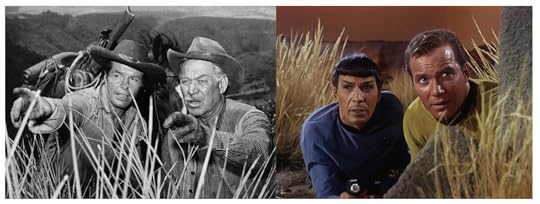 Let's have some fun with generating story ideas for our novels (or short stories).
Many of the writers for Star Trek: The Original Series came from the short story science fiction pool of Amazing Stories and Weird Tales and such. They brought their ideas from short stories to the TV screen.
But the show itself borrows an idea from the very popular Wagon Train that ran from 1957 to 1965. This was a show about Major Seth Adams and his scout Flint McCullough going on a string of adventures as they navigated the wild west in a wagon train. In other words, they were boldly going where no wagon train had gone before.
You can almost see Gene Roddenberry and others sitting around an office thinking up new show ideas, seeing the light bulb go off and exclaiming "We'll do Wagon Train... in space!"
With that in mind, here's a fun exercise for you or your next gathering of writers over coffee. Come up with story ideas based on old stories, films or TV shows, and then changing the settings, twisting the characters, and tweaking them until they're different.
Example:
TV Show: Gilligan's Island
Setting: In Space!
Twisting the Characters: When a group of space tourists plan to see the forbidden planet Delta X, little did they know that the bumbling captain and his sidekick lover McGillicutty would see their ship taken over by an evil professor bound and determined to find the mystery of the spheres, long thought to originate on Delta X. Throw in a couple of love interests and a wacky CEO, and you've got a good mix of characters.
Okay, I just made that up for kicks and giggles, but you can see that once you start twisting things around, you can arrive at a new story based on an old idea.
January 31, 2021
Playing Music Note for Note
Along with writing, I also play bass. Sometimes in bands, sometimes with the community theatre group. A few years ago, I was in one such community production - a musical - and I was one of the monkeys in the pit.
An accomplished pianist in the group came to me one day and said, "I notice you don't always play the score note for note."
He was right, of course. I like to stay close to the score, but I also add my own personality to it. This "extra jangly bits" are an amalgam of 40 years of playing music and all the influences I've encountered along the way.
If they needed someone to play note for note, they didn't need me. A recorded version would have accomplished the same thing.
When they ask me to play, they ask me to bring all that I am to the production, including the extra jangly bits.
It's the same thing as a writer. Readers want to hear your voice. Not someone else's. Mimicking our writing heroes is great for finding our voices, but let's not allow ourselves to become poor imitations. Be you.
An accomplished pianist in the group came to me one day and said, "I notice you don't always play the score note for note."
He was right, of course. I like to stay close to the score, but I also add my own personality to it. This "extra jangly bits" are an amalgam of 40 years of playing music and all the influences I've encountered along the way.
If they needed someone to play note for note, they didn't need me. A recorded version would have accomplished the same thing.
When they ask me to play, they ask me to bring all that I am to the production, including the extra jangly bits.
It's the same thing as a writer. Readers want to hear your voice. Not someone else's. Mimicking our writing heroes is great for finding our voices, but let's not allow ourselves to become poor imitations. Be you.
January 30, 2021
What Motivates Your Characters?
[image error] When we write, we often sketch out our main characters, giving them some physical characteristics, some good and bad habits, and set them on their way. But too often, we give little thought to why they behave the way they do? And sometimes when we take that psychological path, we end up having them do weird stuff.
Not all evil in the hearts of men are caused by poor toilet training habits.
Two things drive your characters: A concrete goal (usually the story goal), and an abstract goal (the driving behavioural force).
Let's take an example of Luke Skywalker. In A New Hope, he desperately wants to leave Tatooine and explore the galaxy. When bad things happen, he sets out on his quest to rescue Leia and confront the evil Empire (concrete goal). That part is easy enough.
But what drives him to do this? What's the underlying abstract motivator? We can consider a number of ideas: justice, love, community... all of those are true. Can you imagine what he'd be like if he was motivated by selfishness, narcissism, and "might makes right"? Surely, he would have joined his father to rule the galaxy.
As you sketch your characters, keep in mind these two motivators: the concrete goal and the abstract goal. Use them as a filter for their behaviour to ensure they remain true to who they are.
Not all evil in the hearts of men are caused by poor toilet training habits.
Two things drive your characters: A concrete goal (usually the story goal), and an abstract goal (the driving behavioural force).
Let's take an example of Luke Skywalker. In A New Hope, he desperately wants to leave Tatooine and explore the galaxy. When bad things happen, he sets out on his quest to rescue Leia and confront the evil Empire (concrete goal). That part is easy enough.
But what drives him to do this? What's the underlying abstract motivator? We can consider a number of ideas: justice, love, community... all of those are true. Can you imagine what he'd be like if he was motivated by selfishness, narcissism, and "might makes right"? Surely, he would have joined his father to rule the galaxy.
As you sketch your characters, keep in mind these two motivators: the concrete goal and the abstract goal. Use them as a filter for their behaviour to ensure they remain true to who they are.
January 29, 2021
Getting To Know Your Novel Characters
There are lots of ways to develop your characters for your story, from checklists and templates to meditation on real-life figures. But one of the best ways to quickly create your characters in depth, bringing them to life even before you begin writing, is the Proust Questionnaire.
Proust Questionnaire for Character Development
The French novelist Marcel Proust pulled together a list of 35 questions that, once answered, pretty much tell you everything you need to know about an individual. It began as a parlour game, something to amuse friends and family, but it's real power for writers lies in using these questions to bring characters to life.
Here's a sample:
What is your idea of perfect happiness?
What is your greatest fear?
What is the trait you most deplore in yourself?
What is the trait you most deplore in others?
Which living person do you most admire?
What is your greatest extravagance?
What is your current state of mind?
What do you consider the most overrated virtue?
On what occasion do you lie?
What do you most dislike about your appearance?
You can find the full list of questions here.
Some of the answers might come quickly, but most of them will require some thought and rumination. Now, I do wonder what it would be like to answer the questions for a character like Captain Kirk or Darth Vader, and perhaps as a thought experiment, I'll do an exercise for that.
But in the meantime, if you're looking for a quick way to build a robust character for your story, the Proust Questionnaire is hard to beat. I'm thinking of making this part of my Write Your First Novel Now! course, it's that powerful. Enjoy!
Proust Questionnaire for Character Development
The French novelist Marcel Proust pulled together a list of 35 questions that, once answered, pretty much tell you everything you need to know about an individual. It began as a parlour game, something to amuse friends and family, but it's real power for writers lies in using these questions to bring characters to life.
Here's a sample:
What is your idea of perfect happiness?
What is your greatest fear?
What is the trait you most deplore in yourself?
What is the trait you most deplore in others?
Which living person do you most admire?
What is your greatest extravagance?
What is your current state of mind?
What do you consider the most overrated virtue?
On what occasion do you lie?
What do you most dislike about your appearance?
You can find the full list of questions here.
Some of the answers might come quickly, but most of them will require some thought and rumination. Now, I do wonder what it would be like to answer the questions for a character like Captain Kirk or Darth Vader, and perhaps as a thought experiment, I'll do an exercise for that.
But in the meantime, if you're looking for a quick way to build a robust character for your story, the Proust Questionnaire is hard to beat. I'm thinking of making this part of my Write Your First Novel Now! course, it's that powerful. Enjoy!
January 28, 2021
Writing to Fail
There's a corny saying you've no doubt heard that goes like this: what would you do if you knew you couldn't fail? The idea is to move beyond the doubting lizard brain fear of everything to get you to a place where you might take a little risk.
But I think that's the wrong question to ask if you're a writer.
The real question to ask is this: what would you do to guarantee that you will fail?
Then, go do that.
In the context of writing, this is a hugely significant distinction. The challenge to write honestly is not about hoping someone will like it, or changing your art based on latest trends in order to appeal to more strangers. I'm not interested in that.
What I'd really like to see is the real you in your story (not a carbon copy Stephen King parrot). Write that story that you know would never get accepted for publication anywhere, the story that most people wouldn't get or care about, but that you certainly care about.
Go write that story.
By the way, the paradox here is that the story you write that you know will fail is often the story that is the most successful.
But I think that's the wrong question to ask if you're a writer.
The real question to ask is this: what would you do to guarantee that you will fail?
Then, go do that.
In the context of writing, this is a hugely significant distinction. The challenge to write honestly is not about hoping someone will like it, or changing your art based on latest trends in order to appeal to more strangers. I'm not interested in that.
What I'd really like to see is the real you in your story (not a carbon copy Stephen King parrot). Write that story that you know would never get accepted for publication anywhere, the story that most people wouldn't get or care about, but that you certainly care about.
Go write that story.
By the way, the paradox here is that the story you write that you know will fail is often the story that is the most successful.
January 27, 2021
The Writing Process
I've been thinking a lot about the writing process lately and came across this quote from one of my heroes, Seth Godin: If we attach ourselves to the outcome, we will sacrifice the process.
What does this mean?
In the context of writing a story or a novel, it means that if we worry about:whether my writing is goodif I'll embarrass myselfwhat happens if no one buys my bookmy family questions my emotional stabilitythe lizard brain tells me to stop trying, that pretending to be a writer is stupid, and that I'm a bad person anyway... Well, you get the picture. This is what happens when we focus on the result. But what if we attach ourselves to the process instead? What would that look like?
The writing process, like any creative process, is an end to itself. In fact, I'd argue that it is the only end worth pursuing. You're not a writer unless you write. Write first, then you become what you do. The way to get there is to write as much as you can.
In the workshops, we talk a lot about getting to your 5th or 6th novel quickly, because by the time you get there, you'll be pretty good at plotting, character development, world building, wordsmithing... But you can't get to good without starting with not so good.
Being attached to the writing process looks like this:showing up to write every day, no matter what (in my experience, the muse only appears after I start writing)writing your best work today (this doesn't mean endlessly revising the same paragraph over and over. There's no test at the end)sharing it with others. In writing groups, on your blog, with your friends and family. The beauty is, this principle applies to not only the arts, but to everything you do... your relationships, job, coaching the soccer team, baking hasty pudding without a recipe :)
Yes, so I'm thinking about the process these days, not so much the outcome. And I leave you with this consideration today: show up, write, share, repeat.
Unsubscribe | Update your profile | 11 Mohawk Crescent, Ottawa, Ontario K2H7G7
What does this mean?
In the context of writing a story or a novel, it means that if we worry about:whether my writing is goodif I'll embarrass myselfwhat happens if no one buys my bookmy family questions my emotional stabilitythe lizard brain tells me to stop trying, that pretending to be a writer is stupid, and that I'm a bad person anyway... Well, you get the picture. This is what happens when we focus on the result. But what if we attach ourselves to the process instead? What would that look like?
The writing process, like any creative process, is an end to itself. In fact, I'd argue that it is the only end worth pursuing. You're not a writer unless you write. Write first, then you become what you do. The way to get there is to write as much as you can.
In the workshops, we talk a lot about getting to your 5th or 6th novel quickly, because by the time you get there, you'll be pretty good at plotting, character development, world building, wordsmithing... But you can't get to good without starting with not so good.
Being attached to the writing process looks like this:showing up to write every day, no matter what (in my experience, the muse only appears after I start writing)writing your best work today (this doesn't mean endlessly revising the same paragraph over and over. There's no test at the end)sharing it with others. In writing groups, on your blog, with your friends and family. The beauty is, this principle applies to not only the arts, but to everything you do... your relationships, job, coaching the soccer team, baking hasty pudding without a recipe :)
Yes, so I'm thinking about the process these days, not so much the outcome. And I leave you with this consideration today: show up, write, share, repeat.
Unsubscribe | Update your profile | 11 Mohawk Crescent, Ottawa, Ontario K2H7G7