Aidan Moher's Blog, page 9
March 13, 2015
Cover Art for City of Blades by Robert Jackson Bennett
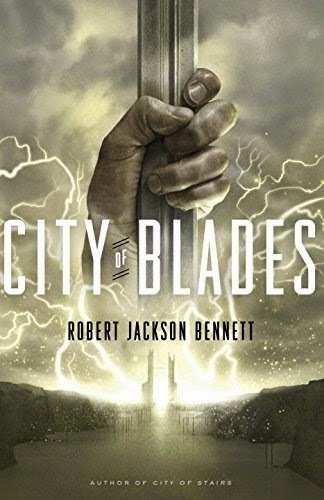
City of Stairs was my favourite novel of 2014. It goes without saying that I’m ravenously excited for this follow-up, City of Blades. Doesn’t hurt that the cover’s gorgeous to boot.
City of Blades is due for release on November 3rd, 2015.
The post Cover Art for City of Blades by Robert Jackson Bennett appeared first on A Dribble of Ink.


March 11, 2015
Not the Only Girl in the Game
Karen Memery is a seamstress – which is to say, salon girl – at the Hotel Mon Cherie in Rapid City. Though romantically inclined towards womenfolk, Karen is a practical soul in a comfortable, well-paying position that lets her save for the future, and her employer, the formidable and aptly-named Madame Damnable, makes sure her girls are protected. But not all who share their profession are so lucky: Chinese and Indian girls in particular are vulnerable to slavery and exploitation, as are those who work the streets. So when Merry Lee, the famous saviour of trafficked girls, shows up badly injured with Priya, her latest rescue, Karen and her sisters are quick to defend them against their pursuers – a man named Peter Bantle and his toughs. But Bantle won’t give Priya up so easily, and soon, his escalating retaliations against Karen, Madame Damnable and the other girls land them with much bigger problems. Who is killing Rapid City’s streetwalkers? How is Bantle running for mayor? And what can Karen do to stop it?
Karen Memory is an energetic, engaging novel and an absolute pleasure to read. Though technically steampunk, the bulk of the story has less to do with brass, cogs and technology and more to do with the varying intersections of character, sexuality, race and gender that necessarily underpin an evolving, industrial, frontier society – and all done with a rambunctious sense of fun. A hallmark of Bear’s writing is her effortless use of narrative voice to reflect a different time, place and culture, and Karen Memory is no different. Told as the first person reminiscence of the titular heroine, the language and cadence immediately situate the reader in the setting and contrive, through a combination of excellent pacing and complex characterisation, to keep her there.
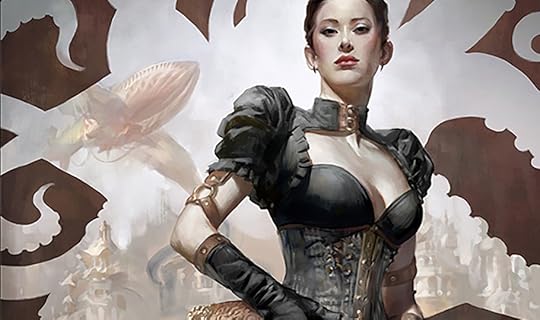
I honestly can’t think of another book I’ve read that’s put sex workers front and centre without taking that as an excuse to describe them in bed.
Here’s the thing about Karen Memory: it’s a story whose protagonists – or most of them, anyway – are prostitutes, but which features no sex scenes. This shouldn’t be a rare thing in literature; it is, for instance, quite common to mention a protagonist’s profession without ever showing them engaged (ahem) in the throes of it. If the profession in question is something like law or teaching, for instance, we might hear peripherally about its impact on the character, but that doesn’t mean we always get lengthy courtroom/classroom scenes, especially if the real action, so to speak, is taking place elsewhere. Yet sex workers, it seems, are seldom if ever extended such narrative courtesy: their lives are viewed as synonymous with their professions, and I honestly can’t think of another book I’ve read that’s put sex workers front and centre without taking that as an excuse to describe them in bed.
The realities of the profession in the time and place are neither exaggerated nor elided. Karen works at a high-class establishment under the auspices of a caring female madame, one who not only strives to protect her girls, but to educate and support them. That some of Karen’s sisters are women who would elsewhere be subject to different social prejudices than Karen herself, particularly within the context of their profession – like Bea, who is black, or Miss Francina, who is trans – is precisely why Madame Damnable’s establishment is not just a home, but a refuge; which is, in turn, why Merry Lee and Priya are offered sanctuary there. But neither is the Hotel Mon Cherie romanticised: the women are always aware of the potential perilousness of their situation, not just because of Peter Bantle’s threats, but in terms of how they’re viewed by “respectable” citizens, and what everyday courtesies they can or can’t expect from such people. Priya and Merry Lee are both trafficking victims, and unprotected streetwalkers are being whipped to death by an unknown killer: neither the reader nor the characters are allowed to forget the crucial distinction between those who choose their profession and those robbed of choice, nor the further distinction between those who, having chosen it, are working in better, safer, more hospitable circumstances than others.
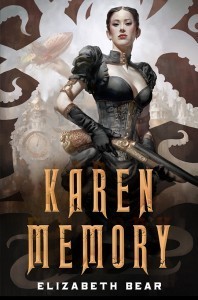
Buy Karen Memory by Elizabeth Bear: Book/eBook
Karen Memory is a lively, heartfelt novel with a suite of funny, clever, courageous, complex heroines.
The inclusion of Bass Reeves – a real historical figure, and the apparent inspiration for the character of the Lone Ranger – is a particularly nice touch; as, for that matter, is the realism in Bear’s portrayal of the daily life of Karen and her sisters. (Those interested in the history of the oldest profession could do worse than to read Nils Ringdal’s Love For Sale: A Global History of Prostitution, which is both fascinating and accessible.) For all the presence of steampunk elements, like electric gloves, airships and mind-control devices, at its heart, this is a story about people – which is, I think, a pertinent means of distinguishing it as an adventure, rather than action, narrative. Whereas action stories are primarily concerned with and defined by external elements – chase scenes, explosions, ticking clocks – adventure stories are more internally focussed, exploring the impact of such devices from a human perspective. Action shows us characters through the lens of crisis, but adventure shows us crisis through the lens of characterisation, and while it’s certainly possible to fuse the two, Karen Memory, with its endearing narration and wonderful cast, sits very firmly in the latter category.
Karen Memory is a lively, heartfelt novel with a suite of funny, clever, courageous, complex heroines. I recommend it without hesitation, and if I wasn’t already a fan of Elizabeth Bear, I certainly would be now.
The post Not the Only Girl in the Game appeared first on A Dribble of Ink.
March 9, 2015
“Gravity’s Own Monster: Worldbuilding in the Air” by Fran Wilde
“Now I will tell you how Octavia, the spider-web city, is made. There is a precipice between two steep mountains: the city is over the void, bound to the two crests with ropes and chains and catwalks. You walk on the little wooden ties, careful not to set your foot in the open spaces, or you cling to the hempen strands. Below there is nothing for hundreds and hundreds of feet: a few clouds glide past; farther down you can glimpse the chasm’s bed. …
Suspended over the abyss, the life of Octavia’s inhabitants is less uncertain than in other cities. They know the net will only last so long.” — Invisible Cities, Italo Calvino
A few things to know before we set out:
First, we’re going up… and (maybe) down, so pack your chutes. Aidan asked me to write a post about worldbuilding in the air — a somewhat non-traditional fantasy setting — because of a few stories I have in the wind. I set both the short story, “A Moment of Gravity, Circumscribed,”1 out this month in XIII: Stories of Transformation (Resurrection House, March 2015), and my upcoming novel Updraft above the clouds.
Second: Gravity’s a tough mistress. I hope you checked that chute before you packed it.
Third, there’s nothing “traditional” about today’s terra-firma fantasy landscape. A look at the recent offerings from Elizabeth Bear (Karen Memory, the Eternal Sky series, all from Tor), Katherine Addison (The Goblin Emperor, Tor 2014), and Ken Liu (The Grace of Kings, Saga, 2015) each offer vistas beyond the familiar hill and vale.
That said, when setting a story far above the ground, there are a number of extra worldbuilding issues to consider. These include natural versus man-made hazards, line of attack, line of supply, and necessity.
Setting a story in the air is a great opportunity to put your characters in jeopardy… and leave them there.
Doing so can be occasioned by a call of duty — as with Anne McCaffrey’s Dragonriders series (please don’t suck, movie, please), or as a piece of a larger setting — as in the floating islands of Arianus in the Death Gate series (Margaret Weis and Tracy Hickman, Spectra, 1990s). Oppositionally, the internal and external cultures of K.W. Jeter’s Farewell Horizontal (St. Martins, 1989) and Steven Gould’s short story “Peaches for Mad Molly,” have arrayed themselves on mega high-rises because there is seemingly nowhere else to go.
You might otherwise set your story in the air for reasons of culture and environment: Bellerophon’s estates in Firefly float above the waves for added security; Star Wars’ Cloud City does so because it’s stationed on a gas giant that would crush it at any lower elevation. The castle in Diana Wynne Jones’ Castle in the Sky floats because: Howl. (Ditto, Miyazaki’s version). Meantime, the floating population of Rajan Khanna’s Falling Sky (Pyr 2014) raises itself on airships to avoid the dangerous ferals down below.
Let’s say that you live above the wreckage of North American civilization. Let’s say that below you, on the ground, live a horde of deadly Ferals who could pass you the Bug with just a drop of bodily fluids. - Falling Sky, Rhajan Khanna
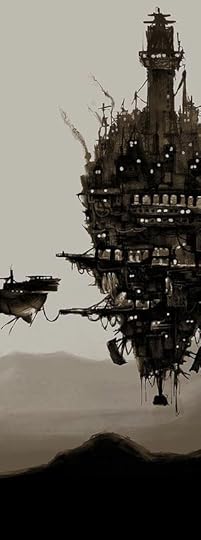
Art by Bzzz88
Height can mean safety or security. It can indicate or confer status. It offers the ability to see far iin some cases, and avoid having things dropped on you in others (unless your enemies somehow get above you). In cases like the Eyrie in George Martin’s A Song of Ice and Fire (Bantam/Voyager, forever and ever), it means that the only approach to your home is one you control.
Sky settings and their cousins the outcrop setting (viz. the Eyrie) have other benefits. They offer philosophies and perspectives that we might otherwise find in fantasy landscapes. Italo Calvino’s sky cities are some of my favorites in Invisible Cities (Harcourt Brace, 1978) for just this reason. And while you might (read: will almost certainly) have to give up your horse and your heavy armor, you can gain wings and bridges, machines that override physics (Jeter’s main character has a motorcycle that runs verticals like highways), bird-people, angel-adjuncts, and dragons. Oh such glorious dragons.
So, too, do you trade the challenge of a river crossing or a plains encampment for problems with wind, weather, and gravity. In a setting where fall and fail are synonymous, these are no small problems. In the air, dumb luck or pure stupidity can kill your characters just as dead as guile and malice.
And in the air, line of attack and line of approach go beyond horizontal. Air Force cadets learn this early, as do video gamers. “The enemy’s gate is down,” is a useful rule beyond the setting of the battle room — in the air, an attack can come from above, below, or any angle. Similarly, battles take place in three dimensions. This means more authorial blocking is required, but it also means your characters must understand the rules of the road or they’re going to crash into each other.
How your airborne culture transports things is also key – do they carry valuables up? Grow food in place? Trade between ships?
How is perpetuity maintained in your sky culture? History is a heavy burden. What your sky-folk can store or carry impacts how high they can go or stay.
In an airborne culture, dangers and difficulties can come from any direction. But then again, so can your story.
“There are three hypotheses about the inhabitants of Baucis: that they hate the earth; that they respect it so much they avoid all contact; that they love it as it was before they existed and with spyglasses and telescopes aimed downward they never tire of examining it, leaf by leaf, stone by stone, ant by ant, contemplating with fascination their own absence.” — Invisible Cities, Italo Calvino
The post “Gravity’s Own Monster: Worldbuilding in the Air” by Fran Wilde appeared first on A Dribble of Ink.
March 6, 2015
My Final 2015 Hugo Awards Ballot & Recommendations
As the Hugo nomination period draws to a close, here are the items that will appear on my final ballot. If you’re unfamiliar with any of the items, I highly encourage you to check them out. 2014 was a wonderful year for genre fiction and art.
Note: If a category doesn’t appear or is incomplete, it’s because I either a) did not make any nominations, or b) will be undecided on some of the final inclusions until the final hour.
Best Novel
City of Stairs by Robert Jackson Bennett
Even as I was startled by its twisted depth, I adored every moment I spent with City of Stairs. Colonialism lies at City of Stairs‘ centre, and RJB handles it with equal parts boldness and delicacy. The ruined beauty of Bulikov and its fallen gods haunted me long after I turned the final page.
Ancillary Sword by Ann Leckie
Review — Will Ancillary Sword be able to recapture its predecessor’s lightning-in-a-bottle success? Probably not, but it’s one of the year’s best novels and, due to its more focused storyline, smoother narrative, and introspective thematic elements, I actually liked it better than Ancillary Justice. No sophmore slump for Leckie.
The Eternal Sky Trilogy by Elizabeth Bear
Review — Calling on the Wheel of Time rule, I’m including Bear’s trilogy here as a bit of a self-indulgence and pie-in-the-sky dream scenario. The Eternal Sky trilogy — Range of Ghosts, Shattered Pillars, and Steles of the Sky — is a fascinating epic fantasy that eschews the tired medieval tropes the genre is known for and replaces with a vivid world based on the Turkish-Mongolian khanates of 13th century Asia.
The Goblin Emperor by Katherine Addison
In a modern fantasy landscape that is littered with the broken corpses left in Grimdark’s wake, Katherine Addison (a pseudonym for Sarah Monette) is a shining light, a beacon of nostalgia and hope on the horizon.
Station Eleven by Emily St. John Mandel
Review — A quiet, riveting post-apocalyptic tale that succeeds because Mandel avoids playing prophet of the apocalypse and shifts focus to the intense personal relationships of the novel’s various protagonists. Beautiful.
Best Related Work
Rocket Talk, hosted by Justin Landon
Landon’s podcast for Tor.com has become the defacto standard for all science fiction and fantasy podcasts to measure up against. Because of Tor.com’s professional status, Rocket Talk is ineligible for nomination in the Best Fancast category, but competes handily with the other nominees in this category.
Tor.com
The big, bad genre site that is slowly subsuming all of the blogosphere’s best writers. It’s impossible to ignore the contribution that this behemoth (which is ineligible for Semi-Prozine) makes to SFF.
Long Hidden: Speculative Fiction from the Margins of History, edited by Rose Fox & Daniel José Older
A lovely collection of stories celebrating all sides of speculative fiction.
Speculative Fiction 2013, edited by Ana Grilo & Thea James
This follow-up to 2014 Hugo nominee Speculative Fiction 2012 is ripe with interesting conversation about science fiction and fantasy. It continues to be an important archive of online SFF fandom. (Note: I have an essay in this collection.)
Women Destroy Science Fiction, edited by Christie Yant, Rachel Swirsky, Wendy N. Wagner, Robyn Lupo, & Gabrielle de Cuir
Did any collection of fiction and non-fiction make so big a wave in 2014? I can’t think of one. A tremendous showcase of love, dedication and passion for SFF.
Best Dramatic Presentation (Long Form)
Guardians of the Galaxy
Game of Thrones: Season Four
The Legend of Korra: Season Three
Best Professional Editor (Short Form)
Neil Clarke, for Clarkesworld
William Schaefer, for Subterranean Press/Magazine
Best Professional Editor (Long Form
Devi Pillai, for Orbit Books
Anne Perry, for Hodder & Stoughton
Best Professional Artist
Victo Ngai
Veronique Meignaud
Richard Anderson
Julie Dillon
Sam Weber
Best Semiprozine
Pornokitsch, edited by Anne Perry & Jared Shurin
The Book Smugglers, edited by Ana Grilo & Thea James
Strange Horizons, edited by Niall Harrison, et al.
Lightspeed Magazine, edited by John Joseph Adams
Best Fanzine
Nerds of a Feather, edited by The G & Vance Kotrla
The Wertzone, edited by Adam Whitehead
Lady Business, edited by Renay, Ana and Jodie
SF Mistressworks, edited by Ian Sales, et al.
Best Fancast
Speculate!, hosted by Bradley P. Beaulieu & Gregory A. Wilson
Sword & Laser, hosted by Veronica Belmont & Tom Merritt
Best Fan Writer
(Note: Good lord, this was a tough category to narrow down this year!)
Natalie Luhrs
Liz Bourke
Abigail Nussbaum
Justin Landon
Max Gladstone
Best Fan Artist
Kuldar Leement
What made your ballot? What did I miss on mine?
The post My Final 2015 Hugo Awards Ballot & Recommendations appeared first on A Dribble of Ink.
March 5, 2015
The Best of A Dribble of Ink ’14
2014 was a banner year for A Dribble of Ink. In addition to all of the fun artwork and news about SFF, A Dribble of Ink published some of its most popular and fascinating essays and reviews. So, to celebrate the best of what A Dribble of Ink published in 2014 (and as a subtle reminder of the site’s eligibility in the “Best Fanzine” category at this year’s Hugo Awards), I’ve gathered together a small collection of essays and reviews that make me particularly proud.
Whether you find something new, or revisit an old favourite, I hope you have fun reading through A Dribble of Ink’s contribution to 2014.
“Life… Dreams… Hope… Where do they come from?” A Final Fantasy VI Retrospective – A languid and loving retrospective about one of the finest RPGs: Final Fantasy VI.
Let’s Talk about Science Fiction Books by Women – Ann Leckie, Julie Czerneda, Maureen Kincaid Speller and others joined me and A Dribble of Ink readers to discuss our favourite science fiction novels by women. The most popular vote? C.J. Cherryh’s Foreigner!
Gene Wolfe: The Reliably Unreliable Author” Chris Gerwel digs deep into Gene Wolfe’s labyrinthine and legendary library.
They Are Not Ghosts – Maureen Kincaid Speller explores the representation of indigenous North American people in science fiction and fantasy.
Writing in Ink to Samarkand – Paul Weimer travels the Silk Road from one end of fantasy to the other.
“Never Give a Sword to a Woman Who Can’t Dance” – A review of Ann Leckie’s Ancillary Sword.
“Put On Some Pants and Get Out” – Brian Staveley ponders what it takes to survive writing a book and nurturing a marriage while raising a new baby.
More Essays
“Women Made of Chrome” by Teresa Frohock
“Of Better Worlds and Worlds Gone Wrong” by Katherine Addison
“‘With Fist and Sword’ Epic Fantasy and Shounen Anime Heroes” by Django Wexler
“The Unrecognized Trajectory of Slow Burn Success” by Janny Wurts
“Dance, George, Dance” by Aidan Moher
More Reviews
A review of Brandon Sanderson’s The Way of Kings by Aidan Moher
A Review of Katherine Addison’s The Goblin Emperor by Foz Meadows
A review of Andy Weir’s The Martian by Aidan Moher
A review of Mary Robinette Kowal’s “The Lady Astronaut of Mars” by Aidan Moher
A Review of Kameron Hurley’s The Mirror Empire by Foz Meadows
What’s your favourite A Dribble of Ink article from 2014?
The post The Best of A Dribble of Ink ’14 appeared first on A Dribble of Ink.
March 4, 2015
Cover Art for The Thorn of Emberlain by Scott Lynch
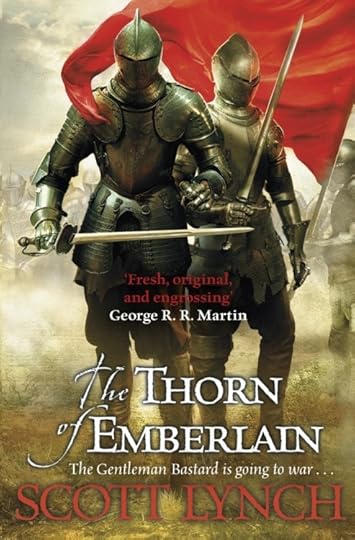
“We’re looking to publish The Thorn of Emberlain before the end of 2015,” revealed the Gollancz blog. Lynch’s release dates are notoriously slippery, but this is encouraging news.
Details on the volume are slim, but the blog post did give readers a sweeping taste of what to expect. “As you can tell from the armour, the business like blades and the scarlet banner Scott’s new book takes Locke into a new world of risks and adventure,” Gollancz said. “You could say that The Lies of Locke Lamora was the book of the con, that Red Seas Under Red Skies was the pirate book and The Republic of Thieves took Locke into politics. Now, with The Thorn of Emberlain the Gentleman Bastard is going to war.”
The cover art is by London-based Uruguayan artist Alejandro Colucci.
The post Cover Art for The Thorn of Emberlain by Scott Lynch appeared first on A Dribble of Ink.
March 3, 2015
“A thousand spots of mould” – In Conversation with Daniel Polansky
“What’s your new book about?” readers ask writers all the time. It’s not such an easy question to answer, Daniel Polansky told me when we started chatting about his new book, Those Above “It’s meant kindly, hardly an unreasonable question given that you did write the damn thing, bound to bring an author to the brink of despair.”
If there are a thousand readers, there are a thousand answers to that question, and Polansky often attempts to find the correct answer to fit the person who’s asking. “There’s the answer that I give to bloggers or interviewers or editors or anyone else who might help generate sales,” he said. “Those Above is the story of a civilization of near-perfect, almost-immortal humanoids who live in a wondrous city at the center of the world, and of the attempts of their enslaved human population to shake off this yoke. There are multiple intersecting viewpoints, there’s political scheming and moral quandaries, there’s sword fights and murder and just enough sex to keep the thing entertaining.”
A book is a thousand ideas held together in tight chain
It works. The book is about all of those things, but it’s not the entire truth. “This has the virtues of being simple and not an outright lie,” Polansky explained. “But it is not my answer, I mean it is not what I secretly think the book is about. Of course a book is no more a single idea than a house is a single brick; a book is a thousand ideas held together in tight chain, shaved down of its extraneous bits and deeply polished. Those Above began, in a past which seems very distant, with with an image—of a giant of a man in a torn hauberk, scarred and fierce and dying futilely, as most of us do. He sort of held my attention, this killer, this savage, this tragic brute. Who was he and how he had become so?”
Those thousand ideas all spawn from that single moment, that freeze frame from within a larger narrative yet to be discovered. I loved Polansky’s description of what happens next.
I would say that Those Above is about the ways in which our upbringing and background bind and narrow our perceptions, limit us in ways which we cannot articulate or even entirely comprehend.
“And like a spot of mold, thoughts began to accrue around him,” he revealed. Nothing glamorous about mould, but it spreads and grows. “Questions, mostly. How would the existence of a non-human species capable of higher thought effect our essentially anthropocentric notions of morality? How would a superior civilization look to someone from an inferior? How might a woman grasp the reigns of power in a society which officially bans them from playing a role in public life? How, by contrast, would a culture look like if the species which had created it were minimally sexually dimorphic? If you were gonna murder a dude with a knife, how would you go abut doing it?”
As there are a limitless number of readers, there are a limitless number of ways a book is written, and Polansky has found, after four books now, that this fractal and chaotic process has prove true each time around. “Such, in my experience, is how a book is written,” he said. “Things glom together until the whole edifice is larger than it needs to be, and then you go back through with a razor, clearing away the brush and debris, the weak ideas and the half-hearted fantasies. And then at the end of it there is this manuscript with your name on it, etched and bound, and you left confused and perhaps faintly proud.”
And the end result is something that will leave fans of big, epic fantasies something to sink their teeth into:
They enslaved humanity three thousand years ago. Tall, strong, perfect, superhuman and near immortal they rule from their glittering palaces in the eternal city in the centre of the world. They are called Those Above by their subjects. They enforce their will with fire and sword.
Twenty five years ago mankind mustered an army and rose up against them, only to be slaughtered in a terrible battle. Hope died that day, but hatred survived. Whispers of another revolt are beginning to stir in the hearts of the oppressed: a woman, widowed in the war, who has dedicated her life to revenge; the general, the only man to ever defeat one of Those Above in single combat, summoned forth to raise a new legion; and a boy killer who rises from the gutter to lead an uprising in the capital.
Those Above is Polansky’s fourth novel, but the first in a new series, The Empty Throne. On the surface, it’s about the things that first spawned from that image of the defeated warrior, those questions about humanity, society. Those above and those below. But it’s also about more than that, Polansky realizes after having spent so long with the text. “At this point, having worked on it for close to two years,” he said. “I would say that Those Above is about the ways in which our upbringing and background bind and narrow our perceptions, limit us in ways which we cannot articulate or even entirely comprehend.”
Fancy words, fancy thoughts, but Polansky recognizes that thematic meanderings are a difficult sell, much moreso that a scarred and dying brute. “But who would buy that book? How would you make a cover for that book? Who is going to blurb that book? I have no idea, I just know that I wrote it.
Buy Those Above by Daniel Polansky
Or suspect I wrote it, because of course, how can I know for sure? Socrates observed that ‘not by wisdom do poets write poetry, but by a sort of genius and inspiration; they are like diviners or soothsayers who also say many fine things, but do not understand the meaning of them.’ By modern century-standards a bit mystical sounding, but there’s certainly something there. A novel is at once a deliberate act of creation and an unconscious record of your own perspective. There is more on the page than you intended—you have scattered secrets unaware.”
Those Above is available now from Hodder & Stoughton. “If anything I’ve written here is of interest to you, please go ahead and check it out,” Polansky implores. “If what I’ve written here had seemed pedantic, dull or uninteresting, I would equally strongly suggest you purchase a copy and offer it to a hated ex-lover, or a work rival. If you do buy it though, and you read it, and you like it to some degree or another, please do me a favor—drop a line and let me know if you have any idea what it’s about. I’m still trying to come up with a good cocktail party shorthand.”
The post “A thousand spots of mould” – In Conversation with Daniel Polansky appeared first on A Dribble of Ink.
February 25, 2015
Cover Art for The Mortal Tally by Sam Sykes
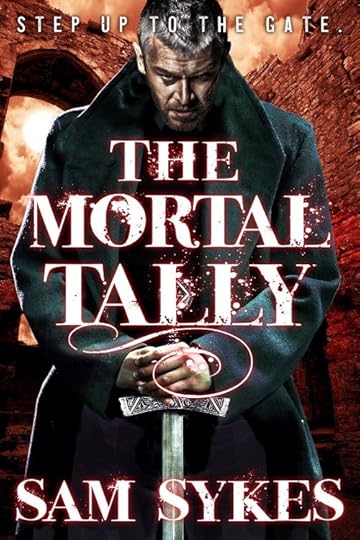
Brooding Swordsman: 1
Hooded Man: 0
I call it a win.
The heart of civilization bleeds.
Cier’Djaal, once the crowning glory of the civilized world, has gone from a city to a battlefield and a battlefield to a graveyard. Foreign armies clash relentlessly on streets laden with the bodies of innocents caught in the crossfire. Cultists and thieves wage shadow wars, tribal armies foment outside the city’s walls, and haughty aristocrats watch the world burn from on high.
As his companions struggle to keep the city from destroying itself, Lenk travels to the Forbidden East in search of the demon who caused it all. But even as he pursues Khoth-Kapira, dark whispers plague his thoughts. Khoth-Kapira promises him a world free of war where Lenk can put down his sword at last. And Lenk finds it hard not to listen.
When gods are deaf, demons will speak.
In all likelihood, this is an unfinished catalogue cover and will change (slightly or wholly) before release. The Mortal Tally is the follow-up to Sam Sykes’ The City Stained Red and is due for release from Orbit Books on January 5th, 2016.
The post Cover Art for The Mortal Tally by Sam Sykes appeared first on A Dribble of Ink.
February 23, 2015
“From Icepunk to a Crown of Stars: Exploring Kate Elliott’s Wonderful Worlds” by Paul Weimer
Kate Elliott’s fiction first came to my attention in the mid-’90s. In the age before the rise of massive social media, I discovered authors through publications like Locus, and through things like award nomination lists. When King’s Dragon showed up on the Nebula shortlist for novels published in 1997 (a ballot that also coincidentally included an unassuming novel titled by a chap named Martin), I was excited to try a new author, and one tackling epic fantasy at that! I was pleased to find that King’s Dragon offered deep and intricate worldbuilding, strong female characters, perspectives on issues and facets of epic fantasy worlds that don’t always get much play, and a willingness to go dark when necessary. This was definitely something different than the epic fantasy of the ’80s I devoured as a teenager. I was hooked on Kate’s work. Hard.
I started reading backward into her œuvre, and then forward ever since.
Though also an author of several science fiction novels (Jaran, for instance, might be considered as Genghis Khan meets Jane Austen in space!), Elliott is best known for being one of the cornerstones of epic fantasy writing starting in the mid 90s and continuing strongly to this day. While many of the innovations and style of Elliott’s rising carries through all of her work, the series’ themselves are individual and distinct in manner, matter, and tone. There is a Kate Elliott fantasy series for nearly every taste of reader.
Buy The Golden Key by Melanie Rawn, Jennifer Roberson, and Kate Elliott: Book/eBook
The Golden Key features a unique spin on the clever and powerful influence art has over the world’s magic.
The Golden Key, co-written with Melanie Rawn and Jennifer Roberson, combines their various talents to write a story over three time periods in a Medieval Spain-like setting. The early to mid ’90s was an intense time of such fantasy collaborations, with authors working together to bring their strengths and skills together to make a work equal to, if not better, than any of their considerable individual talents. Elliott is responsible for the third and final section of the novel. The Golden Key features a unique spin on the clever and powerful influence art has over the world’s magic. The story focuses on the sweep and tragedy of a central figure seeking desperately to hold onto the power and influence he has so carefully built up over so long, even as the world changes beyond his control. The Golden Key rightfully garnered a 1997 World Fantasy Award nomination.
The Crown of Stars series, perhaps Elliott’s best known work, starts with the aforementioned King’s Dragon and continues through seven volumes. Crown of Stars in some ways is the most traditional of her epic fantasy. Readers are dropped into a dynastic struggle in a secondary fantasy world reminiscent of 10th century Western Europe. Add in invasion from the north by a humanoid race, the Eika, accompanied by their equally unnatural dogs. Focus the story on two young main protagonists come into their power, destiny and heritage. Bake and serve. And yet within all that, Elliott includes points of view from all walks of life in her meticulously researched medieval fantasy world. Crown of Stars showcases fascinating worldbuilding and the creation of a secondary world with many interesting and clever aspects highlighted, including a church with a far more egalitarian power structure between men and women. As a just reward for readers, the series builds to a thundering climax that leaves the world changed — distinctly different than at the beginning of the tale.
The Crossroads trilogy begins with Spirit Gate. Set in the world of the Hundred, Elliott explores terrains, cultures and ideas far beyond the Great Wall of Europe. A complex, meaty story of a darkness spreading over the world, and the action packed struggles of those tasked to face it, will or no. The novels also illuminate, explore and debate ideas not always looked at in epic fantasy. Corruption and the nature of power and politics. Complicated moralities, religious freedom, and the role of women in society. Most of all, before the recent fascination with ‘grimdark’, the Crossroads series unflinchingly shows us the fate of ordinary people caught between contending powers, and what they are willing to do in response to such injustices heaped upon them. And did I mention the Reeves, the sheriff-like dispensers of law throughout the Hundred? They are carried to their duties, and to meet the threats to the Hundred by eagles. Giant Eagles. And they are far from cuddly.
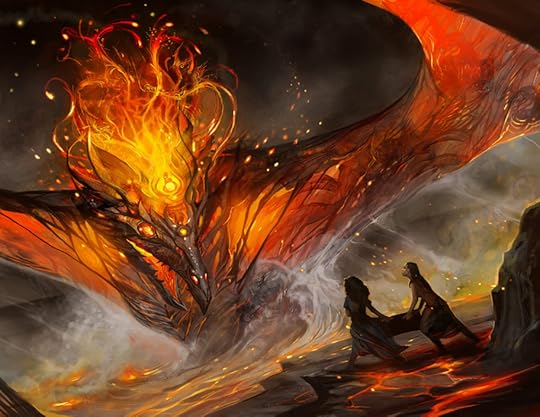
An icepunk world where mages with cold aspected magic feud with the builders of airships.
Spiritwalker, her latest series, kicks things off with Cold Magic and continues Elliott’s experimentation and development as a writer. Unusually for epic fantasy, the series is a strictly first person fantasy adventure narrative. Trained in a House of spies, Cat Barahal and her cousin Bee make their way in an alternate 19th century Regency era world, much more glaciated and colder than ours, where Rome and Carthage continue to contend with each other. An icepunk world where mages with cold aspected magic feud with the builders of airships. A world where revolution against old orders and powers is in the air. A world where the spirit realm, and its Wild Hunt, and sleeping dragons, is terribly near. And did I mention the trolls? Not the kind you’re probably thinking. These trolls are feathered, intelligent, inquisitive descendents of dinosaurs, Troodons to be precise. Like in the Crossroads novels, and in Crown of Stars, the Spiritwalker novels, in the midst of its action and adventure, is willing to engage, explore and interrogate interesting and underexplored concepts in its epic fantasy context.
The Very Best of Kate Elliott collects her shorter fiction, with delightful cover art by Hugo winner Julie Dillon. Elliott’s short fiction is full of dense nuggets of worldbuilding and character, and often provides new and novel perspectives on the worlds of her fantasy novels.
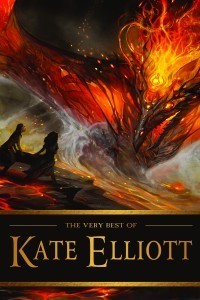
Buy The Very Best of Kate Elliott by Kate Elliott: Book
There is no better time than now to become acquainted with Kate Elliott’s wonderful worlds
Court of Fives marks Elliott’s entry into a subgenre new to her — Young Adult — and looks to be yet another mark of innovation and growth in Elliott’s work. Court of Fives is set in a Greco-Roman Egypt-inspired world, a social setup reminiscent of Little Women, and a plot inspired by The Count of Monte Cristo. Court of Fives marks a furtherance of her experimentation with first person narrative.
And lest you think Kate is even taking a breather from writing the epic fantasy she has mastered and is so well known for, Black Wolves returns us to the world of the Hundred. Black Wolves, set sometime after the events of the previous Crossworlds series and can be read independently of the novels, features a set of protagonists that bear no resemblance to your 13 year old farmboys with a cosmic destiny that you can find on the clearance rack of bog standard epic fantasy. And yes, the Reeves and their Eagles are back!
There is no better time than now to become acquainted with Kate Elliott’s wonderful worlds and I look forward to enjoying the perspective, voice, and talent she brings to epic fantasy for years to come.
The post “From Icepunk to a Crown of Stars: Exploring Kate Elliott’s Wonderful Worlds” by Paul Weimer appeared first on A Dribble of Ink.
February 20, 2015
Cover Art for Ancillary Mercy by Ann Leckie
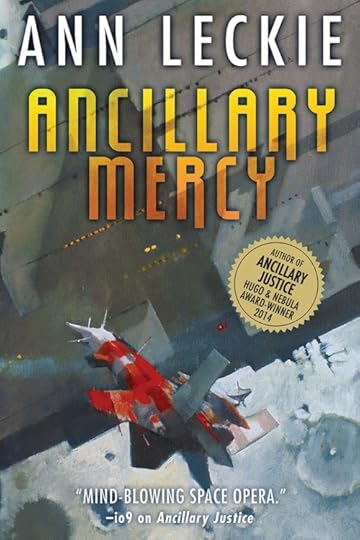
Looking good! No surprise, since all three covers for Ann Leckie’s series come from the same piece of John Harris art, but Orbit has put together another nice cover for Ancillary Mercy, the concluding volume in the Imperial Radch trilogy. The only shame? No hardcover release for the trilogy.
The post Cover Art for Ancillary Mercy by Ann Leckie appeared first on A Dribble of Ink.