
Jonathan Chait's Blog, page 114
February 14, 2011
Is Health Reform Safe Against Judicial Conservatives?
One of the striking things about Roger Vinson's ruling striking down the Affordable Care Act -- which I appraise rather critically in my latest TRB column -- is that there are three distinct legal rationales for the law, and Vinson's ruling finds a way to reject all three of them. One rationale is Congress's authority to tax, which Vinson rejects by deciding the penalty on people who go without health insurance is not a tax. The second is the Commerce Clause, which he rules out by concocting a distinction between activity and "inactivity," the latter of which he claims Congress can't regulate.
And then the third is the Necessary and Proper clause. The Constitution gives Congress authority to enact any laws necessary and proper to execute its others enumerated powers. Charles Fried notes that conservatives on the Supreme Court have previously interpreted this clause, sensibly, to allow Congress to carry out its authority as the clause reads:
Fried supported Roberts and Alito as well and said in an interview he does not believe either of them would be inclined toward "such a departure from standard Commerce Clause jurisprudence."
He added, "I don't see Roberts as going for this tea party stuff."
Fried pointed, as others have, to a case from last term. The chief justice, in U.S. v. Comstock, agreed that the Necessary and Proper Clause gave the government the right to to detain sexually dangerous federal prisoners even after their sentences were completed, although even the power to imprison is not explicit in the Constitution.
Roberts assigned the ruling to Breyer and joined the broadly written opinion in full, something neither Kennedy nor Alito was willing to do, even though both agreed with the outcome.
I think it's obvious that any ruling based on legal precedent will uphold the Affordable Care Act, and not by a 5-4 margin. Keep in mind that striking down the law is a kind of inside straight that requires 5 justices to each reject all three possible legal rationales for the individual mandate, and each rationale has a fairly strong basis in precedent. The only question is whether the justices will follow precedent or just decide to strike down a law they don't like.


Decoding The Budget Debate
The next few months are going to be dominated by the budget showdown between the two parties. It's helpful to step back from the specifics for a moment and consider the broader point, which is that the entire framework of this debate is being driven by the Republicans' desire to consider spending as an abstract proposition and Democrats' desire to consider it in the specific. Almost everything both parties will do revolves around that.
One of the most timeless and fundamental facts of American politics is that people oppose government in the abstract but favor it in the particulars. Republicans need to tailor their opposition to government to accommodate this reality. The largest programs -- defense, Social Security, Medicare, and Medicaid -- all command strong public support. (People show some willingness to cut defense, but many Republicans oppose any cuts in this category, so the party tends to shy away.) But Republicans have to cut something, and so, by process of elimination, they're left with cutting everything else.
Everything else falls into a catch-all known as "domestic discretionary spending," which accounts for every dollar of spending that isn't defense, entitlements, or paying interest on the national debt. This category accounts for less than a fifth of the federal budget, and it's been getting squeezed fairly hard for more than two decades. The budget debate we're having centers almost entirely on this one small slice of the budget. Why is that? Well, it's because it's a category of programs rather than a program itself. Cutting domestic discretionary spending is the closest Republicans can come to cutting spending in the abstract.
Of course, cutting domestic discretionary spending is not the same thing as cutting spending in the abstract. You have to cut individual programs. And that's where the Obama administration thinks it can turn the debate to its advantage. Turn to specifics, and Democrats can force Republicans to answer questions like, Does cutting spending on education or scientific research really help the next generation? (Obvious answer: no.)
This is driving the maneuvering on both sides. The administration thinks that if it offers up cuts, including cuts in programs it supports, it can get past the cut/not cut debate to a debate about specifics, which it can win. Thus you'll see spin like this:
"The debate in Washington is not whether to cut or to spend. We both agree we should cut," said a senior administration official, who briefed reporters Sunday night on the condition of anonymity because the budget had not been released. "The question is how we cut and what we cut."
Republicans want to keep the debate as abstract as possible, focusing on the general need to cut without focusing any attention on the programs themselves. Thus you see spin like this:
"The President talks like someone who recognizes that spending is out of control, but so far it hasn't been matched with action. And his only solution to one of the most significant problems facing our country is to lock in spending at levels we all know are completely unsustainable," Senate Minority Leader Mitch McConnell (Ky.) said in a statement. "Americans don't want a spending freeze at unsustainable levels. They want cuts, dramatic cuts."
In 1996, Bill Clinton won the budget showdown largely by turning the debate onto the specific programs Democrats called "M2E2": Medicare, Medicaid, Education, and the Environment. Republicans aren't touching Medicare and Medicaid -- indeed, defending every dollar of Medicare spending, wasteful or not, was the party's most popular tactic in the health care debate -- but they are slashing spending on public investment. Democrats are now focusing on what E.J. Dionne calls E2I2 -- education, energy, infrastructure and innovation.
But the larger picture is this: the budget debate we're having has virtually nothing to do with the budget deficit, and only a little to do with the size of government. It's a debate about a small slice of the federal budget, and it's happening because Republicans want to cut the size of government without coming out against actual government programs.
February 12, 2011
Obama "Very Vulnerable"?
Yesterday, I discussed an extensive swing state poll showing President Obama leading GOP contenders in all 9 Bush '04 states he won in 2008 (keep in mind that the Republicans probably have to win almost all these states in 2012 to win the electoral college.)
The Weekly Standard's Jeffrey Anderson, though, has his own data:
A CNN poll released this week asked Americans whether they plan to vote for or against President Obama in 2012. The options were "probably vote for," "probably not vote for," "definitely vote for," and "definitely not vote for." The most popular answer was "definitely not vote for" – chosen by 35 percent of respondents. Only 25 percent say they'll "definitely vote for" the president. 51 percent predict he will lose. ...
While a tremendous amount will depend on the strength of the Republican nominee, this much is evident: President Obama is very vulnerable.
Okay. Let's check out that CNN poll. The first thing you notice is that it doesn't ask people to choose between President Obama and a specific Republican, or even a "generic" Republican (generic candidates in either party generally poll well above actual human candidates.) It simply asks if you'll vote for Obama or not. Most lean toward no.
Does this mean much? I don't know. I don't see polls phrased like that very often. It does show a similar question at a similar point in the 1996 election cycle, and those either probably leaning against voting for Bill Clinton had 54%, against 39% definitely or probably voting for him. Anderson, naturally, does not mention this data point.
Like I've said, incumbent presidents generally win unless they're highly unpopular, and Obama is fairly popular. Things could easily change, but the data show that as of now Obama is clearly not "very vulnerable."
February 11, 2011
&c
-- Brad Plumer reports from CPAC.
-- Chris Orr reviews a truly terrible movie.
-- Marlon Brando's love letter to a stewardess: "you have something graceful and tender and femenine."
The Romneyfication Of Mitch Daniels
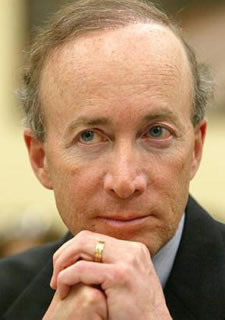 Here is a story that captures everything that's good and everything tragic about Mitch Daniels. At heart, he is clearly an intelligent, sane man. But it's also clear that the process of obtaining the GOP presidential nomination will drive out every reasonable impulse he has.
First, the sane, reasonable part:
Indiana Gov. Mitch Daniels, who is considering a run for the 2012 Republican presidential nomination, veered from his party’s orthodoxy on end-of-life care Friday, suggesting the nation cannot afford to provide every treatment and technology available for every single dying patient.
“We all want to live forever. We want everything done to help us,” he told health care reporters during a discussion of Medicare and its financial pressures. “And we cannot, no one can, do absolutely everything that modern technology makes possible for absolutely everyone ’til absolutely the very last day, the very last resort.”
He added that he understands the urge by families to push for what may be futile care. “It’s the most human thing in the world,” he said. “Your loved one is in desperate shape.” He said “we can try this thing that has almost no chance of working” but questioned whether it is worth it, especially given that “it’s going to cost an incredible amount of money.”
How refreshing. But last year, when the Obama administration pursued the tiniest, most incremental step in this direction -- allowing Medicare to reimburse the cost of end-of-life counselling -- Republicans called it "death panels" and Democrats retreated. So what does Daniels think about this modest, tiny, incremental step in the direction he'd like to see?
And he balked when asked whether Medicare should reimburse doctors for taking time to talk with patients about end-of-life care. It was this type of suggestion during the health care debate that led to the false charge that Democrats wanted government “death panels” for Medicare patients. The Obama administration recently backed off a preliminary decision to reimburse doctors for this work; many suspected politics were at work.
“I don’t have anything more to say,” he said. “I’ve said that it’s an issue we are going to have to wrestle with.”
How pathetic. He's willing to talk about pulling the plug on Granny -- a radical measure -- but he's not willing to endorse the ridiculously tiny step of letting Granny and her family talk to counselors about their options so they can make up their own mind.
The most hilarious passage of the article is when Daniels "clarified" a previous act of heresy:
At one point during the discussion, as reporters pressed for his views, Gov. Daniels abruptly changed the subject to clarify an earlier comment, where he said he didn’t care whether antitax activist Grover Norquist criticized Indiana’s cigarette tax, used to pay for a state health care program. He clarified that he does care what Mr. Norquist says.
That actually is clarifying, though the reality it clarifies is pretty depressing.
The GOP's Overblown Fear Of Blowing It Against Obama
Republicans, reports Jennifer Rubin, are nervous that their weak candidate field is going to blow a great chance to knock of President Obama:
If you talk to Republicans in D.C. -- or in Israel, for that matter -- the overwhelming sentiment about the 2012 contenders is a mix of un-enthusiasm and nervousness. Republicans genuinely believe that the economy and Obama's failure to exert leadership on our fiscal crisis provide an opening for Republicans to do the unusual -- defeat an incumbent president....
There is widespread conservative fretting within the Beltway. Could a golden opportunity slip through the GOP's fingers?
I don't really think it's a golden opportunity. I think it's more of a long-shot opportunity. Incumbent presidents usually win. They can lose if they're quite unpopular, but Obama isn't:
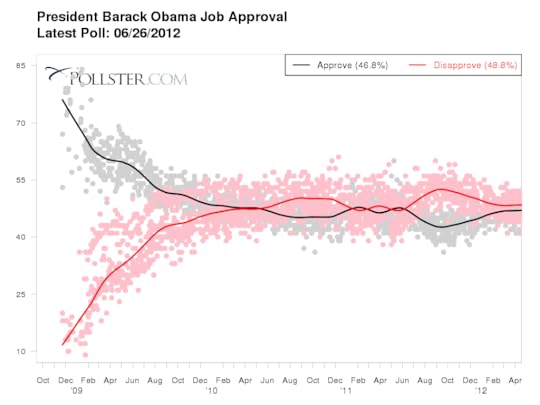
If you want to project that standing onto the electoral college, PPP conducted polling in nine states that flipped from George W. Bush in 2004 to Obama in 2008, matching Obama against four leading opponents. Obama is currently leading in every state against every contender:
In 2008 Barack Obama won nine states and one electoral vote giving Congressional district that had gone to George W. Bush in 2004. We've now polled every single one of those over the last three months except for Indiana, where we can't do one because of restrictions on automated polling in the state. Across 36 horse race match ups against Newt Gingrich, Mike Huckabee, Sarah Palin, and Mitt Romney in Florida, Ohio, North Carolina, Colorado, New Mexico, Virginia, Iowa, Nevada, and Nebraska's 2nd Congressional District Obama is 36 for 36. If he stood for reelection today against one of the current Republican front runners Obama would almost certainly win the same number of electoral votes he did in 2008, if not more. ...
Republicans need two things to happen over the next 20 months if they're going to beat Obama and time is one thing they have on their side- they need a much stronger candidate to emerge, whether it's someone outside this top 4 or someone inside this top 4 successfully remaking their image, and they need Obama's numbers to get back in negative territory and probably by a good amount- somewhere south of 45%.
Lots can happen between now and November '12. But the key factor is the economy, and it's a lot easier to imagine that getting better than it getting worse.
Why The Administration Was Surprised By Mubarak's Speech

When Hosni Mubarak announced last night he planned to stay in office until September, the Obama administration appeared totally shocked. Why? Almost certainly because the administration has been working closely with the Egyptian military, and the military was shocked as well:
Maj. Gen. Safwat El-Zayat, a former senior official of Egypt's General Intelligence and member of the Egyptian Council of Foreign Affairs, asserted, in an interview with Ahram Online, that the address delivered by President Mubarak last night was formulated against the wishes of the armed forces, and away from their oversight. He claimed that Vice Preisdent Omar Suleiman's address, which came on the heels of Mubarak's address, was equally in defiance of the armed forces and away from its oversight.
Attributing this information to his own sources within the Egyptian military, Maj. Gen. El-Zayat said there was now a deep cleavage between the armed forces, represented in its Supreme Council, and the Presidential authority, represented in both President Mubarak and his Vice President, Omar Suleiman.
According to El-Zayat, communiqué #2 issued this morning by the Supreme Armed Forces Council was not, as many people in Egypt and elsewhere understood it, an affirmation of the addresses of Mubarak and Suleiman, but rather an attempt to avoid an open conflict, while at the same time underlining that the army will act as guarantor for the transition to full democracy. He advised that people should listen carefully to the anticipated communique #3.
I'll join all the other domestic-focused bloggers by noting that I have no expertise to offer here but I'm as fascinated and moved by the events in Egypt as anybody. Who knows what the future holds for Egypt -- at the moment we're witnessing one of the most promising moments in the whole history of the Arab world, and I feel giddy. On to democracy in Egypt. And on to Iowa for Mubarak!
Sorry, The CBO Did Not Say Health Reform Kills 800,000 Jobs
Republican pollsters have found that, to whatever degree people are upset about the Affordable Care Act, it is primarily a function of economic conditions rather than ideological opposition to the concept of the law. They accordingly have done everything to frame their opposition in terms of jobs, including titling their repeal bill the "Repealing The Job-Killing Health Care Law Act."
Yesterday, CBO Director Doug Elmendorf testified before the House Budget Committee, and confirmed his agency's finding that the Affordable Care Act would, very slightly, reduce employment levels. In keeping with their policy of loudly touting every CBO analysis that backs up their talking points while dismissing out of hand every CBO analysis that refutes them, Republicans excitedly circulated the video. Here are typical reactions from the Weekly Standard's Jeffrey Anderson ("CBO Director Says Obamacare Would Reduce Employment By 800,000 Workers") and National Review'a Yuval Levin ("Job Killing.")
This description is, at best, highly misleading. CBO did not find that the ACA would kill jobs. It found that "the legislation, on net, will reduce the amount of labor used in the economy by a small amount—roughly half a percent—primarily by reducing the amount of labor that workers choose to supply." It won't be the case that there will be fewer jobs available. It's simply that fewer people will choose to work. Why? CBO explains:
The expansion of Medicaid and the availability of subsidies through the exchanges will effectively increase beneficiaries’ financial resources. Those additional resources will encourage some people to work fewer hours or to withdraw from the labor market. In addition, the phaseout of the subsidies as income rises will effectively increase marginal tax rates, which will also discourage work. But because most workers who are offered insurance through their jobs will be ineligible for the exchanges’ subsidies and because most people will have income that is too high to be eligible for Medicaid, those effects on financial resources and marginal tax rates will apply only to a small segment of the population.
Other provisions in the legislation are also likely to diminish people’s incentives to work. Changes to the insurance market, including provisions that prohibit insurers from denying coverage to people because of preexisting conditions and that restrict how much prices can vary with an individual’s age or health status, will increase the appeal of health insurance plans offered outside the workplace for older workers. As a result, some older workers will choose to retire earlier than they otherwise would.
In other words, people who are only working because they desperately need employer-sponsored health insurance will no longer do so. They're not going on the public dole -- they're just people who have the means not to work full-time and will be free to make employment decisions that aren't premised upon an individual health insurance market that shuts them out. Some workers will choose to retire early because they now have the ability to buy their own health insurance. This is what Republicans call "destroying jobs."
Now, CBO does show a very minor effect of higher taxes discouraging the work incentive. But this is a very small portion of what is a fairly small effect to begin with. Basically the analysis shows the effect of giving workers with preexisting conditions access to a health care system that doesn't lock them into the employer-provided system. Apparently, in the conservative view, being chained to your desk at some big company until you're 65 and unable to retire or start your own business because the individual market is rife with adverse selection is defined as "freedom."
[image error]
Freedom!
Court-pocalypse
Peter Brown points out that the Supreme Court probably won't rule on the individual mandate until 2012, and its members aren't getting any younger:
Chief Justice John Roberts, one of that majority, is 56 years old. The others, and their ages, are Antonin Scalia, 74; Anthony Kennedy, 74; Clarence Thomas, 62; and Samuel Alito, 60. Justice Kennedy is considered the least likely of the group to vote for invalidating the law.
The four “liberal” justices are Ruth Bader Ginsburg, 77; Stephen Breyer, 72; Sonia Sotomayor, 56; and Elena Kagan, 50.
I doubt anybody will retire by 2012. But one practical effect of the individual mandate suit is that, should one of the justices face health problems that left them unable to continue, I don't see how President Obama could get a replacement confirmed. Republicans would block any justice who's not likely to strike down the mandate, which means Obama could only confirm a very partisan movement conservative, which obviously he'd never do.
Did The DLC Have A Philosophy?

I've always believed that Bill Clinton's "Third Way" and the Democratic Leadership Council from which it sprang offered some pretty good policies but virtually nothing in the way of a coherent philosophy other than "do stuff that works and/or is popular." Here's Ron Brownstein's summary of the opposite view:
Clinton blended the DLC’s centrist reformism with his own Southern populism to produce a distinctive governing philosophy that lastingly shifted the political debate within his party—and the nation.
Drawing heavily on DLC thinking, Clinton argued that economic policy should prioritize growth over redistribution; that social policy should link opportunity and personal responsibility (most notably by requiring welfare recipients to work but providing them education and child care); and that fiscal discipline was compatible with government activism. Challenging his party’s retreat from global engagement since Vietnam, Clinton embraced both free trade and a robust U.S. international role. Rejecting “false choices” of the Left and Right, he insisted on a “third way” between them. The DLC “made a major contribution to breaking out of the old Right-Left debate and formulating the debate the way it should be—as tomorrow versus yesterday,” Clinton said in an interview.
As president, Clinton sometimes strayed from these DLC-influenced ideas (especially during his chaotic first two years).
Let's consider these three elements of the DLC's distinctive governing philosophy. First, growth over redistribution. This isn't the same thing as saying Clinton opposed redistribution. Indeed, his DLC-inspired platform emphasized raising taxes on the rich and reducing them on the middle class. That is pure redistribution. Now, it's true that Clinton favored growth, and in the latter part of his term he chose to reduce the national debt over more redistributive activist government alternatives. But I think the better way to characterize this mix is that Clinton, like traditional liberals, favored both growth and redistribution, and he crafted policies that blended the two goals effectively.
Second, Clinton and the DLC believed "social policy should link opportunity and personal responsibility (most notably by requiring welfare recipients to work but providing them education and child care)." "Responsibility" was a big slogan for Clinton and the DLC. But I think welfare reform was not merely the most notable element of this philosophy, it was the entirety of this philosophy. What other ways did Clinton, but not traditional liberals, demand responsibility? I think welfare reform had both a strong substantive and political justification. It's the attempts to define it as stemming from a philosophy that don't persuade me.
Finally, they argued "fiscal discipline was compatible with government activism." Sure. But dread paleoliberals Walter Mondale and Michael Dukakis believed the same thing, and they also had plans to reduce the deficit.
Again, Clinton did move his party to the center, for both substantive and political reasons, and generally with success. The issues on which he moved to the center, the party hasn't moved back. But the efforts to define that move as a coherent philosophy struggled at the time, and continue to struggle, which is part of the reason the DLC failed to adapt itself to the post-Clinton world and ultimately died.
Jonathan Chait's Blog

- Jonathan Chait's profile
- 35 followers

