
Jonathan Chait's Blog, page 118
February 7, 2011
DLC, RIP
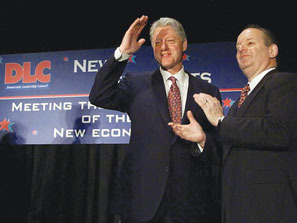 This would have been shocking ten years ago:
The Democratic Leadership Council, the iconic centrist organization of the Clinton years, is out of money and could close its doors as soon as next week, a person familiar with the plans said Monday.
The DLC, a network of Democratic elected officials and policy intellectuals,tried -- but has failed -- to remake itself in the summer of 2009, when its founder, Al From, stepped down as president. Its new leader, former Clinton aide Bruce Reed, sought to remake the group as a think tank, and the DLC split from its associated think tank, the Progressive Policy Institute.
It's hard to remember, but the whole rise of the progressive netroots was organized around opposition to the DLC, which liberals saw as Satan incarnate. Bill Clinton was an early member, and the DLC helped frame his presidential candidacy.
I always had mixed feelings about the group. I think it was about half innovative effort to counterbalance traditional Democratic interest groups, and half naked effort to suck up to corporate America and/or give contentless messaging cover to red state Democrats.
But for the main part, the DLC disappeared because its work was over. The remaking of the Democratic Party begun by Clinton held in place. The DLC floundered because it had nowhere else to go -- having moved the party to the center, it could only advocate for the party is it stood in the Clinton and post-Clinton era, or advocate that it move further still toward the center. It became a an anachronism.


Reagan Revisionism And Reagan Mythology
 Politico has an interesting feature about the fear among conservatives that their campaign to canonize Ronald Reagan has turned their hero into a post-ideological hero, rather than an embodiment of conservative values. A specimen of this fear is Steven Hayward's National Review essay, Reagan Reclaimed," castigating liberals for an ideological kidnapping of Ronaldus Magnus.
Before I wade into this, I should summarize my view of Reagan. I don't think he was a great president. The main accomplishment which he's credited, winning the Cold War, is one in which his policies contributed a very small amount. The most important cause of the fall of the Soviet Union by far was its failed, unsustainable political and economic system, which would have eventually collapsed regardless of American policy. (It's interesting that conservatives' mania for crediting Reagan with the fall of the USSR has required them to downplay the inherent faults of communism, which you'd think they'd naturally emphasize.) The second factor, a distant second, is the postwar containment architecture, created by Harry Truman and maintained by every president through George H.W. Bush, which including a military commitment to defend Western Europe, a series of anti-Soviet alliances, military support for governments threatened with communist invasion and occasional diplomatic or military support for anti-communist guerillas. A third factor, far less significant than the second, was Reagan's incremental ratcheting up of the bipartisan containment policy, which may have slightly hastened the Soviet crackup.
Domestically, Reagan had two main accomplishments. One was to legitimize the religious right as a powerful Republican constituency, a change that has continued to reverberate through American politics. The second was to legitimize massive, non-emergency deficits:
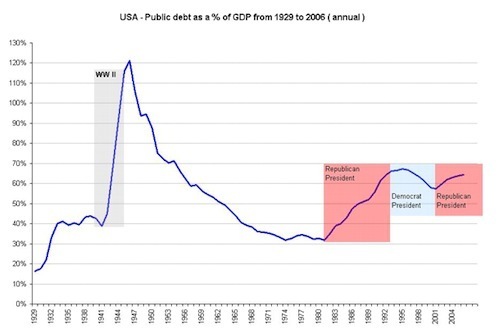
When Dick Cheney batted down a concern about red ink at an internal policy meeting of the Bush administration by insisting "Reagan proved deficits don't matter," he was expressing a perception that has transformed Republican politics ever since.
Now, it's true that the Reagan policies I've described were right-wing ones which alienated liberals at the time and to this day, and have made him a beloved figure on the right.
The source of the revisionism is that, in two of those areas, Reagan reversed himself completely. In foreign policy, he alienated the right by pursuing a detente policy with the USSR. Domestically, his administration recognized that the formula of higher defense spending plus huge tax cuts was a recipe for total fiscal disaster. Reagan agreed to a series of large tax hikes after 1981, and in 1986 signed a tax reform that, while lowering nominal rates, increased the share of taxes paid by the rich.
All of these things would be totally anathema to the modern GOP. (The Bowles-Simpson commission proposed a tax reform similar to Reagan's, and a handful of Republicans were willing to accept it only in return for large spending cuts.) The liberal case for Reagan, then, is that, after introducing new, previously unthinkable right-wing policies, he pragmatically abandoned them as a failure. Conservatives have since pretended that they were Reagan's consistent policy as part of a successful effort to entrench them as unchallenged party dogma.
The right's reaction to this revisionist account is an attempt to preserve the myth of Reagan as right-wing purist. Heyward, in National Review, repeats the charge -- "He raised taxes! He talked to the Soviets and reached arms agreements!" -- but seems to think that putting sarcastic exclamation points after these facts is sufficient to refute them. Heyward's refutation focuses on the fact that Reagan and the left did not like each other much at the time, which doesn't refute the point.
The closest Heyward comes to explaining away Reagan's turn away from (what we now regard as) conservatism is to note that "He expressed disappointment in his diary in 1983 when the Greenspan commission on Social Security came in with a conventional tax-hiking plan to keep the system alive." Right, except he wound up supporting it.
The idea of Reagan as dissident to his own administration's policies actually dates back to the Reagan administration itself, when conservatives complained that the president had been captured by moderate advisors. They even formulated a slogan, "Let Reagan be Reagan," to express their belief that the administration's policies did not represent Reagan's preferences.
I happen to think conservatives were correct about this. But, then, I think Reagan frequently had little idea what his administration was doing. Lou Cannon's masterful Reagan biography portrayed the man as utterly disengaged from the details of governance:
The sad, shared secret of the Reagan White House was that no one in the presidential encourage had confidence in the judgment or capacities of the president.
Pragmatists and conservatives alike treated Reagan as if he were a child monarch in need of constant protection.
Reagan's reliance on metaphor and analogy for understanding made him vulnerable to arguments that were short on facts and long on theatrical gimmicks.
He made sense of foreign policy through his long-developed habit of devising dramatic, all-purpose stories with moralistic messages, forceful plots, and well-developed heroes and villains.
The more Reagan repeated a story, the more he believed it and the more he resisted information that undermined its premises.
Ronald Reagan's subordinates often despaired of him because he seemed to inhabit a fantasy world where cinematic events competed for attention with reality.
(Those excerpts were culled from Rick Hertzberg's classic 1991 review-essay about Reagan.)
The trouble with the conservative view of Reagan as internal dissident to the Reagan administration is twofold. First, it requires us to construct an alternate definition of "Reaganism" that is defined by diary entries and other expressions of Reagan's private thoughts, as opposed to the actual Reagan administration policies.
Second, conservatives deny the obvious corollary to #1: Reagan was intellectually detached and/or suffering from early Alzheimer's symptoms during his presidency. Indeed, they regard this as a scurrilous lie, even as they wave off huge swaths of his policy as the manipulations of aides working against his wishes. I have never seen a conservative attempt to reconcile these two key elements of the Reagan liturgy. Ultimately, Reagan worship is an exercise in creating politically useful myths for the conservative movement.
The Patriot Act And Understanding The Tea Party
Tea Party Republicans are not making a fuss about extending the Patriot Act:
The Patriot Act, one of most prominent expansions of federal authority in the past decade, received overwhelming Republican backing in 2006 when it was first up for renewal. This year, even as the surge of the tea party brought to Washington a new legion of lawmakers suspicious of government power, the law again has a good chance of being reauthorized.
The fact that this is considered surprising or even newsworthy suggests a widespread misunderstanding of the Tea Party movement. It is not an anti-government movement per se. Tea partiers do castigate Republican leaders for spending too much, but so do Republican leaders. (That is the cycle of GOP fiscal policy: 1) pass a bunch of tax cuts while promising it won't lead to deficits, 2) Deficits appear, 3) Blame excessive spending and promise more tax cuts.)
The Tea Party movement represents an intensification of the ideological forces within the Republican Party, not a change. Its anti-government impulses are focused almost entirely on those functions of government that involve redistribution of resources from the fortunate to the unfortunate. Civil liberties were not and are not on the radar.
Who Wants To Date A Serial Killer?
You know how they say the culprit is always the person you least expect? Actually, the culprit is quite often a person you most suspect, like a really creepy serial killer:
Still, the person who had raped and strangled the woman, Cornelia Crilley, a 23-year-old Trans World Airlines flight attendant, eluded him, and the case went unsolved.
Then last month, almost 40 years after he was assigned to the case, Mr. Donnelly, now retired, heard for the first time the name of the man the authorities now believe killed Ms. Crilley: Rodney Alcala, a photographer and a one-time contestant on “The Dating Game” who is on death row in California for murdering five people in the late 1970s.
The notion of a serial killer appearing on "The Dating Game" seemed interesting enough for me to look up, and sure enough, it's on Youtube. The lucky bachelorette actually selects Alcala:
I actually think you could use this concept as a sort of combined game show/reality show. The concept would be a game show in which a woman picks a date from three men, and one of them is actually a serial killer. It may sound tasteless now, but in about five years it will be tame compared to what's on television.
Today In the Budget Showdown
Gearing up for the budget fight, the Obama administration is trying to show it's the reasonable party by offering up cuts to programs its favors. Budget director Jacob Lew writes:
In each of the past two years, the administration has put forward about $20 billion in savings from ending some programs and reducing funds for others. This entailed finding programs that were duplicative, outdated and ineffective. But to achieve the deeper cuts needed to support this spending freeze, we have had to look beyond the obvious and cut spending for purposes we support. We had to choose programs that, absent the fiscal situation, we would not cut.
Since they were instituted, community service block grants have helped to support community action organizations in cities and towns across the country. These are grassroots groups working in poor communities, dedicated to empowering those living there and helping them with some of life’s basic necessities. These are the kinds of programs that President Obama worked with when he was a community organizer, so this cut is not easy for him.
Yet for the past 30 years, these grants have been allocated using a formula that does not consider how good a job the recipients are doing. The president is proposing to cut financing for this grant program in half, saving $350 million, and to reform the remaining half into a competitive grant program, so that funds are spent to give communities the most effective help.
Another difficult cut is a reduction of $125 million, or about a quarter of current financing, to the Great Lakes Restoration Initiative, which supports environmental cleanup and protection. And a third is a reduction in the Community Development Block Grant program. These flexible grants help cities and counties across the nation finance projects in areas like housing, sewers and streets, and economic development in low- and moderate-income neighborhoods.
The strategy is that, when the budget showdown occurs, the White House wants to hold the center and show it's willing to support some cuts, but it won't go as far as Republicans demand. The whole context is a GOP budget that is placing the entire weight of deficit reduction upon the domestic portion of the discretionary budget. The Wall Street Journal editorial page complains that attacks on the GOP budget plans, being formulated by Paul Ryan, are being attacked in contradictory ways:
It's amusing to hear the media and some Democrats joining tea partiers in saying that Republicans are failing to meet their budget pledge to voters. In the same breath they also say that Mr. Ryan's cuts of 20% or more to some programs are too deep and painful. The White House is even saying the cuts could torpedo the economic recovery—though the stimulus couldn't keep unemployment below 9%.
So Republicans can't win: Their cuts are attacked as both too large and too small at the same time.
Actually, there's not much of a contradiction here. The GOP is leaving untouched Medicare, Medicaid, Social Security, Defense, Homeland Security, and -- by necessity -- interest on the national debt. And, of course, they wouldn't think of increasing revenues. What remains is a myriad of programs that include a lot of vital functions of the federal government but represent a small slice of the budget. The Ryan budget would cut them on average by 15%, but still make a tiny dent in the federal budget. The overall point is that a deficit reduction effort focused entirely on reducing one small category of domestic spending is both destructive and ineffectual.
February 6, 2011
TNR's Egypt Coverage
For almost two weeks, the world’s eyes, ears, and hearts have been focused on Egypt, where protestors have amassed to demand an end to President Hosni Mubarak’s dictatorial regime. TNR has been covering the events closely, gathering some of the best commentary and on-the-ground reporting on this history-making event. Here, we have compiled our Egypt coverage, though look for more in the days and weeks ahead:
“‘With Our Eyes Wide Open'” By Leon Wieseltier
“The President in Occultation” by Leon Wieseltier
“American Liberals and the Streets of Cairo” by Leon Wieseltier
“The Failure of U.S. Aid in Egypt” by David Rieff
“Egypt and Indonesia” by Thomas Carothers
“Déjà Vu in Cairo: Lessons from 2005” by Eli Lake
“A Completely Unpredictable Revolution” by Josef Joffe
“The Answer to Egypt’s Problems? An Obscure Plan From the 1980s” by Khairi Abaza and Jonathan Schanzer
“A Note of Warning and Encouragement for Egyptians: From an Iranian Writer Who Lived Through the 1979 Revolution” by Abbas Milani
“Five Things to Understand About the Egyptian Riots” By Heather Hurlburt
“Cairo Dispatch: How Public Opinion Turned Decisively Against the Egyptian Dictator” by Eric Trager
“Cairo Dispatch: Black Friday” by Eric Trager
“Cairo Dispatch: Material World” by Sarah Topol
“Cairo Dispatch: Fear Descends on Cairo” by Sarah Topol
“Cairo Dispatch: Upside Down” by Sarah Topol
“Cairo Dispatch: Understanding Egypt’s Protests” by Sarah Topol
“Cairo Dispatch: The Anti-Mubarak Love Train” by Sarah Topol
“Fox’s Egypt Problem” by James Downie
The Auto Company As Public Entity
I realize that this two-minute Super Bowl spot is mostly Chrysler's attempt to use Detroit to brand itself and sell cars. But I think there's more to it -- a genuine attempt by the company to defend the city where it is based. As a native of the area I was actually a little moved watching this:
Eminem is featured in the spot. I remember years ago, Ann Arbor native Bob Seger, who I believe did not do advertising, used his song "Like A Rock" in a truck commercial. He explained that people in Michigan had been asking him when he was going to do something to help the auto companies, so he relented. I can't vouch for the accuracy of his account, but I believe it. As hard as it may believe for non-Michiganians to believe, people in Detroit think of the auto industry less as a profit-seeking corporation and more as as a public entity responsible for the well-being of the community. That, I would bet, is why you see Eminem doing a Chrysler ad.
February 4, 2011
The Pathology Of Repeal
Yesterday I somewhat cynically suggested that Republicans were not interested in actually altering the individual mandate of the Affordable Care Act. Today, Mitch McConnell says he's not interested in altering anything about the law:
Republicans aren't likely to bury the hatchet with President Obama over the healthcare reform act, their Senate leader said Friday.
Senate Minority Leader Mitch McConnell (R-Ky.), fresh off an unsuccessful vote on Wednesday to repeal healthcare reform, said not to expect Republicans to strike any agreements with the president.
"I think it’s clear that this is an area upon which we are not likely to reach any agreements with the president," McConnell said on conservative pundit Laura Ingraham's radio show.
If this was a dispute about policy, of course, Republicans would be willing to pursue alterations. Democrats didn't like the Bush tax cuts, but if Bush had been willing to tighten up some tax loopholes, maybe lose the estate tax cuts, then they'd have been happy to entertain some alterations. While they may not have liked the law, they could surely imagine ways to improve it that could meet with bipartisan approval, especially given President Obama's professed willingness to negotiate changes. They could do so while still pursuing their preferred model of health care reform.
But the Affordable Care Act has become tot he right a symbolic totem that has little to do with actual policies. Its very existence is an enduring emotional wound. Greg Sargent writes:
Consider this article by the Post's Amy Goldstein, which quotes a range of Tea Partyers talking about the repeal of "Obamacare" in fervent and even messianic tones. They are prepared to invest years in realizing this goal. It's clear that for an untold number of base GOP voters, major questions about political and national identity are now bound up in repeal. An entire industry has been created around this new Holy Grail. There is now a big stake for a whole range of actors, some less reputable than others, in keeping millions of Americans emotionally invested in the idea that total repeal is not only achievable, but absolutely necessary to preserving their liberty and the future of the republic.
The GOP is operating not on the basis of some analysis of public policy but from a sheer pathology.
Adventures In Imagining Popular Support
Charles Krauthammer on E.P.A. regulation of carbon emissions:
I think it shows how ideologically determined the Obama administration is even after being chastised heavily in the midterm election about overreaching. It’s trying to reach around Congress, around the will of the people — and Congress when it rejected cap-and-trade — essentially imposing the carbon tax on the country which doesn’t want it, but it’s going to try to do it by regulation.
On what basis does Krauthammer assert that the people don't want the E.P.A. to regulate carbon emissions? There's not much polling on this, but the polling I've seen shows strong support for regulation.
Now, it's true that support for carbon taxes in weaker. (It's also true that Krauthammer at least used to support such a tax.) So you could say that if the public understood the issue better, they'd realize carbon regulation is an effective tax, and oppose it. But 'd also say that if the public understood the issue better they'd support a carbon tax. It's not an issue where the public has a strong grasp of the details. If you want to deal with public opinion as it exists, the evidence suggests people support the administration's regulatory agenda on the environment.
Rumsfeld's Extremely Qualified Regrets
 Don Rumsfeld's memoir is coming out soon. Hey, don't beat yourself up, Rummy:
Rumsfeld now concedes that, "[i]n retrospect, there may have been times when more troops could have helped."
The stacking of qualifications on top of one another is a characteristically Rumsfeldian touch. In retrospect, there may have been times when more troops would have helped. Not much of a concession to a reality in which it was clear at the time more troops were absolutely vital.
Jonathan Chait's Blog

- Jonathan Chait's profile
- 35 followers

