
Jonathan Chait's Blog, page 117
February 9, 2011
Arianna Huffington's Latest Self
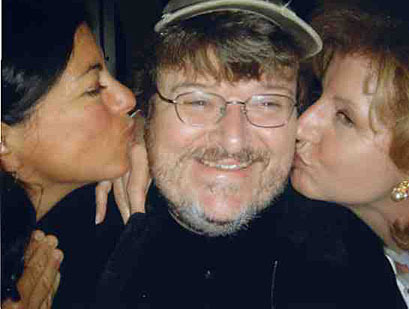
Dana Milbank has a column about Arianna Huffington's deal with AOL, which requires her to ideologically reinvent herself -- again! -- as a centrist who finds ideology tiresome:
AOL Chairman Tim Armstrong said he thinks "Arianna has the same interest we do, which is serving consumers' needs and going beyond the just straight political needs of people." Huffington agreed, boasting that only 15 percent of her eponymous site's traffic is for politics (that's down from 50 percent a couple of years ago), and she emphasized that politics is just one of two dozen "sections," including a new one devoted to covering divorces.
"It's time for all of us in journalism to move beyond left and right," Huffington said Monday on PBS's "NewsHour." "Truly, it is an obsolete way of looking at the problems America is facing."
How many times can she pull this and have people believe her? She began as a neoconservative and advisor to Newt Gingrich during the Republican revolution. She eventually tired of it and moved to a post partisan-phase, a stance that evolved into a Nader-esque critique of both parties from the left, culminating in her high-profile 2000 role holding "shadow conventions" in which various liberal and left-wing figures highlighted issues ignored during the campaign. It was the perfect vehicle to harness liberal disillusionment with Clinton.
Of course, liberal disillusionment with Clinton led directly to George W. Bush, which by 2004 led to a massive upsurge in liberal partisan activism, which Huffington managed to harness as well. I'll let Isaac Chotiner pick up the story:
By 2004, the Iraq invasion was starting to look like something less than a brilliant success, and liberal disgust with the Bush administration was reaching its zenith. Meanwhile the rise of the so-called "netroots," coupled with grave concern about the possibility of a second Bush term, had destroyed almost all momentum for insurgent political movements. The only threat to the status quo could come from John Kerry and a Democratic Party whose principal argument was that they were better at Washington than Bush was. This was the year that saw the publication of Fanatics and Fools, Huffington's "game plan for winning back America," which signaled that she had made her peace with the Democratic Party. Many of the book's problems--particularly its over-the-top criticisms of Schwarzenegger--were owed to her old habit of pushing any argument a demagogic step too far, of wanting too much to be noticed. There was something almost comical about the insistence of this sudden liberal that she be regarded as some kind of leader of American liberalism--that her latest incarnation be treated as her whole story.
Right Is Wrong, Huffington's newest book, is a useful document of her current version, in which progressive politics seem to come so naturally to her that one almost forgets that she has been traveling the whole time. The result is a book that is less genuine and more tiresome. "Yes, the Republican Party has always had its far-right cowboys, its Jesse Helmses and Spiro Agnews," Huffington says near the beginning of the book, explaining her transformation. "Yet they were removed from the party's more sober core. But these days ... it has become impossible to tell where this core stops and the fanatical fringe begins." You have to re-write a not insignificant amount of history to describe the Republican Party's second postwar vice president and one of its most powerful senators--the latter a man who did the country an untold amount of damage in the realm of foreign affairs, at a time when Huffington was an active member of the GOP--as "removed" from anything other than, respectively, respect for the rule of law and common sense. There is some truth to her account of the party's evolution, even if, in a bid to make the book appear timely, locating it in the willingness of Republican primary voters to vote for their longtime bete noire John McCain is odd. She also addresses her erstwhile affection for Gingrich by saying that although he "talked a good game," his heart was "never in it." This is odd, because if there is anything that can be said for Gingrich's intellectual and political wildness, it is that his heart is in it.
Right Is Wrong is one of those books that is completely irritating even when it is correct. Like all people who have discovered their own importance, Huffington has become dull. Consider this bit: "In this time of Lilliputian figures it's clear that to end the hijacking of America by the Right each one of us needs to take up the gauntlet and stand up for truth, no matter how many in the corridors of power or at the top of the media food chain would prefer to maintain the status quo. Leadership is a risky business requiring wisdom, courage, and fortitude--and as my compatriot Socrates put it, courage is the knowledge of what is not to be feared." Her compatriot Socrates! Maybe she should have him over for dinner with some other really interesting people.
And now she is discarding liberal ideology again for a business deal. But I bet she'll be back by, oh, 2020.


February 8, 2011
Capping Off Fred Upton Day
In an effort to make this blog the go-to place for coverage of Rep. Fred Upton -- and reader surveys* suggest this is what the internet audience wants more than even naked photos of attractive actresses -- I am linking Upton's latest handing over of what remains of his soul:
This morning, Upton was pressed by National Journal‘s Ron Brownstein as to why the Upton-Inhofe bill describes climate change as “possible.” After repeated attempts to avoid the question, Upton finally explained his wide-straddling stance: he accepts that the planet is warming, but not that the billions of tons of greenhouse gases emitted by human activity are a cause:
I have said many times, and there was a report a couple of weeks ago that in fact you look at this last year, it was the warmest year in the last decade, I think was the numbers that came out. I don’t — I accept that. I do not say that it is man-made.
Further Upton updates as events warrant.
*entirely fictional
In Defense of Reforming Teacher Evaluations
One of the hot debates in education policy centers around the use of quantitative measures to evaluate teachers -- measuring student achievement and tying teacher compensation, in some way, to that. Jim Manzi has some interesting, though flawed, thoughts about the problems with such measuring systems:
I’ve seen a number of such analytically-driven evaluation efforts up close. They usually fail. By far the most common result that I have seen is that operational managers muscle through use of this tool in the first year of evaluations, and then give up on it by year two in the face of open revolt by the evaluated employees. This revolt is based partially on veiled self-interest (no matter what they say in response to surveys, most people resist being held objectively accountable for results), but is also partially based on the inability of the system designers to meet the legitimate challenges raised by the employees.
Here is a typical (illustrative) conversation between a district manager delivering an annual review based on such an analytical tool, and the retail store manager receiving it:
District Manager: Your 2007 performance ranking is Level 3, which represents 85% payout of annual bonus opportunity.
Store Manager: But I was Level 2 (with 90% bonus payout) last year, and my sales are up more than the chain-wide average this year.
DM: [Reading from a laptop screen] We now establish bonus eligibility based on your sales gain versus the change in the potential of your store’s trade area over the same time period. This is intended to fairly reflect the actual value-added of your performance. We average this over the past three years. Your sales were up 5% this year, but Measured Potential for your store’s area was 10% higher this year, so your actual value-added averaged over 2005 – 2007 declined versus 2004 – 2006.
SM: My “area potential” increased 10%? – that’s news to me. Based on what?
DM: The new SOAP (Store Operating Area Potential) Model.
SM: What?
DM: [Reading from a laptop screen] “SOAP is based on a neural network model that has been carefully statistically validated.” Whatever that means.
[Continues reading] “It considers such factors are trade area demographic changes, competitor store openings, closures and remodels, changes in traffic patterns, changes in co-tenancy, and a variety of other important factors.”
SM: What factors are up that much in my area?
DM: [Skipping to the workbook page for this specific store, and reading from it] A combination of factors, including competitor openings and the training investment made in your store.
SM: But Joe Phillips had the same training program in his store, and he had no new competitor openings – and he told me that he got Level 2 this year, even though his sales were flat with last year. How can that be?
DM: Look, the geniuses at HQ say this thing is right. Let me check with them.
[2 weeks later, via cell phone]
DM: Well, I checked with the Finance, Planning & Analysis Group in Dallas, and they said that “the model is statistically valid at the 95% significance level “ (whatever that means), “but any one data point cannot be validated.”
[10 second pause]
Let me try to take this up the chain to VP Ops, and see what we can do, OK?
SM: Whatever. I’ve got customers at the register to deal with. [Hangs up]
That's an interesting insight into the general problem with quantitative measures. Here are a few points in response:
1. You need some system for deciding how to compensate teachers. Merit pay may not be perfect, but tenure plus single-track longevity-based pay is really, really imperfect. Manzi doesn't say that better systems for measuring teachers are futile, but he's a little too fatalistic about their potential to improve upon a very badly designed status quo.
2. Manzi's description...
evaluating teacher performance by measuring the average change in standardized test scores for the students in a given teacher’s class from the beginning of the year to the end of the year, rather than simply measuring their scores. The rationale is that this is an effective way to adjust for different teachers being confronted with students of differing abilities and environments.
..implies that quantitative measures are being used as the entire system to evaluate teachers. In fact, no state uses such measures for any more than half of the evaluation. The other half involves subjective human evaluations.
3. In general, he's fitting this issue into his "progressives are too optimistic about the potential to rationalize policy" frame. I think that frame is useful -- indeed, of all the conservative perspectives on public policy, it's probably the one liberals should take most seriously. But when you combine the fact that the status quo system is demonstrably terrible, that nobody is trying to devise a formula to control the entire teacher evaluation process, and that nobody is promising the "silver bullet" he assures us doesn't exist, his argument has a bit of a straw man quality.
Fred Upton, Linguist
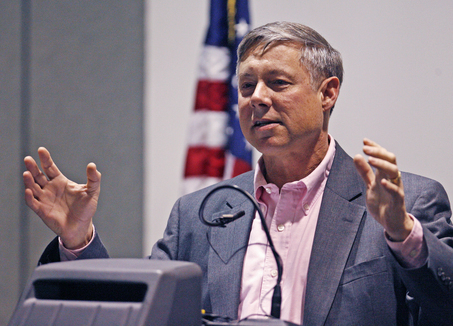
Apparently Fred Upton's method of communicating is an even richer subject than I had thought. Two sentences of Upton's were so jargon-laden that they inspired a long meditation by David Roth:
The topic is what Stephanie K. describes as "watered down 'net neutrality' regulations, including concessions to the cable and wireless industry and companies such as Comcast and AT&T," and which Michigan congressman Fred Upton describes as "nothing less than an assault on the internet." Upton, get on the mic and tell the people what it is:
"We have all grown sick and tired of the Chicago-style politics to ram through job-killing measures at any cost, regardless of the consequences or damage to our economy. Rather than put a gun to the head of our largest economic engines, now is the time for the FCC to cease and desist."
Even assuming, as we ought, that Upton is trying to show that he hates all kinds of regulations -- even the kind that major corporations essentially craft and purchase, which are generally the most popular kind with Congress -- can you figure out what he's trying to say? It's "Do not regulate," I'm pretty sure, but he loses that simple message amid all the messaging catch-words. The result is like the spoken equivalent of an overly SEO-ed piece of web prose -- language that frustrates just about every expectation we have of language. Let's enhance:
"We have all grown sick and tired of the Chicago-style politics to ram through job-killing measures at any cost, regardless of the consequences or damage to our economy. Rather than put a gun to the head of our largest economic engines, now is the time for the FCC to cease and desist."
There is only one thing to do with someone so willing to put message fidelity ahead of the most basic coherence. You give that motherfucker a chairmanship. I'll bet the National Association of Manufacturers congratulates him. A radical splinter faction of the MLA will doubtless be next.
Upton's chairmanship is going to be fun.
Why Are Professors Democrats?
 The New York Times has one of those stories that seem to appear every six months or so about the dearth of conservatives in academia. Conservatives seem to view this entirely as a problem of academic ideological bias. I certainly think that exists, but it can't explain all or even most of the problem, given that even the hard sciences are overwhelmingly Democratic.
One factor is that conservatives are probably less likely than liberals to choose academia, as Paul Krugman notes:
Ideologies have a real effect on overall life outlook, which has a direct impact on job choices. Military officers are much more conservative than the population at large; so? (And funny how you don’t see opinion pieces screaming “bias” and demanding an effort to redress the imbalance.)
The larger issue, I have argued, is that Republicans don't understand that academia's stampede away from their party is an indictment not of academia but of them:
In recent years, and especially under George W. Bush, Republicans have cultivated anti-intellectualism. Remember how Bush in 2000 ridiculed Al Gore for using all them big numbers?
That's not just a campaign ploy. It's how Republicans govern these days. Last summer, my colleague Frank Foer wrote a cover story in the New Republic detailing the way the Bush administration had disdained the advice of experts. And not liberal experts, either. These were Republican-appointed wonks whose know-how on topics such as global warming, the national debt and occupying Iraq were systematically ignored. Bush prefers to follow his gut.
In the world of academia, that's about the nastiest thing you can say about somebody. Bush's supporters consider it a compliment. "Republicans, from Reagan to Bush, admire leaders who are straight-talking men of faith. The Republican leader doesn't have to be book smart," wrote conservative New York Times columnist David Brooks a week before the election. "Democrats, on the other hand, are more apt to emphasize ... being knowledgeable and thoughtful. They value leaders who see complexities, who possess the virtues of the well-educated."
It so happens that, in other columns, Brooks has blamed the dearth of conservative professors on ideological discrimination. In fact, the GOP is just being rejected by those who not only prefer their leaders to think complexly but are complex thinkers themselves. There's a problem with this picture, all right, but it doesn't lie with academia.
Conservatives like to present this as an issue of Marxist English professors, but the reality is that scientists, mathematicians, and people trained in rigorous thinking of all kinds are overwhelmingly rejecting them.
Republicans To Heighten The Contradictions
 Some moderate Democrats are proposing to change the individual mandate, the least popular element of the Affordable Care Act. Politico's story is entitled, "A new Dem threat to health care law." Greg Sargent frets:
If these Dems think this is going to insulate them from GOP attacks, they're kidding themselves: Last night, the NRSC sent out a release blasting McCaskill, asking why she voted for "Obamacare" in the first place if she thinks the mandate is such a bad idea. All they're succeeding in doing is undermining one of the Democratic Party's signature domestic accomplishments.
I think this totally misses what's going on here. The individual mandate is a tool to prevent people from free riding on the health insurance market. It's not the only tool to accomplish that. You can change it without threatening health care. Indeed, liberal Democrat Peter DeFazio has already proposed to replace the mandate with a plan, created by liberal health care wonk Paul Starr, to deny those who forego insurance the ability to reap the benefits of the Affordable Care Act.
Now, the moderate Democrats have not yet unveiled their proposal. But I can promise you this: it will not neuter the individual mandate and replace it with an ineffective alternative that guts the health insurance market. Why not? Because insurance companies don't want that, and if there's one thing that characterizes moderate Democrats, it's a powerful aversion to upsetting the insurance industry. The insurers are fine with the Affordable Care Act. They're fine with repealing the Affordable Care Act and going back to denying coverage to sick people. They're not fine with keeping the requirement that they cover sick people but letting healthy people stay out of the system until they get sick.
As it happens, one person who grasps what's happening, in his reptilian manner, is former Rumsfeld speechwriter Marc Thiessen, who warns Republicans not to cooperate with any attempts to modify the Affordable Care Act:
Last week, [Republicans] helped Democrats pass legislation repealing the provision Obama mentioned - a mandate that businesses file "1099" reports to IRS for all transactions of more than $600 in a given year. This provision had small businesses across the country up in arms. But instead of harnessing that anger to push for full repeal, Republicans instead helped Democrats lift this source of pressure from the business community.
Each individual proposal will seem entirely reasonable and an opportunity for bipartisan cooperation. But if Republicans go along, before they know it they will find that they have been drawn into a strategy of "fix and save" instead of "repeal and replace." ...
As more "fixes" like the 1099 repeal are adopted, the president and Democratic leaders will portray themselves as the reasonable ones who have acknowledged flaws in their law and are working to address them in bipartisan manner. Meanwhile Republicans who continue to push for full repeal will be portrayed as strident hard-liners who care more about delivering a political blow to the president than helping Americans get better health care.
Now, Democrats will portray themselves as reasonable people looking to improve the system, and Republicans will be seen as ideological hard-liners, because that in fact is the reality. But if you share Theissen's premises -- the jihad against the ACA must never be abandoned, and anything that improves the health care system is bad for the GOP -- then the drive to change the Affordable Care Act is terrible for Republicans. I predict they follow Thiessen's advice. Indeed, that notion is already afoot, as the Politico story shows:
Some in GOP circles fear that by teaming up with Democratic moderates, they could give these Democrats bipartisan cover that would help them in 2012.
Some Republicans are quietly warning colleagues not to work with vulnerable Democrats in the first place. This comes after Sen. Bob Corker (R-Tenn.) teamed up with McCaskill to back a proposal that would dramatically cut spending over the next decade and Sen. Mike Johanns (R-Neb.) worked with Manchin to repeal a small-business reporting provision in the health care law.
If you think about it, this is exactly the strategy Republicans pursued in 2009-2010. If a few of them put something on the table -- and many moderate Democrats were ready, especially after the Massachusetts election, to accept the tiniest incremental scrap -- they could have persuaded Democrats to abandon the comprehensive plan they passed. Instead they calculated that withholding bipartisan support would maximize their advantage in the elections. I expect them to pursue the same strategy again.
Heads Wall Street Wins, Tails You Lose
Wall Street lawyer Steve Eckhaus defends his cruelly misunderstood clients:
"It was understandable why there was anger," says Mr. Eckhaus, but "the crisis was not caused by Wall Street fat cats. It was caused by a confluence of economic, political and historical factors."
In general, he said his clients are "pure as the driven snow" and doing work that supports the economy and justifies their pay. Mr. Eckhaus wouldn't discuss his clients' or their pay, but some agreed to be interviewed. His representation also was noted in news clippings and public filings.
"You have to know what the profits are" to know what someone should make, said Mr. Eckhaus, noting Wall Street's top performers usually gobble up 80% of the bonus pool. "Those who are responsible for profits should share in the profits in a way that rewards them."
This is rich. In one breath, Eckhaus attributes the crash of the financial system to outside forces. In the next breath, he attributes the profits of the financial system to the genius of Wall Street. When they win, they deserve full credit. When they lose, it's somebody else's fault. Nice racket.
He's Been Living In His Upton World
Fred Upton used to be considered a Republican moderate, and one of the few members of his party who accepted the scientific consensus on climate change. This made him highly suspicious to conservatives. So, in order to chair the House Energy and Commerce Committee, he had to make a few adjustments. Meet the new Fred Upton:
I had the great privilege of working for President Reagan, and his successful, free-market approach to energy offers important lessons for today's energy debate and its consequences for economic growth and job creation. Reagan inherited all the energy policy mistakes of the 1970s - a decade in which every energy challenge was met with ill-advised federal programs and mandates...
Unfortunately, Obama's State of the Union address offered more of the same: digs at oil producers as purveyors of "yesterday's energy" to be replaced by government-selected "clean energy breakthroughs." The President repeatedly mentioned "clean" but never said "affordable." In contrast, Reagan considered the latter at least as important as the former, because he understood that affordable, abundant, and reliable energy sources are essential to job creation and economic strength. ...
Ronald Reagan's free-market and limited-government approach to energy has a proven track record. On Reagan's centennial the current administration would be wise to follow his course. Two critical first steps would be to remove the obstacles to domestic oil production and put an end to EPA's global warming regulatory overreach.
The dogma here is so thick that any signs of actual thought are barely discernible. First, there's the assumption that "free market" energy policies entail putting zero price on the externality cost of dumping carbon dioxide into the atmosphere, a notion even Hayek disagreed with. Next there's the idea that everything Reagan did was correct, never mind the fact that scientists' understanding of climate change was embryonic at the time. The Gipper didn't know from climate science, and neither should we!
Whether or not Upton actually believes this tripe, I couldn't say. What matters is that this is the level of thought he needs to display in order to carry his party's banner on energy issues.
February 7, 2011
&c
-- Nicolas Lemann reviews George Bush's autobiography.
-- What would a progressive "Tea Party" look like?
-- Save jobs or raise CEO compensation? The Chamber of Commerce knows which it prefers.
These Consultants Are All Wet
[Guest post by James Downie]
Quote of the day, from the St. Petersburg Times:
We tried to coax [Florida State Democratic chairman Rod] Smith, [Alex] Sink's running mate in 2010, into discussing mistakes made in that campaign, but he wouldn't bite: "After the election, I sat down with my consultants, and their names were John Walker, James Beam and Jose Cuervo, my Hispanic consultant. When I finished with them I was done with that consultation."
Neither constitutional adviser Samuel Adams nor naval attache Captain Morgan were available for comment.
Jonathan Chait's Blog

- Jonathan Chait's profile
- 35 followers

