Larry Doyle's Blog, page 6
June 27, 2014
From the Archives: Shedding Light on Dark Pools
 In light of the recent legal action brought by NY AG Eric Schneiderman against Barclays, I thought it might be beneficial to rerun a commentary that I posted here on October 20, 2009.
Ponder that date for a minute. The issues exposed in the suit brought against Barclays are not new developments.
Think of the theft and corruption that has transpired within these dark pools and elsewhere in the last 5 years, if not much longer than that, given that our financial regulators are ‘in bed with Wall Street.’ Some of my assertions expressed in this post have been shown to be more wishful thinking than reality.
Kudos to Joe Saluzzi once again. While a number of people in the markets have been pushing for increased oversight of high frequency trading, in my opinion, nobody deserves more credit than Joe Saluzzi of Themis Trading.
The pressure initiated by Joe and pushed by others is starting to bear real results. How so?
The highly predatory nature of ‘flash orders’ will likely be discontinued. Now we learn that trading activity in dark pools will also likely be seriously restricted. What are dark pools? Why should you care? If you have an interest in the markets, you should care. Let’s navigate.
I was honored to have Joe join me on August 2nd on No Quarter Radio’s Sense on Cents with Larry Doyle. From my review of that interview, we learned that dark pools have developed in the following manner:
- Originally launched by one or two exchanges for the purpose of allowing major money managers to cross large blocks of stock ‘off the floor’ and thus protect the buyers and sellers identities and the price of the transaction
- Now every dealer and exchange have developed dark pools resulting in more and more business occurring off exchanges and without any benefit of transparency. Who is disadvantged? Those without access to the dark pools.
- Dark pools initially had minimum size orders, but many dark pools have increasingly shifted away from a size requirement.
- Dark pools have developed in such a way that some market participants will abuse the intended purpose of the facility, that is to transact, and instead will look to discover information on pending orders through these dark pools.
In summary, dark pools have become a facility which certain market participants are able to utilize at the expense of other market participants. As such, they provide anything but a level playing field. Why were these dark pools ever allowed to develop in such a fashion? Great question and likely a testament to the power of the Wall Street lobby and the profit driven structure of the exchanges.
At long last and thanks to the efforts of Joe and others who desire a fair and level playing field for all investors, the SEC is addressing the problems lurking in these dark pools. Bloomberg highlights this development in writing, Dark Pool Trade Limit Said to Be Cut 95% in SEC Plan:
The U.S. Securities and Exchange Commission will propose toughening its limits on the amount of anonymous trading carried out on stock platforms called dark pools, according to two people familiar with the deliberations.
The commission will propose lowering the amount of daily volume in a company’s shares that can be executed on the networks before prices must be made public to 0.25 percent from 5 percent tomorrow, said the people, who declined to be identified because the discussions weren’t public. John Nester, an SEC spokesman, declined to comment.
The rule change may curtail the number of transactions on dark pools, off-exchange platforms run by firms such as Goldman Sachs Group Inc. and Getco LLC that have drawn scrutiny from Democratic Senators Ted Kaufman of Delaware and Charles Schumer of New York. The systems usually shut down trading in a security when they approach the current 5 percent limit.
Traders turn to dark pools instead of public markets such as the New York Stock Exchange to avoid revealing their identities and giving competitors clues about their strategies. Kaufman and Schumer say the platforms limit transparency in securities markets and put smaller investors at a disadvantage.
A market that does not serve the interests of all its participants in an equitable fashion is not a market. An exchange which favors certain participants over others is not an exchange. Dark pools are another form of crony capitalism.
Thank you Joe Saluzzi for exposing the inequity in this corner of our landscape.
LD
Navigate accordingly.
Larry Doyle
Please order a hard copy or Kindle version of my book, In Bed with Wall Street: The Conspiracy Crippling Our Global Economy.
For those reading this via syndicated outlet or by e-mail or another delivery, please visit the blog to comment on this piece of ‘sense on cents.’
Please subscribe to all my work via e-mail.


Barclays Dark Pool Lawsuit and the ‘In Bed with Wall Street Conspiracy’
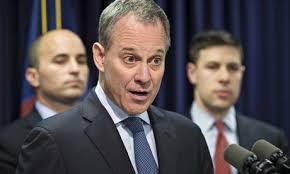 The lawsuit filed by New York Attorney General Eric Schneiderman against Barclays for ‘pernicious fraud’ in the operation of its dark pool sent shock waves through Wall Street yesterday.
The equity valuations for a number of large Wall Street banks declined significantly under the premise that this lawsuit will impact their own business operations in a negative fashion.
Beyond that, though, many might think serious allegations of lying, blatant misrepresentations, fraud, self-dealing, predatory practices aka high frequency trading, investor abuse, and the like mean one thing: just another day on Wall Street.
Let’s play hardball today and navigate a little deeper.
While many will focus on the practices exposed by this lawsuit, I am much more interested in the players. Specifically, why is it that the New York Attorney General is bringing this action rather than the Wall Street’s cops at Finra and/or the SEC?
We learn from this lawsuit that over a year ago the NY AG’s office launched an initiative that ultimately led to this suit. But let’s go back even further than that. In January 2013 — yes, January 2013 a full 18 months ago – The Wall Street Journal wrote a commentary entitled, Vow of New Light for ‘Dark’ Trades and highlighted the following:
A top U.S. regulator plans to shine a light on dark pools, private trading venues that allow buyers and sellers to post orders that are hidden from the rest of the market.
Richard Ketchum, chief executive of the Financial Industry Regulatory Authority, said in an interview Tuesday that the regulator is expanding its oversight of the dark-trading venues, with an eye on whether orders placed in public exchanges are “trying to move prices or encourage sellers that may advance their trading in the dark market.”
The regulator also is boosting its surveillance of high-speed trading and is increasingly looking at rapid-fire trading across exchanges, he said. “You’re going to see more [focus] in those areas in 2013,” Mr. Ketchum said.
Experts said regulators have lagged behind rapid advances in computer-trading technology in recent years, leaving investors in the dark about how the market operates.
Regulators are scrambling to catch up, however. Finra on Tuesday said it implemented a system in 2012 that can track trading patterns that “address more than 50 threat scenarios” across about 80% of the stock market.
The question both begs and screams, if Finra was talking about shining a light on dark pools in January 2013, then what happened?
WHERE THE HELL HAVE FINRA AND THE SEC BEEN IN TERMS OF PROVIDING MEANINGFUL INVESTOR PROTECTION AGAINST THE PRACTICES DESCRIBED IN THE NY AG LAWSUIT?
Regular readers of this blog and my book know the answer to that question. The cops at Finra and the SEC have shown themselves to be ill-equipped, incompetent, captured, or corrupt — but ultimately ‘in bed with Wall Street.’
The media and pols might feign disgust over the allegations of lying, blatant misrepresentations, fraud, self-dealing, predatory practices, investor abuse, and the like embedded within this lawsuit against Barclays. How pathetic.
If those within the fourth estate and atop Capitol Hill cared to look inside the pages of my book, In Bed with Wall Street: The Conspiracy Crippling Our Global Economy, they would see that iterations of the same destructive practices alleged in this suit have also transpired within the regulators themselves.
Navigate accordingly.
Larry Doyle
Please order a hard copy or Kindle version of my book, In Bed with Wall Street: The Conspiracy Crippling Our Global Economy.
For those reading this via syndicated outlet or by e-mail or another delivery, please visit the blog to comment on this piece of ‘sense on cents.’
Please subscribe to all my work via e-mail.
For those who care to view a 10-minute clip of AG Schneiderman addressing the charges in the lawsuit against Barclays, I welcome providing this video:

June 26, 2014
What Was The ‘Real’ Level of 1st Qtr GDP?
 Anyone with a modicum of ‘sense on cents’ is well aware of the maxim ‘garbage in, garbage out.’
If we are to believe that the inflation data reported by Uncle Sam does not properly capture the true level of price increases in our economy — did somebody say intentionally misleading — then the immediate question begs, what is the real level of economic activity in the nation?
Recall that real GDP is defined as:
A measure of economic growth from one period to another expressed as a percentage and adjusted for inflation (i.e. expressed in real as opposed to nominal terms). The real economic growth rate is a measure of the rate of change that a nation’s gross domestic product (GDP) experiences from one year to another.
If inflation is under reported, and the rate of change in our economic growth is a known figure, then by definition the output (that is, real GDP) will be overstated. So I repeat my question: What is the real level, that is a more honest and accurate assessment, of our 1st quarter GDP?
Let’s navigate and review the fabulous work of Rick Davis at Consumer Metrics Institute who goes deeper into this analysis than Uncle Sam and his lapdogs might care:
. . . for this report the BEA assumed annualized net aggregate inflation of 1.27%. During the first quarter (i.e., from January through March) the growth rate of the seasonally adjusted CPI-U index published by the Bureau of Labor Statistics (BLS) was over a half percent higher at a 1.80% (annualized) rate, and the price index reported by the Billion Prices Project (BPP — which arguably reflected the real experiences of American households while recording sharply increasing consumer prices during the first quarter) was over two and a half percent higher at 3.91%.
Under reported inflation will result in overly optimistic growth data, and if the BEA’s numbers were corrected for inflation using the BLS CPI-U the economy would be reported to be contracting at a -3.51% annualized rate. If we were to use the BPP data to adjust for inflation, the first quarter’s contraction rate would have been an horrific -5.62%.
We can keep our heads in the sand as Uncle Sam and others might like, but I prefer to actually know the truth so I can have a better read on what is really going on along our economic landscape and . . . navigate accordingly.
Larry Doyle
Please order a hard copy or Kindle version of my book, In Bed with Wall Street: The Conspiracy Crippling Our Global Economy.
For those reading this via syndicated outlet or by e-mail or another delivery, please visit the blog to comment on this piece of ‘sense on cents.’
Please subscribe to all my work via e-mail.

June 25, 2014
1st Qtr GDP (-2.9%) Turns Corner, Goes Off Cliff
 Are you sick of being lied to?
Virtually every economist and political pundit came into 2014 touting this year as being the one in which our economy turns the corner. Well, in the first quarter of the year I guess we did turn the corner . . . and in doing so ran right off the proverbial cliff.
How could so many be so wrong by such a wide margin in assessing the health and projection of our economy? I will tell you: when the virtues of truth, transparency, and integrity are subjugated to such an extent at the behest of the financial, political, and regulatory ruling triumvirate, we fail to get a fair and honest reading as to what is really going on in our economy, let alone our nation.
An economy does not retract by 2.9% because of weather, folks. Why did the economy suffer such a slowdown? The American consumer is getting increasingly squeezed and is not spending on a wide array of products, especially discretionary items. Why so? Have you checked the costs of fuel, food, rent, and healthcare lately? Where I tank up, a gallon of regular unleaded now runs $4.20/gallon. Bloomberg provides the following insights:
Consumer purchases, which account for about 70 percent of the economy, rose at a 1 percent annualized rate in the first quarter, the weakest pace in five years. The gain, which added 0.71 percentage point to GDP, compared with the previous estimate of 3.1 percent.
The revision reflected a drop in spending tied to health care services. The Bureau of Economic Analysis had estimated that major provisions of President Obama’s signature health care law would boost outlays. A quarterly services survey released this month showed the assumptions were too optimistic. Outlays for health spending actually dropped in the first quarter, subtracting 0.16 percentage point from GDP. The Commerce Department previously estimated those outlays added 1 percentage point to GDP.
Rather than talking more openly and honestly about the costs of these basic goods and services, we get a steady diet of drivel from most major news organizations. Even my favorite outlet, that being Bloomberg, was talking about men’s fashion rather than the economy at 8:38am this morning. Little wonder so many folks continue to look elsewhere for meaningful analysis of the news of the day. I recommend that folks follow the work and analysis of Keith McCullough and team at Hedgeye who have had as good a read on the economy as any I have seen in a long time.
With the 1st quarter retracement in the economy, we would now have to grow at better than a 3.5% rate over the balance of the year to get close to an annual GDP for 2014 of 2%.
I’m an optimist, but I’m also a seeker of the truth wherever it may reside and whatever it might tell us. Better than 3.5% growth for the next three quarters?
I’m taking the under.
Navigate accordingly.
Larry Doyle
Please order a hard copy or Kindle version of my book, In Bed with Wall Street: The Conspiracy Crippling Our Global Economy.
For those reading this via syndicated outlet or by e-mail or another delivery, please visit the blog to comment on this piece of ‘sense on cents.’
Please subscribe to all my work via e-mail.

June 24, 2014
Pope Francis: A True Leader and Inspiration
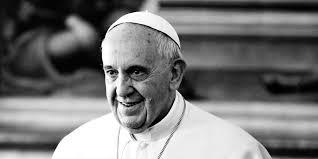 Given the many challenges facing us these days, our nation and world badly need real leaders.
How do I define a leader? An individual who puts the interests of others ahead of his own, does what is right with no regard for how it will impact him/her personally, and speaks up in forceful fashion when it is far more convenient and conducive to sit down or speak purely in political terms.
If we were to hold the bar at an appropriately elevated level, who in America and the world truly define what it is to be a leader? We can come up with some selected individuals perhaps, but by my standards we have a serious lack of true leaders both nationally and globally at this point in time. Fortunately, we can look to Pope Francis if we care to envision a real leader.
Pope Francis has exemplified real leadership numerous times during his papacy but perhaps no single display of true leadership stands out more than his talk the other day in Calabria when he defined the local mafiosi as “adorers of evil.”
In his homily at the Saturday evening Mass during his day trip to Italy’s Calabria region, Pope Francis denounced the dishonesty and violence perpetrated by members of the local mafia.
“When adoration of the Lord is substituted by adoration of money, the road to sin opens to personal interest … When one does not adore the Lord, one becomes an adorer of evil, like those who live by dishonesty and violence,” Pope Francis said June 21 at the outdoor Mass in Sibari, Italy.
“Your land, which so beautiful, knows the signs of the consequences of this sin. The ‘Ndrangheta (Calabrian mafia) is this: adoration of evil and contempt of the common good. This evil must be fought, must be expelled. It must be told no,” he urged.
Those who have chosen the “evil road, such as the mobsters” are “not in communion with God. They are ‘excommunicated’,” he said.
Students of the papacy have proclaimed that Pope Francis was not only directing his words to those engaged in organized crime but also those within the church who have provided cover and comfort to this criminal element.
Is America listening to Pope Francis? We certainly have our own organized legal and illegal corrupt elements deeply embedded within our financial and political systems.
Additionally, many observers have already hinted that Pope Francis is putting himself at personal risk for speaking out so forcefully against the mob. He rises above this concern and seems to dismiss it without a care.
Francis’ homily deserves much greater attention. As with all his words of wisdom, I think we would be wise to incorporate them into our own lives. He provides real inspiration. Some might decry my message and direction here as crossing the line of political correctness. Isn’t that part of the problem right there?
Let’s ponder Francis’ message and then embrace him and his vision. If we are to advance as a land, we need people to stand up, speak out, and embrace the virtues embodied by Francis over that which we have come to define as our social norms but which strike me as real moral decay.
Look no further than his calling out the mob in their own backyard if you need further evidence of what leadership really looks and sounds like.
Navigate accordingly.
Larry Doyle
Please order a hard copy or Kindle version of my book, In Bed with Wall Street: The Conspiracy Crippling Our Global Economy.
For those reading this via syndicated outlet or by e-mail or another delivery, please visit the blog to comment on this piece of ‘sense on cents.’
Please subscribe to all my work via e-mail.

June 23, 2014
Charles Lewis: 935 Lies/The Future of Truth and the Decline of America’s Moral Integrity
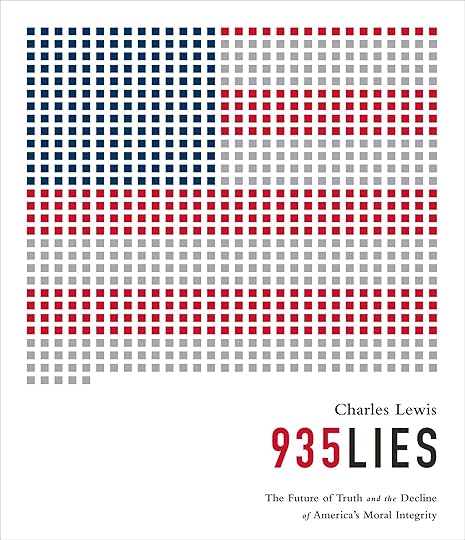 One of the best lines I ever read in The Wall Street Journal was attributed to then CEO of First Boston, Allen Wheat. When asked about a senior executive who had recently departed the firm, Wheat rhetorically inquired and responded, “How do you know when he is lying? His lips move.”
Regrettably, couldn’t we say the same about so many of our so called political and business leaders? I think there is little doubt.
Life in and around Washington, Wall Street, and elsewhere in America now seems much more to revolve around rationalization than integrity. With the media often complicit in allowing the lying to go fully unchecked, our society suffers. Against this backdrop, I am very excited to pick up a copy of a book scheduled to be released tomorrow entitled 935 Lies: The Future of Truth and the Decline of America’s Moral Integrity written by a new Sense on Cents favorite, but longstanding journalistic giant, Charles Lewis.
What are some of the Lies for The Ages, as designated by Lewis?:
“Cigarette smoking is no more ‘addictive’ than coffee, tea or Twinkies.”: James W. Johnston, CEO of RJR Nabisco (Congressional testimony), April 14, 1994
“If you like the [health care] plan you have, you can keep it.”: President Barack Obama, November 6, 2009 (similarly stated numerous times)
“I can say categorically that . . . no one in the White House staff, no one in this Administration, presently employed, was involved in this very bizarre incident.”: President Richard Nixon, discussing the Watergate burglary, press conference, August 29, 1972
“We found the weapons of mass destruction [in Iraq]. We found biological laboratories.”: President George W. Bush, May 29, 2003
In what reads like manna from heaven for those starving for the truth, a preview of Lewis’ book offers the following:
Facts are—and must be—the coin of the realm in a democracy, for a government “of the people, by the people, and for the people” demands an informed citizenry. Unfortunately, for citizens in the United States and throughout the world, distinguishing between fact and fiction has always been a formidable challenge, often with life-and-death consequences. Those in power habitually seek to control the flow of information, corrupting its content and using lies, distortions, or simple suppression to cover their crimes.
Today that quest for truth is more difficult and confusing than ever. The cacophony of the internet, the flood of axe-grinding commentary on cable TV, and the growing legions of paid lobbyists and advocates eager to twist the truth all help to erode the sense of authority once granted to responsible journalists. History is sculpted by its absence.
Charles Lewis is a veteran of the battle for public integrity. 935 Lies explores the many ways truth is manipulated by governments and corporations. Through examples ranging from the countless lies administrations of both parties have used to justify needless wars to the successful decades-long corporate suppression of the truth about tobacco and other dangerous products, Lewis shows how the value of truth is diminished by delay. He explains the political, social, and business changes that have increasingly weakened the ability of journalists to play their traditional truth-telling role. And he describes the new trends, from the rise of nonprofit reporters to the growing numbers of “citizen journalists,” that give reason to be hopeful about the future of truth.
I welcome reading and reviewing this book.
Larry Doyle
Please order a hard copy or Kindle version of my book, In Bed with Wall Street: The Conspiracy Crippling Our Global Economy.
For those reading this via syndicated outlet or by e-mail or another delivery, please visit the blog to comment on this piece of ‘sense on cents.’
Please subscribe to all my work via e-mail.

Charles Lewis: 935 Lies: The Future of Truth and the Decline of America’s Moral Integrity
One of the best lines I ever read in The Wall Street Journal was attributed to then CEO of First Boston Allen Wheat. When asked about a senior executive who had recently departed the firm, Wheat rhetorically inquired and responded, “How do you know when he is lying?” “His lips move.”
Regrettably, couldn’t we say the same about so many of our so called political and business leaders? I think there is little doubt.
Life in and around Washington, Wall Street, and elsewhere in America now seems much more to revolve around rationalization than integrity. With the media often complicit in allowing the lying to go fully unchecked, our society suffers. Against this backdrop, I am very excited to pick up a copy of a book scheduled to be released tomorrow entitled 935 Lies: The Future of Truth and the Decline of America’s Moral Integrity written by a new Sense on Cents favorite but longstanding journalistic giant Charles Lewis.
What are some of the Lies for The Ages as designated by Lewis?:
“Cigarette smoking is no more ‘addictive’ than coffee, tea or Twinkies.”: James W. Johnston, CEO of RJR Nabisco (Congressional testimony), April 14, 1994
“If you like the [health care] plan you have, you can keep it.”: President Barack Obama, November 6, 2009 (similarly stated numerous times)
“I can say categorically that . . . no one in the White House staff, no one in this Administration, presently employed, was involved in this very bizarre incident.”: President Richard Nixon, discussing the Watergate burglary, press conference, August 29, 1972
“We found the weapons of mass destruction [in Iraq]. We found biological laboratories.”: President George W. Bush, May 29, 2003
In what reads like manna from heaven for those starving for the truth, a preview of Lewis’ book offers the following:
Facts are—and must be—the coin of the realm in a democracy, for a government “of the people, by the people, and for the people” demands an informed citizenry. Unfortunately, for citizens in the United States and throughout the world, distinguishing between fact and fiction has always been a formidable challenge, often with life-and-death consequences. Those in power habitually seek to control the flow of information, corrupting its content and using lies, distortions, or simple suppression to cover their crimes.
Today that quest for truth is more difficult and confusing than ever. The cacophony of the internet, the flood of axe-grinding commentary on cable TV, and the growing legions of paid lobbyists and advocates eager to twist the truth all help to erode the sense of authority once granted to responsible journalists. History is sculpted by its absence.
Charles Lewis is a veteran of the battle for public integrity. 935 Lies explores the many ways truth is manipulated by governments and corporations. Through examples ranging from the countless lies administrations of both parties have used to justify needless wars to the successful decades-long corporate suppression of the truth about tobacco and other dangerous products, Lewis shows how the value of truth is diminished by delay. He explains the political, social, and business changes that have increasingly weakened the ability of journalists to play their traditional truth-telling role. And he describes the new trends, from the rise of nonprofit reporters to the growing numbers of “citizen journalists,” that give reason to be hopeful about the future of truth.
I welcome reading and reviewing this book.
Larry Doyle
Please order a hard copy or Kindle version of my book, In Bed with Wall Street: The Conspiracy Crippling Our Global Economy.
For those reading this via syndicated outlet or by e-mail or another delivery, please visit the blog to comment on this piece of ‘sense on cents.’
Please subscribe to all my work via e-mail.
June 20, 2014
Wikileaks: How Banks Will Continue to Rule the World
[image error]I had a little wind in my sails this morning when I saw a lead article in today’s Wall Street Journal regarding the pathetic investor protection provided by the meter maids at FINRA. While adding a little spice to the mix by commenting on that article, I got blown away by a tsunami coming from another direction.
Let’s navigate.
Not that there was ever any doubt that the major global banks rule the world (and will likely continue to do so), a riveting press release put out just yesterday by Wikileaks confirms this reality. Major props to Yves Smith at Naked Capitalism for bringing attention to the Wikileak press release, Secret Trade in Services Agreement (TISA). The serious students in the crowd will have plenty to chew on and digest in the Agreement.
For those more inclined to study from the Cliff Notes, let’s give thanks to Professor Jane Kelsey of the University of Auckland, New Zealand who brings real transparency to the proposed Agreement in her Analysis Article also released by Wikileaks:
(editing in format by LD)
This memorandum provides a preliminary analysis of the leaked financial services chapter of the Trade in Services Agreement (TISA) dated 14 April 2014. It makes the following points:
1. The secrecy of negotiating documents exceeds even the Trans-Pacific Partnership Agreement (TPPA) and runs counter to moves in the World Trade Organization (WTO) towards greater openness:
– The cover sheet records that the draft text will not be declassified until 5 years after the TISA comes into force or the negotiations are otherwise closed.
– Secrecy during the negotiation of a binding and enforceable commercial treaty is objectionable and undemocratic, and invites poorly informed and biased decisions. Secrecy after the fact is patently designed to prevent the governments from being held accountable by their legislatures and citizens.
2. The TISA is being promoted by the same governments that installed the failed model of financial (de)regulation in the WTO and which has been blamed for helping to fuel the Global Financial Crisis (GFC).
– The leaked text shows the US and EU, which pushed financial services liberalisation in the WTO, are the most active in the financial services negotiations on TISA. The third most active participant is the renowned tax haven of Panama.
– The rules also aim to ‘discipline’ governments in favor of a light handed and self-regulatory model of financial regulation.
There you go folks!!
“A light handed and self-regulatory model of financial regulation” means one thing: Game Over. The banks will continue to rule the world. Let’s keep navigating, though, so we can protect ourselves.
3. The same states shut down moves by other WTO Members to critically debate these rules following the Global Financial Crisis (GFC) with a view to reform.
– Various WTO Members called for a review of the rules after the financial crisis.
– Subsequent attempts led by Ecuador to secure a debate in the Committee were eviscerated to the point that the eventual discussion in April 2013 was meaningless.
4. They want to expand and deepen the existing regime through TISA, bypassing the stalled Doha round at the WTO and creating a new template for future free trade agreements and ultimately for the WTO.
– The countries that were at the centre of global finance and were responsible for the Global Financial Crisis will be bound to maintain the rules that allowed that to happen.
– The minimal reforms they have adopted post-GFC will become the maximum permitted regulation.
– Several recent IMF papers have referred to the ‘state of denial’ among affluent economies about the potential for further devastating crises if they maintain the current policy and regulatory regime.
5. TISA is designed for and in close consultation with the global finance industry, whose greed and recklessness has been blamed for successive crises and who continue to capture rulemaking in global institutions.
– When the industry’s demands, as expressed in the consultation on TISA conducted by the US Trade Representative in 2013, are matched against the leaked text it becomes clear that they stand to get most of what they asked for.
6. A sample of provisions from this leaked text show that governments signing on to TISA will: be expected to lock in and extend their current levels of financial deregulation and liberalisation; lose the right to require data to be held onshore; face pressure to authorise potentially toxic insurance products; and risk a legal challenge if they adopt measures to prevent or respond to another crisis.
– The biggest danger is that TISA will stop governments tightening the rules on the financial sector.
That is a tsunami folks.
Rather than my standard sign-off to “Navigate accordingly,” in light of this document I would encourage you to . . . GET TO HIGHER GROUND!!
Larry Doyle
Please order a hard copy or Kindle version of my book, In Bed with Wall Street: The Conspiracy Crippling Our Global Economy.
For those reading this via syndicated outlet or by e-mail or another delivery, please visit the blog to comment on this piece of ‘sense on cents.’
Please subscribe to all my work via e-mail.

June 19, 2014
Charles Lewis: If Truth Be Told
[image error]The truth.
The health of our democracy demands that we pursue and embrace the truth wherever it may take us and whatever we may learn. Regrettably as a nation the truth often largely escapes us due to forces wielded by those who might suffer in the process. We see evidence of this reality almost on a daily basis.
Investigative journalism is critically important to unearthing the truth yet this most noble undertaking remains under serious pressure. Fortunately we have individuals like Charles Lewis, one of the most highly distinguished investigative journalists in our nation’s history, to fight back against the tide.
Lewis provides fabulous context on this topic in a recently penned 3-part series entitled If Truth Be Told. In light of all that is going on in our nation, this series qualifies as an absolute must read and an instant Sense on Cents classic. As a teaser, I welcome providing a few snippets of Lewis’ work. Let’s navigate.
– In my lifetime, independent journalists have fearlessly exposed such abuses of power as the anti-Communist demagoguery of Sen. Joseph McCarthy, the institutionalized racism and injustice across the American South, the gross misrepresentations committed by the U.S. government during the Vietnam War, the wholesale illegalities and breaches of faith broadly known as the Watergate scandal, the excesses of corporate power that caused millions of Americans health-related peril from dangerous products or substances and the improper or illegal post-9/11 uses of governmental power.
– . . . it’s no exaggeration to say that the course of U.S. history was altered by investigative journalists’ scrutiny and accountability of those in power.
– Time after time, however, those same tenacious media have been hoodwinked by the powers that be, whether they’ve occupied the highest echelons of government or Fortune 50 boardrooms. After all, there may be immediate electoral rewards for delaying and distorting the truth . . .
– On the heels of the Lehman bankruptcy, the Dow Jones index plunged 504 points, triggering the worst financial crisis since the Great Depression. But federal regulators were asleep at the wheel, and the media were not exactly digging deeply into Lehman’s affairs either: As the Columbia Journalism Review noted just four days after the bankruptcy examiner’s revealing March 2010 report: “And just like that, the Lehman Brothers scandal drops off the front pages. And not just the front pages — the section fronts, too.”
– In hindsight, it’s easy to point fingers at the media for not aggressively investigating the potential for such travesties, and then not pressing hard enough to document how these events unfolded, where blame lies, whether cover-ups were ongoing. But there may be another explanation for the presumed editorial negligence: Try as they might to unearth the truth, it’s likely that those investigating such stories were lied to. It’s certainly happened to me.
– Individually, of course, we’ve all been lied to throughout our lives, and collectively, as citizens, we’ve been lied to repeatedly by government officials and corporate bigwigs. Unfortunately, distinguishing fact from fiction has always been a formidable challenge, often with life-and-death consequences.
– Consider, for example, the prescient words of Benjamin C. Bradlee, former executive editor of The Washington Post, who presided over coverage of Watergate and publication of the Pentagon Papers. At the Theodore H. White lecture at Harvard, in 1991, Bradlee said, “It seems to me that lying has reached such epidemic proportions in our culture, and among our institutions in recent years, that we’ve all become immunized to it. What the hell ever happened to righteous indignation, anyway?”
Nearly a quarter-century later, we’re regrettably still asking the same perplexing question.
The truth may liberate us but before we are set free we need to find the truth and expose it. I am confident you will thoroughly appreciate the wisdom provided by Lewis and will want to share it with friends, family, and colleagues. To that end, I welcome spreading Lewis’ great work and immediately inducting him into the Sense on Cents Hall of Fame.
If Truth Be Told: Part 1
If Truth Be Told: Part 2
If Truth Be Told: Part 3
Navigate accordingly.
Larry Doyle
Please order a hard copy or Kindle version of my book, In Bed with Wall Street: The Conspiracy Crippling Our Global Economy.
For those reading this via syndicated outlet or by e-mail or another delivery, please visit the blog to comment on this piece of ‘sense on cents.’
Please subscribe to all my work via e-mail.

June 18, 2014
Federal Reserve Quandary: Stagflation
[image error]The Federal Reserve will wrap up its regularly scheduled meeting and release its highly anticipated statement this afternoon at 2pm. The markets always eagerly await this statement so as to read the tea leaves and see what they say about our economy and the impact on interest rates.
Do we really need to wait for 2pm, though, to determine what is really going on in our economy? I think not. What do we know? Plenty, although the financial media, government officials, and the bankers themselves are not always fully forthcoming in promoting the truth. Let’s navigate.
1. Labor markets: the structural level of unemployment remains at elevated levels as reflected in the fact that labor participation rates remain at 35 year lows. This slack is not only a drag on our economy but keeps overall level of wages in check for the economy as a whole. I do not believe that monetary policy has a meaningful impact on alleviating this enormous problem in our nation. Labor markets are presented as being healthier than the reality.
2. Inflation: under reported given the lack of meaningful wage inflation. While wages for many in our nation are largely fixed, the basic costs of living (food, fuel, healthcare, housing) are moving higher at an appreciable rate. Is there any surprise that spending on discretionary items remains largely in check for so many in our nation? Monetary policy both here and abroad are primary drivers of the increased costs of food, fuel, and housing. Can the Federal Reserve think about tightening so as to mitigate these price increases when the EU and Japan are doing all they can to stave off underlying deflationary pressures?
3. Economy: with the housing industry clearly slowing — this is what happens when cost of housing in terms of both rents and prices outpaces incomes — the economy overall is hard pressed to grow at better than the 2% GDP level that we have averaged over the last decade. Although many pundits and political hacks are wont to talk the economy up, talk is cheap. Sluggish growth is exacerbated by the increased costs highlighted above. If we were to extrapolate this further, we might define the real challenge facing our economy as stagflation, that is, “a condition of slow economic growth and relatively high unemployment – a time of stagnation – accompanied by a rise in prices, or inflation.”
What does Janet Yellen have in her bag of tricks to deal with that?
Nothing more than double talk along with a whole lot of hope. While hope is a virtue it is not a central bank policy nor an economic program. Washington needs to address the structural issues impeding our economy by engaging in the following:
1. tax reform
2. entitlement reforms
3. preeminence of the rule of law . . . that humanitarian disaster on our southern border is running roughshod over the laws we have in place to protect our borders. We are supposed to be a nation of laws not men. When laws are not upheld it has a negative impact on the economy.
4. protecting the rights of property holders and investors. Capital flows and formation are predicated on real protections.
5. rooting out cronyism that has grown more deeply embedded in our nation. This reality goes hand in hand with the topic referenced in point 3 above.
Has Washington shown itself capable of taking on these issues? Regrettably not, due to a screaming lack of real leadership on both sides of the aisle.
As a result, all the pressure is placed on the Federal Reserve to continue the charade that erodes the value of our currency and the accompanying quality of life in America for so many. What is the result? The American dream slips further and further away over the horizon.
Navigate accordingly.
Larry Doyle
Please order a hard copy or Kindle version of my book, In Bed with Wall Street: The Conspiracy Crippling Our Global Economy.
For those reading this via syndicated outlet or by e-mail or another delivery, please visit the blog to comment on this piece of ‘sense on cents.’
Please subscribe to all my work via e-mail.