
Brett Hetherington's Blog: "First thought:" My Substack page, page 57
April 8, 2014
Catalonia’s School of Shepherds
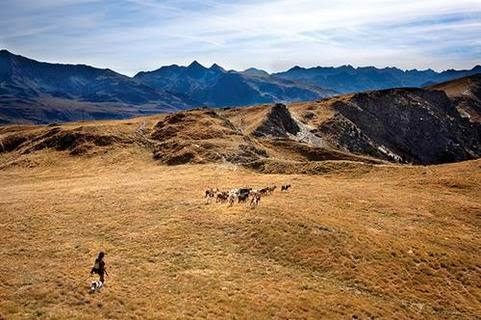 Photograph by Joan Alvado/Nar Photos/ReduxWith Catalonia´s unemployment high, a different kind of school is attracting an increasing number of students from urban areas...
"Sheep have grazed mountainous northeastern Spain for 6 million years, but 20th century industrialization led to a dramatic decline in the number of shepherds who tended them.
For the last six years, Catalonia’s School of Shepherds has worked to keep the ancient profession from disappearing.
Students start with a month of classroom study in a rural home in the Pyrenees. Then they undergo four months of practical training with a veteran shepherd, who gradually gives them responsibilities with a herd.
About 80 percent of students complete the course, and more than 60 percent go on to work in livestock farming.
A new shepherd on a farm that provides food and lodging earns about €680 ($936) a month, and €900 to €1,200 without room or board.
A mountain shepherd—who may tend thousands of animals in a busy summer—earns as much as €2,000 a month."
Source: here.


April 1, 2014
"Land, bread and peace of mind" - My latest opinion column for Catalonia Today magazine
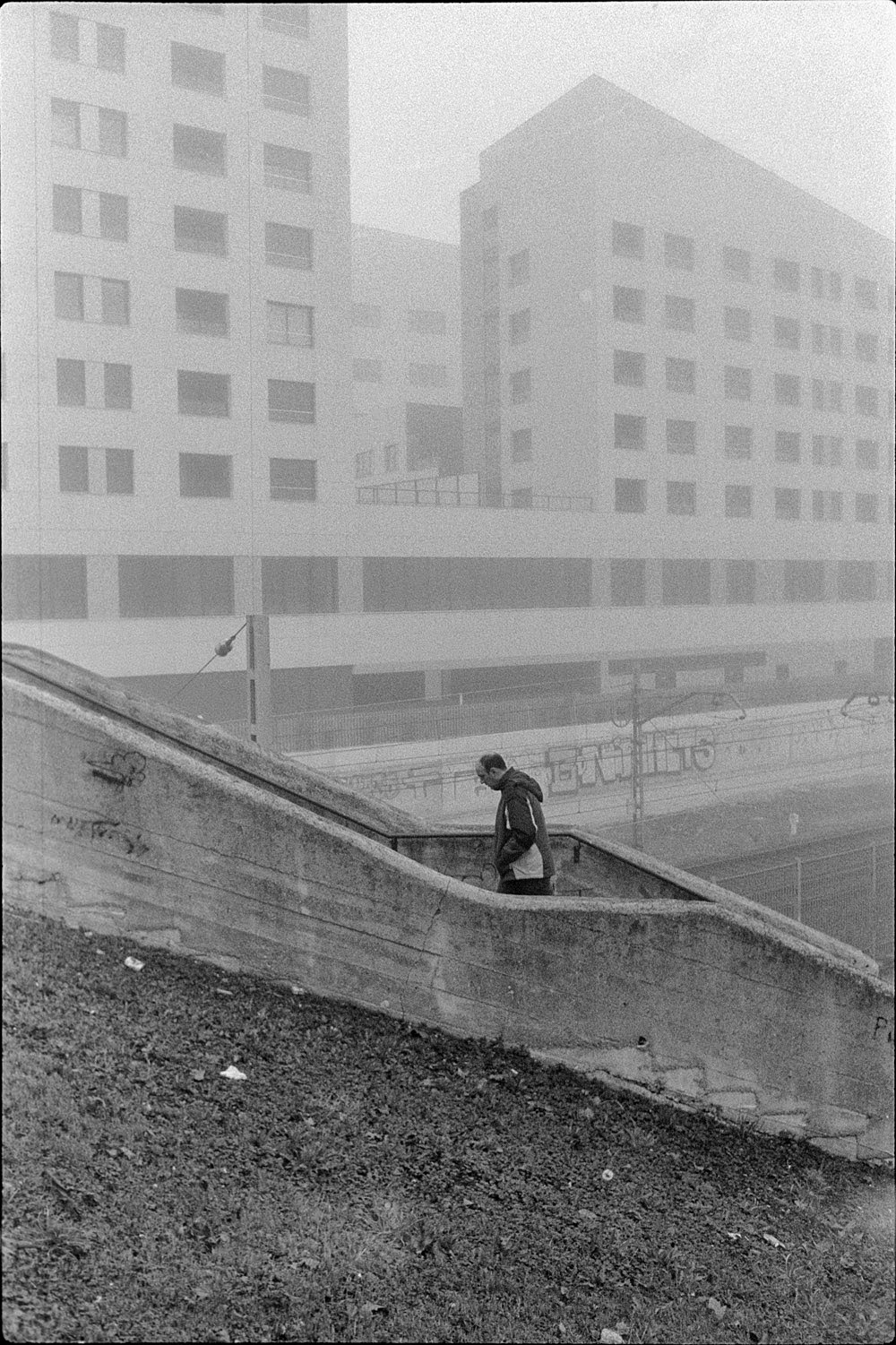 Photo: Javier.If any political slogan ever summed up the basic needs of the human animal, it was Lenin's call to revolution in Russia almost a century ago: "Peace, Bread and Land!"
 Today in Europe, would these essential elements be much different?
The "land question" is still one of the biggest for the average person only partly because we all must have some kind of shelter from nature's more extreme forces.
How we are housed, where we are housed and by what means we pay for our housing partly decides how much stress you have to live with or how much comfort you live in.
If you are renting, the landlord or landlady remains as critical a figure as they were a century ago and despite theoretically better legal rights for tenants, gross exploitation of renters continues in Barcelona, just as it does in Paris, London or Milan.
If you are fortunate enough to be paying off your own dwelling to the bank (as my partner and I have been doing for the last three years) then there is obviously the pressure of ensuring that your income is enough to do this every month...while also putting food on the table.
Sometimes, I wonder if there is still an echo from feudal times in this great housing dilemma.
In England for example, it is simply scandalous that an estimated 50% of total land there is still unregistered.
This means that approximately half the country is owned by families who have inherited large areas of green fields that are not available for possible use as housing. It creates the bizarre fact that English cities are severely over-crowded and the price of a basic flat is well out of reach of the average person.
In Southern Europe the high cost of renting or buying (compared to wages) at least partly explains why in Scandinavian countries only about 4% of 24 to 35 year-olds are still living with their parents.
In Spain this figure is 37.2%, in Portugal it is 44.4% and in much of Eastern Europe around half of young people have not left the nest. We are witnessing generations who are being denied real independence in their lives.
But when it comes to what is being eaten in and outside the home there is also great inequality. In Spain, the massive rise in demand for donated/charity food has been well documented in the media here and in England there has been an almost 400% increase in the use of so-called "food banks" over the last two years alone.
I recently explained to some adults I teach that the American slang word for money is "bread," and this gives a particular relevance to the saying that "The more bread you have, the less shit you have to eat."
Strangely enough though, it is now the case that nearly 40% of food grown in the United States of America is never eaten (as their public broadcaster PBS recently discovered.)
Even allowing for the fact that the average North American consumes more than four hundred times more resources than an African does, the stark absurdity of these numbers cannot explain away how vital food is to our quality of life.
Simply put, land and bread make up a large part of what we call "peace of mind."
[This article was first published in Catalonia Today magazine, April 2014.]
March 30, 2014
The food in Spain
 (Photo: Javier)
Around the world, one in eight people go to bed hungry every night but Spain ranks as the 13th best country for food overall, according to Oxfam's Food Index.
The reasons for this are that in the categories of "enough to eat, food quality and food affordability" Spain does very well, though perhaps surprisingly in the area of health it scores poorly. This is largely due to having a relatively high level of diabetes and obesity, as opposed to most of Africa and Asia which has relatively little of those two medical problems.
March 17, 2014
"High-speed rail beats air travel for the first time"
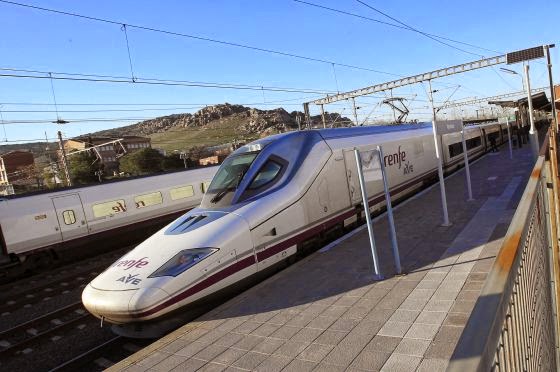 One of the AVE networks high-speed trains. / Mariano Cieza Moreno (EFE)
As part of my next book I plan to take trains across Spain and Catalunya this summer. Personally, I don't intend to use high-speed rail (because I prefer the slower version, when I have the time) but I am very pleased about this weeks news. Overall, train travel is far superior to air travel in my view, and is a vital part of any country's infrastructure...
"For the first time ever, high-speed rail has outpaced air travel in Spain.
Figures released by the National Statistics Institute (INE) this week show that 1.9 million people used the country's extensive AVE network in January compared with 1.8 million people who bought plane tickets.
This represents a 7.3-percent year-on-year drop for airplane travel and a 22-percent rise in high-speed rail journeys.
For the aviation sector, the number is the 28th straight month of decline, while the railway network has seen 11 back-to-back months of growth.
The AVE has become more popular ever since the Public Works Ministry made the decision to lower the fares in February of last year. Meanwhile, airlines have experienced a hike in taxes and a cut in their flight routes."
Source: El País, here.
March 10, 2014
Concha Buika interview in English
A rare interview in English (on Australia's ABC Radio) with the talented Mallorcan flamenco/jazz singer, Concha Buika.
Last week she played her first concert in Sydney and went on to Adelaide as part of a world tour.
Last week she played her first concert in Sydney and went on to Adelaide as part of a world tour.
March 4, 2014
"To screen or not to screen?" - My latest opinion column for Catalonia Today magazine

As I write this, my son is hating me.
Last night I took a computer game off him that his mother and I agreed was violent and told him he would not be getting it back. He is twelve years old and naturally, he disagreed.
But I am not badly disturbed by his feelings toward me. I know they are temporary and I trust in the knowledge that sometimes parents will be hugely unpopular with our own children...if we are being moral, ethical parents - involved parents.
In this part of the world people get a lot right about how children are treated. One of the most notable things is how older children are largely both tolerant and even downright nice to their younger brothers and sisters, as well as to other littler kids they are not related to at all.
In Mediterranean Europe, the family unit is close and socialising with the extended family of grandparents, cousins and other blood relatives is a common part of almost every one's weekly life.
This is in stark contrast to standard Anglo families.
But I would argue that across this stretch of the planet (but probably in other parts, such as North America as well) parents are much too concerned with their children's happiness.
This may sound like a harsh, uncaring statement so it needs a bit of explanation. To me (and to plenty of full-time philosophers) happiness is a temporary state. It comes and goes under it's own invisible steam and can arrive and disappear before we hardly realise it.
The more we desperately look for it or try to manufacture it the more it seems to slip through our fingers.
I'm not advocating that we don't do our best to create situations where our kids are likely to find enjoyment or fun - quite the contrary.
But if we put happiness, which is by its nature a short-term sensation, ahead of trying to develop a son or daughter with a sense of what is right and what is wrong, then we are making a terrible mistake.
If we act and speak by instinctively putting our children's immediate gratification as the priority instead of doing what we can so that they are playing and learning in ways that are beneficial to them (at least in the medium or longer term) what is the logical result?
Years later you end up with adults who value getting as many petty possessions as they can (because materialism is supposed to create contentment) and to them this a thousand times more important than having something as bothersome as a conscience, which just gets in the way of fueling a bigger bank account.
In other words, you have corruption and you have it on a grand scale. The Mediterranean disease.
I accept that the inclination towards having happy children is a healthy one. I just don't accept that this injection of happiness should always be the most important thing.
Faced with the choice of being strongly disliked by my son for a period of time or, on the other hand, turning a blind eye to him exercising disturbing impulses for potentially hours on end, I'd choose unpopularity every time.
Knowing what we now know about how violent, first-person computer games will desensitise even adult users (and that is why modern military training uses simulated war-games) it would be almost a crime to be the indulgent parent.
[A version of this article was first published in Catalonia Today magazine, March 2014.]
March 1, 2014
New York through the eyes of a Spanish great
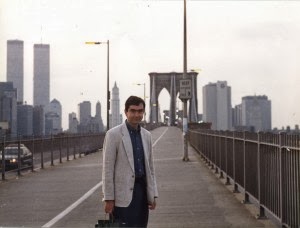 [In the Big Apple, 1990. Source: antoniomunozmolina.net]His insight and acute powers of observation always make his journalism worth reading (as well as his fiction.) Spanish maestro
Antonio Muñoz Molina
writes in El Pais about his adopted home of New York city as a "nostalgia factory." (Article in English.)
[In the Big Apple, 1990. Source: antoniomunozmolina.net]His insight and acute powers of observation always make his journalism worth reading (as well as his fiction.) Spanish maestro
Antonio Muñoz Molina
writes in El Pais about his adopted home of New York city as a "nostalgia factory." (Article in English.)"Nowadays when there are banks and Starbucks on every corner of the yuppied-up Village, and glass towers full of the predatory oligarchs of Russia and China, even nostalgia has a flavor of political protest."
February 21, 2014
"That which is offensive"
 Photo: Jordi BorràsA well-argued and very convincing short article arguing against the disturbing new national "security law" which threatens to turn many acts of public protest (and even plenty of acts that are not protest at all) into criminal offences.
Source: BCN Mes here.
February 19, 2014
Barcelona's "fight club"
A fascinating 5 minute video about young men in Barcelona who are taking up boxing as a way to stay out of trouble and give themselves a purpose in life. (With English subtitles.)
Source:Global Post here.
Source:Global Post here.
February 16, 2014
"New project honors thousands of Jews who braved Catalan Pyrenees to escape Holocaust"
"The Lleida Provincial Council is promoting a project entitled ‘Persecuted and Saved’ that aims to identify and mark the principal paths through the Catalan Pyrenees taken by 80,000 fugitives, 20,000 of whom were Jewish, in order to escape the Nazi horror during the Holocaust.
They will also show the prisons and concentration camps set up to hold those who were caught. The project has already received a good deal of interest from Israel, with Alon Bar, Ambassador of Israel to Spain, visiting the key sites.
Furthermore, Walter Wasercier, CEO of Israel’s principal airline, EL-AL, and Joan Reñé, President of Lleida’s Provincial Council, have met in order to discuss setting up weekly chartered flights between Israel and Lleida-Alguaire Airport. Reñé claims that the project is an opportunity to “recover the historical memory and publicize the little-known events that occurred here during the Holocaust.” Bar summarized the importance of the project with a Hebrew saying, “to save a soul is to save an entire world”.
He also expressed thanks to the Catalan people, many of whom risked their lives to help save Jews and other refugees who were fleeing from Nazi barbarism.
A chance for Jewish people to find their ‘roots’
Bar believes that many Jewish people may find their roots while exploring the sites that their relatives used to escape tyranny and certain death. Over 20,000 Jewish refugees are believed to have passed through the Pyrenees, often taking the harshest and most difficult routes in order to avoid capture by Nazi soldiers patrolling the area.
Better Catalan understanding
Reñé also believes the project is a good chance for Catalans to better understand and appreciate the history of the area and the role that their parents and grandparents played by helping the starving and freezing survivors that made it over the mountains."
Source: Vilaweb here.
"First thought:" My Substack page

For readers who like stimulating & original lit-bits on social & personal issues. From the mind of an always-curious author/teacher/journalist living long-term in Europe (Catalonia/Spain.)
- Brett Hetherington's profile
- 10 followers


