
Brett Hetherington's Blog: "First thought:" My Substack page, page 51
April 3, 2015
"Easy on the eye" - My latest opinion column for Catalonia Today magazine
 Watching my son doing his geography homework the other day I was struck by how much time he was spending on selecting online images to accompany his (minimal) written work.
 This activity is now a big part of modern education which I also know because as a (thankfully former) secondary school teacher of History and English I was continually struggling with students to focus on the text they were developing or learning from and to consider the pictorial aspect as secondary, or supportive.
Students as old as twelve would regularly include a photo of say, Adolf Hitler, with the caption, “Here is a photo of Adolf Hitler,” with no other information about him, as if naming him was all that needed to be said and the real task was to cut and paste an image of him. Some older students would often just plagiarise whatever Wikipedia told them was the truth.
But why should I be surprised about all this? If you are reading this article on a train or metro have a look around right now, or next time. There will probably be more people scrolling through photos on their phones than reading something (apart from chatting by text, perhaps.)
The popularity of social media has given rise to even more use of moving or still pictures as communication. Instagram and YouTube, to name just two, have meant that sharing visuals is easy, fun and almost cost-free. Amateur photography has never been so straight-forward, thanks to camera-phones and digital technology.
Children are obviously some of the major users of their own photos as well as those of their friends. One survey of more than 2,700 young British people aged 13 to 25 found that almost one in six children sends naked photos. Equally, this so-called “sexting” phenomenon in the USA lead investigators from the National Center for Missing & Exploited Children to find that of the more than 130 million images containing child pornography examined since 2002, one in four were initially posted by minors themselves.
It’s natural for young people to have an interest in their bodies and other’s bodies as well. I see no big problem there but an apparent increase in obsession with body image can at least partly be explained by the strong influence of ‘supermodels’ (recently including male ones) and the visual appeal of “skin is in” singers and groups, especially from hip-hop, rap and R&B.
The power of the metrosexual male idol such as David Beckham or Ronaldo has yet to be explored in the mainstream media but this increased emphasis that male-grooming puts on the connection between the visual and the physical is abundantly clear.
Our society simply values those with “eye candy” appeal more than anything else and that is because a glance takes a split second but conveys so much. It’s for this basic reason that film stars have long been paid absurd amounts of money compared to others in the creative industries including virtually all painters, writers and non-commercial musicians.
Looking is easy. Listening is often hit and miss.Reading needs more concentration or patience.
[This article was first published in Catalonia Todaymagazine, April 2015.]


March 28, 2015
Video: Naomi Klein launches her new book in Barcelona
"Si hi ha un desig democràtic per la... by vilawebtv
Canadian journalist and activist Naomi Klein this week launched her new book, "This Changes Everything, Capitalism vs The Climate" at the Centro de Cultura Contemporanea de Barcelona (CCCB).
In this short [VilaWeb] video (with Catalan subtitles) Klein links the idea of political independence with a more independent energy policy.
She was my first journalistic interview in 2000 at the time her excellent first book "No Logo" came out and (even over the telephone) was one of the nicest people I've ever talked to for an article.
March 19, 2015
Video: "Seeking ‘Brave Journalists’ in Spain to investigate the TTIP Trade Agreement"
"The main concerns for groups that oppose the Transatlantic Trade and Investment Partnership (TTIP) between Europe and North America are the lack of transparency and the way in which the agreement will affect the communities involved.
In Madrid, Spain, the Asamblea Popular de Tres Cantos (Tres Cantos Popular Assembly), a community activist group that is well known for its participationin protests against the economic crisis, is “seeking brave journalists” as part of an appeal to the media to investigate the treaty.
In the video published on the organization's blog and various social networks, members of the assembly appear with photographs of employees from Spain's large media organizations, which have largely ignored the treaty in their coverage, and offer them a challenge:" [see English subtitled video above.]
More from Global Voices Online source article here.
March 16, 2015
Homage to George Orwell: free lecture in Barcelona
 Michael Shelden, a Pulitzer Prize finalist for his biography of George Orwell, is holding a conference about the author on Wednesday the 18th of March at 7.30pm at the Institute of North American studies, Via Augusta 123 in Barcelona.
 March 13, 2015
"320,000 Catalans receiving food aid due to rise in “poor workers” "
 "The real scope of the work being done by social institutions in a matter as basic as covering the food requirements of poor families is reaching scandalous figures: over 320,000 people are currently receiving food aid in Catalonia.
 The report...presented yesterday...by the Catalan Red Cross dignif[ies] and defend[s] the right to food. [It] highlights elements that suggest these needs are not going to diminish any time in the near future, such as the increase in “poor workers” - earning wages that do not allow them to meet their basic needs - increasingly more chronic poverty and growing inequality.
Given this scenario, social organizations are committed to working on two areas: first, the dignifying of the system when providing aid, and second, providing people with full care, that is, not only food but also support in housing, hygiene and school materials, as well as training and employability guidelines for finding work.
Last year, the four food banks in Catalonia distributed nearly 22.4 million kilos of food to a total of 260,497 people. All this while every year 262,471 tonnes of food are wasted in homes, shops and restaurants."
[Sònia Pau - Source: Catalonia Today news.]
March 6, 2015
"Spanish television’s clap trap"
One of the most sad and disturbing stories that I've read about the effects of Spain's economic crisis on ordinary people.
March 1, 2015
"Why go the public way? (Part two)" - My latest opinion column for Catalonia Today magazine
 When I was much younger my mother used to tell me that one day if I ever needed a pay raise I should just go and ask my boss for one. In the 1950's when she was at work, before having my brothers and I, this might have got some results.
The first (and last) time I tried the technique of simply asking for an increase in my pay I was unceremoniously sacked. I had been paid between 20 and 21 euros per hour over four years working as a high school teacher of three different subjects at an international school near the wealthy coastal resort town of Sitges and I had become, like my most of my colleagues, frustrated at also doing hour after hour of unpaid labour.
Teachers in the Spanish and Catalan public education system are routinely criticised, sometimes legitimately so, but their conditions of work mean that they cannot be unfairly fired from their jobs, as I once was.
Of course, it's not only public school employees and civil servants that benefit from the protection that the state can give. A doctor or nurse with security of tenure has one less source of stress and therefore is more likely to do their job better - patients and their families may well receive good care at least partly due to the fact that they are in the hands of people who have the reassurance of employment that cannot be terminated by a short-tempered employer.
Personally, this is just one reason why I think government health care is preferable to private and my experiences with both kinds of treatment have so far backed this up.
It's also the case that privatisation - governments selling parts of the public sector to private companies - has largely been disastrous for users of services that were formally run by government organisations. The company behind Britain's first privately run hospital recently said it planned to pull out of its contract but in an extraordinary piece of irony, blamed government budget cuts for making it's emergency department too busy...and naturally less profitable.
The railway network in the UK is a very clear example of how after privatisation prices can skyrocket, while trains are more crowded and late in arriving - regardless of which private firm is operating the line. Since assistance to job seekers in that country was palmed off to various companies, some employees have claimed that they scored “brownie points for cruelty” to the unemployed and were constantly pressured to impose 'benefit sanctions' (meaning cuts to monthly payments) on even the sick and disabled for no good reason.
In Australia, after the telephone system was sold off a large number of rural families were told that they were not as deserving as others to have telephone lines, because they were less “economically-viable” living in small towns. It is a cast-iron rule of economic 'rationalism' that people can be 'rationalised' just like stock.
Some governments are working against privatisation though. Late last year it was reported that Catalan officials are seeking legal tools that might allow them to undermine Spain's Rajoy administration in it's plan to privatise state-owned airport operator AENA, which runs El Prat airport. As well, the new national government in Greece has announced that it is halting the privatisation of both the electricity grid and Athens' port at Piraeus.
It may be that citizens across Europe are again starting to see the merits of going the public way.
[This article was first published in Catalonia Today magazine, March 2015.]
February 20, 2015
Last 3 days of Independent American film festival in Barcelona
 This Sunday the festival winds up. See here for details.
February 14, 2015
"First impressions of the Djemaa el Fna at night, Marrakech" - Matt Hetherington
 "A bit smaller than I expected (seves me right for expecting!), but wonderful in a dark, random, melancholy, chaotic kind of way -- "The Assembly of the Dead" / "The Mosque of Nothing", as the name translates after all. Within sight (i.e. 500 m) of the massive Koutoubia minaret, on a site that was a place of execution apparently well into the 19th century -- a pagan, almost lawless place. Part cheap-thrill carnival, part nuthouse, part music festival, part anit-Islam release-valve, part gay cruise, part pickpocket paradise, part tourist trap, part country fair. And more. I found it mildly predictable after 10 minutes, slightly sad, kind of inspiring, a bit frightening, strangely instructive, otherworldly, and tiring. But Ill be back there tomorrow night."[Matt Hetherington]
February 7, 2015
Video: interview with Nicole Millar
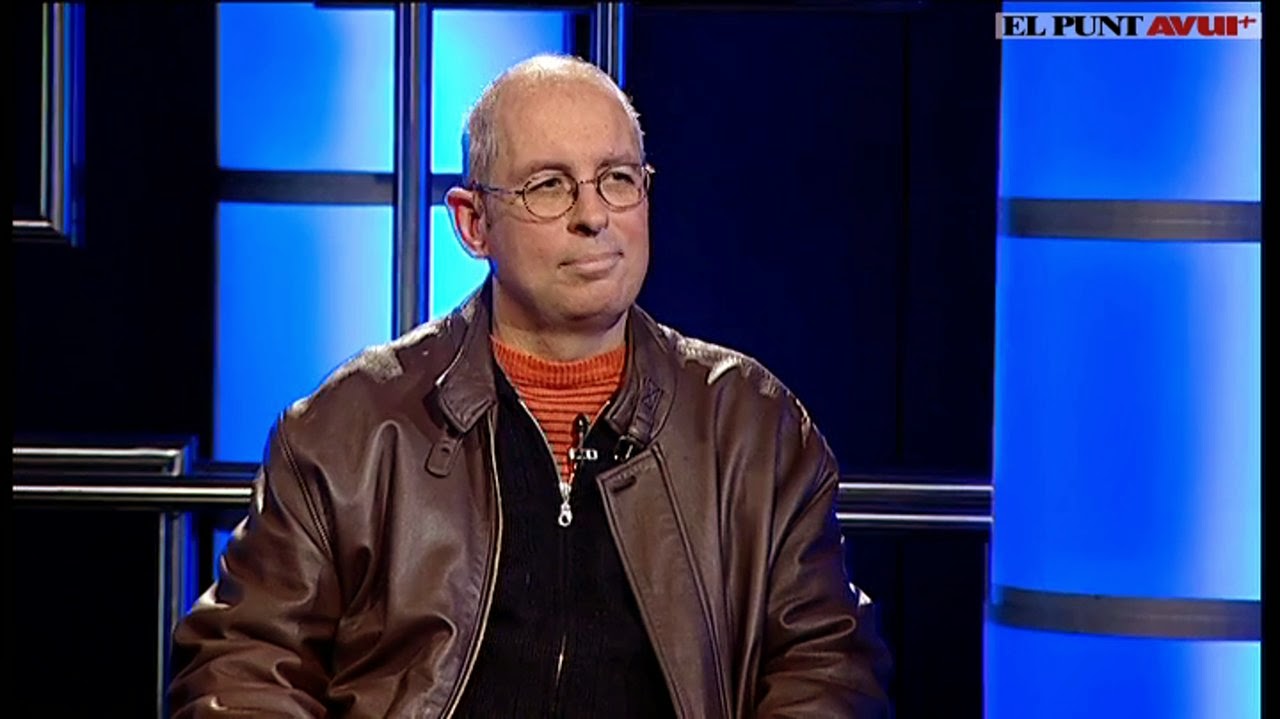 http://www.elpuntavui.tv/video.html?view=video&video_id=118935854
This week I had a very enjoyable interview with Nicole Millar on her English language program for El Punt Avui TV. We talked a lot about parenting and more generally about our lives here.
"First thought:" My Substack page

For readers who like stimulating & original lit-bits on social & personal issues. From the mind of an always-curious author/teacher/journalist living long-term in Europe (Catalonia/Spain.)
- Brett Hetherington's profile
- 10 followers

