
Brett Hetherington's Blog: "First thought:" My Substack page, page 44
July 9, 2016
"Times in the balance" - My latest opinion column for Catalonia Today magazine
 Now that summer is here it is easy to ignore the wider world and only take in what we see through the sun's glare at the beach or from the top of a shady mountain.
Away from the ease of nature’s innocence though, it seems to me that we living in both pivotal and fascinating days. The good news is that Europe can take heart from some real achievements in environmental energy over the last few months.
For example, in the month of May Germany was almost entirely powered by solar and wind, Britain functioned without coal for the first time in over a century and Portugal ran on renewable energy alone for four days straight.
Also, the EU Parliament has called on the European Commission to severely restrict permitted uses of the toxic agricultural herbicide glyphosate - a probable cause of cancer and a substance already found in our bloodstreams.
Just across the sea in Tunisia is another development that must be welcome to anyone who cares about basic human rights. In that part of the continent that originally sparked the Middle Eastern Arab Spring protests over five years ago, Tunisia’s once-extreme Ennahda party "officially declared that it will separate its religious activities from its political ones...[and] acknowledged the primacy of secular democracy over Islamist theocracy."
In other words, mosques there will be politically neutral - a major blow to any recruiters of fundamentalist terrorists.
But there are also current affairs stories that are not at all heartening. Conservative party attacks on the taxpayer-funded BBC TV are continuing without mercy.
David Cameron’s government is trying to take further money away from children’s programmes in a move towards corporate advertising on that great media institution. This idea of complete abandonment of the public sector is now being taken to it’s logical conclusion elsewhere. In Gurgaon, a booming new Indian city with a population of millions they live and work “without a citywide system for water, electricity or even public sewers.”
It is exactly this kind of problem that billionaire technology magnate Bill Gates sees holding the United States of America back. He recently made the case for public funding of crucial infrastructure, arguing: ““Since World War II, U.S.-government R&D [research and development] has defined the state of the art in almost every area. The private sector is in general inept,” he said.
At least North America is experiencing a resurgence in the sales of books however. In 2015, incomes for independent booksellers were up just over 10%, and are remaining strong in 2016. Sadly, this is not the case for the United Kingdom where over six hundred independent bookshops have closed in the last decade.
Meanwhile in Australia, Peter Dutton (a man that doctors voted ‘the worst Health Minister in 35 years - having cut $57 billion from public hospitals) has just been put in charge of the area of national immigration. He was promptly caught on camera making jokes about climate impacts on low-lying Pacific Islands while on diplomatic visit. Then, as part of Australia’s right-wing government he made the self-contradicting comment that refugees “won't be numerate or literate ... They would languish on unemployment ...These people will be taking Australian jobs."
Over the summer I’m going to stop thinking about the above news items. I’m sure there will soon be fresh pieces of our human doings to be amazed by.
[This article was first published in Catalonia Today magazine, July 2016.]


July 2, 2016
"Why British boarding schools produce bad leaders"
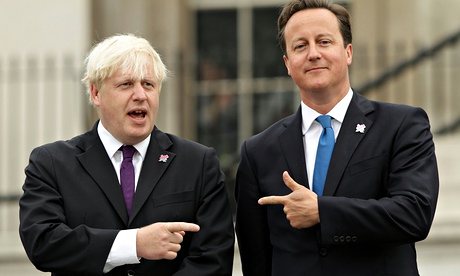 [Boarders … Boris Johnson and David Cameron. Photograph: Yui Mok/PA] "In Britain, the link between private boarding education and leadership is gold-plated.
 If their parents can afford it, children are sent away from home to walk a well-trodden path that leads straight from boarding school through Oxbridge to high office in institutions such as the judiciary, the army, the City and, especially, government.
Our prime minister was only seven when he was sent away to board at Heatherdown preparatory school in Berkshire.
Like so many of the men who hold leadership roles in Britain, he learned to adapt his young character to survive both the loss of his family and the demands of boarding school culture. The psychological impact of these formative experiences on Cameron and other boys who grow up to occupy positions of great power and responsibility cannot be overstated. It leaves them ill-prepared for relationships in the adult world and the nation with a cadre of leaders who perpetuate a culture of elitism, bullying and misogyny affecting the whole of society.
Nevertheless, this golden path is as sure today as it was 100 years ago, when men from such backgrounds led us into a disastrous war; it is familiar, sometimes mocked, but taken for granted. But it is less well known that costly, elite boarding consistently turns out people who appear much more competent than they actually are. They are particularly deficient in non-rational skills, such as those needed to sustain relationships, and are not, in fact, well-equipped to be leaders in today's world
I have been doing psychotherapy with ex-boarders for 25 years and I am a former boarding-school teacher and boarder. My pioneering study of privileged abandonment always sparks controversy: so embedded in British life is boarding that many struggle to see beyond the elitism and understand its impact. The prevalence of institutionalised abuse is finally emerging to public scrutiny, but the effects of normalised parental neglect are more widespread and much less obvious. Am I saying, then, that David Cameron, and the majority of our ruling elite, were damaged by boarding?"
Read more from source here.
June 27, 2016
"A Children's Book Introduces German Kids to the True Story of Syrian Refugees"
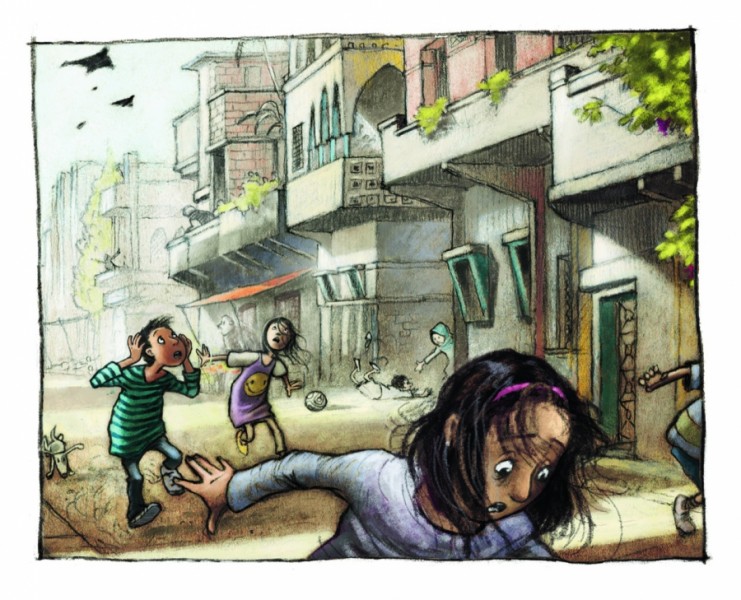 [Credit: Jan Birck] "There are now more than 65 million people displaced by conflict in the world, the highest level ever recorded. Half of these refugees are children.
Germany has received more than 1 million refugees, mostly from Syria and Iraq. Despite supporters initially celebrating Chancellor Angela Merkel's actions, many Germans have begun voicing concerns about when this acceptance of migrants will come to an end.
But while the adults in Germany have expressed mixed reactions to the refugees, German author Kirsten Boie wants children at least to realize that a refugee child is just like any other kid in the world.
In her latest children’s book, “Everything Will Be Alright,” she writes the true story of Rahaf and her family, who flee Homs, Syria due to bombings by war planes. The family crosses the Mediterranean Sea on a small boat, ultimately choosing a small town near Hamburg, Germany to start their new lives.
The book is published in German and Arabic and is meant to be read at school to both German-born children and their new immigrant neighbors. (An English translation is available online here.)"
Listen to this story on PRI.org »
June 24, 2016
"On the results of the UK/Europe referendum - DiEM 25"
 This movement, of which I am a proud member, released a statement this morning which I generally agree with:
 "DiEM25 campaigned vigorously in favour of a radical IN vote.
OUT won because the EU establishment have made it impossible, through their anti-democratic reign (not to mention the asphyxiation of weaker countries like Greece), for the people of Britain to imagine a democratic EU.
Our radical IN campaign was thus defeated.
We can proudly look the powers-that-be in Brussels, Berlin, Frankfurt, Paris etc. in the eye and tell them: “We tried to save the EU from you. But you have poisoned the EU so badly by silencing the voices of democrats that, though we tried, we could not convince to people of Britain to stay.”
We, at DiEM25, are in no mood for being downcast now that Leave won, against our better efforts. As of today, a new exciting challenge begins for our pan-European democratic movement.
At DiEM25 we rejected the logic of EU disintegration implicit in the Leave campaign. But we also rejected the logic of business-as-usual for the EU peddled by David Cameron, Tony Blair, Wolfgang Schäuble, François Hollande, Jean-Claude Juncker, Hillary Clinton and all the other contributors to the loss of EU’s legitimacy, integrity and soul.
DiEM25 regrets that the British people chose to leave in the EU. But at the same time, DiEM25 welcomes the British people’s determination to tackle the diminution of democratic sovereignty caused by the gross de-politicisation of political decisions and the consequent democratic deficit in the EU.
As of today, DiEM25 will seize upon the OUT vote to promote its radical agenda of confronting the EU establishment more powerfully than before.
The EU’s disintegration is now running at full speed. The DiEM25 campaign of building bridges across Europe, bringing democrats together across borders and political parties, is what Europe needs more than ever to avoid a slide into a xenophobic, deflationary, 1930s-like abyss.
In this endeavour, British progressives will be at the heart of DiEM25’s campaigns."
June 18, 2016
" ‘The Day I Became Just a Stupid Number': One Syrian Refugee's Journey to Europe "
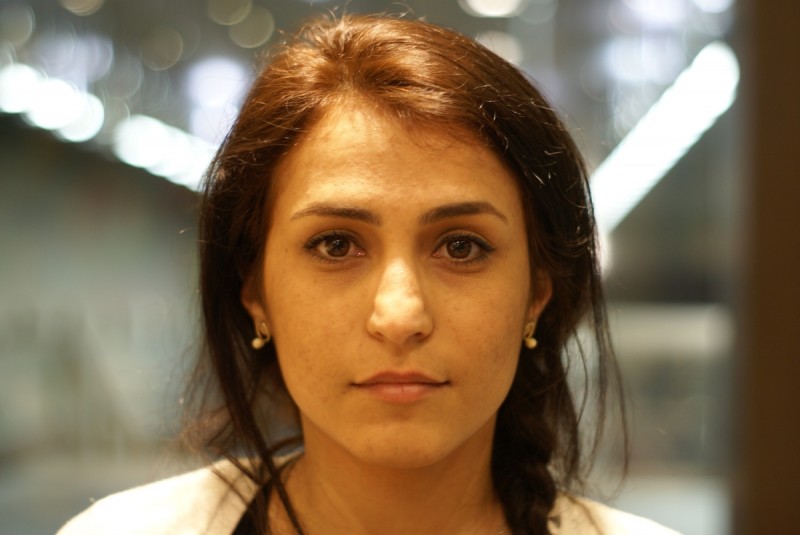 [Zozan Khaled Musa]"A lot has been written about refugees in the last two years. But rarely do we hear from the refugees themselves in more than just soundbites.
 GlobalPost, an international news organization within the PRI family, commissioned essays from five young Syrians who all made the difficult decision to leave their homes — and undertake a menacing journey out of the country, to Turkey, to Greece and across southern Europe.
This essay by Zozan Khaled Musa, 25, was originally published on PRI.org on May 31, 2016, and is republished here with permission.
After a long dark journey in the Aegean Sea, I arrived to the small Greek island of Nera at about 3:30 on the cold morning of Oct. 3, 2015. There were many local fishermen who helped us after the boat landed. They wanted to have the boat’s engine, which was valuable to them.
It was an unbelievable relief to see our feet on land again. We decided to rest in a small room near the beach. There was not enough room for all of us. So only the women and children stayed inside. I made my bag a pillow and my jacket a blanket, but it was so cold that I couldn't close my eyes.
When there was enough light, we walked to the local police station. It was about two-and-a-half miles away.
Many boats arrived to the island that night. Hundreds of people were standing in a line waiting their turn to be registered so they could take another boat to the main island of Kos. In Nera, when my turn came to get inside the office, they wrote the number “17” on my hand.
I will never forget the day that I became just a stupid number on a long inhuman list. How shameful for humanity that so many people became nonhuman in that single helpless moment. I did all the procedures as best I could and headed to Kos, where the authorities waited for us with a paper with each one of our names on it.
That paper allowed us to get on a ship going to Athens. It was a 12-hour journey. I made it to Athens the next morning and parted from my husband's friend’s family and met a Greek friend who was helping me get on a bus to the Macedonian border. It was 11 p.m..."
Read more from source here.
June 11, 2016
"Why the Spanish election offers hope for Europe" - Yanis Varoufakis interviewed in Barcelona
“On 26th June the people of Catalonia, the people of Spain, have a unique opportunity to vote in a progressive government that will save the European Union from itself and from the disaster caused by the self-defeating austerity breeding unbearable authoritarianism.
The incumbent prime minister of the right-wing People’s Party behaves like a spoilt child in Brussels, begging to be allowed to violate the unenforceable rules. The next prime minister of Spain, representing a progressive government that the Spanish voters now have the opportunity to bring to power, must call forth a EU summit that discusses and draws up new, rational, enforceable rules.
Only then can Spain breathe again in a Europe that re-discovers its poise, rationality and humanity. This is why the 26th of June presents a unique opportunity, one that will be realised as long as the next government refuses to commit to existing policies and to Rajoy’s and Dos Guindos’ prior commitments to the Eurogroup.”
Read more from a Greek bearing truths at his blog here.
June 4, 2016
"A stretched agony" - My latest book review for Catalonia Today magazine
 small children trade the world for distractiondeal in statements with the grammar of a road signthey’re happy to put the sun in the top corner of the pagecount backwards from 9 and arrive at the end of this sentenceThese lines from Nathan Shepherdson’s newly-reprinted “Sweeping the Light Back Into the Mirror” are an example of what this award-winning poet does so well: he uses memory to compress sentiments that are without sentimentality and gives us self-revelations that are not self-obsessed.
 In one moment he is inside the mind of himself as a child: innocence, naivety and then using exact nuances of expression to capture that uncomplicated kiddy outlook. On another page you get the distinct impression that he is having a (one-sided) talk with his dead mother. The author not only dedicates the book to Noela Mary Shepherdson (who died in 2003) but he also continually shows a deep understanding of women in general, including an appreciation of women’s clothes and ‘finery.'
But this poet’s skills go much further than mere observation. His brilliantly gothic portrait of two crows near his mother’s grave is sixteen lines of the best poetry I have ever read, and his use of personification is equally as deft because it never seems forced or misplaced. Shepherdson also has a way of reminding us of what he calls the ‘ tribunal of memory ’ and how it can make the settings of people we have been fond of so poignant and emblematic.
I too share his obvious fascination with the insect world (especially ants) and enjoy his regular references to plants, animals and nature in general. It would be wrong though to say that this book is in any way a breezy affair. There is barely a moment of lightness. When it appears it is the bleakest of dark humour (remindeding me of an episode with a waitress in Bob Dylan’s song Highlands.) Shepherdson recalls his mother this way: "you drew a straight line on the wall/laughed and turned/and declared it a self portrait"
Every parent would surely like to be revered with such devotion by a son or daughter, though for this poet it has come at a price. Here, he is filleting his nerves: "this is where I murder truth/cut the bowels out of the clock /this is where you pay the bill/the one you kept under your left breast for years/you had faith/i had you"
The final part of the book is a like a doctor’s chart that puts graphic images on top of one another. It gives snapshots of the brutal physical and mental decline of an emotionally-generous woman, and is a kind of stretched agony. I found tears stinging my eyes while reading the last pages of this book:
take a marking pen and draw infinity around the eyes of one just departedyou have just created two black holesmarked them out with a warning for light to turn away…
i wish i could draw your fingerprints from memory
exhume entire landscapes from an archive of touch
[This article was first published in Catalonia Today magazine, June 2016.]
May 30, 2016
"Can George Orwell Teach Catalonia a Lesson?"
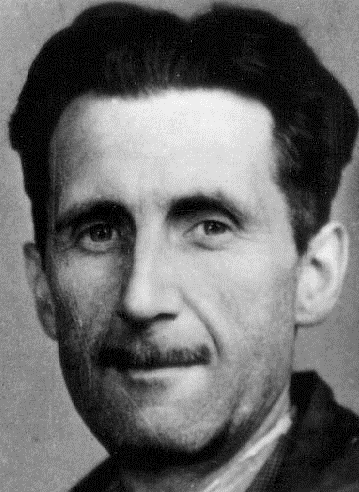 "In the clear yet cold winter of 1936-1937 a 33-year-old George Orwell found himself fighting on the Republican side in the Spanish Civil War. He was to vividly record his experiences in Homage to Catalonia, one of the first-rate nonfictional books on the brutality of war.
 Now, with almost 50% of Catalans in favor breaking away from Spain, Spaniards are facing a possible fracturing of their country. Absurd? Impossible? Illegal? Unconstitutional? Well, Orwell had never imagined that the Barcelona he admired, where “the working class was in the saddle,” and where “there was a belief in the revolution and the future,” was to have “lies and rumors circulating everywhere, the posters screaming from the hoardings that I and everyone like me was a Fascist spy” in less than six months’ time.
No one is predicting that in today’s Spain fellow countrymen will be killing each other, and the Minister of Defense has said that Spanish military involvement will be unnecessary as long as everybody “fulfills their duty.” But there are several salient historical and political parallels between what Orwell experienced in the Spanish Civil War and the current independence movement in Catalonia."
Read more from source at El Pais in English here.
May 21, 2016
"Germany puts refugees to work ... for one euro [an hour]"
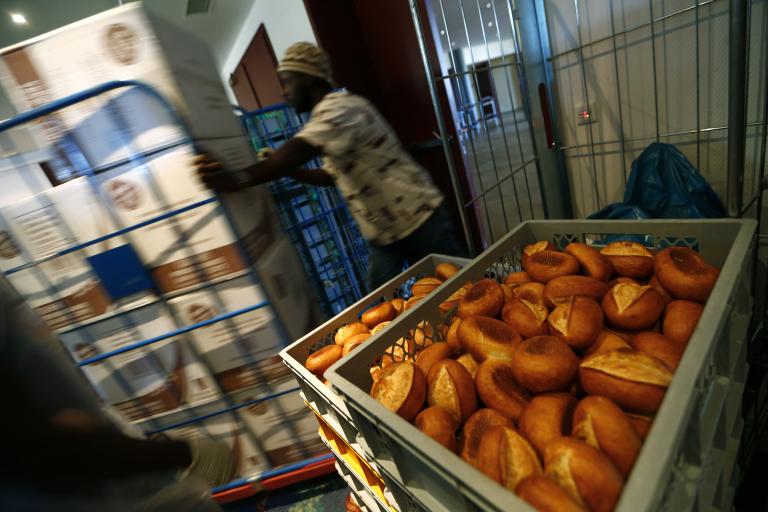 "With a spoon and spatula in hand, Zaid, a 23-year-old Iraqi refugee, lifts the lid on a large pot filled with goulash and potatoes as he begins his shift.
From 6:30 to 8 pm, he is employed by the city of Berlin to dish out dinner to 152 other Syrian, Iraqi, Afghan and Moldovan refugees in a sports hall, which had been turned into an emergency shelter for the newcomers.
Zaid is one of thousands of refugees who have taken on tasks ranging from repairing bicycles to pruning plants to cleaning sidewalks for pay of just over one euro ($1.1) an hour.
The so-called "one-euro jobs" have been touted as a springboard for the newcomers into Germany's job market, but experts remain skeptical about their effectiveness.
At the sports gym, Zaid tries to explain to the sceptical faces crowded in front of him what went into the beef stew that he described as "so German."
For the work that includes setting the table, cutting bread, serving food and then cleaning up, he is paid 1.05 euros an hour.
Restricted to working no more than 20 hours a week, Zaid gets a monthly income of 84 euros at best, a small extra on top of the 143 euros he receives as pocket money while he waits for the official decision on his asylum application."
Read more from source at GlobalPost here.
May 15, 2016
Varoufakis on Spain’s general election & Podemos’ prospects – op-ed in Newsweek
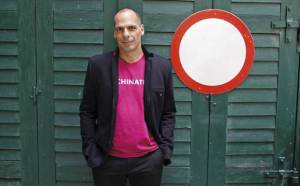 "Last July, Mariano Rajoy, Spain’s conservative prime minister, exited a 17-hour-long European Council meeting dedicated to Greece, wielding in front of the cameras the surrender document that his Greek counterpart, Alexis Tsipras, had just signed.
 Staring into the camera he told the Spanish people watching at home: “This is what you get by voting for parties like Syriza.”
The crushing of the Athens Spring, together with the soothing fairytale of Spain’s economic “recovery,” was meant to stem the rise of Podemos (a.k.a Spain’s answer to Syriza) and to lead Rajoy to a general election victory in December 2015. Alas, voters had other ideas, denying Rajoy a working majority, giving Podemos a larger share than the pollsters had predicted, and producing a hung parliament.
Since then, frantic negotiations between Rajoy’s People’s Party, the fading Socialists led by Pedro Sanchez, the newfangled neoliberal Citizens’ party and Podemos have failed to produce a coalition government, triggering a fresh general election. The new contest’s outcome will hinge on whether Podemos manages to rise from third to second place, pushing the Socialists into a fate similar to that suffered by the Greek socialists (PASOK) and awaiting the French socialists next year.
If Podemos fails, a grand coalition of the establishment parties, possibly with the addition of the Citizens’ party, is on the cards. But if Podemos manages to shrug off Syriza’s humiliation and overcome Rajoy’s fear mongering to become the second largest party, another hung parliament will spell the end of the two-party system. This will yield a Madrid government inimical to the troika and the ironclad majority that the German Finance Minister Wolfgang Schäuble has surrounded himself with in the Eurogroup.
Such a development would spell trouble for Europe’s frazzled establishment which, for this reason, is now trying to rush through a new Greek austerity package before the end of May. The hope is to trap Athens into permanent debt bondage before the Spanish voters deliver a verdict likely to alter the balance of power within the Eurogroup.
But will Podemos manage to overtake the Socialists?"
Read more here.
"First thought:" My Substack page

For readers who like stimulating & original lit-bits on social & personal issues. From the mind of an always-curious author/teacher/journalist living long-term in Europe (Catalonia/Spain.)
- Brett Hetherington's profile
- 10 followers

