
Brett Hetherington's Blog: "First thought:" My Substack page, page 41
January 14, 2017
"The dangers of the sell-off" - My latest opinion column for Catalonia Today magazine
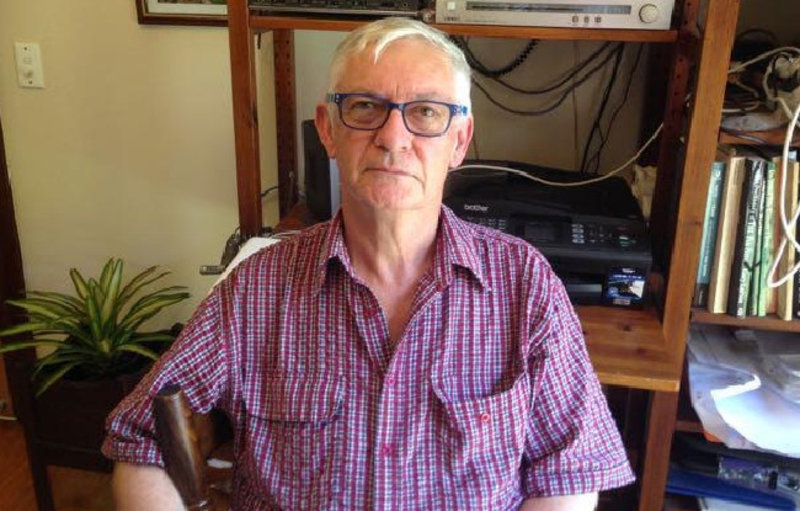 ["Grandpa Mark"] A new year has begun but not much has changed apart from the date on the calendar.
In Australia, that faraway land that has the reputation of a kind of paradise according to some people here in Catalonia, the national government is up to its usual dirty tricks.
Someone working at the public's expense recently discovered a sixty six year-old grandfather named Mark Rogers who the government solicitor is threatening with legal action if he doesn't close down a website he runs.
His alleged crime?
Not corruption, child-pornography or even defrauding bank customers. Rogers, volunteering his own time, dares to host “savemedicare.org” in an attempt to keep the Australian health system in public hands.
The ultra-conservative Turnbull government down-under has told “Grandpa Mark” that he has broken copyright law through 'misleading or deceptive' use of the Medicare “brand” logo.
The fact that Medicare exists not as a brand but as a taxpayer-funded organisation which is responsible for allocating resources to hospitals has been ignored by the Aussie media.
What they have rightly pointed out though is that the government is falsely using the law to intimidate a critic of their policy of selling off Medicare to corporations with big profits from sickness as their sole motive.
Rogers aim is simply to keep the universal health system for all and to publicise the myths that right-wingers in Australia are spreading about Medicare being supposedly 'unaffordable.'
Meanwhile back on this half of the globe, in a progressive move the Slovenian parliament has adopted a constitutional amendment that declares their country's abundant clean water supplies are 'a public good managed by the state' and 'not a market commodity.'
Strangely though, the same centre-left government is planning to employ private security firms to help “manage the flow of thousands of migrants and refugees” travelling through the country toward northern Europe.
If contracting out police work seems a reasonable idea, I would urge you to read British journalist Polly Toynbee's wonderful book about life for the low-paid (titled “Hard Work.”) She spent time in various jobs where, amongst many other shocking discoveries, she found that all across their National Health Service, private agencies were originally used to solve short term staffing but quickly became dependent on them.
The agencies were quick to realise this relationship of dependency so colluded to keep pushing up their fees without paying staff any more than sub-living wage rates. As a result, public service 'managers' were completely unable to manage their teams because they were all being directly employed by companies outside the system.
This has been a business arrangement that only benefitted the companies. And it has now been true for a decade and a half, leaving taxpayers as well as the government and these low-paid workers trapped without a trace of value for money - the exact thing that privatisation is supposed to be so good for.
[This article was was first published in Catalonia Today magazine, January 2017.]


January 4, 2017
Peter Hitchens' controversial pilgrimage to Barcelona
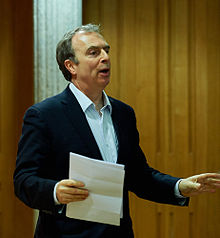 British journalist writing for that horror of a publication, the Daily Mail has some strong opinions about the city...
Many thanks to fine blogger Sackerson for the link.
December 26, 2016
Orwell's Barcelona, December 1936 (& who really are the "wealth creators:") an edited re-post
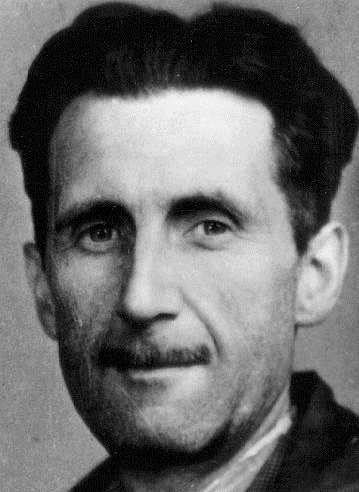 It was at a moment of this same month, exactly 80 years ago, that George Orwell chose to open his exceptional book “Homage to Catalonia.”
Orwell was sure that not only could Socialism work but that it was already working in Barcelona during that autumn and winter, however briefly.
In his earlier life Orwell had argued that wealthy Britain was only able to exist thanks to coal miners working themselves to early deaths in underground infernos. They were then the true creators of that nation’s wealth.
As William Blake wrote, the entire modern world is "underwritten by constant, speechless suffering and that 'culture' begins in the callused hands of exhausted children," [to quote historian, Robert Hughes.]
(This reminds me of a line in a song by another Australian expat, NickCave:
"Out of sorrow, entire worlds have been built.")
In the first page of chapter one, Orwell describes how Barcelona seemed to him only eight decades ago…
“The Anarchists were still in virtual control of Catalonia and the revolution was still in full swing. To anyone who had been there since the beginning it probably seemed even in December or January that the revolutionary period was ending; but when one came straight from England the aspect of Barcelona was something startling and overwhelming. It was the first time that I had ever been in a town where the working class was in the saddle. Practically every building of any size had been seized by the workers and was draped with red flags or with the red and black flag of the Anarchists; every wall was scrawled with the hammer and sickle and with the initials of the revolutionary parties; almost every church had been gutted and its images burnt. Churches here and there were being systematically demolished by gangs of workmen. Every shop and cafe had an inscription saying that it had been collectivized; even the bootblacks had been collectivized and their boxes painted red and black. Waiters and shop-walkers looked you in the face and treated you as an equal. Servile and even ceremonial forms of speech had temporarily disappeared. Nobody said 'Senior' or 'Don' or even 'Usted'; everyone called everyone else 'Comrade' and 'Thou', and said 'Salud!' instead of 'Buenos dias'.
Tipping was forbidden by law; almost my first experience was receiving a lecture from a hotel manager for trying to tip a lift-boy. There were no private motor-cars, they had all been commandeered, and all the trams and taxis and much of the other transport were painted red and black. The revolutionary posters were everywhere, flaming from the walls in clean reds and blues that made the few remaining advertisements look like daubs of mud. Down the Ramblas, the wide central artery of the town where crowds of people streamed constantly to and fro, the loudspeakers were bellowing revolutionary songs all day and far into the night. And it was the aspect of the crowds that was the queerest thing of all. In outward appearance it was a town in which the wealthy classes had practically ceased to exist. Except for a small number of women and foreigners there were no 'well-dressed' people at all.
Practically everyone wore rough working-class clothes, or blue overalls, or some variant of the militia uniform. All this was queer and moving. There was much in it that I did not understand, in some ways I did not even like it, but I recognized it immediately as a state of affairs worth fighting for. Also I believed that things were as they appeared, that this was really a workers' State and that the entire bourgeoisie had either fled, been killed, or voluntarily come over to the workers' side; I did not realize that great numbers of well-to-do bourgeois were simply lying low and disguising themselves as proletarians for the time being.”
December 17, 2016
"Portrait of an Asturian miner" - My latest article for Catalonia Today magazine
 The coal miner's wife wakes him and he coughs. He shuffles to the small bathroom sink and spits black liquid, washing it away with with the brown tap water.
Last night he slept badly, suffering from stomach cramps, diarrhea and vomiting again. He had been working in the zinc mine at Arnao in Castrillon but the Belgian company who own the site have let him go to the San Juan mine. He felt himself to be quite lucky. At least there they had a river pool for the miners to wash in.
As he leaves for another day under the earth the miner looks for a last time at the mountains, at their ferns and the tall groups of eucalyptus - – pencil thin, not quite straight, just like the trees in a Dr Seuss book. He sees the houses with their sharp pitched roofs in front of deep gorges and is comforted by the roll of the hills across this green land.
Our miner is living before the era of the chemical plants and big metal factories. He knows others who dig for iron and knows it’s vital for tinned food because electricity and refrigeration have not yet arrived to this part of the world.
His mine, like many mines, is close to a river: a means of transporting the coal for trading this raw material with British towns like Cardiff and Newcastle-upon-Tyne [where my own father was born and also grew up next to a polluted river.]
This miner's children will one day see the construction of chemical industries, thanks to the mines, thanks to his labour. In fact, he thinks, as he makes the walk to the pits, the story of Asturias is the story of the miner and the story of the miner is the story of Asturias. It is one of hardship and scant reward, of growth but also ill health. It is a tale of the deep earth's hidden secrets and humanity’s immeasurable suffering with the open spaces of the valleys and their claustrophobic confines - as unforgiving and back-breaking as any imagined hell in those greedy shafts penetrating ever downwards into the planet.
Today, like thousands of other days, he will launch his body into the ground and probe for hour after hour for that black rock. Finally, at the end of the day our miner will take aspirin for his aching bones, smiling at the ironic fact that it has ingredients made from the very coal he has been digging for. He does not yet know though that, decades later, his children are going eat kiwi-fruits and chestnuts that will come to grow particularly well in the carbon-coloured soil left from abandoned open-cut mines scattered across the nearby hills.
As the miner eats his simple lunch with his hands still blackened by coal dust, he remembers his father, who was also a miner. He too worked to extract the iron that was in such high demand for both twentieth century century world wars – a metal that helped the rich become richer. His father started life as a rural worker and had to adapt from the rhythms of the seasons to the very different rhythm of an industrial timetable. He had to learn to accept days and nights with no sky or trees, down in the mines which lay right next to his cramped terrace house.
Like every other subterranean labourer, his father and he both wondered if life could ever be different for them. He’d heard that things were a bit better at the only mine run by a trade union. But it was on the other side of Asturias and he had never even visited there.
Our miner lives in Bustiello town where all of the aristocrat Marques de Camilla's workers have their neat little houses below everyone else, at the bottom of the valley. It is an orderly, rectangular village and each house has a small garden. Up the hill above them live the engineers and above them is the church, then God of course. This is what he knows: the planning of the town exactly reflects the social and spiritual hierarchy. The Marques is a conservative man. He fears the progressive men who want social change.
Further on in the mountains there are mining zones that suffered from “special measures” during Franco's dictatorship. Around Pozo Fortuna trade union activists were assassinated and their bodies were thrown down an old pit-hole. Our miner speaks about this sadly with his friends and later falls asleep hoping that the bad times will end.
In the morning, he rises and faces another day.
[This article was first published in Catalonia Today magazine, December 2016.]
December 10, 2016
Barcelona Mayor restates role of the city in settling refugees
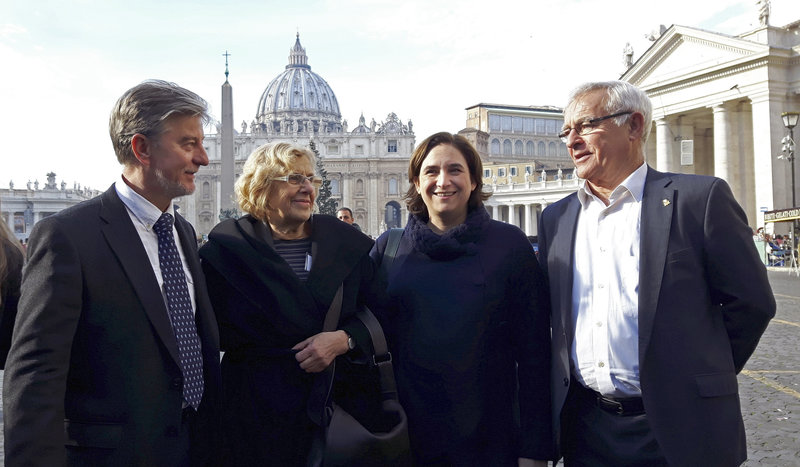 [Colau with her counterparts from Madrid, Zaragoza and Valencia at the Vatican. Photo: EFE.]
"The mayoress of Barcelona, Ada Colau, yesterday [restated] the role that cities can play in the reception of refugees in contrast with the “disastrous handling” so far of the states and the international community in the face of the crisis.
Colau made these claims at the Vatican during her speech at the international summit ‘Europe: refugees are our brothers and sisters' where she was participating with seventy European mayors including those of Madrid, Manuela Carmena; Valencia, Joan Ribó; Zaragoza, Pedro Santisteve, and Malaga, Francisco de la Torre.
The summit opened yesterday but today Colau and other municipal leaders will be received by Pope Francis, who has also been critical of the management of the refugee crisis. Colau appreciated the role taken by the Pope in the issue and denied the existence of any contradictions in being a representative of a lay and non-confessional institution agreeing with the words of the Pope.
For Colau, the meeting is focused “on human rights and democracy,” and asked the other municipal representatives to join forces to combat “the growth of neo-fascism” on the European continent as is represented by the presidential candidate in France, Marine Le Pen.
Warning that the European Union is at a crossroads where it must decide to aid refugees or support the far right, she called for safer means of access to prevent deaths when refugees are forced to flee their countries. Colau demanded more resources and authority for the cities to welcome refugees, grant work permits and allow them to pay taxes “like other citizens.”
“At stake is our civilisation and heritage. The EU was born to say no more to the horrors generated by wars, violence and dehumanisation,” the mayoress concluded."
Source: Catalonia Today.
December 3, 2016
"Competing for victimhood: Why eastern Europe says no to refugees"
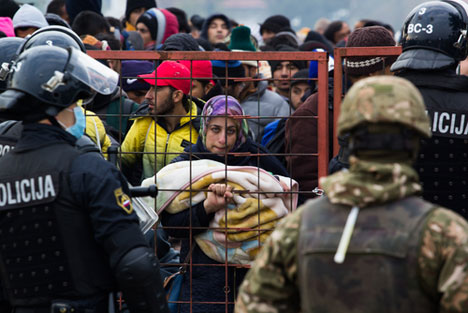 [Slovenia, 25 October 2015. Photo: Janossy Gergely / Shutterstock.com. Source: Shutterstock]
A thoughtful and balanced piece of writing from Slavenka Drakulic that helps explain bigotry in that part of the world...
"The constant meetings of EU leaders concerning the refugee crisis in Brussels have not so far yielded any solutions. Decisions and documents, yes, but the question remains how many of these are going to be implemented in reality. One of the reasons is that former communist states in eastern Europe are more or less openly defying a common approach, in particular the sharing of the burden of refugees through quotas.
Until recently it seemed that eastern and western Europeans were getting closer, that the new EU member states were slowly adapting to western democratic standards not only in form, but also in practice and mentality.
But the refugee crisis has demonstrated how deep the division among Europeans still is. Hungary, Czech Republic and Slovakia reject quotas, Bulgaria was first to build a fence along its border with Turkey, Romania is not offering refugees safe havens either, and Slovenia and Croatia claim lack of capacity, while also lacking the will to keep them.
It looks as if Poland, with its newly elected government, will reinforce this defiance. Not to mention countries outside the EU: if Serbia and Albania are willing to perhaps show a kinder face to refugees while guiding them towards western borders, it is with an eye on possible membership of the Union. Macedonia is in the worst situation, penniless, overrun and desperate. It is obvious that these states are not very eager to, or capable of, demonstrating solidarity, to say the least."
Read more from source at Eurozine here.
November 30, 2016
Join me in conversation at a workshop
 This Thursday afternoon...
"Why We are Losing Our Children & How We Can Get Them Back."
I will be leading a Parenting/Education Workshop near Sitges-Vilanova this Thursday 1st of December at 4.15.
Venue: The Olive Tree School, RAMBLA DEL GARRAF 21Sant Pere de Ribes.
November 27, 2016
Video: "Austerity in 8 minutes: Why it does not work. Why it is still practised"
"At the Cambridge Union's London Debate, economist and DiEM25 co-founder Yanis Varoufakis explains why 'This house has lost confidence in austerity'."
November 19, 2016
Video: "TV talk: Trump, Catalan language and Leonard Cohen"
 http://www.elpuntavui.tv/video/192005057.html
This week I was once again a guest on Matthew Tree's panel show "Our Finest Hour." We discussed Donald Trump, where Catalan is and is not able to be spoken in Catalonia and Leonard Cohen, before a live performance by Guillem Gené of Cohen's song "Bird on a Wire."
November 12, 2016
"Albania's pain" - My latest article for Catalonia Today magazine
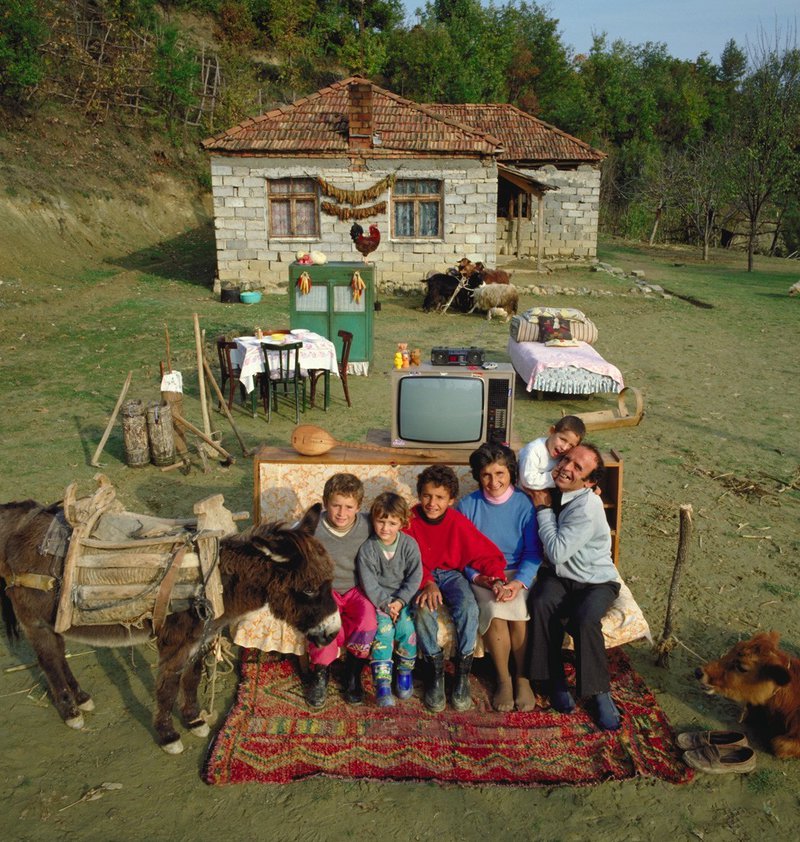 [A middle class Albanian family Photo: PETER MENZEL, FAMILIES OF THE WORLD.]
When I was a curly-haired (and more ignorant) twelve year old in the Cold War years of the early 1980s, one day our History teacher asked the class a general knowledge question: “Who is the world’s longest-serving current dictator?”
Nobody had the correct answer, though Chairman Mao was one of the few responses from the students. Mr Lamb (yes, that was my teacher's name) gave us some helpful clues. “Come on now! He’s been in power since 1944 and he’s not from Asia.” But still, there was no idea running through the developing minds of those in the group. “It’s the Communist leader, Hoxha. Enver Hoxha in Albania,” he told us and wrote this strange sounding name on the board.
A decade and a half later (after French-educated Hoxha had been dead for almost ten years) I started to develop a morbid fascination with this country - a place the wider world knew little about. I read Paul Theroux’s harrowing account of a few weeks he spent travelling there and from a ferry leaving Greece I saw part of its coast: rough, dry and barren of buildings. I discovered that both Albania’s past, equally as much as its present, beggars belief and this pulled me into its orbit.
By the time Hoxha had been claimed by diabetes at the age of seventy six, his regime had modernised the economy in a classically Communist way: at a huge cost to the lives of its citizens. All across Albania, vicious historical blood feuds between families raged on and on unchecked and Hoxha’s secret police, the “sigourmi,” used networks of ordinary people as informers on their workmates and neighbours. Tens of thousands were jailed or disappeared (often in the kind of nightmarish circumstances that could come straight out of a Kafka story) and it’s estimated that up to twenty percent of the population were killed or died in forced labour.
When Hoxha’s supposed “worker’s paradise” came to an end there was a long, widespread orgy of general destruction of public property including factories. Combined with mass unemployment, severe shortages of food and fuel meant that the winter cold froze many people to death. Thousands of badly-needed professionals and working age men and women are still escaping to try to find work in neighbouring Greece or taking the short ferry to an often equally poverty-stricken existence in Italy. Some are going further away, including to Britain.
But even the years before Hoxha were no less bizarre. Albania’s King Zog, who survived five assassination attempts, married an aristocratic half-American woman (having seen her in a photo.) The Albanian parliament insisted on seeing the bloody nightgown from her wedding night, as proof of her virginity. Their giant-sized only son Prince Leka moved to Spain, where he trained exiles for a planned guerilla war against Hoxha. Leka’s combat practice became too much even for Franco’s government and the prince’s former royal playmate Juan Carlos was requested to ask Leka and his tribe to leave the country in the mid 1970s. He then took up residence in South Africa and hung around with the King of Zululand after marrying an Australian citizen and former teacher named Susan.
Meanwhile Albania was falling apart slowly. To see the country today is to witness corruption on a scale that makes Greece, Italy or Spain look like amateurish. Because of threats to their lives, the Prosecutor General Adriatik Llalla was recently forced to send his pregnant wife and two children to live in another European country. On top of this, environmentalist groups say they fear Albania will become Europe’s dumping site now that the national government has agreed to take other countries recycling waste.
Albania has some of our continent’s most spectacular scenery and quiet beaches. It has been predicted to become the next big thing in tourism for many of the last few years but somehow it is still largely neglected.
[This article was first published in Catalonia Today magazine, November 2016.]
"First thought:" My Substack page

For readers who like stimulating & original lit-bits on social & personal issues. From the mind of an always-curious author/teacher/journalist living long-term in Europe (Catalonia/Spain.)
- Brett Hetherington's profile
- 10 followers

