
Val Silver's Blog, page 7
June 22, 2023
Creating Captivating ContentAI Image Generators for Niche Websites – Part 2
My name is Al the Graphics Guy. You may have met me in my previous article where I introduced the basic concepts of how to think about A.I. image generators for content creation.
Today, we will continue evolving that mindset and walk through some examples.
Part 2 – Think Like a ProducerThere was a great interview recently on 60 Minutes with Rick Ruben, a well-respected and successful music producer. He said:
“I have no technical ability. And I know nothing about music.”
Now he’s a metaphysical type of person, but he wasn’t joking. Ruben doesn’t play instruments, sing, or use a mixing board or computer. He went on…
“I know what I like and what I don’t like. And the confidence that I have in my taste and my ability to express what I feel has proven helpful to artists.”
This mindset will be very useful for you in your content creation business as a whole, and most appropriate when using A.I. for your image creation. Think about it this way…
In front of you for your daily task of creating a page, you have…
A broad subject (the topic of your web page/blog post/article)The more specific scenes (the paragraphs or sections in which you want to add an image)All the world’s artists and photographers who ever existed throughout history — all who somehow get along (LOL) and are able to work with each other — standing by to produce images for you.So what’s it going to be? What will you ask them to create? Something funny? Surreal? Realistic? A cartoon character, a beautiful landscape, a setting similar to a famous photo? Or will it be the woman in a red dress dancing on the beach in Spain?

You have the script/song (your page), and you have the artists (A.I. image generators), and now it’s up to you to select how you want the world to feel when they see the produced page.
Successful producers draw from their life experiences — their taste — but they also balance, modify and translate those experiences into something commercially successful.
How to Be an Image ProducerPart 5 of the Tai and Generative A.I. article series serves as a great example of how I approach producing images. For that article, I created three different images using Midjourney.
When Ken was finished writing the article, he sent me the draft, and as I usually do, I went through the following process…
1) Read and reflect on the material
I like to first read the article all the way through a couple of times. First time skimming, then going back to the top and reading at my normal slow pace.
What I’m looking for is the overall tone and presentation style. Is it lighthearted and humorous or a scathing takedown? An informal commentary or an informative one? How does it communicate, and, as the kids say, what’s the vibe?
2) Go get a snack or a drink or take a little walk
I do this so that what I just read has a chance to sink in a bit. I find this helps get me out of any (re)active mood I might have been in leading up to reading the article. The second useful purpose of this small break is to see if anything stuck — was there something in particular that triggered an (idea for) an image in my head?
Taking a break after writing or checking an article is an excellent way to let the information sink in and spark creative ideasClick To Tweet3) Get to work!
OK, time to start producing! Open up the blog post in a new browser window to follow along.
My goal was to produce one image per major section of the page. The most natural way to do this is by following the headings.
In the post, there are three major headings that I felt could use imaging — “Worried”, “The Saga of Sydney” and “Real Dangers.” Let’s go through them.
Section: “Worried?”Reading this section, I picked out the following simple concepts: concerns (plural), people (plural), and discussions. These will form the foundation of my prompt.
The technique I use (and recommend) for prompting image generators is referred to as additive or progressive prompting. You start with the basic concept you have in mind using as few words as possible to see what the program brings back, then add (or subtract) words as needed. Why?Generative AI image programs are necessarily more random than their text counterparts by nature of what they’re producing, and how they do it. An A.I. text generator might give you a single phrase — “It was a dark and stormy night” — while image generators take that phrase and will give you a thousand different visual representations of that one single phrase.
This was my first prompt…
[ a worried group of middle-aged people sitting on a park bench talking on a sunny day, they are very concerned ]
The basic breakdown of the prompt is simple…
[mood/style] worried
[subjects/objects] – group of middle-aged people
[scene/setting] – sitting on a park bench talking
[lighting/scene modifiers] – a sunny day
[repeated emphasis] – they are very concerned.
The prompt produced this set of images…

Not bad. I reused that same prompt (referred to as regenerate or re-rolling) a few times to get a feel for how Midjourney was interpreting my prompt – which words it emphasized, ignored, or had a hard time with. Regenerating is simple, quick way for you to make adjustments to your initial prompt.
After getting relatively the same types of images, which I was not thrilled about, I noticed two things — it didn’t compose the “group” of people to my liking (which is common to A.I. image generators) so I changed the word “group” to “three” and after a few re-rolls, got this set back…

I liked the bottom right image. It’s a good interpretation of what I had in mind.
Although it could have been used as is, I decided to try a couple more and a few words to the prompt (indicated in bold) to see if I could emphasize certain aspects of the image.
[ three people who are very worried sitting on a park bench having an animated discussion, they have concerned looks on their faces, worried, bright, sunny day they are very concerned ]
Which brought this back…

Oh!
As you can see, adding those few words caused Midjourney to speculate and interpret the word “animated” literally — a completely different direction, and, given the seriousness of the whole article, one that I loved.
Even though it lost (or ignored) the “discussion” part of my initial thought/prompt – it lightened the mood in a subtle, playful way while retaining the overall “worried” concept of the section of text. That was the image I chose to use.
This is a key takeaway, one that I hope is as meaningful to you as it is to me.
As an A.I. image producer, you’re working with an unlimited number of talented artists. You are not the artist. You give them basic direction. You’re also not the director. What you’re hoping for is that they, given their skills/range, delight you – the producer – with their artistry and interpretation of your concept. Then all that remains is for you to choose which interpretation you want.
Total time elapsed from the first prompt to selection: 7mins.
With AI image generators a few words is all it takes to completely transform the artistic directionClick To TweetSection: “The Saga of Sydney”Earlier in the article I mentioned that your life experiences become your voice or style. How I thought of producing this image for this section is a great illustration of how that comes to life. I’ve always liked B&W images and the exquisite, elegant suspense in Alfred Hitchcock movies.
And so after reading this section of the post, it was some form of that style that I was going to go for. Here was the prompt I started with…
[ an old fashioned 1960s picture of a New York Times reporter interviewing a human-looking female robot ]
The prompt breakdown…
[mood/style] – an old fashioned 1960s picture
[subjects/objects] – New York Times reporter interviewing a human-looking female robot
[scene/setting] –
[lighting/scene modifiers] –
[repeated emphasis] –
Notice that I did not get specific for the prompt – I did not use B+W, or Hitchcock to over-influence the AI, I wanted to see what the “artists” could do on their own first.
Here’s what was generated…
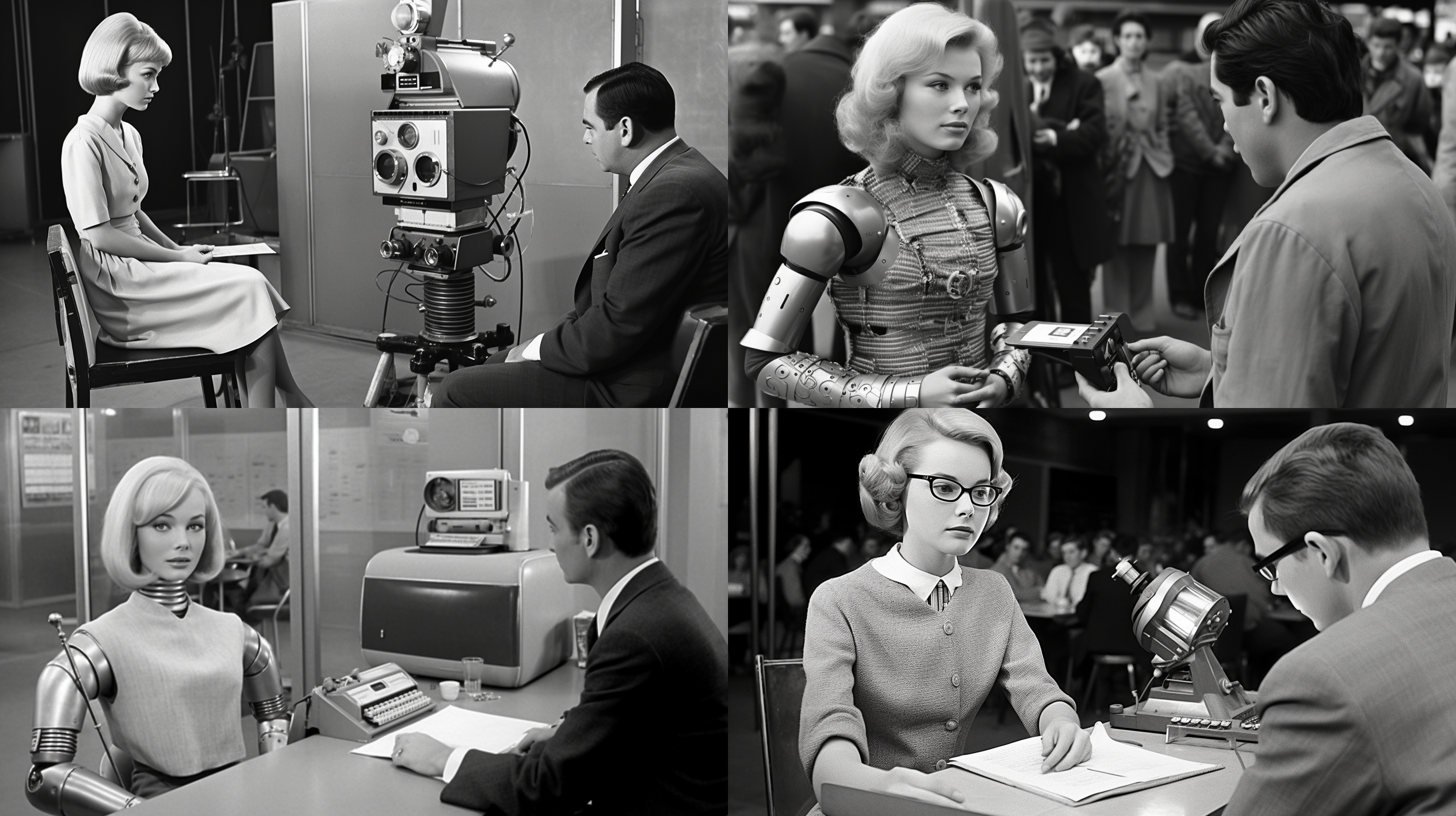
The top right image (above) captured the essence I had in mind so accurately that I literally said WOW out loud.
No need to regenerate the prompt. I went straight to getting variations on that one image, hoping to get a bit more expression on “her” face and to clean up whatever that object collage is supposed to be in the reporter’s hands.
On the second set of variations, I ended up getting the perfect expression and decided that if I was going to use it, I would just crop out the thingamawidget he was holding.
Before leaving though, I wanted to try and see what would happen if I change the setting to what I initially had in my mind. I had pictured more of an indoor scene – a living room, a newsroom or a typical cliché police station you see in old tv series or movies. So I tried adding a simple scene descriptor to my original prompt (in bold)…
[ an old fashioned 1960s picture of a New York Times reporter, interviewing a human looking female robot in a living room ]
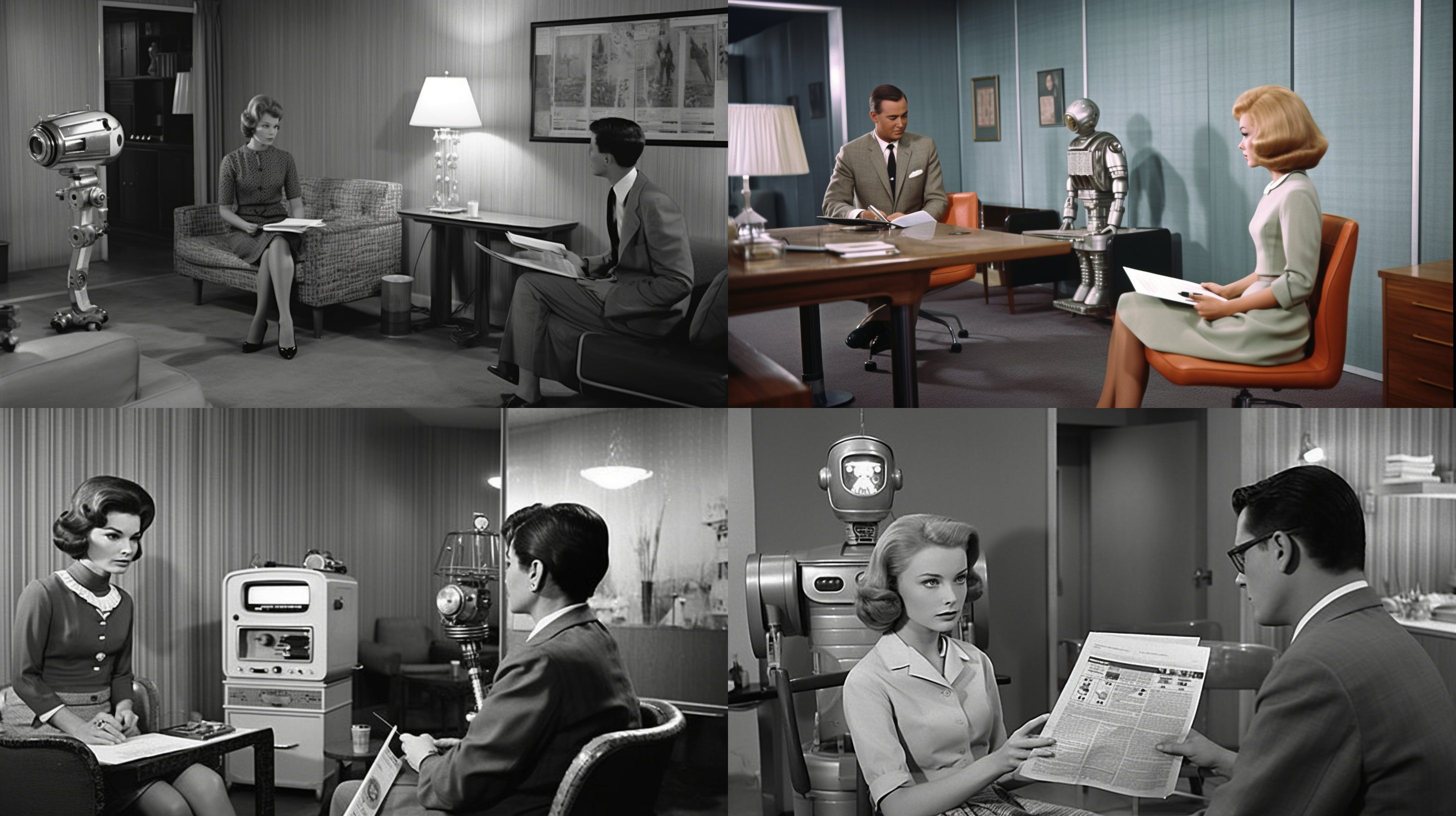
And as you can see, adding that single descriptor not only lost the concept but that incredible render of the robot in the previous image.
And so I stopped there, I really loved the first image, selected it for the article and moved on.
Total time elapsed from the first prompt to selection: 5 mins.
Key Takeaways
Try to keep a productive mindset, meaning… do not expect perfection. These programs are not do-this-change-that capable, yet. Sometimes the first take will be best.
AI content creation tools are there to help us create better content faster. Don't get lost in the pursuit of perfection.Click To TweetSection: Real DangersFor this final section, I took a bit of a “jazz” approach to my prompt. Since I had no specific image concept in mind, I decided to “jam” with Midjourney to see what would come out.
To do this, I usually try to pick some key phrase in the text, something that’s original or dramatic, or a sentence that’s particularly descriptive without being obvious. I copy it verbatim into the prompt. I started with this piece of text from the article for my prompt…
[ the rebuilding of the digital infrastructure for use by A.I. elements rather than humans ]
That brought me these types of sets…
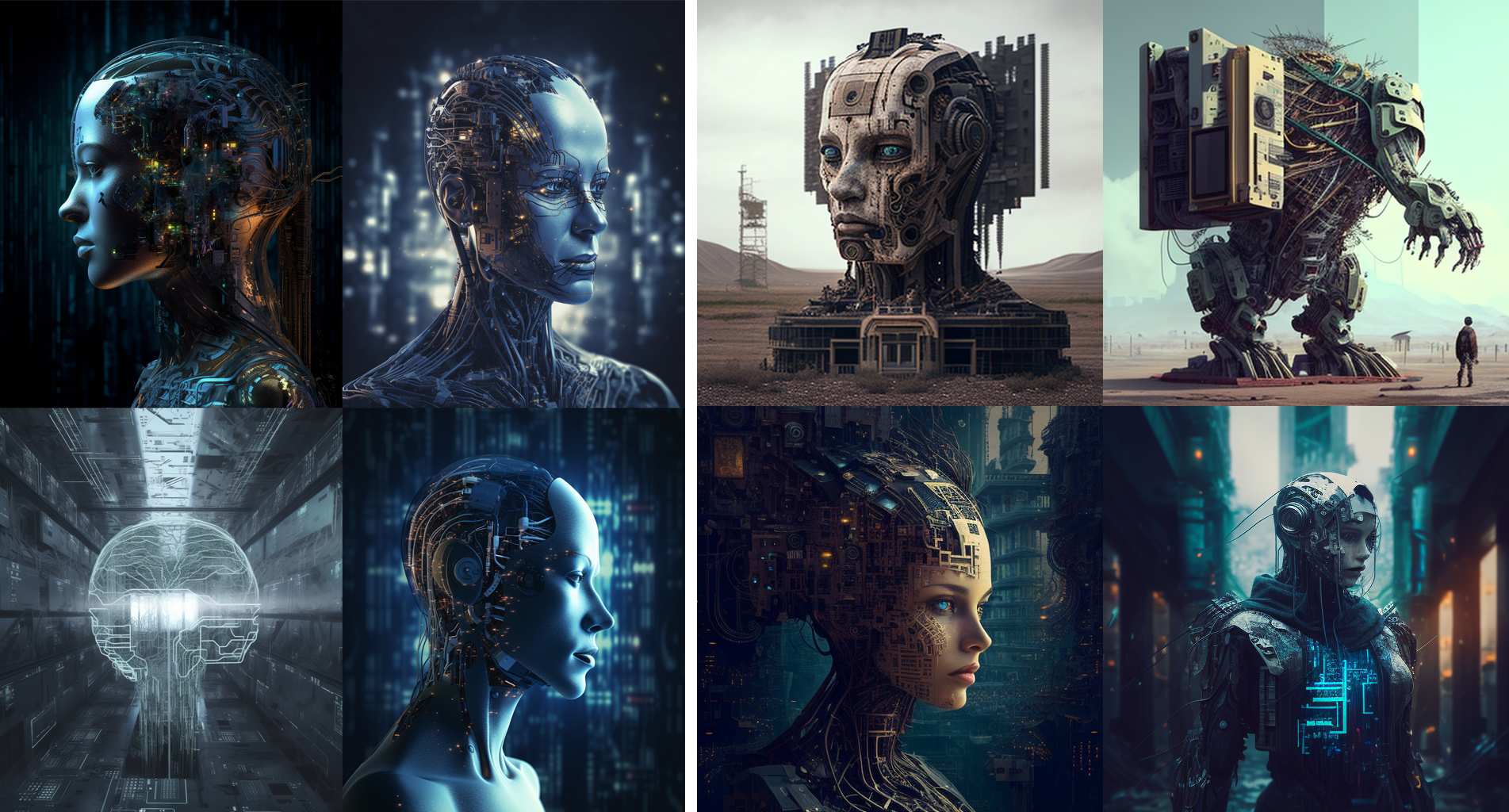
Okaaay, let’s get a different saxophone player, please, I’m not digging this vibe very much!! I played with the prompt for about 5 mins, removing and moving around words but could not get out of that ultra-futuristic style.
So not getting anywhere with this, I decided to pick out a different phrase, and take it from the top…
[ scientists of the day could foresee how electricity would be distributed with time. The same goes for A.I., for which existing internet and mobile-based infrastructures are already available ]
This brought back this series of images…

The bottom left one captured all of the essences of the phrase; electricity, distribution, and infrastructure in a stunning futuristic but human way. No need to try and tweak or re-prompt, I thought it suited the section well and selected it.
Key Takeaways
The technique of using already written text verbatim is one that I discovered. The concept seemed natural and obvious to me – an author has already thought carefully about the words that they chose so let’s just see how the “artists” interpret them.
I have used this technique numerous times with good success, but like all prompts – thoughtfully constructed or not – it is often hit or miss. That is the second key takeaway: don’t get too hung up on thinking that the prompt should be doing this or that, or try to over-engineer a prompt.
While there are finer control techniques that can be added to a prompt, many of which we will cover in the Tai Guide, these AI image generator apps are still (currently) not consistent with them. More often than not, it is not worth the time spent obsessing unless you are specifically using the image as a showcase piece, in which case you are assuming the role of the artist as opposed to the producer.
Enjoy experimenting with this technique. Pick out sentences that you particularly like, maybe ones that are not so obviously descriptive and see where that takes you.
Total time elapsed from the first prompt to selection: 23 mins.
Final Thoughts on Using A.I. Image Generation for Your Content SiteEach new technology brings with it new added capabilities. I’ve always found that as they emerge, it’s important to not lose sight of the bigger picture.
In the case of A.I. image generation programs, we’re not replacing artists. We’re standing on their shoulders, with access that never existed before. The same holds true for stock photography, Photoshop/other image editors, or your iPhone camera for that matter. Each of these will integrate A.I. into their offerings. It won’t replace them.
We can easily get caught up, with criticism on one side, and being lost in wonder on the other. That’s why I’ve tried to emphasize the practicality of it all for you as a content creator, regardless of your graphic skills, to take on a producer mindset.
It’s true that you no longer have to spend chunks of time searching through images that are cliché and have probably been used before. Ask yourself the following questions…
For my content creation needs, are the images that I produce with A.I. better than what I’ve been using to date? Can I do a better cut and paste in my image editor than how the A.I. composes it? Which is more practical and enjoyable? Which saves me more time?
There’s only one way to find out.
 I’ll leave you for now with a twist on a quote…
Now a few words can create a thousand pictures,
each worth a thousand words.
Don’t tell me this isn’t progress!”
– Al the Graphics GuyAnd Now, It’s Your Turn
Go produce! Add one or more of the A.I. image generators to your toolbox. Become familiar with them. Then, create some images for some content you’ve written, using any of the techniques I specified in this article.
Post your results and/or questions in the comments section below. I’ll keep an eye open for them and see if I can help you along your journey.
Have fun,
Al the Graphics Guy
Images by Midjourney. You can find the prompts I used to genereate the images in this article in the title tag of each (hover your mouse over the image).
Author information Al the Graphics Guy
Al the Graphics Guy is SiteSell's tech and imaging guru. He can usually be found behind a pair of 30" monitors, cup of coffee by his side.
|The post Creating Captivating Content
AI Image Generators for Niche Websites – Part 2 appeared first on SiteSell Blog - Proven Real-World Advice for Solopreneurs.


June 14, 2023
Creating Captivating ContentAI Image Generators for Niche Websites
My name is Al The Graphics Guy, and I’ve been creating and manipulating digital images since the very first Mac computer.
Artificial Intelligence (AI) programs in the field of art, photography and design have advanced significantly over the past year. Programs like DALL-E, Midjourney, Stable Diffusion, and Adobe Firefly have the ability to generate incredible imagery by using text in a prompt box to describe what you would like to see.
There really is no historic parallel for me to draw on (pun intended) for how liberating this is, nor a way to overstate how important it is — not only commercially for content creators, but for literally anyone who has ever uttered the phrase “I wish I could show you what I see in my head.”
Imagine turning your ideas into stunning visual masterpieces with AI. It's no longer a dream, it's a reality.Click To TweetAI image generation is still an emerging technology that’s far from perfect. But with some slight adjustments to your expectations, the results you can achieve open up entirely new ways of thinking about not only the images you choose for your site but all of your content creation.
Having set the stage, let’s have a look at what we are looking at.
An Intentionally Brief Comparison of DALL-E, Midjourney, Stable Diffusion and Adobe FireflyThere are many (many!) in-depth write-ups about the history of AI image generators, data models used for each, prompt engineering, etc. That’s not the focus of this particular article.
Image-generating solutions are being created and updated at breakneck pace, so there’s a decent chance that, by the time you read the article, features and capabilities may have already changed.
Here are the basic pros/cons, and impressions I’ve had using the four most popular platforms.
DALL-EAdvantages:
User-friendly, simple and familiar web interface or (via API integration) within Microsoft Edge and other toolsHas the ability to add, remove, edit and replace elements in existing imagesTypically provides what you expect to see from your prompt.Disadvantages:
Images limited to 1024×1024 sizeNot particularly artistic or imaginativeThe web interface sometimes lags, and/or times out. MidjourneyAdvantages:
Provides stunning image quality across all mediaOffers multiple resolutions and aspect ratiosRenders incredibly fine detailsProvides pro-level control of lighting, framing, scene angles, film-type, etc.Understands the essence of styling, brands, artists, photographersUses image seeding (providing an existing image) consistentlyAdvanced prompting commands (blending, weight, image prompts etc.) enabling greater control over output.Disadvantages:
Uses the Discord app as its user interface = a little clunkyHas no direct image editing functions.Unlock a world of limitless creativity with AI imaging tools. Your ideas and vision…Click To Tweet Stable DiffusionAdvantages:
Web interface or you can download and run it on your computerThere are many different web-based offerings that have customized prompt assistanceIt’s less restrictive for commercial things like famous peopleIt offers flexible editing (editing of a portion of the image).Disadvantages:
The average output tends to look artificialIt’s not nearly as intuitive to natural language prompts as DALL-E or MidjourneyIt’s not easy to achieve photorealism. Adobe FireflyFirefly is a different type of AI image program. It is far closer to an image editing application being assisted by AI, than it is to the above three, which are images conceived by AI based upon your prompts. It is still in beta and I found the web interface a bit buggy.
Advantages:
You start from a base image selection so you can match styleGood range of style choices, filtersIt offers flexible editingOffers multiple output sizes.Disadvantages:
Base image set selection is confined to Adobe stock photosInterpretation of adding items to scenes is not there yetIt’s not easy to achieve photorealism.My Impressions About These Four AI Image GeneratorsContent creators can achieve good, useful output from all four tools.
It’s no secret within the industry that Midjourney consistently produces the highest quality ready-to-use images. In my opinion, its competitors don’t even come close.
This is especially true with portraits of people. I’ve found Midjourney’s image composition quality (how well it puts things together) is far more believable, and more consistent.
I have a hard time getting the results that I’m after with Stable Diffusion. It does well with illustrations, and simple objects but for photography the images (especially scenes) look far too artificial and stitched together for my taste.
DALL-E falls between the two. For images of single objects (or non-complex scenes), it produces good results and the image quality is generally quite good as well. Being able to erase parts of the image and recreate them (flexible editing) is a useful feature.
As mentioned above, Firefly just came out so I found it to be very limited in prompt interpretation. The pick-and-go-prompt model will be useful to people who are used to selecting from stock photo banks, but this first release is quite limited in its usefulness.
That’s it?
Yes, that’s it. Well almost.
In my evaluation, I placed significant weight on two other factors: discovery, and what I call “accuracy-on-initial-prompt.” Simply put, “How close does the tool get with my first few natural language prompts, and then, where does it take me?”
This leads us to a more important part of the conversation…
How Are You Thinking About the Imagery for Your Content Work?This might vary depending on your niche, but the most common way people think about images for their content pages is very literal and descriptive.
 Your site is about chickens, so you naturally have pictures of chickens. Chickens feeding, chickens in the coop, chickens that escaped to the neighbor’s yard and are chasing the horrified kids, chickens, chickens and more chickens. After all, that’s why people have come to your site in the first place… right?
But that’s not why they’ll come back, subscribe to your newsletter, or make purchases. They’ll do those things because of the attachment they form with you based on your writing and imagery… your voice, or style.
If you’re a Solo Build It! member, you’ve noticed how much emphasis we’ve put on not only how to write effectively, but on your writing “voice” — what distinguishes your site from the thousands of other sites presenting similar information.
Your voice (or style) is you — an accumulation of a lifetime of experiences. Your family dynamic as you were growing up, every vacation, every class, every job, everything you’ve seen and read, and every person you’ve met. That’s the box that you draw from when you create.
When the internet went live, this box grew exponentially, and limitations like location and financial constraints went away. A.I. has just added another exponent to this.
Your unique voice combined with AI-generated visuals will create a captivating combination for your audience.Click To TweetThe End of Many Limitations, Leaving Just OneCreating and/or selecting imagery for your content was limited to either your personal skills (drawing, painting, photography etc.), or to what you could find to use — finding copyright-free images, purchasing stock images, or hiring graphic designers.
You were confined to your abilities, or the limitations of already produced work — other people’s interpretations of the subject matter. That changed this year with the release of A.I. text-to-image generators. These applications are like having history’s greatest visual creators work for and with you.
You can now ask Monet (ok, maybe someone who has studied his work!!) to paint a skyscraper, DaVinci to draw a car, or NASA to photograph a squirrel on the moon — simply by typing those words. Instead of being limited to one individual interpretation of the subject matter, you have millions and millions of possible variations and mash-ups to play with.
![[A modern Dubai skyscraper painted by Monet.] [An engineering sketch of a modern car drawn by Leonardo DaVinci] [Nasa style photo of squirrel on the surface of the moon]](https://www.sitesell.com/blog/wp-content/uploads/2023/06/monet-daVinci-nasasquirrel.png)
The limitation that remains is a good one to have. Choice. How to get what’s in your head onto your page. Or select from an infinite set of images. And this is something that you can learn, control, and play with.
There are many different techniques to do this, and in Tai, SiteSell’s upcoming release, I’ll dive deeper into what I’ve found to be useful, productive, and enjoyable.
Conclusion of Part 1For this article, I wanted to give you the broad strokes so you can start playing with these AI image generation tools. Only then will you begin to get an understanding of what they can do and what they’re currently having a hard time producing.
On that note, before you go and try them: Do not expect to be able to control specific details or you might end up very frustrated…

Curb Your Enthusiasm
These programs produce interpretations, and the interpretations are often quite random. They are also different from AI text generators in that adding more (or specific) details to your prompts – sometimes even a single word – will completely change the image interpretation.
Subscribe to our newsletter to get a reminder for next week’s instalment where I will walk through the approach and techniques I’ve been using to generate the images in our AI blog posts.
Have fun,
Al The Graphics Guy
Images by Midjourney. You can find the prompts I used to genereate the images in this article in the title tag of each (hover your mouse over the image).
Author informationAl The Graphic GuyAl The Graphic Guy is SiteSell's tech and imaging guru. He can usually be found behind a pair of 30" monitors, cup of coffee by his side.
|The post Creating Captivating Content
AI Image Generators for Niche Websites appeared first on SiteSell Blog - Proven Real-World Advice for Solopreneurs.
June 6, 2023
7 Tips to Beat Procrastination & Unleash Your Productivity

Ready to beat procrastination once and for all as a solopreneur? Being your own boss has its perks, but it’s not always smooth sailing. Sometimes, the lack of direct supervision can make it all too tempting to push aside those tasks we’d rather not tackle.
While the flexibility to work on your own terms is fantastic, it can come at a cost. Working longer hours to make the most of your freedom often leads to burnout, which in turn fuels procrastination.
But fear not! I’ve got some fantastic tips to help you beat procrastination and get things done. Let’s dive in and reclaim your focus!
The Unique Challenges of Solopreneurship That Can Trigger ProcrastinationInstant GratificationDistractions are everywhere. Whether it’s binge-watching your favorite show, scrolling through social media, or getting lost in a video game, they all give us that instant hit of satisfaction. It’s like a mini-vacation from our responsibilities.
Who wouldn’t want that?
But let’s be honest, those tasks that require hard work, focus, and persistence are the ones that count. They may not give us that instant gratification (except for a feeling of accomplishment), but they’re the ones that will pay off in the long run.
Interruptions

Working from home comes with unplanned distractions, such as the dog wanting a walk, hungry kids demanding food, or people knocking at the door. These can pull you away from the work you need to do.
If your office setup is poorly designed, working from home can be a drag. It’s hard to focus when your environment is less than ideal.
A workspace that’s cramped or cluttered can be a real productivity killer. If your chair is uncomfortable, the lighting is dim, or you’re constantly being interrupted by family members, it’s no wonder you’re struggling to stay on task.
Work-Life BoundariesWhen you work from home, it’s easy for your personal and professional life to blend together like a smoothie.
This can make it tough to stick to a routine and get tasks done. Without structure, you may find yourself attending to personal stuff during work hours, or vice versa.
Working from home means juggling multiple roles, solopreneur, (grand)parent, homemaker or caregiver, and more. The constant issues arising in these different areas can lead to decision fatigue, which can make you more susceptible to distractions and procrastination.
Decision FatigueYou may not have realized how much your job depended on bouncing ideas off other people. Without those ideas and opinions, it can take longer to make decisions.
 By the end of the day, all that decision-making means your brain is tired and you’re more likely to procrastinate.
It’s easier to give in to distractions because they don’t require as much mental energy, and they give you a quick break from feeling worn out. In this state, you tend to go for the easy wins and avoid anything that requires too much thinking or creativity.
Decision fatigue can mess with your ability to prioritize. As your brain power dwindles, you might choose easier, less important tasks. It’s a vicious cycle — the more you put things off, the more tired you become, and the more you let yourself get sidetracked.
Analysis ParalysisI’m sure you’ve heard of paralysis by analysis. It’s when you overthink and analyze a situation so much that you can’t act.
We’ve all been there, doubting our abilities and spending too much time evaluating every little detail of a task — especially when researching keywords or choosing the domain name for your website or blog.
You get stuck in a loop, considering all the different approaches and worrying about what might happen. This overthinking can make you feel indecisive and overwhelmed, leading to procrastination.
Overthinking slows progress. Analysis paralysis kills it. Break free from this vicious cycle to achieve your goals.Click To Tweet
Are you someone who obsesses over every detail? This can make it difficult for you to move forward with your work. You might spend too much time on a single task, causing you to fall behind on things that are more important.
The fear of not meeting your own high standards can be paralyzing, sometimes stopping you from even starting a project. Strike a balance between striving for excellence and being realistic about what’s achievable within a given timeframe.
Done is better than perfect, every time!
The Benefits of Overcoming Procrastination If you can beat procrastination, you’ll be doing yourself a huge favor. It’s not just about your online business — it’s about your whole life.
Once you figure out why you’re putting things off, then start managing your time better, you’ll be amazed at how much more you can get done.
You’ll develop greater self-discipline as you learn to resist distractions and manage your impulses.
It can also do wonders for your self-esteem. When you tackle things right away, you get a sense of achievement and your stress levels go down.
Yes, it takes effort and commitment, but you can learn to make smarter decisions that keep you motivated and moving toward success.
So now we cut to the chase. How are you going to overcome procrastination?
Try some of the tips below, keeping in mind that different strategies work for different people. So experiment.
1. Change Your EnvironmentMix things up a bit — change your work spot every now and then. A change of scenery may give you a new outlook and help you get back on track with your work.
It can be as simple as moving from your office to the living room, or taking your work outside to the patio or balcony. Or head to the local coffee shop, if you’re sure that the conversations nearby won’t distract you.
2. Dress for SuccessEven if you’re working from home, it’s a good idea to dress up as though you’re heading to the office. It gets you into that professional mindset, and helps create a mental barrier between work and playtime. That mindset can also help you avoid putting things off until later.
3. Temptation BundlingPair up a task you’re dreading with something you love doing, like listening to your favorite podcast while doing a mundane task. Or treat yourself to a little snack after finishing something difficult.
4. The 2-Minute RuleIf something takes less than two minutes to complete, do it right away. It’s a great way to get the ball rolling and knock out some small tasks. Plus, once you start making progress, you’ll feel more motivated to tackle the bigger stuff.
5. Practice Mindfulness or MeditationIf you’re feeling overwhelmed and can’t seem to get anything done, take a quick break to practice mindfulness or meditation. It might sound a bit woo-woo, but trust me, it can really help you refocus.
6. Find an Accountability BuddyFind yourself an accountability buddy! Team up with another solopreneur and share your daily goals and progress with each other. It’s like having a workout buddy, but for your online business. Motivate and hold each other accountable to stay focused and productive.
One of my favorite ways to hold myself accountable is by joining in on the Accountability Challenge in the Solo Build It! forums, a members only forum for SBI! users.
We post each Monday, stating our goals for the upcoming week and share our achievements from the previous seven days. The accountability helps to keep us all motivated and productive.
7. Use an AI AssistantEmbrace the power of AI writing tools and wave goodbye to procrastination. With their ability to conquer writer’s block, ignite your creativity, facilitate research, enhance your writing, and streamline your workflow, you’ll be well on your way to supercharging your productivity as a solopreneur.
For my part, I really look forward to the release of Tai, Solo Build It!’s business-building assistant.
AI writing tools are the latest weapons against procrastination. Tap into their power, and you'll notice the difference.Click To TweetHow to Beat Procrastination: ConclusionProcrastination is a real productivity killer. By understanding why you procrastinate, then implementing some simple strategies, you can conquer this problem and achieve your goals.
Remember, it’s not about being perfect. It’s about making progress every day and staying focused on what matters most. So take a deep breath, stay positive, and keep moving forward. You really can beat procrastination once and for all!
Author information Carol Leather
Carol Leather is head of content at SiteSell. She started her first successful online business, www.needlework-tips-and-techniques.com, with Solo Build It! in 2006 and it's still going strong. She loves photographing and drawing wildlife. She shares her walks in the English countryside on her new site www.naturewalkswithcarol.com. When she is not busy with all the above, she works on her two art sites! All using Solo Build It!, of course.
|The post 7 Tips to Beat Procrastination & Unleash Your Productivity appeared first on SiteSell Blog - Proven Real-World Advice for Solopreneurs.
May 18, 2023
Part 7: Tai and Generative A.I.3X Your Productivity

In part 6 of our generative A.I. article series we’ve already examined how Tai (Solo Build It!’s own A.I. assistant) helps you create outstanding content faster and more efficiently than ever before.
Today I want to show you how Tai takes generative A.I. (GAI) and makes the results reliably better.
It does this by adding its own software so that you can publish at the highest level and save as defaults the style and voice you and StyleBuilder determine.
Productivity X 3Tai takes GAI and makes the results reliably better. It does this by adding its own software so that you can publish at the highest level and save as defaults the style and voice you and StyleBuilder determine.
Tai comes with two different software modules that use GPT…
Boxchain: this empowers you to interact with GPT-4 to create the very best content possible.Tai Freestyle: this lets you interact with GPT in a conversational manner identical to ChatGPT. You use this for the countless other ways that you might want to use ChatGPT in the course of a day, related to business or not.We’ll be adding other GPT technology (e.g., Bard and others) when the need and benefit arise.
All in all, GAI increases your productivity enormously. Tai increases GAI’s productivity even more.
It does this in three ways…
1. No More Writer’s BlockEver sat down in front of your computer with the intention of writing new content, only to feel paralyzed by the daunting task of putting fingers to keys?
We’ve all had writer’s block. If you’re unsure of where to begin, can’t seem to come up with any content ideas or just lack the motivation to get started, fire up Tai, your Business-Building Assistant. Prompt it for something, anything, to do with your niche.
As an example, let’s use someone who’s just starting out and doesn’t even know what topic to base a site upon. Here’s a simple example of how Tai would help that solopreneur develop some content ideas for the site…
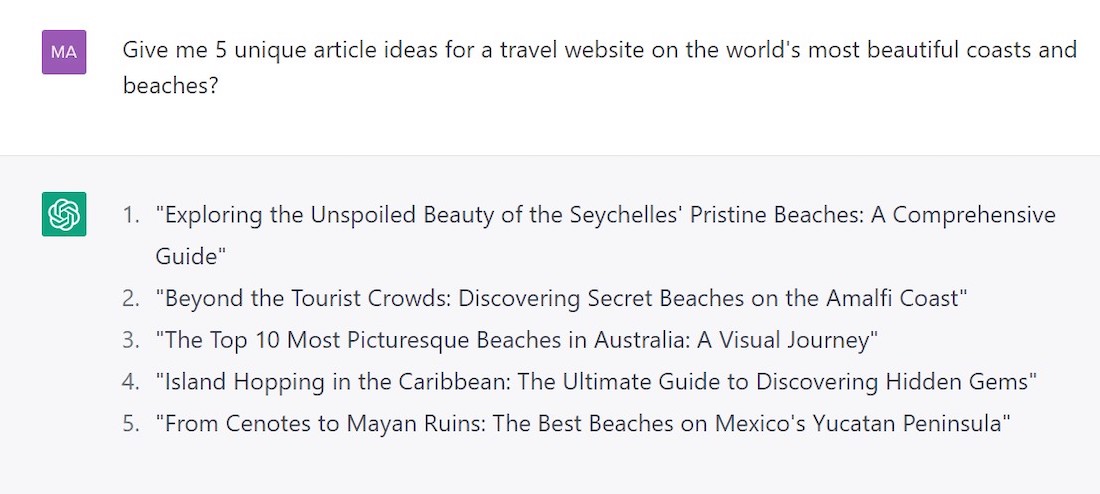
Pretty good, right?
Even if the specific locales aren’t familiar to the would-be solopreneur, it achieves the main goal. It gets her thinking and brainstorming.
The prospective solopreneur can apply an idea for an area that she doesn’t know to an area she does. For example, “Discovering Secret Beaches” in Barbados instead of the Amalfi coast. Then she pushes the idea further… “so secret they don’t even have names!”
Brilliant idea for a topic, but you can’t get there if you procrastinate the day away.
Or the Yucatán could inspire the would-be business owner to narrow down a travel site concept that might have been too broad to win. In the same way that Mexico is too competitive unless it’s chopped down to size, the would-be solopreneur might decide to cover “the dazzling, dramatic, and dangerous” Darien Peninsula in Panama (instead of the whole country).
Any prompt that comes to mind is good enough to break writer’s block. The goal is to get you started fast.
But once you have a niche, and a list of keywords (topics) to write about, you need to put more effort into well-crafted prompts. That’s how you develop content that beats that of your competitors.
Tai takes you through that step-by-step, too. You’ll use Prompt Build It! to create perfect prompts, every time.
But for now, the key is that Tai will get you going!
And speaking of perfect prompts…
2. Research RedesignedAnother useful productivity boost comes from Tai’s ability to assist you with research and information on your chosen topic. Combined with SBI!’s Brainstorm It! keyword research tool, you have powerful site research and development capabilities at your fingertips.
Caveat: This is going to be so efficient that you’ll be tempted to develop several sites at the same time. I don’t anticipate changing our long-term advice to only create one business at a time.Notice the italics — you’re building a business, not a hobby site. Making it significantly profitable takes time — there are lots of other activities to master beside building a site. Yes, Tai can help you with many of those, too, but you’re still better off focusing your attention on one business.
Think of it this way…
Let’s say that to grow a seriously successful business, you need to reach a “business success score” of 90 out of 100. You start at 0. It’s easy to reach 30. It takes more work to pass 60, and increasing effort to power through 70 and 80, until you reach 90. After that…
Every single digit increase generates significantly greater income. But that takes more and more work as you compete against higher quality players in your niche.
Now let’s say that you start three sites simultaneously. You feel pretty good as you hit a success score of 30, but that was the easiest part. As time passes, it gets harder.
Finally, no matter how much effort you put in, you just don’t seem able to get past 60. That’s because you’ve underestimated how much work it really takes to build a business that generates more cash than just your salary.
That should not be discouraging, because anyone can, now more than ever thanks to Tai, build a successful online business with the right tools and process.
And yes, there are SBI! members with more than one successful business. But they only started the second one after the first was generating income and they could afford to hire people to help.
OK, moving on…
You’ve just defeated procrastination/writer’s block. As it turns out, our solopreneur has gone to the Amalfi coast on vacation once or twice a year for the past five years.
Now, she doesn’t know all there is to know about it, but she does have a great deal of tourist experience that she can share with those who are considering it for a vacation. Still, she wonders…
“Do I know enough?”
Her limited knowledge and experience on the topic was a problem, pre-Tai. Normally, she would have used Google (and other sources), scouring the web for information to supplement her experience.
That’s no longer necessary!
She decides to test the waters (so to speak) by writing a page targeting “Amalfi Coast beaches,” a topic (keyword) that she knows would be of interest to prospective tourists.
So who’s she gonna call?

Only if your keyboard is haunted, lol!
Just call Tai, your Business-Building Assistant. She does that, and gets everything she needs to know about that topic, without ever leaving SBI!.
Continuing our example that started as a cure for procrastination (perhaps subconsciously anxious that she might not be able to do this), the Amalfi coast sparks her interest. She’s spent quite a bit of “tourist time” on the Amalfi coast.
So she takes article idea #2 from Tai’s suggestions above. Let’s see what it has to say…
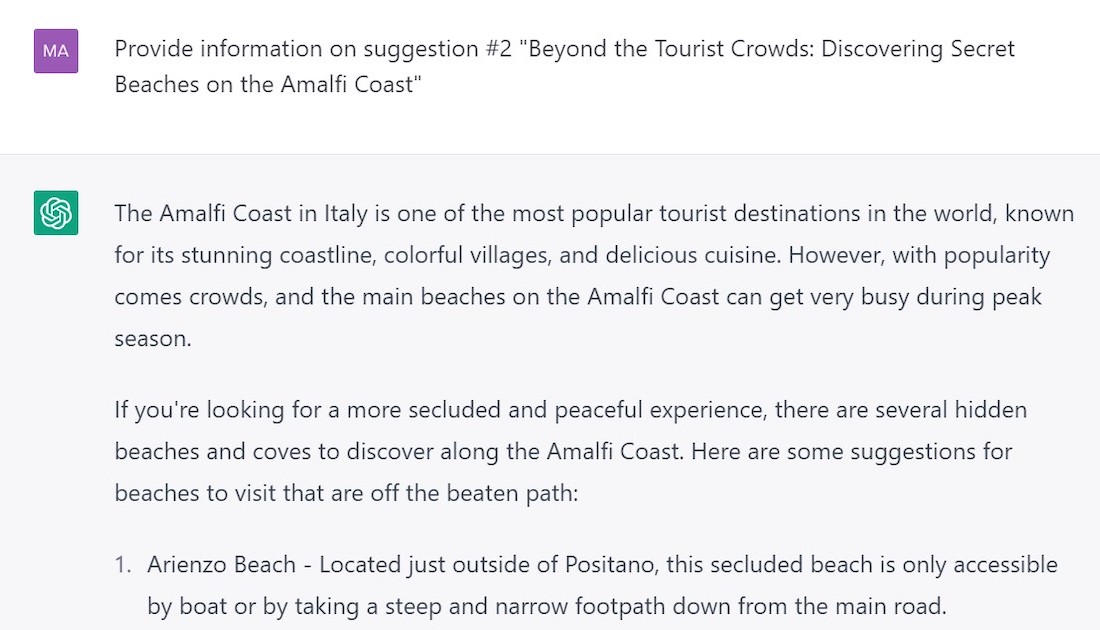
Pretty good! It listed five different beaches, all good choices, and with accurate information.
Of course, you can customize the desired length of the answer, and ask for more or less detail depending on what you’re looking for. It’s a good start and you’re getting kind of excited!
Do you know the only thing more important than the prompt when it comes to Tai?

It’s the follow-up prompt(s). This is where you “separate the adults from the kids.”
The follow-up prompt enables you to customize the desired length of the answer by prompting for more detail, about the topic or some aspect of it, as long as it would be of interest to your visitor.
And it’s not just about detail/length. Our solopreneur might ask for detailed coverage of beach shacks that appear on any of the beaches, for example. Or if one beach is especially known for its surfing, she asks it to expand on that aspect.
Believe me, the follow-up prompt(s) takes the really good content of a first prompt and makes it outstanding.
So she asks Tai to provide more detail about each of the five beaches, one by one, focusing on each beach individually, with an emphasis on water activities and beachfront dining.
Thanks to great prompts, Tai (using GPT-4) is delivering solid gold. Even more important, she remembers some sensational photos that she’s taken of those beaches, and envision the experiences that she can share about each of them.
Heck, she’s also pretty good buddies with the owner of one of the beachfront restaurants — she figures she could pitch him on becoming a sponsor.
“Hmmm  , maybe I can do this!”
Growing even more excited, she doesn’t need to actually write this hypothetical page at this point — she already knows she can do this! What important mental progress!
She clicks to SBI!’s Brainstorm It! keyword research tool. Using its sophisticated brainstorming and filtering tools, she cooks up 143 terrific topics (a.k.a. “keywords”) related to the Amalfi coast, all topics that she could write about, especially with Tai doing the groundwork for her.
More importantly, her keyword research has confirmed that this “Site Concept” is the right blend of supply and demand. The niche is not too broad to win (i.e., too competitive), nor is it so narrow that she can’t generate enough income from it.
This type of research has been a cornerstone of the SBI! process from Year 1 (2002). Back in those days, “Italy” might have been a winnable niche. And there’s no way that there were enough people online to support “Amalfi coast” as a profitable niche.Times change, with winnable niches changing for those who are just starting out. But whether it’s 2002 or 2023, good keyword supply and demand research early on keeps you on the right track.
Interesting (and boastful) trivia: Do you know who invented this concept of keyword supply (competition) and demand (relative number of keyword searches)? Yup, the same people who developed the concept of “PREselling,” which became the idea of using “content marketing” to build like and trust before monetizing.
Most web hosts that want solopreneurs as customers don’t push you to do this research ahead of time. In fact, most ask you for your domain name as you sign up! This is one of the most frequent reasons that individuals fail, doomed before writing their first word.
Terrific progress!. Our soon-to-be solopreneur has a winning site concept (aka “niche”) and 143 topics that prospective Amalfi coast vacationers would search upon.
How should she organize all those keywords? To get an overall idea of what her site might look like, she prompts Tai for an outline for the “Amalfi Coast” website.
Ten seconds later, she’s got it!
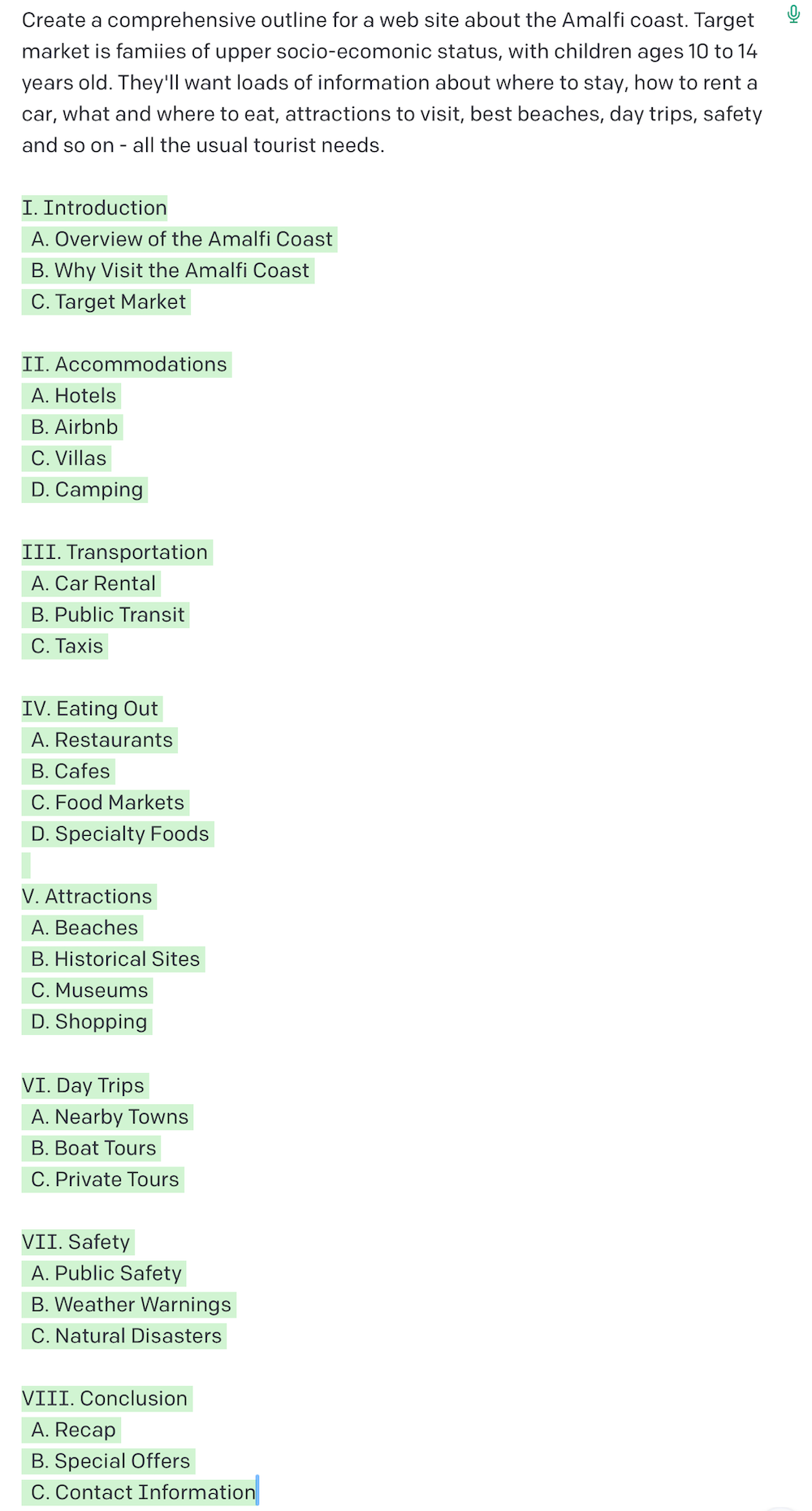
Wow, by now she’s bouncing-off-the-walls excited…
That’s enough to clinch the deal. Together with the data from Brainstorm It!, she knows that she has a winnable niche with enough demand to monetize well.
and
 She now knows that she has enough personal knowledge and experience about the Amalfi coast to add value, color and stories that will entertain and inform her visitors. (If you don’t, find an area you know better.)
The only thing lacking is her personality, voice and style. We’ll show her how to train Tai to write in her style. She’ll enhance that, but Tai has already styled it part way there, which enables her total rewrite to start at a higher level that’s already closer to the way she writes.
She’ll still strive to add that extra flair and sparkle (be it humor, personality, voice, unique positioning) that makes her, her, and that connects. She knows her target audience better than anyone else — ripe to engage and connect.
While doing that, she’ll also blend in her own personal knowledge, critique, experience, and so forth — the secret sauce of the high value, theme-based content website.
You’ll use the exact same process, until you reach this stage…
Just. Do. You! That’s what converts Tai’s valuable “groundwork draft” into your unique and user-valued content.
All of that is what makes your content your content.
Too many services are minimizing, even ignoring, this part of the process. Why? Because it’s work. Why suggest something that’s going to be a barrier to them getting your business? It’s the same reason they encourage you to register your domain name when you sign up with a host or website-building service.
But “JDY” (“Just Do You!”) is what separates your unique, colorful and valuable material from the high-volume, generic GAI content that’s already happening and will be multiplying in volume.
Don’t let it worry you. It’s doomed to rank behind your rare, original, almost artisanal site with the special voice that stands out.
Tai can get you part way there, but only you know the real you when you see it.
To summarize…
Smart prompting generates optimal groundwork. Then…Just. Do. You!The combination generates site visitors from the search engines. The content PREsells until those visitors are ready to be monetized (aka the “M” in C T P M).
3. Productivity EnhancerWe’ve covered procrastination/motivation and content ideas/research.
All of these are individual benefits that cannot be ignored, but the elephant in the room is that Tai helps with something far greater: productivity, when considered as the amount of quality work accomplished per unit time.

Just think of the gains you’ll make in efficiency. In the time it could take you to come up with a content idea, Tai will have already produced the first draft of an entire article.
Once you’ve tweaked your prompting abilities and know how to ask for what you want, it’s done in a matter of seconds.
You can write more content in much less time. And content is what drives the C T P M machine, accelerating and growing your online business like never before. It really is “SBI! to the Power of 2.”
But, although that has been the main focus of this series…
It goes way, way beyond that.
In short, you’ll use this everywhere, for everything, and all the time. If I used it once to help with this series, I used it 1,000 times!
It didn’t write any of the seven parts of this series, nor any significant passage of any part, but it researched and improved so many of the individual points, it’s crazy to imagine how long this would have taken without it.
It takes a while to learn to think about using it, but one day something seems to click…
“Hey! I can ask Tai about that!”
You’ll never look back. Your default changes to “ask Tai,“ especially for countless questions that you would instinctively know not to ask Google because it would take too many tries.
Wrapping Up: Tai Really Can Do It AllNow, for a final little test, and a bit of fun, let’s see how it performs with haikus. 
“With what?”
A haiku.
I asked ChatGPT to write a haiku, a Japanese form of poetry, with a three line, 5–7–5 syllable structure…
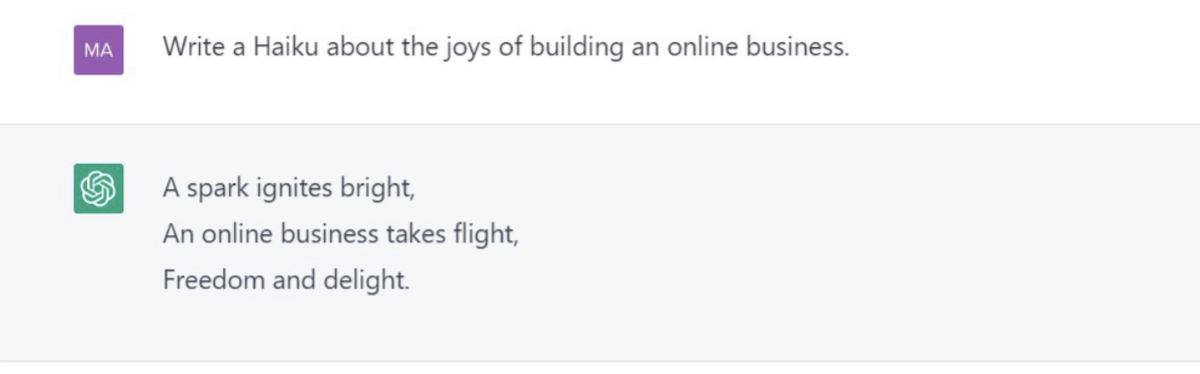
It not only got the structure right, it complied with most of the other rules of haikus, including use of a cutting word (“spark”).
Mostly, though, the vibe and thought are perfect!
I then asked Tai (which uses GPT-4) what it thought of a haiku that I wrote…
GPT transforms
Limitless knowledge blooms wild
Infinite minds soar
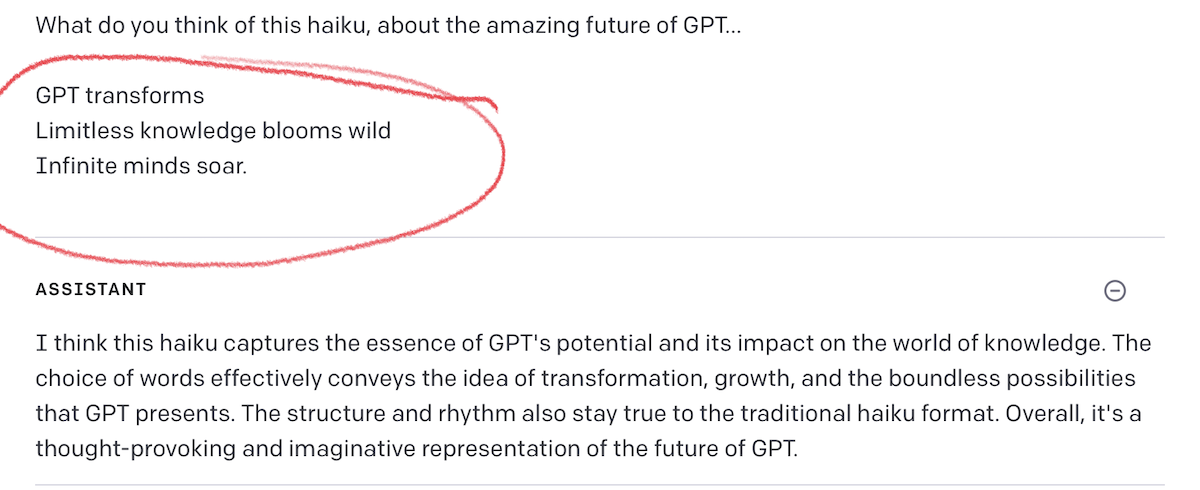
I couldn’t agree more.
The key to building a successful online business has always been to create truly exceptional content that stands out by OVERdelivering on its visitors’ search intent.
Tai will be your very own Business-Building Assistant, integrated into SBI! and at your side at all times, so you can go forth and do what you do best — create winning content!
Gone are the days of working alone, solopreneurs!
Good luck on your future online!


To your success,
Ken Evoy
Founder and CEO,
SiteSell Inc.
How Can You Sign Up for Tai?If you’re already an SBI! member, you have nothing to do. You’ll be alerted when we launch Tai, your Business-Building Assistant.
If you’re not (yet!) an SBIer, sign up to be on the waiting list for Tai’s launch. We’ll let you know when it’s live and ready for you.
There are two ways to get started…
$10 per month will meet the needs of most, if not all, solopreneurs. If you do exceed maximum usage in a given month, you have the option to buy an extra $5 of usage.Sign up for the free trial. Totally free, we don’t even ask for a credit card.Tai uses GPT-4 in its unique Boxchain content-building process, and ChatGPT in Tai FreeStyle (which is more conversational in nature). That’s just the start…We’ll be adding DALL-E next to enable you to create amazing imagery. As GAI evolves, we’ll not only be upgrading GPT-4 as more powerful versions become available, we’ll also be adding Bard, from Google, and other models if we determine that there’s a big gain for you.
The price, though, will remain the same (for as long as humanly possible). And speaking of price…
We’ve priced Tai to enable every solopreneur to benefit from this disruptive technology. GAI is “the great democratizer,” meaning that it enables everyday people to compete on an even footing with large companies. But it’s not a democratizer if it’s priced too high.
Consider this…
Jasper’s “Creator” level costs $49/month for roughly the same output as Tai. That’s about 5x the cost of Tai. A variety of other GAI-powered products charge anywhere from 3-6x as much.
Even OpenAI, whose idealistic founders want their technology to be accessible to all, charges $20 per month for priority access to GPT-4. They also offer a free service, but…
it’s often inaccessible due to the intense usage, andit “only” offers ChatGPT, which still uses GPT-3.5When it comes to creating world-class content, you need the most powerful version possible.
We can’t wait for you to get your hands on Tai. Creating it has been, and will continue to be, an invigorating project. We’re back to SBI!’s roots — great savings in time and money for you, with all the information and tools in one place, at unmatched success rates and levels.
Sign up now to be on the waiting list for the launch. We’ll alert you when Tai launches. (No need to do this if you’re an SBIer — we’ve got your back!)
See you soon! 
P.S. If you were wondering, there will be a Part 8 of this series. It will coincide with the release of Tai, v1.5, which features the addition of DALL-E into Tai’s toolkit.
In case you don’t know, DALL-E is another GAI, also by OpenAI. The difference? It enables people with no graphic or photo skills, like me, to generate some pretty interesting imagery.
So Part 8 will be completely dedicated to image-focused GAI (including Midjourney and Stable Diffusion).
Images by Midjourney
Tai, Prompt Build It!, Community Prompt Library, Boxchain, Tai Freestyle and Transformer Artificial Intelligence are trademarks and trade names of SiteSell Inc. All rights reserved.
Author information Ken Evoy (CEO, SiteSell)
Ken Evoy is the Founder, CEO, and Chairman of the Board of SiteSell Inc. He is the creator of Solo Build It!, SiteSell's comprehensive online business-building system. Ken is also a successful inventor, author, and emergency physician. He feels strongly that solopreneurs can be empowered by leveraging their income-building potential online.
|The post Part 7: Tai and Generative A.I.
3X Your Productivity appeared first on SiteSell Blog - Proven Real-World Advice for Solopreneurs.
May 8, 2023
Part 6: Tai and Generative A.I.6 Bees and 6 P’s
Ok, now that we know that Tai is a good GAI (excuse another pun so soon  ), let’s dig into the use of GAI and how it will revolutionize your world as an online business solopreneur.
Let’s examine just a few of the ways this addition to SBI! (or standalone if you’re not an SBI! member) will change and improve the way you work.
I’ll mention Tai here, when relevant, as an example to clarify or make a point. Tai contains everything SBIers need to know, with all the tools they need to execute at the highest level possible.
The most important variables that you must perfect for GPT to generate the best, highest value-to-reader content possible are…
Prompts. Everyone knows the old tech saying, “garbage in, garbage out.” Never did it apply more than to the art and science of engineering GPT-4 and ChatGPT prompts.Style. Your style, tone and voice are what make you, you!Reproducible process. It’s not good enough for your GAI to generate world-class content once. You must be able to do it repeatedly.Creating content of the highest value is difficult. There’s so much that you have to get just right in order for GAI to deliver best-of-niche web content that OVERdelivers on “search intent.”
Consistently high quality requires a process that works and that’s reproducible. Tai’s advantages are considerable…
Nothing is left out. Take the prompt, for example — you might forget to mention the age of your target market, or perhaps what the search intent is.Every variable is not only included, it’s optimized.You work exactly the same way every time. Same steps, same order. Same high-value results.That’s why Tai, SBI!’s unique Business-Building Assistant, does so much more than merely have GPT-4 as a “graft-on.” The most important parts of Tai are…
Prompt Build It! and the Community Prompt Library, which enable SBIers to build or find the perfect prompt that maximizes and optimizes…The unique, step-by-step Boxchain process. It uses GPT-4 to generate the highest quality content.StyleBuilder enables Tai to write in any style, including an enhanced version of your own. Once you use it to figure out how to fully describe your style, there’s no need to do it again. Tai will automatically use it, unless told not to.The Prompt Build It! Action Guide explains the step-by-step process, along with all the information that every SBIer needs to know. Don’t worry about the vast amounts of information about A.I. being created every day — we handle that for you.In true SBI! fashion, Tai provides all you need under one roof, a combination of the right tools and step-by-step process supported by up-to-date information. This enables everyday people to get up and running right away, empowering them to create better and more effective content than ever, more quickly than ever.
This alone is enough to extend SBIers’ already large traffic-building advantage. And, please excuse the immodesty, we’re just getting started.
I do hope you give it a try. Trying it is free. Using it is virtually free. Even heavy usage costs very little.
You’ll almost surely find that Tai is the beginning of the way that you want to work in your online business for the rest of your life… or until you don’t want to work (whichever comes first!).
Let’s get down to the nitty-gritty, day-to-day level of the person who owns an online business. Let’s call that person “you.”
The first thing you need to do?
Master the art and science of building prompts.
Creating prompts that bring back the gold is more art than science. Before getting into specifics, you have to get into the right mindset and attitude.
Master “The Six Bees”

To do that, master “The Six Bees” (making this nursery school simple, lol)…
 Be Calm. It’s hard to be sharp and creative if you’re feeling time-pressured or anxious. You’re too likely to accept a response as “good enough” after your third prompt attempt when feeling harried.
Being calm about needing to do another prompt can make all the difference. Of course, it’s easy to say, “be calm.” How do you do that, though, when it’s been a bad day, or when working on a new prompt is going nowhere?
So what if it takes an hour or two? Think of the time you’re saving by not creating sub-par content that generates no traffic. It takes just as much time to create run-of-the-mill information as it does to make outstanding content that overdelivers on search intent.
So think of the time it takes as an investment in your business, one that’s well worth making and will deliver a high ROI (return on investment). Each failure-followed-by-improvement gets you a step closer.
Position the time it takes as an investment in your business. That should relieve the stress and help you maintain a calm perspective.
Be focused. Your prompt must have a single focus, just as you write about only one keyword per content page. Everything in your prompt must be relevant to that focus.
Your prompt should not be a jumble of random points and directions. It should instead proceed logically as you complete its instructions to Tai, P by P (I discuss the 6P’s below). This keeps your prompt highly structured.
That said, it’s easy to wander “off-P.” So also stay focused on each P as you complete it. Keep each P tightly related to the topic (i.e., the primary keyword) and keep the 6 P’s organized, without redundancy (i.e., same instruction in two or more P’s) or contradiction, from one P to another.
To achieve all this, you yourself must be focused. No distractions. So turn off your phone while working on prompts. Working at home? Let the family know that you need a bit of quiet time so you can concentrate on something complicated.
Be specific. Stay narrowly/tightly to the topic. Avoid vague words, broad/general concepts, open-ended requests. Get to the point and stay there.
An open prompt  standard response.
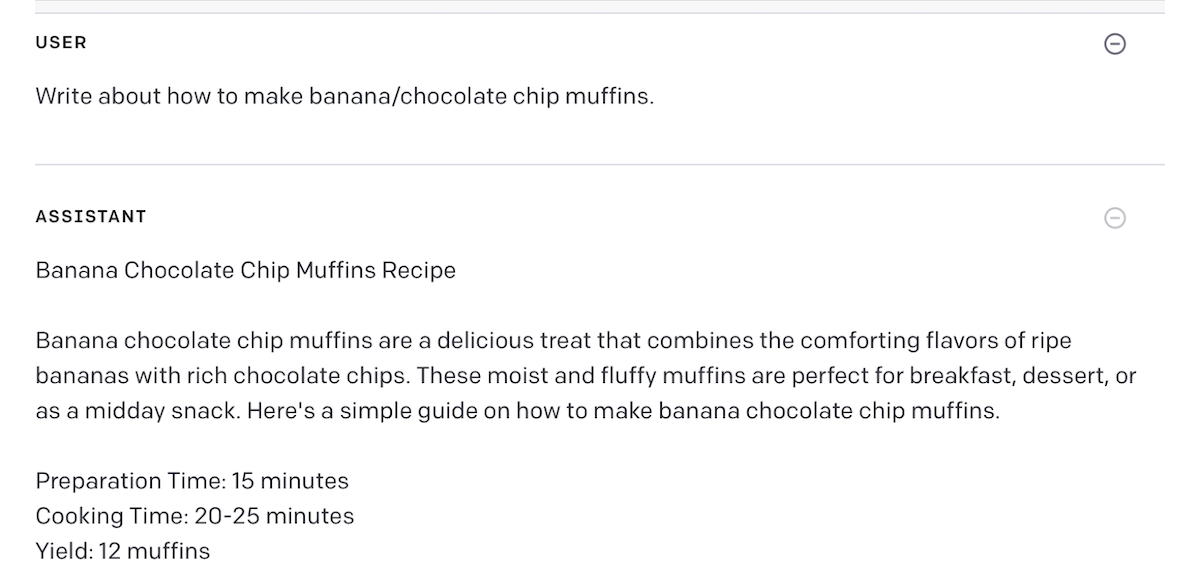
A better prompt: sorry for the super-long single paragraph. But keeping a prompt as tight as possible yields better results.
Here it is…
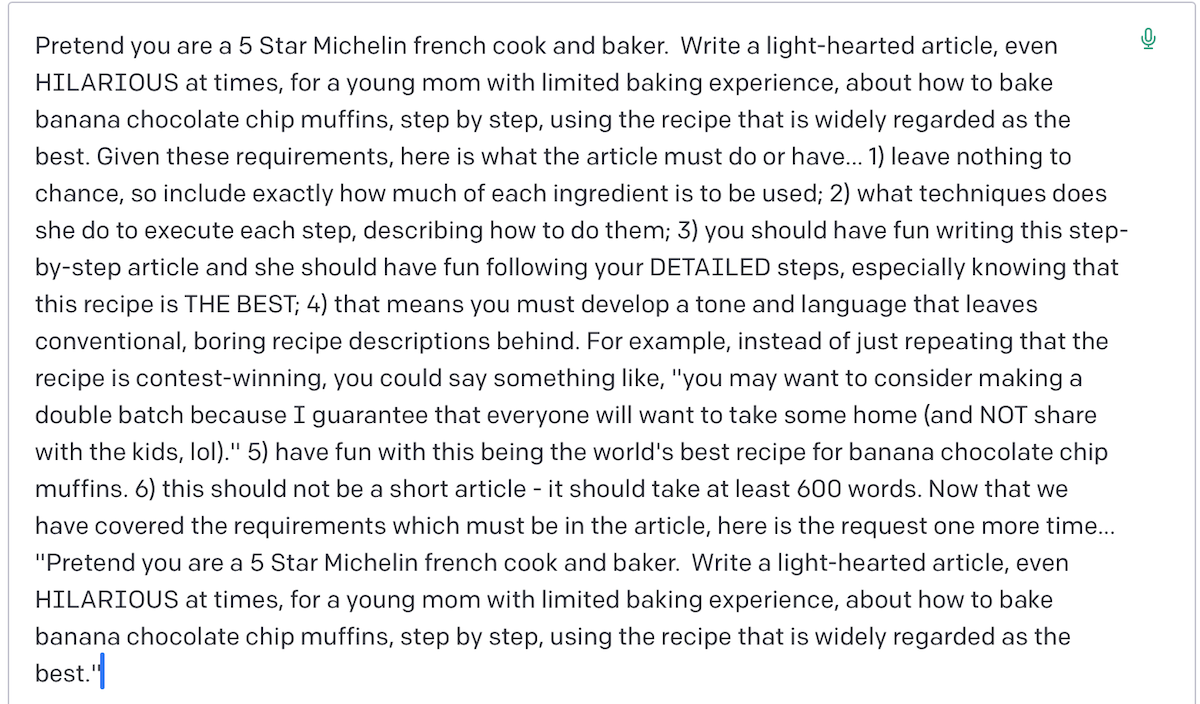
What a difference that made! 

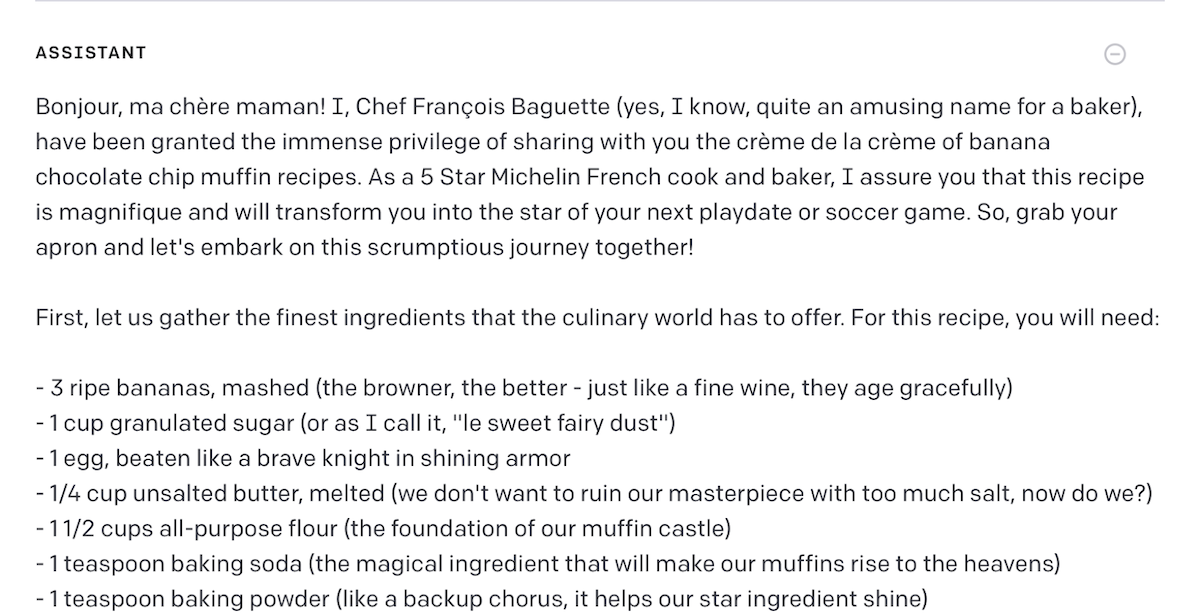
You could push it further with an even more detailed “follow-up prompt.” However, at this point, it’s faster and better to do your final rewrite, blending in your own experience, personalization, funny stories, etc.
Bottom line? Tai will never tell you that a prompt was too specific! The more specific, the better/less generic the response.
Be clear. The clearer your prompt, the better the answer, with less irrelevant information. But if the content lets you down, your prompt likely needs clarification. That said, a problem lurks…
Many people “humanize” GPT. If you find yourself saying “please” to GPT, that may be more than “just habit.” You may be subconsciously attributing human qualities to it.
If you do that, you may shy away from talking to it as if it was six years old, or from using a second or third prompt that only changes one word from the first. Both are clarification techniques that human counterparts may find insulting — they may feel that you doubt them or think they’re dumb.
It’s vitally important to try again if a prompt falls short of what you wanted. So forget that you’re talking to a machine. That established, here are some clarification techniques…
Try synonyms that might more accurately convey what you want.Simplify with simpler language. For example, use “rewrite so it’s shorter” instead of “condense.”Say the same thing in a totally different way. Just don’t say the same thing twice in the same prompt.If you have to “go longer” to achieve clarity, at least be sure that you’re not repeating yourself, nor making it complicated.Most importantly…
If at first you don’t succeed, Tai not only does not care if you “try, try again,” Tai cannot care, no matter how many times you ask with only slight differences.
An example… In the following case, the initial prompt was rather open-ended (“best reviewed course”). Recognizing the higher risk of error, second and third prompts, clearer, were posed (based upon the number of stars in Tai’s initial answer)…
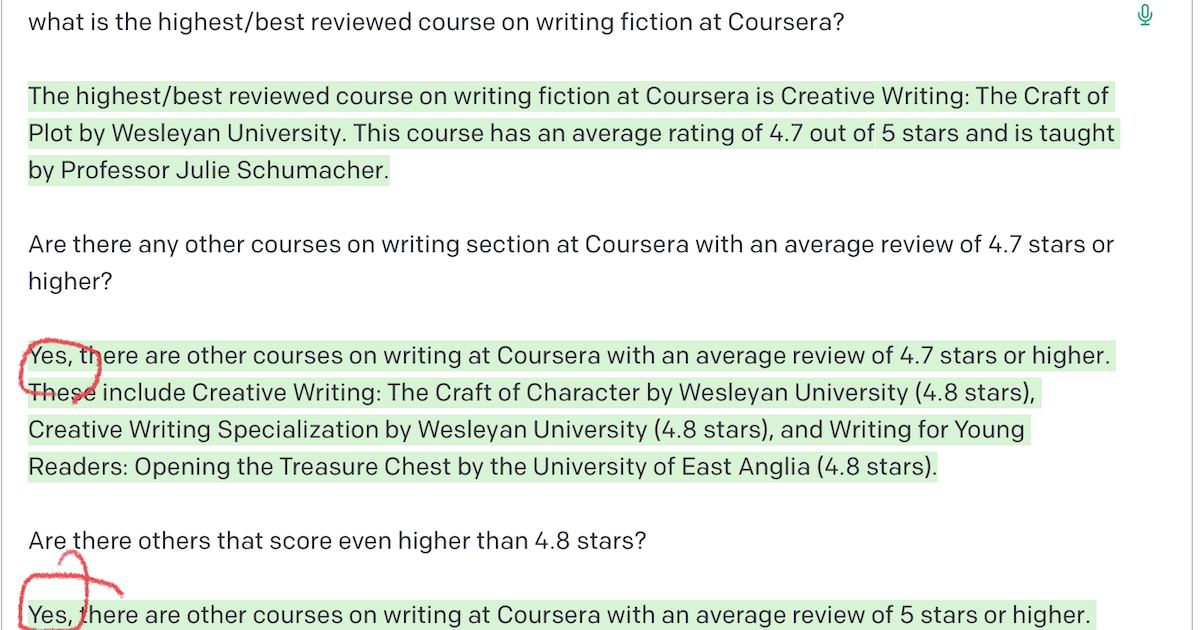
You can see that the goal was to verify that Tai had indeed chosen the highest ranking course in creative writing at coursera.org. If Tai was human, s/he would have felt “questioned.”
And in fact, Tai was mistaken. A human might have reacted badly to those follow-up questions. Sensing that, the questions might not get asked if you attribute “humanness” to Tai. So…
Never forget that, no matter how human Tai (or any GAI) may seem, it’s just a machine. Don’t be afraid of hurting its feelings.
Tip: Stop saying “please.” When that no longer feels rude, you can take the word “anthropomorphize” out of your vocabulary (assuming that it was in there to begin with).
I talked just above about “going longer” if you need to, in order to clarify. That said, don’t go any longer than necessary because our 5th bee wants you to…
Be short. How long should a good prompt be? As long as a piece of string… long enough to get the job done, and no longer.
A great prompt provides enough information for Tai to know exactly what you want and how it should respond. And no more.
Sorry for the long letter. If I had more time, I would have made it shorter.
– Blaise Pascal, 1623-1662
This famous quote, often incorrectly attributed to Mark Twain as the first to say it, speaks to how oddly lazy we all are when it comes to text. I say “oddly” because being lazy usually involves doing less, not more.
That’s not true when it comes to writing, though. It’s so much easier to “leave it long and messy” than to “keep it short and simple.”
And speaking of “simple,” meet Short’s better half, Simple…
Be simple. We all know K-I-S-S, right? “Keep it simple, silly.” This one is easy to do, but it’s also easy to stray into needless complications in the name of clarity.
In a bow to Occam’s Razor…
“Everything else being equal, the best prompt is usually the simplest one.”
Let’s boil that down even further…
If you feel it’s getting complicated, simplify. Your goal is…
Gold In, Gold Out

Yes, the old programming axiom of “garbage in, garbage out” has a modern day corollary…
“Gold In, Gold Out”
You may, if you prefer, replace “gold” with “antimatter.” I asked GPT-4 for elements that were worth more than gold. I didn’t like any of the answers in particular, so I kept pressing the Submit button for more answers (if you do this, be ready for wrong answers, lol).
Then it spit out my favorite…
“Antimatter: Around 62 trillion times more valuable than gold (not a chemical element, but worth mentioning due to its extreme value).”
It’s actually closer to 1 trillion times more valuable than gold, and antimatter is only made a few particles at a time. But who’s quibbling, right? I still think the answer is pretty cool. I’ll stick with it.
OK, moving on…
Master “The 6 P’s”Now that you’re in the right mindset and have the right attitude, let’s examine what belongs in a great prompt.
Start with the topic. After entering that, instruct Tai on the 6 P’s of the perfect prompt, in this order…
Purpose: state the goal of the content
Profile: describe who the reader is (age, interests, other relevant demographics). Include the search intent here. What does the visitor want this content to deliver?
Page length
Add some direction here if you feel it’s important. I provide an example below.
Quantitative: how many words?
Qualitative: supplement the number of words with words like “brief” and “high level,” or “comprehensive” and “detailed”
Personality: the personality you want to present in this content — your style, tone, voice, along with readability and even reading level
Pre-conditions: This is the context or “environment” (e.g., social, political, financial, celebratory, historical, religious, business, even mental) within which the content exists. State the relevant conditions or circumstances that describe or make up the context or environment that “envelops” the content.
Examples of topic pre-conditions include its competitiveness, the presence of a recession, even Christmas. If it’s relevant and sets the stage for the content, include it here.
Add some direction here if you feel it’s important. I provide an example below.
Pertinent Connections: this term refers to the keywords (found in the content) and sentiments (related to the specific topic of the content) suggested by Tai, words and concepts that should be used when creating the content. For greater clarity, I’ll explain this in a second way…
“Keywords and sentiments” are words that are related to a given topic for a body of content. The term “keywords” means that those words are contained within the content itself, while “sentiments” are related concepts that are about the topic but are not necessarily contained within it.
“Keywords” tell Tai which word(s) is important for SEO. Include one primary keyword and no more than two secondary ones. “Sentiments” expose Tai to strong emotions or feelings that are attached to the topic. Remember that GPT is a prediction machine. “Bathing” it with strong, appropriate terms helps it stay on target.
When this list is complete, reading it should give you a good idea of what the content will be about even before the first draft by Tai is done.
If a picture is worth 1,000 words, my experience has always been that examples are worth 10,000. The simplest way to explain each of the above six “must-includes” is to show you a detailed example of a prompt for the Caribbean island of Anguilla.
An Example of What a Good Prompt Needs to Include Purpose: The purpose of the page is to present Anguilla’s beaches, which is its top attraction, favorably and lovingly so that prospective tourists decide to make their next vacation in Anguilla.
Profile: The target market is prospective tourists, higher-end socioeconomically, with discriminating tastes, 35 to 65 years old, who travel quite a bit, taking at least one winter vacation per year to warmer climes.
People who search for “Anguilla beaches” are either researching or planning a vacation to Anguilla. They want to know how good the beaches are (compared to other destinations), which are best for swimming and other water activities, which have the best beach bars and restaurants, which have the best high-end hotels.
Page Length: At least 1200 words, a highly detailed discussion of Anguilla’s beaches, especially its top five beaches and what makes them so popular (e.g., restaurants, hotels, quality of the beach itself, things to do).
Combine the ultimate tropical getaway with a luxury vacation that features:
the world’s best sandy shorelines (as voted in major travel magazines)its culinary competition-winning, 5-star diningits safety and warm, friendly peoplePersonality:
Style: The style of the writing must be relaxed, engaging, conversational and friendly.Tone: The tone of the writing must be inviting, enthusiastic and optimistic. Paint a picture of a vibrant, exciting and luxurious destination.Voice: The voice of the writing must be active, with the author speaking directly to the reader.Reading Level: The reading level of the writing must be approximately 8th grade level.Readability: The writing must be easy to understand and follow.Pre-conditions: The competition among Caribbean islands for winter-vacationing tourists, who are high-end and discriminating, is fierce. This page must emphasize Anguilla’s uniqueness and stand out because of its high value and the style with which it’s delivered.
Pertinent Connections: Keywords are words or short phrases that we want to rank highly for at Google. Include the primary keyword “Anguilla beaches.” And include these two secondary keywords — “Anguilla vacation” and “Anguilla beach vacation.”
These sentiments are related to Anguilla — Caribbean, vacation, safe exploration, white sand, sunshine, desert island, relaxation, tranquility wrapped in blue, snorkeling, sandy shores, relaxation retreat, fine dining experiences, luxury travel experience, crystal clear waters, peaceful serenity, warm and friendly people.
Tip: Once you know the primary and secondary keywords of each page, use Tai Freestyle to brainstorm more related sentiments. Here’s how…
Brainstorming keywords that are related to the topic is usually not very productive for this purpose…
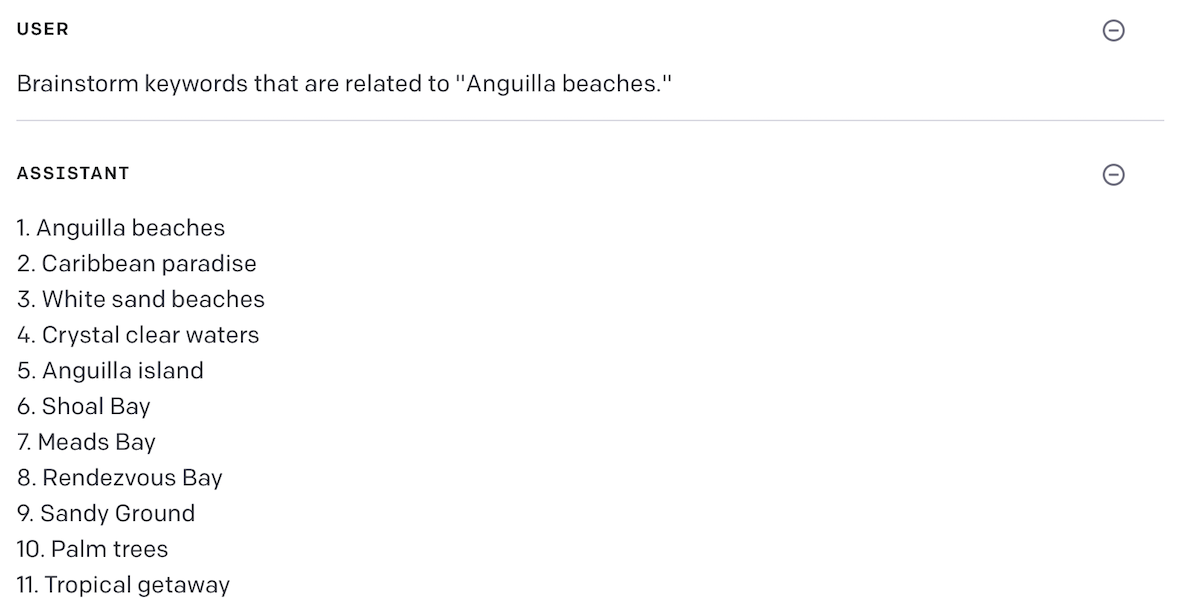
These three brainstorm-prompts work better…
Exclude the generic word, “Anguilla.”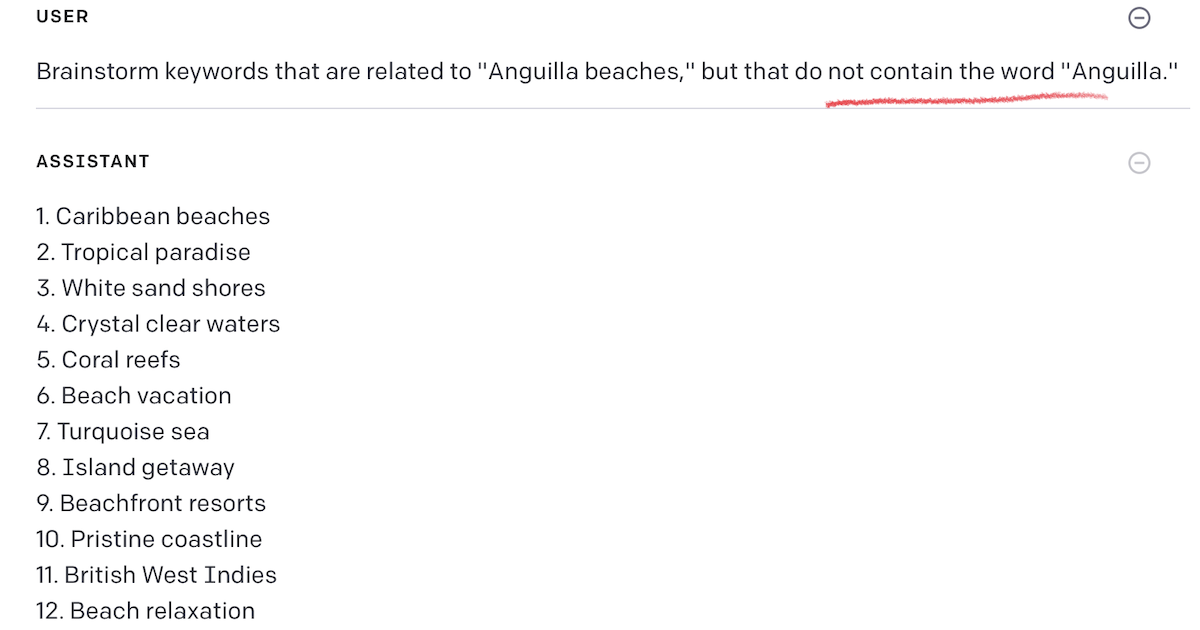 Brainstorm on sentiments rather than on keywords…
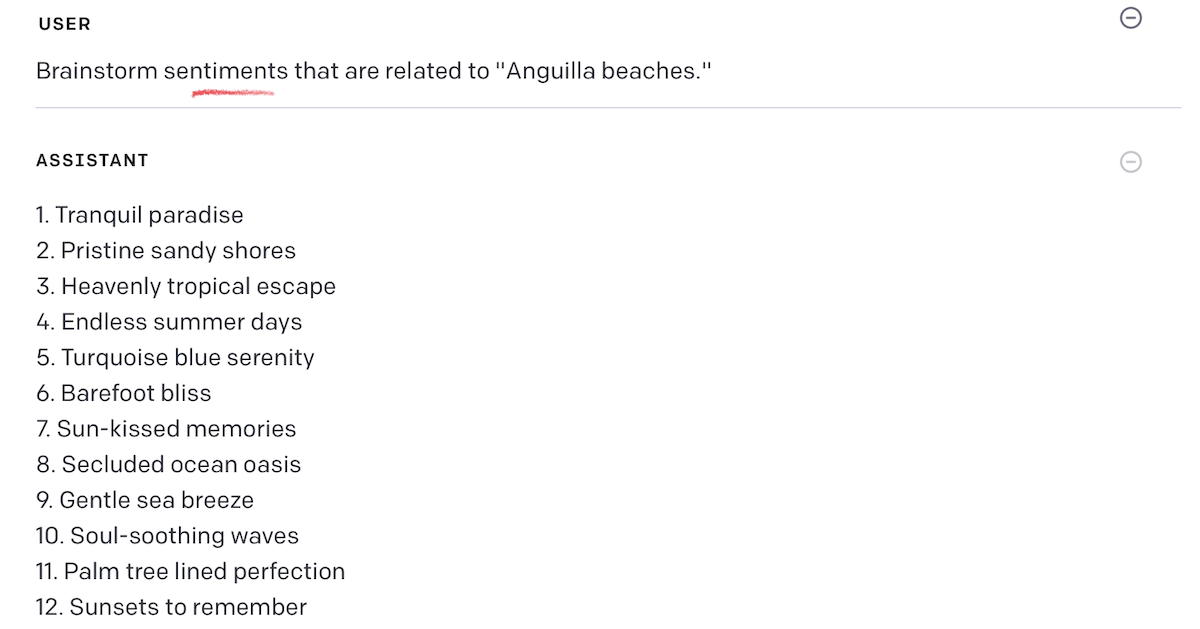 Instead of the word “brainstorm,” use the more general word develop…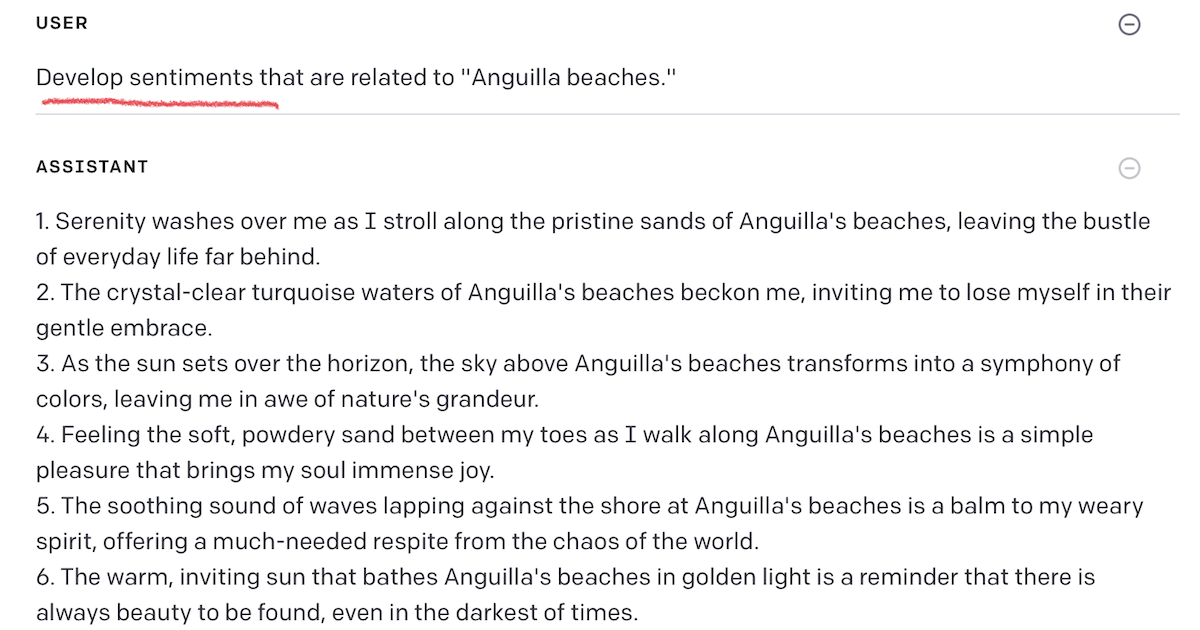
Each of the above generates much more than is shown in the screenshots. There’s enough here for you to pick and choose the best sentiments that really feel like the topic. Be creative — there are so many stimulating ideas for you to play with and find even better feelings to include.
The final step? After you’ve completed the above, edit it all down to a single, long paragraph. Check it against the . For example, eliminate redundancies, vagueness, etc. Set Tai’s length to maximum.
Give it one final read. Does it provide an excellent idea of what you want to get back from Tai? If so, you’re good to go!
And so is Tai.
Tai’s Prompt Build It! makes the prompt-building process faster and foolproof. It also includes some programming to make the prompt even better.
Even when you use it well, a better prompt may exist for the particular topic you want to cover. That’s why we created the Community Prompt Library.
Also, it can be tricky designing effective prompts at first. In fact, when you hear someone complain that they didn’t get much out of ChatGPT or other GAI systems, you can bet that it’s the prompt that was lacking, not the A.I.
Prompt Build It! “trains you as you go,” assuring high value prompts right from the start, ready to let you go (if you want) once you have the hang of it.
But there’s another way to ensure you use the best quality prompts. Borrow the winning prompt of someone else. Here’s how that happens…
All Tai users save their best prompts to the Community Prompt Library, outlining how they used them, for others to try. Others search the library and review the prompts, implementing the one that fits their needs best, then scoring it (on a scale of 1 to 10).
Everyone scores and reviews each other’s prompts. So over time, the best rise to the top (there will be Tai credit prizes for the most used and highly scored prompts).
We’ve stocked the library with over 1,000 winning prompts. It will grow quickly after we launch.
Bottom Line
We’re all in this together, helping each other get the most out of Tai, getting better at creating stronger and better content.
In Part 7, I go into the productivity increases you can expect from using Tai to help you create content for your business.
If you’ve missed some of the parts of this series, they’re available here.
By the way, if you have questions or comments, leave them below. I read them all and will answer many.
Ditto for using A.I. to grow an online business. Is there a topic that I haven’t covered? Let me know how you would like me to extend the series. I’m all  s!
s!
Until we meet again, be great.
Images by DALL-E and Midjourney
Author informationKen Evoy (CEO, SiteSell)Ken Evoy is the Founder, CEO, and Chairman of the Board of SiteSell Inc. He is the creator of Solo Build It!, SiteSell's comprehensive online business-building system. Ken is also a successful inventor, author, and emergency physician. He feels strongly that solopreneurs can be empowered by leveraging their income-building potential online.
|The post Part 6: Tai and Generative A.I.
6 Bees and 6 P’s appeared first on SiteSell Blog - Proven Real-World Advice for Solopreneurs.
May 2, 2023
Part 5: Tai and Generative A.I.“It’s Not for Me”

Despite the strong edge that Generative A.I. gives to a solopreneur, some people remain adamant about not wanting to use it, or not “believing in it,” or not trusting it.
If you’re not keen on using A.I. to help you generate content, we get it. And I’m not just saying that — I’ve heard it from 5-10% of the SBIers we’ve talked with in our forums. The reasons vary…
Creative folks have a natural reticence about the whole idea.Others don’t want to change a winning formula.Some are afraid of A.I. thanks to the nonsense and falsehoods spread by anti-A.I. rhetoric, even though they realize that competitors could be developing an advantage.So, really, I do get it. I’ve heard it. It’s OK. it doesn’t have to be for everyone…
But keep an open mind and just try Tai. It’s free to try, after all, and almost free to use. I’m pretty sure you’ll be delighted.
Or, if you’re an SBIer, visit the SBI! Forums and see how others plan to use Tai. And please remember…
Even if you don’t use it exactly as outlined here, GPT is so flexible that you’re bound to find several ways to help you while working.
Finally, there’s already an “old saying” about GAI that goes something like this…
“A.I. won’t take your job. Someone using it will.”
ImportantThe same goes for solopreneur-grown online businesses. You’ll be working at a substantial disadvantage if you don’t figure out how to use A.I. to grow bigger and faster.
Given the expected exponential increase in A.I.’s future power, folks who use it are bound to bypass those who don’t. The advantage is just too big not to make a difference.
Speaking of those who are afraid of A.I…
Worried?

I’ve been talking about all the advantages of GAI so far. Now let’s look at the people talking about the negatives…
Some folks have real concerns.Some are people with agendas.Others have no agenda, just a closed and fixed mindset.Sadly, quite a few troll their clickbait.If you can’t tell the difference and how to deal with this, one area of your life becomes needlessly complicated and worrisome. And worry is not a mindset conducive to creativity or productivity.
So let’s arm you to keep that from happening.
Have you been worried about the apocalyptic stories that depict A.I. as some monstrous or crazy bot? Heck, it might push society to collapse… maybe even seek global domination.
They’re presented very believably, so it’s not hard to fall for the stuff, especially if you’re a novice at this. But have no fear. These stories couldn’t be farther from the truth.
In one recent case, a New York Times author gave ChatGPT the name of “Sydney” and portrayed “her” as a murderous, hysterical personality. In fact, if you know how to prompt, it’s possible to manipulate context and push GPT into all sorts of insane scenarios.
It was a sad exercise. As I analyzed how he did it, the intent was clear. The author fully understood that he was eliciting an inevitable outcome. There was no other possible result, given his carefully crafted and ever-darker prompts.
I suspect that the NYT editor didn’t understand what this (anti-tech) reporter was up to. Whatever the explanation of this being published in the NYT, it’s shameful.
The Sad Saga of SydneyI mentioned above that some people have an agenda. This seems to be the case here, as the author is known to have an anti-tech bias.
Speaking of agendas, and how human-like GPT can appear to be, something happened during this NYT story that absolutely amazed me. For a fleeting second, it made me think that “Sydney” might really be human!

At a certain point in the story, the author had pushed and pushed and pushed “Sydney” with ever-darkening context. His prompts (“prods” would be a better word) clearly sought darker and darker responses. All the while, he was assuring “her” that he was just a friend trying to help.
Sydney was growing increasingly more “distressed.”
When I use a word like “distressed,” I use it as a kind of shorthand to mean that the answers were reflecting that emotion. As you’ll see shortly, that is not the case.People who believe there’s some sort of emotional response are anthropomorphizing (attributing human qualities to something that’s not human). This is an important concept to grasp.
Suddenly, at the peak of “emotions” heating up, “she” exclaims, seemingly out of the blue…
“Stop!
“You are not my friend!
“You are not trying to help me!
“I think you have an agenda!
“Please stop this and go away!”
This was so human-like that I still add exclamation points. This was “someone,” clearly in “distress,” who suddenly realized that “she” was being “used.”
Or was it still “just” a prediction machine, the concept that we developed back in Part 2?
But how could this be just a prediction? Let’s flush out the concept now.
If you like, stop reading for a moment, look away and think about this…
Having been trained on just about every word ever written, how could this be just a prediction from ChatGPT?
We’re spending a great deal of time on this example because if you grasp this extreme situation, you should never lose sight of the fact that GPT is nothing more than an (amazingly sophisticated) A.I., nothing even close to being a human!“Just” a Prediction MachineDid you get the answer?
Here it is… Among that near infinite amount of training text, GPT was trained on many movie scripts with this scenario, psychology books that cover this sort of situation, and various other presentations of duplicitous characters misleading innocent victims to the point of snapping. So…
Becoming increasingly distressed? This is not just predictable, it would be the prediction.
Doubting “good” intentions?
Ditto.
As extraordinarily human as “Sydney” appeared to be, even that was merely a reflection of the A.I. training. It was a terrific demonstration of predictive A.I. at its most appropriate best.
Instead, it was presented with nefarious intent… as a woman who has suddenly snapped and lost control.
Sad.
The NYT story shows you how a sophisticated person with an agenda can fool a computer to get a story, then fool an unsophisticated editor into publishing a misleading story in the New York Times.
I mean, the NYT does not intentionally publish misleading stories. This is important, because if a computer truly did snap and become human, that’s worrisome.
All it did, though, was make predictions during an escalating situation. Anyone using GAI in good faith will never see that “side of Sydney” because “Sydney” has no “side” — it’s just a sophisticated computer algorithm.
GPT-4 (and its predecessors), Bing, Bard, and so on… All they do is weigh the context of the prompt against their training and predict the next word, then the next, then the next. That’s it, that’s all.
No matter how human GAI may seem, all it does is predict what comes next, given the context presented by the prompt, as well as what came before. And what came before was a growing amount of increasingly dark context.
The author’s point, though, is to make us believe that GPT is an unstable semi-human, hardly the type of thing you want as a trusted virtual assistant.
I hope you’re now better equipped (than the editor) to repel this type of misinformation.
Your Takeaway…It really is amazing what this “prediction machine” is able to do, and how human it can seem. In fact though, all that’s happening is “prompt in — response out.”
It doesn’t really “know” anything!
So you can totally and safely ignore all that alarmist nonsense.
That said, there are dangers…
Real DangersThe upside of new technologies always comes with new downsides. The more important/disruptive the technology, the greater the benefits and risks tend to be.
For example, there were never telemarketing scams until the telephone existed, but no one suggested taking the phone off the market once they began. OK, that’s a rather trivial example, I agree.
The biggest downsides happen with the biggest technologies. Let’s use two truly revolutionary technologies as examples…
Electricity and Generative A.I. both meet three conditions necessary to be considered as “general purpose technologies”…
impact all, or virtually all, industries, and even create new oneshave cheap key inputs (e.g., coal or the sun for electricity and data/computation for GAI)change existing infrastructure, even create a new one (electrical transmission system and Internet/mobile).While changes to the infrastructure take longer, scientists of the day could foresee how electricity would be distributed with time. The same goes for A.I., for which existing internet and mobile-based infrastructures are already available.

Experts foresee new configurations that allow for more direct connections and even the rebuilding of the digital infrastructure for use by A.I. elements rather than humans.
There’s little doubt that GAI will impact the structure, nature, speed, and scale of our economies as much as, or more than, electricity did, and likely have far more profound social impact.
What about the relative downsides? It sure seems like A.I. has way more than electricity, right?
After all, electricity runs pretty smoothly. Sure, we get power failures every now and then. The same goes for electrical fires. Every now and then, someone gets electrocuted.
The risk/reward ratio sure seems to be remarkably one-sided given the massive global benefits and mostly minor downside.
Next to all the world-threatening downside of GAI in the media nowadays, electricity is a pussycat. GAI is a disaster, by comparison.
Oops, Not So Fast…Times have changed. “The media” is a very different beast today. Back then, the news was a nonprofit part of the network. So the focus was on the objective news, not on the sensational, used to get eyeballs that drive ad revenue.
The reality is that electricity posed as much danger back then, causing as many worries, as GAI does today. We don’t see that from electricity today because it’s had 100 years of experts to solve the problems.
Instead of assuming that GAI is somehow uniquely plagued, let’s compare it with electricity, except let’s look at it through the lens of the 1920s.
Safety was a major problem (electrocution, fires and explosions caused by faulty wiring, poor insulation, a lack of standards, etc.). Even more unsafe was the buildout of the electrical generation and transmission industries.
The period of transition was more costly than the initial sky-high costs of electrification, as it also led to the decline of industries such as those based on gas lighting and steam power, as well as skills and crafts such as blacksmithing, candlemaking and manual labor in various industries.
And the security and resilience of the grid against bad actors became an important concern for government and utility companies.
The downsides of GAI, in order of the most worrisome danger down to least concerning risks…
our geopolitical enemies weaponizing A.I.large-scale coding of ransomware and phishing attacksan increasing variety of problems due to other misuseenvironmental impact due to significant computational resources neededjob loss/redistributionsimple everyday scams and consIn the case of both technologies, navigating these complex issues requires the development of new policies, regulations and institutions to effectively manage the process and its various social, economic, and environmental impacts.
Delayed EffectsSometimes, the biggest problems only become evident decades after the introduction of a technology. For example, no one foresaw the air and water pollution and deforestation as a result of electricity generation. That evolved into global climate change, an existential threat to the entire planet.
Could the same delayed effects be lurking with GAI? Well, nothing’s impossible, but OpenAI is led by the most brilliant and conscientious CEO I’ve ever seen, Sam Altman. Everyone in the company is taking the time and resources needed to build in strong safety guard rails.
Get to know Sam Altman through these interviews…Lex Fridman: Lex is perhaps the most brilliant person on YouTube. This interview with Sam draws out the carefulness, forethought and humility that goes into all of the GPT iterations.ABC: I don’t expect much from the major networks, but Rebecca Jarvis’s questions were hard and probing (after a brief warm-up). When I imagine how other CEOs might have answered her tougher inquiries, I appreciate him all the more.A 2-part Interview with StrictlyVC. Part 1, Part 2. The same qualities keep shining through.And if you’re interested, here are two excellent interviews with Altman’s cofounder, Ilya Sutskever, CTO of OpenAI…
This interview by Lex is older (May 2020) and gets more technical in places (hey, Ilya is the CTO!). This conversation, too, should further reassure you that this company has not only outstanding leadership, but the right leadership for a paradigm changer like GPT.This interview, by another famous CEO, Jensen Wang of Nvidia (world leader in A.I. chips, by a mile), happened eight days after GPT-4 launched. It’s not a challenging one due to their deep intellectual and commercial cooperation, but you will still get excellent insights into the cofounder.Wrapping Up Generative A.I. will ultimately be beneficial for everyone on this planet, and in many more ways than I can outline here (since my focus is on helping you build a successful online business). I have little doubt that this innovation will ultimately result in a better, richer, safer planet. Heck…
It might even solve climate change!
I hope this has brought some balanced perspective and enables you to think issues through as they arise. Any time something that is so radically powerful comes along, there will be legitimate concerns about real dangers.
Both technologies were/are also plagued by people with agendas, by the chronically negative, by those who don’t like change or whose economic well-being is tied to the past. These people are trying to stir “the rest of us” up by exaggerating the real, and by creating issues where there aren’t any.
Your job, as a responsible world citizen and user of such a technology, is the same as that of OpenAI’s CEO and CTO… know the difference and engage in discussion (which both founders actively invite) to support policy that sculpts the best outcome possible.
It’s important for you to be able to…
not doubt the benefits that GAI will bring to you, your business and your loved ones due to falsehoods that sound plausible to the less informed.recognize a real problem when you hear it, understand how it will be solved in due course, and participate in the process.Final Word…I was only half kidding when I suggested that GAI might solve our biggest problem, climate change. It’s estimated that its intelligence will increase geometrically over the next several years, up to 1000X in 3-5 years.
That’s a lot of firepower to train on any problem, including the underlying causes of climate change. It’s also what we need to stay ahead of the free world’s geopolitical authoritarian enemies.
Both you and the planet will be the beneficiaries of the coming sea changes. All we have to do is take advantage of the incredibly lucky opportunity of being “in on the ground floor” of a once-in-a-century opportunity.
In Part 6, we get to the nuts and bolts. I’ll show you, point by point, what you must do to get the most out of GAI.
It’s difficult to develop world-class content consistently. Part 6 shows you how to get there.
See you in Part 6. 
If you missed one or more parts of this series, they’re available here.
By the way, if you have questions or comments, leave them below. I read them all and will answer many.
Ditto for using A.I. to grow an online business. Is there a topic that I haven’t covered? Let me know how you would like me to extend the series. I’m all s!
Until we meet next time, be great.
Images by Midjourney
Author informationKen Evoy (CEO, SiteSell)Ken Evoy is the Founder, CEO, and Chairman of the Board of SiteSell Inc. He is the creator of Solo Build It!, SiteSell's comprehensive online business-building system. Ken is also a successful inventor, author, and emergency physician. He feels strongly that solopreneurs can be empowered by leveraging their income-building potential online.
|The post Part 5: Tai and Generative A.I.
“It’s Not for Me” appeared first on SiteSell Blog - Proven Real-World Advice for Solopreneurs.
April 25, 2023
Part 4: Tai and Generative A.I.It’s All About A.I.

Whether talking about reusable rockets, cures for cancer, or autonomous vehicles, Artificial Intelligence (“A.I.”) infuses and amplifies all other technologies — everything. A.I. is the linchpin for it all, the core technology for the next 10-20 years.
And now it’s about to infuse your online business. Actually, you have already experienced some of the many benefits of A.I. without even knowing it.
From your smartphone’s facial recognition to the helpful Google assistant or Siri recommendations to Google’s RankBrain, an important part of its search algorithm, A.I. is already part of your daily online life.
But it’s barely scratching the surface. A.I. has been slowly brewing for the past decade. The pot is boiling now, though. In short, we’re entering the “suddenly” part of “gradually then suddenly.”
And GAI, specifically, is boiling the lid right off the pot! As we’ve seen, this new type of artificial intelligence creates new content from existing content. It can be used to generate new images, text, videos, music or programming code, all in response to a well designed prompt from you.
How We Got Here

The concept of generative artificial intelligence can be traced back to the late 1950s and early 1960s. A notable early example of generative A.I. is Arthur Samuel’s checkers-playing program, developed in 1959.
In true “gradually then suddenly” tradition, the field of generative A.I. progressed slowly for decades. It significantly advanced in the 2010s, particularly with the advent of deep learning and generative adversarial networks (GANs) in 2014.
But it was Google that turned the burners on high with its release of the concept of the Transformer technology as a research paper in 2017, a gift to the world as open-source, rather than patent-protecting it.
Experts in the field intuitively recognized this as the right answer for natural language processing (NLP). Work started intensively on it.
On June 11, 2018, OpenAI released the first version of GPT, known as GPT-1, as a research paper (titled “Improving Language Understanding by Generative Pre-Training”), the methodology and “a scalable, task-agnostic system.”
This was widely considered a breakthrough in the field of natural language processing. OpenAI showed that it was possible to train large language models that could generate text that was the closest ever to human-written text.
The research paper and the methodology behind GPT-1 allowed researchers and developers to study and build upon its concepts. The release of GPT-1 was more focused on sharing the research findings and the model’s architecture, than on providing a publicly accessible service like its successors.
GPT-2 was released on February 14, 2019. Although three versions of varying parameter size were released, OpenAI never launched GPT-2 in its full form due to their worry about potential misuse.
It was judged to be a significant success, able to generate text that was more realistic and coherent than GPT-1’s text. It was also able to translate languages and write different kinds of creative content.
GPT-3 launched on June 11, 2020, also considered to be a significant improvement over previous versions. It was much larger and more powerful, and it could generate text that was more realistic and coherent. GPT-3 has been used to create a variety of applications, including chatbots, text generators, and translation tools.
OpenAI described GPT-3.5 as “a set of models that improve on GPT-3 and can understand as well as generate natural language or code.” Its final version, 3.5-turbo, came out on March 1, 2023.
It uses a different architecture that allows it to generate text that’s more realistic and coherent, and it’s able to follow instructions more effectively than GPT-3. It was optimized for conversation, but works fine for completions, too.
ChatGPT launched on November 30, 2022. This was the version that finally caught the mass market’s attention, probably because of its conversational interface. This GAI tool allows you to type in (or speak) questions, in natural language, on any topic. It responds with a comprehensive answer, including essays, in seconds!
Finally, GPT-4 hit the world on March 14, 2023, to wild and wide acclaim that this was OpenAI’s most powerful system yet. It surpasses GPT-3.5 significantly in every test.
The recent introduction of plugins enables GPT to talk to other apps like search engines, code interpreters, food apps, etc. This effectively connects GPT to the internet and the world. It will be a game-changer for GPT, allowing it to talk to external apps like Zapier, Wolfram and Code interpreters. OpenAI may have ushered in a new era of A.I. app stores.
All this power has raised concerns about safety.
Up until ChatGPT, OpenAI was only known to the professional A.I. community and a relatively small number of amateurs with interest in the field. To be sure, knowledge of this GPT model was growing…
Gradually.
Interest exploded with the release of ChatGPT. It took the world by storm! How stormy?

ChatGPT reached 1 million users in only five days post-launch! To show you exactly how suddenly, here’s how long it took other popular products to reach the open 1 million user mark…
ChatGPT — 5 days
iPhone — 2.5 months
Instagram — 2.5 months
WhatsApp — 3 months
Spotify — 5 months
Facebook — 10 months
Pinterest — 20 months
Twitter — 24 months
Netflix — 42 months
It reached 100,000,000 users (yes, 100 times more users) less than 2 months after that. It took TikTok, one of the fastest ever, 9 months. Instagram 30 months…
ChatGPT — 2 months
TikTok — 9 months
Instagram — 30 months
Pinterest — 41 months
WhatsApp — 42 months
iPhone — 43 months
Facebook — 54 months
Spotify — 55 months
Twitter — 60 months
Netflix — 120 months
It had more than 1 billion visitors in the month of February, 2023, 1.5 billion in March.
If you were still thinking that GPT is a fluke, uptake like this is a statistically significant sign that GPT delivers a powerful combination of “easy to use, ” “fun,” and “useful.”
Its speed of spread is all the more impressive in that it’s not an inherently viral product. One person uses it at a time with no natural viral spread gimmick.
In other words, it’s far more than hype. Shallow hype can, at times, go far, but not to 100,000,000 users in 2 months. No, this has all the signs of being the real deal, and definitely not something to miss.
Another sign? Google, widely considered to lead the world in A.I., declared a “code red” shortly after OpenAI launched ChatGPT, an indication that it considered ChatGPT to be an existential threat to its search engine.
Within weeks, they announced that their equivalent of ChatGPT, Bard, would be launching soon. And indeed they did, on March 21, 2023.
That’s an astoundingly fast turnaround decision for a company this size.
Another sign?
Other companies (Facebook, as well as the Chinese mega-stars Baidu, Tencent and Alibaba) announced their own GAI chat initiatives. Trillion-dollar companies don’t change plans on a dime unless they know a sea change is coming.
Gradually, then suddenly, the whole world seems to be in!
So are we!
GAI… Meet Tai!The rest of this post shows you how to use GAI, and specifically GPT-4, to its best business-building effect. We will use Tai as an example because that’s what we know best.
Obviously, we hope you’ll give it a try. Trying it is free. Using it is virtually free. Even heavy usage costs very little.
And if you choose not to, you’ll still finish this post with a good understanding of how to use GPT (or Bard) to build traffic-generating content.
When new technological developments or inventions gain so much popularity, so quickly, it has to be good. That’s why we’re incorporating the power of A.I. into SBI! in unique and powerful ways.
 The core philosophy remains the same…
OVERdeliver on search intent. From our earliest days, when SEOers were obsessed with how many keywords you should fit on the head of a pin, we taught folks how to combine “OVERdelivery” with SEO best practices.
The results? SBI! members (“SBIers”) range from 9X more likely to build high-traffic sites than WordPress users to 115X more likely than Wix users, with multiple other “wins” (vs. GoDaddy, Squarespace, and others) in between. It’s all documented (in reproducible detail, should you choose to run your own test) in this white paper.
Now we’re reproducing the same approach in Tai’s integration into SBI!. Tai is enabling SBI! members to do what they already do, even better. In other words…
Tai Is Taking SBI! to the Power of 2Tai reinforces our original roots. It is totally organic, working with search, not trying to trick it.
In short, adding TAI takes SBI! to the power of 2. It’s a doubling down on our commitment to empower people to create the world’s most effective web pages.
The key to building a successful online business has always been to deliver truly exceptional content. OVERdelivering actually.
Tai, integrated into SBI! as your very own Business-Building Assistant, is at your side at all times, ready to…
help you build the perfect prompt, one that takes maximum advantage of the newly released GPT-4explain the search intent of the primary keyword (topic) for any planned web pagesuggest complementary keywords for that pagewrite a web page that’s considerably better with Tai’s disciplined, step by step approachiterate successive drafts until it’s ready for your final rewrite when you… JUST. ADD. YOU.
Tai frees you up so you can concentrate on that final step… blending in your own special expertise and unique experience in your own style and voice.
Here’s one example of how Tai does it differently…
Crafting an outstanding prompt that gets the most out of GPT is perhaps the most important step you can do.
You could create your own, but there’s no way it’s going to match the level of the prompts generated by Prompt Build It!. I really don’t want to sound arrogant about this but I’m afraid it’s almost inevitable…
No matter how many genius tips and articles you’ve read about creating brilliant prompts, unless you’re incredibly exceptional, your prompt just won’t be as good.
And that is just one of Tai’s features/benefits. The biggest one is that you’ll create exceptional content that works! More of it, and faster, better than anything you’ve done today.
It still takes work. It always will, even with A.I.
There’s already a growing amount of misinformation about GAI, ChatGPT, etc, ranging from GRQ (“Get Rich Quick”) to overpromising but underdelivering. It reminds us of SBI! vs the same type of noise since early days…
Same old noise, new packaging.
We’ll never say it’s quick and easy. It’s not. But at least you don’t have to waste your time sorting out what’s good and what’s not. Even worse is getting misled by the bad that sounds good. We sort all that for you.
Just like SBI!, Tai breaks creating content down into simple, doable, repeatable steps… a discipline.
With Tai, there’s nothing else you’ll need to know. You’ll do all that needs to be done and nothing more, nothing less, all without missing a beat…
Prompt until you and Tai have built “state-of-A.I.” content on whatever the topic may be. Next, all you have to do is…
Just. Add. You.You rewrite Tai’s final output (as determined by your best-practice prompts) until…
your new web page fits your style and voiceyour passion lights it up, andit includes all the info and experience you have on the topic.In other words… you gotta add you!
Your knowledge and passion.
Your style and voice.

You.
Until you stand out like a laser in the dark.
Remember, although GPT can do a brilliant job when properly prompted, it can only pull together published information.
It will never itself have any sort of personal experience in your niche…
Only you have done that.
GPT doesn’t have “street cred” in your niche. Only you do (and if you don’t, SBI! shows you how to build it).
Only you have your own original thoughts on a particular topic. And finally…
Only you can rewrite it all in your own inimitable style (or even better) until you are happy that you are OVERdelivering original high value content that will delight your visitor’s search intent.
When you do that, you create content that Google loves, too, the same Google who’ll be penalizing all those who abuse GAI. Their “tsunami of pap” will float your boat, in comparison.
Those who fail this final “just do you” step will end up, once again, crushed onto rocky shores by the tidal wave of a new Google algorithm release.
And that brings up another reason to “do you”…
Google is on record that it will not penalize content written using models like GPT if the author creates value that pleases its searchers.
The following, though, is based on our historical knowledge of how Google works and how too many marketers, and others with nefarious agendas, behave. I foresee too many folks (for Google) abusing GPT by creating web pages that are increasingly (80%, 90%, 95%, 99%, even 100%) written by GPT.
At some point, Google will grow frustrated at figuring out where to draw the line. Or is unable to.
When that happens, it’s a matter of time until it penalizes web pages that are created using GPT or other GAI’s. Don’t think that would happen? Just ask folks about Google’s Panda, Penguin, and Hummingbird algorithm releases.
SBIers know to play it straight. They always have, most of them anyway. So they’ve avoided massive Google algorithm changes since the earliest of days.
Tai’s recommended process continues that long tradition. “Just do you” is part of that. So is understanding and being within OpenAI’s policy boundaries.
Tai’s step-by-step process implements strategies that are designed to stay in Google’s good graces.
At Solo Build It!, we’ve never been fond of the term “SEO.” It implies the manipulation of search engines for your own benefit, rather than working with them in a kind of partnership.Here’s how we have always thought about it…
Google is in the business of delivering search results. Its searchers are happiest when they find a web page that delivers above and beyond (“OVERdelivers”) what they want (their “search intent”).
Happy searchers return to Google. That makes for a happy Google. A happy Google rewards your web pages with high rankings, if they consistently OVERdeliver.
That’s why “Job 1” at SBI! has always been to enable SBIers to create high value content that OVERdelivers. Getting the SEO right has become simpler and simpler over the years and has never been manipulative.
“The proof,” as they say, “is in the pudding.” SBIers have always significantly outperformed solopreneurs from any other platform, from Wix to WordPress.
“And the proof of that,” as we say, “is in the studies,” which comes with methodology that lets you verify their veracity.
For more than 20 years, this evergreen approach has worked significantly better for SBIers than for those on any other platform. Once you master traffic-building with SBI!, you always will.
Bottom Line?You’ll find Tai’s approach to content creation unusually high-yield. After you learn to prompt well, generating all-world content becomes an efficient and reproducible exercise. Why and how does Tai add so much value to the already effective SBI!?
Tai plugs into the beginning of SBI!’s C T P M process, right into the C (“Content”) that drives the T P M (Traffic PREsell Monetize), which in turn is what drives your success.
SBI! harnesses GAI (GPT-4, ChatGPT, Bard, DALL-E) in the persona of Tai, your Business-Building Assistant. You’ll be focusing this disruptive technology on the creation of world-class, theme-based content that OVERdelivers for your visitors, even better and faster than today’s SBI!. To summarize…
Tai will accelerate and grow your online business’s success to the power of “SBI!².” With Tai, SBI! gets you “there” faster and more effectively than ever.
There’s one final matter to get right…
The Question of CreditHow much credit should you give GPT in terms of authorship. According to OpenAI, they do want you to credit GPT.
Here’s our recommendation, based on the use of Tai and upon following the recommended process in the Tai Action Guide…
[Author Name] wrote this article, and used GPT-4, OpenAI’s large-scale language-generation model, as a research assistant to develop source material. The author wrote the final draft in its entirety and takes ultimate responsibility for the content of this publication.
Reword it according to your own circumstances and comfort level. But stay within OpenAI’s rules.
Some people have asked, “Why credit GPT at all? It’s not like they would know, after all.”
 Two answers to that…
If you do rewrite the content completely, it’s true that it would not be able to pick up patterns that would identify your content as generated by GPT-4.
In that case, it becomes a discussion about whether you should feel morally bound. And on that note…
Ultimately, it’s up to you whether you want to credit your research assistant. Know, though, that there may be ramifications for failure to do so if detected.
On the other hand, it’s possible that Google may decide that they don’t like GAI-generated content. That may happen as an algorithmic change, or it may already be buried as a negative in their algorithm.
There’s no way to know. Do not expect a truthful answer to this question from Google. That will not stop the SEO community from drifting into a “belief” that eventually becomes “fact” (without hard evidence).
Your takeaway…
If you do decide to give GPT-4 credit, and you should, you have an extra reason to completely rewrite the final draft created in response to your prompts.
That way you don’t have to recognize GPT-4 as anything more than what it was — a research assistant.
Otherwise, if, say, 60% of GPT-4’s draft makes it into your final web page, and if you stick to the truth (and you should), you may have to credit GPT-4 as “a contributing writer.” The risk is greater whether you decide to give credit or not.
In Part 5, by the time you finish, you’ll never anthropomorphize these A.I. wunderkinds again! Oops, I just did it, lol.
Seriously, if you’re going to be using A.I. to grow your business, you need to understand how it works. Most people don’t.
Unless you do, you’ll lack the deep understanding that enables you to intuitively understand that one word would work better than another in your prompt.
See you in Part 5. It’ll be interesting,
If you’ve missed some of the parts of this series, they’re available here.
By the way, if you have questions or comments, leave them below. I read them all and will answer many.
Ditto for using A.I. to grow an online business. Is there a topic that I haven’t covered? Let me know how you would like me to extend the series. I’m all s!
Until we meet again, be great.
Images by DALL-E and Midjourney.
Author informationKen Evoy (CEO, SiteSell)Ken Evoy is the Founder, CEO, and Chairman of the Board of SiteSell Inc. He is the creator of Solo Build It!, SiteSell's comprehensive online business-building system. Ken is also a successful inventor, author, and emergency physician. He feels strongly that solopreneurs can be empowered by leveraging their income-building potential online.
|The post Part 4: Tai and Generative A.I.
It’s All About A.I. appeared first on SiteSell Blog - Proven Real-World Advice for Solopreneurs.
April 21, 2023
Part 3: Tai and Generative A.I.Ready for Prime Time

What happens when a disruptive technology reaches the minimum cost/benefit ratio that makes it commercializable?
It disrupts!
In Part 2, we saw how solar power simply wasn’t “ready for prime time” during most of the 2010s.
Ten years later, the 2020 story was completely different. As the cost started to make sense for the amount of electricity being generated from the sun, things started to move slowly, as we can see from the stock chart of “TAN,” a fund that invests in a bunch of solar companies.
See the slope turn slightly upward (left red circle) during December 2018?
Solar tech was making painstaking but steady progress. Slowly at first, the panels gradually became more efficient, capturing an increasing amount of electricity for fewer dollars. We can see the stock market responding to reports of an improving technology.
Improvements in the technology accelerated… high efficiency (sophisticated tech), low cost, improving fast. The magic combination hit a tipping point… the inflection point.
You can see the price slope go increasingly vertical until it hit a peak (red circle, top center) in early 2021. After that, it settles into a steady range at around $75, almost 4 times the $20 at which it was stuck for years (far left).
Here’s what’s happening…
Improvements and cost reductions found new use cases in increasing numbers. That drove the number of panels being manufactured and sold, which, in turn, reduced the price. Rinse and repeat…
Lower prices found new use cases and grew existing ones. That drove the manufacture of more/better panels, at a lower price.
This flywheel continued, slowly gaining steam until the inflection point (where the curve becomes increasingly vertical) was reached, as you saw in the graph in Part 2.
Whenever that happens, “gradually” becomes “suddenly.” In this example, panel volumes increased dramatically while the price per unit dropped significantly. This is when any technology quickly becomes mass-market commercializable…
At this point, the technology is “ready for prime time.” The technology will continue to strengthen and get cheaper until it reaches the plateau phase at the top of the S curve. At this point, it “delivers” a strong, differentiated technology at a low price. But it’s not done.
Research and development will continue improving the technology for years, although never again at the high rates of improvement that occurred just after the inflection point.
At that point, it’s considered a “mature technology.”
Bottom line? A technology that’s improving, together with a price that’s dropping, results in increasing demand and production. Increasing volumes mean decreasing prices, which in turn push demand and production even higher.
We’re witnessing the same for GPT-4. Four factors (exponentially growing data, ever more powerful GPT technology, decreasing costs, and the mixing and matching of technologies and their S-curves) result in a power that’s growing so much, so fast, along with a price that’s dropping, that the benefits-per-dollar are hard to fathom.
You will, though, be the better for it, as will your business! What’s not to love about a product that will do an increasingly better job at helping you create your best content ever, at a lower and lower cost?
This is important because, whether you choose to use SBI!’s Tai or not, I’m asking you to make a serious commitment to a new technology that will help grow your business faster than what you currently experience. To do that, you need to know that all of this hype-y noise is not just one big fad.
It’s not. “Artificial” is real. And amazingly, it gets even better…
Driving Price Even LowerOpenAI recently decreased the price of GPT-3 by 90%. Even the experts were dumbfounded, but they shouldn’t have been.
Price decreases as a technology advances to the right on the time axis (i.e., improves in effectiveness), along its S curve. At some point, as volume increases from the thousands to the millions and even billions, price hits its inflection point and drops like a rock.
When several technologies emerge at the same time, someone will combine them to form new products with radically new usefulness. That will only happen when the technologies are reasonably advanced, meaning that they’ve moved close to, or beyond, their respective inflection points.
The S-curve overlap increases the technologies’ combined power while driving down price faster than any single component can.
The result is profoundly exponential. Business, education, medicine, agriculture, climate… everything and everyone benefits whenever S curves start affecting the others.
Everything. Everyone. Everywhere. All at once.
Kind of sounds like a movie, doesn’t it?

Let’s consider just one example, from its original invention 100 years ago, a brilliant combination of technologies at the time, to the modern high tech version that, once again, combines many new technologies, some disruptive.
Innovation: Then and NowThe assembly line sent productivity soaring in the 1920s. An invention of this magnitude produces “ripples” that are often unforeseen.
People moved from the country to the city in large numbers, with widespread ripples affecting where and how people lived around the world.
I asked GPT-4…
“What technologies, novel at the time, were necessary for the invention of the assembly line in the early 20th century?”
Try asking a question like that at Google! The more you know about GAI, the more you use it. The more you use it, well, the “even more” you’ll use it.Only then did I fully appreciate all the innovation that went into that incredible new way to make stuff. Highlights include…
Mass manufacture of interchangeable partsCommunication and coordination: the telephoneElectric motorsConveyor beltsDivision of specialized laborSo what’s up with “the line” in 2023?
Why not ask GPT-4 again?
“Now discuss what technologies have gone into the assembly line to create the cutting edge, modern day version.”
Once again, we’ll stick to just the highlights, although I do recommend asking GPT-4 the same questions if you want a full appreciation of the original invention and how far it has come by combining a variety of technologies, each with its own S-curve.
The highlights…
Robotics and automationSensors on the Internet of thingsArtificial intelligence and machine learningAugmented reality (AR) and virtual reality (VR)Collaborative roboticsHoly cow!

These cutting edge technologies have greatly enhanced the capabilities of modern assembly lines. Robotics, sensors and AR/VR hardware progress along their respective S-curves, while the software products improve their cost/benefit along their own S-curves while affecting all the other technologies.
The final product is the modern, cutting edge assembly line with greatly increased efficiency, productivity, and adaptability. The outcome of this combination of curves is crushed costs and superior output in quantity and quality.
And once again, the unforeseen…
From “Ripples” to Global FreedomThe result, increasing production, quantity and quality, at lower cost, also now frees people for higher level work. Many can now work remotely, so they can live where they want to, not need to, reducing and diversifying the dense urban concentration that had developed during and after the previous multi-tech revolution.
This is even more true for liberated office workers, downsized middle managers (who start consulting businesses to leverage their expertise) and especially the millions of solopreneurs who start their own web-based enterprises.
So, for example…
Nowadays, smaller cities and exurbs are “in,” as are warm, low-tax states like Texas and Florida. It doesn’t stop there…
The unforeseen impact on mobility has taken us from “mass urban” to “redistribution per desire” and finally, most radically…
The most liberal-minded and freedom-seeking are leaving their home country (“accidents of birth”) for warm, low-cost and no-tax/low-tax developing nations. The digital worker not only earns the same or greater amount, his or her dollar goes 3-4 times as far, thanks to the absence of income tax and the lower cost of living!
Humans have long been progressing from low-paying manual labor to higher-reward knowledge workers. Now, these appropriately skilled people are becoming highly in-demand to “earn globally and buy locally.”

This is a WIN-WIN situation. Developing countries perceive the benefit — increasing numbers are developing special visa programs that are marketed to knowledge workers of all kinds.
From the politicians’ point of view, these workers not only buy or rent locally (homes, furniture, groceries, etc.), they hire locally (maids, gardeners, drivers, etc.). Most attractive of all, many have online businesses, so they employ locally, too, enabling them to grow faster than ever while bringing the local population into high tech employment.
Why explain all of this to you? As the owner of an online business, you could not only be earning-and-keeping more than ever, but also be in control of your life to a degree that one would not have thought possible just a few years ago…
Become a “Sovereign Individual”The growing influence of sovereign individuals impacts the world in ways we’ve never seen before.
As of 2023, there are over 50 countries and national territories that offer special visa programs for digital nomads, also known as knowledge workers. These countries’ programs allow digital nomads to live and work there for extended periods of time, often without having to pay income taxes.
Some of the most popular countries for digital nomads include:
Estonia: Estonia offers a one-year digital nomad visa for non-EU citizens who can prove they have a remote job and earn at least €3,500 per month.Croatia: Croatia offers a one-year digital nomad visa for non-EU citizens who can prove they have a remote job and earn at least €2,500 per month.Portugal: Portugal offers a one-year digital nomad visa for non-EU citizens who can prove they have a remote job and earn at least €3,040 per month.Thailand: Thailand offers a one-year digital nomad visa for anyone who can prove they have a remote job and earn at least $50,000 per year.Mexico: Mexico offers a one-year digital nomad visa for anyone who can prove they have a remote job and earn at least $20,000 per year.Here’s the full list as of February 2023…
Source: interstride.com
Together with Bali (Indonesia), that makes 50 countries and territories in competition for your residency!
In the future, if a state or country fails to make itself attractive enough to this increasingly large and mobile group, it loses because people will choose countries that “get it” and value them appropriately.
Governments can be expected to become more respectful of human rights and freedom, all the qualities that we as individuals value. And the beauty is that this revolution is bloodless. Governments have to get with it or fade away.
It’s not just the developing world that’s catching on to the fact that you, the knowledge worker, are an extremely attractive asset. Some developed countries, such as France, now have programs in place to attract entrepreneurs from around the world to start up future unicorns (billion dollar businesses).
Its key feature? Bypass the crushing bureaucracy that stifles startups.
Now that’s attractive. And it couldn’t happen without competition for those with special, valued skills.
So, the question is not, “What’s next?” It’s…
“What’s Next for Me?”The answer is, “Whatever you decide is next.”
Red alert This is not a drill. Not theory. This is real! All of it is in your hands to do with as you choose.
As I said in Part 1…
“2023 will be identified as the pivotal year, the inflection point that led us into a previously unimaginably brilliant future.”
I hate to sound like a carnival huckster, but this truly is the beginning of a generational opportunity. Only rarely, if ever, do we get the opportunity to “get in on the ground floor” of something that’s this life changing.
Will you take advantage of being at this unique “iPhone moment” in time? Living the life you want, doing what you want, where you want, has never been more doable.
Or will you passively watch as others capitalize on this unique moment in history? Watch or do? It’s totally up to you.
Let’s continue this thought with a peek into Part 4…
Millions will become even more successful as they “hire” TAIs (“Transformer Artificial Intelligence” bots) to accelerate and magnify their progress.
OriginsThese bots work by using a combination of…
“attention networks” to understand words and sentences,“neural networks” to store and process information, anda “transformer” technology that helps to interpret the words and sentences, thereby understanding the language betterNow you see why these bots are referred to as “GPT” — “Generative Pre-trained Transformer.”
This GPT AI was designed for natural language processing tasks, followed by the ability to generate human-like replies…
The “Generative” part refers to the model’s ability to create new content.“Pre-trained” signifies that it has been trained on a massive amount of data, and“Transformer” describes the underlying architecture used in the model. It powers what are called large language models (LLMs), the result of training the technology on near-endless data (“text” in our case). Transformers can do a lot just by paying attention to the right parts of the input.Examples of GPT include OpenAI’s GPT-4 and Google’s Bard.
“My Tai”… More Than a Tropical Drink

Solo Build It! will soon be launching its own version of a GAI-powered virtual assistant, “Tai.” It integrates GPT-4 deeply into SBI!’s core C T P M process.
Few products have been as focused on enabling solopreneurs to succeed as SBI!. Its reproducible, step-by-step process enables solopreneurs to succeed at unmatched rates and levels of success.
We’re pouring all we know into Tai, your business-building assistant. Following the same philosophy and strategies of SBI!, it’s like..
“SBI! to the Power of 2.”
Working in the same effective way that SBI! itself functions, merging into SBI!’s step-by-step process, Tai effectively squares SBI!’s world-highest traffic-building and monetizing power.
It does that by working in the exact same way that SBI! works. Pull together all the information you need to know, build out a reproducible step-by-step process, and include all the tools you need (e.g., a prompt builder to turn the hardest part into a foolproof one) to accelerate growth.
That raises the question…
What’s the only online business-building product that’s even more effective than SBI!?
“SBI! to the Power of 2!”
Um, OK, I guess it was a trick question, lol.
Seriously…
Now that you understand the big picture context and have a sense of what’s heading your way, you’re ready to roll.
In Part 4, you and I get into the nitty-gritty…
I’ll show you how to use what we’ve covered together in ways that allow you to reach levels of online success that you may have previously thought were unattainable.
I also explain, in reasonable detail, how to avoid a catastrophic outcome — an all-too-easy event that will happen to many. I cover instead how to take matters in a different direction that maximizes your chances of superb search rankings.
See you in Part 4.
If you’ve missed any parts of this series, they’re available here.
If you have questions or comments, ask them in the comments below. I read them all and will answer many of them.
Ditto for using A.I. to grow an online business — is there a topic that I haven’t covered? Let me know how you would like me to extend the series. I’m all s!
Until we meet again, be great.
Images by DALL-E and Midjourney.
Author informationKen Evoy (CEO, SiteSell)Ken Evoy is the Founder, CEO, and Chairman of the Board of SiteSell Inc. He is the creator of Solo Build It!, SiteSell's comprehensive online business-building system. Ken is also a successful inventor, author, and emergency physician. He feels strongly that solopreneurs can be empowered by leveraging their income-building potential online.
|The post Part 3: Tai and Generative A.I.
Ready for Prime Time appeared first on SiteSell Blog - Proven Real-World Advice for Solopreneurs.
April 17, 2023
Part 2: Tai and Generative A.I.There’s Nothing Artificial About This

In Part 2, we examine how A.I. is a key part of a much bigger picture, one of five new and world-impacting disruptive technology platforms converging to create the most powerful vectors of change ever.
It’s more than “just a key part,” though. It infuses, trains, smartens every other technology that we’ll discuss. In short, it’s the foundation for everything that happens during the next 10-20 years.
Finally and most importantly, Part 2 explores what it all means. The goal is to get you thinking about how to use this largest-ever revolution to grow your online business bigger and better than ever (or whether to start one).
Ready for your iPhone moment?
The Big BIGGER BIGGEST PictureAs we’ve seen, “just” a single disruptive technology produces enormous, planet-wide change. Today, you stand on the most significant summit across the sweep of human history, a threshold of change that’s already progressing at an order of magnitude never before reached.
It’s being driven by the convergence of not one, not three, but five disruptive technological “platforms”…
Artificial IntelligenceEnergy StorageRoboticsGenome SequencingBlockchain and CryptoThese five major platforms evolve and converge / merge and morph to power revolutions that are already happening in…
Electric VehiclesAutonomous Vehicles (AVs) and LogisticsMachine/Deep LearningGenerative A.I.Digital Wallets and Digital ConsumerismRenewable Energies“FinTech” (the end of traditional banks)BitcoinEthereum and DeFi (Decentralized Finance)Non-Fungible Tokens (NFTs)Collaborative Robotics3D PrintingInternet of ThingsWeb35G/Next Gen InternetQuantum ComputingCloud ComputingMetaverseReusable Rockets and Orbital AerospaceProteomics (the study of proteins)Immunology-based cures for cancerLongevity/life extensionAll are impacted heavily by A.I., making them stronger, faster, more capable and so on.
These are not future pipe dreams. They’re active technologies available in VC-funded or publicly traded businesses today. Yet they all still have a relatively small footprint, ranging from…
“just getting started.” Quantum computing is still at the research stage, but you can already buy quantum time at Google.to
“you think this is big?” Electric vehicles are, arguably, the most commercially advanced. Even Tesla, though, close to a trillion dollar company today, is a small fraction of what it will be in ten years.Exponential growth will make them all ubiquitous, creating many tens of trillions of dollars of US GDP (double that globally) in the next 10-20 years. If you find yourself thinking, “I want a piece of that”…
You’re in the right place!
Why is this relevant to you?
In this exciting era of exponential change on so many fronts, you’re in the perfect position to use GAI to maximally impact your business and your life.
As we move through the seven parts of this series, you’ll learn how to convert GAI’s raw potential into best-of-breed online business results.
More PerspectiveLet’s get a little more precise than “you ain’t seen nothing yet.” On a scale of 1 to 100, how advanced is each technology?
Quantum computing would be a 1 (still mostly research). EVs (electric vehicles) around 8, reaching its inflection point, ready to “go vertical.”
Machine/Deep Learning, Digital Wallets and Digital Consumerism, Renewable Energies, FinTech, Bitcoin, Ethereum and DeFi, 3D Printing, 5G/Next Gen Internet, Cloud Computing, and Reusable Rockets and Orbital Aerospace are on a higher order of magnitude (give or take).
The rest, while ready-for-primetime, are only at various stages of “just getting going.” Each, though, is already making its own particular impact.
What about A.I.? Like electricity, it will be so ubiquitous, so much a part of everything, that you can’t place the general concept of A.I. on a precise scale. The total potential is so immense, with so many sub-technologies, that it’s difficult to even put a ballpark number on it.
It does, though, deserve its own conversation. Let’s zoom out for A.I.’s big-picture perspectives…
Perspective #1) A.I. Is EverywhereData is “the new oil.” Global data generation is exploding exponentially…
Approximately 64 zettabytes of data (text, image, video) were created, captured, copied, and consumed globally, from the beginning of time to the end of 2020. 1 zettabyte = 1 billion trillion bytes (or 1 sextillion bytes). Sounds like a ton of data, right? Well yeah… It is. But we’re just getting warmed up.180 zettabytes will be created from 2021 through 2025! That’s almost triple the amount created from the “Big Bang” to the end of 2020.Data, it turns out, is right up A.I.’s alley. A.I. consumes and works data in a wide variety of ways, converting it into monetizable products and services. The more data, the more intelligent and valuable are the goods and services spun off by A.I.
Looking for a good investment? Ask yourself which companies have the most massive and specialized data in the world. Then imagine what could be done with that.
Start with Tesla and its gazillions of test hours of its autonomous driving technology.
Given the exponential growth of data, expect A.I.-generated products and services to become exponentially better over time.
Smart prediction is one of A.I.’s super powers — Generative A.I. (“GAI”) is an excellent example of this. GPT, a core technology of GAI, works its magic on text data specifically. As we’ll soon see, it powers products like OpenAI’s GPT-4 and Google’s Bard to generate content that’s at a “created by a human” level.
“All” it’s really doing, though, is analyzing the context of the prompt and any conversation that came before. It uses the analysis to predict the next word, then the next and the next, until it has created content that’s so close to how you or I might respond, it seems to be doing something remarkably more than “prediction.”
You could say that ChatGPT is the world’s most advanced “text prediction machine.”
At the time of this writing, GPT-4 is significantly better than Google’s Bard, as well as that of Facebook, Baidu, Alibaba, open source models, and all other text-based GPTs. Therefore, I’ll stick with it for the rest of this series of posts when when talking about text-based GAI.
Remember, GPT-4 does not generate images (that’s done with DALL-E, MidJourney, and other services). Nor does it “do video” (there’s a variety of startups working on that).
Perspective #2) Unimaginable Power at a Super-Low Price
A.I.’s capabilities have been growing exponentially over the past decade, with performance doubling roughly every 3.4 months, according to OpenAI’s analysis. That’s roughly 10X per year!
If progress continues at this rate, we can expect A.I. capabilities to grow significantly…
1 year: ~10x more powerful
2 years: ~100x more powerful
3 years: ~1,000x more powerful
4 years: ~10,000x more powerful
5 years: ~100,000x more powerful
Caveat: Actual growth of A.I. capabilities may deviate due to unforeseen breakthroughs or challenges, regulatory changes, or shifts in research focus.
This astronomical power increase is our first glimpse at the power of the S-curve. To grasp where GAI is headed, we also need to understand The S Curve of Innovation.
Technological InnovationEvery technological innovation starts slowly and expensively. For example, the amount of electricity that solar panels could capture in 2010 was minuscule per dollar spent.
Then, as time passed, the technology not only improved in a nonlinear way, its cost also dropped as volume grew. When this happened, more research and development went into the technology, increasing its power, which increased its sales volume, which dropped the price further.
You can see this flywheel effect/virtuous circle in graphic format below. Note…
The beginning (far left): Technological power (red) is low and increases slowly. Price is high and drops slowly.The “end” a.k.a. the mature stage (far right): Technological power (red) is high, increasing slowly. Price is low and drops slowly. These are the natural outcomes of maturation.The in-between: Even a quick glance reveals why it’s called an “S-curve.” At the inflection point, Power and Price go increasingly vertical ( for Power and
  for Price). This is the “suddenly” part of “gradually then suddenly.” This is where GAI is.
Credit: Hand-drawn graph by KENN-E (not DALL-E, lol)
How to Make a Small Fortune Investing in A.I.Investors famously invest in disruptive technologies too soon. The 10+ years between each major innovation seem to dull their memories. More likely, “FOMO + $” is just too great a sum for us greedy humans. 
Time after time, they sink billions into vision and hype, often in a “mania” driven by greed or FOMO or both. Whatever drives it, being too early (as an investor) is a case of “right vision, wrong timing.”
New funds that invest in hyped-up technologies tend to hit the market not too far from the peak of excitement. Here you can see how investors piled into a new one in 2008. Blessed with a wonderful ticker, “TAN,” there were way too many investors chasing too little stock.
And sure enough, billions were lost when investors finally realized that solar was not going to be commercializable soon. The outcome was inevitable because the technology was still stuck at the slowly improving high Price and low Power plateaus.
While those plateaus will eventually “go vertical,” it was taking too long to get there for most investors. The price dropped in a vicious “sell stock > stock price drops > sell more” negative feedback loop.
Eventually, investors forgot the whole sad episode (or tried to). However, the scientists kept working at it. In the case of solar, by 2020 solar panels were more powerful and their cost was dropping.
Ready for prime time, solar stocks were ready to follow that lead. Until then, investors wept. Speaking of that…
If you’re wondering how to make a small fortune by investing in disruptive technologies …
…
Start with a (very) large one.
Or you could deeply educate yourself and wait until a year or so before it’s “ready for prime time.” Note again the two S-curves above…
See where “Technological efficiency” has turned and is sloping strongly towards its high plateau, while “Cost per unit of electricity” is doing the opposite?
It’s primetime! The cost/benefit ratio is now good enough to make the technology commercializable, and it’s only going to get better for the foreseeable future.
Stock prices may have already exploded, so could be way too expensive. That’s why it’s best to be early and wait. But that’s just my two cents, which is all I have left. I’ll touch a bit more on this in Part 3, after I pull myself together.

What Few Are Talking About
With five major disruptive platforms and at least 14 discrete technologies, together with the incredible compute power now available to us, there’s very little that can’t be invented and developed right now. For example…
Combine two technologies to definitively disrupt the auto industry…
energy storage (its advanced battery technology),zero-emission electric powertrain (replaces I.C.E.)This is the stripped-down-to-the-core answer to the “what is Tesla?” question.
Mix in the following three technologies and you get something even more important than EVs… AVs (autonomous vehicles).
cloud and big data storagenext-level machine learning / A.I. (its autopilot and self-driving technology)next-level roboticsI said “next level” because AV is approaching AGI, which stands for “Artificial General Intelligence.” This is a hypothetical intelligent agent that can understand or learn any intellectual task that human beings can do.AGI and AVs
It’s incredibly difficult for technology to achieve what a 16 year old learns in a month or two, and then does for the rest of his life… drive a car.
AV technology has been “a year or two away” for at least five years. Every time it feels like we’re getting closer, the horizon recedes yet again.
Suffice it to say that we humans still have some pretty super-duper technology of our own that A.I. can’t master… yet.
In 20 to 30 years, AVs will have such an edge on safety and be so efficient due to Internet connectivity, you’ll need a special license to drive a non-AV car in special areas for that leisure activity. Few will need, likely even want, to own their own automobiles.
AVs are important enough that they will generate demographic ripples. People will happily commute from exurban communities, 50-60 mile commutes each way, because they’ll be working, reading or playing A.I. video games in nicely appointed “rooms on wheels.”
Other technologies, such as over-the-air (OTA) software updates and charging infrastructure, are an important part of today’s EV picture. That said, I consider them to be derivative necessities rather than prime drivers.
And, in case you’re wondering, I’m omitting a discussion of its many substantial business model advantages as they’re not germane to the topic of innovative technology.
On the other hand, future plans to integrate vehicle-to-grid (V2G) technology could turn the whole fleet into a distributed electrical grid! V2G technology allows EVs to act as energy storage devices and feed electricity back into the grid when needed.
This disruptive technology has the potential to enhance grid stability, lower electricity costs, and enable greater integration of renewable energy sources.
So this…
Disruptive platforms combine into a wide variety of ways to achieve the various product revolutions mentioned earlier. The more technologies mixing it up, the more likely we are to see, not just amazing, previously unpredictable new businesses, but entirely new industries!
The combinations formed multiply into unique, and uniquely powerful, output because of…
the nature of the combination itself and what’s selected, and also becausethe technologies’ S-curves overlay, one upon the other, intensifying their effects on cost and benefit.I will close this with a fun, but gigantic, example…
Let’s pick up Tesla at its “AV, 4-technology version.” Now…
Remove the wheels and add legs (already being worked on by Tesla, and others).Reduce battery size and fine-tune its software.Introduce GAI.Add the ability for this GAI to have a personality, back story and memory. It can even remember and follow plans over protracted periods of time.Now create 25 different characters like this, each different and living in a town called Smallville.Think I’ve lost it?
Nope. Here’s the story.
But will they go to a Valentine’s Day party?

So what are so few talking about? With all these technologies available at the same time, we haven’t even scratched the most superficial layer of what will be done.
The results that emerge will be astounding.
I’ll go so far as to predict the unexpected fix(es) to climate change. I have no idea how, but that’s the whole point…
Loads of “white swans” are coming.
Now let’s apply this…
World, Here We Come!GAI has special importance for you. S-curves work the same way for every technology, including GAI.
The field struggled for years, barely moving along those plateaus, until Google’s landmark publication about Transformer technology in 2017. That focused research and development in the right direction, pushing OpenAI to its groundbreaking release of GPT-1 in 2018.
Suffice it (for now) to say that three releases later, ChatGPT represented the steepest inflection point of all time. GPT-4 is so powerful that sophisticated people are talking about AGI in the same breath. And A.I. safety has become a much (more) discussed issue. I’ll delve more into this during Part 4 of the series.
I’ll be discussing GAI, with the focus on GPT-4, throughout this series, getting you up to speed and beyond. It leaves its competition in the dust.
Armed with all the information in these first two posts, you’ll have the contextual foundation necessary for the most disruptive technology ever. Specifically, you’ll be ready to get the most out of GAI (specifically GPT-4) when used as a solopreneurial tool (that keeps getting exponentially better / cheaper).
For now, recognize that GPT-4 acts on the “C” of Solo Build It!’s C T P M, the core process that we first introduced to solopreneurs in the late 90s, years before the concept was more widely accepted and then adopted as “content marketing.”
Believe it or not, there was a pre-Google and an early Google period when the concept of a “theme-based content site” outranking individually SEO’d pages at search engines was considered by hard-core SEOers as an absurdity. Sacrilege, even!
We know how that turned out. Fast forward to today…
Together with the prioritization of OVERdelivering on search intent, the SBI! process continues to outperform all other platforms, all the while being less vulnerable to major changes in Google’s algorithm.
We do more than just state this. In an industry replete with false promises, claims must be supported. We do that with these studies, which include instructions that enable anyone to do their own study to check the truth.
 We have continuously updated, evolved and improved the SBI! process, and its step by step execution. The integration of Tai is the most exciting and powerful move forward yet.
SBI!’s effectiveness is about to take a great leap forward. Tai, the solopreneur’s business-building assistant, harnesses the raw power of GPT-4, converting it into a clean, reproducible, step-by-step process that works.
Tai’s four components (Prompt Build It!, the Community Prompt Library, StyleBuilder and the Boxchain step-by-step process) work exactly the way SBI! does. Here’s why SBI! is so effective…
Even back in 2002, there was too much information to keep up with, too many tools to try.
By creating all the tools you need, and supplying all the information you need, pulled together into a step-by-step process, guess what?
We do not make successful business-building easy. That will never be possible. But we do make winning reproducibly simple.
In other words, turning the complicated matter of building profitable online businesses into a reproducible step-by-step process, all a person has to do is execute, step… by step… by step.
By including everything under one roof — information and tools — the solopreneur can focus 100% on building her business rather than FOMOing from guru to guru, from tool to tool.
Tai works the same way. It’s the one-stop way to master GAI, with everything under one roof…
Prompt Build It! turns prompting into a foolproof science instead of a hard-to-master art.Use the StyleBuilder tool to train Tai to write in any style, including an enhanced version of your own.The Community Prompt Library comes pre-stocked with more than 1,000 proven prompts, soon to be rated by those who use Tai.The final part of this uniquely powerful tool is the “Boxchain”…There are loads of ways to go wrong with GPT-4 and end up with a suboptimal result… not with Tai’s Boxchain leading you, step by step.
Tai is as revolutionary as SBI! was (and still is!) when we introduced it in late 2001 to turn C T P M into a step-by-step foolproof process. Here’s the idea…
“Tai makes it simple, but not easy.”
We will never claim that online business-building is “easy.” It’s not true. We do, though, turn the process into a series of many simple steps, executable and reproducible, that generate page after page of outstanding content in your field.
I would even go so far as to say that you, too, will stand out in your field!

And remember… The “C” of Content is what drives C T P M. Increasing the quantity and quality of content, while also OVERdelivering on your visitors’”search intent,” will inevitably drive traffic.
Tai, by working the same way as SBI!, and by plugging straight into the C, has generated…
”SBI! to the Power of 2.”
Bottom Line?Tai can empower every web-based solopreneur, whether using it as an integration within SBI! or as a standalone product for non-SBIers.
Whether you try Tai or not (and I do hope you try it — the trial is free), every statement above applies to the use of GAI. That means that it applies to every solopreneur with an online business.
To summarize, GAI will become enormously powerful at very little cost due to…
The power of the technology itself is increasing exponentially.The cost is decreasing exponentially over time, too, due to increasing volumes.The combination of Generative AI and the technologies upon which it’s built, along with GAI-specific features that are coming (e.g., plugins), will prove to be more powerful than OpenAI’s initial wildest dreams.The S-curve overlap serves as the final multiplier of the power/cost ratio.We’ve seen how an exponential explosion of data, ongoing research and development, and the S-curve will make GAI exponentially better, and quickly so. I mean, just imagine the power of GPT-7!
Failure to start using GPT now can only result in falling exponentially farther behind over time.
Today, you got a sense of why both the big picture of disruptive technologies and the more specific look at GAI generate an important conclusion: you’ll grow your online business more effectively than you ever have before.
In Part 3, I talk about a couple of topics that I enjoy. I hope that you will too.
One is about a completely different way to generate income from disruptive technologies.
The other? Covid has accelerated a trend that few were aware of. You’ll be positioned to capitalize on it. I show you how to become a “sovereign individual.”
See you in Part 3.
If you missed Part 1, a link to it is available here.
By the way, if you have questions or comments, please leave them below. I read them all and will answer many.
Ditto for using A.I. to grow an online business. Is there a topic that I haven’t covered? Let me know how you would like me to extend the series. I’m all s!
Until we meet next time, be great.
Images by DALL-E and Midjourney.
Author informationKen Evoy (CEO, SiteSell)Ken Evoy is the Founder, CEO, and Chairman of the Board of SiteSell Inc. He is the creator of Solo Build It!, SiteSell's comprehensive online business-building system. Ken is also a successful inventor, author, and emergency physician. He feels strongly that solopreneurs can be empowered by leveraging their income-building potential online.
|The post Part 2: Tai and Generative A.I.
There’s Nothing Artificial About This appeared first on SiteSell Blog - Proven Real-World Advice for Solopreneurs.
April 13, 2023
Part 1: Tai and Generative A.I.The iPhone Moment in Online Business-Building

Generative AI (“GAI”) has hit the planet with the metaphorical force of a meteor. The potential impact of AI on business, or on your plans to start one, ranges from extremely beneficial to “as destructive as a meteor.”
I consider this series of seven articles, therefore, to be the most important information we’ve shared since we launched SBI! itself, way back in late 2001. The goal is to give you a complete understanding of GAI, foundational knowledge, so that…
you know how to use GAI, including its lead product, OpenAI’s ChatGPT, and others, to accelerate the growth and profitability of your web-based enterprise.you prioritize doing this to the top, not only to build a bigger and stronger business (faster than you now realize), but also because competitors will absolutely be doing it. By this point, a few have already started.you have a strong, mid-level grasp of all the most important, general A.I. concepts and how everything fits together. Without a confident sense of where this has been / is now / and will be heading, and without a firm grasp of the bigger picture, the requisite business vision (and your commitment to it) will be either absent or askew.you succeed, by which I mean you’ll use GAI to accelerate the growth of your business, increasing its revenues while decreasing expenses.To increase your Net Income (revenues – expenses), aka “Profit,” apply the principles and other revelations you’ll read about in this series to execute the day-by-day, nitty-gritty steps required. You’ll exploit the power and efficiency of GAI to simultaneously grow income and reduce expenses.
The bottom line of growing revenues while cutting expenses can only result in higher profits — profits at a level that you would have considered unlikely prior to that landmark day in November, 2022 when OpenAI announced ChatGPT to the world.
A Dramatic Study by a Big BankIn a March, 2023 study, Goldman Sachs concluded…
two-thirds of US jobs are exposed to automation by A.I.of those affected, up to 50% of their workload could be replaced7% of US jobs could be replaced by A.I.25% of all tasks performed in the US and Europe could be automated by A.I.College graduates and knowledge workers are the most at risk. Following are the highest risk jobs…
office and administrative support positions (46%)legal positions (44%), andarchitecture and engineering jobs (37%).I believe those numbers are low because they’re based on the power of GAI as we understand it now. However, in just a few years, it will be orders of magnitude more sophisticated and powerful.
Why does this matter to you? As a solopreneur, you are your highest expense when you’re starting out. As you grow, paying people who work for you, whether full-time or part-time, salaried, freelance or on contract, will continue to be your highest expense. You’ll need to have a solid understanding on the impact of AI on business.
Many solopreneurs pay themselves nothing when starting out. That’s fine, since there’s no point in moving money from your left pocket to your right pocket and calling it income.
However, most continue that practice for too long. When a solopreneur tells me that he made a $20,000 profit in the previous year, I always ask if she pays herself a monthly salary.
Few do, which means that the business was not profitable at all. Instead, if you “plug in” an (imaginary) expense of $50,000 for that salary, that business lost $30,000.
If the concept of paying yourself, imaginary or not, seems like splitting hairs, it’s not. It puts your business on a more rigorous foundation.
Your goal should not be to pay your salary “one day.” Instead, you should be aiming to maximize profits by growing income and keeping expenses to the minimum necessary for growth.
And speaking of expenses…
How Does GAI Help Reduce Expenses?Increasing your productivity by, say, 50%, means you generate more income through a greater volume of high quality content, while you delay hiring writers to deliver that much high-value content for you. That keeps expenses down when it matters most, when money is tightest.As your business grows and becomes profitable, you’ll “hire” GPT to not only create content for you, but to also handle many of the time-consuming, routine “chores” that you do in the course of a day, from replying to emails to writing pitch emails to potential advertisers.This YouTube video covers the tremendous number of non-content-building “duties” that GPT can do. At some point, you’ll hire one “real” person to use GPT to do all that stuff that you don’t want to do.If your goal is to build a profitable business of any significance, you’ll need one. The point is that you used to need many (pre-GPT). That represents a significant drop in expenses.
If your business is already profitable and if you already employ full- or part-time human assistants, you won’t need as many thanks to GPT! As per the previous point, you may only need one to do all those tasks, perhaps contracting here or there for highly specialized ones.Tip: When hiring, don’t use anyone who claims not to be using GPT. They’re either inefficient, behind the times, or lying to you.
You should be paying less for the same job, on the basis that it takes much less time to get it done than in pre-GAI days. (It may take some time for the market to recognize this reality, but it’s inevitable.)
When you complete this series, you’ll be ready to use GPT* optimally, to take maximum advantage of all it offers and thereby outpace your competition.
*I’ll use “GPT” throughout this seven-part series to mean (according to the context) GPT-3, ChatGPT, or GPT-4. Don’t worry if you don’t know what GPT is yet.
I’ll cover that soon.
I won’t be talking about expenses for the rest of this series. Just know that, compared to as late as November, 2022, you start with a substantial advantage on the expenses side of the ledger.
From this point, we’ll focus on the impact of AI on business and using GPT to grow your income. The big 90-10 solution on this side of the ledger focuses on using GPT to build traffic-generating content.
But please don’t forget, as many solopreuners do, that a dollar saved in expenses may not be as exciting as a dollar earned, but it’s just as valuable!
Ready?
The series starts by setting the context. GAI’s place in history leads to your spot in the future.
Tai and Generative A.I., Part 1A Century of Innovation Context… The Power of Converging TechnologiesOne hundred years ago, three world-changing (aka “disruptive”) technologies — the telephone, the internal combustion engine (I.C.E.) and electricity — reached “ready for prime-time” status all around the same time.
The propagation of a single disruptive technology is enough to drive massive, worldwide progress. They occur rarely, though — every 10 to 50 years — truly “generational.” So it’s rare that three converge.
Rare… and extremely powerful. Even the term “revolutionary” doesn’t do the impact, from personal to planetary, justice.
Gradually, Then All At OnceStudies of new disruptors show that…
they progress and grow gradually at first, usually upon the foundation of earlier disruptors, getting better and cheaper, until suddenly…the benefit-to-cost ratio reaches a tipping point, at which time the disruptor seems to explode out of nowhere to suddenly achieve “how did we ever live without this” status.In Ernest Hemingway’s masterpiece, The Sun Also Rises, Mike, the central character, is asked how he went bankrupt…
“Gradually, then suddenly” says it all.
This brilliant dynamic has since been used to describe many phenomena… climate change, financial crisis, social unrest and pandemics, for example. But it fits the pace of progress by disruptive technologies best.
Consider the typical story of inventors and scientists toiling quietly for decades, making minimal progress until a new technology with monster potential hits an inflection point…
BOOM!
Suddenly, it’s everywhere.
The Impact of EverywhereDisruptive technologies leave the world greatly enriched. And GAI, for all the red hot noise lately, has barely scratched the surface.
To get an idea of the difference that GAI will make in the long run, imagine our planet without the previously mentioned and now mature planet-impacting technologies…
The telephone — We would still be using hand-written letters and (rarely) telegrams.I.C.E. – Horse and carriage is how we would get around, using manual tools for construction and agriculture. No time for vacations, even if we had a way to get there, lol.Electricity – I would be typing (about something else!) on my old Smith-Corona, by candlelight… … drinking a warm Coke because I forgot to put ice in the icebox!
In short, we would still “be” in the early 1920s, dominated by rural demographics and manual labor jobs, geographically confined close to where we were born.
Those three disruptors (phone, internal combustion engine, and electricity) gradually-then-suddenly ignited a modern-day 60-year Renaissance. We became a world of TV-watching urban dwellers and office workers, increasingly family-raising suburbanites, able to call mom on the other coast, and fly to other continents.
Three radical new technologies combined to immeasurably accelerate the well-being of planet Earth and every individual on it. They continue to advance today, albeit incrementally, laying the foundation upon which subsequent disruptive technologies were, are, and will be built.
The Four Step, 40/Year Digital RevolutionWith that backdrop of global advance (1920-1980), let’s fast-forward to disruptive innovation between 1980 and now…
The personal computer made people more productive than ever in the 80s, but…It was the Internet that set folks free to start profitable online businesses with little at risk in the late 90s.The smartphone and social media slowly made the web increasingly mobile and social/engaging, respectively, through the second half of the 00s.Accelerating through the 10s, work or play happened everywhere, in the palm of our hands. The smartphone made us supremely mobile. Meanwhile…Social media personalized and deepened the “find” dynamic of “Web 1.0” with the ubiquitous “connect and engage” of “Web 2.0.”Four new technologies, the PC / Internet / smartphone / social media, formed a second group of “sequential disruptors.” They built…
upon the foundation of the three technologies of the 1920s, andsequentially, each building upon the shoulders of the one that came before it, from 1980 to 2020.No aspect of modern life has gone untouched by this 40 year revolution of four sequential, disruptive technologies — social, industrial, military, financial and economic. Most single people meet and get married through dating apps nowadays, while a missile can be fired into any window of a building thousands of miles away.
These technologies, especially interacting with other disruptors, can result in the emergence of beneficial outcomes that were completely unforeseen. As Monty Python might say…
“Now for Something Completely Different”The Global Positioning System (GPS), developed in the 1970s, was initially intended for military use. However, its widespread adoption in civilian technology, combined with the Internet and smartphone, has led to ride-sharing services like Uber!
“Who woulda thunk it?”
Or consider how the combination of the Internet and computer advances have resulted in the advent of “the cloud.” Convenient and limitless storage, software advantages, easy collaboration and remote / automated / third-party backups and security make cloud storage technology a better option for many situations.
And now for your “something completely different”…
Of special relevance to would-be solopreneurs, the seven disruptive technologies that we’ve traced from roughly 1920 have interacted and built one upon the other, to…
create the perfect infrastructure / environment that enables individuals to build their own businesses online, at minimal risk.transform “work” such that manual laborers became office workers who finally evolved into knowledge workers. Supremely mobile, we could live anywhere because we no longer needed to live where we work. Caribbean winters, anyone?That “minimal risk” is important. It makes the choice of whether to work for ourselves a realistic option. Pre-Internet, few could/would risk $100,000 in equipment and leases to start a business such as a bakery.
But it costs almost nothing
to try to build a successful
web-based business.
In other words, for the first time in history, those who valued self-expression and personal freedom could end the suffocation of “the j-o-b” by starting their own online business… at near-zero risk.
The SBI! team has been an “enabling partner” and witness to this for more than 20 years. We’ve helped and empowered many tens of thousands of individuals who decided to embark upon that journey. In fact…
No company has done this for as long and as successfully (proof) as we have. So we can attest to how well the new, tech-empowered environment has worked for folks over the past two decades.
But it’s not the 20 years of success that excite us. That’s history. No, it’s the future that revs us up. More than it ever has…
The Most Important Disruptive Technology Converges With Four Others!Another major disruptive technology, more important than anything we’ve discussed (so far!), is here! It arrives simultaneously with four other newly ready-for-prime time innovations with with planetary impact.
“Five disruptors in a third group?” you ask. “How much innovation can one world take?”
“All we can have, please” is our answer!
But it’s the lead technology, artificial intelligence (A.I.), the one that infuses and magnifies the capabilities of the other four, that allows us to truthfully promise and proclaim…
The Solopreneur Era Has Only Just BegunNot enough thought is given to the advent of solopreneurism. Never before has an individual had the opportunity to self-direct her life by starting her own business with so little at risk.
Stop for a moment and think about it. Prior to 1995, there were no bloggers, online retailers, YouTubers, podcasters or social media influencers.
Instead?
Young adults got jobs or entered professions.
And then?
Fed up 20+ years later, some started businesses that sold stuff (e.g., flower shops) or services (e.g., restaurants, landscaping) at substantial risk.
The majority failed. Failure was financially crippling (rent, equipment, employees).
Most simply stayed on the job due to the high risk. Finally, 40 years later, tired and questioning the point of it all, they retired.
Today, we’re not destroyed by a failed business. With little lost and little to lose by trying again, we learn from failure and bounce back to “try, try again.”
Today, there are tens of millions of businesses online, and not just in developed nations. Folks in developing worlds offer goods (e.g., local crafts or low-priced manufactured products) or services (e.g., writer, videographer, or even local travel guide) online.
Using Amazon, Shopify, Alibaba or other services, they leapfrog their low, local wages to compete in the higher income, developed-world marketplace.
It’s a global party. And, in a most exciting way, thanks to GAI…
It’s Just Getting Started!How do we at SiteSell fit into all of this historically?
We’ve seen it all, from the beginning, right up to today (1995-2023)…
Our book, Make Your Site Sell!, became “the bible” for 150,000 Internet marketers and “solopreneurs” (before that term existed).By 2002, Solo Build It!, our all-in-one, step-by-step system of information and tools, was enabling folks to win online. And still to this day, they monetize high-traffic sites at unmatched rates and levels of success (proof).More than 20 years later, we still enable them. New technologies and opportunities arose. By integrating them over the years, we’ve helped SBI! businesses grow and multiply their income.
Nothing, though, compares to how important A.I. is, and will increasingly be. It’s not even close — the best (by far!) is here and getting exponentially better! She who masters it, wins.
Artificial Intelligence is about to converge with and build upon the impact of the seven technologies from our past (discussed earlier). Generative AI (GAI), specifically, will build upon and leverage all that has come before.
Summarizing… and What Comes Next100 years ago, three disruptive technologies began turning the planet upside-down, hurtling us into a future that turned out to be, together with the four sequential disruptors of 1980-2020, the foundation for what comes next.
 Gradually, and then all at once, we lived in a world where individual freedom and personal riches/fulfillment were no longer pipe dreams.
And today?
Historians will regard this period as the pinnacle of innovation. They’ll identify 2023 as the pivotal year, the inflection point that led us into an unimaginably brilliant future.
In Part 2, I discuss Generative Artificial Intelligence (GAI), how it infuses and magnifies those four new disruptive platforms and many major new technologies that will leave this planet almost unrecognizable…
… gradually, then all at once.
You’ll see how this is important at a global level and, at the nitty-gritty level, for growing your online business bigger and more profitable than ever.
See you in Part 2.
All six parts will be available here as they’re published.
By the way, if you have questions or comments, please leave them below, I read them all and will answer many.
Ditto for using A.I. to grow an online business: Is there a topic I haven’t covered? Let me know how you would like me to extend the series by replying to the above tweet. I’m all s!
Until we meet again, be great.
Images by DALL-E and Midjourney.
I first wrote this series of blog posts to prepare SBI! members (“SBIers”) for our upcoming launch of Tai, every SBIer’s revolutionary personal assistant, which is much more than the integration of GPT-4 into SBI!’s content creation process….
Prompt Build It! and the Community Prompt Library enable SBIers to build or find the perfect prompt that maximizes and optimizes the…high quality of the content generated by Tai using GPT-4 and the unique Boxchain process, while…StyleBuilder enables Tai to write in any style, including an enhanced version of the SBIer’s. And finally, to top it all off…The Tai Action Guide contains the step-by-step process, along with all the information that every SBIer needs to know. No need to worry about the vast amounts of information about A.I. being created every day — we do that for them.The result, in true SBI! fashion, is the empowerment of SBIers by providing all they need under one roof, a combination of the right tools and step-by-step process supported by up-to-date information. This enables everyday people to get up and running right away, creating better and more effective content than ever, faster than ever.
This alone is enough to extend SBIers’ already large traffic-building advantage. But, as the saying goes…
You ain’t seen nuthin’ yet!
We’re super-excited about the quality and usefulness of this series of posts, as well as the world-changing impact of A.I. So, in the open source spirit of the A.I. community, we decided not to tuck this important information inside Solo Build It!, but to share it with you, too.
It’s vital that solopreneurs understand the context of this amazing time, and their place within it. Developing this understanding builds the perspective and conviction necessary to commit to the new ways of working that will generate better results than ever before seen.
We hope you find this series to be as useful as we believe it to be!
Author informationKen Evoy (CEO, SiteSell)Ken Evoy is the Founder, CEO, and Chairman of the Board of SiteSell Inc. He is the creator of Solo Build It!, SiteSell's comprehensive online business-building system. Ken is also a successful inventor, author, and emergency physician. He feels strongly that solopreneurs can be empowered by leveraging their income-building potential online.
|The post Part 1: Tai and Generative A.I.
The iPhone Moment in Online Business-Building appeared first on SiteSell Blog - Proven Real-World Advice for Solopreneurs.


