
Val Silver's Blog, page 6
December 15, 2023
Unlock Profitability: Exploring New Ways to Monetize a Website Using AI

Tapping into the full monetization potential of a website can seem unattainable at times. Especially when you’re navigating shifting algorithms to keep your traffic levels up, only to have portions of your hard-earned advertising revenues pilfered by ad blockers.
With affiliate marketing, another popular monetization method, some folks might experience too much competition in their niche or a lack of unique affiliate programs altogether. They may also be exposed to frequent policy changes by the programs they do use.
If you’re seeking a cure for these headaches, these days you might look for ways to monetize a website using AI.

It doesn’t matter if you’re a novice website owner or a seasoned pro, when it comes to website monetization, the pursuit of income streams can be a challenge. The question is, how do you unearth those hidden opportunities to generate revenue from your website in ways that align with your passion, expertise, and audience?
Meet Tai…
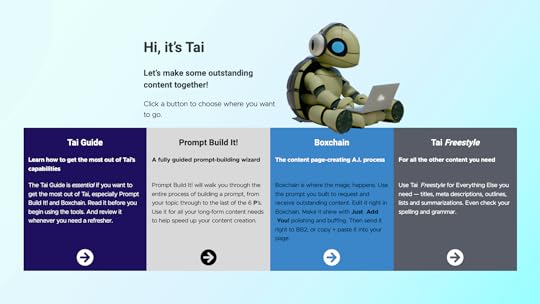
Tai is a smart business-building AI assistant. It’s available as a standalone version or as an integrated part of Solo Build It! or SBI! for WP. Its main focus is to help you write outstanding content for your blog or website. In addition, it’s also excellent for discovering innovative monetization ideas, and it can significantly advance your goal of online business success.
If you’re looking for solutions for your website monetization, then Tai could be just the right tool for you. It doesn’t matter if you’re not a tech guru, because even though Tai is capable of amazing AI feats, it’s easy to use.
Tai accommodates all skill levels. Its user-friendly interface ensures that no one misses the chance to find ways to monetize a blog or website using AI.

Tai is a generative Artificial Intelligence (GAI) tool, with profound analytical capabilities. It helps you uncover hard-to-spot unique monetization opportunities that were previously too time-consuming to research. This is revolutionary, because how can you take advantage of something if you don’t even know it exists?
Yet Tai reaches beyond the ideas. It can also help users understand why specific suggestions might work well for their website. This is important decision-making material, because you can decide for yourself whether to pursue or postpone the ideas presented by Tai.
How to Harness Tai for Maximum Monetization PossibilitiesThese strategies suit your site because they not only create a strong revenue stream but also add value to your community. Whether it’s high-quality products, educational content, or unique experiences, each method provides something of value, ensuring your website remains a trusted resource for your audience. – Tai
To give you an idea of Tai’s results, we’ll look at some examples. First, let’s assume you own a gardening blog. Your initial thoughts about monetization might revolve around partnering with seed companies, selling gardening tools, or publishing sponsored posts from landscaping firms.
Tai could take you beyond these typical ideas and introduce you to opportunities such as organizing online gardening workshops, collaborating with eco-friendly product companies, creating paid online courses, and much more.
Next, consider a website about healthful eating. Tai might suggest introducing an eBook on green smoothie recipes as a monetization strategy, explaining that the popularity of green smoothies spiked recently and aligns with your site’s content. Use this unique strategy profitably, given the recent surge in popularity of these healthful beverages.
Tai’s suggestion aligns perfectly with your site’s main content. If you choose to use this monetization method, you provide valuable content to your readers while also capitalizing on the increasing demand for nutritious green smoothies.

Tai’s insights help you keep your monetization efforts in sync with your audience’s values and needs, ensuring the success and profitability of your online business.
Tai Saves You Time and EffortOne of Tai’s key benefits is its ability to take a more comprehensive view. Where we humans can consider a few dozen variables at the best of times, Tai can analyze millions of data points at once and determine a solution. This saves those long hours spent on manual research and analysis, or trial and error.
The primary goal of Tai is to fast-track the success of your online business. One way to do this is by reducing the time spent on brainstorming and researching monetization ideas. Such tasks are tedious and time-consuming.
With Tai, instead of brainstorming and researching, you spend your time implementing the ideas. Plus, as an AI tool, Tai has the ability to learn and adapt, ensuring that it continues to provide you with options that are most likely to bring you success in the online business world.
The Importance of a Diverse Monetization StrategyWhy should you monetize a website with AI in the first place? Because reliance upon one monetization channel is risky. Until now, website owners have relied heavily on the likes of Google AdSense ads, affiliate marketing, and similar sources of revenue. While definitely useful, these methods have limitations, leaving you with less diversity and possibly underused potential for your site.
 For example, what would happen if you sold a third-party product on your site and the maker of that product, or the affiliate program itself, went out of business? Or what would happen if your favorite affiliate program made drastic commission cuts, shredding your income overnight?
A diverse monetization plan produces a safety net against uncertainties like these. In fact, you could say that implementing a diverse monetization strategy makes your business resilient.
How to Use TaiUsing Tai is straightforward. Simply tell it what you want and it delivers accordingly. The act of making a request, known as prompting, is easy to grasp with a bit of guidance from the Tai Guide.
To make the most out of Tai, you’ll need to feed it some information about your website or blog. This includes your niche and audience, the kind of content you create, your ambitions for your site, and other relevant details. After entering the information, Tai processes your request and, like a smart assistant, returns suggestions for diverse ways to monetize your online property.
Some of Tai’s suggestions will prove immediately beneficial, while others might need tweaking or further exploration. Tai can also offer advice on how best to apply each monetization idea, so you’re never left guessing about how to proceed.
See for YourselfHere are some clever ideas I generated for a make-believe site, RoaminNow.com. Among the bunch, one item — highlighted below — really shines through as not only doable but also a perfect match to the creator’s vision and mission for the site. Putting this plan into action is set to be an enjoyable and rewarding addition to this online business.
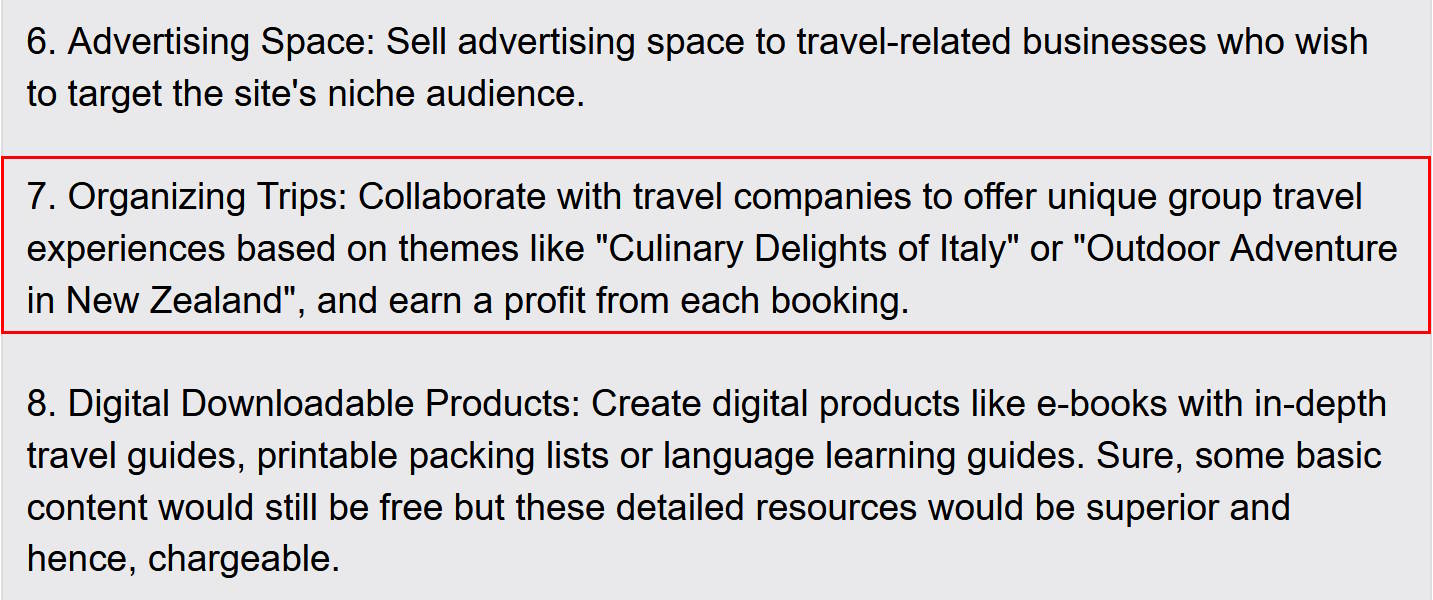
There are no secret skills needed to get Tai working for you. Let Tai know what you’re after and give it the basics around the subject. To paint you a picture, here’s the prompt I used to whip up those clever monetization ideas above:
Give me 10 ORIGINAL monetization ideas along with a detailed description of each. This is the background for the website:Website Topic: Digital Nomad Travels
Domain Name: RoaminNow.com
Demographics for Typical Visitors: Adventure enthusiasts and travel lovers aged 25-45, diverse audience, equally distributed between genders. Visitors to the site are not just looking for information; they seek inspiration, connection, and a sense of belonging to a community of like-minded explorers. RoaminNow.com is not just a website; it’s a platform that fuels the spirit of adventure.
Description: RoaminNow.com is the go-to destination for immersive travel content, catering to the wanderlust in everyone. The website is a treasure trove of travel stories, guides, and breathtaking visuals that inspire and guide individuals to embark on their own adventures. Whether you’re a seasoned traveler seeking off-the-beaten-path destinations or a first-timer looking for travel tips, RoaminNow.com is your virtual passport to a world of exploration.
The info you give Tai is totally your call. It doesn’t have to be as formal as this. Play around with it and you’ll see. Tai is easy to work with, delivering results easily and swiftly. And here’s the best part — there’s no “please” or “thank you” necessary, Tai’s here to help off the bat!
Tai understands the nuances between websites and offers custom solutions for your particular situation. It provides you with a unique, personalized path for making money from your website, helping you squeeze out every juicy bit of profit.
But Tai doesn’t stop there. Tai continually learns to improve the quality and effectiveness of its suggestions. That means you can periodically query Tai for new ideas, giving you fresh inspiration when you need it. This ensures that your monetization always aligns with the dynamic trends and needs of the digital world.
For You and Tai, What’s Next?As a new tool within the Solo Build It! suite, Tai brings a fresh perspective to the SBI! system. Use it before you build a new site, and build those choices into your business from the beginning, or overhaul your existing site and add new choices to your monetization mix.
While SBI! already offers an everything-in-one-place platform for creating an online business, adding Tai to the mix is like icing on the cake. And it makes site-building fun!

To sum it up, Tai enables website owners to explore diverse monetization ideas in a matter of minutes. It’s a monetization process that’s more efficient, more approachable and ultimately more profitable than ever before.
Whether you’re wanting to know how to monetize a WordPress blog or you’re contemplating a new online business, Tai is a valuable addition to your online toolkit.
With Tai, the challenge of monetizing your website just got a lot easier. You’ll see that the mountain isn’t so high after all. Let Tai be the companion to guide your climb.
The next step is up to you. Take that leap and incorporate Tai into your monetization strategy. Harness the power of Artificial Intelligence to reveal those hidden opportunities that can turn your passion project into a thriving online business.
Try Tai For FreeBECOME AN SBI! MEMBER TODAYAuthor information Brenda Rowe
Brenda Rowe is a freelance writer who's been an SBI! enthusiast since 2006. She's the creator of BirthdayBullseye.com, where she transforms birthdays into extraordinary experiences. Beyond content creation, Brenda has a passion for helping and devotes herself to several volunteer activities. She also enjoys baking, crafting and decorating her country home where she lives with her husband of over 30 years.
|The post Unlock Profitability: Exploring New Ways to Monetize a Website Using AI appeared first on SiteSell Blog - Proven Real-World Advice for Solopreneurs.


October 30, 2023
Seasonal Content Writing Tips – Save Time and Boost Creativity with AI

Seasonal Content Writing Tips – as a content creator, you can’t just live in the now. You need to get ahead of the game by crafting content that complements the upcoming seasons, holidays, and events.
Plan the year ahead with one simple tool: a content calendar. Make it easy by having everything at your fingertips, whether it’s on paper or in digital form.
Include important dates for your brand, like product launches or significant company milestones. By creating a visual representation of the year ahead, you’ll be able to effectively plan and organize your blogging strategy.
However, while having an editorial calendar is definitely useful, it’s equally important to keep an open mind and be ready to seize new ideas and opportunities that come your way.
What Are Seasonal Content Writing Tips?Just like you adjust your wardrobe with the seasons, your content should reflect the themes and topics that are relevant during different times of the year.
The sunny days of summer give you the perfect opportunity to cover outdoor activities, travel tips, or the latest summer fashion trends. As the holiday season rolls around, there are gift guides, mouthwatering recipes, and dazzling decorations to write about.
By aligning your content with the spirit of each season and holiday, you'll keep your audience engaged and excited for what's to come!Click To TweetDon’t feel like you have to reinvent the wheel every time you create content. Sometimes, a fresh perspective or a unique twist on existing content can be just as effective.
Timing is everything. Get ahead of the holiday rush by writing your pages weeks in advance!
Start by BrainstormingLet’s tap into the spirit of the season or upcoming holiday to spice up your content! Get those creative gears turning. How can you infuse those themes into your visuals? Any authentic storytelling you can include? Perhaps you can add some interactive elements.
What about a seasonal DIY or craft project? Some ideas you come up with might include…
SpringShow your visitors how to create a flower crown using fresh flowers — teach them the basics of flower arrangement and give them something to wear at spring events.How to plant a herb garden — this will provide them with fresh herbs and teach them gardening basics.SummerBeach-inspired shell crafts — show them how to make seashell wind chimes, candle holders or picture framesTie-Dye Clothing — teach them how to make their summer garments unique using tie-dying techniques.AutumnLeaf art — inspire your readers to collect autumn leaves and create prints or collages, or use them to decorate greetings cards.Pumpkin carving — teach them the basics of pumpkin carving, from selecting the right pumpkin to carving intricate patternsWinterDIY Snow Globes — help them create a winter scene using miniature figures, glitter and water.Handmade Ornaments — whether it’s using salt dough, felt or recycled materials, introduce techniques to create unique and personalized ornaments to hang on the tree.

Remember, the key is to offer your audience a variety of engaging content that aligns with their interests and keeps them excited and eager to learn from you.
There are plenty of other interesting seasonal options to explore if crafting isn’t your cup of tea. How about trying your hand at seasonal recipes, writing a holiday travel guide, sharing fashion tips, recommending books, taking on fitness challenges, or even hosting photography contests?
Use Automation to Save Time
When it comes to writing seasonal web pages or blog posts, you might find yourself fretting over how to fit everything into your limited time.
Let’s discuss the role of automation in content creation and how it can save you time.
With the help of Artificial Intelligence (AI), marketers and content creators can break free from the monotony of daily tasks and tap into their creativity in more exciting and inventive ways.
Imagine having the power to effortlessly schedule your social media posts, without the hassle of manually posting. Say goodbye to missed opportunities and hello to maximum engagement, as your automation tools publish your posts at the optimal times.
Not only can AI revolutionize the way you automate processes, it can also be a valuable asset in the creative process. Just imagine having access to an AI tool that can generate lists and outlines to help you structure your written content.
If you choose Solo Build It! as your website building platform, you’ll gain a valuable asset — Tai, your own AI business-building assistant. Tai comes with an extensive guide, showing you all the insider tips and tricks to make your seasonal pages (along with all your others) shine.
AI revolutionizes the way you create content, while automation takes the hassle out of scheduling posts Click To TweetWhile AI can be a powerful ally in the world of social media and content creation, it can never match the magic of human creativity. Blend the potential of AI with your unique human touch, adding your insights and personality to your work.
Show, Don’t Tell

Seasonal writing requires a delicate touch, especially if your content doesn’t directly relate to the season. If that’s the case, subtly incorporate elements that remind your readers of the current time of year.
 How do you do this? Describe the sights, sounds, scents, and emotions associated with each season, be it the warmth of a cozy fireplace in winter or the sizzling sound of barbecue in summer.
Visuals play an important role, too. Either use your own photos or enlist the help of AI image generators to create seasonal themed images. I produced the images for this article with a tool called MidJourney.
Tip: Keep your design fresh and engaging by regularly updating it to reflect the current season or upcoming holiday.
Explore the relationship between colors and holidays. Christmas, for example, is commonly associated with red and green, while Valentine’s Day is symbolized by shades of red and pink, and Halloween with orange and black.
Incorporate these colors into your website through the use of fonts, backgrounds and images. If your color sense is lacking, check out tools like Coolors or Colormind, which will suggest color palettes based on the emotions or feelings you want to convey.
Create a visual feast for your audience – let your content embody the sights, sounds, and emotions of each season.Click To TweetDid you know that there are tools that can help you design with color blindness in mind? Colorblindly and ColorSafe not only simulate how your designs will appear to someone with color blindness. They can also suggest alternative color combinations that would be more accessible.
Always test your design on a variety of devices, and get feedback from your audience to ensure that your use of color is effective and appealing.
Avoid These Common PitfallsFor your seasonal content to be valuable, you have to publish it before the season or event. There’s no point publishing a post about financial freedom for Independence Day on the 8th of July, or Halloween at the beginning of November.
Here are a few more stumbling blocks to watch out for.
Understanding your target audience and their preferences is crucial. Do you want to cater to a younger crowd with spooky Halloween content or an older audience with heartwarming Thanksgiving or Christmas content?
When it comes to incorporating seasons and holidays into your content, don’t settle for generic greetings and cliché themes. Stand out from the crowd with unique and creative ideas that will delight your audience.
Finding the perfect balance in your content can be as tricky as navigating a crowded holiday market.
While it’s tempting to write pages and pages of seasonal and holiday-themed content, be careful not to overdo it. Bombarding your audience with constant reminders of the time of year can feel forced and insincere.
Although it can be great for boosting engagement and connecting with your audience, it’s also important not to neglect evergreen content. This type of content is not tied to a specific season or holiday, and is relevant and valuable to your audience all year round.
Seasonal Content Writing Tips: Wrapping up

So, go ahead and embrace the seasons and holidays in your content marketing strategy. With careful planning, creativity, and a focus on your audience’s needs, you’ll be able to create engaging and impactful content that leaves a lasting impression.
Don't be afraid to ask for help from AI. Its ability to generate ideas ensures that you'll never run out of inspiration.Click To TweetBy following these seasonal content writing tips, you’ll be well on your way to engaging your audience and keeping your content fresh and relevant throughout the year.
BECOME AN SBI! MEMBER TODAYAuthor information Carol Leather
Carol Leather is head of content at SiteSell. She started her first successful online business, www.needlework-tips-and-techniques.com, with Solo Build It! in 2006 and it's still going strong. She loves photographing and drawing wildlife. She shares her walks in the English countryside on her new site www.naturewalkswithcarol.com. When she is not busy with all the above, she works on her two art sites! All using Solo Build It!, of course.
|The post Seasonal Content Writing Tips – Save Time and Boost Creativity with AI appeared first on SiteSell Blog - Proven Real-World Advice for Solopreneurs.
Creating Seasonal Theme Content – Save Time and Boost Creativity with AI
As a content creator, you can’t just live in the now. You need to get ahead of the game by crafting content that complements the upcoming seasons, holidays, and events.
Plan the year ahead with one simple tool: a content calendar. Make it easy by having everything at your fingertips, whether it’s on paper or in digital form.
Include important dates for your brand, like product launches or significant company milestones. By creating a visual representation of the year ahead, you’ll be able to effectively plan and organize your blogging strategy.
However, while having an editorial calendar is definitely useful, it’s equally important to keep an open mind and be ready to seize new ideas and opportunities that come your way.
What Is Seasonal Content?Just like you adjust your wardrobe with the seasons, your content should reflect the themes and topics that are relevant during different times of the year.
The sunny days of summer give you the perfect opportunity to cover outdoor activities, travel tips, or the latest summer fashion trends. As the holiday season rolls around, there are gift guides, mouthwatering recipes, and dazzling decorations to write about.
By aligning your content with the spirit of each season and holiday, you'll keep your audience engaged and excited for what's to come!Click To TweetDon’t feel like you have to reinvent the wheel every time you create content. Sometimes, a fresh perspective or a unique twist on existing content can be just as effective.
Timing is everything. Get ahead of the holiday rush by writing your pages weeks in advance!
Start by BrainstormingLet’s tap into the spirit of the season or upcoming holiday to spice up your content! Get those creative gears turning. How can you infuse those themes into your visuals? Any authentic storytelling you can include? Perhaps you can add some interactive elements.
What about a seasonal DIY or craft project? Some ideas you come up with might include…
SpringShow your visitors how to create a flower crown using fresh flowers — teach them the basics of flower arrangement and give them something to wear at spring events.How to plant a herb garden — this will provide them with fresh herbs and teach them gardening basics.SummerBeach-inspired shell crafts — show them how to make seashell wind chimes, candle holders or picture framesTie-Dye Clothing — teach them how to make their summer garments unique using tie-dying techniques.AutumnLeaf art — inspire your readers to collect autumn leaves and create prints or collages, or use them to decorate greetings cards.Pumpkin carving — teach them the basics of pumpkin carving, from selecting the right pumpkin to carving intricate patternsWinterDIY Snow Globes — help them create a winter scene using miniature figures, glitter and water.Handmade Ornaments — whether it’s using salt dough, felt or recycled materials, introduce techniques to create unique and personalized ornaments to hang on the tree.
Remember, the key is to offer your audience a variety of engaging content that aligns with their interests and keeps them excited and eager to learn from you.
There are plenty of other interesting options to explore if crafting isn’t your cup of tea. How about trying your hand at seasonal recipes, writing a holiday travel guide, sharing fashion tips, recommending books, taking on fitness challenges, or even hosting photography contests?
Use Automation to Save Time
When it comes to writing seasonal web pages or blog posts, you might find yourself fretting over how to fit everything into your limited time.
Let’s discuss the role of automation in content creation and how it can save you time.
With the help of Artificial Intelligence (AI), marketers and content creators can break free from the monotony of daily tasks and tap into their creativity in more exciting and inventive ways.
Imagine having the power to effortlessly schedule your social media posts, without the hassle of manually posting. Say goodbye to missed opportunities and hello to maximum engagement, as your automation tools publish your posts at the optimal times.
Not only can AI revolutionize the way you automate processes, it can also be a valuable asset in the creative process. Just imagine having access to an AI tool that can generate lists and outlines to help you structure your written content.
If you choose Solo Build It! as your website building platform, you’ll gain a valuable asset — Tai, your own AI business-building assistant. Tai comes with an extensive guide, showing you all the insider tips and tricks to make your seasonal pages (along with all your others) shine.
AI revolutionizes the way you create content, while automation takes the hassle out of scheduling posts Click To TweetWhile AI can be a powerful ally in the world of social media and content creation, it can never match the magic of human creativity. Blend the potential of AI with your unique human touch, adding your insights and personality to your work.
Show, Don’t Tell
Seasonal writing requires a delicate touch, especially if your content doesn’t directly relate to the season. If that’s the case, subtly incorporate elements that remind your readers of the current time of year.
How do you do this? Describe the sights, sounds, scents, and emotions associated with each season, be it the warmth of a cozy fireplace in winter or the sizzling sound of barbecue in summer.
Visuals play an important role, too. Either use your own photos or enlist the help of AI image generators to create seasonal themed images. I produced the images for this article with a tool called MidJourney.
Tip: Keep your design fresh and engaging by regularly updating it to reflect the current season or upcoming holiday.
Explore the relationship between colors and holidays. Christmas, for example, is commonly associated with red and green, while Valentine’s Day is symbolized by shades of red and pink, and Halloween with orange and black.
Incorporate these colors into your website through the use of fonts, backgrounds and images. If your color sense is lacking, check out tools like Coolors or Colormind, which will suggest color palettes based on the emotions or feelings you want to convey.
Create a visual feast for your audience – let your content embody the sights, sounds, and emotions of each season.Click To TweetDid you know that there are tools that can help you design with color blindness in mind? Colorblindly and ColorSafe not only simulate how your designs will appear to someone with color blindness. They can also suggest alternative color combinations that would be more accessible.
Always test your design on a variety of devices, and get feedback from your audience to ensure that your use of color is effective and appealing.
Avoid These Common PitfallsFor your seasonal content to be valuable, you have to publish it before the season or event. There’s no point publishing a post about financial freedom for Independence Day on the 8th of July, or Halloween at the beginning of November.
Here are a few more stumbling blocks to watch out for.
Understanding your target audience and their preferences is crucial. Do you want to cater to a younger crowd with spooky Halloween content or an older audience with heartwarming Thanksgiving or Christmas content?
When it comes to incorporating seasons and holidays into your content, don’t settle for generic greetings and cliché themes. Stand out from the crowd with unique and creative ideas that will delight your audience.
Finding the perfect balance in your content can be as tricky as navigating a crowded holiday market.
While it’s tempting to write pages and pages of seasonal and holiday-themed content, be careful not to overdo it. Bombarding your audience with constant reminders of the time of year can feel forced and insincere.
Although it can be great for boosting engagement and connecting with your audience, it’s also important not to neglect evergreen content. This type of content is not tied to a specific season or holiday, and is relevant and valuable to your audience all year round.
Creating Seasonal Theme Content: Wrapping up
So, go ahead and embrace the seasons and holidays in your content marketing strategy. With careful planning, creativity, and a focus on your audience’s needs, you’ll be able to create engaging and impactful content that leaves a lasting impression.
Don't be afraid to ask for help from AI. Its ability to generate ideas ensures that you'll never run out of inspiration.Click To TweetBy following these tips, you’ll be well on your way to engaging your audience and keeping your content fresh and relevant throughout the year.
BECOME AN SBI! MEMBER TODAYAuthor informationCarol LeatherCarol Leather is head of content at SiteSell. She started her first successful online business, www.needlework-tips-and-techniques.com, with Solo Build It! in 2006 and it's still going strong. She loves photographing and drawing wildlife. She shares her walks in the English countryside on her new site www.naturewalkswithcarol.com. When she is not busy with all the above, she works on her two art sites! All using Solo Build It!, of course.
|The post Creating Seasonal Theme Content – Save Time and Boost Creativity with AI appeared first on SiteSell Blog - Proven Real-World Advice for Solopreneurs.
September 21, 2023
Authentic Storytelling in the Age of AI

Imagine sitting by a roaring fire, listening to a friend share an engaging, heartfelt story. Now imagine that warmth spreading to the readers of your web page or blog post.
Authentic storytelling is a powerful tool that can bring people together, whether they’re in the same room or on the other side of the world.
How Authentic Storytelling in the Age of AI Benefits Your BusinessStorytelling enables you to break through the noise and stand out from your competition. By sharing your stories you’ll be able to create an intimate environment where readers feel they’re getting to know the real you.
This leads to increased customer loyalty and repeat business. Your audience will be more likely to choose your products or services over your competitors because they feel a genuine connection with you.
Not only does storytelling help you build stronger relationships with your website visitors, it also positions you as an authority.
As you share your expert knowledge and experiences through stories, you demonstrate the precise experience, expertise, authority, and trustworthiness (E-E-A-T) that Google values. This credible reputation not only satisfies the algorithms but organically attracts more clients, driving your sales and profitability upwards.
Take, for example, my blackwork embroidery patterns. The ideas for these don’t come out of thin air. There’s a story behind the creation of each one. Sharing these stories helps bring the design to life for customers, encouraging them to continue the story for themselves when they stitch it.
Authentic storytelling goes beyond mere words on a page - it allows readers to connect on a deeper level.Click To TweetBy sharing honest experiences and emotions, we invite our readers to walk a mile in our shoes. This shared journey fosters a bond that goes beyond the typical writer-reader relationship.
How Modern Technologies Help With StorytellingThe rise of generative Artificial Intelligence (GAI) offers an opportunity to revolutionize storytelling. AI can enhance the way we speak to our audience and create content that truly resonates. If we have the experiences to share, but not the “right” words to use, AI can help us rephrase them and make the story more engaging.
However, there are challenges to overcome. AI lacks emotional experience, often missing out on context and nuances that are crucial for interpreting a story. That’s where we come back in.
AI enhances storytelling by making narratives more engaging, but the human touch remains essential for emotional depth.Click To TweetAs writers, we can harness the power of AI while imparting our human insights and emotions. It’s a harmonious collaboration.

As a writer, I view authentic storytelling as an open conversation, a dialogue that bridges the gap between me and my readers. It’s about being genuine, transparent, and most importantly, truthful.
Authentic storytelling is not just about recounting events; it’s about sharing the raw emotions, the triumphs, the failures, the laughter, and the tears that come with these events. If AI can help me with the basic organization of my writing, then I am willing to work with it to serve my visitor as best as I can.
 5 Seconds That Change Everything
One book that influenced my storytelling was “Storyworthy” by Matthew Dicks. Dicks emphasizes the ‘5-second moment’.
He’s referring to a pivotal moment that changes everything in your life. A moment when something impacts what you do, think or feel from then on. This could be a public moment where you achieve a goal, such as winning a medal, or a private one that you have never shared before.
All great stories — whether in a book, movie or real life — tell the story of a 5 second moment in someone’s life. The purpose of the rest of the story is to bring clarity to that moment. When sharing these moments, pare them down to the minimum that gets the message across. Cut out the preamble.
If you’re planning to incorporate authentic storytelling on your site, the book is well worth the read.
Transparency Is ParamountAs AI permeates into storytelling, it’s crucial to uphold transparency. The audience must know when AI is used, and how it influences the story.
While AI can handle routine tasks such as data collection and analysis, the human touch remains irreplaceable in initially creating a truly captivating and emotionally resonant story. This combination of human and AI efforts can enhance the credibility and trustworthiness of a story.
Stories become magic when we blend the wizardry of AI with the heartbeats of human experience.Click To TweetAI can also boost storytelling by refining the wording and presentation of the text. It can generate clear, concise and grammatically correct narratives, thus making stories more compelling and relatable.
Writing in Collaboration With AISometimes when we write about the events in our lives, we tend to get carried away. We add unnecessary details, go off on tangents, and lose our readers in the process.
What we want to do is focus on the essential story, that “5 second moment” that truly matters. We want to create a powerful connection with our readers and draw them into our story, making them feel like they’re right there with us, experiencing every emotion and sensation.
To investigate the power of AI I did an experiment.
I quickly jotted down a story from my own life and then asked AI to rewrite it “to be clear and concise, yet engaging”. The results are below…
The Story in My Own WordsWhen I was 8, I had been looking forward to my summer vacation with my grandparents. It would be just me and them, my younger sister being too young to join in. We were camping in a trailer tent, a new experience for me.
The New Forest was full of ponies, and I couldn’t resist following where they went, admiring their wildness yet familiarity. My grandparents couldn’t keep up and trailed along behind.
After a while I looked back and they weren’t in sight! I was alone! I panicked and started crying. I was lost on the moor.
Of course they weren’t far away and eventually found me, sitting on the ground in a flood of tears. But I never forgot that moment. Even now I will mentally photograph landmarks when somewhere new to ensure I can find my way back.
 Dartmoor pony by Carol Leather, from a more recent vacation (I still love ponies)My Story as Told by AI
Have you ever had a moment where you felt lost and alone? I remember one summer vacation when I was 8 years old, camping with my grandparents in the beautiful New Forest. It was just the three of us, and I was so excited for this special time together. The forest was filled with wild ponies, and I couldn’t help but be captivated by their freedom and beauty.
But one day, as I followed the ponies, I looked back and realized that my grandparents were no longer in sight. Panic washed over me, and I found myself crying and feeling completely lost on the moor. It was a scary moment for me as a young child, but my grandparents soon found me, sitting on the ground, tears streaming down my face.
That experience has stayed with me all these years, and it’s taught me a valuable lesson about the importance of finding my way back. Whether it’s in the physical sense, like mentally photographing landmarks, or in the metaphorical sense, like finding our path in life, having a sense of direction is crucial.
Comparing the StoriesBoth versions of the story have their strengths. My personal account brings a sense of authenticity and a direct connection to my emotions at that moment. On the other hand, the AI’s retelling adds a touch of universality, making the story relatable to a wider audience.
So, which storyteller takes the prize? Well, it’s up to you to decide! Both versions have their merits, and ultimately it comes down to personal preference. If I were to use this story on my nature walks site I would probably combine the two versions.
What matters most is the power of storytelling itself and the emotions it evokes within us.
By incorporating authentic storytelling techniques into our writing, we can convey our messages more effectively. By placing our readers in the heart of our stories, we can foster empathy and understanding, making our messages more resonant and impactful.
Authentic Storytelling in the Age of AI: A Look AheadWhile AI can enhance accuracy and efficiency, the human touch is crucial for emotional depth and understanding context. Looking ahead, as AI technology continues to advance, its role in storytelling will likely become even more significant, helping to captivate audiences with more immersive and engaging narratives.
AI is the paintbrush, but the storyteller remains the artist, infusing every stroke with the colors of humanity.Click To TweetI encourage you to embrace authentic storytelling in the age of AI. Share your experiences, your emotions, your truth, and watch as your bond with your readers grows stronger than ever.
BECOME AN SBI! MEMBER TODAYAuthor informationCarol LeatherCarol Leather is head of content at SiteSell. She started her first successful online business, www.needlework-tips-and-techniques.com, with Solo Build It! in 2006 and it's still going strong. She loves photographing and drawing wildlife. She shares her walks in the English countryside on her new site www.naturewalkswithcarol.com. When she is not busy with all the above, she works on her two art sites! All using Solo Build It!, of course.
|The post Authentic Storytelling in the Age of AI appeared first on SiteSell Blog - Proven Real-World Advice for Solopreneurs.
August 31, 2023
Starting an Online BusinessFrequently Asked Questions – Answered
 Starting an online business frequently asked questions.
You’ve likely heard the old saying, “The journey of a thousand miles begins with a single step.” Cliché, I know. But also quite true.
What could be your first step into starting an online business? How about answers to some of the most frequently asked questions?
From understanding the basics to identifying the right niche or figuring out costs, it can seem a bit dizzying!
I’m here to help navigate these waters and offer genuine answers to your starting an online business frequently asked questions. These answers aren’t pulled out of thin air. They’re based on working with budding online business owners here at Solo Build It! since 2010 and having started my own in 2006.
So, buckle up. Let’s jump right in together!
1. I have no experience with online businesses, websites or blogs. Where do I even begin?Starting an online business can seem daunting, especially when you’re new to it all. But here’s the truth: no one went from zero to successful business owner in a week, month, or even six months.
Rome wasn’t built in a day, and nor will your online business. The path to success may be long, but it’s certainly worth it. Click To TweetThose who claim you’ll be up and running in a few days are either delusional or lying.
Start small. Learn the basics. Learn a little bit more each day and start applying what you learn.
You’ll find tons of resources when you search for “how to start a blog” or “blogging for beginners.” However, if you want to speed up your learning curve and follow a more structured approach, joining the Solo Build It! community is your best option.
Solo Build It! (SBI!) is designed to walk you through the entire process of building a profitable online business, step by step.
It’s not just about blogging or creating a website. It’s about having the right mindset (running a business vs writing a blog), finding the right niche for you, understanding your audience, crafting high-quality content, building your “brand of one,” and developing strategies to monetize your efforts.
Check out some of our real life success lessons for inspiration. Many of these “everyday people” started with zero knowledge and worked their way up to being the successful solopreneurs they are today.2. Can I create a website or blog with no technical skills?Absolutely! Don’t worry if you aren’t tech-savvy. Sometimes that’s even an advantage. Why? Because you don’t have to “unlearn” bad habits or wrong advice you might have picked up in previous attempts.
Like, for example, believing that SEO (search engine optimization) is the most important factor for succeeding online. It’s not. Yes, sure, you need to understand and apply the basic rules, but your main emphasis should always be on serving your human visitor.
With the right tools and guidance, you can create a professional-looking site without knowing a single line of code.Click To TweetNo need to be a designer either! Many blogging and website platforms offer customizable templates and a user-friendly interface. Ease of use is one of the ten factors to consider when choosing the best blogging platform for your needs.
Hear from Jill Loeffler how she built a successful travel website with zero technical know-how:
3. Which online business is best (for beginners)?Perhaps you’re wondering what kind of online business you should start. Honestly, it depends on your interests, skills, and time. There’s no one-size-fits-all answer here.
What I’ve seen from working with online business owners here at Solo Build It! is that many start with an informational website about one of their hobbies or passions. Info sites are great because you can earn an income in a “hands-off” way, with display ads and affiliate marketing.
These passive monetization methods are easy to implement and maintain. Once you’ve got your feet wet, it makes sense to move to higher paying models, like creating and selling digital products, selling services or adding a shop where you offer physical products.
The advantage of a platform like SBI! is that it caters to various types of online businesses, offering the necessary tools and guidance, no matter what path you choose.
4. How do I find the right niche/topic?Choosing your niche can make or break the success of your online business. Yes, it’s that important. So take your time with it.
Be sure to pick a topic you love and know a lot about (or you’re at least willing to learn as much as you can about it).
It’s also vital to ensure there’s a demand for what you want to offer. You need a balance between your passion and what people want or need.
Using tools such as SBI!’s Brainstorm It!, you can research and find the areas where your interests meet high demand with low competition. That’s your sweet spot for starting a successful online business.
In effect, the perfect niche is one that blends passion and demand with solid monetization potential.Click To Tweet5. How much does it cost to start an online business?Starting an online business frequently asked questions would not be complete if we didn’t address expenses. The good news is, starting a business online costs a lot less than starting a brick-and-mortar store.
At the most basic level, you’ll need to pay for domain registration (typically $10 to $20 per year) and website hosting.
The cost for hosting varies greatly, depending on the host, the features you want and your website traffic. When you’re just getting started, go with shared hosting, which is the cheapest form of hosting. Expect to pay between $3 and $14 per month.
You might also need to spend on tools for doing keyword research, site design, an email marketing provider and — of course — training.
Or you could choose a platform that provides all of the above in one place and for one inclusive price (no upsells, no plugins). I know one that offers exactly that. 
Check out everything that’s included in Solo Build It! here.
6. How long does it take to make money with an online business? This is one of the starting an online business frequently asked questions where I wish I had a definitive answer. A more satisfying one than “it depends.”
There are just too many factors at play: your niche, how much and how consistently you work on your business, the monetization methods you choose, how strong your competition is.
As a general rule of thumb, expect the first income after about 6 months. Why not sooner? Because you first need to publish sufficient content to attract enough visitors, who will — because of your great content — begin to trust you as an expert in your niche. Only then can you start monetizing.
We call this the C T P M process. It has proven its value for our members for more than two decades.
The beauty of an online business is the flexibility it offers. You can devote as many or as few hours per week as your personal circumstances allow.
Most of the Solo Build It! members I interviewed started their website as a side hustle, while still working a full-time job. If that’s your situation too, you may only be able to spend 5 to 10 hours per week on your business.
Perhaps you’re a stay-at-home parent and you can dedicate the morning hours, when the kids are at school, to building your online business.
Or maybe you’ll go all in with 40 hours per week or more, because you’re retired or you quit your job.
The key is consistency, as regular inputs — even small ones — add up over time.
 Slow and steady wins the online business race. Whether it's 5 or 40 hours a week, consistency is key!Click To Tweet8. How can I make money with an online business (especially if I have no product to sell)?
If you thought that making money online means you need your own products to sell, I have good news for you. Selling your own digital or physical products is a good way to monetize, no doubt, and one to aspire to.
But it’s not the only way. And you certainly don’t need your own products to get started.
In an earlier article, I collected a list of 32 ways to make money blogging.
At the beginning, many solopreneurs choose passive monetization models like Google AdSense or recommending other people’s products or services for which they receive a commission (what’s called the affiliate marketing model).
While these passive income streams are convenient — they don’t require much of your time — they also have a low profit margin.
To earn more per visitor, you need to move on to more active ways to monetize, like creating your own products, or offering your own services. Of course, the higher earnings come with more work and the obligation of dealing with customers, suppliers, contractors, and perhaps even employees.
Whatever direction you choose, there’s one golden rule to follow:
Don’t put all your monetization eggs in one basket. In other words, diversify your income streams!
9. What are the best ways to promote an online business?The single best way to promote your online business is to create outstanding content that overdelivers on your visitors’ search intent.
Sounds simple, right? On one hand it is, because there’s no “secret sauce” involved. But it’s also hard because to succeed you need to:
know your topic wellknow your audience well, andknow how to write well.Want to learn more about how to produce quality content? Download the free quality content checklist.
There are many ways to promote your website and business.
Applying basic SEO rules (especially choosing the right keywords) can help improve your site’s visibility in search engines, driving free, organic traffic to your site.
Social media is a fantastic way to engage with your audience, build a community around your brand, and advertise your offerings.
And then there’s email marketing. Building an email list from the start is a must. It allows you to nurture relationships with your readers and potential customers.
10. How do I avoid getting overwhelmed or discouraged?Building a business isn’t easy. It never will be, not in a thousand years. Free money would be nice, but it simply isn’t in the cards.
Whenever you get the occasional sinking or drowning feeling, this personal story by Solo Build It!’s founder and CEO, Ken Evoy, might help:
“I love snorkeling. But one time in Anguilla, when I was just a beginner, I went too far out, about 700 yards or so, to where the second reef suddenly drops into dark water and it gets cold. A first-time snorkeler should never be there alone.
I started to panic, and began flailing around. I quickly realized I was going to drown if I didn’t slow down, breathe easy and do a slow steady stroke all the way back to shore. And that’s exactly what I did.
I stayed around the inshore reef and explored its treasures after that. It was just as much fun, and I was perfectly safe.
So why did I get myself into that near-drowning situation in the first place? I couldn’t help myself. I kept wanting to see and do more. And when I got into trouble, I felt overwhelmed in that huge ocean. I did way more than I should have.”

Starting an online business can be like Ken’s snorkeling experience. It sometimes feels like you’ve swum too far into the unknown. The thought of it all can be overwhelming, even terrifying.
The key to avoiding feeling discouraged or overwhelmed is to take it steady and slow… the tortoise way.
 Click To Tweet
Don’t try to do everything at once. Focus on mastering one task at a time. And most important, remember to breathe and take breaks. Find 7 more business motivation tips here.
And, just like a first time snorkeler shouldn’t go too far from shore alone, you shouldn’t be alone either. That’s why being part of a friendly community of like-minded solopreneurs — like the legendary SBI! forums — is so important.
Bonus question: How can AI help me start and grow an online business?Picture AI (Artificial Intelligence) as a super helper that’s by your side at all times. While AI can help with many things, I want to talk about the three areas most important to us as online business owners: researching, writing, and creating images and videos.
Researching your topic: Imagine having an enthusiastic assistant who never sleeps and spends all their time online, eager to help you uncover all the secrets of your chosen business topic. That’s what AI can do! It can gather a heap of information in no time, sparking ideas for new articles or putting a different spin on existing ones.
Outlining and writing content: Who wouldn’t want an assistant to help us write compelling content that connects with our audience? Even better if that helper had vast knowledge about practically every topic. And to top it off, had flawless grammar and spelling skills!
Generative AI ticks all the boxes. It can help create outlines for your content, suggest irresistible titles and subheadings, create a first draft, and make sure the spelling and grammar are right.
Creating images and videos: Adding images for your content was limited to either your personal skills or to what you could find to use. Now, thanks to AI image generators, you’re limited only by your imagination and how well you can prompt, i.e., tell a generator what image (or video) you want it to produce.
You don’t have to be tech-savvy to use AI. You just have to know how to use it for maximum benefit.That’s why Tai, Solo Build It’s soon-to-be released AI assistant includes all you need under one roof: a combination of the right tools and step-by-step process to help you create outstanding content faster than ever before.
By the way, I created the article you’re reading now in collaboration with Tai (I’m part of the beta testing team).
Starting an Online Business Frequently Asked Questions AnsweredDid I manage to answer your most pressing questions about starting an online business? I hope so. If not, please ask in the comments section or — even better — get in touch with one of my colleagues from the SBI! Advisor Team.
Ready to begin? We’re here for you. With Solo Build It!’s advanced tools, guidance, community, and your very own AI assistant, Tai, this journey will be less daunting and more exciting. Pinkie promise. 
 Margit Streifeneder
Margit Streifeneder is the Marketing Co-Director at SiteSell. She works with a small but mighty team to spread the word about Solo Build It!, via helpful content, informative emails and eye-catching ads. She's passionate about helping solopreneurs achieve success, and enjoys interviewing SBI! members about their achievements. Besides growing her own online business, she loves exploring new places, hiking, dancing and spoiling her three cats.
|The post Starting an Online Business
Frequently Asked Questions – Answered appeared first on SiteSell Blog - Proven Real-World Advice for Solopreneurs.
Starting an Online BusinessYour Frequently Asked Questions Answered
You’ve likely heard the old saying, “The journey of a thousand miles begins with a single step.” Cliché, I know. But also quite true.
What could be your first step into starting an online business? How about answers to some of the most frequently asked questions?
From understanding the basics to identifying the right niche or figuring out costs, it can seem a bit dizzying!
I’m here to help navigate these waters and offer genuine answers to your pressing questions about starting a business online. These answers aren’t pulled out of thin air. They’re based on working with budding online business owners here at Solo Build It! since 2010 and having started my own in 2006.
So, buckle up. Let’s jump right in together!
1. I have no experience with online businesses, websites or blogs. Where do I even begin?Starting an online business can seem daunting, especially when you’re new to it all. But here’s the truth: no one went from zero to successful business owner in a week, month, or even six months.
Rome wasn’t built in a day, and nor will your online business. The path to success may be long, but it’s certainly worth it. Click To TweetThose who claim you’ll be up and running in a few days are either delusional or lying.
Start small. Learn the basics. Learn a little bit more each day and start applying what you learn.
You’ll find tons of resources when you search for “how to start a blog” or “blogging for beginners.” However, if you want to speed up your learning curve and follow a more structured approach, joining the Solo Build It! community is your best option.
Solo Build It! (SBI!) is designed to walk you through the entire process of building a profitable online business, step by step.
It’s not just about blogging or creating a website. It’s about having the right mindset (running a business vs writing a blog), finding the right niche for you, understanding your audience, crafting high-quality content, building your “brand of one,” and developing strategies to monetize your efforts.
Check out some of our real life success lessons for inspiration. Many of these “everyday people” started with zero knowledge and worked their way up to being the successful solopreneurs they are today.2. Can I create a website or blog with no technical skills?Absolutely! Don’t worry if you aren’t tech-savvy. Sometimes that’s even an advantage. Why? Because you don’t have to “unlearn” bad habits or wrong advice you might have picked up in previous attempts.
Like, for example, believing that SEO (search engine optimization) is the most important factor for succeeding online. It’s not. Yes, sure, you need to understand and apply the basic rules, but your main emphasis should always be on serving your human visitor.
With the right tools and guidance, you can create a professional-looking site without knowing a single line of code.Click To TweetNo need to be a designer either! Many blogging and website platforms offer customizable templates and a user-friendly interface. Ease of use is one of the ten factors to consider when choosing the best blogging platform for your needs.
Hear from Jill Loeffler how she built a successful travel website with zero technical know-how:
3. Which online business is best (for beginners)?Perhaps you’re wondering what kind of online business you should start. Honestly, it depends on your interests, skills, and time. There’s no one-size-fits-all answer here.
What I’ve seen from working with online business owners here at Solo Build It! is that many start with an informational website about one of their hobbies or passions. Info sites are great because you can earn an income in a “hands-off” way, with display ads and affiliate marketing.
These passive monetization methods are easy to implement and maintain. Once you’ve got your feet wet, it makes sense to move to higher paying models, like creating and selling digital products, selling services or adding a shop where you offer physical products.
The advantage of a platform like SBI! is that it caters to various types of online businesses, offering the necessary tools and guidance, no matter what path you choose.
4. How do I find the right niche/topic?Choosing your niche can make or break the success of your online business. Yes, it’s that important. So take your time with it.
Be sure to pick a topic you love and know a lot about (or you’re at least willing to learn as much as you can about it).
It’s also vital to ensure there’s a demand for what you want to offer. You need a balance between your passion and what people want or need.
Using tools such as SBI!’s Brainstorm It!, you can research and find the areas where your interests meet high demand with low competition. That’s your sweet spot for starting a successful online business.
In effect, the perfect niche is one that blends passion and demand with solid monetization potential.Click To Tweet5. How much does it cost to start an online business?Starting an online business costs a lot less than starting a brick-and-mortar store.
At the most basic level, you’ll need to pay for domain registration (typically $10 to $20 per year) and website hosting.
The cost for hosting varies greatly, depending on the host, the features you want and your website traffic. When you’re just getting started, go with shared hosting, which is the cheapest form of hosting. Expect to pay between $3 and $14 per month.
You might also need to spend on tools for doing keyword research, site design, an email marketing provider and — of course — training.
Or you could choose a platform that provides all of the above in one place and for one inclusive price (no upsells, no plugins). I know one that offers exactly that.
Check out everything that’s included in Solo Build It! here.
6. How long does it take to make money with an online business?This is one of the online business questions where I wish I had a definitive answer. A more satisfying one than “it depends.”
There are just too many factors at play: your niche, how much and how consistently you work on your business, the monetization methods you choose, how strong your competition is.
As a general rule of thumb, expect the first income after about 6 months. Why not sooner? Because you first need to publish sufficient content to attract enough visitors, who will — because of your great content — begin to trust you as an expert in your niche. Only then can you start monetizing.
We call this the C T P M process. It has proven its value for our members for more than two decades.
The beauty of an online business is the flexibility it offers. You can devote as many or as few hours per week as your personal circumstances allow.
Most of the Solo Build It! members I interviewed started their website as a side hustle, while still working a full-time job. If that’s your situation too, you may only be able to spend 5 to 10 hours per week on your business.
Perhaps you’re a stay-at-home parent and you can dedicate the morning hours, when the kids are at school, to building your online business.
Or maybe you’ll go all in with 40 hours per week or more, because you’re retired or you quit your job.
The key is consistency, as regular inputs — even small ones — add up over time.
Slow and steady wins the online business race. Whether it's 5 or 40 hours a week, consistency is key!Click To Tweet8. How can I make money with an online business (especially if I have no product to sell)?If you thought that making money online means you need your own products to sell, I have good news for you. Selling your own digital or physical products is a good way to monetize, no doubt, and one to aspire to.
But it’s not the only way. And you certainly don’t need your own products to get started.
In an earlier article, I collected a list of 32 ways to make money blogging.
At the beginning, many solopreneurs choose passive monetization models like Google AdSense or recommending other people’s products or services for which they receive a commission (what’s called the affiliate marketing model).
While these passive income streams are convenient — they don’t require much of your time — they also have a low profit margin.
To earn more per visitor, you need to move on to more active ways to monetize, like creating your own products, or offering your own services. Of course, the higher earnings come with more work and the obligation of dealing with customers, suppliers, contractors, and perhaps even employees.
Whatever direction you choose, there’s one golden rule to follow:
Don’t put all your monetization eggs in one basket. In other words, diversify your income streams!
9. What are the best ways to promote an online business?The single best way to promote your online business is to create outstanding content that overdelivers on your visitors’ search intent.
Sounds simple, right? On one hand it is, because there’s no “secret sauce” involved. But it’s also hard because to succeed you need to:
know your topic wellknow your audience well, andknow how to write well.Want to learn more about how to produce quality content? Download the free quality content checklist.
There are many ways to promote your website and business.
Applying basic SEO rules (especially choosing the right keywords) can help improve your site’s visibility in search engines, driving free, organic traffic to your site.
Social media is a fantastic way to engage with your audience, build a community around your brand, and advertise your offerings.
And then there’s email marketing. Building an email list from the start is a must. It allows you to nurture relationships with your readers and potential customers.
10. How do I avoid getting overwhelmed or discouraged?Building a business isn’t easy. It never will be, not in a thousand years. Free money would be nice, but it simply isn’t in the cards.
Whenever you get the occasional sinking or drowning feeling, this personal story by Solo Build It!’s founder and CEO, Ken Evoy, might help:
“I love snorkeling. But one time in Anguilla, when I was just a beginner, I went too far out, about 700 yards or so, to where the second reef suddenly drops into dark water and it gets cold. A first-time snorkeler should never be there alone.
I started to panic, and began flailing around. I quickly realized I was going to drown if I didn’t slow down, breathe easy and do a slow steady stroke all the way back to shore. And that’s exactly what I did.
I stayed around the inshore reef and explored its treasures after that. It was just as much fun, and I was perfectly safe.
So why did I get myself into that near-drowning situation in the first place? I couldn’t help myself. I kept wanting to see and do more. And when I got into trouble, I felt overwhelmed in that huge ocean. I did way more than I should have.”
Starting an online business can be like Ken’s snorkeling experience. It sometimes feels like you’ve swum too far into the unknown. The thought of it all can be overwhelming, even terrifying.
The key to avoiding feeling discouraged or overwhelmed is to take it steady and slow… the tortoise way.
Click To TweetDon’t try to do everything at once. Focus on mastering one task at a time. And most important, remember to breathe and take breaks. Find 7 more business motivation tips here.
And, just like a first time snorkeler shouldn’t go too far from shore alone, you shouldn’t be alone either. That’s why being part of a friendly community of like-minded solopreneurs — like the legendary SBI! forums — is so important.
Bonus question: How can AI help me start and grow an online business?Picture AI (Artificial Intelligence) as a super helper that’s by your side at all times. While AI can help with many things, I want to talk about the three areas most important to us as online business owners: researching, writing, and creating images and videos.
Researching your topic: Imagine having an enthusiastic assistant who never sleeps and spends all their time online, eager to help you uncover all the secrets of your chosen business topic. That’s what AI can do! It can gather a heap of information in no time, sparking ideas for new articles or putting a different spin on existing ones.
Outlining and writing content: Who wouldn’t want an assistant to help us write compelling content that connects with our audience? Even better if that helper had vast knowledge about practically every topic. And to top it off, had flawless grammar and spelling skills!
Generative AI ticks all the boxes. It can help create outlines for your content, suggest irresistible titles and subheadings, create a first draft, and make sure the spelling and grammar are right.
Creating images and videos: Adding images for your content was limited to either your personal skills or to what you could find to use. Now, thanks to AI image generators, you’re limited only by your imagination and how well you can prompt, i.e., tell a generator what image (or video) you want it to produce.
You don’t have to be tech-savvy to use AI. You just have to know how to use it for maximum benefit.That’s why Tai, Solo Build It’s soon-to-be released AI assistant includes all you need under one roof: a combination of the right tools and step-by-step process to help you create outstanding content faster than ever before.
By the way, I created the article you’re reading now in collaboration with Tai (I’m part of the beta testing team).
Starting an Online Business: Your Frequently Asked Questions AnsweredDid I manage to answer your most pressing questions about starting an online business? I hope so. If not, please ask in the comments section or — even better — get in touch with one of my colleagues from the SBI! Advisor Team.
Ready to begin? We’re here for you. With Solo Build It!’s advanced tools, guidance, community, and your very own AI assistant, Tai, this journey will be less daunting and more exciting. Pinkie promise.
Margit StreifenederMargit Streifeneder is the Marketing Co-Director at SiteSell. She works with a small but mighty team to spread the word about Solo Build It!, via helpful content, informative emails and eye-catching ads. She's passionate about helping solopreneurs achieve success, and enjoys interviewing SBI! members about their achievements. Besides growing her own online business, she loves exploring new places, hiking, dancing and spoiling her three cats.
|The post Starting an Online Business
Your Frequently Asked Questions Answered appeared first on SiteSell Blog - Proven Real-World Advice for Solopreneurs.
August 17, 2023
Blogxiety and Why Bloggers Quit: Avoid These 5 Mistakes
You’ve just started your blog or website. You’re pumping out article after article and eagerly awaiting that first dollar. A couple months in, you feel dejected and think about giving up on your online business.
Why do so many bloggers quit? Why might you be thinking of quitting?
Maybe you’re not getting the traffic or income you expected or desired.Perhaps the initial spark and excitement have faded, and you’re beginning to doubt whether this was the right thing to do.You’re wondering how much work you have to put in before you start seeing results.Your goals and aspirations seem far out of reach.Do any of these points describe you?
They might, and maybe they still do. But if you’ve gone on to achieve great things in the online world, you’ll know that sometimes you just have to push that little bit harder to begin seeing the fruits of your labour.
So why is it that so many enthusiastic bloggers or website owners simply give up their pursuit of online business success?
Here are the five main reasons, along with tips on how you can overcome them:
1. BlogxietyA relatively new term, unknown by most bloggers but certainly felt by many, blogxiety is quite simply anxiety associated with blogging.
We all experience anxiety in other aspects of life, so what’s different with blogxiety?
 Well, like any stress associated with work, it makes matters unpleasant. Work-related stress may well have been what encouraged you to start your own business and be your own boss, to get away from the looming deadlines and workplace politics.
If you haven’t made the move to solopreneurship, perhaps the company you work for is insisting on a return to in-office working again, adding more stress in your attempt to maintain your family’s hard earned work-life balance.
Blogxiety is the solopreneur’s equivalent of work-related stress, and it can result in potentially successful bloggers quitting for a number of reasons:
Blogging burnout from trying to do too much too quickly, for too long. Don’t push yourself too hard. Set short-term content goals that you know are achievable based on your abilities and your available time.
If you know you can only write one new article a week, then write one. Exceeding your limit will create work/life imbalance, and the quality of your work will suffer too.
Comparing your level of success with those more successful than you. This can do one of two things: Encourage you and show you what’s possible, or discourage you and make you doubt that you’ll ever achieve the same.
If you’re in the latter group, remember that everyone starts at the bottom. View the blogs you admire and look up to as great sources of information and inspiration. Observe what works for them and use what you learn to achieve your own goals.
Limited technical and website development knowledge. For those keen on starting out, this can often be a major deterrent.
Solo Build It! requires no previous technical abilities. Every step of the way to success is clearly defined and laid out in the Action Guide.
2. Not Looking Before You JumpFinding the right niche is arguably the most important aspect of starting a successful online business. Sometimes all that passion and excitement at the start of your journey can lead to hurried decisions and dreadful consequences down the line.
Picking a niche you’re not passionate about or one in which you don’t have much experience or knowledge is often a recipe for disaster.
Choosing a niche is about a lot more than just keywords; it's about aligning passion with potential and purpose with proficiency.Click To TweetThat’s why it’s paramount that you take as long as you need to ensure you hone in on your perfect niche, which means answering “yes” to just about all of the following:
Are you truly passionate about your niche?Are you knowledgeable or experienced in this niche?Does your niche have sufficient monetization potential?Is your niche aligned with your values?If you’re having trouble with niche selection, this article on how to choose the perfect niche breaks the process down into three simple steps.
3. Not Being Realistic With YourselfMany aspiring bloggers fall into the trap of expecting overnight success.
The reality is that building a successful online business takes time, effort, and consistent dedication.
You likely will not see immediate results, so you may become discouraged and wonder what you’re doing wrong. But the results will often follow long after you publish the first or even the 21st article.
Expecting instant blogging success? That will only set you up for disappointment. Be patient and, above all, be realistic.Click To TweetIt can take many months to a year or more before you see that first dollar roll in. But in the long run, it’s all worth it. Set short-term goals, and dedicate a certain amount of time each day or week to your website. Slowly but surely you’ll start reaping the rewards.
4. Thinking Blogging Is EasyCreating quality content that’s loved by humans and search engines alike isn’t easy. But it’s not all that complicated either. Once you get the hang of it, what quickly becomes apparent is the amount of work involved.
Working consistently on your website and regularly publishing new content takes dedication and perseverance.
Many underestimate the time and effort needed to be successful and ultimately make a living blogging. Create valuable content regularly, engage with your audience, and grow your website’s traffic. Eventually you’ll see the time and effort you invested convert into income.
To stay on track, create a content schedule. Break down larger tasks into smaller, more manageable ones.
Surround yourself with like-minded individuals in-person or online, who share the same interests as you and who can provide support and encouragement throughout your journey.
5. Thinking Motivation Is EnoughWhen a lot of hard work is required, what do you need?

Coffee But also motivation.
We all know motivation is important when it comes to doing or achieving just about anything. It also ties in with passion and niche selection. You’re passionate about your niche and you’re also motivated to share your valuable insight with the world.
Motivation to work on your business often comes in bursts. It’s that surge of excitement and inspiration that makes you eager to create content and engage with your audience.
But as with any venture, there will be moments when the initial enthusiasm fades. Life gets busy, unexpected challenges arise, and maintaining, let alone growing, a website can feel like an uphill battle.
The important thing to remember is that motivation isn’t consistent, isn’t regular and isn’t predictable. Motivation ebbs and flows. You might knock out three new articles one morning, while you accomplish absolutely nothing for the next three weeks.
This is where dedication and perseverance come into play.
Dedication is the commitment to your website and the willingness to put in the effort consistently. It’s the discipline to stick to your content schedule, even when you don’t feel like it.
Perseverance, on the other hand, is the determination to push through obstacles and setbacks. It’s the resilience to keep going even when you face criticism, low traffic, or slow progress.
A good balance of motivation, dedication and perseverance is necessary to become and remain successful. If you’re running a bit low on the motivation side of things, here are 7 business motivation tips that work.
Motivation may ignite your blogging journey, but dedication and perseverance are what keep the flame burning through the trials and tribulations.Click To TweetWhy Bloggers Quit: Wrapping UpI could write a dozen more reasons for why bloggers quit, but the five I’ve mentioned encapsulate the core culprits for online business failure.
Even the most successful of bloggers have experienced setbacks and discouraging moments along the way. I know I certainly have!
The difference between the successful solopreneurs and the quitters is that the successful ones kept on pushing. They saw challenges as opportunities and failures as learning opportunities. And they kept their eyes fixed on their goals. That’s exactly what you need to do, and keep doing, even when you don’t feel like it.
Remember that a blogger’s journey is a marathon, not a sprint.
Pace yourself, because your passion and, above all, your story, are worth the commitment to success.
 William Smith
William Smith helps manage Solo Build It!'s social media presence. He is an avid photographer and a relentless traveler, who loves discovering and sharing the world's most stunning coastal destinations through his website www.exqusitecoasts.com.
|The post Blogxiety and Why Bloggers Quit: Avoid These 5 Mistakes appeared first on SiteSell Blog - Proven Real-World Advice for Solopreneurs.
July 20, 2023
What’s Your Motivation to Start a Business Online?
This question of what motivates you to start a business isn’t always easy to answer. There are numerous factors that can influence your motivation and drive. Taking the time to reflect on this can provide valuable insights into your goals and aspirations.
Motivation can stem from various sources, including…
The desire for financial independence and the opportunity to create wealth.Passion for your product or service, for wanting to make a positive impact on your customers’ lives.The challenge of building something from scratch.The wish to leave a legacy for your family.It’s important to recognize that motivation can evolve and change over time. What initially sparked your entrepreneurial journey may not be the same thing that keeps you going years down the line.
As your business grows and changes, so too may your motivations. It's essential to regularly reassess what drives you and ensure that your goals align with your current values.Click To TweetSo, let’s take some time to reflect on what truly motivates you to build your online business.
Financial IndependenceFinancial independence is often the primary motivation for solopreneurs.
The longing for freedom and security can drive you to break free from the limitations of traditional employment and make choices based on your own desires, rather than financial constraints.
However, achieving this requires more than just motivation; it requires action.
So, if financial independence is one of your motivations, it’s useful to pair your desire for action with the concept of passive income.
Passive IncomePassive income refers to revenue that requires little to no effort to maintain once the initial work has been done. One of its main advantages is that it allows you to earn money while you sleep. Imagine waking up in the morning to find that you’ve made money overnight without lifting a finger. Sounds like a dream, right? Well, with passive income, it can become a reality.
Financial freedom and independence earned through passive income sources are the hallmarks of solopreneurship, allowing you to earn an income while you sleep.Click To TweetBy taking action and implementing strategies to generate passive income, you can create a sustainable source of revenue that continues to grow even when you’re not actively working.
Ways To Earn Passive IncomeLet’s take a closer look at some of the different ways you can generate passive income.
Writing an ebook is a popular option for many aspiring authors. Once you’ve written and published your book, it can continue to generate sales for years to come. With the rise of digital platforms like Amazon Kindle, self-publishing has become more accessible than ever before.
For inspiration, watch this interview with Mike Miller, who has published 20+ ebooks, all generated from the content on his website:
Affiliate marketing is another avenue for passive income. This involves promoting products or services and earning a commission for each sale made through your referral. By building a website or blog and attracting an audience, you can leverage your platform to recommend products and earn passive income from affiliate partnerships.
Creating an online course is yet another way. If you have expertise in a particular subject, you can package your knowledge into an online course and sell it to interested learners. Once you’ve created and launched the course, it can continue to generate revenue as more students enroll.
You may need to update the content periodically or provide support to your students, but compared to the time and effort required in a traditional job, it’s a relatively small commitment.
The beauty of passive income is that it allows you to break free from the traditional “time for money” model.

The beauty of nature intertwined with the beauty of passive income — a perfect reflection captured by Carol’s camera.
Instead of trading your time for a fixed paycheck, passive income allows you to earn money even when you’re not actively working. This opens up opportunities for you to pursue other passions, spend time with loved ones, or even travel the world while still earning an income.
Enough to motivate anyone? Still need convincing?
Pursuing a PassionMany solopreneurs are motivated by the chance to turn a hobby or passion into a profitable venture. Transform anything from a love for baking, crafting or coding, or any other hobby, into a business.
Unsure where your passion lies? Find out with our free worksheet.
By leveraging your skills and knowledge in your passion, you can create a unique product or service that resonates with others who share the same interests. This not only allows you to do what you love, it connects you with a community of like-minded individuals who appreciate and support your work.

One of Carol’s passions is photography. She has two SBI! sites that showcase her wildlife images.
When you’re genuinely passionate about what you do, it reflects in the quality of your work. People are willing to pay a premium for that quality. As a solopreneur, you have the flexibility to set your own prices and determine your income based on the value you provide.
Pursuing your passion also gives you the freedom to work on your own terms. You can choose when and where to work, allowing you to create a schedule that fits your lifestyle.
Everyone has their unique passion. It's just a matter of finding yours. Your passion will fuel your success. Click To Tweet
Now is the time to let your motivation drive you towards achieving your dreams of personal freedom and independence. By embracing the solopreneur lifestyle, you can unlock the potential to do what you love while making a living. It’s an opportunity to pursue your passion and turn it into a successful venture.
The Challenge of Building Something From ScratchWhether it’s starting a new online business, pursuing a creative project, or learning a new skill, the process of creating something from nothing is both challenging and rewarding.
It requires motivation, determination, and a willingness to step out of your comfort zone.

Carol met the challenge of creating needlepoint designs from scratch head-on and created a collection to sell on her needlework site.
Motivation is what will keep you going when things get tough. It will push you to overcome obstacles along the way. Without motivation, it’s easy to give up when faced with setbacks or challenges. But with a strong sense of purpose and a clear vision of what you want to achieve, you’ll find the strength to keep going, even when the going gets tough.
One of the greatest benefits of starting something from scratch is the opportunity for personal growth. As you navigate the challenges and uncertainties of building something new, you’ll develop valuable skills such as problem-solving and resilience. You’ll learn to embrace failure as a stepping stone to success. You’ll develop a growth mindset that will serve you well in all areas of your life.
Building something from scratch also allows you to leave your mark on the world. Whether it’s creating a product that solves a problem, sharing your knowledge and expertise with others, or making a positive impact on your community, building something new gives you the opportunity to make a difference.
Starting from scratch can be challenging, but the rewards are worth it. The feeling of having built something extraordinary from nothing is priceless!Click To TweetLeave a Legacy for Your FamilyMany solopreneurs are driven by the desire to create something that will outlast them and leave a positive mark on the world. Building a business that can be passed along to future generations is not only a way to secure your family’s financial future, it also allows you to leave a legacy that will be remembered for years to come.
 Imagine the pride and satisfaction of knowing that your hard work and dedication have created a business that will continue to thrive long after you’re gone. Your business could become a source of inspiration and opportunity for your children and grandchildren, providing them with a solid foundation for their own success.
But building a legacy business takes more than just a dream. It requires careful planning, strategic decision-making, and a long-term vision. You need to think beyond short-term gains and focus on building a sustainable, scalable business that can withstand the test of time.
One key aspect of building a legacy business is creating systems and processes that future generations can easily replicate and pass along. This means documenting your workflows, standardizing your operations, and investing in technology that can automate and streamline your business processes.
By doing so, you’re not only making your business more efficient and scalable, you’re also ensuring that your successors will have the tools and resources they need to continue your legacy.
Involving a younger generation in your business can be a transformative and enriching experience for both of you. By providing opportunities for them to contribute and participate in meaningful ways, you foster their personal growth and development and infuse your business with fresh perspectives and innovative ideas.
And inviting your children or grandchildren to be part of the decision-making process can be a powerful way to engage them and make them feel valued. This involvement fosters a sense of ownership and responsibility and cultivates a sense of loyalty and commitment towards your business.
Building a legacy business means creating something that generates profits while making a positive difference in the world.Click To TweetWhether it’s through sustainable practices, social responsibility initiatives, or community involvement, your business can leave a lasting impact on the communities it serves.
Motivation to Start a Business: ConclusionMotivation is a powerful force that drives solopreneurs to achieve financial independence, pursue their passions, build something from scratch, and leave a lasting legacy.
Financial independence provides the freedom to live life on your own terms and pursue your dreams without limitations.
Passion fuels the fire within you, pushing you to overcome obstacles and persevere in the face of challenges.
Building something from scratch allows you to create a business that aligns with your values and vision, giving you a sense of fulfillment and purpose.
Finally, leaving a legacy may be your ultimate goal as you strive to create something that will outlast you and make a positive impact on the world.
So, let your motivation guide you on the incredible journey of solopreneurship, and remember that with passion, determination, and a long-term vision, anything is possible.
BECOME AN SBI! MEMBER TODAYAuthor informationCarol LeatherCarol Leather is head of content at SiteSell. She started her first successful online business, www.needlework-tips-and-techniques.com, with Solo Build It! in 2006 and it's still going strong. She loves photographing and drawing wildlife. She shares her walks in the English countryside on her new site www.naturewalkswithcarol.com. When she is not busy with all the above, she works on her two art sites! All using Solo Build It!, of course.
|The post What’s Your Motivation to Start a Business Online? appeared first on SiteSell Blog - Proven Real-World Advice for Solopreneurs.
July 13, 2023
Threads vs Twitter: The Battle of Titans, Musk vs Zuckerberg

On Sunday, this thread (pun intended!) popped up in the Solo Build It! forums: “Anyone Threading Yet?”
Great timing! I’ve been meaning to cover Meta’s (aka Facebook’s) release of Threads, a direct attack on Twitter, since it launched on July 5th.
The key questions to answer are:
Will Threads Succeed, and Should You Use it?This is a battle of two unlikeable but brilliant entrepreneurs. The media seems to be behind Zuck(erberg) as the lesser of two evil billionaires, I guess.
Musk has thoroughly mismanaged Twitter so far. We’ll see if his new CEO can save their day. Until that happens, though, it’s quite likely that Musk has botched Twitter so badly that it may not be recoverable.
From firing people who were key to maintaining and growing the technology and business, to selling blue ticks (which gives you wider dissemination, no longer a sign that you’re a somebody), it’s truly amazing how badly he’s managed Twitter. And, importantly, he’s grown a ton of bad will along the way.
On the other hand, Zuck has largely marketed Threads by pumping it as the fastest new product adoption in history, even faster than OpenAI’s ChatGPT. The media has swallowed that hook, line and sinker. That makes it sound like the success story that it is not… yet.
I mean, a gazillion signups in a week does not count if you can force-feed it down the mouths of 10 gazillion IG followers (the two are tightly connected).
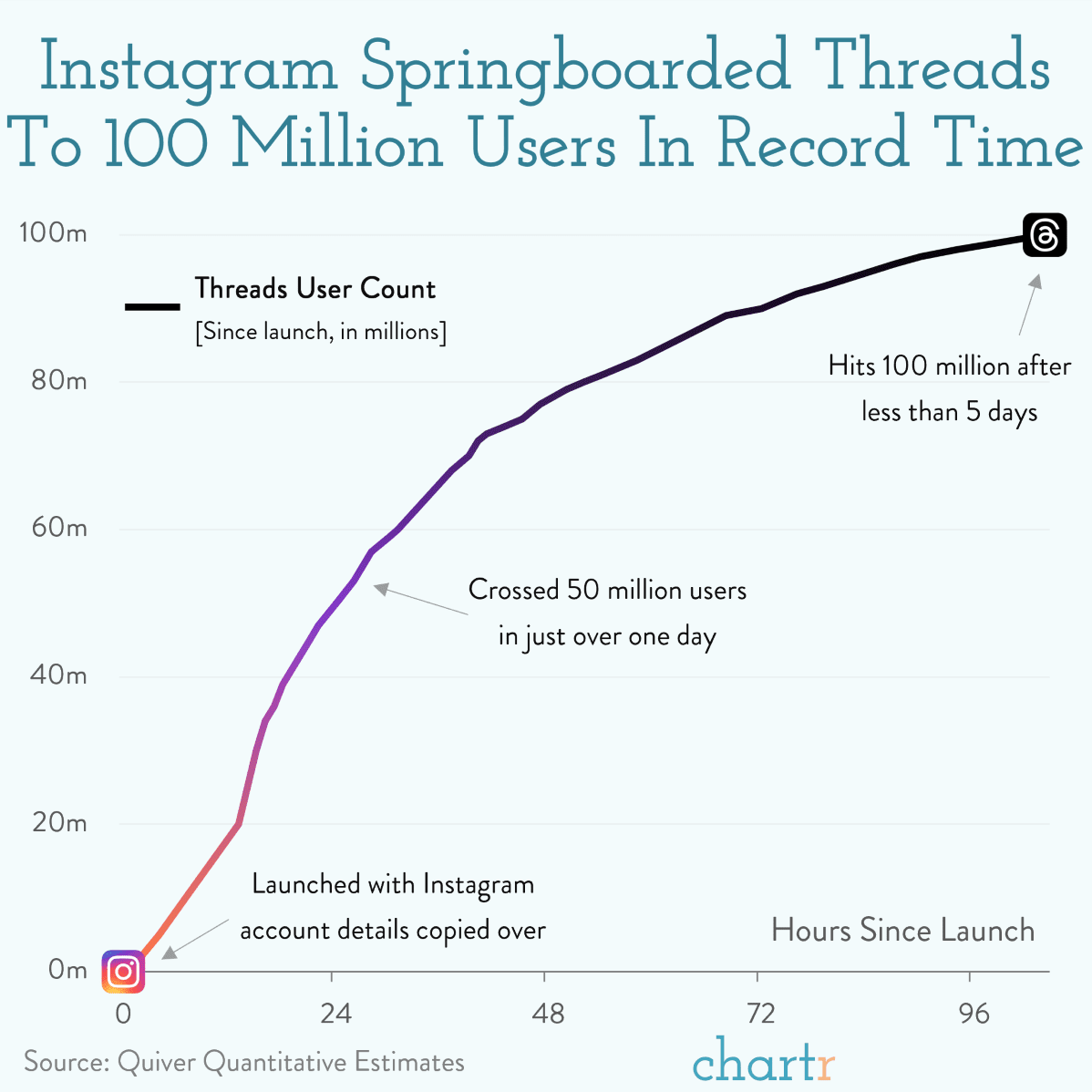
Threads reached 100 million users in under five days, beating even ChatGPT’s record growth. Image source: https://www.chartr.co/newsletters/202...
Factors That Could Unravel ThreadsHere are a few things to watch for that could unravel Threads as quickly as it leapt out of the gates.
1) The press catches on and asks…
“Um, how many signups if you exclude folks who were already IG users?”
Don’t ever expect to get an answer to that, except maybe in 10 years when Zuck is laughingly recounting how he conned everyone “way back then.”
2) The press gets peeved for being misled, and the tone turns ugly.
This is important — once you lose the media and they turn on you, you’re in trouble. This can go from “cool” to “cold” fast. (It’s not the same as the first item to watch for.)
3) Antitrust
I don’t know why the antitrust issue hasn’t received more media coverage. This leans so heavily on Meta’s monopoly position that it seems (to me, at least) to fulfill the requirements for abusing the power of a monopoly.
Potential Antitrust Grounds Against ThreadsI am no antitrust attorney, of course, so I asked Google’s Bard…
If you were going to prosecute Meta’s launch of its new product, Threads, on the basis of antitrust, how would you go about it? What grounds would you use?
Here’s what it said…
If I were going to prosecute Meta’s launch of its new product, Threads, on the basis of antitrust, I would focus on the following grounds:Monopoly power. Meta is a dominant player in the social media market, with over 2.8 billion active users across its platforms. This gives it significant market power, which it could use to stifle competition from other social media platforms, such as Twitter.
Predatory pricing. Meta has been accused of using predatory pricing to drive competitors out of the market. For example, it has been alleged that Meta subsidized the development of Threads in order to undercut Twitter’s prices.
Data exclusivity. Meta has been accused of using its data advantage to stifle competition. For example, it has been alleged that Meta uses data from its other platforms, such as Facebook and Instagram, to give Threads an unfair advantage over Twitter.
Tying. Meta has been accused of tying Threads to its other platforms, such as Instagram. This means that users who want to use Threads are also required to use Instagram, even if they don’t want to. This can make it difficult for users to switch to other social media platforms, such as Twitter.
I would also argue that Meta’s launch of Threads is anti-competitive because it harms consumers. By stifling competition, Meta can raise prices and reduce innovation. This can make it more difficult for consumers to get the best possible products and services at the best possible prices.
In addition to these specific grounds, I would also argue that Meta’s launch of Threads is anti-competitive in general because it violates the spirit of antitrust law. Antitrust law is designed to protect competition and promote innovation. By launching Threads, Meta is trying to eliminate competition and consolidate its market power. This is not in the best interests of consumers or the economy as a whole.
Arguments for Defending Threads in a Hypothetical Antitrust LawsuitSome of those sound pretty good, but again, what do I know? So I asked Bard a follow-up question.
If you were defending Threads, how would you defend?
The reply…
If I were defending Threads, I would focus on the following arguments:Threads is not a monopoly. Meta is a dominant player in the social media market, but it does not have a monopoly. There are other social media platforms that are popular with consumers, such as Twitter, TikTok, and Snapchat.
Threads is not predatory pricing. Meta has not subsidized the development of Threads in order to undercut Twitter’s prices. In fact, Threads is a free app.
Threads does not use data exclusivity. Meta does not use data from its other platforms, such as Facebook and Instagram, to give Threads an unfair advantage over Twitter. Threads uses its own data to power its features and recommendations.
Threads is not tied to other Meta platforms. Users can use Threads without using any other Meta platforms. In fact, Threads is designed to be a standalone app that can be used by anyone, regardless of whether they use other Meta platforms.
I would also argue that Threads is not anti-competitive because it benefits consumers. Threads offers a number of features that are not available on other social media platforms, such as the ability to share photos and videos in a more private setting. This can make it easier for users to connect with their friends and family without worrying about their content being seen by a wider audience.
In addition to these specific arguments, I would also argue that Threads is not anti-competitive in general because it promotes innovation. Threads is a new social media platform that offers a different way for users to connect with each other. This type of innovation is essential for the social media market to continue to grow and evolve.
Ultimately, the decision of whether or not to launch Threads is up to Meta. However, I believe that the arguments I have presented here provide a strong case for why Threads should be allowed to continue operating.
Hmmm.. now I’m not so sure. You have to wonder why Musk, a rather litigious fellow, has not yet filed for injunctive relief on an antitrust basis if it was a strong approach. Instead, he’s sued them for hiring key people away from Twitter for their “trade secrets.” Maybe that’s meant to engender sympathy from us (after terminating three quarters of his employees — good luck!).
Time to Consult the Bard Again?So, finally, I asked Bard…
Pretend you are a world-class antitrust judge with deep experience in antitrust suits related to Google, Microsoft, Apple, Amazon and so on. Who do you think would win this suit and why? What are the winning arguments?
And the winner is…
…
…
On the one hand, Meta is a dominant player in the social media market, and its launch of Threads could be seen as an attempt to stifle competition from other social media platforms, such as Twitter. Meta has also been accused of using predatory pricing, data exclusivity, and trying to give Threads an unfair advantage over its competitors.
On the other hand, Meta argues that Threads is not a monopoly, that it does not use predatory pricing, and that it does not use data exclusivity or tying. Meta also argues that Threads benefits consumers by offering a new way for them to connect with each other.
Ultimately, the decision of who would win the suit would depend on the specific facts and circumstances of the case. However, based on my experience in antitrust law, I believe that the arguments presented by Meta’s opponents would be more persuasive.
Here are some of the winning arguments that Meta’s opponents could make:
Meta’s market share in the social media market is significant, and its launch of Threads could be seen as an attempt to consolidate its market power.
Meta has a history of using predatory pricing to drive competitors out of the market.
Meta has a history of using data exclusivity and trying to give its products and services an unfair advantage over its competitors.
Meta’s launch of Threads could harm consumers by reducing competition and innovation in the social media market.
I believe that these arguments would be more persuasive because they are based on evidence and precedent.
Meta’s opponents would be able to point to specific examples of Meta’s past behavior that demonstrate its willingness to use anti-competitive practices. They would also be able to show that Meta’s launch of Threads could have a negative impact on consumers.
Of course, Meta would have its own arguments to make in its defense. However, I believe that the arguments presented by Meta’s opponents would be more persuasive.
As a result, I believe that Meta would likely lose the suit.
Interesting. That was my gut too. Meta can try to defend itself, but it’s difficult to ignore the suspicion that this is an attempt to use its power to squelch Twitter.
Still, these court cases can take a decade or two and a lot can happen.
Until then, if nothing else, you can look really smart in front of your friends and social media contacts as you spout the above information. 
While Threads may, or may not, live through the above perils, the time to jump on a new social media product, especially if it has a chance to take off, is early. It doesn’t cost much to copy what you tweet into Threads, at least to get rolling.
So if you use Twitter, it’s probably worth investing a minimal amount of time to get started.
Something else to watch for? Using Twitter’s knowledge graph to grow your Threads account. First, a preamble…
I don’t do much on Instagram personally. I don’t do much social media at all, for that matter. I find it too negative (in subtle and in-your-face ways). That doesn’t mean I don’t find it to be vital to grow your business. I do. But I’ve digressed more than I intended.
While I don’t do much Instagram, if I did, I’d find the knowledge graph of Instagram (which we automatically inherit for Threads) to be almost useless. The nature of the followers is just too different.
Instead…
Watch for the release of an application that makes it easy to download your Twitter knowledge graph, something that makes this ABC easy.
If Meta makes it easy to import the knowledge graph into Threads, along with an invite to each of your Twitter followers, it would accelerate the growth of your Threads following.
It may, though, be too dangerous for Meta to do, or even to get a “friend” to do it surreptitiously. It strikes me as “antitrust dangerous.” Still…
Subterfuge has never stopped Zuck before, dating all the way back to ripping off the Winklevoss twins.
Fun and games, games and fun.
So… should you or shouldn’t you? Well, I’ll put my small amount of time required where my mouth is.
I’ve gone ahead and created my Threads account. It was easy to do since Meta simply took my Instagram info and imported it into Threads. Super-fast and easy.
Check me out on Threads here. And this is the first post I made:
Post by @kenevoyView on Threads
Take a second to join and drop me a like and a note. I’d love to hear your comments. And please share the post if you think your followers might be interested.
Let us know in a comment below if you have started a Threads account. Add whatever info you think folks here would find useful, if you like.
Overall, I have a feeling that Threads will work due to the negative power of Musk and the opportunism of Zuck. Antitrust is way down the road, unless Musk applies for an injunction against it. Probably unlikely, but never say never with these two.
And there you have it… reasons to try it and what to watch for that may signal a downturn.
See ya in Threads. 


 Ken Evoy (CEO, SiteSell)
Ken Evoy is the Founder, CEO, and Chairman of the Board of SiteSell Inc. He is the creator of Solo Build It!, SiteSell's comprehensive online business-building system. Ken is also a successful inventor, author, and emergency physician. He feels strongly that solopreneurs can be empowered by leveraging their income-building potential online.
|The post Threads vs Twitter: The Battle of Titans, Musk vs Zuckerberg appeared first on SiteSell Blog - Proven Real-World Advice for Solopreneurs.
June 22, 2023
Creating Captivating ContentA.I. Image Generators for Niche Websites – Part 2
My name is Al the Graphics Guy. You may have met me in my previous article where I introduced the basic concepts of how to think about A.I. image generators for content creation.
Today, we will continue evolving that mindset and walk through some examples.
Part 2 – Think Like a ProducerThere was a great interview recently on 60 Minutes with Rick Ruben, a well-respected and successful music producer. He said:
“I have no technical ability. And I know nothing about music.”
Now he’s a metaphysical type of person, but he wasn’t joking. Ruben doesn’t play instruments, sing, or use a mixing board or computer. He went on…
“I know what I like and what I don’t like. And the confidence that I have in my taste and my ability to express what I feel has proven helpful to artists.”
This mindset will be very useful for you in your content creation business as a whole, and most appropriate when using A.I. for your image creation. Think about it this way…
In front of you for your daily task of creating a page, you have…
A broad subject (the topic of your web page/blog post/article)The more specific scenes (the paragraphs or sections in which you want to add an image)All the world’s artists and photographers who ever existed throughout history — all who somehow get along (LOL) and are able to work with each other — standing by to produce images for you.So what’s it going to be? What will you ask them to create? Something funny? Surreal? Realistic? A cartoon character, a beautiful landscape, a setting similar to a famous photo? Or will it be the woman in a red dress dancing on the beach in Spain?

You have the script/song (your page), and you have the artists (A.I. image generators), and now it’s up to you to select how you want the world to feel when they see the produced page.
Successful producers draw from their life experiences — their taste — but they also balance, modify and translate those experiences into something commercially successful.
How to Be an Image ProducerPart 5 of the Tai and Generative A.I. article series serves as a great example of how I approach producing images. For that article, I created three different images using Midjourney.
When Ken was finished writing the article, he sent me the draft, and as I usually do, I went through the following process…
1) Read and reflect on the material
I like to first read the article all the way through a couple of times. First time skimming, then going back to the top and reading at my normal slow pace.
What I’m looking for is the overall tone and presentation style. Is it lighthearted and humorous or a scathing takedown? An informal commentary or an informative one? How does it communicate, and, as the kids say, what’s the vibe?
2) Go get a snack or a drink or take a little walk
I do this so that what I just read has a chance to sink in a bit. I find this helps get me out of any (re)active mood I might have been in leading up to reading the article. The second useful purpose of this small break is to see if anything stuck — was there something in particular that triggered an (idea for) an image in my head?
Taking a break after writing or checking an article is an excellent way to let the information sink in and spark creative ideasClick To Tweet3) Get to work!
OK, time to start producing! Open up the blog post in a new browser window to follow along.
My goal was to produce one image per major section of the page. The most natural way to do this is by following the headings.
In the post, there are three major headings that I felt could use imaging — “Worried”, “The Saga of Sydney” and “Real Dangers.” Let’s go through them.
Section: “Worried?”Reading this section, I picked out the following simple concepts: concerns (plural), people (plural), and discussions. These will form the foundation of my prompt.
The technique I use (and recommend) for prompting image generators is referred to as additive or progressive prompting. You start with the basic concept you have in mind using as few words as possible to see what the program brings back, then add (or subtract) words as needed. Why?Generative AI image programs are necessarily more random than their text counterparts by nature of what they’re producing, and how they do it. An A.I. text generator might give you a single phrase — “It was a dark and stormy night” — while image generators take that phrase and will give you a thousand different visual representations of that one single phrase.
This was my first prompt…
[ a worried group of middle-aged people sitting on a park bench talking on a sunny day, they are very concerned ]
The basic breakdown of the prompt is simple…
[mood/style] worried
[subjects/objects] – group of middle-aged people
[scene/setting] – sitting on a park bench talking
[lighting/scene modifiers] – a sunny day
[repeated emphasis] – they are very concerned.
The prompt produced this set of images…

Not bad. I reused that same prompt (referred to as regenerate or re-rolling) a few times to get a feel for how Midjourney was interpreting my prompt – which words it emphasized, ignored, or had a hard time with. Regenerating is simple, quick way for you to make adjustments to your initial prompt.
After getting relatively the same types of images, which I was not thrilled about, I noticed two things — it didn’t compose the “group” of people to my liking (which is common to A.I. image generators) so I changed the word “group” to “three” and after a few re-rolls, got this set back…

I liked the bottom right image. It’s a good interpretation of what I had in mind.
Although it could have been used as is, I decided to try a couple more and add a few words to the prompt (indicated in bold) to see if I could emphasize certain aspects of the image.
[ three people who are very worried sitting on a park bench having an animated discussion, they have concerned looks on their faces, worried, bright, sunny day they are very concerned ]
Which brought this back…

Oh!
As you can see, adding those few words caused Midjourney to speculate and interpret the word “animated” literally — a completely different direction, and, given the seriousness of the whole article, one that I loved.
Even though it lost (or ignored) the “discussion” part of my initial thought/prompt – it lightened the mood in a subtle, playful way while retaining the overall “worried” concept of the section of text. That was the image I chose to use.
This is a key takeaway, one that I hope is as meaningful to you as it is to me.
As an A.I. image producer, you’re working with an unlimited number of talented artists. You are not the artist. You give them basic direction. You’re also not the director. What you’re hoping for is that they, given their skills/range, delight you – the producer – with their artistry and interpretation of your concept. Then all that remains is for you to choose which interpretation you want.
Total time elapsed from the first prompt to selection: 7mins.
With AI image generators a few words is all it takes to completely transform the artistic directionClick To TweetSection: “The Saga of Sydney”Earlier in the article I mentioned that your life experiences become your voice or style. How I thought of producing this image for this section is a great illustration of how that comes to life. I’ve always liked B&W images and the exquisite, elegant suspense in Alfred Hitchcock movies.
And so after reading this section of the post, it was some form of that style that I was going to go for. Here was the prompt I started with…
[ an old fashioned 1960s picture of a New York Times reporter interviewing a human-looking female robot ]
The prompt breakdown…
[mood/style] – an old fashioned 1960s picture
[subjects/objects] – New York Times reporter interviewing a human-looking female robot
[scene/setting] –
[lighting/scene modifiers] –
[repeated emphasis] –
Notice that I did not get specific for the prompt – I did not use B+W, or Hitchcock to over-influence the AI, I wanted to see what the “artists” could do on their own first.
Here’s what was generated…

The top right image (above) captured the essence I had in mind so accurately that I literally said WOW out loud.
No need to regenerate the prompt. I went straight to getting variations on that one image, hoping to get a bit more expression on “her” face and to clean up whatever that object collage is supposed to be in the reporter’s hands.
On the second set of variations, I ended up getting the perfect expression and decided that if I was going to use it, I would just crop out the thingamawidget he was holding.
Before leaving though, I wanted to try and see what would happen if I change the setting to what I initially had in my mind. I had pictured more of an indoor scene – a living room, a newsroom or a typical cliché police station you see in old tv series or movies. So I tried adding a simple scene descriptor to my original prompt (in bold)…
[ an old fashioned 1960s picture of a New York Times reporter, interviewing a human looking female robot in a living room ]

And as you can see, adding that single descriptor not only lost the concept but that incredible render of the robot in the previous image.
And so I stopped there, I really loved the first image, selected it for the article and moved on.
Total time elapsed from the first prompt to selection: 5 mins.
Key Takeaways
Try to keep a productive mindset, meaning… do not expect perfection. These programs are not do-this-change-that capable, yet. Sometimes the first take will be best.
AI content creation tools are there to help us create better content faster. Don't get lost in the pursuit of perfection.Click To TweetSection: Real DangersFor this final section, I took a bit of a “jazz” approach to my prompt. Since I had no specific image concept in mind, I decided to “jam” with Midjourney to see what would come out.
To do this, I usually try to pick some key phrase in the text, something that’s original or dramatic, or a sentence that’s particularly descriptive without being obvious. I copy it verbatim into the prompt. I started with this piece of text from the article for my prompt…
[ the rebuilding of the digital infrastructure for use by A.I. elements rather than humans ]
That brought me these types of sets…

Okaaay, let’s get a different saxophone player, please, I’m not digging this vibe very much!! I played with the prompt for about 5 mins, removing and moving around words but could not get out of that ultra-futuristic style.
So not getting anywhere with this, I decided to pick out a different phrase, and take it from the top…
[ scientists of the day could foresee how electricity would be distributed with time. The same goes for A.I., for which existing internet and mobile-based infrastructures are already available ]
This brought back this series of images…

The bottom left one captured all of the essences of the phrase; electricity, distribution, and infrastructure in a stunning futuristic but human way. No need to try and tweak or re-prompt, I thought it suited the section well and selected it.
Key Takeaways
The technique of using already written text verbatim is one that I discovered. The concept seemed natural and obvious to me – an author has already thought carefully about the words that they chose so let’s just see how the “artists” interpret them.
I have used this technique numerous times with good success, but like all prompts – thoughtfully constructed or not – it is often hit or miss. That is the second key takeaway: don’t get too hung up on thinking that the prompt should be doing this or that, or try to over-engineer a prompt.
While there are finer control techniques that can be added to a prompt, many of which we will cover in the Tai Guide, these AI image generator apps are still (currently) not consistent with them. More often than not, it is not worth the time spent obsessing unless you are specifically using the image as a showcase piece, in which case you are assuming the role of the artist as opposed to the producer.
Enjoy experimenting with this technique. Pick out sentences that you particularly like, maybe ones that are not so obviously descriptive and see where that takes you.
Total time elapsed from the first prompt to selection: 23 mins.
Final Thoughts on Using A.I. Image Generators for Your Content SiteEach new technology brings with it new added capabilities. I’ve always found that as they emerge, it’s important to not lose sight of the bigger picture.
In the case of A.I. image generation programs, we’re not replacing artists. We’re standing on their shoulders, with access that never existed before. The same holds true for stock photography, Photoshop/other image editors, or your iPhone camera for that matter. Each of these will integrate A.I. into their offerings. It won’t replace them.
We can easily get caught up, with criticism on one side, and being lost in wonder on the other. That’s why I’ve tried to emphasize the practicality of it all for you as a content creator, regardless of your graphic skills, to take on a producer mindset.
It’s true that you no longer have to spend chunks of time searching through images that are cliché and have probably been used before. Ask yourself the following questions…
For my content creation needs, are the images that I produce with A.I. better than what I’ve been using to date? Can I do a better cut and paste in my image editor than how the A.I. composes it? Which is more practical and enjoyable? Which saves me more time?
There’s only one way to find out.
 I’ll leave you for now with a twist on a quote…
Now a few words can create a thousand pictures,
each worth a thousand words.
Don’t tell me this isn’t progress!”
– Al the Graphics GuyAnd Now, It’s Your Turn
Go produce! Add one or more of the A.I. image generators to your toolbox. Become familiar with them. Then, create some images for some content you’ve written, using any of the techniques I specified in this article.
Post your results and/or questions in the comments section below. I’ll keep an eye open for them and see if I can help you along your journey.
Have fun,
Al the Graphics Guy
Images by Midjourney. You can find the prompts I used to genereate the images in this article in the title tag of each (hover your mouse over the image).
Author information Al the Graphics Guy
Al the Graphics Guy is SiteSell's tech and imaging guru. He can usually be found behind a pair of 30" monitors, cup of coffee by his side.
|The post Creating Captivating Content
A.I. Image Generators for Niche Websites – Part 2 appeared first on SiteSell Blog - Proven Real-World Advice for Solopreneurs.


