
Val Silver's Blog, page 3
November 13, 2024
Start an Online Business From Your Kitchen Table

Back in 2009, Mary and Dave Morris of FrontPorchIdeas.com launched their online business from their kitchen table. To this day, they enjoy the freedom of no commutes, no bosses, flexible hours, and unlimited vacation time.
Since then, starting an online business from home has become both easier and harder. Easier thanks to a wealth of tools for content creation, marketing, relationship-building, and sales.
Harder due to the rapid pace of change, including the rise of generative AI, which has transformed how we create and consume online content.
So, is starting an online business still worth it? Absolutely.
In this article we’ll:
explore why online businesses continue to be attractiveoutline key steps to launch your ventureaddress common challengesdiscuss tools to accelerate your successintroduce you to some successful kitchen table entrepreneursWhy Start an Online Business?We can’t know every person’s motivation for starting a business online, but here are some of the most common reasons:
Flexibility and freedom: Run your business on your own schedule, from anywhere with an internet connection.Low startup costs: Compared to traditional brick-and-mortar businesses, online ventures often require minimal initial investment.Potential for profitability: With the right strategy, online businesses can be highly profitable. Our article on whether blogs still make money delves deeper into this topic.Flexibility, freedom, and low startup costs - just a few reasons why starting an online business is more appealing than ever.Click To TweetFour Essential Steps to Launch Your Kitchen Table BusinessHere are the four key steps for launching a home-based business:
Step 1: Choose Your NicheIdentify your passions and skills: Brainstorm business ideas. Start with what you know and love.Research market demand: Simply put, you need to ensure there’s an audience for your offering. Solo Build It!’s keyword- and niche-research tool was designed with this task in mind.Understand search intent: Meet user needs by fulfilling their search intent, a crucial aspect of online success.Step 2: Set Up Your Online PresenceSelect the right tools: Choose platforms and software that align with your business needs. Our guide on essential tools for online businesses can help you make informed decisions.Create a website or blog: This is your digital storefront and primary point of contact with your customer base.Establish your brand identity: Develop a unique and memorable brand. Learn more about building your brand to stand out in the crowded online space. save pin for later
  Step 3: Develop a Content StrategyConduct keyword research: Use the best keyword research tools to identify topics your audience is searching for.Create valuable, intent-focused content: Produce content that addresses your audience’s needs and questions.Implement SEO best practices: Optimize your content to improve visibility in search engine results.Step 4: Build and Engage Your AudienceLeverage social media: Use platforms where your target audience spends time.Implement email marketing: Build a subscriber list to nurture relationships with potential customers, as well as existing customers.Encourage repeat visits: Implement strategies to keep visitors coming back to your site, fostering loyalty and increasing conversions.Building an audience is more than numbers. Engage authentically, nurture relationships, and grow a loyal following.Click To TweetSounds overwhelming? Remember that you won’t do everything at once. Take it one step at a time. Sit down at your kitchen table with a cup of your favorite beverage, and start writing down which topics could become the basis for your online business.
If you’re a person who values an all-in-one solution, with structured guidance and access to a helpful community, check out Solo Build It!. It might just be what you’re looking for!
Overcoming Common Online Business ChallengesStarting a home-based business offers many advantages, and it also comes with its own set of unique challenges. Recognizing and addressing these obstacles head-on will help you avoid burnout and stay committed long-term.
Let’s explore some common challenges and strategies to overcome them:
Time Management: When you work from home, the line between work and personal life can blur easily. To combat this:Create a structured daily schedule and stick to it religiously.Use time-blocking techniques to allocate specific hours for different tasks.Implement productivity tools like Trello or Asana to keep track of your projects and deadlines.Set clear “office hours” and communicate them to family and friends to minimize interruptions.Staying Motivated: Without the structure of a traditional workplace, self-motivation becomes crucial:Set clear, achievable short-term and long-term goals for your business.Break larger projects into smaller, manageable tasks to maintain a sense of progress.Create a rewards system for yourself when you achieve milestones.Join online entrepreneur communities or local networking groups to stay inspired and accountable.Balancing Home and Work Life: When your business is at home, it’s easy for work to spill over into personal time:Designate a specific area in your home solely for work, even if it’s just a corner of your kitchen table.Establish a routine that signals the start and end of your workday, like a short walk or changing clothes.Use separate devices or user accounts for work and personal use if possible.Practice saying “no” to non-essential tasks during your designated work hours.When working from home it's essential that you balance work and personal life by creating a dedicated workspace, setting a routine, and respecting 'off-hours'Click To TweetCombating Isolation: Working alone can sometimes lead to feelings of isolation:Schedule regular video calls with colleagues, mentors, or fellow entrepreneurs. At Solo Build It!, we offer weekly Zoom calls for our members, where you can learn new things and make new friends.Work from a local coffee shop or co-working space occasionally for a change of scenery.Attend industry events or webinars to stay connected with your professional community.Managing Distractions: Home environments often come with unique distractions:Identify your most common distractions and create strategies to minimize them.Use website blockers during work hours to avoid time-wasting sites.Communicate clear boundaries with family members or roommates about your work needs.
Also read: The Ultimate List of Work From Home Tips
Now it’s time to go from theory to practice. Let us introduce you to three members of the SBI! community who’ve created their online businesses right from their kitchen table, living room or home office.
Meet Three Successful Kitchen Table EntrepreneursMary and Dave Morris: Turning Their Passion for Front Porches Into an Income Powerhouse

Niche: porches, DIY home decoration
Website: www.frontporchideas.com
Primary monetization model: selling ad space
Secondary revenue streams: contractor referral network, affiliate programs, ebooks, calendars, t-shirts, mugs
Mary and Dave dubbed themselves “kitchen table entrepreneurs” early on because they worked from their kitchen table in the first 5-6 years of their business.
They still remember the day they made their first 77 cents: April 20, 2009.
Just a month later, their daily earnings had increased tenfold and continued to climb rapidly. After a year and a half, Mary was able to quit her regular job. Since then, she and Dave have made their living from their online business.
Their blog became so popular that it was featured on Fox News, Blog Talk Radio, and even in Google’s yearly economic report for Tennessee.
Read Mary and Dave’s full story here.
Boo and Tony Peel: From Debt to Financial Freedom

Niche: travel
Website: www.victoriafalls-guide.net
Primary monetization model: commissions from hotels, lodges and tour operators
Secondary revenue streams: vacation planning services, ebooks (travel guides), selling advertising space
Around eight months after launching their Victoria Falls Guide, Tony and Boo’s hard work creating great content paid off with their first booking and a small commission.
Soon, their business took off, and inquiries flooded in. Today, they employ three full-time consultants and book hundreds of trips to Zimbabwe each year.
Their online business has transformed their lives, enabling them to support themselves, eliminate their debt, and return to their home country Zimbabwe.
Read more about this couple’s extraordinary journey here.
Luke and Hollie Barber: Speech Therapy Business Supports a Family of Six

Niche: speech therapy
Website: www.home-speech-home.com
Primary monetization model: apps
Secondary revenue streams: ebooks, PDF downloads
Luke and Hollie initially monetized their website through standard beginner methods like Google AdSense and Amazon affiliate links. Despite increasing website traffic, these passive income streams only generated a few thousand dollars annually.
While they also sold ebooks, their income truly took off after Luke made a key discovery in their website analytics: their word lists were attracting the most views, primarily from iPads and iPhones.
This sparked the idea for their first app, which proved incredibly successful — so successful, in fact, that it allowed Luke to leave his job as a speech therapist.
Since then, he and Hollie have developed several more apps, and the income from their online business comfortably supports them and their four children.
Read Luke and Hollie’s full story here.
Discover more inspiring journeys on our blog or tune in to our YouTube channel for interviews with successful solopreneurs.
Takeaway and Next StepsStarting an online business from your kitchen table is more accessible than ever before. By following the steps outlined in this article — from choosing your niche and setting up your online presence to developing a content strategy and engaging your audience — you can turn your entrepreneurial dreams into reality.
The entrepreneurial path is all about learning and adapting as you go. Embrace the bumps in the road, use the right tools, and stay committed to providing value to your audience.
Ready to take the next step?Explore how Solo Build It! or SBI! for WordPress can provide you with the comprehensive toolkit and knowledge base you need to build a successful online business.
Your kitchen table awaits – it’s time to transform it into the headquarters of your thriving online venture!
[cta btnlink="https://www.sitesell.com/sbiforwp" buttontext="Get Started with SBI! for WP"][cta btnlink="https://www.sitesell.com" buttontext="Get Started with SBI!"]
Author information
 Margit Streifeneder
Margit Streifeneder is the Marketing Co-Director at SiteSell. She works with a small but mighty team to spread the word about Solo Build It!, via helpful content, informative emails and eye-catching ads. She's passionate about helping solopreneurs achieve success, and enjoys interviewing SBI! members about their achievements. Besides growing her own online business, she loves exploring new places, hiking, dancing and spoiling her four cats.
|The post Start an Online Business From Your Kitchen Table appeared first on SiteSell Blog - Proven Real-World Advice for Solopreneurs.


October 31, 2024
Get Repeat Traffic to Your Site: 8 Proven Strategies

Attracting visitors to your website is only half the battle when it comes to online success. The real challenge is in keeping them coming back for more.
Repeat traffic is the driving force behind any successful online business, fostering loyalty, boosting conversions and growth. But how exactly can you encourage visitors to return time and time again?
Let’s examine eight proven strategies that will help you generate a steady stream of repeat traffic to your site.
Understanding the Importance of Repeat TrafficBefore we look at the tactics, it’s important to grasp why repeat traffic is so vital for your online success. When visitors return to your site, it indicates that they find value in your content or offerings. These returning visitors are more likely to convert into customers, as they’ve already developed a level of trust with your brand.
Repeat traffic has significant other benefits as well. Search engines like Google interpret frequent return visits as a sign of quality content, which can have a positive impact on your search rankings. As your rankings improve, you’ll naturally attract even more visitors and potential customers, creating a healthy growth cycle.
How to Boost Your Website’s Repeat TrafficNow that we’ve established the importance of repeat traffic, let’s explore eight powerful strategies to keep your audience coming back for more.
1. Create High-Quality, Valuable ContentThe foundation of any successful repeat traffic strategy is consistently producing high-quality, valuable content. Your website should be a go-to resource for information, solutions and insights related to your niche.
Here are some tips to ensure your content keeps visitors coming back:
Conduct thorough research to provide in-depth, authoritative information.Use a mix of content formats, including articles, images and videos.Address your audience’s pain points and offer practical solutions.Keep your content fresh and up-to-date with the latest trends.Encourage engagement through comments and discussions.2. Optimize Your Website for User ExperienceA website that’s easy to navigate creates a great user experience, which encourages repeat visits. If visitors find your site difficult to navigate or slow to load, they’re unlikely to return.
Here are some key aspects to focus on:
Make sure your site is mobile-friendly.Optimize page load times for faster performance.Use an intuitive navigation structure.Add clear, compelling calls to action (CTAs) to guide users.Maintain a consistent, visually appealing design across all pages.

Email marketing remains one of the most effective tools for driving repeat traffic.
By building an email list and sending regular, value-packed email newsletters, you can keep your audience engaged and encourage them to revisit your site.
Consider these email marketing best practices:
Offer a compelling lead magnet to encourage sign-ups.Segment your email list for more targeted communications.Provide exclusive content or offers to subscribers.Use personalization to increase relevance and engagement.Include clear CTAs that direct readers back to your website.4. Tap Into the Potential of Social MediaSocial media platforms offer excellent opportunities to stay connected with your audience and drive repeat traffic. By maintaining an active presence on relevant social networks, you can keep your brand top-of-mind and give followers reasons to return to your site.
Here’s how to maximize your social media efforts:
Share your latest content across your social profiles.Engage with followers through comments and direct messages.Use eye-catching visuals to grab attention in fast-changing feeds.Leverage platform-specific features (i.e., Instagram reels).Remember, social media is about building relationships. Aim to focus on providing value and connecting with your followers.
5. Implement a Content Update StrategyRegularly updating and refreshing your existing content is a powerful way to generate repeat traffic. Not only does this practice keep your content relevant and accurate, it also gives you a reason to repurpose older pieces.
Here’s how to approach content updates:
Identify your most popular or evergreen content.Review and update statistics, examples, and recommendations.Add new sections to address recent developments or trends.Improve the content’s structure and readability.Republish the updated content.Also Read: Seasonal Content Writing Tips
 save pin for later 6. Create a Loyalty Program
Implementing a loyalty program is another great way to generate repeat traffic. By offering rewards or exclusive benefits to frequent visitors, you create a strong incentive for people to return to your site regularly.
Here are some ideas for structuring a loyalty program:
Offer points for various actions, such as making purchases or sharing content.Provide tiered benefits based on engagement levels.Give loyal members early access to new content or products.Host exclusive events or webinars for program members.Offer personalized discounts or special promotions.A well-designed loyalty program can transform casual visitors into devoted fans who return to your site time and time again.
7. Incorporate Interactive ElementsInteractive elements like polls, quizzes, and comments sections can be powerful tools for encouraging repeat visits to your website. These features engage your audience and invite participation, making visitors more likely to return.
Here’s how to effectively integrate interactive elements:
Create polls or quizzes that align with your content and your audience’s interests. These can provide valuable insights while making your site more engaging.Establish a space where your audience can discuss topics related to your niche. This can lead to the formation of a community that regularly returns to engage with each other and your content.8. Encourage User-Generated ContentUser-generated content (UGC) can foster community and encourage repeat visits. When users contribute content to your site, they’re more likely to return to see responses and engage further.
Here are some ways to incorporate UGC:
Enable comments on your blog posts and respond actively.Create a forum or discussion board for your community.Encourage users to submit reviews or testimonials.Run contests that involve user submissions.Feature user-generated content prominently on your site.By giving your audience a voice, you’re creating a sense of ownership and belonging that can significantly boost repeat traffic.
Measuring and Analyzing Your Repeat TrafficTo truly optimize your repeat traffic strategy, it’s essential to measure and analyze your results. Tools like Google Analytics 4 can provide valuable insights into your visitor behavior, including:
Returning visitor rateFrequency of visitsTime between visitsPages per session for returning visitorsConversion rates for returning visitorsBy regularly reviewing these metrics, you can identify what’s working well and where there’s room for improvement in your repeat traffic strategy.
Building Long-Term Success With Repeat TrafficGenerating repeat traffic is not a one-time effort but an ongoing process that requires dedication, creativity and a deep understanding of your audience’s needs. By implementing the strategies outlined in this article, you’ll be well on your way to building a loyal community of returning visitors who value your content and offerings.
Managing all these aspects of your online presence can be challenging, especially if you’re just starting out or trying to grow your business. This is where comprehensive solutions like Solo Build It! (SBI!) and SBI! for WordPress can make a significant difference.
Each of these platforms provides the tools, training, and support you need to build not just a website or blog, but a thriving online business. From keyword research and content creation to traffic analysis and email marketing, SBI! and its sister product, SBI! for WP (WordPress), offer everything you need to attract, engage and retain visitors.
Ready to take your online presence to the next level and start building a steady stream of repeat traffic?
Explore Solo Build It! or SBI! for WP today and discover how these powerful platforms can help you achieve your online business goals.
[cta btnlink="https://www.sitesell.com/sbiforwp" buttontext="Get Started with SBI! for WP"][cta btnlink="https://www.sitesell.com" buttontext="Get Started with SBI!"]
Also Read: How to Promote Your Website: 23 Ways to Earn Free Traffic
Author information Solo Build It! Team
The Solo Build It! Team creates high-value content to help solopreneurs build successful online businesses. With their trusty tortoise mascot Shelly by their side, they believe in the power of "slow and steady wins the race." Whether you're a digital nomad, retiree, or freedom-seeker, they're here to guide you towards your lifestyle goals, one website at a time.
|The post Get Repeat Traffic to Your Site: 8 Proven Strategies appeared first on SiteSell Blog - Proven Real-World Advice for Solopreneurs.
October 17, 2024
Best Keyword Research Tool: Your Ticket to Search Visibility

Whether you’re an experienced blogger or an aspiring entrepreneur taking your first steps online, having the right keyword research tool can be a tremendous help for getting your content found at the search engines.
But with so many options available, how do you choose the best keyword research tool for your needs? We’ve done the heavy lifting for you, analyzing and comparing countless tools to bring you the 7 top keyword research tools currently.
1. Brainstorm It! (Included in Solo Build It!)PlanPriceMonthly SBI! Subscription$39.99 per monthAnnual SBI! Subscription$365 per yearWhen it comes to comprehensive keyword research that goes beyond mere suggestions, Brainstorm It! stands head and shoulders above the competition.
As an integral component of the Solo Build It! (SBI!) and SBI! for WP platforms, this powerhouse tool offers a holistic approach to keyword research that’s tailored for serious online business owners.
Key FeaturesVersatile Brainstorming Options: Offers various types of brainstorms, including vertical and horizontal, so you can capture a wide array of related terms and uncover hidden gems in your niche.Refinement Capabilities: Helps you identify and eliminate overly general keywords, focusing on niche-relevant terms that can drive targeted traffic.Niche Exploration: Allows deep dives into specific aspects of your chosen niche, uncovering less competitive keywords with high potential.Integration With Business-Building Tools: As part of the SBI! ecosystem, Brainstorm It! seamlessly integrates with other tools for site-building, content creation, and traffic analysis.How It WorksLet’s illustrate the power of Brainstorm It! with a real-world example. Imagine you’re passionate about archery and want to build a site about your journey to the Olympics while educating beginners. Here’s how you’d leverage Brainstorm It!.
Start Broad: Begin with a seed keyword like “archery.” This casts a wide net, capturing a diverse range of related terms and topics.Refine Your Keyword List: As you sift through the results, you’ll identify and eliminate overly general terms. For instance, while “target” might appear in your results, you’ll focus on more specific, niche-relevant terms like “archery target” or “Olympic archery target.”Explore Specific Aspects: Dive deeper into particular areas of your niche. You might explore terms like “recurve bow archery” or “archery form techniques” to uncover more specialized, less popular keywords.Analyze Demand and Supply: Brainstorm It! provides valuable data on search demand and competition for each keyword, helping you identify opportunities where high demand meets low competition.Plan Your Content Strategy: Use the insights gained to map out a content strategy that addresses various aspects of archery, from beginner tips to advanced techniques, equipment reviews, and Olympic training insights.Best ForSolo entrepreneurs, website owners, small businesses and bloggers who are using the Solo Build It! or SBI! for WP platforms.
2. Ahrefs Keywords ExplorerPlanPrice per monthStarter$29Lite$129Standard$249Advanced$449Ahrefs has long been a favorite among SEO professionals for its robust backlink analysis capabilities. However, in recent years, its Keywords Explorer tool has evolved into a strong contender in the keyword research arena.
Key FeaturesIn-depth Keyword Information: Provides comprehensive data on monthly searches, keyword difficulty, and click-through rates, giving you a 360-degree view of each keyword’s potential.Precise Keyword Difficulty Metric: Offers exact estimates on the number of backlinks needed to rank on the first page of Google, taking the guesswork out of your SEO strategy.First Page Competition Analysis: Breaks down the competition for each keyword, allowing you to gauge the effort required to outrank existing content.Content Gap Analysis: Identifies keywords that your competitors are ranking for but you’re not, revealing untapped opportunities in your niche.Ahrefs’ strength lies in its data-driven approach, providing SEO professionals and content creators with the insights needed to make informed decisions about their keyword targeting strategies.
Best ForSeasoned digital marketers, SEO professionals, and medium to large businesses.
3. SemrushPlanPrice per monthPro$139.95Guru$249.95Business$499.95Semrush takes a unique approach to keyword research by focusing heavily on competitor analysis, making it a favorite among digital marketers looking to gain an edge over their competition.
Key FeaturesCompetitor Keyword Analysis: Uncovers keywords your competitors are ranking for, revealing untapped opportunities and gaps in your own strategy.Keyword Magic Tool: Accesses a massive database of over 25 billion terms for comprehensive keyword ideas, ensuring you never run out of content inspiration.Historical Data: Provides insights into how keyword trends have evolved over time, helping you predict future opportunities.Semrush’s strength lies in its ability to reveal “outside-the-box” keywords that would be difficult to discover through traditional methods.
By analyzing competitor strategies, you can uncover valuable keywords that your audience is already searching for but you might have overlooked.
Best ForExperienced digital marketers, full-service marketing agencies, large businesses, and enterprises.
4. Google Search ConsolePlanPrice per month–FreeWhile not traditionally thought of as a keyword research tool, Google Search Console offers unique insights that can supercharge your ranking efforts, especially for optimizing existing content.
Key FeaturesPerformance Report: Shows which pages get the most clicks from Google and the keywords driving that traffic, providing direct insights from Google itself.Opportunity Keywords: Helps identify keywords where you rank from #8-#20, presenting opportunities for quick wins with targeted on-page optimization.Integration With Google Analytics: Combines data for more in-depth keyword insights, allowing you to correlate keyword performance with user behavior on your site.Search Appearance Analysis: Provides information on how your site appears in search results, including rich results and featured snippets.Best ForWebsite owners, small to medium businesses, and anyone focused on improving organic search performance.
5. Backlinko Keyword ToolPlanPrice per month–FreeFor those just starting out or working with a limited budget, Backlinko’s Keyword Tool offers a solid entry point into the world of keyword research.
Key FeaturesAccess to Semrush’s Database: Leverages Semrush’s extensive keyword collection without the premium price tag, giving users access to high-quality data.Low-Competition Keyword Identification: Helps users find keywords that are easier to rank for, perfect for new websites or those in competitive niches.Blog Content Inspiration: Provides ideas for creating engaging, search engine-friendly content, helping you plan your content calendar effectively.User-Friendly Interface: Designed with beginners in mind, making it easy to get started with keyword research without a steep learning curve.This tool provides a solid foundation for understanding keyword metrics, and can help guide initial content strategies.
Best ForBeginners, bloggers, and small businesses on a tight budget.
6. SoovlePlanPrice per month–FreeSoovle stands out in the crowded keyword research space by aggregating suggested keywords from multiple sources, including Google, YouTube, Bing, Yahoo, and Amazon.
Key FeaturesMulti-Platform Suggestions: Gathers keyword ideas from various search engines and e-commerce platforms, providing a diverse range of suggestions.Saved Suggestions Feature: Allows users to easily save and download favorite keyword ideas, streamlining the research process.Untapped Keyword Discovery: Helps find unique keywords that competitors might overlook, particularly useful for identifying cross-platform opportunities.Visual Keyword Cloud: Presents popular related terms in a visually appealing format, making it easy to spot trends at a glance.Soovle’s ability to pull suggestions from multiple sources makes it a strong tool for discovering diverse keyword opportunities across different platforms. This can be particularly useful for businesses looking to expand their reach across various online channels.
Best ForContent creators, bloggers, and small businesses looking for diverse keyword ideas.
7. JaaxyPlanPrice per monthStarterFree trialPro$49Enterprise$99Jaaxy offers a straightforward yet powerful approach to keyword research, making it accessible to users of all skill levels while still providing valuable insights.
Key FeaturesExtensive Keyword Ideas: Generates a wide variety of keyword suggestions quickly, helping you brainstorm content ideas efficiently.Traffic Potential Estimates: Provides insights into potential traffic for each keyword, helping you prioritize your efforts.Alphabet Soup Technique: Uses a unique method to generate keyword ideas based on common organic search patterns.Best ForAffiliate marketers, niche website owners, and small businesses.
Choosing the Right Tool for Your NeedsAs we’ve explored the current top 7 keyword research tools, it’s clear that each offers unique features and benefits tailored to different needs and skill levels. However, Brainstorm It! stands out as the top choice, especially for those looking to build a comprehensive, sustainable online business.
What sets Brainstorm It! apart is not just its powerful keyword research capabilities, but its integration with the Solo Build It! ecosystem. This means you’re getting more than just a research tool; you’re gaining access to a complete suite of business-building resources, extensive training, and a supportive community of like-minded solopreneurs.
For those serious about their online success, we recommend exploring Solo Build It! (SBI!) or SBI! for WordPress. These all-inclusive solutions offer:
Powerful keyword research through Brainstorm It!Website building tools that make creating a professional site easy, even for beginnersComprehensive training that guides you through every step of building your online businessA supportive community of fellow entrepreneurs to share insights and overcome challengesOngoing updates and support to keep you at the forefront of digital marketing trendsWhether you’re just starting out on your online journey or looking to take your existing business to new heights, SBI! and SBI! for WP provide the tools, knowledge, and support you need to succeed online.
Discover Solo Build It!’s complete system for building a profitable online business.
[cta btnlink="https://www.sitesell.com/sbiforwp" buttontext="Get Started with SBI! for WP"][cta btnlink="https://www.sitesell.com" buttontext="Get Started with SBI!"]
Also Read: Keyword Research Tutorial With SBI!’s Tools
#dtables {border:3px solid orange;width:60%;margin:auto;box-shadow:8px 8px 8px #ddd;} #dtables {@media only screen and (max-width: 600px) {width:100% !important;}Author informationSolo Build It! TeamThe Solo Build It! Team creates high-value content to help solopreneurs build successful online businesses. With their trusty tortoise mascot Shelly by their side, they believe in the power of "slow and steady wins the race." Whether you're a digital nomad, retiree, or freedom-seeker, they're here to guide you towards your lifestyle goals, one website at a time.
|The post Best Keyword Research Tool: Your Ticket to Search Visibility appeared first on SiteSell Blog - Proven Real-World Advice for Solopreneurs.
October 3, 2024
How to Build Your Brand: 10 Practical Steps

Whether you’re a solopreneur or a small business owner, establishing a strong brand identity sets you apart from your competitors and helps create lasting connections with your target audience.
This comprehensive guide will walk you through the process of building your brand to completion, from defining your core business values to maintaining your brand reputation.
Understanding the Importance of Brand-BuildingBefore we dive into the specifics, let’s consider why brand-building is crucial for your business:
Clear Direction: A well-defined brand provides a roadmap for your business, guiding your decisions and actions.Increased Credibility: Established brands are often perceived as more trustworthy and reliable.Better Recognition: A strong brand identity makes your business more memorable and shareable.Targeted Appeal: A clear brand message helps attract your ideal customers.Customer Loyalty: A compelling brand story can foster deep connections with your audience, leading to repeat sales and loyal customers.Revenue Growth: Effective branding can ultimately lead to increased sales and revenue.Now, let’s explore the step-by-step process of building your brand.
1. Define Your Business Goals and ValuesThe foundation of any strong brand is a clear understanding of your business’s purpose and values. Start by creating the following statements:
Vision Statement: Briefly describe your company’s long-term goals and purpose in two to three sentences.Mission Statement: Explain the impact your products or services will have on your customers, and outline the steps needed to achieve your vision.Values Statement: Define the principles and code of ethics that guide your daily operations and company culture.These statements will serve as the north star for your brand, guiding your decisions and helping you stay true to your core purpose.
Here’s an example:
Vision Statement: “To become the leading provider of eco-friendly home solutions, inspiring a global shift towards sustainable living.”Mission Statement: “We create innovative, affordable, and environmentally friendly home products that help our customers reduce their carbon footprint while saving money. Through education and community engagement, we empower individuals to make sustainable choices in their daily lives.”Values Statement: “Sustainability, innovation, integrity, and customer empowerment are at the heart of everything we do.”2. Research Your Target Audience

Understanding your target market is crucial for creating a brand that resonates with potential customers. Here’s how to conduct effective market research:
Analyze existing customer demographics (if applicable).Study similar brands and their customers.Conduct user studies, interviews, and surveys to understand customer needs, interests, and pain points.Create buyer personas based on common characteristics found during your research.Remember, the more specific you can be about your target audience, the more effectively you can tailor your brand and marketing strategy to appeal to them.
When creating buyer personas, consider the following factors:
Demographics: Age, gender, location, income level, educationPsychographics: Values, interests, lifestyle, personality traitsBehavior patterns: Shopping habits, brand preferences, social media usagePain Points: Challenges they face that your product or service can solveGoals and Aspirations: What they hope to achieve by using your product or serviceHere’s an example:“Eco-conscious Emma is a 28-year-old urban professional living in a small apartment. She’s passionate about sustainability but struggles to find affordable, stylish eco-friendly home products. Emma is active on Instagram and Pinterest, often seeking inspiration for green living. She values brands that are transparent about their environmental impact and appreciates companies that educate consumers about sustainability.”
Want to stand out? Research your target audience, tailor your message, and build loyalty through meaningful connections.Click To Tweet3. Analyze the CompetitionKeeping track of your competitors helps you identify market gaps and opportunities. Follow these steps:
Search for businesses in your niche and list them.Analyze their products, services, pricing, and promotion strategies.Conduct a SWOT analysis (Strengths, Weaknesses, Opportunities, Threats) for each competitor.Explore review sites and forums to identify common issues customers face with competitors.Use these insights to develop better products or services and solve existing market problems.When conducting your competitive analysis, pay attention to:
Brand Messaging: How do competitors communicate their value proposition?Visual Identity: What design elements do they use, and how does it reflect their brand?Content Strategy: What type of content do they produce, and how do they engage with their audience?Customer Experience: How do they handle customer service and support?Innovation: Are they introducing new products or features regularly? How can you do so differently?4. Determine Your Brand PositioningBrand positioning helps differentiate your business from competitors by establishing a unique value proposition. Consider the following factors:
Affordable pricesInnovative productsExcellent serviceEnjoyable user experiencePremium qualityOnce you’ve identified your key differentiators, create a brand positioning statement that outlines your target market and how your products or services fulfill their needs.
Use this as a template to create your brand positioning statement:“For [target market] who [their needs], [your company name] provides [solutions to their problems] because [unique selling points].”
Here is an example of how that would look:
“For environmentally conscious homeowners who want to reduce their carbon footprint without sacrificing style or breaking the bank, EcoHome provides affordable, stylish, and sustainable home products because we believe that eco-friendly living should be accessible to everyone.“
To further refine your brand positioning, consider:
Price-to-Quality Ratio: Where does your brand sit on the spectrum of budget-friendly to luxury?Emotional vs. Functional Benefits: Do you appeal more to your customers’ emotions or practical needs?Niche Focus: Are you targeting a specific subset of the market with specialized products or services?Innovation Level: Are you a disruptor in your industry or a reliable, traditional option?5. Build Effective Brand CommunicationClear and effective communication is essential for conveying your brand message to your target audience. Focus on these key elements:
Business NameChoose a memorable name that’s relevant to your business, easy to pronounce, and available as a domain name. Consider blending words, using acronyms, or drawing inspiration from others in your niche before .
Tips for choosing a great business name:
Keep it short and simpleEnsure it’s easy to spell and pronounceMake it unique and distinctiveConsider its potential for trademark protectionTest it with your target audienceCatchy SloganCreate a concise, memorable slogan that communicates your brand’s purpose. Follow these steps:
Brainstorm phrases related to your industry and niche.Keep it short and straightforward.Use A/B testing to determine which slogan resonates best with your audience.Examples of well-known and effective slogans:
Nike: “Just Do It”Apple: “Think Different”L’Oréal: “Because You’re Worth It” Compelling Brand Story
Develop narratives that spark emotional connections with your target audience:
Share your background story or the company’s humble beginnings.Highlight challenges you’ve overcome.Focus on how your brand aims to make a positive impact.Prioritize honesty and transparency in your storytelling.Elements of a powerful brand story:
Authenticity: Be genuine and true to your brand’s valuesEmotion: Evoke feelings that resonate with your audience.Relevance: Connect your story to your customers’ lives and experiences.Consistency: Ensure your story aligns with all aspects of your brand.Simplicity: Keep it clear and easy to understand.6. Design Your Brand’s Visual IdentityVisual elements play a crucial role in defining your brand identity. Consider the following:
Create a memorable logo that captures your brand essence.Choose a suitable color scheme that reflects your brand personality.Select typography that complements your overall design.Ensure all visual elements match your brand’s personal voice and values.Create brand guidelines to maintain consistency across all marketing materials.When designing your visual identity:
Logo: Aim for simplicity, scalability, and versatility. Your logo should work well in various sizes and formats.Color Palette: Choose 2-4 primary colors and 2-3 secondary colors. Consider color psychology and industry norms when making your selection.Typography: Select 1-2 primary fonts for headings and body text. Ensure they’re legible across different media and sizes.Imagery Style: Define guidelines for photos, illustrations, and icons used in your marketing materials.Layout and Composition: Establish rules for how visual elements should be arranged in various marketing materials.Create a brand style guide that outlines all these elements, ensuring consistency across all touchpoints.
7. Build Your Brand Website save pin for later
 A well-designed website is essential for establishing your online presence and credibility. Include the following key pages:
Home Page: Make a strong first impression by clearly communicating your brand and offerings.About Page: Share your expertise, brand story, mission, goals.Landing Pages: Create targeted landing pages for specific marketing campaigns or offers.Testimonials: Display positive reviews to build trust with potential customers.Product or Service Pages: Highlight your offerings, pricing, and unique selling points.When designing your website, keep these tips in mind:
Maintain consistency in branding elements throughout the site.Use a clean, clutter-free layout for better user experience.Optimize for search engines to improve visibility and drive organic traffic.Ensure mobile responsiveness for seamless viewing on all devices.Implement clear call-to-action (CTA) buttons to guide users through the sales funnel.Use high-quality images and videos to showcase your products or services.Include social proof elements like customer reviews, case studies, testimonials or client logos.Optimize page load speed for better user experience and ranking performance.Solo Build It! helps you create a professional-looking site quickly with customizable templates and user-friendly interfaces, making it easier for non-technical users to build and maintain their websites.
If you’re a WordPress user, take a look at SBI! for WP.
Your website is your brand's first impression online. Make it count with clear messaging and a user-friendly experience.Click To Tweet8. Implement Content Marketing to Build AuthorityCreating valuable content helps showcase your expertise and build relationships with your target audience. Follow these steps:
Conduct keyword research to identify topics your audience cares about.Develop a unique brand voice that resonates with your target market.Consistently publish high-quality content to establish your authority in the industry.Create comprehensive guides, reports, and case studies.Content marketing strategies to consider:
Web Pages: Evergreen (or frequently updated) content that provides information and solutions your target market searches forBlog Posts: Regular articles addressing your audience’s pain points and interestsInfographics: Visual representations of data or concepts related to your industryVideos: Tutorials, product demonstrations, or behind-the-scenes contentPodcasts: Audio content discussing industry trends or interviewing expertsWebinars: Live or recorded educational sessions on relevant topicseBooks: In-depth resources that provide value to your readersWhen developing your content strategy:
Create a content calendar to plan and organize your publishing schedule.Repurpose content across different formats to maximize its reach and impact.Encourage user-generated content through contests or hashtag campaigns.Collaborate with industry influencers or thought leaders to expand your reach.Use email marketing to distribute your content and nurture leads.Remember to optimize your content for search engines by incorporating relevant keywords, meta descriptions, and internal links.
9. Integrate Your Brand Across Marketing Channels

Expand your brand presence beyond your website by leveraging various marketing channels:
Social Media MarketingUse platforms like X (Twitter), Facebook, and Instagram to build brand awareness and engage with your audience. Create entertaining and relatable social media posts, respond to followers’ comments, and consider partnering with influencers to expand your reach.
Tips for effective social media marketing:
Choose platforms that align with your target audience’s preferences.Maintain a consistent posting schedule.Use a mix of content types (text, images, videos, reels, shorts, stories).Engage with your followers through comments, direct messages, and polls.Use hashtags strategically to increase visibility.Monitor social media analytics to refine your strategy.Email MarketingBuild an email list by offering sign-up incentives like free resources or discounts. Use email campaigns to nurture relationships with potential customers, share company updates, and promote your products or services.
Best practices for email marketing:
Segment your email list based on subscriber preferences or behavior.Personalize email content to increase engagement.Create compelling subject lines to improve open rates.Use a clear and prominent call-to-action (CTA) in each email.Test different email designs and content to optimize performance.Ensure your emails are mobile-friendly.Search Engine Marketing (SEM)Complement your organic search efforts with paid advertising to increase visibility quickly. Consider advertising through platforms like Google Ads to attract more visitors to your website.
SEM strategies to consider:
Keyword Targeting: Bid on relevant keywords related to your products or servicesAd Extensions: Use additional information like site links or call buttons to enhance your adsRetargeting: Show ads to users who have previously visited your websiteLocal Advertising: Target users in specific geographic locationsA/B Testing: Experiment with different ad copy and landing pages to improve performance10. Maintain Brand ReputationOnce you’ve established your brand, work on maintaining its reputation:
Deliver excellent customer service consistently.Monitor brand mentions across various platforms.Address negative feedback promptly and professionally.Gather and showcase positive testimonials to build social proof.Additional tips for maintaining brand reputation:
Set up Google Alerts for your brand name and related keywords to stay informed about online mentions.Use social listening tools to monitor conversations about your brand on social media platforms.Encourage and incentivize customers to leave reviews on relevant platforms.Regularly update your products or services based on customer feedback and market trends.Maintain transparency in your business practices and communication.Building your brand takes time, but the payoff is a loyal customer base that keeps coming back.Click To TweetThe Power of a Strong BrandBuilding a strong brand is an ongoing process that requires dedication, consistency, and a deep understanding of your target audience. By following the steps outlined in this guide, you’ll be well on your way to creating a memorable brand that resonates with your potential customers and sets you apart from the competition.
As you build your brand, keep these five key takeaways in mind:
Stay true to your business’s core values and mission.Consistently deliver on your brand promise.Adapt to changing market conditions while maintaining your brand essence.Regularly evaluate and refine your brand strategy based on performance metrics and customer feedback.Invest in ongoing employee training to ensure everyone in your organization understands and embodies your brand values.Build a brand that truly stands out.
Sign up for our newsletter to receive more tips and resources for building a successful online business and brand.
[cta btnlink="https://www.sitesell.com/marketing/op..." buttontext="Subscribe to the Solo Build It! newsletter"]
Also Read: Starting an Online Business Frequently Asked Questions
Author informationSolo Build It! TeamThe Solo Build It! Team creates high-value content to help solopreneurs build successful online businesses. With their trusty tortoise mascot Shelly by their side, they believe in the power of "slow and steady wins the race." Whether you're a digital nomad, retiree, or freedom-seeker, they're here to guide you towards your lifestyle goals, one website at a time.
|The post How to Build Your Brand: 10 Practical Steps appeared first on SiteSell Blog - Proven Real-World Advice for Solopreneurs.
September 20, 2024
What Search Intent Is And Why It’s Important for Ranking

Understanding your target audience is key to your success in the online business world and one important aspect of this understanding is search intent.
Whether you’re a seasoned marketer or just starting your online business journey, grasping the concept of what search intent is can significantly impact your writing and marketing strategies and overall online presence.
So, what is search intent, exactly? Read on to find out!
Defining What Search Intent IsSearch intent, also referred to as user intent, is essentially the underlying reason behind someone typing a given query into Google or any other search engine. It represents the user’s goal or objective when performing a search. Are they looking for information? Trying to make a purchase? Or perhaps wanting to navigate to a specific website?
Understanding these motivations is crucial for creating content that meets users’ needs and ranks well in search engine results pages (SERPs).
Let’s consider an example to illustrate this concept. Imagine someone searches for “best dog food” on a search platform. At first glance, you might think they’re ready to buy dog food. However, a closer look reveals that they’re likely in the research phase, comparing different options before making a decision.
This important piece of insight can guide your content strategy and help you create more relevant, valuable information for your audience.
The Four Types of Search Intent
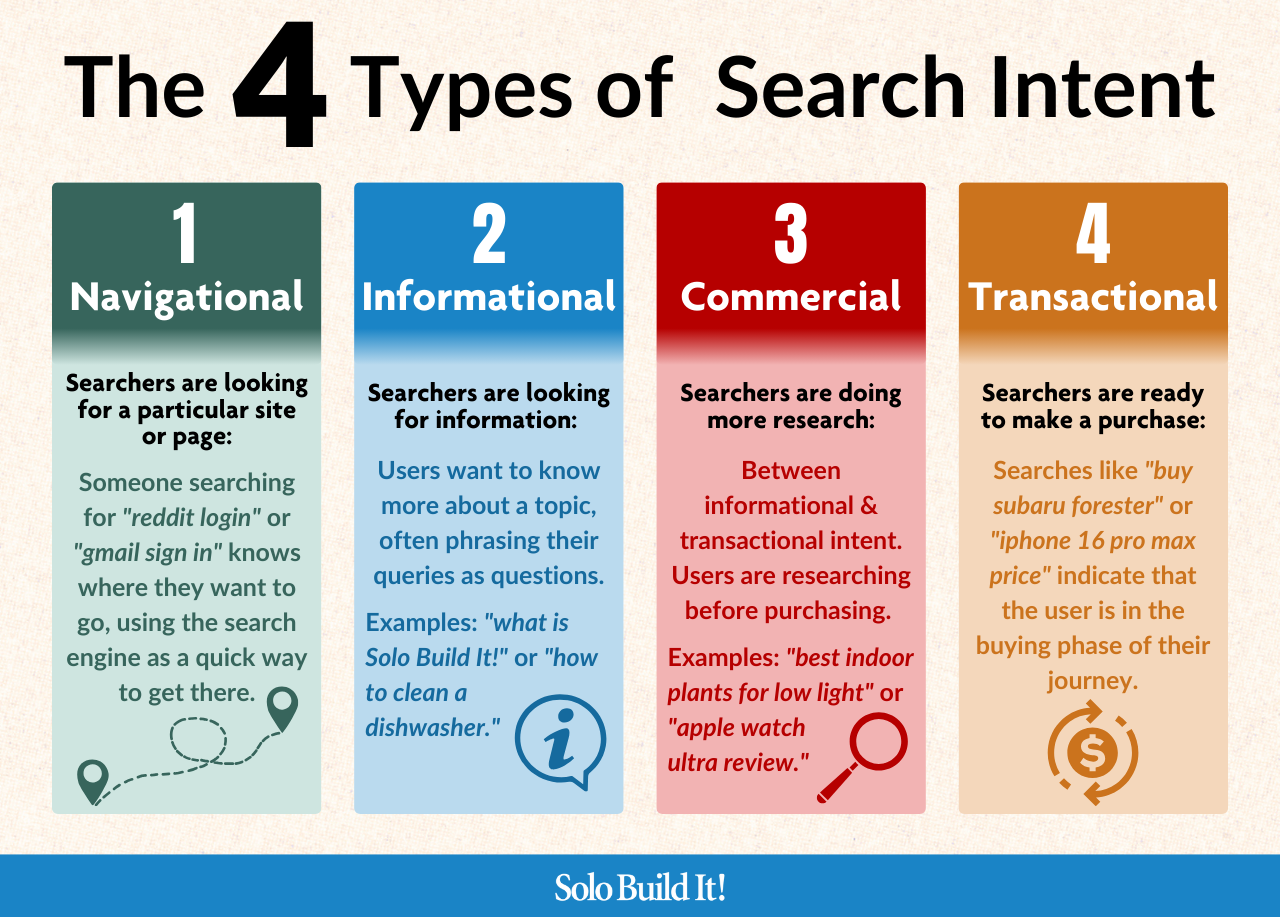
To better understand and categorize search intent, we typically divide it into four main types:
Navigational Intent: Searchers with navigational intent are looking for a particular site or page. For example, someone searching for “reddit login” or “gmail sign in” knows exactly where they want to go and is using the search engine as a quick way to get there.Informational Intent: This type of intent is all about learning. Users with informational search intent want to know more about a topic, often phrasing their queries as questions using words like who, what, where, why, and how. Examples include “what is Solo Build It!” or “how to clean a dishwasher.”Commercial Intent: Commercial intent sits between informational and transactional intent. Users with this intent are researching before making a purchase decision. They might search for “best indoor plants for low light” or “apple watch ultra review.”Transactional Intent: Users with transactional intent are ready to take action, often making a purchase. Searches like “buy subaru forester” or “iphone 16 pro max price” indicate that the user is in the buying phase of their journey.Understanding these different types of intent is crucial for creating content that aligns with your audience’s needs at various stages of their journey.
Why Is Search Intent Important for Ranking?Now that we’ve defined search intent and its types, let’s explore why it’s so critical for your ranking efforts.
Improved Search Engine RankingsSearch engines, particularly Google, have invested heavily in understanding and interpreting user intent. Their primary goal is to provide the most relevant results for users’ queries. By aligning your content with the appropriate search intent, you increase your chances of ranking higher in search results.
For example, if you’re targeting the keyword “best dog food,” creating a product page for your top-selling dog food brand might seem logical.
However, a quick look at the search results shows that Google considers this a commercial intent keyword, favoring review articles that compare multiple brands.
 save pin for later
 Understanding what search intent is allows you to create content that better matches what Google (and users) expect to see for this query.
Better User ExperienceWhen your content aligns with user intent, visitors are more likely to find what they’re looking for on your site. This improved user experience can lead to longer time on page, lower bounce rates, and higher engagement metrics – all factors that can positively influence your rankings.
Increased Conversion RatesBy targeting the right intent at each stage of the customer journey, you can guide users through your marketing funnel more effectively.
For example, informational content can attract and educate potential customers, while transactional content can help convert those ready to make a purchase.
More Effective Content StrategyUnderstanding what search intent is also allows you to create a more targeted and effective content strategy. You can focus on producing content that meets specific user needs at different stages of their journey, rather than creating content that may not resonate with your audience.
How to Determine Search IntentWhile sometimes the intent behind a search query is obvious, other times it may require a bit more investigation. Here are some methods to help you determine search intent:
Analyze the Keyword: Often, the search term itself can give clues about intent. Question words like “what” or “how” usually indicate informational intent, while words like “buy” or “price” suggest transactional intent.Check SERP Features: The types of results Google displays can provide insight into the perceived intent. For example, shopping ads might indicate transactional intent, while featured snippets often appear for informational queries.Study Top-Ranking Content: Examine the content currently ranking for your target keywords. What content type is it? How is it structured? This can give you valuable insights into what Google considers relevant for that query.Use Keyword Research Tools: Many keyword research tools include intent analysis as part of their keyword research features. These can be invaluable for quickly assessing intent across a large number of keywords.Implementing Search Intent in Your StrategyNow that you understand the importance of search intent, how can you apply this knowledge to your marketing strategy? Here are some key steps:
Conduct Thorough Keyword Research: Tools such as Brainstorm It! and Tai (both are part of Solo Build It!’s integrated suite of tools) can help you identify keywords relevant to your business, and pay attention to the intent behind each keyword.Create Intent-Aligned Content: Develop content that matches the intent behind your target keywords. This might mean creating in-depth guides for informational queries, comparison articles for commercial intent, or optimized product pages for transactional keywords.Optimize Existing Content: Review your current content and ensure it aligns with the intent of the keywords it’s targeting. You may need to make adjustments or create new content to better match user intent.Monitor and Adapt: Keep an eye on your rankings and user engagement metrics. If a page isn’t performing as expected, reassess the intent behind the target keyword and adjust your content accordingly.Search Intent Is Critical For Ranking High In Search Engines

Understanding and optimizing for search intent is no longer optional; it’s essential. By aligning your content with user intent, you not only improve your chances of ranking well in search results but also provide more value to your audience.
Whether you’re just starting your online journey or looking to improve your existing website’s performance, focusing on what search intent is can make a significant difference. It’s about creating the right content for the right audience at the right time in their journey.
Ready to take your marketing strategy to the next level?
Sign up for our newsletter to receive regular updates, tips, and insights on search intent and online business success.
Don’t miss out on the latest strategies to help your website thrive in the digital landscape. Subscribe now and start optimizing your content for better search performance.
[cta btnlink="https://www.sitesell.com/marketing/op..." buttontext="Subscribe to the Solo Build It! newsletter"]
Also Read: The Importance of Website Content (Create a High-Quality Website)
Author informationMargit StreifenederMargit Streifeneder is the Marketing Co-Director at SiteSell. She works with a small but mighty team to spread the word about Solo Build It!, via helpful content, informative emails and eye-catching ads. She's passionate about helping solopreneurs achieve success, and enjoys interviewing SBI! members about their achievements. Besides growing her own online business, she loves exploring new places, hiking, dancing and spoiling her three cats.
|The post What Search Intent Is And Why It’s Important for Ranking appeared first on SiteSell Blog - Proven Real-World Advice for Solopreneurs.
September 12, 2024
Game-Changing Tools for Online Business Growth
If you’re researching the best tools for online business, particularly in the age of artificial intelligence, this article will shorten your learning curve. Running an online business has become more achievable than ever, but to make it in today’s hyper-competitive landscape, having the right process and tools is key.
The following are essential for anyone starting an online business, regardless of its niche or target audience.
1. A Reliable Desktop or Laptop ComputerAt the foundation of any online business is a dependable computer. It serves as your primary workstation, allowing you to access the internet, manage your business files, and run essential software for various tasks.
A laptop offers the added benefit of portability, enabling you to work from anywhere. This flexibility is particularly valuable for entrepreneurs who are constantly on the move or prefer to work from different locations.
While you likely already have a computer, it’s worth considering an upgrade if your current device is outdated or slow.
Click-to-Tweet: “A reliable laptop allows you to work from anywhere. Freedom = productivity!”
2. High-Speed Internet ConnectionA fast and reliable internet connection is crucial for running an online business. It enables you to:
Communicate effectively with clients and customers.Access important files and documents quickly.Stay connected with your target audience.Manage your website and online presence efficiently.Consider investing in a business-grade internet package to ensure consistent connectivity.
3. Online Business Builder or Content Management SystemWhether you choose an all-in-one platform or a sitebuilder where you piece together the tools and plugins you need, it’s important to conduct due diligence to make the right decision for your goals.
For example, Solo Build It! is an all-in-one business-building system, and WordPress is a content management system where you add the theme, a keyword research tool, plugins and software of your choosing. You’ll need to start with one or the other.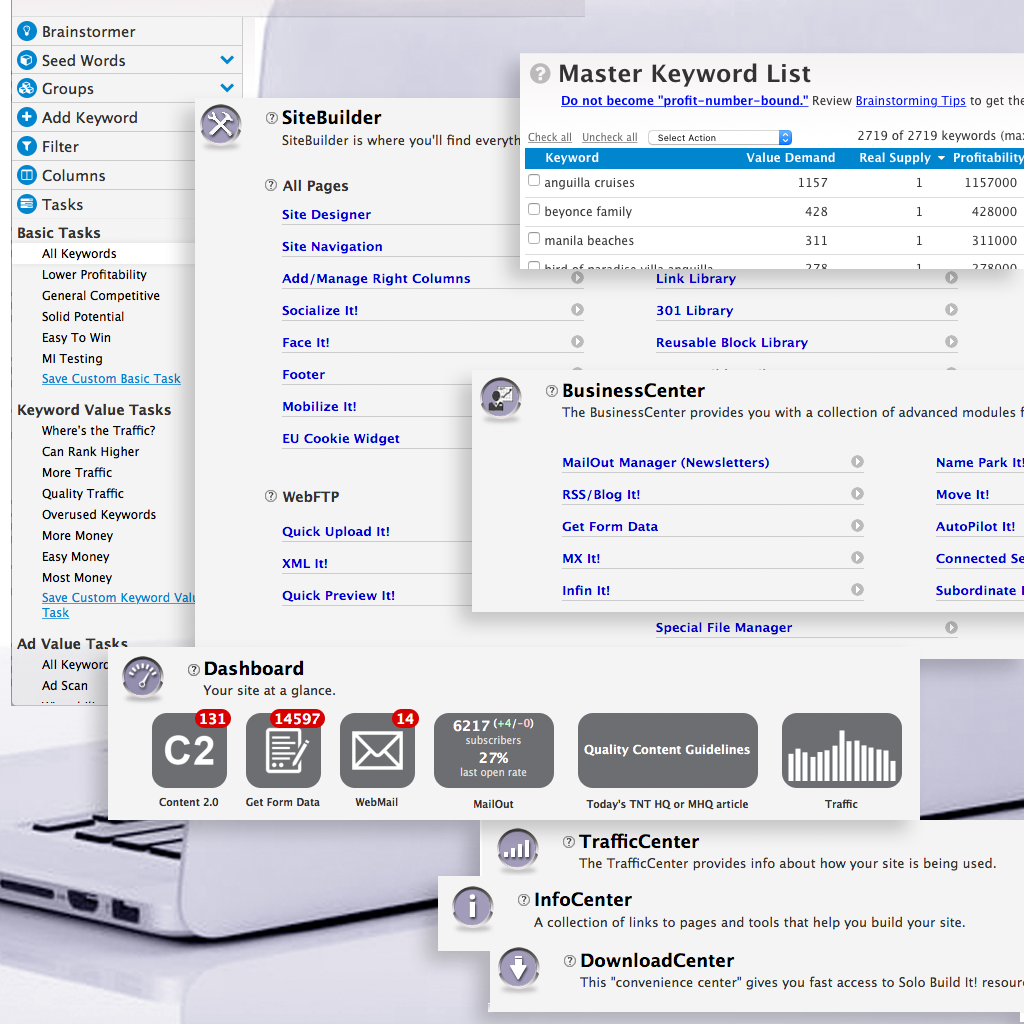
A keyword research tool helps you identify what keywords and keyphrases people use to search for information in your niche. This assists you in:
checking out the competitive landscapedetermining what keywords to write aboutplanning how to monetize your businessFor example, SBI!’s keyword research tool includes a site concept finder to help you determine the best niche to start a business around. The tool then identifies hundreds of keywords people use in search, and provides supply, demand and profitability numbers.
It uses Semrush’s powerful suite of APIs to ensure that the keyword research data is current and relevant.
There are many keyword research tools on the market. Just do a Google search and check out a few.
5. Smartphone With a Quality CameraA smartphone is an indispensable tool for online business owners. It allows you to:
Stay connected on the go.Capture high-quality images and videos of your products or services.Respond promptly to customer inquiries.Process payments on the move.When choosing a smartphone for your business, prioritize models with high-quality cameras. Professional-looking photos and videos can significantly enhance your brand’s credibility and appeal to potential customers.
6. Email Marketing SoftwareEmail marketing remains one of the most effective ways to engage customers and drive sales. With the right email marketing software, you can:
Send targeted campaigns based on customer behavior and preferences.Automate your email marketing efforts.Segment your audience for more personalized communication.Track and analyze campaign performance.Some popular email marketing tools include Mailchimp and AWeber.
Also Read: Email Marketing Funnel: How to Create Sales Funnels Via Email
7. Social Media Management ToolsSocial media is a vital channel for promoting your online business and engaging with your audience. However, managing multiple social media accounts can be time-consuming.
A social media management tool can help you:
Manage all your social media accounts from a single platform.Schedule posts in advance.Track performance metrics across different platforms.Hootsuite, for instance, offers robust features for scheduling, automation, content curation, and social media monitoring, making it an excellent choice for businesses looking to establish a strong social media presence.
Time is money in the world of online business. Develop a strategy suited to your business and schedule your posts in advance.Click To Tweet8. Google WorkspaceGoogle Workspace (formerly G Suite) is a comprehensive set of productivity and collaboration tools that can benefit your online business. It includes:
Gmail (using your site’s domain name) for professional email communicationGoogle Drive for cloud storage and file sharingGoogle Docs, Sheets, and Slides for document creation and collaborationGoogle Calendar for scheduling and time managementGoogle Meet for video conferencing save pin for later
 This suite of tools can help you stay organized, collaborate effectively with team members, and manage your business operations more efficiently.
9. Cybersecurity SoftwareIf you have an online store connected to your business, protecting it from cyber threats is crucial in today’s digital landscape. Cybersecurity software can help safeguard your business against:
Malware and virusesPhishing attacksData breachesHacking attemptsPopular cybersecurity solutions include Norton, McAfee, and Kaspersky.
10. Customer Support SoftwareProviding excellent customer service is key to the success of any online business. If you prefer to outsource customer service, take a look at software-as-a-service companies like Helpdesk. Customer support software can help you:
Manage customer inquiries efficiently.Track and resolve customer issues.Provide timely support across multiple channels.Popular options in this category include Hiver, Zendesk, Freshdesk, and Help Scout.
Tools That Are Nice to Have, But Not NecessaryThese tools will make your job easier, but they aren’t necessary to have at the beginning. You can start adding them as your business grows bigger.
1. Graphic Design SoftwareCreating visually appealing graphics for your website, social media, and marketing materials is essential for attracting and retaining customers.
Professional design software like Adobe Photoshop or Illustrator can be expensive. There are more affordable and user-friendly options available:
Canva: A versatile, user-friendly graphic design tool with a wide range of templates and features suitable for beginners.GIMP: A free, open-source alternative to Photoshop with powerful image editing capabilities.Inkscape: A free vector graphics editor, similar to Adobe Illustrator.These online tools can help you create professional-looking graphics without breaking the bank or requiring extensive design experience.
You don't need to be a pro designer to create stunning visuals for your business. Tools like Canva make it super simple!Click To Tweet2. Website Optimization ToolsIf you have an online store, it needs to perform well in terms of speed and user experience. Website optimization tools like Google Analytics 4 can help you:
Analyze your website’s performance and loading speed.Identify areas for improvement.Implement optimizations to enhance user experience.3. eBook Selling ToolIf your online business involves selling digital products like eBooks, having a dedicated eBook selling tool is essential. This tool allows you to:
Easily distribute your eBooks to your customers without the hassle of manual delivery.Protect your intellectual property with built-in security features that prevent unauthorized sharing.Manage transactions seamlessly, offering various payment gateways and tracking your sales.Tools like Gumroad, SendOwl, and Payhip are popular choices for eBook sellers. They provide user-friendly platforms where you can upload your eBooks, set prices, and automate the sales process, freeing you to focus on creating more valuable content for your audience.
4. Online Courses Hosting PlatformOffering online courses is a fantastic way to monetize your expertise and build a community around your brand. An online courses platform helps you:
Create and deliver engaging course content, from video lessons to downloadable resources.Manage student enrollments and progress, ensuring each learner has a personalized experience.Process payments and handle subscriptions, making it easy to scale your course offerings.Platforms like Thinkific, Teachable, and Kajabi are excellent for setting up and managing online courses. They offer a range of features, including course creation tools, marketing options, and analytics to track student engagement.
Now You’re Ready to Run an Online BusinessStarting an online business is much more affordable than launching a traditional brick-and-mortar store — and you can work on it from anywhere. With just a few essential tools, you can begin your entrepreneurial journey without the hefty overhead costs associated with a physical location.
Running a successful online business requires more than just a great product or service, though. It demands the right set of tools to manage various aspects of your operations efficiently.
While the initial investment in these tools may seem a bit daunting at first, remember they’re designed to save you time and resources in the long run. By automating repetitive tasks and streamlining your operations, these tools allow you to focus on more important aspects of your business, such as building your audience (traffic) monetization strategy, and cultivating long-term relationships.
As you embark on your online business journey or look to optimize your existing operations, consider investing in a comprehensive online business building solution like Solo Build It! (SBI!) or WordPress with SBI! for WP.
With the right platform and tools at your disposal, you’ll be well-equipped to navigate the challenges of the digital marketplace and build a thriving online business.
Also Read: Starting an Online Business Frequently Asked Questions
Subscribe to the Solo Build It! newsletterAuthor informationMargit StreifenederMargit Streifeneder is the Marketing Co-Director at SiteSell. She works with a small but mighty team to spread the word about Solo Build It!, via helpful content, informative emails and eye-catching ads. She's passionate about helping solopreneurs achieve success, and enjoys interviewing SBI! members about their achievements. Besides growing her own online business, she loves exploring new places, hiking, dancing and spoiling her three cats.
|The post Game-Changing Tools for Online Business Growth appeared first on SiteSell Blog - Proven Real-World Advice for Solopreneurs.
August 22, 2024
Do Blogs Still Make Money? The Surprising Truth

With social media and short-form content dominating the internet, you might wonder: do blogs still make money? Let’s try to answer this question together.
Blogs remain a powerful tool for generating passive income, building authority, and creating lasting value on the internet.
This article explores the current state of blogging, reveals profitable strategies, and shows you how to turn your passion into a full-time income through blogging.
Whether you’re a seasoned blogger or just starting out, you’ll discover why blogs remain a relevant and potentially lucrative venture in today’s online world.
The Evolution of Blogging: From Hobby to BusinessWhen blogs first emerged in the 2000s, they were primarily personal online diaries. Today, blogs serve as robust platforms for businesses, thought leaders, and entrepreneurs to share expertise, build audiences, and generate substantial revenue.
As the internet evolved, so did the role of bloggers. What started as a hobby for many has become a full-time career for thousands. Professional bloggers have emerged across various niches, from travel and lifestyle to finance and technology.
These individuals have mastered the art of creating engaging blog content while simultaneously running profitable online businesses.
Do Blogs Still Make Money? The Numbers Don’t LieDespite claims that blogging is dead, the industry continues to grow. According to recent statistics:
The blogging industry is set to grow by $417.85 billion between 2021-2025.80% of bloggers report that blogging drives positive results.Popular blogs in top niches can earn upwards of $50,000 per month.These figures demonstrate that blogging is not just alive; it’s thriving! However, success in this competitive industry requires more than just passion; it demands strategy, persistence, and the right tools.
How Blogs Generate Revenue: Diverse Streams of IncomeSuccessful bloggers don’t rely on a single source of income. Instead, they diversify their revenue streams to maximize earnings and create a stable income.
Here are some of the most effective ways blogs make money in and beyond:
1. Affiliate MarketingAffiliate marketing remains a cornerstone of blog monetization. By incorporating affiliate links into their content, bloggers earn commissions on products or services they recommend.
The key to success lies in promoting products that align with your audience’s interests and needs.
2. Digital ProductsCreating and selling digital products has become increasingly popular among bloggers. These can include:
E-booksOnline coursesWebinarsPrintablesSoftware or appsDigital products offer high profit margins and the potential for passive income, as they can be sold repeatedly without additional production costs.
3. Sponsored ContentAs your blog grows in popularity, brands may approach you for sponsored content opportunities. This involves creating blog posts, videos, or social media content that promotes a company’s products or services.
Sponsored content can be highly lucrative, especially for blogs with engaged audiences in specific niches.
 save pin for later 4. Display Advertising
While not as popular as it once was, display advertising, such as Google AdSense, still plays a role in blog monetization.
This method works best for blogs with high traffic volumes, as earnings are typically based on impressions or clicks.
5. Physical ProductsSome bloggers have successfully launched their own physical products, leveraging their audience and brand to create additional revenue streams.
This could range from print-on-demand products to niche-specific items that solve problems for their readers.
6. Membership Sites and PatreonBy offering exclusive content, resources, or community access, bloggers can create recurring revenue through membership sites or platforms like Patreon.
This model works particularly well for blogs that provide high-value, specialized information.
7. Consulting and CoachingMany successful bloggers offer consulting services or coaching programs related to their niche. This allows them to monetize their knowledge directly while providing personalized value to their audience.
 The Secret to Blogging Success: Finding Your Profitable Niche
One of the most critical factors in building a money-making blog is choosing the right niche. A profitable niche should:
Align with your passions and expertise.Have a sizable and engaged audience.Offer monetization opportunities.Have long-term potential.Some examples of profitable niches include:
Personal finance and investingHealth and wellnessTechnology and gadgetsSustainable livingRemote work and digital nomadismParenting and family lifeSolo Build It! members have access to a smart keyword research and analysis tool to help with evaluating a niche’s popularity and competition.
Deciding about a niche is much more than a numbers exercise though. You’ll live with your chosen niche for many years to come. So you need to find a topic that really excites you. If you struggle to come up with ideas, our free “passion worksheet” will help.
Building Your Blog for SuccessLet’s look at five steps that are crucial for your blogging success.
1. Create High-Quality, Valuable ContentThe foundation of any successful blog is consistently producing high-quality, valuable content. This means:
Addressing your audience’s pain points and questionsProviding actionable advice and solutionsStaying up-to-date with trends in your nicheIncorporating multimedia elements like images, videos, and infographicsAlso Read: 7 Tips on How to Write Blog Posts Faster
2. Engage With Your AudienceBuilding a community around your blog is essential for long-term success. Engage with your readers by:
Responding to commentsEncouraging discussionCreating social media presenceHosting live Q&A sessions or webinars3. Implement Email MarketingEmail marketing is a powerful tool for nurturing relationships with your audience and driving conversions. Build your email list by:
Offering valuable lead magnetsCreating targeted opt-in formsSegmenting your list for personalized communicationConsistently providing value through your newsletters4. Diversify Your Content FormatsWhile written blog posts remain important, diversifying your content formats can help you reach a wider audience and increase engagement time on your blog. Consider incorporating:
Video content (YouTube, TikTok, Instagram Reels)PodcastsInfographicsInteractive content (quizzes, calculators)5. Collaborate With Other Bloggers and InfluencersNetworking and collaborating with others in your niche can help expand your reach and provide new opportunities. Consider:
Guest posting on other blogsParticipating in podcast interviewsCo-creating content or productsJoining mastermind groups or blogging communities (for example, Solo Build It!’s forums)

While blogging can be highly rewarding, it’s not without its challenges. Here are some common obstacles and how to overcome them:
1. Consistency and Time ManagementChallenge: Maintaining a consistent publishing schedule while juggling other responsibilities.Solution: Create a content calendar, batch create content, and consider outsourcing some tasks.Also Read: How Many Blog Posts to Make Money
2. Standing Out in a Crowded NicheChallenge: Differentiating yourself from other bloggers in your niche.Solution: Focus on your unique perspective, personal experiences, and specific sub-niches within your broader topic.3. Monetization PressureChallenge: Feeling pressured to monetize quickly, potentially compromising content quality.Solution: Focus on building a solid foundation of quality content and an engaged audience before heavily monetizing. At Solo Build It!, we advise our members to start monetizing only when they have at least 30 pages of high quality content and/or 100 visitors per day.4. Keeping Up with Technology and TrendsChallenge: Staying current with evolving technology and industry trends.Solution: Allocate time for ongoing learning, join professional communities, and attend industry conferences or webinars.5. Dealing with BurnoutChallenge: Maintaining motivation and avoiding burnout.Solution: Set realistic goals, take regular breaks, and remember why you started blogging in the first place.The Future of Blogging: Trends to WatchAs we look ahead, several trends are shaping the future of blogging:
AI-assisted content creationIncreased focus on video and interactive contentVoice search optimizationHyper-personalization through data analyticsIntegration with emerging technologiesStaying ahead of these trends can help position your blog for long-term success.
Your Path to Blogging Success Starts HereAs we’ve explored throughout this article, blogs absolutely still make money. With the right strategies, tools, and mindset, blogging continues to offer incredible opportunities for creating a full-time income and building a meaningful online presence.
Blogging is a great way to share your passion, establish yourself as an authority in your field, and create a thriving online business.
Ready to take the next step in your blogging journey? Sign up for our newsletter to receive exclusive tips, strategies, and resources to help you build a successful, profitable blog. Don’t miss out on the opportunity to turn your blogging dreams into reality!
Subscribe to the Solo Build It! newsletterAuthor informationMargit StreifenederMargit Streifeneder is the Marketing Co-Director at SiteSell. She works with a small but mighty team to spread the word about Solo Build It!, via helpful content, informative emails and eye-catching ads. She's passionate about helping solopreneurs achieve success, and enjoys interviewing SBI! members about their achievements. Besides growing her own online business, she loves exploring new places, hiking, dancing and spoiling her three cats.
|The post Do Blogs Still Make Money? The Surprising Truth appeared first on SiteSell Blog - Proven Real-World Advice for Solopreneurs.
August 9, 2024
How to Increase Website Engagement: 5 Actionable Tips

Engagement. Engagement. Engagement. A term that you never hear the end of in the world of social media marketing.
It’s something we always want more of and have been told will help us go “viral,” increase our reach, and so on and so forth.
On social media, increasing and measuring engagement is rather straightforward.
All you have to do is create posts that stir up engagement and measure your success by the engagement rate, which is the number of likes, shares, and comments expressed as a percentage of reach.
Simple.
But what about on a website or blog?
Engagement looks a little different in this neck of the woods, and you need to seek out the stats that matter when trying to measure how engaging your content really is.
In this blog post, I’ll be covering the ins and outs of how to increase website engagement, why it matters, and how you can improve yours.
First things first, here are the three main ways to measure engagement on your website:
Average engagement timePage views per sessionAverage session durationYou can find all these metrics in Google Analytics 4. The higher the numbers, the better.
Why Website Engagement Is ImportantBefore we take a look at how to increase website engagement, let’s explore the benefits. There are a number of them, and some of them may not be obvious.
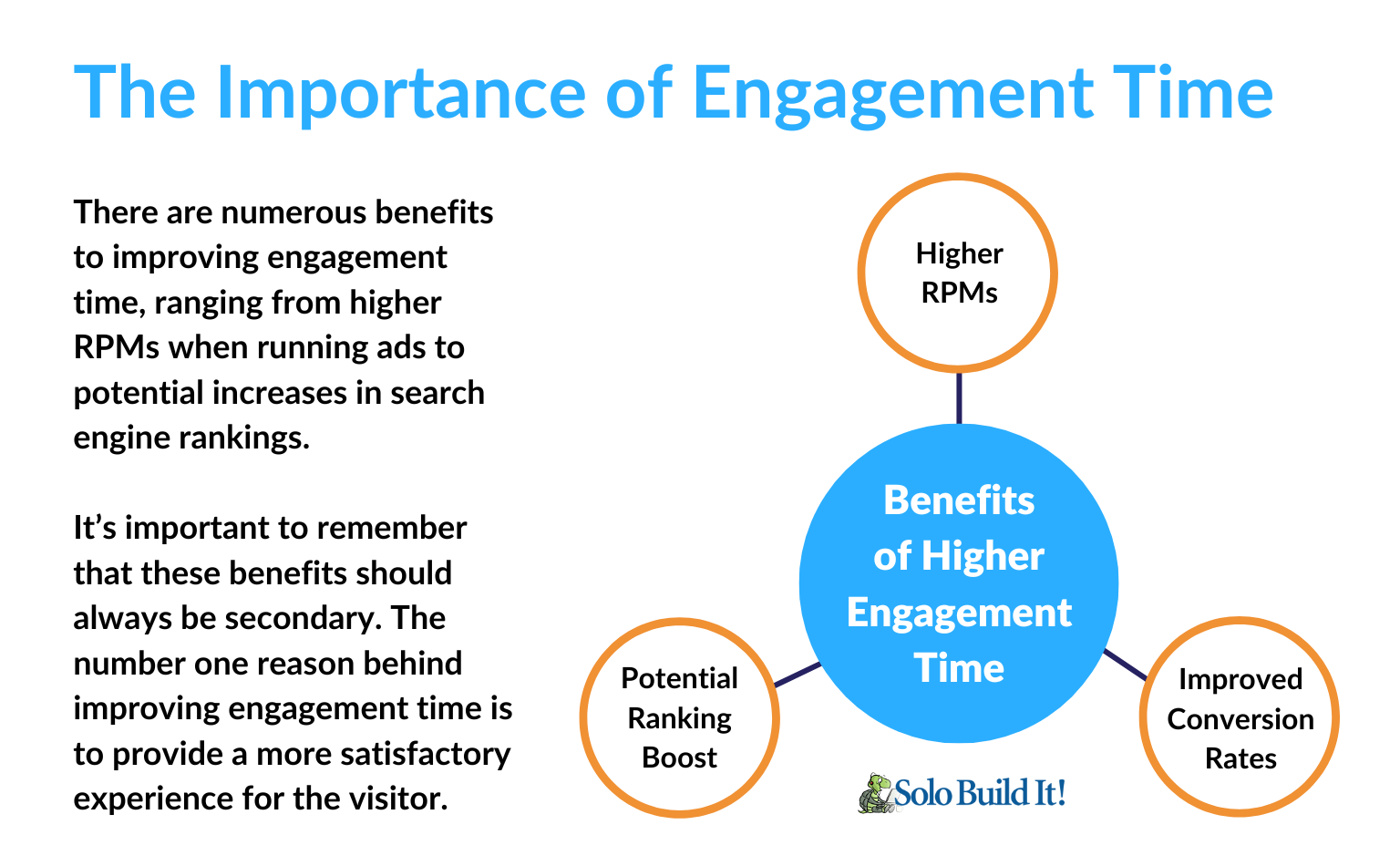
Let’s assume you monetize your website with display ads through Mediavine, Raptive, AdSense, or one of the many other options out there.
Everyone running ads wants the highest RPM possible, of course. The RPM is essentially the earnings accrued for every 1000 units. These units can be either page views or sessions.
Page view RPM is usually lower than session RPM, as sessions often include multiple page views.
As you can imagine, if people are spending longer on a page or your average session duration increases, the number of ads they see goes up, which in turn means you earn more per visitor per page, resulting in a higher RPM.
We’ll cover improving engagement a little later on in this guide. Here’s the gist though — don’t simply write longer articles with larger fonts and spacing.
Better Conversion RatesImagine this: A visitor lands on your website from Google or another traffic source, scrolls around for a couple of seconds, and then returns to where they came from.
Were they pleased with the content on your website, to the point that they’d sign up for your newsletter? Probably not.
Were they even on your site long enough for them to see your newsletter sign-up form? Again, probably not.
And if that’s the case, the chances of them seeing and buying your products or services are practically zero.
Now maybe that page answers a single specific question, and after finding the answer, the visitor leaves.
What’s more likely, however, is that the content on the page is not well optimized or suited to producing long engagement times. Perhaps the page isn’t quite matching the search intent. That’s a common one. But there could be a variety of other factors at play here.
That doesn’t necessarily mean the page is not well written, or that it lacks the information the visitor expects to find. It might just be the way the page is laid out and formatted.
Or maybe you should start adding some content snippets to pages that your visitors might not know they’d be interested in. We’ll explore that in a moment.
Knowing How To Increase Website Engagement Is Important for Search Engine RankingsThis one is more difficult to measure, but we do know that on-page signals are important to Google and definitely play a role in determining rankings. Obviously, if people are spending a long time on your page, Google figures that the page is pretty good. And that could result in a boost to that page’s ranking over time.
On the other hand, if a page has an engagement time of only three seconds and visitors are just bouncing back to the search results, Google’s going to put two and two together and drop your page’s ranking because people aren’t happy with what they’re being presented.
As long as visitors are staying on your website for a good length of time, including on one specific page or across multiple pages combining to create a prolonged session, you’re going to look good in Google’s eyes.
How to Increase Website Engagement TimeAs mentioned earlier, engagement time essentially refers to how much time people are spending on your website. And writing longer articles or increasing font size and line spacing are not going to magically increase engagement time — not significantly in any case. This could potentially annoy visitors as well.
If you’re just going in and making wholesale changes to your site, like blindly lengthening pages or hiding the most valuable piece of content right at the bottom of articles, purely in an attempt to increase RPM and without thinking about the user experience, you’re doing it wrong. Big time. And this puts you at risk of being hit by future Google updates.
That’s why those three examples are generally best placed under the artificial shortcuts category, which I wouldn’t recommend you follow unless there’s a good reason to do so. Of course, if your font is tiny and your line spacing is way too tight, go ahead and make the necessary changes.
A font size of 18 pixels and a line height of 1.6 pixels are what to aim for.
In this case, you’re improving the user experience. And if you think the visitor would enjoy a bit more information on the topic, again, go ahead and lengthen the page.
Do you see what I’m getting at here?
Do it for the user, and only for the user. Despite Google’s ambiguous communication over the years, that’s how they want you to think, and that’s how we, as website owners, should always be thinking.
Be helpful in every sense of the word.
Here’s how to do that:
Tip #1: Put Yourself in Your Visitors’ ShoesEverything starts here. This is about understanding your visitor’s digital journey, where they started, and where they want to go.
If you have a food blog and someone’s reading your article on “Spicy Sichuan chicken stir-fry recipe,” what do they want?
You should know your ideal visitor inside out—what they’re looking for, what their problems are, and how best you can help them.
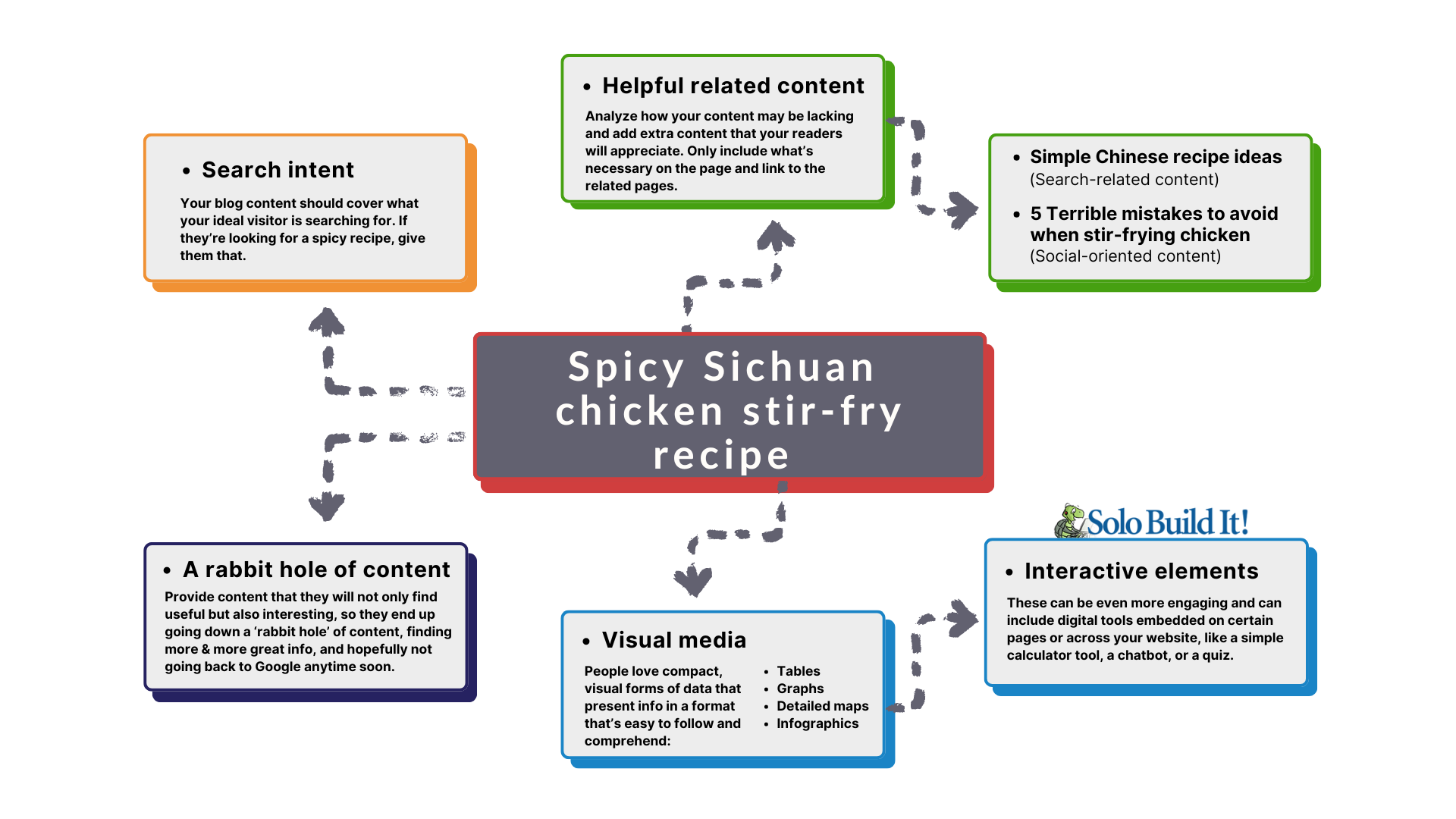
First, think about intent. It can be easy to go wrong here. If you search for “Spicy Sichuan chicken stir-fry recipe,” are you pleased with the articles Google presents?
If you’re writing on this topic, will your visitors be pleased with your content? If the articles in the search results properly address the search intent, make sure your article does the same. If your article omits “spicy” from the title and talks about a mild recipe, people aren’t going to click on it, and those that do will probably be disappointed and bounce back to Google.
On the other hand, maybe none of the top-ranking articles properly match the search intent. This would be a great opportunity for you to step in and create a piece of content people want to read.
Now, besides the basics of a well-written, easy-to-follow recipe that matches search intent without unnecessary fluff about the history of chicken or the Sichuan region of China, think about what your ideal visitor is thinking.
If they searched for this recipe and are reading your article, they’ve probably decided that this is what they want to make. So how can you keep them on the page and on your website for longer without being intrusive or annoying?
Tip #3: Create Additional Content That’s Helpful and UsefulAnalyze how your article may be lacking. What additional information can you add that’s relevant and imminently useful? Maybe you can add a small callout box with the basic steps on how to properly velvet or marinate the chicken for an incredibly tender result. This can link off to your in-depth article on the topic in case your visitor has the time to delve in, or should I say, dig in? 😉
Don’t provide all of this information on the page though, as that would lengthen the article unnecessarily. Just give them a taste of the content so they can judge for themselves whether it’s something they want to read.
What about related content that they might not be searching for right now, but might be interested in if you present it to them in the right way?
This could be the kind of content they’d go back to Google to search for. If you can guess what they’ll search for next, give them the option to read it on your website instead.
Maybe this is a dish that requires quite a bit of time and effort to make. And they know that because your article is titled accordingly: “Traditional spicy Sichuan chicken stir-fry recipe.”
And you clearly state in the introduction that this takes two hours to prepare, so they know what to expect. They want to make the traditional dish, and that’s what they’re expecting from your article.
They’re invested in this stir-fry.
Why?
 save pin for later
 Maybe they want to impress their friends, family members, or whoever it may be. Maybe they just love Chinese food and want to make this dish the original way. Figuring out the why is important.
Towards the end of the page, you could have a little related snippet of content with a striking image of a Chinese dessert with the following title:
“Impress your friends with this dead-simple delicious Chinese dessert.”
They might open this up in a new tab or just read it there and then after completing the stir-fry recipe. The way you phrase your related content is, of course, important for keeping people engaged.
You’re creating a full picture for them. Higher up on the page, you could do the same, but instead of a dessert recipe, you’d introduce your spring roll recipe.
Another example, less related to the meal they’re preparing but more to the overarching theme of cooking chicken:
“Don’t make these 5 terrible mistakes when stir-frying chicken.”
In your article, you could cover one of them that applies to the recipe at hand, and then link off to the full article that covers the topic completely.
This one really triggers an emotional response, particularly fear, which makes it pretty tough to resist reading.
They don’t want to mess up this stir-fry, right?! So they read the article.
And yes, that may sound like a slightly clickbaity title, but that shouldn’t matter if you really deliver the goods and share some excellent tips and tricks to avoid mistakes that people really do make.
With that last example, you can imagine it’s probably not the kind of content people search for. Who goes to Google wanting to learn about mistakes to avoid when stir-frying chicken?
Practically no one, because it’s a really niche topic and people expect to be properly guided by the recipe they choose to follow. But this kind of content is perfect for social platforms, where it just pops up in their feed and is intriguing enough and fear-inducing enough to get their attention and ultimately get the click.
As long as the page is well written, it’s not a problem if it doesn’t get Google traffic or people aren’t searching for the term. In fact, because it’s not optimized for SEO or any specific keyword, Google may actually appreciate the fact that you’re writing content not targeting search engines but that your visitors are actually checking out and reading when visiting your Sichuan stir-fry recipe from search.
Tip #4: Lead Your Readers Down a Rabbit Hole of Irresistible ContentSo this comes down to providing highly relevant content recommendations, including a mix of search-related content they might’ve gone on to search for afterwards, as well as interesting, social-oriented content that appeals to them and draws them in.
You want to provide them with additional content that they will not only find useful but also interesting, so they end up going down this rabbit hole of content, finding more and more stellar content, and hopefully not going back to Google anytime soon.
The longer they hang around in your ecosystem, the more time you have to build trust, convey your personality, and display your authority, which results in more email signups, more people joining your Facebook group, and all that other good stuff.
You’ll know your audience, what they want from you, and what kind of content they’d enjoy being recommended. These are just some ideas in the food niche to get you thinking.
Tai, Solo Build It!’s AI Assistant, can be a great help with this. Dial in your ideal audience, niche, and topic, then see what it comes up with.
Tip #5: Include Visual Media and Interactive ElementsPeople love compact, visual forms of data that present significant information in a high-density format that’s both easy to follow and easy to comprehend.
There are quite a few examples of this, including:
TablesGraphsDetailed mapsInteractive elementsInfographics that may combine a number of these elements.This is a great way to provide value to the visitor, share something interesting, and increase engagement time, all without adding any fluff to your content.
Go through your website and see if you can find pages that are well suited to this type of content and that could benefit from including something like this.
Going back to the stir-fry recipe example, maybe a table of the recipe’s nutritional information or a map of the Sichuan region of China with various dishes depicted across the map could work.
Sometimes, a visual element does not necessarily need to convey a lot of value but can just be striking and intriguing enough to get people interested. A beautifully illustrated Sichuan recipe map may not be the most useful, but your target audience may find it fascinating.
Yes, this type of content can take time to create, and at first, if you’re not used to using digital illustration tools or graphic design software, it may seem a little daunting. But don’t underestimate your abilities and what you can achieve with simple tools like Canva.
Interactive elements, on the other hand, can be even more engaging for visitors. These can include digital tools embedded on certain pages or across your website, like a simple calculator tool, a chatbot, or a quiz.
The good thing with these is that they can also be set up in a way that you get visitors to sign up for your newsletter while engaging with the interactive element. A quiz, for example, may ask users for their email address in exchange for the results.
Quizzes and calculators take time to create, but once up and running, they can passively grow your online business in more ways than one.
Back to the visual elements. Here’s an example of a digital illustration of mine from a page covering the Amalfi Coast:

This page has a good average engagement time, and it consists of this map at the top of the page, since that’s what people are searching for, as well as a list of towns worth visiting along the coast.
Yes, I could’ve just embedded a Google map, but which one would you prefer?
And that’s what it ultimately comes down to.
When working on how to increase website engagement, give your visitors what they prefer — the most helpful, thoughtful, and valuable content you can create.
Even if it takes a little extra time and effort to create something special for your visitors, it is undoubtedly worthwhile. When they take the time to fully appreciate what you have created for them, the end result will be incredibly rewarding.
Want more in-depth guides and actionable strategies to grow your online success?
Subscribe to the Solo Build It! newsletterAuthor information William Smith
William Smith helps manage Solo Build It!'s social media presence. He is an avid photographer and a relentless traveler, who loves discovering and sharing the world's most stunning coastal destinations through his website https://www.exquisitecoasts.com/
|The post How to Increase Website Engagement: 5 Actionable Tips appeared first on SiteSell Blog - Proven Real-World Advice for Solopreneurs.
July 25, 2024
Hungry for Traffic? Learn How This Chef Used AI to Revitalize Her Site

I think the real value of Tai is Prompt Build It!. It gives structure to the prompt-building process so that I meet the search intent for my audience and the first draft is roughly in language I would use. – Patty Maguire, naturallygluten-free.com
At 48, after years of unexplained health issues, including miscarriages and digestive problems, Patty Maguire received an unexpected diagnosis: celiac disease.
Soon after her diagnosis, she enrolled in George Brown College, the premier culinary school in Canada, to learn everything about food and gluten-free cooking. She also wanted to share her new-found knowledge and her experience of adapting to life with celiac disease with others.
Naturallygluten-free.com was born. At that time, Patty still had a full-time job as project manager for a major Canadian financial institution. Her time for working on her website was limited.
That changed when she retired in 2021. She knew her site had a strong foundation, but it needed to be “revitalized.”
With the help of Solo Build It!’s guidance and its AI assistant, Tai, she set to work. The results? A steady increase in organic traffic that proves her efforts are paying off.
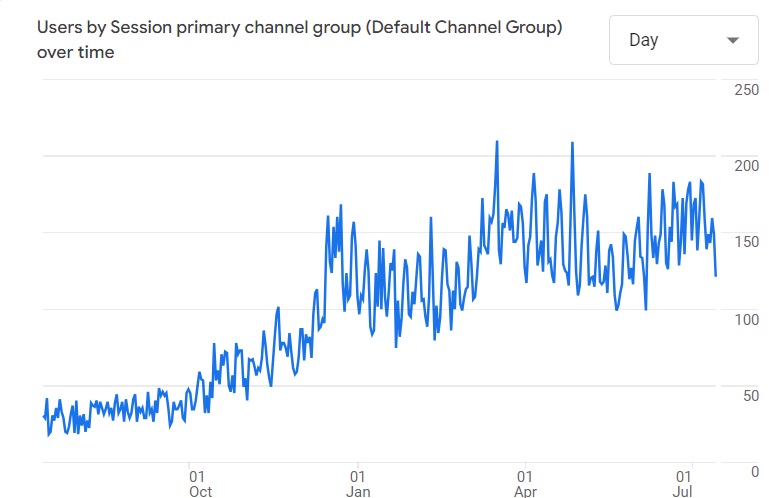 Google Analytic stats for naturallygluten-free.com from June 2023 to July 2024: organic traffic has been increasing steadily since Patty started improving her pages.
There’s a lot we can learn from Patty’s revitalization efforts, whether you own a blog or site that needs a fresh approach, or you’re just starting out. Let’s dig in!
1. Patty, you started naturallygluten-free.com in 2013, shortly after you were diagnosed with celiac disease. Tell us a bit about your journey, and especially about how your goals for your site have changed since a certain event in April 2021.I was working full-time as a project manager for a major Canadian insurance company and raising a family. I knew that I wanted to eventually put the corporate world behind me and run my own business but had no idea what that would look like.
I got the idea of writing a blog from a blogger I followed. It seemed to suit my introverted personality perfectly. The problem was, I didn’t have a topic.
In 2012, after a long battle with health issues that no doctor could seem to pin down, I was diagnosed with celiac disease. For anyone not familiar, celiac is a condition where the immune system attacks the small intestine when gluten is consumed.
Getting a diagnosis took 24 years, then learning to “go gluten free” was a whole other hurdle. Finding good information was difficult. When I realized how many others were having the same challenges, I knew I had my topic.
That blogger I mentioned earlier spoke of SBI! in one of his posts so I looked into it, asked some questions, then signed up. Naurallygluten-free.com was born and I was on my way!
The next few years were a steep learning curve. I had no idea how to write for the web, and I didn’t have a lot of time to devote to writing with job and family commitments. I loved the tortoise meme that SBI! promotes. It gave me confidence that I would get there even if the going was slow.
During those years I also decided that I needed to learn to cook more from scratch. Bottled sauces, packaged foods and seasonings are a big problem for someone with celiac.
I enrolled in a cooking course at George Brown College in Toronto. One cooking course led to another and another and before I knew it, I’d completed the chef’s training program. Now I had skills I could share as well as a deep knowledge of food theory and nutrition.
After a couple of writing courses and photography courses, I noticed my newer web pages were very different from the early ones. And that they were starting to get a little traffic. My work and my patience were paying off.
In April of 2021, I put corporate politics behind me and retired. I made sure I was financially sound so that there would be no pressure for the website to produce income quickly, but it would be my back pocket strategy and the path to the retirement I wanted — enjoying my home and my family, traveling, cooking great food and writing about it for my website.
 Some of the delicious gluten-free recipes Patty shares on her website.TAKEAWAY #1: Does Patty’s path to starting her online business ring a bell for you? Perhaps you, too, have this desire of leaving the 9-to-5 life behind and becoming your own boss, if only you had the right business idea!
Your topic may be just under your nose! Look closely at your daily life. Is there anything that deeply interests you and you just can’t seem to find good information about it? It could be a personal issue or something to do with your profession.
Is there a topic you could talk about for ages? Something that your friends and family always come to you for help?
Any of these topics could be the basis for your future online business. For more guidance on discovering your “Goldilocks niche,” check out this article.
2. You decided to follow the “Revitalize Your Site” steps outlined in Solo Build It!’s educational material. Briefly explain what you’re doing and how it helps you improve your site.When I retired in April 2021, my goal was to build Naturallygluten-free.com into something I could be proud of. I knew the site had good bones. The keywords I’d chosen by following SBI’s Action Guide were good. It was how I covered those topics that needed improvement.
I found the “Revitalize Your Site” material in Tips and Techniques HQ and felt like it was written for me! I read through and made lots of notes. Those notes became a checklist and the checklist became a spreadsheet.
I pasted a list of all my pages down column A of my spreadsheet and the checklist of items that each page needed across the top. I added in a few design elements of my own that I wanted to improve. Now every page needs to meet every item in the checklist to “pass.”
When I choose a page to rewrite, I start by looking at some key stats.
How many page views has it received in the past year?What’s the bounce rate?What’s the time on page?I record these on the spreadsheet so I can go back later to see if there has been improvement. Then I run the page through the checklist to see what needs work. Some pages need a few tweaks and maybe some fresh images. Many need a total rewrite.
I use my MKL (= Master Keyword List, a part of SBI!’s keyword brainstormer) and Google Ads Keyword Planner to research keywords. They help to ensure that the keyword for the page I’m working on is good, and if not, I may change it. They also help me to find secondary keywords and to know which ones make money.
I use Headline Studio by CoSchedule to help me write better headlines.
I use Hemingway Editor to help me make my content more concise and easier to read.
I use Tai or ChatGPT to help me with page outlines and to write a good 160-character page description that will entice Google searchers to click on my site.
I’ve recently started using Tai’s “Prompt Build It” and Boxchain to write my first draft.
TAKEAWAY #2: Wow. I’m blown away by Patty’s systematic approach to breathing new life into her site. Her experience as a project manager serves her well.Let’s summarize the key points:
Start with a solid understanding of what needs to be doneCreate a checklistTrack your progressLeverage the right toolsRinse and repeatBy now, you may be wondering what’s inside SBI!’s “Revitalize Your Site” guide that proved to be so helpful for Patty. Here’s a sneak peek:
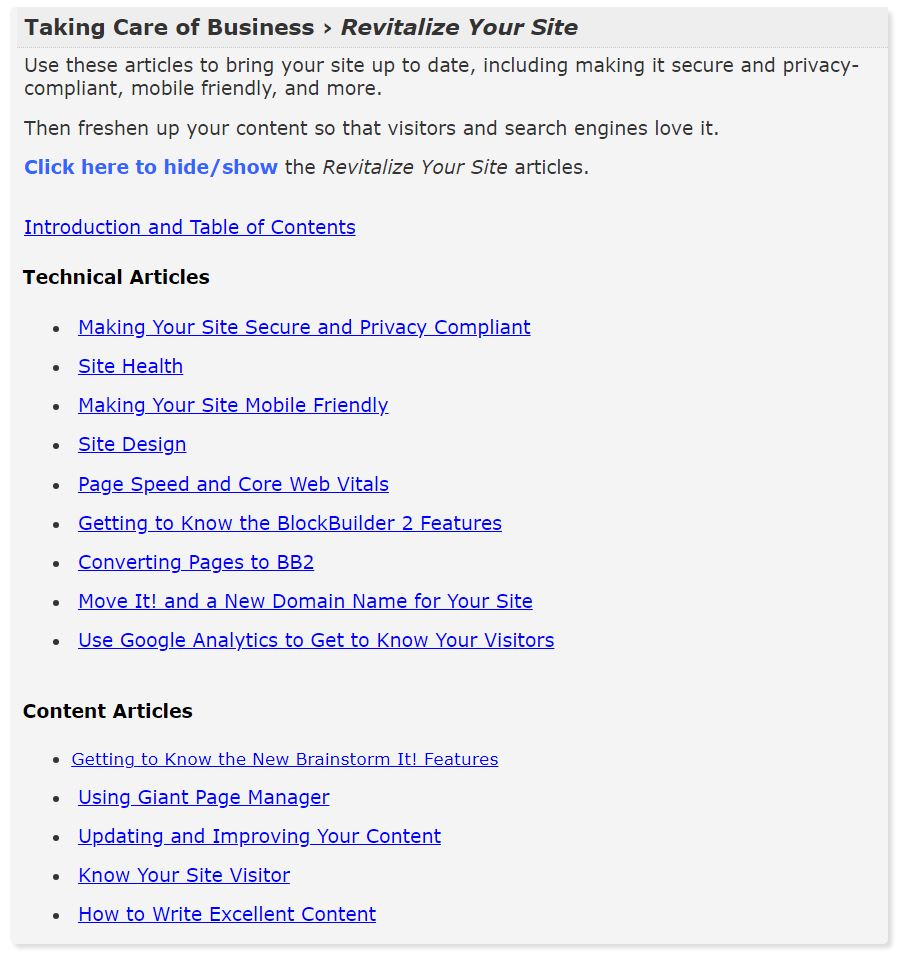
Does your web host or site builder offer similar comprehensive guidance? If not, consider joining Solo Build It!
I asked Patty if she’d consider sharing the spreadsheet where she tracks her revitalization process. She graciously agreed. Keep reading to find out how to get your free copy.
3. What is your process for deciding which topics to write about? Has your process changed since Tai, SBI!’s AI assistant, was launched?Finding topics at this point is not an issue, so I’ve not employed Tai for this yet. The keywords I found using Brainstormer are good, and I’m happy with the tier structure I’ve built.
Since 2021 I’ve tried to find a balance between rewriting old content and creating new. The ideas for new content come mostly from the research I do for my rewrites and things I come across in my day-to-day life and travels.
I’m sure at some point the ideas will dry up and AI will become a useful idea generator.
TAKEAWAY #3: What’s the first thing you do when you start a blog or website? Contrary to popular belief, it’s not registering your domain name and choosing a fancy design.It’s much less “sexy” and far more important: you do research. Who is your audience? What information, products or services are they looking for? Which solutions can you offer them?
Keyword research plays a big role at this stage. Assuming that you chose a niche you know well, you may already have a good idea about what topics (aka keywords) to cover. However, relying only on your personal knowledge and your “gut” isn’t enough if you aim to build a real business, not just a hobby site.
You need to use a tool like SBI!’s Brainstorm It! to find keywords that cover all aspects of your niche, keywords that people actually search for. You also want to know how many people search for the terms (“demand”) and how competitive they are (“supply”). You’ll get all this data from Brainstorm It!.
Another handy feature? Our Blueprint It! module lets you organize your keywords into what we call a tier structure.
Think of it like the chapters of a book. Your Tier 1 page (the home page of your site) would be your book title (the overall theme). Tier 2 pages would be the chapters (in the online world also known as “content pillars”). Tier 3 pages would be the sections within each chapter.
Here’s an example blueprint for an imaginary site about “photography” (which would be far too broad for a niche site; this is just for illustration purposes).
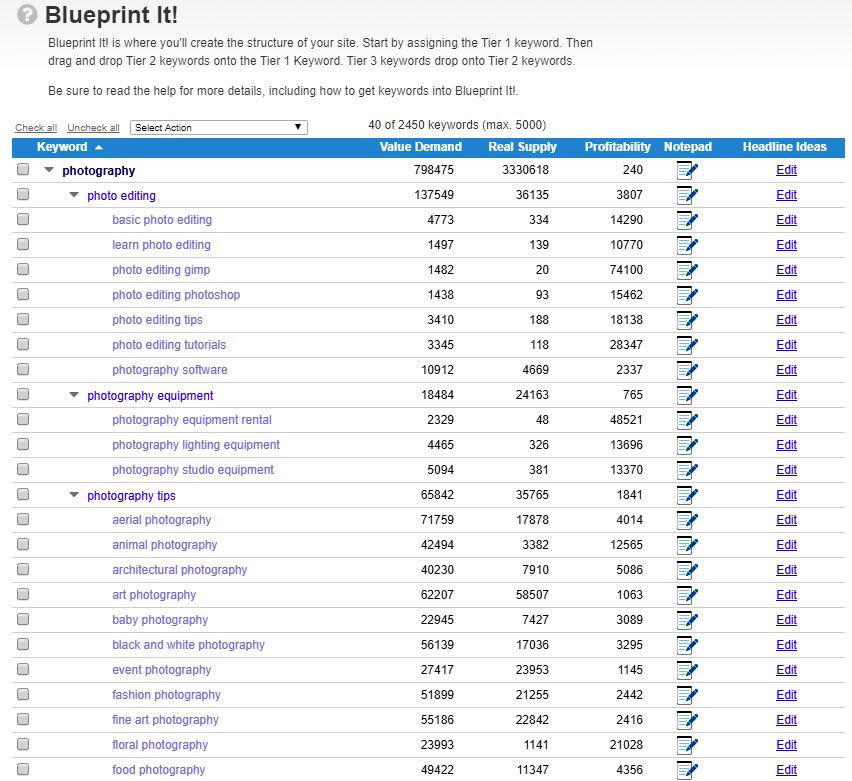
4. How does Tai help you with research, idea generation or any other tasks related to growing your site and online business?
I’m mostly using Tai to write the first draft of my articles. It often finds bits of information or angles that I hadn’t thought of. Of course, it sometimes brings back incorrect information. That’s a current limitation of AI, so I make sure to double-check everything.
I find Tai works well to help me find different and more concise ways of saying what I want to say. I can be a bit wordy, so giving Tai a paragraph and asking it to say the same thing in x number of words, maintaining the key points, is a useful exercise.
I’ve also had some fun with Tai images. I mostly use my own photos on the site, but sometimes I have an idea that’s just not practical for me to try to photograph.
TAKEAWAY #4: Patty takes advantage of some of Tai’s core functions. The first one she mentions is Tai’s main purpose: helping you draft high-quality content in less time than it would normally take you.Speeding up the writing process isn’t the only benefit though. Tai can also infuse your content with ideas and view-points you might not have thought of otherwise.
Another way Tai can help you is by improving your writing. Whether you ask it to tighten a paragraph, expand on it or rewrite it completely, Tai’s by your side. Personally, this is one of my favorite uses of generative AI tools… to help me become a better writer.
If you’ve never tried it, you should. My guess is you’d be pleasantly surprised. For more inspiration, check out our article featuring 9 creative ways to use Tai Freestyle.
Last but not least, there’s Tai Images. With just a few words, you can produce beautiful photorealistic images or drawings, like this example from Patty’s website.
[caption id="attachment_20225" align="aligncenter" width="750"] A bouquet of gluten-free grains on a table surrounded by fruits and vegetables, created with Tai Images. Here is the image on Patty’s site.[/caption]
I believe the main reason for traffic growth is the “Revitalize Your Site” process. I can’t pin it down to one thing, but I think all the pieces work together to get my pages noticed by search engines and by human searchers.
Better headlinesBetter descriptionsScannable pages with subheadings, short paragraphs and bulleted listsGood use of linksGood secondary keywordsMore professional images that look betterSimple designPages that pass the speed test (mostly), are mobile friendly and pass the Hemingway editorRecipe schema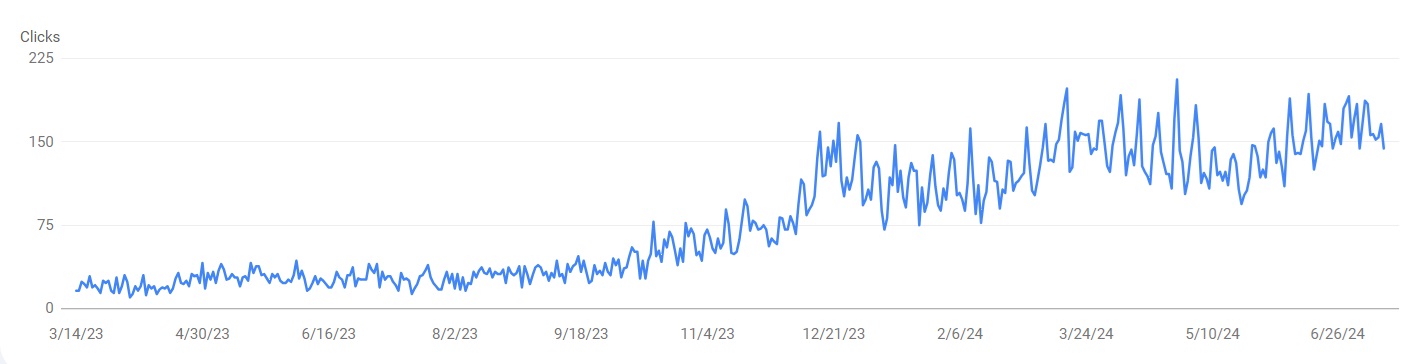 The graph shows clicks from Google search results to naturallygluten-free.com, from March 2023 through June 2024. The upward trend continues, with no negative impact from Google’s Helpful Content or other algorithm updates.TAKEAWAY #5: Sustainable traffic growth comes from a comprehensive approach to site improvement, not a single “magic bullet” strategy. Patty’s experience with the “Revitalize Your Site” process demonstrates this perfectly.
Whether rewriting older pages or creating new ones, she focuses on:
Content Quality: Better headlines, descriptions, and keyword usage.User Experience: Scannable pages with clear structure.Visual and Technical Aspects: Professional images, simple design, fast loading, mobile-friendly pages, and proper schema usage.These enhancements align well with Google’s recent algorithm updates (like the Helpful Content Update and March 2024 Core Update), which prioritized user-focused, valuable content.
The traffic graph shows a clear upward trend starting around September 2023, highlighting the effectiveness of Patty’s efforts.
Congratulations are in order!
6. Increased traffic usually also means higher earnings. Did you notice a positive impact on your income, and if so, how big was the impact?My only monetization right now is Google AdSense. I’m keeping it simple while I focus on content. I don’t really think of it as money, it’s more like points. Another metric I can use to track progress and keep me motivated.
When I started to revitalize my site in 2021 it was earning a couple of dollars per month. It took me until Dec 2022 to get my first $100 payout from Google. That was a huge milestone!
In 2023 I averaged just under $10 per month. Now I’ve passed the $50 per month mark and growth is speeding up. I think that snowball is getting some momentum.
TAKEAWAY #6: If you need income overnight, starting a website or blog may not be the right choice for you. Like with any other business, you’ll have to invest first before you can reap the rewards.In our case, “investing” mainly refers to your time. Patty’s spot on when she talks about “keeping it simple while focusing on content.”
Building a solid foundation of quality content is crucial before worrying about generating revenue. We recommend having at least 30 pages of high value content and a steady stream of 100 visitors per day before you start monetizing.
Once the first couple of dollars are rolling in, you know you’re on the right track. Like a rolling snowball, your income growth will accelerate as you continue to publish outstanding content and attract a larger audience.
7. You’re currently monetizing mainly via ads. Do you have plans for adding other monetization options, and if so, which ones?I’m planning to start offering branded merchandise for this Christmas. I’ve opened a Zazzle account and have been playing with designs for T-shirts and totes.
VistaPrint has cooler bags that I think will be of interest to my readers as well. People with celiac need to take food with them wherever we go because we can’t always just grab a bite in a restaurant, so a branded cooler bag might do well.
I set up an Amazon affiliate account a few years ago, but it was too soon and didn’t really produce anything. Now that I’m getting some traffic it’s time to revisit that as an opportunity.
TAKEAWAY #7: As your website grows, so do your monetization opportunities. Here’s what we can learn from Patty’s plans:Timing is important: Patty tried Amazon affiliates early on but found it wasn’t effective with low traffic. Now, with increased visitor numbers, she’s ready to give it another go. Most monetization methods (and specifically the more passive ones) need a certain level of traffic to be effective.
Know your audience: Patty’s considering branded merchandise like cooler bags, understanding that her celiac-focused audience often needs to carry their own food. The lesson? Focus on creating products that solve your readers’ specific problems.
Diversify strategically: By adding merchandise and revisiting affiliate marketing, Patty’s expanding beyond ad revenue. This diversification is so important. You don’t want to rely on a single income stream.
Start small and experiment: Using print-on-demand services like Zazzle allows Patty to test designs without a large upfront investment. This is a smart way to dip your toes into selling physical products.
Leverage your brand: Creating branded merchandise not only provides income but also helps you build your “brand of one.”
8. What do you see as Tai’s biggest benefit for you as a website owner / blogger?Getting that first draft written is a challenge for any writer. Prompt Build It! provides structure to get the creative juices flowing and makes the first draft easy. It still takes thought and creativity to write a good article that appeals to human readers and has my personality attached. Tai provides the boost.
TAKEAWAY #8: Can you relate to the challenge Patty describes? Writer’s block and blank page syndrome are real in a blogger’s world.Tai’s Prompt Build It! feature gives you a framework to organize your thoughts and get the ball rolling on that first draft.
Tai isn’t about replacing your voice — it’s about giving you a head start. You’ll still need to add your personal touch, but with the heavy lifting done, you can focus on infusing your content with your expertise and personality.
With such a structured approach to content creation, you’re more likely to publish regularly – a key factor in growing your online presence.
 Patty and her family, enjoying their gluten-free Christmas dinner.9. Have you tried other generative AI tools, e.g., ChatGPT or Claude? If yes, how does Tai compare to them, from your experience?
I was playing with the free version of ChatGPT before Tai came out, so I was already familiar with the value of AI as an editor and idea generator.
I think the real value of Tai is Prompt Build It!. It gives structure to the prompt-building process so that I meet the search intent for my audience and the first draft is roughly in language I would use.
I still use ChatGPT for some brainstorming activities and to help me write social media posts. I like the cost (free), the speed and the back-and-forth conversational style.
TAKEAWAY #9: Generative AI, the technology behind assistants like Tai, ChatGPT and Claude, is powerful. But it’s also likely to generate generic content if you don’t know how to use it.Tai addresses this challenge. Like Solo Build It!, Tai provides you with the tools and the guidance for using these tools in the most efficient way.
And while you can use Tai for many things (e.g. brainstorming, summarizing long text, developing original monetization concepts), its core function is focused on one goal:
Enabling you to create outstanding content for your blog or website faster than ever before, and having fun with it!
 Patty having fun with her baby grandson in Sudbury, Ontario.10. And finally, what’s your best piece of advice for revitalizing a site or blog with the help of an AI tool like Tai?
Like any good project manager, I would say have a plan, work your plan and be flexible enough to recognize new ideas and opportunities when they come along.
“Revitalize Your Site” is a comprehensive guide to hitting all the points that will make your site appealing to search engines and humans alike.
Tai is like your handy assistant that can take some of the grunt work out of research and the writing of that dreaded first draft.
Key Takeaways for Revitalizing a Blog or Website save pin for later
 Patty’s background in project management shines through in her approach to revitalizing naturallygluten-free.com.
Do you also have a site or blog that needs a boost? Even if you’re just starting out, you could benefit from her advice.
Here are the key steps to follow:
Have a Plan
Start with a comprehensive strategy. As an SBI! member, you can use the “Revitalize Your Site” guide as your roadmap.
Work Your Plan
Consistently implement your revitalization steps, tackling one aspect at a time.
Stay Flexible
Be ready to adapt your plan when new opportunities or ideas arise.
Leverage AI as Your Assistant
Use Tai to handle research and first drafts, freeing your time for higher-level tasks. Sign up to Tai for free here. You don’t have to be a Solo Build It! member to use it.
Balance Structure and Creativity
Follow your structured plan while remaining open to new insights AI might spark.
Focus on Quality
Use generative AI tools like Tai to speed up your process, but ensure the final content truly serves your audience.
Ready to start revitalizing your own site or blog?
Enter your details below and we’ll send you Patty’s tracking sheet right away.
Margit StreifenederMargit Streifeneder is the Marketing Co-Director at SiteSell. She works with a small but mighty team to spread the word about Solo Build It!, via helpful content, informative emails and eye-catching ads. She's passionate about helping solopreneurs achieve success, and enjoys interviewing SBI! members about their achievements. Besides growing her own online business, she loves exploring new places, hiking, dancing and spoiling her three cats.
|The post Hungry for Traffic? Learn How This Chef Used AI to Revitalize Her Site appeared first on SiteSell Blog - Proven Real-World Advice for Solopreneurs.
June 27, 2024
AI Assisted Content Creation: Travel Blogger Shares His Growth Formula

Tai’s biggest benefit to me is the time saved. An hour or two (or ten) here and there can make all the difference come the end of the month and I’m multiple posts ahead.
Eran Fulson, www.tourmygermany.com
On his site’s About Me page, Eran calls himself a “jack of all trades and master of none.” In his previous careers, he’s been a ski-lift operator, welder, bartender, and a builder in three countries.
Now he can add writer and online business owner to his résumé. Together with his mom Gerhild Fulson (of “Just Like Oma” fame) and niece Lydia, Eran has created TourMyGermany.com, where he and his team share all about his parent’s home country Germany.
Tour My Germany is — at the time of this writing — less than 1.5 years old and already shows impressive traffic growth. It wasn’t impacted by Google’s Helpful Content Update in September 2023 or the March 2024 Core Update.
We wanted to know how Eran and his team did it, and specifically which role Solo Build It!’s AI assistant Tai played. Let’s dig in and hear from Eran himself!
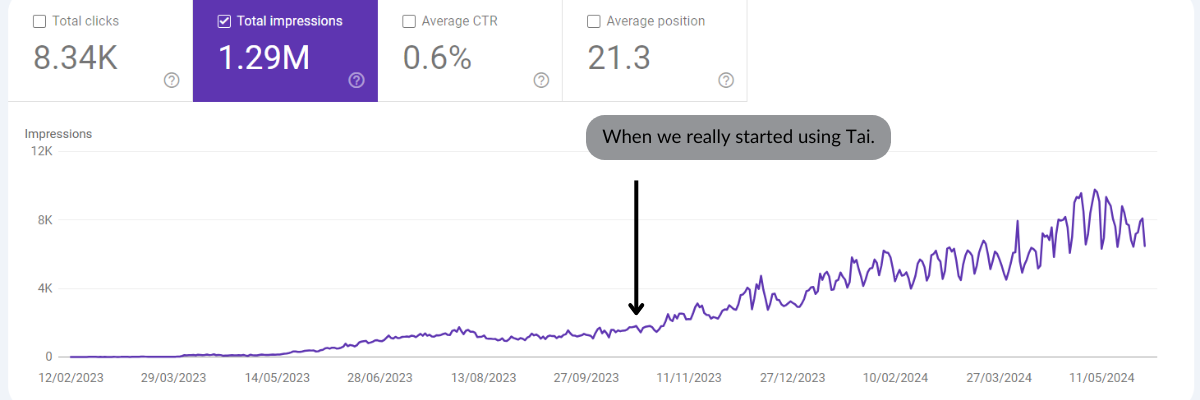 Google Search Console data for Tour My Germany from February 2023 to May 2024 (16 months), clearly showing the accelerated growth after Eran started using Tai for content creation.
1. What is your process for deciding which topics to write about? Has your process changed since Tai was launched?
We started the website with two topics in mind, German cities and castles. After a dozen or so pages we began picking sub-topics from the content we had already written. This led to easy cross-linking across the site as every new topic can reference back to one or more previous posts.
I’d be very keen to see how Tai can influence the initial creative process if we were starting from scratch. At the moment, we still have a plethora of ideas to work through, but Tai is helping by drastically cutting our writing times down with Boxchain.
TAKEAWAY #1: When starting a new site or blog, combine your creativity and niche knowledge with smart brainstorming tools. If you do only one or the other, you’ll end up with mediocre results.Why? Because if you just go with your gut, you’ll write about what you find interesting, and you may miss lots of topics your audience wants to know about.
On the flipside, your human judgment is necessary to weed out keywords generated by a tool like SBI!’s Brainstorm It! that simply don’t make sense.
Eran’s story exemplifies this perfectly. His initial inspiration came from his niece’s desire to write about German castles. Brainstorm It! then helped them identify the main keywords for their launch content.
They branched out to cover German cities as well, a logical choice for a travel site. Once again, they used Brainstorm It! to discover low-competition keywords, which they then turned — with Tai’s help — into high-quality web pages.
 Lydia loves German castles! Recognize the one in the background?2. When you have your topic, what happens next? Can you briefly explain your step-by-step process from topic to published page?
After using Brainstormer to find the new page’s main keyword, I then use RankIQ for the main keyword’s related terms. This gives another 100 keywords to use in my post. I’ll break these down into headings (location), subheadings (points of interest in said location), and filler words (e.g., best time, good idea, amazing, etc.).
From there, I work my way through the “six P’s” in Tai’s Prompt Build It! until I get to P6, Pertinent Connections or Sentiments. There I insert all of those previously sectioned keywords.
After researching the content for accurate information, along with official websites to link to, I’ll arrange, rewrite, and pad out the content as needed to suit the overall direction of the post.
I’ll go section-by-section in SBI!’s BlockBuilder, filling with images and text as I go. Analyze It! ensures all the necessary boxes are ticked before building the page.
TAKEAWAY #2: Like with the topic selection process, Eran employs a clever combination of “man and machine” for writing his articles.By the way, if some of what he describes feels like it’s way over your head, don’t despair.
Building a website or online business involves a learning curve, but Solo Build It! helps you shorten it. With step-by-step guidance and a supportive community, you’ll gain the knowledge and skills you need for success. SBI! also provides a comprehensive set of tools under one roof, minimizing the initial need for external services.
Eran’s experience is a great example. I was curious if he had ever tried using Tai Freestyle (one of Tai’s core modules) instead of RankIQ to discover the 100 related keywords he likes to use in his blog posts.
He told me: I hadn’t, but I will now.
A couple of hours later, he came back with the results:
So, I tried Tai Freestyle to see if I could mimic the results I’m used to seeing with RankIQ. With a bit of prompt wizardry, I can get pretty close. The key is not asking for 100 related keywords, but specifying a certain number of keywords for headers and paragraph topics. And then complementary keywords to those topics, which will help round out the overall post.
I like it when things I suggest turn out so well. 
 Eran’s field research wouldn’t be complete without sampling some refreshing Bavarian beer.3. AI generated content can sometimes sound robotic and/or contain errors. How do you ensure that your final piece is error-free and “uniquely you”?
 Instead of copy-and-pasting the whole AI content, I’ll rewrite it word-for-word(ish) while “hearing” what it sounds like and making changes to sound more like my own voice. Given the prompt process in Tai, the output is easier to rewrite when it already sounds like me to begin with.
As for ensuring error-free content, I check every single paragraph. If one states some information about a particular location, then I’ll do a quick search on that location’s official website to ensure that it’s 100% correct. It also helps me to collect outbound links to scatter throughout the post.
Yes, it takes a little bit of extra effort, but correcting published misinformation is like trying to put the genie back in the bottle.
TAKEAWAY #3: Eran’s process of humanizing the AI-generated content aligns perfectly with what we dubbed as doing the “JAY walk”: Just. Add. You!Once you’ve created your draft in collaboration with Tai, it’s crucial that you:
check the content for errors (generative AI tools still tend to “hallucinate,” i.e., they make up facts) andedit it extensively, so that it sounds like you.Tai includes a handy little tool called StyleBuilder. In a few simple steps, you can train Tai to write in any writing style you like, by using samples either from your own writing or from an author you admire.
StyleBuilder ensures that the content Tai generates aligns with your voice. But it still needs your expertise, experience and stories to truly resonate with your audience.
Watch the short video below to see StyleBuilder in action.
4. What do you see as Tai’s biggest benefit for you as a website owner / blogger?When Tour My Germany began, I started off primarily writing articles and creating social media content. As time went on, my job description evolved into a more administrative role, but one where I still had to try to find time to write.
Tai’s biggest benefit to me is the time saved. An hour or two (or ten) here and there can make all the difference come the end of the month and you’re multiple posts ahead.
TAKEAWAY #4: Doing more in less time… isn’t that the holy grail for us solopreneurs, bloggers and side hustlers?It’s also the big promise of artificial intelligence, that it helps us become more efficient, faster and better at what we do. Personally, I still feel that AI often costs me more time than it saves me. But I guess that’s because there’s so much going on in the AI world and I’m trying to keep up with it all.
When you’re focused on just one thing (creating outstanding content for your website or blog) and one user-friendly tool (Tai), then you’re much more likely to benefit from AI’s time saving promise, as Eran’s example impressively shows.
 “Oma Gerhild” exploring Veste Coburg.5. Do you see any downsides in using AI for content creation?
In a word: complacency.
Just like any new technology that saves time, there are inherent risks that go hand-in-hand as soon as one becomes too comfortable with it. Especially in an industry where we impart our knowledge.
The more we entrust a fallible entity to create content, the greater the risk of misinformation slipping through and under Google’s ever-watchful eye.
TAKEAWAY #5: When you browse an AI tool directory like Futurepedia or simply do a Google search for “AI writing tools,” you’ll find dozens of platforms promising you to “revolutionize your long-form writing” with “unparalleled speed and efficiency.”It sounds as if you press a few buttons and — mere seconds later — your perfect 2000 word, search engine optimized article is ready for you. All you have to do is publish it and wait for the traffic (and money) to roll in.
And at first glance these AI-generated articles sound impressive. But once you look closer, you realize that they contain a lot of fluff, tell-tale buzzwords (unlock, unleash, empower, etc.) and flat-out errors.
Sure, there may be people who have short-lived success by publishing hundreds of AI-written articles per day. But if you’re in it for the long term, and want to be proud of your content, don’t become complacent.
Use AI as it’s meant to be used… as an ever helpful, knowledgeable assistant, not as a replacement for you, the writer.
6. What else do you use Tai for, apart from helping you write new pages?As I alluded to earlier, at the moment, the Tour My Germany foundation is pretty well set, and having more time is our holy grail.
That said, I recently bought another site through SBI!, and I will undoubtedly be making full use of the Tai toolkit to create the framework for an exciting new venture.
TAKEAWAY #6: While Tai’s focus is on helping you produce outstanding long-form articles and blog posts, it’s also great during the research and planning phase for a new niche website.For example, you can use it to explore your audience’s pain points, discover topic ideas, find a keyword’s search intent and plan your monetization.
When you combine Tai’s creativity with Solo Build It!’s keyword brainstorming and analysis tools, you’ll nail down your niche in record time.
7. How important is the newly added Tai Images module for you? Do you plan on using AI-generated images on your site?Being in the travel niche, we can only use real-life photos on the site. Much as I’ve tried finding a way to implement AI images, sadly, there isn’t a capacity for us to use them.
TAKEAWAY #7: Understand your niche’s requirements and constraints. While AI-generated images can be valuable for certain topics, such as fiction, education, interior design or fashion, other niches like travel demand authenticity through real-life photographs.Always prioritize the expectations and needs of your audience when deciding on content elements. If your niche requires genuine visuals, focus on creating or sourcing high-quality, original images.
In addition, the need for having to take pictures is the perfect “excuse” for visiting all those beautiful places you’re writing about! You might even get free stays in luxury hotels and lodges if you have a well established travel blog.
8. Have you tried other generative AI tools, e.g., ChatGPT or Gemini? If yes, how does Tai compare to them, from your experience?I used ChatGPT in its infancy, albeit with mixed results. Perplexity.ai has been good for research, as it often comes back with fairly credible content references that aren’t solely Wikipedia links.
Funnily enough, I’ve primarily used Claude.ai, and now it’s part of the Tai family.
I’ll give full kudos to Tai’s prompt-creation process. The results that come back are on par with being a prompt engineer, but without needing a full understanding of how to build a prompt in the first place.
TAKEAWAY #8: Tai was the first and still is — as far as we know — the only AI writing assistant that includes a fully guided prompt-building wizard. After entering your page’s topic, you’ll be led through six questions, aka the “6 P’s”:P1: Purpose: What is the primary goal of your content?
P2: Profile: Characterize your ideal reader or audience.
P3: Page Length: Set the desired scope of your content.
P4: Personality: Determine the style, tone, voice, and reading level of your piece.
P5: Preconditions: Outline the specific context or scenario for your content.
P6: Pertinent Connections: Associate desired keywords and express sentiments that resonate with your content.
This structured process ensures that you’ll draft prompts that will result in excellent output from the generative AI tool, saving you time and frustration.
Give it a try and see for yourself. Signing up to Tai is free, and you’ll get 20,000 credits to experiment with it.
9. Your Google traffic has increased since you started using Tai (congrats!). Did you also notice a positive impact on your earnings? If so, how big was the impact?I wish I could answer this one. However, we’ve only recently applied for entry into Mediavine and are awaiting their decision.
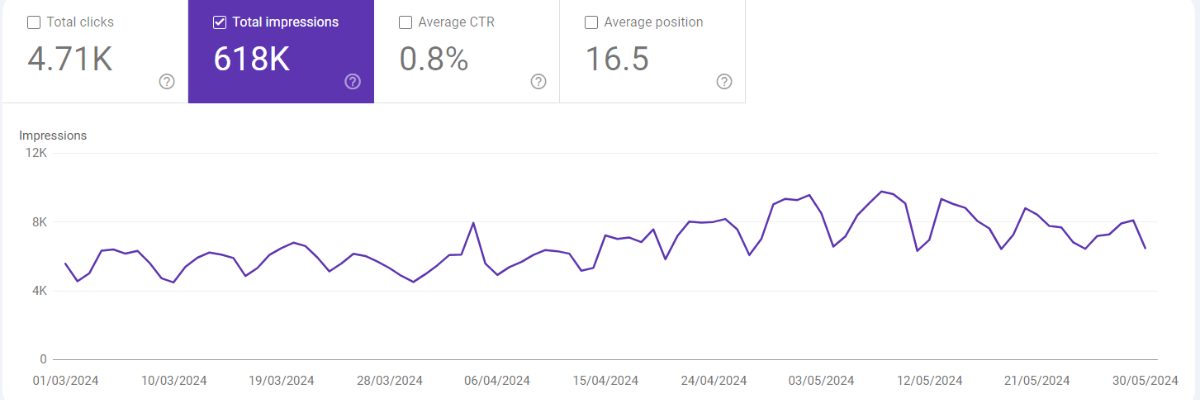 Google Search Console data for Tour My Germany from March to May 2024 (3 months), showing no signs of slowing down!TAKEAWAY #9: Mediavine is an ad management service, similar to Google’s AdSense. It’s popular with bloggers and website owners because it offers higher earnings than AdSense.
It also comes with higher requirements though. To join their main program, your blog needs to have 50,000 sessions per month (i.e., quite a lot of traffic). In early 2024 they introduced “Journey by Mediavine,” a self-service program that requires only 10,000 monthly sessions.
This allows newer and smaller sites to benefit from Mediavine’s high quality ads inventory.
Before you can expect any earnings from your site or blog, you need to build up its presence first. We typically advise SBI! members to start monetizing when they have at least 30 pages of high value content and a steady stream of about 100 visitors per day.
Another important piece of advice is to diversify your income streams. Once you have some experience with easy monetization options like ads and affiliate marketing, branch out into more active methods, for example creating and selling digital products, offering coaching or consulting services or adding an e-commerce store.
10. And finally, what advice would you give someone new to using generative AI in general and Tai specifically?For me, AI is an essential tool to have in my toolkit. While some view it as a threat to creativity, I look at it as a way to expand on my creative output. However, I also take AI content with the same level of trust as a door-to-door snake-oil salesman.
Specifically on Tai, study the Tai Guide with the same vigor you put into writing your wedding vows (provided you didn’t use AI for that as well). And take your time through the Prompt Build It! process. This lays the foundation for the bulk of your content.
So far so good, and the future is looking bright.
Eran and Lydia feeling excited about Tour My Germany, and what the future holds for them.
TAKEAWAY #10: Excellent advice from Eran. To summarize…Use Tai or any generative AI platform as a tool to help you with your creative tasks, not to replace you. You’re in the driver’s seat!Critically review AI-generated content. Never publish it without editing and fact-checking.Invest enough time to really learn how to use AI assistants. With Tai, you’ll get access to our in-depth Tai Guide, giving you the knowledge you need to use AI to your advantage.Try Tai for FreeTry SBI! plus TaiAuthor informationMargit StreifenederMargit Streifeneder is the Marketing Co-Director at SiteSell. She works with a small but mighty team to spread the word about Solo Build It!, via helpful content, informative emails and eye-catching ads. She's passionate about helping solopreneurs achieve success, and enjoys interviewing SBI! members about their achievements. Besides growing her own online business, she loves exploring new places, hiking, dancing and spoiling her three cats.
|The post AI Assisted Content Creation: Travel Blogger Shares His Growth Formula appeared first on SiteSell Blog - Proven Real-World Advice for Solopreneurs.


