
Jonathan Clements's Blog, page 402
September 22, 2018
All Better?
THE SAVINGS RATE has been revised by the federal government—and the new numbers offer a rosier take on America’s financial rectitude. But is the story believable?
Make no mistake: The old figures told a sorry tale. They suggested our savings habits fell apart after 1984 and with a vengeance after 1997. But suddenly, post-1984 doesn’t look so grim. Under the new methodology, the annual savings rate averaged 11.3% over the 35 years through 1984, modestly higher than the 11.1% average under the old methodology. But the big improvement has come in the 33 years since then: The new data put the savings rate at an average 6.7% a year since 1984, versus 5.9% under the old methodology—an increase of 0.8 percentage point per year.
Even more surprising, the new data suggest we’ve seen a resurgence of thrift since the Great Recession. Forget the old story of gradually deteriorating financial restraint in the decades since the Second World War. Sure, that has happened. But now we can give the story a happier ending.
From 1950 to 1998, the annual savings rate averaged 10.4%, according to the new methodology. We then became awfully naughty and started spending far too much. In 1999, for the first time in 60 years, the savings rate slipped below 6%. Over the decade that followed, we socked away a paltry 4.7% a year, on average.
Perhaps the late 1990s stock market bubble and the early 2000s housing bubble went to our heads. Perhaps we felt so wealthy that we saw less need to save. But it seems the Great Recession brought us back to our senses. Starting in 2009, the savings rate has averaged 7%, including an impressive 8.9% in 2012. In short, we were sinners, but now we’ve been (ahem) saved.
Nice story, right?
It seems that the Commerce Department’s Bureau of Economic Analysis, which computes the savings rate, found that Americans—especially small business owners—were earning more than it originally estimated. Result: If income estimates go up but spending stays the same, that means Americans must be saving more.
 This brings us to two key issues with the savings rate. First, we don’t measure it directly. Rather, the savings rate is the residual that’s left after estimating all the components included in total income and total spending. If any of those numbers are off, the savings rate will also be skewed.
Second, the government’s savings rate isn’t truly comparable to the savings levels recommended by financial experts. Experts typically advocate that workers save 10% to 12% of pretax income. The government, by contrast, looks at total savings as a percentage of post-tax income, which makes the savings rate seem more robust. Even then, the official saving rate of 6.7% for 2017 falls far short of what most experts would recommend.
It’s impossible for me—or anybody else—to say whether today’s official savings rate is accurate. But even with the revisions, we’re still far below the savings rate we saw during much of the post-Second World War period, and also far below what experts recommend. Does the recent uptick herald a new era of financial rectitude? Let’s hope so—because it would make for a lovely story.
Follow Jonathan on Twitter @ClementsMoney and on Facebook . His new book, From Here to Financial Happiness, can now be ordered from Amazon and Barnes & Noble. Jonathan’s most recent articles include My Favorite Questions, Striking a Chord, Tell Us a Story and Bad News.
The post All Better? appeared first on HumbleDollar.


September 21, 2018
Heading Home (Part I)
JUST A FEW MONTHS ago, I wrote about my housing plans. Those plans included waiting until I was closer to retirement age before purchasing a home. Having spent the past five years as a renter, I assumed I’d keep renting until I was ready to leave fulltime work behind.
Living in a relatively inexpensive apartment complex came with a few benefits. It allowed me to invest a large part of my income in various retirement accounts. I fully funded a Roth IRA three years in a row. I came close to investing the maximum allowed in my pretax retirement account at work. I lived way below my means and, as a result, built up a sizable retirement account balance before I turned 50.
But living as a renter wasn’t always easy. I had to move, within my complex, three different times due to noise-related issues. I spent a substantial amount of money on various white-noise devices and sound-cancelling headsets, which I used—mostly unsuccessfully—to try to block the sounds of tenants in neighboring units.
In the summer, the various apartments I rented were unbearably hot. In the winter, there were issues with snow and ice that made the outside staircases dangerous to descend. My dogs could never run loose and I longed to fall asleep to the sound of chirping crickets, rather than the noise of footsteps pacing back and forth above me.
And so, a few months ago, I began to contemplate becoming a homeowner again. I assumed that on my $70,000 salary, I’d be lucky to qualify for a $200,000 mortgage. In the greater Portland, Oregon, area, that kind of money might allow me to buy a small fixer-upper in one of the city’s distant suburbs. I spent a couple of weeks checking out houses I thought I could afford and wasn’t thrilled by what I found. My commute to work would increase to over an hour each way and I’d be miles from the neighborhood where my Mom lives.
I became so discouraged by what I saw, I briefly investigated renting a house, instead of buying one. But with houses in the area renting for between $2,000 and $2,400 per month, it seemed like buying would still be the better long-term financial decision. Moreover, rental homes that allowed pets were few and far between.
It was then that it dawned on me: Maybe I didn’t really know how large a loan I would qualify for. In any case, the real estate agents I had talked to didn’t want to deal with me  until I could present a document showing I was pre-approved for a loan, so I applied to my local credit union for a mortgage.
I was prepared to be disappointed—but wasn’t: The credit union said it would lend me $403,000.
Kristine Hayes is a departmental manager at a small, liberal arts college. This is the first in a series of articles about her recent home purchase. Her previous blogs include Happy Ending, Material Girl and Homeward Bound.
The post Heading Home (Part I) appeared first on HumbleDollar.
September 20, 2018
Lay Down the Law
I DON’T KNOW about you, but there are things I wish I had learned when I was young—say, at the ripe old age of three or four. I wish I had learned another language. I wish I had started the violin. I wish someone had taught me math and not just how to count to 10.
I believe we can learn all these things and more at a very early age. Why? Because we are human sponges when we’re children. At that age, we’re wonderfully efficient learners. Children are literally wired to absorb information.
It takes thousands of hours of practice to become a good violinist. Even after putting in that effort, the odds of becoming a virtuoso aren’t great. On the other hand, far less time is needed to master the fundamentals of finance. It isn’t rocket science—far from it—and the payoff is far more assured. If you’re looking for a large reward for relatively little effort, I would argue that few endeavors can rival learning about finance.
We all need someone to teach us about money when we’re growing up—and yet often it simply doesn’t happen. It seemed like there were two taboo topics that my parents never discussed—money and sex. Sex education is now taught routinely in our schools, but not finance. Isn’t that ironic in a society as materialistic as ours?
Two years ago, I decided to act on these convictions by writing a financial guide for my two children, now ages 11 and 13. I ended up distilling everything I had learned about finance into series of laws. Below are four of the most important:
Law No. 1: Compound interest is the most crucial notion in finance. This simple concept has enormous practical implications for both investors and borrowers, including the virtues of starting to save as early in life as possible and the tremendous cost of carrying credit card debt.
Law No. 2: Nothing else will matter if you don’t learn to save. The overwhelming majority of finance books focus on investing. These books are alluring, because they promise a quick road to riches. But unfortunately, there are no shortcuts in finance. The most important things we can do to ensure financial success is save money. It isn’t nearly as exciting as investing—but it is indispensable.
Law No. 3: Borrowing, except for a mortgage, is the road to financial slavery. Put bluntly, non-mortgage debt is toxic to your financial wellbeing. Like so many things in finance, debt is more than just a money issue. It’s a behavioral issue. We’re constantly encouraged—by family, friends, colleagues and advertising—to buy things we can’t truly afford, and yet we don’t even realize it.
Law No. 4: Know your net worth. An increasing net worth is a sign of financial health. If I could only know one thing about a family to assess their financial health, I wouldn’t ask about salaries or the size of their house. Instead, I would want to know their net worth and what’s happened to it over the past five to 10 years. Net worth and its long-term trend speak volumes about the state of a family’s finances.
John Lim is a radiologist in Reno, Nevada. He’s working on a finance book geared toward children.
The post Lay Down the Law appeared first on HumbleDollar.
September 19, 2018
Twelve Rules
JORDAN PETERSON, a Canadian clinical psychologist and professor at the University of Toronto, has thundered onto the cultural scene, thanks in large part to his book 12 Rules for Life: An Antidote to Chaos. I began reading with healthy skepticism, but quickly became a fan.
Not that the doctor and I agree on all points. But the book immediately confronted my intellectual laziness in a careful but unavoidable way. On second reading, I began to think about alternate applications for his advice. With great literary license, the following contains some thoughts in that regard. All quotes are from 12 Rules for Life.
Rule 1: Stand up straight, with your shoulders back.
Peterson begins his rules with lobsters, dominance hierarchies and serotonin, which he makes far more interesting and relevant than you might suspect. “Circumstances change, and so can you. Positive feedback loops, adding effect to effect, can spiral counterproductively in a negative direction, but can also work to get you ahead.” In your financial life, this is where you stare down your financial condition, own it and take responsibility for improvement.
Rule 2: Treat yourself like someone you are responsible for helping.
Peterson points out how people fail to do things that are good for them. “Don’t underestimate the power of vision and direction. These are irresistible forces, able to transform what might appear to be unconquerable obstacles into traversable pathways and expanding opportunities. Strengthen the individual. Start with yourself. Take care with yourself.” What advice would you give to someone in your financial condition? Are you following that advice yourself?
Rule 3: Make friends with people who want the best for you.
Peterson explains how the environment you select for yourself has a direct influence on your quality of life. You know those people who encourage your financial intemperance? They’re not your friends; they are just making you poor. “The same thing happens when well-meaning counselors place a delinquent teen among comparatively civilized peers. The delinquency spreads, not the stability. Down is a lot easier than up.” Get rid of the losers. Find friends who want you to do truly well and who will carefully correct you when you need it.
Rule 4: Compare yourself to who you were yesterday, not to who someone else is today.
Peterson introduces your internal critic and the way it works, and then offers this observation: “Finally, you might come to realize that the specifics of the many games you are playing are so unique to you, so individual, that comparison to others is simply inappropriate. Perhaps you are overvaluing what you don’t have and undervaluing what you do. There’s some real utility in gratitude.” Don’t be resentful of what you see around you. Just keep pedaling.
Rule 5: Do not let your children do anything that makes you dislike them.
That includes the use of money. “Parents have a duty to act as proxies for the real world—merciful proxies, caring proxies—but proxies, nonetheless. This obligation supersedes any responsibility to ensure happiness, foster creativity, or boost self-esteem. It is the primary duty of parents to make their children socially desirable. That will provide the child with opportunity, self-regard, and security.” The world is a harsh place to learn the basics of money. Start early.
Rule 6: Set your house in perfect order before you criticize the world.
There is much to despair about. The government and culture have gone to seed, the U.S. is $21.5 trillion in debt and many financial crimes go unpunished. You can’t fix it all. Instead, advises Peterson, “Consider your circumstances. Start small. Have you taken advantage of the opportunities offered to you?”
He continues: “Don’t blame capitalism, the radical left, or the iniquity of your enemies. Don’t reorganize the state until you have ordered your own experience. Have some humility…. Perhaps you will see that if all people did this, in their own lives, the world might stop being an evil place.” Clean up your own financial act. Get honest and straight with yourself. Then call your Congressman.
Rule 7: Pursue what is meaningful (not what is expedient).
Peterson speaks gravely about delayed gratification, sacrifice and meaning. He states forthrightly that happiness is an unworthy objective. “Expedience is following blind impulse. It’s short-term gain. It’s narrow and selfish. It lies to get its way. It takes nothing into account. It’s immature and irresponsible. Meaning is its mature replacement. Meaning emerges when impulses are regulated, organized and unified…. It will provide the antidote for chaos and suffering. It will make everything matter. It will make everything better.” For what purpose are you seeking to succeed financially? What would your success even look like? Who, besides you, will care if you succeed or fail?
Rule 8: Tell the truth—or, at least, don’t lie.
Peterson uses history to demonstrate the horrible potential of deceit. “Lies corrupt the world. Worse, that is their intent…. Truth makes the past truly past, and makes the best use of the future’s possibilities. Truth is the ultimate, inexhaustible natural resource. It’s the light in the darkness.” It is only through devotion to truth that you can respond properly to anything, financial or otherwise.
Rule 9: Assume that the person you are listening to might know something that you don’t.
As a regular reader of others’ writing, you are living this rule. “So, listen, to yourself and to those with whom you are speaking. Your wisdom then consists not of the knowledge you already have, but the continual search for knowledge, which is the highest form of wisdom.” That, to me, is what this website is all about.
Rule 10: Be precise in your speech.
Peterson encourages intellectual rigor with regard to ordering your thoughts and ideas. “If you identify things, with careful attention and language, you bring them forward as viable, obedient objects…. You make them specific and useful, and reduce their complexity.” And then, “You must determine where you are going in your life, because you cannot get there unless you move in that direction. Random wandering will not move you forward.” Why, precisely, is your financial plan ordered as it is?
Rule 11: Do not bother children when they are skateboarding.
Peterson writes deeply about culture and the historical dangers of self-appointed judges trying to control others. “People… don’t seek to minimize risk. They seek to optimize it. We’re hard-wired… to enjoy risk (some of us more than others)…. Overprotected, we will fail when something dangerous, unexpected and full of opportunity suddenly makes its appearance, as it inevitably will.” Failing forward can be an indispensable element of growth.
Rule 12: Pet a cat when you encounter one on the street.
Peterson shares the heartbreaking story of his daughter Mikhaila’s orthopedic condition and treatment. “People are very tough. People can survive through much pain and loss. But to persevere they must see the good in Being. If they lose that, they are truly lost…. And maybe when you are going for a walk and your head is spinning a cat will show up and if you pay attention to it then you will get a reminder for just fifteen seconds that the wonder of Being might make up for the ineradicable suffering that accompanies it.” Money, sometimes, is only money.
When not paddling, biking or shooting, Phil Dawson provides technical services for a global auto manufacturer. He, his sweetheart Donna and their four extraordinary daughters live in and around Jarrettsville, Maryland. His previous blogs include Got to Believe, No Exit and A Most Morbid Game . You can contact Phil via LinkedIn .
The post Twelve Rules appeared first on HumbleDollar.
September 18, 2018
Harder Than It Looks
PICKING WINNING stocks seems so easy—and yet most investors fail miserably. Why? Partly, it’s the nature of the stock market, with its fierce competition, unavoidable trading costs and gains skewed toward a minority of shares. But partly, it’s the emotional pitfalls that trip up all too many investors. I pull together these various threads in my latest article for Creative Planning—and offer eight reasons the apparently easy money so often proves elusive.
Follow Jonathan on Twitter @ClementsMoney and on Facebook . His new book, From Here to Financial Happiness, can now be ordered from Amazon and Barnes & Noble.
The post Harder Than It Looks appeared first on HumbleDollar.
Viva Las Vegas
I AM NOT an investment expert. I am befuddled by such things as puts and calls. Who is putting what where?
I do know the difference between stocks and bonds. I know that bond prices go up when interest rates go down, and vice versa, and I eventually figured out why. I also know stock markets are used to raise capital and that shareholders are actually owners of a company, but with little power or influence, especially small individual investors. In addition, I know you can make money in the financial markets in two ways: increases in the price of a stock or bond, and through the payment of dividends or interest.
But then I get to the point where I don’t understand. What the heck is the yield curve and does it matter to me? And don’t even get me started on the VIX.
I have a relative who works in wealth management and we have interesting discussions about my failure to comprehend the difference between the stock market and a Las Vegas casino.
Here’s the thing: I’m told that what drives the price of a stock is earnings. Even outside factors, like the economy and political turmoil, all come down to their impact on earnings. But why do earnings drive the price of a stock? Because growing earnings create more value. Value for who? Shareholders. But how? Because they increase the stock price.
How much does this merry-go-round ride cost?
If I buy a stock that pays dividends, it seems to me that growing earnings should lead to higher dividends. That makes sense since, as an owner, I am supposed to share in the profits. Aren’t I?
But if a stock doesn’t pay a dividend, how do growing earnings create more value, except by people betting on something whose hoped-for higher price will be based on another person’s bet? See, we’re back in Las Vegas: We’re betting that there will always be some player willing to cover my bet with a raise.
Or are we betting that the stock will pay a nice dividend someday? If a company isn’t sharing its earnings with me—the shareholder—why should more supposed value by way of the stock price be created for me? Why should anyone be willing to pay more for the stock? Wait, I know: The company is reinvesting earnings in the business, to grow the business. To what end? Well, so people will pay more for each share.
Oh my! Just send me a dividend check, please. I’m an old retiree in need of an income stream.
Is there anyone else out there as confused and cynical as me? In the meantime, the casino—I mean, stock market—seems to be performing quite well. That’s a good thing, because one way or another most Americans are counting on it, even if they don’t realize it. I know I am. I don’t plan on getting off the merry-go-round. It may fund my next vacation. Want to guess where?
Richard Quinn blogs at QuinnsCommentary.com. Before retiring in 2010, Dick was a compensation and benefits executive. His previous blogs include Running in Place, Tortoises Needed, That’s Rich and Sharing the Load. Follow Dick on Twitter @QuinnsComments.
The post Viva Las Vegas appeared first on HumbleDollar.
September 16, 2018
Just Like Warren?
THE NOTED PHYSICIST Lord Kelvin reportedly declared in 1900, “There is nothing new to be discovered in physics now.” In the annals of inaccurate proclamations, this one stands out. Just a few years later, Einstein published his Theory of Relativity and, in the following years, proceeded to upend many of the scientific world’s longest standing and most deeply held beliefs.
The world of personal finance witnessed a similarly inaccurate prediction 76 years later. When the newly formed Vanguard Group launched its first index fund, Edward Johnson, then the leader of Fidelity Investments, derided and dismissed this new approach to investing. He is quoted as saying, “I can’t believe that the great mass of investors are going to be satisfied with an ultimate goal of just achieving average returns.”
Johnson wasn’t alone in his criticism. Others called the notion of an index fund “un-American.” But like Lord Kelvin, these critics got it wrong. Indexing took off in popularity, today Vanguard is twice the size of Fidelity—and Fidelity itself is now making a big push into index funds.
Inaccurate predictions, with the benefit of hindsight, are always amusing, but they should also give us pause. Today, virtually all of the evidence, and most industry experts, favor index funds as the best way for individuals to invest, and I agree with them. But we should heed the lesson provided by the Kelvins and the Johnsons, and not become too comfortable in our beliefs. We should always keep our eyes—and our minds—open to new approaches.
One approach, called “factor investing,” has been gaining in popularity and is worth understanding.
The premise of factor investing is entirely logical: If you examine the stock market, you’ll find that there are certain factors that historically have caused some types of stocks to do better than others. Among the most well-known factors, for example, is the size of a company. Specifically, small companies’ stocks tend to outperform those of big companies because they are often able to grow faster, on a percentage basis, than their larger competitors. Another well-established factor is valuation: Cheaper stocks tend to outperform more expensive stocks because, when you buy an inexpensive stock, you are buying at a discount, providing more opportunity for gains later. Both of these factors make intuitive sense to me.
While size and value are the two best known factors, they aren’t the only ones. Research has lately turned up a slew of factors associated with superior market returns. In fact, a recent study attempted to explain Warren Buffett’s success through the lens of factors and highlighted another one: quality. What the authors found was that, in addition to cheap stocks, Buffett favors high quality companies, defined as those having above-average profitability and stability of profits, above-average growth and a below-average debt load.
In other words, the authors believe, a large part of Buffett’s success can be boiled down to a simple formula: buy good companies at cheap prices. In a way, it seems absurdly easy. Now that we know the purported road to wealth, should you shift your investments over to mimic Buffett?
No, not yet. But I also wouldn’t make the mistake of dismissing the concept. This area is still very new and is still making the transition from theory to practice. Some factor-based funds that draw on the new research, such as AQR Large Cap Defensive Style Fund (AUEIX) and iShares Edge MSCI USA Quality Factor ETF (QUAL), have as much as five years of history. But most are much newer. In fact, Vanguard only launched its own factor-based funds—including a multifactor fund—earlier this year and they’re all still very small. The idea needs a little more time to mature and for best practices to develop. For now, I would bet only on the most well-established factors—size and value. But this is an important trend to monitor. I, for one, am watching it closely.
Adam M. Grossman’s previous blogs include Any Alternative, Buy What You Know and Staying Focused . Adam is the founder of Mayport Wealth Management , a fixed-fee financial planning firm in Boston. He’s an advocate of evidence-based investing and is on a mission to lower the cost of investment advice for consumers. Follow Adam on Twitter @AdamMGrossman .
The post Just Like Warren? appeared first on HumbleDollar.
September 15, 2018
Newsletter No. 32
WHAT WILL IT TAKE to achieve a better financial life? It all starts with asking the right questions, as I explain in HumbleDollar’s latest newsletter. Some examples: If money were no object, what would you change about your life? If you were out of work, how long could you cover expenses before having to take drastic financial steps? In late 2008 and early 2009, did you buy stocks, sell or sit tight?
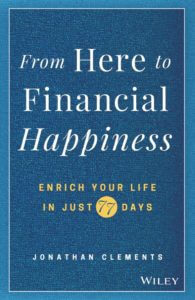
In all, the newsletter offers 31 key questions to ponder. The questions are drawn from my new book, From Here to Financial Happiness, which takes readers on a 77-day journey that helps them figure out where they stand, what they want and what steps they ought to take next. For the next seven days, the hardcover will be available from Amazon for less than $22.50—a 25% discount from the cover price. The Kindle edition, meanwhile, costs $11.99.
Haven’t visited HumbleDollar in recent weeks? Our latest newsletter also offers a rundown of the blogs we’ve published so far this month.
The post Newsletter No. 32 appeared first on HumbleDollar.
My Favorite Questions
YOU’RE UNLIKELY to get the right answers—unless you ask the right questions.
That’s especially true when it comes to managing money. We have answers thrust in our faces all the time, as marketers and salespeople exhort us to buy this mutual fund, that car, this stock, that home and this insurance policy.
But are these really what we want or need? It’s hard to know unless we ask the right questions. There’s ample evidence that many folks end up with financial products they don’t need and spend money in ways that bring little or no happiness. It isn’t that we can’t figure out the answers—but to do so, we need to eschew snap decisions and instead take the time to ponder key questions, so we build the financial life we truly want.
That’s the goal of my new book, From Here to Financial Happiness, which was published last week by John Wiley & Sons. The book takes readers on a 77-day journey that helps them figure out where they stand, what they want and what steps they ought to take.
I view all this as a conversation, with questions posed by me and plenty of room in the book for readers to write down their answers. Want to make sure you squeeze maximum happiness from your spending, buy the right portfolio, pursue the goals you really care about and avoid major money mistakes? Consider these 31 questions—all of which are drawn from my new book:
If money were no object, what would you change about your life?
What are your top financial worries?
What are the three smartest financial moves you’ve ever made?
What do you consider your three biggest financial mistakes?
How much financial help should you give a child?
When in your life were you happiest, what made it a happy time—and what role, if any, did money play?
What’s the minimum amount of money you need each month to keep your financial life afloat?
If you were out of work, how long could you cover expenses before having to take drastic financial steps?
What did you learn about money from your parents—and which of these beliefs have you adopted as your own?
Think of three people you know who are in great financial shape. What have been the keys to their financial success?
Is it important to you to drive a nice car and, if so, why?
In the typical week, which moments do you enjoy the most—and which do you dislike the most?
Is getting rich one of your overriding life goals?
Think about your weaknesses. Are they acceptable human failings—or are they inflicting major damage, including major financial damage?
Who depends on you financially—and how would they cope if you suffered an
 untimely demise?
When is it okay to go into debt?
Think about your life’s major expenditures, like buying homes, purchasing cars, remodeling projects, expensive vacations and paying for college. Which are most likely to make you smile and which ones disappointed you?
What’s on your wish list for major expenditures in the years ahead?
Do you believe a home is a good investment? Why?
What’s your net worth—the value of everything you own, minus all debt?
Does your stock-bond mix reflect your paycheck or lack thereof?
Imagine your perfect retirement day. How would you spend it—and would you be happy doing these things every day for the rest of your life?
Are there children—either your own or somebody else’s—whom you’d like to help financially, and what sort of assistance would you like to provide?
In late 2008 and early 2009, did you buy stocks, sell or sit tight?
How much do you pay in investment costs each year?
If you weren’t burdened by the knowledge of what you hold, what you sold and how markets have fared, would you own your current portfolio?
If you take your bonds and other interest-paying investments, and subtract all your debts, what’s your net bond position?
Are you on track to have all debt paid off by retirement?
If you died tomorrow, would you bequeath a mess?
When was the last time you talked honestly about your finances with somebody?
If you were writing your own obituary, what accomplishments would you include? In the years ahead, what further accomplishments would you like to add?
Special Offer
For the next seven days, the hardcover edition of From Here to Financial Happiness will be available from Amazon for less than $22.50—a 25% discount from full price. Meanwhile, the Kindle edition costs just $11.99. You can also purchase the book from Barnes & Noble and elsewhere.
Latest Blogs
“Americans say it would take $2.4 million to be considered truly wealthy,” writes Richard Quinn. “Only 5% come close. Many more just live like they have that much.”
How does Alan Cronk gauge his son’s money management, now that his son is on his own? “Shortly after graduating in 2016, his credit score was an excellent 810. Today, it stands at a still healthy 791.”
A group of Kanye West’s stock picks has beaten the market by 40 percentage points this year. Adam Grossman asks, what can we learn from his performance?
Dennis Quillen on his divorce: “My wisest decision was preserving my annuity income, mutual funds, future freelance earnings and other income streams, while sacrificing things like the condo, the newest car and lots of furniture.”
What were folks reading on HumbleDollar last month? Check out the seven most popular blogs.
“After the market closed on Oct. 19, I called a stockbroker friend. He said there was sure to be rioting, so he was going to drive into the city, collect his mother from Queens and whisk her to safety.”
Worried about the stock market’s heady gains and considering commodities, hedge funds and other alternative investments? Adam Grossman has a suggestion: Look at bonds instead.
“I kept my cars until it didn’t make economic sense to repair them,” Dennis Friedman recounts. “I learned that, if you were a good saver, you didn’t have to be a good investor to reach your financial goals.”
A financial planner has been stealing content from HumbleDollar without permission. We got our revenge.
“I buy $40 in lottery tickets on the first day of each month,” admits Richard
 Quinn. “Many years ago, this was part of my retirement plan—the years when I was young and foolish, or maybe just foolish.”
Underpay your own income taxes and you could face modest tax penalties. But fail to pay your employees’ income taxes and things could get really ugly, warns Julian Block.
It looks like retirees will receive Social Security checks that are around 2.7% larger in 2019. Richard Quinn explains the calculation—and debunks two pervasive myths.
Follow Jonathan on Twitter @ClementsMoney and on Facebook . His most recent articles include Striking a Chord, Tell Us a Story, Bad News and No Place Like Home.
The post My Favorite Questions appeared first on HumbleDollar.
September 14, 2018
Archie Is Scum
A FINANCIAL PLANNER called Archie Nickel is stealing entire articles from HumbleDollar and posting them to his own site—without permission. In the online world, it’s fine to link to interesting articles elsewhere on the web. But it’s a no-no to swipe entire articles. I’ve endeavored to contact the nefarious Nickel, by posting comments on his site and via Twitter, but he’s ignored my requests to stop purloining this site’s blogs and and to remove the blogs he’s previously stolen.
This is my revenge.
It seems Nickel is taking every article from this site’s RSS feed and automatically adding them to his site. When I hit publish, the headline “Archie Is Scum” will appear on his site. (I subsequently took a screen shot of his homepage. Take a look to the right.)
Happy Friday, Archie.
Follow Jonathan on Twitter @ClementsMoney and on Facebook . His new book, From Here to Financial Happiness, can now be ordered from Amazon and Barnes & Noble. Jonathan’s most recent articles include Striking a Chord, Tell Us a Story, Bad News and No Place Like Home.
The post Archie Is Scum appeared first on HumbleDollar.


