
Jonathan Clements's Blog, page 405
August 22, 2018
Family Resemblance
THERE’S LITTLE difference between the typical American family’s spending habits and that of our federal government—and many state governments as well. We run our government like many Americans run their financial lives, living above our means, seeking instant gratification, saving inadequately, showing little concern for the future, supporting our lifestyle with debt and denying the risks we face.
According to the Congressional Budget Office, all the major trust funds are headed for insolvency in the near future. The CBO projects that the federal government’s highway, disability insurance, Social Security retirement benefits and Medicare trust funds will all be exhausted by 2032 without action to stabilize their finances.
In seems, as a society, we always want more and yet rarely ask how or who will pay for what we want—or even if it will be paid for. To achieve our social goals, we borrow and borrow and put future financial concerns on the back burner.
This is similar to what Americans do as individuals. Our saving rate is notoriously low and our debt high. Reports vary, but it appears about 40% of U.S. households carry credit card debt. One study found that the average household that carries credit card debt has a balance that exceeds $15,000 at an interest rate of about 15% and a late payment rate of 30%. Most individuals admit the debt is mostly due to unnecessary spending.
More (ahem) good news: To their liabilities, each American can add $64,000 for their share of our national debt. The annual interest on federal debt is more than $294 billion and growing, with over $80 billion of that going toward current Social Security benefits. What about federal spending cuts? We don’t like them. Some claim we can afford more spending because we are the “richest country in the world.”
On a personal level, look at any survey and you will find money to be the first or second reason for discord between couples. We don’t seem to be able to handle money well at either the government or the household level. All the while, retirement is looming. Younger Americans don’t think they will collect much, if anything, from Social Security, while others overestimate what it will provide. According to survey responses, three-quarters of Americans are behind on their retirement planning. The reality: Americans as a group simply aren’t prepared for retirement.
And neither is the U.S. government. Social Security is spending down its reserves. Sooner or later, our financial problems must be dealt with on both an individual and national level. Dealing with our national budgetary issues will likely mean higher taxes or lower government benefits, thereby compounding individual fiscal problems. Warning: Trouble ahead. Plan accordingly.
Richard Quinn blogs at QuinnsCommentary.com. Before retiring in 2010, Dick was a compensation and benefits executive. His previous blogs include Late Start, Ten Commandments and Running on Empty. Follow Dick on Twitter @QuinnsComments.
The post Family Resemblance appeared first on HumbleDollar.


August 21, 2018
Powerful Partners
I JOINED MY company’s 401(k) plan at age 25. Now, I’m 51. Over the intervening 26 years, there have been many market cycles, recessions, bull markets, a financial crisis and countless periods of market volatility.
Still, my 401(k) is well on its way to being big enough for a comfortable retirement. How did it get there? A third of the balance came from my contributions, a third from my employer’s matching and profit sharing contributions, and a third came from investment gains. The stock market, my employer and I have proven to be powerful partners.
A recent report stated that the preferred 401(k) investment for millennials is cash. That might seem like a safe choice. But inflation has averaged 2.9% a year over the past 40 years, wiping out any return from holding cash. The two strongest wealth accumulation weapons in a young person’s arsenal are time and the power of compounding. The U.S. economy has grown steadily for the last 225 years, with only occasional and brief periods of slowdown. Not betting on this strong economic horse—by failing to invest in the stock market—is a terrible mistake.
Fortunately, I didn’t make that mistake. In addition to saving diligently, here are the three things I did right over the years:
I have been consistently invested, through good times and bad, in a diversified portfolio of stocks.
I have not tried to time the market based on gut feelings. The S&P 500 has risen in 73 of the past 100 calendar years and market returns have bested the inflation rate in 80 of those years. Attempting to improve on those odds, by darting in and out of the stock market, is simply not a good bet to make.
I never took a 401(k) loan. When you borrow from your 401(k), the sum involved is removed from your account. That means your money isn’t working for your benefit—and that’s a lost opportunity for growth.
Not all my moves were smart. I occasionally purchased individual stocks. For example, in February 2000, I bought a small tech stock at the peak of the dot-com craze. It lost most of its value over the next year. I kept the shares in the account for the next 15 years at its tiny market value. It was a constant reminder that buying individual stocks in a retirement account is a bad idea. In retrospect, that foolish investment paid off—because it helped keep me on the straight and narrow.
C.J. MacDonald is a portfolio manager with Westwood Wealth Management in Dallas and the author of Basis Points, Westwood’s market insights and commentary blog. Follow C.J. on Twitter @WestwoodCJMacD.
The post Powerful Partners appeared first on HumbleDollar.
August 19, 2018
Eight Heroes
A CURIOUS THING happened in Stockholm in 2013. The Royal Swedish Academy of Sciences awarded the Nobel Prize in economics to three academics who had developed theories about stock prices. What was odd was that two of the recipients—Eugene Fama and Robert Shiller—couldn’t have been more opposed in their viewpoints.
Fama believes that stock prices are always rational and that there’s no such thing as a market bubble. Shiller believes that stock prices are often irrational and that bubbles do occur. And yet the Nobel Committee gave them both the same prestigious award, implying that their conclusions were equally valid.
This always struck me as nonsensical. Either the Earth is flat or it’s round. It can’t be both. In the case of stock prices, the data are clear: Shiller’s point of view makes more sense. Stock prices get out of whack all the time. Investors overreact and bubbles form frequently. Even Fama himself has halfheartedly acknowledged this, saying that his theory is just “a model” and that it is “difficult to prove” and “not always true.”
Why am I hung up on this? A Nobel Prize is like a Good Housekeeping seal of approval. In my opinion, the Swedish Academy did a disservice to individual investors by validating two opposing theories. It’s like telling people that you can eat a balanced diet or that you can eat cheeseburgers at every meal, and that both approaches are equally valid.
From my point of view, as a financial advisor, the people most deserving of awards are those who have done the most to educate—and advocate for—individual investors. They are the true heroes in personal finance. If you are looking to develop your own personal finance knowledge and skills, here are eight individuals who, I think, deserve your attention:
Ben Graham. Well known as Warren Buffett’s teacher and mentor, Graham also shared his wisdom in a set of timeless books. Most memorably, in The Intelligent Investor, Graham explains investor psychology using an invented character called Mr. Market. What he says about investing is as true today as it was when the book was published in 1949.
Warren Buffett. Revered for his investment skills, Buffett is a hero in my book for the efforts he has made to educate individual investors. In each of his annual letters to shareholders, he devotes space to providing investment advice for ordinary individuals. It’s an incredible public service. You can find 40 years’ worth of Buffett’s letters on his website.
David Swensen. As the longtime manager of the top-performing university endowment, Yale University’s David Swensen knows a thing or two about beating the market. But he also knows that individuals aren’t afforded the same investment opportunities as giant universities. It’s an important point: Yes, you can make a fortune in hedge funds and other exotic investments, but only if your business card has Harvard or Yale on it. Swensen’s book Unconventional Success lays out the argument in clear terms.
John Bogle. Vanguard Group founder Jack Bogle started one of the first index funds in 1976. Even today, at age 89, he does more than almost anyone to articulate for consumers the benefits of keeping costs low. And his company has been extremely effective at pressuring all of its competitors to lower prices. This has benefited consumers immeasurably. Bogle has written several books. I would recommend Enough or The Little Book of Common Sense Investing.
Terrance Odean. A finance professor at the University of California at Berkeley, Terry Odean is not a household name, but he ought to be. He conducted a series of studies that examined the behavior of individual investors, often in conjunction with fellow academic Brad Barber. While many people say that it’s difficult to beat the market, Odean proved it, by studying the results of thousands of individual brokerage accounts. But he didn’t stop there. More recently, Odean produced an educational—and entertaining—series of videos, which are available at no cost on YouTube. If you watch the one entitled Save Early, Save Now, be sure to stick around for the final 13 seconds.
Seth Klarman. In addition to being one of the world’s most successful hedge fund managers, Klarman has done the best job, in my view, of debunking the flawed-but-standard textbook notion that an investment’s risk can be summarized in one number. Klarman’s book is out of print and sells for about $1,000 on eBay. But you can learn a lot from interviews that he has given over the years, including this YouTube video.
Howard Marks. The founder of Los Angeles-based Oaktree Capital, Marks is an incredibly clear thinker and shares his commonsense ideas with the public in periodic memos. Like Klarman, Marks departs from the less-than-useful textbook approach to thinking about risk. Especially in the 10th year of a bull market, I would recommend subscribing to Marks’s memos, which are available at no cost on Oaktree’s website.
Nassim Nicholas Taleb. A retired trader, Taleb uses the analogy of a black swan—a phenomenon that is very rare but does actually exist—to make an important point: Just because something has never happened before, or just because you have never seen it yourself, doesn’t mean that it can’t happen. Taleb’s bestselling book The Black Swan deserves a place on your bookshelf. Yes, the past is a guide to the future. But it is not a perfect roadmap.
Adam M. Grossman’s previous blogs include Separated at Birth, Non Prophet, Stress Test and All of the Above . Adam is the founder of Mayport Wealth Management , a fixed-fee financial planning firm in Boston. He’s an advocate of evidence-based investing and is on a mission to lower the cost of investment advice for consumers. Follow Adam on Twitter @AdamMGrossman .
If you purchase any of the books listed above by clicking through to Amazon using the embedded hyperlinks, HumbleDollar earns a small referral fee.
The post Eight Heroes appeared first on HumbleDollar.
August 18, 2018
Newsletter No. 30
YOU CAN’T GET high returns without taking high risk—and yet many investors believe that U.S. stocks are not only safer than foreign shares, but also pretty much guaranteed to outperform over the long haul. I take a look at this muddled thinking in HumbleDollar’s latest newsletter.
I’m now putting out the newsletter twice a month, in large part because email subscribers were requesting a regular list of HumbleDollar’s latest blogs. You’ll find that list in the newsletter, as well as details of other changes here at HumbleDollar.
The post Newsletter No. 30 appeared first on HumbleDollar.
No Place Like Home?
WE CAN’T CONTROL the financial markets. But we can pretty much guarantee we’ll pocket whatever the stock and bond markets deliver—by buying index funds. So why do I hear so much grousing from indexers?
At issue isn’t a failure of index funds, but rather a failure of investors’ expectations. Over the past few months, I’ve heard from countless hardcore indexers who have done the sensible thing and built globally diversified portfolios. Often, they own some variation of the classic three-fund portfolio: a total U.S. stock market index fund, a total international stock index fund and a broad U.S. bond market fund. Yet they have a gnawing sense of unease—because their portfolio hasn’t kept up with the U.S. stock market averages.
 As stocks have soared while interest rates have bumped along at miserably low levels, many investors have written to me, questioning the need to own bonds. More recently—and, to me, more troubling—the disdain has extended to foreign stock markets.
This, of course, smacks of performance chasing. Over the past five years, the S&P 500 has clocked 13.1% a year, while MSCI’s Europe, Australasia and Far East index has eked out a 5.9% annual gain and the Bloomberg Barclays Aggregate Bond index has managed just 2.3% a year. The past few weeks will, no doubt, further fuel investors’ discontent. Foreign stocks have taken it on the chin, their prices knocked down by turmoil in Turkey and a strengthening U.S. dollar. The latter cuts the value of foreign shares for U.S. holders.
What we’re seeing, however, is more than just performance chasing. From the comments I’ve received, there’s a pervasive belief that U.S. stocks are both safer and offer higher returns, and that foreign stocks are both riskier and destined to underperform. I’ve heard from folks who complain about sketchy accounting and weaker property rights abroad, which suggest foreign stocks are a dodgier proposition. In the next sentence, they’ll tell me that international markets have always underperformed and will always underperform. They then go on to say that they can get all the foreign exposure they need with U.S. multinationals, which they happily acknowledge perform just like U.S. stocks.
Got all that? Maybe it’s time to revisit first principles—and recall both the reasons we diversify and the unbreakable connection between risk and reward.
When we spread our investment bets widely, we’re looking for both short- and long-term portfolio protection. In the short-term, owning thousands of securities from different parts of the global market will give us a less volatile portfolio, as some securities zig when others zag. Meanwhile, over the long haul, global diversification increases the odds that we’ll meet our financial goals, because there’s less risk our portfolio’s performance will be badly derailed if one or two parts of the financial markets post truly wretched returns.
“I believe every investor should look at his or her investment mix and ask, ‘What if I’m wrong?'”
We won’t get this short- and long-term protection if our sole investment is U.S. stocks, including U.S. multinationals. Nothing is going to zig when our U.S. stocks zag, so we lose the short-term portfolio protection. What about the long haul? We’ll be sunk if the next decade sees U.S. stocks sink.
That brings me to the contention that U.S. stocks are both safer and sure to outperform over the long term. I find this bizarre. Remember, these comments are coming from folks who have drunk the Kool-Aid, accepted that markets are efficient and banked their life’s savings on index funds.
If we accept that markets are efficient, we’re buying into the notion that all parts of the financial markets have similar risk-adjusted expected returns. True, those expectations almost certainly won’t be met: Some market segments will do surprisingly well, while others will disappoint.
Nonetheless, our starting assumption should be that risk and expected return are joined at the hip. We shouldn’t start with the idea that one market—the U.S. stock market, in this case—is not only safer, but also pretty much guaranteed to deliver superior returns. If that were the case, rational investors everywhere would buy U.S. stocks, driving up their price and eliminating this free lunch.
This raises an obvious question: Are U.S. stocks in a bubble? I am loath to even mention the word. I feel we’re too quick to slap the “bubble” label on any asset that’s recently performed well. Much of the time, bubbles are only apparent later, when we look back and marvel at the magnitude of the comeuppance and clearly see the folly that preceded it.
But bubble or not, many U.S. investors—including many indexers—are displaying an alarming degree of home bias. U.S. stocks may offer comforting familiarity. But they’re also more expensive than other major markets, and they alone don’t make a good portfolio.
I believe every investor should look at his or her investment mix and ask, “What if I’m wrong?” What if U.S. shares are priced so richly that a decade of terrible performance lies ahead? I’m not predicting it will happen, but I can’t be sure it won’t—and I don’t want the consequences of that potentially terrible performance to nix my retirement. That’s why I have roughly a third of my portfolio in U.S. stocks, a third in foreign stocks and a third in bonds. I won’t end up with the greatest returns. But I’m pretty confident I won’t end up broke.
Back So Soon
STARTING WITH THIS ISSUE, I’m increasing the frequency of this newsletter to twice a month. A big reason: Email subscribers have been asking that I regularly put out a list of new blog posts. Your wish is granted: Below, you’ll find links to the articles that have been published since the last newsletter.
Keep in mind that HumbleDollar’s homepage doesn’t just include five or six new blogs each week. There’s also a slew of other features, including intriguing statistics, action items, daily insights, an archive feature and highlighted sections from our comprehensive money guide. If you want to see these other features, make a point of checking out the homepage on a regular basis.
 Readers have also asked that I make it easier to comment on blogs, newsletters and money guide sections. Before, you needed a Facebook account to comment. Now, you can comment if you have a Facebook, Google or Twitter account, or—alternatively—if you set up a username and password with Disqus, which built the commenting system that’s now installed on HumbleDollar.
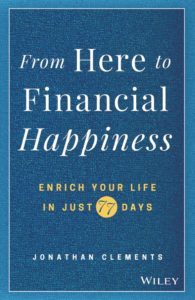
My new book, From Here to Financial Happiness, is available for preorder. It’s officially out Sept. 5. Finally, if you haven’t already, please give the Two-Minute Checkup a test drive—and then tell us what you think by clicking the survey link at the bottom of the spreadsheet.
Latest Blogs
Forget trying to time the market—and instead make sure you have enough in cash and bonds to ride out a stock market decline, writes Adam Grossman.
Want to help your teenagers build their own credit history? Add them as authorized users to your credit cards, suggests Alan Cronk—but only if you use your cards responsibly.
Read about how veteran financial journalist Mary Rowland came to lose most of her left side to amputation—and what she learned.
Want a comfortable retirement? Richard Quinn offers 10 commandments.
Fidelity has slashed its index-fund expenses and scrapped its investment minimums. What does it mean for investors? Here are answers to five key questions.
What happens when a mutual fund is offered as a Collective Investment Trust in a 401(k)? Sometimes, it gets cheaper—and sometimes investors get gouged, says Adam Grossman.
When disaster strikes, who are you going to call? Dennis Friedman looks at the
 financial first responders in his life.
Not sure you have enough health expenses to claim a federal tax deduction? Don’t overlook medically mandated home improvements, says Julian Block.
“Never drink anything but beer or coffee. Water will rust your insides,” plus other lessons (financial and otherwise) that Joel Schofer learned from his two grandfathers.
Couples are having kids later—which means college costs hit just as parents are looking to retire. What to do? Richard Quinn offers nine tips.
Follow Jonathan on Twitter @ClementsMoney and on Facebook .
The post No Place Like Home? appeared first on HumbleDollar.
August 17, 2018
Late Start
I WAS 45 YEARS old in 1988. That year, my oldest child started college and, the next year, my second son. Two years later, it was my daughter’s turn. The year after, my youngest went off to college. I had at least one child in college for 10 years in a row.
I bet you think this is a story of college loans and other debt. Nope, it’s about retirement planning. After going into major debt and using all my assets, other than my 401(k), I had several years to recover. Fortunately, I was also eligible for a pension—and I eventually retired at age 67.
In 2018, things are very different. Today, all my children have kids in elementary school—at an age when my children were going off to college. My oldest son, now age 48, will be nearly 60 when his oldest child starts college. The second son, age 47, will be 63 when his youngest graduates high school. The situation is similar for my other children and, it seems, for many in their generation.
See where I’m going with this? Saving for both retirement and college has always been a challenge. But there used to be a gap between the end of one and the start of the next. That gap is disappearing.
The age at which women have their first child has been rising for decades. In 2016, the Center for Disease Control reported that, for the first time, women in their early 30s were having more children than those in their late 20s.
None of my children has a pension. My advice to them is save for retirement first. To help with college costs, my wife and I contribute to our grandchildren’s 529 plans in lieu of birthday and other gifts.
In my view, the long-term solution to college costs is rethinking the entire post-secondary education process, including the number of years spent in college and better defining which jobs truly require a four-year bachelor’s degree. But until that happens, most Americans have no easy funding solution. Still, here are nine tips:
Start saving early for college, even if it’s only small amounts.
Spend less on birthday and holiday gifts, and divert more to an education fund. Ask relatives to do the same.
Explore funding opportunities such as 529 plans, Coverdell education savings accounts and even Roth IRAs.
Consider the pros and cons of putting college savings in your 401(k) or IRA if you will be age 59½ or older when the funds are needed. Retirement accounts are a mixed bag when it comes to financial aid: They may not count as assets in the aid formulas, but withdrawals will count as income.
As your child gets closer to college age, research the best loans and investigate opportunities for grants.
Consider starting with two years at a community college, and perhaps earning an associate degree, and then transferring to a better-known institution from which your child will then earn his or her bachelor’s.
Consider the educational assistance programs offered by the Department of Veterans Affairs.
Instead of shooting for the best big-name private college and the debt that may come with it, try to match your child’s goals with the best affordable school. If the teenager’s goals are poorly defined, as they likely will be, a decent state school may do the job.
Most of all, don’t sacrifice saving for your own retirement. There are no good alternatives to getting old.
Richard Quinn blogs at QuinnsCommentary.com. Before retiring in 2010, Dick was a compensation and benefits executive. His previous blogs include Ten Commandments, Running on Empty, Taking Your Lumps and Pain Postponed. Follow Dick on Twitter @QuinnsComments.
The post Late Start appeared first on HumbleDollar.
August 16, 2018
Two Grandpas
UNLIKE ROBERT KIYOSAKI, I only have one dad. I did have two grandfathers, though, and one died recently. The other died a few years ago. One was rich and one was poor. Well, he might not have been poor, but he was poorer than the one who just died. What did they teach me?
My poor(er) grandpa worked odd jobs his whole life. He never owned a business that I was aware of. I don’t think investing was his thing, because he never had all that much money. He had a low-six-figure retirement nest egg and he had Social Security. Frankly, all he wanted to do was bowl. He had a 300 game once, which I think was his life’s crowning achievement.
Despite his lack of financial acumen or success, he never really wanted for anything. After his wife—my grandmother—developed dementia and moved into a nursing home, he lived independently up until the end of his life in a small apartment that was near his children and the bowling alley. He drove a perfectly fine car. He went out for meals when he wanted, his favorite meal being well-done steak at any local diner. He had Medicare for his health insurance. What’s the lesson here?
Poor Grandpa Lesson No. 1: A modest lifestyle and low spending will make up for a less-than-impressive nest egg.
He lived into his 90s despite severe heart and vascular disease, prostate cancer, and smoking nearly his whole life. He stayed mentally intact the entire time, and was bowling right up until the end. What was his secret? As he told me many times…
Poor Grandpa Lesson No. 2: “Never drink anything but beer or coffee. Water will rust your insides.”
My rich grandpa died recently, and there are many things you can learn from his financial life. He lived in a small town in Pennsylvania that had a population of 2,069 in the 2010 census. In that town, he ran a small business that sold furniture and operated a funeral parlor. As he once told me, the furniture makers made the coffins, so the businesses were linked in the old days. He and his brother worked for his father, who ran the business before them. Running this small business allowed him to build a net worth that was significant by anyone’s definition.
Rich Grandpa Lesson No. 1: The easiest way to become wealthy is to own a business.
He never owned more than one car while I knew him, although his business owned delivery trucks he could use. He lived in the same house the entire time, which was a modest brick house on the town’s main street. It was 2,300 square feet, four bedrooms, two baths, and sold for $185,000 in 2015, when he moved into a nursing home. According to Zillow, it is now worth $197,639. He had the same spouse, my grandmother, and never divorced.
Rich Grandpa Lesson No: 2: One Spouse+One House=Path to Wealth.
During his life, he periodically purchased stock in a local bank. Over the years and after 20 or so bank mergers, that local bank was now a subsidiary of a large international bank. Along came the 2008-09 financial crisis… and that investment was worth only a small fraction of what it once was. A very small fraction.
Rich Grandpa Lesson No. 3: Diversify to reduce risk. Don’t put all your financial eggs in one basket.
There is one final lesson that I learned from my rich grandfather that I’ll never forget.
Rich Grandpa Lesson No. 4: If you are a young boy and want to see nudity for the first time, go on a furniture delivery with your grandpa who owns a furniture store. There just might be a Playboy calendar hanging above the kitchen table.
Joel M. Schofer, MD, MBA, is a Commander with the U.S. Navy’s Medical Corps. His previous blogs for HumbleDollar include My Favorite Word, Winning the Game and Getting Used. He blogs about personal finance at MilitaryMillions.com and can be reached at Still-In@MilitaryMillions.com. The views expressed here are those of the author and do not necessarily reflect the official policy or position of the Department of the Navy, Department of Defense or the U.S. Government.
The post Two Grandpas appeared first on HumbleDollar.
August 15, 2018
Doctor’s Orders
SOME OF MY CLIENTS incur hefty medical expenses for themselves and family members. I tell them not to expect too much help from the IRS when it comes to deducting such expenses—unless the costs are well into five figures.
To deduct medical costs, taxpayers have to forego the standard deduction and instead itemize on Schedule A of Form 1040. Their expenses also have to be for bills that aren’t covered by insurance or reimbursed by employers.
The big hurdle: The expenses have to be sizable. Not only do taxpayers’ total itemized deductions have to exceed 2018’s much higher standard deduction, but also medical expenses are deductible only to the extent that their total in any one year exceeds a specified percentage of adjusted gross income. Congress keeps changing the percentage.
I remind clients that they did get some help from the tax law passed by Congress in December 2017. True, the legislation abolishes or curtails many long-cherished write-offs—for example, exemptions for dependents, and write-offs for property taxes, and state and local income taxes.
But lawmakers included a provision that slightly liberalizes how much can be claimed for medical expenses. They replaced a threshold of 10% with a threshold of 7.5% for 2017 and 2018. The threshold reverts to 10% for the years 2019 through 2025.
More important, amid all the nitpicky tax rules, taxpayers often overlook a key notion: Deductible expenditures include more than just outlays for doctors, hospitals, eyeglasses, hearing aids, insurance premiums and the like. Taxpayers also are entitled to claim payments for medically-mandated home improvements, as well as the installation of special equipment or facilities in their homes.
That doesn’t mean, however, that they’re able to deduct all of their payments for equipment or improvements. Those kinds of payments are allowable only to the extent they exceed increases in the value of their homes.
An example: An allergist advises a child’s parents to install an air cleaning system and other kinds of equipment because the child is asthmatic. The aggregate cost is $20,000. The improvements result in an increase of $15,000 in home value. With those numbers, the parents’ allowable deduction is only $5,000.
Other examples of improvements or equipment that readily pass IRS muster are elevators or bathrooms on lower floors that makes things easier for persons who are arthritic or have heart conditions. More liberal rules apply when doctor-recommended improvements are made by tenants to rental properties—for instance, wheelchair ramps. Renters can claim all of their costs because the improvements don’t boost the value of a dwelling they own. Whether individuals are owners or renters, their deductibles include all of their payments for detachable equipment, such as window air conditioners that relieve medical problems.
The IRS cuts some slack for homeowners when they’re unable to deduct the cost of improvements, because those costs don’t exceed increases in the value of their homes. The agency says they still can deduct amounts spent operating and maintaining equipment. Such expenses might include electricity, repairs and service contracts, as long as the equipment remains medically necessary.
J ulian Block writes and practices law in Larchmont, New York, and was formerly with the IRS as a special agent (criminal investigator). His previous blogs include In Your Debt, Moving Costs and Anti-Social Security. Information about his books is available at JulianBlockTaxExpert.com . Follow Julian on Twitter @BlockJulian.
The post Doctor’s Orders appeared first on HumbleDollar.
August 14, 2018
First Responders
MY DOCTOR TOLD ME that my white blood cell count has been trending lower for the past five years. He was concerned there was something going on with my immune system and wanted me to see an oncologist.
The oncologist performed a number of tests and couldn’t find anything that would have caused my condition. He wasn’t concerned about my ability to fight off infections because my absolute neutrophil count was in an acceptable range. He went on to explain that neutrophils are one of the most important types of white blood cell, because they’re a first responder to any infection. They can travel through the walls of blood vessels and tissue to combat injury and illness.
That got me thinking about other parts of my life—and I realized there are financial neutrophils, which also act like first responders. They come in different forms: a financial asset, an insurance policy, your spouse, a best friend. Their job is to combat those unexpected expenses that threaten your financial security. To do this, they need to be readily available, so you can deploy them at a moment’s notice.
According to a 2015 report by the Pew Charitable Trusts, 60% of households experienced one or more financial shocks over the prior 12 months, with the most expensive shock typically costing $2,000. Pew defines a financial shock as an unexpected expense, such as a job loss, injury, illness, death, or a major auto or home expense.
The best first responder against a job loss, as well as an unexpected household or auto expense, would be a six-month cash emergency fund that would cover your living expenses. This would allow you time to find another job and pay for any major repairs. If necessary, you can also use money from a Roth IRA, because you can withdraw your contributions at any time without paying taxes or penalties.
The Kaiser Family Foundation found that 26% of U.S. adults had difficulty paying their medical bills over the prior 12 months. This number includes people who have health insurance. High medical expenses can lead to financial bankruptcy. The best first responders against an injury or illness would be a combination of health insurance, a health savings account, disability insurance and a six-month cash emergency fund.
Here are some other first responders you might deploy when unexpected expenses hit:
Term life insurance offers low-cost financial protection, should your spouse or significant other die.
Home and auto insurance can help protect you from natural disasters, such as floods, fire, earthquakes, hurricanes and tornadoes.
A personal umbrella liability policy provides added protection against legal claims made against you.
A home equity line of credit and a credit card with an available balance can help cover major expenses when you’re short on cash.
And don’t forget family and friends. They can be a valuable resource in protecting you from unexpected costs. According to a Wall Street Journal article, “an estimated 34.2 million people provide unpaid care to those 50 and older. These caregivers, about 95% family, and long the backbone of the nation’s long-term care system, provide an estimated $500 billion worth of free care annually.” Having family and friends nearby, who are willing to provide assistance at times of need, can save you thousands of dollars.
First responders are not intended to grow your portfolio, as a stock would. Instead, they protect you from sacrificing your financial future for an unexpected major expense. They can also help you avoid bankruptcy. They make you feel safe and secure, offering invaluable peace of mind.
Dennis Friedman retired at age 58 from Boeing Aerospace Company. He enjoys reading and writing about personal finance. His previous blogs include Truth Be Told, Mind Games and Looking Forward.
The post First Responders appeared first on HumbleDollar.
August 12, 2018
Separated at Birth
IF YOU’RE A FAN of basketball, you may be familiar with the Lopez twins—Brook and Robin. On the surface, they are identical in every way. Both stand seven feet tall. Both went to Stanford University. Both entered the NBA draft in 2008 and both were picked in the first round. Since then, both have enjoyed successful careers.
A casual observer would be hard-pressed to see any difference between the Lopez twins, but there is one: While they are both impressive players, they have different styles and, over the course of his career, Brook has delivered somewhat better performance. This, in turn, has contributed to greater career success. Like all NBA players, both have earned millions, but Brook’s cumulative earnings have been 80% higher than Robin’s.
When it comes to your investments—and especially your retirement accounts—it’s critical to be aware of a similar kind of “twins” problem that could have a material impact on your savings.
As you may know, mutual fund companies use a concept known as “share classes” to charge different investors different prices. Depending on how you purchase a fund and how much of it you purchase, you may pay a higher or lower price. At Vanguard Group, if you want to buy its fund that tracks the S&P 500 Index, you have four choices: Investor Shares, which cost 0.14% per year; Admiral Shares, which cost 0.04%; Institutional Shares which cost 0.035%; and finally, Institutional Plus Shares, which cost just 0.02%. The underlying investments are identical in all four cases. It’s just the price that differs.
Other fund companies use their own terminology to distinguish among share classes. In many cases, you will see Class A, Class B and Class C. Again, the underlying funds are all the same; it’s just the fees that are different.
Altogether, in the U.S., there are approximately 8,000 different mutual funds. But when you add up all the share classes, there are more than 25,000 different fund options available to investors.
This can be confusing, but at least the share class designation is included wherever you see the fund’s name, and ticker symbols are unique to each share class. That allows you to use publicly available data sources, such as Morningstar, to compare funds and share classes.
When it comes to your retirement account, however, it’s more complicated, owing to a growing trend known as Collective Investment Trusts (CITs). In simple terms, a CIT is a private fund established by an investment firm for an individual employer. It will be an exact replica of a fund available to the public. But here’s what’s tricky about them: CIT funds have names that are identical, or nearly identical, to their publicly-traded siblings, but their fee structures are usually very different.
Let’s look at an example—a popular fund called Vanguard Target Retirement 2040. Suppose your employer offered this fund in your company 401(k) and you wanted to research it. You could go to the Vanguard website, where you would find a detailed description of the fund and its holdings. You would also see the available share classes and associated fees. In this fund’s case, you would find it available as Investor Shares, costing 0.15%, or Institutional Shares, for 0.09%. By any standard, either of those fees would be quite reasonable, so you might decide to invest.
But here’s the catch: Your company’s variant of the Vanguard Target Retirement 2040 might be something entirely different. It might be a CIT, with its own customized price, created either by Vanguard or by a third-party record keeper especially for your employer. But it can be hard to know. Since CITs aren’t available to the public, they don’t carry ticker symbols and this makes them impossible to research using the usual publicly available resources.
The impact could be significant. In the case of Vanguard Target Retirement 2040, which is available to the public for either 0.09% or 0.15%, I have seen CIT versions which cost as little as 0.05% and as much as 0.91%. The latter version would have been created by a third-party record keeper, and the cost likely includes a host of “administration” costs. To put it in dollar terms, if you have $100,000 in your account, a 0.05% fee would cost you $50 per year, while a 0.91% fee would cost you $910. And you would incur that cost every year.
In the past, CITs were less of a consideration. In 2011, fewer than half of retirement plans offered them. But, by 2016, that number had risen to two-thirds and they are growing quickly. In some cases, this is a good thing. If you work for one of the companies that is able to offer funds for less than they are available to the public, that’s great. But you’ll need to do your homework. Here are three suggestions:
Check your employer’s plan documentation to be sure you know exactly which variant of each fund it’s offering. Look up the fee on each one. Often, these fees won’t appear on your statement, but they will be in supplementary materials you’re entitled to review.
Recheck your selections periodically—perhaps once a year. That’s because fund companies raise and lower fees from time to time, and you might miss the change within the fine print.
Be especially careful of target-date funds like the Vanguard fund I used as an example here. These funds are popular, because they’re designed to reduce risk over time as you approach retirement. But perhaps because of that popularity, I have noticed in many plans that the target-date funds are among the most expensive options. If that’s the case, it may be possible to purchase the constituent parts for less. To find out, check your employer’s fund menu.
Adam M. Grossman’s previous blogs include Non Prophet, Stress Test and All of the Above . Adam is the founder of Mayport Wealth Management , a fixed-fee financial planning firm in Boston. He’s an advocate of evidence-based investing and is on a mission to lower the cost of investment advice for consumers. Follow Adam on Twitter @AdamMGrossman .
The post Separated at Birth appeared first on HumbleDollar.


