
Bill Treasurer's Blog, page 3
December 18, 2024
Cresting as a Leader: Turning Transitions into Triumphs
There’s a certain inevitability to leadership – no matter how high you climb. The view from the top is exhilarating at first—the accolades, the accomplishments, the recognition—but what happens when the climb slows, when the thrill of the ascent gives way to something far less glamorous? For those who’ve been at the top of their game for a while, the inevitable truth is this: cresting happens. And when it does, it’s not just about the shift in your role, it’s about the shift in how you see the world and your place in it.
So, you’ve spent years building a track record that’s nothing short of impressive. You’ve earned your stripes, weathered your fair share of butt-kicks, and carved a path that’s left a lasting impact on your team and your organization. You’ve given everything you’ve got to the cause, and you’ve made a difference—no doubt about it. But then, as time passes, the game starts to change.
You may not feel it at first, but eventually, you’ll notice that the energy isn’t quite the same. The problems people bring to you start to feel a little less urgent. Your responses—once full of fire—begin to take on a more measured, even detached tone. That’s what we call cresting. It’s the point at which the most exciting days of your leadership career are behind you, and the horizon begins to look a little different. The fire that once fueled you starts to flicker, and in its place, a sense of contentment begins to take hold. But with that contentment often comes a deep discomfort.
So what does it look like to lead after cresting, and how to turn this inevitable phase of your leadership into an opportunity to create even more impact than before?
The CrestImagine building a long and positive track record as a leader. You’ve earned your stripes through hard work, persistence, and dedication. You’ve suffered through, and learned from, many butt kicks. And you’ve given more to the organization than it has given to you. Most importantly, you’ve made the Holy Shift, making a real, positive, and enduring difference in the lives of those you’ve led. The organization and the people you’ve led are better off because of your contributions. You are at the top of your game.
One day you will walk into work and things will be different. Your energy will be different. People’s problems will seem just a little less significant, and your response when they bring them to you will register with a hint of dispassion. These changes will be barely noticeable at first. But after teetering over the summit of your leadership game, every successive day thereafter will be stretched out over a long, slow decline. Like a reflection of life itself, nobody leads forever.
One cold reality on the backside of the crest is that you will never have a leadership role of the same significance as the one you hold now. This is it. There is no larger mountain to climb. Having something to prove is hugely motivating for your career because it stiffens your sense of purpose. At the later stage of your leadership career, though, you’ve already proven yourself. The ambition it once took to make your mark and establish your worth is less necessary. In between mustered-up spikes in enthusiasm, t here’s a more general lack of excitement. Cresting comes with a loss of belly-fi re that only a been- there-d one- that seasoned leaders can fully comprehend. At the tail end of your leadership career, purpose may give way to listlessness.
Creating OpportunitiesLeaders get jazzed by creating opportunities to grow and develop people and organizations. Much of the excitement of leadership comes from the opportunities that leaders are able to identify, shape, and exploit. In a very real way, leaders are opportunity creators.
One of my previous books, Leaders Open Doors, highlights the central leadership responsibility of opening doors of opportunity for others. There is something completely energizing and gratifying about using your influence for the good of others. For this reason, leaders are constantly on the lookout for skill-stretching, spirit-stirring, and standard-raising opportunities—for the people they lead, and for themselves.
What makes cresting so challenging for the seasoned leader is that there are fewer doors of opportunity to charge through. The fewer opportunities there are, the more uncomfortable the leader gets. The leader may feel acutely fearful or panicked.
Continuing the ClimbAs you reflect on what it means to crest in your leadership journey, I want to leave you with this: the true test of a seasoned leader isn’t how high you climb or how hard you fight to stay at the top, but how you respond when the climb slows down, when the world no longer expects you to be the one with all the answers. You see, the key to navigating the backside of the mountain lies in how you handle the inevitable change. And here’s the thing: just because the summit behind you grows distant, doesn’t mean you can’t still play a powerful role.
In those quieter moments, when the roar of ambition fades and the rush of daily victories has subsided, your value as a leader is often tested not by your influence, but by your ability to create influence in others. You’ve already proved your worth. Now, it’s about helping others rise, opening doors that have yet to be opened, and finding new ways to shape your legacy.
So, if you’re feeling that tug of listlessness, or sensing that your leadership fire isn’t quite as hot as it once was, take a moment to shift the focus. Leadership doesn’t stop just because the thrill fades. It simply changes shape. The next great chapter for you might not be about charging through doors, but about passing the keys to the next generation of leaders, guiding them through their own ascension.
You’ve earned your stripes, but don’t let the lack of new mountains stop you from continuing to lead—this time, from a place of wisdom and legacy.
As you inevitably feel yourself cresting as a leader, how will you adjust and try to continue the climb? It might be as simple as creating opportunities.
Interested in learning more about how to approach difficult leadership situations? Check out these related posts:
How to Deal with Leadership PressuresDelegation Can Be Your Friend
This is post is based on an excerpt from Leadership Kick In The Ass
Image by Devraj Bajgain from Pixabay
The post Cresting as a Leader: Turning Transitions into Triumphs appeared first on Giant Leap Consulting.


December 11, 2024
Carry Yourself Like a Leader
As the saying goes in business, you want to “look and act the part.” It’s hard to be a leader if you’re frumpy. Personal style matters. If you want to make a great impression on your bosses, your clients, and the people you’re leading, you have to pay attention to “how you’re showing up.” Here’s how:
BE ORGANIZEDFor some people, this will mean cleaning up your mess! If your desk is piled with stacks of paper from three years ago, you’re sending the wrong impression. Namely, you’re a mess. People will be much more likely to have confidence in the direction you’re providing them if you’re organized.
BE GOAL-ORIENTEDYour boss probably is, and you should be too. Having goals is a way of being organized because goals help prioritize “what’s important”. Show other people that you’re goal-oriented, by placing your type-written goals conspicuously in your cubical.
WALK WITH CONFIDENCEWhen you attend a meeting, such as with your boss or with clients, walk into the room confidently, shake people’s hands confidently (and firmly), and speak confidently. Whatever you do, DON’T pretend to be invisible.
USE ASSERTIVE LANGUAGEAvoid tentative language like “Maybe we should…” or “This is probably a stupid idea, but…” Instead, use words like “Our next move ought to be…” or “My opinion is that…”
BE UBIQUITOUSRemember, it’s not who you know, it’s who knows you. One way to tell if you’re having an impact at work is when your boss seeks your input before making decisions. Be ubiquitous by getting involved with as much as you can handle while still being effective. The more senior people who are seeking your counsel, the broader your influence is becoming.
DRESS SHARPLYSorry, jeans and flip-flops won’t cut it. If you want to be a leader, you’ve got to dress like a leader. That means paying attention to what you wear. You don’t have to come to work dressed in a business suit, but you do have to make sure that you’re clothes are cleaned and ironed.
Businessman and philanthropist Ray Kroc once said, “The quality of a leader is reflected in the standards they set for themselves.”
How will you set your own standards for yourself? Next time you want to make an impact, ask yourself, “Am I a successful contributor and leader in my business?”
Interested in learning more about how to become a leader? Check out these related posts:
Knowing Yourself and Leading OthersHow to Deal with Leadership Pressures
Updated December 2024
The post Carry Yourself Like a Leader appeared first on Giant Leap Consulting.
November 20, 2024
Confidence and Humility
Leadership can feel like walking a tightrope—one where balance is everything. Too much confidence, and you risk alienating those you lead. Too little, and you risk losing their respect. The setbacks leaders face are often not random but rather the natural result of how they’ve been showing up over time. These challenges serve as wake-up calls, highlighting the dangers of leaning too far into extremes. Whether rooted in overconfidence or underconfidence, they remind us of the critical need for balance in leadership.
Most setbacks are the natural consequence of a leader’s accumulated behavior over time. Often, they are an inevitable response to exaggerated hubris or withering meekness. You’re most likely to get them when you’re overly prideful or anemically weak. Butt kicks are life’s mysterious and painful way of reminding us of the dangers of too much or too little confidence.
OverconfidenceWhen we believe in ourselves more than we should, when we put more stock in our skills and capabilities than they actually warrant, and when we start all tasks from the presumption that “I got this,” overconfidence begins to distort our leadership. Overconfidence causes us to make decisions impulsively fast. Overconfidence causes us to trust our judgment over the judgment of others. Overconfidence causes us to be dismissive toward those whom we perceive as slowing us down or not having the power to further our goals.
The most obvious and embellished example of overconfidence is the Pighead leader, who often steps over (or on!) people they view as getting in the way of their goals. Butt kicks stemming from overconfidence are the natural blowback of selfish leadership, often coming in the form of backstabbing or betrayal by the people we have led (or, more often, misled). As Julius Caesar said, “Et tu, Brute?”
UnderconfidenceWhen we are preoccupied with the potential for failure at the start of every task, when we hyperfocus on risk mitigation, and when we continually delay decisions by deferring them for others’ approval, underconfidence is at work. Underconfidence causes us to be timid, hesitant, and unoriginal. When we lack confidence, we don’t trust our ideas, much less fight for them. We cede to the ideas, perspectives, and preferences of others. Consequently, we lose the opportunity to shape decisions and effect change.
Underconfidence, as you might have guessed, causes the weak leader to lack a backbone. The Weakling leader defends neither themselves nor those they’re leading (or misleading!). Butt kicks stemming from prolonged underconfidence are often connected to the loss of respect among your bosses, your peers, those you’re leading, and ultimately, yourself. When you don’t take steps to build your own confidence, you are disrespecting yourself. Collectively, the hesitancy, timidity, indecision, and lack of respect caused by underconfidence add up to the loss of both leadership potency and relevance.
Confident HumilityA leader’s choice of how to lead needs to take into account what followers will follow. Followers won’t follow leaders who lead through intimidation and who don’t care about them. They also won’t follow weakness and cowardice. Most especially, they won’t follow leaders who diminish them and make them feel small. What they will follow is a leader who embodies strong values, paints a clear and hopeful vision of the future, acts with reasonability and composure, solicits and acts on their input, and makes people feel proud of themselves. Followers follow leaders who are confidently humble.
For our leadership to be assertive, decisive, and firm, we need to have confidence. For our leadership to be authentic, giving, and supportive, we need to have humility.
Confidence and humility are complementary and
counterbalancing forces that fortify the potency of leadership.
When our actions are directed by confidence and humility, we are truly operating out of our best selves. The leadership ideal, then, is to become a leader who is both highly confident and genuinely humble. You’ve gotten to this place where you respect those you lead as much as you respect yourself.
The Confident and Humble LeaderWhat does a confidently humble leader look like? First, they are comfortable in their own skin. That comfort stems from the self-respect that seasoning and experience provide. They know that they have earned their place. They capitalized on the lessons they learned from all of the butt-kickings they’ve had along the way.
Self-worth doesn’t come from what others think about them;
it comes from living in alignment with a value system that they honor and uphold.
Principles matter, providing a source of strength and guiding their decisions and choices. The confidently humble leader states their views assertively and constructively, not to trump others, but to add perspective. When situations require, they can be forceful and direct, but never in a way that is demeaning toward others. The people they are leading make their jobs meaningful and worthwhile, and their growth and development are how they assess effectiveness.
The confident humble leader knows that they don’t have all the answers, and doesn’t expect it. They are eager to get the input, perspective, and help of the people they’re leading, and know that they are eager to give it. Leadership isn’t threatened by strong opinions or personalities. Above all, they value people who are candid, thoughtful, and authentic. They are all of those things.
How can leaders navigate the delicate balance between confidence and humility, ensuring they neither fall prey to arrogance nor shrink from their rightful influence? Is it possible to do this while fostering an environment where those they lead feel empowered, respected, and heard?
Interested in learning more about growth? Check out these related posts:
Cultivate GrowthPersonal Transformation Through LeadershipThis post was based on an excerpt from A Leadership Kick in the Ass.
Image by Mohamed Hassan from Pixabay
The post Confidence and Humility appeared first on Giant Leap Consulting.
November 13, 2024
Courageously Fearful
I’m an ex-high diver. Every day for seven years I would courageously climb to the top of a hundred-foot high-dive ladder (the equivalent of a ten-story building) and stand atop a one-foot-by-one-foot perch. Then, after a quick prayer, I would leap into the air like an eagle taking flight. Except eagles soar upward. I never did. I would always go down, careening at speeds of over fifty miles per hour into a pool that was only ten feet deep. Fifteen hundred high dives, all done with no parachute, no bungee, and no safety gear. Just me and a Speedo. Keep in mind, that I am profoundly afraid of heights.
Becoming a high diver was a culmination of a series of things I did to engage with, learn from, and ultimately dominate my fear of heights. Many of the lessons I learned from this experience are chronicled in my first book, Right Risk: 10 Powerful Principles for Taking Giant Leaps with Your Life (Berrett-Koehler Publishers, 2003). The book’s front cover has a picture of me diving while on fire. No kidding.
Courageously Approaching BusinessI’m so convinced of the importance of building courage to business success that in 2002, after working as a change-management consultant for over a decade, I founded Giant Leap Consulting, a courage-building company. Our mission is to help people and organizations to be more courageous so that they can take whatever “giant leaps” they’re facing. Through the work Giant Leap has done with thousands of workers and renowned organizations, we’ve developed a track record of helping people to be more courageous at work.
Courage is not limited to extreme feats of bravery. There’s a more tempered, everyday experience of courage that is accessible to everyone. It takes courage, for example, to…
deliver upward feedback to your boss,volunteer to take on a challenging project where others have failed,fess up about a mistake that you or your company made,give a presentation to your boss’s boss,enforce new performance standards on tenured or seasoned employees.If you aim to have a thriving career, make a true difference at work, or lead other people, you should start by committing yourself to working with courage. Courage isn’t just for daredevils. It’s for everyone!
Interested in learning more about courage? Check out these related topics:Why Should You Train for Courage?
What Every Leader Should Be Doing
Image by Welcome to All ! ツ from Pixabay
Updated November 2024
The post Courageously Fearful appeared first on Giant Leap Consulting.
October 28, 2024
Blown Away in Asheville
Giant Leap Consulting is based in Asheville, N.C. I’ve lived in Asheville for nineteen years, after moving from Atlanta, Georgia. My wife and I chose to live here because of the groovy vibe, outdoorsy community, and millions of beautiful trees. In our wildest dreams, we never thought we’d end up at ground zero for Hurricane Helene.
I have to confess, I love heavy weather. I was even stupid enough to have hunkered down during Hurricane Bob in 1991 when I was living in Carolina Beach, N.C. Hurricane Helene didn’t intimidate me, and by the time its remnants hit Western North Carolina, it had been downgraded to a tropical storm. So I underestimated what I thought the impact would be, even as I donned a raincoat and stepped outside into the storm.
What I didn’t take into account was the biblical once-in-a-thousand-year rainfall that Asheville had just had 36 hours before Helene came through. The water was already so saturated, and the rivers so crested, that Helene became a natural disaster tipping point. After the storm was over, I took pictures of home after home whose roofs had been toppled on by a large tree. Every single picture you see here was taken by me after the storm, except the 4-second video which was taken by my son, Ian.



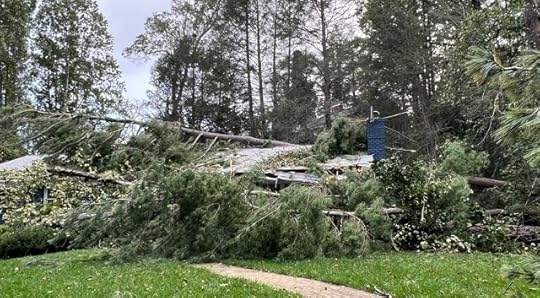


Your browser does not support the video tag.
Mother Nature took away Asheville’s water, electrical, cell, and internet services. For the first 24 hours, there was no help on the ground at all, other than committed neighbors. No FEMA, no energy companies, no Spectrum, no faith-based organizations. No nothing. It appeared that the cavalry wasn’t coming to save us.
Asheville Coming TogetherA few years back I bought a generator, figuring we might need it in the event of a rare ice storm. It came in very handy, as it allowed us to keep our food refrigerated and our devices charged. The most uncomfortable part was not having potable water. The City of Asheville turned off everyone’s spigots. We were forced to use water from our neighbor’s backyard pool just to flush our toilet. While the discomfort of not having any power or water or internet would get prolonged, the cavalry did, in fact, come.
Despite whatever conspiracy wacko bullshit you may have heard from people who don’t live in Western North Carolina, FEMA was (is) here and is actively helping people in numerous ways. The faith-based communities have been outstanding, particularly Samaritan’s Purse and Convoy of Hope. World Central Kitchen has also done extraordinary work, and I’ll be a fan of Chef José Ramón Andrés, WCK’s founder, for life. Most importantly, neighbors have been helping neighbors while being neighborly. If Helene blew me away with her force, the Asheville community has blown me away with its resiliency, grit, and goodness.
Fortunately, none of Asheville’s beautiful trees fell on my home. Other than significant damage to two retaining walls in my backyard, we came through unscathed. While the recovery has been slow, it’s also been steady. Our spigots work again, but we have an ongoing “boil water” rule in effect. We can, though, use the non-potable water to do laundry, wash dishes, and flush. We just can’t drink it unless we boil it first.
The Lesson Learned in AshevilleIt’ll take me a while to process the lessons I’ve learned riding out this experience, which I’ll include in a future blog. I will say two things, though, First, Mother Nature is an equalizer. She doesn’t care about your socioeconomic background or educational pedigree. If you’re standing in her way, she will mow you the hell down. Second, while the good folks who live in this part of North Carolina have been significantly inconvenienced by Helene, there are people in war-ravaged places like Ukraine and Gaza who have lived this way, or worse, for years. My burden was lessened knowing that others have experienced far worse than me. My heart goes out to them, and to all the families who have lost loved ones because of Hurricane Helene.
Next time you experience a life-altering event, what will you take away from it?
The post Blown Away in Asheville appeared first on Giant Leap Consulting.
October 23, 2024
Lead With Care
Do you care about me? This is what people want to know when they work for you. They may not say it directly, but it is the core question that defines the relationship between you and the people you lead. When people believe the answer is “yes,” they will be more committed to their work, and to you. But when they think the answer is “no,” their commitment to their job and their loyalty to you will suffer.
To be a leader means getting results. But when the drive for results monopolizes a leader’s attention, people become the lesser priority. When a leader cares more about the “ends” (results) and less about the “means” (people), he becomes susceptible to treating people like objects. You’ll hear it in his language—he’ll refer to people as “resources,” as if they were interchangeable parts sitting on a machinery shelf. He’ll stress the importance of resource planning to manage the budget and schedule. He’ll plead with his bosses for more resources to enlarge the capacity of his department. The leader is the machinist, and his resources are his machine parts.
How You Treat People Determines the Results You GetA single-minded focus on results often leads directly to treating people poorly. The drive to achieve results becomes the leader’s excuse for toughness. She’ll say things like, “Sure, I’m tough. We’re under relentless pressure from our competitors, and margins are tight. Being tough creates urgency and motivates people to work hard. My boss is tough on me, so why shouldn’t I be tough on the people who work for me?”
To be sure, results matter. But people achieve those results, and when you treat people poorly you’ll get poor results. This brings us back to the central question: Do you care about me? The answer shows up in your treatment of people. You may say that you care about people, but if you never smile, constantly move up deadlines, rarely ask for their opinions or use their input, take credit for their good work, set unrealistic goals, and never say “thank you” for hard work, then you don’t really care about them. And they know it.
So What Does it Look Like to Lead with Care?When you care about people, you take an interest in their career aspirations. You seek, and value, their opinions. You appreciate that each person has a life outside the office that impacts how they perform inside the office. You know that people aren’t just “resources”; they are the coach of a local soccer team, a lay minister at the church, an active alumna at the state college,
or a husband whose wife just died after a long battle with breast cancer, and father to three heartbroken kids.
Answering “yes” to the core do-you-care-about-me question means taking a deep and genuine interest in those you are leading. Caring, in this sense, is obliging. When you care about people, you give them more of your time, attention, and active support. A wise leader treats people as more important than results because strong people produce those results. Period.
Caring Begets CaringAs a practical matter, it’s a good idea to care about your people. When they know you care about them, they will care about you—and your success. In fact, you’ll know that you’re truly a leader who cares when the people you lead start seeking and valuing your input, when they take an interest in your career aspirations, and when they are actively supportive of you. And when your people care about you,
they’ll help you get better results.
Next time you find yourself actively leading others, ask yourself “How do I care about them?”
Interested in learning more about how you treat those you lead? Check out these related topics:
Personal Transformation Through LeadershipOpportunity Focused LeadershipThis post was based on an excerpt from Leaders Open Doors.
Image by Goran Horvat from Pixabay
The post Lead With Care appeared first on Giant Leap Consulting.
October 17, 2024
Functional and Dysfunctional Leadership
If you’re aim is to be an effective leader, you need to be crystal clear about the differences between functional and dysfunctional leadership. It all comes down to getting the right blend of confidence and humility. We consider leaders functional when they carry the right blend of confidence and humility. Conversely, we view leaders who are excessively one or the other as dysfunctional.
Arrogant or Weak LeadershipThe leaders we most want to follow know who they are and what they stand for, yet they are also gracious and not stuck up. The best leaders are centered, grounded, and non-toxic. They lead not so their power can grow, but so ours can.
When confidence becomes untethered from humility, arrogance follows. Arrogant leadership is selfish leadership, and arrogant leaders fixate on getting their way. Without the moderating effect of humility, confidence slips into conceit and self-centeredness. The self-centered leader loses sight of the very purpose of leadership: to improve the conditions of those being led. Unless he gets his way, he will be irritable, combative, and controlling.
If confidence minus humility equals arrogance, then humility minus confidence equals weakness. Whereas arrogant leaders are selfish and insist on getting their way, weak leaders are ineffective, ceding the way to more dominant or persuasive people. Weak leaders lack backbone, influence, and ultimately relevance.
In the worst instances, weak leaders are useless. They don’t get things done, effect change, or wield influence. Few things are as pitiful as an impotent and irrelevant leader. Nobody wants to be led by a wuss.
The Solution: Confident HumilityFor our leadership to be assertive, decisive, and firm, we need to have confidence. For our leadership to be authentic, giving, and supportive, we need to have humility. Confidence and humility are complementary and counterbalancing forces that fortify the potency of leadership.
When our actions are directed by confidence and humility, we are truly operating out of our best self.
The leadership ideal, then, is to become a leader who is both highly confident and genuinely humble.
You’ve gotten to this place when you respect those you lead equally as much as you respect yourself. What does a confidently humble leader look like? First, she is comfortable in her own skin. That comfort stems from the self-respect that seasoning and experience provide. She knows that she has earned her place. She has capitalized on the lessons she learned from all of the challenging experiences she’s had along the way. Her self-worth doesn’t come from what others think about her; it comes from living in alignment with a value system that she honors and upholds. Principles matter to her, providing a source of strength and guiding her decisions and choices.
The confidently humble leader states her views assertively and constructively, not to trump others, but to add her perspective. When situations require, she can be forceful and direct, but never in a way that is demeaning toward others. To her, people are not objects. The people she is leading make her job meaningful and worthwhile, and their growth and development are how she assesses her effectiveness.
Being a fully functional leader means matching confidence with humility. How will you avoid dysfunctional leadership?
Want to learn more about effective leadership? Check out these related topics:
Delegation Can Be Your FriendOpportunity Focused LeadershipExcerpted from “A Leadership Kick in the Ass.” Learn more here.
Image by Mohamed Hassan from Pixabay | Post Updated October 2024
The post Functional and Dysfunctional Leadership appeared first on Giant Leap Consulting.
September 18, 2024
Prepare for Risk
A high diver does not simply climb up and hurl himself off a 100-foot ladder without a great deal of preparation. Likewise, when facing a giant leap in your own life, there are steps you can take to prepare for risk.
The 4 Principles to Prepare for RiskFind your golden SilenceTrue, risk-taking involves action. But before you can act you need to know what to act on. The reason silence is so important to risk-taking—and in particular Right Risk-taking is that it helps make your risks more deliberate, intentional, and directed. Silence, extended to the point of mental stillness, has a leveling effect on your perspective, sharpening your powers of discernment. Through silence you become more attuned to your most deeply held beliefs and values, helping you perceive what risks are most compatible with your inner constitution and thus which are truly worth taking. Through silence you can more accurately answer your Right Risk question, Is this the Right Risk for me? Hence, the first principle of Right Risk is to find your golden silence.
Defy InertiaThrough risk-taking, we move beyond the comfort of our current condition and overcome inertia. Sometimes this movement is taken through physical action, such as leaving the safety of the ground to scale the face of El Capitan. Other times the movement entails more of a cerebral shift, converting to a new political or religious belief system, for example. Whether physical or intellectual, risk is a vehicle that moves us from where we are to where we want to be, and you simply can’t get from here to there without movement.
As a general rule, the greater the distance between your current reality (here) and the destination to which the risk will carry you (there), the more substantial the risk. The hard truth is, that the bigger the gap between here and there, the more energy, discomfort, and sacrifice will be required to overcome inertia and take the risk. Risk-taking is hard work.
Write Your Risk ScriptsAs part of getting ready for a risk, it is important to keep your scripts from limiting your progress. Though a complete scriptural rewrite may not be possible without extensive soul-searching, working with my coachees has taught me that it is possible to influence them. One way to do this is to pick a personal mantra. In readying for our risk, the benefit of a personal mantra is that it helps boost our courage, allowing us to take risks we might otherwise avoid.
For a personal mantra to be effective, it has to be exquisitely simple, certainly no more than a sentence long. Also, your mantra should compensate for whatever risk-limiting scripts you are operating under at a specific moment in time.
Turn on the Risk PressureThe fourth principle in readying for your risk is that you need the pressure to nudge yourself from your current situation—your risk platform. Our lives have many points of risk pressure that act on us by forming an acute dissatisfaction with our current circumstances. Often our dissatisfaction intensifies until it grabs us by the throat and screams, “Take the risk and jump, you fool!” We reach this leaping point when the risk of changing outweighs the risk of staying the same.
For example, when faced with a career transition, the risk decision often boils down to a choice between a known unhappiness and an unknown possibility of happiness. We become increasingly dissatisfied with our current job until it becomes nearly impossible to get out of bed and face another day at the office. We may call in sick to avoid the risk decision, but the decision won’t let us go. The more we allow ourselves to live in a state of dissatisfaction, the more we feel as if we are living a lie, and the pressure builds. Although many of us have a tremendous capacity for tolerating misery, eventually, we will reach our high-dive moment and decide the risk of changing outweighs the risk of staying in a suffocating situation.
The PreparationAs you prepare to take your own giant leap, remember that the principles of Right Risk are your guideposts. Finding your golden silence will grant you clarity and perspective, helping you discern the risks that truly align with your values. Defying inertia is essential—embrace the movement required to shift from your current state to your desired destination. Crafting effective risk scripts and personal mantras will bolster your courage and navigate you through the uncertainties. Finally, embrace the risk pressure that propels you toward action, recognizing that true growth often comes from the discomfort of change.
Next time you face the uncertainty of risk, how will you prepare for risk?
Interested in learning more about how to approach risk? Check out these related posts:
Taking the Right Risk as a LeaderRisk Being YourselfThis post is based on an excerpt from Right Risk: 10 Powerful Principles for Taking Giant Leaps with Your Life.
Image by WOKANDAPIX from Pixabay
The post Prepare for Risk appeared first on Giant Leap Consulting.
September 12, 2024
Delegation Can Be Your Friend
Delegation can often seem like a time suck, but remember this: taking a task off of your plate leaves you more time. How could you spend that extra time? Additionally, delegation empowers those you lead. It gives them a greater sense of responsibility. Something necessary for moving toward the success of the project or organization.
Yet we still don’t delegate.
According to a recent Conference Board report, 78% of all personnel in major corporations believe that their boss, manager, or superior with whom they have a reporting relationship routinely does work that would be more effectively done by someone at their own level. Most managers agree with their team members. In fact, 66% of managers say they would like to “increase their use of delegation as a time management and personnel development tool.”
The challenge is not that we don’t realize the need for delegation — it’s that we aren’t always sure how to accomplish it well. Tweet this
Here are 10 steps for successful delegation:Know what the task is.Have the end result/desired outcome you want in mind.Find the right person.Share with them the results you desire.Explain why the tasks and/or results are important.Acknowledge how performing this task will benefit them.Ask them how it’s going to get done: “What do you feel is the best way to handle/complete this?” or “How have you handled something like this in the past?”Determine the exact time frame that you want the task finished by.Reconfirm the deadline. That can sound like: “Okay great, then you will be able to have it done by next Monday?”Follow up at an agreed-upon time. If you don’t, you run the risk of training the person not to be accountable by sending the message that it’s okay for tasks not to be completed.How are you at delegation? Better question, how is your manager at delegation?
Are you struggling to delegate? Contact Giant Leap at info@www.giantleapconsulting.com to learn about our signature leadership workshops, including our New Manager Boot Camp. This post is an excerpt from GLC’s New Manager Boot Camp Workbook, by Bill Treasurer.
Want to learn more about leadership and productivity? Check out these related posts:
A Tool Kit for Productive Meetings
How Will AI Impact Organizations and the Role of Leaders?
Image by Gerd Altmann from Pixabay
Post updated September 2024.
The post Delegation Can Be Your Friend appeared first on Giant Leap Consulting.
August 30, 2024
The Three Bills
Now that I’m in my sixties, I find myself reflecting on the strange journey of my life. If I zoom out, it seems to have moved through three major phases: The Good Bill, The Bad Bill, and the Better Bill.
Bill #1I grew up in a lower-middle-class household in an upper-middle-class suburb of New York, 18 miles from Manhattan. My parents had their struggles, but me and my three siblings knew right from wrong and how to say “please” and “thank you.” I was a good kid. Creative, friendly, kind, and sensitive. When my neighborhood friends and I would play “war,” I was always the priest who would bless those who had fallen on the backyard battlefields. The kid priest epitomized Bill #1.
For sport, I was a springboard diver. Eventually, I got a full athletic scholarship to West Virginia University (WVU), which enabled me to get a college degree. At the time, WVU was the #1 party school in the nation, and I partied with gusto. This was the beginning of Bill #2.
Bill #2
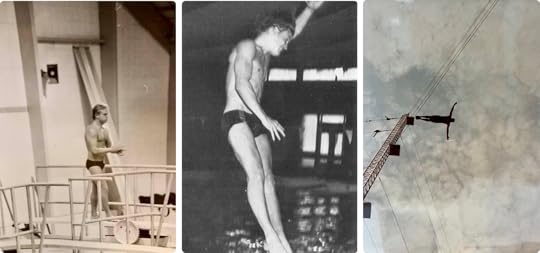
After college, I became a member of the US High Diving Team, a troupe of aerial expedition athletes who traveled throughout the country as part of an aquatic entertainment production. My high-diving comrades and I would climb to the top of a 100-foot ladder and hurl ourselves off at speeds in excess of 50 mph before hitting a small pool that was 10 feet deep. Yes, I actually did that. For seven years I lived the life of a carny, smiling for the audience like an All-American athlete during the daytime, and pillaging through the town like a drunken Viking at night. My drinking horn was never full enough.
The partying life is alive and fun. Until it’s not. I don’t know the exact moment things took a turn for me, but a turn they took. All the boozy carousing masked a slow erosion of my character, allowing me to lie to myself, and others, more and more. Before long, I had shifted from good to bad. I couldn’t be trusted. When I’d look in the mirror, I had to avert my eyes because I couldn’t stand the person who was looking back at me. My frequent trips to oblivion helped dull my self-loathing.
Bill #3This Bill came as the result of a bad dinner date. I actually thought the date had gone really well. But when I called the woman the next day, she said she’d never date me again, and reminded me that I had borrowed money from her to pay for dinner. She also told me that I had a drinking problem and gave me the number of a friend of hers who had faced his own problems with alcohol. I was embarrassed enough to pick up the phone. I was sick and tired of being sick and tired.
August 31st marks 30 years of living a sober life. The decision to live free of mind-altering substances transformed me and my life. I live wide awake to every experience now. That means I go through every situation, good and bad, feeling all the feels. When things get tight or tough, I don’t escape to alcohol. I work through them. Bill #3 is anything but perfect, but he is far more centered, patient, generous, and present. And far less self-centered. These days, I live comfortably in my own skin. I’m good friends with the guy who looks back at me from the mirror.
Bill #4
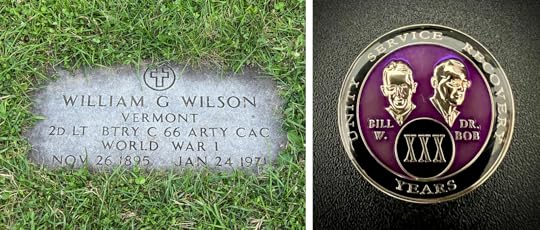
There’s an epilogue to this story, and it involves Bill #4. Recently, to mark my 30th anniversary of living in sobriety, I traveled to the tiny little town of East Dorset, Vermont, to visit an anonymous little cemetery on the outskirts of town. There, by the humble graveside of a World War 1 veteran, 2nd Lieutenant William Griffith Wilson, I said a prayer of gratitude. Bill W., as he is more affectionately known, is the founder of a spiritual program of recovery that has transformed the lives of millions of people throughout the world, including me. Because of him, I am still trudging on the road of happy destiny one day at a time.
The post The Three Bills appeared first on Giant Leap Consulting.


