
Bill Treasurer's Blog, page 24
October 19, 2017
The Essential Humbling of Cam Newton

Cam Newton is one cocky quarterback. Like few athletes, Newton is one who can back up his mouthy bluster with godlike talent. He swaggers and dabs with the confidence and attitude befitting of a 28-year-old dude who, at 6 ft. 5 inches, literally looks down on nearly everyone. The NFL superstar of the Carolina Panthers was once quoted as saying, “I see myself not only as a football player, but as an entertainer and icon.”
Oh, how the mighty fall. Cam’s plummet started at a standard NFL news conference, when a reporter from the Charlotte Observer, the Panthers’ hometown newspaper, asked about the routes that Cam was making on his wide receiver run, and whether they were physical enough. Cam, with a boyish smirk, replied, “It’s funny to hear a female talk about routes like . . . it’s funny.”
Keep in mind that Newton has had plenty of other controversial moments in his meteoric career. In 2008, while redshirting at the University of Florida, he was arrested on felony burglary and larceny charges (and obstruction of justice) after stealing a laptop from another student. As the cops closed in on him, he tossed the computer out his dorm window. He announced his decision to transfer to Blinn College in Brenham, Texas, three days before the Gators won the national championship by beating Oklahoma. It was widely reported that the University of Florida had planned on expelling Newton both for his felony arrest, and for three instances of “academic dishonesty.”
Later, Newton would transfer again, this time to Auburn University, where he would have a stellar career that included being the first SEC player ever to throw for 2000 yards and rush for 1000 yards in a single season. Newton led the team to the national championship and, deservedly, won the Heisman Trophy.
Newton has also stirred up controversy as an NFL quarterback. He instantly became one of the NFL’s biggest sensations, throwing for 400 yards in his first NFL game. In 2015, Newton led the Panthers to the Super Bowl against the Denver Broncos. But after the game, which the Panthers lost 24 to 10, he was viewed as being a sore loser. He sulked during the postgame news conference, eventually becoming so frustrated that he got up and walked out. A few days later he said, “Who likes to lose? You show me a good loser and I’ll show you a loser.”
Legendary sportswriter and commentator Heywood Hale Broun once said, “Sports do not build character, they reveal it.” That may be true. But what does build character are humiliating events, particularly those that are self-inflicted. Confidence, for uber-talented people of all sorts, can quickly turn to cockiness and conceit; and when that happens, life has a way of providing a cosmic boomerang that levels the ego into a more manageable size. Within two days of his “funny” remark to Jourdan Rodrigue, the female reporter from the Charlotte Observer, Newton issued a video apology.
Cynics were quick to point out that Newton had already lost an endorsement with Dannon Yogurt, and likely issued the apology out of convenience. But Cam faced bigger endorsement losses after his Super Bowl sore-loser moment, and never fully apologized. There’s likely something more important going on here that the cynics are missing; the acquisition of genuine humility.
In my book A Leadership Kick in the Ass, I talk about the importance of transformational humiliating events as life’s important correction mechanism for right-sizing big egos. Sometimes the best thing that can happen to a talented but overconfident person, is to get a psychological ass-kicking. For example, Steve Jobs, after getting fired from Apple, the company he founded, called the embarrassing event “the best thing that ever happened to me.” Why? According to his longtime collaborator, Ed Catmull, founder and president of Pixar, by suffering through the experience, along with other failures at that time, Jobs became a more empathetic human being who took a greater interest in others.
Watching Newton’s apology video, you don’t get the sense that this is a guy who’s apologizing because he feels forced to. He gets to a touchtone level of honesty that is at once raw and beautiful. He owns it with full contrition, acknowledging that what he said was “extremely degrading and disrespectful to women.” Then, revealing the full measure of his remorse, he connects the inappropriateness of his comments to being a father of two girls, saying: “I am the father of two beautiful daughters, and at their age I try to instill in them that they can do and be anything that they want to be . . . I’ve learned a valuable lesson from this. To all the young people who see this . . . don’t be like me. Be better than me.”
In the foreword to my book, Clint Hurdle, the coach of the Pittsburgh Pirates, says that there are two kinds of leaders: those who have been humbled, and those who are about to be. Cam Newton’s character is being built and revealed at the same time, not through athletic triumph, but through self-induced humiliation. It’s very likely that someday in the future, Cam Newton will look back on this humbling event with gratitude, thankful that it helped him become a better and more respectful man. This is the stuff that true greatness is made of.


October 11, 2017
Give Permission to Be Courageous

Often the most powerful action you can take to provoke courageous behavior is to give people permission to be courageous. Before starting my own company, I worked for Accenture, one of the world’s largest and most respected management and technology consulting companies, as its first-ever internal executive coach. Before moving into the coaching role, however, I remember being petrified at the prospect of coaching the senior executives whom I worked with. As a middle manager, I had reported to a few of them and knew how intimidating some of them were. I feared that my lower rank would cause my coaching guidance to be discounted and that eventually my role would be marginalized. Nearly all of the senior execs had more business experience than I had, yet I’d be counseling them. Safety for me meant preserving the positive reputation I had built up prior to that moment. Moving into the new coaching role, I feared, might threaten it.
I was so worried about failing that I strongly considered forgoing the opportunity, despite the fact that I wanted it badly. Now, admitting to your boss that you’re scared of failing is hard to do in any company. It is particularly hard to do in a company made up of hotshot consultants. But I was fortunate to be working for Hines Brannan, a seasoned and level-headed senior partner. Hines had a way of lifting my head up past the speed bumps of the moment so that I could view my career as a winding journey. So I went to him and said, “Hines, I think you should consider placing someone else in the new coaching role. I’m okay with coaching people at my level, but it wouldn’t be fair for me to coach people who are more senior than me. I mean, I’ve reported to some of these people in the past. The thought of coaching them is just too intimidating.”
Hines listened patiently. Then, instead of telling me what a wuss I was being, he simply said, “But Bill, you coach me.”
He was right. Like many of the senior executives I would be coaching, I reported to him. And over the years, I had become a bit of a confidant to him. In the process, I had grown comfortable offering Hines my perspective on issues and challenges that he was grappling with. I’m sure that Hines had far more impact on me as a coach than I ever had on him, but in the moments when I had coached him, he had drawn value from it. By pointing out the obvious, Hines gave me permission to see the opportunity in a different way. The confidence I had already established in coaching him could be extended to working with the other executives. His words helped me to cut myself a break. Moreover, his words helped put my courage to work. After all, if I could coach the most senior executive on the account, certainly I could coach the people who reported to him.
The most important thing that Hines did was to give me permission to express my fears without embarrassment. Unlike some bosses I had worked for, Hines didn’t make me feel small so that he could feel big. With him, I never felt dismissed or patronized. He never disrespected me by multitasking when I talked with him, despite his pressing schedule. To the contrary, when I approached him, I always had his full presence and attention. I felt valued, not intimidated. Because Hines’s disposition permitted me to express myself without fear, when I did, he was in a much better position to provide me with good counsel. Had I reported to another executive, I would have been much more reluctant to express my fears and concerns.
More tangibly, Hines gave me permission to be courageous by pointing out where I was already doing the very thing I was afraid of. This was incontrovertible proof that I could indeed meet the challenge . . . because I was already meeting it. Armed with this knowledge, I was able to build up a thriving internal coaching practice, eventually coaching thirty Accenture executives on a regular basis.
Permission enhances safety. Often workers avoid doing courageous things because their heads are telling them that they aren’t “allowed” to. As a manager, how you carry yourself will make a big impact on how safe they feel and, thus, on how expressive they will be. By giving them your full presence, you’ll cause them to feel valued and “allowed” to bring their fears out in the open. When they do, you’ll be better able to address their concerns and shift their thinking to all the ways they are prepared to meet their challenges.
Who on your team needs to be given permission to be courageous?
September 26, 2017
This Above All: Create Safety First

Over the years, a lot of people have inspired me with their courage. But none as much as my fourteen-year-old daughter, Tobina. Bina, as we call her, has cerebral palsy. She is also profoundly deaf. Both challenges are the byproducts of a virulent staph infection she contracted at the hospital just days after she was born.
Americans with disabilities make up the largest minority population in the United States. Some 54 million Americans have a disability of one form or another. And anyone who has been graced by the company of such people knows what a blessing it can be. It can also be heartbreaking. During Bina’s first year, it became clear that she was lagging behind her twin brother, Alex, in significant ways. Alex rolled over. Bina didn’t. Alex crawled. Bina didn’t. Alex responded to our baby talk. Bina didn’t. Alex received adoring smiles from strangers. Bina didn’t.
At first, all I could focus on was Bina’s disabilities, which caused me a lot of anger. I’d think, “Why did this happen to her? Who caused this?” and “Why can’t she do the things her brother can do?” Then, just before she turned two, a friend of mine wisely suggested that I start focusing on Bina’s abilities, not her disabilities. When I heeded my friend’s advice, Bina started progressing much more rapidly. In some strange way, my anger had become a block to Bina’s progress. Looking back, I suspect that I had begun to pigeonhole Bina as “handicapped” and in subtle ways was treating her as such.
One summer a few months before Bina’s fifth birthday, I set up a trampoline in the backyard in a not-so-subtle effort to nudge Alex toward springboard diving. On afternoons when I wasn’t on the road, I’d bounce on the trampoline with Alex and teach him tricks. Bina would be there too, laughing and watching us from the corner of the trampoline bed. At the end of our practice sessions I’d always make time for Bina too, holding her little hands and bouncing up and down.
One day, just to see what would happen, I sat behind Bina, stood her upright, steadied her hips, and let go of her hands. Then my little girl did something she never had done before: She took three full steps. On the hard floor, Bina was never confident enough to do this. Kids with cerebral palsy fall down a lot, and Bina was no different. She had fallen off enough chairs to know that the hard floor wasn’t her friend. So watching Bina take three teetering steps was hugely thrilling. On her fourth step she fell to the mat and giggled as my wife, Shannon, and I cheered wildly.
Recognizing that we were onto something, Shannon and I began to set aside time each day to walk with Bina on the trampoline. Before long, three steps turned to five steps, and five turned into ten. Then we set up a long runner of matted cushion on our back deck, figuring it would help her make the transition from the spongy trampoline surface to the hardwood floor. Drawing on her trampoline successes,
Bina cautiously stepped out on the runner. Soon she was taking more steps on the deck than she was able to on the trampoline. It was all terrifically encouraging and inspiring. Here was our daughter taking her first awkward steps, courageously and persistently . . . at four years old.
Bina eventually graduated to walking on our hardwood floors. Now she even walks on our concrete driveway. Walking unaided has helped her to become more self-reliant and confident. The transformation we’ve witnessed in Bina’s willingness to take the risk of walking has been nothing short of astounding, teaching us the value of creating safety as a way of enabling courageous behavior in our brave little girl.
By setting up our backyard trampoline we had inadvertently stumbled upon a safe way for Bina to do something that she had previously felt was too unsafe to do. Walking, formerly a frightening and potentially injuring experience, now had become fun. Notice that the action we wanted Bina to take (walking) hadn’t changed. What had changed was the consequence (and only temporarily). The spongy trampoline surface was far more forgiving than our hardwood floors. When we surrounded the same action with safer consequences, Bina became much more willing to take a risk.
In the same way that increasing Bina’s safety by reducing the negative consequences encouraged her to take the risk of walking, workers will be much more likely to step up to challenges when there are safety nets in place. People take risks relative to how safe they feel. The more forgiving the consequences, the more likely people are to extend themselves. This does not mean that getting people to be courageous means creating a risk-free environment. Rather, it means supporting their courageous actions with a reasonable amount of safety.
In the workplace, setting up safety nets is essential for promoting courageous behavior amongst your team. What safety nets do you need to install?
If you’d like to learn more about Giant Leap Consulting and how to promote courageous behavior, including our unique workshop, The Right and Wrong of Risk-taking, visit giantleapconsulting.com.
September 14, 2017
3 Ways to Harness Fear

Why do some people confront their fears and others avoid them? I grappled with this question during the writing of my first book, Right Risk. Through the writing of that book, and after consulting with many leaders and experts since, I have learned that people face their fears when they are so physically and psychologically prepared that they are able to convert fear into excitement.
The goal of harnessing fear is putting fear’s energy to good use. Fear, like electricity, can be paralyzing. But properly harnessed, it can provide workers with the energy they’ll need to sustain them when facing challenging situations. Here are three things you can do to put fear to work for you:
1. Normalize it.
Worse than fear is its emotional corollary, shame. Workers, particularly men, feel embarrassed about feeling fearful. When comparing themselves with more confident coworkers, fearful workers see themselves as inadequate, wondering, “What’s wrong with me that I can’t be more fearless?” When shame enters the room, confidence walks out the door.
In dealing with fearful workers, it is tempting to want to discount their fears by telling them, “Don’t be afraid.” But doing so is silly and ineffective. They are afraid. So why not acknowledge that instead? Acknowledging fear makes it more ordinary, lessening workers’ feelings of shame. “Of course you’re afraid,” you might say, “why wouldn’t you be?”
During Giant Leap’s courage-building workshops, we often include a segment where each participant shares a fear that he or she is facing at work. The ensuing conversations are rich and profound, and for me the most important and gratifying aspects of our work. Fear, when exposed to the light of day, loses its potency. When workers voice their fears, the fears become more normal and mundane. These conversations, which often last a few hours, help mitigate workers’ feelings of shame because they begin to realize that at any moment nearly all people are dealing with some type of work-related fear. By far the most common thing participants tell me after these conversations is that by hearing the fears of their coworkers, they feel “less screwed up” than they did before the workshop. The fact that so many people are contending with a workplace fear shows them that fear is a normal part of the work experience. Once workers start to see fear as normal, they give it less attention, which allows them to shift their focus away from it.
2. Tie Fear to Courage
Many people wrongly exclude fear from the definition of courage, believing that courage is the absence of fear, or fearlessness. The reality, though, is that courage is fearful. When we are acting courageously, we are, most typically, very afraid. But we don’t allow the fear we’re carrying to stop us. Instead, we press on. This is the signature feature of courage: to carry on despite being afraid. Fear, thus, is an essential element in the definition of courage. You can’t be courageous unless you are afraid.
When fear is included in the definition of courage, fearful situations turn into opportunities to demonstrate courage. The best evidence that a worker is being courageous is that she shows all the signs of being afraid but is taking action anyway. People who press on despite being full of fear epitomize what it means to be courageous. This is exactly the type of behavior that you as a manager want to acknowledge and reinforce. Few things stiffen the spine with pride as much as hearing your boss say things like “I’m impressed with how courageous you’re being” or “Thanks for being so courageous.”
Former mayor of New York City, Rudy Giuliani underscored how closely courage and fear are tied together in a talk I attended. He was reflecting on the lessons that his father had given him about courage, and how he drew on those lessons during the days immediately after 9/11. He said, “If you don’t have a fear, you’d better go get one. Dealing with fear is how you find your courage.”
3. Use Fear’s Energy
The best way to deal with fear is to use it against itself. Fear is not inert. It has energy. When properly harnessed, fear’s energy can provide momentum for facing challenging situations.
Much of my company’s work involves designing and developing comprehensive leadership programs for emerging and experienced leaders. As part of the design process, we gather input from many sources, including the organization’s most senior executives. While designing of one of our programs, I asked the CEO what he considered to be the single the most important leadership message he wanted to reinforce among the leadership ranks. He said, “The most important thing people need to know is that leadership depends on having sweaty palms.”
“Huh?” I said.
He explained, “For our leaders to grow, and for our company to be most successful, our leaders need to regularly be doing things that are so scary for them that it causes their palms to sweat. Challenge provokes fear, and having sweaty palms shows you, physiologically, that fear is energizing the body. You get sweaty palms by moving outside of your comfort zone and into your courage zone. It’s inside your courage zone where the learning and growing happens.”
For workers, having sweaty palms means learning to carry fear with them when facing challenges. Again, courage is not about being fearless. It’s about taking your fear with you. Part of your job as a leader is to help people to stop fearing fear. Fear is a business reality. Fear is. Harnessing fear helps workers to capitalize on fear’s energy so that they can do challenging and courageous things.
August 29, 2017
4 Types of Organizational Culture

“Culture isn’t just one aspect of the game, it is the game.” – Lou Gerstner, Former CEO, IBM
Webster’s Dictionary defines culture as “the integrated pattern of human behavior that includes thought, speech, action, and artifacts and depends on man’s capacity for learning and transmitting knowledge to succeeding generations.” Leadership and management guru Dr. Stephen Covey calls culture “the shared value system of people as manifested in their behavior.”
A more simple definition of organizational culture is “the way we do things around here.” Every organization has a unique way of doing things. A number of business authors have identified different types of organizational cultures. The types that I’ve most commonly observed are the following:
THE COMPETITIVE CULTURE
The first type of organizational culture is competitive. This culture is fast moving and highly competitive. There is a constant drive to constantly outdo what you’ve done before. Much of the focus is on financial growth, and winning work. Examples include brokerage firms, law firms, and construction companies. Such cultures are often stressful environments in which to operate. Only the strong survive.
THE SERVICE CULTURE
In service cultures, pleasing the customer comes first. Decisions are always made with the client’s view in mind. How well the company serves its customer is seen as a differentiator. As such, Service cultures constantly strive to make things “user friendly” in order to create customer loyalty. Examples of this culture include the Ritz-Carlton, American Express “Platinum” Card, and LL Bean.
THE INNOVATIVE CULTURE
Companies that rely on innovation for their livelihood incessantly strive to attract new customers (and wow current customers) with leading-edge technologies and approaches. In the Innovative culture, employee creativity is held at a premium. Innovative cultures have a big appetite for risk-taking, and, as such, the work environment in an Innovative culture is often high-energy. Companies such as Pixar, Apple, and Gore-Tex fall into this category.
THE BUREAUCRATIC CULTURE
Bureaucratic cultures value consistency and process-adherence. In such cultures, predictability is valued more than creativity, and following “the rules” is more important than striving for improvements. The average employee tenure in Bureaucratic cultures is much higher than in the other cultures, often because in such cultures “seniority rules.” Public services and government agencies often fit into this category.
Not every organization will fit neatly into one of these categories, but these categories cover a large majority of organizations out there. Which culture best describes your organization?
Want to learn more about how to make your organization more effective? Giant Leap Consulting offers leadership coaching. Learn more here.
August 14, 2017
Meetings, Meetings, Meetings…Yuck!

Meetings, meetings and more meetings. Ever feel like you are perpetually in a state of meetings? In my consulting work, I hear this complaint a lot. You’re not alone if you feel meetings are a waste of time or that they leave you with no time to get real work done.
Despite being so frustrating, meetings are important. They are where direction gets set and decisions get made. Provided, of course, that they are run well. Having facilitated productive and unproductive meetings, I’d like to share some meeting tips that, hopefully, will help you hate meetings less!
Before sharing the tips, I need to make one important point: above all, make sure the meeting is a good use of everyone’s time! When people feel that having attended the meeting was worthwhile and valuable, they won’t bellyache about the meeting.
Here are some tips to help you make good use of everyone’s meeting time:
DEFINE THE PURPOSE: Know exactly why you’re having the meeting, and what outcomes you want to achieve. Ask yourself, “What outcomes, if achieved, would make this meeting a win?” Write it down to remind yourself to keep on track!
ADVANCE THE AGENDA: Send out an agenda, and do it at least 48 hours in advance of the meeting. Sending it out late the evening before expecting people to act on the agenda information is unacceptable, and rude. The agenda sets the tone for the meeting and allows everyone to know what the goals of the meeting are.
ARRIVE EARLY: If you’re in charge of the meeting, you should arrive before anyone else does. For routine or smaller meetings, plan on being there and having at least 20 minutes to spare after you’ve set the room up. For larger and more important meetings, get there at least 60 minutes beforehand. Being late to your own meeting tells your team that the meeting is not a priority to you. If the meeting is not a priority to you, it won’t be to your team either.
START ON TIME: Don’t punish the folks who arrive on time by waiting for those who don’t. Time is valuable for everyone. Consistently starting meetings on time will teach people to be on time for your meetings in the future. By the way, it has been my experience that the more senior executives you have attending the meeting, the higher the likelihood that the meeting will start late. If the attendees outrank you, communicate with the most senior executive prior to the meeting, encouraging them to get to the meeting early and kick off the meeting for you.
KEEP IT TIME-BOXED: Make sure to time-box each agenda item, and assign a person to be the taskmaster/timekeeper. If you run out of time on one topic, put it aside and agree to come back to it in the future. This will ensure that everything on the agenda is addressed. Put the most important agenda items upfront so they don’t become the potatoes that fall off the plate if things fall behind.
END WITH A SELF-PROPELLING AGENDA: Set up the next meeting by creating the next meeting’s agenda. Reiterate what action items have been determined and who is responsible for each one.
Meetings can be considered a necessary evil. However, by following these tips, your meetings will be productive and value-added rather than pointless time drains.
July 18, 2017
Physician Heal Thyself

Bill Treasurer is a fake! I came to that conclusion about a year after I had become a full-time internal executive coach at Accenture. The role itself was perfect. I had a budget, a good deal of latitude to do the job as I saw fit, and although most of my coachees outranked me, all had signed an agreement that it would be a “levelless” relationship. Besides all that, I was making a lot of money doing what I love to do, helping people grow.
Why was I a fake? Because the more I coached my clients, the more I realized that my own beliefs and actions were out of step. As a coach, it is my job to help accentuate my coachees, to help them become the person they want to become. To do this, I help coachees identify their deepest aspirations, and then help them create a plan for making those aspirations real. While I was successful in helping my coachees apply these techniques, I wasn’t applying them in my own life. I had become the consultant’s consultant, someone who could give advice better than he could apply it.
The problem was, I was not being the person I wanted to become. I was living an inauthentic life.
Throughout the ages, the most consistent prescription for personal well-being is this: Be who you must be. The Greek poet Pindar said, “Grow into what you are.” Ralph Waldo Emerson said, “Insist on yourself, never imitate.” Famed psychologist Erich Fromm said, “Man’s main task in life is to give birth to himself, to become what he potentially is.” Robert Louis Stevenson said, “To be what we are, and to become what we are capable of becoming, is the only end in life.” And Abraham Maslow said, “A musician must make music, an artist must paint, a poet must write if he is to be ultimately at peace with himself. What a man can be, he must be.”
These sages said explicitly what we all know implicitly, that when you have become far removed from who you are supposed to be, when your work-self and personal-self are wholly different people, and when the masks you wear don’t look anything like your real face, you expend too much energy living a life of pretense.
Authenticity has to do with integrity. When the person we portray to the world is the same as the person we truly are, we are being our authentic self. When we are authentic, we are who we are, take us or leave us. To live authentically is to live without pretense, and to express and assert the gift of your individuality. Living authentically means being psychologically patriotic, proud of who you are. The benefit of being our authentic selves is that instead of wasting time pretending to be someone we are not, we have more impassioned energy to get on with the business of living. Living a life of authenticity represents the end to an exhausting game of make-believe.
Where are you living an inauthentic life? Giant Leap Consulting can help you live more authentically. Learn more about our leadership coaching program.
July 3, 2017
The Courage to Be Courageous

I once coached a professional named Bob who was considering three separate job offers. All were well known companies, but one was of particular renown. Its name carried a certain pedigree that eclipsed the others. Bob had settled his mind on one of the lesser offers, rationalizing that this particular job most resembled the roles that he had had in the past—roles that no longer challenged him, as he had mentioned in the course of earlier discussions. Sensing there was more to it, I asked him to describe his impressions about the more prominent company. He said that many of the people who worked there had Ivy League degrees (which he didn’t) and/or graduate degrees (which he had). Although they had offered him the job, he said that he was afraid he wouldn’t cut it. I now understood that the issue wasn’t about skill compatibility; it was about Bob’s personal insecurities, it was about his fear. I probed further, “Bob, what exactly are you afraid of?” He thought for a second and said, “I guess I am afraid that everyone will be smarter than me, that my ideas won’t be valued. If that happens, they’ll fire me.”
Directed by Bob’s answer, I asked him another, more courage-provoking, question: If fear weren’t an issue, which job would you choose? Without hesitation he selected the one he was most afraid of.
As Bob’s story illustrates, fear often indicates something about yourself that you are avoiding. Left unaddressed, life will bombard you with a litany of opportunities to confront these “issues” until you finally resolve them. Each time you avoid the issue, you stuff it further into your psyche. But knowing that dealing with the issue represents your growth, your psyche throws the issue back up until you finally confront it, as if to say, if you don’t learn the lesson, you have to repeat the class. Through coaching, Bob was able to see that not only did the job he was afraid of represent an opportunity to gain experience working in a world-class organization, but it also represented an ideal opportunity to explore and, more importantly, to overcome his deep-rooted feelings of low self-worth. But to benefit from both opportunities, he would have to muster up the courage to be courageous and to face his fear. Ultimately he did. He chose the opportunity he was most afraid of.
Any risk situation has a grand continuum: You are either moving in the direction of your courage or moving in the direction of your cowardice. When you face your fears, your Courage Capability expands, enlarging your capacity for dealing with future fears. In this way, demonstrating courage is itself a form of encouragement in that it fills you with greater levels of courage. Fortified with more courage, you are then capable of facing more fearful situations. For example, as a young professional you might find it petrifying to give a presentation to ten people. However, as you progress in your career and gain more experience with public speaking, you are able to comfortably address larger and larger audiences. In this example, the number of additional audience members reflects the degree of expansion of your Courage Capability.
Of course the opposite is also true. In situations where you allow fear to prevent yourself from having something you want, you enlarge your Cowardice Capability. And the more cowardice you exhibit, the more it grows because cowardice feeds on the diminishment of courage. On a certain level, this is also quantifiable. For example, the person who is afraid to take the risk of asking for a raise can calculate his cowardice as the difference between his current salary and the adjusted salary he feels he deserves but is too afraid to ask for (assuming, of course, that he would have gotten the raise).
People don’t like using the word coward. They look for softer, less offensive terms. But just because we don’t like the word doesn’t mean cowardice isn’t real. Cowardice is as real as courage. One exists in relation to the other. Furthermore, just as there have been times in your life when you’ve been courageous, the chances are, at some point in your life you’ve been a coward as well. Most acts of cowardice, however, go unnoticed and remain concealed within the confines of your heart. Cowardice comes in compromising your principles, in allowing your boundaries to be crossed, in failing to demonstrate personal fidelity, and in not taking a stand for what you believe in. You could spend your whole life being a coward and no one would know it but you.
Having the courage to be courageous means backing up courageous actions with a courageous attitude. It means holding a clear picture of yourself being courageous and continuously asking yourself, how would the courageous person I want to become act in this fearful situation that I am faced with today? It means first believing in the virtue of courage and then acting in a courageous manner.
When it comes to courage, you have to believe it to be it.
To learn more about ways you can be courageous, contact Giant Leap Consulting. http://giantleapconsulting.com/services/leadership-development/
June 27, 2017
Right Risk
West of Kilkenny, in the heart of southern Ireland, is the little town of Galmoy, the birthplace of my great-grandmother, Mary McCormack. Years ago, during a visit to the Emerald Isle, my wife and I journeyed to the small thatch-covered home where Gandy, as we called her, was born.
Other than her thick Irish brogue, my memories of Gandy are vague. She died when I was 10 years old. Yet as I peered through the windows of the humble little dwelling, I felt strangely connected to her. I was moved with the profound recognition that, at great personal cost, had she not taken the risks that she took, I would not exist.
Mary McCormack was 17 years old when, from the bow of a steamship headed for America, she waved goodbye to her mother and father. She would never see them again.
My great-grandmother’s big risk, though courageous, was by no means unique in our family. Her husband, my great-grandfather, himself a Norwegian immigrant, took on the risky profession of a New York cop. Later, my paternal grandfather took the risk of opening a business, an Esso station in Pelham, N.Y. Even the relationship of my parents was the result of a small, but ultimately enduring risk. They met on a blind date. Like all families, and like humanity itself, my family is connected through a long lineage of risks taken.
Throughout the ages, the most basic problem shared by all people is knowing which risks to take, and which to avoid. Although the experience of struggling with a risk decision is both universal and unavoidable, the way each of us goes about deciding which risks to take is highly personal. Each of us takes risks for our own reasons and rationale. When faced with a risk, each of us is left to answer for ourselves this simple, but profound, risk-discerning question: Is this the right risk for me?
Risks that are right for us may seem absurdly dangerous and completely unnatural to the spectator, making it difficult for them to support us. But when a risk is right for us, the real harm comes in letting it pass us by. Every risk can be split in two, the risk of action and the risk of inaction, and both have consequences. Had my great-grandmother stayed safe and sound in the sleepy little town of Galmoy, for example, she may have pleased her parents, but she would have had to carry the lifelong burden of a stillborn dream.
It is a mistake to think that Right Risks are danger-free. “Right” is not a function of safety, it is a function of compatibility. The Right Risk for you may be entirely wrong for someone else. “Right” is in the eye of the beholder. I am sure that young Mary McCormack was viewed by some as crazy, perhaps even disloyal, for leaving home. But because Right Risks are organic to our own life, the unnatural act becomes the most natural choice for our own progression. With all the runaway irrationality of eloping lovers, when a risk is right for us, we won’t let reason get in the way of passion.
Regardless of how unnatural or absurd they may seem to the outsider, Right Risks are those that are in our life’s best interest. To say “yes” to a Right Risk is to promote your own development. Thus, when faced with a major risk, accurately answering the question “Is this the Right Risk for me?” becomes critically important to our life’s progression.
What Right Risks are you facing in your personal or professional life? What risks would seem absurd to others, but for you would be dangerous not to take? What Right Risks is your life waiting for you to take? To risk or not to risk, that is always the question!
Contact Giant Leap Consulting about our risk-taking workshop, Walking the Fine Line of Risk, and learn more about all of Giant Leap Consulting’s leadership programs here: http://giantleapconsulting.com/services/leadership-development/
June 13, 2017
Fear of the Known

Last week we talked about how fear of the unknown can hold you back. In my opinion, fear of the unknown is overrated. The real fear, and the hardest to overcome, is fear of the known. Few things inhibit our ability to take a risk as much as an early bad experience. In these instances, you know all too well the consequences of a risk . . . and you’ve got the scars to prove it.
I used to be an avid whitewater kayaker. A few years ago, while paddling Tennessee’s famed Ocoee River, I got flipped upside down in a rapid affectionately known as “Grumpy.” Kayakers label rapids based on reputation, a linguistic expression of homage to man’s collective risk experience. Some names are friendly, like “Surprise” or “Cat’s Pajamas,” other names are more ominous, like “Decapitation Rock,” “Table Saw,” or “Witch’s Hole.” Grumpy got its name for a reason—this nasty hydraulic is as friendly as a grizzly bear with hemorrhoids. By obsessing solely about Grumpy’s dangerous consequences, I lost my composure and exited my kayak. In fast moving whitewater, the safest place to be is in your boat, even if you’re upside down. It is when you are orphaned from your boat that you are most exposed to rocks. As I bobbled up and down the fast river, I felt as if I was in a liquid pinball game, banging into rocks with every body part. By the time Grumpy was through trashing me, I was bruised all over.
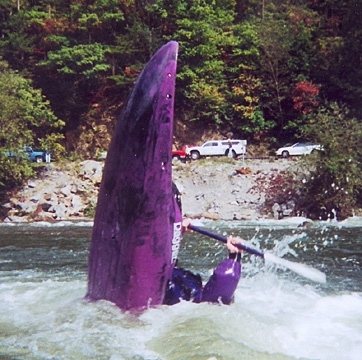
After my little brawl with Grumpy, whenever my buddies and I would go paddling, I would shamefully trudge my boat past Grumpy and enter the water farther downstream. Before long, years had gone by since the episode, but I was still trudging my boat past the rapid. I was in full fear of the known. Whereas the antidote to fear of the unknown is gaining knowledge, the antidote to fear of the known is a mixture of willful ignorance and focused attention. The truth was, unless I could stop mentally replaying the beating I had taken years earlier, I would never get past my fear of Grumpy. At the same time, I would have to pinpoint exactly what had gone wrong so that I could do it differently.
When I finally did paddle through Grumpy again, instead of thinking about all the things that could go wrong, I focused on the specific actions that I needed to take to successfully navigate the rapid. When you look at Grumpy in its entirety, it is incredibly intimidating. Water crashes onto boulders, rushes through narrow confluences, and circulates beneath undercut rocks. But successfully navigating Grumpy comes down to an intermediate ferry move. Ferrying is when you use the river’s current to move from one side of the river to the other while facing upstream. By focusing with laser-like attention on making the ferry move, and not on Grumpy’s tumultuous panorama, I was able to conquer the rapid and my fear too.
What fear of the known is holding you back?
Learn more about Giant Leap Consulting’s leadership programs: http://giantleapconsulting.com/services/leadership-development/
This story was adapted from my first book, Right Risk.


