
Bill Treasurer's Blog, page 23
March 26, 2018
Want to Appear In Bill’s Next Book? Send Us Your Story!

Bill Treasurer, author of acclaimed books including Right Risk, Leaders Open Doors, and A Leadership Kick In The Ass, knows that leadership moves the world. Be it small venues or big, when leadership is active, prevalent, and shared, results happen. We have seen leaders make profound and enduring positive changes at the personal and organizational level. But, with more and more frequency, we have also seen leaders do breathtakingly stupid, self-serving, and unethical things. We’re sure you have seen these things too.
We are excited to announce Bill is currently at work on his new book, The Leadership Killers: Reclaiming Humility in an Age of Arrogance. Co-written with retired U.S. Navy Seal Captain John Havlik, The Leadership Killers is an exploration of the forces that quietly cause leaders to compromise their integrity, misuse their power, and subvert their own effectiveness.
The most lethal force is hubris. Unless you manage your ego, your leadership will be seriously flawed.
Now, we want real-world stories–like yours!–to share with readers around the globe.
Think about a time when your ego or hubris (excessive pride or self-confidence) got you into trouble at work, in an organization, or in a collaboration/partnership.
How did ego get in the way?
What happened when your pride or excessive self-confidence took over?
What steps did you take to modify hubris or let go of your ego?
What consequences, positive outcomes and lessons arose from this event?
Tell Us Your Story…
It’s easy as 1-2-3.
Fill out the form below. Feel free to give us as much story detail as possible at this time. Don’t worry, we’ll go over the details with you later if we’re interested in using your story. Press Submit.
We will review your story. If we are interested in including it in the book, we will reach out to you for more details or to clarify anything necessary, as well as ask you how you would like to be identified (or not identified, first name or alias is fine!) and give you a timeline of what to expect.
As a thank you, you’ll receive an exclusive excerpt from Bill’s forthcoming book…before anyone else gets a chance to see it! This excerpt will be ready in May or June 2018.
[contact-form-7]


March 19, 2018
Look Me In The Eye!

Greetings GLC readers! I hope 2018 is going well as you continue to work on all those resolutions you promised yourself you would improve upon, with being a better “communicator” as your #1. If not, it should be, because as leaders, your ability to effectively communicate via any available means (social media, video, written, etc.) is critical to mission/business success!
Unfortunately, with the development of social media, we’ve forgotten to use–or get better at–the most important and influential means of communication. In layman’s terms, we’ve forgotten how to look someone in the eye and just talk to them one-on-one.
During my last Iraq deployment, I was the Deputy Commander of the U.S. special operations headquarters unit overseeing all Special Operations Forces (SOF) operations in Iraq. On 21 October 2011, then President Obama announced that the full withdrawal of all U.S. military personnel from Iraq would be accomplished by the end of that year. A no-later-than exit date of 19 December was directed, so that gave us approximately two months to plan on how we would move all the equipment and personnel out of country to meet the President’s decree. A daunting task to say the least, but in true special ops fashion, my boss looked me in the eye and said something inspirational to the effect of “Make it happen, Coach.”
I did 4 key things to make it happen:
Delegation
First, I had to teach an officer on the staff with 26 yrs of military service how to “delegate.” This officer was a good friend, but he liked to get into “the weeds” too much, and get his hands dirty more than direct others what to do. This “training” took about 30 seconds, because I quickly emphasized that what I really needed him to do was get the staff onboard as quickly as possible to immediately start the tedious inventory of all the equipment accumulated after 10 years of sustained combat operations, then ultimately move that equipment and all personnel to various locations around Iraq as the 19 December date got closer.
Strategic Planning
Once he was trained, I worked with that same officer to develop a Plan of Action & Milestones (POA&M). I used this tool throughout my naval career as it provided all hands with a comprehensive checklist and timeline of critical events, the dates these events needed to be accomplished, and who on the staff was responsible for action.
Consistent Meetings
Once the POA&M was developed, I started weekly department head meetings to review and keep the staff leaders informed of the status of our withdrawal, because these folks conducted daily interactions with U.S. conventional military and U.S. State Department support units that were critical to safely moving our people and equipment around (and ultimately) out of Iraq. As 19 Dec got closer, these weekly meetings quickly became daily (and sometimes hourly) sessions as POA&M events were completed and/or changed.
Direct Communication
And finally, as needed, but usually before any major personnel/equipment move (which were many), I sat the entire staff down either in person and/or via secure video teleconferences to remote locations around Iraq, and had my Chief of Staff and the Operations folks update the staff on how the withdrawal was going, and highlight what the boss’s expectations of them were as we got closer to the 19 Dec exit date. These sit-downs were invaluable, by keeping everyone informed while affording them a venue to ask and get timely answers to any questions they might have had.
Coach’s Tip(s) For This Month:
Talk to your people! Look them in the eye and tell them what you expect from them! The total withdrawal of all U.S. military personnel and equipment out of Iraq as directed by President Obama by the end of 2011 was successfully accomplished by leaders talking directly with their people, and not by sending out countless emails and/or directives for them to read (and hopefully follow).
Utilize a tool such as POA&M (Plan of Action and Milestones) for any project major events, especially if it involves significant changes to the way you normally do business.
CAPT John “Coach” Havlik, USN (Ret), retired from the Navy in 2014 after 31 years of distinguished service in the Naval Special Warfare (SEAL) community. He has served on all SEAL teams on both coasts, including the famed SEAL Team SIX. Coach completed graduate studies at the Naval War College in Newport, RI, receiving an M.A. in National Security and Strategic Studies and also completed a course of instruction in Spanish at the Defense Language Institute in Monterey, CA. Coach graduated from West Virginia University with a B.S. in Business Administration and was a member of the Men’s Swim Team for 4 years.
Coach Havlik is a Special Advisor to Giant Leap Consulting and regularly speaks about leadership and working as a team under arduous and stressful conditions.
March 12, 2018
7 Ways To Recover And Be Stronger After A Hard Leadership Lesson

Have you ever worked with a mentor or business role model and wondered, “How do they do it every day without breaking down?”
Here’s a fundamental truth from my book, A Leadership Kick in the Ass: your mentors and role models learn from every move they make, every failure they experience, and they refine the process as they go along. They’re not afraid to experiment as they move forward.
Think back to the last time you learned a lesson the hard way. How did you react? Did you make changes to become better and stronger? Or did you stick yourself in the conviction of “having to be right?”
If you chose the former, you are already 98% closer to aligning your practice with your mentors and those who have been successful before you.
It doesn’t matter what industry you’re in, what company model you have, or even what your unique career goals are. Each one of your leadership mentors, business role models, and personal life icons practices these seven key leadership moves to regularly recover and grow stronger as a leader, and you should, too:
Focus on the long game. A kick in the leadership pants is just a momentary speed bump on your longer leadership career. The spike in pain will eventually yield to worthwhile lessons and changes. Focus on where you ultimately want your career to end up, not the detour it may have taken.
Learn from your feelings. Pay close attention the feelings that come up for you after you fail or fall short. Identify what you’re feeling, precisely. Do you feel embarrassed, resentful, fearful, something else? Then ask yourself, “What information is this feeling trying to give me?” and “What is the lesson this feeling is trying to teach me?”
Remember, discomfort = growth. Comfort may be comfortable, but it’s also stagnant. You don’t grow in a zone of comfort. You grow, progress, and evolve in a zone of discomfort. The more uncomfortable that moment felt, the more growth can result from it.
Broaden your view of courage. Being vulnerable, open and receptive to change is a form of courage. Hard-changing types wrongly see courage as being fearless. Nothing could be further from the truth. Courage is fearful. The simplest definition of courage is “acting despite being afraid.” Courage requires fear. As long as you are moving forward, it’s when there’s a knot in your stomach, a lump in your throat and sweat on your palms that your courage is doing its job.
Don’t be oblivious to yourself. How much might it be costing you to remain loyal to your ignorance? Self-exploration and discovery can be painful, but what is more painful in the long run is being a stunted human being, incapable of acknowledging, assimilating and shoring up your shortcomings.
Be your own project. Lots of people lead projects better than they lead themselves. Think about what it takes to lead a great project. You identify your desired outcomes, you put together a timeline, you create milestones, and you gather the resources you need to execute the project and make it successful. You also use metrics to track your progress. You can manage your leadership hard lessons the same way!
Stay present. Fully immerse yourself in your experience. What feelings come up for you? What fears are at work? What are you learning and how can it be put to good use?
As much as this self-discovery can be painful, it can be vastly rewarding. The journey to the center of yourself is the most important one you’ll ever take. It’s how you become a whole person, and a wholly unique leader. Don’t mimic your mentors on the superficial stuff–biohacking, morning routines, what books they read, what they eat and who they socialize with–but go deeper to do the real work that requires facing what it takes to be great and lead others.
February 9, 2018
Finding Your Voice Leads to Creative Courage

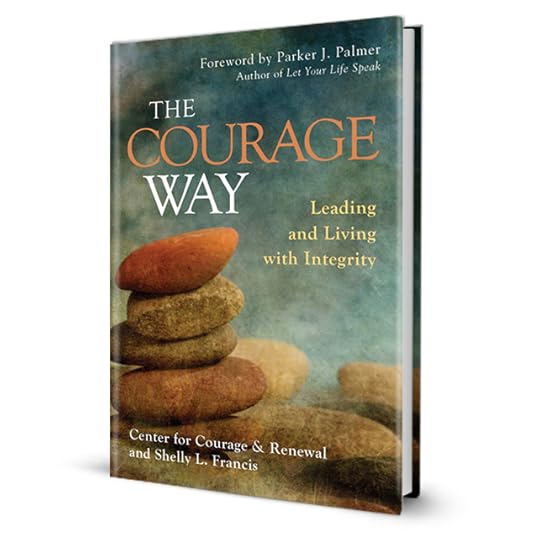
I am excited that author and leader Shelly Francis is sharing an excerpt from her new book, The Courage Way. At its core, leadership is a daily, ongoing practice and a journey that requires courage. I hope you find inspiration for your own path in the words below. — Bill
Finding Your Voice Leads to Creative Courage
By Shelly L. Francis
The capacity to risk stepping into the unknown is seeded deeply in the rich soil of vocation. Leaders cultivate their capacity to risk by building trust in themselves and in others over time. By embracing the paradoxes of limits and strengths, leaders expand the boundaries of how much they are willing to risk showing up as themselves to grow into the next stage of life and leadership.
“People find innovative responses to impossible situations not because they are well-trained professionals or particularly gifted,” writes John Paul Lederach in his book The Moral Imagination. “Innovative responses arise because this is their context, their place. The essence of the response is not found so much in what they do but in who they are and how they see themselves in relationship with others. They speak with their lives.” Lederach goes on to say that what he calls the “journey toward change” requires vulnerability and a willingness to risk.
A leader named Jonathan cultivated his willingness to look inward honestly and to risk being himself with his staff parallels the mission of his nonprofit organization. He sees the paradox of strength and vulnerability and how it informs courage. “Kids who grow up in South Central LA and neighborhoods like this are streetwise and have evolved in certain ways, but they are undeveloped and naïve in others. Then there are sophisticated, successful people who are making things happen in the world, but they’re fearful and out of touch with their values. Whatever your ecosystem, courage shows up in how you respond to opportunities to go outside of what you know.”
Jonathan recalls taking a group of kids to photograph the neighborhood, walking over a bridge spanning the 110 Freeway. One boy just stood there looking down at the traffic, staring and staring, while the other kids were moving along. Jonathan finally went back and asked him, “What’s going on?”
Still watching the cars speeding by and without looking up, the boy said, “Where are they going?”
Jonathan has never forgotten that moment when that boy’s life called him from the freeway. “It was such a powerful moment of epiphany for him to realize that a whole world existed beyond his own neighborhood and experience.”
Jonathan likes a Rumi couplet that says, “Be afraid, but don’t move the way fear makes you move.” He explained why: “I used to think courage was about being fearless. Now I understand that it’s not about denying my fear—there are a lot of things to dread in the world these days. But we can develop ourselves to be able to choose how we’re going to respond to those feelings.
“That’s huge for everybody, but especially our kids, our staff, and our constituents in this neighborhood. There are so many opportunities to get into trouble, to be drawn into tempting and unhealthy dynamics, and to self-destruct. To recognize that one can feel all kinds of ways and at the end of the day choose how to move rather than become a victim . . . that’s real courage.”
True leadership comes not from the sound of a commanding voice but from the nudging of an inner voice—from our own realization that the time has come to go beyond dreaming to doing.
—Madeline Albright
About Shelly L. Francis
Shelly L. Francis has been the marketing and communications director at the Center for Courage & Renewal since mid-2012. Before coming to the Center, Shelly directed trade marketing and publicity for multi-media publisher Sounds True, Inc. Her career has spanned international program management, web design, corporate communications, trade journals, and software manuals.
The common thread throughout her career has been bringing to light best-kept secrets — technology, services, resources, ideas — while bringing people together to facilitate collective impact and good work. Her latest book The Courage Way: Leading and Living with Integrity identifies key ingredients needed to cultivate courage in personal and professional aspects of life.
January 24, 2018
Walk The Deckplates!

Happy 2018! With the new year comes the traditional resolutions where we strive to do better: lose weight, get in shape, be happy, be a better parent, etc.
I would suggest to you all that as leaders, I bet we all could do a little better in the “listening” department.
Let me explain.
During my first big “leadership” job in the Navy, I was assigned as the Executive Officer (XO) of an overseas special operations unit, responsible for the management of the unit’s day-to-day activities. I was the second-in-command, with only the unit Commanding Officer (CO) being senior to me in both rank and authority. I was also the “bad cop” in the good cop/bad cop scenario, with the CO always being the good cop. As the unit bad cop, I spent most of my day dealing with all the negative and punitive issues of the command well before they ever reached the CO’s attention.
After a couple of months of being chained to my desk and “IN” basket, I finally had an afternoon where I could walk around, meet and talk with my sailors. While in one department, I overheard one of my junior sailors say to another, “Leadership at this unit doesn’t know what’s happening on the deckplates.”
Now, this phrase is a common naval euphemism used by sailors to highlight their belief that those in charge don’t have a clue of what’s happening in and around their respective unit. While I had uttered something similar at a few of my previous bosses, now my sailors were talking about ME! Instead of yelling and reacting badly to the sailor’s comment as any proper XO would do, I immediately returned to my office to try and figure out what I needed to do as a leader to better understand what was happening around my unit.
Here are the two actions I committed to:
1. I started to walk the deck plates.
Every Friday afternoon, I made time in my schedule to push away from my desk, and “walk the deckplates” while inspecting the weekly Field Day (a.k.a. unit cleanup). This allowed me to interact with my sailors while ensuring that the unit and its spaces were clean before securing for weekend liberty. During these “walkabouts,” I made it a point to meet all my sailors, look them in the eye, shake their hands, and learn their names, their backgrounds, their families, and most importantly, the issues that were affecting them (and ultimately the unit).
I was amazed at what I learned, and how positively my sailors responded to me because I took the time to learn about them!
2. I got serious about names.
I was (and still am) horrible with names, especially first names. The military makes it easy for mental slackers like me by assigning everyone a rank and then posting the last name of a service member on their uniform for easy reference.
What they don’t help you with is that individual sailor’s first name, because conventional military protocol deems it unprofessional for a leader to call a subordinate by their first name.
I wanted to change that.
During one of our seasonal uniform and haircut inspections, I made it a point to walk through the ranks of my sailors, shake their hands, look them in the eyes and call them by their first name. Of the approximately 180 personnel assigned to my unit, I remembered the first names of all my sailors…except for one.
As I stood in front of that sailor (and my command) trying to guess what his first name was for what seemed like several minutes, I finally relented and apologized to him because I really didn’t know what his first name was. He laughed, accepted my apology and then stated the only reason I didn’t know his first name was because he hadn’t been in my office for being in trouble.
The kicker to this story was several months later this same sailor was selected as the unit’s Sailor of the Year! How ironic it was to me that despite my best efforts, the only first name I didn’t know of all my personnel was the one of my very best sailor!
Coach’s tip for this month: Turn off your computer, leave your cell phone in your office, get up from your desk and MAKE TIME to walk around and talk to your people!
They have the solutions to any/all issues you may encounter in whatever profession you’re in, but YOU AS THE LEADER must have the internal fortitude to shake their hand, look them in the eye and talk to them. It’s truly unbelievable what you can learn, while also highlighting how much you don’t know! By taking the time to talk (and listen) to your people, you will never have to worry about hearing how “leadership at this unit doesn’t know what’s happening down on the deckplates.”
CAPT John “Coach” Havlik, USN (Ret), retired from the Navy in 2014 after 31 years of distinguished service in the Naval Special Warfare (SEAL) community. He has served on all SEAL teams on both coasts, including the famed SEAL Team SIX. Coach completed graduate studies at the Naval War College in Newport, RI, receiving an M.A. in National Security and Strategic Studies and also completed a course of instruction in Spanish at the Defense Language Institute in Monterey, CA. Coach graduated from West Virginia University with a B.S. in Business Administration and was a member of the Men’s Swim Team for 4 years.
Coach Havlik is a Special Advisor to Giant Leap Consulting and regularly speaks about leadership and working as a team under arduous and stressful conditions.
December 18, 2017
Deployed for the Holidays

During my 31 years in the Navy, I was deployed or stationed overseas during the holidays nine times. And I loved every minute of it!!
Now, some of you may wonder why I loved being far from loved ones during the one time of the year when family is highlighted, and the only answer I can come up with was that deep down inside of me it just felt right. To me, I was with “family.” I was with my platoon and/or working with fellow servicemembers, doing whatever job I was assigned in defense of the greatest country in the world. What can be more noble or honorable? To me, absolutely nothing!!
Now there were indeed some perks to being deployed or stationed overseas during the holidays. The “care packages” from home and friends were more frequent and often contained a bit more of the goodies we couldn’t get overseas. Additionally, the base morale and recreational leadership worked tirelessly to make us all feel like we were home, adorning the base facilities and buildings with a plethora of holiday decorations, frills and wintery trim! Extra attention was always given to the dining facility, where there was no shortage of wintery bells and whistles displayed, and never was one lacking for great food and holiday sweets!! Even when I was deployed to Iraq or the Philippines, there were times when I actually felt I was somewhere up north, waiting to hit the slopes.
I vividly remember one Christmas in Bahrain, when one of my department heads came to my office and stated there was a pallet of Girl Scout cookies delivered to us, and wanted to know what to do with all the cookies. God bless the Girl Scouts! When I stated I couldn’t believe it, I went outside only to find one standard USAF cargo pallet (approximately 9 feet long and 7 feet wide) stacked approximately 5 foot high full of various cookies!! When I saw it, my initial thought was that I had died and gone to heaven, since anyone who knows me knows that there isn’t a cake/cookie/doughnut made that I don’t like! Once I got over my sugary shock, I directed my department head to distribute a fair share of boxes to our fellow command members, and then ship the remainder of the boxes to the troops located forward.
As a leader, I felt it was vitally important that I devoted extra attention to the morale of my subordinates and co-workers during the holidays, many who did not feel the same as I did, but ultimately recognized that being overseas was part of the job. I did my best to ensure that every member of my command had a place to go for a holiday dinner, and we even had “White Elephant” type of gift exchanges so that every command member got a present of some kind. These simple events were critical to individual morale and command “espirit de corps,” and helped to take away a little bit of the natural loneliness folks felt being far away from home.
Coach’s tip for this month: Send a “care package” overseas to a deployed servicemember! Many local veteran’s organizations/agencies do this during the holiday season. Reach out to one of them and see what you can do. It is invaluable!
Also, recognize the families of deployed service members. The holidays are naturally a stressful time for most, but think of the added worry of those having a loved one deployed to some remote location, helping to keep this country and its citizens safe. It’s not easy. Thank them and make sure they are doing OK!
Happy Holidays! See you in 2018!
—
CAPT John “Coach” Havlik, USN (Ret), retired from the Navy in 2014 after 31 years of distinguished service in the Naval Special Warfare (SEAL) community. He has served on all SEAL teams on both coasts, including the famed SEAL Team SIX. Coach completed graduate studies at the Naval War College in Newport, RI, receiving an M.A. in National Security and Strategic Studies and also completed a course of instruction in Spanish at the Defense Language Institute in Monterey, CA. Coach graduated from West Virginia University with a B.S. in Business Administration and was a member of the Men’s Swim Team for 4 years. Coach Havlik is a Special Advisor to Giant Leap Consulting and regularly speaks about leadership and working as a team under arduous and stressful conditions.
December 12, 2017
Leaders Don’t Freak Out

As a leader, stress is inevitable. However, it is what you do with that stress makes all the difference. You can either let stress take you down, or you can let it energize and motivate you.
Before starting my business a dozen years ago, I spent six years at Accenture, one of the world’s largest management consulting firms. How large? Over 300000 employees and nearly $35 billion in revenue.
Peter Drucker said that the problem with consulting companies is that when you build the beast, you have to feed the beast. Partners at Accenture were under tremendous pressure to both deliver value to our clients and generate more revenue…always in that order.
During my last two years at the firm, I served as Accenture’s first full-time internal executive coach. I had a clientele of 35 partners and associate partners. I can tell you that many partners felt the pressure to grow the business. Stress takes a toll. Often that toll is felt most by the people being led by the leader. The default option for a lot of leaders is to externalize their stress toward the people they lead. If you’ve ever gotten your head bitten off by your boss, or watched your boss freak-out over some minor mistake, you’ve experienced your leader’s stress firsthand.
The leaders we most admire are those who remain composed when the potential for anxiety is high. We feel most confident in our leaders when they are levelheaded and reasonable. In my case, the leader who made the best and biggest impression on me was Hines Brannan. He had (and still has) a humble confidence about him that only years of experience can give a leader. More on Hines and his grace here: http://youtu.be/QC0hfBuTR7I
Who is the levelheaded leader who made all the difference in your life? Who is the leader who refused to freak-out? Share your thoughts in the comments.
My advice to leaders everywhere: Don’t freak-out.
November 28, 2017
The Courage to Trust Your Team

The only way to make a man trustworthy is to trust him.- Henry Stimson
Leadership is commonly associated with action – trying, doing, achieving. However, there is another side to leadership that focuses on the followers: trust. As leaders, we need to actively trust our followers. This may sound simple, but is often harder for the goal-oriented achievers.
The act of trusting often requires letting go of our need to control outcomes or people, our defense mechanisms, and our preconceptions about what is “right.” For hard-driving controlling types, such as the coffee-clutching professionals who make up much of today’s workforce, this goes against the grain of everything they stand for. Trust runs counter to the take-charge ethos that epitomizes today’s business world. In many companies, the most valued employees are those who, when encountering challenging situations, control chaos, force order, and take decisive action. As the Roman poet Virgil said, “Fortune favors the bold.”
TRUST Courage, for managers, is a tricky thing. On the one hand, you need your employees to trust you so that they follow your direction enthusiastically. On the other hand, you have to monitor their performance, which, if done too closely, often feels distrusting. Plus many managers work in companies layered with systems that are inherently distrustful. It is more difficult to fill workers’ TRUST buckets if you’re an extension of a system that doesn’t trust them. “Sure,” your workers may say, “I’ll trust you . . . just as soon as you get the company to stop random drug testing, monitoring our e-mails, and making us submit time reports.”
New managers in particular are challenged with TRUST Courage. Consider, for example, how hard it is for new managers to delegate important tasks to employees. In such instances, if the employee screws up, it can reflect on the manager, not the employee. Consequently, many new managers struggle to fully let go of delegated tasks, choosing to hover above direct reports like smothering parents. In so doing, they become Spillers, thwarting employee development and keeping themselves mired in tasks that they should have outgrown by this stage in their careers.
Delegation involves not acting on the temptation to grab the task back from the employee. The ability to delegate is directly proportional to how much trust a manager has in an employee. Trust doesn’t come easily for new managers (or immature experienced ones), because it involves intentionally refraining from controlling an outcome (or a person). If the manager doesn’t trust that the employee will get the job done, he will grab the task back and do it himself—or worse, he won’t even give the task to the employee in the first place. The result is a sort of leadership dependency whereby workers wait to be told what to do, like baby birds waiting to be fed. When this happens, a dangerous Spill cycle begins; the leader keeps doing the tasks, which keeps the workers from gaining the skills to do the tasks, which keeps the leader from delegating the tasks, which keeps the leader doing the tasks, et cetera.
TRUST Courage involves taking risks on other people and accepting that you might get harmed in the process.
Trust is risky. When you trust, you become vulnerable to actions that are beyond your direct control. Your success becomes dependent upon someone else’s action. Th e challenge here is one of reliance; you have to give up direct control and rely on the actions of others. It is this lack of control that makes trust so difficult. Trusting you can harm me. Because of this risk, it takes courage to place trust in others. It takes TRUST Courage, for example, to let employees do their jobs without interference. It takes TRUST Courage to accept that, despite their best efforts, employees will make occasional mistakes.
How can you trust your team more this week? What would that look like for you?
November 10, 2017
Don’t Ring the Bell!

Throughout SEAL training, there are several time tested catch phrases that SEAL trainees hear and carry with them from the moment they walk through the doors of the schoolhouse in Coronado to formally start BUD/S (Basic Underwater Demolition/SEAL) training, to hopefully the day they graduate some 6 months later. A few of these witty (but effective) phrases include: “The Only Easy Day Was Yesterday” (the BUD/S motto), “Pain is a great motivator”, “Take Hell Week one meal at a time”, “It pays to be a winner”, and a few other keepers. However, there is one ominous phrase that ultimately drives everything that a trainee does in BUD/S training and that is “Don’t Ring The Bell!” See, if a trainee voluntarily rings the bell three times at anytime during BUD/S, they have decided to quit for whatever reason(s), and will immediately be removed from the class and made available for further assignment to another job in the Navy.
Now, that damn bell is always visible during a trainee’s day, just innocently hanging there on the pole outside the instructor’s office, waiting for the next victim to ring it three times and say “Adios” to BUD/S. What makes the bell even more ominous, is that during Hell Week, the bell is transported to every training event, no matter the time or the day, tempting the trainees to come on over and ring it if training gets to be a bit too much for them to continue.
I came close to ringing that damn bell on Tuesday night of my Hell Week. I’ll save the full story for a future posting, but the gist was that at the time, I was really tired having been up for approximately 48 hours, extremely cold (my Hell Week was held during February), and soaking wet and sandy from being in/out of the water for most of those 48 hours. After one specific training “evolution”, I mentioned to a couple of my fellow trainees in my boat crew that I was thinking of quitting. As we were preparing for our first “scheduled” 15 minute sleep break, I was called over by my proctor (a SEAL instructor who oversees a class through that specific phase of training, and acts as a liaison between the class and the instructor staff), who asked,”WTF sir! I heard you wanted to quit! Why?” Immediately I felt embarrassed and ashamed that I was standing there in front of my proctor, shivering, cold, and tired, and having to explain to him why I wanted to quit. I believe I mumbled something profound like, “I’m not sure I’m cut out for this SEAL thing.” Before I knew it, my proctor was in my face and with eyes glaring down into my soul, and said, “You’re an officer! Stop thinking about yourself and start thinking about your men!”
With that statement, my proctor gave me the requisite rudder adjustment I needed to stop feeling sorry for myself, and I started being the type of officer that the SEAL Teams needed and DEMANDED! I ultimately returned to my boat crew, never thought of quitting again, and never rang the bell, until 6 months later when I graduated! When I finally did ring that damn bell, I tried to rip it off the pole, as did the other 21 guys that graduated with me! IT FELT AWESOME!!
Coach’s tip for the month: when life/work gets tough, don’t quit! Reevaluate and/or readjust as required. Don’t ring the bell!
—
CAPT John “Coach” Havlik, USN (Ret), retired from the Navy in 2014 after 31 years of distinguished service in the Naval Special Warfare (SEAL) community. He has served on all SEAL teams on both coasts, including the famed SEAL Team SIX. Coach completed graduate studies at the Naval War College in Newport, RI, receiving an M.A. in National Security and Strategic Studies and also completed a course of instruction in Spanish at the Defense Language Institute in Monterey, CA. Coach graduated from West Virginia University with a B.S. in Business Administration and was a member of the Men’s Swim Team for 4 years. Coach Havlik is a Special Advisor to Giant Leap Consulting and regularly speaks about leadership and working as a team under arduous and stressful conditions.
November 1, 2017
The Perverse Thinking of Never Standing Still

In the mid-1990s, a regional communications company launched a billboard advertising campaign that implored people to “Never Stand Still!” The underlying message was that to be successful, you must be perpetually on the go. God forbid you be still! Stillness is for weaklings and has-beens; the new breed of winners are those who are furiously busy and accessible. The ad was essentially saying, If you want to avoid missing out on emerging opportunities, you’ve got to be continually refreshed with up-to-date information, you need “all the news, all the time,” you’ve got to be electronically connected! You’ll be eminently productive to the extent you are permanently interruptible.
In my first book, Right Risk, I point out that “Never Stand Still!” is asinine advice. Standing still is exactly what you should do if you’re facing a major decision or risk. Standing still teaches us composure and poise, and keeps us from getting caught up in a haze of distraction. Stillness brings focus, enabling you to regulate your emotions and discern the right course of action.
The importance of stillness was well described by Oprah Winfrey in an editorial in O Magazine. In running her production company, Harpo, Oprah is pulled in many different directions by many different people. To get centered, she walks into her closet, sits on the floor, and in her words – “goes still as a stone.” She writes, “When I walk out, I am centered on what’s most important and can make decisions based on what’s right for me–not on what everyone else wants or needs. I’ve learned that the more stressful and chaotic things are on the outside, the calmer you need to be on the inside.”
The French mathematician Blaise Pascal famously said that all of man’s problems stem from being unable to sit alone quietly in a room. Those words are more relevant today than they were in his time. We seem to have lost the ability to saunter, to carry on a lingering conversation, to kick back and relax. Instead, anxiety and worry are talked about with pride. With a good deal of self-importance, business people often refer to “what keeps them awake at night,” as if stress-induced insomnia were an essential factor in professional success. Busyness has become the defining preoccupation of our age. The only quiet moment we seem to get is in that brief interlude in the morning while we are waiting for our computer to boot up. We seem hell-bent on keeping ourselves distracted. We crank up the radio volume in our car, unwind with “comfort TV” at home, cut deals on our cell phone at the playground and spoon-feed our minds with Internet junk food everywhere we can. We work harder and harder to buy more and more laborsaving devices. And the more we acquire, the unhappier we seem to get. For as much as our cell phones, emails, social media, and tablets have put us in touch with others, they have put us way out of touch with ourselves.
The problem with the boundary-less world is just that – we have no boundaries. We allow the world in with no filter to help us decide the relative importance of each new bit of information. When everything is urgent, all things get trivialized.
Henry David Thoreau writes in his final book, Walking, that this kind of undisciplined results in more than just mental laziness. It can permanently profane how we think so that “all our thoughts shall be tinged with triviality.” A better and healthier approach is to periodically get disconnected from all your electronic tethers so you can hear yourself think. Sometimes, as Thoreau suggests, it’s important to go on long walks just so you can have long, uninterrupted thoughts.
Think back over the past 24 hours. Did you take any time for silence? What might you be able to do to reduce the amount of time you spend looking at a computer screen? How can you incorporate more stillness into your day?


