Elizabeth Ellen Carter's Blog, page 14
September 12, 2016
Tuesday Book Club: Maggi Andersen

Chesterfield couch, in royal purple – just perfect for our distinguished guest on tonight’s show.
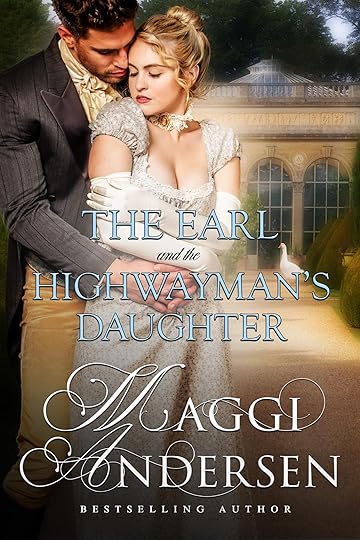
Today I welcome the wonderful Maggi Andersen as a my latest guest on the fabulous purple couch. Today Maggi is going to share more about her latest release, The Earl and the Highwayman’s Daughter.
Hi, thank you for inviting me to your lovely blog to tell you more about my latest release The Earl and the Highwayman’s Daughter.
It’s my absolute pleasure, Maggi! What were you like at school?

The beautiful Maggi Andersen, author of The Earl And The Highwayman’s Daughter.
A dreamy child, always reading. Good at English, hopeless at maths.
What inspired you to write?
Some people are born writers; I think I’m one of those. I’ve always had a strong urge to create stories.
Which writers inspire you?
Eloisa James, Courtney Milan, Amanda Quick and Lauren Willig.
What inspired you to write this story?
It was originally a short story written for my publisher. I liked the hero and heroine so much I decided they deserved a longer story.
 How much research do you do?
I’m always deep in research. For this books it was highwaymen, etiquette and manners. I’m constantly searching for new information about Regency food and I love the houses, the décor and the fashions.
Can you give us a blurb to let us know what the story is about?
Regency Romance
Eugenia Hawthorne, daughter of a deceitful highwayman, saves the life of the Earl of Trentham after he’s deposited at her door suffering from a bullet wound. Outsmarting her father, the earl takes Eugenia to live in his beautiful country estate, Lilac Court. But what does he really want from her? It seems there’s a mystery attached to an emerald necklace, which he wishes her to wear at a London ball. Could Eugenia be the daughter of a powerful duke, but born on the wrong side of the blanket? Her mother refused to tell her.
As Brendan, Earl of Trentham, works to bring down a hated foe, he and his sister instruct Eugenia in the ways of the ton. She is beautiful and, despite the cloud over her birth, will be desired by many men. Why doesn’t that prospect make him happy?
Give us an insight into your main character. What does she do that is so special?
My heroine, Eugenia Hawthorn, is a no-nonsense kind of woman. She’s learned to be self-efficient growing up on a farm. I like that she’s caring and brave, and she stands up for herself.
Which actor/actress would you like to see playing the lead character from your most recent book?
For the hero, who doesn’t like Aiden Turner? (Poldark) 
For the heroine, Australian actress, Mia Wasikowska, who played Alice in Wonderland and Alice Through the Looking Glass with Johnny Depp.
What book are you reading at present?
The Anatomist’s Wife by Anna Lee Huber. A new author to me, I’m enjoying the first in her Victorian mystery series.
What writing project are you working on next?
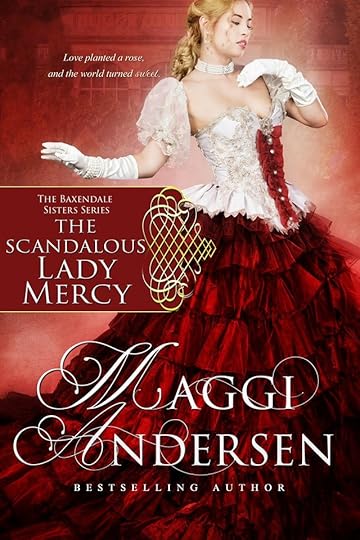 I’m writing the fifth and final book in the Baxendale Sisters Series, The Scandalous Lady Mercy. *Would you like a peek at the cover?
Yes please!
Tell us something unique about you that they wouldn’t guess from just looking at your photograph?
My hobby is bird watching. We have many varieties of birds in the Southern Highlands of Australia. Tourist come in droves in the spring for the gardens and the bird life.
What is your favourite positive saying?
“Remember that sometimes not getting what you want is a wonderful stroke of luck.” Dalai Lama
What is your favourite book and why?
Charlotte Brontë’s Gothic novel, Jane Eyre gripped me emotionally from the beginning with its haunting narrative. Rochester was the very first romantic book hero. He inspired my romance writing. Who can forget the first time they meet, when he almost runs her down on horseback?
What is your favourite quote?
“Be who you are and say what you feel, because those who mind don’t matter and those who matter don’t mind.”
Dr. Seuss
What is your favourite movie and why?
Pride and Prejudice. I don’t know how many times I’ve watched different versions of it. A charming Cinderella story, where against all odds the guy gets the girl. The Regency era has endless charm, and Jane Austen’s novels are a delight.
How can readers discover more about you and you work?
· Website: http://www.maggiandersenauthor.com
· Blog: http://www.maggiandersen.blogspot.com
· Facebook: https://www.facebook.com/maggiandersenauthor
· Twitter: https://twitter.com/maggiandersen
· Linkedin: https://www.linkedin.com/in/maggiandersen?trk=nav_responsive_tab_profile
· Pinterest: https://au.pinterest.com/maggiandersen/
· Amazon Author Page: https://www.amazon.com/Maggi-Andersen/e/B003MJXQVG/ref=sr_tc_2_0?qid=1473051386&sr=1-2-ent
· Smashwords: https://www.smashwords.com/profile/view/Maggicoleman
· Goodreads: https://www.goodreads.com/author/show/2786221.Maggi_Andersen
Would you like to share an excerpt from your book?
I’d be delighted, thank you.
Eugenia wandered outside again. It was a glorious day. Lord Trentham would be still out riding somewhere over the estate. Walking along, deep in thought, she found herself at the stables, where Mr. Pollitt and the stable boy unloaded sacks of oats and beans from a dray.
He smiled and removed his cap. “Anything I can do for you, Miss Hawthorne?”
“Thank you, Mr. Pollitt. I have a rather odd request.”
Half an hour later, Eugenia emerged from the groom’s room above the stables, just as his lordship rode in.
Lord Trentham dismounted and strode over to stare up at her as she descended the stairs. “What on earth…?”
“I should like to ride, my lord.” She stepped off the bottom rung, aware that her appearance had shocked him. She was dressed in Mr. Pollitt’s breeches, rolled up at the bottom, and a large shirt, which smelled strongly of horse.
“Neal?” His lordship swiveled around to look at Mr. Pollitt
“Please don’t be angry with Mr. Pollitt. I insisted,” Eugenia said.
His lordship studied her outfit, his gaze lingering on her legs. “You cannot go about dressed like that, Eugenia. Have you actually ridden a horse?”
She huffed. “Of course. I’m a country girl. But we only had the carthorse. He didn’t take kindly to being ridden.”
A flicker of amusement entered his blue eyes. “I imagine not. Bring out a sidesaddle, Neal.”
She frowned. “Must I have one?”
He arched a brow. “Ladies don’t ride astride, Eugenia.”
“Who is going to see me here?”
“And you must ride with the groom.”
“Can’t I ride with you, my lord?”
A small smile lifted the corners of his mouth. “You are determined. My sister would be outraged.”
She grinned. “Must she learn of it? I should not like to upset her.”
He stroked his chin. “I intend for you to receive instruction before I take you riding in Rotten Row.”
“Rotten what, my lord?” she asked as she followed him along the horse boxes.
“It’s where the ton ride in Hyde Park.”
“I thought this one, milord.” Mr. Pollitt waited at a horse stall.
“I see Neal has selected a good mount for you.”
The groom led out a short, solid grey horse. “This is Grey Dreamer, Miss Hawthorne.” He went to fetch the saddle.
Dismayed, Eugenia stared at the horse. “I’m to ride a pony?” She’d been patting a tall chestnut gelding who had thrust his handsome head over the door of the box. “She looks half asleep.”
His lordship threw back his head and laughed. “Then you shall wake her. Grey Dreamer is my stallion’s companion. Neal, please assist Miss Hawthorne to mount.”
Eugenia eyed the sidesaddle. It looked impossibly foolish. “Can I not use an ordinary saddle?”
His lordship shook his head. “That is unacceptable. And I’m losing patience.”
With the groom’s help, she clambered onto the saddle and arranged her leg around the pommel. She took up the reins and reached for the crop, and then as his lordship mounted his stallion, she walked the animal out onto the cobblestones in the stable yard.
Once out in the sunshine, Grey Dreamer appeared to droop. Eugenia nudged the animal in its round belly with the heel of her half boot. The grey came alive and took off down the carriage drive with his lordship yelling instructions behind her. The horse then lurched sideways onto the lawn, heading straight for the rose garden.
“Whoa,” Eugenia cried, tugging on the reins. Her face burned with distress. What would his lordship think if she trampled his garden? With one final violent tug, she managed to steer the stubborn horse away from the roses and pull her up. Grey Dreamer bent her head, and with delicate precision, picked up a fallen rose, and munched it, a serene expression in her big brown eyes. “You are a fraud, Grey Dreamer,” Eugenia said with disgust.
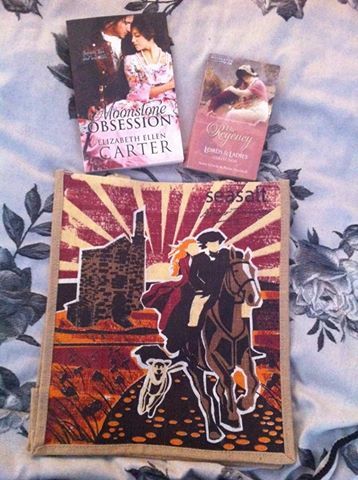
Your Chance to Win a Limited Edition Poldark Tote!
Signed by Eleanor Tomlinson and filled with books!
How? Just click the link below and find out in next month’s newsletter!
Join Now!
Share!


The post Tuesday Book Club: Maggi Andersen appeared first on EE Carter.


September 3, 2016
Happy Father’s Day
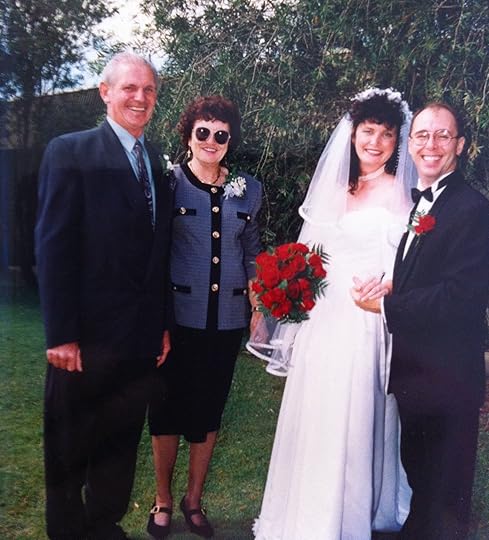
My grandfather and my grandmother at our wedding in 1994.
Today is the first Sunday in September and Australia celebrates Father’s Day.
If you are blessed with a wonderful father who is still living, be sure to give him an extra big hug and tell him how much you appreciate him. You’re never too old to do it.
Unfortunately I don’t have a happy relationship with my father. He turned his back on his family nearly 40 years ago and never looked back.
But this post is not about being a downer on this important day.
This Father’s Day, I’d like to introduce you to my grandfather, a man who exemplified everything a husband, father and grandfather should be and take a look at just the ways he influenced my life.
Charles Edward Beadle was born in October 1927 in Starbeck, a little town near Harrogate in Yorkshire.
He was the son of a coal miner, later an estate gardener, one of four children – three boys and a girl. He was not quite 18 when the war ended, but while still on military service, he fell in love with my grandmother, a flame-haired Irish woman two years older than himself.
They had two children, my mother and my aunt.
After one particularly harsh northern winter, he read a newspaper advertisement inviting people to emigrate to Australia. His decision to clip the coupon came as a result of a pique.
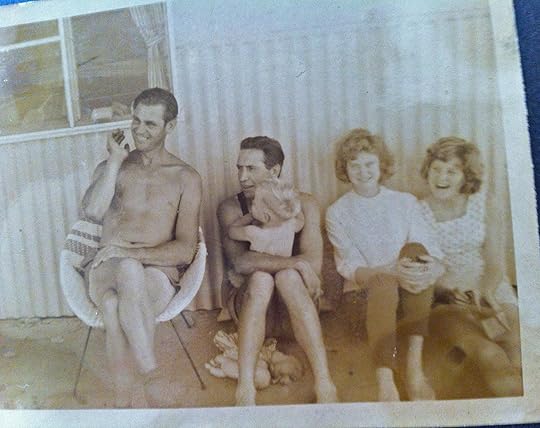
In 1963 my grandparents, mum and sister emigrated to Australia as ’10 pound Poms’. Here is my grandfather (seated) with the man who became my paternal grandfather (a Scotsman everyone called ‘Mac’), to the right my mother and next my aunt. They are pictured at Villawood Migrant Hostel in Sydney in 1963.
He had been walking down the street when he saw an old man reflexively tug his forelock at the passing of the local Lord’s car which was empty apart from the chauffeur. That really grated against his sense of fair play and the belief that one deserves honours only by merit.
In fact, so short-lived had his outrage been, he never even mentioned his actions to my grandmother and forgotten all about it until a letter arrived from Australia House – the family had been accepted. They were going to Australia.
There were opportunities here that one could never dream of in England – plenty of work, the chance to own a house, a chance to live modestly well. Not extravagantly or ostentatiously – that was never his way. His ambitions were simple a modest house, a modest car, a happy family.
I became particularly close to my grandfather after my own father left. What I learned from him were not conscious teachable moments, but rather it was the way he lived his life.
First of all, he valued education. He only attained a Year 10 education, doing what most did back in the 1940s if you were part of the working class. But what he did do was never stop learning.
He loved the library – a world full of books and it was ‘free’. That alone was enough to warm the heart of a Yorkshireman.
And he read.
And he read everything.
A little of Shakespeare, a little of Jane Austen, Arthur Conan-Doyle, Agatha Christie, the Encyclopedia Britannica, mechanical how-to books, Mills & Boon Medical Romances he was fond of too.
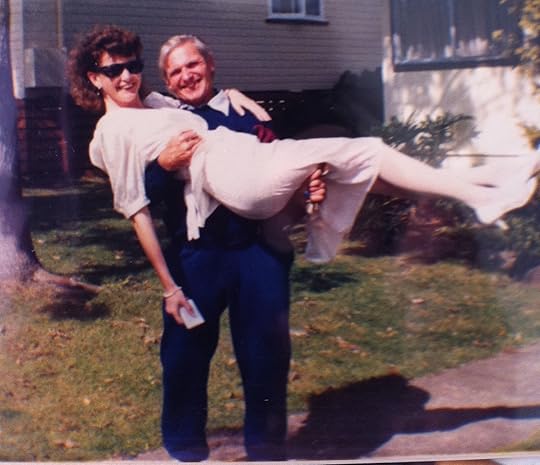
My grandfather celebrating me getting my drivers’ license in 1987.
He showed me that all you needed was a frank curiosity and an open mind. With those two things, you had everything any university could teach you.
Secondly, he valued hard work and lived within his means. My grandfather was never one to sit on the dole. It was a safety net only. When construction work dried up, he applied for anything and everything. He even worked as a door-to-door encyclopedia salesman.
Not that the family ever went without. For a short time he owned a boat and he saved up enough money to go back with my grandmother for a holiday in England three times.
Thirdly, he valued fairness. His ambition for a better life was never at the expense of his family or his community.
He always supported the dreams and goals of others.
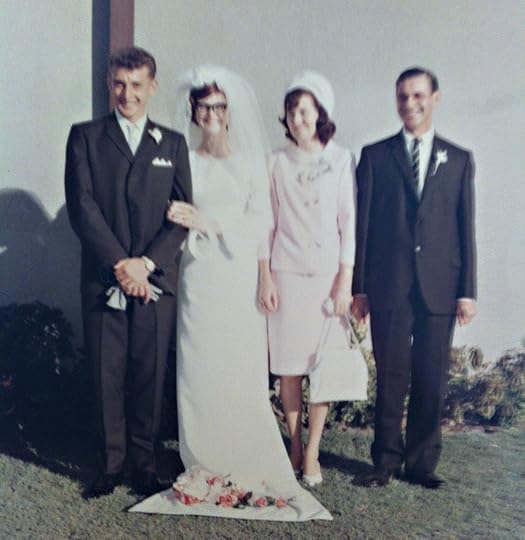
My parents’ wedding in 1967. Pictured with my grandparents.
When I was a young teenager and decided I wanted to be a journalist, he encouraged me wholeheartedly. At that stage no one in our family had ever completed high school, let alone had an ambition for a profession.
Years later he said that if there was one upside from my father’s departure, was that I had been allowed to nurture my calling and not belittled for it as my father most certainly would have done.
In fact, it was the only unkind (although true) thing I every heard grandad say about my father.
He also fostered my mother’s ambition when she was ready to rebuild her life. He encouraged her to study for her librarian qualifications, which she did while raising my sister and me. And through, that my mother became the first person in our family to receive tertiary qualifications.
Most of all he embraced life wholeheartedly.
He was an open-minded seeker of truth and he found it, embracing it without reservation and spending many hours working as a volunteer for the less fortunate.
He converted to Catholicism to marry my grandmother – and as I understand it, a stipulation of her Irish father. And to this day my she says my grandfather was a better Catholic than she was.
He loved technology and in some respects was one of the early adopters in our family – microwave oven, mobile phone – he loved it all.
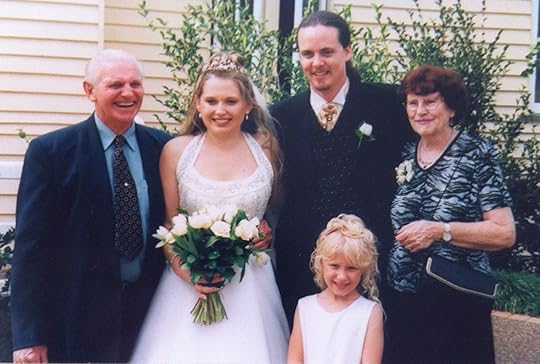
My grandfather pictured at my cousin’s wedding in March 2001. This was the last photograph taken of him. He died of a heart attack three days later.
He wasn’t quite sure how he could make use of a computer, but when the internet came along, he was ready to jump on board. The idea of sharing e-mails, images and information from around the world delighted him and was ready buy one when he passed away.
When we were building our house, he was there too. My husband had to stop him several times from climbing up to the roof to help, he was that hands on. Grandad was no stranger at the gym either, working out with weights when he was in his 70s. Truly, he was vitality personified.
Charles Edward Beadle – Charlie to everyone, not one could ever say a bad thing about him – passed away in March 2001.
I see his face and hear his voice almost every day, such is the influence he had on my life. I know that he, like my late mother, would be proud of my writing career and even now I can feel their encouragement (my mother would be okay with my sex scenes, but I do blush with the idea of my grandfather reading them).
Happy Father’s Day to you grandad.
Happy Father’s Day to the amazing men whose love, influence and inspiration makes our lives richer and gives us the foundation to reach higher.
Thank you.
Your Chance to Win a Limited Edition Poldark Tote!
Signed by Eleanor Tomlinson and filled with books!
How? Just click the link below and find out in next month’s newsletter!
Join Now!
Share!


The post Happy Father’s Day appeared first on EE Carter.
August 15, 2016
Tuesday Book Club: Christina Phillips
Chesterfield couch, in royal purple – just perfect for our distinguished guest on tonight’s show.
Welcome to Christina Phillips! She joins me today on the couch for Tuesday Book Club!
What were you like at school?
Shy, introverted, loved making up stories. Not changed much in all these years!
What inspired you to write?
I know it’s a writer’s cliché but I’ve always loved writing. I still have notebooks from when I was eleven where I’d write stories about girls at boarding school (the romance came later!). When I was a teen I wrote epic tragic poems. Interestingly, I discovered recently that when I was 14 I wrote a time travel romance for one of my English essays that involved a Roman centurion! However, he was a baddie and to escape him I ended up trapped in the time machine (which apparently wanted to eat my soul J )

Christine Phillips – author of The Druid Chronicles
Which writers inspire you?
When I was 18 I read Clan of the Cave Bear by Jean M Auel, and that book completely blew me away. Even now I find it hard to convince myself that it’s FICTION, CHRISTINA!
What inspired you to write this story?
Although I’ve always loved reading historical romance it never occurred to me to write one with the aim of publication. I actually started off aiming at Mills & Boon with short category romance, but although I got close with revisions a few times I never quite made it over that magical line. Another of my fave genres ever since I was a child was paranormal (even though when I was kid I didn’t realise that’s what it was!) so I wrote a couple of short PNR/futuristic fantasy erotic romances and they were published by The Wild Rose Press. One night while doing admin, this tough Roman warrior stormed into my mind searching for his Druid princess. I was hooked! What was a Roman doing looking for a Druid, unless he was planning on slaughtering her? So of course I had to drop everything and find out!
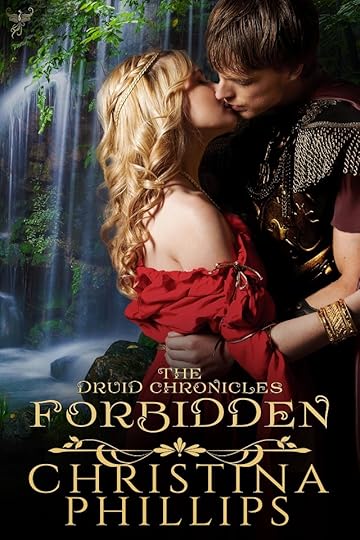
The first book in the series.
How much research do you do?
I did a huge amount of research for The Druid Chronicles, but although there’s plenty of information about the Romans, there’s hardly anything about the Druids. This is mainly because they passed their knowledge down through oral teachings, and the only contemporary writings regarding them are from the Roman viewpoint. Prejudiced, much? So when it came to the Druids in my books, my imagination took flight
Can you give us a blurb to let us know what the story is about?
He was a master of seduction – but no match for the magical allure of the woman he wanted most
Carys knew from the moment she first spied on Maximus in his naked barbarian glory that he was a dangerous Roman centurion – his taut, battle-scarred flesh marking him as a fearless warrior. But her desire for him was as undeniable as it was illicit.
Charged by his emperor to eliminate a clan of powerful Druids in Britain, Maximus never expects his mission to be thwarted by the clan’s ethereal princess, Carys, his daring voyeur. Falling under her spell, he doesn’t realize her true heritage – until he captures her heart as well as her body.
As Carys’ loyalties are twisted, and freedom is no longer her single-minded obsession, an avenging former lover threatens to crush Maximus’ people into oblivion. Now Carys and Maximus must overcome the devastation of war and face the ultimate sacrifice if their forbidden love is to survive.
Previously published by Penguin US in 2010
Give us an insight into your main character. What does he/she do that is so special?
Maximus is a patrician and a tough Roman warrior. He’s used to being obeyed without question, especially by the women in his life. When he meets Carys his entire world is turned inside out. Not only does she defy him at every turn, she appears to think there’s nothing unusual for women to be equal to their man. The thing I love about Maximus is he’s willing to open his mind to a culture so different from his own, and accept Carys for who she is, despite the edict from his Emperor.
Which actor/actress would you like to see playing the lead character from your most recent book?
Henry Cavill. Of course!
What book/s are you reading at present?
I’ve just finished Erica Hayes’ Sapphire City superhero books, Scorched and Scarred. Loved them.
What writing project are you working on next?
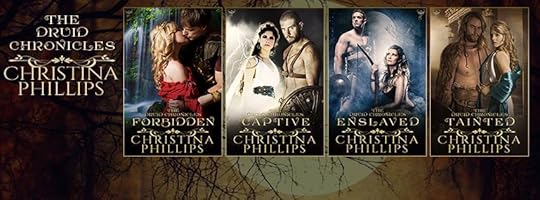
Besides doing the final read throughs for the other books in The Druid Chronicles (all will be released this year) I’m writing the second book in my Viking Bastards MC club series, a contemporary romance for Entangled Publishing’s Scorched line.
What is your favourite positive saying?
Don’t let the bastards get you down.
What is your favourite book and why?
I’m fickle, and this changes with my mood!
What is your favourite quote?
Never give up! Never surrender! (Galaxy Quest)
What is your favourite movie and why?
One of my fave movies is Love, Actually. We watch it every year in December (and sometimes mid way through the year as well). I adore Emma Thompson and the scene in the bedroom brings me to tears every time. I also love Alan Rickman in anything, but one of the things that kills me every time is how the PM stands up to the American President. Hilarious!
How can readers discover more about you and you work?
Website: http://christinaphillips.com/?page_id...
Facebook: https://www.facebook.com/christinaphi...
Twitter: https://twitter.com/ChristinaPh_
Amazon Author Page: https://www.amazon.com/Christina-Phil...
Sign up for my New Release Newsletter
Book Links: (* American, UK, etc.) iBooks | Amazon | B&N | Kobo
Goodreads: https://www.goodreads.com/book/show/3...
Would you like to share an excerpt from your book?
Free Books?
Just click the link below:
Join Now!
Share!


The post Tuesday Book Club: Christina Phillips appeared first on EE Carter.
August 12, 2016
Know Your Enemy – Part 2
Villains need just as much love as heroes — from an author’s point of view at any rate.
To understand the stakes and the obstacles our heroes and heroines have to face we need to understand the villain.
What is it that makes them tick? Just to say they are evil incarnate is not enough.
Our cultural touchstone for the concepts of good and evil is Judeo-Christianity. Even the devil — the very embodiment of evil — is depicted in the Bible as motivated by hatred and jealousy of both God and humanity.
So what fuels the rivalry, the hatred, the jealousy, the bitterness?
That’s the thing which authors need to explore and readers to understand. In it, we are shown their powerful motivating force, their arsenal of mayhem and crucially, the means of their destruction.
There is a seductive power in knowing what motivates our villains – a ‘there but for the grace of God, go I’ perspective.
We may not be fooled by the villain, but there are plenty of other characters willing to be seduced — perhaps even one of the good guys who through betrayal, will provide the set back that causes our heroes and heroines to reassess their actions and tactics.
The most villainous villains know how to turn on the charm — they’re beautiful (the fairest of them all), they say all the right things (when they want something), they know human nature well and know how to manipulate it.
Even the devil is described as an angel of light – see, that sounds nice doesn’t it, why should anyone be afraid of an angel of light?…
To create an compelling villain his motivation has to be clear and unwavering right from the outside. It is his single-minded determination which helps make him formidable.
The full extent of his plans should be meted out during the course of the story. Don’t reveal everything up front, keep us in suspense as the hero and heroine are being kept in suspense. Every James Bond story has 007 following a bread crumb trail of clues until the final showdown with the villain.
Our villain has to know our hero and heroine’s weakness and be prepared to exploit it.
Our heroes, having been torn from their perfectly well-ordered lives will need to learn the villains weakness during the course of the story.
Charming, determined, intelligent — those attributes might apply equally to hero as to villain and that’s why we love to read them.
The fact that the good guy (and gal) wins is just icing on the cake.
Free Books?
Just click the link below:
Join Now!
Share!


The post Know Your Enemy – Part 2 appeared first on EE Carter.
August 3, 2016
Know Your Enemy
The heart of great storytelling is conflict. There has to be an obstacle to be overcome. Our characters must be forever changed by the experience we’re sharing with them.
Sometimes that conflict is internal (and that is so often the case in romance) — our hero and heroine must overcome the past emotional hurt, dashed expectations, current insecurities, in order to grasp the prize of love and a happily ever after.
Sometimes the conflict is external and the hero and heroine must fight an adversary, antagonist, enemy or nemesis.
Often we use those terms interchangeably but in fact they are not the same and how you choose each one determines how you characterise you villain.
Nemesis
(defined: an opponent or rival whom a person cannot best or overcome.)
The best known example is Sherlock Holmes and Moriarty
Why is Moriarty a nemesis as opposed to any other of our villainous definitions?
It’s because Holmes and Moriarty are two sides of the same coin. They are intellectual equals except one has decided to use their talents for niceness instead of evil.
Often nemeses are defeated by an extraordinary turn of good luck or external aid (the cavalry shows up, there is an act of divine intervention, etc) for the hero.
Enemy
(defined: a person who is actively opposed or hostile to someone or something)
One of my favourite literary villains is Count Fosco in Wilkie Collins’ The Woman In White. He is charming urbane and devilishly single minded.
Unlike a nemesis, for the enemy it’s never personal – you just happen to be in their way.
It would be unwise to underestimate an enemy, they will smile while stabbing you in the gut.
Enemies are best defeated by exploiting their weakness and turning what appears to be their power, against them.
Antagonist
(defined: the adversary of the hero or protagonist of a drama or other literary work)
In pharmacology an antagonist is a drug that counteracts the effects of another drug, so that’s how we will refine our definition of antagonist.
The antagonist isn’t necessarily evil and they don’t necessarily hate the hero and heroine.
Either directly or indirectly their actions thwart the desires or the goals of our protagonists.
Antagonists are frequently seen in children’s books (My favourite is Nellie Oleson from Little House on The Prairie) or in more light-weight and humorous adult fiction.
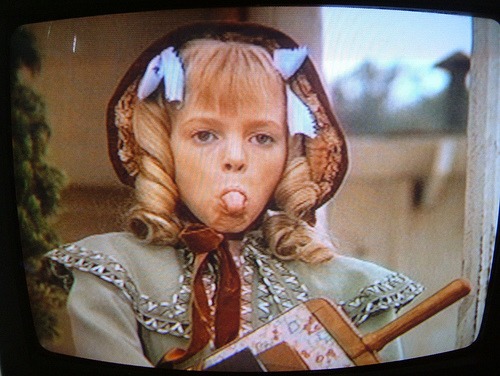
Ain’t she a little charmer? Nellie Oleson was Laura Ingles antagonist
In the 1990s sitcom The Nanny, the character of CC is Fran’s antagonist. Niles the Butler is CC’s antagonist.
Niles and CC gives us the classic ‘enemies to lovers’ which is a staple of many a romance novel.
Adversary
(defined: a person, group, etc., that is an opponent in a contest; contestant.
Like Antagonists, adversaries don’t necessarily hate the hero or heroine. Instead, they are rivals come together in some common cause.
It is a race to the finish, to solve the quest, to win the race.
Again rivals can patch their differences and indeed become friends, if not lovers.
In The Shop Around The Corner (and it’s 1990s remake You’ve Got Mail) it is business or a little misunderstanding that sets these characters apart.
The subtlety of these definitions add nuance and depth to stories. Sometimes the villains can be just as popular as the heroes (who doesn’t love Cruella de Ville or the Wicked Witch of the West?)
Next time we’ll look at how to flesh out your villains to make them as well rounded as your heroes (and in some cases utterly sympathetic!)
Free Books?
Just click the link below:
Join Now!
Share!


The post Know Your Enemy appeared first on EE Carter.
July 29, 2016
Book Cover Reveal: Thief of Hearts
I’ve been in the writing and editing cave recently (simultaneously – that’s not an easy feat!)
Anyway, I’d just like to let you know that I have a new title coming out in November, a fun historical mystery romance called Thief of Hearts.
Set in 1890s London
When audacious diamond thefts take place in London with no sign of entry, it takes a magician and mystery novel-loving young woman to catch a thief who has his eye on the greatest prize – the Star of December diamond…
I was inspired by the great Agatha Christie who seemed to effortlessly blend mystery, romance and humor.
The Thief of Hearts will be on pre-order in October for a November release date. In the meantime, I hope you enjoy seeing the cover!
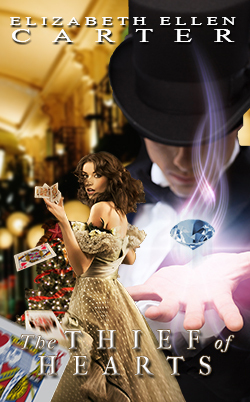
The cover design is by Duncan Carling-Rodgers of Business Communications Management. If you’re thinking that the same sounds familiar, then you’re right. Duncan is my husband.
Free Books?
Just click the link below:
Join Now!
Share!


The post Book Cover Reveal: Thief of Hearts appeared first on EE Carter.
June 28, 2016
Running Writing
There was a discussion online a little while ago about writing a novel.
With a little smile, I could tell who were truly aspiring authors, inching their way towards being ready to pitch or publish their novels.
They talked about working for years on writing their manuscript – four years, six years, eight years, some even longer.
We’ve all been there, especially when you have a story burning within you, but you’re not quite sure you’re a writer, not quite sure of the story, not quite sure you know what the hell you’re doing…
Many of these manuscripts will never see the light of day.
I don’t say this to be dismissive of the effort involved. It is hard work to martial thoughts together to create a tale which makes sense from beginning to end – not to mention a story which is rich and powerful with description and characters.
And if that story does nothing more than entertain the writer during the process of creation and it never sees the light of day, then it has served its purpose – a creative outlet has been explored.
But I can always tell who among those aspiring writers will get their manuscript over the finishing line without me having read a word of it.
They are the ones who never, ever say, ‘I wish I could find time for writing’.
These aspiring authors always find the time a week, even if it is just 15 minutes a day.
Yes there are times when it may be days, weeks, even months before pen hits paper (or fingers hit keyboard) but these should be either planned hiatuses or extenuating circumstances.
But for those writers for whom the passion burns bright will become authors.
In many respects writing a novel is like training for a marathon. It takes discipline and training.
Excuses don’t wash on the track, nor will they work for a writer — not if you’re serious about your novel.
A distance runner competes against herself — and so does a writer. One who doesn’t train, who doesn’t write, will never see that work through to fruition and will never know what she might have been capable of.
Free Books?
Just click the link below:
Join Now!
Share!


The post Running Writing appeared first on EE Carter.
June 19, 2016
My Presentation to the Australian Productivity Commission
Well about now I’ll be delivering a five minute speech to the Australian productivity Commission’s public hearings into Intellectual Property Arrangement from the Mercure Hotel on 85-87 North Quay Street Brisbane QLD 4000, Leichhardt Room.
First of all I’d like to thank everyone who has contacted me or sent me encouraging messages. I wouldn’t have the confidence to pursue this if not for your support.
For anyone who is not quite sure what this is about, I’ve blogged on the issue of the proposal to reduce the duration of copyright here and here. I also made a nuisance of myself in comments here, which led to the very wonderful Di Morrissey giving me a kind mention here.
Fortunately, I won’t be alone. I’ll be on a panel with Melanie Hill and Christine Bongers. The lovely Louise Sherwin-Stark from Hachette will be there all day too. She has reached out to me and we’ve chatted via e-mail. I appreciate her kindness and support.
Special mention to Anderson Cheung from the Australian Productivity Commission who has been terrific in organising this opportunity. I’d like to thank him very much.
If time and opportunity permits I hope to have the opportunity to live Tweet my impressions. If so, you’ll find them here.
And so, here’s my presentation:
My name is Jacqui Carling-Rodgers.
I am ex-newspaper journalist, former director of an award-winning advertising agency, and under the name of Elizabeth Ellen Carter, an award-winning historical romance and historical fiction author.
First of all I would like to thank the Australian Productivity Commission for the opportunity to discuss my concerns with the findings of the Intellectual Property Arrangement report.
Specifically, Finding 4.2:
“While hard to pinpoint an optimal copyright term, a more reasonable estimate would be closer to 15 to 25 years after creation; considerably less than 70 years after death.”
The obvious question is, ‘reasonable to whom?’
Certainly not to me; certainly not to the United States, nor to the EU. Why Australia would want to be an outlier on this matter invites speculation worthy of a suspense novel.
I’ve read through the relevant section of the report.
The recommendation that copyright protection should be severely curtailed comes from two academic reports which start from an erroneous premise, and lack understanding of the arts and entertainment industry.
Creative works do have a commercial life after 20 years. Just listen to the radio or watch television commercials for proof of this.
The truth of the matter is, the opportunity to maximise a back catalogue is integral to an author’s earning capacity. Every title is important.
People who buy my latest book often go back and purchase previous titles. That’s how I earn my living.
The bulk of my sales are ebooks.
Limiting the length of copyright would give anyone with PDF or an .epub file the right to trade on an author’s name, reputation and product without compensation. I would be competing against myself for sales and receiving no income from it.
A book is unique. It is both intellectual property and a tangible asset that can be bought, sold and traded. Protection, even after the death of its creator, is not at all unreasonable.
Here is a personal example:
Philip Rodgers was an English musician and teacher who wrote arrangements on recorder, flute and guitar for music students.
After he passed away, royalties from those books helped support his widow and her young son.
According to my husband, the amount of money his mother received each month may have only been small — the equivalent of a week’s groceries — but its value was great when there was little money coming in to the home.
Copyright protection and duration matters for another very important reason: the preservation of natural rights.
To quote 17th century jurist John Locke: “every Man has a Property in his own Person. This, no Body has any Right to but himself. The Labour of his Body, and the Work of his Hands, we may say, are properly his“.
Locke did not come to this conclusion in a vacuum. The inviolability of property rights is one of the enduring principles in the 800 year old Magna Carter on which our common law is derived.
Any abridging of intellectual property rights with respect to copyright protection sets a dangerous precedent. It dictates how long you may own your own property.
If protection of intellectual property is eroded today, then ownership of physical property is at risk tomorrow.
And all because an erroneous premise based on demonstrably incorrect academic research has decided what you may own and for how long you may own it.
Thank you.
Free Books?
Just click the link below:
Join Now!
Share!


The post My Presentation to the Australian Productivity Commission appeared first on EE Carter.
June 17, 2016
The Copyright Hunger Games
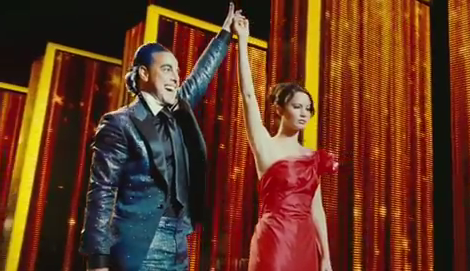
Hopefully it will be me with my hand raised high wearing a stunning red dress in the interests of bringing liberty to the Districts…
On Monday I address the Australian Productivity Commission on Intellectual Property Agreements.
I feel a bit like Katniss from The Hunger Games leading a rebellion against the Capitol…
Anyway, my issue with the report is with Finding 4.2:
“While hard to pinpoint an optimal copyright term, a more reasonable estimate would be closer to 15 to 25 years after creation; considerably less than 70 years after death.”
A lot of people have asked why this is such a big deal. After all, we’re protected by Free Trade Agreements and the Berne Convention aren’t we? On the surface it appears to make no sense.
Hanlon’s Razor states: Never attribute to malice that which is adequately explained by stupidity.
But one can never be too careful about such things, so I also subscribe to the aphorism credited to Wendell Phillips: Eternal vigilance is the price of liberty; power is ever stealing from the many to the few.
From my research, this seems to be part of a worldwide movement to limit copyright and other protections for authors, artists and other creators.
Let’s answer a few questions:
What evidence does the APC use to support its finding?
The recommendation that copyright protection should be severely curtailed comes from two academic reports which start from an erroneous premise, and lack understanding of the arts and entertainment industry.
Why are the two studies wrong?
Firstly arts and entertainment provide cultural touchstones.
A favourite song brings will bring back memories from your teen years. A favourite movie or TV show has a catch phrase that becomes mainstream. A book starts a cultural phenomenon that feeds TV and movies (Poldark, Outlander, The Hunger Games, Divergent, The Maze Runners – heck even the Marvel movies started as a form of literature).
Therefore arts and entertainment has longer value than just a piece of pop culture ephemera – that’s why it is used in TV commercials, to help create an emotional connection.
So why shouldn’t its creators receive recognition for their industry and innovation?
Yeah, but what about those studies the APC cites?
There’s a problem with both of them in that they either lack understanding of arts and entertainment or they’ve lumped in books with other things which can be copyrighted (academic studies, software, product manuals etc, etc).
So to use them to bolster the argument to reduce copyright duration is wrong headed.
Let’s take a quick look at the two studies:
The abstract actually disagrees with itself which makes everything else in the report suspect:
In this paper we raise questions concerning the widely accepted proposition that economic efficiency requires that copyright protection be limited in its duration (often shorter than the current term). We show that just as an absence of property rights in tangible property would lead to inefficiencies, so intangible works that fall into the public domain may be inefficiently used because of congestion externalities and impaired incentives to invest in maintaining and exploiting these works. Although a system of indefinite renewals could lead to perpetual copyrights or very long terms, this is unlikely. Our empirical analysis indicates that (1) fewer than 11 percent of the copyrights registered between 1883 and 1964 were renewed at the end of their 28-year term, even though the cost of renewal was small; (2) copyrights are subject to significant depreciation and have an expected or average life of only about 15 years; and (3) copyright registration and renewals are highly responsive to economic incentives for the shorter the expected life of a copyright and the higher the registration and renewal fees, the less likely are both registration and renewal. This in turn suggests that a system of modestly higher registration and renewal fees than at present, a relatively short initial term (20 years or so), and a right of indefinite renewal (possibly subject to an overall maximum term of protection of say 100 years) would cause a large number of copyrighted works to be returned to the public domain quite soon after they were created. A further benefit of indefinite renewal is that it would largely eliminate the rent-seeking problem that is created by the fact that owners (and users) of valuable copyrights that are soon to expire will expend real resources on trying to persuade (dissuade) Congress to extend the term.
Let me sum it up:
Copyright in the US requires it to be registered for it to apply. After 28 years a lot of people don’t pay the renewal. Therefore (according to the academics), the commercial life of what was protected is now extinguished and should go into the public domain.
Using that as an argument to impinge on the rights of Australian authors doesn’t hold water mainly because Australian copyright (as it is in most places in the world) is granted automatically when the work is “fixed” (i.e. completed and published).
I’ve highlighted another issue in bold:
would cause a large number of copyrighted works to be returned to the public domain quite soon after they were created.
Hello? Returned to the public domain? That assumes that the work was public domain to begin with and that is most certainly not the case.
Pollock (2007)
Rufus Pollock is an economist with an agenda. He describes himself as an entrepreneur and an activist.
He runs Open Knowledge Foundation with the laudable goal of: using advocacy, technology and training to unlock information.
His two studies, Optimal Copyright Over Time: Technological Change And The Stock Of Works and Forever Minus A Day? Calculating Optimal Copyright Term, are all very nice as far as they go but let’s keep in mind that Mr Pollock has an agenda to push.
He is an activist after all.
Further, keep in mind that this is all very theoretical and a “parismonious theoretical model” at that. In other words, it’s glorified guesswork.
And the kicker? While the IP Statement on the web site allows reproduction of content under a Creative Commons license, Open Knowledge Foundation name itself is trademarked and therefore protected, potentially into perpetuity…
Well, can’t you trademark your name to protect your work, if copyright protection is limited to 20 years?
It costs about $1500 which is a huge impost on authors who may not even earn that in their first year (and some may never earn that amount in five years). Worse, there is that you will be successful in being granted a trade mark even on your own name.
Yeah, but Australia is signatory to the Berne Convention and various Free Trade Agreements. You’re worrying about nothing.
Yes, Australia is a signatory to the Berne Convention, but let’s take a look at the small print:
Although the Berne Convention states that the copyright law of the country where copyright is claimed shall be applied, Article 7(8) states that “unless the legislation of that country otherwise provides, the term shall not exceed the term fixed in the country of origin of the work”, i.e., an author is normally not entitled a longer copyright abroad than at home, even if the laws abroad give a longer term. This is commonly known as “the rule of the shorter term”.
So if Australia’s copyright term limit was 20 years, it would apply in every territory of the world.
Look, agreements are subject to change all the time. To suggest that this is (or any other human right) locked in stone, never to change, is to lack understanding of history.
Recall the great social changes over the past century, once they were considered unthinkable. Now they are reality.
Consider this – Mr Pollock’s “parsimonious theoretical model” attracted the attention of a political party which made it part of their platform to reduce copyright to 14 years after creation based on his study.
Just last year The UK Greens Party were operating under the deluded opinion that if you punish creators by limiting their earning potential then you’ll force them to produce more books, songs and movies.
A bit harsh?
Let’s hand it over to Richard Mollett, CEO of The Book Seller:
There is a similar absence of rigour or sense when it comes to the specific point of reducing copyright term to 14 years. There is apparently a line of reasoning – alas, again left to the imagination – which says that if an author can only exclusively earn royalties for 14 years there will be more cultural output. Perhaps the idea is that writers will have to write a lot more so that they always have a work in copyright. No more lazily retiring on the proceeds of one big hit! The thought must also presumably be that publishers, instead of being able to subsidise the investment in new writers through royalties on the back lists of others, will invest even more in their live and emerging writers.
But the real kicker is that the Greens sincerely believe that cultural productivity will be expanded if peer to peer copying is legalised, meaning that the ability of any creator to earn money will be severely curtailed. In a Green world that’s seen as fine (money being the source of most evil of course), but it may seem less fine to the person who has to make a choice between writing for a living and doing something else.
While the UK Greens quickly backpedaled on reducing copyright duration – bless ’em, creatives have copyright protection for 14 years after their deaths, instead – they still support piracy of creative works – just as long as you don’t make a profit from the theft, don’t you know…
What is lunatic policy from a minor but influential political group today (remember, the Greens in the UK preference Labour, the Greens in Australia preference Labor), could become mainstream political policy (and law) tomorrow.
That is why it is important to take the strongest possible stance today to bury this proposal so deep that it never sees the light of day again.
Seriously?
Yes, seriously.
Copyright protection and duration matters for a very important reason: the preservation of natural rights.
To quote 17th century jurist John Locke: “every Man has a Property in his own Person. This, no Body has any Right to but himself. The Labour of his Body, and the Work of his Hands, we may say, are properly his”.
Locke did not come to this conclusion in a vacuum. The inviolability of property rights is one of the enduring principles in the 800 year old Magna Carter on which our common law is derived.
Any abridging of intellectual property rights with respect to copyright protection sets a dangerous precedent. It dictates how long you may own your own property.
If protection of intellectual property is eroded today, then ownership of physical property is at risk tomorrow.
And all because an erroneous premise based on demonstrably incorrect academic research has decided what you may own and for how long you may own it.
Free Books?
Just click the link below:
Join Now!
Share!


The post The Copyright Hunger Games appeared first on EE Carter.
June 11, 2016
Suspense-Ful (or why I can’t get into Outlander)
Sitting down with a good book or watching a favourite film or TV show is a special experience.
A good writer can draw you into a world which is so utterly different to the one outside your window and make you believe there are aliens, dragons, time travel – you too will believe a man can fly…
As readers or viewers we give up more than just our time, we give up something that Samuel Taylor Coleridge described way back in 1817 – the willing suspension of disbelief.
What is true of poetry is equally true of other form of arts but it comes with a caveat which I can’t find better expressed than this: “You can ask an audience to believe the impossible, but not the improbable.”
Once that trust is breached then it is nearly impossible to win them back.
When it comes to historical romance or historical fiction, people in good faith may agree to disagree about the date of an item of clothing, a dance, a first use of a word or a phrase or even a birth date. Not everyone is a historian and not everyone prizes historical accuracy.
Often, and this is so much the case in historical romance, if it sounds right, then the reader will accept it as part of the story – especially if the characters are engaging.
And there’s the rub.
Continues after break
Free Books?
Just click the link below:
Join Now!
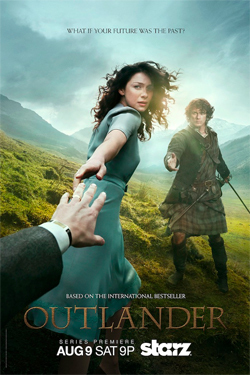
“Ever had the feeling you wanted to go, ever had the feeling you wanted to stay. Stay. Go.” (with apologies to Jimmy Durante)
Fiddle with history as much as you like, but never mess with human nature – that is the surest way of destroying that gossamer thread that connects the reader or viewer from their world and into yours.
In the world of romance, one of those deal breakers is the ‘too stupid to live’ heroines.
She’s the one who runs off with the villain that even blind freddie could have picked. She’s the one who makes a dumb decision that endangers her life and that of the hero, or (and this is my favourite), she mouths off the bad guys who would just as soon slit her throat for no other reason other than… well, I don’t know the reason, there is no reason, it’s just stupid.
Which, ah brings me to Outlander.
Yes, yes, yes I know we’re half way through the second season, but last month I finally got around watching the first episode of the first season.
I didn’t like it.
I’m sorry Outlander fans. I wanted to like it so much, but I couldn’t.
The conceit of Outlander is there are magic time travelling portals from the standing stones in Scotland and other conveniently placed locations around the world. I can buy that.
What I couldn’t buy was the heroine Claire.
As much as Claire has been described as ‘warm and intelligent’, I didn’t get that from the first episode, instead she fell into the TSTL category very quickly.
Let me count the ways:
The narration was heavy handed.
The Druid thing obviously telegraphed and laboured.
The pacing was very uneven. They would have been better off ending the first ep with her seeing Black Jack and leaving the first meeting with Jamie until ep 2 to emphasise the weird other-worldliness of the time slip.
I giggled at Black Jack’s rapey-rapey ogling when he first sees Claire. Again, so obvious and not in a good way. Either bad acting or bad directing. If you’re giggling at Dick Dastardly, then you’re not going to take the villain seriously – ever.
Outlander had so much ‘just so‘ storytelling about it with coincidences bordering on the incredulous:
Claire is a nurse and has an interest in botany (and presumably medicinal plants and healing lore, but she can’t identify a ubiquitous forget-me-not).
She’s an orphan conveniently raised by her archaeologist uncle (that’s going to show up again. Secret ancient Egyptian spell?)
Hubby Frank is there to give exposition on the Scottish past and conveniently looks exactly like his villainous forebear which makes it easy for Claire to fall in love with and marry Jamie, even though she is already married.
Claire seems to be a mouthy thing and in reality would have been beaten, if not have her throat slit, by either the 18th century Scots or the English – take your pick.
Claire seems to have 21st century feminist sensibilities, not even 20th century sensibilities which makes her even more anachronistic.
Hubby Frank sees someone watching Claire through the window of the B&B and his first thought was a former lover of Claire’s and not a peeping Tom?
Also, I’m not quite buying Highlander Jamie. He’s was the only clean shaven man in the group of Scottish Lairds. Why? Is he too young to shave? He looks all of about 18.
By the end of the first episode, I found myself wishing that either the Scots or the English would just put her (and us) out of her misery and go back to their border skirmishes. And so that slender gossamer thread of trust between reader/viewer and author/producer is lost.
And that’s even without looking at the question of whether Outlander is appropriate viewing for today’s feminists.
Well, that having been said lot of other people like the books and like the show and more power to them, so I guess that makes me an Outlander outlier.
Exit question: how much anachronism or out of kilter characterisation can you put up with before a book/movie/TV series loses your interest? What are the deal breakers?
Share!


The post Suspense-Ful (or why I can’t get into Outlander) appeared first on EE Carter.