Elizabeth Ellen Carter's Blog, page 16
February 27, 2016
Readers Writers Down Under 2016
I’ve had a marvellous weekend thanks to a Friday lunch with wonderful author friends, Eva Scott, Noelle Clark and Susanne Bellamy. And I get to spend this coming Friday with Susanne, Noelle as well as TP Hogan and Demelza Carlton.
And if I come across sounding a little like a fangirl, well I am, because it is the Readers Writers Down Under event in Surfers Paradise this coming weekend. There is something very special about meeting other authors, readers, reviewers and bloggers – an amazing community of people who love books and love story telling.
If you’re free on Saturday, I’d love to meet you at the QT Hotel, Surfers Paradise:
9.30am, Saturday 5 March
7 Staghorn Avenue, Surfers Paradise
Share!


The post Readers Writers Down Under 2016 appeared first on EE Carter.


February 19, 2016
Risen rises to the challenge

Lucius (Tom Felton) and Clavius (Joseph Fiennes) examine the crime scene in Risen.
Yesterday dear hubby took me out to dinner and movies for my birthday. The movie we picked is Risen, starring Joseph Fiennes, Tom Felton and Cliff Curtis.
Set in the era of the Roman Empire it focuses on a pivotal 40 days of history as seen through the eyes of Clavius, a Roman tribune played very effectively by Fiennes.
Having spent a year researching ancient Rome (having re-read and re-watched I, Claudius into the bargain) while writing Dark Heart, (currently being edited), although 200 years after the events in Risen, I was looking forward to seeing it.
There’s a lot to like and, like all good movies, dear hubby and I discussed it all the way home and part of today as well – a hangover from 1980s and 1990s when we were professional film reviewers.
Loved, loved, loved the setting and the way it touched on Roman and Jewish culture and custom in a way that was natural – and that’s what historical stories should strive for. Characters in film or book should never seem conscious of their environment.

Be careful who your friends are…
Risen is a detective story and it really works at this level. Clavius is an ambitious tribune hoping for a ticket out of the hell-hole that is Judea and his boss, Pilate is favourably disposed towards him.
What should have been a routine execution of seditious and criminal miscreants has Pilate worried. The Sanhedrin are acting like mafia stand-over merchants, exercising political pressure over one prisoner in particular – and that’s the last thing Pilate needs when the Emperor is expected to visit within the next fortnight
However the prisoner’s execution is just the beginning of the trouble. It gets worse when the body disappears and if the rumour spreads, the already restless city will be an uncontrollable riot.
I found myself watching the film and seeing how this could work nearly scene for scene as a 1930s noir:
A police department for the barracks
the seedy back alley of New York or San Francisco for Judea
A gun instead of a sword
The interrogations
An intense and emotional scene in a tavern
The hero who loses everything when he makes a stand for justice.
The dialogue is very naturalistic – none of the pontificating speeches of Hollywood biblical epics so entertainingly parodied to in the trailer for Hail, Caesar, the Cohen Brothers film which is next on the list to see when it opens.
And to me that was the real refreshing aspect of Risen, the characters were nuanced and subtly drawn. You felt as though you were watching ordinary people of their era going about their ordinary lives until an extraordinary event overtakes them.
The film is not without deliberate points of humour.
Lucius (Tom Felton) is a ambitious young rookie who comes to Clavius certain he has a lead – a prostitute has claimed she has seen this missing Yeshua alive.
“How will you recognise her?” asks Clavius.
Lucius’s enthusiasm is blunted.
“Well… she’s a woman of the street,” he says.
Clavius tells him, “You need someone who knows what she looks like.”
They head to his men’s barracks and Clavius asks the twenty or so inside if any one of them knows Mary Magdalene. After a moment’s hesitation one hand goes up, then another and then other until at least half the men have their hands raised.
Risen is good storytelling with strong performances. It is a film for a sophisticated audience who can put aside their preconceptions and allow the story to unfold before them and take the journey with Clavius. Highly recommended.
ADDED to say that I was sorry to hear of the passing of Umberto Eco, author of another great historical detective story, The Name Of The Rose.
Share!


The post Risen rises to the challenge appeared first on EE Carter.
January 28, 2016
The Battle of Quatre Bras
 The Battle of Waterloo was a culmination of a number of different battles between the English-led Allies and Napoleon’s French forces – one of those being the Battle of Quatre Bras.
I have to confess to exercising some literary licence. In 1809 only 140 British officers were peers or peers sons but those numbers grew as the war continued.
Thomas and his twin brother Robert, being younger sons of an Earl, decided to join the 69th Regiment and joined Wellington on the final campaigns that culminated in the Battle of Waterloo.
For the Worsley twins, their fight would come to an end at the Battle of Quatre Bras on 16th of June, 1815, two days before Waterloo.
Quatre Bras, literally meaning four arms, in this case the French for crossroads in French and this particular battle took place at the hamlet of the same time in the province of Walloon, Belgium.
It was a pitched battle, a definitive line in the sand to defeat Napoleon once and for all. Although Napoleon was out manned, he was certainly not out gunned:
Throughout the Peninsula War and the Waterloo campaign the Duke of Wellington was plagued by a shortage of artillery. The British Army was sustained by the haphazard system of volunteer recruitment and the Royal Artillery was never able to recruit a sufficient number of gunners. Napoleon had exploited the advances in gunnery techniques of the last years of the Ancienne Regime to create his powerful and highly mobile artillery. Many of his battles had been won using a combination of the manoeuvrability and fire power of his guns and the speed of his columns of infantry, supported by the mass of his cavalry.
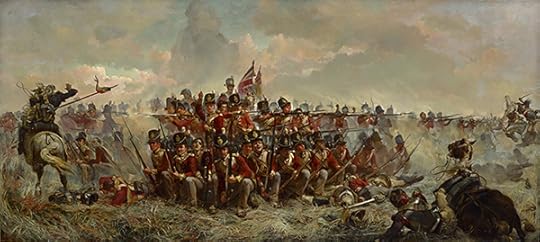
Lady Butler’s magnificent 1875 painting of the the 28th Regiment at the Battle of Quatre Bras and an example of a defensive square. To get a better appreciation of the power of this painting view a large version here.
Although useless against artillery, one defensive technique that worked effectively against a cavalry charge was a defensive square and this is what the 69th Regiment was ordered to do to stop an expected cavalry charge by the French General Kellerman, however things went awry:
During the battle of Quatre Bras, the 69th were charged by a mass of French cavalry. They attempted to form up into squares, with their bayonets pointing outwards. This formation was almost impossible for cavalry to attack, as their horses would refuse to charge onto a mass of spear-pointed bayonets. However, possibly due to confusing orders from their inexperienced commander the Prince of Orange, the 69th were unable to get into squares in time. Two companies were caught in the open, and hacked down by French sabres, almost to the last man.
In this slaughter, a French cuirassier (armoured cavalry soldier) cut down Ensign Duncan Keith, who carried the King’s Colour. This flag was personally presented to the regiment by the monarch, and served as a rallying point and source of pride for the troops.
The 69th Regiment suffered 38 killed and 115 wounded out of 546 men. In Nocturne, Robert Worsley was one of the 38 killed.
I imagined Thomas’s injuries to be as a result of close quarter’s attack as the cuirassiers over ran their position – a sabre strike, then a fall, a clip across the head by a charging horse, a badly fractured leg as waves of cavalry swept through.
Funnily enough, the wound which caused Thomas’ terrible facial scar is unrelated to the injury that sent him blind. Trauma to the occipital lobe of the brain, which is right at the very back of the head, can result in cortical blindness in which the eyes themselves function normally in that the pupils are reactive. In short, it is a neurological injury, not an ocular one. In such cases recovery of sight is possible although vision problems may remain.
Let’s hear this in Thomas’s own words:
“A few months later, we were at the battle of Quatre Bras. It was very nearly a complete rout. The head of the Dutch forces was William, the Prince of Orange. He countermanded an order from our General to form a defensive square and prepare for attack.
“Robert and I were side by side in a single formation when Napoleon’s cavalry cut through us like butter. Our commander was killed.
“The last thing I remember seeing with certainty was Robert looking at me in surprise and the bloom of red across his chest as he fell. Then I was struck also. I’ve never known such pain. I thought my head had been cleaved in two. As it turned out, it wasn’t far from the truth.”
Thomas paused in his recounting.
“I believe I was unconscious for a time. At least until nightfall. I have the vaguest memory of seeing tall thin trees above me and restless stars across a darkening sky as they carried me from the field. Then nothing for a very long time and, when I was aware again, I could see no more.”
Nocturne, a gothic Regency novella. Out February 1
Share!


The post The Battle of Quatre Bras appeared first on EE Carter.
January 15, 2016
Moonstone Conspiracy: 2015 ARRA finalist

I’m honoured that Moonstone Conspiracy is a finalist.
I’m very honoured to be a finalist in the Australian Romance Readers Association awards for my historical romance Moonstone Conspiracy.
Moonstone Conspiracy was quite a difficult story to write. The heroine, Lady Abigail Houghall (whom we first met in Moonstone Obsession) was an utter conniving bitch, but there was something about her that people seemed to love.
Abigail’s redemption in Moonstone Conspiracy was not an easy one. She found herself in a very low place and the rat-cunning she employed so effortlessly had to be used to even greater effect.
One man saw something in her and saw a chance to turn her from a Jezebel to a Rahab. He acknowledged her past, and gave her the opportunity to use it for a greater good.
Abigail also needed a partner in this exercise and she received one in the form of the Honourable Daniel Ridgeway, the son of an aristocrat who too had to live on rat cunning to survive.

Moonstone Conspiracy with a special guest appearance by Sir Percy Blakeney
Where Abigail threw herself into affairs, Daniel eschewed any close relationships.
These two broken people, brought together by circumstances beyond their control discover the transcendent power of love to heal and to overcome.
I’m so thrilled to be incredibly illustrious company such as Téa Cooper, Anna Campbell Author Page, Frances Housden, Sasha Cottman, Allison Butler and Anne Gracie.
Buy Moonstone Conspiracy
All Romance eReads
Amazon
Barnes & Noble
iTunes
Google Play
Share!


The post Moonstone Conspiracy: 2015 ARRA finalist appeared first on EE Carter.
January 14, 2016
Field v Chopin – the origin of the Nocturne
I have to confess, that before starting to research and write Nocturne, I had been under the impression that Frederic Chopin invented the that musical form.
That presented a challenge because Nocturne is set in 1820 and Chopin was born in 1810. But the more I researched, the most I found out the fascinating history of this beautiful Romantic form.
Certainly Chopin is the most successful exponent of it with 21 to his name — those beautiful dreamy melodies that truly evoke the both the intimacy and the vastness of night — and yet it was an Irishman, John Field who an lay claim to the honour.

A compilation of John Field’s 18 Nocturnes
Sadly, nowhere near as well remembered at Chopin, Field was a child prodigy who first performed professionally at the age of ten at the Rotunda Assembly Rooms in Dublin. A year later, in 1793 he was apprenticed to Muzio Clementi, an Italian-born English composer (and himself a prodigy) who later became a publisher and a manufacturer of pianos.
At this time the piano was a relatively new instrument, having first been first invented in 1709 in Padua, Italy. The piano (or pianoforte to give the instrument its full name) differed from its cousin the harpsichord thank to the ability for it to be played either softly (piano) or loudly (forte). The harpsichord could only be played at one volume.
The piano didn’t come into wide use until the latter part of the 18th century when it boomed in popularity thanks in part to the industrial revolution’s ability to make standardised parts, which made the piano both reliable and relatively affordable.
The interest in piano music then grew exponentially in the 19th century and composers and performers such as Field traveled widely throughout Europe showcasing the piano’s versatility. Field himself was a leading exponent of the sustain pedal.
Field, performed across Europe but settled in Moscow for many years where he taught and played, during which time wrote 18 nocturnes and was a heavy influence on Chopin.
Sadly, like many gifted Irishmen, alcohol became the ruin John Field where he drank through his fortune and, gravely ill with cancer, returned to England for an operation and then embarked on another gruelling European schedule.
In Italy, in 1834, he fell ill and was hospitalized for several months in Naples, where he was discovered by a Russian noble family, the Rakhmanovs. They managed to bring him back to Moscow, by way of Vienna, where he stayed with Carl Czerny and gave some concerts. Back in Moscow in September 1835, Field composed his last nocturnes before his death in January 1837, aged 54. The story goes that when Field was on his deathbed his friends brought him a priest, who asked what was his true religion, for his parents had been nominally Protestant, yet Field had been married in a Catholic ceremony. Was he a Catholic? A Protestant? Perhaps a Calvinist? No, not a Calvinist – ‘Je suis claveciste!’ (I’m a pianist) said the Irishman, joking to the last.
In honour of the true originator of Nocturnes, John Field receives mention in my gothic Regency novella, Nocturne.
Before I go, I’ll leave you with a selection of Field’s works:
Share!


The post Field v Chopin – the origin of the Nocturne appeared first on EE Carter.
January 13, 2016


January 10, 2016
The Anatomy Of A Cover
A fellow from an online writing group is brand new to publishing – a writer, he admits, not a publisher and not a marketer.
One of the things in which he expressed interest during the discussion was covers and cover art – so hence this post which shows how a book cover is born.
‘People eat with their eyes’, a used car sales man once told me. Rogue though he was, the man was right.
People are intrigued by what they first see, then they will open their hearts (and their wallets) to what is inside.
Whether you are looking at doing one yourself, hiring a graphic artist or are placed in the capable hands of a publisher’s in-house team – we writers owe three big cheers and an acknowledgement of our cover artists.
I’m using the cover of Nocturne, my upcoming novella (read more here – hint, hint) to reveal what goes on behind the scenes in making a beautiful romance cover (although the principles are just the same regardless of the genre).
A huge thank you my darling husband, Duncan from (Business Communications Management) for the such an outstanding cover!
Mood
The first step for the designer is to get the brief from the author. This should take the form of a questionnaire:
How many main characters are there?
What do they look like? Their age, gender, nationality, hair colour, eye colour, distinguishing marks
What are their key attributes? Rock stars? Dukes and Duchesses? — You get the idea
What is the style of the work? A sweeping romance? A gritty crime drama? A rom-com? An angsty YA coming-of-age? Dystopian?
You might also nominate covers of other titles that go some way to capturing the mood. This is invaluable to your cover artist – as are example of things you don’t like.
Before you shoot off all of that information, take a look at those other covers and ask:
Why did they choose that image?
Why did the artist use it in that way?
Why was that typeface used?
Being able to articulate why makes briefing the designer so much easier. And helps you avoid ending up here…
Just an aside, being an author is means more than being a writer. If you are at all serious about making writing your profession, you should have an understanding of all of the elements that come together to bring your title to market.
That’s not to say that you have to be an expert in editing, photography, cover design, typesetting, formatting, audio-visual production (for book trailers), or marketing – you can hire experts to do one or more of those tasks – but you do need to understand the process.
The Book Cover
I had a clear vision in my mind on what the hero and heroine looked like. I visited a number of stock photography sites. If your publisher is supplying your cover, be sure you get the brief 100% spot on. Hopefully you will get the chance to approve the cover which plenty of time to make adjustments if things are egregiously bad (and sometimes you don’t… and that’s a story for another time.)
In my case I searched stock libraries that specialised in stock images for novels, particularly historical romance. I fell in love with the image of the hero and heroine and I knew I had found the major element of my cover art.
Buy the largest size image that you’ll need (you may wish to use it for a print edition or subsequent marketing material).
Once I had the image and verbally outlined my vision for the cover, Duncan went to work. I’m especially lucky because he and I are on the same wavelength 99% of the time. His first draft was 99.9% perfect from the get go.
DO NOT COUNT ON THIS FOR YOUR COVER DESIGNER – THEY ARE NOT MIND READERS AND THIS IS A COLLABORATIVE PROCESS
Now, where was I?
Ah yes.
In the case of Nocturne’s cover, it is made of three images plus type.
Let’s take a look at each layer:

The Regency-era hero and heroine were originally on a plain grey background. Perfect for deep etching (extracting the background). Duncan went to the extra work of keeping in Thomas Worsley’s curl of hair and the effort is worth it.

Our hero is a pianist, so he needs a piano. Duncan chose this piano because in Nocturne, the piano is in Blackheath Manor’s drawing room. You’ll also notice that it is ‘faded’. Duncan reduced its opacity so as not to compete with the real focus of the cover – Ella and Thomas. As you can see the image doesn’t go all the way to the bottom of our canvas, but that’s okay because he is going to introduce a new element.

This piece of stock art is perfect! The sepia tone suggests age, we have a piano keyboard and we have sheet music – all are elements in the story. It is also a very interesting texture, so this helps give us visual appeal. Let’s see how this is shaping up:

Ahhh, isn’t it lovely? But there are a couple of things missing. Can you guess what they are?
Whether the author name goes above or below the title is frequently less about pride and top billing (unlike film and TV) , and more about aesthetic design. There is a lot going on in the bottom part of the image. We have the hero and heroine in a close embrace, so the author name goes up the top in white to stand out.
We’re nearly there – we just need the title and even now we have to give it some serious thought.
Duncan went to the trouble of searching font libraries and font foundries (I love that name, it harks back to the early days of the moveable type printing press and the hot metal on which the lettering was cast). He chose one called 1805 Austerlitz:
In 1805, December second, the Napoleonic French army won the famous battle of Austerlitz, against Autrichian and Russian armies.
Napoleon was a great general, but his hand-writing was not legible at all, so he employed a few secretaries who wrote the official mail. This font was created, inspired from letters written by one of these professional secretaries and scribes in the months before the battle. We propose it as a typical example of the French Hand from this period.
The font contains numerous ligatures and alternative characters so as to look as close as possible to real handwriting.
Perfect! It’s just so evocative!
Our hero is wounded in the Battle of Quatre Bras, the final battle before Napoleon met his Waterloo. So just this one thoughtful choice in title font, tells the reader that they will be reading a story set in the the early 1800s.
Let’s look at the completed cover:
Isn’t it stunning?
I hope you’ve enjoyed this basic overview of cover design.
Now, with all of this new found knowledge, please give a hearty cheer once more to those amazing artists and designers who use their talent, experience and knowledge to make our books look wonderful.
And then with this new-found knowledge, you can take a look at some lousy book covers and know why they are so bad…
Share!


The post The Anatomy Of A Cover appeared first on EE Carter.
January 1, 2016
Cover Reveal: Nocturne
I’m thrilled to show you the cover for Nocturne, my Regency-era gothic romance and share a little about how it came about.
There are some moments that come to you in a blinding flash of inspiration.
The story of governess Ella Montgomery and Thomas Worsley, the wounded veteran of the Napoleonic wars is one of those moments.
Nocturne is rich with understated tension that begins with the first page. It also has some unexpected twists along the way.
Nocturne is set in the beautiful county of Bedfordshire in the fictional town of Renthorpe.
The hero and heroine of Nocturne couldn’t wait to tell the story of their unconventional and forbidden romance, upstairs and downstairs intrigue. As the author, all I can do is just go along for the ride!
Nocturne is a novella.
Today I’m delighted to show off my cover and in the next week or two, I’ll be sharing some more snippets of their story and will let you know of it’s official release day.
It’s been a long time since a story has pulled me as this one has. I hope you enjoy it when it comes out in February in time for Valentine’s Day.
Share!


The post Cover Reveal: Nocturne appeared first on EE Carter.
December 27, 2015
Holding Out For A Hero
Where have all the good men gone
And where are all the gods?
Where’s the street-wise Hercules
To fight the rising odds?
Isn’t there a white knight upon a fiery steed?
Late at night I toss and I turn and I dream of what I need
What makes a good romantic hero and heroine? I include both because today’s romantic heroine doesn’t wait for the hero to rescue her from circumstances, or from the villain. She is no victim, seeking out a safe space from microaggressors.
Although she may be limited in the actions she can take because of societal expectations – as Marion Halcombe laments in Wilkie Collins’ The Woman in White – or through physical limitations, our romantic heroine is, nonetheless an active participant in the world around her.
So while I talk of heroes here, I don’t mean to diminish the agency women have in romance novels, but let’s face it – women read romance novels to experience the feeling of falling in love again – that heady, breathless, excitement that comes with a new relationship, one you have hopes for but there is still uncertainty of the unknown that diminishes as our couple get to know one another and move towards the fulfilling ‘happily ever after’.
To that end, we need to believe in these heroes. They need to have the characteristics of manliness that we can be satisfied at the end that the heroine has made the right choice in falling in love with.

An off-putting alpha male
Manliness is often conflated with alpha male obstinacy, pig headedness, brawn over brains but I think that is to miss the point entirely.
There are plenty of men who can’t muscle their way out of trouble for whatever reason and they are no less masculine. In fact there are no shortage of romance novels in which the hero is not physically whole.
There is also a secondary type of hero who would rather talk his way out of trouble.
What makes a hero is moral clarity. We see this in all manner of stories both romantic and action/adventure. He is the hero who could kill the villain in cold blood that doesn’t, he is the man who puts his life in danger to pull the villain off the cliff edge instead of leaving him drop to death – the fact the many villains die at the end is as a result of their own actions, not the heroes.
When the hero does kill, it is done in self-defense, to protect of the defenseless or in the service of an objectively moral good (defeating the Nazis, defending the planet from malevolent aliens, etc).
Even if he is not called upon to take such drastic measures, our hero knows who he is as a man our hero will ultimately be faced with an convenient option which is wrong or inconvenient option which is right. He may struggle to make his decision, but ultimately it will be the objectively right one.
Which at nearly 500 words brings me to my point – a fascinating article this month by Brendan O’Neill called The Crisis of Character. Over much longer than 500 words, he addresses the malaise of the 21st century, the lack of moral clarity when it comes post-modern thinking.
Nothing speaks more profoundly to the crisis of character than the phrase, ‘I identify as…’. In the past, individuals were. ‘I am a builder.’ ‘I am a mother.’ ‘I am a Jew.’ There was a confidence, a certainty, to their sense of identity, and to their declaration of it. ‘I am.’ Today, individuals identify as something. ‘I identify as working class.’ ‘I identify as non-binary.’… The rise of the i-word in our definition of ourselves, the ascendancy of what is called ‘self-identification’, is one of the most notable developments of the 21st century so far. It speaks to a shift from being to passing through; from a clear sense of presence in the world to a feeling of transience; from identities that were rooted to identities that are tentative, insecure, questionable.
Who sounds more heroic:
The guy who says, “I am a man.” or,
The guy who says, “I identify as male.”?
That certitude gives confidence that when it comes to making those moral decisions, our hero will make the right one regardless of the blowtorch of public opinion. Even if it means he has to stand alone when everyone else has capitulated.
O’Neill speaks of how language has been altered to fit an alternate reality (I address the subject too) where an objectively false notion is being foisted on society at large. The disease of narcissism is uncritically accepted and the demands of external validation become increasingly louder, drowning out the still small voice of conscience, moral clarity and objective truth.
No wonder romantic fiction is increasingly popular – where men and women, as flawed as we all are as human beings, make compelling and objectively right choices on the journey to a satisfying and life-long happily ever after.
Share!


The post Holding Out For A Hero appeared first on EE Carter.
December 18, 2015
Man Up

Photo source: Tankfarm & Co.
I have a confession to make. I’m looking at other men.
Perhaps I should clarify, since I’m a very happily married woman who adores her husband.
I’m looking at men to understand them better, to find out what makes them tick, to explore how they think and how they would react in particular situations.
Because this is the conclusion I reached before I left my teens – men and women aren’t just physically different (duh!) but they are emotionally and psychologically different as well.
Romance is a fascination genre to explore these innate differences because we get into the heads and hearts of our characters as they discover the one they fall in love with, the other half of their soul that leads to that sacred and transcendent moment where ‘two become one flesh’.
There are screeds (and screeds and screeds) written about men’s inability to write effectively from a female point of view.
But I also have a fairly firm suspicion that there are many women writers in the broad world of romance don’t get men’s characterisations right either but are picked up less readily than the gender inverse because:
Few men read romance enough to pick up on the disconnect
Women are more adept at being political activist and highlighting real and perceived incidents of sexism
To dismiss men as simple creatures, driven by little more than base needs of food and sex, is to ignore the depth and richness of their perspective and experience.
Since 50% of the POV is my novels is going to be from a man’s perspective, it’s important for me to get it right.
I’m especially fortunate to have a husband I can (and have) talked about these things with. And I’m fully aware that a large number of guys wouldn’t feel comfortable having that level of intimate conversation, it’s not how they’re wired. I’ve suggested to hubby in the past that he guest posts an article on the subject of the romantic hero based on the novels he’s read over the years, but like a typical man, he’s too busy doing things. Perhaps one day…
If you’re looking for insight into how men think, I wouldn’t recommend going to those ‘top secrets men wished women knew’ listicles found in women’s magazines or web sites either. Most of them can be boiled down to the asinine platitude of:
We men are just like you, but with a penis, so don’t change a thing, you’re totally awesome just the way you are.
This may or may not be true, but it doesn’t help getting into the male psyche.
Broadly speaking men are wired to do stuff. Very little time is spent analysing feelings, but that’s not to say that men aren’t capable of great moments of self-reflection – they most certainly are (just read the comments at the end of this article) – but the end goal must result in an action they can take.
And you know what? Women like these men too.
My recommendation is if you’re looking for a greater understanding of what men think and feel about themselves and the world around them, then you need to find men who speak their language. Since stalking is illegal and eavesdropping in on conversations is just a little creepy, then the best bet is to read articles by men for men on what it is to be a man.
And I’m not talking about superficial, politically correct fluff or the permanent adolescence found in the pages of lads mags (fortunately or unfortunately a dying breed) – I’m talking about the celebration and validation of manhood as a positive experience with frank and sometimes uncomfortable topics tackled.
I love men and I always have (although my heart is taken by one man in particular). To me they are endlessly fascinating and I enjoy making my heroes the best authentic men they can be.
What aspects do you enjoy of attitudes and attributes of men? What characteristics of men do you think romance get right and what do you think authors get wrong?
I’d love to hear from you.
Share!