Sorry, you must be a member of this group to do that.
Elizabeth Ellen Carter's Blog, page 11
July 7, 2017
The Rocky Career Of William Bentinck
Set in 1814 in England, Sicily, Algeria and Turkey, Captive of the Corsairs is an action packed historical romance. It will be published on July 21 through Dragonblade Publishing. It’s available for pre-order now!
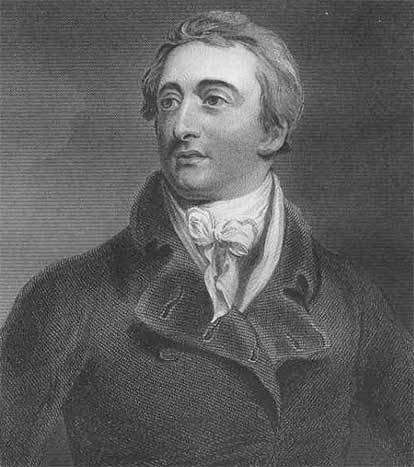
William Bentinck
Occasionally real life figures make an entrance in my historical romances. To me it seems an additional way to place my fictional characters in the living world of their time.
Dark Heart includes an appearance by the Bishop of Interamna who was one of history’s three St. Valentines. There was a role for British Prime Minister William Pitt thre Younger in Moonstone Obsession. In Warrior’s Surrender, I briefly featured William Wallcher, the real life Bishop of Durham.
In Captive of the Corsairs, the real life personality is lieutenant-general William Bentinck, commander of the British troops in Sicily. He features strongly in several scenes with both Captain Kit Hardacre and Sophia Green.
Kit is something of a thorn in Bentinck’s side but is tolerated because his activities around the Mediterranean provide valuable intelligence for Bentinck’s own use as well as that of British interests.
The thorny relationship between the captain and commander mirrors Bentinck’s real life relations with his own government.
William Bentinck was something of a maverick. He joined the Coldstream Guards in January 1791 at the age of 16, purchasing an ensign’s commission. By 1798, he was a colonel in the 24th Dragoons. Five years later, he was appointed Governor of Madras and continued to rise in ranks but his governorship ended in recall to England in 1807 after his order that native troops not wear their traditional uniforms sparked a mutiny.
By 1811, he was commander of British troops in Sicily, British representative to the Court of Palermo, and a lieutenant-general. He immediately began involving himself in internal Sicilian affairs. He butted heads with the former Archduchess Maria Karolina of Austria, by then Queen of Naples-Sicily, who dubbed him La bestia feroce (the ferocious beast).
The correspondence Bentinck shoved aside bore the royal crest of Maria Carolina, Queen of Naples and Sicily. She called Bentinck ‘the Beast’, and he had an equally viperous name for her. Kit had it in him to feel sorry for the man. He had overheard a conversation that suggested Bentinck had right royal problems with his own monarchy thanks to his ill-considered expedition to interfere in the politics of Genoa.
If Kit had been one of Bentinck’s subordinates, he’d be quaking in his boots at the murderous expression cast his way. The mountains of Vesuvius couldn’t erupt so spectacularly. Perhaps it wasn’t wise to poke the bear.
“I had an official complaint this morning from the Ottoman envoy over your behaviour at the reception.”
– Captive Of The Corsairs
Bentinck was sympathetic to the Sicilians and also visualised a unified Italy in the future. In 1814, he landed with British and Sicilian troops at Genoa, making liberal proclamations of a new order in Italy. However, this embarrassed the British government because it sided with Maria Carolina and wanted to give much of Italy to Austria. Bentinck was recalled to England yet again in 1815.
Surprisingly, in 1828 he was appointed Governor-General of Bengal. Unsurprisingly, he began to meddle again.
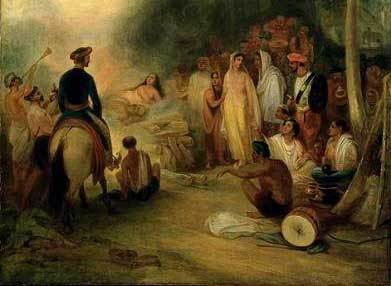
Detail from the painting Suttee by James Atkinson (1780–1852) (c) British Library Board 2009 (F165)
Reforming the court system, he made English, rather than Persian, the language of the higher courts and encouraged western-style education. He allied with Indian social reformer Raja Ram Mohan Roy, who objected to practises such as caste rigidity, polygamy, child marriage, and sati, the prescribed death of a widow on her husband’s funeral pyre.
Bentinck passed the Bengal Sati Regulation banning its practice in 1829. (Today, western post-modernists cast the ban as faux outrage at the treatment of women abroad to deflect from subjection of women at home, pointing out that English widows did not fully secure control of their own property until 1882. However, this downplays the work of Raja Ram Mohan Roy against sati prior to Bentinck’s involvement. Moreover, English wives were not expected to kill themselves when their husbands died!)
Bentinck returned to Britain in 1835 and died in June 1839. He had been married to Lady Mary Acheson, daughter of the 1st Earl of Gosford, since 1803. She died in 1843.

Created for book lovers
Join Elizabeth’s Library Book Club today for free reads, exclusive excerpts, competitions and more!
Join Now!
The post The Rocky Career Of William Bentinck appeared first on EE Carter.


June 22, 2017
Counter Cultural
Cultural appropriation.
It’s a subject that I’ve spoken briefly on here and here.
There’s quite a bit I want to say about this because over the past two years, I’ve noticed a strong push back against authors who feature characters from different ethnicities or cultures.
I had hoped it was a fringe topic, limited to the extremes of radical identity politics, but I’m sad to be mistaken.
This past week the United Nations is looking at drafting legislation to make cultural appropriation illegal.
I’ll let that sink in for a moment.
The United Nations: accountable to no one, which allows oppressive governments to sit on panels to determine Human Rights, has been responsible for the spread of cholera in Haiti, whose “peacekeepers” have committed war crimes in the form of rapes in Central Africa and has exacerbated human misery because of its inefficiencies and corrupt practices.
This is the organisation which is being used to eventually tell you what food you can cook, what art you can perform, what earrings you can wear and even how you wear your hair.
Yes, yes, it sounds like I’m traipsing through tin-foil hat territory here, but check out the links above.
I didn’t make them up.
It might be worth to get a clear understanding on a few things, so you can understand where my disquiet about cultural appropriation comes from.
Cultural Appropriation v Copyright
Copyright is the protection afforded by the creator of an original work.
It doesn’t extend to the people (or culture) who created the tools for that expression.
That means a person who writes a song for piano and guitar owns the rights to the song.
She doesn’t share royalties with the people of Italy (home of the piano-forte) or Spain (which invented the guitar).
Don’t laugh, there is already enough confusion regarding the law regarding art which may reflect or impinge on what is considered Australian Aboriginal art.
The first question on that web site is: ‘Is it OK to use dots in my painting like Aboriginal artists do?’
Sadly the web site doesn’t actually answer the question, which might lead some well-meaning artist to believe the answer is either ‘No’ or ‘Yes, but you have to seek permission’.
Australia’s copyright and other intellectual property laws do not protect the idea of painting in dots or using hashes, symbols and style that may be directly taken (but not copied) from Aboriginal and Torres Strait Islander (ATSI) art. There is no copyright protection for copying original images because the material being copied is determined to be “outside” the duration of copyright protection and there is no protection available to cultural symbols or the people whose totems they represent.
If an indigenous community paints as an unidentified group there is no copyright protection available unless the group can be named and identified. If an indigenous community tells its oral history and it is not transcribed, there is no copyright protection. If it is transcribed, the laws state that the writer owns the copyright – but of course, it may not be the scribe’s story.
Now that’s clear – you create something original and the copyright (intellectual property) is yours.
Copy an identified individual or group’s original work, you are a plagiarist and a thief – no soup for you (and, quite rightly, a possible fine and hefty damages).
So, if cultural appropriation is not the protection of copyright, then what is it?
“It doesn’t belong to you”
The line of thinking seems to be that if you are not of that particular culture, you don’t have ‘permission’ to use or adapt items from that culture.
That’s really going to screw my local bakery which is owned by a Malay family who do fabulous Cornish Pasties, Aussie Meat Pies, French Croissants, Belgian cheesecakes and delicious Italian cannolis. (We’ll fight the Kiwis for ownership of the Pavlova).
Here’s another conundrum, the Japanese language and religion were lifted from the Chinese. Anime which is a hugely popular artform from Japan which features characters of an exaggerated caucasian form (big eyes and frequently for female characters, blonde hair, blue eyes, pale skin). It ‘appropriates’ storylines from all around the world to create a highly original artform.
The Japanese are apparently bemused by it all. About two years ago, an exhibition of Kimonos was sent to a gallery in Boston. Among the treats for visitors was the opportunity to wear a kimono and have a photo taken. University students protested – ‘cultural appropriation,’ they screamed (you’ll notice they don’t do anything less than a shout).
The Japanese media were fascinated, they sent a news crew. While a small percentage of the protestors were of Asia origin, not one of them was actually a Japanese national.
A school friend of mine who lives in Japan interviewed a traditional kimono maker to see whether he was offended by cultural appropriation.
That message, recently iterated to me by an employee at the Nishijin Textiles Center in Kyoto, is this: Anyone can appropriate and creatively modify kimono styles whenever and however they like.
This message should be broadcast to counter those who misguidedly oppose the appropriation of Japan’s fashion traditions by “the West.” Japanese are not the West’s victims, and the kimono industry is ill-served by obsessions about Orientalism and politically correct “understanding.”
Kaori Nakano, a professor of fashion history at Meiji University put it to me this way: “Cultural appropriation is the beginning of new creativity. Even if it includes some misunderstanding, it creates something new.” It may be the key to the future of kimono fashion.
A very sensible attitude indeed. And not a unique one.
And this is how ridiculous the current situation has become – an author got trolled on social media this month for cultural appropriation because she had written a fantasy story in which a Minotaur (of Greek mythology) was female and not male.
If you didn’t laugh, you’d weep. Truly.
Another question I’ve not seen satisfactorily answered is, if one has to seek permission to use, borrow, adapt a tool, a style or an object from a culture which is no one’s own, to whom do they apply?
The United Nations?
To a group which may or may not truly represent people of a particular culture?
Would such a group charge a licence fee? If so, how much?
Once you start going through the thought exercise and bring it to its conclusion, cultural appropriation activism begins to smack of stand-over merchants, grifting, extortion and rank opportunism.
“You’re telling someone else’s story.”
Fiction, it may surprise some people to know, is fictitious. It is made up – sometimes for pure entertainment, sometimes to explore universal human themes.
To do that, we assemble a cast of characters and give them goals, motivation and conflict.
From what I can gather, the cultural appropriation crowd seems to think that there is only one kind of experience someone from a particular ethnic or cultural group can have.
If you, as an author don’t follow this convention, (which usually appears centred on a hierarchy of victimhood grievances), then you are somehow being disrespectful or inauthentic to that subset of humanity as a whole.
That seems narrow-minded to me.
It’s like deciding that there is only one shade of blue in the world.
Ridiculous.
An individual’s life experience is as unique as they are because the sum of a person’s life isn’t just what is ‘done’ to them, but how ‘they’ choose to react to external forces.
Just think of the hundreds of forks in the road you experience every day that require a choice. Each individual choice results in a slightly different outcome/perspective no matter how many other common factors there might be.
Just think, six billion plus unique perspectives.
The only time you can be telling someone else’s story is if you’re writing a biography.
“Your privilege is preventing the *other* from profiting from their story.”
This is something that requires quite a bit of unpacking and I’m going to focus on four things: privilege, preventing, other, profiting.
I quite readily concede that living in a first world country not riven by war, crime, systemic corruption and unending natural disasters is a privilege.
But as we identified earlier, the cultural appropriation advocate appears to believe in a limited set of lived human experiences.
So it appears if you are white and ‘cis-het’, you have powers far beyond that of mortal men (or women). A Superman, an ubermensch, if you will.
It’s rubbish of course.
How does my white friend struggling on a disability pension have more privilege than my black friend who is a successful accountant?
Preventing. While acknowledging that discrimination can exist to a greater or lesser extent (in reality, I would suggest that it is lesser, rather than greater), the notion that any artwork I might create is ‘preventing’ someone who is not white and ‘cis-het’ from creating art is ludicrous on its face.
Other, others, ‘othering’… ::shudder:: is there a more dehumanising term in socio-political thought?
Other simply means ‘someone who is not you’. Well join the club. There are more than six billion people who fall into this category.
Treat others as you would like to be treated – a unique, precious individual who matters because of who they are, not what they are.
There is a reason why that rule is golden, you know.
Profiting. According to the cultural appropriation advocate’s canon, your success comes from stomping on the backs of the downtrodden.
The truth is making a living out of artistic pursuits (or even being picked up for publication, a recording contract, a gallery showing, or an acting gig) is a crap-shoot, a roll of the dice.
All any of us can do is work as hard on our craft and show some business acumen. In this respect artists are inventors and entrepreneurs. There is never any obligation for the public to buy, just a hope.
Cultural appropriation is how art works. Cultural appropriation is how people with so many differences find a common language, a common experience, a greater understanding of one another.
The world would be a poorer place if Dame Kiri te Kanawa could not sing, if Albert Namatjira had not painted, if Janet Collins had not danced.
Cultural appropriation doesn’t take anything away from the original, but instead takes its inspiration and creates something new and unique that we can all enjoy.
On that basis, one has to question why some people want to create barriers instead of tearing them down.
Created for book lovers
Join Elizabeth’s Library Book Club today for free reads, exclusive excerpts, competitions and more!
Join Now!
The post Counter Cultural appeared first on EE Carter.
April 28, 2017
St Valentine and the Ides of February
Dark Heart, my Roman-era romantic suspense will be published on May 12 through Dragonblade Publishing. It’s available for pre-order now!
Who is Saint Valentine?
 His name is now a byword for romance and all things heart and flowers on February 14, but there is so much more to this man than just romance.
First of all, there is more than one St Valentine.
The first St. Valentine was a physician-priest who lived in Rome in the third century. He joined with St. Marius in efforts to comfort the martyrs of the persecution of Christians by Emperor Claudius II. St. Valentine himself was arrested, beaten, condemned to death and beheaded for his beliefs on February 14, AD 270. He was buried on the Flaminian Way and Pope Julius I later built a basilica over St. Valentine’s tomb. His relics were moved to the Church of St. Praxedes in the thirteenth century. It’s believed that this is the St. Valentine after which the day was named.
The second St. Valentine was Bishop of Interamna (present-day Terni, 60 miles outside of Rome). He, too, suffered under the persecution of Claudius II. He was arrested, scourged, and beheaded. No more is known of him.
The third St. Valentine was martyred in Africa with several companions and that is all that’s known about him.
For Dark Heart, I’ve chosen the Bishop of Interamna as my Valentin (which is his name in the Latin) and he become a friend and champion to my two lovers, Marcus and Kyna.
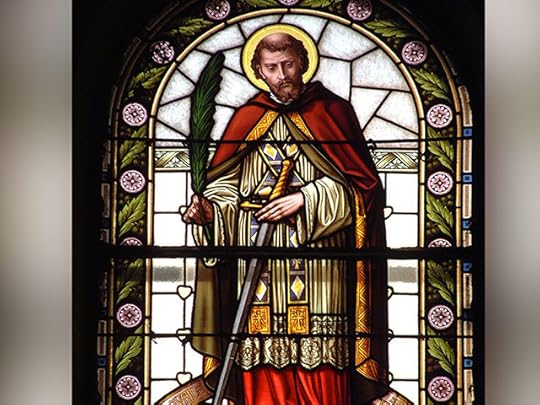 According to Father Frank O’Gara of Whitefriars Street Church in Dublin, Ireland, St Valentine was an anti-establishment rebel.
“He was a Roman Priest at a time when there was an emperor called Claudius who persecuted the church at that particular time,” Father O’Gara explains. ” He also had an edict that prohibited the marriage of young people. This was based on the hypothesis that unmarried soldiers fought better than married soldiers because married soldiers might be afraid of what might happen to them or their wives or families if they died.”
Not many people know today that Valentin, this physician-priest (ah, no wonder Kyna, being a doctor herself was so fond of him), is also the patron saint of epilepsy. Saint Valentine had been blessed with the gift of healing – specifically epilepsy.
At this time three pagan youths, Proculus, Ephebus and Apollonius, came from Athens to Rome to study. They found a tutor named Craton, and lived in his home. Craton’s son Cherimon fell grievously ill, and his spine was so contorted that his head was bent down to his knees. Craton asked Bishop Valentine to help his sick son.
The holy bishop went into the sick child’s room and prayed fervently all night. When day came, the happy parents saw their son had been healed. They believed in Christ and were baptized with all their household.
Although two different men, both of the Valentines were executed on the same day (February 14), in 270 AD or 278 AD, (depending on sources).
So why the 14th?
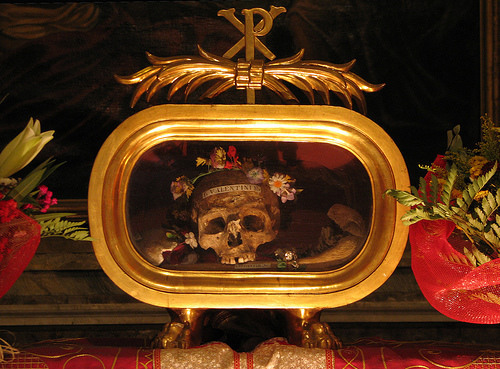
Located in Basilica of Santa Maria in Rome is believed to be the skull of the 3rd century AD St Valentine.
The Romans held great store in ‘lucky and unlucky days’.
The Roman calendar operated through the use of three main days (the Kalends, the Nones, and the Ides), in reference to which all dates were given. Ides came, either on the thirteenth or fifteenth day of the month, on the day after the full moon.
As most of us know, the Ides of March was particularly unlucky for Julius Caesar…
To the Romans, odd days were lucky days and the three even days after Ides were particularly considered unlucky. The first even day after the 13th of Ides, is of course, the 14th, so it seems likely then, that the date for execution was chosen deliberately to curse those who were condemned to death.
This also makes particular sense considering the reason why our Valentines were killed. They were martyred for refusing to renounce Christ which was a major political affront to the establishment since the politics and religion of Ancient Rome were indivisible.
That’s a theme I touch on lightly in Dark Heart, but it’s one I’m thinking of exploring further in the second sequel.
Excerpt
Marcus looked at the tall candelabras and judged how far the candles might have to burn down before he could make his excuses and leave. He reclined on the nearest bench and forced his attention to the conversation.
“Well, one thing is for certain,” announced Gaius, reaching across for a small wedge of cheese. “There is little more the Senate can do. We’ve made our protest and the Praetorian Guard have told us outright their loyalty is to the new emperor. So Cato will go to trial and it does not bode well for him.”
Another guest, Senator Flavius, an older man and lean – almost to the point of looking emaciated in Marcus’ opinion – was in the process of assisting his rather contrasting wife onto a lectus as he responded.
“We’ve done our duty by him and our new emperor to the best of our abilities,” Flavius said, almost defensively. “Neither can have issue on that account.”
The man seated himself beside his rotund spouse, a dark-haired woman in a deep blue stola, revealing every ample curve. With an indulgent smile, Flavius handed her a fig and she devoured it greedily.
“As for Cato,” he expounded further, “I don’t know what’s gotten into the man. He just sits in his room writing papers and reading, always reading.
“We’ve taken auguries on his behalf — he refuses to do so for himself.”
“Mind you, none of them have been favorable,” the wife chimed in around a mouthful of fruit.
Lucius clapped his hands together sharply and indicated more wine for his goblet.
“And the gods are annnnngry,” he said, drawing out the last word. Alongside him, Livia giggled.
“Don’t mock, boy!” demanded Gaius.
Lucius slammed down the goblet and purple liquid splashed over the rim, running down the carved decoration of nymphs and pooling on the table.
“It’s you who don’t get it! The gods want men like Cato dead! The sooner he’s thrown down the Gemonian Stairs like the traitor dog he is, the better.”
An uncomfortable silence descended on the dinner party. Marcus watched the other guests express looks of pity or sympathy to Gaius; others pretended to find the exquisitely painted frescos around the dining room suddenly fascinating.
No wonder.
Cato was well-respected, a friend to many in the room. Any eccentricities should be excused. To wish him harm, let alone the ignoble death of a traitor, was shocking. Marcus himself might have been taken aback if he had not been already privy to Lucius’ thoughts.
Created for book lovers
Join Elizabeth’s Library Book Club today for free reads, exclusive excerpts, competitions and more!
Join Now!
Share!


The post St Valentine and the Ides of February appeared first on EE Carter.
April 27, 2017
Friends, Romans, Countrymen…
Dark Heart, my Roman-era romantic suspense will be published on May 12 through Dragonblade Publishing. It’s available for pre-order now!
If I speak in the tongues of men or of angels, but do not have love, I am only a resounding gong or a clanging cymbal.
Today, rhetoric gets a bad rap and its definition to most people would be summed up from the verse from 1 Corinthians 13 from the Bible.
Rhetoric has come to mean empty words and insincerity, but it wasn’t always this way.
Rhetoric – the art of persuasion was a vital part of Roman politics and social discourse. The Roman Empire may have had its Caesars and Emperors but his word was not always law. Like in democracies today there is a head of state, a Senate and a lower house and the Empire functioned in many respects by the consent of the governed.
The plebeians outnumbered the patrician class by an order of magnitude and life wasn’t any good for anyone is there was a general strike or mass rebellion. So the ruling classes – from Emperors down to Magistrates and lawyers had to persuade the largest number of people to their case.
Without mass media and social media, and even without the humble printing press and public address system, getting the message out to the greatest number of people and without it becoming lost in translation, was a work of art in itself.
The Romans helped their cause by erecting buildings such as the Forum and various bascilica to have outstanding acoustics. In fact, the acoustics were so good that the Christian church adopted, then modelled churches in that design to ensure that Mass could be heard even by those sitting in the back pews.
But what of the speakers themselves? Effective rhetoric – the use of persuasive language was one important part – the second was oratorical gestures used for emphasis. In effect, public speaking became performance art and specific gestures – expansive arms for inclusion, and hand up for silence — had specific meanings.
Although theatrical gesticulation by public speakers disappeared in the 20th century when film and television gives us front row seats, we are still attuned to body language – not a new term, but coined by Cicero in 50 BC: ‘sermo corporis’.
Here is a fabulous example, delivered here with sublime effect by Charlton Heston in the 1970 film version of Julius Caesar.
As a playwright, Shakespeare new the power of oratory only too well, and he uses it to masterful effect in Mark Anthony’s speech in Julius Caesar.
In the speech that follows, Antony merely sets the table for dissent. He progressively hits upon the notes of ambition and honourable in a cadence that soon calls both terms into question. Antony’s prime weapons at the beginning are his conspicuous ambiguity regarding Caesar (“If it were so, it was a grievous fault”) and Brutus (“Yet Brutus says he was ambitious”), rhetorical questions (“Did this in Caesar seem ambitious?”) and feigned intent (“I speak not to disprove what Brutus spoke”). More chilling, however, is Antony’s cynical epilogue to the funeral speech as the mob departs: “Now let it work: mischief, thou art afoot/Take thou what course thou wilt!” As Antony exemplifies, the art of persuasion is not far removed in Julius Caesar from the craft of manipulation.
You can find the rest of this fascinating analysis here.
Created for book lovers
Join Elizabeth’s Library Book Club today for free reads, exclusive excerpts, competitions and more!
Join Now!
Share!


The post Friends, Romans, Countrymen… appeared first on EE Carter.
April 26, 2017
Tuesday Book Club: Caroline Warfield’s The Reluctant Wife
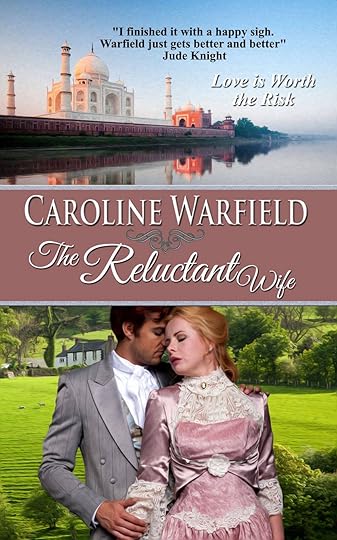
There’s a Tuesday Book Club bonus! (Actually, truth to tell, my life is topsy-turvy in the best possible way and I forget to feature another of the most remarkble Bluestocking Belle authors, Caroline Warfield. These incredible authors are on my auto-buy list and I’m looking to reading The Reluctant Wife.
What were you like at school?

The gorgeous and brilliant historical romance author Caroline Warfield
I was so quiet teachers would tell my parents they suspected I was very bright, but they couldn’t tell. Catholic elementary schools had huge classes back then, and I tended to get lost in the crowd.
What inspired you to write?
Inspired me? I don’t remember ever not wanting to write. I think reading is what inspires writing. I’m sure that is true for me.
Which writers inspire you?
I read a lot of history and theology, but I suspect you mean fiction.
Growing up? Harper Lee, Mark Twain, Thomas B. Costain, Charlotte Bronte, Louisa May Alcott, and Pearl Buck. As a teen I fell in love with the books of Dorothy Dunnett. She fired my imagination more than anyone ever has. My go-to romance writers are Mary Balogh, Grace Burrowes, and Carla Kelly. I also love Ruth Downie and C.S. Harris.
What inspired you to write this story?
When I wrote A Dangerous Nativity, I had fun creating three little boys. I began envisioning their future and decided to make them the heroes of my next series. As a boy Fred was the adventurous one, horse-mad with dreams of glory. His military career seemed inevitable, and given the time period, India a likely place he might go.
How much research do you do?
I do a moderate amount of academic research just to get the setting and the period in my head before I start. I do a lot of Internet research for facts and specifics. I often end up with piles of left over facts and information. Much of it ends up in my every-three-week columns on History Imagined and other blogs. www.historyimagined.com
Can you give us a blurb to let us know what the story is about?
I’ll give you a short one. The longer one is on my website and Amazon.
When Captain Fred Wheatly, a soldier with more honor than sense, is forced to resign from the Bengal army, and his mistress dies leaving him with two half-caste daughters to raise, he reluctantly turns to Clare Armbruster for help. But the interfering widow has her own problems, and a past she would rather forget. With no more military career and two half-caste daughters to support, Fred must return to England and turn once more—as a failure—to the family he let down so often in the past. Can two hearts rise above the past to forge a future together?
Give us an insight into your main character. What does he do that is so special?
Captain Frederick Wheatly is a natural leader. His instinct for sizing up a situation and making solid decisions serves him well. His men respect him, and the villagers in Dehrapur turn to him, not the tax collector or the cantonment’s commander, for help. On the other hand, he has no patience with bureaucracy or politics, and often ends up in trouble in spite of his determination to do the right thing. When it comes to women, however, he is utterly clueless. Even a six year old has more sense of relationships than he does. Luckily, he is easily amused.
Which actor/actress would you like to see playing the lead character from your most recent book?
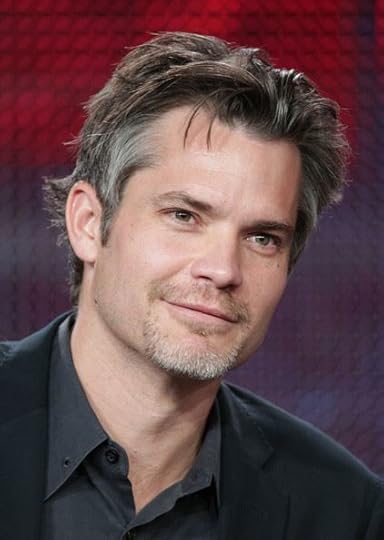
The handsome Tim Olyphant. You can see a touch of the rascal in him.
Timothy Olyphant, the lead actor in the American TV series Justified. He is very Fred!
What book/s are you reading at present?
I just started Anne Perry’s Revenge in a Cold River.
What writing project are you working on next?
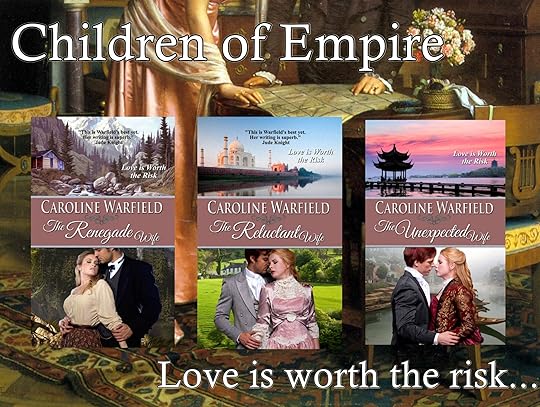
I’ve begun The Unexpected Wife, Book 3 in Children of Empire series. Charles Wheatly, Duke of Murnane, Fred’s cousin, is sunk in grief and trapped in a loveless marriage at the beginning of the book. What he needs is an adventure of his own. When the government asks him to look into things in Canton, China, he jumps at the opportunity.
Tell us something unique about you that they wouldn’t guess from just looking at your photograph?
I love the out of doors, whether standing at the shore watching the waves, hiking in the woods, or watching birds at a refuge.
What is your favourite positive saying?
Happiness is a choice we make. Choose it every day.
What is your favourite book and why?
Historical Fiction? The Game of Kings. Recent years? What Angels Fear. Of mine? Dangerous Secrets—and I think this one. It’s a lovely story.
What is your favourite quote?
“You are He who is God. I am she who is not.” (I’ve heard that ascribed to Catherine of Sienna) or as Dorothy Dunnett put it, “We play at being God but the Almighty has a way of reminding us the job is already full.”
What is your favourite movie and why?
Oh please, there are so many. One I particularly liked that bombed was Joe vs. the Volcano. The message was, you can’t fully live unless you’re willing to jump into the volcano (or whatever torrent is in front of you). Staying “safe” is an illusion that results in a sort of half-life.
 How can readers discover more about you and you work?
Web: http://www.carolinewarfield.com/
Facebook: https://www.facebook.com/carolinewarfield7
Twitter: https://twitter.com/CaroWarfield
Newsletter: http://www.carolinewarfield.com/newsletter/
Pinterest: https://www.pinterest.com/warfieldcaro/
Amaazon Author Page: http://www.amazon.com/Caroline-Warfield/e/B00N9PZZZS/
Good Reads: http://bit.ly/1C5blTm
The Bluestocking Belles: http://bluestockingbelles.net/about/caroline-warfield/
Would you like to share an excerpt from your book?
Of course!
Clare had stopped listening. A prickle of awareness drew her gaze to the entrance where another man entered. He stood well above average height, he radiated coiled strength, and her eyes found his auburn hair unerringly. Captain Wheatly had come. The rapid acceleration of her heart took her off guard. Why should I care that he’s here?
“Clare? The lieutenant asked you a question.”
Lieutenant? Clare blinked to clear her head, only to see Mrs. Davis’s icy glare turned on Captain Wheatly. “Is that your strange captain from the black neighborhood?” she demanded in a faux whisper.
The lieutenant’s avid curiosity added to Clare’s discomfort. “Is that Wheatly in a captain’s uniform? I thought they might demote him after the business with Cornell,” he volunteered.
Clare forced herself to turn to the lieutenant. “Cornell?” she asked to deflect Mrs. Davis’s questions.
“Collector at Dehrapur. Wheatly assaulted the man. Unprovoked, I heard,” the lieutenant answered.
She looked back, unable to stop herself. Merciful angels, he’s seen me. She watched the captain start toward them. At least Gleason could make introductions.
The lieutenant went on as though he had her full attention. “He was in line for promotion, the one that went to your brother instead. Philip posted over there right after it happened.”
Clare found it impossible to look away. The captain gave an ironic smile when he saw her watching. Mrs. Davis gave a sharp intake of breath when she realized Wheatly’s intent. “He’s coming here? Clare, I think I should warn you that a man who has been passed over as this one was—”
Before she could finish, Colonel Davis, who had been coming from the other direction, met the captain and greeted him with a smile. Clare couldn’t hear the words, but Captain Wheatly’s self-deprecating grin seemed to indicate at least a modicum of respect. The two men approached together.
“Captain Frederick Wheatly, may I present my wife, Mrs. Davis.” The captain bowed properly, and the colonel went on, “And our house guest, Miss Armbruster.”
This time the captain’s eyes held a distinct twinkle. “Miss Armbruster and I are acquainted. I met her when she visited her brother in Dehrapur.”
“Of course, of course! I should have remembered,” the colonel said jovially. He leaned toward Clare and winked. “He’s a catch, this one. Doesn’t like to boast of his connections, but earls and dukes lurk in his pedigree. His cousin stepped down from Under-Secretary for War and the Colonies just last year!”
Captain Wheatly looked discomfited by that revelation.
Gleason looked skeptical. “The Duke of Murnane?” he gasped.
Before anyone could answer, the small orchestra hired for the occasion began to play, and the captain cocked an eyebrow as if to ask a question.
“I think the captain wants a dance, Miss Armbruster. It’s your patriotic duty to see to the morale of the troops,” the colonel said coyly.
Captain Wheatly put out a gloved hand, and she put her equally gloved hand in his. Walking away from Gleason and the Davises, she admitted two things to herself. She was glad he came, and she planned to enjoy the dance.
Created for book lovers
Join Elizabeth’s Library Book Club today for free reads, exclusive excerpts, competitions and more!
Join Now!
Share!


The post Tuesday Book Club: Caroline Warfield’s The Reluctant Wife appeared first on EE Carter.
April 24, 2017
Tuesday Book Club: Shehanne Moore’s The Writer And The Rake
I’m on the record as generally not being a fan of time travel historicals. Much of the time they seem a bit ‘betwixt and between’, satisfying neither contemporary nor historical romance lover in me.
One big huge exception is the amazing Shehanne Moore who writes big, fantasy worlds with unconventional characters and the most entertaining dialogue I’ve ever seen.
I’m thrilled to welcome her once again to my Tuesday Book Club.
What were you like at school?

Shehanne Moore. A wonderful author, incredibly talented and with such an amazing smile!
Now Elizabeth do you really want me to tell you? (You know I do! – EEC) At primary I was very, very good and I learned lots. At secondary I learned lots too, just not the same things. My education was furthered by lots of trips to town and even ones I never intended to take. Like the time my partner-in-skiving-crime pal and me had to join the swimming group on its way down the road, having been caught bonnie skiving off. That day my education was furthered by learning how to play it well cool till we spied a bus coming towards us and were able to nudge to the back of the line, and nip across the road and catch it. We were very glad about this as we didn’t have costumes or towels—in fact we weren’t actually in that group at all–but we were confident we would think of something given the pool was a 30 minute walk. Let’s just say being flung out of classes when I was there to be in a class was a sort of way of life.
What inspired you to write?
I have always wanted to write. When I was little I had very bad chest problems and spent a lot of time reading. I read everything I could put my mitts on from an early age. It was another world to be in and I loved that an author could give you that world, that place of escape. I remember reading that RL Stevenson spent a lot of time ill as a child, when I read his Treasure Island at aged eight and I thinking I would love to do this. He went from where he was then to doing this. It’s possible.
Which writers inspire you?
Oh, I am a huge fan of so many and I guess it depends on where you were age-wise when you read them. I remember devouring Anya Seton at age 15. I have read so many of the classics, Tolstoy, Hugo. I love Les Miserables. Dickens—what a man with characters. I am especially inspired by the hard boiled school of writers, like James M Cain. Horace McCoy. (All oldies I am afraid.) They kept it so tight and Cain fair could write about women. I adore F. Scott Fitzgerald’s prose. Somerset Maughn—very tight again. I often reread F Tennyson Jessy’s Pin to See the Peepshow because although a lot would be red penned today, she created this fabulous social history of the run up to ww1, of how it was to live in London at that time. She created this beast of a central character with lots of nice snide observations like wishing a bomb would drop on her husband. I love Margaret Mitchell. And yes, Kate Furnivall has become a friend but I do remember picking up her first book way back and starting to read it in the Tesco car park and thinking, how great to see a historical like this out there.
Hee hee, I bet you are sorry you asked (Never! I think we’re kindred spirits, I love the classics and getting to know great historical authors – EEC). But I am a huge fan of historical and very much looking forward to reading your Dark Heart when it comes out. It looks wonderful. (Thank you! – EEC)
What inspired you to write this story?
Well, the fact I got an email the week before Christmas, not last one, the one before, from my ed, asking for that book, after I talked myself out a corner—she’d wanted stone circles for the time travelling and I thought NOOOO–in The Viking and the Courtesan, wasn’t just kind of plenty inspiring, it was code to me for, stop opening your blabby big mouth. I never planned on this series, which is about different members of a time travelling dynasty. But I thought…ok… I actually used a situation one of my daughters had been in for years as the backdrop to the modern bit. I had thought about a book from that situ but I know if I could write contemporary, so I left it. I have my heroine doing what I told my daughter to do about that situation, which she wouldn’t.
How much research do you do?
I kind of have a lot of history at my fingertips. I also read a lot off biographies and have studied history fairly extensively. Social history too which is a very different thing. I don’t believe in hitting a reader with painstaking detail. I figure they can go read a history book for that. But I will put the flavour i.e. women were shaped differently in 1765, so I have the heroine who is from the present day having trouble with the shoes and clothes and flagging that up in her thoughts. Or I may have a character doing something in a scene in a book, say like lighting a tinder box. I obviously research that and fit in action tags with the dialogue.
Also I try to be on my turf where possible. I set the present day bits of this current book in my home city and across the water in a place I lived in for nigh on 30 years, so I knew the wee details, like how everyone calls it ‘the village ’when it’s not a village.
Or I squirrel places I have been to, away for later use, like the church in Coxwold, the monk’s cell at Mount Grace Priory. (It sounds wonderful! – EEC)
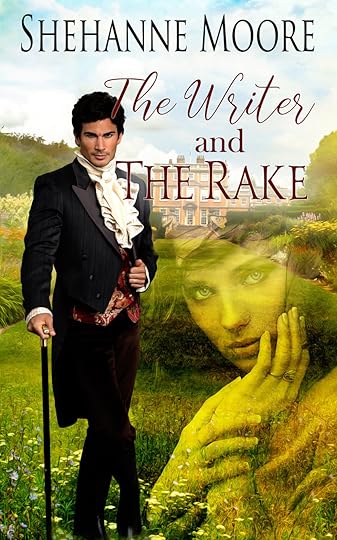
You will never have as much fun reading a time slip historical than with Shehanne Moore’s The Writer and The Rake.
Can you give us a blurb to let us know what the story is about?
1765 had bugger all to recommend it.
He saw her coming. If he’d known her effect he’d have walked away.
When it comes to doing it all, hard coated ‘wild child’ writer, Brittany Carter ticks every box. Having it all is a different thing though, what with her need to thwart an ex fiancé, and herself transported from the present to Georgian times. But then, so long as she can find her way back to her world of fame, and promised fortune, what’s there to worry about?
Georgian bad boy Mitchell Killgower is at the center of an inheritance dispute and he needs Brittany as his obedient, country mouse wife. Or rather he needs her like a hole in the head. In and out of his bed he’s never known a woman like her. A woman who can disappear and reappear like her either.
And when his coolly contained anarchist, who is anything but, learns how to return to her world and stay there, will having it all be enough, or does she underestimate him…and herself.
Give us an insight into your main character. What does he/she do that is so special?
She uhm… well she gets drunk and chain smokes. I think that’s pretty special (Er well sort of ) for a gal in 1765. Also she’s a writer…I am sure I am amongst friends here when I say I think that is pretty special.
Which actor/actress would you like to see playing the lead character from your most recent book?
I see Mamie McCoy. She has the right polished veneer, the looks that are sometimes stunning and sometimes quite ordinary, the right cool, but I always feel she is at her best when she gives you the glimpse underneath the facade, the woman who has found life a battle but won’t show that to anyone. As you can see Brittany is.
But she’s also quite vulnerable underneath. And it is something Mitchell clocks from very early on. Despite the barriers he puts up it gives him an understanding of her, even if he doesn’t want it.
What book/s are you reading at present?
Believe it or not I am reading an excellent historical mystery, The Thief Of Hearts by an Elizabeth Ellen Carter. Don’t know if you have heard of her, or not (Who? – EEC). I’d have had it finished if I hadn’t had so much to do but it’s great to dive back into it. And I am also going to start Dark Rosaleen a book about the Great Famine in Ireland.
What writing project are you working on next?
I am working on a book I started before I was asked to write this one, called O’Roarke’s Destiny. It’ a historical rom obvi and it’s about a battle royal over a house. On the surface anyway. I am also busy on revamping an actual Historical fiction called The Ladies of Fetter Lane. tag line, their loves, their lives, their deaths. And mulling over another Time Mutant series book about Malice, heroine of the The Viking and the Courtesan’s daughter, aptly named Remain.
Tell us something unique about you that they wouldn’t guess from just looking at your photograph?
I am really very nice. (But we already knew that! – EEC)
Do you have a trailer or do you intend to create one for your own book/s?
I do have a trailer and here is the link. (this is the embed code Elizabeth I am providing both)
(This is the ordinary youtube one )
What is your favourite positive saying?
‘Life isn’t about waiting for the storm to pass. It’s about learning to dance in the rain.’
What is your favourite book and why?
OOH, that is so hard because as I said before certain books appeal at certain times in life, places we are at and ages we are. I remember year ago my mum saying how it wasn’t possible to have that and I have come to think she is right. I love so many for so many different reasons.
What is your favourite quote?
AHHHHH. Was that a quote? Probably not. I quote my Nan , now long gone, a lote. She always said, ‘what’s afore ye winnae go past ye.’
What is your favourite movie and why?
Now that..that is Gone With The Wind. I don’t give a flying proverbial how there’s all this stuff about it being racist. If it is then it’s important to remember that THAT was how people thought at that time and learn from it. We all need mirrors held up to us. The world wouldn’t be in half the mess it is if we learnt from our mistakes. I saw it first at 14 when it was on a special anniversary tour and my mum took me. I have never tired of it, no matter how many times I have seen it. The cinematography for its day was amazing. The condensing of the book writing wise was amazing. Clark Gable and Vivien Leigh were stupendous. Her and Olivia De Havilland were so young and beautiful when they made that film and look at the performances they turned in.
How can readers discover more about you and you work?
Website: http://shehannemooreweeblycom.weebly.com/
Blog: http://shehannemooreweeblycom.weebly.com/
Facebook: https://www.facebook.com/Shehanne-Moore-163736780417433/?ref=br_rs
Twitter: http://bit.ly/2mPs8Kp
Pinterest: www.pinterest.com/shehanne/
Goodreads: http://bit.ly/2ogvN1d
Buy Links Loving Lady Lazuli.
Amazon
Barnes and Noble
Kobo
Buy links The Unraveling of Lady Fury
Amazon
Barnes and Noble
His Judas Bride
Amazon
Barnes and Noble
The Writer and The Rake- http://amzn.to/2oaacuf
The Viking and The Courtesan – http://amzn.to/2n5q11T
Would you like to share an excerpt from your book?
Of course. This one is from not long after Brittany arrives in 1765 and is convinced she’s dead.
“Wife? Mitchell?”
As Christian spoke, Brittany strove to look composed, serene. She’d fallen down the rope, somehow broken that vase, nearly broken her neck, except she couldn’t break her neck. She’d already been murdered by Sebastian. These things were bad enough. Had she mentioned that Mitchell Killgower was transfixed with horror?
“She is not—”
“But she is very, very nice, Aunt Christian, the mother I never had, so we are all getting along . . .getting along quite famously in fact.”
Brittany struggled to her feet, dug in her pocket, fished out her fags. What a bloody awful thing it was being dead. Even her fag was so bent, getting it between her lips was such a mammoth task, it took three attempts. Five if she counted keeping her hand steady enough to ping her lighter and suck long and hard, wreathing herself in delicious, such needed smoke. She sucked even harder, while she considered her next move. It wasn’t biting her nails, or being pushed into the carriage. She’d a new slant on the carriage. The fag was just what she needed to find her cool and face down whatever these things were. She’d already come to think, ‘ghoul one’ and ‘ghoul two.’ Mitchell made it ‘ghoul three.’
“Are you sure your new mother is nice, dear, only . . . only she looks . . . Well, I really don’t know what to say.”
“Believe me, darling, the feeling’s mutual.”
Mitchell‘s eyes were icy as polar caps. “May I say, for the benefit of those who are hard of hearing, this woman is not—”
“Your wife?” The uncle’s shining, silver cravat pin nearly pinged from his cravat. He grasped his cane so tightly his knuckles were white as his hair. “I should sincerely hope not. You know our terms and conditions on that. If this is the best you can do, then we should redraw our will now. Unless you’re going to try telling us she’s Fleming’s wife?”
“Well, Uncle, now that you come to mention it. At sixteen, it is about time. Half the boys in the county, if not the country, are already—”
“Oh, really? Mitchell . . .” Brittany took a deep breath and pinged her fag beneath the withered hydrangea. The afterlife wasn’t what she’d thought. If this wasn’t heaven, or hell, then it was some sort of place of atonement. Look at all these ghostly shrubs and trees for a start and those stone dragons poking out of the walls.
Ghosts did wander the face of the earth. These must be the ones with unfinished business who’d managed back. She wouldn’t rest till she’d done whatever it took to do that and make Sebastian’s life hell. Mitchell would know the way. Whatever this was about, put out her hand to the weary traveller and he’d owe her big time. Besides why should she suffer all these stinging cuts to her pride? She was the perfect homemaker. Look at all these rugs and pot plants she’d bought for Sebastian’s. The ones he’d thrown at her when there were rows.
“All right, you win. So you were right. Your aunt and uncle can’t take a joke, but are you really going to let them talk to me like this? We both know I was locked in that room by . . . by a certain person and that person wasn’t you, my dearest. With hardly any clothes to speak of too? All for a joke? Hmm? Fleming, what do you have to say? Let’s hope it’s interesting?”
“No, I never. How would I do that?”
“Very, very easily, darling. Don’t lie to your great-uncle. It’s so unbecoming when he’s such a nice man.”
“You mean, Fleming, you never had any clothes on either?”
Fleming flushed scarlet. “Uncle. They took my clothes. They put me out wearing a bed sheet.”
“But, you just said to your great aunt that your new mother was very nice. Well? Which is it to be? Are you lying to me, boy?”
“She . . . she is nice, Uncle Clarence. But, I didn’t lock her in my room. How could I?”
Created for book lovers
Join Elizabeth’s Library Book Club today for free reads, exclusive excerpts, competitions and more!
Join Now!
Share!


The post Tuesday Book Club: Shehanne Moore’s The Writer And The Rake appeared first on EE Carter.
April 20, 2017
Letting Latin Live!
Dark Heart, my Roman-era romantic suspense will be published on May 12 through Dragonblade Publishing. It’s available for pre-order now!
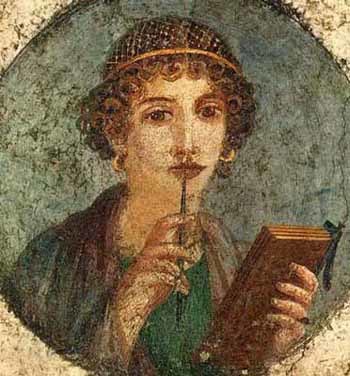
This lady contemplates how to correctly conjugate in Latin
The Roman empire might have long gone, but it’s legacy remains strong even to this day.
Did you know that sixty percent of the English language comes from Latin!
Latin stopped being taught in most schools from the early 1970s, which was a dreadful mistake because of its foundational influence not only on English but also all of the Romance languages – Spanish, French, Italian and Portuguese – (the Romance referring to Roman).
It can be argued that Latin never really went away. Even after the Empire fell, many of the governmental systems and procedures inherited by the Romans continue and found its way into permanent use in law, science, medicine and biology with these things kept alive by the Christian church – specifically the Catholic church.
Many common phrases and short forms we use today would be familiar to the Romans – as would some proverbs.
Here are some familiar ones:
alea iascta est – The die is cast
audentes fortuna iuvat – Fortune favours the bold
errare humanum est – To err is human
ophidia in herba – Snake in the grass
Let’s not forget the good ole Carpe diem: “Seize the day.”
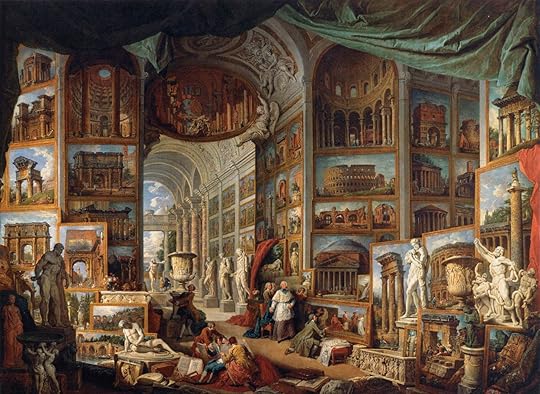
Giovanni Paolo Pannini – Gallery of Views of Ancient Rome.
And one of my favourites from Cicero – Non nobis solum nati sumus – we are not born for ourselves alone.
One that I used in Dark Heart, and which appears as a recurring motif, has a double meaning: optimi natatores saepius submerguntur – The best swimmers often drown.
Even if you never learned Latin, you could make a good stab at understanding its meaning in three of the words at least:
Optimi = optimal/best/ideal
Natatores = swimmer (you might have to go back to your high school French to pick up notation for swimming
Submerguntur = that looks close enough to submerge to infer that it means drown
Today we might describe the same moral as pride goes before a fall.
The phrase is particularly apt for my hero Marcus Cornelius Drusus who is a swimmer. He receives this warning from his best friend Lucius, while on the trail of a murderous cult planning to further destablise the Empire.
So next time you read a book excerpt you will know that it comes from the Latin ‘ex’ out of and ‘carpere’ to pluck and literally means to pluck out and has been commonly used in English since the 1630s.
So bring back Latin, I say! And making the case far better than I could is Charlotte Higgins:
What else? Children learning it will quickly start to read the great classics of Latin literature. After a couple of years, Catullus and Martial. After three, Virgil, Pliny, Ovid, Cicero. Soon come Horace, Lucretius, Tacitus. This is tough, uncompromisingly difficult stuff – but also offers entry into an astonishing world, a lost world that paradoxically offers itself up vividly and excitingly through its literature. These great writers lie at the head of a western tradition in writing that enfolds Chaucer, Shakespeare, Milton, Keats, Eliot, Heaney. To be a good reader of English and Irish literature alone,
knowledge of the literature of the Romans offers an inestimable advantage.
Dark Heart Excerpt
“How did Philomen keep his appointments?”
“He had a wax tablet. Either I would write them down or he would.” She surveyed the disordered room. The magistrate looked about, too.
Wax tablets were strewn across the desk and floor. One had been stepped on, leaving a booted imprint. Others were smeared with blood.
She sent up a silent prayer of thanks. Philomen’s lifelong collection of medical texts, both Greek and Roman, were safe in his study inside the villa. It would have been a final insult if they had been stolen or destroyed.
Kyna tipped upright a three-legged stool and found the right tablet. Its back was broken but when she pushed it together, the writing was still legible. Behind her, the magistrate approached and she inhaled the faint aroma of cedar and orange.
He didn’t take the tablet from her; instead he seemed content to read the list from over her shoulder.
She ignored his presence the best she could and concenstrated on the names and the brief description of the patient’s ailment. She knew all of these people. None of them would have harmed Philomen. There had been no appointments after the noon meal.
“Wait outside.”
At first she thought the command was for her and turned, but over the magistrate’s shoulder, a guard saluted and retreated to the taberna’s entrance.
“Tell me about the man you saw.”
There was an edge to the young magistrate’s voice that forced her eyes to his.
Ut imago est animi voltus sic indices oculi – “the face is a picture of the mind as the eyes are its interpreter”. As the saying came to her, he looked away. Kyna felt her brows crease. Was he hiding something?
Created for book lovers
Join Elizabeth’s Library Book Club today for free reads, exclusive excerpts, competitions and more!
Join Now!
Share!


The post Letting Latin Live! appeared first on EE Carter.
April 16, 2017
Tuesday Book Club: Jude Knight’s A Raging Madness
Earlier this year I was honoured to be invited to join The Bluestocking Belles, a wonderful group of historical romance authors who are outstandingly talented and successful.
It’s my great pleasure to introduce Jude Knight, from New Zealand, just across the Tasman from me!
Before we get into today’s interview, a reminder to join us on April 28/29 for a wonderful Facebook Party, called Love Speaks.
What were you like at school?

The wonderful, charming and intelligent Jude Knight is my special guest today.
I was the quirky kid in the library; the one who got the teachers’ jokes and wrote parodies of the poems we were studying in English. My school’s crest featured a lion, so I started an underground newspaper called ‘Bleat: the student’s voice’, whose symbol was a very unhappy looking lamb. I had a lot of illness in my school years, and missed quite a bit of school, but still managed to pass most things; mostly because I wrote good essays and have the kind of brain that stores away trivia. Anything that required work, like memorising foreign language vocabularies or learning dates, I didn’t do so well at. One teacher once wrote on an exam paper of mine. “You have written an excellent English essay. It is a pity the subject is History.”
What inspired you to write?
I have always told stories. My mother swears I began before I could talk, and certainly by the time I was at preschool, I was making up stories for the other children. Somewhere in my seventh or eighth year, I first announced that I planned to be a writer and a mother when I grew up.
Which writers inspire you?
How long have you got? Here’s a brief of the top of the head selection. Asimov, Le Guin, Tolkein, Agatha Christie, P.D. James, Patricia Wentworth, Terry Pratchett, Elizabeth Hoyt, Georgette Heyer, Grace Burrows, Shakespeare, Dickens. And many more, from whom I’ve learnt and in whose pioneering feet I aspire to tread. The writers of the Psalms and the translators of the Bible are right up there, too. (What a wonderful set of authors! – EEC)
 What inspired you to write this story?
As with all my books, many different things came together to make this story.
I started with Ella. She wandered into my head, determinedly not a victim despite her circumstances. I met her in the precursor to the scene where she climbs from her bedroom in her shift, and hears her in-laws plotting against her. Two years ago, I saw that scene, and now it is written and on preorder. Isn’t that wonderful? (I love it when that happens – that’s when you know you have something special. – EEC)
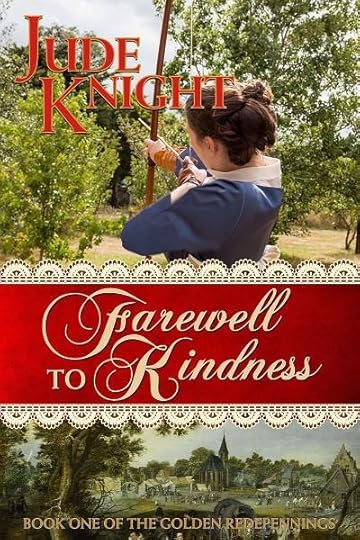
Alex wasn’t going to be my wounded soldier in Farewell to Kindness, but once I swapped him for the original friend of my hero, I fell in love with his courage and wondered what had caused his suspicion of women. A Raging Madness was how I explored the answers.
The theme came early, and prompted both the title and the number of villains. Envy poisons, and love heals. That’s my story in a nutshell.
The canal trip had three reasons. First, I’ve always wanted to do one, and reading about them and watching Youtube clips was nearly as good. Second, I wanted to throw my hero and heroine into close quarters, and a canal boat cabin did it. Third, it tickled my fancy to have my hero and heroine fleeing in one of the slowest modes of transport ever invented.
How much research do you do?
Way more than ever shows in the books. I’ve never met a research rabbit hole I didn’t immediately want to leap down, and I have a dread of getting some simple thing wrong.
Can you give us a blurb to let us know what the story is about?
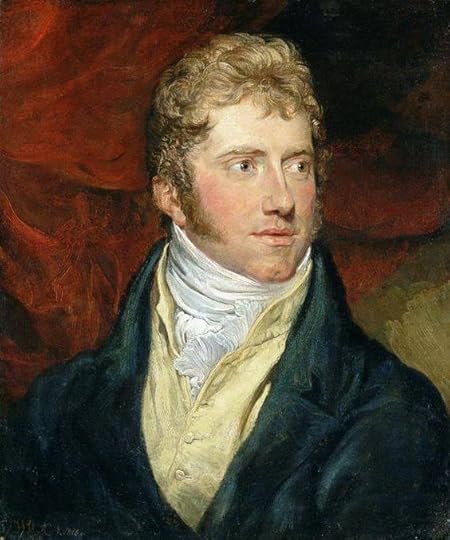
Alex, a historical romantic her to fall in love with (from A Raging Madness by Jude Knight)
Their marriage is a fiction. Their enemies are all too real.
Ella survived an abusive and philandering husband, in-laws who hate her, and public scorn. But she’s not sure she will survive love. It is too late to guard her heart from the man forced to pretend he has married such a disreputable widow, but at least she will not burden him with feelings he can never return.
Alex understands his supposed wife never wishes to remarry. And if she had chosen to wed, it would not have been to him. He should have wooed her when he was whole, when he could have had her love, not her pity. But it is too late now. She looks at him and sees a broken man. Perhaps she will learn to bear him.
In their masquerade of a marriage, Ella and Alex soon discover they are more well-matched than they expected. But then the couple’s blossoming trust is ripped apart by a malicious enemy. Two lost souls must together face the demons of their past to save their lives and give their love a future.
Give us an insight into your main character. What does he/she do that is so special?
What I love about Alex is that he fights his own desires and convictions to give the woman he loves the right and power to make her own choices. What more can a girl ask of her hero? And Ella? As I said before, I love that her trials have tempered her. She has enormous courage.
Which actor/actress would you like to see playing the lead character from your most recent book?
When I was writing A Raging Madness, I had a photo of Alex Pettyfer as my visual inspiration for Alex. I’d love to see Anne Hathaway as my heroine.
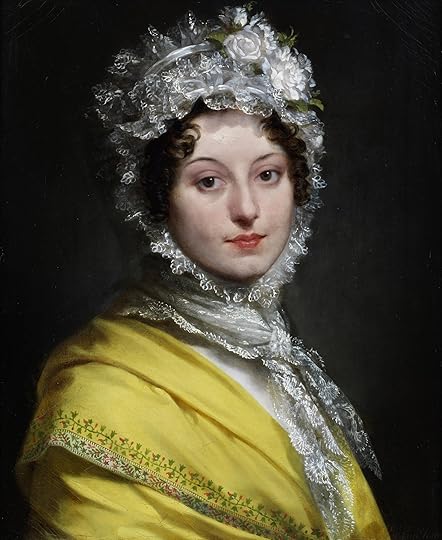
Ella, the heroine of Raging Madness.
What book/s are you reading at present?
My current research book is Secret Service: British Agents in France 1792 to 1815, by Elizabeth Sparrow. This is for one of my current writing projects.
I finished Jessica Cale’s Broken Things a day or two ago, and haven’t started anything new yet. I’ve also read Caroline Warfield’s The Reluctant Bride and Sherry Ewing’s Nothing But Time, and want to read the other books that are being launched with mine on 29 April (Elizabeth’s Dark Heart, Amy Quinton’s What the Scot Hears, and Caroline’s Holiday in Bath). That should keep me amused.
What writing project are you working on next?
I have two novels on the go. I am writing the sequel to A Raging Madness, which is called The Realm of Silence. I am also researching for Concealed in Shadow, which is the sequel to my historical mystery, Revealed in Mist. Given my reading matter, it won’t surprise you to know that both novels involve spies.
I’m also writing novellas for two different anthologies, and both are departures from my usual period. The first is for the Bluestocking Belles, and is set during the Mt Tarawera eruption in New Zealand in 1886. The second is for the Speakeasy Scribes, and is set in the late 21st Century, 40 years into a new ice age.
Tell us something unique about you that they wouldn’t guess from just looking at your photograph?
I am short. I mean really short. I mean under five feet / one point five metres.
Not unique? Okay. My ambition for my old age is to become a grammar guerilla and sneak out at night to correct typographical errors in signs. (I’ve found your role model! – EEC)
What is your favourite positive saying?
There are no problems; only challenges.
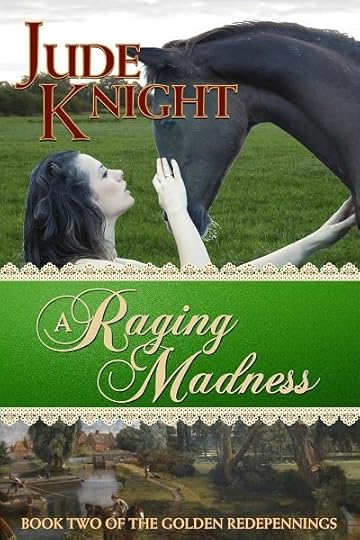 What is your favourite book and why?
That’s as hard as listing the authors who inspired me. I have a long, long list. I love books that are soundly based on research but that don’t hang it all out like wet laundry; ones in which real people walk and live and act in accordance with their times and their natures; ones that deal with important issues (and yes, falling in love is important).
What is your favourite quote?
I like different ones on different days. Today’s is “To write means more than putting pretty words on a page. To write is to share part of your soul.” A perennial favourite is ‘The aim is publication not perfection”.
What is your favourite movie and why?
The Sound of Music. Because even though I’ve read both the Von Trapp Family Singers and the debunking reports, it is just so outrageously cheerful and optimistic. And everyone should be able to sing their way out of being dragooned by the Nazis.
How can readers discover more about you and you work?
Author bio
Jude Knight’s writing goal is to transport readers to another time, another place, where they can enjoy adventure and romance, thrill to trials and challenges, uncover secrets and solve mysteries, delight in a happy ending, and return from their virtual holiday refreshed and ready for anything.
She writes historical novels, novellas, and short stories, mostly set in the early 19th Century. She writes strong determined heroines, heroes who can appreciate a clever capable woman, villains you’ll love to loathe, and all with a leavening of humour.
Website and blog: http://judeknightauthor.com/
Facebook: https://www.facebook.com/JudeKnightAuthor/
Twitter: https://twitter.com/JudeKnightBooks
Pinterest: https://nz.pinterest.com/jknight1033/
Smashwords: https://www.smashwords.com/profile/view/JudeKnight
Goodreads: https://www.goodreads.com/author/show/8603586.Jude_Knight
Amazon author page: https://www.amazon.com/Jude-Knight/e/B00RG3SG7I
Would you like to share an excerpt from your book?
Alex poured the coffee, his rinsed shaving mug doing service for Jonno’s portion. Ella sat and sipped while Jonno cleared the table and pushed the serving trolley out of the way. At Alex’s gesture, he sat on the stool again.
“Now, Lady Melville. What trouble are you in, and how can we help?” And should he believe a word she said? She did not act like a lunatic, apart from appearing half-naked in his room in the middle of the night. Apart from the panicked response to her brother-in-law.
That she had taken opium in some form was beyond a doubt. The contracted pupils, the loss of appetite, the shaky hand, the restless shifting in her seat, all spoke to that. Thanks to his injury, Alex had far too close and personal an experience of the symptoms to mistake them. The bruises on her jaw hinted that the drug taking might not have been voluntary, but perhaps her keepers needed to drug her to keep her calm.
Sane or not, Alex hoped he would not need to hand her back to Braxton. Her fear might be irrational, but when she had stood at bay, begging for his help, he had been thrown back ten years. Not that she begged him then. But he left camp on a short trip for supplies, and returned to find Ella married and much changed, her fire banked; her joy extinguished. That time, he had ignored her plight, hardened his heart and left her to the fate she had engineered. And had suffered with her as the consequences quenched her vitality and sucked away the last of her childhood. Suffered, and been powerless to help.
“I have been drugged,” Ella said baldly. “Twice a day. For weeks now. They won’t tell me why. If I refuse, they force me.”
“‘They’ being Braxton and his wife?” Alex prompted.
“And Constance’s dresser.”
“Go on.” He was careful to show no disbelief, no surprise.
“I have been kept in my room. They locked the door. They took all my clothes, my shoes. I saw you out the window and so I came. Will you help me, Alex?”
“I can take you to the rector.” Even as he said it he remembered the plump little man greasing at Braxton’s elbow. Ella would find no help there.
“No!” Her rejection was instant and panicked. “He will give me back and they will send me to that place. No, Alex. You do not know what they plan for me.” She was weeping. Alex had seen her calm under cannon fire, dry-eyed at her father’s funeral, efficient and unemotional in the midst of the carnage of a hospital tent after a battle. He had never seen her weep.
He captured her hands, and kept his voice low and soothing. “I do not, Ella. Tell me.”
Created for book lovers
Join Elizabeth’s Library Book Club today for free reads, exclusive excerpts, competitions and more!
Join Now!
Share!


The post Tuesday Book Club: Jude Knight’s A Raging Madness appeared first on EE Carter.
April 13, 2017
Doctor, Doctor
Dark Heart, my Roman-era romantic suspense will be published on April 28 through Dragonblade Publishing.
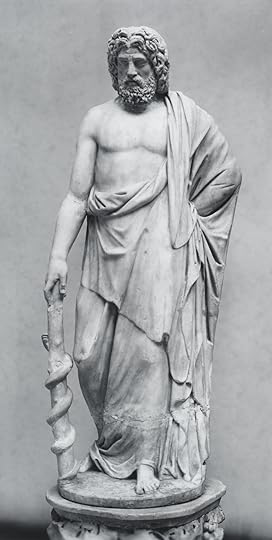
A statue of Aesculapius, the god of medicine for both the Greeks and Romans. Notice the snake rising up the staff. A hint of the caduceus that symbolises doctors and paramedics today.
It might come as a surprise to many to discover that back in ancient Rome there were women doctors.
Those un-PC Romans even had a gendered term for them – medicae – as opposed to medicus for men.
Although their work would likely have been obstetrics and gynaecological, they did more than just midwifery work and had a higher status than midwives – which proves that not much has changed in thousands of years.
Medicaes were citizens, not slaves, so I’ve taken a bit of creative licence on this topic in Dark Heart, but as we learn from Kyna, Philomen Erasmus – the Greek doctor who trained her – was an independent minded chap.
That’s not to say that doctors were universally admired and trusted as they are today. In many respects they were treated a bit like lawyers – with suspicion, accused of doing too little and charging too much.
And again, unlike today, the profession of doctor was not something a Roman would want their children to study. That kind of thing was left to the Greeks who had made the profession their own.
Doctors did go through training often via an apprenticeship and as a medical intern at the temples of Aesculapius – the temples of healing and most famous of which is in Rome on Tiber Island.
[image error]
Tiber Island. Essentially it was Rome’s medical precinct.
While we had to wait until the medieval period before we see the beginning of the scientific method being codified and applied to all aspects of science, ancient Roman and Greek doctors were nonetheless comprehensively trained with the best information they had at the time.
The Grey’s Anatomy equivalent was the works of Galen whose works formed the basis of medical theory for a good thousand years.
He was fascinated by anatomy and used animal corpses to extrapolate his theories, since Roman Law forbade dissection of human corpses – a prohibition which remained until the Renaissance.
Like many modern health enthusiasts, Galen was a big believer in food being the primary medicine with surgical and drug intervention being a drastic step.
His works were widely referenced by doctors all over the Empire and, in honour of him, I’ve mentioned him as a contemporary of my fictional doctor Philomen, who collected a number of his works.
The survival and amendment of Hippocratic medicine is attributed to Galen. Galen writes that a physician “must be skilled at reasoning about the problems presented to him, must understand the nature and function of the body within the physician world and must ‘practice temperance and despise all money’.
Which brings us to the late Roman Empire, and the introduction of the comes archiatorum, an honorary position of today’s equivalent of a Chief Medical Officer or Surgeon-General. The equivalent of the AMA or the doctor’s registration board was archiatri who arbitrated on all medical disputes. Rome had fourteen of them; the number in other communities varied from five and up to ten, depending on the population.
The Surgeon-General was a nobleman, so in Dark Heart, I’ve made him a Senator who becomes integral to the plot. Something which connects my heroine Kyna into mystery the hero Marcus wants to get to the bottom of.
Okay this has nothing to do with Ancient Rome – or medicine – but when I was writing this blog post, this was the earworm that came to mind. There is no for cure earworms but to share them.
You’re welcome. 
April 6, 2017
Concrete Solutions In History
Dark Heart, my Roman-era romantic suspense will be published on April 28 through Dragonblade Publishing.

The city of the Gold Coast. My home. My grandfather was a steel fixer (labourer) who built some of these steel and concrete high rises in the 1960s and 1970s.
I live in one of the youngest cities of one of the youngest countries – the Gold Coast, in the state of Queensland, Australia. The resort city as we know it only really came into being in the 1950s and as a result, it is nearly impossible to find a standing structure that doesn’t date from the 20th century.
So, one can’t look at Ancient Rome without being in awe of buildings that have lasted more than a thousand years.
How did they do it?
They mastered the art of concrete.
Now, that might elicit one great big yawn today – after all concrete is everywhere, many of us might live in a concrete jungle. Concrete is so commonplace that it is easy to forget that the formula for it had been lost for more than 1000 years.
Even more remarkable is that engineers today are still studying the composition of Roman concrete to make improvements to today’s building material.
They have discovered that the ancient Roman formulation bonds better, is stronger, does not require reinforcing and is even more environmentally friendly!
The Romans’ recipe was essentially lime, volcanic ash and salt water. The interaction between these ingredients produces calcium aluminum silicate hydrate (CASH), which is the bonding material. The study also revealed that Roman concrete contains tobermorite, a material with a highly organized and very strong structure of molecules.
Researchers also found that the Roman process for creating concrete releases less carbon dioxide than today’s method. Portland cement requires an extreme amount of heat to produce, while the Romans used a naturally material, volcanic ash. We have experimented with using volcanic ash, and more commonly, fly ash, to replace Portland cement, but until now there was no way to know how strong this type of concrete would be.
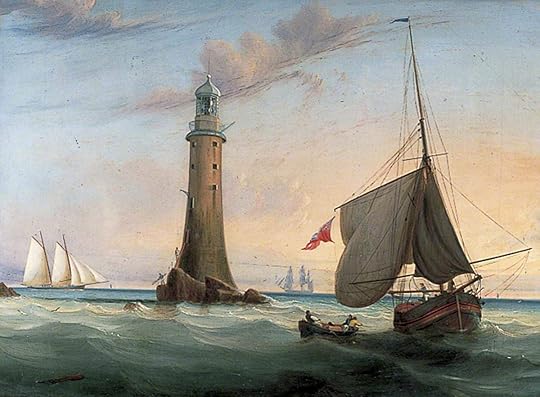
Lynn, John; Smeaton’s Eddystone Lighthouse; Canterbury City Council Museums and Galleries; http://www.artuk.org/artworks/smeaton...
For centuries following the fall of the Roman Empire, building material was limited to what could be quarried, nailed together or fired in a kiln. It wasn’t until 1756 that British civil engineer John Smeaton found a formula that worked after numerous experiments.
He used to be the Eddystone Lighthouse in Cornwall in 1793.
There were further improvements made to the formulation by another English inventor John Aspdin in 1824. He developed Portland cement which is still available today.
Even so, 19th century concrete wasn’t a patch on Roman concrete. The next leap in the modern version of the material came from Germany.
It was in Germany that the first systematic testing of concrete took place in 1836. The test measured the tensile and compressive strength of concrete. Another main ingredient of concrete is aggregate and includes sand, crushed stone, clay, gravel, slag and shale. Concrete that uses imbedded metal is called reinforced concrete or Ferroconcrete. It was Joseph Monier who first invented reinforced concrete in 1849. He was a Gardner who made flowerpots and tubs of reinforced concrete with the use of iron mesh. The reinforced concrete thus combined the tensile power of metal and the compression strength of concrete for tolerating heavy loads. He received a patent for this invention in the year 1867.
In 1886, the first rotary kiln was introduced in England that made constant production of cement. In 1891, George Bartholomew made the first concrete street in Ohio, USA. By 1920s, concrete found major usage in construction of roads and buildings. It was in 1936 that the first concrete dams Hoover and Grand Cooley were built.
Now the tallest structures man has ever known are made of reinforced concrete. It’s quite a feat, but it also comes with a downside. Steel rusts which means concrete spalling (concrete cancer) unless the concrete is maintained.
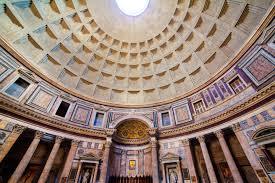
The stunning and incomparable oculus – the non-reinforced dome in Rome’s Pantheon.
Romans structures never had to worry about that because they never required reinforcing which is why today, the world’s largest non-reinforced concrete dome still remains the magnificent Pantheon built nearly two millennia ago in 125 AD.
Created for book lovers
Join Elizabeth’s Library Book Club today for free reads, exclusive excerpts, competitions and more!
Join Now!
Share!


The post Concrete Solutions In History appeared first on EE Carter.