Kay Kenyon's Blog, page 7
October 7, 2019
My SF novel at $.99
NOW through Sunday, October 13
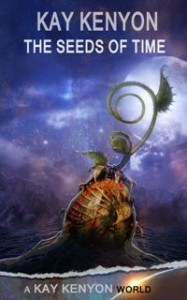
Clio Finn is a time travel pilot on the run from a dystopian and graying Earth. Now she’s found a planet with what could be viable, saving biota. If she can get home from across the galaxy. With the enemies Clio’s got, that’s a very big IF. One week only, the eBook is reduced to $.99 at all e-retailers.
The Seeds of Time, a reader favorite.
Click here to purchase: books2read.com/seeds


October 2, 2019
Is This Scene Worth It?

Don’t let tepid scenes suck the juice from your novel.
One simple step can save you time — and perhaps your novel.
Recognize this situation? You’ve just re-read the last scene written, and now it’s time to write another. You have a sort-of-good idea for it. And maybe when you write it, it will improve “in the telling.”
On the other hand, you’re thinking, you could just explain the action in a narrative bridge. Or perhaps tuck the information bit by bit into several scenes? In other words, you’re not sure the scene is worth it.
So how can we decide whether to bring this nugget of action on stage in a scene?
“Forward the plot” is the usual scene advice. But even following that criteria it’s easy to write tepid, low-interest scenes.
Let your intuition help.
Here’s a quick way to help you judge if your idea for the scene is good enough: Give it a title. (You won’t use these titles in the manuscript, this is just a quick test for drama.)
The title doesn’t need to be catchy or meaningful to anyone else. But to you, it reflects the dramatic essence of the next story bit. Examples from my planning notebook for a recent novel:
Blood on the silver screen
Breaking into the sanatorium
Having to beg
To take advantage of your intuition, do the naming quickly. Does the title remind you of the deep currents of your story? If so, maybe that’s the right scene–dramatic if possible, or at least inherently interesting. If you have trouble nailing the title, take it as a diagnostic warning. Ditto if the title doesn’t really sing to you. Like:
Nina takes the coach to town
Drowning his sorrows at Scotty’s bar
Logically, Nina might have to get to town. Or your main character might well go to a bar after just having learned he’s got to save the world. But these titles, if they reflect the heart of the scene, warn you not to bring this material on stage.
The malicious meander.
Will it hurt if you have a scene of the major character considering his predicament with a bottle of his favorite adult beverage? Probably, if nothing else happens. Will it hurt the novel to have a coffee-drinking scene where the kindly supporting character offers support in the face of the major character’s setback? The quick-test title: Coffee and empathy.
Maybe pass on that one.
Many writing decisions lie in wait: the beats of the scene, the escalation, the pay off. But an apt title allows you to make a quick judgment of whether the next few pages will be worth the ink and the sweat. Or whether those pages might induce the reader’s attention to wander.
Therefore: help yourself avoid the malicious meander and the boring plot chunk. The next time you start a scene, try giving the action a title.
August 9, 2019
Crossing that chasm in your novel
Sometimes we writers (you know who you are) hit a blind spot in the novel. Not really a bout of writer’s block, but a serious question about What Comes Next.
We might nobly feel like writing but we can’t quite picture the next sequence. Even when we have confidence in the overall plot, sometimes a section is like looking across a chasm where the bridge is down.
All the light goes out of the room, and we may find ourselves sullen and resentful. This is not what we signed up for. Writing flows, it doesn’t require construction work, for crying out loud. We begin to think: My planning didn’t work, my plot is too thin. I am one of those writers whose time is, sadly, up. My novel hates me.
As we get a grip on this hissy fit, we eventually conclude that it’s time to do some deep, methodical plotting. We’re going to have to think through this sequence of the story in excruciating detail.
And truthfully, we’d rather put pins in our cheeks. These are the kinds of times when a writer decides to wash the car or groom the dog. Believe me, I’ve been there (well, got a cat, but you get the picture.) Nevertheless we know that the chasm will wait for us, so really, let’s just Do It.
That is, let’s create a Step Sheet.
The Step Sheet.
The Step Sheet is a logical plot progression composed of 2-3 sentences in each step. First this happens, then this, then this. All the while making sure that it could believably happen in that order and has satisfying dramatic content. It isn’t a scene plan–nothing complicated–just a simple list. Because when you need this much heavy lifting on your plot, it isn’t about nuance. You just need to get across the chasm. You can make it pretty when you write it.
I like to number the Steps. It helps me believe that this is going to be simple. 1, 2, 3, 4. I do my Step Sheets in a notebook, never at the computer. I’m not a superstitious person, but Step Sheets must be done with a pencil and paper.
Like a root canal, it works. And it isn’t as unpleasant as we might expect. If we sic our brains on What Happens Next, the leetle gray cells usually do their job and —voila!– we are out of the woods. We may even find that as we work (and re-work) the Step Sheet, we find cool (for now, extraneous) story ideas occurring to us. If this happens, just jot them in the margins, but continue building that bloody bridge.
Then we can be in a good mood again about the novel. (Oh, fragile writer’s mind!) Nothing annoying or daunting about tomorrow’s work. When we sit down to write in the morning, we’ll just walk over that bridge.
We may sheepishly look around to make sure no one saw us being truculent and faithless. I won’t tell if you won’t.
July 27, 2019
Of aliens and butterflies
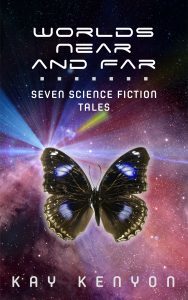
I’m so pleased to announce a new collection of science fiction short stories. Most were published in anthologies over the years and are gathered together here for the first time.
In these stories, you can walk the decks of a generation ship, meet gentle and not-so-gentle alien life, ride on the shoulders of an avatar, and enter a new green world where metal bows down to the seeds of time. Available in ebook and paper.
Amazon
Kobo
Nook
Apple
Google Play
For another of my short story collections, try Dystopia: Seven Dark and Hopeful Tales!
June 20, 2019
New retailers, new discounts
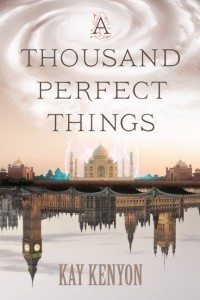
My first fantasy is now available at all e-retailers.
A Thousand Perfect Things: an historical fantasy set in an alternate 19th century England and India. Enter a magic-infused world where silver tigers and demon birds roam and one young woman is caught up in a sweeping mutiny . . .
Amazon
Barnes and Noble
Kobo
iTunes
Google Play
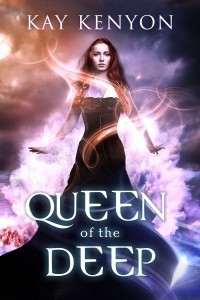 Queen of the Deep is at $.99 for one week only.
And it’s also available for the first time at all e-retailers!
Travel to a magical renaissance with actress Jane Gray who must play a role for the highest of stakes–love and survival. A beguiling fantasy filled with magic, adventure, romance–and dangerous secrets.
Amazon
Barnes and Noble
Kobo
iTunes
Google Play
May 31, 2019
15 questions to guide your novel
Sometimes you just gotta get methodical. Novels are big and unruly, but chaos does not need to reign. Here are 15 framing questions that can help you discover and define what you what to write. I’ll use one of my books to give examples.
Questions 1-4. The main “handles” readers will use to discover your book.
 1. What genre? Some aspiring writers are surprisingly conflicted about what type of story to write. My only advice is to read in likely genres. Read a lot. Learn what stories you adore.
For my book, the answer to the genre question was Fantasy. But there are so many types of fantasy, and some form popular subgenres such as gaslamp, sword and sorcery, grimdark, folkloric. So we drill down. (For examples of types of fantasy, see my post Landscapes of Fantasy.)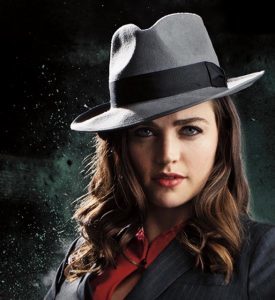
2. What kind of fantasy? In the case of the book I had in mind, it was historical fantasy with psi-powers.
3. What makes it stand out? Set in inter-war 1930s Britain. Let the story have something fresh, even unique. But not so unique that you’ll never be able to sell it.
4. Multi-book or stand alone? Multi-book, let’s say. I thought the concept had legs for several books. After all, I reasoned, The Entire and The Rose didn’t kill me. Right, let’s do a series. (Wait, TEATR did kill me, but I’m over that now.) I called the series The Dark Talents Novels.
Questions 5-10. The shape of the story.
5. What is the milieu, what is the magic about? In 1936, psi-powers have come into the world as a result of the suffering of World War I.
6. What is the story problem? A Nazi plot against Great Britain based on cold and ice.
 7. What is the title? Some writers save this question for after they’ve written the novel, but I have to have it early. At the Table of Wolves.
8. Who is the major character (MC)? Kim Tavistock, a determined woman whose hard gift it is to hear from people secrets they most wish to hide — whether she want to know or would very much prefer not to know.
9. Who is the primary character standing against the MC? (To avoid spoilers, I’ll skip my answers to the rest of the questions, but the considerations are still ones I use every book.)
10. Who else is in the story and how will they add to the tension or depth?
Questions 11-15. Going deep.
11. MC backstory. What makes him or her tick?
12. Who gets a point of view or even a subplot? This decision often will change as I begin to write. Actually, answers to several of these questions will often change as I write. My first answers just give me default direction.
13. What am I trying to say? What is the point, the theme that all aspects serve in a subtle, yet fundamental way?
14. In what inevitable but surprising way does the story end?
15. What secrets can I lay in to fuel mysteries and major turning points?
That’s it! Give these 15 points some thought, and you will, in Robert Ray’s terms, frontload your subconscious, and in doing so, discover your true story.
May 8, 2019
My novel at $.99
NOW through Tuesday, May 14
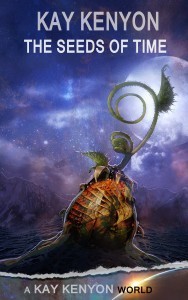
Clio Finn is a time travel pilot on the run from a dystopian and graying Earth. Now she’s found a planet with what could be viable, saving biota. If she can get home from across the galaxy. With the enemies Clio’s got, that’s a very big IF. One week only, the eBook is reduced to $.99 at all e-retailers.
The Seeds of Time, a reader favorite.
Click here to purchase: books2read.com/seeds
April 28, 2019
Pitching your novel
How do you pitch a novel? And why lavish time on it? Is it just so that we won’t be caught flat-footed when someone asks what the story is about?
The Point of Pitching
While it’s true that an intriguing, quick blurb for a novel makes us look more professional–and saves us the embarrassment of stumbling through a confused rendition, a pitch also has a deep marketing purpose.
A pitch positions your novel amid the world of books. It gives instant perspective on the story, pinpointing genre, tone, and unique features. Publishing today depends on branding and brevity. For better or worse, we’re in the world of entertainment and marketing with its thirst for audience definition.
The pitch isn’t just for marketing. The novel’s “handle” will follow the book through the whole path of publication, affecting–whether explicitly or in the background–cover design, choice of titles, author blurbs, and promotion.
Pitch Patterns
To process information, people sort input into patterns. So with the pitch, we’re helping people to quickly identify our novel’s pattern, making our story “known” at an instinctive level.
“Adventure novel,” “coming of age,” “family story” are all familiar patterns that begin to narrow the universe of our story. That’s a good place to start.
An example from one of my recent books, At the Table of Wolves:
“An historical fantasy . . .”
I’m a big fan of establishing the “kind” of book immediately (historical fantasy) so that we can grab onto the most salient positioning feature. Then I need extra information to bring my story into sharper focus. Setting is a major feature of Wolves, so I added in:
” . . . set in 1936 England when psi-powers have come into the world . . .”
This opening quickly zeroes in on genre and sub-genre. Not just a historical fantasy, but the interwar years. Not medieval fantasy, not sword and sorcery, but psychic abilities.
But we still don’t have a grasp of who or what, so I add in:

The era. Female major character undercover. How can we glimpse the basics of Your novel?
“. . . and a young woman with a gift for hearing the truth is recruited into espionage, uncovering a Nazi plot to invade England with a mysterious power over ice and cold.”
This leaves us with “A historical fantasy set in 1936 England when psi-powers have come into the world and a young woman with a gift for hearing the truth is recruited into espionage, uncovering a Nazi plot to invade England with a mysterious power over ice and cold.”
This pitch gives clarity of genre, a hint of world-building (a gift for hearing the truth; a power over ice and cold) and the story problem (Nazi plot to invade England.) What can make it stronger: A comparison to other stories.
So tack on: “Tinker Tailor Soldier Spy meets the X-men.” This tells us that the story deals with super powers (adventure) with an overlay of espionage (thriller). A comp in the “____ meets ____” mode not only describes the work, it suggests who the audience for your book is.
Or establish contrast as in: My book is like “A” except for “B.” Using Naomi Novik’s Uprooted as an example, “A fairy tale but with a heroine who rescues the dragon.” And, as well: “The violence of the Brothers Grimm deepened by the friendship of two women.” You don’t need to stick to two.
Creating the perfect pitch isn’t easy. But once you relax into the creative process, the exercise can be a bit of fun. Seriously!
April 1, 2019
Book Birthday and Other Earnest Events
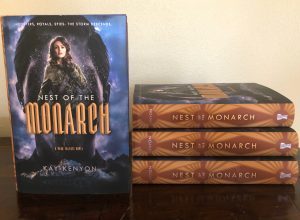
AVAILABLE APRIL 16.
IT’S APRIL, and so this month Nest of the Monarch comes into the world. I was thrilled to hold my lovely book in my hands a few days ago. It’s the 3rd book in the trilogy, and I can promise you, I took The major character to the limit. I asked myself, what is the most that could be asked of her? Came up with an intriguing answer, I think! If so inclined, pre-order here.
So, you know the drill, I will be earnestly talking about the book in various venues over the next few weeks. Also reading from it, which I love to do because I enjoy the drama of good read, even though I am an introvert. (Go figure.)
APRIL 16. Tuesday. Nest of the Monarch’s book birthday! The trilogy is complete. This book said to be “riveting” by Publishers Weekly. OK, then!
APRIL 19-21. Norwescon, Seattle. My workshop: The Magic of Plotting. Friday 2:30-4:00.
APRIL 23. Tuesday, 6:00-7:00 PM. Reading and signing at Cashmere WA library.
MAY 2. Thursday, 7:00-8:00 PM. U Book Store, Seattle. Reading and signing with Louise Marley (The Witch’s Kind)
MAY 4, Saturday, 1:00-3:00. Signing, A Book for all Seasons. 707 US HWY 2, Lower, level ste b, Leavenworth, WA (just a few steps away from old location.)
AUGUST 2-4. Willamette Writers Conference.
February 18, 2019
My first story collection
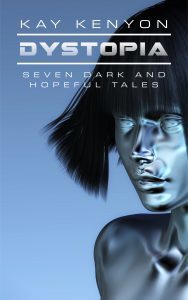
I’m excited to announce the publication of my first science fiction story collection! It brings together seven short stories published between 2003 and 2018. These are stories–at least the earliest ones–that may be hard to find because they were published in various anthologies. Now they’re here, all in one collection. Subjects include:
the Singularity
genomics gone wrong
designer medicine
dystopian alternate history
post-apocalyptic futures
$2.99. Check it out at these on-line retailers. (Coming soon in paperback!)
We are afraid of the phages, of course. They spit toxins, and if necessary, explode. But they’ll lose interest after a few miles. With our chemical makeup, clean hydrogen drive and biomolecular imprint, we have pretty good camouflage. The forest can’t detect us as a foreign body.
If it could, we’d be dead. –from the short story, “The Spires of Greme”