Kay Kenyon's Blog, page 6
July 27, 2020
This Saturday: My plotting workshop
Mapping the Labyrinth at the Rambo Academy of Wayward Writers
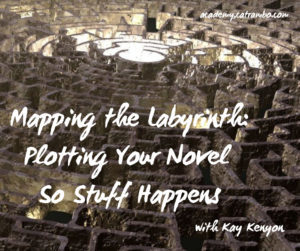 On-line class: Sunday, August 2, 2020, 9:30-11:30 AM Pacific Time
How do you develop a novel’s plot? Is it luck, or trial and error, or are there classic approaches to achieve your best story? Learn how to use structural principals to take your character on a transformative journey inspired by great plotting. Become fluent in turning points, those fork-in-the-road hinges that catapult your story in a dramatic rising action. Concept, subplots, conflict–we’ve got ’em covered. Let’s map our way out of the maze and conquer the art of plotting.
More information: https://bit.ly/3fcfCvU
Cost is $99 ($79 for Patreon supporters and former students, which includes classes/workshops at the Cat Rambo Academy for Wayward Writers.) Cat is offering a few scholarships: For information on applying, click here.
To register for this class, to Cat Rambo with the following details:
The email address that you use for Google stuff
The name of the class: “Mapping the Labyrinth” with Kay Kenyon
Whether you would prefer to pay via Paypal, check, or some other means.
You will be invoiced when the class slot is reserved.
I hope to see you on Saturday, August 2nd!


May 30, 2020
Feedback on your novel: A closer look
Feedback on your fiction is, on the surface of it, a sensible thing. You’re writing for readers, and people reading your draft and giving opinions is bound to be helpful, right?
Not always.
Sometimes we end up feeling undermined or, conversely, falsely assured. Feedback can be useful at times, but for reasons that are often invisible to writers, may fail to help us. In pursuit of the deeper truth about feedback, here are some observations.
Motivation and self confidence
We writers are in an insecure vocation. Connecting with readers can seem unfairly difficult, even random. In such an environment we may turn to others for feedback. But we may not be ready to handle criticism, and this can weaken our intention, especially if we are already lacking in writerly confidence.
If you’re really ready to hear honest opinions, then it might be a good idea to get feedback. Personally, I tend to avoid feedback (except under strict conditions), because I find myself susceptible to doubt and confused by too much input.
I know I’m being a bit contrary, but give it some thought. At a deeper level, you know why you want feedback, and you may well be right about whatever decision you come to. But: Sharer beware.
Writers’ groups and friends
Writers’ groups can be helpful. They provide psychological support and motivation. They may also give usable feedback at the page level or slightly beyond. (“I got confused when . . .” “I haven’t warmed up to your character yet.”)
Don’t go to writers’ groups hungry for validation or fearful of criticism. Repeat this five times before every meeting. You’re there to find out what the piece needs in order to be better, period. Is this hard? Yes. Really, there’s no way to sugar coat this truth.
Critiques from family and friends are not “at arm’s length.” Their praise might feel good, but may not be helpful in practical terms or to your attitude and mood. Stop, stop giving your manuscripts to people hoping for praise.
Unless your writers’ group reads full manuscripts, getting piece-meal feedback on your novel can take months or even years. You’ll get feedback on your writing, but not on your story, the arena where most drafts falter.
Don’t engage your group with fixing problems. They can help identify issues, but getting them involved with creative decisions fosters dependency and can undermine your creative intuition.
I end this section by saying I believe writers’ groups can be great support in the writing life. They’ve helped me see issues I might otherwise have missed. They’ve inspired me and nurtured friendships, not inconsiderable benefits in the writing life. But, honestly, I go for their sharp perspective on issues, not hoping for praise. I want them to catch stuff.
Learning to dance with the marketplace
Despite all of the above, I do think it’s a good idea to take seriously feedback from agents and editors who take time to read your material. (Your acquiring editor’s feedback is a different case entirely. Stuff of another blog post.)
When your work is published, you’ll enter the arena of validation. It’ll loom large in your mind–as it does in mine–but we shouldn’t let it define us. We keep on, practicing gratitude that we found the writing life and also working on humility should some success arise.
When you’re on contract, there may not be time to get feedback. One idea is to find several excellent readers. Give them your second draft of the first three-quarters of the novel. While you’re writing the last section, they are reading. One month before your deadline, the critiques come in and you revise. I only recommend this if you have healthy relationship with feedback (as per the Motivation section of this post).
The big picture
Read extensively. Practice judging how your story compares with writers you admire (at least the first few books that launched their careers.) Get tough, be diagnostic in your approach to evaluating your stories. Then send them out and see if they connect with readers. Accept that, in the main, your exquisite and excruciating task is to decide what to write and how to do it.
Learn to navigate the writing life having faith in the worthwhile nature of your work, knowing it will sometimes succeed in reaching others, and other times will not. Our writing practice is a deeply personal commitment and is worth nurturing every day lest the world and its constant comparisons cause us to lose heart–or forget how much fun it is to write stories!
April 8, 2020
My April & May Webinars
I’m doing two webinars in next three weeks. They’re one hour long, and free to Write on the River members. BUT membership is only $35/year for this worthy writing organization, so even if you only participate in these two classes, it ends up costing you only $17.50 apiece. And there will likely be more webinar events from WOTR thru the spring, which will end up being free to you as a WOTR member. Hope to see you on-line for some fun classes!
Let’s meet on Zoom!
Saturday, April 18, 10:00-11:15 AM – Developing a Powerful Plot
I’ll provide insights into plot and character starting with suggested questions to ask of an initial novel concept, questions that can lead us to a more nuanced, layered story. We’ll consider how the major character can help deepen the plot and how a convincing story arc can shine a light on what happens next.
Saturday, May 2, 10:00-11:15 AM – Pacing in the Novel
We’ll look at strategies to avoid the doldrums that can beset long fiction. We’ll investigate the underpinnings that give horsepower to a story–letting you decide when to step on the gas and when to back off. And never fear, we’ll take a closer look at causes of the infamous saggy middle of the novel, and some antidotes that can keep the wind in your story’s sails.
To join WOTR and participate in these cool webinars, click HERE for a one year-membership.
Then go to WOTR’s home page HERE for registration details! (Should be up by Monday, April 13.)
LET’S MEET ON SATURDAY APRIL 18 AND SATURDAY MAY 2 AND RENEW OUR ENERGY FOR WRITING!
April 5, 2020
Keeping Track of Series

The novel being constructed.
Here I go again, getting all organized about things. Writing things, that is. But even for you organizational skeptics, you must admit that to write a series, you gotta keep track of stuff.
During the writing of my first series, The Entire and The Rose, I found that no matter how blindingly clear story elements were as I wrote, I got fuzzy on, or outright forgot many of them while writing subsequent books. With my next series, The Dark Talents novels, I was forewarned. I employed some tracking tools that I had used on stand-alone novels, but which proved to be even more critical with a series.
When I recommend these tools to my writing students, sometimes they give me pitying looks, as if to say, Really? If we did this stuff, we’d never get any work done!
But I maintain you’ll save a ton of time if you keep track of your series with a few handy documents. For instance, you won’t go chasing through your document trying to find a term or place name, a character’s name, and expressions.
So below please find my top two-three tracking documents.
STYLE SHEET. This critical document is nearly impossible to create after the fact, but built up day by day, week by week, it’s a life-saver. So, as you start the first novel in the series, create categories to dump special terms in and then–dump them in. Which special terms? Here are some of mine:
Characters names, those who come on stage and those merely referred to, such as political figures, family members living and dead. People’s titles, if any. Named pets.
For epic novels, I have subcategories of characters by region, organization or for SFF, sentient species.
Place names used in scenes or just referred to. Create subcategories by region for complex or epic works.
The style sheet not only reminds me what people and things are called but specifies case and spelling. Now, you might have these things in your planning notebook, but if you rely on notes, you’ll hate yourself by page 182. Or you’ll hate the story, and we can’t have that!
For the style sheet for science fiction or fantasy novels you’ll need further lists:
Terms of technology, culture, politics, religion, geographic regions, flora, fauna, clothes, food.
Sayings. Expressions, oaths, homilies and vernacular terms.
Literature. Important books, documents, and texts referred to.
The discipline is that after every writing session, list the latest terms and names. Don’t obsess over finding each one, but quickly check your draft and add to your Style Sheet. Edit the ones you’ve decided to change.
Do this and you will save endless combings, searches, misspellings and other housekeeping duties that waste time. And you will thank me. (Donations accepted.)
2. SCENE LIST. A very brief description of every scene.
Whose point of view.
What happened.
What very important things you revealed to the reader.
If you’re a teensy bit obsessive–you know who you are–jot down any mysteries you introduced, such as things brought up that are intriguing but that you don’t yet explain.
I like to bold characters’ names when they’re first introduced. Call me picky.
For science fiction and fantasy, a third tracking tool.
3. WORLD BUILDING NOTEBOOK. This becomes your bible for series continuity. Use a three ring binder so you can easily replace pages with new and improved concepts.
Science and magic
Geography
Politics
Religions and superstitions
Social and religious hierarchy
Calendar and time-keeping
Money, economics, employment
Characteristics of sentient species
Historical dates and events
Plus all the rest: Medicine, fashion, gender roles, cool things about flora and fauna.
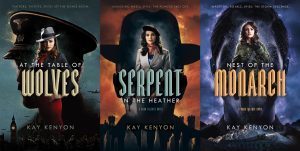
The finished series. No loose ends!
But won’t creating these documents and updating them slow you down? OK, here’s my last word. Go ahead and start writing without these tools. For a limited time. Like 30 pages. When you see the error of your ways, hustle up the documents and start recording things!
Because if you’re anything like me: You. Will. Forget. But if you truly hate to record things, at least do the style sheet. That one will save you infinite trouble, I promise!
March 23, 2020
15 Joyful Things
Anyone else been waking up at 3 o’clock in the morning lately?
There’s a lot to worry about with so many people going through heavy cares or acute stress over health, family, and employment. Even if I’m not experiencing these things outright, it’s hard to watch this happening to so many others.
But it’s important that we keep our spirits up. Not only for our own sakes but so that we can be supportive emotionally and materially to others; that is, present, balanced, and compassionate instead of blameful, pessimistic, and fearful.
And it’s important to us as writers, if circumstances allow, to keep going, even though it might seem all we’re doing is telling stories. It’s what we do, and it’s not irrelevant.
Here’s one way I’m staying present and optimistic. I’m thinking of things that are still good, still working, still bringing me (or should be bringing me) joy.
When I think clearly about my life right now, I see that there are many moments to savor, things that, honestly, I have taken for granted for decades. Chances to be with little victories and everyday joys instead of sailing past them while I’m thinking of something else. Like the state of the world.
Maybe it starts with a glass of water and how amazing it is that I have clean water to drink. I know that many people don’t. But even if they did, I can see it as a source of joy to drink when thirsty, at least if I’m really present for it. Just to allow myself to feel grateful for that simple thing.
And to be in the moment for a walk or exercise when I’m not in pain. Not that I’m often in pain, but still–to realize that I may not always be fit and mobile, and isn’t it a source of joy to move briskly and use body, muscles, and balance?
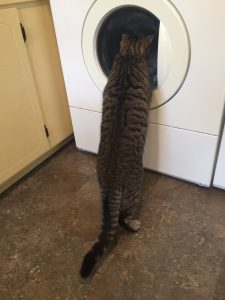
Winston pausing to savor an everyday moment.
And so on through the routines of the day, even if there aren’t big things to celebrate. Because, I remind myself, this is my life right now. There are times when I’ll need to plan for the future, prepare for a future event, but I don’t need to let my mind go wandering into the future when life is happening right now, with a glass of water, a breeze from the window, the first bite of a meal, a savored cup of tea, a brief interaction with a loved one, the feel of a good book in my hands, the first 20 seconds of a shower, the absence of pain as I move, the absence (for now) of mental turmoil from possible future sorrows.
Because, odd as it may sound, absence of hardship can be a dependable source of joy if I let myself be grateful, to really know that I am fortunate on this day, in this moment, to have freedom from hardship.
Thus my idea of fifteen joyful things. Every day, to notice a number of things that are in my life and that bring a moment or two of joy. I’m thinking that fifteen would be a good number to start with, until I get better at it.
What great practice for real life even in good times! But especially these times.
Stay well inside and out, is my wish for you. And also for myself, even if I have to work at it and remind myself–a lot–that this is happening. Whatever it is, it’s happening. And how joyful if I can just learn to show up for it all, in calm awareness and gratitude.
January 12, 2020
Nest of the Monarch in paper
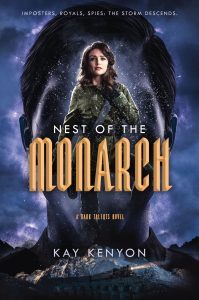
In trade paper January 14. Also in eBook & hardcover.
A top ten fantasy read of 2019. —Pat’s Fantasy Hotlist
“Riveting.” — Publishers Weekly
Trade paper edition arrives on Tuesday January 14.
Berlin, 1936. Winter and fascism descend on Europe. Kim Tavistock has put her life at risk before . . . this time it’s her very soul.
A few questions come to mind: Why does Kim’s Berlin station handler say “Everyone has their limits”?
Can a British spy trust the British Intelligence Service? Can she even trust herself?
Is the man she’s living with going to help her or kill her?
What’s it like to be both less than human and more than human at the same time?
Who’s the last person Kim could ever expect to meet on Christmas eve among monsters?
Find Nest of the Monarch at these fine retailers:
January 6, 2020
The wandering novel
A novel is complex, if only because it’s so long. It can so easily wander off course, fall into episodic events and feel scattered.
To maintain unity in a story, create or discover the novel’s dramatic purpose, whether it’s the human value at stake or the theme related to a human value. To write at our best, the challenge is to know in the simplest terms, what larger issue the story is about.
This dramatic purpose can shape our decisions about what events to portray and which to leave out. Making it more likely that readers will experience a cohesive, fulfilling story.
Getting to Meaning
Examples of human values explored in novels: The Kite Runner: atonement; The Titanic (film): to be loved for oneself; The End of the World Running Club: spiritual renewal; A Discovery of Witches: self-knowledge. These are universal human issues. In these best-selling stories, fictional events and characters are chosen to dramatize these human issues.
Not only does the inherent drama in these stories feel meaningful, but the stories deeply reach the emotions of the reader. Because when we put a strong human value at stake, we touch universal pressure points that bring forth empathy.
It’s wonderful if the dramatic purpose comes to you in the novel’s planning stage. But in my novels sometimes I discover the human value at stake only after I’ve written my way into the novel. I uncover a richer vein than I started with.
Handling a theme
This writing concept–of a specific human value as a unifier–is related to theme, but is not necessarily a theme. A theme in story is “what is true” as proven by the story. Not what is true all the time (otherwise we might have a “lesson”) but what is true within the frame of the story. For example, The Godfather: “Family loyalty leads to a life of crime.” (from James Frey’s How to Write a Damn Good Novel.)
 We don’t want to hit the reader over the head with our dramatic purpose. The author trusts it as a guide without putting a mouthful of message on the page. I like what screenwriter Brian McDonald says about this. “The reader won’t know what the theme is but the writer knows.”
Such as the theme in the James Bond film Skyfall: “Sometimes the old ways are best.” (Watch for that line toward the end of the film. It slips in in a way that most people don’t consciously recognize as the executed theme.)
Try stating “what you’re talking about” in one sentence. Here are some examples from film, as cited by McDonald. (Theme is a necessity in film, which is a tighter medium than a novel.) ET: “Eliott needs to learn empathy.” Tootsie: “Wearing a dress has made you a better man.” Wizard of Oz: “You already have what you need.” For more on theme: Brian McDonald, The Golden Theme.
Human value as theme
Not all stories have a provable theme. Many powerful stories tap into a human value, simply defined and beautifully fulfilled. In a sense we can call this a theme but I separate the two for clarity.
 How to decide? Let your story guide you to your best writerly wisdom. If you don’t find some order of theme, ask what unifying concept is suggested by your story, one that you may not be optimizing. You may want to keep probing as you write or before you write. Once discovered (or crafted) bring that concept on stage and into your major character’s issues and desires.
Sometimes we find we’ve written to a theme that we didn’t consciously know. Brilliant! For myself, I tend not to rely on brilliance. But, dear Muse, I would be in your debt should you drop one on me!
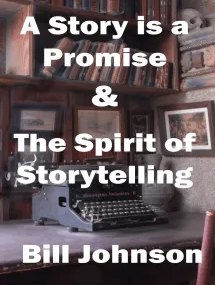
For more on dramatic purpose: Bill Johnson, A Story is a Promise; Larry Brooks, Story Physics.
November 14, 2019
Character in a nutshell
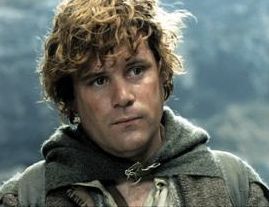 Can you describe your character’s essence or their raison d’etre, in a short phrase? How about Sam Gamgee’s “Some things are worth fighting for.” Or Scarlett O’Hara’s “I’ll never be hungry again!”
Our major characters are usually so deep we need a whole novel to flesh them out. But haven’t we chosen a character because she or he embodies a specific dramatic purpose? If this is true, we should know what that is. We should know it so well, we can say it in a phrase.
Sounds hard, but bear with me. Ask yourself what does my character want or believe in their very core? What limitation do they always fear and fight against? What gives their lives meaning in their own estimation?
Although it does take many pages to define these fears and aspirations in relation to the plot, the author must know them more directly. For this reason, it may be helpful if a writer creates a visceral handle for central characters, to keep their through line clearly in view. Something the character would say.
In my notebook for a recent novel, I found the results of one of these through line exercises. I boiled down my words to one phrase for each of eleven characters. I was surprised at how quickly the essence of each important character came to me.
Here was the product of that exercise:
Kim: For the innocent.
Julian: Never again.
Martin (a teenager): I always screw up.
Antagonist: Revenge is sweet.
Rose: I have my part.
Gustaw: Fight them in the shadows.
Owen: We will out think them.
Lloyd: I got screwed.
The spymaster: My hands are tied.
Elsa: Appearances deceive.
Walter: I’ve got your back.
I kept coming back to these lines, staying focused on their wisdom and clarity. In the midst of a messy novel (aren’t they all?) wisdom and clarity can be a life line.
November 8, 2019
I’m teaching a novel seminar
I’m giving a 7-week novel seminar for Write on the River!
For beginners and mid-career writers wishing to pursue a publishing career. The class is limited to six students and will be held in Wenatchee, WA. Sessions consist of an hour of instruction and an hour’s critique of a student manuscript by the instructor and the other students.
The sessions will be designed to deepen students’ abilities to evaluate their writing with an eye to marketplace considerations as well as compelling fictional elements.
Some of these are useful tools.
DATES AND REQUIREMENTS
DATES: Sessions will be held every other Wednesday, February 12 through May 6.
TIME: 6:30 – 8:30 PM
COST: $300
REQUIREMENTS
Please apply to attend. Details here.
Membership in Write on the River.
18 years of age or older.
Have at least 30 pages of a novel written and ready for critique by February 12.
TOPICS
Feb 12 – Concept and the foundation of story.
Feb 27 – The engine of the novel: Character.
March 13 – The shape of the novel: Acts, meaning, and movement.
March 27 – Plot development.
April 10 – Narrative Strategy.
April 24 – Narrative techniques.
May 8 – Revision and staying on target.
Apply by December 30th – For more details please click HERE.
October 19, 2019
Drawing Winners
Thank you to my newsletters subscribers who entered to win my latest drawing!
I am pleased to send to the following winners a paperback copy of Dystopia, my science fiction short story collection: Craig. J., Ana I. and Sanjuanita M.
Craig, Ana and Sanjuanita, your book will be on the way soon. Congratulations!
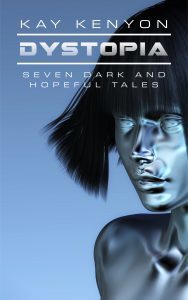
The prize for the drawing, my first short story colleciton.
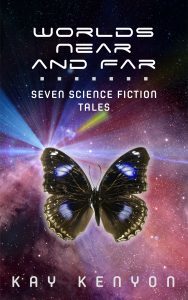
And just to mention: My recently published second story collection!