Kay Kenyon's Blog, page 21
June 7, 2013
Writing back and forth
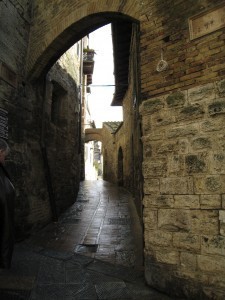
Lucca, Italy. I got lost here, once for a bad hour or so. They built these winding streets to confuse an invading army. And tourists!
My “work in progress” is turning out to be a work of “back and forth.” I make some forward progress but I am revising the old stuff in ways that are a bit disconcerting.
The story is planned, even down to 65 scenes that describe the plot progression. But a novel isn’t all plot. Now at about page 100, I find myself coming into key insights about the characters that alter how they have behaved up to this point.
And, in this book, I find myself going back and changing things.
This is a bit odd for me, because normally I would make a note of changes and just plunge on, knowing that a revision later will catch the insights. But nope, I can’t–or won’t–leave the draft that rough. It’s rather maddening to find myself altering the text (and so often!) Really, is this just an excuse not to write the hard stuff, the new pages?
I think all writers have to fight the urge to smooth and deepen the first draft chapters. And a bit of that is probably inevitable. But with this WIP, oh boy.
It’s as though I need a clean launch of the people and the plot, or I don’t feel the direction of the book will be quite right. This is particularly the case with my major character. She has unique powers — what is her attitude toward them, and how will she use them? That was something I thought long and hard about in planning, but now I’m learning so much more about her. And it’s more interesting than what I had planned.
All well and good so far, but it doesn’t end there. I’m also researching my historical period like crazy and finding new threads that I just Have to start weaving in . . . and off I go, revising chapter two again.
I don’t know if this is a big problem, but it’s surely slowing me down. And, as I’ve said before on this blog, too much revising as one writes is an invitation to revision blindness, where you’ve gone over the pages so many times you can no longer get an objective view.
So I’m going back and forth, trying to curb the excessive revision, but capturing the big ones. One of the awkward results is that I’ve now reprinted the opening about a dozen times. On the plus side, this story rocks!
I don’t know where this tendency will end, but it’s got me a tad nervous.


June 3, 2013
Grounding the strange
I’m having a fascinating time moving into the world of the fantasy novel. How lucky we are in SF/F to have such a diverse genre to play in!
In late August, my first fantasy, A Thousand Perfect Things comes out. I thought long and hard about what kind of fantasy to begin with. For awhile I considered a traditional fantasy, but some reason, I find the usual epic fantasy is not a style I relish. (Still, I love it when others pull it off well, like Martin, Erickson, Weeks, Abercrombie.) Nor am I comfortable with softer worlds of hedge-wizards and courtesans. It’s too easy-going, maybe. I like something a bit stranger than that.
I think what I love about fantasy as altered history is that I can create unusual and fun worlds and still have a tether to the familiar. SF/F fans enjoy the imaginative leaps, but most will only go so far. We reach a point where we are too confused. Where it is just too hard to follow, to relate. I do think that is a danger, especially for a writer like myself who tends to lean rather hard into strangeness.

Magic cat in the bush? (Sumo)
Using the ground of history anchors the reader to something familiar. We can sink into, say, 1857 Shropshire, and feel that we know the place. From those recognizable surroundings we can then enjoy the slow unveiling of indigenous magic and extra-normal events. It is not all totally new.
And it’s better so. I don’t want to ask the reader to pedal uphill all the way, but to enjoy the surprises and find them intriguing and entertaining.
Or maybe I just like the lovely surprises–such as finding that outside a gracious country manor house there’s a terrorist bird in a sycamore tree. And it can read.
May 30, 2013
The mess of the novel.
 As I wade into the waters–of my next novel–I am struck once again at how little I know. How do I begin this marathon? How much information is needed right here? Is this supporting cast sufficient? Is the tension getting on the page, or is it only in my head? Does this new concept fly or falter?
I must confess I do not know. And, mind you, I’m writing my twelfth novel.
It’s not as though I’m unprepared. I have an impressive notebook chock full of planning. I wrote a great synopsis that tells me at least one version of the story really works. I have character sketches and key scenes creating a classic structure. I have a killer title.
But the proof is on the page, not in the planning. And here I encounter frustrations, revisions, re-thinking and . . . doubt. Can I do this again?
My husband tells me I go through this every time. The story is a lump of sodden clay in my hands. I am on page 75 and I wonder if I can make it to 375. It’s a long way to go, and the characters are pulling in different directions, and I can’t tell if it’s even interesting. Im stymied by plot and character questions.
Yet I go on.
This is the great secret, I think, of writing the novel. One goes on. We go on despite doubt, because we can never be certain we’ve nailed it. Because the story will never be perfect. The process of writing is terribly murky, despite notebooks, lists and sketches. It is, at times, an unholy mess. To be a novelist it is best if we can sink into that mess without fear or at least without panic. If we’ve done this before, we know that the mess is a natural part of writing. That the story will go through strengthening revisions. And the only way to get to revising is to get a draft down on paper. Therefore we must go on.
Randall Jarrell said the definition of a novel is a narrative of a certain length with something wrong with it. I love that quote because it gives me permission to make mistakes.
My novel doesn’t have to be perfect, and it doesn’t have to have a clear forward writing process. It will be a mess. A beloved, balky child.
And each child is different. No matter how many you have.
May 23, 2013
Fantasies as re-imagined history
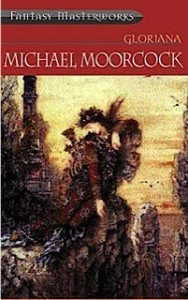
Right now on Black Gate magazine: Mucking with the Mundane, my take on fantasies set in alternate historical periods.
How do authors get readers to abandon what they know about what already happened and take a ride with the fantastical?
I look at Moorcock’s Gloriana, Card’s Alvin Maker series and such works as Novik’s Temeraire series.
If you haven’t checked out the excellent Black Gate: Adventures in Fantasy Literature, try it now!
May 21, 2013
Book giveaway
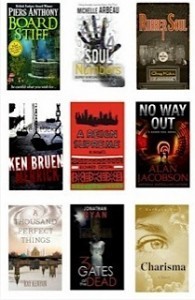
My publisher is holding a giveaway for signed ARCs of their nine lead titles for fall, including my latest novel, A Thousand Perfect Things. Check out this cool site to enter the contest, or see the giveaway button on my fan page, Kay Kenyon, Author. June 15 deadline to enter.
 3 Gates of the Dead: Jonathan Ryan
Follows Aidan Schaeffer, a young assistant pastor whose fiancé is a victim in a series of ritualistic killings. Aidan investigates but threatens to corrupt his very soul with the otherworldly truth behind the slaughter of innocents.
No Way Out: Alan Jacobson
When a firebomb destroys an art gallery in London, FBI Profiler Karen Vail is sent overseas to work with Scotland Yard. Vail discovers the motive behind the attack—an explosive 440-year-old manuscript that political radicals will destroy at all costs.
A Thousand Perfect Things: Kay Kenyon
This fantasy novel is set in an alternate 19th century Earth, where a war rages between scientific Anglica and magical Bharata. Tori Harding, an aspiring botanist must journey into the world of magics to claim her fate.
Board Stiff: Xanth #38: Piers Anthony
In “Board Stiff” a young woman makes a wish for adventure and excitement because she is board stiff. The mischievous fates in turn transform her into a plank of wood.
Merrick: Ken Bruen
“Merrick” is a noir crime story set in New York City about a rogue ex-cop from the Irish Guarda, who is actually a serial killer wanted for murder in Ireland.
Charisma: Barbara Hall
Sarah Lange is plagued by heavenly voices and a desire to go “home”, after a near death experience. Frightened by her desire to die, she enlists Dr. David Sutton, a scientist who struggles to save Sarah and to believe.
A Reign Supreme: Richard Crystal
A musician discovers he is half-brother to a Kenyan King who needs his help to save his people from genocide and the greed of corrupted officials, when a copper deposit is found on their ancestral lands.
Rubber Soul: Greg Kihn
A rock murder mystery that takes readers on a ride through Beatlemania—from the early days in Liverpool to six sold out shows per night in Hamburg.
Soul Numbers: Michelle Arbeau
Teaches readers how to decipher the message behind any number sequence and how to apply that information to successfully navigate their lives.
Happy reading!
May 16, 2013
Casting the book
We all know the importance of the main character, the “star” in a story. But the wider cast is also crucial adding to the drama, complexity and believability. Here are some characters who inhabit A Thousand Perfect Things (August, 2013):
Important People In Book
The year is 1857 in an altered England called Anglica and an alternate India
 named Bharata.
Major character: Tori Harding, 18 year-old student and ardent supporter of her famous botanist grandfather.
Sir Charles Littlewood, the preeminent botanist of Anglica, age 87.
Colonel Terrence Harding, Tori’s father, who supports Tori’s scientific ambitions, but only so far.
Elizabeth Platt, a teacher, who will join the 1,000 mile caravan to magical Bharata and become Tori’s fast friend.
Edmond Muir-Smith, a captain with King’s Company of the fusiliers, who will be sent to “show the flag” in Bharata and charm the Anglic woman who dare to journey with him.
Mahindra, a Bharata sadhu (holy man) and revolutionary who lost his sons against the Anglics.
Prince Uttam, Rana of the princely state of Kathore, who offers hospitality and withholds deadly secrets.
Jai, youngest son of the Rana; a hemophiliac, friend to Tori, and perhaps something more . . .
Sahaj, heir to the throne of Kathore, whose best friends are two silver tigers who understand him better than he could possibly know.
Lieutenant Ned Conolly, political officer attached to Uttam’s court, playing a double game, or is it triple?
Drapadi, Jai’s long-dead ancestor, who still pursues her ambitions. Being dead is no obstacle, especially with a host of demons at her side.
. . . and many more!
May 10, 2013
Got fan page?

Inviting you to drop by my new fan page on Facebook. (Kay Kenyon, Author) What’ll be there? Book talk, mostly. What’s up with the new book, contests, giveaways, favorite books, great posts on the wonderful world of SF/F and beyond!
Please drop by and give me a “Like!” I get some cool features from Facebook if I reach a certain number. And thanks!
May 6, 2013
Ups and downs
It was an up and down week.
It’s not the week I would normally talk about. But these are the scenes from the cutting room floor, the little realities of the writing life:
The ups
Hitting my stride on WIP, reasonable page count this week. Not great, but given what else is going on around here, quite respectable.
Advance Reader Copies of A Thousand Perfect Things will have full color wrap around cover, I learned this week.
Received a lovely advance blurb from a well-known writer for Perfect Things.
Wrote a tough scene for the WIP. Wondered if I could pull it off, but love it.
Heard from my publisher that my cover and story concept are generating some industry excitement.
Had a few very nice messages on FaceBook about my stories.
Had fun interactions on some Groups on Linked-in.
For the WIP, following a slightly different method of writing, and I quite like it. What is it? Writing a sequential scene plan with 60 or so discrete scenes. It took a couple weeks to do it, but my complicated WIP now has a clear plot progression. Not exactly a “this week” triumph, but it all bleeds together!
The downs
Got pulled away from writing by a major volunteer activity.
Got slammed on one my books.
Worried excessively about genre-fit. Why can’t I write in the dead-bang center of the genre? (But decided a well-told unique tale with proper nods to genre can lift me above the fray.)
Sadly concluded that I need copious amounts of further research on WIP.
Received a quite unexpectedly high bill for a promotions project I’ve been developing.
Have a nonfiction project that I’ve substantially re-written four times, and still not satisfied with it.
Read that Phillip Roth said that writing is “frustrating and humiliating.” Began to wonder if it is!
So what’s the sum total of my week in the writing life? Well, all that can be said is, ups and downs. Or, to quote something Mike Resnick told me, “It’s never as good as you think it will be, or as bad as you fear.” So calm down and carry on, my girl!
April 29, 2013
Convergence of ideas
I have no idea how the brain works, but in a novel-writing brain (er, mine at least) it works from convergence. Or at least that’s my theory this morning.
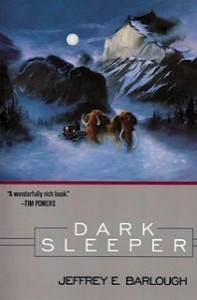 In the excellent on line magazine, Black Gate, I read an interview with Jeffrey E. Barlough, author of the Western Lights series. He described how his latest book in the series came from combining three different writing projects he was working on. He also said that his rich alternate history world came from the intersection of 1) his interest in paleontology; 2) a love of Victorian fiction; and 3) his time as a volunteer excavator and the La Brea Tar Pits.
I often cook up story ideas that way, too. Even wildly disparate ideas, once brought together, can suggest meaningful themes and plots. This is a variation of the old short story-generating tactic of making two lists and then grabbing one idea from each list to see what possibilities the association brings.
To make this work all the better, it helps if you’re deeply engaged with the threads. Thus, recently, when I was searching for my next story, I got a springboard effect from two nonfiction books that had me in their thrall.
My new novel (August, 2013) A Thousand Perfect Things is about a re-imagined England and India, when a Victorian woman takes on the scientific establishment and the British Raj to find her destiny in a magical subcontinent rife with palace intrigues, ghosts and an immanent revolution.
The inspiration for this was the conjunction of two books:
Dry Storeroom No. 1: The Secret Life of the Natural History Museum by Richard Fortey, and Raj: The Making and Unmaking of British India by Lawrence James. These fabulous books–which I just happened to be reading at the same time (one by my bedside, one on the couch) suggested strands of subject matter that my brain churned into fiction. It became a braid of ideas that I lived with for the next year of my writing life.
A fantasy based on history (the Raj) and science (the museum.) Thus, convergence!
___________________________________
Dear readers and friends,
My blog is changing. I’ll be sharing more personal perspectives on the writing life rather than teaching fiction. In order to commit more time to my writing, some things, alas, must go. It’s exciting to have a new book coming out, and of course, the next one’s under way. They’ll now get more of my attention. I hope you’ll still drop by and catch some of my musings on the writing life and, along the way, insights into my latest book . With many thanks–Kay
April 22, 2013
Write on the River

J.A. Jance keynoter
The best little conference in the world.
Yup, I’m going out on a limb and making that claim for the Write on the River Conference in Wenatchee (Washington) next month.
You’ve been to conferences (please say you have!) and you know how workshops with published authors can instruct, inspire and impact your writing life. If not–find one! Writing conferences abound, and there’s one near you.
Join us in sunny Eastern Washington wine country on the banks of the Columbia River. We’re a small, boutique conference with major presenters, a full range of topics and with time to chat and time for you.
Write on the River Conference with Keynoter J.A. Jance
May 17, 18, 19, 2013
Register HERE
Our lineup of workshops includes:
Publishing
Novels
Nonfiction books
High School workshop
Digital publishing
Fiction, poetry, short stories
Agent and editor appointments
First page critiques
Internet marketing
YA writing
. . . and MORE!

Pam van Hylckama Vlieg, Larsen Pomada Agency

Gary Luke, Sasquatch Press

Robert Dugoni, intensive class

Jennifer Lauck, memoirist