
Richard Conniff's Blog, page 70
August 7, 2013
Discovering Mammals in Insect Soup and Leech Stew
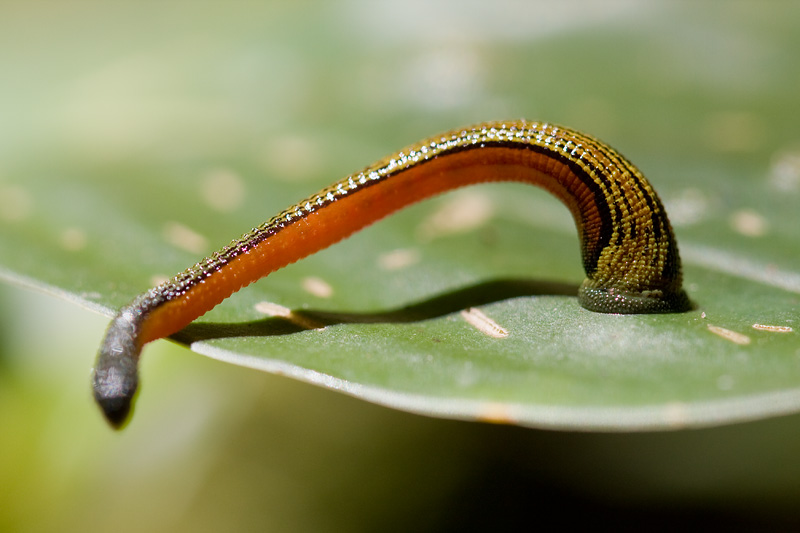
The land leech as conservationist
Wandering through the forest in Madagascar a while back, I quickly became accustomed to having land leeches turn up on various parts of my body. “Filthy little devils” is what Humphrey Bogart’s character called them in African Queen. But mostly the leeches were annoying because anticoagulants in their saliva caused the wounds to bleed long after I had flicked the leeches themselves back into the underbrush. It certainly never occurred to me that I was tampering with one of the most sophisticated and cost effective biological monitoring tools ever invented.
Imagine your mission is to visit a remote protected area and determine the presence of the Annamite striped rabbit (Nesolagus timminsi), first discovered in the Annamite Mountains of Vietnam and Laos in the 1990s, and rarely seen since then. You have tried using camera traps in likely habitats for 2000 nights—that’s more than five years—without success. Monitoring on foot has also failed to produce results, as rare mammals are often nocturnal and have typically managed to survive because they live in steep, wet, densely vegetated places. They also tend to be heavily hunted. So they naturally flee from humans. What to do?
Go out and ask the leeches what they’ve been eating.
Resarchers recently tested the method in the Central Annamite region of Vietnam, using the time-honored technique of picking the leeches—25 of them—off their own … to read the rest of this story, click here.



August 5, 2013
Starfish are Keystone Killers

(Photo: James Pauls/Getty)
This is the time of year for wandering the beaches and studying what washes up, and starfish often figure prominently in what we find, and in our memories of summer. It’s partly because they are so strangely symmetrical—often with their hundreds of small, tube-like legs still wriggling underneath. And it’s also because they seem so vulnerable caught out in the sun, even though in their own world, beneath the waves, they are in fact great predators.
But you will probably not be seeing any starfish this summer on the U.S. East Coast. Some unknown killer has devastated populations from New Jersey to Maine. Caitlin del Sesto, a graduate student at the University of Rhode Island, was one of the first to notice it, when starfish she had collected for a study began to develop white lesions and then melt away in her aquarium. Some of the sick ones actually shed all their limbs in response to the stress.
Other researchers have since reported the same disturbing phenomenon. Divers from the Marine Biological Laboratory on Cape Cod are also finding that concentrations of starfish—or sea stars, as scientists prefer to call them—have been … to read the rest of this item, click here.


Putting a Wild Cat Back in a Changing Habitat

Iberian lynx
The Iberian lynx made headlines last week, as a likely candidate for extinction because of climate change. But I missed the key point: Researchers are already planning to adapt by re-introducing captive-reared lynx only to cooler upland habitat, because that’s where they will need to go to survive in a warmer world.
Here’s an account sent to Strange Behaviors by Virginia writer William H Funk:
The Iberian lynx is the world’s most imperiled felid, with a total population of around 250 animals still in the wild. It’s a bobcat-sized hunter of rabbits, mice and birds in the dry scrub and maquis thickets of southern Spain.
It remains critically endangered, with poor genetic diversity, and only about five percent of it natural habitat still intact.
But the lynx (Felis pardinus) has recently benefitted from captive breeding efforts. Beginning in 2009, Spanish scientists have reintroduced 40 of the cats to the province of Andalusia, and one was recently sighting hunting far to the north in Don Quixote’s old stomping grounds of Castile-La Mancha.
These efforts aim to put the lynx on the road to a comeback, staving off the first extinction in the feline family since the saber-toothed cat died out 10,000 years ago.
Saving the lynx has already brought direct benefits to its human neighbors, as wildlife watching has become a tourist attraction in the area. And with unemployment in Andalusia at nearly 37 percent, the program has also created numerous local jobs for habitat restoration.
But poaching, death by automobile, and disease continue to take their toll.
Iberian lynx is a remarkably handsome animal, weighing about 25 pounds, with thick, drooping muttonchops, long silky ear tufts, and gray speckled fur with yellowish/rusty tinting and chocolate spots. Its long hind legs are perfectly adapted for its leaping attack, and it has big, broad paws for snagging prey. It fills an important ecological niche, hunting small-to-medium-size vertebrates. But its favorite food is the European rabbit (Oryctolagus cuniculus), hero of the novel Watership Down.
And therein lies the problem. Climate change is expected to cause Spain’s rabbit population to seek higher, cooler habitat, and it’s doubtful the cats can adapt fast enough on their own to keep up with their favorite prey. Last month a paper in the scientific journal Nature Climate Change predicted that unless climate change is figured into reintroduction efforts, the millions of euros and years of hard work could vanish with the lynx inside of 50 years.
In one of the first broad analyses of climate change and prey availability as integral factors for wildlife management, the researchers argued that the Iberian lynx conservation effort must incorporate the likely effects of global warming to keep the lynx alive into the next century. They propose adapting management plans to reintroduce the species exclusively to Spain’s higher terrain, such as the Pyrenean foothills, where rabbits will likely migrate. That way, this lovely, fierce little cat will have more time to adapt to its home far above the burning plain.


August 2, 2013
Abundant Food for All (But No Burgers)

Probably not the answer to world hunger (Photo: Len Rizzi/Wikimedia Commons)
Some good news and bad, from the University of Minnesota.
Interesting that they are careful to avoid the word “vegetarian.” Or much in the way of direct dietary recommendation.
But it sure sounds like we need to eat less red meat, not just to feed a growing human population, but to minimize reckless agricultural expansion into the remaining natural forestland. Here’s the press release:
The world’s croplands could feed 4 billion more people than they do now just by shifting from producing animal feed and biofuels to producing exclusively food for human consumption, according to new research from the Institute on the Environment at the University of Minnesota.
Even a smaller, partial shift from crop-intensive livestock such as feedlot beef to food animals such as chicken or pork could increase agricultural efficiency and provide food for millions, the study says.
“We essentially have uncovered an astoundingly abundant supply of food for a hungry world, hidden in plain sight in the farmlands we already cultivate,” says graduate research assistant Emily Cassidy, lead author of the paper published in Environmental Research Letters. ”Depending on the extent to which farmers and consumers are willing to change current practices, existing croplands couldfeed millions or even billions more people.”
Demand for crops is expected to double by 2050 as population grows and increasing affluence boosts meat consumption. Meat takes a particularly big toll on food security because it takes up to 30 crop calories to produce a single calorie of meat. In addition, crops are increasingly being used for biofuels rather than food production. This study sought to quantify the benefit to food security that would accrue if some or all of the lands used to produce animal feed and fuel were reallocated to directly produce food for people.
To get at that question, Cassidy and colleagues first mapped the extent and productivity of 41 major crops between 1997 and 2003, adjusting numbers for imports and exports and calculating conversion efficiencies of animal feed using U.S. Department of Agriculture data. The researchers assumed humans need an average of 2,700 calories per day, and grazing lands and animals were not included in the study. Among the team’s findings:
Only 12 percent of crop calories used for animal feed end up as calories consumed by humans.
Only 55 percent of crop calories worldwide directly nourish people.
Growing food exclusively for direct human consumption could boost available food calories up to 70 percent
U.S. agriculture alone could feed an additional 1 billion people by shifting crop calories to direct human consumption.
When calculated on the basis of protein rather than calories, results were similar. For instance, of all plant protein produced, 49 percent ends up in human diets.In addition to the global findings, the research team looked at allocation of crop calories in four key countries: India, China, Brazil and the U.S. They found that while India allocates 90 percent of calories to feeding people, the other three allocate 58 percent, 45 percent, and 27 percent, respectively.
Noting the major cultural and economic dimensions involved, the researchers acknowledged that while a complete shift from animal to plant-based diets may not be feasible, even a partial shift would benefit food security. Quantifying the impact of various strategies, they found that a shift from crop-intensive beef to pork and chicken could feed an additional 357 million people, and a shift to nonmeat diets that include eggs and milk could feed an additional 815 million people.
The researchers emphasized that they are not making diet prescriptions or recommendations, just pointing out opportunities for gains in food production. They noted that humans can completely meet protein needs with plant-based diets, but that crop systems would need to shift (e.g., toward more production of protein-rich legumes) to meet human dietary needs.
“The good news is that we already produce enough calories to feed a few billion more people,” Cassidy says. “As our planet gets more crowded or we experience disasters like droughts and pests, we can find ways of using existing croplands more efficiently.”
In addition to her role as Global Landscapes Initiative graduate research assistant with the Institute on the Environment, Cassidy is a graduate student in the Natural Resources Science and Management program in the University of Minnesota’s College of Food, Agriculture and Natural Resource Sciences.
Journal Reference:
Emily S Cassidy, Paul C West, James S Gerber, Jonathan A Foley. Redefining agricultural yields: from tonnes to people nourished per hectare. Environmental Research Letters, 2013; 8 (3): 034015 DOI: 10.1088/1748-9326/8/3/034015


August 1, 2013
I Feel Bad About This Fish
Watch (and wince) as it encounters a giant water bug larva:
http://www.eurekalert.org/multimedia/pub/59841.php?from=245631
Here’s the gruesome story:
The giant water bug Lethocerus patruelis is the largest European true bug and the largest European water insect. The adult bugs reach an impressive 8 cm in length, and the largest representatives of the same family are even bigger — up to almost 12 cm. A new article published in the open access journal Zookeys provides detailed information on karyotype and the chromosome behavior, the male reproductive system of the species, as well as interesting insights into the life habits and the distribution of the species on the Balkans.
Lethocerus patruelis is a member of the family Belostomatidae also known as electric light bugs or toe biters. These bugs are fierce predators which stalk, capture and feed on aquatic crustaceans, fish and amphibians. When they strike, they inject strong digestive saliva, sucking out the liquefied remains to feed. This powerful hunting tool gave the family its common name, referring to the extremely painful bite from the Belostomatidae members. Their bite is considered one of the most painful that can be ever inflicted by any insect but it is of no medical significance.
During their study of the giant water bug N. Simov and M. Langourov from the study team had the unique chance to witness and record on video the vicious predatory practices of the species. In the recorded material, a larva uses the stems of a water plant to stalk and ambush its unsuspicious pray. The giant water bug larva can be seen storming from its cover and catching and injecting saliva into a small fish.
During the last ten years, many new findings of L. patruelis were made by the team in Southern Bulgaria, providing evidence that the giant water bug is expanding its territory northwards. Such a wide and abundant distribution of the species in these regions would be a further sign of the recent changes of European bug fauna caused by climate change and an important clue for the effects of global warming.
Source: Snejana Grozeva, Valentina Kuznetsova, Nikolay Simov, Mario Langourov, Svetla Dalakchieva. Sex chromosome pre-reduction in male meiosis of Lethocerus patruelis (Stål, 1854) (Heteroptera, Belostomatidae) with some notes on the distribution of the species. ZooKeys, 2013; 319: 119 DOI: 10.3897/zookeys.319.4384


July 31, 2013
France To Massacre Sharks “For Science”

French island plans revenge killing ofl 45 bull sharks, like this one, and 45 tiger sharks (Photo: Alastair Pollock Photography/Getty)
Authorities on the Indian Ocean island of Réunion have announced a plan to kill 90 sharks along its coastline, in addition to 24 already killed over the past year, in response to five human deaths from shark attacks there since 2011.
George Burgess, director of shark research at Florida Natural History Museum and an expert on shark attacks, immediately denounced the killing program to GrindTV.com as “an archaic, knee-jerk reaction that seems more borne of vengeance than of science.”
Burgess warned that such revenge killings would do more to hurt the tourism trade on Réunion than the sharks themselves: “This likely will blow up in their faces because most visitors to Réunion have a more sophisticated conservation ethic than the authorities are apparently giving them credit for.”
At the same time, the authorities also announced a seasonal ban on surfing across much of the island, according to Surfer magazine, which broke the story. This measure has caused further outrage among surfers, many of whom had lobbied in the past for a shark culling program,
These controversial decisions came in the immediate aftermath of the latest killing. When 15-year-old Sarah Roperth decided to go snorkeling with a friend on a Monday afternoon two weeks ago, she chose a beach where she has been swimming all her life. According to the friend, who witnessed the attack, they were about 15 feet from the shore when the shark hit, instantly … to read the rest of the story, click here.


Arrests in Killing of Sea Turtle Conservationist

Pre-dawn raid (Photo: Lindsay Fendt)
Two months ago, I reported on the brutal killing of a sea turtle conservationist in Costa Rica. This morning police began making arrests in the case. Here’s the report from the Tico Times:
MOÍN, Limón – Shortly after 5 a.m. on Wednesday morning, agents from Costa Rica’s Judicial Investigation Police (OIJ) raided several locations near Moín port and the city of Limón, both on the Caribbean coast, and arrested several suspects believed to be involved in the May 31 murder of turtle conservationist Jairo Mora, as well as other crimes, including robbery and turtle egg poaching.
OIJ spokeswoman Marisel Rodríguez said the number of suspects arrested is eight, and police are still searching for six others. Agents raided homes in La Managuita, Los Cocos, Pacuare and Guápiles, including two small houses down a muddy road in a forested area near Moín port – near where Mora was killed – where a Tico Times reporter witnessed at least one man placed under arrest and loaded into the back of an OIJ van.
Among the evidence police confiscated is Mora’s cellphone, Rodríguez said.
Initial reports from the Prosecutor’s Office indicate that investigators believe robbery was the motive for the brutal murder, which took place on an isolated beach where Mora worked to protect nesting sea turtles. Investigators said the suspects belong to a criminal gang dedicated to committing robberies and assaults in the area, not international drug trafficking, as was widely believed, based on Mora’s previous run-ins with poachers and the prevalence of cocaine and marijuana trafficking in the area.
Rodríguez said several of the suspects have prior arrests for robbery and assault. (To read the full story click here.)


July 27, 2013
Ted Turner’s Bierstadt Vision of the American West
I like the idea that art and science are far more closely related than people tend to think, and I’ve also always regarded Ted Turner as one of my favorite Philistines. So check out this account of how Bierstadt and other great landscape artists helped shape his ideas about conservation:
MORE THAN 20 YEARS AGO, ON THE FIRST MORNING I EVER INTERVIEWED TED TURNER, THE FAMOUS “MEDIA MOGUL” WAS IN THE NASCENT STAGE OF ASSUMING A NEW IDENTITY: WESTERN “BISON BARON.” Turner, the pioneering founder of 24-hour news, stood in front of a plate-glass window and directed my attention toward a distant green pasture at his Flying D Ranch in Montana.
Miles away, a herd of bison peppered foothills in the Spanish Peaks, a northward trending, white-summited spur of the rugged Madison Range. Once Turner had my attention, he motioned back into his rustic living room where we were standing. He pointed to artworks by Albert Bierstadt, Karl Bodmer and George Catlin.
Romantically conceived, and in some ways documentarian in their portrayals of the West, they were originally created during the 19th century when the region was still wild — prior to the human-caused, near annihilation of 35 million iconic bison; elk, deer and pronghorn herds; enclaves of bighorn sheep and mountain goats; grizzly bears, wolves, beaver and trumpeter swans, among a larger litany.
In response to my question — “Mr. Turner, what is the vision you have for your property?” — he alluded to a mood of enchantment that still radiated from the artistic surfaces. He said, “I want my land to look and feel like those.”
What most readers may not realize is that art has always served as a powerful reference point for Turner …
To read the full story from Western Art & Architecture, click here. (And beware the heavy dose of sucking up to the rich.)


Best News Ever in Agriculture? Or Utter Bullshit?
Here’s how The Telegraph (UK) pitches the big news yesterday from the University of Nottingham:
You may never need to put fertiliser on your plants again.
Scientists have invented a technology that allows plants to fertilise themselves by obtaining nitrogen from the air.
Almost all plants rely on nitrogen from the soil to grow, but few are able to use it directly from the air and so rely upon manure or synthetic fertiliser.
However, biologists at the University of Nottingham have discovered a form of bacteria found in sugar cane juice that traps this nitrogen by itself. (To read the rest of the Telegraph article click here. )
And here’s the tirade blogger and University of California at Davis microbiologist Jonathan Eisen launched after I passed the press release along to him yesterday morning:
Well, this is one heck of a science-by-press release case.
Was pointed to this press release: World-Changing Technology Enables Crops to Take Nitrogen from the Air which comes to us from the University of Nottingham. It makes some really bold claims like
A major new technology has been developed by The University of Nottingham, which enables all of the world’s crops to take nitrogen from the air rather than expensive and environmentally damaging fertilisers
Eisen goes on to conclude:
The only problem is – they don’t present any evidence. None. No data. No paper. No poster. Nothing. It is simply a press release with a bunch of words. Ridiculous. I think I am going to announce I have a way to not only get all crops to fix nitrogen, but that it will work by telepathy. This is one of the worst science-by-press-release cases I have ever ever seen. (To savor the whole tirade, click here.)
So is the best news ever in the history of agriculture? Or utter bullshit?
Until sometimes produces actual evidence, I side with Eisen, partly because he’s a far more reliable source than The Telegraph, which doesn’t even bother with the standard procedure of seeking comments from other experts in the field. But I agree mainly because the University of Nottingham was stupid enough to produce a press release on such a world-changing topic without even attempting to link to a scientific publication in support of its sweeping conclusions.
That’s just a recipe for bad science. But please comment to let me know what you think.


July 25, 2013
Who’s Hitting Baby Seals Hardest? It’s Not the Hunters

(Photo: Keren Su/Getty)
Beginning in the late 1960s, one of the most sensational media campaigns ever targeted the commercial killing of harp seal pups in Canada’s Maritime Provinces. It had all the elements to elicit outrage: The pups themselves were plump little things with white fur and big glossy eyes, cute as a child’s stuffed animal. The hunters, on the other hand, looked brutal and anonymous, swinging their clubs down on the skulls of their victims, staining the ice with blood as they stripped off the precious fur, and lining up the carcasses like sardines in a tin.
The campaign provoked an international outcry and helped make its sponsor, the International Fund for Animal Welfare (IFAW), one of the largest wildlife protection groups in the world. But it had little effect on the fate of the seals.
Canada’s Department of Fisheries and Oceans still grants permission to kill about 300,000 harp seals annually. Proponents of the continued killing argue that the hunt has deep cultural roots in the area, provides a small income to local residents, and helps reduce predation on cod and other commercial species as they slowly recover from decades of overfishing. IFAW, Greenpeace, and others counter that the hunt is cruel and that cod make up a relatively minor part of the harp seal’s diet. Meanwhile, through all the fury, the population of harp seals (Pagophilus groenlandicus, literally “the ice-lover from Greenland”) has remained stable, at about 6.9 million.
But a new study in the online journal PlosOne suggests that harp seals may be vulnerable to a far larger threat … To read the rest of this story, click here.



