Forbes Arnone's Blog, page 13
April 21, 2014






April 20, 2014
Sneak Peek Sunday ~ How to Get Ainsley Bishop to Fall in Love by T.M. Franklin

Today, we get a sneak peek at the fun upcoming release from T.M. Franklin!

Summary
Seventeen-year-old Oliver Wendell Holmes (Yes, his parents are just that peculiar, but his brother’s name is Sherlock, so it could have been worse) knows that he’s different. He’s quirky, awkward, and he’s okay with that. Oliver also likes making lists—meticulous procedures for achieving his goals, step-by-step. Whether it’s “How to Get an A in Chemistry” or “How to Get Accepted to MIT,” he has a process, and it’s worked for him so far. He doesn’t even care that the popular kids mock him. Oliver’s got his eye on the prize.
So when he decides it’s time to declare his feelings for Ainsley Bishop, the girl of his dreams, it’s only natural for him to make a list—a point-by-point strategy to win her heart. He knows it will take a grand gesture for her to see all he has to offer, and her approaching birthday provides the ideal opportunity for Oliver to put his plan into action.
Finding the perfect gift is a challenge Oliver meets with his usual dogged determination. He’ll need to watch her carefully for clues to pinpoint exactly what he should give her. And along the way, he might just learn that what Ainsley really needs is not quite what he expected.
Excerpt
I hesitated for a moment, scanning the parking lot as I tried to decide whether I should approach her or continue on. On the one hand, it was a chance to interact with Ainsley without interruption. On the other hand, it was a chance to interact with Ainsley without interruption. I gulped, my mouth suddenly dry. After all, it was one thing to have a list, a plan of action. It was often another thing to implement that plan when the object of your affection made you feel like you might throw up at any moment.
I was pretty sure that would not aid my cause.
On the other hand, she was sitting there all alone and looking a little sad, if I wasn’t mistaken. And yes, I realized that was three hands, but I was kind of panicking a bit and unsure what to do and counting hands was a low priority at that moment.
“Oliver?” Ainsley looked up and waved, effectively making the decision for me.
I took a deep breath in a fruitless attempt to calm my racing heartbeat and put on what I hoped was a casual, yet friendly, expression as I made my way to her. She smiled, and I remembered that might be a good idea. To smile. So I did.
“Hi,” I said, my voice cracking. It always chose the most inopportune times to do that.
Ainsley was too nice to point it out, though. “Hi,” she said.
“Are you, uh . . .” I could do this. I could be brave. I could take the bull by the horns or the girl by the . . . whatever. “Do you need a ride or, uh, something?”
Good. That was good. Not too pushy, but helpful. I was a helpful guy. I could be helpful. Of course, then she’d be in the cab of my truck with me. A closed-in area where I’d have to make conversation without making a fool of myself. I felt the panic edging up again.
“Oh, no, that’s okay,” she said, waving a hand toward the football field. “I’m waiting for Ian. He’ll be done soon.”
Oh. I wasn’t sure if I felt disappointed or relieved. Disappointed. A little relieved. But mostly disappointed. “Okay then. I’ll just . . .” I made a vague gesture over my shoulder as I started to back away. I really needed to practice these interactions in front of the mirror or something.
“I was surprised to see you at practice,” she said, stopping me in my tracks. “I mean, no offense, but Drama Club doesn’t really seem like your kind of thing.”
Despite my strongest efforts to keep it down, a flush inched its way up my neck. “Oh . . . no. Yeah. It’s totally. My thing that is. Drama Club. Very Drama-clubby. I am. I mean.” I reached up to tug at my hair. Why couldn’t I form complete sentences? “I like plays,” I said finally, pleased that at least that made some kind of sense.

Want to read more? Well, here’s your chance – a signed print ARC of How to Get Ainsley Bishop to Fall in Love with You is up for grabs – so Enter now for a chance to WIN!
Goodreads Book Giveaway

How to Get Ainsley Bishop to Fall in Love with You
by T.M. Franklin
Giveaway ends April 22, 2014.
See the giveaway details at Goodreads.
BLOGGERS: If you’d like to request an ARC of Ainsley for review – or sign up for the blog tour in June – do it here!


Ainsley will be released JUNE 12, 2014!!
Filed under: Sneak Peek Sundays





April 19, 2014
A-Z Challenge ~ Queen Elizabeth I #atozchallenge

Here’s an assignment I did for an English Literature class. Our Instructor gave us the choice to do a formal paper or use our creativity and do something with that. We had to discuss the works of two authors during the Elizabethan Era. I chose Christopher Marlowe and Queen Elizabeth. After writing this little piece, which I must say I got 100% on, I got a huge plot bunny for a story with Christopher Marlowe. If only I had the time to write it along with the three others I have started. ::sigh:: So, here we go. Let me know what you think.
Limits of Desire
“Good day, Your Grace. Would you care to join me for a stroll around the garden?” With a slight bow, Christopher Marlowe approached Queen Elizabeth with his elbow extended for her to grasp. Her Majesty wrapped her fingers in the crook of his arm and they began to walk through the gardens of the Royal Palace of Hatfield, the Queen’s favorite home.
During the second part of Elizabeth’s reign, many great English works of literature were written. Christopher Marlowe was a poet and great playwright, Edmund Spenser a great poet, and William Shakespeare a great poet and playwright. Christopher Marlowe was a familiar face in Queen Elizabeth’s court, as he possibly worked for one of her Privy Council members as a spy. Abrams and Greenblatt (2006) states, “Although much sensational information about Marlowe has been discovered in modern times, we are still largely “ignorant in the affairs he went about.” The likeliest possibility is that he served as a spy or agent provocateur against the English Catholics who were conspiring to overthrow the Protestant regime” (p. 458). During that time, Marlowe also wrote plays and the most performed play was Tamburlaine. Queen Elizabeth was a frequent patron of the stage. Therefore, when the Mayor of London tried to shut down the theatre houses, the Privy Council stepped in on her behalf preventing the closures to take place. During her coronation, Queen Elizabeth set the country back to Protestant religion after her sister, Mary I executed non-Catholics. England was being set back to rights, but Elizabeth had a difficult road to navigate.
“Good day, Sir,” replied Elizabeth. “What brings you to Hatfield Palace?”
Strolling past the small hedges lining the walkway, Marlowe replied, “I came to see Sir Walsingham, and thought I would take a stroll with the most beautiful woman in all of England.”
Elizabeth scoffed. She knew in his young age of twenty-six, he had seen plenty of beautiful women, and, at the peak of her sixtieth year, she knew she was not as beautiful as she was once.
“How you flatter such an old woman.” She looked up at his playful face and changed the subject. “Sir Marlowe, your play, Tamburlaine, was performed here last night by the Admiral’s Men. They were quite entertaining.”
“Ah, yes, I am sorry I missed it. When I left Cambridge, I spent a lot of my time with the Admiral’s Company and the troupe performs my play all over England.”
“You know, Tamburlaine reminds me very much of my father. I believe he thought himself greater than God at times. He wanted to rule it all. When the Catholic Church got in his way, he separated from them. If he was annoyed or found them disagreeable, he had them eliminated. My own mother…” She stopped speaking, because she never spoke of her mother’s death. Thinking of death in general made her very sad, and, as of late, her friends had been dying off little by little. Therefore, thinking of her mother’s death just made it worse. She was in the company of an amiable young man and did not want to taint it with morbid thoughts.
Ward (2008) states, “In Tamburlaine Marlowe departs from the aims and motives of his historical sources concerning tyranny and punishment, and, as I shall argue, employs the heavily ironic tone of Lucan’s discussion of Julius Caesar’s apparently ‘divine’ barbarism” (p. 318).
“I have heard said that Tamburlaine reflects your views on religion. Is that true, Sir? Do you feel that, perhaps, you cannot say out loud what you believe? Therefore, you have to write it in your plays?” Queen Elizabeth asked.
Braden (2006) quotes Brown in saying, “Prior to the 1590s, writers tend to defend literature in humanist terms, by arguing that it held a kernel of political or moral truth. . . .” (p. 397).
“I can assure you, Your Grace, I do not have any beliefs that may differ than your own.” He reassured. However, his thoughts on how he had to deny his true desires to be neither Catholic nor Protestant could never be spoken aloud, especially not in court. He shook his head, not sure whether it was a good idea or not to have given her all that he wrote.
“Perhaps, but we all have deep desires that we have to lock away. I had deep desires that could have never manifested. I wanted to marry once, but it would have never have been approved. So, I swore to never marry. However, the Privy Council suggested several approved matches. I entertained them and laughed behind their backs. I swore long ago, I would never put myself in a position where a man could control me.”
Abrams and Greenblatt (2006) states, “In 1580 his Protestant convictions led him publicly to oppose Queen Elizabeth’s projected marriage to the Catholic duke of Anjou. The queen, who hated interference with her diplomatic maneuvers, angrily dismissed Sidney from the court” (p. 450). This also shows how serious the idea of religion was at the time. Abrams and Greenblatt (2006) also explains Sir Philip Sidney’s position in Queen Elizabeth’s life,: Though she sent him on some diplomatic missions, the queen clearly regarded the zealous young man with considerable skepticism” (p. 450).
Christopher Marlowe thought over her words and sympathized. He dared not discuss his romantic leanings aloud. He held too many secrets, but that was how one survived in those times.
“How wonderful it would have been if love could be as you described it in The Passionate Shepherd to His Love. Carpe diem and all. Uncomplicated love. Imagine being able to live in the moment while forgetting the consequences.” She looked off wistfully.
Marlowe said, “Come live with me and be my love, And we will all the pleasures prove” (Marlowe, 1599/2006, p. 459). He laughed remembering how young he was when he wrote that.
“Oh, I have recently read your newest play Doctor Faustus. What do you say about Faustus and his actions?” she asked.
“Well, I created a story of good versus evil, of ambition, and hope. However, in the end, I created a dramatic final scene, where Faustus’s hope of redemption was too late. He chose to obey evil instead of doing the right thing by asking for forgiveness,” explained Marlowe.
“Yes, yes. I can see how one might get caught up in a world of greed and ambition. It happens fairly easy in our world. Does it now, Marlowe?”
“I can see how that is possible, Your Majesty.”
“I hope to see Doctor Faustus on stage one day. And, perhaps, we can take another stroll to discuss literature at its finest once more,” she said, leading him back toward the house. “Let us return. I have much to attend to, Sir.”
“Of course, Your Grace. It has been a pleasure and one I hope to receive again.”
In 1593, Christopher Marlowe was murdered in a pub. The reason remains unknown. (Abrams and Greenblatt, 2006). After Marlowe’s death, Shakespeare is said to have mimicked his style and even used some of his lines. Marlowe influenced many authors with his works, as he was the first to use blank verse–verse without rhyme. Abrams and Greenblatt (2006) explain, The English theater audience had never before heard such resonant, immensely energetic blank verse. The great period of Elizabethan drama was launched by what Ben Jonson called ‘Marlowe’s mighty line’” (p. 458).
Desire is a powerful emotion; however, the ability to suppress that emotion shows such strength and courage. There are many things in life to desire: love, ambition, wealth, and freedom to live as one chooses. During the 16th century, the poems and plays may not have all focused on religion directly, but they did touch upon it. In some plays, like those by Christopher Marlowe, the characters acted out with great monologues and possibly spoke of the beliefs and desires of the playwright. Times were still precarious in England in the late 1500s. Religion and plots against the Queen were still major issues. Queen Elizabeth wrote, “The daughter of debate, that discord aye doth sow, Shall reap no gain where former rule still peach hath taught to grow. No foreign banished wight shall anchor in this port: Our realm brooks no seditious sects–let them elsewhere resort” (Elizabeth I, 1589/2006, p. 359). Mary Stuart, Queen Elizabeth’s cousin, was constantly plotting against her. However, Elizabeth rose above her barriers with grace and dignity and was a well-loved queen. Bell (2003) quotes Levin in saying, “Elizabeth’s amazing personality not only shaped her own century so it is known as the Elizabethan Age, but hundreds of years later her image still fascinates us” (p. 247).
References
Abrams, M., & Greenblatt, S. (Eds.) (2006). The Norton anthology of English literature: The major authors (8th ed., Vol. A). New York, NY: W. W. Norton & Company.
Bell, I. (2003). The Reign of Elizabeth I. Medieval & Renaissance Drama In England, 16243-248.
Braden, G. (2006). Redefining Elizabethan Literature. Modern Language Quarterly, 67(3), 397-400.
Elizabeth I. (2006). The doubt of my future foes. In M. Abrams & S. Greenblatt (Eds.) The Norton anthology of English literature: The major authors (8th ed., Vol. A). New York, NY: W. W. Norton & Company. (Original Work Published 1589)
Marlowe, C. (2006). The Passionate Shepherd to His Love. In M. Abrams & S. Greenblatt (Eds.) The Norton anthology of English literature: The major authors (8th ed., Vol. A). New York, NY: W. W. Norton & Company. (Original Work Published 1599)
Ward, A. E. (2008). Lucanic Irony in Marlowe’s Tamburlaine. Modern Language Review, 103(2), 311-329.
Filed under: Writing





April 18, 2014
A-Z Challenge ~ Painting #atozchallenge

This was an assignment for my creative writing class a while back.
Rich images often create inspiration and imagination. The purpose of this assignment is to spark creativity and begin the creative writing process. Select a visual art piece—painting, drawing, or photograph—from a gallery, online gallery, or museum. The idea is an “art” piece—not a photo someone took on vacation. In a 1,050- to 1,750-word paper, write a creative piece—poem, dialogue, essay, or short story—on your reaction to the visual art. Let your imagination run. Consider the following questions to help spark (do not make this a Q and A response) your imagination to create a creative piece:
I chose a painting.
· What story comes to mind; what images come to mind?
· What dialogue is taking place in the story among the character(s)?
· Consider what might have happened before or what might happen after.
· Describe the culture of the image.
· What is the main object or image in the artwork? What is its purpose? What is the person thinking?
· Consider why this piece was created, or the perspective of the artist.
· What do you think about when viewing this piece? Any particular memories, emotions, or reactions?
This is a rough draft, so please excuse any mistakes.
A Beatrice of My Own
“Whoa, excuse me,” I said. I looked up to see who bumped into me. A beautiful girl, maybe right out of high school, stood there flustered and apologetic.
“No, it was my fault. I’m so sorry,” she said with such an angelic voice.
“No, I should have been watching where I was going instead of watching my feet,” I said.
Just as she was most likely going to say it was her fault again, a man called her.
“Sorry, again, gotta go.”
She ran off with the older man who was most likely her father. As I watched them until they were lost in the crowd, I couldn’t help but feel a loss at her walking away from me. We were in the Victoria train station in London. I was on my way to the airport, but it looked like she was going somewhere else.
I graduated college a few weeks ago and wanted to backpack through Europe before I had to act like a real adult and get a job. I wasn’t sure how long it would take since I was playing it all by ear. My plan was to start in England and travel from Venice, Italy all the way down the country as I could.
Surprisingly, I made it to Florence in great time. In less than two weeks, I had managed to see many cities on my way down, but I had a feeling that I would be staying in Florence for a while. The city was beautiful and full with so much history. From what I’ve read so many famous people were born there.
I found myself in Florence’s Cathedral of Santa Maria del Fiore. The church was magnificent and so grand with a huge dome and a tall tower. It looked very Gothic. As I strolled through looking at every piece of art and admiring all the statues, I found one painting that called to me. I had no idea what it was about or who it was in the picture, so I began to read the information plaque.
It said, “Domenico di Michelino, Dante and His Poem, 1465.” The painting was so strange but interesting. In the middle stood a man holding a book and around him were different buildings. I wasn’t quite sure what one of them was as it had what looked like a bunch of dead bodies piled on top of each other. The guy in the middle looked as if he was floating, almost orchestrating the scenes surrounding him. He exuded dominance and surety, and he looked like someone of high status. I stood there for what felt like hours staring at it until a familiar voice from behind me grabbed my attention.
I wanted to check and see if it was who I thought it was because, in all honesty, it would have been too much of a coincidence. I pretended to look around at the room as I stretched. Yeah, lame move, but it was all I could come up with. There she was speaking quietly with her hands to the same man she was with before. She was still as beautiful as the last time I saw her. Her long brown curly hair, her supple bronzed skin, and her big brown eyes were captivating.
Without an ounce of shame, I eavesdropped on the conversation. I focused my vision back on the painting, trying to keep up with her description of it.
“Dad, look. This is my favorite painting. That is Dante Alighieri, the author of The Divine Comedy. I’m sorta obsessed with this man,” she said and giggled.
“Yeah, I’ve heard of him. So, what’s this painting about?” asked her father.
“Well, let’s see, where to start … Okay, it all started when he met a girl named Beatrice when he was about eighteen years old. He fell in love with her right in that moment and had an unrequited love with her. There was no real love affair or anything and they actually ended up marrying other people. I guess they may have seen each other a few times in between.
“Then he got caught up in some type of political trouble and was exiled from the city he was born in that he loved so much. It was the worst punishment anyone could have ever given him. Sometime after that he found out Beatrice died and he was heartbroken. So, he wrote this love poem to her and to his beloved city,” she said. I was in complete awe at her knowledge of this Dante she speaks of.
“But what does that have to do with this painting?” asked her father.
“Oh, well, the poem he wrote is about Hell, Purgatory, and Heaven. See in the painting … that right there to his right is Hell. Behind him is Purgatory and to his left is Heaven or as he called it, Paradise.
“In his hand, he’s holding a book of the opening lines of his poem. Dante said, ‘In the middle of the journey of our life/I found myself in a dark wood, for the straight path was lost’ (“The Divine Comedy”, 2005).”
I had questions to ask her but I didn’t want to interrupt or come off as rude. Instead, I pictured this Dante and what he must have felt when he wrote that poem.
“This painting is a representation of his poem. The artist took some liberties, because the dome was not there when Dante was in Florence. But it doesn’t matter, the point of his poem and what the painting is showing is the redemption Dante went through to cleanse his soul of all of his sins. He wanted to be good enough for Beatrice so he could meet her in heaven.
“He also wanted to be good enough to be invited back to his city. He came up with the nine circles of Hell and the journey he goes through to get to Heaven. It was amazing what he went through to be good enough for a woman he never really knew. I hope one day I find someone who loves me as much as he loved her,” she said with a sigh.
I had to speak to her as her view of the painting made me feel even more of an attachment to it than I already did.
“Excuse me. I don’t mean to interrupt, but I couldn’t help overhearing your description of this painting. I have to tell you it has interested me greatly. Can you tell me more?” I asked.
Her father looked at me skeptically, and it reminded me of my manners.
“I apologize. Let me introduce myself. I’m Nick Collins,” I said.
“Nice to meet you, I’m Gina and this is my father, Greg,” she said holding out her hand. When my hand met hers, I felt a jolt shoot up my arm. My body flinched in reaction and the way Gina’s eyes bulged out led me to believe she felt it too. I did jump back, however; when her father cleared his throat.
“Um, yeah, it’s nice to meet you, Sir,” I said as I held out my hand. He looked at me, then at my hand, and finally took it.
“You, too,” he said.
I looked back at Gina and asked her to tell me more about the painting. The passion that exuded from Gina as she described poured out of her with every expression and every word. She truly loved the poem and admired the man the painting was inspired by. Her excitement was contagious and I found myself under its spell. I had never felt such a love for anything such as the love Gina described Dante felt for his city and Beatrice.
“The way you describe the painting makes me believe the artist was paying homage to Dante. And to think that it was all to get back to this city right here and be with the love of his life. Look at his stance; he’s presenting the pieces of his poem to all who look at this painting,” I said.
“Will you tell me more about Beatrice and their love story?” I asked.
As I strolled around the basilica with Gina and her father, speaking of great loves, I realized I might have found my very own Beatrice. What were the chances that I’d ever see a girl I bumped into in London all the way over in Italy, if it wasn’t meant to be?
References
di Michelino, D. (1465). Dante and His Poem. [Painting] Retrieved from http://www.ancientworlds.net/aw/Post/1125154
The Divine Comedy. (2005). Retrieved from http://www.nvcc.edu/home/vpoulakis/translation/dantetr1.htm
Filed under: Writing





April 17, 2014
A-Z Challenge ~ Ocean #atozchallenge

Some of the first memories I have are spending time with my dad on his boat in the Atlantic Ocean. When he moved to California, he purchased a 50 foot Fedship and rehabbed it. It turned into a beautiful yacht. We lived on it for several years and would take it to Catalina almost every weekend during the summer months. The ocean has always been a peaceful and comfortable place for me. My husband is not too keen with it, but I was able to convince him to ride a Sea-Doo with me once in Cancun, and he almost had a heart attack. My fearlessness of the ocean and love of speed had him swearing he’d never go with me again. Well, until he felt safe taking a jungle tour with me in Cancun, where we got to drive our own speedboats. And I have tons of experience in driving those, seeing I had a 13 foot Boston Whaler that I’d take everywhere in the Marina del Rey harbor and around Catalina Island as a teenager. Anyway, so we set off on the tour and are following the guide in his own boat, and the guide’s messing around by driving fast and going this way and that. I follow him and jump his wakes, zigzagging back and forth and instantly my husband regrets this adventure. It was a lot of fun. I wish I had pictures of it.
There was another time when I was about sixteen, at Catalina, and we were moored away from the island. My dad wanted to go hiking and I just wanted to cruise around on my whaler. When I dropped him off at the docks, he told me not to speed, how dangerous it was, and blah blah blah. Of course I told him, no problem. Anyway, once he’s out of site, I take off and cruise around, no destination planned, just driving. Finally I think I’m cruising around in a safe enough area where I can get speed and jump a few wakes to catch air, and sure enough I do that a couple of times until I realize hours have passed and it was time to pick up my dad. Well, fast forward a week or so and were back home in MDR. He comes home with some pictures of the trip and I’m flipping through them, when I get to one of me in the whaler completely airborne. I was like, oh crap… busted. Yeah, he took the picture from the top of mountain during his hike. I wasn’t safe at all. LOL Fun memories. Times I’ll never forget.
Here are some of my favorite ocean pictures.

Antonio, me, and Kristen swimming with the dolphins in Hawaii.

Ko’olina beach in Hawaii
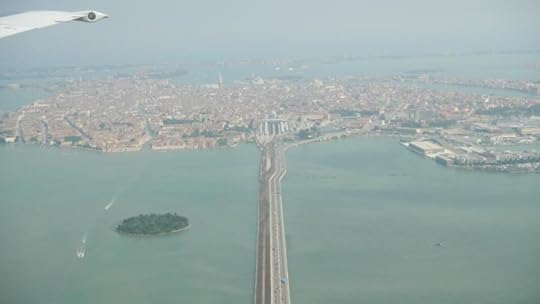
Our view of Venice, Italy from the airplane. I’m cheating a little with this one, because it’s really a lagoon that meets two different rivers not an ocean.
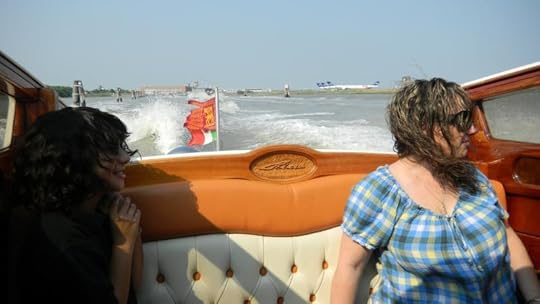
Water Taxi to Venezia
I can’t seem to find pictures, but I also love the beautiful crystal green ocean in Cancun. Even the darker waters in Acapulco and Cabo San Lucas. Just give me an ocean. :)
What’s your favorite ocean?
Filed under: Writing





April 16, 2014
A-Z Challenge ~ New York City #atozchallenge

My family and I have been to NYC a lot. I love going there and walking in the hustle and bustle of Manhattan.
In 2011, my husband and I took our youngest to Comic Con there and had a blast. During that time, my sister, Kristen lived in Connecticut, so we’d stay with her and take the 40 minute express train to Grand Central Station. It saved us a lot of money. So, here are some of the pictures we took while there.
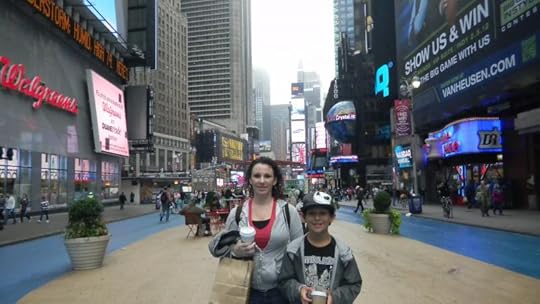
Times Square with my boy.

Comic Con
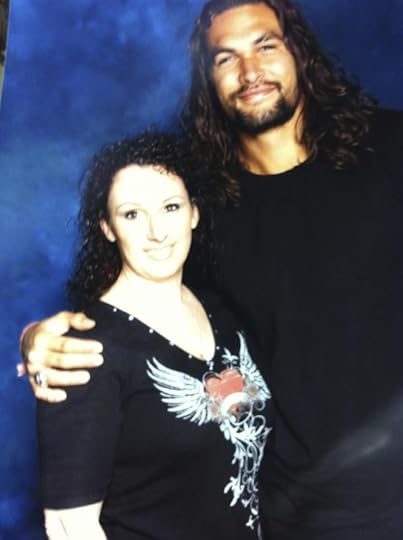
The highlight of Comic Con … Meeting Jason Mamoa
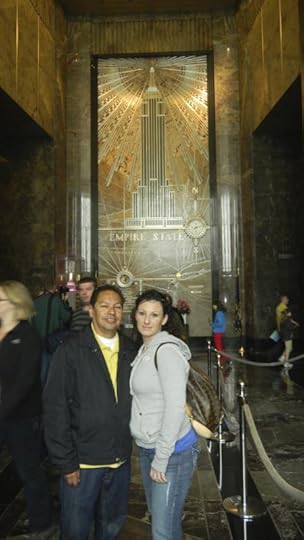
Finally got to see the Empire State Building.

A view from the top of the ESB

Times Square with my sister and son.
We had such a wonderful trip. We were only there for 4 days, but it was worth every minute of it. Also, during this trip, while walking in Times Square, we came around the corner where the Toys R Us is, and were thrust into a sea of people. Well, it happened to be that weekend the Wall Street picketed and every inch of the side walk was filled with bodies and it went on for miles. Well, people were pushing and shoving and I was freaking because of my son being pushed around by adults and people wanting to fight to get out of the crowd. So, before I cracked someone’s skull for messing with my kid, we had to escape up a side street, once we got to one, and get out of dodge. I hate crowds and people in my space so that part of the trip was NOT fun. The picture below was actually in a less crowded portion of the picketing, but as you can see, both sides of the street were packed with people.

Wall Street Picketing
So, which place do you love to return to over and over again?
Filed under: Writing





April 15, 2014
A-Z Challenge ~ My Mr. Manny #atozchallenge

My Mr. Manny was my first novel. It’s a romance and the journey of Mia from being a little girl playing on the street with her cousins and friends to adult after marriage and divorce.
Here’s a picture of my main character, Mia. This is how I imagine her.


Summary:
This ultimate HEA is the perfect cure for a book hangover! So, if you’re a bit emotionally exhausted, but still need something to read, this is the book for you.
Mia Balducci misses her childhood days and yearns for the big, Italian family that she left behind in small town Massachusetts. At the tender age of sixteen, Mia moves with her bachelor father to Los Angeles, but no matter how many years pass, it never becomes home to her. The years spent living with her father aren’t easy, especially since she can’t stop thinking about what she once had. Her enrollment in the University of Southern California promises to bring exciting changes to her life, but Mia winds up with big problems instead. When she runs into an old friend from her old hometown of Winthrop, she gets swept up in nostalgia, and she soon loses herself in a quickly-progressing romance. When the fantasy falls apart, she is left to raise her precious little girl, Lucia, on her own. The demands of Mia’s work schedule and Lucia’s needs increase, and their lives become increasingly hectic. It is soon clear to Mia that she needs help. Luckily, her life-saving cousin saves the day and brings the mother and daughter a male nanny – their new “manny.”
After losing his high-pressure job on Wall Street, Dominic Roberts wants to follow his dreams to have a family. He’s already one fiancée down, and there are no likely prospects for another. In order to find the family he so desperately wants, he finds himself getting into the manny business. Since he is fully qualified to provide child care and is eager to leave New York City behind, his sister-in-law is able to land him a job in California working for his first client – the beautiful and intriguing Mia Balducci.
Will Lucia like the new man in her mother’s life? Will Mia? And will this new trio discover the happily ever after they all so desperately seek?
Find it on Amazon.
Filed under: Writing





April 14, 2014
A-Z Challenge ~ Lucky Harbor #atozchallenge

Lucky Harbor is a fictitious place that I would love to live in. Have you ever heard of it? Well, author, Jill Shalvis wrote this series, The Lucky Harbor Series all about these sexy, macho, irresistible men. Every single one of these men has his own amazing quality that will sweep you off your feet. So here they are … take a look at them. They are actually companion novels and can be read on their own.
Go ahead and give them a try. Take a vacation to Lucky Harbor.






Filed under: Writing





April 12, 2014
A-Z Challenge ~ Kristen #atozchallenge

This blogging by letter is kind of fun, but I’m not much of a writer in this manner. So, sorry if some of these topics bore you to death. When I was sixteen years old, my mother popped out another girl. She also had one when I was thirteen. But when I was sixteen, I moved to California to live with my dad, so I didn’t get to spend a lot of time with my baby sister after she was born. However, once I graduated high school and she flew out here with my other sister, Denise and my mother, I decided to take my sisters every summer my mother was willing to send them to me. The youngest, Kristen, loved coming to visit me and came almost every single summer until she went to college and worked two jobs.
My husband and I had a tradition just for her. Every year on her birthday, we’d take her on a special vacation. One year we went on Disney Cruise, another Cancun, and another Hawaii. You get the point. We didn’t even do this for our boys, but my baby sister got spoiled every year.
Even though we have so many years between us, we are very close. She’s my friend, my sister, and we all tease that she’s my daughter (since I don’t have any girls). I’m so proud of all she’s accomplished. Graduating college, getting a job in her field and pursuing that career to the fullest. Recently, she received a promotion and was moved across the country.
It took me all these years (since she graduated high school) to convince her to move to California with me. Finally, almost ten years later, I have her here on the West Coast. She’s living in Northern California, near San Francisco, not so close, but a lot closer than she was. And I’m ecstatic. So far this year, I’ve been up to see her once, and she’s come down to see me. We hope to do this as often as possible.

Me and Kristen at our favorite Mexican restaurant
Do you have a favorite sibling?
Filed under: Writing





April 11, 2014
A-Z Challenge ~ JASNA – Jane Austen #atozchallenge

About six years ago I found Jane Austen and devoured every single one of her books. My favorite by far is Persuasion, but there’s not a single one I dislike.
This year is the 200th anniversary of Mansfield Park, and JASNA (Jane Austen Society of North America) is celebrating. I belong to JASNA and go to all of the Southwest meetings. If you’re a fan, find the charter in your area. This Spring they are having a great meeting at UCLA with a tour of their botanical gardens to celebrate the 200th anniversary of Mansfield Park.

Here’s a sneak peek at what sort of things we’ll be doing at the Spring meeting.
They have confirmed four wonderful speakers so far: Kim Wilson, the author of In the Garden with Jane Austen, who will speak about one of the novel’s major themes: gardens in Jane Austen’s day; Anne Mellor, Distinguished Research Professor of English at UCLA, who will speak about the slave trade in Mansfield Park. Dr. John Halperin, the author of The Life of Jane Austen, and Phil Rundel of UCLA who will describe some of the UCLA gardens attendees may visit.
A few years ago, I was fortunate enough to go to Bath and visit her museum.

The famous Pump Room so often referred to in her novels.

The Jane Austen Centre in Bath
Have you read all her books? What is your favorite Austen novel?
Filed under: Writing