Summer Kinard's Blog, page 16
July 11, 2016
What I Say to My White Kids About Race

There’s a lot of lofty advice floating around about how white parents can fight racism. But I prefer real talk and hands on approaches. In hopes that this helps others, here’s how I talk to my five white kids about race.
God made people different colors because of joy. The ultimate truth is that God made people in His image out of love. They’re all different shapes and colors because that’s what makes God happy.
Starting 500 years ago, greedy people invented the idea that brown people aren’t humans. They did this so they could kidnap people -even little kids- and hurt them and make them work for no money. This went on for over 300 years, and it’s still happening in some places now. We call that time period “slavery.”
It took a lot of brave people of all colors fighting a long time to end slavery. Even though it’s been against the law for 150 years, a lot of people still think brown people aren’t human. They think this because they want to steal the money and stuff brown people have.
If you hear someone talk about a person with dark brown skin in these ways, it’s because the person talking is greedy and a thief. They want what isn’t theirs and have forgotten they shouldn’t steal. The greedy people will use these words about brown people: lazy, roaches, slimy, sneaky, dishonest, scary, violent, demon, no angel, don’t deserve it, not hard workers, stupid, ignorant, welfare, entitled, bad priorities, lacking understanding. You’ll hear how the greedy person uses these words for all brown people.
Greedy people will also call everyone who speaks Spanish -like your Uncle D and Cousin L or Ms. M at church or Ms. O and her girls or Ms. E’s mama – Mexicans. They’ll say it as though “Mexican” is a gross word, like “stinky poop.” They might say “black” or “African American” in a nasty tone of voice, too.
Remember how Maleficent mocks Aurora’s Prince? She had bad habits and was greedy, too. Or how Hans made fun of Anna when he didn’t love her? He was trying to steal her kingdom. Or how Mother Gothel stole Rapunzel because she wanted all the sun flowers power for herself. Same with Ursula. Same with the bad guys in Kung Fu Panda. They’re lying because they’re trying to steal.
The bad guys got that way by believing they deserved to be in charge and that they could just steal kingdoms and hurt people to get their way.
Racism -pretending brown people are evil so you can steal their stuff- is the same thing, except that it’s a lot of little stealing and a lot of little lying about the way people are. It builds up so that some people can’t even see it’s a bad idea.
People will treat you nicely sometimes as part of being mean to brown people. Think of Cinderella’s stepmom spoiling Cinderella’s stepsisters. She did it partly to humiliate and hurt Cinderella. Sometimes you will be given something just so that a mean person doesn’t have to give it to a brown person.
If you hear a person saying mean things about a brown person, even if they give you a present or are nice to you, don’t trust the person saying mean things. They’re lying and trying to trick you into being greedy with them.
Here are some things you can say: “Stop it.” “I don’t think it’s right to talk about people like that.” “I think God loves everyone the same.” “I don’t like when you talk about brown people that way.”
Usually, the person saying the lies will argue with you. Not long ago, your Daddy met a man who kept insulting “Mexicans.” Dad said, “I’d appreciate it if you’d watch what you’re saying about Mexicans. My brother is a Mexican.” The man said, “Oh, well, they’re short.” Dad said, “You’d be surprised.” The man stopped. Notice that Dad didn’t get the mean man to repent of all his greed or bad habits. But he made it clear that it is not ok to say lies about brown people.
Sometimes the mean people will threaten you or insult you when you tell them to stop saying bad things about brown people. It’s still your responsibility as a Christian to tell bad guys “no-no,” but don’t do it alone. If you come across someone who seems mean or is hurting someone else, say, “Stop!” And “No!” And call for help.
Even the people who believe lies about brown people will see your light skin and treat you nicer. You can use the attention they give you to stop them hurting others.
If someone says something mean about brown people, tell Mommy and Daddy. We’ll see what we can do about it.
If you see another kid get called a mean name or treated mean because they’re brown, stand next to them. Stand next to them and glare at the person saying the mean thing.
If you get a chance, tell the kid who was hurt, “You don’t deserve to be treated like that.”
Don’t expect the kid to thank you or talk with you. It’s common decency in God’s kingdom to see another person as good. You can nod and walk away once you say this.
The greedy bad habit that says brown people aren’t human also lies to light skinned people. It says that we should get to say what is or isn’t good or cool or interesting or true. If you don’t like the clothes or music of someone brown, don’t think that matters to whether the brown person’s stuff is beautiful to God.
Remember what we say at Church, that we’re like the thief. Always ask for God’s love to show you how to treat people. Always remember that God creates people in different colors for joy.


June 30, 2016
Gluten-free Scones
Today on Tea & Crumples, I posted the gluten free version of my scone recipe. This is great for my son with special needs and for me, since neither of us can eat wheat.

My son and I both need gluten-free foods, so I adapted Sienna’s Southern Scone recipe from Tea & Crumplesfor the gluten-free crowd. I used Pamela’s Gluten-Free Artisan Flour Blend as the base flour, but you can try your favorite gluten-free flour blend. Make sure it already has added gums, or add your own.
Ingredients:
2 cups all-purpose gluten free flour
3 teaspoons aluminum-free baking powder
½ -1 teaspoon sea salt
½ Cup unbleached sugar (or coconut sugar)
3/4 Cup heavy cream, plus extra for coating
2 eggs, slightly beaten
1 stick butter
1 teaspoon vanilla
optional: 1 cup nuts, chocolate chips, or dried fruit
Preheat oven to 400 F. Grease a cast iron skillet with ghee or butter, and set it aside. Stir together flour, baking powder, salt, and sugars. Cut butter into little pieces and press with hands into flour mixture until it is incorporated. It will resemble coarse…
View original post 286 more words


June 29, 2016
The Cumulative Effect of Miracles
I sit in silence to watch the swirl of steam rise above a cup of tea, the walls of memory flexing around me. I’m in my Great Aunt Clara’s parlor, her ashtray of seaglass sparkling alongside a bowl of candy orange slices. I taste hot tea for the first time on her loveseat, beside my Grandmama. They are talking of old Galveston and people buried with their memories in sunbaked mausoleums. The lilt of their voices makes me drowsy. It’s a holy drowse, lit through with soft echoes of Dominican schoolbooks and sea lavender and hope. Grandmama is right here with me at this table, still telling me a story. It’s a good one, better because it keeps going.
I’m at both tables, too, a child just learning and a mother teaching. I set a tray between my children and tell them my version of the stories that shaped my hope.
They are hand-me-down miracles, but they’re still good. Plenty of wear left in these gospel shoes.
My son tries them on for size. He wonders aloud, “Mom, isn’t it strange how miracles seem to run in our family?”
It’s amazing, dear one, but not strange. Miracles are normal for Christians. What’s strange is how they are there to clothe the day even when unlooked-for, like a favorite sweater you happen upon just when the weather turns cold.
It’s strange because of my own estrangement. How I wish I could feel at home in this cozy grace. I’m working on it, but every time I get ahead of myself, I’m back at the beginning, at the table, the flowing words of my elders mystifying and comforting me. I taste again for the first time. A new habit starts. It will sustain life and be passed down with the rest from my old-new hands.
I live in the tension of always beginning and always bearing fruit. My lap overflows with lines of sacred texts and more sacred toddlers. I have a heart filled with tears and myrrh and laughter. Sometimes I get things right. Mostly, not.
But here I am again, sitting with the new and old and always. I can almost understand their words.
“Nothing is lost.”
“Nothing is ever lost.”


May 15, 2016
Reading Like a Mother of a Neuro-atypical Child
I almost labeled this post, “Books By the Pound.” We just got back from the bookstore with a haul of 39 children’s books. Last week, 6 other books arrived by mail. Before you step on your, “Use the Library!” soapbox, let me tell you why I spend so much money (and time) buying books.

The duck was my son’s favorite animal in Brown Bear.
Our youngest son LOVES books, but he’s still pre-verbal. Sometimes he finds a page in a favorite book that upsets him. Sometimes he also finds a marker:

The sad Elephant was too intense.
Other times, he can’t find his favorite toy ice cream cone or a real ice cream cone. But he wants to look at the pictures in his favorite ice cream book.

I saved most of this book because he’s learning to make sounds to go with his actions. If he’s silent, I can’t always tell he’s eating a book.
So he eats the book.
He has loved and eaten and editorialized on a dozen or so favorite books. We mend what can be mended and read around what we can. Then we add the title to our Amazon list to buy again.

Most of tonight’s book haul.
Or we save up rewards points to shop at our local Barnes & Noble.
The library, alas, is out of the question for now.
Someday, though.
I hope.


April 16, 2016
Creativity is Not a Luxury
I’m sure many of you have seen Kim Brooks’ article in NYMag, with the tagline, “Is domestic life the enemy of creative work?” I find it irksome. Here’s why.

When I started this blog, I wanted to show that writing as a mother of young children is possible, and how. I have published three novels since, as well as birthed three children. Writing is a guerilla operation most days. I type on my phone through naps with a nursing baby. I give the children their own paper and pens to practice while I make notes on plot beside them. More than one of my manuscripts bears the marks of chocolate chip muffins and milk.
I’m trying to combat the myth that one should only write if one has “free” time. That lie paralyzes good writers. More insidiously, it downgrades stories to luxury goods. It belittles the human need for art and story, and it lowers the status of those who create.
Over the past three years, since my debut novel was published (and I had only two small children instead of my current five), I have met dozens of other writers who are mothers. Some of them came to writing later in life, but many of them are writing in the thick of life with children.
Writing mothers share a sense of creative drive that they prioritize as part of their daily lives. Are they writing during day job hours? Not usually. Do they get enough sleep? Probably not. But they write. They create.
The true artist is the ascetic. The true ascetic is flexible. They are “true” because they get art done.
One can garner a lot of sympathy by promoting the prevailing myth that creating is a luxury that should be reserved for luxurious expanses of free time. But it’s not really helping anyone to do so.
I wrote on my Facebook share of the article, “Grow a backbone. Artists can do anything if they have at least one of these: Ego, Virtue, A Cause. Pick one and stop making whiny excuses.” I stand by that [grumpy] pronouncement, but I want to clarify one part of it.
Ego is the enemy of domesticity. If one sees creating as an exercise in egotism, domestic life won’t be sustainable. But the vast majority of artists function and create by means of disciplining themselves, not indulging themselves.
Let me clear something up. There have been a few months when a household of sick persons (me included) and a broken computer have kept me from getting a consistent word count on paper. But did I stop writing? No. I typed myself emails on my phone in the middle of the night. I grabbed crayons and wrote on the back of bills. My stainless steel refrigerator is covered in whiteboard marker – all notes reminding me of turns in stories or telling details of characters.
Writing is not neat. If you think family life equals tidy life, that might be your issue, not creativity.
Writing is not a luxury. I have to write to maintain my sense of balance and focus and meaning in the world.
While I disagree with the unhelpful characterization of writing as a luxury of a tortured romantic state best done far from one’s loved ones, I agree with Ms. Brooks in this: Writers who don’t write die inside.


April 2, 2016
Loud

My first high school chorus teacher, Mrs. Wright, told us that if we listened to recordings of Beethoven, we should listen to them loud. You can’t appreciate the passion and joy in his music without being immersed in it.
I like to listen to chant the same way. If you sing chant, you know that it’s a full body experience. The harmonies zip through the vessels of the body faster than blood, telling each cell what it was made for.
Music shifts the barometric pressure in my soul.
Today I participated in two very loud musical performances. The first was in my kitchen, surrounded by children. We plucked plastic coffee bottles from the recycling and made the room resound with rhythm. Over the steady beat, I sang songs: “Down By the Station,” “Sing a Song of Sixpence,” “Lavender’s Blue,” “The Brave Old Duke of York,” “10 Green Bottles,” “We Are Marching in the Light of God,” “I Heard the Voice of Jesus Say.” The babies head bopped and danced and helped make the music.
The second was as an audience member in a theater, enthralled by the gorgeous Met HD broadcast of Madame Butterfly. My friend and I soaked up beauty for 3.5 hours. We wowed and wept, held in the beauty that wrapped each person’s grief and joy in song. In a word, the experience was palliative.
My mouth has been full of songs of my own making and the songs I happened on or heard. Lately, the loudest ones, the songs that raised me up and taught me and patted me and sent me on my way, were the clear, soft lullabies I sing my children. My youngest son doesn’t talk much, but he sings these sweet, high songs back to me. Our connection has always been in blood and bone and music, from his first fragile days when I wrapped him in red silk and sang him arias over the beeps of life support machines. His language is song.
We hope in the coming weeks to learn how to communicate more with our little one, but for now I am grateful for these three things: that there is music, that my boy can understand it, that his mother is loud.


April 1, 2016
PSA: Natural Spider Control

Happy April Fool’s Day! Feel free to share.


March 8, 2016
How Listening Helps You Write
Today I had that conversation again, the one where an acquaintance admits they’ve been reading books on how to write but making no headway. I like books on writing, to an extent, but they aren’t for everybody.
Today, in the safe confines of a dentist office, I looked at a gracious and brilliant professional woman and lowered my voice. “Most of those books are written by people who thrive on visual communication. Personally, I grew up in an oral culture. I write by listening.”
She related. We can both reproduce a lecture in beautiful notes. We both talk to ourselves around the house. We both think out loud even in silence.
I told her the secret to writing when you learn by ear: practice a little each day listening to yourself. Write what you hear. In time, your intuition will become more clear, and you’ll find the thread of story you need to tell.
What I didn’t say today was that I stole this method of listening from Christian monasticism. The Rule of Benedict begins with “obsculta,” a type of heart-deep listening.
Obsculta is the heart-deep way one listens to a spiritual father or mother. It’s also the way for us to hear the loving God speaking in our hearts. We need this listening like a garden needs water, deep and daily.
Every writer can benefit from writing every day, but it’s absolutely vital to the Listeners among us. Just as we grow in trust with a friend who listens to us often, Listeners grow to trust the grace given them when they listen deeply each day.
What’s your favorite time of day for deep listening?


Oral Cultures and Writing
Today I had that conversation again, the one where an acquaintance admits they’ve been reading books on how to write but making no headway. I like books on writing, to an extent, but they aren’t for everybody.
Today, in the safe confines of a dentist office, I looked at a gracious and brilliant professional woman and lowered my voice. “Most of those books are written by people who thrive on visual communication. Personally, I grew up in an oral culture. I write by listening.”
She related. We can both reproduce a lecture in beautiful notes. We both talk to ourselves around the house. We both think out loud even in silence.
I told her the secret to writing when you learn by ear: practice a little each day listening to yourself. Write what you hear. In time, your intuition will become more clear, and you’ll find the thread of story you need to tell.
What I didn’t say today was that I stole this method of listening from Christian monasticism. The Rule of Benedict begins with “obsculta,” a type of heart-deep listening.
Obsculta is the heart-deep way one listens to a spiritual father or mother. It’s also the way for us to hear the loving God speaking in our hearts. We need this listening like a garden needs water, deep and daily.
Every writer can benefit from writing every day, but it’s absolutely vital to the Listeners among us. Just as we grow in trust with a friend who listens to us often, Listeners grow to trust the grace given them when they listen deeply each day.
What’s your favorite time of day for deep listening?
March 3, 2016
His Song is With Me in the Night
Some fifteen years ago, my husband and I rented a few rooms in a derelict historic building in a state park. The rent was low and the view was lovely, and our housemate was a creative type from a previous generation. One night, when her gallbladder had failed her, she limped to our hallway, hunched over in pain.
“Summer,” she stage whispered, “Summer, please help me.”
I of course jumped out of bed and ran to see what was wrong.
“I can’t sleep. The pain is too much. Can you sing to me?”
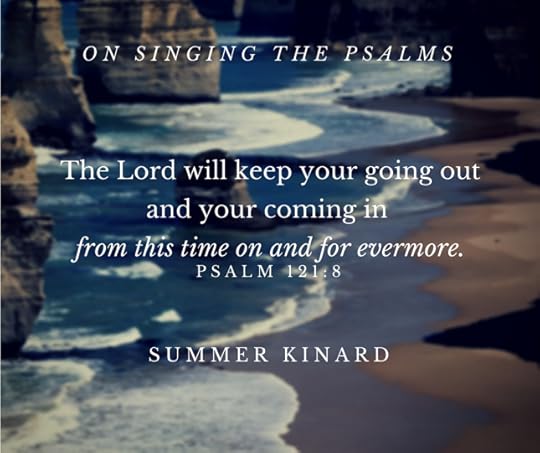
It was the middle of the night, near the prayer hour known as Lauds. Perhaps I sensed the proximity to the quiet prayers of night the world over. The song that came out of me that night was a portion of a Psalm that I had set to music to help me remember it in my Hebrew class. Translated, you see part of it in the image above.
“The Lord will keep you from all evil. The Lord will keep your life. The Lord will keep your going out and your coming in from this time on and forevermore.”
After a few times through that Psalm in every tune I knew for it and a few times through the 23rd, my housemate nodded. The music had healed her, she said, and she felt she could cope well enough to sleep.
Our lives have changed in myriad ways since those grad school days of housemates and Hebrew. We’ve bought houses and cars, had children and buried parents. But I find the same words coming to my lips on the dark nights. Plainsong, Gospel, Byzantine, Anglican, improvised, high Latin, low church and twangy, the Psalms pour out like balm.
Sometimes the grace goes to the hearer, and sometimes I am the only one comforted, as my voice wavers over the fevered head of a whimpering child or I set the rhythm of repentance with my tears. I have sung psalms over ventilators for the healing and the dying, a hope unseen but heard and felt. I have sung them into the hair of my babies and lined them sotto voce into the walls of unquiet rooms.
In our disconnected world filled with so much noise, the steady cadence of the Psalms joins us together. If we could hear each other, we wouldn’t hear the memes and politics and advertisements but the soul cry of the Psalms:
Out of the depths I cry to you…
Into your hands…
Then were our mouths filled with laughter…
His steadfast love endures forever…
Hallelujah…
God is our refuge and strength…
Psalms give us the “be still and know that I am God” and the “rejoice,” the many voices of awe at the pain and glory of love.
I won’t tell you in your crux night that singing Psalms will solve everything, but I know it will heal you. I’ll meet you there in the singing.