Summer Kinard's Blog, page 15
November 11, 2016
Yes, You’re Probably Racist: How White People Are Born Into Racism and How to Fight It
Sit back for a minute, because you haven’t heard what I’m about to say before.
Ever wonder why it seems natural to see race, but not to see racism?
Look, none of us chooses the family we’re born into. If you’re white, and probably even if you’re not, you were born into a ready made pattern of racism. I’m not judging you, but I am going to bear witness to you.
I’m going to tell you straight up that learning this will change your world if you let it.
Racism is hard to see because it acts like a family dynamic.
Whaaaaat are you talking about? Ok. Big words. But stay with me. Most families go through times when they’re getting along pretty well and have their lives together, and other times when it’s not so much. If the family has pretty good habits of getting along, they can weather a lot. Being flexible and looking for the next right step, fixing the problem instead of the blame, everyone feeling valued, and really respecting each other are all good habits that can make for a well-run family.
But lots of families either always or sometime turn dysfunctional. They stop being able to sort themselves out from one another, they don’t get much done, they grow rigid and stifled and usually have abuse symptoms of some kind (addictions, beatings, criminal activities, yelling mean all the time).
Why do families stop functioning? They get stuck in a game.
The game isn’t one that anyone wins, but it gives emotional satisfaction. That means you can feel really good about yourself if you play the game.
The game is a substitute for boundaries.
Here’s how it works. There are three roles that each person or group can play: the Heroes, the Bad Guys, and the Victims.
Scoring is simple. Heroes get Gratitude Points. Victims get Sympathy Points. Bad Guys get Drama points. Everyone in the game gets to share all points racked up, but there’s an extra rush of Acceptance Points to whoever is playing a role at the time.
The catch is that you can’t think of any other possible world outside the Three Role Triangle. You have to keep jumping into one of the roles to build the Acceptance Points and do your part for everyone in the game.
Since not everything you need to have a good life fits into the Triangle, you’ll start to suffer. So will everyone else. But instead of connecting your actions with consequences or trying to fix the problem, you only have the Triangle. Everything is the game. Without the game, you don’t know who you are. Without the game, there are no Acceptance Points.
You panic when you realize you could lose your Acceptance Points. You work harder to fit everything you experience into the Triangle. You settle into a comfortable pattern of being a Savior. Maybe you don’t get to meet your own needs or reflect on your own soul, but you have the thrill of the Gratitude Points that help you control the people around you.
Wait. What? Control? I thought this was a game. Yes. It’s a game where people control each other by insisting that the Triangle is the only way to function or understand life.
Why are you talking about a game instead of racism?
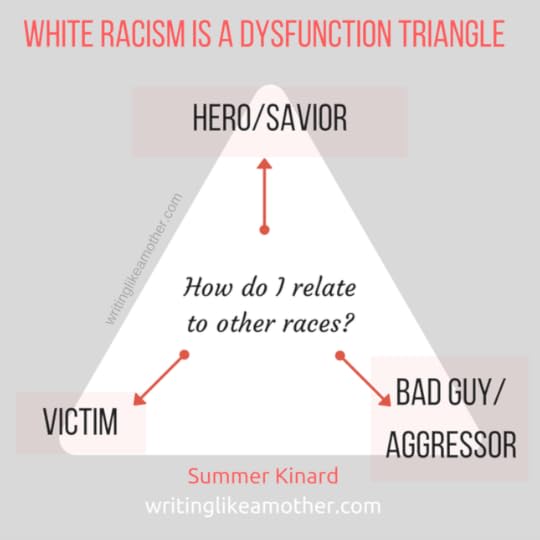
Just like someone stuck in a bad family pattern, whites can’t see beyond the racism game.
The Three Role Triangle functions exactly the same in racism as in dysfunctional families.
That’s why you’re comfortable sending money or going on mission trips to black people far away, but you don’t cultivate friendships with black people near you. +4 Gratitude Points
That’s why you think, on the rare occasions that you hear a black person say that you are hurting them, that YOU are the victim. +2 Sympathy Points
That’s why you’re not going to stand around and let those teenagers just dress differently from you. (Pull up your pants!) +3 Drama Points
That’s why you think that talking to a person with brown skin is something that deserves congratulations. +1 Gratitude Points
That’s why you hate it when the media tries to act like we’re living different experiences from black people. +5 Sympathy Points
That’s why you automatically think that any black person you meet wants your help. +7 Gratitude Points
You are the Hero and Savior of brown and black people, and if you’re not the Hero, you’re the Victim of slander or unfairness or the burden of being such a good person, because you’re a Hero, but sometimes when it’s all too much, you’re the Aggressor, dammit, because someone has to show them their place. Decorum and Class are so necessary –why are they trying to take that from you, a Victim, when all you, a Hero, want is what’s best for them?
The only way out is to break the cycle, and I’m sorry to have to tell you, but it’s going to be hard as hell. You will have to learn to stop yourself from playing the game you’ve played your whole life.
You’ll relapse.
You’ll think you’re out of it, and you’ll find yourself slipping right into a warm bath of hurt feelings when no one thanks you for acting like a decent human being toward them.
You’ll want to agree with the lady in line at the grocery store that black women need to stop having kids when they aren’t married, and you’ll have to remember that your desire for those Drama Points for judging someone and Gratitude Points for sharing your superior white wisdom means you’ve backslid right into the game.
You will have a thousand choices every day to break the cycle. You will look at the lady offering to share a pool of Acceptance Points with you, and you will feel the pull of them like the belly pit pull of desire. You’ll want to meld right into that invisible role and be one with this stranger beside you. You were taught that you are supposed to feel like this and to call that feeling good–Points upon Points with no consequences and nothing to lose but your freedom and soul.
You will snap out of it. You will hear the lady say, “Those black women ought to stop having babies with all them different daddies,” and you will remind yourself that the game is not real. You don’t have points at all when you unplug from it. You have a conscience and eyes and ears and a heart and a God, and you know better than to say yes to the seduction.
“No,” you will say to yourself.
You will mourn. All those years thinking you fit in and were accepted, when the other white people only wanted you for their game. They weren’t really your friends. They were your co-oppressors – oppressing you and them together, and reaching out together to oppress all the world with the rules of the Triangle. You will look at that lady and you will see someone who is not your friend after all. She is a lady buying enemas and a carton of Salems and a half gallon of orange juice and a box of Little Debbies on a Tuesday morning, and she hates herself and wants you to lie to her so she can pretend a little longer that the game is real.
“You know what?” you’ll ask the lady, “I think you and I are better than this.”
You will be rejected. This will hurt, but accept the pain as a gift. Your teammates have thrown you out of the game. In the long run, when you’ve learned to make real friends, their rejection will help. In the short term, let the tears wash your eyes so you can see better.
“I don’t know what you’re talking about,” the lady will snap. She will mutter a cruelty loud enough for you to hear it but softly enough for her to award herself as both a Savior and a Victim.
You will keep going. The black checkout clerk will tell you thanks for saying something to that lady, and you will not get any points. You will feel humbled and sad that you had to fight so hard to do so small a decency and much more sad that the clerk thought it was unusual and much more so that she knows white people are in the Triangle and gave you the option of Gratitude Points. You will look her in the eye and try not to cry, and you will tell her something incoherent but sincere that will make you a Crazy White Lady but in a cautiously good way. “I’m so sorry you have to put up with that. I wish it wasn’t weird for someone to stop that nonsense. Oh, I did get celery. Would you look at that?”
You will fight fight fight the urge to define yourself by an imagined game. And you will not even scratch the surface of what the black people around you have to deal with.
You will learn to listen without curating other people’s stories. You’ll break the habit of thinking you’re in charge of the Accepted Understanding of what people mean when they speak. You’ll start to love other people honestly and humbly. You’ll look at them in wonder as your eyes start to see the joy of God who made them and you for this very thing.



November 2, 2016
Goodnight Jesus Board Book Review
First, let me give you a statistical analysis of my children.
Ages: 8,6,2.5,2.5,1.5
Special Needs: ADHD, dyslexia, autism, sensory processing
3 boys, 2 girls
Why do those things matter? Well, it’s rare for us to find a good bedtime story that will suit every child in the family.
That’s why Goodnight Jesus is so welcome.
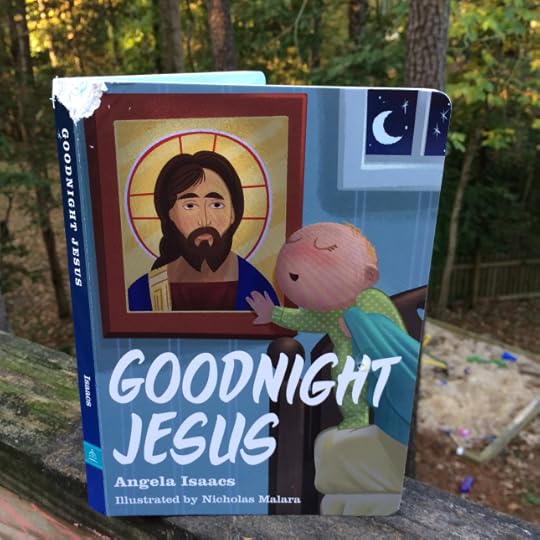
The story follows the baby main character as he or she kisses the icons, Cross, Bible, and family goodnight. If that sounds really sweet, it is. Everyone in the family likes this book.

Especially the toddlers. See the smudges on the pages in the photo? Baby kisses.
There was one major dilemma we encountered in reading this book, though.
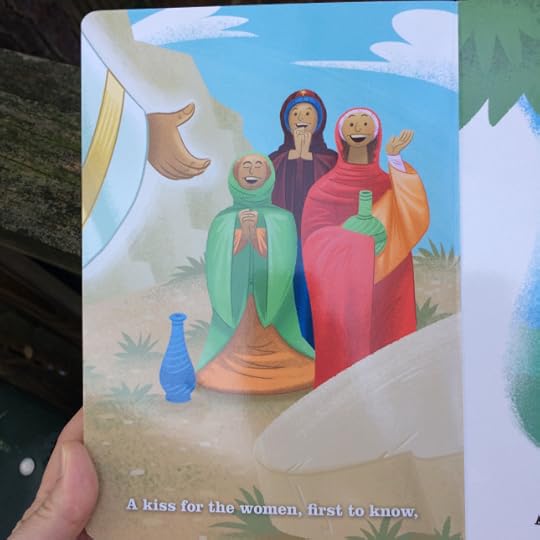
We have an icon of the Myrr-Bearing Women in our house, but…
Should we kiss the book or the actual icons in our home?
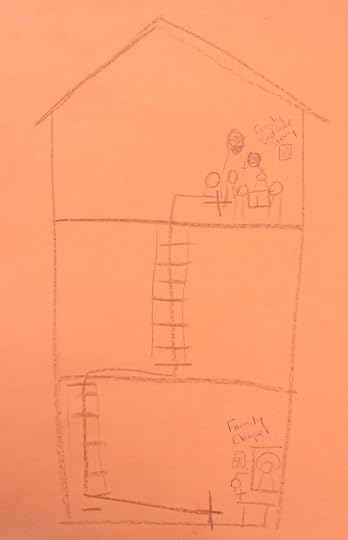
The Family Chapel with most of the icons is two storeys away from the bedtime story chair.
As you can tell from the impressive, professional-quality crayon drawing above, our family chapel that contains most of the icons listed in the book is two flights of stairs and several hallways away from our bedtime story spot.
We decided to let the kids kiss the pictures in the book and see what happened. Guess what happened?
The toddlers started seeking out the icons of the Theotokos in their bedrooms, as well as the small patron saint icons we leave accessible to them at all times. They give them kisses more often now!
Run-Down of Responses
Our three toddlers, including our son with autism, had no trouble associating the drawings with the Gospel book at church and the regular icons in our home and church. They love hearing the book over and over and taking turns kissing the pages. Since we’ve started reading Goodnight Jesus, the littles have made the leap between venerating at church and venerating at home. They go looking for their little icons, kiss them, and place them back on their little shelves before playing again.
Our older two like the book well enough to ask questions about the icons shown. Since my husband is an iconographer, they see and hear a fair bit about different icons. Some of their questions have been about the style of the icons, some about the people in them. The board book is targeted to the younger crowd, but I think it says a lot about the simple yet deep resonance of the story that my older children could also discuss it and not get annoyed with having the story repeated often.
The parents. {stage whispering to the side while main blog post continues, like the fools in Shakespeare plays} Okay, you know the real question here. Yes, it’s pious. Yes, it’s pretty. Yes, it’s cute and accessible to little kids. But we all really want to know if it’s annoying to read 2-4-6-8-10 times in a row. I have good news for you. It is not annoying. There isn’t a cloying rhyme scheme. Everything is natural and sweet in a child-like way. The drawings are bright but tired-eyes-at-the-end-of-the-day-friendly. It’s a winner.
Was the book ADHD-friendly? Yes! It has built-in actions that help engage a child with wiggles.
Was it sensory issue-friendly? Yes! The repetition lets our little one who takes time processing sounds take her time processing sounds, and the reinforcement in the images makes the book easy to grasp.
How about autism-friendly? Yes! The picture prompts work great for our son with extreme language delay, and the illustrations hit the sweet spot on interesting/overstimulating balance. There’s just enough detail for him to like taking his time looking over the book on his own AND he can follow along while we read without having a sensory overload. As you already know if you follow this blog, my son eats books he really likes.
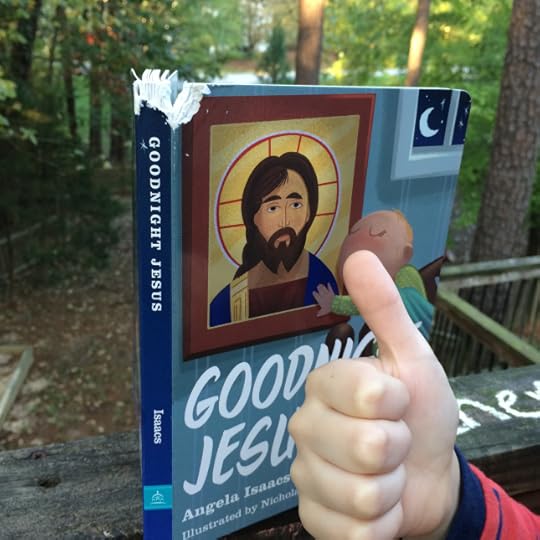
This book is Basil-approved.
We’ve been excited about Goodnight Jesus for months, so we ordered a copy right away on Amazon when it came out. Alas, it was backordered. Before our copy came in the mail, I was contacted by Ancient Faith Publishing to see if I’d be interested in writing an honest review of the book in exchange for a free copy. Of course I said yes! We always have to buy two or three copies of good books anyhow, so this was a win-win.
You can pick up your copy of Goodnight Jesus at the {Ancient Faith Store} or on {Amazon — affiliate link}. This is a wonderful book for baby showers, godchild gifts, Christmas presents, or any other occasion in which you’d like to give a child an enjoyable gift.


November 1, 2016
Restoring My Soul in the Laundry Room
This morning I gathered the laundry from the main floor of the house and carried it upstairs. The towels were stiff with tears and spilled milk. Tiny britches caked in mud and fancy bloomers stained blue with ink bounced on top of the pile. I love those little bloomers. They were the final step in dressing my daughters in church dresses. “Restore me to my original beauty,” I whispered.

I studied theology in universities for nine years, and the upshot is that I preach to my laundry.
Even though she’s not considered a saint in the Orthodox Christian tradition, I keep an image of Hildegard of Bingen in my laundry room. In a little book of medieval prayers, I treasure her words on the Incarnation – “he bleached the agony out of his clothes.”
We are to put on the Lord Jesus Christ, not as clothing, but as power and energy, eating Him as the immortal life craved by creatures made for communion with the everlasting God.
I think of clothing and healing and energy and purification and redemption and communion as I pull clothing in and out of machines and fold and tug and stack and store.
Theosis happens here in the care of our sacred bodies.
But it also happens when the laundry pile gets too high because of an illness or a visit or a project. It happens when the littles tromp into the house caked in sand and clay, and I look at them through the mud and speak to the living creature in that clay that God was thinking of when he made the first of us.
Tertullian said that when God fashioned Adam in the clay, he was thinking of the Son of God who would one day take flesh. That truth hums through the little green laundry room, mixing with the smell of cleaners and fresh clothes and mud and ink to proclaim a humble gospel.
Theosis happens in the mud.


October 10, 2016
Halloween Hacks for Special Needs Kids
My friend, author Charli Riggle, has a great post up today on her blog Catherine’s Pascha. {Read it HERE}. I contributed the section on Halloween for nonverbal children. Go check it out and share with anyone you know who might need it!
I’d love to hear your ideas in the comments here, too. Let’s learn together.
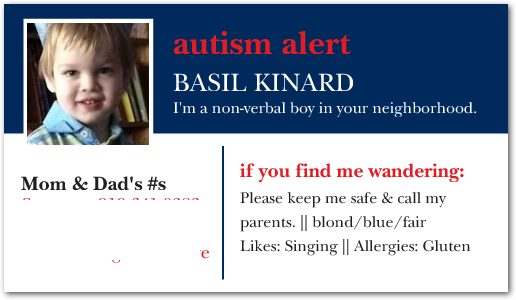
One of my family’s Halloween strategies is to give some of our neighbors these cards with our phone numbers and address. Read the post for more ideas, and share your own in the comments!


October 3, 2016
Logos Theology for Kids without Words
Today I guest posted on the Catherine’s Pascha blog about “The Logos for My Nonverbal Son.” Please stop by and read it HERE
.


September 28, 2016
Well-Behaved Women Often Make History – Guest Post by Deborah Hining
From time to time, I ask another writing mother to join my blog with a guest post. Today I welcome my friend Deborah Hining, award-winning author of A Sinner in Paradise and A Saint in Graceland, to tell her truth about an insidious lie we see almost every time we drive.
***
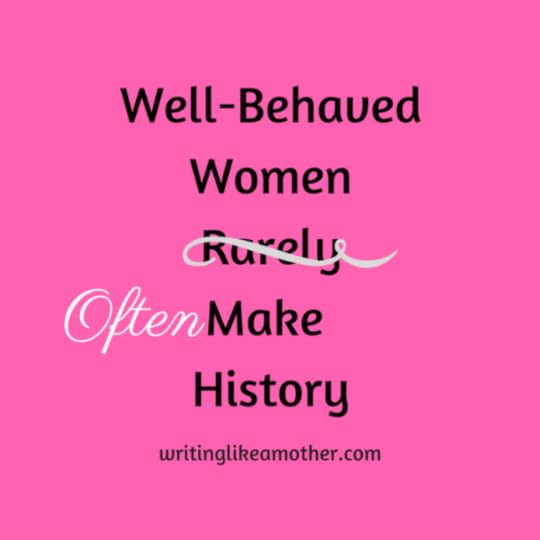
Don’t believe everything you read on a bumper sticker. Deborah Hining talks about what it takes to be memorable.
Usually I take bumper stickers in the spirit they were intended, especially those that are sassy or exceptionally geeky, but occasionally one that probably is intended to be funny will rub me the wrong way. The one that is currently on my “It disturbs me to see” list reads, “Well-Behaved Women Rarely Make History.”
I find it irksome because, for one, it is not true.
Think hard. How many badly behaved women can you think of who have made history compared with well-behaved history-makers?
Wracking my brain, I can come up with only a handful of “bad” ones, but easily, a dozen of well-behaved women’s names come to mind. Off the top of my head: The Virgin Mary, Queen Elizabeth the First, Queen Victoria, Mother Theresa, Corrie ten Boom, Anne Frank, Madam Curie, Helen Keller, Amelia Earhart, Princess Diana, Eleonore Roosevelt, Golda Meir, and the list can go on for a very long time.
These women were human, and as such had some ordinary human faults, but those faults are irrelevant to the reason for their fame. What put them into history was their care for others, their fight for justice, their good works, talents, ambitions, intelligence, and leadership.
There are a few (a very few) who have made history with their bad behavior. Mata Hari slept with the enemy as a double agent. Lizzy Borden took an axe, gave her mother 40 whacks. Mary the First of England was known as “Bloody Mary” because she executed people who adhered to the wrong religion. There are many women whose bad behavior made them famous for a while, but for the most part, the history that they made was minor. Look them up and see who they were. I bet you’ve never heard of most of them, and the ones you have heard of recede into the shadows compared to the truly great, well- behaved women. Compare Bloody Mary with her sister Elizabeth I. Which one of them do you know more about? The bloody one, or the beloved monarch who led England into unpresented prosperity and enlightenment? Who sits in your consciousness more firmly—Mother Theresa or Mata Hari? Queen Victoria or Irma Ida Ilse Grese, the Nazi sadist? Who do you more easily recognize—Eleanor Roosevelt or Eleonore of Aquitaine (who was considered to “misbehave” because she favored her sons over her husband)?
There is another, more important reason I find such ideas about the merits of bad behavior distressing. I see them as damaging to our collective psyche. It says to our sons and daughters, “The way to be recognized is to act out. Don’t be a lady (or a gentleman). Don’t mind your manners. Behave badly.”
Such messages teach that the best way to get noticed is by taking your clothes off, getting drunk in public places, using foul language, bullying, and in general flouting the basics of decorous behavior. We all know this does not work.
People who deliberately misbehave in order to get noticed probably have swallowed the lie that ephemeral notoriety means the same thing as greatness. No one has bothered to teach them that true renown comes only by accomplishing something of real note.
Looking at our modern era, who do you think will fare better in the eyes of history, young rock stars who probably embarrass their mothers with their cringe-worthy performances, or Princess Kate, who minds her manners and works to end human trafficking?
Sad news that anybody, man or woman, who behaves badly might make the headlines for even a season, let alone go down in history, but that seems to be exactly what our culture is teaching us these days.
People have lost the inclination to be gracious. They have become overly sensitive to their own feelings, angry at anyone who expresses an opinion they disagree with.
No longer are politicians “politic,” held to a standard of judiciousness and sanity. The ones who get noticed—and voted for—are the ones who throw tantrums and blithely ignore the rules of manners. My Facebook page sports posts from conservatives and liberals alike that are full of untruths and half-truths, foul language, snide and vicious comments, and general hatred for anyone who is not on their side.
Whoever puts up the bumper sticker, “Well-behaved women rarely make history” may not be thinking that general bad behavior is the way to make your mark. Perhaps she is just frustrated by that fact that historically, women who deigned to rise to the top, to make something of themselves were the ones who did not conform to the societal expectation of helpmeet/mother/daughter/weaker vessel.
You may believe that women who become leaders do so because they stand up in defiance against stereotypical gender-defining roles, and that means they are “misbehaving” in the eyes of our society.
I believe that this line of thinking is very dangerous and has no place in the mind of anyone who believes in gender equality. Allowing that a stereotypical gender-role mindset is the norm gives credence to the idea that women who lead or do important things are automatically “misbehaving.”
That sends the message that women need to think twice about breaking barriers, of rising to the top, of achieving greatness. It says that ambitious women will have to deal with the rancor of people who will consider them bad for aspiring to the same goals for which men are applauded.
Since when is making great breakthroughs in science and medicine a bad thing? Since when is espousing equal rights for all, as did our more outspoken feminist and civil rights leaders, a bad behavior? Just because some people say it is doesn’t make it so.
Let’s not tell our girls that people who say it is so are people they should listen to. Let’s let them know that people who consider their aspirations and ambitions to be a type of misbehavior are people who DO NOT matter. They are small-minded, insignificant, and not to be regarded as sane.
Instead, let’s let it be known that well-behaved women DO make history, and in a good way, just as well-behaved men do.
The great women of history frequently adhered to the rules of good behavior—they had integrity, they were honest, kind, polite, generous, and unpretentious, and it was in part their graciousness and goodness that made them acceptable as leaders.
In fact, people who do try to behave well far outnumber their evil counterparts in the pages of history. Good people are far more likely to achieve great things, be more likely to rise to the top and to make lasting impressions upon the world.
How long will Golda Meir or Florence Nightingale, “good” women by any standard, grace the pages of history? Whoever heard of that awful Belle Gunnes?
***
This post contains Amazon affiliate links to Deborah’s books. If you choose to shop via those links, I will receive a small percentage of the sales for directing you to the site, but you will not pay a higher rate.


September 8, 2016
Stuff That Helps With Nonverbal Kids
This isn’t a philosophical post. I have found that there are a few products that really help me help my son who has autism. Sharing here because they might help someone else.
Waterproof paper. It prints in a laser printer, but not inkjet. My son’s visual language PODD is printed on this material, and we’re planning some visual schedules as well.
Window Crayons. We have a sliding glass door, and I’ve been able to draw a few First/Then patterns and pictures so my son can point to request things. You can probably find these at your local big box store as well.
Soft Pajamas. My children with autism or ADHD sensory issues practically live in soft, long sleeve, long pants pajamas when we’re at home. Sign up for Carter’s or OshKosh newsletters to get word on their frequent great sales. The tighter fit of the pajamas helps to soothe the little ones’ sensory needs.
Elephant and Piggie Books. These have simple language, model body language and emotions well, and allow the reader to interact with the book. My youngest son is learning to shake his head “no” and nod “yes” from our Elephant and Piggie book time.
Daniel Tiger. If your child is young enough to like Daniel Tiger, consider watching the shows on PBSkids and reading the books. Daniel Tiger is an entire show about social scripts and schedules. The show makes emotional intelligence easy to teach.
That’s all for today. I’ll update again another time. I hope this helps!
*This post contains Amazon affiliate links. If you purchase an item on Amazon after clicking here, you pay the same price as everyone else, but Amazon gives me the few cents of advertizing money for sending you to their site. If you choose to shop through these links, I can guarantee you that any revenue will go towards buying more children’s books for my family.*


September 4, 2016
How Being A Mermaid Saved Me From Depression
I used to feel it rolling in like the tide. I would be in a pleasant place, on the shore in the sunlight. The water washed over my toes, leaving behind relief like the wake of a good cry. I would see it coming, with no power to run. A cruel word, a derisive look, and the water was at my knees, then my neck. Then would come the long hours, days, weeks, months of struggling to breathe. Every moment, I had to decide to keep going, to believe that I should live despite the heavy water trying to sink me.
When I was a teenager, I split myself in two. I let the waters take me. I would fantasize about a beautiful forest with a green canopy and wildflowers and quiet. I would lie down to rest in an open grave under a spreading oak. I allowed myself the numbness of the cold water. I allowed myself the vision of peace. But I also kept going, because I knew better than to trust the sea or any picture of death without flies.
When I was in college and grad school, I balled myself together again. When the waters came, I would pull my knees up to my chin under warm blankets. I turned on a white noise soundtrack and thought of myself as a sphere. I could float on the ocean. It could wash over me, and I did not have to sink. But I couldn’t always float. Sometimes my dreary body pulled me down. Sometimes there were rocks that could break a sphere.
Once I had children, the ocean was inside of me. Still untamed, still dangerous, still filled with images that might be either dreams or lies. But with every birth, I found that I could push the ocean into its proper place. When I am in it, I can swim. When I am out of it, I can see its beauty and helpfulness.
What changed is that I am a mermaid now, a hybrid creature. I can swim through the waters of depression instead of sinking. I can walk away, slowly, slogging, and dry out.
I have always been able to function while drowning. Most of my friends and family have no idea that I’ve struggled with depression. I haven’t known so myself, except in hindsight. When a tide has receded, I’ve looked down in wonder at my clean toes. If you’ve been to my house, you’ll understand that this is literal. My housekeeping cycles over years, steadily improving or falling into complete disorder according to the intensity of barnacles crushing my soul.
The chief obstacle of my housekeeping is clutter. I have a hard time getting rid of other people’s junk.
Every time I step out of the water and sweep up the sand, I come across the detritus of other people’s cruelty and indifference. In a drawer in my favorite desk, I keep insulting letters. I think about throwing them away during every low tide.
The conventional wisdom is that you should not hang onto negative objects, negative words, or negative people. But conventional wisdom is stupid. Conventional wisdom does not have to defend itself against gaslighting. Conventional people don’t know that a list of cruelties or a stack of insulting letters can be life rafts. Anything that keeps the ocean outside of my skin, that lets me say “you are there, and I am here,” is a treasure. In the low tides, I can laugh at the lists. I can tuck the papers away and say, “See, you did not imagine it. They really said those things. You are not making it up. You are sane.”
Sanity keeps me from dissolving. It lets me transform. But it’s not very pleasant in the moment.
You will probably wonder what’s on my list. Yours will be different on land. But I’ll tell you mine because the sea makes everything look the same.
On the surface are the comically audacious cuts, ranked in order of absurdity: the woman who tried to avoid eye contact in the grocery store by pulling her hair over her face and sidestepping, the priest who called me “good peasant breeding stock” when I was pregnant with twins, the many people who greeted news of children with “congratulations…I guess,” the man who saw me on the tea aisle at the store and turned and walked away to avoid conversation though we had made eye contact, the person who reduced a year of 20 hour weeks of volunteer work to organize a major event to my “making posters,” the pastor who wrote me warning that I shouldn’t learn too much in college lest knowledge kill my spirit, the mother ruining my baby shower by shouting at me that she had hurt her butt in the bathtub and therefore I was hateful to her, the time my mom told acquaintances that I regularly sang with Pavarotti when I made the mistake of suggesting that she listen to Pavarotti’s recording of a song I was learning, the time my dad wrote me from prison to chastise me for making fun of someone because they only gave me $100 as a gift when I neither made fun of them nor did they give me $100.
The times I was too smart or thought I was smarter than them or was a smartass or was too quiet or too loud or showed too much knowledge in a subject on which I had expertise, the time a man quoted me to myself unknowingly in defense against my suggestion for altering the document he was quoting, the time someone quoted a soy protein bar advertisement as health research, the time someone insisted that his hour of reading a few chapters of a book made him more knowledgeable than my three degrees and doctoral hours and teaching on the subject. These are the light ones. Then the tide deepens, suddenly, without warning.
The time she told everyone about the party and the desserts and foods at the party, and we all discussed how cool it was going to be and congratulated her on her clever planning, and she turned to me after the others walked off and explained that she was limiting the guest list, and I had to say that I had not assumed I was invited, and I was only wishing her well – all true- but was it necessary to pointedly uninvite me? And the limited guest list was 100 people, including 75 of my friends, but not 101, because considerations had to be made for space. And of course I understood. I understood that I was not important. I understood that no one liked me. I understood that I was an embarrassment to myself for having talked with someone so seemingly kind before, for having assumed it was ok for me to be her friend, even an uninvited friend. And how awkward, and how embarrassing, that I gave the impression that I was begging for an invitation. I thought it was a light conversation about food and cooking and how fun it is to plan a party, like the ones she came to at my house. But it was really a conversation about how I’m not very interesting or fun or important, and how I take up too much space, and how I embarrass myself by trying to talk to people as interesting and important as she was. And how I have to be told specifically that I am not invited.
But really, she was wrong about that, because I always assume I am not invited. I already know that I am not on any friend’s A list. I don’t know why anyone ever talks with me at all, come to think of it.
The water is at my knees.
Do you remember those times after church in the garden, when you stopped by to say hi to your peer group, fellow parents of little children, and you thought it might be nice to get together for lunch either that day or another Sunday, so you went up to them to chat? And after speaking with you for a few minutes about a common subject, they –serendipity!- launched into a detailed discussion about a big gathering at a mutual friend’s house in a little while. It was an open invitation potluck, from the sound of it, and since you were still part of the conversation, you asked a polite question that would have allowed them to save face if you were mistaken, just in case. Oh, are y’all heading to a potluck? They could have said, yes, some old friends are in town and they were planning to see them. I would have wished them well and gone on. They could have said that I was welcome to come in the reserved manner that tells people that they aren’t really welcome. They could have not talked about an open party that they didn’t want me to attend in front of me. But instead, they said, “Oh, it’s just some people getting together. It’s already planned.” Even though it wasn’t, of course, and you were later asked why you weren’t there.
The same person does this often. She tells you about gatherings that are going to happen, in public places or with mutual friends, or both, and gives an exciting detail or two such as one usually gives before extending an invitation. But when you say, “Perhaps we can meet you for a few minutes. We were thinking of going, too,” she explains that you are not welcome. “Well, it’s just some of us getting together. It’s already planned.” So you say, “Oh, well, we were really planning on going on such a day instead. Perhaps we’ll run into so and so another time.” But really you mean that you understand that your presence would ruin their fun. They don’t like you, though it’s a wonder that this person is so bold as to point it out to you in your living room. Why is it that she does this? Is it because she thinks you’re too stupid to have caught on to your deliberate exclusion? Or that you are too unfeeling to notice the slight? Or more likely, that she thinks you are very boring and that coming to visit you is an act of charitable duty that she undertakes as asceticism to build up her fine character? That’s what it is. You are the means of their self-discipline, like the treadmill at the gym.
It doesn’t matter what they seem to be saying with their words and tone of voice and body language. You might be self-deceived. You could be one of those people who finds out midlife that they have one of those brain disorders that blinds them to others’ intentions. You think about all of your friends and realize that very few of them like you, and the ones that say they do actually find you unconscionably dull.
True, some of them are alcoholics who probably don’t invite you to out where they will drink because they don’t like that you might find them dull. But that means that you are also a judgmental, pedantic old fart who offends her friends by seeming to disapprove of their alcoholism. But you really just don’t want to go back to feeling numb. It’s terrifying. It’s horrible when you lose feeling in your teeth and feet, and it travels up your legs, and your elbows and shoulders tingle a little, and you are floating away before you know it. You cannot stand any medicine or substance that breaks your tenuous connection to the ground. Also, they are dreadfully boring when they drink and seem to think the act of drinking itself entertaining.
Thinking this, you realize that you do think they are dull when they’re drunk, so maybe they are right about you after all.
There are those emails that say they are right about you. The friends who broke up with you. They said they are surprised you have any friends at all, that they are not surprised that another friend dumped you. They say that you are a toxic person. You are mean-spirited and cruel to children. That last one opens a full wound.
Cruel to children. Like the people who pointed a gun at you, and beat you, and called you a bitch and fat and stupid and starved you, and tried to keep you from doing your homework or making good grades and beat you if you made an A- instead of an A, and tried to trap you so you couldn’t go back to college, and trapped you on balconies and in cars and yelled at you and said you didn’t love the baby siblings you cared for and raised before you left.
You are back in the closet while your dad beats your mom and breaks everything breakable, and you have your toddler sister at the back of the closet, behind pillows and blankets, and you are between her and the door, and your plan if he comes is to tell your sister she is in a tent, and to be very quiet so she can see fairies, and you throw the Rainbow Brite comforter over her head so they don’t know she is there, and you wonder if you will survive the broken bones, but please God don’t let him find the baby and don’t let him hurt her. If I can get him out of here, I can jump through the window back first with her on my lap, and maybe the glass won’t kill me and I can run her to safety. But if I scream even if I’m dying, the neighbors will save my sister.
There was a night not too long ago when he put the gun on the dashboard and drove and drove down country roads into the starlight and way out into a rural pasture, and you were pretty sure because he was drunk and raging that he was taking you and your mom out there to kill you, but thank God you were still a child enough to have a sweet child’s voice, and you asked him about the stars and said, “Is that Cassiopeia?” and pretended not to know which was the big dipper and which was the little dipper, so that when he stopped the car and told you to get out, you pretended to be excited about the big dipper, and he was drunk enough to grow maudlin and to forget that he had convinced himself the past few hours that your mother had cheated on him and that he was a failure and should put his family out of their misery, and instead he pointed out the stars to you, and he tucked the gun under the seat and drove you the long way home, and you fell asleep riding over the bumpy dirt roads out of sheer animal relief.
All this goes to show that they are right. You should not try to talk to any of them. It’s sad that you are cruel to children, because you cannot see it at all. From what you do all day and all night, it seems to you that you are kind to them and love them. You thought that their happiness and joy and freedom and flourishing were signs of that, but really, you managed to be resilient while living with a compulsive liar and someone who sometimes thought about killing you. Your parents actually hated you, and you are here, talking with these people who are so much more important and interesting than you. So maybe you’re actually a shitty parent, too, even though you thought you were a cycle-breaker who thoughtfully and deliberately arranged her life differently and made very different choices. You thought that you were the first person in your family to get a college degree and two graduate degrees and to live without addiction or abuse and to heal heal heal and to walk every day further out of hell.
But wait. If we are laying out evidence for why you should not be loved, do you think you should mention the good things, too? Like when the Archbishop of Canterbury whispered in your ear that you have a great gift for leadership, or when the officials at the state office commend your parenting and tell you that your child, with the less than first percentile language function and less than seventh percentile cognitive function, who has flourished and shown himself both intelligent and capable of learning language after all, is excelling beyond any expectations because of you, or the stack of good grades and publications, or the people you love who you know love you, or your fierce loyalty, or the way you sing? Sometimes people even seem to like you when they meet you.
Oh! And don’t you forget that you are a reader. People cannot lie to you, because you read body language so well. It’s a side effect of walking out of hell. Maybe the people who don’t like you don’t really not like you, but they are merely used to being around obtuse people. They are spelling out your uninvitedness because they think you didn’t catch on. But you are, meanwhile, so close to being able to read people’s minds from their bodily intentions that society is physically painful to you. They mean to be subtle, but to you they are shouting. They are jerky like newborn babies are jerky, without the muting effects of the water.
This is when you feel your fins sprout out. This is when you remember that the meaning you have made of your grief is not complete. When they insult you, they don’t know that it will hit home. They are used to tossing out spiked words like seashells. They think you are standing on the shore, where you won’t get splashed.
Do you remember how you forgave your parents for hating you? It was a brute decision at first, dynanite in the water. Then you listed out the wounds as they surfaced like jellyfish. You threw them onto the shore one at a time and let the sun dry them out till they turned to paper. You read the letters and scoffed. You told the stories and wrote them down and wrote them again. You smoothed out the grief with your hands, flattening it on the table to see it clearly. You folded it into a paper boat and tossed it in the water.
But the pages were covered in a nonsense language, and you read them wrong. Now you’ve swum back into them. You are surrounded by the scoffs and slights and absurdities and sharp words of friends and enemies and people who have turned on you. They all look like nonsense as you swim past, breathing in the strong salt water.
You remember that we all came out of this stew of salt and heat, and the papers dissolve, the sharpness of the words unraveling into the water like seaweed. It floats by, innocuous. You are immune to it now. You have walked on the land, and you have survived your foolish attempts at walking in the sea. Now you swim, and you see that you are a creature you never imagined yourself to be.
When you walk on the land, the words and body language are sharp as swords on your tender feet. When you swim, nothing hurts you. The abyss is not there to drown you but to buoy you. Your mistake before was seeing the water as judgment.
You thought you had to justify yourself, and you couldn’t. You couldn’t prove your loved ones righteous, either. But now, you see the weeds float past, your words, their words, hurts, cruelties, exclusions. None of it is important on its own. You can barely taste the bile in the water.
You are a mermaid. What made you so was acceptance. You decided that even if all the bad stuff were true about you, you still wanted love. That’s when you started to transform.
The ocean seems like love sometimes. But you don’t really know what it is. You might call it mercy, and you might say it’s justice. You’d be right either way. It’s the reckoning that came to you when you needed it, to wash out the wounds, to dilute the poison till it turned to medicine. You live in it now. And maybe, sometimes, you can help the drowning.


August 23, 2016
Boost Your Joy Now
Anyone following my Instagram feed knows that I’ve been up to my topknot in organization projects this month. We’re sprinting to get away rooms and quiet spaces and living spaces and sleeping spaces and art spaces and work spaces sorted out before our homeschool resumes in September. Meanwhile, we have therapists over a couple of times a week to help us learn how to work with our little one with autism. And there’s another 10 trashbags worth of outgrown baby and toddler clothes to sort and give away. And a scriptorium that needs piecing together. And an office that needs to be rearranged. And, and, and. Plus everyday living: eating, laughing, singing, stories.
Today I stood in the kitchen and glanced at the steady flame of the beeswax candle burning in our prayer corner. I felt happy, but still frazzled. I remembered the little trick for settling runaway anxiety. Place your hand on your chest and say aloud, “I know that I’m anxious.” Breathe three times.
But I wasn’t anxious. I was tired. I have 5 small children and am middle aged. I’m dismantling cribs and baby gates as my toddlers master them and climb out of them. I have plantar fasciitis in one foot and a wicked Duplo bruise on the bottom of the other one. But that’s not anxiety. It’s knowing that I need to take care of myself. So what was the matter?
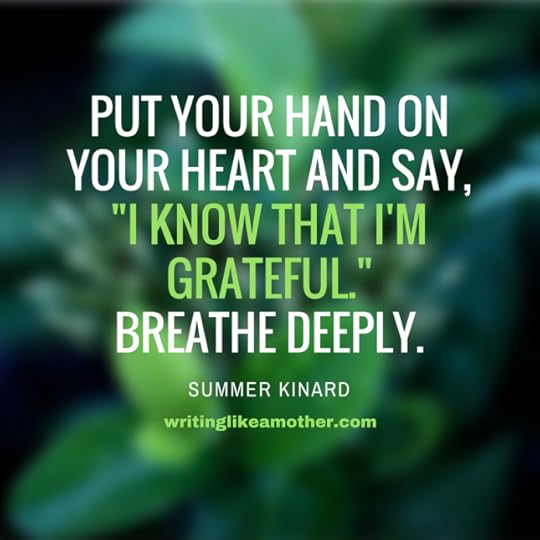
Then it came to me while I waited for the tea to steep. I put my hand over my heart and said aloud,
“I know that I’m grateful.”
The deep breath that followed dropped down grace along with my shoulders. I felt the tension leave me.
My youngest son, the one whose brain works a bit differently, only had a few words when he was supposed to have 100, but those words were zingers. He would cry out in pure joy in the middle of the night, “Ever, ever, ever! It IS! It IS! It IS!” I would wake up when he sang like that with the light of heaven pressed on my eyes, always surprised to find that the room was still dark.
His little voice was the answer to my grownup worried prayers. When? When? When? How long, O Lord? Is there healing? Is there a Balm in Gilead? Is there peace? If I could hold a grain of the joy with which he sang, I would have the mustard seed that moves mountains.
“I know that I’m grateful.”
When I said those words today (and not just the once), I felt that joy come home in me.
“I know that I’m grateful.”
Ever, ever, ever! It is. It is. It IS!
We’re so often advised to slow down. Don’t miss it! Savor life. Live in the moment.
But our bodies are often left in a loop of anxieties and stress. We hold onto tensions far longer than we need to. We watch the doors and windows long after the danger has passed.
“I know that I’m grateful.”
Gratitude got us through the dark night, and it will open the path to us right now.
Let your body in on your present joys. Stop. Put your hand on your heart. Know that you are grateful.


August 13, 2016
Shine
A dozen years ago, my friend Linda introduced me to the practice of polishing silver during penitential seasons of the church year. This weekend, thanks to the kindness of my friend and fellow writer Deborah Hining (whose books you might like!), my children got to experience this practice firsthand. 
We started with tarnish. Can you see your face in the surfaces? We could not. When God looks at us, do we reflect the image of God?
What happens when we clean a patch of the tarnish off? This is how repentance works. Changing habits reveals more and more of the brightness.

It was hard work, but we saw our faces.