Summer Kinard's Blog, page 14
February 16, 2017
a little about writing
Enjoy this brief writing exercise to keep you keeping on through the weekend.
Think of a day that you liked. Now think of a few minutes in that day that you liked especially.
Describe it bluntly. “What I remember most was…”
Check into your senses. Smell? Touch? Weather? Movement? Taste? Colors? Shapes?
What I remember most was the tang of popcorn salt in the air.
What I remember most was her floral perfume melding with the crisp leafy fragrance of the clean wash.
What I remember most was the fog, so dense that my best friend’s neon culottes moving next to me were the only hint that I wasn’t alone.
What I remember most was waking to the whisper of wind that swayed my hammock.
What I remember most was being hugged so that I said the opposite of what I meant, “You’re hugging the life outta me,” when she was hugging it in.
What I remember most was the perfect parabola of his little elbow hovering above the wet sand when the shell began to move.
Now do a little math. Subtract yourself. Add why you cared.
The tang of popcorn salt made the air taste of desire.
Granny’s floral perfume melded with the crisp leafy fragrance of the clean wash. I pressed my face into the scent of home.
The fog closed off my vision until the only hint that I was not alone was the hint of Gloria’s neon culottes alongside me.
Held high in a hammock, I believe that I can be loved by the whispering wind that lulls me and rocks me.
I told her, “You’re hugging the life outta me,” when she was hugging it in.
His little elbow hovered in a perfect parabola above the wet sand when the shell began to move, as though my boy’s love of the sea had made them kin.
Have fun. Practice.
Care to share your results of this writing exercise? Comment below.



February 12, 2017
Vintage Faith: Granny’s House and the Household of God
One of the earliest ways Christians spoke about salvation history –that is, how God works in history –is with the idea of creation as the household of God. In this household, everything was set in order, and the children were both treasured and expected to grow up to be like their Father.
When I came to the ancient Christian faith, I found myself comparing the lessons I learned with my experiences at my great-grandma Granny’s house. Ancient Christian faith is a time-tested way of life, and it resonated in my memories of the way we did things in Granny’s house.
Memory is always overlaid on places. The ancients knew this and developed a system of remembering thousands of minute details by imagining them in familiar places. When St. Augustine tells people in his Confessions to throw open the fields and palaces of their memories to see the way that God has worked, he means an actual practice of forming memory by thinking of a palace or a field that one could remember no matter what.
For me, Granny’s house is such a place. It’s so impressed on my mind that I can imagine walking through every room, though I have not been in that house in over 25 years.
It’s not surprising, then, that the big ideas in the ancient faith – saints, fasting, tradition, hospitality, and devotion – wove themselves around the iron bedsteads and sewing machine and checkerboard kitchen floors of Granny’s house. The meaning of faith shines through the daily acts of care for one another that took place in those rooms.
Saints tell out the meaning of the sewing notions, and the calendar tugs up the scents of seasonal cooking in that kitchen. Everyday patterns of life with Granny show me how to live a faith that is best practiced in small acts of dailiness. This is the same faith that, writ large, looks like art and gold and cathedrals and works of wonder. But here, you can eat it with a spoon and wash your hands in it and put it on when you get dressed in the morning and preserve it when you dust and sweep and mop and tidy.
When I am overwhelmed by my inability to understand or to implement a part of the faith, I find myself back there, a little girl at the knees of my Grandma and Granny, learning how to live a life that will keep.
The ancient faith is faith that keeps.
Join me on this journey to explore Vintage Faith by following this blog or Liking my Facebook page.
What part of your family’s everyday household traditions remind you of the Christian faith?


January 27, 2017
Therapeutic Service Dogs in Church: Let The Children Come
First, let’s clear up a misconception.
Therapeutic service dogs are specially trained service animals prescribed by a doctor to help a person with a physical or developmental disability function in daily life.
They are NOT the same as family pets, which do not have a place in Orthodox Church services.
[image error]
Therapeutic service dogs should be thought of along the same lines that one would think of any prescription from a doctor. If you wouldn’t require someone to stop taking their heart medication in order to come to church, you shouldn’t ask a family to leave a therapeutic service dog at home.
Watch this video that shows how service dogs help children with special needs attend church services.
If you see a service dog in church, how should you act towards the dog and owner (handler)?
Great questions! Here are some tips from my friend and faithful church-goer Jamey Cook, who is blind and has partnered with a service dog for many years:
It is always appropriate to ask a guide dog user before looking at, petting, or talking to the dog.
It is also OK to alert the handler to a behavior, such as telling him/her when the dog is trying to sneak a piece of cake at coffee hour.
Should you need to alert the handler in the rare case of a dog’s inappropriate behavior, let the handler do the correcting. (If the dog is partnered with a child, the parent or an assistant might take care of the behavior.)
It’s OK to direct the dog handler, but it’s not OK to grab the dog’s harness.
Also, being occasionally stepped on is an occupational hazard for guide dogs–trying to avoid that is a good idea, but don’t worry to much if it happens accidentally.
I hope this post helps take the mystery out of how to welcome families with service dogs into church services.
Do you have experiences with trained therapeutic service dogs* in church services? Share in the comments.
This post is based in part on research for my forthcoming book co-written with Charlotte Riggle on welcoming families with special needs into the faith life and fellowship of the Orthodox Church. Follow this blog, like my page on Facebook, or subscribe to my quarterly newsletter for updates.
*For the sake of explaining to people unfamiliar with the range of service dogs, I have sometimes called therapeutic service dogs “therapy dogs” for short. There is another set of dogs called “therapy dogs” that specialize in visiting gently with people in schools or nursing homes. For the sake of this article and video, however, I am speaking of the specially trained service dogs who have a therapeutic role in the lives of their disabled human partner.*


Therapy Dogs in Church: Let The Children Come
First, let’s clear up a misconception.
Therapy dogs are specially trained service animals prescribed by a doctor to help a person with a physical or developmental disability function in daily life.
They are NOT the same as family pets, which do not have a place in Orthodox Church services.
[image error]
Therapy dogs should be thought of along the same lines that one would think of any prescription from a doctor. If you wouldn’t require someone to stop taking their heart medication in order to come to church, you shouldn’t ask a family to leave a therapeutic service dog at home.
Watch this video that shows how service dogs help children with special needs attend church services.
If you see a service dog in church, how should you act towards the dog and owner (handler)?
Great questions! Here are some tips from my friend and faithful church-goer Jamey Cook, who is blind and has partnered with a service dog for many years:
It is always appropriate to ask a guide dog user before looking at, petting, or talking to the dog.
It is also OK to alert the handler to a behavior, such as telling him/her when the dog is trying to sneak a piece of cake at coffee hour.
Should you need to alert the handler in the rare case of a dog’s inappropriate behavior, let the handler do the correcting. (If the dog is partnered with a child, the parent or an assistant might take care of the behavior.)
It’s OK to direct the dog handler, but it’s not OK to grab the dog’s harness.
Also, being occasionally stepped on is an occupational hazard for guide dogs–trying to avoid that is a good idea, but don’t worry to much if it happens accidentally.
I hope this post helps take the mystery out of how to welcome families with service dogs into church services.
Do you have experiences with trained therapy or service dogs in church services? Share in the comments.
This post is based in part on research for my forthcoming book co-written with Charlotte Riggle on welcoming families with special needs into the faith life and fellowship of the Orthodox Church. Follow this blog, like my page on Facebook, or subscribe to my quarterly newsletter for updates.
January 26, 2017
Multicultural Children’s Book Day Review: Chocolate, Math & Cars, Oh My!
Over the past year, as I’ve delved into therapy for my son with autism, I have found the joy in working with his strengths in order to reach him and teach him. That’s one of the reasons I was delighted with Eddie and the Hot Cocoa Hot Rod by Valerie Williams-Sanchez.
Eddie loves cars, and I love the glorious language with which he loves them. Read aloud this rhyme that Eddie repeats to himself throughout the book:
Cars that are big and cars that are small, minivans, sports cars, I like them all.
Cars that race and cars that roar, the louder their engines, I like them more.
[image error]
The central rhyme is Eddie’s heart music, and it dances in and out of a story of redemption perfect for any child facing a major challenge.
Eddie begins the story so distracted by his love of cars that he fails his math test. Through the team work of his parents, a car-loving and dedicated math teacher, Eddie, and his new friends in the car club, Eddie’s love of cars inspires him to focus and work hard on math. By the end of the story, Eddie has mastered math and found a group of like-minded friends. The people around Eddie helped him master himself by embracing his love of cars.
Like all of Ms. Williams-Sanchez’s, Eddie and the Hot Cocoa Hot Rod has an element of chocolate. In this story, chocolate is part of a stabilizing ritual that also forms Eddie’s imagination. He thinks of his favorite car, the titular hot rod, as the color of hot cocoa. Readers will appreciate the brightly executed and well-framed juvenile-style illustrations that feature Eddie’s multiracial family and a diverse group of friends.
What I Loved About This Book:
The story was well executed and complex while remaining relevant and accessible to children.
That poem! It reminds me of the rhymes in Pantaloon and The Cat in the Hat –words that suit the story so well that they sing in the mind and make reading a joy.
The adults in this book reach out to Eddie by building on what he knows and loves. I’ve not found a better recipe for learning or teaching, and I’m glad to see that wisdom in an enjoyable story.
The hot cocoa. Eddie’s mom loves him with a daily ritual of chocolate. I support that.
You will find Eddie and the Hot Cocoa Hot Rod and the entire Cocoa Kids Collection of books at {Valerie Williams-Sanchez’s website}.
[image error]
Did you know?
Despite census data that shows 37% of the US population consists of people of color, only 10% of children’s books published have diversity content.
Multicultural Children’s Book Day 2017 (1/27/17) is its fourth year and was founded by Valarie Budayr from Jump Into A Book and Mia Wenjen from PragmaticMom. Our mission is to raise awareness on the ongoing need to include kid’s books that celebrate diversity in home and school bookshelves while also working diligently to get more of these types of books into the hands of young readers, parents and educators.


January 14, 2017
My View While Writing
A writer’s view is largely internal. We imagine other places and see through faces that are not our own. I watch another’s hands stir the dough and turn earth and lock the clasps that change their histories. We live in a world steeped with accumulated memories and sighs, the ink of our pens washing out layers previously hidden.
[image error]
Don’t be deceived. Imagination relies on our bodies. We write in the intersections of body and soul, and a pen cannot move forward a jot without both. Writing is an act of the body-soul union. All writing is prayer in this way.
What we put before our eyes affects the vision of our mind’s eye. I can’t trace all the effects of my writing view, but I know it helps me write. The safe space, the sacred space, makes me brave.


January 8, 2017
Some Myrrh Podcast: Spiritual Warfare
Over the past year, I’ve had the privilege of being a guest on podcasts and radio shows, and a few friends have suggested that I give podcasting a try. Here’s my first go. Give it a listen, and let me know your thoughts in the comments.
Spiritual Warfare. It’s not what you think it is.
[image error]
Spiritual Warfare podcast. Some Myrrh
https://writinglikeamother.files.wordpress.com/2017/01/spiritual-warfare-recording-1-2017-01-08-t04-40-07pm-somemyrrh-0h14m51s.mp3


December 20, 2016
How to Give Alms
If you have compassion fatigue, this post is for you.
[image error]
Revealing God’s presence one dollar at a time.
The biggest mistake that people make with almsgiving is applying corporate law to their reasoning. There are lots of types of charitable giving. There’s philanthropy to community organizations, stewardship of church life, tithing outright to religious organizations, fundraising, supporting far flung ministries and relief. They’re all good things, but they aren’t almsgiving.
For the sake of almsgiving, organizations do not count as people.
Now that that’s out of the way, you can focus on what almsgiving really is and why it matters. In seasons of fasting, almsgiving can be especially important. I talked about what almsgiving means in my life with Angela Doll Carlson on her Ancient Faith podcast, The Wilderness Journal. Check out those episodes {here} and {here}.
Alms are given by one person to another person, in person.
They are given without judgment and in humility.
They are an outpouring of overabundant gratitude to God, whether or not they flow from an abundance of financial resources.
The teachers of the Church have always stressed the importance of almsgiving for spiritual health. If you have compassion fatigue from the stacks of requests for financial support that come in the mail at this time of year, this should relieve you. Why? Because the pile of demands that meet you online and in your mailbox are not required of you.
Alms are not grand gestures. They’re quiet, and they’re personal. They won’t get your name on a mailing list or on a brick or a wall or a scholarship.
You also don’t have to go out of your way to find and put together a Pinterest-worthy “blessing bag” or other pre-packaged gift to beggars. In fact, it’s probably better that you don’t.
Almsgiving is fundamentally a practice in not judging one’s neighbor.
If you avoid almsgiving because you think poorly of the characters of beggars, then perhaps it’s time to make a good beginning.
Here’s how to give alms to strangers:
Gather small bills. If you don’t carry cash, go out of your way for a month to save change and have it turned into dollar bills, or cash a $20 bill into ones. It takes preparation.
Use the time of preparation as a reminder to thank God and to pray for those who will receive the alms, whoever they are.
Put a few dollars, folded individually, into a pocket or an accessible place in your vehicle if you’re likely to see people while driving.
When you see a beggar or happen upon someone short a couple bucks in line, give the money to them, from your hand to theirs.
Ask them to pray for you. You can say, “please pray for me,” or “Please pray for my family,” or “Please pray for {your name} a sinner,” if you like. (That last one seems over the top in the US, but do as you feel led.)
If they ask you to pray for them, too, tell them you’ll do so. If not, nod anyhow.
Smile and go on your way, thanking God for the glory of a person – the living icon – you just got to encounter. Pray for them.
To friends, it’s up to you. Cash, check, gift card, anonymous or not, the main thing is that you give freely and with gratitude.
Did I just tell you to give with gratitude? Yes. You will become happy in giving. It will humble you and fill you with joy and thanksgiving.
What if you need alms?
Ask. Let your need be known. Pray. Give thanks to God whether you receive or not. Do not allow oppression to make you bitter. When you receive alms, pray for the people who gave.
Last year, our family had a few months of financial crisis during which we gratefully received alms from several families of our acquaintance, some anonymous and some not. I was profoundly grateful to all those who gave, and I spent hours before the icons thanking God for the givers and praying for them.
If this sounds a bit like you’re buying prayers, that’s because alms is a part of praying without ceasing that you can see. When the desert fathers talked about praying without ceasing, they assumed the poor they supported by their alms would pray for them while they slept or took care of other bodily needs.
We are all in the presence of God together, and almsgiving makes the togetherness visible.
What’s your experience with almsgiving? Comment for our mutual encouragement.
{For a reflection on almsgiving during my time of trying to give alms in-kind, check out my older post, A Tale of Two Grannies.}


December 8, 2016
Rend Your Hearts and Not Your Intestines
If you have food allergies or a special diet, you might have heard some of these misconceptions at church.

I remember blinking into the bright window at the allergist’s office as he handed over the prescription for my Epi-pens. “Anaphylaxis is a train leaving the station. We have to catch it before it gets going,” he said. I had gone to him after my throat started swelling closed on an ordinary morning. I thought maybe I had developed a peanut allergy because of how dull my breakfast had been: toast with butter and strawberry jam, tea with sugar and milk, and a bite of the peanut butter Lara bar my son handed me. But the allergist was holding a readout with a very strange set of answers. I was allergic to wheat.
The first thing I thought about when I got home was how I was going to commune at church. I inquired of the Lord and immediately heard a word of comfort: Man does not live by bread…
View original post 1,064 more words


November 27, 2016
Visual Schedule for Orthodox Liturgy
I know I’m not the only parent who gets asked a few dozen times, “When is Feast of Peace?” or “When’s Communion?” I made this visual schedule of the Liturgy for my child who has trouble with sensory processing and transitions. I hope this helps lots of other parents, too!
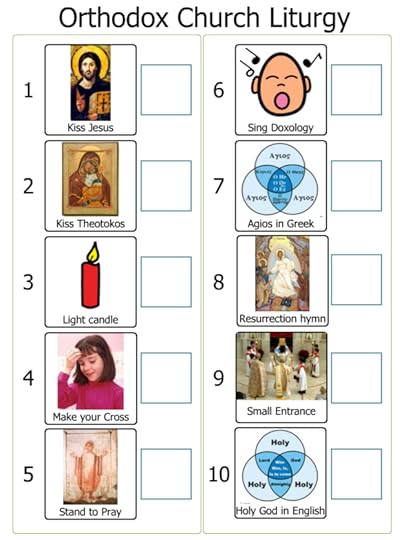
Download the PDF version of this and the other 2 pages of the Visual Schedule for the Divine Liturgy on Writing Like a Mother. Author Summer Kinard put this schedule together for her own children.
This is all part of my effort to make the Orthodox Christian faith more accessible to children and families with special needs. My friend Charlotte Riggle (author of Catherine’s Pascha) and I are hard at work planning a book on the subject. Grab these schedule pages, share with friends, and if you will, comment to let me know which issues you’d like addressed in our book. What do you love about the faith that you don’t want your child or family to miss out on?
Here’s the Visual Schedule for Children in wheelchairs:orthodox-liturgy-wheelchair
All images either from BoardMaker or the Internet. Not copyrighted, but also not for commercial use. Please give credit and link back to this post if you share. Thank you!