Dan Eldredge's Blog, page 7
October 16, 2015
Joe Dever's Lone Wolf
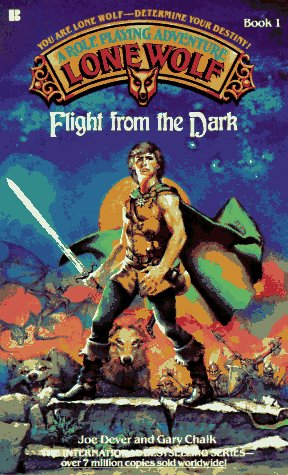 In Junior High School I went to my school's book fair and I found Book 1 Joe Dever's Adventure Gamebook series Lone Wolf: Flight from the Dark. I had already been a fan of Choose Your Own Adventure books, but this was a step beyond that--rather than simply making decisions, you created a character, with skills and equipment you chose at the beginning of the book, and used them throughout the story.
The stories were engaging and exciting, with a real risk of failure that added, and they were replayable--the next time you read them, you just made different decisions and explored new avenues in the story that you previously didn't know existed.
Lone Wolf wasn't the only Choose You Own Adventure series, there was also the Zork gamebooks, based on the computer game at the time, but in my opinion (then and now), Zork never could hold a candle compared to Lone Wolf.
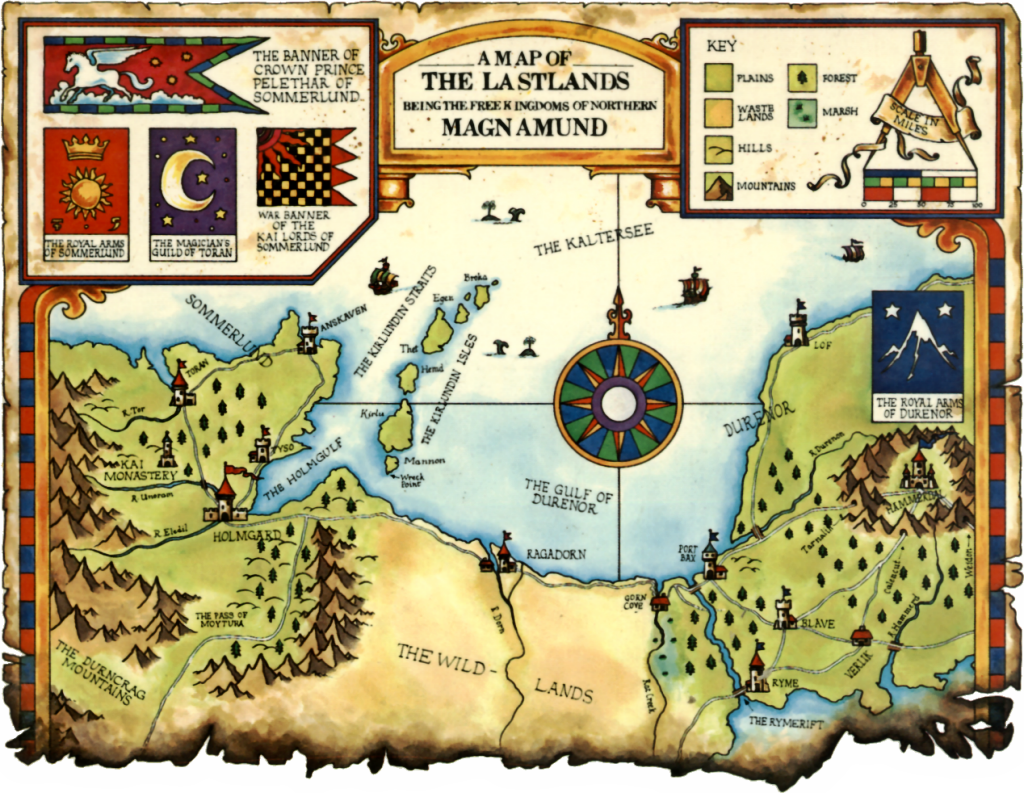 The map for Flight from the Dark and Fire on the Water, courtesy Project Aon and Joe DeverAfter rapidly consuming the first three books, I would eagerly look for the next book in the series every time I went to the bookstore. With each new book would come a new map, and I would excitedly pore over the map, wanting to see what new lands Lone Wolf would explore in each new adventure. My love of maps, which wasn't restricted to Lone Wolf but was certainly encouraged by it, in part inspired me to make my own maps, which contributed in its own way to the creation of my own world, which is now the world of my novels
The Pirates of Alnari
and
The Grand Masquerade
.
The map for Flight from the Dark and Fire on the Water, courtesy Project Aon and Joe DeverAfter rapidly consuming the first three books, I would eagerly look for the next book in the series every time I went to the bookstore. With each new book would come a new map, and I would excitedly pore over the map, wanting to see what new lands Lone Wolf would explore in each new adventure. My love of maps, which wasn't restricted to Lone Wolf but was certainly encouraged by it, in part inspired me to make my own maps, which contributed in its own way to the creation of my own world, which is now the world of my novels
The Pirates of Alnari
and
The Grand Masquerade
.I also bought the Magnamund Companion, which was an excellent supplement to the series, but I had a major complaint--it was way too short. I wanted more.
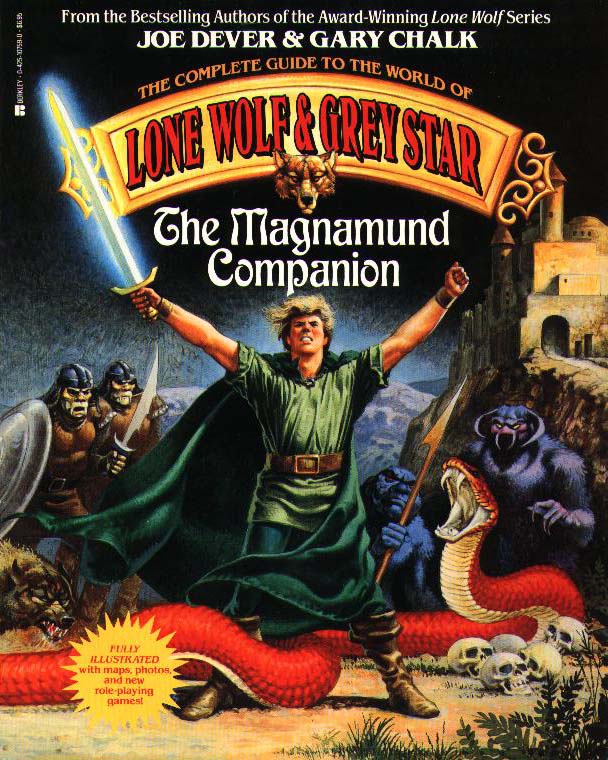 Within the pages of The Magnamund Companion was a section called "Modelling Magnamund", which had a cool diorama of the Kai Monastery under attack by an army of Giaks led by a wizard. There was a little note mentioning that parts of the model were made by a company called "Citadel Miniatures" that had a worldwide mailing service. I sent in a letter...and within months I got into this crazy wargaming hobby, with my first purchase of some Chaos Warrior miniatures and Warhammer Fantasy Battle, 3rd edition.
In later years, long after I had played through the books multiple times, I would read the books just for their story value alone, which made them worth the read. But by the mid-90s, I had a hard time finding any of the books after Book 12. With the rise of computer roleplaying games, it seemed like the Lone Wolf books were petering out.
Fortunately, Lone Wolf's adventures did not end there. Years later, while looking online to see if any Lone Wolf stuff might exist on the web, I stumbled upon Project Aon. To my astonishment, Joe Dever was still around and kicking (great news), and more than that, he had generously allowed some of his books to be published online by the project, and thereafter to be downloaded free of charge. Talk about awesome. Twenty-five to thirty years after the series first appeared, I would get to be able to read the most recent books in the series. What's more, the nature of the books, with the reader jumping from numbered section to section in pursuit of the story, was ideally suited to modern ereaders. I had always intended, and now I have the chance to do it with both the original books, and with ebooks.
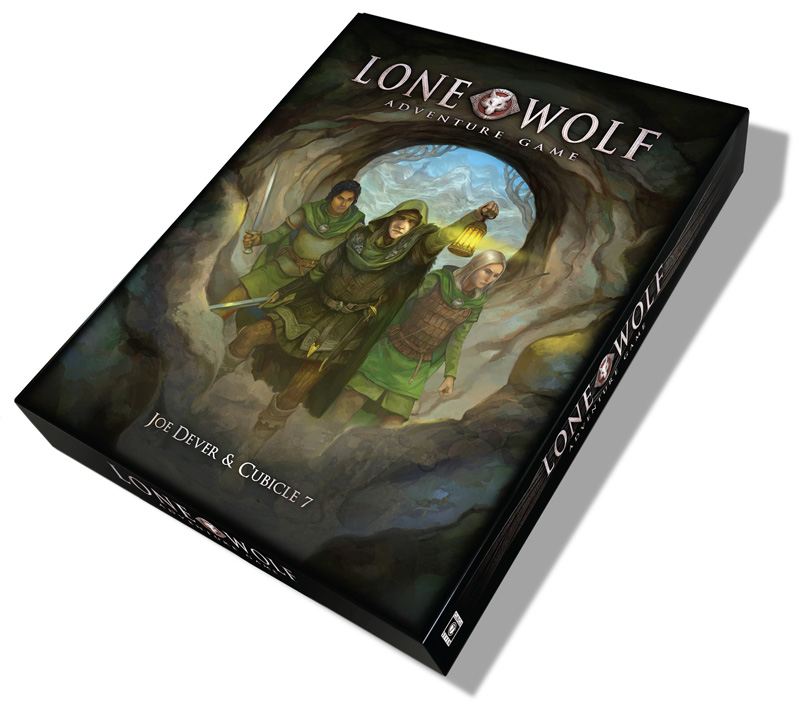 But that's not all. Joe Dever has teamed up with Cubicle 7 to create the Lone Wolf Adventure Game, a tabletop RPG inspired by the original gamebooks. The game system incorporates the original gamebook rules and expands upon them, resulting in an a very simple game system suitable for beginners, but can also be made more complex for more experienced gamers (more on this in future post). This is brilliant, as it allows old time Lone Wolf fans to use the game as a fantastic way to introduce their kids to tabletop RPGs, but its expandability gives it life as a game for when the kids get more experienced, or as a game between adults. I plan on taking my kids on their first (simple) tabletop adventure soon, and once I do, I'll post a recap here.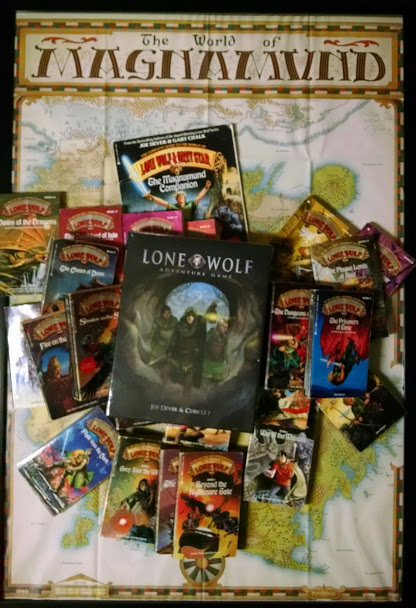
For Sommerlund and the Kai!


October 15, 2015
Wargaming Terrain: Mediterranean Villa
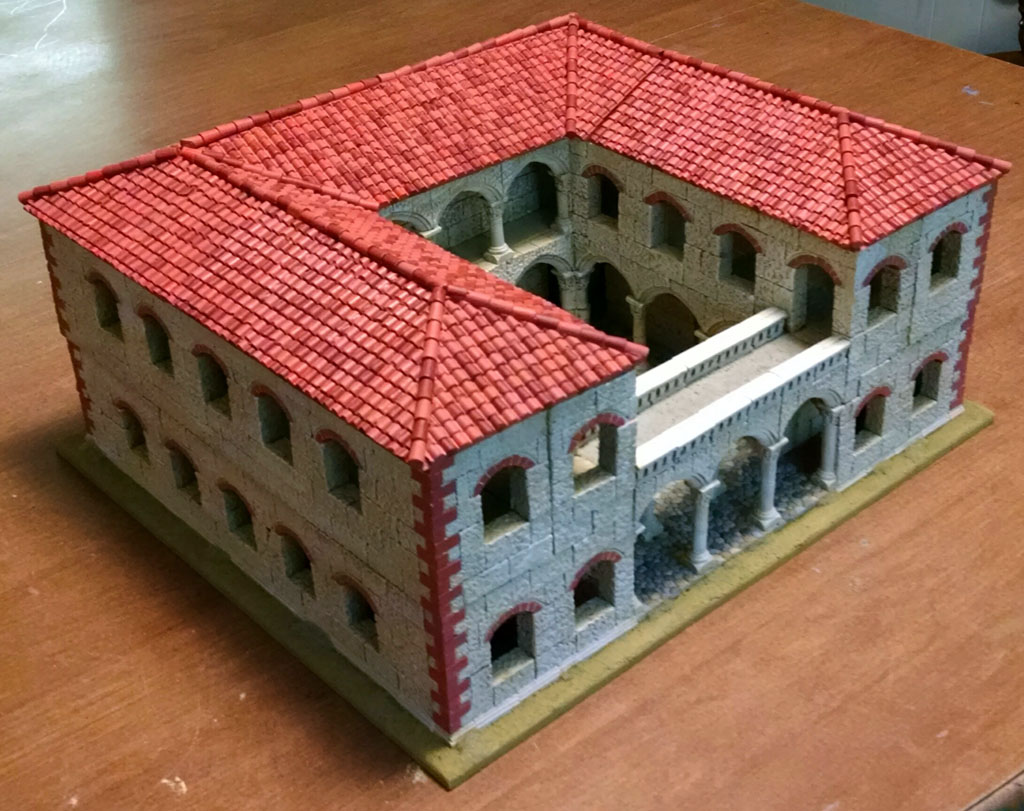 I recently completed a relatively large piece of gaming terrain for use in games of Bolt Action, using plaster blocks made from molds from HirstArts.
It could also be used in any 28mm wargame, including Warhammer 40k, Warhammer Fantasy or Kings of War.
The first thing I did was cut out a piece of 3/8" thick MDF to the required dimensions, then sanded down the edges to smooth them a bit. I had some extra dental stone left over from a previous project, so I made a few molds of that, but I did the majority of the model using Plaster of Paris. Plaster of Paris is not a very durable material, but it served for this. We'll see how it holds up to actual gaming.
The molds I used are HirstArts molds #40, #41, #45, #53, #54, #60, #202, #210, and #230.
I drew the basic layout of the floorplan directly onto the MDF, and then started gluing pieces in.
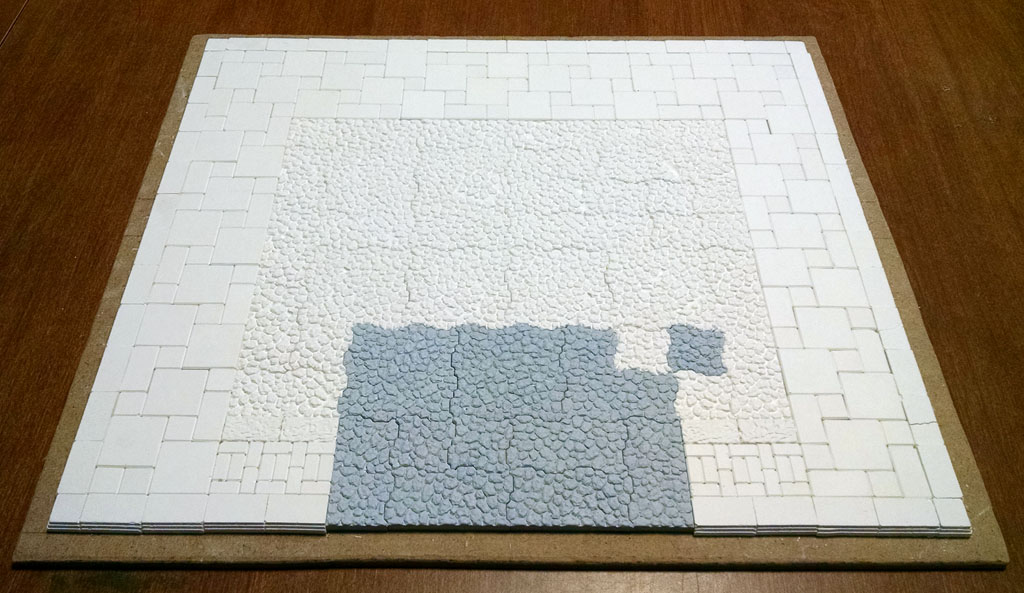 The courtyard and entryway was cobblestone from mold #210 while the hallway tiles were a pattern of tiles from mold #202. The edges were from mold #54.
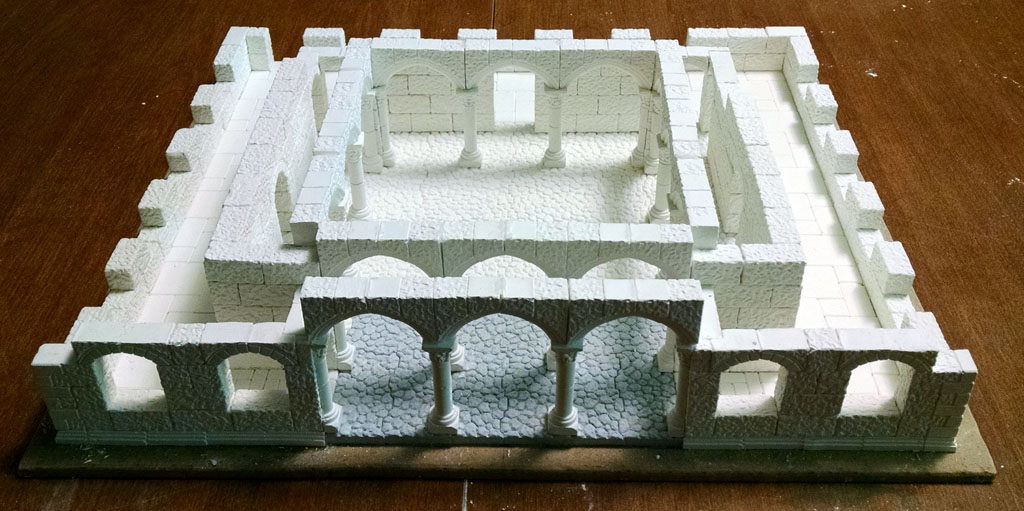 I started building up the walls. I used a form (made of legos) where I could, but in my haste things didn't come out perfectly and everything isn't perfectly aligned. I rationalize this by saying that this villa is old and has survived some settling, ground shifting, earthquakes, and nearby artillery barrages.
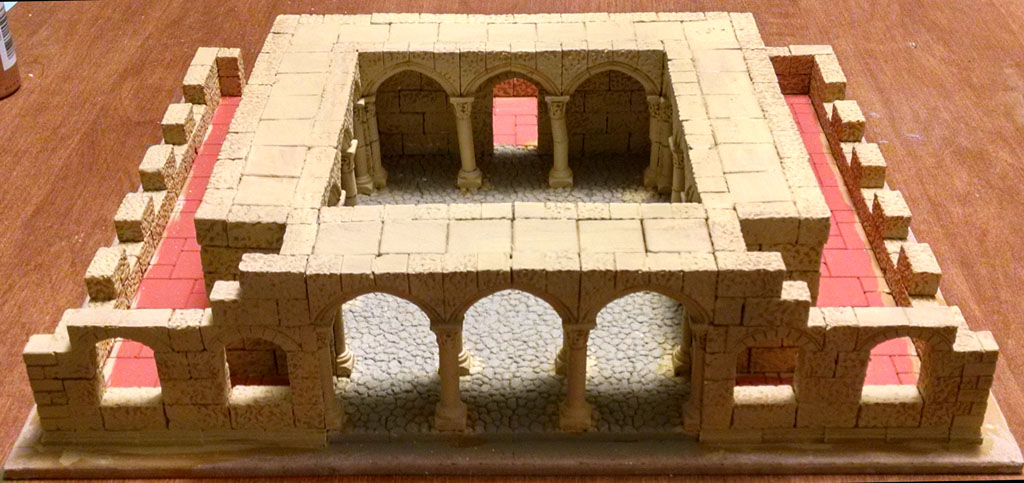 I started painting some of the hard to reach places that would become even more inaccessible once the model was completed. At this point I kept building and forgot to take pictures, so we jump ahead to the final result:
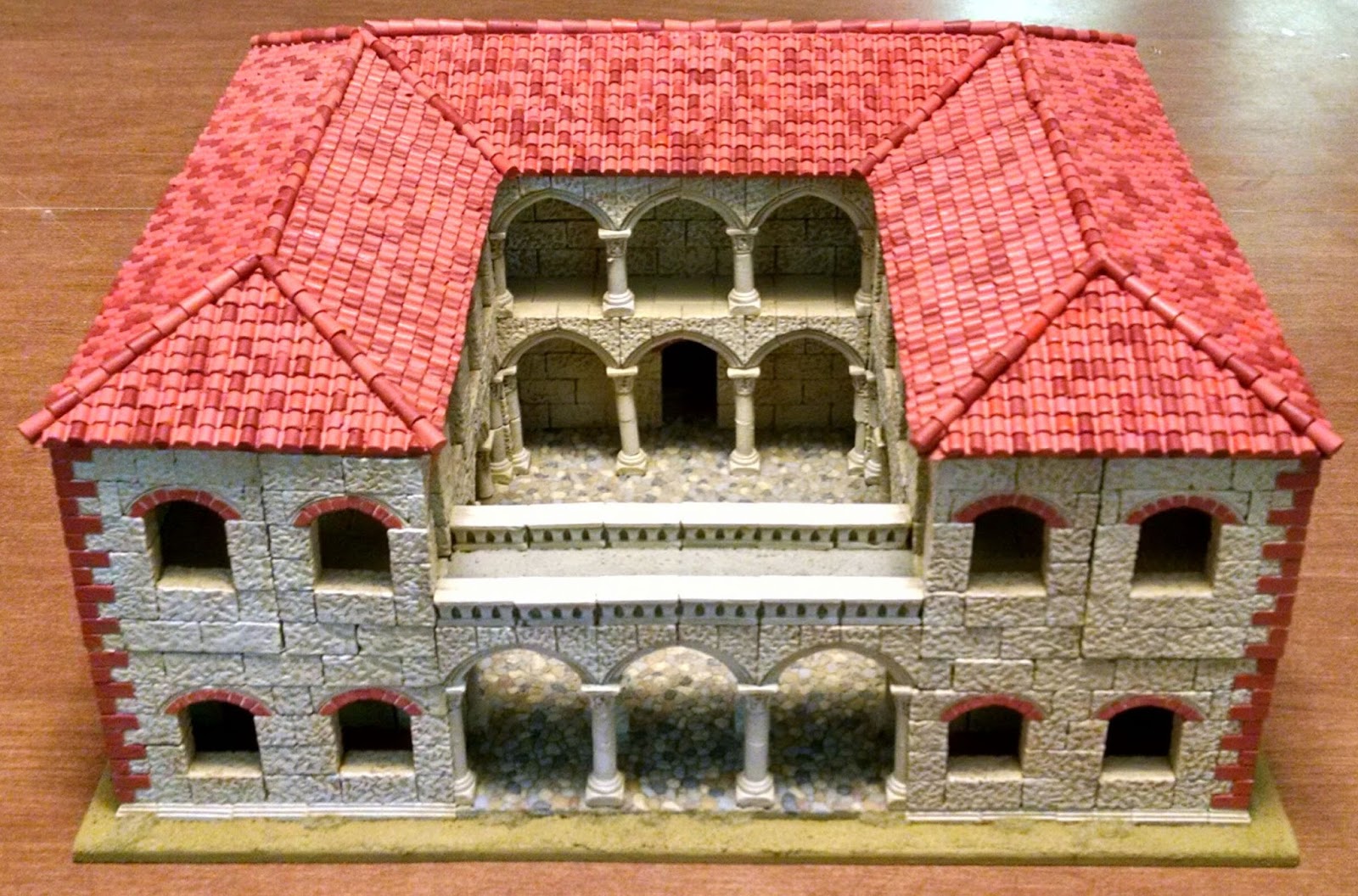 I coated the base in sand and painted it Vallejo Middlestone, and put some static grass on it as well. I made some supports for the roof, then used posterboard as a base layer upon which to mount the roof tiles.
 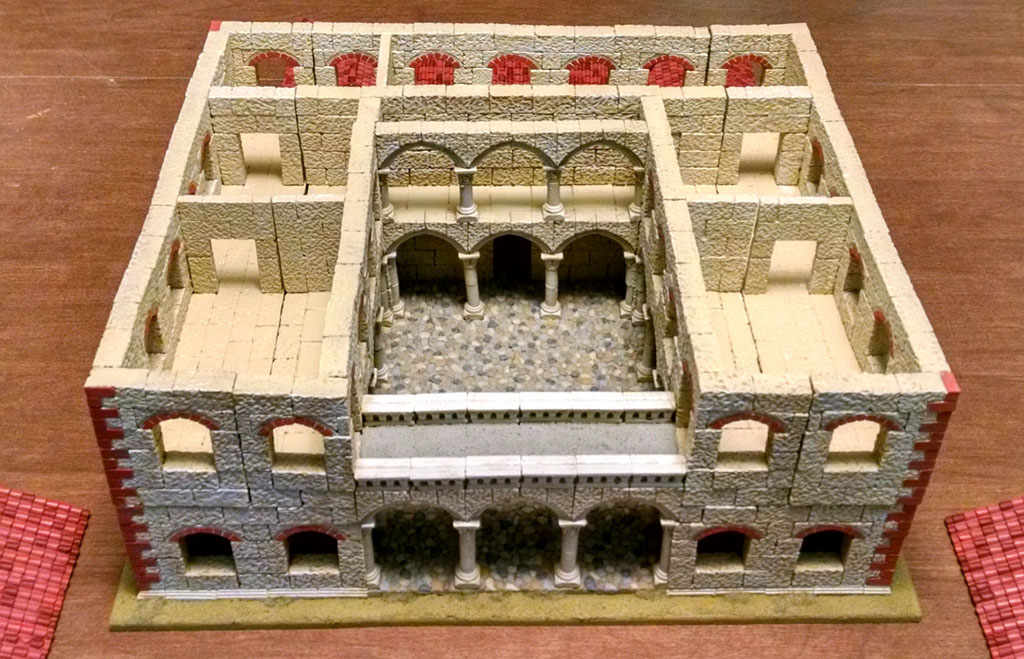 Here is the model with the roof removed for access. I painted the cobblestone courtyard a variety of shades, and did the same with the terracotta tile roof--little details like this may take a while, but I think the effect in the end makes the extra work worthwhile.
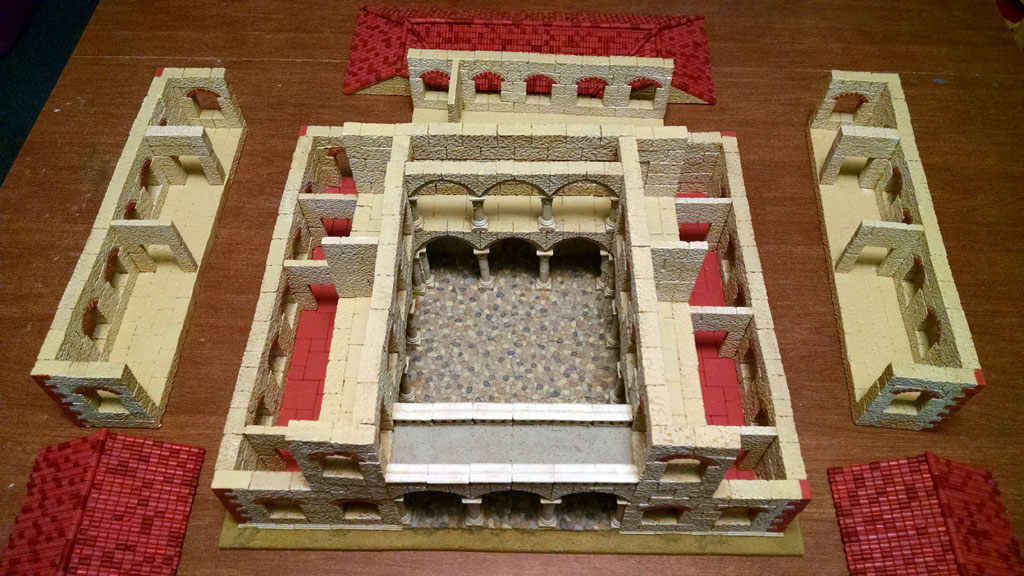 ...and with parts of the second floor removed for additional access.
The finished model.
...and with parts of the second floor removed for additional access.
The finished model.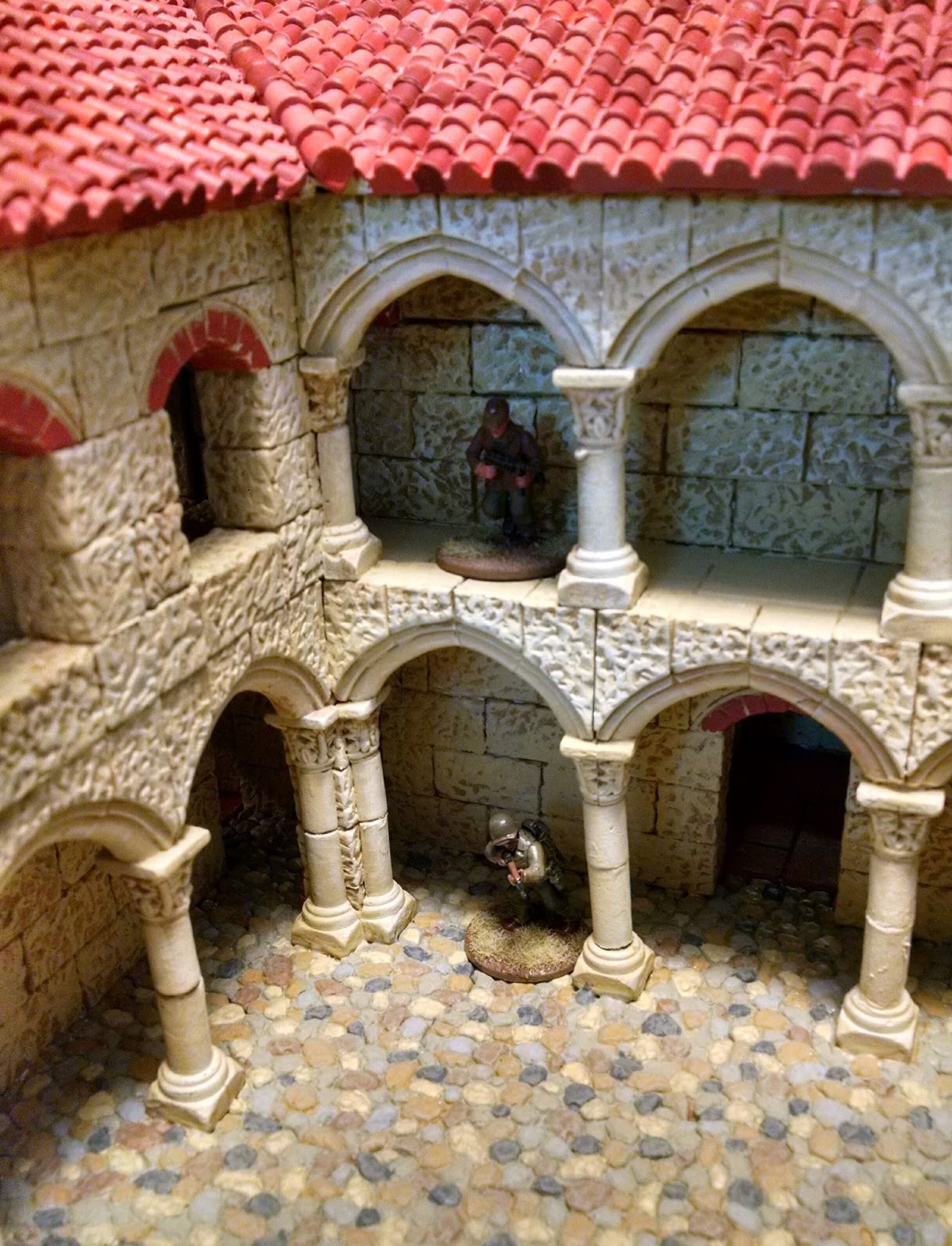 Looking out for any Krauts that might be lurking about...
September 25, 2015
Killington Spartan Beast 2015
 September 19, 2015
They say that when you are in the midst of a difficult trial, there is a moment of truth in which you overcome your fears and succeed in achieving your goal (or don’t). The Killington Spartan Beast was the trial, but my moment of truth for it actually came several weeks ahead of the race.
I started doing Obstacle Course Races in 2014 with the Boston Spartan Sprint. At the time I felt completely out of shape and unprepared, but I desperately needed motivation to get myself out of my funk, so I took on the challenge. After seven weeks of exercise doing an accelerated couch-to-5k program, I did the race. It took me a long time, but I finished, and realized that Obstacle Course Racing was something I could do again, and use it to keep my motivation to exercise up. I started off 2015 with the Bonefrog Challenge in May, which was a much more difficult race. I managed to finish that race as well, but again, I took a very long time. In June was Tough Mudder, which was much the same story. But the ultimate prize was the Spartan Beast at Killington in September. Everything I had heard about this race was intimidating, and unlike the Bonefrog and Tough Mudder, none of my friends would be participating, so I would have to go it alone. If I did a Spartan Sprint, Super, and Beast in the same calendar year, I would earn the coveted Spartan “Trifecta”. I had considered a slower ramp up of difficulty by doing a Sprint in 2014, a Sprint and a Super in 2015, and the entire Trifecta in 2016. With none of my friends even doing the Super in 2015, I wavered on doing it, but I bit the bullet and did it alone in late June, and it wasn’t so bad. And with the Super under my belt, I decided that I had to go for it and do the Beast as well, so I signed up.
And then, as things always happen, Murphy’s Law intervened with a vengeance. Barely days after I signed up for the Beast and began a strict training regimen, my 6-year-old daughter was hospitalized for a week with salmonella. The important thing is that she is fine now, but my first month of training was completely shot. Then work started getting extremely busy, and on top of that my mother-in-law got sick with multiple hospitalizations (she's on the mend now)...and my training regimen collapsed into nothing. Instead of ramping up my training as I needed to, I had stopped exercising entirely. In the meantime I did the Battlefrog in July and the Spartan Sprint in August, but the races themselves were the extent of my training. The entire year, with all of its OCRs, was supposed to be training for the Beast, but it seemed that the gods were out to stop me. Work was also supposed to get extremely busy right about the time of the Beast, so things would be even more stressful than usual. To say I was discouraged was an understatement.
Then, about three weeks before the race, I came to the realization that I didn’t have to do the Beast. I could always defer it to 2016, and pay the transfer fee (which, considering the circumstances, didn’t seem that bad). So I came to the conclusion that I had taken on too much, and I made the decision to postpone the Beast indefinitely. Immediately, I felt a huge sense of relief, and I could feel the stress begin to melt away.
But within a day, I felt like a total failure. I had given up before I started and that crushed me. Due to my lack of conditioning, I felt that I would be in deep trouble if I did the race, I knew that would regret not making the attempt.
So I committed to it.
 As time got closer to the Beast, the nervousness was palpable on the NE Spahtens Facebook page. People were debating (and panicking) about packing the right gear, the right foods, and about not being prepared, and so on. By now I had done enough races that I felt confident that given enough time, one way or another I could complete the Beast. The obstacles didn’t scare me, the mountain scared me only a little, but the time limit did scare me. I am terrifically slow, even more so on hills. In the previous six races I had done, people would constantly pass by me for most of the race, and then towards the end I would start passing people sitting down on the side of the trail, out of steam. But the Beast was different thing entirely, and there was a real risk of DNF (did not finish) due to my slow speed. The race was billed as 12+ miles, but realistically was more likely to be ~16 miles, on the very steep Mount Killington, VT.
But fortunately the NE Spahtens got a team start time of 8:00am (being a part of the largest team has its perks). With the course open until 10:00pm, I felt I would have the time I needed, provided nothing catastrophic happened. Even so, Killington Beast veterans continually reminded me to keep moving throughout the race and not stop for anything.
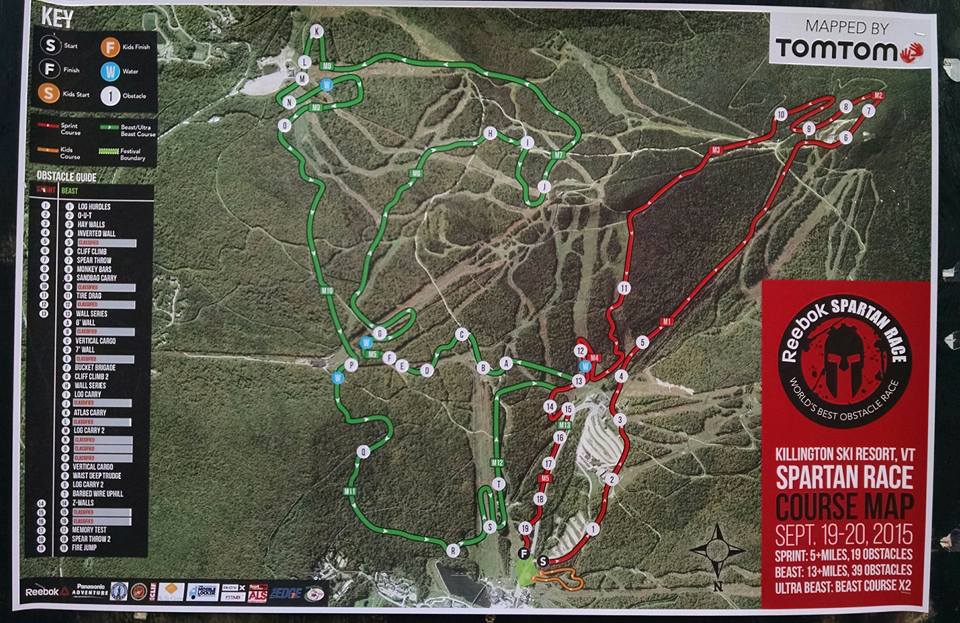 Course Map
I had gotten a room in a quaint old hotel in White River Junction, VT, and on the day of the race, I got up at 4:30am and drove in the dark to Killington, arriving at about 6:30am, just as the sun was rising over the mountains.
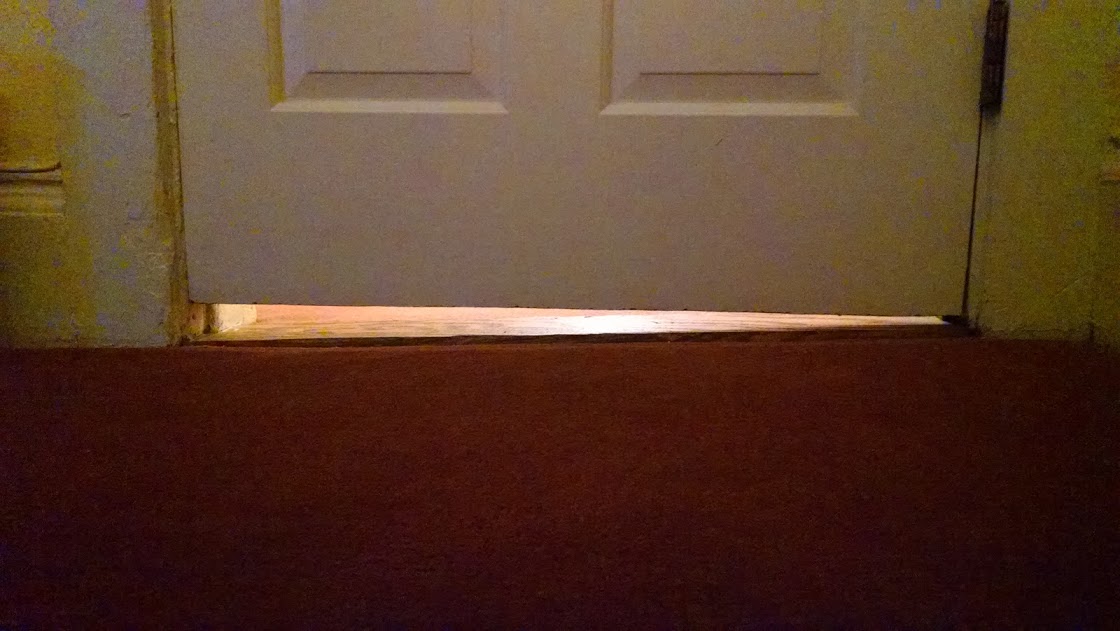 The door to my room in the "quaint old hotel"
 Registration was easy as usual, and I checked and double-checked my gear before dropping off my bag at the bag check. I took a final pit stop in the bathroom, where a lot of people were dealing with frayed nerves, and then left back towards the team tent. I did some stretching, stayed for the team photo, and before long it was time to head towards the Start line.
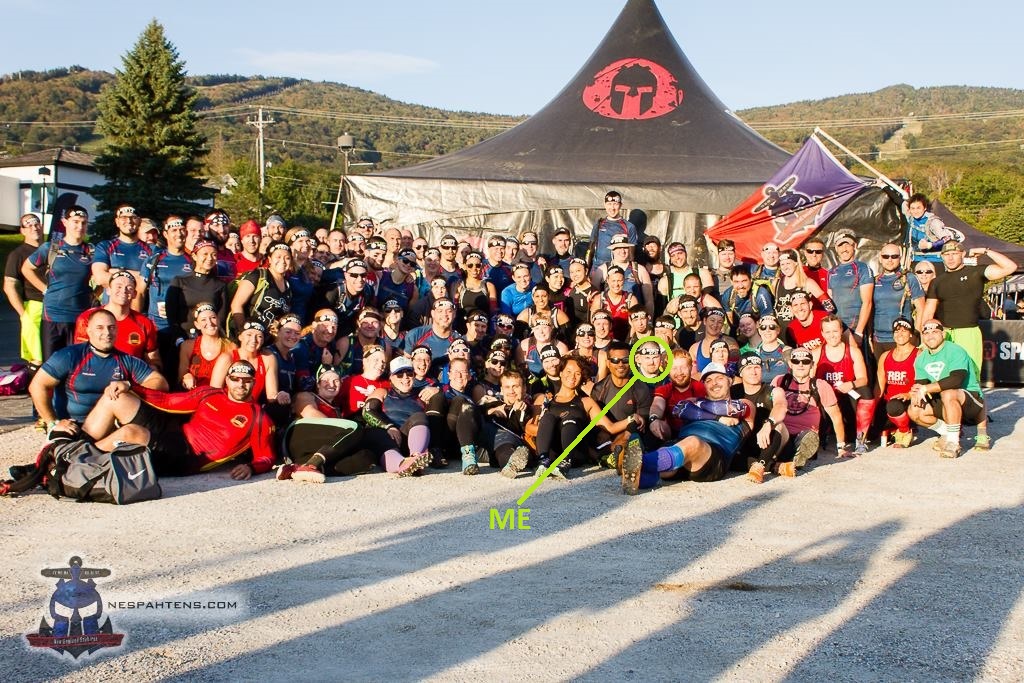 Pre-race Team photo. Courtesy NE Spahtens
Time: 0:00Distance: 0.0 milesElevation: 2,280 ft
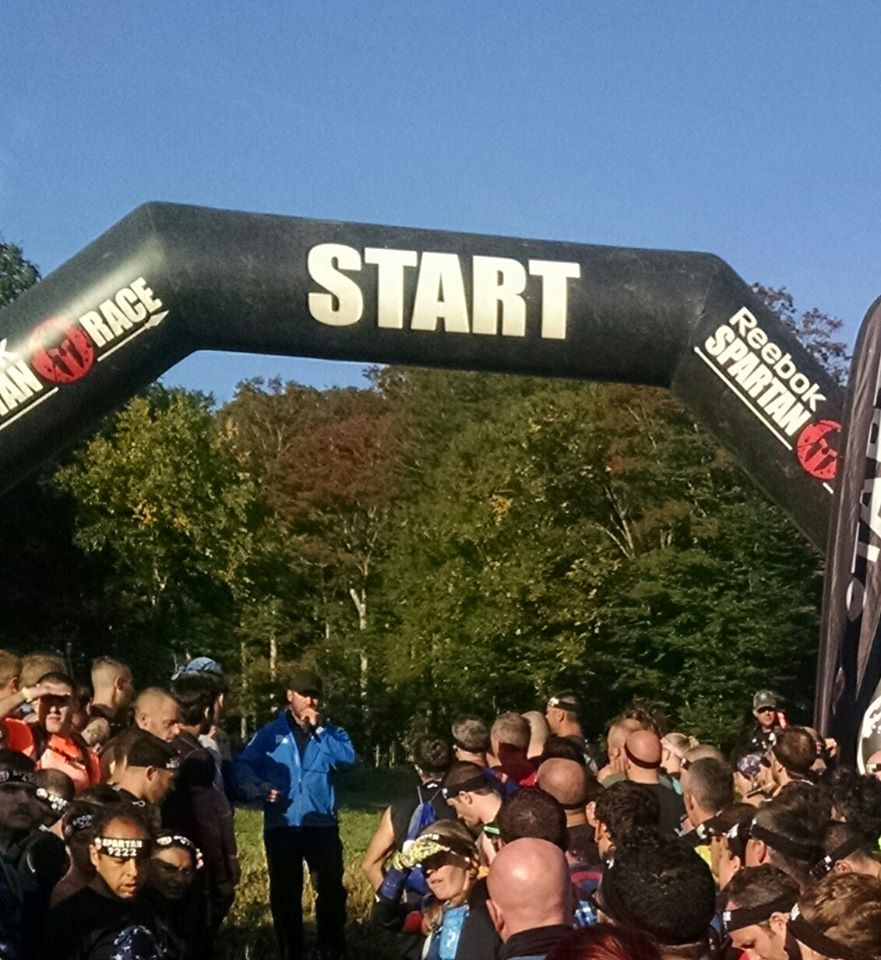 The motivational speech at the Start Line
There was the standard speech to start the race, and we were off. My pre-race jitters evaporated by now, and the weather was beautiful. The first mile or so of the course was relatively flat, with some of the standard easy obstacles to warm us up, Log Hurdles, O-U-T (over-under-through) walls, Hay Bales, and an Inverted Wall. Next was the Memorization Code--we had to memorize a code that they would ask us later in the race. (Note: Just like the Spartan Super...they never did ask us the code later on) I found my code (Juliett 199-2601) and moved on quickly. And then the next mile was straight up the mountain to Killington Peak, 1,500 feet up.
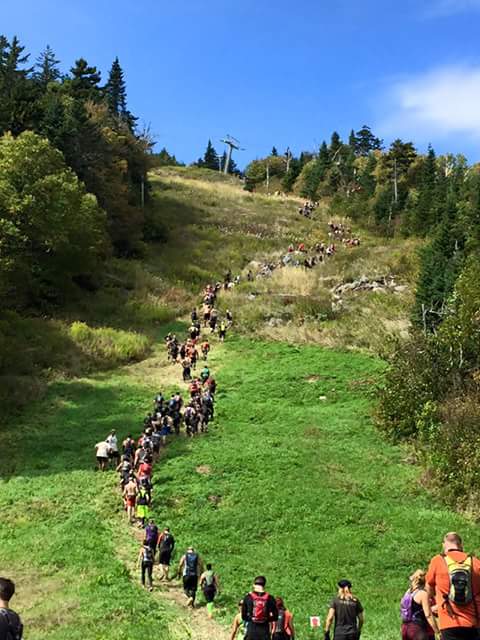 Up the Mountain. Photo courtesy NE Spahtens
I went at my own pace, practiced controlling my breathing and used the rest step, and although the climb was extremely long, it wasn’t all that bad. There were a few points along the way where roads crossed the trail, and I saw what would become a recurring theme: at every convenient stopping point, people took a seat and rested, enjoying the view and eating like they were having a picnic. It had been drilled into me by all Beast vets that I needed to keep moving, so I never stopped. I just snacked on the move and kept going.
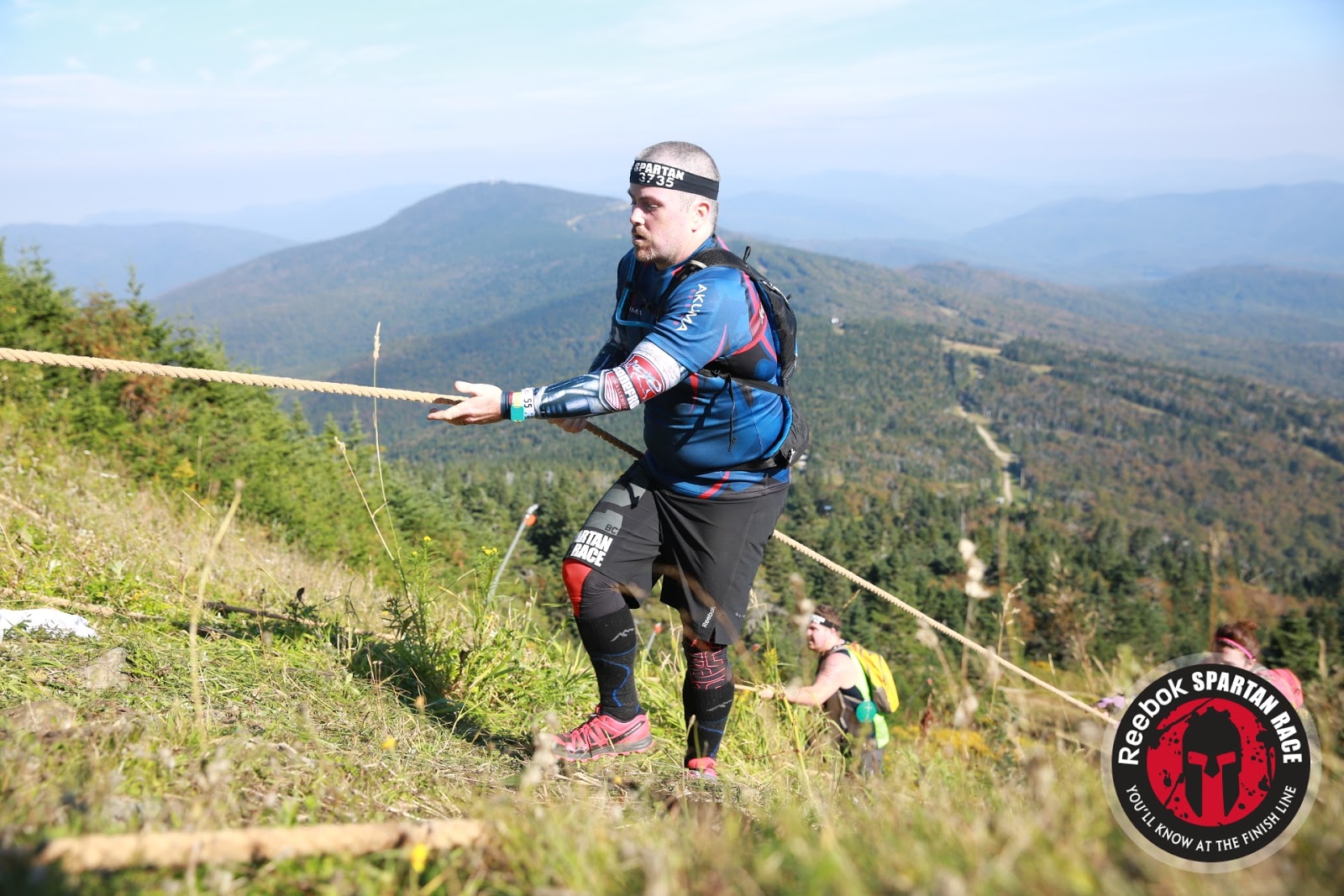 Cliff Climb
The last part of the summit climb they had a rope assist, aka the Cliff Climb. At the summit I stopped long enough to take a picture, and then it was on to the Spear Throw.
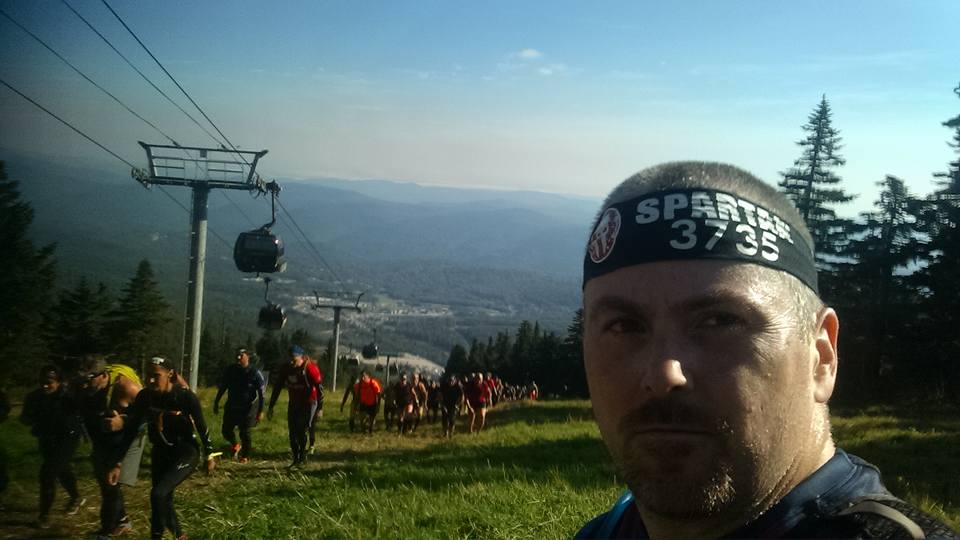 First Summit
Time: 1:27:01Distance: 2.06 milesElevation: 4,172 ft
The Spear Throw target was very small, and of course I missed and did my 30 burpees. Then I started back down, and quickly ran into the 40 lb. pancake Sandbag Carry. They had already run out of sandbags, so I had to wait for a few minutes for a sandbag to become available. The carry had a steep downhill but gentle uphill component, so it wasn’t too bad: 0.28 miles and 125 feet elevation gain in 10:30.
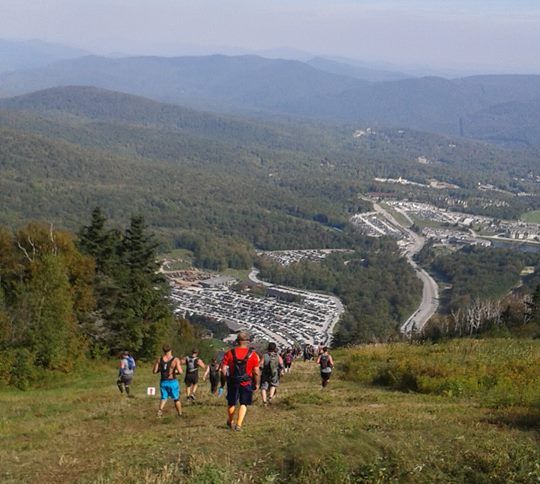 Down the ski run. Photo courtesy NE Spahtens
After this was the long descent back down towards the base of the mountain. This included going steeply down several wooded trails and a wide open section. In the middle of this was the Tire Drag, where we had to sit and pull on a rope to drag a tire up the slope of the ski run, and then carry it back down to its starting position. I did this pretty easily.
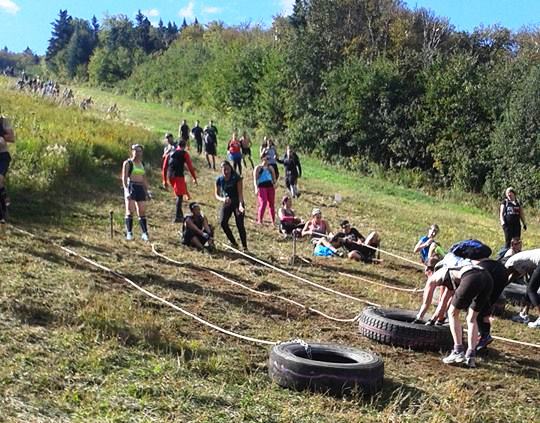 Tire Drag. Photo courtesy NE SpahtensDown the mountain some more to the Sandbag Carry. This was a lot more difficult than the pancake carry--0.34 miles and 146 of elevation gain in 17:49. The bag was probably twice as heavy as the pancake, but I was able to drape it across my shoulders and trudge up the mountain--this time the uphill was extremely steep and the downhill slightly less so. To keep myself going, I had a list of names in my head of people I was doing the race for, and repeated them over and over to keep myself focused.
 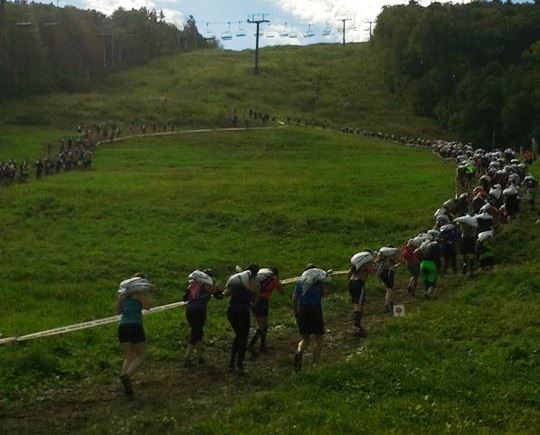 Sandbag Carry. Photo courtesy NE SpahtensAfter the carry was the first water station, where they told us they were not refilling camelbaks. This surprised me, but it was a sign of things to come later in the race. I took my cup of water, downed it, and continued.
Time: 2:53:18Distance: 4.63 milesElevation: 2,541 ft
Right away was a set of walls, through a short trail in the woods to another clearing where they had a Rig setup. I tried it, held onto the vertical ropes, prepared to swing to the rings, and then my right shoulder dislocated and I couldn’t recover. (Not to over-dramatize it, but both my shoulders are hyper-mobile and I can dislocate them & pop them back in at will. The problem is that whenever I hang from my arms, both shoulders want to come out of their sockets, so I have to fight to keep them in place almost as much as I have to hang on with my hands. In any event, when my right shoulder popped out I knew I wasn’t going any farther on the Rig)
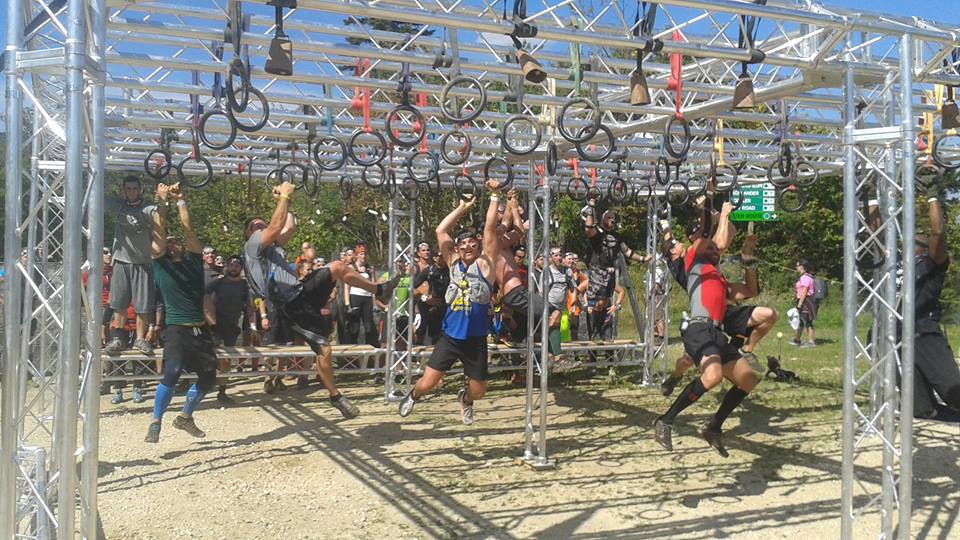 The Rig. Photo courtesy NE Spahtens
I went over to the designated area and 30 more burpees. At this point I took the opportunity to tend to my feet. On the steep downhills, my toes had taken a beating by being repeatedly squashed into the front of my shoes, and my big toes were developing hot spots. I took off my shoes and put on some athletic tape.
Immediately following the Rig was the Hercules Hoist. I didn’t see anyone doing burpees for this, so I figured that the weight must not be that bad. In previous races my hands always got rope burn from this obstacle, so this time I came prepared with leather gloves. This turned out to be a big mistake. As soon as I started pulling on the rope, it slid through my gloves as if I had covered them in grease. I simply could not get a grip on the rope. After struggling for far too long, some of the other racers helped me complete the hoist, and thoroughly embarrassed, I continued on.
Time: 3:25:05Distance: 5.25 milesElevation: 2,738 ft
Next in the woods was a Vertical Cargo net that was not that high, but very unstable. I made it over that and onto another trail, where there was a long Barbed Wire Crawl.
Time: 3:50:52Distance: 6.00 milesElevation: 2,388 ft
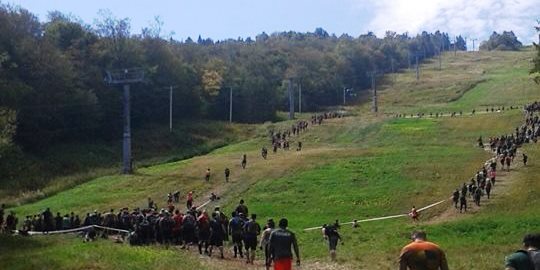 Bucket Brigade. Photo courtesy NE Spahtens
Next was a Log Balance Beam, and then the Bucket Brigade. There was a very long wait for this one as they had run out of buckets. At nearly every obstacle in the race, at all the water stations, and many parts of the trails (especially where they entered into woods from open ground), there were bottlenecks. As I waited in line for the Bucket Brigade, I had plenty of time to become more and more apprehensive. People had stopped to rest all over the place, and the mountain looked terrifically steep. I finally got a bucket, filled it up, and started up the mountain. Far earlier than I wanted to, I had to stop and rest. I went down on one knee and rested the bucket on my thigh. I kept checking my heart rate monitor, and my heart rate had spiked to 180 (which is the max for a 40-year-old like me). I let it settle down a bit, and then I got up and went up a little farther, until my heart rate hit 180 again, and then I rested again, repeating this process until I reached the top. Like all of the carries in this and every other OCR I’ve ever done, I followed my personal rule of “rest as necessary, but never let the Bucket/Sandbag/Log touch the ground during the carry.” I never thought about quitting or skipping the obstacle, but at the time I was thinking “I don’t know how I’m going to do this one…” Ten times I rested before reaching the highest point. All along the path, people were sitting on their buckets, or letting them slam into the ground whenever they stopped to rest, frequently dumping some of the gravel out. On the way back down, it was not my heart that was the problem, but rather my hands. I went until they started to to shake, threatening to make me drop the bucket, and I stopped to rest with the bucket on my knee until my hands stopped twitching. I only needed five rests on the way down. 0.43 miles, 155 feet of elevation gain in 34:09.
Following the Bucket Brigade was some very steep trails uphill through the woods to summit another peak (a sub-peak of Bear Mountain).
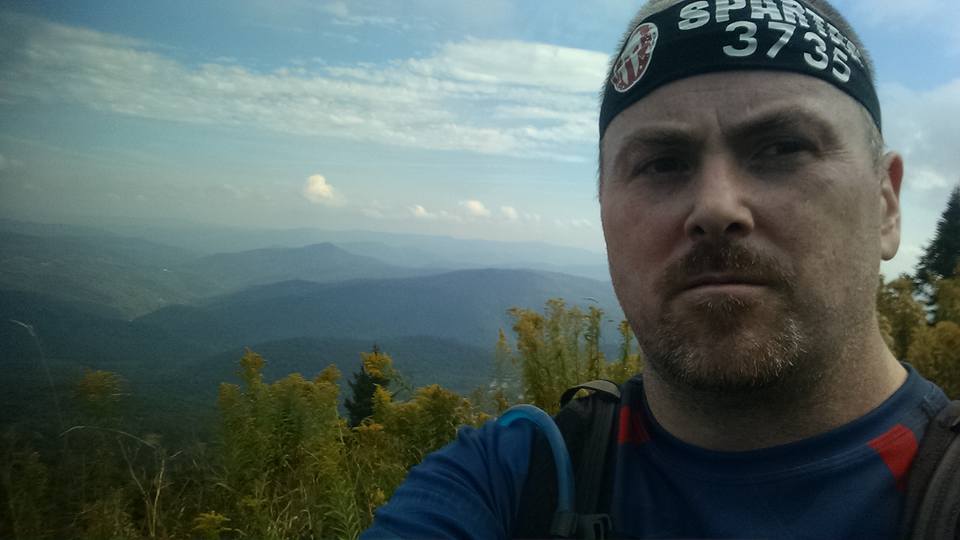 Second Summit
Time: 5:56:12Distance: 7.87 milesElevation: 3,665 ft
We did a Farmer’s Log Carry, and then a long, long trail down the mountain. At about this time my right knee started giving me some problems. Towards the end of the Tough Mudder in June, my right knee started hurting pretty bad, but by that time I was almost done with the race. Here, I was only about halfway through...I took some ibuprofen and kept going.
Near the bottom we ran into a Rope Climb--which was very short compared to other rope climbs I’ve faced, and I was able to manage this easily. Continuing down, we neared a lodge where there was a long series of shorter Walls followed by several “Thru” Walls, and then more Log Hurdles.
Time: 7:36:35Distance: 10.19 milesElevation: 2,096 ft
Next was a Log Carry, 0.26 miles over 152 feet of elevation gain in 13:04.
Immediately following the Log Carry was a water station, and thus began the long wait. The station was out of water, and so one volunteer was filling camelbaks from a garden hose with low water pressure, while the line just grew and grew and grew. The racers had been led to believe that they would be able to refill their packs at all the water stations, and many were completely out of water by this point, having been turned away from other stations with only a half-cup of water and unable to refill their packs. As a result there were a lot of very disgruntled racers here. Many discussed skipping the water station and going on, but with 5-6 miles of race left to go, to skip it might risk getting dehydrated. For my part I stayed quiet and waited for the line to move. I had been on the course for over 8 hours, with an unknown distance ahead of me, and I began to worry that the delay would not allow me to finish in time. The delay had caused all of us to cool off, and many racers were also concerned that they would get cramps. My heart rate slowed to its lowest rate here for the entire course. Finally, after a 40 minute wait, just as I got to the front of the line, a water truck arrived to speed things up, and I was on my way again.
Time: 8:25:06Distance: 10.75 milesElevation: 2,072 ft
Immediately after the backup was another Rig setup--you had to climb over a wall, do the rig, then climb over another wall and back down. I was angry at the long delay, and knowing that with my shoulders and general lack of upper body strength I had essentially no chance of success, I just walked by this obstacle without any regrets. Over Hay Bales and back into the woods to start a steep 500 foot climb.
It was about this point that I realized that barring an accident of some sort, I was going to finish. I don’t know if it was that realization, or that I had hit a second wind, or if it was just the ibuprofen working, but I felt strong and was able to pick up the pace a bit. For almost the entirety of the course people had been passing me, but now I started to pass people, and more and more I was passing people resting on the side of the path who had passed me earlier in the race. In general many more racers were resting, and more often, than earlier in the course.
At Mile 12 we hit another water station (this one well-supplied), and then the Atlas Carry--you had to carry a large stone sphere a short distance, do 5 burpees, and then carry the stone back to the starting position. More trails and a second Vertical Cargo net, this one with a sizable backup, and then down to the base of the mountain by the lake where we had to do the Waist Deep Trudge. We were supposed to wade out to a rope, touch it, and then cross the water to the exit point. Most racers were trying to stay out of the water as much as possible, going only knee to waist deep, gingerly stepping from rock to rock. I got impatient with this and just plowed through the water about chest deep and ended up passing dozens of people. My GPS battery died just before I got into the water.
Time: 10:12:25Distance: 13.7 milesElevation: 2,200 ft
Back into the woods for more trails, which were not that technical. I kept telling myself that the race wasn’t over, and there would certainly be some surprises left to try to crush our spirits. Coming out of the woods and into the clear, ahead there was a steep ski run. On the left and closest side of the run was another Log Carry. Either it was my second wind talking, or this one wasn’t as bad, but I managed to do this entire carry without stopping to rest. By now the crescent moon was bright over the crest of the mountain.
On the right side of the ski run, leading up the mountain was a long Barbed Wire Crawl uphill in the gathering darkness. Where possible I usually use the rolling technique to go through barbed wire, but it wasn’t feasible this time, so I was forced to alternate between high and low crawls. After this it was another long slog uphill until a road crossed the ski run, and then we turned right to follow the road. By the time the trail turned to go back downhill into the woods, the woods were very dark, so it was time to turn on the headlamps. Fortunately a lot of people had them, so it was easy to see where you were going. We emerged into a clearing with another easy Rope Climb, this one with a lot of spectators watching. I was surprised to see so many people just bypass it. I don’t know if people thought it was too dark to do obstacles anymore, or if they had just had enough, but they just walked on by. The climb wasn’t high, so I did it pretty easily and kept going. Next were the Z-Walls. I’m getting better at this one, but I was pretty tired, so fortunately someone kindly spotted me through it, and I completed it with only a little help. Again, maybe half the racers were bypassing it.
The course turned downhill for the home stretch. In the distance I could see the fire burning, with some spotlights on the finish line, and music blaring. Spectators were lining the edge of the path cheering everyone on, but were only visible as shapes in the darkness.
The next obstacle was an Atlas Log Carry, and as I did that I watched even more people just walk on by the obstacle, and this was followed by an interminable downhill Barbed Wire Crawl that served to get everyone muddy. I was able to roll downhill through this one. On the far side were a few more Log Hurdles, and then the last Spear Throw. The Fire Jump and Finish Line were clearly in sight just beyond. Apparently it was very tempting to move on and get on to the finish, as it was difficult to see the spears and targets unless you had a headlamp. A lot of racers were just skipping it, or just attempting the throw and then skipping their burpees. I failed my throw and started my burpees. Appropriately enough, See You Again by Wiz Khalifa started playing at the finish line. I was almost done, and I thought about the long day without my family, and wanting to tell them all about it when I saw them again. Normally this late in a race I’m wiped out and my “burpees” are a formless joke, but I did the last few in good form. It was on to the Fire Jump. In the darkness the fire looked awesome, with two little “bonfires” at either end and a low wall in the middle to jump over. I waited my turn, then jumped the fire and ran the rest of the way through the Finish Line.
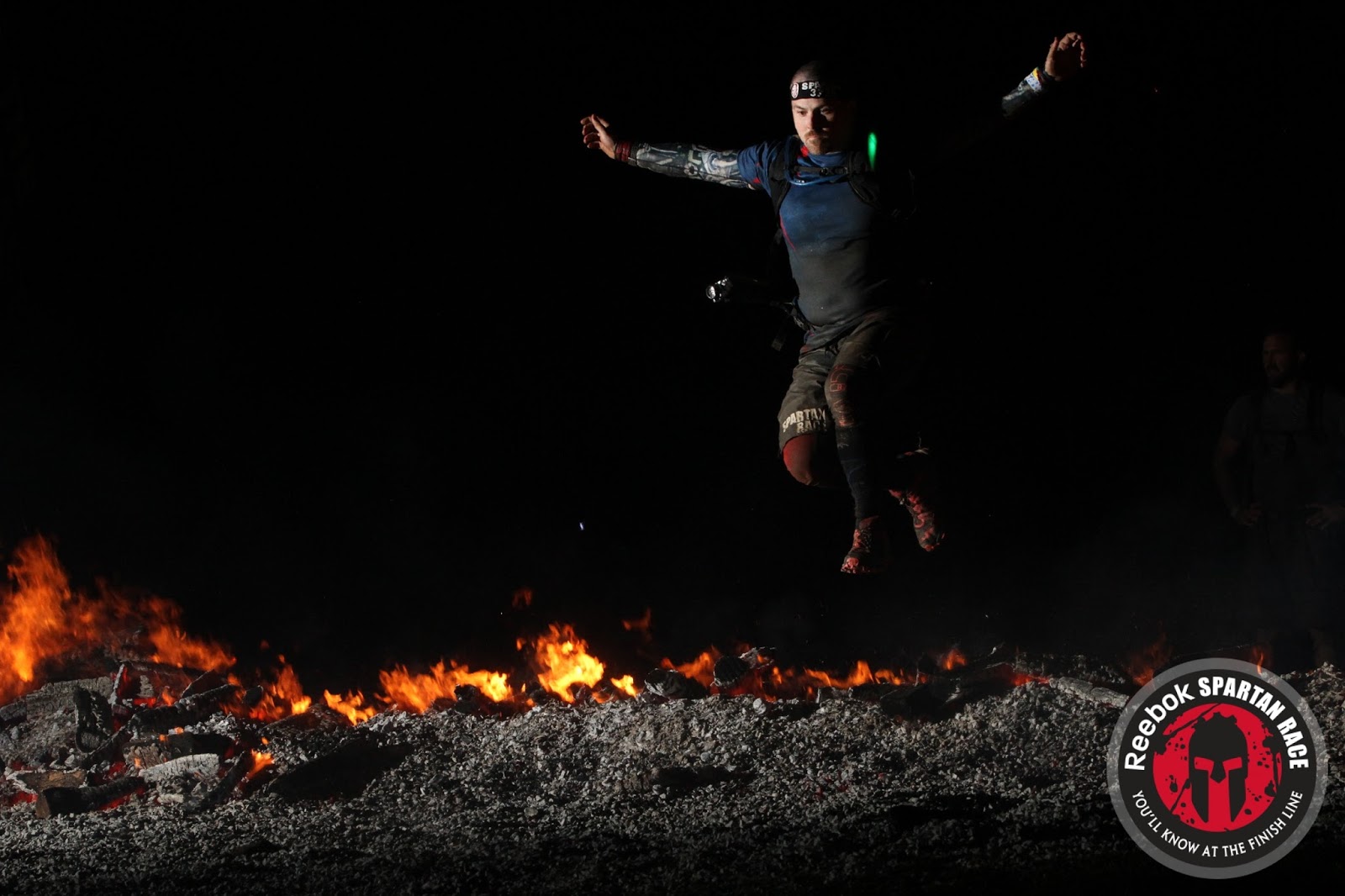 Over the Fire
Time: 11:42:27Distance: ~15.95 miles
On the far side a volunteer congratulated me and put the medal over my head--I can’t emphasize enough what a mental boost that gives you. Normally when I hear spectators cheering the racers, I never think they’re cheering me, rather I imagine they’re cheering on all the other racers, and I’m just in the way. Whenever I am resting during a race, for example during a bucket carry, and other racers say things like “You got this, you can do it” I always feel embarrassed and want to say, “I’m fine, just keep going and don’t pay attention to me.” But at the end, when someone puts a medal over your head and congratulates you, it’s great. This is in strict contrast to some races I’ve done where a volunteer is holding dozens of medals in their hands and just casually hands you one as you go by.
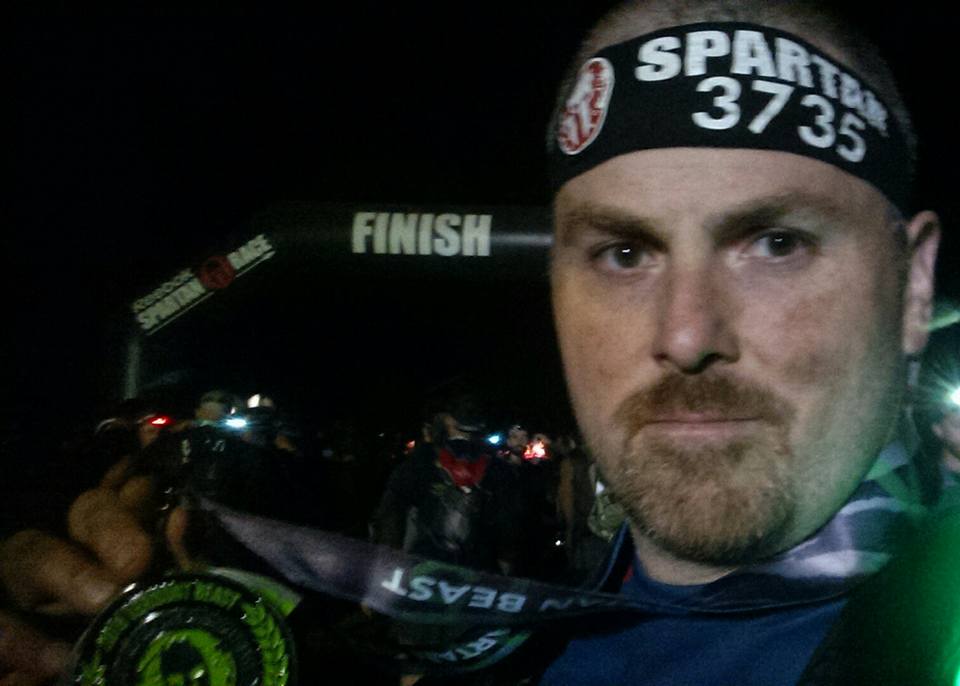
Having done the Beast, I realize that despite the hype I had nothing to fear in doing it. I felt fine afterwards, and although I had a hotel room an hour away, I felt easily strong enough to drive the three hours straight home. (I had already paid for the hotel room so I just went there) The race was long, and there were parts that were hard, but by the end I almost felt let down. Perhaps I am not pushing myself hard enough. My racing strategy tends to be that since I don’t know how long the race will be or what I will face ahead, I need to conserve my strength. As a result, I always finish with some gas left in the tank, but my strategy always seems justified when I see people far fitter than I resting, injured, or broken on the side of the path in the late stages of the race--people who blasted by me earlier. Before the race I heard dozens of stories about how Killington would be brutal, and that it would break you mentally and physically. I don’t want to diminish anyone else’s accomplishment or experience, but I really don’t think the race was that bad. Overall it was a great experience and I look forward to the challenge again next year.
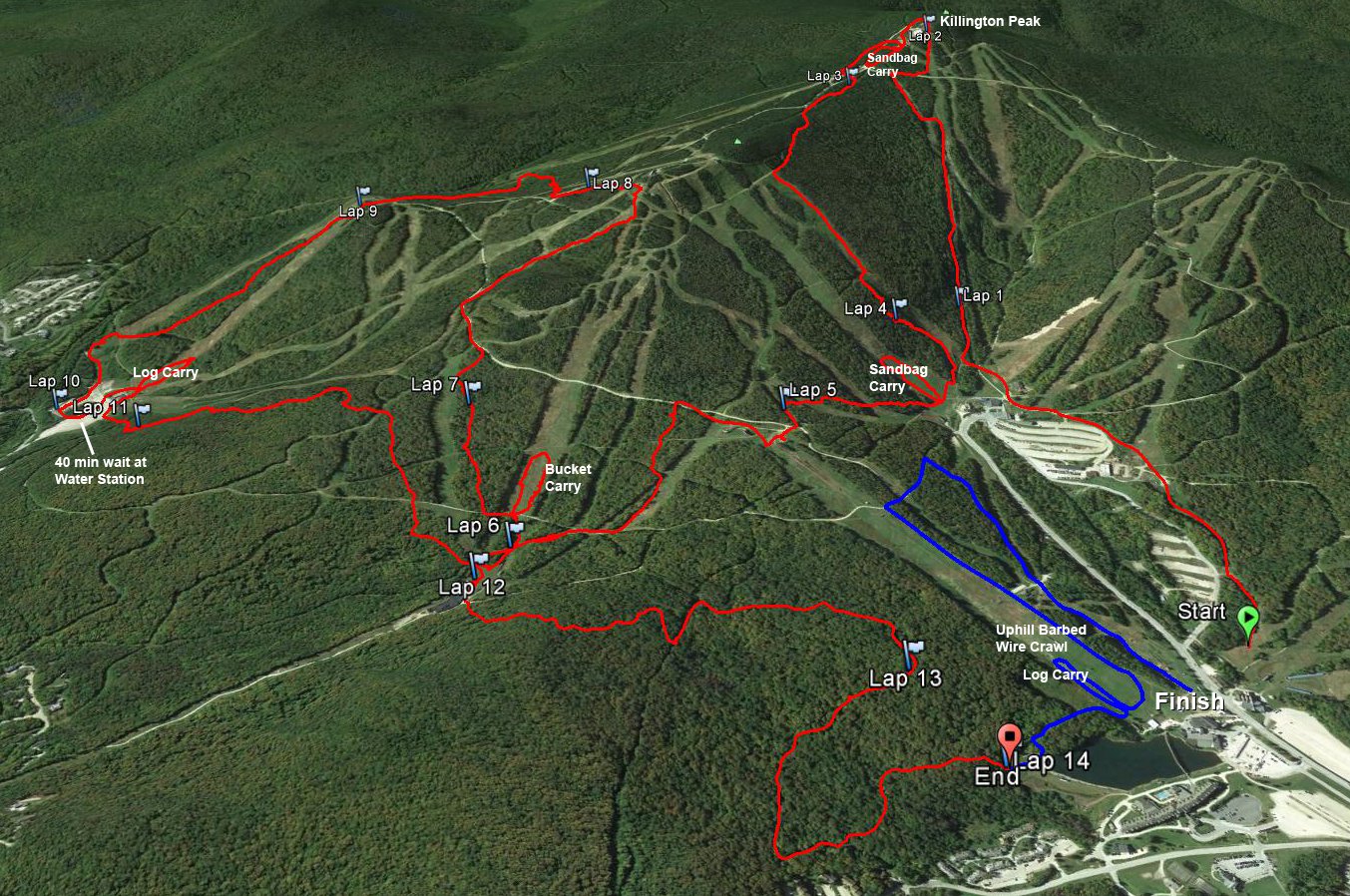 My GPS map. The red is what my GPS recorded, the blue is my estimate of the rest of the course.Before the race I thought that if I finished the Beast, I never would have to do it again. But now that I’ve done it, I see no reason why I shouldn’t. As of now, anyway, I plan on being back next year.
Other Races in this series
August 31, 2015
Boston Spartan Sprint 2015
 August 29, 2015Last year at this time, prior to my first OCR, the Boston Spartan Sprint 2014 in Amesbury, I was jittery, excited, and nervous for weeks before the event. This time around, I have many more races under my belt, and the nervousness didn’t kick in until a day or two prior. I had done more difficult races already this year, I had been to the locale...there was really nothing to get worked up about. The real nervousness will kick in prior to the Beast...20 days from now.
Although the Sprint is billed as 3+ miles, the Sprint last year was 4.7 miles or so, so I imagined that this time it would be roughly the same distance. I did not bring a hydration pack to this race because I imagined it would be short, and I knew there would be water stations along the way.
The race started and after a short run the first obstacle was a Hay Wall--actually two of them. I like these obstacles because I jump up and roll over the top and keep going.
Next was the O-U-T, which seems to be a common early obstacle in Spartan races. Next was a set of Over Walls, which I believe was only 6’ high, and before I know it, we were at the 1 mile marker. I took some water and then went to the Inverted Wall, which I do pretty well on, and then the Monkey Bars. It was the same setup as the Monkey Bars at the Super, but reversed: this time, the bars started far apart and got closer together as you got to the far end. I succeeded here, but it was rough on my shoulders.
Next was an Atlas Carry, which was pretty easy, and then the Rope Climb. The rope was far, far higher than it was for Battlefrog, and quite intimidating. I got into the water, which was a little above waist height, and fortunately they had a tarp lining the bottom so I didn’t sink into the mud. After some struggle I managed to get out of the water, and ultimately halfway up the rope. It seemed like my body knew what to do, but my mind was drawing a blank. I kept thinking I needed to lift with my arms rather than just hold them in place, raise my legs and then stand on the rope. By the time I was halfway, my mind wasn’t in it, and I thought that I might be able to make it to the top, but I didn’t think I could make it back down safely if I did. On top of that, there was another person on the rope next to me and below, so I slipped or something, I’d probably fall on them. So I called it quits and went back down, and did my 30 burpees.
After the rope climb was Rolling Mud, which was three mudpits, followed by a dunk wall. As I emerged from the other side, I wiped the water off my face as I didn’t want to inhale/drink any of that stuff, only to see a photographer taking pictures of me. So I’m sure that’ll look good. (ultimately I never found those pictures on the Spartan site, which is just as well)
Next was a Barbed Wire Crawl, which made me glad I didn’t bring my hydration pack. It started out normal enough, but the second half was a gooey warm muddy slurry that was the muddiest mud I’ve been in yet at an OCR.
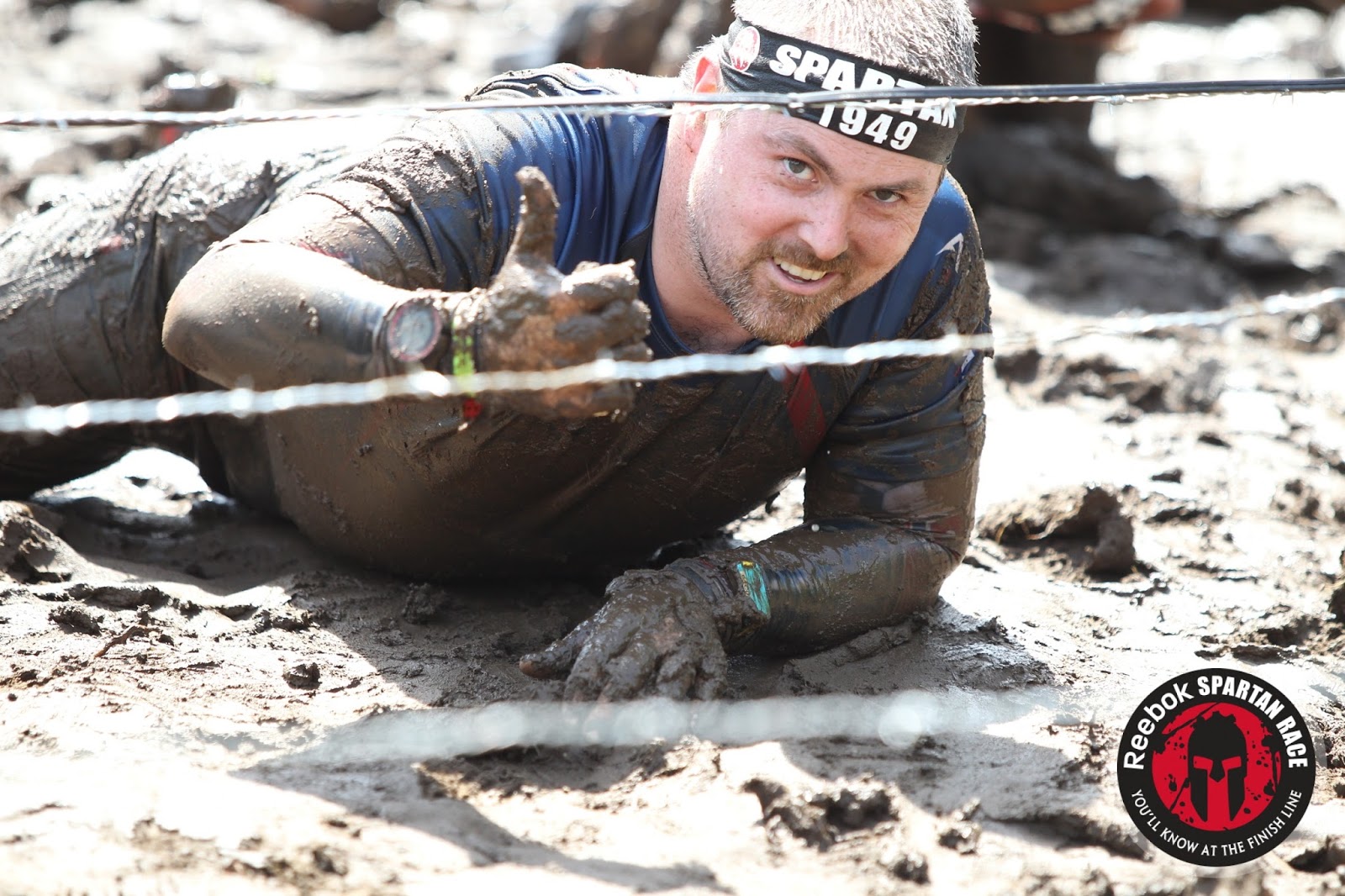 Enjoying the mud
Next was the Log Hop, which was supposed to be something different than it was, for some reason they had to alter the obstacle, so it was just high-stepping over some lines between logs.
Next was a Plate Drag, which was difficult but not too bad, another water station, and then a Sandbag Carry up a small hill, down it, up again, and back down.
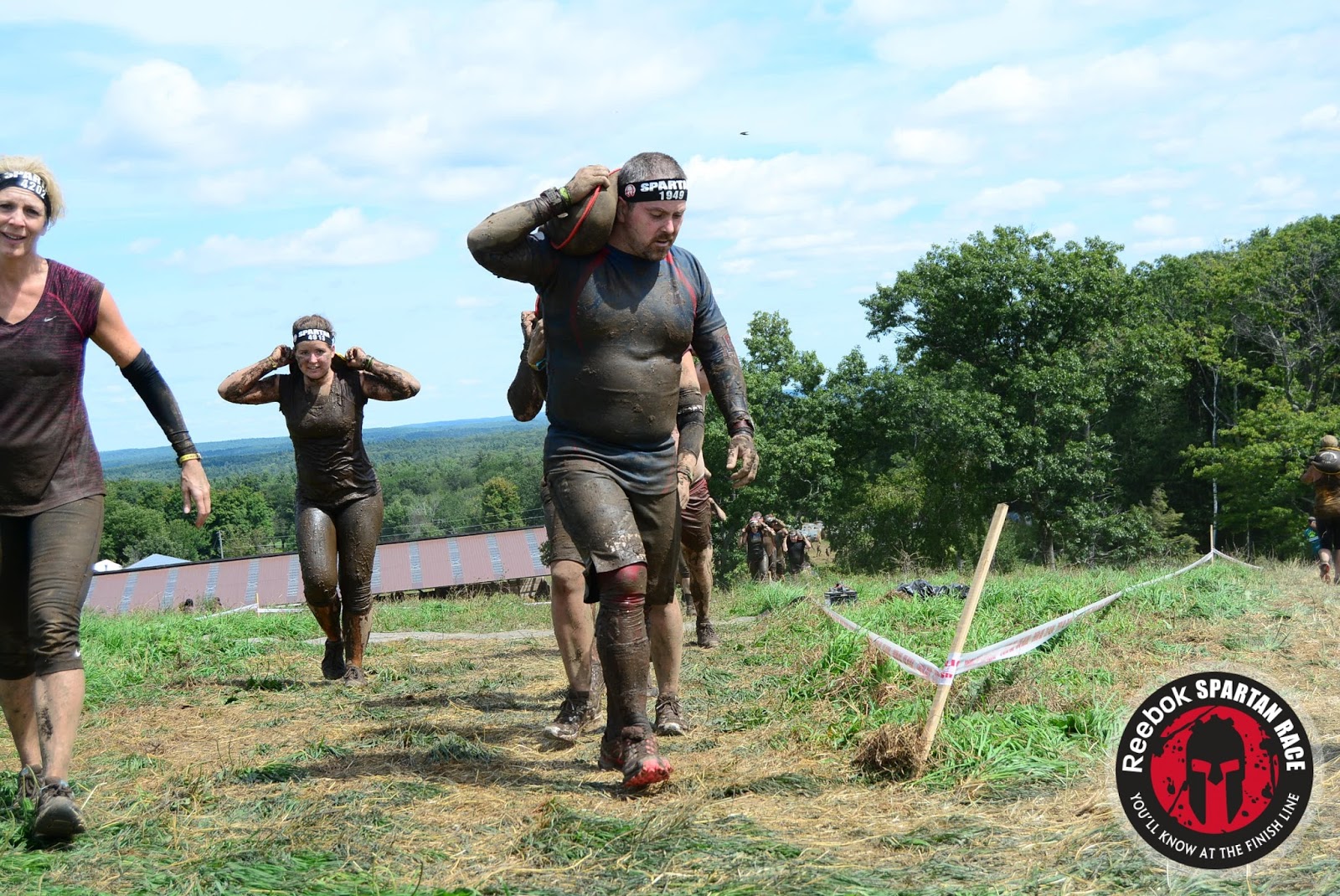 Sandbag Carry
Then the Stairway to Sparta, which is a 6’ wall leading to a A-Frame ladder. And then the Bucket Brigade, which thankfully was much shorter than it was at the Super. I only needed to rest once, and when I started up again, I got a better grip on it and was able to finish without resting again.
Next was a Set of Three Walls, 8’, 7’, and then 6’. I got a boost going over the first two walls, then managed the last one myself.
I attempted the Hercules Hoist, but my hands were already burning, and I knew I wouldn’t be able to lift the bag very far, and also do it without getting a bad rope burn. So I skipped it and did my burpees. Next was the Spear Throw, and was mentally preparing myself for another 30 burpees. But I took the spear, looked at the target, and thought “Your body knows what to do”, and I just threw it. The spear went true and hit the target’s “neck”, impaling it and passing halfway through. Happily surprised, I moved onto the the next water station, and then the Bridge.
Normally I find the Bridge pretty easy, as it is just a ladder to the top, then a walk across wood planks, and back down another ladder. This time it had a twist--instead of wood planks at the top, it was a horizontal cargo net (of the Spartan Race variety). You could walk across it if you were careful, and there was no real danger of falling, but you could lose your footing and slip a leg through the gaps. I started walking, and then ended up crawling on all fours instead. It was definitely a fear-inducing obstacle.
After the bridge were the Z-Walls, and I mentally prepared myself to fail this one again, as I have never succeeded on it before due to my grip failing. However, once I got on, I was surprised to find it was easier than I had anticipated, and I actually succeeded. I rang the bell and kept going.
Next was the Clif Multi-bar (aka the Rig), which I attempted but failed--hanging from the bars like that did a real number on my shoulders. I did my burpees and kept going. Next was an A-Frame Cargo Net, which was easy, and more hiking. I knew we were getting close to the finish. There was a Farmer’s Log Carry, and based on seeing other racers do it, it looked hard, but when I hefted the logs, it wasn’t as bad as I had feared. Onto the home stretch.
First was a Slip Wall, wherein you grab a rope and haul yourself up a sloped wall, which is always easier than it looks, at least for me. Then a vertical cargo net that wasn’t as high as I feared, but leaned slightly toward you. I made it over that, and then it was just the Fire Jump and then the finish.
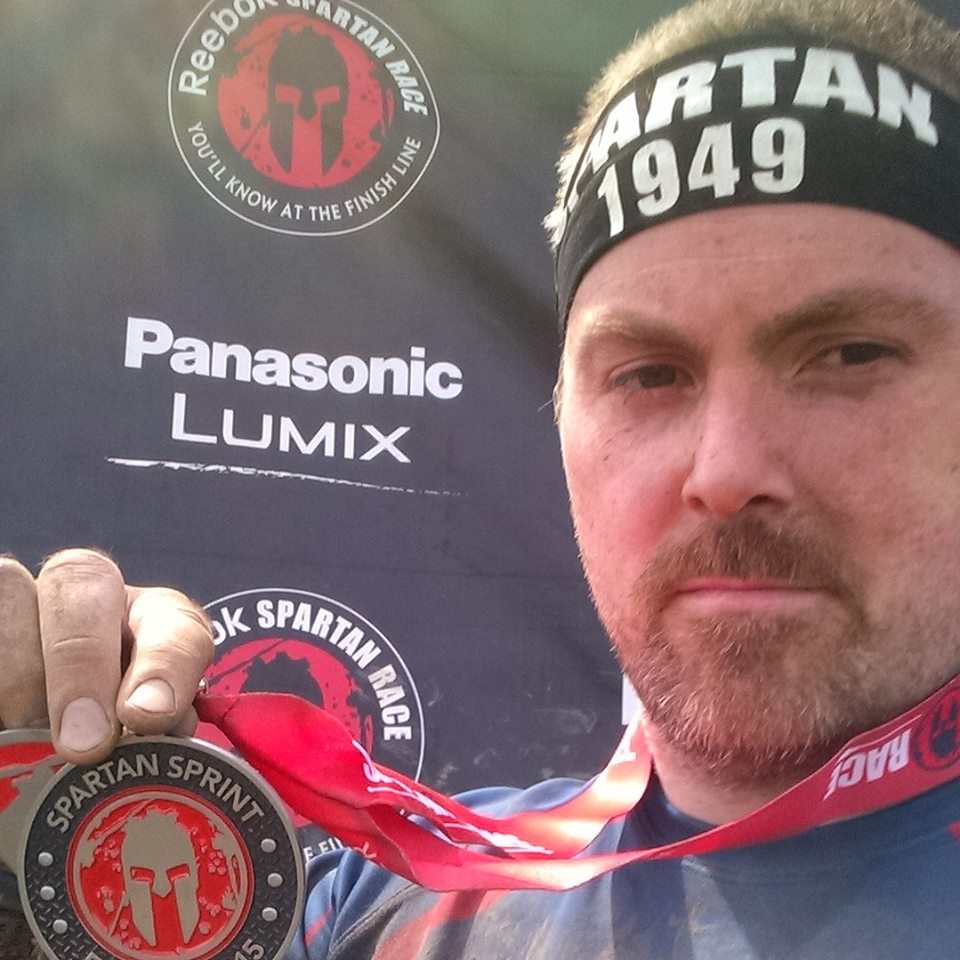 In conclusion this was a good race that made me feel good about myself--I was able to improve on my performance over last year by completing more obstacles and finishing the race faster. Next, to complete my first Trifecta...is the Beast.
Other races in this series
July 27, 2015
Battlefrog New England 2015
 July 25, 2015
With the hoopla leading up to this race, I was a little worried about how it would go (short version: There were questions about Battlefrog's future because it was rumored they were in financial trouble). As for difficulty, this race was less distance than the Spartan Super, and I knew the venue to be flat, so I was not too worried.
Parking was similar to the Super, but right away you could tell things were a smaller scale. Whereas the Super they had maybe 10 porta-potties at the parking area, here there was only three. There was also a line at the buses, but fortunately I didn’t have to wait too long to get on one. At the venue, Registration was extremely fast and easy. Up to the festival area, the layout seemed a little strange, and I had to cut through a merchant tent to get inside (perhaps I didn’t enter the right way, but I just followed the crowd). Bag check was smooth dropping off, but less so picking up--it did not seem very organized despite several volunteers helping out. I ended up having to find my bag myself and then point it out to the volunteer who retrieved it.
The NE Spahtens start the race
The course itself followed much of the path of the Spartan Super, so I was familiar with the terrain. As always, I lagged behind as the group surged ahead. To my surprise the first obstacle was a Rope Climb, and there was already a backup. The climb didn’t seem as high as some others, and the ropes were very close together. I’ve never completed a rope climb before, and I wasn’t looking forward to failing the first obstacle, but I managed to do this one, which was definitely a mental boost early in the race.
Next was a Tire Flip, then a Mud Trudge (at the Super it was just a muddy pool that was part of the trail, here it was a little muddier and deeper, and called an obstacle). Next was an 8’ Wall. At the Super they had an 8’ wall that I needed a boost over, here they had a horizontal board for a foothold maybe 3’ up that was sufficient to get me over the wall unassisted. Next was 60 degrees, an inverted ladder. I usually manage inverted walls just fine, but this one was a challenge to get over the top bar. Next was the Jerry Can Carry. Men got a 20 liter plastic Jerry Can mostly filled with water (so about 40 lbs? It felt like a lot more). We carried that 0.4 miles, and then it was on to the Natural Ledge, which was essentially climbing up a fallen tree to get to the top of a ledge. Some might consider it cheating to call that an obstacle, but it’s really just taking advantage of the terrain of the venue. Next was Mounds of Grounds, which was a standard multiple mud pit obstacle.
Next was an obstacle that isn’t on the map, but (I think) has been called Gut Check or something similar. It is set up similar to gymnastic uneven bars. You climb up to stand on a log (the lower “bar”), then have to leap onto a higher log, get over it, and then you’re done. There was medical staff standing by at this one, and I could see why--it would have been easy to fall off the higher bar if you misjudged your jump. I saw several people jump up to it and not quite make it, clinging to the upper log and struggling to get over. Some succeeded, others didn’t. I saw one guy jump up, grab the log in a bear hug grip and swing right over it, which seemed crazy to me when I saw it. I decided not to overthink any particular technique and just go for it, so when it was my turn, I leaped, hugged the upper log like the other guy did, and my momentum swung me right over it like it was the most natural thing in the world.
Next was Normandy Jacks, which was a wire crawl (thankfully no barbs) that had some small pits dug into it as well, which made it more interesting than the standard wire crawl. Here is where I learned that compression sleeves do make a difference in protecting your arms during crawls!
Next was a 12’ Rope Wall. I attempted this one assuming I would fail, and I almost gave up, but I tried again, managed to get my foot on a foothold, and completed it. The obstacle was difficult but I enjoyed it. Next was the Wreck Bag Carry for 0.34 miles. Since I could carry the bag across my shoulders and I could control it easily by the widely spaced handles, this was a breeze and I barely noticed the weight. Next was a Slant (Inverted) Wall, and then the Platinum Rig. By this point I was pretty tired, and by the amount of people doing 8-count body builders around it, there were a lot of failures. The women’s side had various footholds for parts of it, and I thought it looked hard...but then I saw the men’s side and actually laughed. A lot of guys just looked at it, shook their heads, and did the penalty. For principle’s sake I climbed on the first part, a vertical metal pipe that was slick with mud & sweat, promptly slipped right off, and did the penalty. I had forgotten how many body-builders to do, so I asked someone, who said “Eight? Ten?” and shrugged. There wasn’t anyone policing the body builders, which I thought was good. It’s my own race and I’ll penalize myself by what I think I deserve, and I don’t need anyone to yell at me while I’m doing it. I did ten body-builders and moved on.
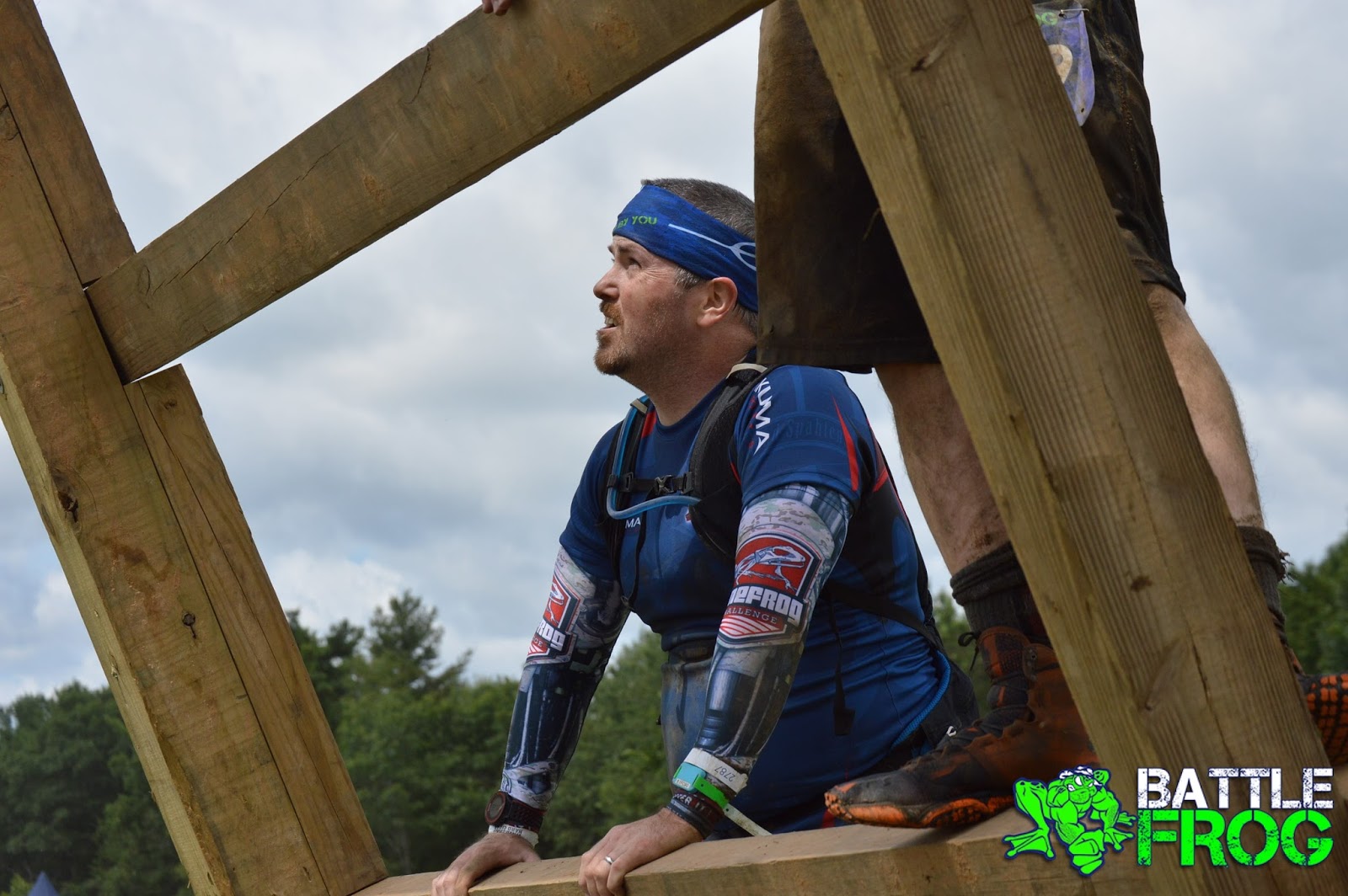 Climbing the Delta Ladder
Next was the Delta Ladder, which was very tall with widely spaced planks. I just took it slow and steady and got through it fine. Next was a 6’ Wall and then Tsunami. I had never done an obstacle like this before, and it looked like fun. First you went up a cargo net, and then dropped off the top onto a quarter pipe made slick with water from a hose. A lot of people were hesitating at the top, but I just went over and did it, slid down to the bottom and that was that. Reading other reviews apparently Tsunami was a disappointment to others. I thought it was ok, but if there are better versions, then I’m all for them. I approve of the cargo net at the beginning however, as there was already a backup due to people hesitating at the top--a rope climb to get up or anything else that could slow it down would only make it worse. But a slicker slide or into a pool of water would be a welcome addition, but I imagine there were limitations due to the venue.
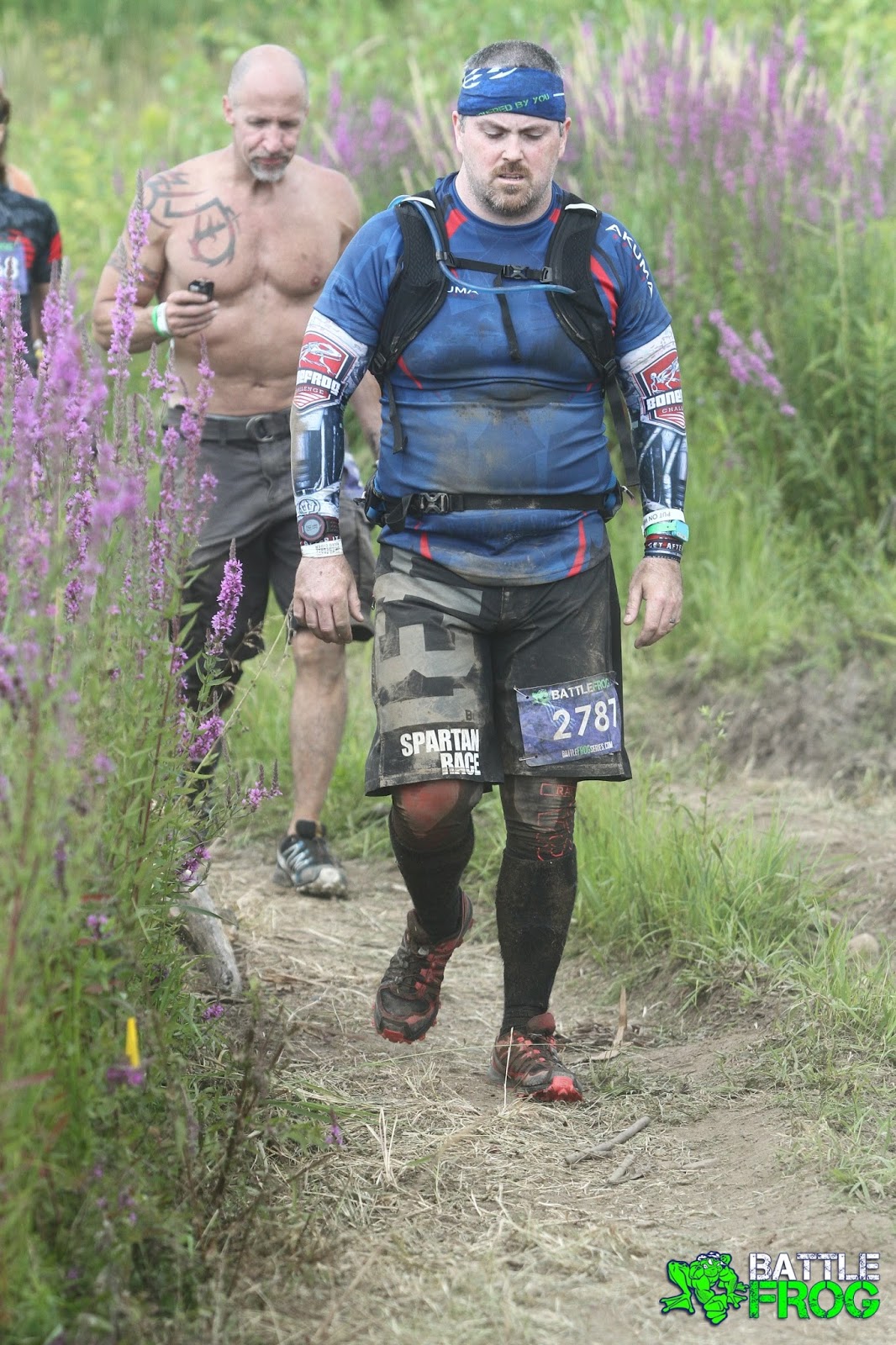 Tired Trudging on the Trail
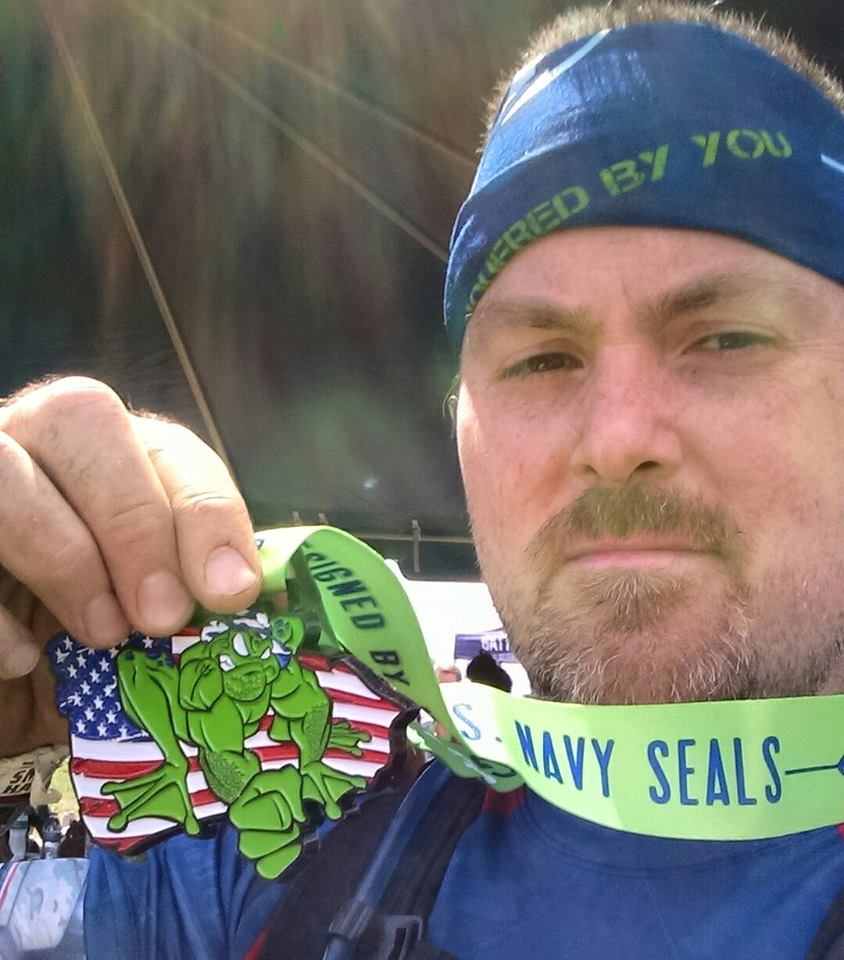
Next was an Inverted Wall, but this one was leaning away rather than towards you. I ran up, managed to get a finger hold at the top, and pulled myself over. Then a 12’ Ladder Wall, up and down, and then the final obstacle. Tip of the Spear was the final obstacle, with a horizontal traverse across three slanted walls in succession, the first with ropes, the second with wooden rail for finger grips, and the last with more ropes. I managed the first ropes, got halfway through the second part when my grip failed me and I could not complete it. Angry with myself, I did 10 body-builders, and then completed the final rope section, then crossed the Finish Line.Interesting side note on finishing: I’ve done 5 OCRs now, Spartan Sprint, Bone Frog, Tough Mudder, Spartan Super, and now Battlefrog. At Bone Frog, a veteran put the medal over my head and gave me a firm handshake. At Tough Mudder there was a crowd of people there waiting, all supportive and eager to award me my headband. At Battlefrog a volunteer put the medal over my head. But at the two Spartan races? Both times, the volunteers waiting at the finish line handed me my medal as if it was an afterthought. It’s not that I feel cheated for not getting a pat on the back at the Spartan races, but the reception you get at the end puts a positive cap on the tone of the race.
To sum up, Battlefrog was a fun race. Not as physically punishing as some of the longer (and hillier) races I’ve done, but some of the obstacles were unique and challenging, which is always a plus and makes a race stand out. It was good to have obstacles that were challenging but not impossible for someone of my fitness level. Assuming Battlefrog is still around next year I’ll definitely be back.
Other Races in this series
June 22, 2015
Boston Spartan Super 2015
 June 20, 2015In the days before this race I was somewhat apprehensive--although there were to be no hills, it was the first race I would be doing entirely alone. I did most of last year’s Spartan Sprint alone, since Ben was late, and then had to rush to meet his son, perforce having to leave me behind (I told him to go on ahead), he was there with me for a short while. Both Bonefrog and Tough Mudder I did with John et al. There would be the New England Spahtens to run with, but without any identifying gear on, I didn’t really feel “part” of them despite running with them. Essentially, I would be running this race alone.
Course Map
A bonus to this race was that relatively speaking, it was close to home. Only an hour drive--and the next two races I am doing will also be at the same site in Barre, MA, so I would get a good taste of the terrain. Parking was in a huge field in what turned out to be a 10-minute shuttle bus drive from the venue. It was a long walk from the car to the shuttle buses, and by the buses was a line of porta-potties. Having them there was good, but at 8:45am, several people were coming out of the porta-potties warning others that they were already out of toilet paper... The bus took us to the farm itself where it was another walk to registration. Registration was well-organized and fast, as is typical for Spartan Races, which was good, because I was worried about being late for the start. Bag check went smoothly as well, and I was able to get VIP bag check for being part of the largest team. Vendors were selling beer, some sandwiches, smoothies, and the farm had its own kiosk. I might have missed some vendors, but it appeared that the food options were limited, especially for kids. It was good to see several obstacles set up for kids in the Festival area: a climbing rope, a kid’s sized wall to climb over, and of course the kid’s race itself.
Soon we were called to start line, where we endured what I thought was too long of a pep talk, and then we were off at a jog. I wanted to slow down and walk, but the momentum of the crowd was such that I had to keep moving faster than I am used to (which isn’t that fast).
The first obstacles were pretty easy, to get your blood going. First was Hay Wall, which was jumping over walls made of hay, and then a pair of 6’ walls, which I managed to climb over without difficulty. Next was O-U-T (Over Under Through). I helped a fellow Spahten over the wall, but managed to climb over myself. He thanked me for the help, and I introduced myself, only to have him run off apparently not hearing me, which made me feel a little stupid.
Next was the Monkey Bars, and I cursed as I approached, thinking I was already going to have to do some burpees, and I still felt like we had just gotten started. These monkey bars were different from previous races--they were level, and the bars were thicker so I was able to get a better grip. I also planned better for this one, deciding to go from one bar with both hands and then moving to the next, rather than hand-over-hand. I assumed I would make it a few bars and then fall off, but to my astonishment, by the time I got that far I still felt strong and thought I could go all the way. I took my time, went methodically, and as I got close to the end I saw their trick--towards the end the bars got more spread apart, so I had to swing the last two bars or so. But I managed it and was immensely pleased with myself.
Next was an interminable Barbed Wire Crawl--I measured it on the map as 130m of it. Fortunately it was not muddy and there were not a lot of rocks, but the barbed wire certainly was barbed (I tore up my right palm on it) and it was very low, so for most of the crawl I had to crawl rather than roll.
Then there was a hike back towards the Festival area, and on the way I passed a team of racers in red shirts who were helping along one of their members in a wheelchair, which was pretty cool to see. The path was so narrow and rugged they were forced to carry him and his chair past it. By the festival area was the first water station and a porta-potty, then a lattice bridge over the entrance to the festival area. I took it slowly and deliberately and had no problems. Next we passed the kid’s race area, and I saw some kids doing the course, looking like they were having a blast. Back towards the woods there was a wall with a Memorization Test - my code was Quebec 733-3276, which we were informed we’d be tested on later in the course...and ultimately weren’t. Soon after that was a 7' Wall (which I managed myself), and an 8’ Wall, which I didn’t. I helped one guy over and then he helped me over.
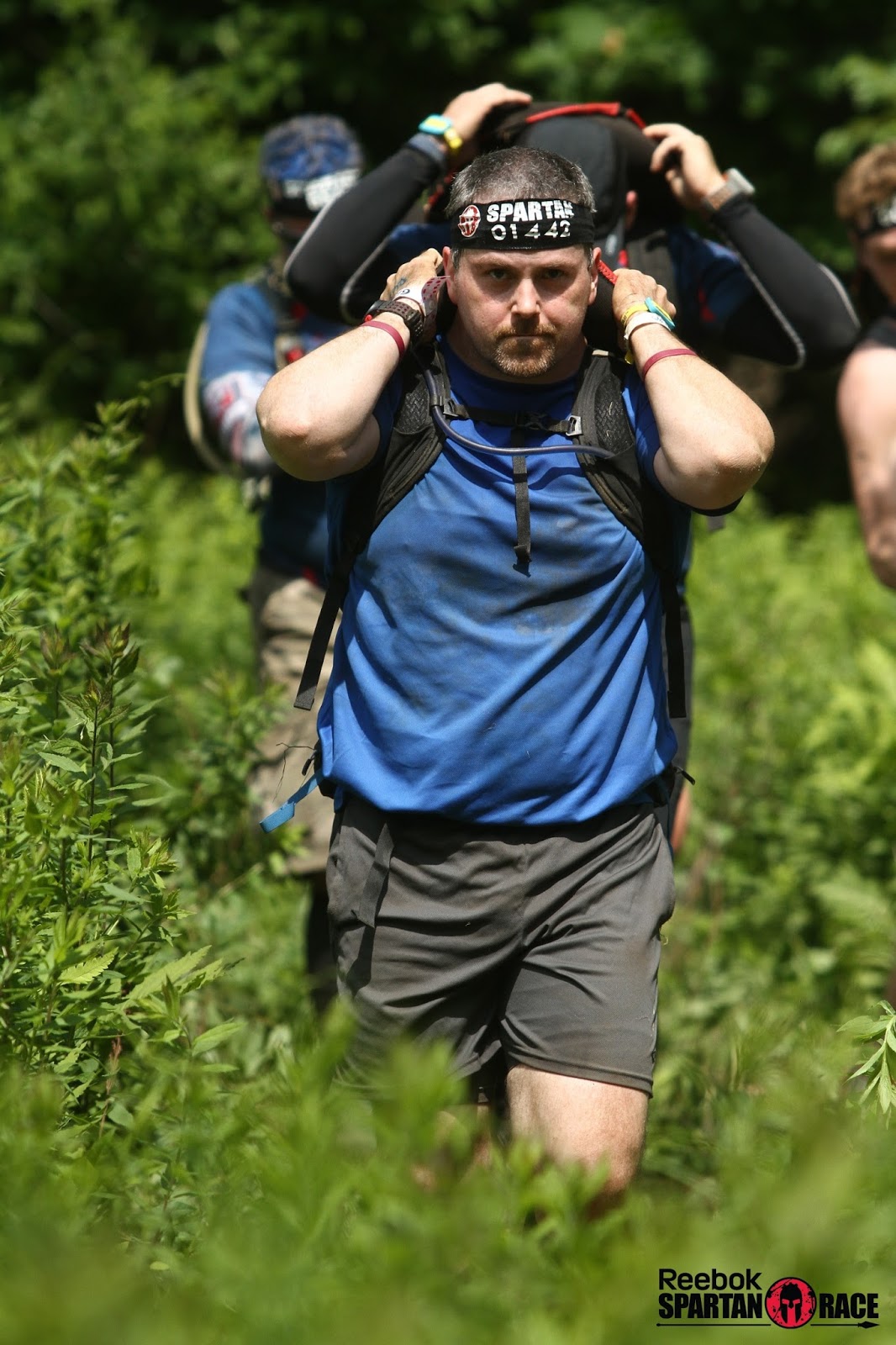 Sandbag Carry
After that was a Sandbag Carry which wasn’t difficult at all, and then back towards the Festival area for a Vertical Cargo Net. This one had two sides to it, so there wasn’t a backup like there was at the Bonefrog, and the next itself was tighter, so it was also easier than the Bonefrog’s.
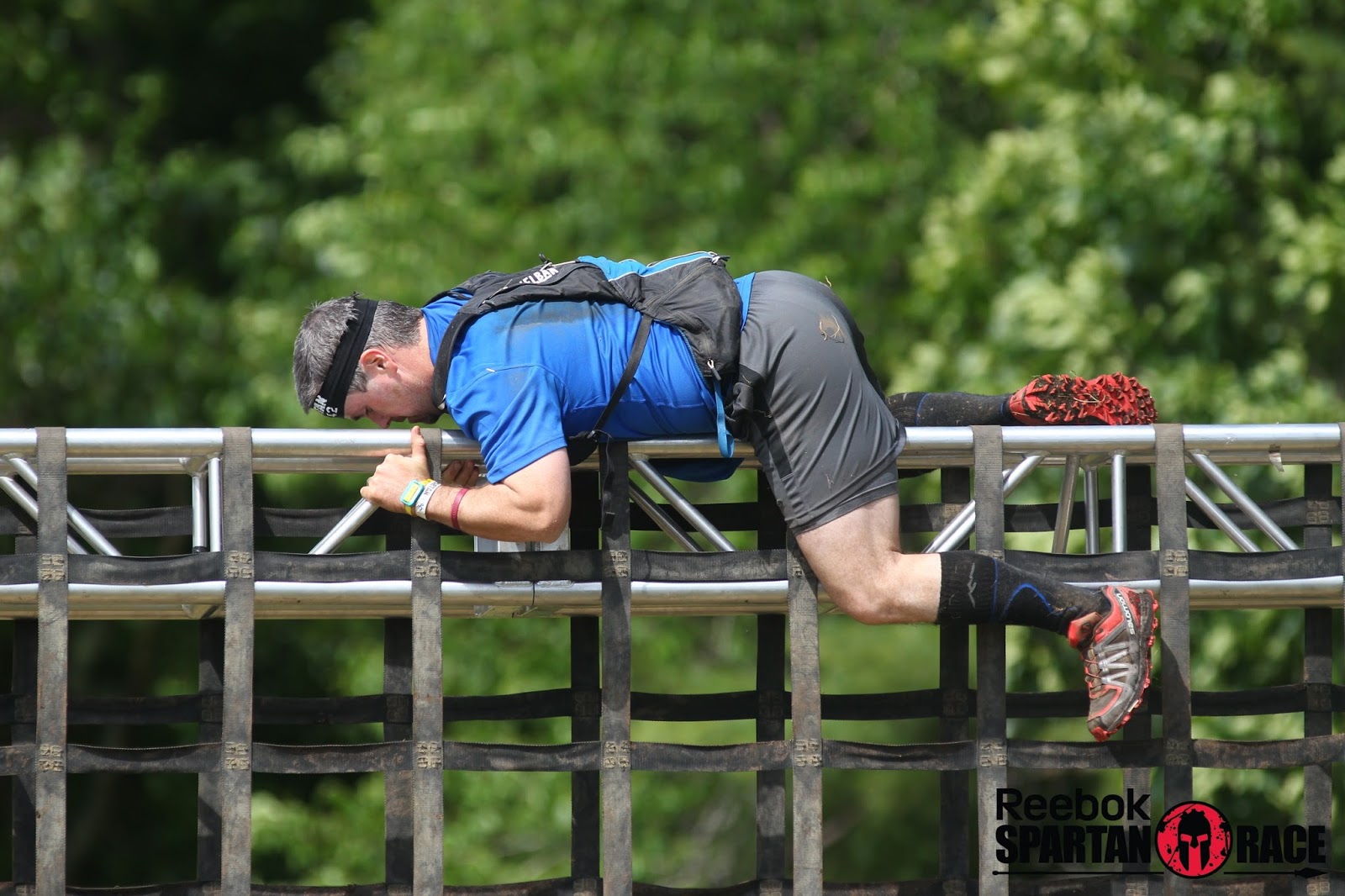 Surmounting the Vertical Cargo Net
A very long hike and ultimately to the Inverted Wall, which I managed just fine, and then a Plate Drag, which consisted of a metal plate with a pair of sandbags in it. Mine was in a very rutty patch of ground, and so it got stuck several times and I had to go forward and lift it out. Soon after that was the Z-Walls (the horizontal wall traverse). I got 2/3 of the way through this before I slipped and fell. I was pleased at how far I managed, but also angry that I fell. A lot of people were getting assistance from each other on this one, but again, I was “alone” so that hurt me here. I had to do my 30 burpees, and already I was exhausted so I had no form. I plowed through them and moved onto the Atlas Carry. The Atlas Carry consisted of carrying a large stone (at least 50 lbs) a short distance, doing 5 burpees, and then carrying the stone back.
Following that was the Bucket Brigade. Seeing as the ground was more or less flat, the distance was long, and we had to carry the bucket a quarter of a mile. I got nearly halfway before I had to set it down, and then set it down (on my knee--my “rule” is that I won’t let it touch the ground) several more times after that. As at the Sprint last year, this was by far the most physically demanding challenge. A few people on the way passed me while I rested, trying to cheer me up. Unnecessary, but it was good to see the spirit of camaraderie. (I actually ended up passing a few of them before the end of the Brigade)
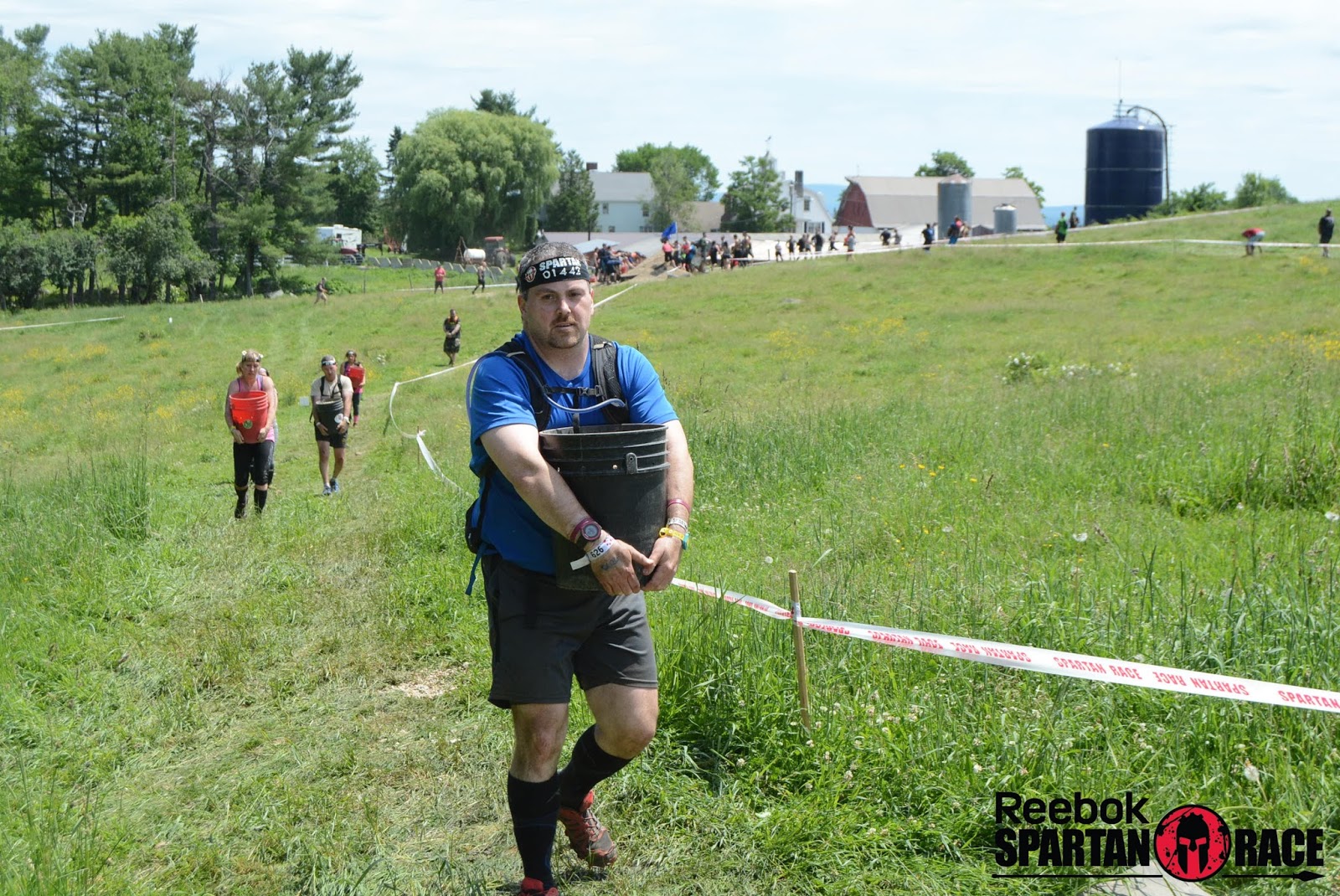 Bucket Brigade
After that was the Stairway to Sparta, which was an A-frame wood lattice, with a 6’ or 7’ wall to begin the climb. I made it up just fine, only for my left calf to threaten to cramp as I pulled myself to the top of the wall. This would plague me later. More hiking, and then to the Spear Throw. Predictably I failed this obstacle. The spears were attached by ropes so you could drag them back rather than have someone go forward to retrieve them, which was good in theory, but they seemed too short to me and made it harder to get a good arc upon throwing them. 30 more burpees.
Another hike and a short reprieve at a water station, and then onto the Mud Moats, with a Slip Wall (angled wall with a rope assist), and then to the most difficult part of the course.
First up was the rope climb. More experienced than I was at my first OCR, I didn’t hesitate this time, and went right in. The water was chest deep--nearly to my armpits. The rope was knotted, which was a plus, but again, I didn’t get far. I got out of the water, but no farther. 30 burpees. Next was a short Tyrolean Traverse, over ground. I got on the rope and my technique was good, but I didn’t think I was going to be strong enough to make it. Then both my lower legs cramped up and I fell off the rope. Angry with myself, I sat on the ground for a minute, feeling sorry/angry at myself before continuing. 30 more burpees. Next was the Clif Multi-Bars which was a rig consisting of bars, ropes, and more bars, which of course I got nowhere. 30 more burpees.
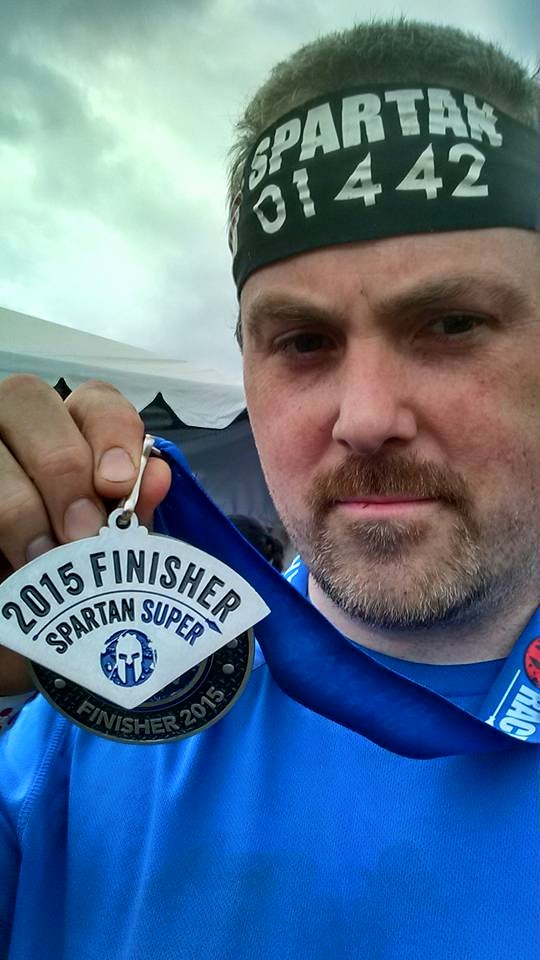
More hiking, or rather slogging, through a lot of mud, and then to the Hercules Hoist. There was no way I would be able to manage this on my own, so I had to buddy up with another guy, and then a third. It took all three of us to do the hoist, and I got a little rope burn on it as well. Then over an A-frame Cargo Net, which again was very tight and therefore not difficult. Back into the woods and into more mud, and I saw the 7-mile marker. My watch said 3:42:00, so I figured if I hustled it, I could reach mile 8 under four hours. The Super was supposed to be 8+ miles, so it might not mean I could finish by 4 hours, but it was a goal to shoot for. I picked up the pace, still slogging through mud, and then, to my surprise, I came out of the woods, and the Finish Line was in sight. Just the fire jump and that was it. Anti-climactic to say the least. I jumped over the fire and finished, and after the 12-year-old volunteer disentangled the medals, he handed me one (odd--both Spartan races I was handed a medal, while a medal was placed over my head at the Bonefrog, and at the Tough Mudder someone put a headband on my head).
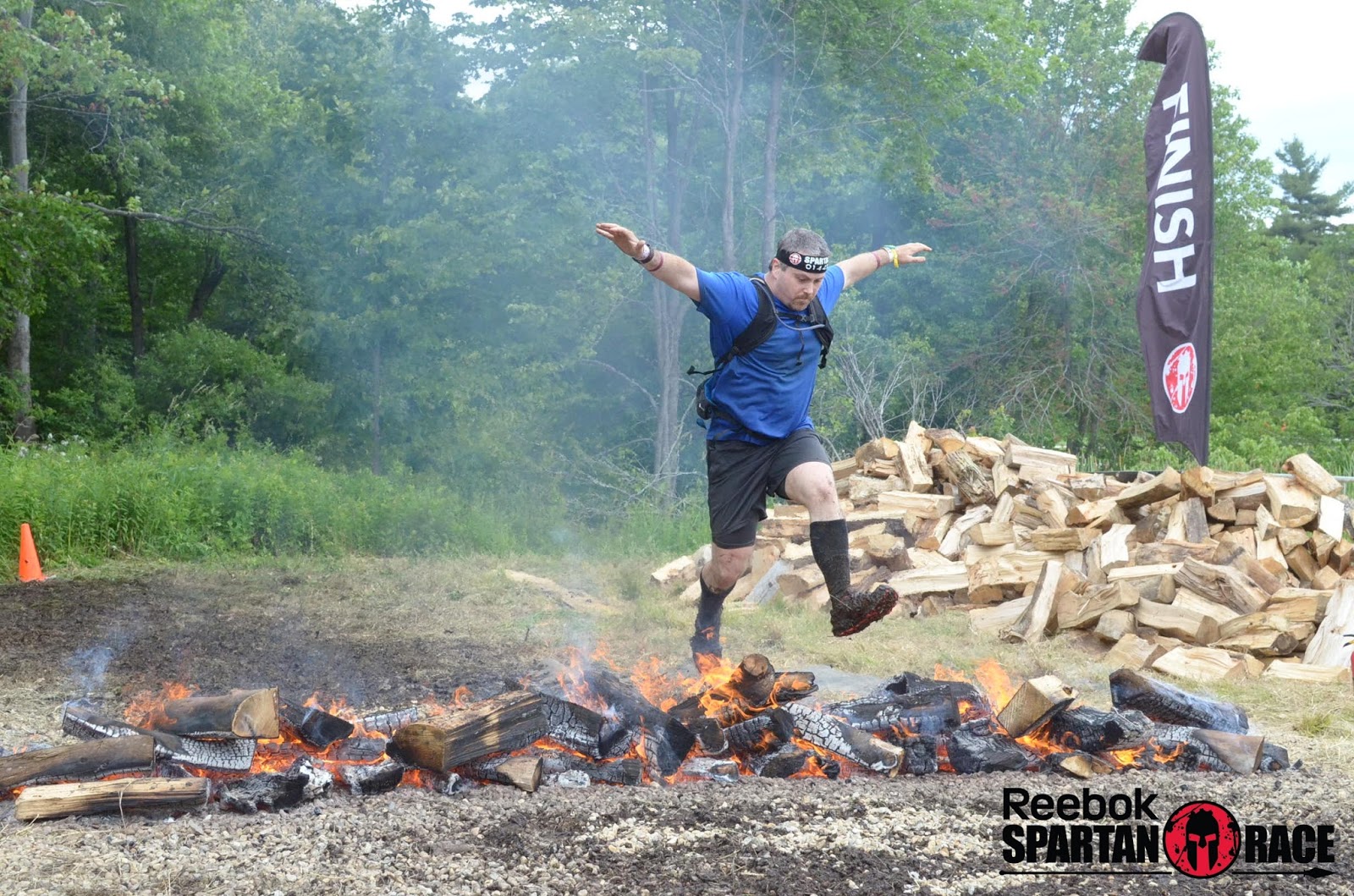 Over the Fire
All in all I consider the race a success--as I did the same number of burpees that I did for the Sprint last year, and I passed the monkey bars. But the finish of the race seemed anti-climactic, and the race itself is less fun without someone to run it with. But it looks like I’ll be running the remainder of this year’s races alone. Onto the Battlefrog!
Other Races in this Series
June 8, 2015
Tough Mudder New England 2015
 June 7, 2015
After having done the Bone Frog three weeks ago, I was not nervous about the Tough Mudder. The distance was the same, but far fewer obstacles and those didn’t seem as difficult--many were teamwork based, while others were more “mental grit” obstacles rather than physically demanding. Ultimately, the biggest punishment was the mountain itself.
June 7, 2015
After having done the Bone Frog three weeks ago, I was not nervous about the Tough Mudder. The distance was the same, but far fewer obstacles and those didn’t seem as difficult--many were teamwork based, while others were more “mental grit” obstacles rather than physically demanding. Ultimately, the biggest punishment was the mountain itself.My friend Jane drove to my house and from there I drove to Mount Snow, VT. Parking was easy, and we had to park at the far end of the lot that never completely filled up. It was a hike to get to the starting area. Registration was much more laid back than the other races I’ve been to, it was pretty smooth and we got through relatively quickly. They had volunteers moving up and down the line checking IDs and such to help speed things along.
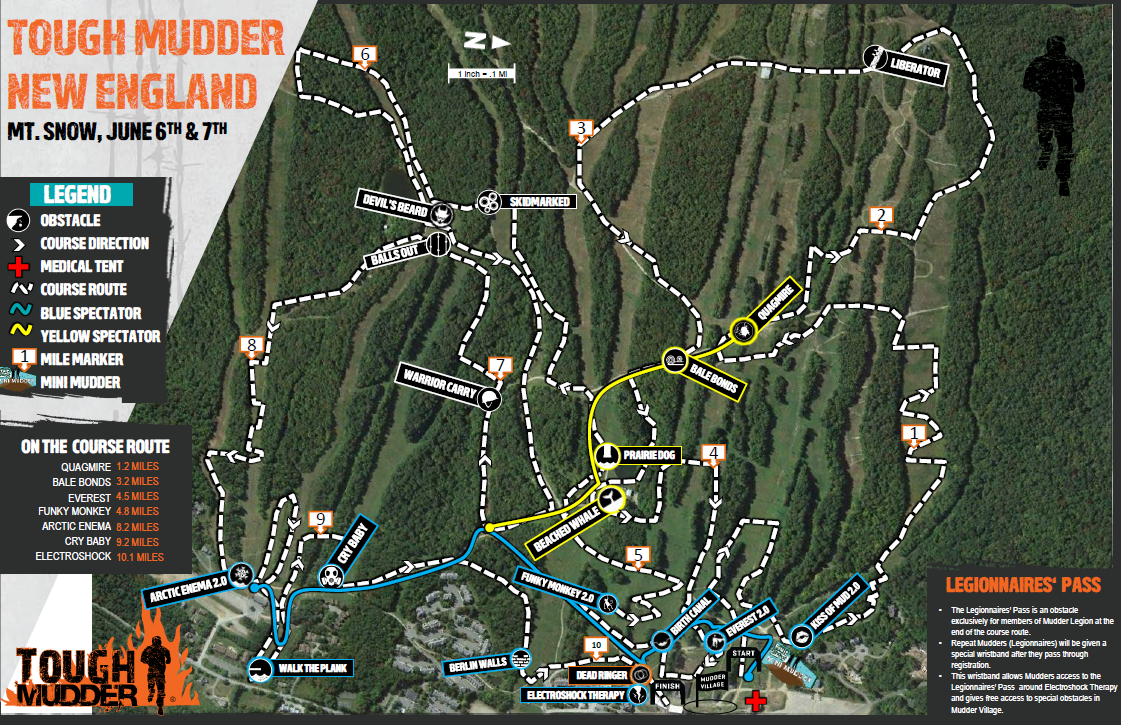 Course Map
After registration we met our friend John, put on sunscreen/bug spray and our bibs. Bathrooms were porta-potties, but there were plenty of them. Bag check was easy as well, but cost $10 (as opposed to $5 at Bone Frog). We still had easily a half hour before the team wave, but a staff member told us that they weren’t enforcing wave times--if you were ready, you could go anytime. We found our friend Nicole and the four of us went to the Warm Up area, where an enthusiastic DJ led us through some aerobics. Then on to the start line, where we were given a pep talk, that was good but entirely too long, and then we were off.
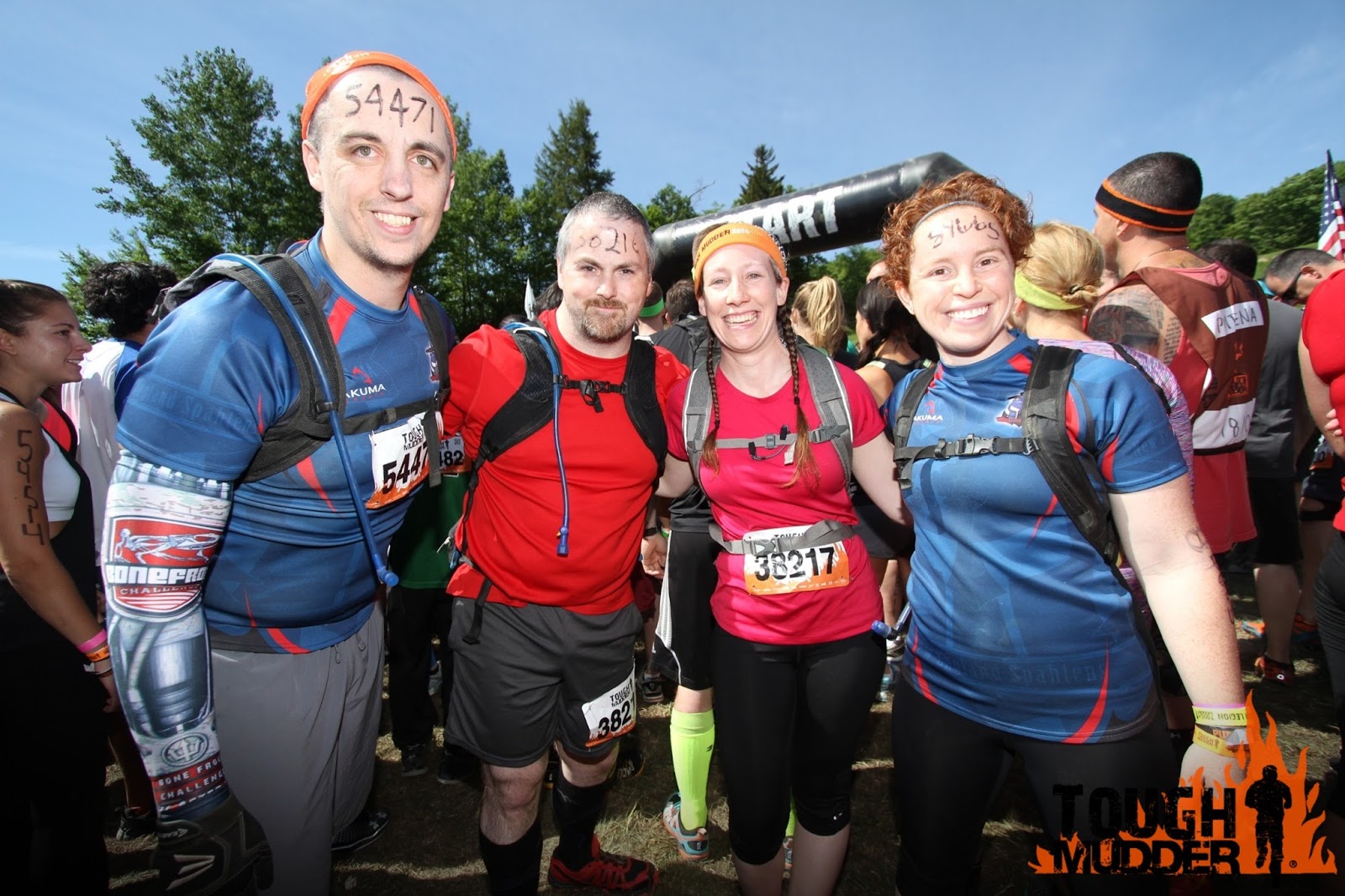 Ready to race
As I expected, the mountain itself was my biggest enemy. There was nothing quite as bad at the “Stairway to Valhalla” that there was at the Bone Frog, but there were definitely more hikes up ski runs. There were also a lot of hikes down ski runs as well, which were punishing to my right knee. Going up and down those hills, and as slow as I did, makes me very wary of attempting the Killington Spartan Beast this year, unless I seriously up my fitness level.
First obstacle was Kiss of Mud 2.0, which was a low crawl through mud under barbed wire. My hydration pack god snagged, but otherwise it wasn’t so bad.
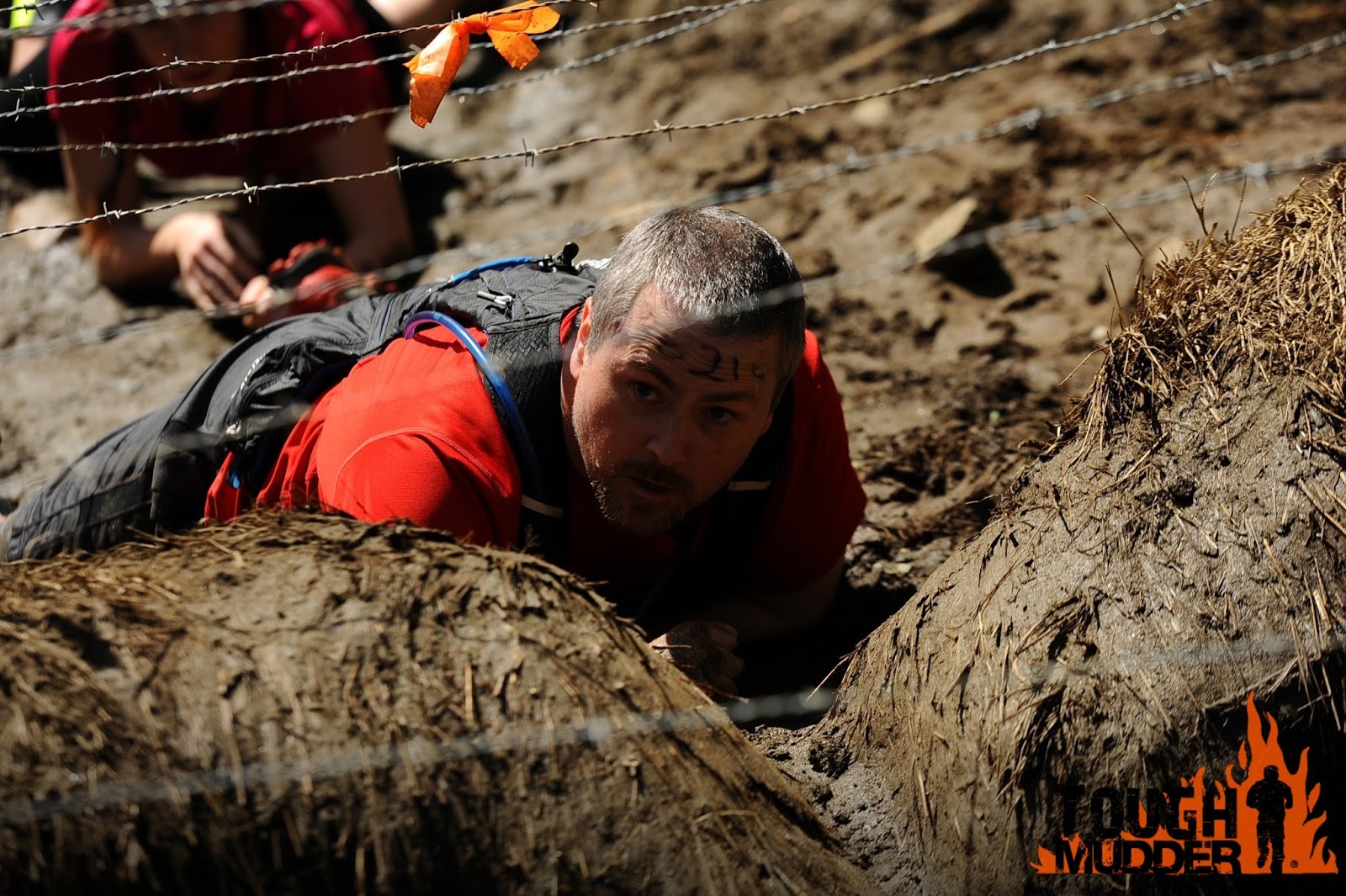 Negotiating the Barbed Wire
Next was a tough climb up the ski slopes for a mile and a half until we reached Liberator, which you had to climb up a wall using pegs you inserted into holes in the wall to support you (and some footholds). Next was Bale Bonds, which was climbing over walls of hay bales, and then Quagmire, which was a trudge through a mudpit. The others hesitated for a moment at that one, but I just plowed through it. So far the obstacles were pretty easy, but the hill was killing me. For the most part, Jane stayed close to me while I slogged up the hills, while John and Nicole usually went on ahead to the next stopping point and waited there.
Next was Beached Whale, which consisted of large inflatable that you had to work together as a team to get over, then down to Everest 2.0, which was a curved slope wall (a quarter pipe) that you had to run up, grab a rope, and then climb to the top while others held the ropes and helped you up. Next was Birth Canal which was another low crawl under a plastic tarp filled with water that pressed you down--it certainly lived up to its name. Then Funky Monkey, a set of monkey bars that Nicole dominated, John and I failed (although I think I got a little farther along than John did, but just a little, and Jane skipped. Up to this point I was doing the obstacles just fine, but this one beat me. I really need to work on the upper body strength, grip strength, and losing weight.
Back up the hill to Prairie Dog, which was shimmying down a narrow plastic pipe. Farther uphill to Skidmarked, a tall inverse wall which required us to help each other over, then more hiking to get to Devil’s Beard, which was a long crawl downhill under a relatively tight net.
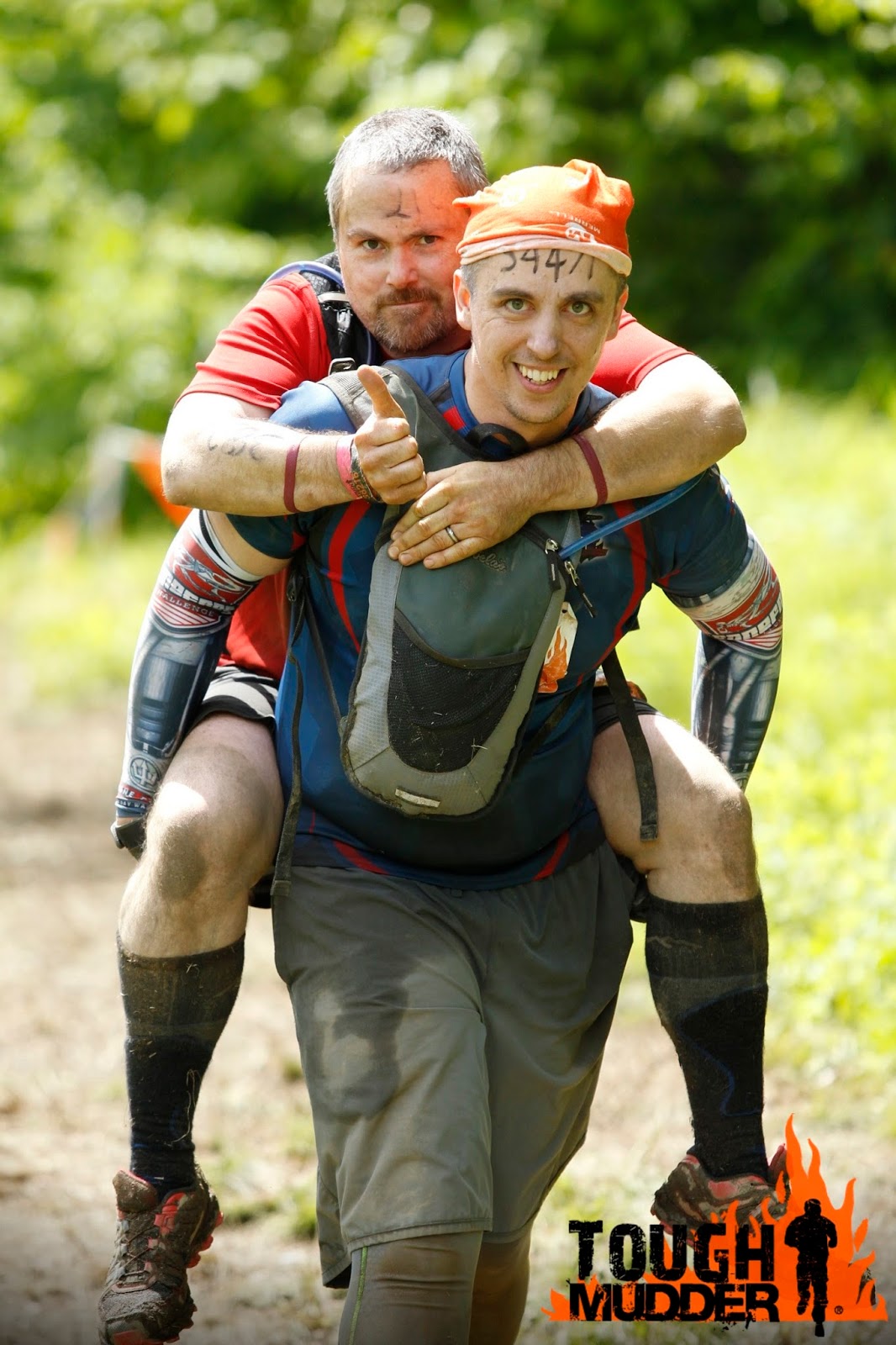 John carries me for the first half of the Warrior CarryDownhill and back up to the Warrior Carry, John carried me piggyback a ways and then I returned the favor, while Nicole and Jane did the same. More up and down hiking to Balls Out, which was a canted wall that you had to traverse sideways, using hanging ropes to traverse it. Nicole crushed it, John got most of the way but slipped near the end. Jane slipped a few times but completed it--I couldn’t get past the second rope. Other than the fact that I’m not strong enough to do it, my shoes simply could not get any traction on the wall, and my feet slid down the wall like they had been greased… I was angry that I couldn’t do it, and punched one of the walls in frustration with myself, skinning my knuckles.
 A long way downhill to the bottom, where we did Arctic Enema. This was one of the more mental obstacles. You slid down a short slide into a pool of ice water--full immersion. Then you had to climb over a wall into another pool of ice water, then another pool to get out. Nicole balked at this one--she said she was very cold-phobic, but she went ahead and did it anyway. I followed her, and it wasn’t as bad as I thought--very cold, but I didn’t cramp up or anything. The cold went away fast enough once we got moving again. Another short stint up and down the hill and we did Walk the Plank, a jump from maybe 15 feet high into a pool of water. I did a cannonball from the top. While swimming, my calf cramped up slightly, but it wasn’t too bad.
Back up a very steep hill to Cry Baby, which was a crawl through an enclosure with tear gas. I went to one side where the tear gas didn’t look that dense. It didn’t sting my eyes at all (I kept one eye closed the entire time). It smelled like strong peppermint, and burned your lungs if you breathed it too deeply. I got through it fine. Nicole did it as well, while Jane & John skipped it.
Next was Berlin Walls, which was only one wall, but it was very high and required a lot of boosting to get over. John helped as all over and skipped it himself due to his bad knees, but he did most of the work anyway.
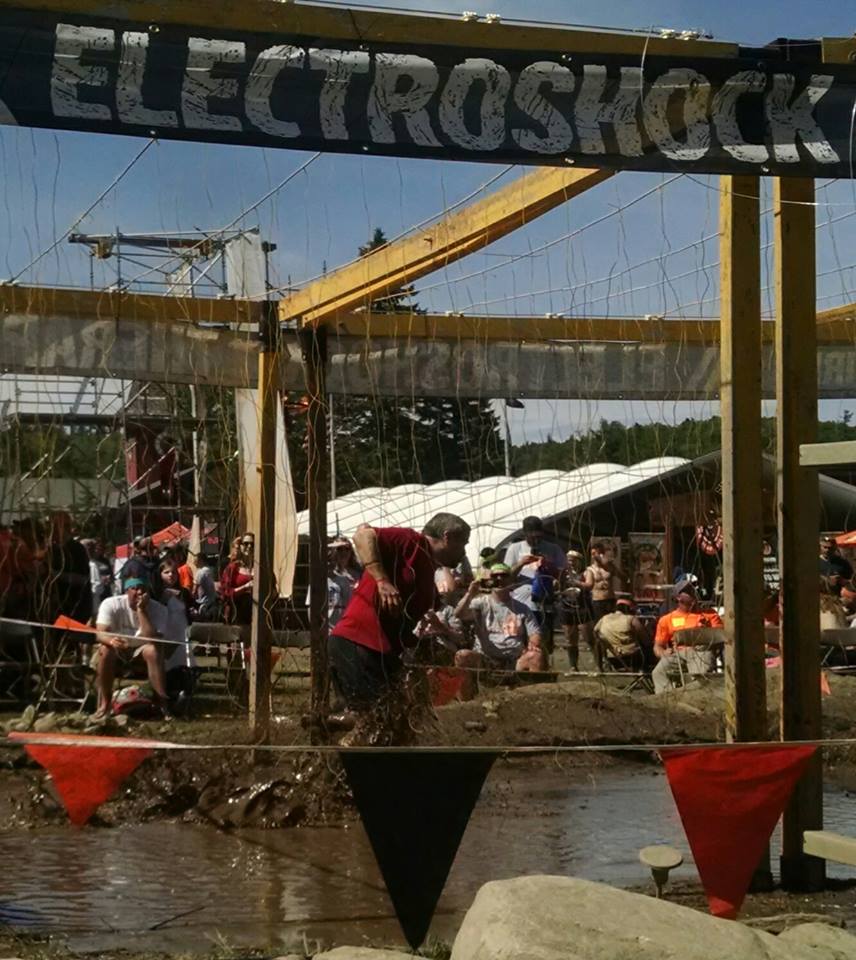 I run through Electroshock
A short hike later we were almost done. John, Jane, and Nicole, all being Tough Mudder “Legionnaires”, that is, having already done a Tough Mudder, got the option to do Dead Ringer, which they held a pair of rings and needed to move them from peg to peg while hanging from them. After that was Electroshock, with the Finish line right past it. John and Jane skipped it, while Nicole and I did it. It turned out to be something of a disappointment, as I figured every dangling string would be live, but I plowed through most of them and got nothing. I only got a shock on two of them, and even that wasn’t very strong.
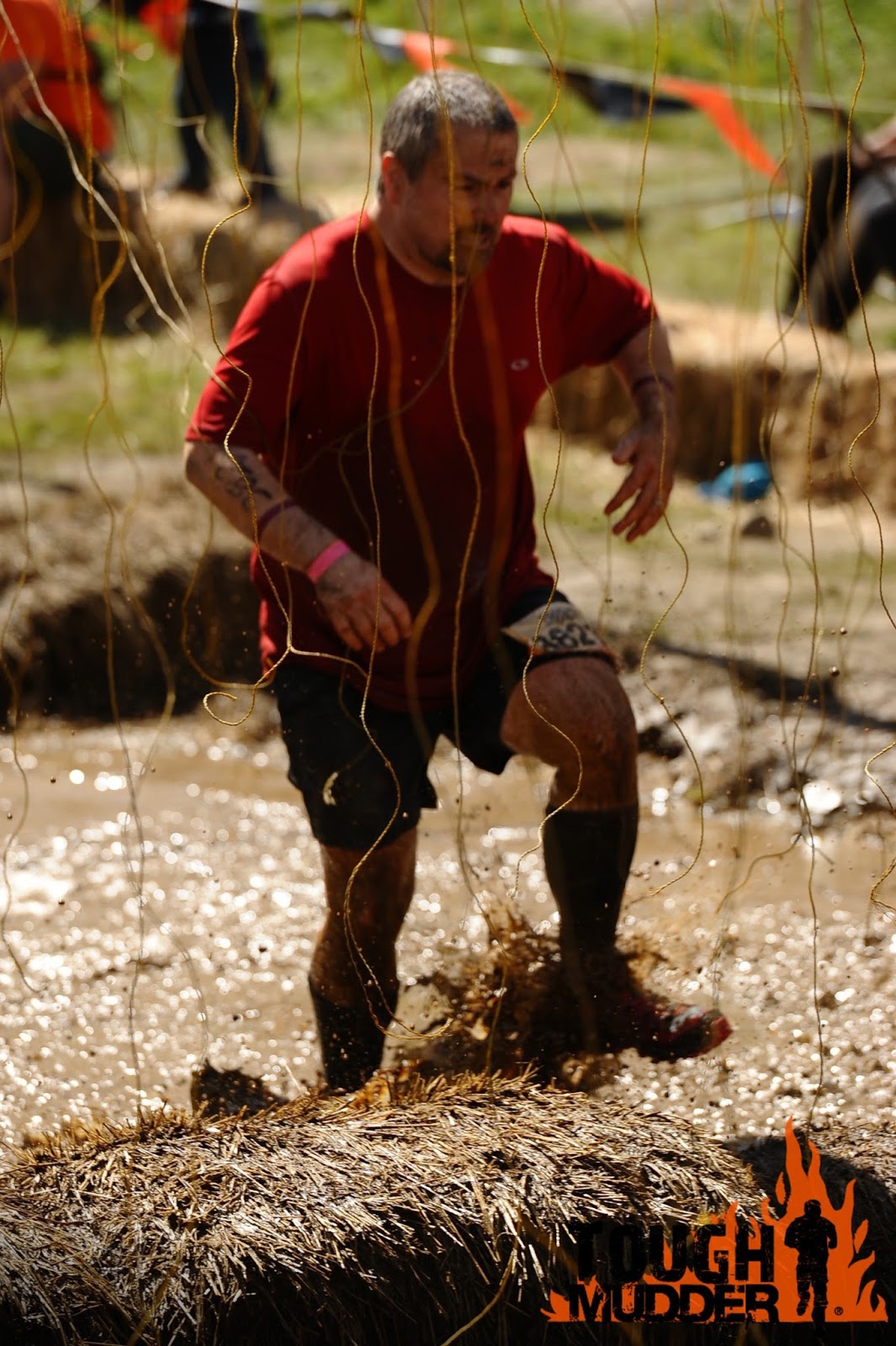 Getting zappedThrough the finish line, and past all the spectators were a bunch of volunteers, one of whom put a Tough Mudder headband on my head.
 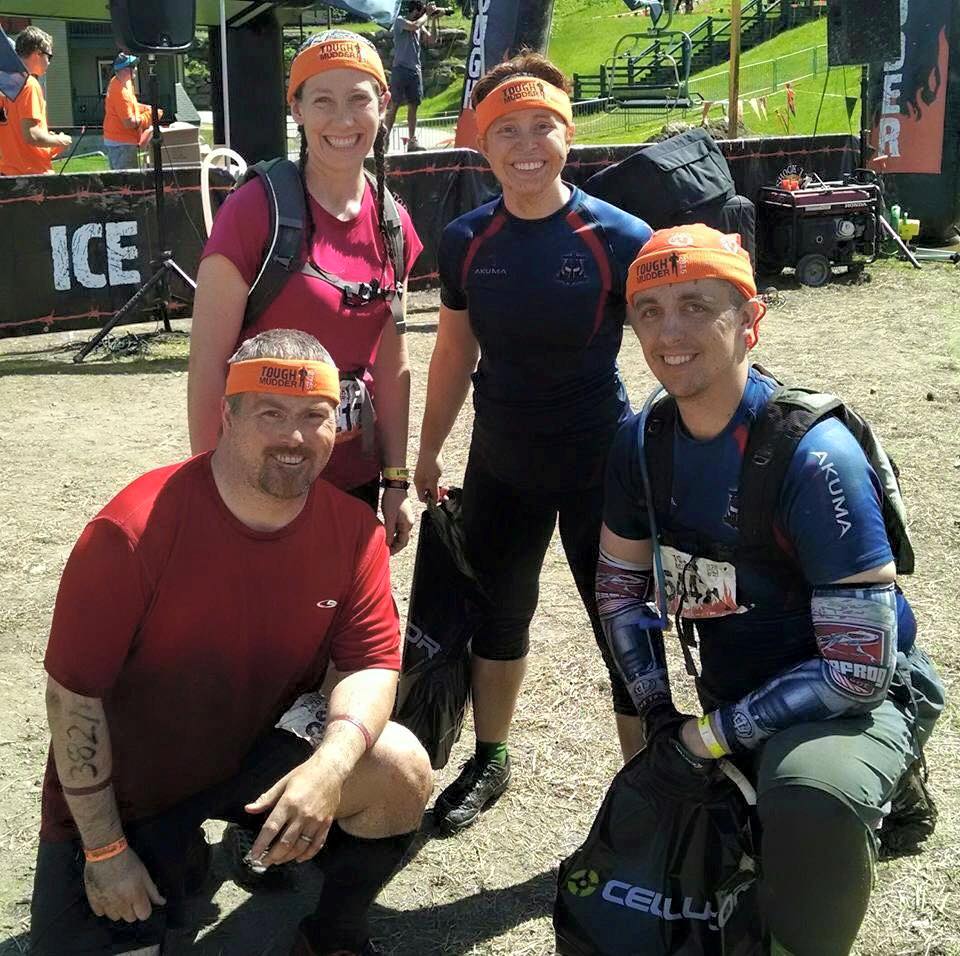 Sporting our new headbands
All in all, I thought the race was easier than Bone Frog, but rougher on my knees. The “mental grit” obstacles were definitely fun, and I liked the race a lot. I’d like to do another one.
Other Races in this series
May 18, 2015
Bone Frog Challenge New England 2015
 May 16, 2015
This was my second OCR. I had originally planned on doing the Killington Spartan Sprint in 2014, but real life got in the way, and I could not manage to train so I did not feel up to it. I vowed that 2015 would be different, and so I signed up for the Bonefrog Challenge. I planned on starting 2015 with some hardcore training, but again, real life got in the way and I wasn’t able to train much until March, and then I knew what I was doing was not enough. The closer I got to the event, the more I felt that I had bitten off more than I could chew. 10+ miles, 50 obstacles, 6000’ of elevation change...this felt like it would be too much for me. I kept training as much as I could, however, and even managed two long “runs” of 10.5 and 11.5 miles on the treadmill in the month leading up to the race. I was very slow, but I could do it, and that gave me a little bit of confidence.
May 16, 2015
This was my second OCR. I had originally planned on doing the Killington Spartan Sprint in 2014, but real life got in the way, and I could not manage to train so I did not feel up to it. I vowed that 2015 would be different, and so I signed up for the Bonefrog Challenge. I planned on starting 2015 with some hardcore training, but again, real life got in the way and I wasn’t able to train much until March, and then I knew what I was doing was not enough. The closer I got to the event, the more I felt that I had bitten off more than I could chew. 10+ miles, 50 obstacles, 6000’ of elevation change...this felt like it would be too much for me. I kept training as much as I could, however, and even managed two long “runs” of 10.5 and 11.5 miles on the treadmill in the month leading up to the race. I was very slow, but I could do it, and that gave me a little bit of confidence.Course Map
Arriving at the venue, a ski mountain in Western Mass., I wasn’t nearly as nervous as I had been at my first OCR. I was properly equipped with hydration pack, long socks, trail-running shoes and clothing, and I had been through a check-in before, so I knew what to expect. I had also regulated my food consumption sufficiently the week before I had no digestion issues--always a concern.
I met my friends John and Linda at the NE Spahtens tent with a pair of John’s co-workers and Nicole, another Spahten they were friendly with. Time was near so we were off to the start line. The weather was good, not too hot and generally overcast, although there would be sun later in the day. At 10:00am we were off.
The first part of the race was up the mountain, and I realized very quickly what would be the most difficult part of the race for me: the hills. My heart rate shot up, my pace slowed dramatically, and as would happen for the rest of the day, I would trail behind the others. I don’t remember all the obstacles in order in spite of having a map available, but I will do my best to recall them. There was a standard Low Crawl under wires, and very quickly I had scraped my knees and forearms in the muddy ground. Next was a jump/climb over a large plastic tube perhaps 4-5 feet high, with lots of mud around it--I managed these easily. There followed a Tire Drag--you had to pull a tire towards you with a rope, then drag it back to its starting position. Nicole, being petite, had difficulty dragging hers, so I helped her do it and then did it again myself. Another Low Crawl and then a Sandbag Carry uphill--the bag was flexible so it was easy to rest on a shoulder. Up the hill, switch shoulders, carry it back down. Then a Tarzan Swing--I had done one at the Spartan Sprint last year, so this was easy. By now were were back down at the base of the mountain.
Then was the first long wait of the day--the obstacle was the “Assault Craft” of several large inflatable boats tethered together, and you had to go from one to the next to cross a body of water. They were having trouble with the boats, as apparently some came untied, and people would bunch up in the boats causing more backups, etc. I estimate we waited in line at least a half hour, probably more, before getting our chance. The obstacle was fun, and I managed to jump from boat to boat without falling in. Next was a Log Carry up a hill and back that was easier than the sandbag carry.
Next was the first set of Monkey Bars. I knew these would be tough, and I was proven right--my hand slipped right off the first bar like it was coated with grease. Already I had little grip strength. I did my penalties and went in line for a Tyrolean Traverse. Another long wait as there were many in line and only six ropes. I knew the technique, and managed to keep it up for perhaps ten feet, but then I went into the water and had to swim. The water was shockingly cold, and sapped my strength very quickly, and swimming with shoes on was very hard. I considered waving to one of the lifeguards for help, but in the end I made it to the far shore by myself.
Next up was a horizontal wall climb and another long wait. I managed most of the climb before I had to descend, which was much harder than ascending, and I slipped off and fell, having to do more pushups. What followed was swinging handles/monkey bars, which I tried but of course failed, and more pushups.
Next was a climb through a wooden contraption, on top of monkey bars in a wooden frame, and then a Trench Crawl with a bend in it underneath an opaque tarp. Some people were having claustrophobia issues with it, but I kept on my hands and knees and got through ok. My only complaint was that wherever I put my knees, it seemed like it was on a rock. After that was a hop through some foxholes with some hedgehogs that was made to look like Normandy Beach. Back up the hill to a Tire Carry, and then back down to a “Black Out.” Another opaque tarp that covered three consecutive walls with windows in it at varying heights you had to climb through. The only illumination was provided by some chemlights, which proved to be enough to get by. There was a backup inside, but it wasn’t so bad.
By now it was clear that the obstacles were well spaced, which was a plus, because it broke up the hiking a lot. Past another obstacle (a wall?) and then was the Stairway to Valhalla. This consisted of climbed straight up a very steep ski run to the top. In places it was steep enough that some people went on all fours to climb it. Utterly exhausting, it took me a long time but I got up it. At the top was a memorial to fallen veterans and a board that you could sign. Back down and on. Another Horizontal Wall--much easier and with better holds than the first, I did this one easily and then a reverse wall which was doable, and lots more hiking. Another obstacle with a backup was one with a Horizontal Pole lined with Tires that you had to get over--the backup was caused by people who couldn’t make it over. When it got to my turn, I used a person to help me over and got boosted far that I crashed down on the other side, but was ok. I made it over the second one myself. More hiking to two consecutive nearly vertical walls with a rope up and down on each, I could not manage any of it and thus had to do more pushups.
Next was a few walls to go over and under, and then another Sandbag Carry--this one you had to fill yourself and carry up and down a hill. At this point a volunteer told us we were at the 7 mile mark. Already I had gone more than the Spartan Sprint, but it didn’t feel that far. I felt low on gas, but not empty. With this encouragement we went on to a Vertical Rope Climb, which I failed--I knew what to do, but did not have the strength to do it. Next was a flurry of obstacles, including a less steep Rope Climb, which I could do, climbing over some logs, then another vertical Rope Climb followed by Monkey Bars and another Rope Climb, which I predictably failed (at the vertical rope climb). I asked the nearby volunteer what the penalty was, and he said “Just pride on this one,” to which I replied, “I lost that a while ago.”
Next was a Vertical Cargo Net, and another long backup. (by this point in the race, I feel like I had lost maybe 90 minutes in waiting in line for obstacles). The cargo net was vertical and perhaps 15-20 feet high. A lot of people needed to be talked through it. When it came to my turn, I managed it fine--I didn’t think it was technically hard, but I was low on gas and that made it difficult. Getting my shoes caught in the ropes was another worry but I did it ok. More walls then a steep ladder with maybe 3-feet between “rungs”, which was easy for me, although it would have been much harder had I been shorter.
Next was “31 Heroes”, a memorial to veterans who died in a helicopter crash in Afghanistan: you had to do a military press with a sandbag and then a burpee for each name. Another wait, then I slogged through my 31 presses/burpees and on again. I think the tribute is a great obstacle, and although I didn’t shout the names out loud, I made sure to say each one in turn, and not just count to 31.
On to “Mind Games” which was to answer some questions, and we were told that “it was all downhill from here.” Not quite true, but close enough. The next obstacle was the “Slide for Life”, near the base of a large wind turbine. You had to jump up to a platform, climb through a hole to a higher platform (I needed help getting up), and then a slide down a rope back to the ground, which you had to do as a Tyrolean Traverse. It took some doing to hang onto the rope backwards and headfirst off the edge of the platform, but I did it ok, and managed to hang on long enough to complete the obstacle. I was proud of myself for completing that one.
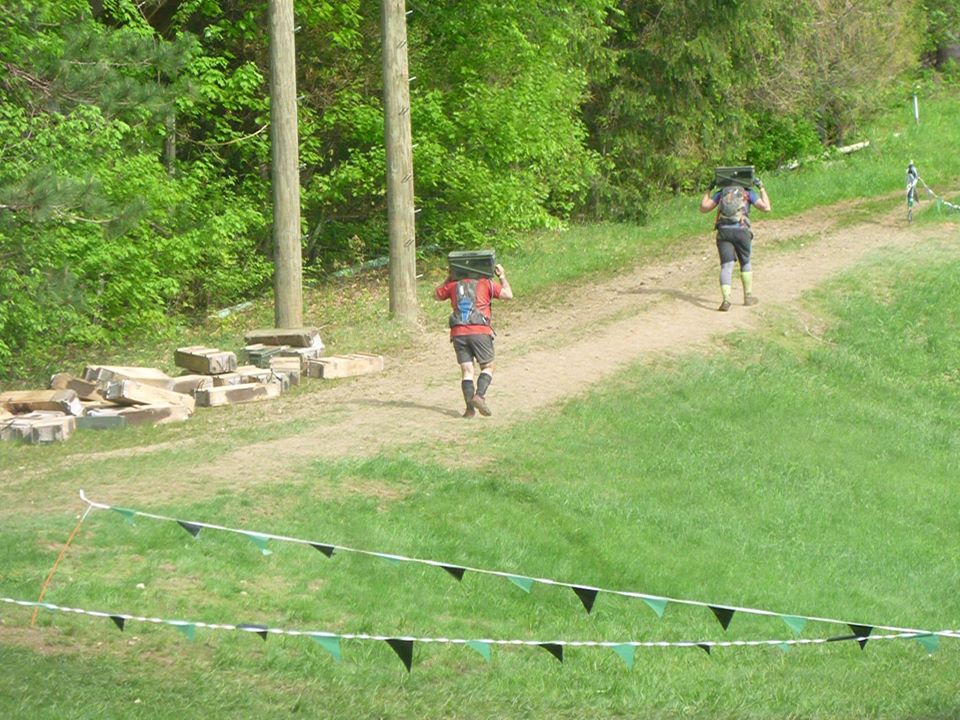 Carrying an ammunition box up the mountain
A few more obstacles that are a blur and lots of hiking through the woods, and then back through a tunnel that we had jumped over at the beginning of the race. Down to the base of the mountain again, and for the final push. We had to Carry Ammunition Boxes up the hill and back down--by this time my wife Kerri and the kids caught their first sight of me, and Kerri took a picture of me going up the hill with the ammo box on my shoulders. Back down and over a tall wall (more boosting), then a Balance Walk over a telephone pole that would shift and roll slightly. Then was a climb up a set of horizontal logs--you had to make small jumps up each one, which was difficult, but I managed ok (proud of myself again), and once I was told an easy way to get down, I did it and was fine. Then another rope climb/monkey bars/rope climb that I tried just to say that I did, and failed, so it was a final 50 pushups, with Kerri and the kids cheering me on. Then a short low crawl and a “roll” through sand, and John, Linda, and I were all through the finish line together. 7:04:18, 10 miles and 6000’ elevation change.
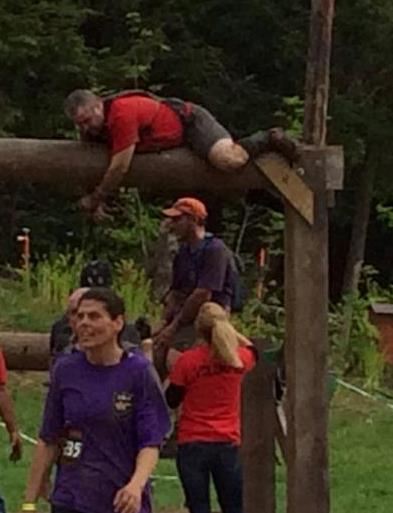 Horizontal Log Obstacle
This was definitely more of a challenge--and more fun, than last year’s Spartan Sprint. It was good to race with friends, especially those patient enough to wait for me. Unlike the Sprint, this time I really had a sense of accomplishment in finishing. Aside from scraped up knees and forearms, I’m just sore from the experience. My next race is the Tough Mudder in three weeks, and I think I can handle it.
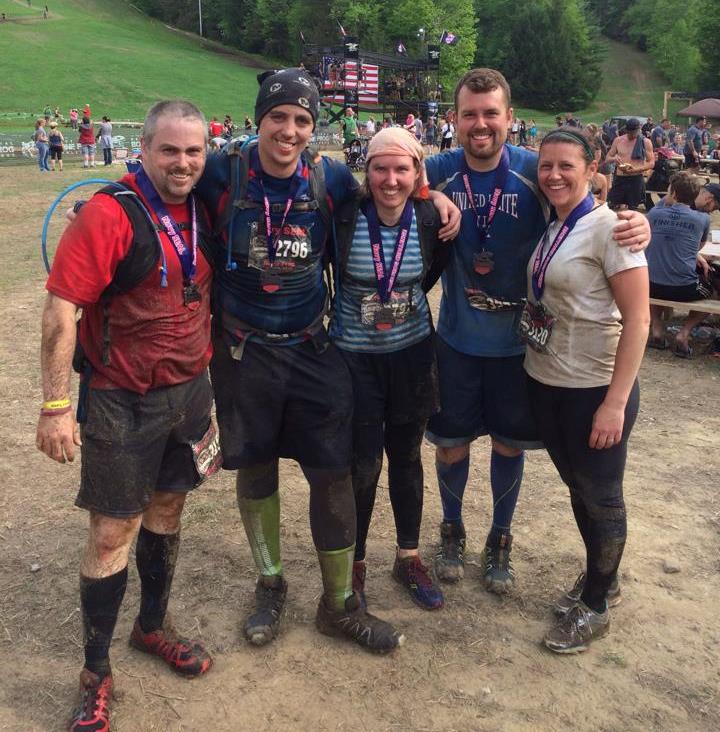 Survived my second race! Other Races in this Series
November 10, 2014
Behind the Scenes of a Free Book Promotion: Part 4

 In posts one, two, and three of this series I talked about my previous promotions and how I prepared for the next one. Now for the results. Did it have an impact on my sales? Did I get a return of investment?
Undoubtedly many people download free books do so because of the deal, and the book is filed away forever among the thousands in their collection, never to be read. A small percentage of the downloads is by readers who find the book interesting enough to read right away, and may perhaps leave a review and potentially buy the next book in the series.
The 855 from the previous promotion did not prove enough to have a significant percentage to produce post-promotional sales from the added visibility, and then I did not have any other works published to benefit from any readers who wanted more.
This time I got over 3,600 downloads. Was that enough to have an impact?
Yes.
When the Paid Kindle Store ranking for The Pirates of Alnari was reset, it was 13,586, and #37 in the Sea Stories category--the best it has ever been since it was published.
So I did better, but did I do good enough?
In the month prior to the promotion, I had a total of 1 sale and 2 borrows. Across all my titles. Yikes. Assuming each borrow brings in $1.52, that comes to a total of $5.76.
In the three weeks since the promotion began, I have had a total of 27 sales ($63.96) and 9 borrows ($13.68). Many of the sales and borrows (11 and 2 respectively) came the day after the promotion ended. The rest have come in ones and twos since then. Many were for The Pirates of Alnari, no doubt due to the additional visibility on Amazon (e.g., showing up in the Also Bought sections). However, about half of the post-promotion sales (13 sales and 4 borrows) are for the sequel, The Grand Masquerade, and my short story Our Turn to Shoot. Therefore it appears that some people who have read The Pirates of Alnari are moving onto my other books, which is a good sign. Over the long term, as more people of the 3,600 who downloaded it read it, hopefully they will consider leaving a review and move on to reading The Grand Masquerade.
Also in the aftermath, The Pirates of Alnari got three more reviews (2 5-star and 1 4-star), and The Grand Masquerade got one more (5-star) review.
In summary, my total earnings in the three weeks comes to $76.44, which is just over half my investment of $150.50. More will hopefully trickle in over the next month or so, perhaps enough to earn me a return on my investment.
At this point however, while the boost in sales is encouraging,the bottom line is that the promotion was still a failure. It did not provide a ROI. Lessons for next time are obvious: I need more titles to benefit from the post-promotional boost, and I need to keep trying.
In the meantime, seeing as I took a lot of David Gaughran's advice for this promo, I wanted to give his latest release a plug. It's a steal bundled with two other great ebooks for indie authors, so pick it up!
November 7, 2014
Behind the Scenes of a Free Book Promotion, Part 3
In the third post of my Behind the Scenes of a Free Book Promotion series, I will talk about Promotion Day itself. The day before the promotion, I got an email from Booktweeters saying that my book wasn’t free today (that is, the day before the promo), and so they couldn’t feature it. I quickly responded saying it wasn’t supposed to be free the day before, and enclosed a copy of my invoice as proof. They responded, apologizing for the mistake. Good, but this wasn’t exactly increasing my confidence in them…
I set up a spreadsheet to track my downloads throughout the day, much as I had done with my Book Gorilla promotion in 2013. I had plotted a graph with my previous promotions results on it already. For the 2013 promotion, the initial download rate was typical for all my previous free promotions: an almost negligible trickle. Then, when the Book Gorilla email went out soon after 10:00am, for a few hours I got downloads averaging nearly 80 per hour. After that, it started to decay exponentially. By the second day it was back down to a trickle, a averaging less than 10 downloads per hour for the rest of the day.
How would the new promotion perform?
Day 1 (all times EDT) (All Rankings are from the Free Store, not the Paid Store)
TimeDownloadsKindle Store RankingScience Fiction & FantasyFantasyEpic Fantasy5:00am130,321n/an/an/a
5:00am Free Kindle eBooks & Tips puts up their daily blog post.
TimeDownloadsKindle Store RankingScience Fiction & FantasyFantasyEpic Fantasy7:00am630,321n/an/an/a
7:00am There is a slight increase in download rate.
TimeDownloadsKindle Store RankingScience Fiction & FantasyFantasyEpic Fantasy8:00am2330,321n/an/an/a
8:00am eBookSoda daily email.
TimeDownloadsKindle Store RankingScience Fiction & FantasyFantasyEpic Fantasy9:16am5212,079n/an/an/a
9:16m The Fussy Librarian daily email, and about the same time I note that the EReader New Today blog post is up. There is an increase in download rate.
TimeDownloadsKindle Store RankingScience Fiction & FantasyFantasyEpic Fantasy10:12am11812,079n/an/an/a
10:12am BookGorilla daily email. The download rate has been increasing, and it increases a little bit more before steadying at ~120 per hour. This lasts until about 3:30pm.
TimeDownloadsKindle Store RankingScience Fiction & FantasyFantasyEpic Fantasy3:05pm691521n/an/a12
3:05pm Free Kindle eBooks & Tips daily email.
TimeDownloadsKindle Store RankingScience Fiction & FantasyFantasyEpic Fantasy3:17pm714521n/an/a12
3:17pm EReader News Today daily email. Due to either Free Kindle eBooks & Tips or EReader News Today or both, there is another increase in download rate to nearly 200 per hour, which lasts until midnight.
TimeDownloadsKindle Store RankingScience Fiction & FantasyFantasyEpic FantasyDay 2 12:00am2,32668n/an/a1
10:00am From midnight until 8:00am, the download rate unsurprisingly decreased to about 40 per hour.
TimeDownloadsKindle Store RankingScience Fiction & FantasyFantasyEpic Fantasy8:00am2,82147531
8:00am There is a modest increase in download rate, to about 50 per hour, that is remarkably steady throughout the day, and continues to the end of the promotion period.
TimeDownloadsKindle Store RankingScience Fiction & FantasyFantasyEpic FantasyEnd of Day 23,63676961
Final Download Count: 3,636.
As time ran out on Day 2, I waffled for a bit. My rankings were still very good, but they had already peaked. Should I extend the promotion another day? If the pattern of download rate decreasing after midnight continued, my rate of 50 per hour would probably have declined as well. It might have recovered slightly in the morning, but I doubted that it would do all that well for a third day. In the end I decided to let the promotion end as planned, and I hoped to capitalize on any buzz while the fire was still hot.
It would be days before the the aftermath of the promotion took effect. But while I waited to see if there would be any post promotional sales bounce, I could analyze what effect that the advertisers might have had.
The following is the graph I made during the promotion (click for a larger image). The black line is the number of downloads I received on my 2013 promotion, where I took a single ad out from BookGorilla. The blue line represents the current promotion. The text boxes are placed on the horizontal axis representing when their respective email blasts went out.

It is difficult to tell with any certainty just which advertiser had the biggest impact, especially as some of them sent out their emails at the similar times. But from what I can gather, BookGorilla, The Fussy Librarian, Free Kindle Books & Tips, and EReader News Today all appeared to contribute into getting downloads. eBookSoda did not appear to have a significant impact. Booktweeters is even harder to tell, as they sent their tweets out throughout the day. But since I cannot definitively attribute any impact to them, I can’t give them any credit either.
In the last post of this series, I’ll talk about the aftermath of the promotion, and whether or not I achieved a return on my investment.