Dan Eldredge's Blog, page 6
April 11, 2016
Writing Part 3: Finally Publishing... Independently
 While I was busy writing up story outlines to submit to Games Workshop's Black Library, my friend Jack Badelaire lost interest in doing the same and instead began exploring Amazon's Kindle Direct Publishing (KDP). At the time I thought he was missing the boat. KDP was interesting, but ebooks weren't all that popular (yet), and I was more interested in writing stories for Games Workshop. Seeing how into their games I was, it seemed like a dream job.
It did not take long for me to realize that it was I who was missing the boat.
[image error] [image error]
In the meantime my submissions to GW had gone nowhere. Jack had published and was having some modest success with his writing, so I felt I had a decent shot of doing the same.
Once I had decided to independently publish my writing, I delved into my old writing as a starting point. I was deeply invested in the world-building I had done, but the writing itself needed a lot of work, to put it mildly. My first novel, 93,000 words long, that I had completed in 1991? Trash. The second novel, completed in 1995? Trash. My third novel, that I had completed in 1997? Trash...well, maybe I could salvage something from it.
The plot itself was decent, but the story carried a lot of baggage from the first two novels which needed to be excised. A host of characters were deleted while those that remained evolved. Much exposition was eliminated, as I had begun to learn that much of storytelling comes from what you deliberately do not tell your reader. Most significantly, I completely eliminated all magical elements from my "fantasy" novel. From the beginning I had included them because in my experience fantasy by definition was about wizards, dragons, elves, goblins, and so forth. But as I got older, I found that I was more interested in the "real" aspects of stories I read: characters, relationships, and real-world problems, than I was interested in magic, fantastic creatures and races, and magical solutions to magical problems. My fantasy novel was still fantasy in that it took place on a different world from our own.
As I rewrote the novel, increasingly I discarded the original story entirely and rewrote it until the original was merely the seed. The plot matured and grew in complexity, and I finally had a first draft I was proud of, and sent it off to my alpha reader on August 4, 2012.
Two days later my wife was diagnosed with cancer.* The next several months were a whirlwind of doctor's appointments and trips to the hospital for treatments, and I juggled caring for my wife, 3-year-old daughter, and 1-year-old son. To say that my life was stressful during this time is an understatement. But despite this, I managed to publish my first novel, The Pirates of Alnari , on November 23, 2012. In a way it was therapeutic--while the rest of the family slept, I would unwind by working on getting my novel ready for publication. Focusing on it provided a much needed escape.
[image error] [image error]When I published The Pirates of Alnari, I spread the word on social media, and got the expected response from friends and family, most of whom gave encouragement, and a small subset actually purchased a copy. Soon, however, the sales trailed off to a trickle, and then stopped. This was of course discouraging, but I had learned in the process of publishing that most fantasy writers do not achieve any true measure of success until they have perhaps five novels published. Completing and publishing my first novel was itself a success, albeit a modest one.
I tried marketing The Pirates of Alnari with various promotional efforts, but it never got far. I did get reviews, and generally good ones, but sales did not grow. Along the way I learned that the best way to market one book is to write a another one. Readers in general like series, and the more titles you have available, the more likely they'll read your work at all.
It was a year and a half before I published my second novel, The Grand Masquerade . My time was still being taken up by taking care of my family, compounded with the fact that I was writing this novel from scratch rather than rewriting a previous work.
[image error] I published The Grand Masquerade in June 2014, and again got the predicted sales to friends and family with again trailed off to essentially nothing. The Pirates of Alnari got a modest, temporary boost, but all too quickly flatlined again. I needed to keep writing.
[image error]In the meantime, my good friend Jack Badelaire was having great success with his series of World War II novels, focusing on the British Commandos. By this time he had published his fourth book in the series and gathered a loyal following along the way. Early on we had discussed collaborating on a novel, or that he would write his Commando series and I would write a parallel series about the U.S. Army Rangers. I had outlined a plot and written a few chapters, but my writing process stagnated for a while. Then in the fall of 2015 I finally buckled down and pounded out the first novel in the series: RANGER: Operation Axehammer.
[image error] Both Jack and I were hoping that the parallel series would support each other: people who read COMMANDO would read RANGER, and vice versa. So we promoted each other's works and I got the same cover artist that created the COMMANDO covers to do the RANGER cover.
RANGER: Operation Axehammer has been available on Amazon for three months now, and has done pretty well, but that's a story for another post.
*The good news is that my wife is now cancer-free, although she still suffers from late effects of both the cancer and the treatments.


March 28, 2016
Writing Part 2: Dodging Bullets
 In my experiences with publishing my writing, I feel that I dodged some bullets in that I failed to get published. Had I gotten published by a legacy publisher, I think I would have gone down a bumpy road of frustration, disappointment, and ultimately failure. Failing to get published was actually a good thing. Each failure on the road to publication was like dodging a bullet. Yes, some of those bullets might have missed me by inches and others by miles...but the important thing is that I didn't get hit.
In 1991 I was a senior in high school when I completed my first novel. It was a fantasy novel that I had written for the fun of it, and was heavily influenced by my interests at the time: epic fantasies like The Silmarillion, with a tiny bit of the questing and character banter from The Belgariad, and a healthy dose of battles inspired by the wargame Warhammer Fantasy Battle. Attempting to get my book published was the next logical step, but I had no idea at all of how to go about it. One of my parents saw an ad in a magazine from a publishing company, and so I submitted my manuscript to them. A few months later, I got a response. The publisher offered to publish my novel for a fee of $15,000. The publisher was in fact a vanity publisher, and in my naivety at the time I did not even know what a vanity publisher was.
Even at the young age of 17, I thought the pitch smelled fishy. The publisher's brochures were two-color pamphlets that looked like they were produced in the 1950s. In it was an illustration of a guy at a drafting table, with the text stating how they would design an attractive jacket for the book. I thought to myself that if the jacket was developed with the same care as their brochure was, then no thanks. The publisher said the book would be printed in a hardcover format and retail for $17.95. This was emphatically not what I was interested in. As a reader I exclusively read mass market paperbacks, and since I envisioned my writing to appeal primarily to those of my own demographic, a hardcover edition seemed a complete waste, and in any event far too expensive for the average teenage boy. They also pitched that they would create press releases for local media and organize events at local bookstores for book signings. To my mind a press release seemed...inappropriate. Why would my local TV station or newspaper even care about this sort of thing? As an introvert, the idea of a book signing event horrified me. More than that, I had envisioned book signings to be for established authors who already had a fanbase. Offering to arrange them for a new author was simply an appeal to my vanity. I was beginning to understand the concept of vanity publishing.
A few days after I received the response from the vanity publisher (contract included and ready for my signature!), my parents sat me down and told me, sadness in their eyes, that there was no way we could afford to pay for the publication of my book. I could tell they were afraid of breaking my heart, as they knew how much work I had put into it. I told them up front that I didn't mind. If this was how publishing worked, then I didn't want any part of it.
So I dodged my first bullet by not succumbing to vanity and trying to scrape up the money to buy into this scam. I reached for the prize, but snatched my hand back once I got a better look at what I was reaching for.
* * *
Soon after my mother bought me a book called The Writer's Marketplace, which provided a list of publishers ("real" publishers) and their submission guidelines. Some only accepted submissions through agents, so I ignored those, and looked specifically for publishers that accepted unsolicited manuscripts. Armed with that knowledge, I submitted my novel to several fantasy publishers. Response time was measured in months, so I tried to forget about it and continued to write.
Over the next four years, I attended college and wrote two more novels. I felt them both to be far superior to my first effort, and they were. They still sucked. Using an updated edition of The Writer's Marketplace, I submitted these manuscripts to publishers as well. As time went on, the rejections trickled in, with rejection letters ranging from the obviously photocopied form letter, to one standout that was not a form letter, but said that my writing had promise, and encouraged me to send them more work. Nowadays I look back on that and can't imagine what they were thinking in encouraging me. What I had sent them was ghastly.
The bullet I dodged here was of my own making. My writing still sucked, so notwithstanding the encouragement, my submissions probably came nowhere near to being accepted. But what if they had been?
I had submitted out of the wilderness of complete ignorance. I assumed that if by some miracle my book was accepted for publication, we'd have some friendly negotiations, I'd sign a contract, there would be some editing, the book would be published, the royalties would roll in, and everything would be grand. It never occurred to me that a publisher might not have my best interests at heart. But the evils of legacy publishing are a story for another time.
* * *
In 1997 I started graduate school, and any time I had for writing was quickly swallowed up by the workload. It was years and years before I would seriously look at writing again.
I had been a fan of Games Workshop's games since the 1980s (see above), and was most deeply interested in the grimdark future of Warhammer 40,000. I played the games, read the novels, painted the miniatures, wrote up battle reports (q.v. this blog), and so on. Then I found out in 2010 that they were accepting submissions for potential new authors for the Black Library (their fiction publishing wing). The Warhammer 40k universe is a big one, and I thought there might be room in it for some of my stories.
I talked with my good friend Jack Badelaire, who also expressed interest in making a submission, and so the two of us worked on stories in parallel. However, he ended up losing interest and focusing on something else--writing his own stuff and submitting it to Kindle Direct Publishing. I thought he was missing the boat. Here was a great opportunity! We had the opportunity of writing for the Black Library, alongside the likes of Dan Abnett, Graham McNeill, and Aaron Dembski-Bowden. In the end, I submitted proposals for one short story and two novels.
Crickets.
Or were they the sounds of bullets zipping by in the distance?
Again, I thought that if my work was accepted, I'd be writing stories for fun and living the high life.
Now a little wiser, I've come to learn that had my work been accepted there, I would have been involved in writing books on spec, with deadlines, not very much money... and everything I wrote would be the property of GW for the life of the copyright. I didn't realize it at the time, but I was fortunate to be rejected.
* * *
In the meantime Jack had opened the door to Kindle Direct Publishing (KDP). His success would spur me to revisit my old writing and try it myself. KDP would be the magic bullet.
March 24, 2016
Writing, Part 1: How my Teachers Crushed my Creativity
 I started writing creatively in elementary school, but rarely finished anything. I started a story about wild horses that was a few pages long, and I started a novel about "Will the Cat" that lasted a chapter or two before I lost interest. In any event, I didn't mention my extracurricular writing to my teachers. Looking at the scrapbook where my mother collected selected assignments, I can see that some of my school writing efforts received standard praise, but that's not what I remember about my experiences. Mostly I remember the rejections.
My third grade teacher was well known for being strict. She would berate the class daily, waggling her middle finger at us and referring to us as "You little infants!" (she wasn't giving us an obscene gesture--rather, for some reason she used her middle finger as her pointer finger) One day she gave us a writing assignment where we were to write a story about a raindrop named Droplet's adventure falling from a cloud to the earth. I wanted to be creative, so I named my raindrop "Mike" instead. Big mistake. I got marked off for that because I didn't follow directions, and the teacher actually erased the name "Mike" on my paper and wrote in Droplet instead. As a young 8-year-old, I wasn't about to complain, as I probably would have been called a "little infant" and gotten a middle finger in the face.
As an aside, the sole exception to rejection that I do remember is an assignment in 6th grade. Our instructions were minimal: Write a story about Mount Marshmallow. Unlike most creative writing assignments, the minimal instructions provided allowed me to get into it. I drew a map featuring Mount Marshmallow (on an extrasolar planet I named Omega Centauri) and wrote about a mountain climbing expedition to conquer the alien peak. The 2-page assignment ballooned into 6 pages for me, and the teacher was sufficiently impressed that she had me read it to the class.
The map that sparked the story was the key. I had always been fascinated by the maps I found in National Geographic, as well as books such as The Hobbit, The Lord of the Rings, and the Lone Wolf series of adventure gamebooks. I started to draw my own maps, and it was only natural to me to populate them peoples, cultures, conflicts, and story ideas. I started writing a novel in 7th grade (1987), writing by the seat of my pants and slowly building a story as I went. By my junior year in high school, I had finished a first draft of some 90,000 words, but it was all handwritten in scattered notebooks. So I typed up the novel on my mother's computer, rewriting and revising heavily as my grasp of writing had matured significantly in the four years since I started.
After English class one day, I was discussing my book with a friend, and the teacher overheard the conversation. She was an excellent teacher and I enjoyed her class. I looked to her, and perhaps anticipating what might come next, she shook her head and told me flat out, "Sorry, I don't have time to read it." I never brought it up again.
Late in the year she was temporarily replaced by another teacher. During a writing assignment where we were supposed to describe our bedrooms, I wrote that I had a bookshelf that was so large that it "loomed" over you when you approached it (I was being dramatic). The teacher commented with her official red pen that using the word "loom" in such a fashion was anthropomorphizing an inanimate object, and therefore incorrect. At the time I was intimidated and said nothing. To this day I remain stunned that an English Teacher would say something like that.
So disenchanted with English, in my senior year I declined to take the AP English class despite having the grades for it. What was the point? I took a lower level class instead, which was easy but boring.
I started applying for colleges, and like all students, met with my guidance counselor to discuss my future. He said that I had good grades and was smart, but smart kids were a dime a dozen. I was light on extracurricular activities, and therefore there was little to make me stand out from the crowd. Therefore, I should not get my hopes up about attending a good school, and apply to several safety schools in case.
"But I've written a book," I replied.
The guidance counselor smirked at me skeptically and said, "You mean, you're writing a book." I inferred from his manner that he thought he was being charitable, and that he really believed I hadn't even gotten that far.
"No, I mean I've written a book. It's 93,000 words." I took a copy of the printed manuscript out of my backpack and thumped all 300 pages of it onto his desk.
A sickened look came over his face as if he was terrified that I might ask him to read it or worse, get some actual guidance from him. He quickly changed the subject and got me out of his office as fast as he could.
I graduated high school and attended Wheaton College, a small Liberal Arts school in Massachusetts. As part of the Liberal Arts curriculum, all freshmen were required to take an English class, but students could waive the class if they could provide three writing samples, one being a term paper. Unfortunately despite a lot of digging I could not find any of my old term papers from high school, so I submitted what I did have: two creative writing assignments from high school, and my 93,000 word novel. My waiver was promptly rejected due to the lack of a term paper. I objected that while I didn't submit a term paper, what I did submit should certainly serve as a good measure of my writing ability. I was told that since I didn't prove I could write a term paper, it was just too darn bad. Therefore, to make up for my clear deficiency in writing term papers, I was assigned to... a journalism course.
At college I asked around about my writing, seeking out advice wherever I could, and was told of a professor in the English department who was a published author, and it was suggested I speak to her. I did, expecting nothing. She didn't disappoint me. When I told her what I had written, she said that she wrote children's books, and therefore couldn't help me. Have a nice day.
By this time I had matured enough that I had long since learned my lesson about writing: I was on my own. No one had helped, and more than that, no one wanted to. There would be no mentor to swoop down and show me the ropes. If I wanted to learn how to write and publish my work, I would have to do it myself.
The writing part, well, I've found that the best way to learn how to do it was to simply write, write, and write some more. As for the publishing part, in retrospect I think about it as an exercise in dodging bullets... which will be the subject of part 2 of this series.
March 23, 2016
In Praise of the Kindle
 Back in the early 2000s, I considering buying my first digital camera. I was leery of doing so, as all the photos I would take would end up on my computer, and how would I get prints? All of my family photos were in photos albums where I could feel nostalgic occasionally paging through them, provided I could get over the slightly musty smell. To be honest, only the oldest photos were in the albums--the more recent ones were more likely to be still in the envelopes from the local drugstore photo-developers.
I was already scanning some of the pictures I took after having them developed, and I could see doing more of that going forward, so I bit the bullet and bought a digital camera.
I never looked back.
The convenience of a digital camera was beyond compare. I found less and less reason to ever want a film camera. No longer did I have to worry about buying film, taking bad pictures that I would just throw away, getting the pictures developed, going to pick up those pictures, and then not knowing what to do with all the prints...except toss them in a box with all the others. These days, I have boxes and boxes filled with old photographs, and it fills me with dread when I consider the effort it will require to digitize them.
Digital books was a different animal. I was proud of my collection of hardcover and paperback books. I had multiple bookshelves packed with them--many of the shelves two books deep, with other books stuffed on top because there was no more room. I read many of those books over and over again until the bindings broke and they fell apart. (I replaced those, but in some cases I couldn't bear to get rid of the old copy). Some of them were so old they had a musty smell that I put up with when I read them again. I kept a dictionary by my bedside at night so I could look up any words I didn't know as I read. I usually carried a book wherever I went so I could read in waiting rooms, on the bus or on the train, any time there was the possibility of there being time to read.
When I heard about the Kindle, I wasn't really interested. It was a new technology; there didn't seem to be many titles available yet for it (at the time I didn't bother looking), and I didn't see the need for it. I was happy with all the books I had, and I did not relish the idea of having to spend the money to replace my library with ebooks when I had physical copies (similar to replacing cassettes with CD/DVDs, and then digital copies of music/movies).
But something happened in the early 2010s. With the rise of Kindle Direct Publishing, there came the opportunity for me to publish some of my writing. If I was to write ebooks, I would have to buy a Kindle to ensure proper formatting of my work. The price of a Kindle wasn't that expensive, so I went ahead and bought one. (I briefly considered purchasing a Nook instead, but ultimately decided on a Kindle. Boy, was that ever a good decision!)
I purchased a novel on it to read, and was hooked. It was also easy to find lots of free books (e.g., the classics) on the internet, so it was extremely easy to load up my Kindle with hundreds of books. It did not take long for my e-library outnumber my p-library. The Kindle was lighter than all but the smallest paperbacks, and about the size of a very thin trade paperback. I could adjust the font size, make notes, highlights, all sorts of neat tricks. There was no need for dictionary at my beside table anymore--I could just highlight the word on my Kindle and it would provide the definition.
When it came time for me to move again, I looked at my huge library of pbooks and sighed. I always had to box them up, ship them to my new home, and unbox them again. Due to lack of space, some of them had to stay in the boxes until I needed one...which resulted in a curse-filled digging in the depths of a closet through heavy unlabeled boxes until I found (or not) what I was looking for.
However, by this time I had bought several ebooks of pbooks I already owned. When I wanted to read a particular book again, I just bought the ebook because reading on my Kindle (or increasingly, the Kindle App on my smartphone) was just so much more convenient. I realized that there was no longer a need for me to lug my p-library wherever I went. Indeed, there were lots of books that I greatly enjoyed when I first read them, and I held onto them for sentimental value, but I knew that it was unlikely that I would never read them again. After I realized this, the vast majority of those books were boxed up and donated.
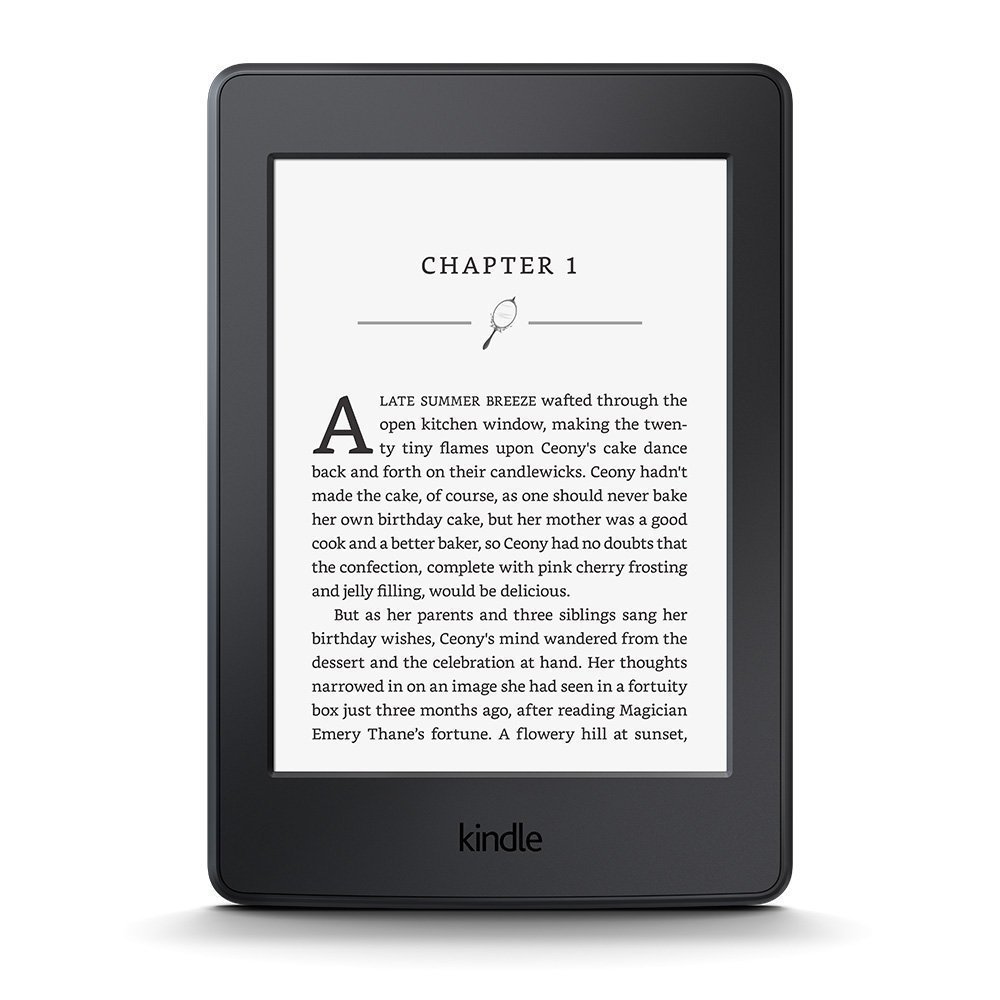
My wife was more of a casual reader in that she might read a book or two a year on the recommendation of friends. She bought me a Kindle Paperwhite for Christmas one year (I was interested in the backlight feature). Soon after I showed her how to use it, she claimed it as her own. She especially loves the dictionary feature. I didn't mind, as by this time I had mostly switched to the Kindle App on my smartphone. I have every book I want to read, whenever I want it. No more lugging large, cumbersome books around with me. I still have my original Kindle, with its fantastic battery life, as a backup.
Not the least benefit from all this is what the Kindle has done for my writing. My writing is a story for another post, but ebooks, and in particular the Kindle and Kindle Direct Publishing, has allowed me to put my work out there and earn some money. It's easy to like something that helps pay the bills.
But why am I suddenly praising the Kindle now, years after I've started using it? Because I found a book I wanted to read that did not have a Kindle edition. That's rare these days, and normally if I do find a book I'd like to read that doesn't have a Kindle edition, I shrug and move on--because I know there's thousands of books I want to read that do have Kindle editions. But this book was an exception--I needed to read the book as research for my next writing project. So I bought it, started reading it...and felt like I was back in the Stone Age. The hardcover book was heavy and cumbersome. If I forget to lug it with me, I can't read it when I want to (unlike my smartphone, which I have with me essentially continuously). Last night I wanted to look up a word, and out of habit I touched the page to highlight it, and of course nothing happened. So I cursed, put the book down, broke out my phone and looked it up there. Rather than getting my answer in literally a second, it took about a minute to get back to reading, breaking my flow of thought. Almost immediately after that, I wanted to highlight a section and take some notes (I'm reading this for research after all). Again, I had to put the book down and hunt around for a sticky note to mark the page so I could take down my notes at some later time. What a pain in the butt. And to top it off, while I was reading, one of my rambunctious kids plowed into me, spilling juice all over the book. If I was reading a Kindle, the result would have been a little cursing and a few paper towels and problem solved. For a pbook? It's permanently damaged.
In short, I've been spoiled by my Kindle experience, and having to go back to a pbook has made me appreciate ebooks all the more.
Get a Kindle (or download the free app to your phone or tablet). You'll never look back.
P.S. I may address pbook loyalist luddites in a future post.
March 22, 2016
Tiger Tank, Part 1
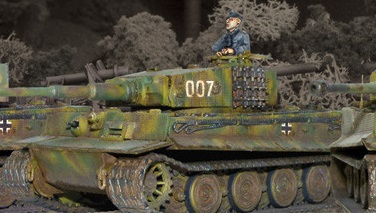 I see the incredible potential of airbrushes for model painting, but my experience is limited. Even so, I have managed some decent results, but getting them has not been without some frustration (this frustration is admittedly due to my unfamiliarity with airbrushing.
A while back I did what I thought was a pretty decent job airbrushing a Tau Devilfish, but it's been a while since I picked up my airbrush--a long while. In the meantime I purchased a new airbrush set and compressor, which is much better than the 30-40 year old piece of junk I had. Although, to be fair, if it was still running at 30-40 years old, it must have been pretty good. It lacked a regulator though, so I went ahead with the upgrade.
I've learned that there's a lot of trial and error to airbrushing. Getting the paint properly thinned and setting the correct air pressure is key. Time and again I would mix up some paint, thin it with some water, only to have the airbrush jam. Then I would thin the paint more, and the result would be dirty water spraying over the model. Then I would attempt to thin it midway between the two extremes, and I would test spray the airbrush on a paper towel, and what looked like a good spray of paint would come out. Success...not. By the time I would move the airbrush from the paper towel to the model, it would clog again.
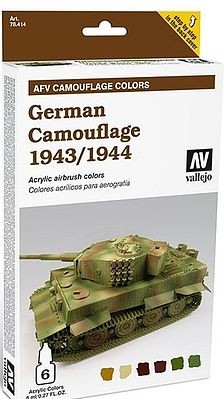
In frustration I ordered some airbrush specific paints (up to this point I used mainly standard model paints). Since my first project was to be a Tiger tank for Bolt Action, I ordered the Vallejo AFV Camouflage set for German Camouflage 1943/1944.
Figuring that since these paints were designed for airbrushing, I would be able to paint with them straight out of the bottle, or at least with minimal thinning. No such luck. I had the same problems I did with the other paints.
I did some searching on youtube for airbrush tutorials to get tips on thinning, but without much success. I finally decided to buy some Vallejo Airbrush Thinner and Flow Improver, in the hopes that these would save the day.
 To my vast relief, they did. With 2-3 drops each of Flow Improver and Thinner to ten drops of paint, I got a very good mix of paint that actually gave a decent spray of paint without clogging. I still need practice with flow control on the airbrush and technique, but at least now I was in business.
So after that very long introduction, I could finally work on the Tiger tank. Conveniently, the Vallejo German Camouflage 1943/1944 set comes with illustrated instructions on the back of the box:
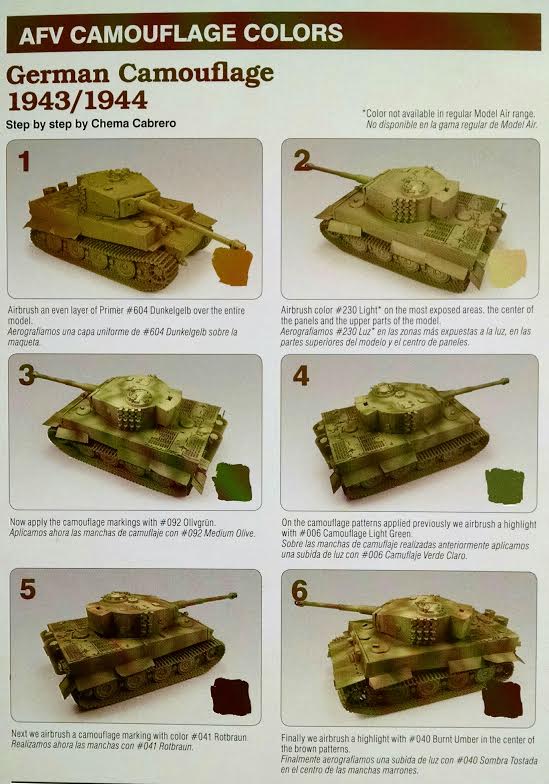
Step 1: Airbrush Dunkelgelb #604 Surface Primer over the entire model.
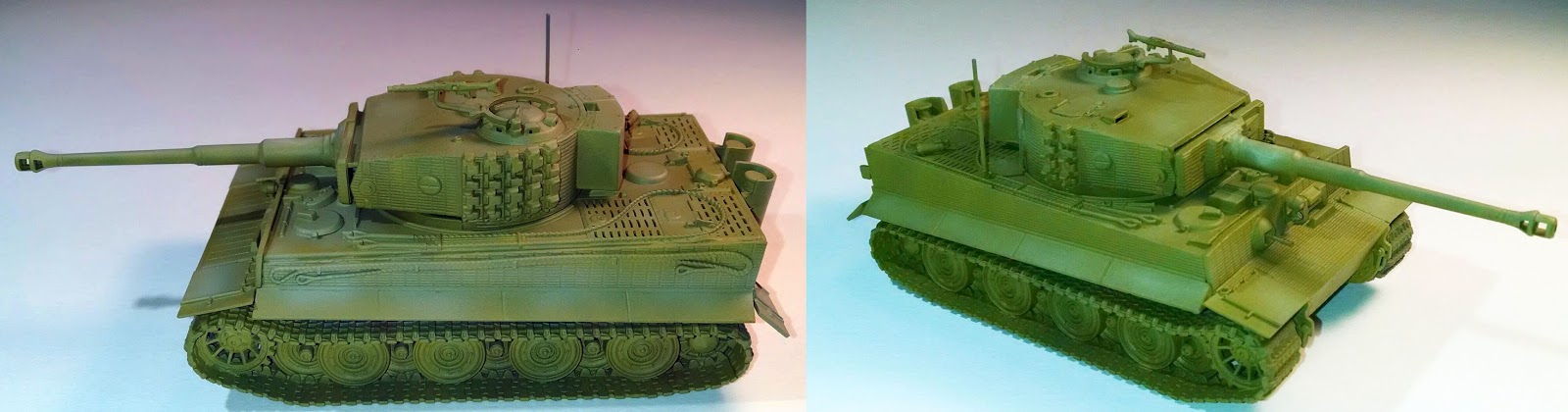
 Step 2: Airbrush #230 Light over the most exposed areas, centers of panels, and the upper surfaces of the model. This step requires a little bit of control to get the centers of the panels, but I didn't worry about it too much if I didn't get it perfect--this is partially to get a gentle highlight on various parts of the model.
 Step 3: Now to start the camouflage. Airbrush stripes with #092 Olivgrun. This requires some control, and it's the first place where I can "really" screw up. Since this kind of airbrushing is all about gentle transitions between colors, if I mess up severely, I need to start over. Completely over. Still, I did a decent job here, although I did get something of a heavy spray onto the top of the turret--you can see how the camouflage stripe is thicker and darker than the other stripes. But it's not too bad. For a perfectionist like me, it's hard to overlook it, but I need to move on.
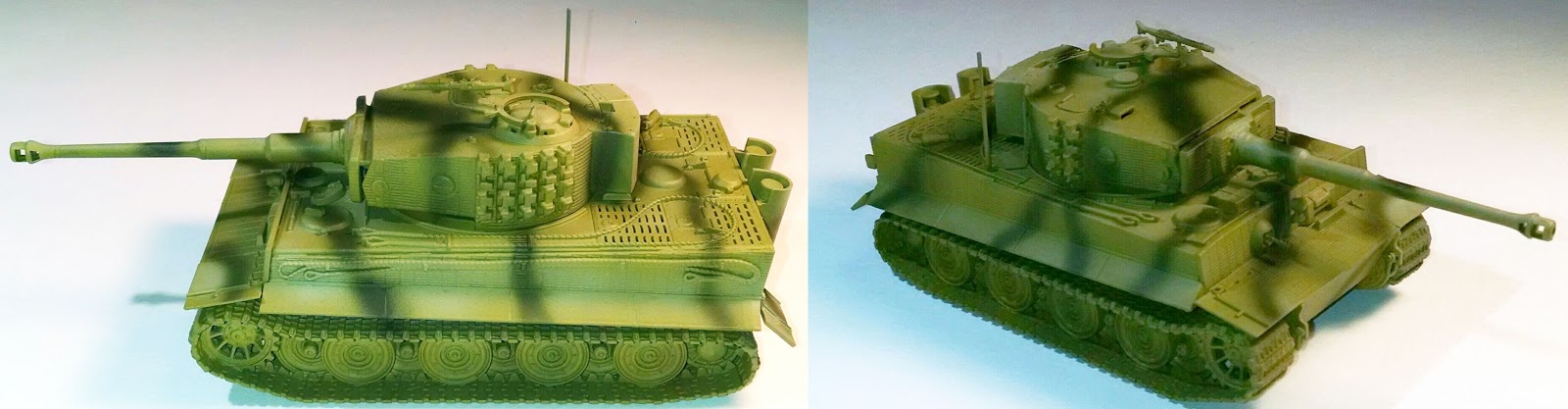 Step 4: On the previously painted green camouflage stripes, airbrush a highlight using #006 Camouflage Light Green. Here I was pretty careful not to overdo it, and gently added the color to the stripes.
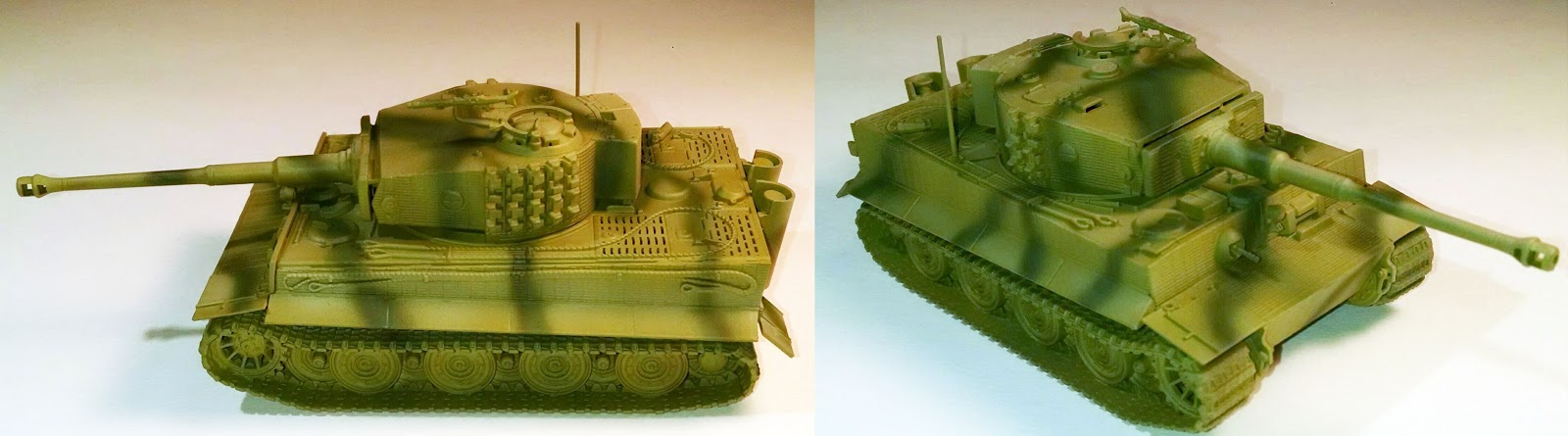 Step 5: Airbrush the brown camouflage stripes using #041 Rotbraun, Again, I had to be careful here, and you can see my little mistake with the heavy/dark spray on the left side of the hull, aft. But it's not too horrible, so I'll go with it. I console myself that I can mitigate these mistakes somewhat during the weathering phase.
 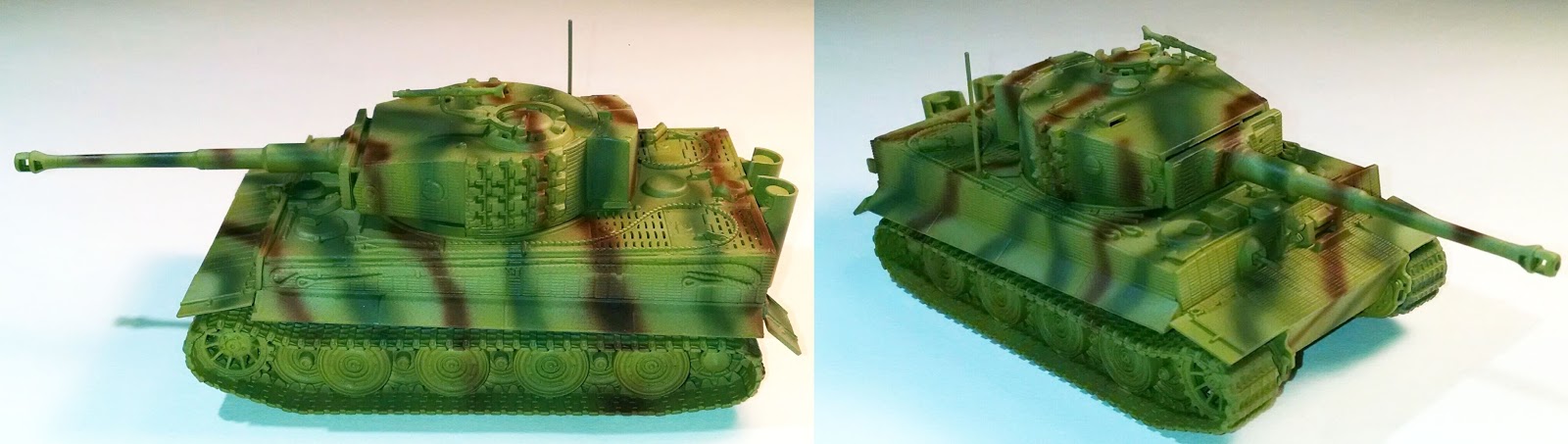 Step 6: Airbrush a highlight to the brown camouflage stripes using #040 Burnt Umber. Like Step 4, I took it easy here, just trying to modulate the stripes a little bit.
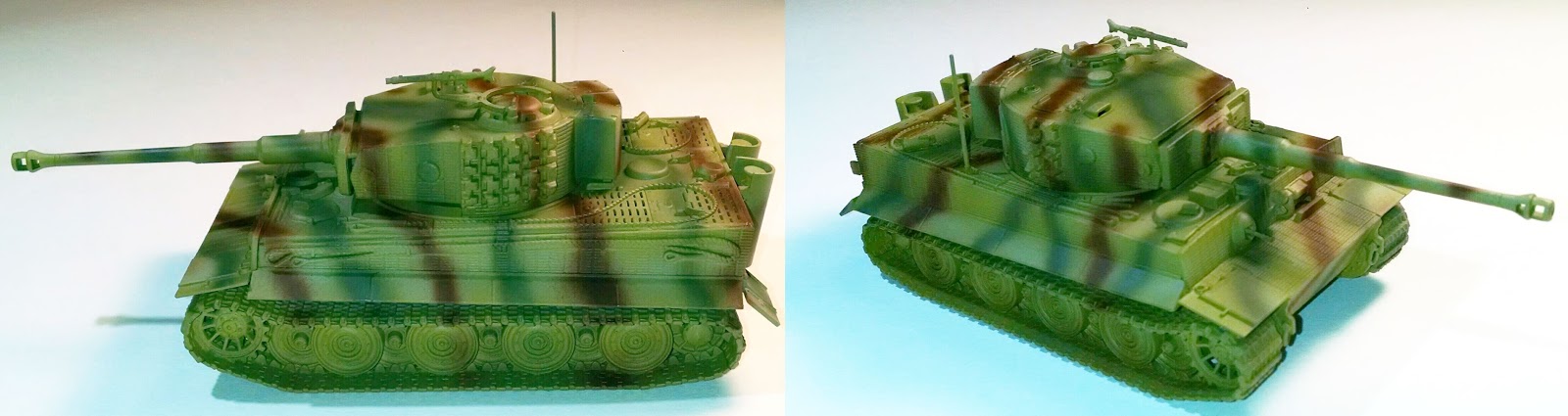 Now I can move onto the next steps, which is painting in some details, putting on the decals, and then weathering it. One thing I'll say at this point, is that this initial paint job is bright, as in, straight out of the factory bright. In order to look like a vehicle in service, it needs weathering, and lots of it!
In the next post in this series I will add the decals and start the weathering process.
March 7, 2016
BoldrDash Winterdash
 March 5, 2016
2016 got off to a rocky start OCR-wise. After proving to myself in 2015 that I could do these races, I was determined to make 2016 a year in which I would “do them better.” My first planned race was the Blizzard Blast at the end of January. I missed it because most of my family was sick and I had to take care of them. By all accounts I missed a fun race. For most of February I was suffering from strep and then bronchitis, so my training essentially came to a halt. Most of the people I knew would not be attending this race, and although I know several New England Spahtens, none that I knew would be going to this particular race.
I got ready, stretched, and was off to the finish line with the rest of Spahtens. Looking around, there was no one I knew, so I just was determined to run with the crowd. After a humorous snafu at the starting line (with one race director counting down from 10 until start, and the other immediately telling us “Go!”), we got started.
The first obstacle was a carrying a rock across a field and back twice--the rock wasn’t big, but it was frozen to the ground so when I picked it up, I had to rip a chunk of frozen earth with it. Next was a slalom while carrying a 2-man wreck bag, and then into the woods to do a horizontal traverse across a cargo net. I didn’t feel especially winded, but checking my watch, my heart rate had spiked beyond my max, which is a testament to how out of shape I am.
Next was some parallel bars that turned out to be easier than I expected. Then a tire toss--you got three tries to throw a tire over a post. I missed all three (the third try just barely) and had to do the penalty. Next was a crawl pipe, but with the added complication of it being mounted on a see-saw. The pipes were slippery on the inside and people were having trouble getting up them, but I managed it with some effort.
Throughout the running portions of the race, my lingering bronchitis was making itself known, as I had some coughing fits, and my nose was running for most it. Back into the woods, and the next obstacle was wire crawl up and then down. Next was a suspended tire that you had to climb through, and then the Monkey Bars. The Monkey Bars when a suspended ladder. The rungs were not too far apart, and it wasn’t too long, but my shoulders were sore after completing it.
Next was a “spider web” to crawl through, following by a pulley hoist--I chose a relatively light weight, but it was still rough on my hands--again, I’m reminded that I need to work on my grip strength. Then was a set of balance beams with a twist at the end--a set of inclined platforms that you had to jump back and forth between. I managed three of the four platforms but stumbled on the fourth--this was a cool obstacle.
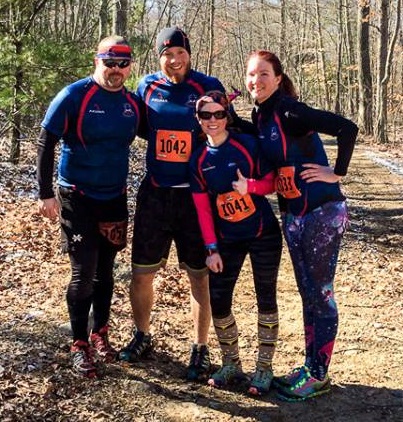 Glacier (me), and the trio that kept me on pace: Ron, Gingah Ninjah, and Fire MoxieThe next one was making use of some local terrain--you had to crawl under bell without ringing it, and then had to negotiate some benches. While doing most of the obstacles, there were three Spahtens that I was keeping pace with--on some obstacles they would pass me, on others I would pass them. I tried to keep pace with them so as to push myself and not slack off. Next was a relatively easy traverse wall, and then a long march through the woods, including climbing a ridgeline--not terribly steep, but certainly the steepest part of this course. Next was a simple tire crawl-through, and then a tire drag. The tire I picked was pretty small, so not wanting to dog it I dragged it back and forth twice.
 More marching through the woods, and it was clear that it was getting near the end. I crossed a wooden bridge over part of the reservoir, and then was a Tire hurdle obstacle--you had to climb over a wooden frame with several tires on it that were free to move, making it slightly more difficult. I was able to get over them ok, and pressed on. Next was a rope climb, which wasn’t that high at all, so I was able to ring the bell without too much difficulty. Right after that was a rope swing, and then more woods--part of it a zig-zag path on a causeway over the reservoir.
By now the course took me parallel to the road which lead to the starting area, so I knew that I was on the home stretch. The next obstacle was a walk over a seesaw while carrying a slosh pipe, which was pretty easy, and then a jog most of the way to the finish line. The last obstacle was a Slack-line Traverse--you had to balance on one rope while holding onto a second rope over your head, which I managed just fine. From there it was a just a few steps to the finish line.
I finished the race in 1:15:46, with a distance of 3.89 miles. Much faster than I did the Epic Fifth Challenge, but then, it was far, far less hilly, with less difficult obstacles, and no backups. Still, I’m glad I did as well as I did, and it’s a good start to the season.
January 29, 2016
The Effectiveness of BookBub Ads
 BookBub is the most popular mailing list / advertisement venue for ebooks right now. BookBub sends out a daily email to well over three million subscribers showcasing ebooks that are being offered for a discount. There are many other promotional sites out there that are useful, but they don't have nearly the number of subscribers that BookBub does.
For an independent author, the downsides to BookBub are twofold: the chances of getting accepted, and the high price of entry.
There are innumerable posts out there already that give advice on how to better your odds of acceptance, including one by BookBub itself, so this post will not address that.
Instead, this post will address the high price of entry, or more specifically, the potential return on investment (ROI) of running a book ad. Depending on the popularity of the genre and the type of promotion involved, a Bookbub ad can cost anywhere from $55 to $2,350. (as of January 2016) As an author I am most interested in submitting to the Fantasy or Action and Adventure genres, where prices range from $260 to $1,450.
To find out, for 30 days I tracked the Amazon rankings of 50 titles from BookBub ads from the following categories: Fantasy, Science Fiction, Historical Fiction, Action and Adventure, and Bestsellers, because those titles are of the most interest to me as both a reader and a writer. Since you get less than 50 titles in a single ad, I collected the titles over a period of a little more than a week until I got up to 50.
Right from the beginning, I noticed something interesting--only 3 of the 50 titles were independently published. Out of the rest, some of them may have been independently published under the name of a small publisher, but the majority were large publishers. Lest that sound too depressing, all three indie titles did very well in terms of rankings. In fact, the ranking of those titles at the end of the experiment (30 days after the ad went live) were 2, 3, and 19 out of the 50 titles studied. Having a large publisher might give an author a better chance of getting an ad accepted, but according to my study, doesn't give the author a boost in terms of ROI.
Once I had tracked the rankings of each title, I grouped them by promo price point and averaged the rankings. I then plotted the results for the 30 day period for each average: $0.99, $1.99, and $2.99-$3.99, and Overall Average.
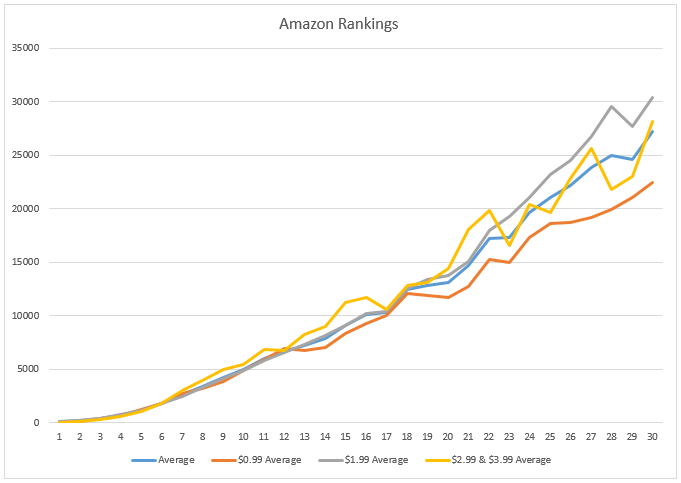 Amazon Ranking vs. Time (Days after ad runs), averaged by price pointThe first thing you notice is that for the first week, the different price points have nearly identical curves. More than that, as time goes on, all the way up to 30 days, there is little divergence. One would think that books priced $0.99 would do far better across the board than those priced $2.99. Not so--they ALL do well. But is it well enough to justify the far higher price of a $2.99 ad compared to a $0.99 ad? To determine that, we'll have to put a dollar amount on those rankings.
In tracking the numbers I flagged when a title reverted to its original price. I did this specifically to see if there would be a sudden drop in sales due to the new price. One thing I noticed is that some of the titles actually kept their discounted price for the entire 30 days. As for a drop in sales, to my surprise, I didn't see any such drop. I conclude from this (unscientific) study that while sales drops probably occur, they are not nearly as significant as I had thought. For the purposes of calculating ROI, I assume that the discounted price is maintained for the duration of the 30 days after the ad runs.
Also, for titles in the $2.99 - $3.99 range, I assumed that for royalty calculation purposes, all of the titles were in fact $2.99 with a 70% royalty.
In order to translate the rankings to a number of sales per day, I used this online tool, plotted the results, and produced the following equation:
Royalty = 29371 * [number of sales] ^(-0.8) * [price point] * [royalty percentage]
Where royalty percentage = 0.35 for a price point of less than $2.99, and 0.70 otherwise.
For the initial investment, the four primary genres I chose, Fantasy, Science Fiction, Action and Adventure, and Historical Fiction, the spread in prices fortunately isn't all that much:
Category under $1$1 - $2$2+Historical Fiction$670$1,165$1,675Action and Adventure$580$1,000$1,450Fantasy $520$890$1,300Science Fiction $490$845$1,225
Which averages out to $565, $975, and $1,413 for each price point respectively.
With those investments, here are the returns:
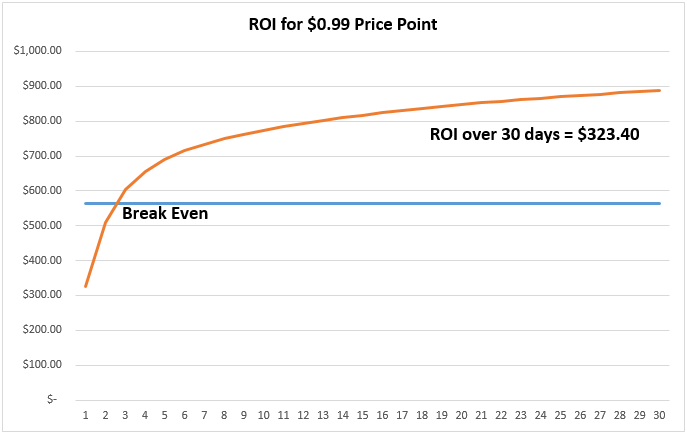
Looks like a sound investment. The Break Even point is reached on Day 3. Total Royalties over 30 days is $888.40, resulting in an ROI of $323.40. Not bad.
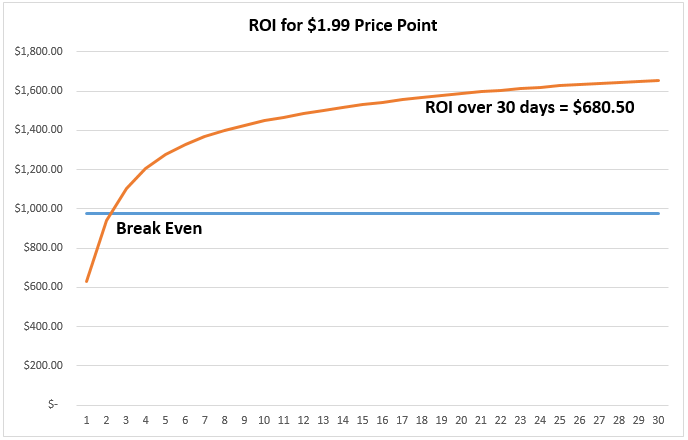
The $1.99 price point gives even better results. The Break Even point is Day 3 again, and Total Sales is $1,655.50, yielding an ROI of $680.50.
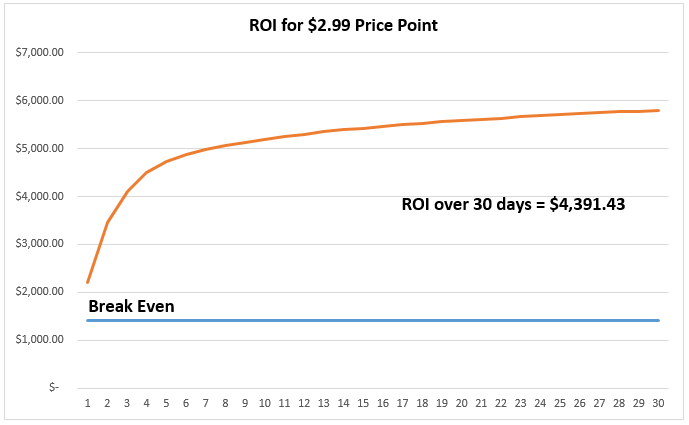
...Wow. For the $2.99 price point, the Break Even is reached on the first day, with total royalties equaling $5,804.43. This leads to an ROI of $4,391.43.
What is going on here? Well, a few things, so far as I can figure. First, as I noted earlier, all three price points get very similar (that is, excellent) rankings, especially for the first week, where most of the sales occur. This, coupled with the $2.99 price point having a far better royalty ($2.99 * 0.70 = $2.09 per sale) than the other price points ($1.99 * 0.35 = $0.70 per sale) ($0.99 * 0.35 = $0.35 per sale), yields massive returns right off the bat. There may also be a psychological factor at play: Discounting a $2.99 title to $0.99 is a good deal, certainly, but still, $2.99 isn't all that much to spend. However, discounting a $9.99 title to $2.99 "feels" like a better deal, because of the $7.00 difference in cost. Especially if you're getting a bundle of several books at once...
Still, you might be thinking that these results just represent the average. It's still a lot of money to pony up for an ad, so what if your book underperforms?
To answer this question, I plotted up the ROI graphs again, this time only using the worst performer in each price point. What happened to those titles?
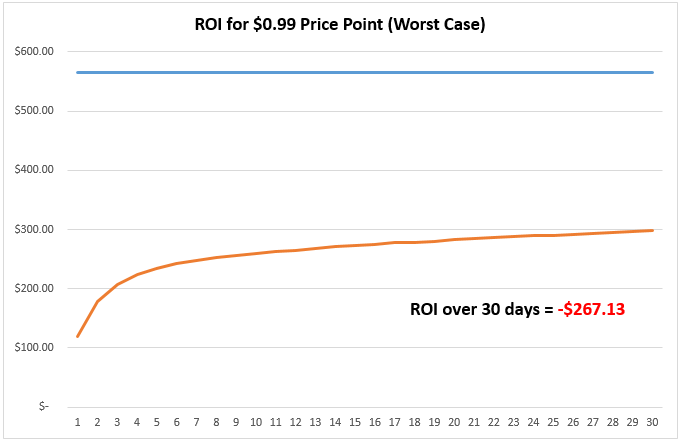
Uh-oh, now things don't seem so hot. In this case, a book discounted from $3.99 to $0.99 did not get an ROI after 30 days. Or did it?
Remember, I conservatively assumed during my averaging that the price points stayed at the discounted price for the full 30 days. What if we take into account when it went back to regular price?
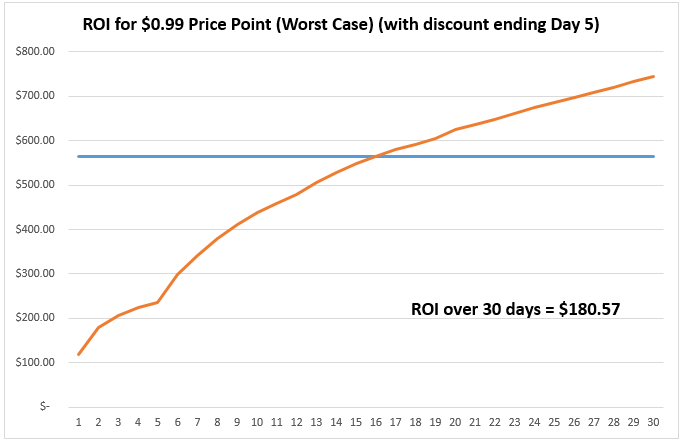 Now things don't look quite so bad. Reverting back to the original price causes a large bump in royalties, which is enough to produce a respectable ROI.
For the $1.99 price point Worst Case:
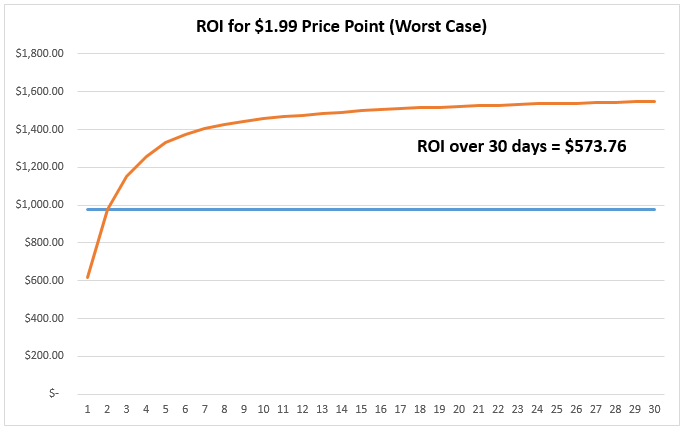
Already there is enough to cover the investment costs and produce an ROI, which isn't even much worse than the average of $680. The original price of this book was $6.99, so what happens when we take that into account?
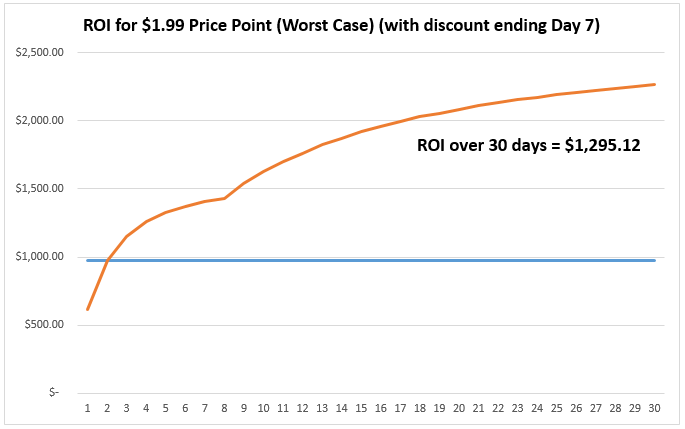 Here, the ROI is significantly improved--more than doubled, in fact.
 What about for the $2.99 Worst Case?
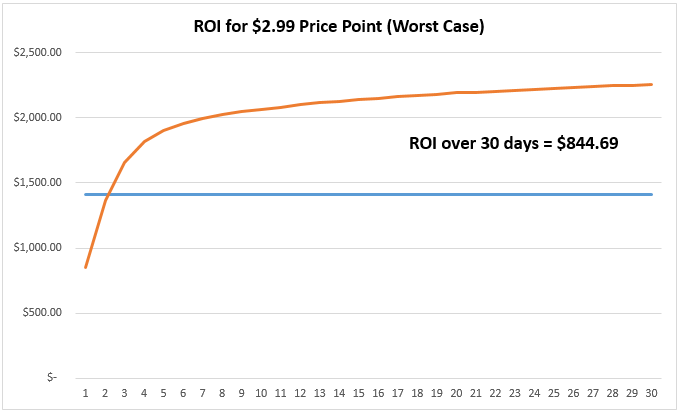 Here, there is a good ROI again. And when we include the book reverting to its non-discounted price when it did, we get:
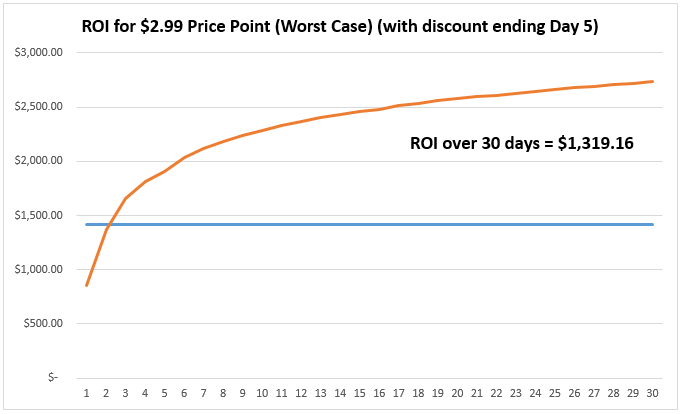 Here, the visible "bump" in royalties caused by the end of the discount isn't as dramatic, but there still is a benefit. The ROI over 30 days still goes up by 56%.
So that's the bottom line. No matter what you price your book at, even if it underperforms, it's likely that you'll make your money back with room to spare. What's more, these numbers don't account for any "spillover" sales you might get for your other titles. (as an aside, make sure you have other titles available to benefit from this)
My advice? Create a bundle of 3+ books, price the bundle at $9.99, then submit an ad to Bookbub for a promo at $2.99. According to the posts giving tips, bundles are more likely to be accepted.
And if you are fortunate enough to get accepted by BookBub, find the money to pay for the ad. It's worth it.
January 2, 2016
RANGER: Operation Axehammer is Released for Kindle!
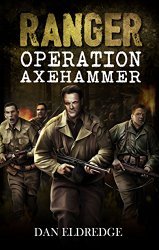
My third novel, the first in a new series, is now available on Kindle!
Eager to take the fight to the Germans, hundreds of young American soldiers volunteer to become Rangers, an elite unit modeled after the famed British Commandos. Chuck Hawkins and Alan Patrick are two such men, ready to accept the challenge and show the world that Americans are ready to fight.
After surviving months of hellish training, Hawkins and Patrick are selected to join a Ranger squad on a covert mission in occupied France. Under orders to avoid contact with the Germans, the plan goes awry when bullets start flying minutes after their landing. Hawkins, Patrick, and the rest of the Rangers are determined to complete their mission, all the while pursued by a ruthless SS officer and his fanatical troops.
RANGER: Operation Axehammer is a military action - adventure novel written in the spirit of classic war movies and wartime pulp adventure fiction.
The ebook is available from:
Amazon US
 Amazon UKAmazon DEAmazon FRAmazon ESAmazon ITAmazon NLAmazon JPAmazon BRAmazon CAAmazon MXAmazon AUAmazon IN
November 16, 2015
Epic Fifth F.I.T. Challenge
 November 14, 2015
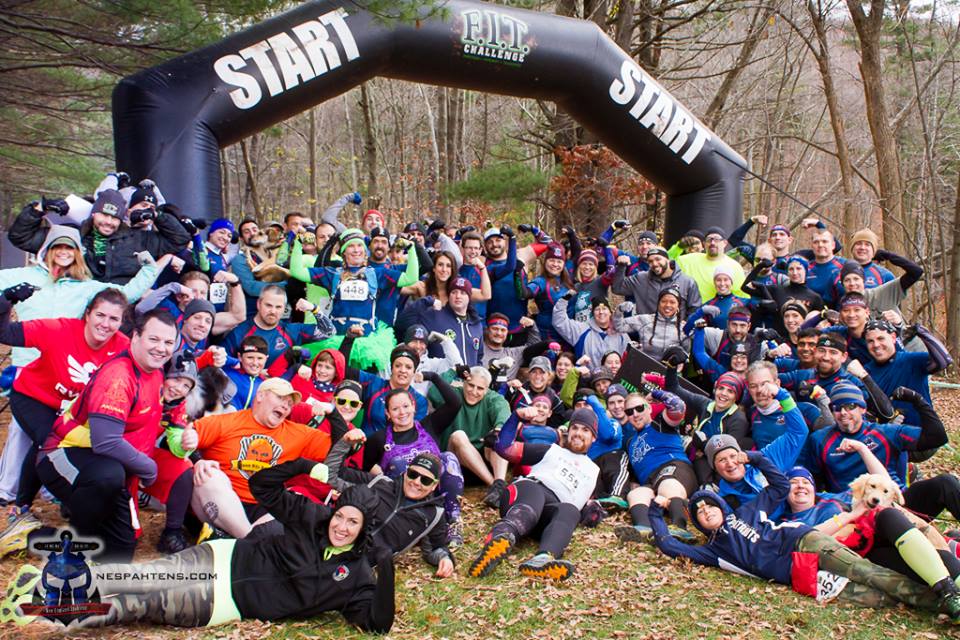
The Epic Fifth F.I.T. Challenge is the last OCR I will be doing for 2015. It was a short race, only 3.68 miles, so I was not too worried about it. It was also a small race, with only 500 participants. I had not seriously exercised since the Killington Beast, but I was not too worried, but now that the race is over, I wish I had trained more for it.I convinced sister Kathy, brother-in-law Dave, and my nephew Seamus to do the race with me. Seamus was excited, but Kathy was more nervous about it.
The venue was Diamond Hill State Park in Cumberland, Rhode Island. Traveling there was easy, and brought back some memories of when I was a kid and we frequently traveled to that area.
Arriving at the venue...it felt like November. It was cold (mid 40s) and windy. I wore a sweatshirt and pants over my racing gear, only taking them off at the last minute. I had intended to run the race with Kathy, Dave and Seamus, all of us keeping together for mutual moral support, but Seamus wanted to go ahead, so I stayed with him while Kathy and Dave lagged behind. The first part of the race was up Diamond Hill, which, while not nearly as high as Killington, was rockier, and in some places just as steep. The first half of the race was primarily going up and down the hill, clambering over rocks, with only a few obstacles to break it up. They included a few walls, a few inverted walls, a cargo net, and doing a bunch of reps lifting a 45lb. barbell. I helped Seamus do his reps, and then did my own after his.
Back to the main part of the course, we found some pretty interesting obstacles--some of them I’ve never seen before. First was a peg climb--similar to the “Liberator” at Tough Mudder, but this wasn’t quite as high, but it was vertical rather than sloped. It was only a short way up the tree, but I found that my upper body strength was not up to the task, and the cold didn’t make it any easier. Next was a rope climb. I made it a short way up, so I was able to demonstrate the technique to Seamus, but I could not make it to the top. I really need to buckle down over the winter and get in shape.
After that was a climb onto one log, and from there up to another one. I boosted Seamus up, and he was able to do it, but I needed help to do it myself. Following that was a carry--a wreck bag up the hill and back down. Seamus took a 25 lb bag while I took a 50lb. Seamus had trouble keeping his on his shoulders, but he managed the entire carry without help, and was proud of it.
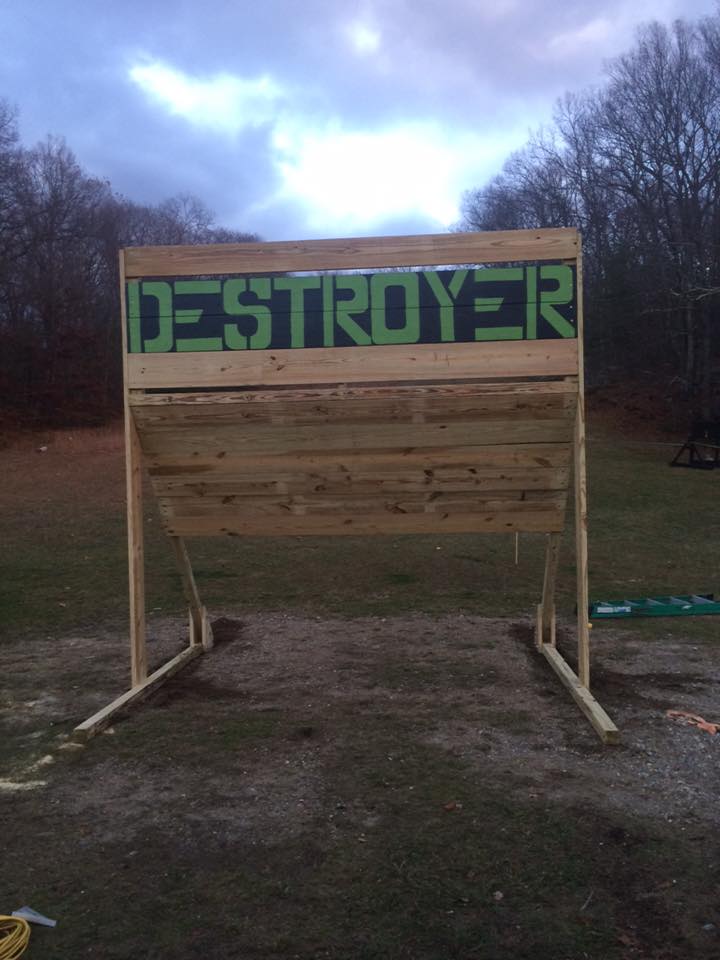
Next was the Destroyer. Both of us looked at this one with some trepidation. It was a wall with some handholds, perhaps 12 feet high, and the bottom 2/3 sloped away from the climber. Seamus did it with a boost, and was rightfully proud of that one. I tried it myself, slipped and fell off, tearing some skin off a finger. I tried it again, this time with a little help and coaching, and managed to get over the top. Again I was reminded at how I need to up my game.
Back up the hill for some trail running and the last mile of the race, and the last obstacles. There was an interesting wall that looked like a simple climbing wall, but it hung from trees, and was not attached at the bottom so it could swing freely (the "Floating Wall"). Me and another racer boosted up Seamus, and then I tackled the wall myself. I did it, but my calves both cramped up badly. Next was a series of over/unders, and then a variation on an Atlas Carry--you had to lift up an Atlas ball and push it over your shoulder five times. After that was a rig, which I always have difficulty with. First was monkey bars and then to another hanging pipe, and then a cargo net. Seamus managed most of it, but I only could do a handful of monkey bars. The cold, my numb hands, my loose shoulders, and my strength in general was just not up to the task. I did the Cargo net and then onto the last obstacle, an inverted wall, and then over the finish line where Seamus met me.
Seamus and I rested for perhaps 15 minutes until Kathy and Dave showed up, and then we cheered them on until they finished. It was a good race, with some challenging obstacles that I hadn’t seen before. All in all though, I really need to work harder to get back in shape--especially to lose some weight, which will help with everything.
October 19, 2015
Unboxing: Lone Wolf Adventure Game
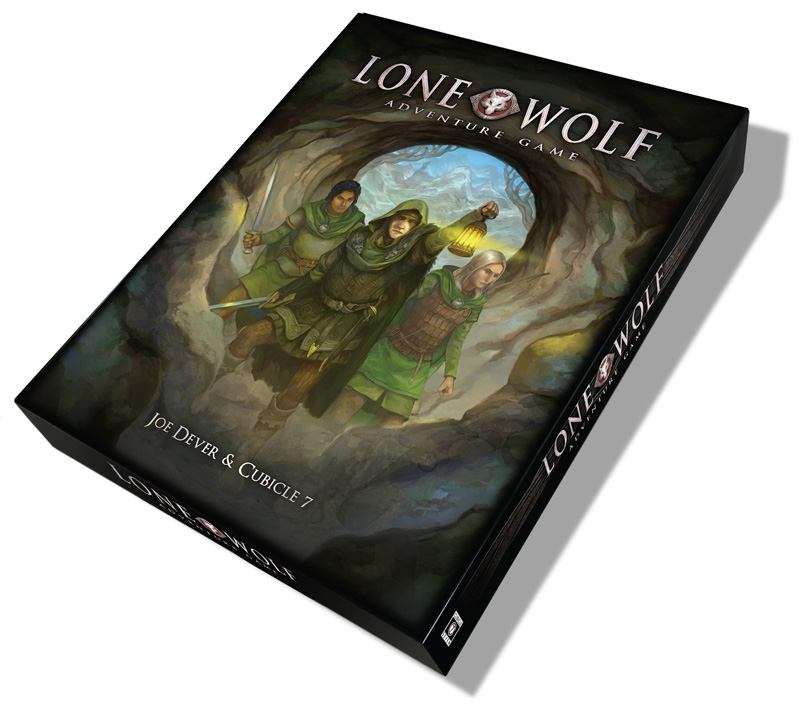 As I mentioned in a previous post, as a kid I was a big fan of Joe Dever's Lone Wolf Adventure Gamebooks. So it was with eager anticipation that I received my boxed copy of the Lone Wolf Adventure Game.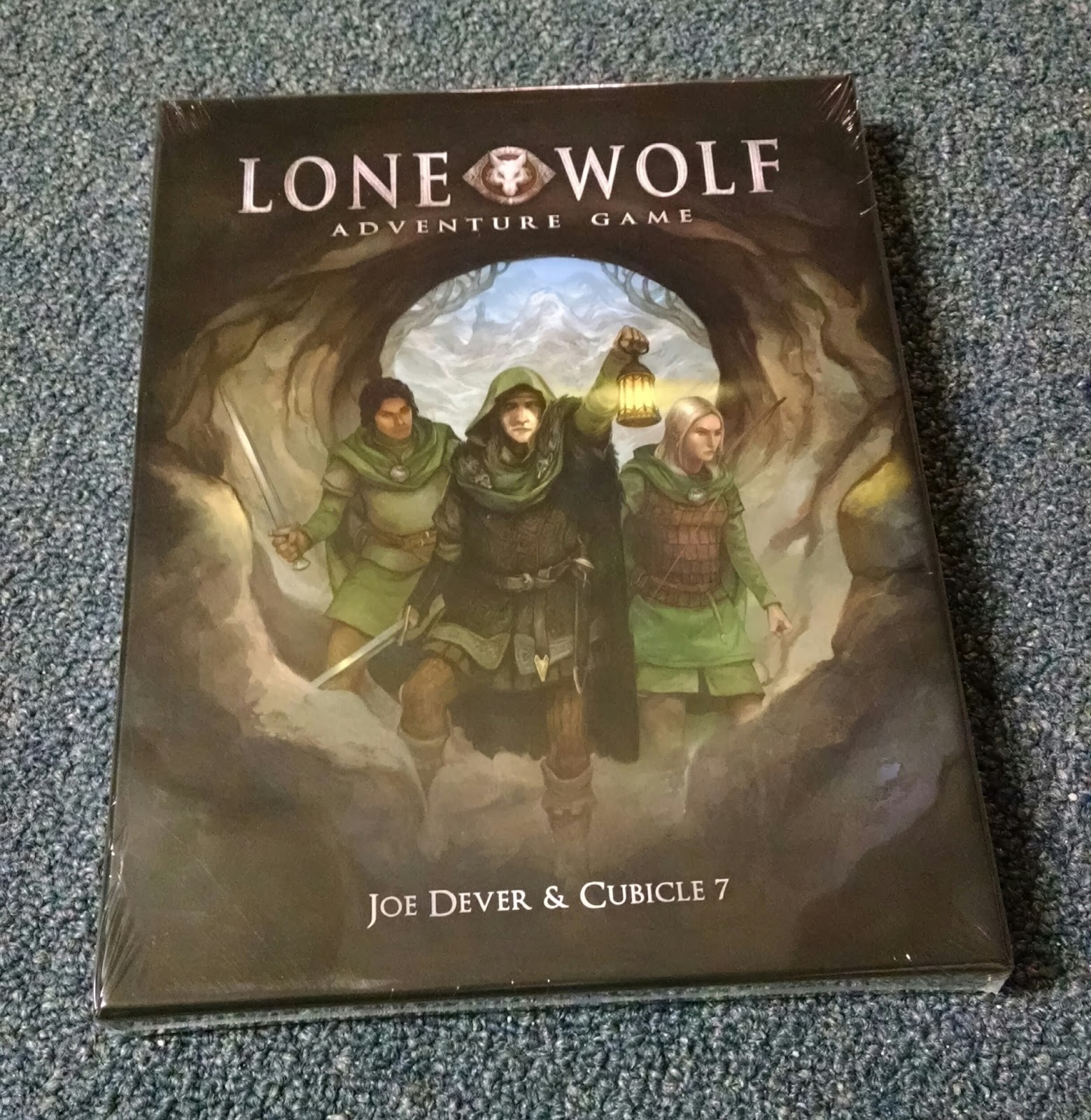
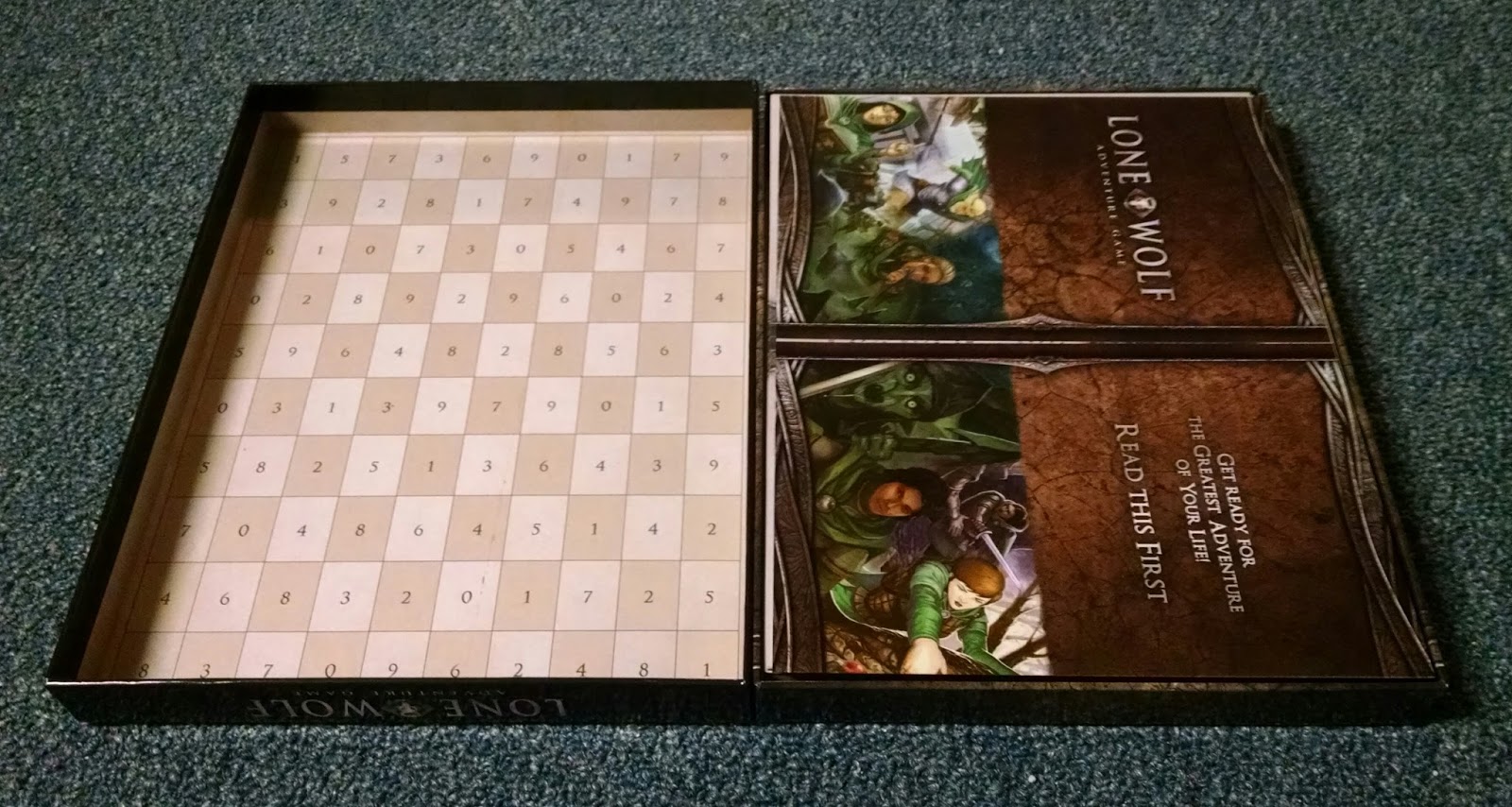 The inside of the box top (and, it turns out, the bottom too) serves as a Random Number Table, similar to the ones found in the backs of all the Lone Wolf gamebooks. It serves as a decent substitute should you be without any dice.
 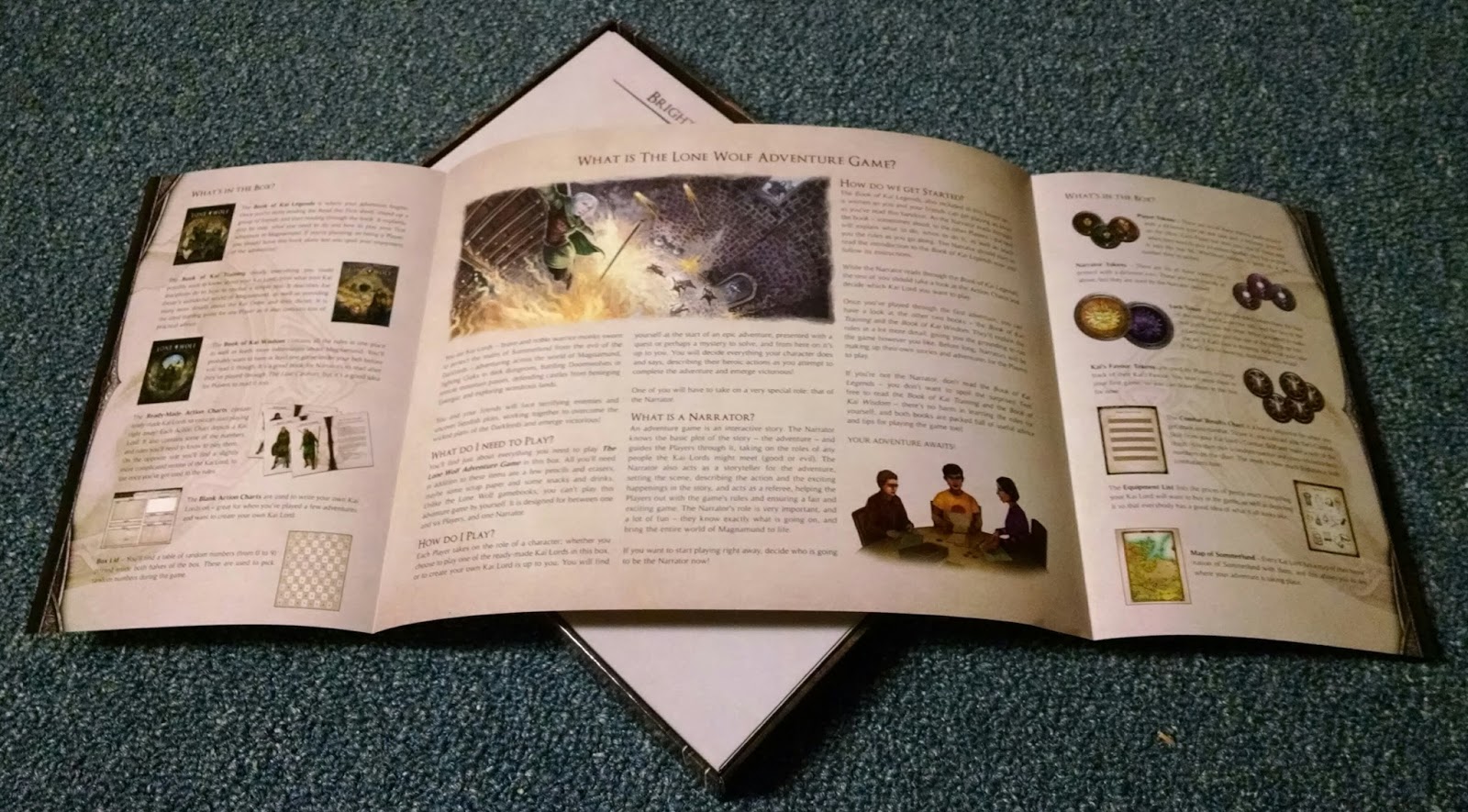 Inside is a quick start "read me first" handout, along with several "Action Charts" (the Lone Wolf equivalent of "Character Sheet") for six pre-generated characters that come with the game. Four are male, and two are female.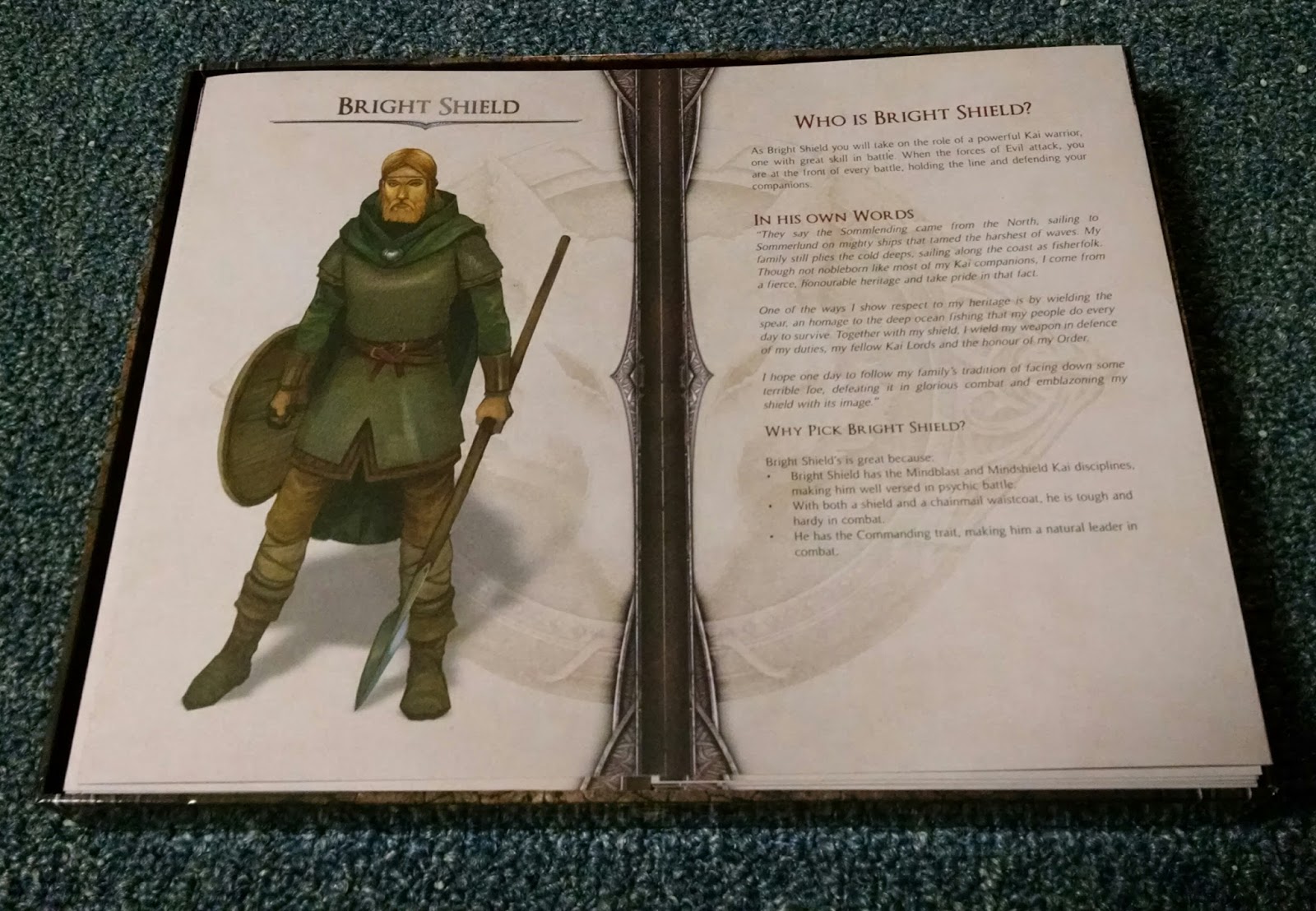
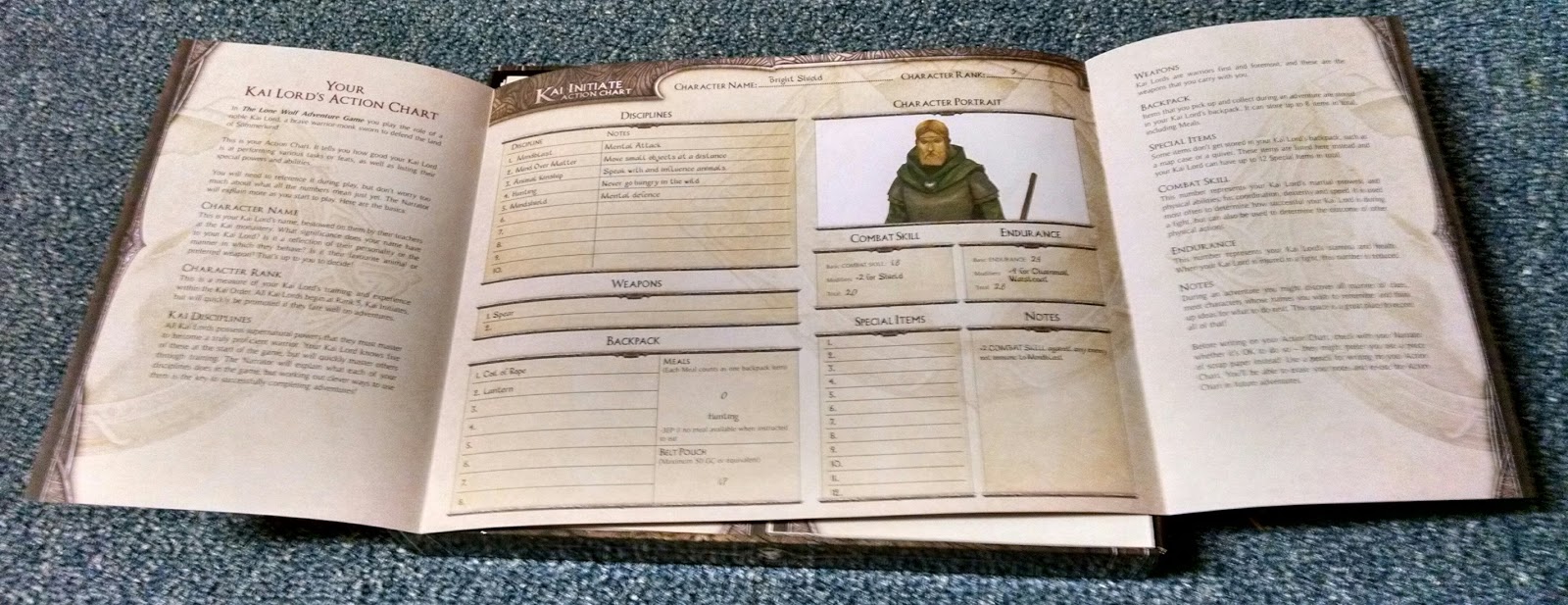
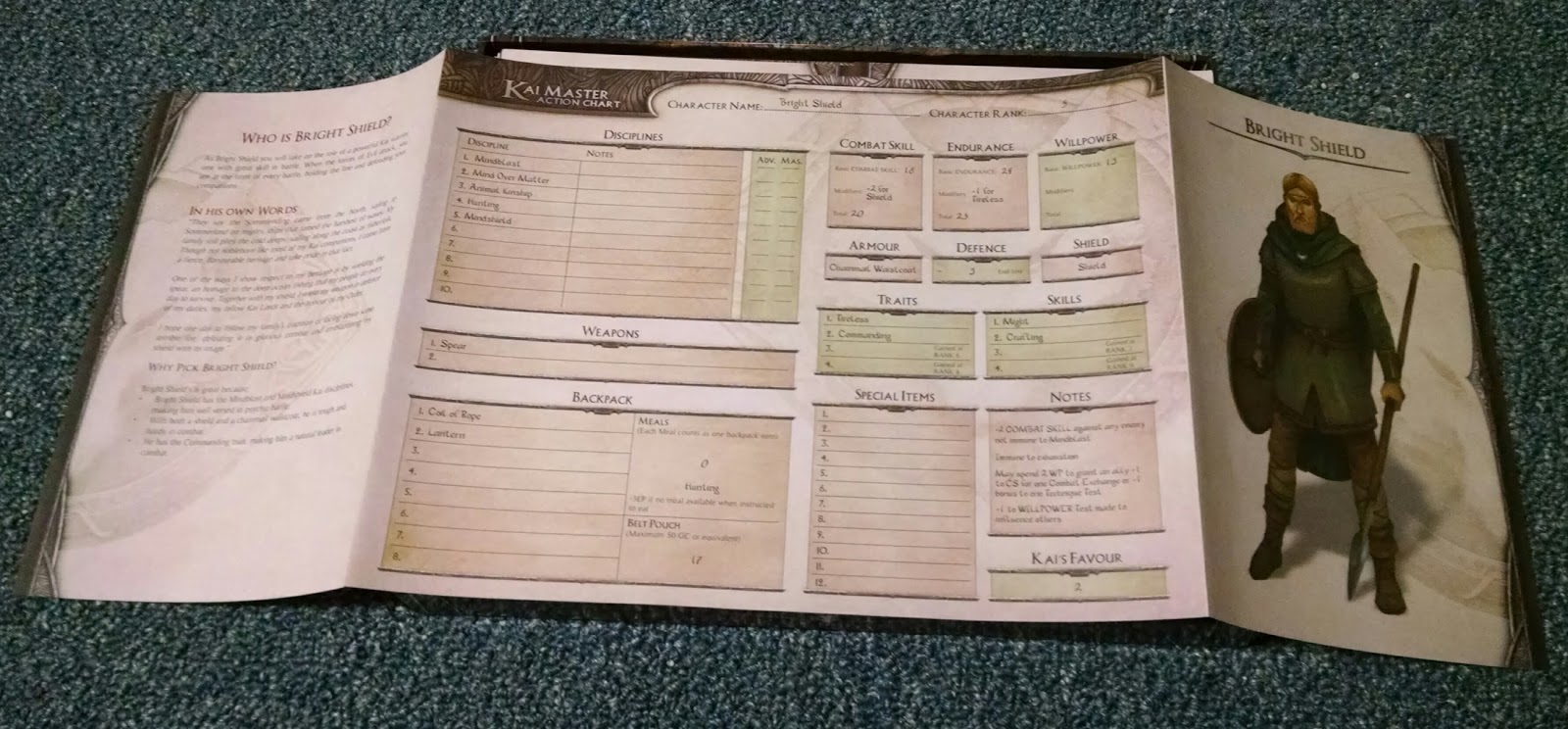 The Action Charts are reversible, with one side containing the chart for the "Initiate-level" game, and the other containing the "Master-level" chart. The flaps contain character artwork and additional background information.
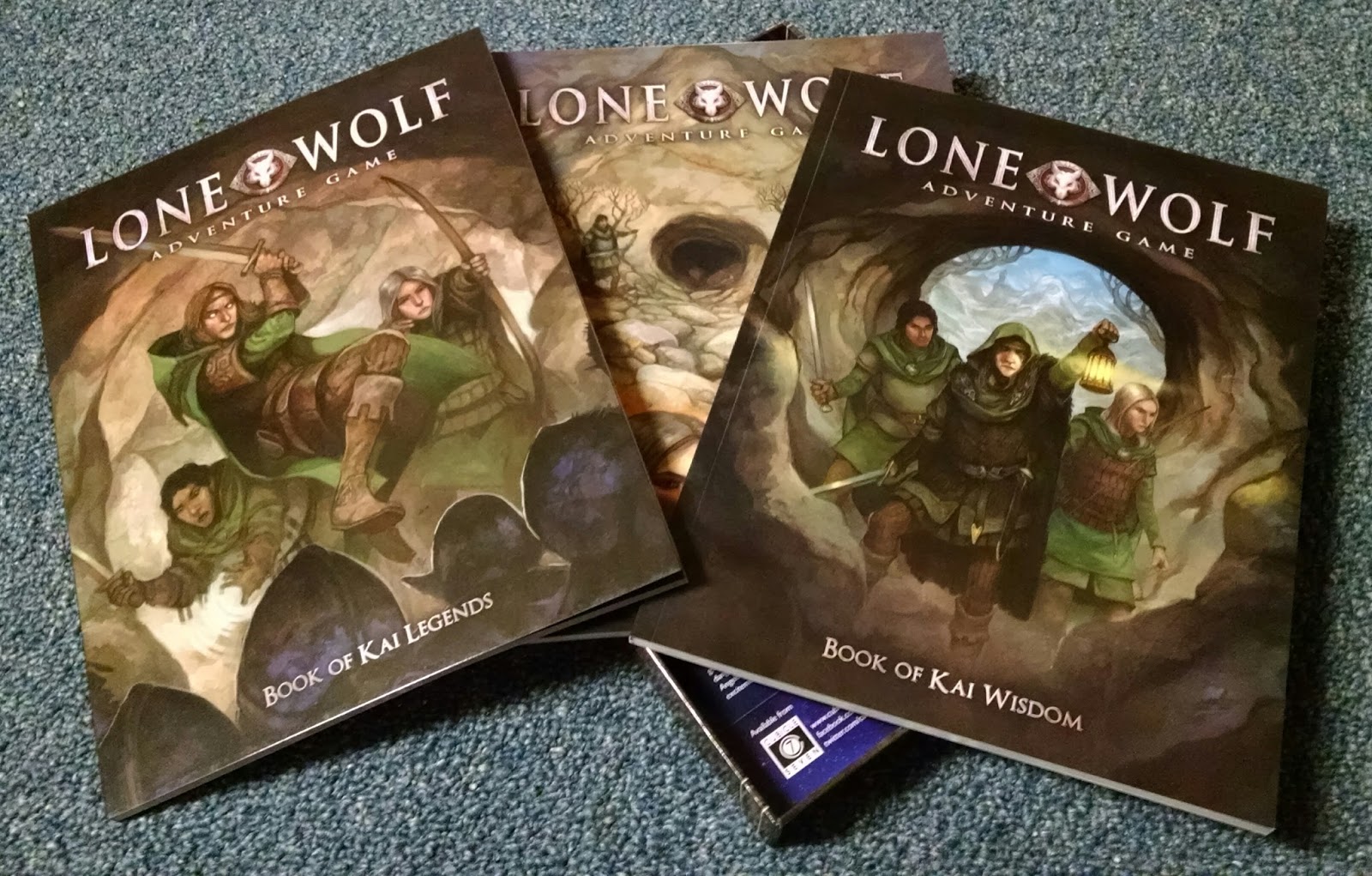 The rulebooks themselves are full color, high quality books, divided into the Book of Kai Wisdom (which serves as the Narrator's (Gamemaster's) book for how to run games along with some world background information), the Book of Kai Training (which is the book on character creation and skills), and the Book of Kai Legends (which contains introductory adventures and campaign ideas & rules)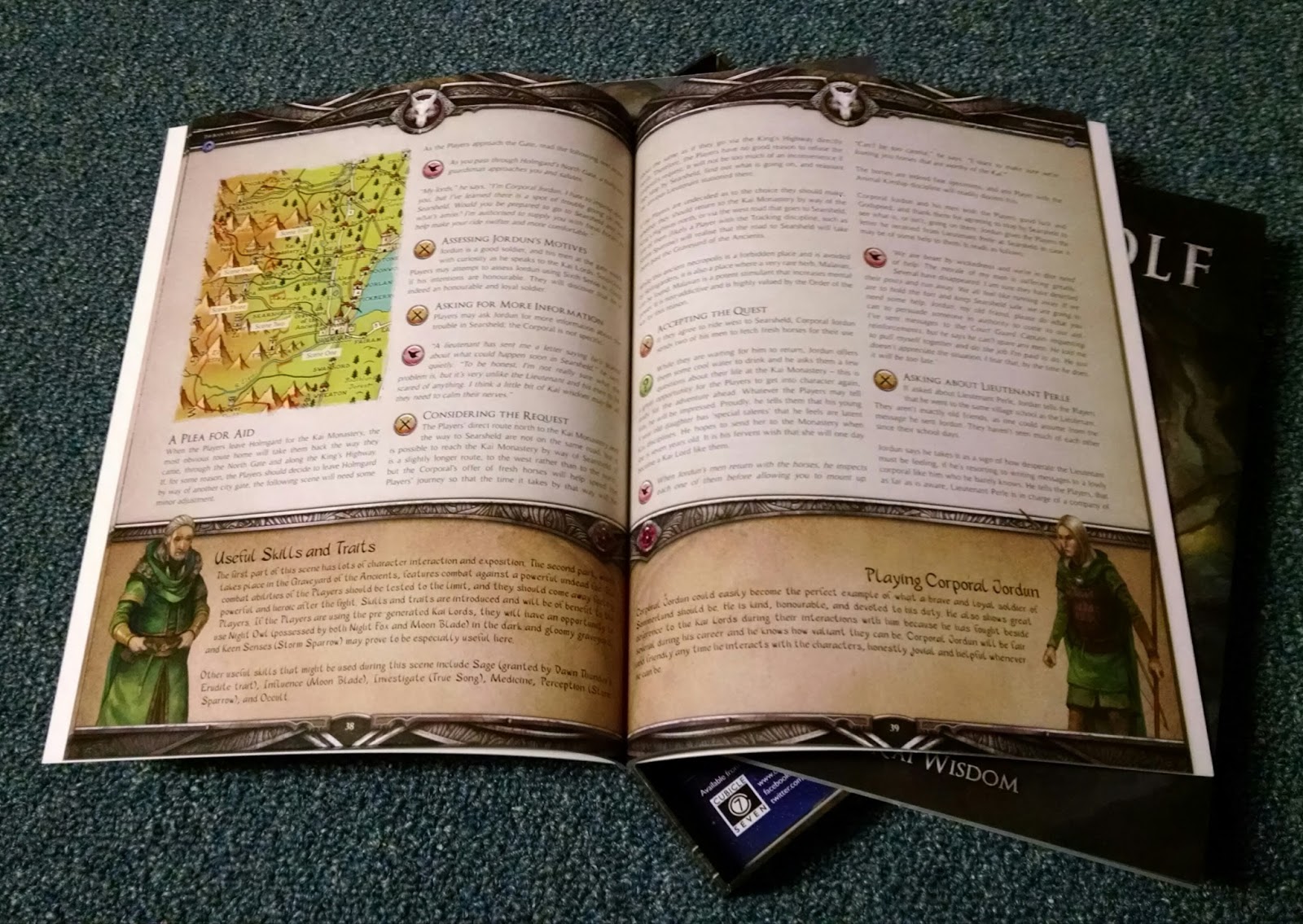
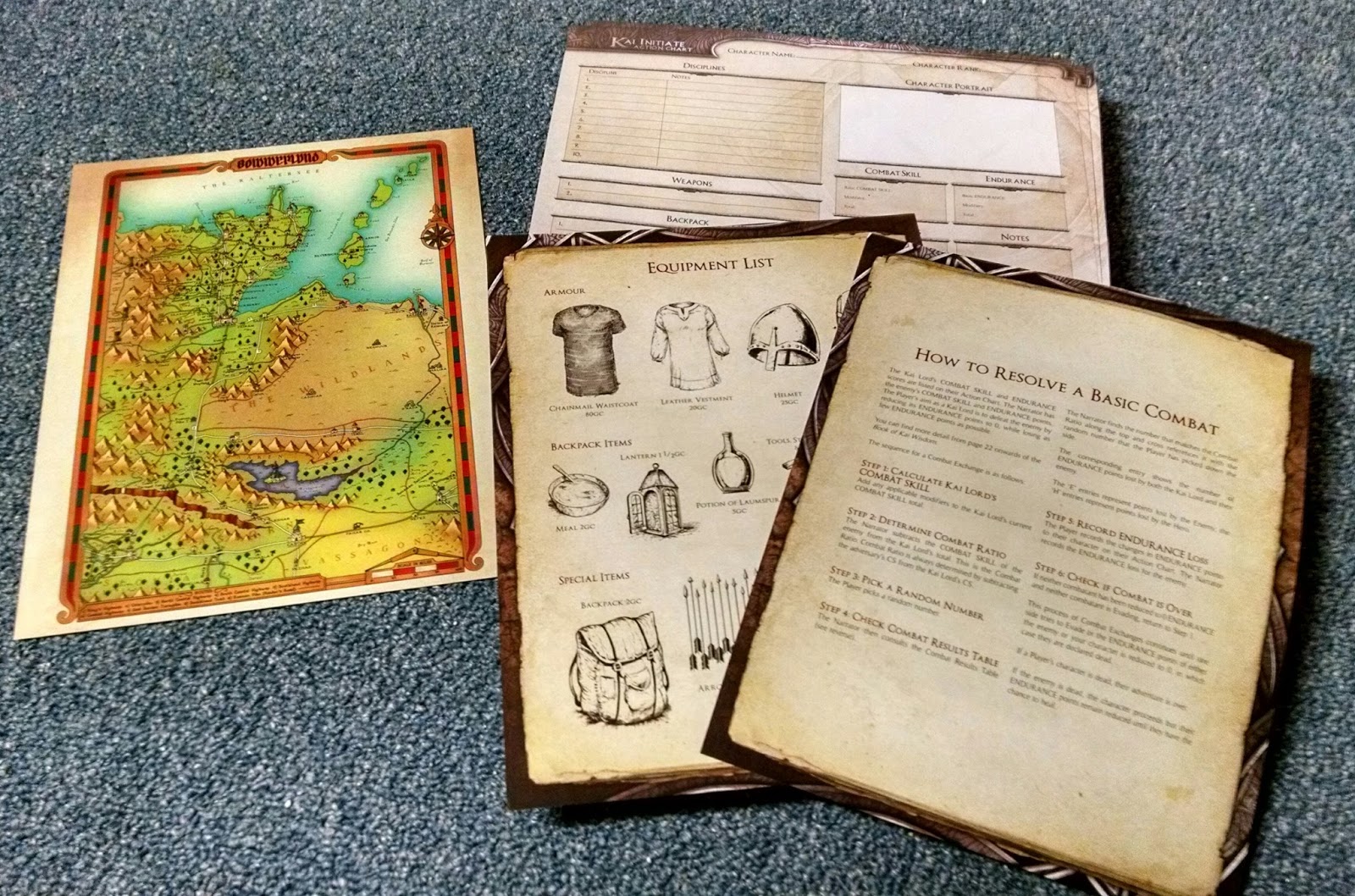 There are also some handouts that includes a double-sided map of Sommerlund and surrounding lands, some reference sheets, and blank Action Charts. While the Action Charts would work great for their intended purpose, since they are on such nice paper, it almost seems a shame to use them, so I will likely use photocopied versions instead.
 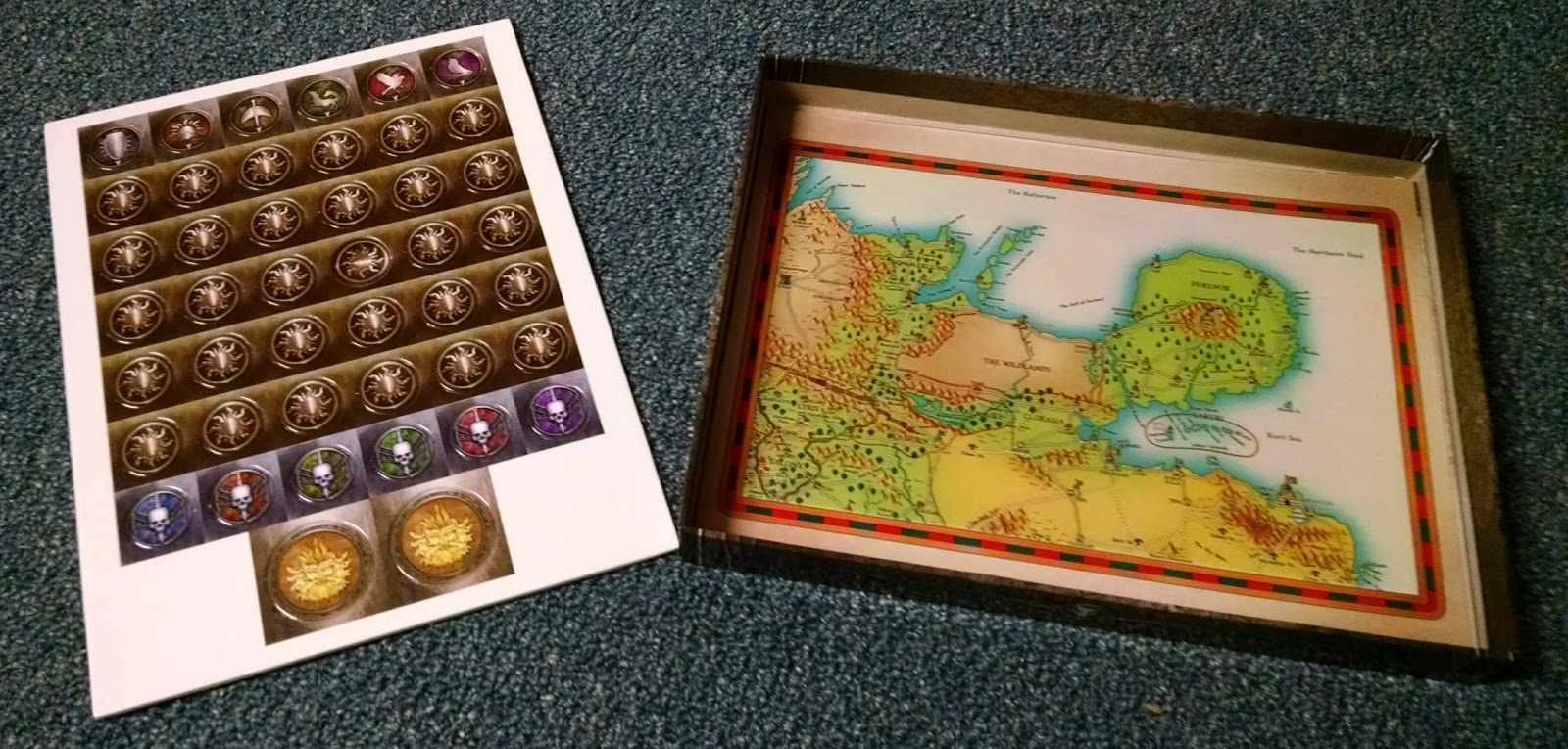 There is a sheet of counters that can be used for "Luck tests", which amount to flipping a coin, and also for using the Random Number Tables that make up the insides of the box covers. I will likely be using dice for my games, but I may use these occasionally for novelty's sake.
In conclusion you get a lot for your $30. Production values for RPGs have certainly gone up in recent years, and the Lone Wolf Adventure Game is no exception. I look forward to the supplements to the game that are due out next year. I also plan to try out the system with my children soon, and once I do I will post a recap of that here.