Mike Vardy's Blog, page 78
December 25, 2015
The Productivityist Podcast 72: Simon Tyler
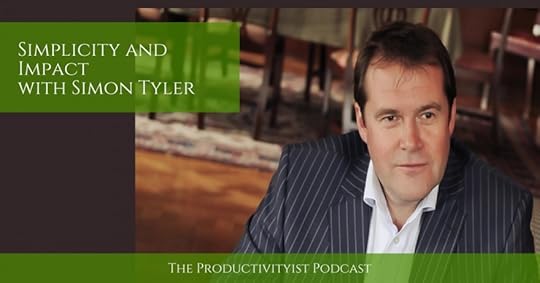
In this edition of The Productivityist Podcast I speak with Simon Tyler, author of The Impact Code and The Simple Way. We talk about raising your impact level in business, simple ways to be more productive, and much more.
Relevant Links
Simon Tyler | Website
The Impact Code by Simon Tyler
The Simple Way by Simon Tyler
Simple Notes | Simon Tyler
Effortless Gent
Simon Tyler (@simplysimont) | Twitter
If you’d like to offer patronage to the show, go to the podcast’s Patreon page and lend any dollar amount you can. All of the proceeds go into making the show even better. (Plus there are some nifty perks for you to claim at the different patronage levels!)
Thanks again for listening…and happy holidays!
The post The Productivityist Podcast 72: Simon Tyler appeared first on Productivityist.


December 24, 2015
How To Procrastinate Productively
This is a guest post by Niraj Ranjan. He is the founder of Hiver (formerly GrexIt), an app the lets you share Gmail labels with other Gmail users. Niraj works on programming, customer support, sales, and contributes to design and UI.
You’ve got an important project coming up, but instead of doing it, you find yourself reorganizing your bookshelves or watching videos on Youtube. Sounds familiar, right? But here’s some good news: procrastination is not always a bad thing.
In many cases, this “wasted time” can actually be used as a way to boost your productivity.
Now that I have been running my company for over four years now, I have concluded that procrastination is very helpful at times. At my startup, there is a “procrastinator’s board” where each employee is encouraged to list out the specific items that they want to accomplish on the next day. Because this board is for everyone to see, it works really well with providing both motivation and accountability. When an item is placed on the board, the task or project it is almost always completed the very next day. And, more often than not, the tasks are well-executed too.
You can often learn something from your procrastination, when you take the time to analyze it. Here are five ways you can use your procrastination to boost your productivity:
1. Finish the smaller tasks first.
Procrastination sometimes feels like a way of wasting time, but what if it’s not? An essay written by Stanford professor John Perry shows how structured procrastinators are actually more productive. According to this essay, procrastinators are rarely doing “nothing.” They just avoid the most important work by replacing it with something else. So in many cases, you are building momentum by tackling the easier tasks first. You might clean, pay bills, work on another project, send out overdue emails, or do something else. In the end, you will likely get around to doing the thing you’re supposed to do.
Action Step: Make a to-do list and place the most important task at the top. If you feel like you can’t get started on the important task right now, just work your way up from the bottom by focusing on the easier tasks. This way your procrastination is actually a way of building momentum. Once you’ve knocked out a few tasks, move on to the most important task.
2. Use procrastination to become more creative.
Bill Gates once famously said, “I choose a lazy person to do a hard job. Because a lazy person will find an easy way to do it.” In some cases, we put off doing work because it is too hard. You can change that up by making the work easier. Invent a new approach to do the same task and simplify it. If you’re not sure, ask someone else to get some outside perspective.
Action Step: Instead of having an anxiety attack because you haven’t completed your work, be mindful. Listen to your procrastination. What is it trying to tell you? Is doing the task a bad idea? Is there a different way to do the task? Being mindful will help you come up with creative solutions.
3. Give yourself a break.
In order to procrastinate better, you need to change the way you go about it. Decide in advance how long your break will be. Sensible, short breaks will help your urge to procrastinate. Use your break as a time to regain some mental clarity. If you have been in the same position for too long, get up and take a walk. You’ll find that you feel better when you get back to work. And don’t forget to use a timer to keep yourself on track.
Action Step: Measure how much time you spend working versus how much time you spend procrastinating to take intelligent breaks. You can use a website like Rescuetime which runs in the background observing your browsing habits. It will make graphs of how much time you spend productively and how much time you spend watching videos or browsing social media websites. It is important to know where you are procrastinating. Be honest about your habit and also know where exactly your time is going. Remember that you will have more energy during certain hours in the day. Look for any patterns of procrastination and take breaks when needed to boost your productivity.
4. Use deadlines to motivate you.
In some cases, you may procrastinate because you like to work under pressure. This study suggests that the more complicated a task is, the more time you think you have to do it. In our minds we think that since the task requires a lot of time to complete, it must be farther off in terms of the due date than it actually is. When the clock strikes, panic mode starts and then you do our best to complete it. This seems especially true for people in creative fields. Deadlines become a motivational tool that leads to creativity.
Action Step: Set a personal deadline before the actual deadline. Have milestones of progress that you should reach by a specific date. This way, you will still have the rush of the deadline without actually missing the deadline. Consider texting or calling a friend to help keep yourself accountable.
5. Use procrastination for decision making.
Procrastination can actually help you make better decisions. Frank Partnoy, the author of Wait: The Art and Science of Delay says that when faced with a decision, we should assess how long we have to make it, and then wait until the last possible moment to do so.
Action Step: Weigh out the pros and cons for a decision you need to make. Even after this step, you may need some time to feel right about the decision. Use a deadline as mentioned above in number four so you can stay on target.
Conclusion
You know the difference between taking break that will recharge you giving you a fresh perspective and a break that will completely derail your progress. Self-awareness is the underlying issue with procrastination. Once you are aware of (and intentional about) what you are doing, you will find you can get more work done. Use this tool of self-awareness to help you procrastinate in ways that boost your productivity.
Spend a few minutes (here’s a timer for you to use) using one of the action steps above and please share what you did in the comments.
The post How To Procrastinate Productively appeared first on Productivityist.

December 22, 2015
Do You Want Fast Or Do You Want Forever?
The other night I was watching television and saw an ad for the online dating site, eHarmony. The gentleman behind the desk asked the potential client whether she wanted a relationship that’s “fast or forever.”
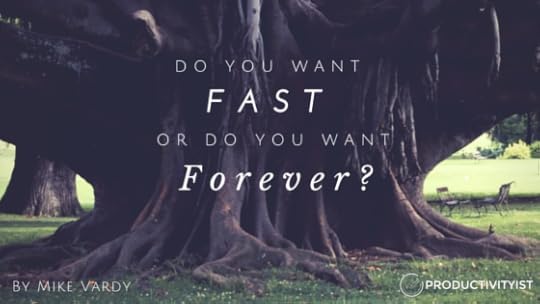
That quotation has stuck with me ever since. In a lot of cases, it seems as if fast is the desired outcome over the forever outcome. The quick fix is more desirable than the lasting one that takes time to nurture. If you or I could take a pill to make things better, we would. I’m not suggesting that there’s anything inherently wrong with that dream. But it really is just a dream. Nothing that lasts happens quickly. It takes time for the roots to take hold to form a foundation. This then serves as an anchor providing stability against the wear and tear of everyday life.
Do you want fast or do you want forever? You need to think about your answer to that question when looking how your approach to productivity.
Fast means you install the latest task management app without having a framework of handling your tasks in the first place. When the app crumbles under the weight of a frail system – or you find that the app isn’t working the way you need it to – you move on to the next app.
What if you spent time finding the right approach first?
What if you fostered a productivity system and personalized it over time so that it could work with pretty much any app that exists or may exist down the road? Wouldn’t this make you more effective? Wouldn’t that make you more efficient? Wouldn’t that make things better?
It sure would. But it isn’t the fast way. It’s the forever way.
I’ve just created The NOW Year™ Action Plan to help guide you to long-term success. The NOW Year™ Action Plan includes a 25-page ebook, worksheets, and audio downloads. Best of all, it also can help you in the short-term too, because it is easy to implement. As you’re planning ahead for 2016, wouldn’t it be nice to have a tool to help you create a system to fit YOUR needs? Pick it up HERE for only $20.16. But hurry – The NOW Year™ Action Plan is only available until 1/1/16!
I’ve also been thinking about this quote regarding my own work and my business.
Ever since I’ve transitioned Productivityist from a personal website to a full-fledged company, I’ve felt that part of what I’ve done in the past has been compromised. In some ways, I spent time building up the business fast without being as thoughtful about it as I had before. I’m not totally sure why this happened, but I’m glad I caught it before it spiraled too far out of control. In this case, going too fast in the wrong direction could have led to me taking forever to get back to where I really wanted to go.
I want my work to be something that has a lasting appeal. I have always said that you should get better at something before you try doing it faster. I’m going to take my own advice with my work. I’m going to slow down and do better. That’s the key to creating something that can stand the test of time.
So…do you want fast or do you want forever? I’d love to hear your answer to that question in the comments below.
The post Do You Want Fast Or Do You Want Forever? appeared first on Productivityist.

December 18, 2015
The Productivityist Podcast 71: Chris Johnson
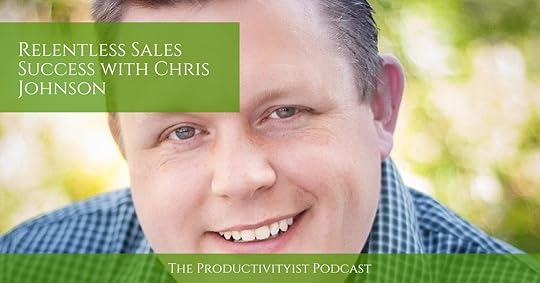
In this installment of the podcast, I’m joined by my friend and principal owner of Simplifilm Chris Johnson. We dive into a lot of things but really focus on how to work on sales technique and how being relentless in the sales arena – and in life – can go a long way.
Relevant Links
Simplifilm
World Domination Summit
5 Steps to Land Your Dream Clients: The 10–10–10 Strategy | Fizzle
Specialist or Jack-of-All-Trades? The Answer’s Obvious to Me | Gary Vaynerchuk
Close.io
No more yes. It’s either HELL YEAH! or no. | Derek Sivers
Experimenting with A.J. Jacobs | Workflowing #64
Chris Johnson’s Website & Blog
Chris Johnson (@genuinechris) | Twitter
Enjoy the podcast and want to help make it even better? Then become a patron The Productivityist Podcast through our Patreon campaign! Check out The Productivityist Podcast’s Patreon page and take a look at all of the perks – including regular Productivity Pack deliveries sent every January, May, and September – available only to Patreon supporters!
The post The Productivityist Podcast 71: Chris Johnson appeared first on Productivityist.

December 16, 2015
A New Year Plan for Busy People
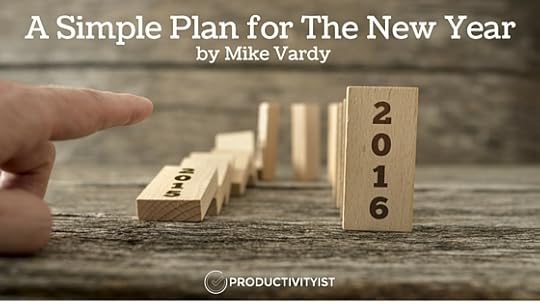
The holiday season is in full swing and to say you’re busy is an understatement, right? The new year is rapidly approaching. You want to finish the year strong, but this often means some other tasks and projects are left incomplete. And the thing is…it takes time to plan your year. And setting aside that time can be a real problem – especially if you follow the calendar to start your year.
As the end of December begins to wind down, the likelihood of focusing your energy on finishing the year strong can easily push plans for the next year further down the list. It’s as if the planning for the new year is abandoned because it takes up too much space in your schedule to do.
But it doesn’t have to be that way.
You can create a simple plan for your new year that allows you to look beyond a vague (and often demanding) resolution. It’s time to give your intentions for the months ahead the attention they deserve. All it takes is blocking out 25 minutes of time over a 10 day period to build a solid framework for your year.
Don’t think it’s possible to make that time happen? Think about it this way:
There are 15 days between the date of this post and the end of 2015. That’s a total of 21,600 minutes. I’m asking you to spend no more than 25 minutes a day for 10 days on this planning process. That’s 250 minutes in total. If you do the math, that works out to 1.16% of the amount of the time left in the calendar year. Surely a focused plan for the next 365 days is worth such a small investment of focused time.
Surely you’re worth it…right? Of course you are.
Now if you’re ready to take a brief look at how this plan works, read on.
How The Plan Works
There are really 3 things you need to keep in mind when building a simple plan for your year:
Have a simple focal point that represents your entire year.
Have monthly pillars that you can look to at regular intervals throughout the year.
Have daily triggers that keep you from guessing and get you going every day.
When you intersect all three of these aspects in a simple yearly plan, you’ll have taken a huge step towards having the year you want anytime you want.

The best part? You can start that planning process right now. You just need to do the following:
Pick 3 Words for the year: I’m not a big proponent of New Year’s Resolutions, so instead I choose three words to help me propel the year to come to great heights. This idea came from Chris Brogan (and was introduced to me by my former podcasting partner and good friend Michael Schechter) a couple of years ago. Your Three Words should be chosen in a way that they act as driving forces for everything you do in the year to come.
Choose themes for each month of the year: Monthly themes are key because they keep you aware of the bigger picture on those occasions when you get caught up in the minutia of the day-to-day. Having a compass of that nature can really help you make the most of your energy, your time, and your year.
Choose themes for each day of the week: Every day has one so that it triggers your overarching focus for that particular day of the week. (Note: That doesn’t mean you only do that activity on that day, but that activity/type of work gets your overarching focus.)
Just by completing the steps above you’ll be well on your way to crafting the year you want to have.
But if you want to save even more time, I would like to help you craft your plan for 2016.
In fact, with my help you can craft your plan for the next year in half the time. That means you can have your plan for the next year ready to go in just 125 minutes over 5 days – even less if you’re ambitious enough!
How can I help you with this?
The NOW Year™ Action Plan is the key.
It’s a short and inexpensive program that will show you a framework that is simple, durable, and flexible. The NOW Year™ Action Plan can even help you craft your annual plan for many years to come.
The NOW Year™ Action plan comes with an Action Guide that will help you choose your three words, decide on powerful monthly themes, and select daily themes that will keep you on course each and every day. It even comes with a companion audio program that walks you through the planning process from beginning to end. There is also a Quickstart PDF that outlines the entire framework in one handy sheet that you can print out and put wherever you want. Plus, you’ll get regular updates and bonuses throughout the year that will add to The NOW Year™ experience.
The NOW Year™ Action Plan is priced at just $20.16 and is on sale until January 1, 2016.
That’s right. I’m only offering this program from now until January 1st, 2016. After that you won’t be able to get it in its current form or at its current price ever again. Pre-orders for The NOW Year™ Action plan start today and the product will be released on December 21st. Anyone who pre-orders will get emails daily until the product launch date so you can get a head start on the planning process if you want. (I’ll also be including some exclusive materials in those emails that won’t be available with the product itself.)
I want you to have a plan going into the next calendar year. And I want it to be as simple as making a New Year’s Resolution but with more weight and substance. I want your plan to be lasting and have impact – both now and in the future. The NOW Year™ Action Plan can help you make that a reality. And it can help you starting now.
Click here to pre-order The NOW Year™ Action Plan now!
The post A New Year Plan for Busy People appeared first on Productivityist.

December 14, 2015
The One Thing I Started Scheduling On My Calendar
I’m not a big believer in scheduling tasks on your calendar. Instead, I strongly believe the task app you’re using is the best place for that.
Why?
Because if you fill your calendar up with all of the things that you need and want to do, it can fill up your schedule and then overwhelm you. This will then have a negative impact on how you complete those tasks.
So while I don’t advocate scheduling everything on your calendar, I have started to schedule ONE Thing on my calendar on a regular basis.
I’ve started to schedule the ONE Thing on my calendar.
This is the ONE Thing I want to work on consistently so that it can be done well and not rushed. The ONE Thing that has a high value and will move me forward in the most desirable fashion possible – effectively and efficiently. The ONE Thing that will make the biggest difference in my work and, ultimately, my life.
If you’d like to find out more about the ONE Thing I’m working on – and get a behind-the-scenes look at it while I’m working on building it, then click here and sign up for updates.
Now the ONE Thing can change over time. It won’t always be the same ONE Thing. And the ONE Thing overrides my monthly theme because it is actually scheduled in my calendar. Outside of that scheduled time chunk, I’ll still focus on my monthly theme for that month. And the daily theme still plays a role when I’m working on the ONE Thing because there are often elements of my daily theme that needs to be covered in the ONE Thing I’m working on (writing, learning, admin work, etc.).
But the ONE Thing trumps My 3 Absolutes. It trumps The Monthly Theme. It trumps everything else. Because when the ONE Thing wins, I win.
I strongly encourage you to decide on the ONE Thing you need and want to work on consistently and block out time to make it happen. It’ll stand out on your schedule (especially if you don’t hyper-schedule yourself – I recommend you use a separate colour to showcase it) and you’ll feel drawn to it because you’ve placed it as the priority above all other tasks on your to do list.
There’s a reason that it’s called the ONE Thing. So give it the attention it deserves and you’ll do better (and feel better about your schedule) time and time again.
Gary Keller has written an excellent book about this, and you can order it here. And if you want to learn more about my one thing, then click here and you’ll be able to keep up with me as I bring it to life.
The post The One Thing I Started Scheduling On My Calendar appeared first on Productivityist.

December 11, 2015
The Productivityist Podcast 70: The Art of The Side Hustle with Nick Loper
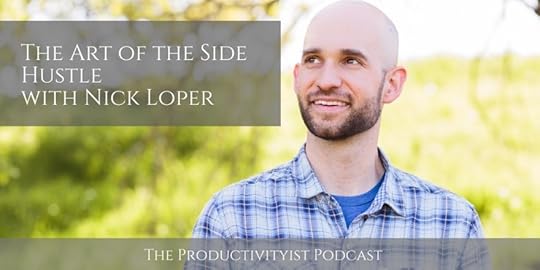
On this episode of the podcast I speak with the founder of Side Hustle Nation, Nick Loper. We talk about some of the unconventional productivity tactics he uses and dive into some of the equally unconventional side hustle experiments he’s undertaken.
Relevant Links
Nick Loper (@nloper) | Twitter
The 3 Laws of Side Hustle Physics | Side Hustle Nation
How I Got on the Homepage of Fiverr and Earned $920 in 10 Days | Side Hustle Nation
My Time Tracking Results: My Decidedly Un–4-Hour Workweek and Passive vs. Active Income Time | Side Hustle Nation
The Definitive Guide to Rat Race Math | Side Hustle Nation
The 5 Step System to Quit Your Job In the Next 12 Months | Side Hustle Nation
Confidence Power Plus Motorized Electric Treadmill | Amazon
FitDesk v2.0 Desk Exercise Bike with Massage Bar | Amazon
Herman Miller Envelop Desk | Amazon
Cold Shower Therapy™ | Joel Runyon
Ice Face: Hack To Get the Benefits of Cold Thermogenesis | The Bulletproof Executive
Tony Robbins on Morning Routines, Peak Performance, and Mastering Money | The Blog of Author Tim Ferriss
5 Morning Rituals That Help Me Win The Day | The Blog of Author Tim Ferriss
Deliberately Experimenting with Deliberate Practice — Looking for Subjects to Test My Advice | Study Hacks by Cal Newport
RescueTime
Toggl
79 Side Hustle Business Ideas You Can Start Today | Side Hustle Nation
Enjoy the podcast and want to help make it even better? Then support The Productivityist Podcast by becoming a patron! Click here to visit The Productivityist Podcast’s Patreon page and choose from a wide variety of perks – including monthly 20 minute coaching sessions with yours truly available only to Patreon supporters!
The post The Productivityist Podcast 70: The Art of The Side Hustle with Nick Loper appeared first on Productivityist.

December 9, 2015
The Task At Hand Vs. The Time On Hand

Note from Mike: This is a post that was originally published in The Productivityist Weekly. Not signed up for the newsletter yet? Click here and you’ll get it delivered to your inbox every week and receive a copy of The Way of The Productivityist Manifesto absolutely FREE!
If you’ve ever watched my 3 minute TEDx talk, you’ll see that the central theme is in order to be more productive, focus on the task at hand rather than the time on hand.
Sure, we’re all trying to get a lot done – especially during the holiday season. We’re all feeling the time crunch with so much to do in a limited amount of time. I’d suggest that the likelihood of getting everything done over the next month is going to be incredibly challenging, if not impossible.
When you start to look at what is the most important item you want to get done, then you will find time will work for you instead of making you feel like time is working against you.
Over the next few weeks, you’ll likely have less work-related tasks. Instead, you will be spending some time with family, catching up on some leisure reading, and so on. Things will start to slow down, and that’s when you can really start to notice that what you’re doing is far more task-oriented than time-oriented.
Sure, you’re doing those things because of the time of year, but what would happen if you started to shift that kind of mindset after the holidays? Time will always play a role in our lives because we don’t live in silos, but it doesn’t need to take precedence over the tasks in our lives.
This simple adjustment can really make a big difference in your productivity and in the quality of your life as a whole.
Start thinking more about the task at hand than the time you have on hand. Right now is one of the best times of the year to start doing so, and you may very well be able to carry that line of thinking through to the year ahead.
The post The Task At Hand Vs. The Time On Hand appeared first on Productivityist.

December 7, 2015
How To Get Better Perspective (In Just 90 Seconds)
Here’s a typical day for most people:
Wake up.
Get ready for work.
Go to work.
Work.
Get ready to go home.
Go home.
Do “home” work.
Have some leisure time.
Go to bed.
This may be simplifying things, but those are the basics. Sure, some of these things may be placed in a different order, but they happen at some point in the day.
But there’s more to it than that.
There are specifics. There are details. There are finer points than just the itemized list.
Yet we don’t break it down to the specifics, the details or the finer points as often as we might want – or should. Instead we just go through the list, checking things off as we go and waiting to get to the end of the list only to start it all over again the very next day.
Over time, we work at getting faster at completing the things on the itemized list. We work at getting out the door faster for work so we can beat traffic. We work at cramming in as many activities as possible during our leisure time so we can – hopefully – have more enjoyment.
The problem with just adding speed to the mix on its own is that we run the risk of being less effective. When we add more speed or more details to the things on our list, we often lose our ability to be intentional and attentive to those very details.
In our haste to do more, we don’t fully taste what we already do.
We consume; we don’t experience. We settle; we don’t savour. All of this means that we “do” productive.
We should “be” productive.
“Life gives you plenty of time to do whatever you want to do if you stay in the present moment.” – Deepak Chopra
I saw Deepak Chopra speak a couple of months back and while I don’t agree with everything he speaks about, I do like what he says about being and how it relates to time. Being is not associated with time.
Rather than spending time speeding things up for the sake of doing, taking the time to think about whether or not what you are doing is worth doing at all. Instead of checking off as many boxes as possible, check the boxes you have on your list and make conscious choices about them.
In order to make this happen, you need to be aware and have focus. (What’s even more interesting is that you need to be aware to have full focus and you need to have focus in order to be fully aware.)
I’d like to offer a 90 second exercise to help you get better perspective, become aware, and find a small measure of focus.
After you’re done reading this piece, just stop and do nothing for 30 seconds. It may help to focus on your breath and close your eyes while doing so. But do this no longer than 30 seconds today.
Once you’re done with the 30 seconds, grab a piece of paper and a pen/pencil and write down everything you think you need to do, ought to do, or want to do over the course of 30 seconds. You should time this. Stop once the 30 seconds is up.
Take a final 30 seconds to choose one of those things to work on today. Commit to working on it so that you can honestly say you have made progress on it before day’s end.
That’s it. That’s all I want you to do. By doing this, you’re being aware. And by working on just one thing intentionally, you’re exercising focus.
In short, you’re being productive.
“I am a human being, not a human doing.” – Kurt Vonnegut
I want to help more people – people like you – be. I want you to be aware so that you can focus on checking off the right boxes instead of trying to check off all of the boxes.
Now go and complete that 90 second exercise. You’ll be glad you did later.
Want to give yourself even more perspective and increase your level of focus? Then the Awareness Building Class is for you. It contains five audio lessons filled with real-life stories and actionable advice to help you improve your focus and sort out any confusion in your work or personal life. It’s time to become proactive instead of reactive in your work life and your personal life.
The post How To Get Better Perspective (In Just 90 Seconds) appeared first on Productivityist.

December 4, 2015
The Productivityist Podcast 69: Boosting The Brain with Dr. Andrew Hill
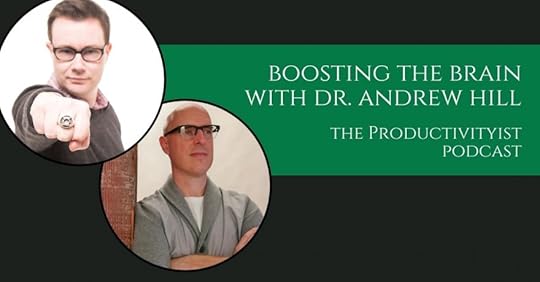
I had an absolute blast spending time with the Lead Neuroscientist of truBrain, Dr. Andrew Hill, on this episode of the podcast. We talk about a ton of “brain stuff”, including the importance of getting things out of your head, how decision fatigue works, and more.
Relevant Links
truBrain | (re)Designing Focus
The Pomodoro Technique®
The Productivityist Podcast 66: A Doer Who Likes To Be with Michael Townsend Williams | Productivityist
Morning Pages | Julia Cameron
Comedian | Official Site
Pavlok | Break Bad Habits in Five Days
Andrew Hill, PhD (@AndrewHillPhD) | Twitter
Peak Brain Institute
Note: Apologies for the sound on this episode. For some reason Skype defaulted back to the laptop microphone port which I had my iPhone headphones plugged into. I’m not sure why this happened – and I didn’t catch it during the recording. There was also noise and the guest’s side my producer John Poelstra did the best he could with, but is still present. That said, I think the quality of the conversation still holds up.
Thanks again for your support and enjoy the episode!
The post The Productivityist Podcast 69: Boosting The Brain with Dr. Andrew Hill appeared first on Productivityist.