
Susan Spann's Blog, page 98
January 2, 2013
Contract Negotiation, Part 1: Mutual Benefit
Welcome to a new year of #PubLaw, the Wednesday blog feature where we explore publishing law issues of interest to writers!
This year’s first series: The How-To’s of Contract Negotiation.
Two primary philosophies dominate negotiation theory. The first, called “Zero-Sum (Or Zero-Sum Game)” holds that in any negotiation, one person’s gains create equal losses for the other side. In simpler words: every time I “win” a negotiating point, my opponent loses something.
I’ve never liked Zero-Sum theory because it places a negative, often hostile (and always aggressive) spin on negotiations. Publishing, in particular, is a place where contract negotiations aim to create a lasting, mutually beneficial relationship – and that can prove difficult where the initial negotiations look and feel like a bloody war.
The alternative to Zero-Sum is Mutual Benefit Negotiation – the idea that, for any given contract, there is a place where both sides can maximize the benefits of and returns on a contractual relationship.
I’ve always preferred to negotiate from a mutual benefit perspective, and found it far more successful than the Zero-Sum approach. This is particularly true in publishing, where the parties are often negotiating contracts that last many years (and sometimes outlive the author).
Step 1 in the PubLaw approach is viewing negotiation as a process by which a publishing contract reaches a point of maximum mutual benefit.
You, the author, seek to maximize your returns on your work. The publisher also wants to maximize its returns.
Sometimes authors forget that those goals are not mutually exclusive. Without surrendering rights, or agreeing to terms that are less than fair, it’s important for authors to remember that the publisher’s goal is actually the same as the author’s – to sell as many copies of the author’s work as possible. Finding the right, mutually beneficial, set of contract terms is the first step in that all-important process.
What do you think of Mutual Benefit Negotiation as an alternative to Zero-Sum thinking? Do you use it in other parts of your life as well? If you have questions about this or other aspects of publishing law and negotiations, please ask in the comments – I love to hear from you!


January 1, 2013
Resolutions!
Happy New Year, one and all.
I’ve been away a while, recharging the batteries and working on a couple of projects, but new years bring new chances to share – and I’m looking forward to sharing this year with all of you!
We’re just over 7 months from the launch of CLAWS OF THE CAT, and I’ve been hard at work with my awesome web designer on a whole new look for the website (well, ok, he’s been hard at work and I’ve been supervising). We’re hoping to roll the front page out very soon, and I’ll have lots of extra content to share as the months go by and the series launch approaches!
In the meantime, I’m working on some New Year’s Resolutions. I’ve heard people have a better chance of success if they make the announcements public, so here goes:
1. I resolve to blog five days a week! No missed days, no missed content in 2013.
2. I resolve to write every day, even if it’s “only” a blog post’s worth of content.
3. I resolve to let Oobie keep helping me with my novels. (And not just because she’s sitting here, watching to make sure I include this. Really…)

I’ve got a couple more, but we’ll keep them for another day.
Your turn! What are your resolutions for 2013?
December 28, 2012
The Fun That Never Ends
I’m at the Debutante Ball today, explaining why I love “The Song That Never Ends.”
Don’t know the song? Hop over and let me share …. if you dare …
December 24, 2012
‘Twas the Night Before Christmas – On the Reef
Twas the night before Christmas, and all through the reef
Every creature was swimming, with fervent belief
That an afternoon feeding would surely appear,
Every seahorse was on Santa’s “good list” this year.

Emo the clown nestled snug in his host,
An Anthelia coral grown larger than most.
And Flappy and Jet called a Christmas-Eve truce,
While Cygnus cast eyes on “his” Christmassy spruce.

From the back of the tank there arose such a clatter,
I sprang from the desk to see what was the matter.
I flew to the tank, started looking around,
To determine what made such a clattering sound.
The bluish-white lights gave a wintery glow
To the reef and the myriad corals below.
When, what to my wondering eyes should appear,
But a three-inch gold goby with no sense of fear.

A bold little watchman, this Emperor Max,
With a thousand-yard stare and a liking for snacks.
He hung in mid-water and glared at each fish -
Keeping this reef in line is his Christmas Eve wish!
“Now Cygnus! Now, Ghillie! Now, Ceti and Flappy!
Hey, Emo! Hey, Jett! Quit looking so happy!
From the top of the rocks to the top of the glass
This MY REEF, I tell you! It’s mine to harass!”
As dry leaves that before the wild hurricane fly,
When they meet with an obstacle, mount to the sky.
So all of the fish out of Max’s way flew,
giving him a wide berth, and his attitude too.
And then, in a twinkling, I heard little clatters
like plinko balls falling, or plastic that shatters.
I drew back and once again looked all around -
As Banzai fell down off the reef with a bound.

He was dressed in a shell, as a hermit crab should,
He’d been climbing the sea fan (to prove that he could).
But he fell from a height and went flat on his back,
He looked pretty foolish, (and that is a fact).
The fall made Max angry! His temper was up!
“I said no shenanigans, you foolish pup!”
The watchman’s long mouth was drawn down like a bow,
“Nobody messes with me, don’t you know?”
But then, from the opposite side of the box,
came a large cloud of sand and a clatter of rocks.
Scooter Jett taunted Flappy just one time too many:
Their Christmas Eve truce? Gone as if there weren’t any!

Flappy’s chubby and plump, a right jolly old elf,
And I laugh when I see him, in spite of myself.
But a wink of Jett’s eye or a twist of her head,
Has poor Flappy the Mandarin seeing some red.
Max spoke not a word, but went straight to his work,
sneaking up behind Flappy (who’s being a jerk)
and, with his best thousand-watt Angryfish stare,
Max imposes a Christmas Eve peace everywhere!

Max returns to his post, floating over the reef,
And gives me what might be a look of relief.
For the moment at least there’s no trouble in sight.
“Happy Christmas to all, and to all a good-night!”
December 19, 2012
An Interview With Dana Gynther
Please help me welcome Dana Gynther, author of the recently released historical novel CROSSING ON THE PARIS (Gallery Books, November 2012)

Dana Gynther was raised in St Louis and Auburn, Alabama. After college, she lived in France for eighteen months, then returned to the University of Alabama to get an MA in French Literature. In 1994, she and her French-speaking Spanish husband moved to his hometown, Valencia (Spain), where they work as teachers and translators. They have two daughters and two cats.
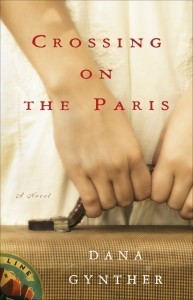
A November 2012 Indie Next Pick, Crossing on the Paris … has the feel of a riveting miniseries as you turn the pages expectantly wanting to find out how this voyage ends. – Barnes and Noble Book Club
I first encountered Dana – and CROSSING ON THE PARIS – when Heather Webb interviewed her at Between the Sheets. I picked up CROSSING ON THE PARIS that day, and read the entire novel in one afternoon – you can read my review here (spoiler – I loved it). I’m so thrilled that Dana could join us here today!
And so, on with the questions:
1. Where did you grow up? Will you share a favorite story from your childhood?
I was born in St Louis but, since my father was a professor and my mother a southerner, we moved to the college town of Auburn (Alabama) when I was ten. That summer, my cousin Kathy and I spent a week together at my grandmother’s house. She was an elderly widow even then, and lived in an isolated house in a fork-in-the-road community. After a relatively boring first day—exploring the empty pastures, drinking a yoo-hoo at the gas station, feeding the chickens—we went to bed early, like everybody else in the county. We shared the big bed with the pink chenille bedspread next to the window (usually reserved for our older sisters) and, listening to the cicadas, tried to fall asleep. A little while later, we saw a car pull up under the lone street light down the road. People got out and started walking towards the house. We could hear the mumble of their voices, their footsteps in the tall grass. They tried the screened door on the back porch but couldn’t open it, then came around the house—passing right by our window!—to go to the front. Sweating in cold terror, we lay in the bed, pressed against one another, mute and motionless. Luckily, the intruders had no better luck with the front door and soon left. When we heard the soft rumble of their car engine and saw the receding tail lights, we could finally breathe again. We jumped out of bed, turned on the lights, and woke up our grandmother.
“Mamaw!” Kathy shouted. “Someone tried to break in!”
She frowned at us (we’d pulled a few hijinks in the past) and drawled, “Well, I tell you what. If anyone came in here and saw my ugly face, they’d go running scared!”
In the light of day, we were no longer afraid. Since our grandmother didn’t take us seriously, we decided to become detectives. We scoured the yard and porches, looking for clues, and set a few traps in case they came back, putting Mason jars in strategic places as an alarm system. Until our parents came for us a few days later, all our conversation and activities were dominated by the attempted break-in which, in the end, provided us with hours of entertainment and excitement.
2. What inspired you to start writing?
That’s hard to say—probably my love of conversation/stories, books, language(s), the words themselves. In the beginning, all of my writing was personal (journals, travel books, poems, memoir) and meant for a very limited audience: just myself or select friends and family members.
Unlike private writing, I specifically remember making the decision to write fiction. It was 2006 and I was translating the website for a local monument, a public bathhouse built in 1313. Learning about its history, I kept thinking, “Man, this would be a perfect venue for a novel! Someone should really use this material!” Finally, I realized that person could be me. I wrote The Admiral’s Baths, my first novel, and still hope to get it published.
3. If you could go back in time and share one writing lesson with “new writer you” before starting your first manuscript … what would that be?
I think it’s important for writers of Historical Fiction to learn that, often, less is more. When doing research, you discover extraordinary events and fascinating people and it’s a huge temptation to try to fit it all in your text. You have to remember that your story comes first. I know that sounds obvious, but to us history dorks, it’s very hard.
4. Your new novel, CROSSING ON THE PARIS, is set on an ocean liner (the Paris) shortly after the end of World War I. What inspired you to choose this unique time and setting?
This novel was also inspired by a translation job. My husband and I translated a museum catalog called “Gigantes del Atlantico” (Giants of the Atlantic), all about French Line ocean steamers: their history, mechanics, aesthetics, and social structure. Again, I had that same gut feeling—Wow! What a great subject for fiction!—but this second time around, I didn’t hesitate.
5. Do you have a favorite author? If so, who and why?
Not a favorite author, but a favorite century: I love 19th century literature. I got hooked on it in my late 20s and have since gone on Thomas Hardy jags, mooned over Moby Dick, read and reread Dickens and Austen, discovered the great Wilkie Collins, and on and on. It’s like Living Historical Fiction (and they didn’t have to do all that research!). I love and need to mix contemporary fiction into the bag—Zadie Smith, Paul Auster, JK Rowling, Barbara Kingsolver, etc. etc.
On a side note, I am a firm believer that teenagers should not be obligated to read the classics. Most of them are just not prepared for the prose-poetry of Melville, the tragedy of “Tess of the d’Urbervilles” or the detailed sensibilities of the Russians. Forced upon too young, readers get a bad taste in their mouths for many authors of classics (except, maybe, Twain, the Brontës, Fitzgerald and Dickens) and won’t explore them later on. As for myself, when I was a teenager I devoured stuff like Stephen King novels, “Helter Skelter”, “Gone with the Wind” and the biography of Jim Morrison. And I’m not surprised—or disappointed—when my teenage daughters want to read similar things.
6. CROSSING ON THE PARIS has three female protagonists, each of whom has a different reason for boarding the Paris. One woman is traveling first-class, one in second-class, and the third is a member of the crew assigned to serve working-class steerage passengers). What did you find most challenging about telling a story from three very different perspectives?
It was like telling three stories, really. Each woman had her background, her on-board story, and different physical environs, the three areas of the ship. One thing I was highly aware of, however, was making it “fair.” I wanted no one woman to overshadow the others and wanted each one to get equal time. Perhaps this comes from being the mother of two? At any rate, after finishing each “Day” on board (the main dividers of the novel), I counted the number of pages for each woman and made sure they were more or less the same.
7. Do you have a favorite scene in CROSSING ON THE PARIS? If so, what makes that scene stand out for you?
The scene of Vera Sinclair giving Max the puppet show. It was not in the original manuscript and is therefore relatively “new” to me and still has some freshness. It’s a reflection on childhood—on that of Vera, Josef, and Max himself—combining melancholy with playfulness, two of Vera’s key traits.
8. What is the last book you read, and why did you read it?
At the moment, I’m reading Georges Simenon mysteries (currently 45º à l’ombre), mainly to practice my French. I have an MA in French and lived in France for over a year in my early twenties, but, due to all the years I’ve lived in Valencia, my Spanish has pretty much eclipsed it. The foreign language area of my brain seems to be very fragile ground. If I’m reading in French, even now, my Spanish temporarily goes out the window.
9. How long did it take you to write CROSSING ON THE PARIS? How did you push yourself to get past difficult moments in writing and editing?
I started it in 2007, the summer after we translated the catalogue, but it’s hard to calculate exactly how much time it took to write. Do you include all the time spent mentally plotting things out, doing background reading, and making notes and outlines? And how about that very essential “down time,” when you put the MS aside and don’t look at it for a couple of months? And all of the various drafts (each one requiring its “time away”)? If so, taking into account I made a few final changes in the spring of 2012, it comes to about five years. But I think that’s misleading.
As far as pushing myself, once I had an agent interested (and the possibility of publication), I found that was motivation enough. Besides, when it’s a question of something I really like—writing, for one—I have plenty of self-discipline (housework is another story).
And now, the speed round:
- Plotter or pantser?
Plotter
- Coffee, tea, or bourbon?
No wine on the list? Coffee then.
- Socks or no socks?
From October to May—definitely socks. I’m very cold-natured and we have tile floors and no central heating.
- Cats, dogs, or reptiles?
Cats. I’ve almost always had one—if not two or three.
- For dinner: Italian, Mexican, Burgers or Thai?
Who’s cooking? If it’s me, Italian. If we go out, Thai.
Thank you, Dana, for joining me today! I loved CROSSING ON THE PARIS and think many of my readers will love it too!
Set on an ocean liner in 1921, “Crossing on the Paris” explores the lives of three women on board. Vera Sinclair, an elderly woman travelling in first class, is reluctantly moving back to New York after thirty wonderful years in Paris. In second class, Constance Stone, a provincial wife and mother, is returning home after a failed attempt to bring her bohemian sister back to Worcester. Below decks, Julie Vernet embarks on her first job in the steerage service crew. During the course of the voyage, classes blur, romances blossom and lives change.
CROSSING ON THE PARIS is available at Barnes & Noble, Amazon.com, Target, and at local and independent bookstores near you!
Wednesday #Publaw: 2012 in Review
This is the final Writing Wednesday/#Publaw post of 2012.
In 2013, I’m starting an exciting new series on contracts and negotiation – be sure to tune in on Wednesdays for more publishing legal advice!
But now, let’s take a look back at 2012.
From my perspective, this year saw an increase in author self-education about the publishing business – a very positive trend that I anticipate will continue in 2013.
The more publishing changes, the more authors need to be informed about the industry, their rights and the best way to interact with the increasingly in-touch and attentive audience.
On the publishing front, I’ve seen increased willingness by publishers to negotiate clarifying language into contracts and remove ambiguities. For authors, this means don’t be afraid to ask the publisher to clarify confusing terms in your contract.
The emergence of more POD and hybrid presses continues to increase opportunities for authors – but also makes contract review even more important. It’s the fine print that distinguishes a good publisher from a bad one. Don’t sign without solid, qualified review!
I’ve seen a reduction in “difficult cases” – authors who sign a contract first and only later discover they’ve made a mistake. I’m hoping that’s a trend that continues in 2013 and beyond.
I’m taking a break from #PubLaw until the first of the year, but tune in January 2 for the start of my new series on contract negotiation for authors!
Do you have questions about publishing law or business? Please feel free to ask me in the comments or on Twitter (@SusanSpann)!
December 18, 2012
A Pause to Appreciate Those We Love
It’s hard to turn on any media without seeing a discussion of last week’s horrific events in CT. I’ve deliberately kept my silence – partly from respect for those involved and partly from a need to process (and mourn) the situation in my own way.
I am deeply attached to the things I love, though I might not always show it as openly as I should.
Cyg and Ceti couldn’t care less about appearances. If they’re within touching distance, they do, from holding tails at dinnertime:

to swimming together:

to the occasional moments when I think Cyg might rather not give a pony-back ride but does it anyway because he loves her:

The lesson here is clear, and simple.
If you love something (or someone), let it know. Life is short, and often beastly, but also filled with beautiful gifts that are all too easy to miss or overlook.
Take a little time this week – and every week – and let your appreciation show. If someone asks – just tell them you learned it from a seahorse.

December 17, 2012
Monday Blog Game: Favorite Words
Today’s edition of the Monday Blog Game invites everyone to blog (or comment – comments are open) about a “favorite word.” What’s yours?
Is it serious? Funny? A little of both? Blog about it and link back here, or hop into the comments and tell me, I’d love to know!
Today, I’m hosting a guest-post on the topic by Marci Jefferson, and I’ll post my own entry later this afternoon. (Edit: 4:00pm: Marci has said this so nicely, I think I’ll let her entry stand alone for this week.)
And so, here’s Marci!
Monday Blog Game: Favorite Words
Susan’s Monday blog game is usually fun and light. When she told us last week that today’s topic was our “favorite word,” I immediately jotted a funny list of likely candidates. Now, in the dim haze of Connecticut’s shooting tragedy, only one word comes to mind.
Peace.
Whole books and songs have been written on this illusive ideal. Entire international foundations move to create and support it. It has been longed for in every nation during every war since the beginning of time. It is the hope, inspiration, and prayer of every parent bringing a new life into this world. It is the very message of this holiday season.
And our semblance of it has been brutally shaken. Many discussions about gun control have flown around the media the last few days. Yet, in a peaceful world, weaponry would not exist. The United States’ poor handling of violent and mentally ill citizens is a topic getting less media attention. In a peace-loving world, might we be better able to recognize and treat those individuals in need?
I like to think so. That is why my favorite word today is Hope.
Hope, not only for peace, but healing for our troubled nation and the hearts of those who mourn.

December 14, 2012
A Review: Crossing on the Paris
Review: HIGHLY RECOMMENDED.
Last Saturday I spent a happy afternoon reading Dana Gynther’s new novel, CROSSING ON THE PARIS.
The novel follows three woman – a first-class passenger returning to New York after decades abroad, a second-class traveler going home to Massachusetts after an unsuccessful attempt to persuade her Bohemian sister to leave Paris and come home to help with their ill and aging mother, and a young French woman who has accepted a job on the Paris, a luxury liner starting her maiden voyage across the Atlantic.
The novel switches between the three characters’ points of view but never seems choppy or confused. In fact, Dana Gynther “hands off” the narrative at moments when the three women’s paths collide (generally unexpectedly) and weaves a flowing, cohesive story from these women and their experiences at sea.
CROSSING ON THE PARIS falls somewhere between historical fiction and women’s fiction. I’d call it the best of both – without the worst parts of either. The story moves quickly, the characters are engaging and often funny. Gynther’s supporting cast is well-developed, from the nasty supervisor who watches poor Julie Vernet with an eagle’s eye to the charismatic doctor whose unexpected affections make second-class passenger Constance Stone re-think her settled Massachusetts life. I thoroughly enjoyed the novel and read it in a single afternoon.
The ending surprised me – in more ways than one – and I found it particularly nice that although the outcome was not the one I anticipated I enjoyed it even more than I would have enjoyed the expected one. In that, too, Gynther has done a fantastic job.
CROSSING ON THE PARIS gets a “Highly Recommended” mark from me – if you’re looking for a winter read or a gift for someone who likes either women’s fiction, historical fiction, or general fiction with a historical bent, this book should definitely be at the top of your list.
December 13, 2012
The Return of the Monday Blog Game
After a brief holiday hiatus, the Monday Blog Game is returning as a permanent feature starting this coming Monday, December 17.
What’s the Monday blog game?
Simple. Every Thursday, I’ll post a topic on my Facebook page. Anyone interested in playing along should pick up the topic and either post on the topic the following Monday or leave a comment here on my Monday blog post giving an answer to or thoughts about the topic. (You can do both, and you can also blog at your own blog and leave a comment here with a link so readers can find your post.)
The point of the game is simple: having fun and seeing other people’s thoughts on random topics.
The topic for Monday December 17 is: Favorite Word(s). Pick one and tell me why it’s your favorite. As a bonus: if you’ve never actually used your favorite word in something you’ve written, tell me why!
If you’re reading this, you’re invited to play along – and I hope you will!


