
Susan Spann's Blog, page 96
January 21, 2013
Monday Blog Game: Writing as Craft
I didn’t originally realize that writing was a craft.
I thought writing meant “telling stories.”
My first completed manuscript attempted to tell a story I made up – the fictional history of Borte Ujin, senior wife of Genghis Khan. The agents who read the manuscript offered nearly identical feedback: great idea, solid pacing, interesting voice – but the characters are flat and uninspired.
I wrote another book, adding dialogue tags and descriptive adverbs galore.
And once again, I was told my characters seemed merely two-dimensional.
It wasn’t until much later – years down the line – that I recognized the problem. Characters require more than dialogue tags. They need a fully-realized world and lives that started before page 1 and continue after “the end.” (Unless they’re dead.)
This realization sparked my interest in writing as a craft – in learning to do more than just put a story on a page. Good writing requires growth and constant effort to improve.
A writer can learn until his or her dying day.
I’m on a never-ending quest to improve my writing and push my prose to a higher state. For me, that means a three-pronged approach: I read, I write, and I analyze written words (my own and those of other authors). It’s difficult, and time-consuming, but in the end the results are more than worth it.
How do you feel about writing as craft? What steps do you take to improve? Do you have a favorite author whose writing inspires you, either as a reader or as an artist?


Inspiration From Master Writers: a guest post by DeAnn Smith

I write hundreds of words daily for my day job. Writing for a news outlet and novel writing have similarities but significant differences.
I spent two decades growing my craft as a journalist. I worked to get better details and verbs into stories, and pushed sources for better quotes to make a story sing. Gobbledygook was verboten.
I realized last week how much my novel writing is growing. I was thrilled to be tagged in a game that has you post on Facebook seven lines from page 7 or page 77 of your work-in-progress. I was pleasantly surprised by how much stronger my writing was on page 77 than page 7.
For both my day job and my fictional writing, I believe paying close attention to successful writers is essential.
I am a voracious reader, especially historical fiction, except now I read a book for pleasure and to deconstruction it for ideas. Imitation is the sincerest form of flattery. I am particularly inspired by Elizabeth Chadwick, whose A Place Beyond Courage I just devoured. I am enthralled by how she mixes modern language and “old-sounding” words that evoke medieval England. I need to work on my transitions between dialogue and reading master authors helps me learn.
I draw particular inspiration from Chadwick’s To Defy A King and Anne Easter Smith’s Queen by Right. Both open with feisty young girls who grow to become remarkable women while overcoming loss and adversity. Both are models for my Anne of York.
January 19, 2013
News! January 19, 2013
This week in Spann of Time news:
Shinobi news!
The new author website is almost ready to launch, and I can’t wait to share it with the world.
Also, I’m looking forward to seeing galleys of Claws of the Cat, which should be finished some time in February.
I’ve finished polish edits on Book 2 of the Shinobi Mystery series, tentatively titled Blade of the Samurai, and I’ll be sending it to the publisher very soon.
Upcoming Appearances
1. On January 24 I’m blogging at Chiseled in Rock. This week, we’re looking at grants of rights in publishing contracts.
2. Also on the 24th, I’ll be at the Debutante Ball – bringin’ the crazy!
3. I’ve been invited to speak at the upcoming WANAcon online writers’ conference, which will take place February 22-23, 2013. Details to come, but the topics include author business plans, publishing contracts, and acting as the watchdog for your writing career.
4. And last, but certainly not least, I’ll be at the Historical Novel Society Conference in Florida, June 21-23. I’m participating in a panel on writing historical mystery – and I hope to see you there!
January 18, 2013
For Love of Thesaurus
January 18 is the birthday of Peter Mark Roget, perhaps best known for writing the first thesaurus.
Like me, Roget used lists as a coping mechanism (no word on whether he had more success completing the items on his than I have with mine).
The first edition of Roget’s Thesaurus of English Words and Phrases Classified and Arranged so as to Facilitate the Expression of Ideas and Assist in Literary Composition (Note: this is why publishers want to approve your title…) was published in 1852 and went through 28 printings before Roget’s death in 1869.
In honor of the occasion, permit me to offer some of my favorite searches (and results) from thesaurus.com:
defenestrate: No results found. Did you mean “demonstrate”? (No, but I’m willing to watch if you’d like to…)
murder: annihilation, assassination, blood, bloodshed, butchery, carnage, crime, death, destruction, dispatching, felony, foul play, hit*, homicide, knifing, liquidation, lynching, manslaughter, massacre, off*, offing, one-way ticket, rub out, shooting, slaying, taking out, terrorism, the business, the works. (I have to admit, “the works” is one of my favorites.)
vaccum: barrenness, blank, blankness, chasm, depletedness, desertedness, desolation, destitution, exhaustion, gap, inanition, inanity, vacancy, vaccum , vacuity, vacuousness, vacuum, void, waste (All of which perfectly describe my feelings when I use one.)
and, finally, one which isn’t original to me but which I love nonetheless:
ninja: no results found. (Of course not. They didn’t want you to.)
Have you got a favorite word or favorite thesaurus result? Anything that makes you laugh? Share with me in the comments!
January 17, 2013
Exploring the Bakufu
Many Westerners know the words “shogun” and “shogunate,” but fewer recognize “bakufu” – even though the concept is familiar.
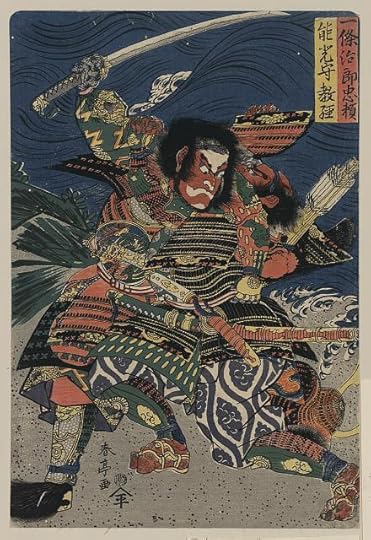
Ichijō jirō tadayori notonokami noritsune by Katsukawa Shuntei (Image in public domain)
“Bakufu” (幕府:ばくふ) is the Japanese term for the shogunate or, more specifically, the shogun’s government. The term translates “tent office” or “field headquarters” and implies a government of temporary duration.
The Japanese emperor originally established the shogunate on a short-term basis. The title “shogun” was given to military commanders who led campaigns on the emperor’s behalf. By the medieval period, however, the shogun became de facto ruler of Japan, and his “field headquarters” took on more permanent status.
The emperor remained the ruling monarch, but by the 12th century his power was more ceremonial than temporal.
The shogun and the bakufu had seized control of the country.
Throughout the medieval period, rival daimyo (essentially warlords) fought to control the shogunate, and the military government changed hands several times. Each new shogun was “approved” and appointed by the emperor, though in truth the office of shogun and control of the bakufu went to the man with the power (and intestinal fortitude) to seize and control Kyoto.
Warring daimyo play a major part in the Shinobi Mysteries, which take place at a time when Kyoto was under constant threat of attack. The bakufu features heavily in Book 2, Blade of the Samurai, which involves the murder of a government official.
Did you know about the bakufu? Do you know about any other “unexpected” turns in government structures? I’d love to hear about them in the comments!
January 16, 2013
Negotiation Step 3: Read the Contract
Step 1 to a successful negotiation is attitude: go in seeking a mutually beneficial solution.
Step 2 is know thy business, and the publisher’s business too.
Which brings us to Step 3: Read the Contract, and Understand Every Word.
I’m always surprised when an author approaches me with a publishing problem and then admits to not having read the contract before (s)he signed it. The offered reasons vary, but at the end of the day they’re unimportant. A contract signatory is legally responsible for knowing what the document contains.
Do not ever sign a contract – publishing or otherwise – unless you have read and understand it.
This probably frightens many of you. Most authors dont’ speak fluent legalese. Fortunately, you’re not alone. Websites like this one (and the Twitter #PubLaw hashtag) exist, in part, to help authors learn. An agent or a publishing lawyer can help you understand your contract language.
Understanding contract language is even more important for independent authors, who must be business-savvy as well as writing pros.
Starting this week, I’m the Thursday blogger at Chiseled in Rock, the Rocky Mountain Fiction Writers blog. My opening series there will take an “up close and personal” look at publishing contract language, with a focus on helping authors understand the legalese of the publishing world.
Join me tomorrow at Chiseled in Rock or leave your questions in the comments here – but whether you learn from me, your lawyer, your agent, or another reliable source, by all means learn. And read that contract. Your rights – and perhaps your career – depend upon it.
January 15, 2013
Mushrooms of the Reef
When I post photographs of my aquarium on Twitter and elsewhere, I’m always surprised by the number of comments I receive about the mushroom corals.

I suspect it has a lot to do with the fact that most large marine aquariums don’t include any “mushroom corals” (Actinodiscus sp., Ricordea sp, etc). The choice has less to do with survivability than predation. Many marine fish consider soft-bodied, non-stinging mushroom corals a tasty (and defenseless) treat.
Fortunately, seahorses largely leave them alone, which means the mushrooms flourish in my tank. The largest ones are about 6″ in diameter when fully opened:
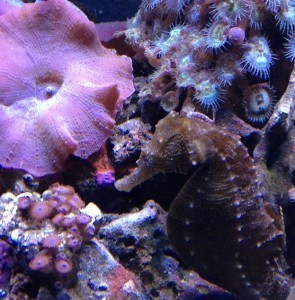
In the wild, mushroom corals live in shallow, well-lit waters where their zooxanthellae can get enough light for photosynthesis. The corals shrink at night and expand in daylight to increase the surface area for their symbiotic zooxanthellae.
These symbiotes give the mushroom coral its brilliant color and provide the coral itself with most of its energy. Mushrooms are capable of absorbing some nutrients from the water, but for the most part they “eat” what their symbiotes produce through photosynthesis and chemosynthesis.
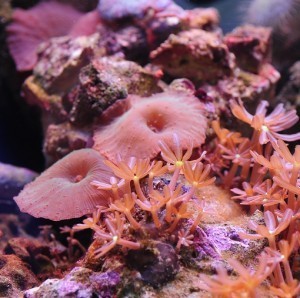
Science-geekery aside, I love the mushroom corals for their floppy, soft appearance and beautiful colors. (For the record, they feel just as soft as they look, though they don’t much like being touched.) I have several varieties in the tank at present, and I’m always on the lookout for a new type or color to add to my collection.
Have you ever seen mushroom corals in the wild or in an aquarium? What’s your favorite coral? Let me know in the comments – I love to hear from you!
January 14, 2013
Monday Blog Game: Quirky Pets
Today’s Monday Blog Game topic: pets and their quirks.*
My favorite smallest cat, Oobie, has a number of quirks, one of which causes me almost constant amusement.
Oobie likes to sit on important things.

If she perceives that an object is important to me, she sits on it as quickly (and as often) as possible.
Leaving the desk guarantees she’ll take the computer, and also that she’ll be put out when I reclaim it upon my return.

Two weeks ago, when the copy edited manuscript of Claws of the Cat arrived for review, I had to persuade her to surrender the pages.
It wasn’t easy.

Some might call her obstinate, or ill-behaved, but I can see the behavior for what it is – a need to be involved in important activities (read: all activities that concern me).
Cats are known for sitting on things, but I’ve never had a cat that took it to such a carefully tailored extreme.
*Want to play along with the Monday Blog Game? If you have a blog, post an entry about today’s topic and link to it in the comments. No blog? No problem! Post a comment with your story here. I love it when people play along!
My Quirky Dog, Lucy: A Guest Post by DeAnn Smith
I was delighted when this week’s blog topic was pets’ quirks. Our beloved Australian cattle dog, Lucy, is a walking quirk. After all, the spoiled dear thinks she is a four-legged human. And wouldn’t you if you were a dog and had your own queen-sized bed in your own room to sleep in any time you desire?

So many quirks to choose from, but Lucy and I agreed I would share her disdain for water and love of snow.Lucy is a stray we rescued literally from the middle of the road in southeast Arkansas where snow is a rarity. Unlike my brother’s labs, she has a horror of water. When it’s pouring, she will stand at the door and visibly convey, “You are kidding right? I will not go out there.” Heaven forbid, she have to relieve herself during the rain. She finds the nearest rock patch and ensures two of her dainty paws firmly stay on a concrete driveway. We pay groomers because I would get bruised and scratched whenever we tried to give her a bath.Snow is a completely different story and brings out pure, unadulterated joy in her. After she moved from my home state to our home in a ‘burb of Kansas City in 2004, we naturally experienced a long, hard winter that Laura Ingalls Wilder could recognize.

The first time we had snow Lucy was baffled and a bit terrified. My husband had to shovel snow to create a patch of grass for her. But her aversion evaporated as quickly as she learned to plow through it. Even though I’m a native Southerner who hates the cold, I always look forward to the first decent snowfall just to watch Lucy’s reaction, which is akin to a doggie Christmas day.I dare say she knows what I mean when I utter the magic words, “Lucy, let’s go play in the snow!” She rushes out and cavorts and dances in the flakes. She eats the snow and has learned to throw herself across a strip of ice where she slides like a penguin with a big, silly grin on her face.Even if a picture is worth a thousand words, I leave you with this image of Lucy whose least favorite tune has to be Eric Clapton’s Let it Rain and favorite song undoubtedly is Let it snow, let it snow, let it snow!

January 13, 2013
Newsflash: January 13, 2013
Although I don’t generally blog on weekends, with so many big things happening this year I thought I’d start a weekly news post with updates and information.
Shinobi News
1. Last week I finished copy edits on Claws of the Cat – the final step before St. Martin’s / Minotaur produces galleys (aka ARCs or Advance Reading Copies) of the book. I’m thrilled with the final product and can’t wait for it to become available for review!
2. Claws of the Cat is currently featured on the Macmillan Library website as part of the Spring 2013 Debut Chapter E-Sampler from St. Martin’s Press. Librarians can download the sampler from NetGalley at this link: http://bit.ly/Spring2013Sampler and find out more about Claws of the Cat here.
3. I’m working on the final “polish edit” of the second Shinobi mystery, Blade of the Samurai, which is due to the publisher in March, 2013. Stay tuned for more exciting details!
Upcoming Appearances
1. As usual, I’ll be blogging at the Debutante Ball on Thursday (January 17). This week, the topic is “Guilty Pleasures.”
2. January 17 also marks my debut as a contributing blogger at Chiseled in Rock, the blog of the Rocky Mountain Fiction Writers’ organization. I’ll be blogging there every Thursday about legal and business issues of interest to authors at all stages of a publishing career.
And, as always, we’ve got an exciting week of posts planned for Spann of Time, with the Monday Blog Game, Tuesday Tank Day, and much, much more!


