
Susan Spann's Blog, page 94
February 13, 2013
Negotiation Means Learning HOW to listen
Welcome back to the continuing Wednesday #PubLaw series on negotiation.
Today we’re taking a look at another important negotiating tactic: learning how to listen.
Many people “listen” to someone else talk without actually listening. They spend the time preparing what they intend to say when the other person finishes speaking.
It’s an important distinction because we don’t absorb what someone else is saying when we’re focused mostly on our own response.
So, how do we break this habit? In three steps:
1. Practice listening. When talking with other people, focus on their words. If you find yourself thinking about your response, consciously shift your mind back onto the words the other person is saying. Think about their words, not your reaction.
Note: this requires caring about what others have to say. An important skill that will serve you well as a person as well as a negotiator.
2. Listen Actively. Don’t just let the words go in one ear, bounce off your pre-formed opinions, and fly out the other ear unheard. Consider the words you’re hearing and what you think about the other side’s position. This is different than planning your response, though there may be crossover involved.
3. Plan your response after the other side finishes. Take a moment to think if you need to. If you have to take a few seconds, that’s ok. It’s even all right to say “Could I have a minute to think about it.” In negotiations, people appreciate you taking the time to consider their position.
Listening to the other side allows you to practice another important negotiation strategy: thinking on your feet and finding ways to meet in the middle.
Join me next week, when we look at exactly how that’s done.
Have questions about negotiation strategies or other publishing law issues? Ask away in the comments – I love to hear from you!


February 12, 2013
Tuesday Tank Shenanigans
Some weeks, the tank reminds me that nature, too, has a sense of humor.
I thought I’d share few of the recent smile-inducing moments:
The little female seahorse, Ceti, likes to hitch to a powerhead outflow near the top of the tank. Cygnus tried to copy her, only to learn that an eight-inch seahorse can’t quite fit in a four-inch space:
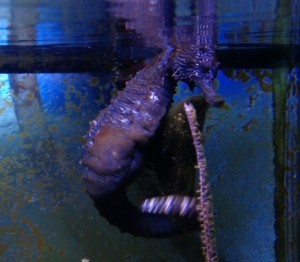
(He spent ten minutes repeating this “slip and fail” until he finally gave up and hitched elsewhere – at which point the female immediately hitched on this very spot.)
Emperor Maximus Angryfish continued his perpetual disapproval of all shenanigans – but early Saturday, he did it from the comfort of the clove polyps:
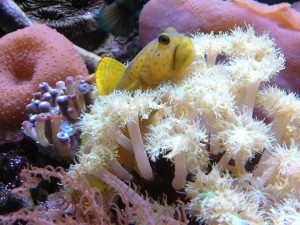
(Some mornings, it’s not worth the extra effort to leave your bed.)
The brittle stars normally hide in crevices and extend their arms to catch any food that goes by. They move to new hiding places at night, and I occasionally find one on the glass when the lights come on in the morning, but generally speaking starfish don’t leave their crevices during the day.
This little guy didn’t get the memo.

(He emerged from the rock, crossed the sand bed, climbed the entire length of the glass and took up residence in the filter intake screen. Given his size, I’m guessing he was ousted from his hiding place by a slightly larger star, though it’s still unusual that he decided to make the move in daylight.)
And finally, but certainly not least:
Sometimes when I’m trying to take a picture of the corals (or some other part of the tank) the fish get curious. The result?
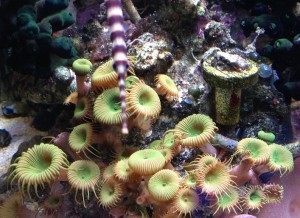
Pipefish photobomb.
What’s your favorite of the four? Let me know!
Also: Congratulations to Julianne Douglas, the winner of the PORTRAITS OF AN ARTIST giveaway! Julianne, if you’ll email me your address, I’ll send it on to Mary Burns right away!
February 11, 2013
February Observances, 2013
No clue how this month got so far advanced without me noticing, but I’m going with “deadlines can be distracting.”
There’s still time to celebrate February’s observances, though – so with no further ado, I’ll remind you that February is:
Bake for family fun month (and in some cases, fun for the fire department too!)
Pull your sofa off the wall month (one might ask why you duct-taped it there in the first place, but I digress…)
Sweet Potato Month (badly behaved potatoes need not apply)
Expect Success Month (no joke here…this one I’m actually fond of)
and, last but not least:
Pet dental health month (a good excuse not to share your cupcakes with the cat.)
Know other great observances this month? Share ‘em in the comments – I love a party!
February 7, 2013
An Interview With Mary Burns – and a Contest!
Please welcome Mary Burns, author of the new historical novel PORTRAITS OF AN ARTIST (Sand Hill Review Press, February 2013)
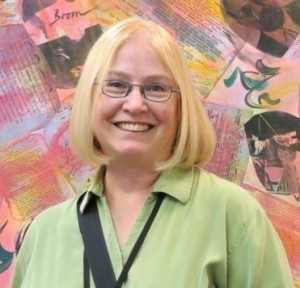
Mary F. Burns writes historical novels, is a member of and book reviewer for the Historical Novel Society and a member of the HNS Conference 2013 board of directors. Her debut historical novel J-The Woman Who Wrote the Bible was published in July 2010 by O-Books (John Hunt Publishers, UK). Ms. Burns was born in Chicago, Illinois and attended Northern Illinois University in DeKalb where she earned a BA and MA in English; she also has a law degree from Golden Gate University. She relocated to San Francisco in 1976 where she lives with her husband Stuart.
I met Mary through the Historical Novel Society and was fortunate enough to receive and read an advance review copy of her novel. I loved it (you can read my review here) and am delighted that Mary agreed to let me interview her today!
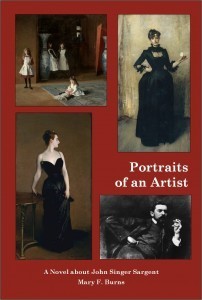
Mary is also giving away a copy of her novel to a lucky commenter! For a chance to win, leave a comment on this blog post between now and midnight Pacific Time on Monday, February 11!
And now, on with the questions!
1. Where did you grow up? Will you share a favorite story from your childhood?
I was born in Chicago and grew up in the western suburbs in LaGrange. Our house was the second one to be built on a former cornfield (that was happening a lot in the 1950’s), and there were no trees. The day after we moved in (I had just turned three), the only other house in the “Cantigny Manor” development caught fire! As it was an unincorporated area at that time, and next to a very large state-owned forest preserve, there wasn’t even a volunteer fire department nearby, and fires could easily get out of control. Luckily, all my uncles and aunts—and there were lots of them (Irish/Croatian/Polish Catholic families)—were on hand to form a bucket brigade and put out the fire. That’s pretty much my earliest memory—what a welcome to our new home!
2. What inspired you to start writing?
Reading! I became an avid reader at the age of nine, when I contracted rheumatic fever and was ordered to “stay in bed” for a whole year. My mother brought me books from the library: The Bobbsey Twins, the “Little Maida” series, all those Encyclopedia Brittanica books for kids about science and the natural world—but it was the stories I loved most. I moved on quickly to Nancy Drew, and I wrote a little diary (lost now, sadly—or not!). I wrote my first ‘novel’ in 1964 about The Beatles—even before “A Hard Day’s Night” came out, I imagined the adventures of the Fab Four as they wandered around a London I wouldn’t see for 40 years.
3. If you could go back in time and share one writing lesson with “new writer you” before starting your first manuscript … what would that be?
Figure out the Point of View first – the first novel I wrote, inspired by visiting Mendocino, a tiny seaside village in northern California, has to-date been re-written five times, each one from a different point of view. I’m now so confused about the story that I haven’t a clue as to which one works best! But I’ve learned a lot about POV since then, and I realize that it’s closely tied to what you’re actually trying to accomplish, which character has the lead voice, and how you want to involve the reader.
4. Your new novel, PORTRAITS OF AN ARTIST, explores the life (and scandals) of expatriate American painter John Singer Sargent. What inspired you to write Sargent’s story?
I saw a huge exhibit of Sargent paintings in Washington, D.C. in 1999. I was not familiar with his work. The painting that intrigued me the most was the enormous (7 x 7 foot) “Portraits d’Enfants”, also known as the “Daughters of Edward Darley Boit.” Seen in person, up close, the painting is haunting and mysterious, with heavily laid-on swashes of pure white paint that leap out of the utter darkness of shadows in the background. The oldest daughter, Florence—I was to learn all their names in time—is more in shadow than light, her face not even visible. I remember thinking, what kind of portrait is that? In fact, it wasn’t even clear that the two girls standing in the back (next to Florence is Jane) are “daughters”—they’re dressed more like servants, with the younger two girls—Mary Louisa standing with her arms “at ease” and baby Julia on the floor—looking like stiff, dressed-up dolls. I kept thinking, there’s a story here, there’s some dark, uncanny, psychological tale hidden—and exposed—by all this paint. Who was this artist, and why did he paint a portrait like this?
5. Do you have a favorite author or book? If so, who (or what) is it, and why?
I have to say Jane Austen and Henry James first and foremost—Pride and Prejudice and Portrait of a Lady, respectively. I love Austen because I can just open any one of her novels at any page and just become absorbed in her orderly, thoughtful, witty, generous society—a respite from our present age of chaos and violence. I adore James for the very complexity of his thoughts, his characters, his sentences that make you slow down and savor the flow of the idea, the turn of his phrases, his ultimate mastery of the language. And I have to add Colm Toibin’s The Master— a novel about Henry James—as a current favorite; there’s so much of James’ own style, with the added layer of modern emotion; I’ve read it four times in the last three years.
6. PORTRAITS OF AN ARTIST tells Sargent’s story through the eyes and voices of his subjects, which gives the narrative a fascinating, layered perspective. What did you find most challenging about telling a story from multiple narrative views?
As I said, Point of View has become kind of an obsession with me. I wrote the first draft of Portraits in a third person objective POV, but it came out a little dull, just sort of plodding along—this happened, and then this, and then that. I briefly tried a First Person POV with one of the major characters, Violet Paget, who was a long-time friend of Sargent’s, but then the book became all about her, which was not what I wanted. Then I wrote it with Sargent as the teller of the tale. It didn’t take very long to realize that that was very restricting, although his First Person voice brought a great deal more vivacity and immediacy to the story. It was easier to care about Sargent and what he was going through—but he had to be in every scene! I couldn’t reveal what other people thought about him, or felt about him, and that—it became clear to me—was turning out to be the essence of my book: how to understand a mostly inscrutable, intensely private person who nonetheless was a huge success in the art world of the late 19th century. It wasn’t known, but it was rumored, that he was gay—or maybe not; that he had compromised a young woman of his acquaintance, and really should marry her—or maybe not; that he’d sold his soul (and body) for the chance to paint the most famous woman in Paris—or maybe not really…. What to do?
Having written the whole book from Sargent’s POV, though, was a very fruitful exercise, as I now felt I was thoroughly in his head—I had mapped his motivations, his feelings, his responses, so I really, really knew him. I pondered the notion of having multiple First Person voices, and then it hit me: the portraits would be the characters! They would tell the story of Sargent, from their points of view—each with his or her own voice—reliable or unreliable—vain, sincere, spiteful, honest, blinded by love or lust—and from those “portraits” of Sargent by his own “portraits”, the reader would be able to hear and understand the impact that Sargent had on all those people—lovers, friends, teachers, clients, judges—and infer some sense of who the man himself had been.
And so I ended up with a novel that has fifteen first-person narrators, plus Sargent. Luckily, my publisher was as insistent as I was on using as illustrations a “headshot” of each of the portrait/characters at the beginning of the chapters in which they’re featured, along with their names. It was a challenge—but a wonderful one—to make each of their voices distinct, but I (humbly) think I met the challenge. I’ll leave it to my readers to decide.
7. Do you have a favorite scene or section from PORTRAITS OF AN ARTIST? If so, what makes that scene stand out for you?
The scene where Sargent has just about finished painting his portrait of the famous “Madame X” and realizes it is too perfect. He needs to do something to it that will make it a truly great portrait, not just a good likeness. I really got into the artistic mindset in this scene—something that’s true for all artists—writers, painters, sculptors, composers—and the aha moment that strikes like lightning and you know you’ve nailed “it”.
8. What is the last book you read, and why did you read it?
I’ve been immersing myself in two different historical mystery series: Jacqueline Winspear’s Maisie Dobbs, and Frank Tallis’s Max Lieberman Mysteries. Both of these series have been around for a while, but I just found them! The Maisie Dobbs character is so very intriguing—thoughtful, a little spooky but grounded—and the era of “between the Wars” is absolutely fascinating. In the last three months I have read all of the books in the series except the first one, which I can’t seem to find yet. As for Max Lieberman, his time period is about 30 years before Maisie, in 1906 Vienna. Max is a “consulting psychologist” to detective Oskar Reinhardt, and they form a Sherlock & Watson team of great camaraderie, intelligence and humor. Sigmund Freud and Gustav Mahler are also regular characters in the series (Freud is always telling Yiddish jokes!) Both series are excellent examples of the true historical mystery.
9. How long did it take you to write PORTRAITS OF AN ARTIST? How did you push yourself to get past difficult moments in writing and editing?
Two and a half years, what with all the re-writing. I got so many rejections from editors (I had a literary agent doing this) that it was quite discouraging. One editor said the book needed “more on-screen sex”, stating that I had perhaps captured the Victorian mind-set too well, and needed to pump it up for modern readers. (Sigh.) Another editor said it needed a strong female protagonist, as that is what sells to the largely female audience of historical fiction. It was very discouraging, and I put the book a couple of times, but my love for the characters and Sargent’s story kept me coming back to it. Eventually I found an independent publisher in my own backyard (Menlo Park) without the help of my agent, and everything just zoomed from that point on.
10. Do you have any upcoming signings or readings?
I have my Book Launch scheduled for Thursday, Feb. 21st at Bookshop West Portal in San Francisco, 7:00 pm. I’m working on other venues throughout the Spring.
And now, the speed round:
Plotter or pantser?
Definitely pantser (if by that you mean winging it as you go along?)
Coffee, tea, or bourbon?
Oh, Bourbon! (when it’s not champagne)
Socks or no socks?
Socks for sure. Always have cold feet, lol.
Cats, dogs, or reptiles?
None, though I love dogs. Too much responsibility and energy!
For dinner: Italian, Mexican, Burgers or Thai?
MEXICAN!!!! Hands down.
Thank you, Mary, for joining us today and sharing more about PORTRAITS OF AN ARTIST!
You can find Mary at her website and more information about the novel on her blog. You can also find PORTRAITS OF AN ARTIST through the publisher, Sand Hill Review Press, at the Kobo Store, on Barnes & Noble, at Amazon, and at a variety of independent booksellers.
Also, Mary has generously offered to give away a copy of the novel to one lucky commenter! For a chance to win, leave a comment on this blog post between now and midnight, Pacific time, on Monday February 11. I’ll draw a winner on Tuesday morning!
February 6, 2013
Negotiatiors, Like Flies, Prefer Honey to Vinegar
Welcome back to our continuing Wednesday #PubLaw series on negotiations.
Today we’re looking at one of my mother’s favorite sayings: “you catch more flies with honey than with vinegar.”
The phrase means exactly what it sounds like, and it applies not only to negotiation but to every part of an author’s career. Whether you’re just starting out or have “New York Times Bestselling Author” forever in front of your name, you’ll get farther in life if you treat other people with kindness.
Negotiation is no different.
After preparing your list of terms to negotiate, spend some time thinking about most polite way to make your points. By way of example:
Less Effective: “How dare you try to steal worldwide rights to my work in all forms and formats! Did you think I wouldn’t notice you trying to take advantage of me?”
More Effective: “I notice you tried to take worldwide rights to all forms and formats. I’m not giving you that. What about North American rights?”
Most Effective: “The contract specifies world rights, all forms and formats. Could you tell me about your plans for international distribution?”
Note that the “most effective” example phrases the issue as a question, not an objection. If the publisher has good plans for international distribution, you may be willing to grant the worldwide rights they seek. If the publisher has no plans (or none the representative can explain), it’s reasonable for you to counter with something like, “Since there are no plans for international distribution now, can we restrict the rights to North America? I’d like to keep the foreign rights available in case an opportunity arises.”
The keys are polite tone of voice and opening dialogue.
Hostility and declarative statements derail negotiations quickly. A friendly tone and an openness to discussion are effective – and often successful – negotiating tools.
Have you had an experience where tone (your own or someone else’s) impacted negotiations? I’d love to hear your thoughts in the comments.
February 5, 2013
Bumblebees of the Sea
I recently acquired two dozen bumblebee snails (Pusiostoma mendicaria) to supplement my reef tank’s “clean-up crew.”
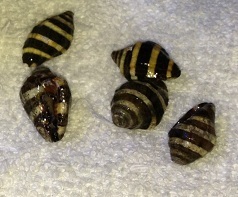
Bumblebee snails are native to the shallow, reef-filled waters of Fiji and other tropical islands. They’re small (about the size of a jelly belly) and considered “reef safe” because they don’t eat living corals or fish. Instead, these opportunistic omnivores feed mostly on detritus and “leftovers” (meaning uneaten fish food … or what it becomes a few hours later).
Like most invertebrates, the bumblebees went through a 45-minute acclimatization drip before I introduced them to the tank. This ensured that their systems had time to adjust to differences in temperature and salinity.
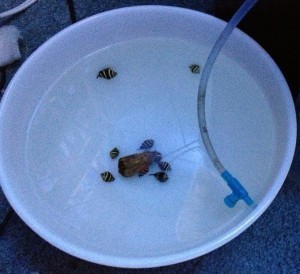
(The flexible tubing connects to my tank, and the little blue head on the end allows me to set and adjust the rate of flow. The larger shell at the center is a halloween hermit who came home the same day as the snails.)
After the drip came the drop – right into the reef, where the bumblebees quickly made themselves at home. Most have selected caves that serve as “home base” during the day. The snails venture out mostly at feeding time and at night.
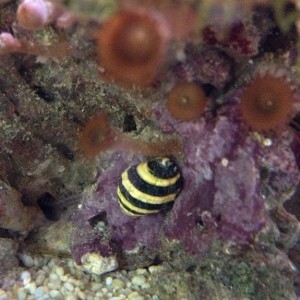
As snails go, the bumblebees are one of a few that meet with almost universal approval. Most people I know don’t normally call any kind of mollusc “cute” – but for bumblebees, I think most would make an exception.
What do you think? Are the bumblebees cute, or is a snail by another name still just a snail?
February 4, 2013
BETWEEN Contest Winners!
Thank you to everyone who entered last week’s blog and Facebook contests for a copy of Kerry Schafer’s fantastic new fantasy novel, BETWEEN. Kerry and I appreciate your support.
I’ve done random number drawings from the comments and Likes, and here are the winners!
The winner of the blog contest is Comment #6: Candie Campbell (8:13pm).
The winner of the Facebook “Like” contest is Shannon Baker.
Congratulations to the winners – if you’ll contact me by email (SusanLSpann (at) gmail (dot) com) or via a Facebook message, and give me your addresses, I’ll send your copies of BETWEEN ASAP!
I hope you enjoy the book!
February 2, 2013
An Interview With Kerry Schafer – and a Giveaway!
Please help me welcome Kerry Schafer, author of the recently-released fantasy novel BETWEEN (Ace, January 2013).

Kerry Schafer lives in Colville, Washington, with her family, which includes two cats, a rescue fish, and a preternaturally large black dog. A self-styled perpetual student, she earned an RN from Royal Alexandra Hospital in Edmonton, Alberta; a BA in English (Honours) from York University in Toronto, Ontario; and an M.Ed. in counseling psychology from Washington State University.
I met Kerry through the Debutante Ball, where she and I are members of the “Class of 2013.” We share a number of quirks, including a love for penguins and fantasy fiction, both of which feature in Kerry’s debut release, BETWEEN. (Read to the bottom to learn how to win a paperback copy of the book!)

On with the questions!
1. Where did you grow up? Will you share a favorite story from your childhood?
I was born and raised in the town of Williams Lake, British Columbia. We had 160 acres of land up on top of Fox Mountain, and my childhood was about as idyllic as it gets. In the winter we made a skating rink in the cow pasture, and there was a perfect sliding hill down to the pond. Summers we rode horses and climbed trees and went swimming and water skiing. There were a lot of chores, of course, but plenty of time to run wild and free.
2. What inspired you to start writing?
I think I just fell in love with words. From the time I learned how to read – my mom taught me, by the way – I read everything I could get my hands on. I remember there was some sort of “choose your own project” thing at school round about sixth grade, and I decided to write a book of poems.
3. If you could go back in time and share one writing lesson with “new writer you” before starting your first manuscript … what would that be?
Write every day, whether you feel like it or not. Try everything. Don’t rush into trying to get published too soon. Study structure and pacing. Take risks. And for God’s sake, don’t stop writing for years at a time because you’ve compared your writing to some genius and it doesn’t measure up.
4. Your debut novel, BETWEEN, features a protagonist who learns that the line between waking and dreams is thinner (and more malleable) than she believed. What inspired you to create a fantasy world involving dreams?
How much time do we have? The short answer is that I have a long standing fascination with dreams. Even as a small child I remember sitting in the back seat of the car during a long drive to somewhere, and wondering whether I was dreaming or awake. What if, I asked my child self, what if all of the time I think I am awake, I am really dreaming? I sort of freaked myself out with that line of thought.
5. Do you have a favorite author? If so, who and why?
Having a favorite author would be like having a favorite child. There are so many authors that I love, and for so many different reasons. I can’t pick just one.
6. Fantasy novels require substantial world-building and attention to detail. What did you find most challenging about creating the fantasy elements of BETWEEN?
BETWEEN just about broke my brain. The initial drafts contained extremely complicated alternate reality scenarios that were far beyond my ability to portray. It was Vivian who finally showed me Dreamworld, Wakeworld, and Between during a free writing exercise. I’m learning to never, ever underestimate the power of the subconscious, or what my characters know that I don’t.
7. Do you have a favorite scene in BETWEEN? If so, what makes that scene stand out for you?
There’s that favorite word again. A couple of scenes do stand out for me. I like the scene in the ER where Vivian’s reality first gets tangled with Dreamworld. And I loved writing Isobel’s scenes because it was fascinating to try to see the world through her eyes. Oh – I’d almost forgotten how much I loved writing Zee’s Dem Bones scene. I am not going to tell you what any of that is about.
8. What is the last book you read, and why did you read it?
The last book I finished was The Girl’s Guide to Love and Supper Clubs by Dana Bate. I read it because she is my Debutante Ball sister, but I loved it! Her MC has a wonderfully funny voice, there is a ton of delicious food to salivate over, and I loved the ending. Good news – her book is out in a few weeks and you can read it too!!
9. Your protagonist, Vivian, has a penguin (named Poe) as her totem animal and companion. I loved this element of the book and thought Poe added a lot to the story. What inspired you to use a penguin instead of a more “traditional” animal companion?
At the time I was writing Between, my co-worker found a penguin website that entertained us for days. This group of male Adélie penguins was rescued from an oil slick, cleaned up, and then fitted with radio transmitters. They were turned loose to swim south to the breeding grounds, and every day their relative positions were posted on a map on the website. This one penguin – Vivian by name – never did swim south. He spent some time swimming in circles, usually turning left. We made a lot of jokes about the ADHD penguin and the shiny fish. And then one morning, Vivian the Penguin began swimming north. By this time he had become an important figure in our lives, a metaphor, in fact. We used “swimming north” to mean going your own way and following your own path. And so, when I sat down to write I had a penguin on my mind.
10. Do you have any upcoming signings or readings?
I will be reading and signing at Auntie’s Books, Spokane, Washington, on February 16th. Also, I’m having a virtual launch party at Bitten by Books on January 29th.
And now, the speed round:
- Plotter or pantser?
Modified panster
- Coffee, tea, or bourbon?
Snort. You have to ask? Coffee
- Socks or no socks?
Bare feet whenever possible.
- Cats, dogs, or reptiles?
Cats. (Shhh, don’t’ tell my dogs)
- For dinner: Italian, Mexican, Burgers or Thai?
Completely dependent on mood.
Thank you, Kerry, for joining us today and sharing a little more about BETWEEN!
You can find Kerry’s website here, and you can find BETWEEN at Indiebound, Barnes & Noble, BooksaMillion, Amazon.com and a variety of local, independent booksellers.
I read and enjoyed this novel so much that I decided to buy two extra copies to give away to my readers. I’m running two separate contests this weekend: one on THIS POST and the other on my Facebook page. (And yes, you can enter both. The contests – and the drawings – are separate.)
To enter here, leave a comment on THIS POST between now and midnight on Sunday, February 3. I’ll draw a winner at random from among the comments and announce the winner next Monday here on the blog. The winner will receive one (1) paperback copy of BETWEEN!
To enter the Facebook contest, go to my Facebook page and “Like” the BETWEEN CONTEST POST before midnight on February 3. I’ll draw a winner at random from the “Likes” and announce the winner on the facebook page (and here on the blog) on Monday. The winner will receive one (1) paperback copy of BETWEEN!
February 1, 2013
The Big BETWEEN Giveaway Begins!
For the past five days, I’ve played host to Kerry Schafer’s friend the Random Penguin to celebrate the launch of Kerry’s debut fantasy novel, BETWEEN.
And I’m not the only one who’s gotten attached to the little guy. Oobie thinks he’s a hoot.
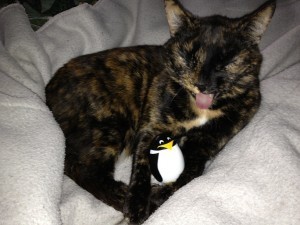
Before RP starts “swimming north” tomorrow, we’ve got two more big hurrahs in store for him. The first is a Facebook contest, which is running through midnight tonight. Here’s how you enter:
Go to my facebook page today and “Like” the contest post. It will be the one that says “BETWEEN CONTEST POST.” (Feel free to like any others you want to, but it won’t help you win the book.) At midnight on Sunday, February 3, 3013 I’ll pick a winner, who will receive one (1) paperback copy of Kerry’s novel BETWEEN. On Monday I’ll post the winner’s name on my Facebook page and here on the blog. You have to “Like” the post before midnight on January 31 to be eligible to win the contest.
The second BETWEEN giveaway happens tomorrow, here on the blog, on the post containing my interview with author Kerry Schafer. Leave a comment on the Kerry Schafer Interview blog post between tomorrow and midnight on Sunday (February 3, 2013) to enter. I’ll draw a winner Sunday night, and that winner will receive one (1) paperback copy of BETWEEN. I’ll announce the blog contest winner’s name here on the blog on Monday too.
You can enter both contests – which means TWO chances to win a paperback copy of BETWEEN!
What are you waiting for?? Get to Facebook and get liking!
January 31, 2013
A Very Random Book Signing
Most of you know that I’m hosting the Sacramento leg of the Random Penguin’s world tour to celebrate the release of Kerry Schafer’s BETWEEN.
Last night, RP hosted a launch party and signing for some local fans of Kerry’s work.
The crowd arrived on time – and it was standing room only by the time the Random Penguin took the stage.
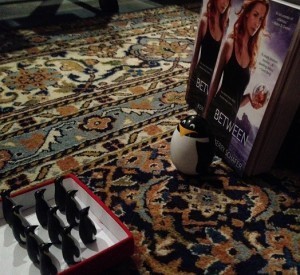
After the reading, Random Penguin spoke to a long (but well-dressed) line of faithful fans. He shook flippers and answered questions for almost an hour.
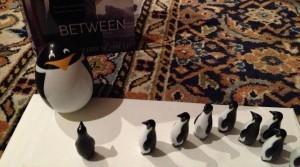
Finally, it was time to sign the books!
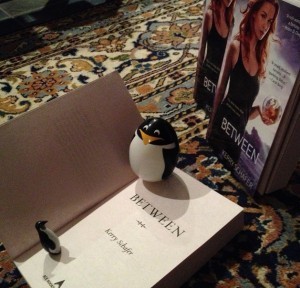
The Sacramento-area penguins have waited a very long time for a celebrity they can relate to. They were out in force last night to support the Random Penguin, and Kerry, and BETWEEN.
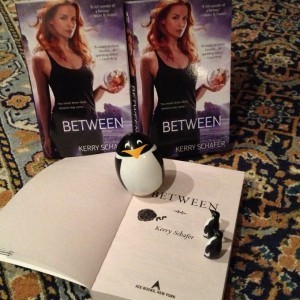
Unfortunately, most English keyboards can’t transliterate Penguish well, so you’ll have to rely on my review of BETWEEN – which I describe as a new and exciting take on fantasy fiction. (You can see the rest at the link.)
If you’d like to know even more, tune in Saturday for my interview with Kerry Schafer, author of BETWEEN, and be sure to leave a comment on the interview post – I’ll be drawing a winner from the comments on the interview post and sending that lucky person a copy of BETWEEN! I’ll also be doing a drawing on my Facebook page tomorrow, so look for it there – or stop by here tomorrow for the link!


