
Susan Spann's Blog, page 92
March 13, 2013
Copyright: A Gift That Keeps on Giving
For works created after January 1, 1978, U.S. copyright protection lasts for the life of the author plus 70 years. (Corporate copyrights and anonymous works receive protection for 95 years from publication or 120 years from creation, whichever expires first.)
This means that authors must plan for control of their copyrights after death – for published and unpublished works alike.
For this reason, all authors need an estate plan.

The good news – and also the bad news – is that you actually have an estate plan already, whether or not you’ve created one. The law of every country (and every U.S. state) provides for inheritance of property after death. Where the decedent (aka “the dead guy,” “the corpse,” or – in this case – THE AUTHOR) has a valid written will or trust, that estate plan takes precedence and the law instructs the decedent’s representative to distribute the property under the terms of the decedent’s written plan.
But if a person dies intestate (without a will or trust) the law takes care of the person’s estate then, too. The property passes to the decedent’s heirs at law, meaning the people who inherit where there is no will or trust under the “law of intestate succession.”
Bad puns and inappropriate jokes aside … this isn’t something you want to happen to you.
In most cases, your heirs at law will be your spouse, your children, your parents (if alive when you die), and/or your siblings – in that approximate order. But that’s not guaranteed. In some jurisdictions (and some cases in all jurisdictions), property escheats to the state – which means the state (or the government) inherits your property when you die.
Do you really want the government owning your copyrights?
I didn’t think so.
The take home lesson – write an estate plan now, and make sure it governs your copyrights. In the weeks to come, we’ll look at how to do that – with wills and trusts, and also how to select the heirs who will administer your copyrights after your death.
Because copyrights are a gift that keeps on giving, even after you’re gone – and you don’t want to accidentally give it away.
Have questions about copyright law? Estate plans for authors? Something else? Hop into the comments and let me know!


March 12, 2013
Happy Halloween, Hermit!
I’ve mentioned our Halloween Hermit, Lazarus (named for an almost unfortunate molting incident, during which we believed him dead) but it recently occurred to me that he deserved a post of his own – even more so now that we’ve acquired a second Halloween Hermit, Spike:

(That’s Spike at the front, trying to climb the glass, and Lazarus at the back on the left-hand side.)
The Halloween Hermit (Trizopagurus (Ciliopagurus) strigatus) - also known as the orange-legged or striped hermit – is native to the Indo-Pacific region and features the brightest coloration of any hermit commonly found in private aquariums.

The crabs get their names from their brilliant orange and black striped legs, and although they don’t mind a live snack (let the snails beware), they’re just as happy to eat “dead” foods like frozen mysis and brine.
Lazarus has already learned to grab for the seahorses’ feeding tube. If he catches it, he hangs from the end and pulls out pieces of frozen shrimp as I’m squirting them into the feeding dish.
He’s also learned to hitch a ride on snails climbing up the side of the tank – which he uses as his personal elevator to the top of the reef.
Spike and Lazarus more or less ignore one another, which I appreciate because it means I can keep them both without trouble.
They’re active (though somewhat slow and clumsy), and good at cleaning up detritus, which makes them a welcome and entertaining addition to the reef.
What do you think of the Halloween Hermit? Spooky treat or creepy beast?
March 11, 2013
An Interview With Shannon Baker
Today we welcome Shannon Baker, author of the Nora Abbott Mystery Series, which debuted this month with the release of TAINTED MOUNTAIN (Midnight Ink, March 2013).

Shannon Baker is lover of mountains, plains, oceans and rivers and can often be found traipsing around the great outdoors. Tainted Mountain, the first in her Nora Abbott Mystery Series, is set in Flagstaff, AZ, where she lived for several years and worked for The Grand Canyon Trust, a hotbed of environmentalists who, usually, don’t resort to murder. Shannon now makes her home in Boulder, CO.

Tainted Mountain (Midnight Ink), the first book in the Nora Abbott Mystery Series is a fast-paced mix of eco-terrorists, native spirituality, and murder. A young ski area owner in Flagstaff, AZ is determined to use man-made snow, an energy tycoon has his own reasons for promoting it, enviros and tribes may use any means to stop it. But the spirits of the mountain just might have the last say.
I first met Shannon at the Rocky Mountain Fiction Writers’ Colorado Gold Conference in 2010. She’s a delightful person, very approachable and great fun to know (so if you see her at a conference or a signing, be sure to say hi!), and I’m thrilled to be able to share this interview – and her book – with all my readers.
And so, on with the questions:
Where did you grow up? Will you share a favorite story from your childhood?
Assuming I have grown up… The course of my life was set early. I was the youngest of three children and eager to be included with the big kids. I’d do pretty much whatever my sibs asked me to do just to be part of the fun. I’m not saying I was abused but my mother got up from a nap one afternoon just in time to stop them from putting me in the oven. They’d convinced me to climb into a roaster pan. I do remember putting my finger on the hot stove of the “Thing Maker” because they assured me it wasn’t hot. (Do any of you remember those? Now kids have to wear knee pads and helmets to get on a tricycle, back then, they gave us hot plates to play with.) When I ran crying to my mother her response was, “It’s your own fault for being so stupid.” So yes, I am big on self-accountability.
What inspired you to start writing?
I married a rancher and moved to the most rural of isolated places in western Nebraska. It was just a little bit patriarchal out in the boonies. To help keep a little of myself for myself, I rebelled by writing. I kept it secret for a long time. Then I started publishing little pieces here and there. It was all okay, as long as writing didn’t interfere with the priorities my mother-in-law so kindly laid out for me. It wasn’t exactly like Children of the Corn. Exactly.
If you could go back in time and share one writing lesson with “new writer you” before starting your first manuscript … what would that be?
Listen you, you’re going to write a lot of crap. A lot. Get after it and do it because you have to write stuff you’ll throw away just to learn how to get better. There is no other way. Be kind to you and don’t expect to be great right away. There is no short cut. You have to write a lot of bad stuff. Don’t worry. Write it. You’ll get better as you go.
Your new novel, TAINTED MOUNTAIN, is the first in the Nora Abbott Mystery Series, set in Flagstaff, Arizona. What inspired you to write a mystery series set in the American southwest?
When I moved to Flagstaff in 2006, I learned about the controversy over Snowbowl. It is one of the oldest ski resorts in the United States, started in 1938. To augment their snow supply in the drought, they planned to make snow. But the peaks are sacred to 13 tribes who weren’t pleased about treated wastewater—potty water—being sprayed on their sacred ground. Who could resist that kind of conflict?
When I started researching I discovered the Hopi tribe. They are one of the smallest tribes and yet, they feel responsible for the balance of the whole world. There is so much in the Hopi culture that draws me in. Fascinating!
Do you have a favorite author or book? If so, who (or what) is it, and why?
I love so many writers but I always go back my earliest favorites. I love Margaret Mitchell because she gave us Scarlett. Margaret Atwood wowed me with Robber Bride and Barbara Kingsolver hooked me with Animal Dreams and Bean Trees and made me fall in love with The Poisonwood Bible. Nobody can torture a hero like Carol Berg. I just finished Stephen King’s 11/25/63… man. When I get asked this question I end up going back to the earliest favorite writers because I’m so shallow the last book I read is usually the best. In this case, Junkyard Dogs, by Craig Johnson.
TAINTED MOUNTAIN weaves Native American spiritual elements with environmental concerns, set against the backdrop of a ski resort (and, of course, a murder). What did you find most challenging about telling a story with so many different narrative elements?
The Hopi culture is extremely secretive. It is so far outside the boundaries of my middle class white experience. I can read about it and talk to Hopi people and observe, but I know that a basic perspective and understanding is missing. As much research as I can collect will not let my mind mold to differences I can’t even imagine exist.
Mari Sandoz, in her introduction to Cheyenne Autumn, talks about how Europeans perceive life in terms of time, where the Sioux experience existence in terms of where. I can acknowledge the difference and I can imagine how it might change how I think. But I can’t really understand, as much as I’d like to.
So that’s the challenge. I want to show that there is more to the world than any one culture can experience.
Do you have a favorite scene or section from TAINTED MOUNTAIN? If so, what makes that scene stand out for you?
It is one of the more quiet scenes in the book. Nora is at a Hopi corn field and she’s opening up to the more mystic flow of the book. That scene comes from a conversation I had with a Hopi farmer. This guy had a degree in Ag from NAU, but he spoke with such love for his corn. After all the time I spent in western Nebraska and knowing how scientific farming and ranching can be, I was blown away by the Hopi farmer’s relationship with the land and the elements. I never doubted him for a moment and I wanted Nora to feel that same belief.
What is the last book you read, and why did you read it?
By the time this posts I will have a few more under my belt, but I bought A Soldier of the Great War by Mark Helprin. I was forced into it because my boss said it was the best book he ever read. I ended up having to get in on CD from the library. I hated it so much. The story might have been good but he could have used half the words! Sheesh. Talk about self-induglent. It’s like reading Les Miserables and having to slog through the history of a monastery and every detail of the sewer system on Paris. I’m way too shallow and impatient for that shit.
How did you research the Native American elements appearing in TAINTED MOUNTAIN? What is your favorite part of researching unique details for your novels?
I started in the library and finding a bunch of books on Hopi. The topic intrigued me so I stopped in an art gallery in Flagstaff that featured kachinas. I got into a conversation with an adversarial Hopi proponent who gave me a reading list about Hopi. He was a white guy who married a Hopi woman and he did not want me to put out false information or be disrespectful. From there, I headed out to the rez for a couple of visits. Then I struck up a friendship with a Hopi woman I worked with at the Grand Canyon Trust, an environmental non-profit. All of this pulled me in and I couldn’t wait to write about this tiny tribe, living on isolated mesas in northern Arizona, who believe they have responsibility to keep the whole world in balance.
Do you have any upcoming signings or readings?
I’ll be celebrating the book launch in Colorado on March 16th at the Broadway Book Mall.
We’re working up a joint signing with Betsy Dornbush, Lynda Hilburn, and Julie Kazimer at the Boulder Book Store in June.
But more importantly, I know you, Susan Spann, are celebrating your own book launch of Claws of the Cat! Congratulations!
*Shannon will also be featured at The Debutante Ball blog this coming Saturday, March 16, where she’ll be giving away a copy of her book to a lucky commenter – so be sure to check out the Ball on Saturday morning for your chance to win!
And now, the speed round:
Plotter or pantser?
Plotter. (Excel spreadsheet, so sad.)
Coffee, tea, or bourbon?
Red wine
Socks or no socks?
Slippers
Cats, dogs, or reptiles?
Love dogs. Am dogless currently and feeling the emptiness. (I also love cats but I love my Dave more and he has low cat-tolerance.) But I have total aquarium envy of Susan’s sea horses.
For dinner: Italian, Mexican, Burgers or Thai?
Mexican. Mexican. Mexican.
Thank you, Shannon, for joining us today (and also for the shout out to Claws of the Cat!) – I’m thrilled that you took time out from your launch to spend a few minutes with me!
You can find TAINTED MOUNTAIN at Amazon, Barnes & Noble, Indiebound, and at your local independent bookstore, as well as directly from Midnight Ink. I’ve already bought my eBook version, and I’m looking forward to getting a hard copy signed by Shannon at Colorado Gold this September!
If you’d like to know more about Shannon or the Nora Abbott Mysteries, you can find out at Shannon’s website!
March 8, 2013
HNS 2013: for Writers, for Readers, for Florida Fun
Have you ever attended a writers’ conference? You should.

Ancient tribal societies organized gatherings, a chance for allied tribes to meet, share news, and celebrate tribal events. Writers’ conferences are analogues to tribal bonfires, a time when modern skalds and readers gather to meet and learn from one another.
I went to the Historical Novel Society’s 2011 conference as a lone-wolf historical novelist, and left a mystery writer with new friends who would soon become my critique group – and also the pillars of this author’s writing world.
Could a conference really do all that?
It could, and it did, and it can for you too.
I arrived in San Diego for HNS 2011 excited to pitch my most recent historical manuscript and nervous about talking with other authors. The first afternoon in the bookstore, I met Erika Mailman, author of The Witch’s Trinity and Woman of Ill Fame (who will be speaking at a panel on Witchcraft in Fiction at HNS 2013). Erika broke through my shyness and made me feel not only welcome but a peer – even though she was published and I was not. Two years later, we’re friends who share coffee and breakfast regularly, as well as critiquing one another’s work – but for HNS’11, I would never have known her.
After Erika boosted my confidence, I attended pitch sessions with several editors. Although the manuscript I pitched was pure historical, I’d had an idea for a mystery series set in samurai Japan. Only an idea, however, so I kept it completely secret. By chance, one of the editors I met with asked – out of the blue – if I ever wrote mysteries.
I stammered out an assent, quickly qualified by the admission that I hadn’t actually written one, but I had this idea “for a ninja detective series.”
Write it, she said, it sounds fantastic.
That’s all the encouragement I needed. The Shinobi mysteries went from inspiration to certainty in an instant.
I spent the Saturday cocktail hour meeting a group of authors I chatted with on Twitter before the conference. Heather Webb, Marci Jefferson, Sophie Perinot, Amanda Orr, Kris Waldherr, and Julianne Douglas were among the fabulous ladies I met and befriended that night. Like Erika, they didn’t seem to mind my nervousness or my slightly awkward ways – and when Heather founded a writing group a few weeks after the conference, she invited me to join (and I gladly accepted).
I went to HNS 2011 hoping to find an agent and sell my book. I didn’t do either – but the conference gave me something even better: it refocused my writing on historical mystery (where I belong!) and introduced me to friends I will have and love for the rest of my life.
Two years later, I’ll return – to HNS 2013 – as a panelist, with an agent and a debut novel 3 weeks from its hardback release.
In 2011 the HNS conference was very good to me … will 2013 be your year? Join me in Florida – let’s find out together!
March 7, 2013
Marching Through Monthly Observances (2013)
March may have a reputation for “coming in like a lion,” but this one seems to have sneaked in more like a mountain lion hunting prey than its roaring savannah cousin. Translation: I missed this post last week, but we’re catching up now!
For those who didn’t already know, March 2013 is official:
Small Press Month (We’re looking at you, Independent presses – stay strong and keep up the good work!)
Adopt a Rescued Guinea Pig Month (Maybe they need rescuing form the lions?)
Frozen Food Month (Hold on, TV Dinner, I’m gonna let you finish … but ice cream is the best frozen food OF ALL TIME.)
Exotic Winter Fruit, Leeks, & Green Onions Month (Spin the wheel of fruit!)
Caffeine Awareness Month (coffee, Coffee, COFFEE!!!)
Save Your Vision Month (my colored fonts aren’t helping.)
and,
Optimism Month (though I doubt it will ever catch on…)
Have more crazy March observances? Please share them in the comments!
March 6, 2013
Leaving A Literal Legacy
Today’s #PubLaw/Writing Wednesday is actually a re-post from last October, but I’m using it as the lead in to my new series dealing with the Legal Legacy of writing – how to deal with the fact that your copyrights outlive you.
How to to address intellectual property rights in your will or trust.
Intellectual property rights – including an author’s copyrights in his or her works – survive the author’s death. Under U.S. law, copyright lasts for the life of the author plus 70 years - the term is the same for unpublished works as it is for published ones.
Every author needs an estate plan, including a properly drafted will or trust, which addresses and disposes of copyrights held at the author’s death.
Step 1: Create an estate plan. You can do this yourself or hire an attorney to do it for you, but a good estate plan requires a writing and generally means either a will or a trust. Many states allow handwritten wills – called holographic wills – provided the will complies with certain legal requirements.
Step 2: Make sure the estate plan includes specific references to your copyrighted works. The specific language may vary, but you need a provision bequeathing all of your intellectual property rights (“including without limitation all copyrights and copyrighted works”) to the person you want to own those rights after your death.
You can grant the rights as a unit or split them up – to one person or to several. The choice is yours. Just remember: anything you don’t grant specifically will pass by operation of law to the person who receives the “residuary” or remainder of your estate.
Step 3: Include language authorizing your executor (or trustee) to execute any necessary assignments of rights to ensure your heirs have documented rights to control your copyrights. Although the law of most states grants executors this right by default, it’s easier (and faster) if your estate plan is specific on this point.
Step 4: Assemble a list of all your copyrighted works and contact information for publishers, agents, etc. You may know who published your novels, or (for independent authors) where they’re currently offered for sale – but your heirs won’t necessarily know where to look for that information. Keep lists of all your copyrights and important contacts with your estate plan.
And remember: If you have no written estate plan, everything passes to your legal heirs – usually either your spouse, your children or your parents and siblings, depending on the state. Don’t take the risk of your copyrights falling into the wrong hands. Create an estate plan, make lists, and keep everything together so your heirs don’t have to look for it after you’re gone.
A little extra work today can translate to benefits – and peace of mind – later on.
In the weeks to come, we’ll break down these ideas in more detail, to help authors organize the intellectual property parts of the estate planning process.
Do you have an estate plan? Does it mention your copyrights? Do you have any other questions about copyright law and publishing? Click into the comments and let me know!
March 5, 2013
My Favorite Faviids
Although the members of family Faviidae make up the second largest group of stony corals, few people outside the aquarium hobby (and SCUBA divers) recognize them on sight.
Brain corals are faviids, as are many other, less quickly recognized species. They tend to be colorful, slow-growing, and fairly easy to raise in captivity (under proper conditions) which makes them ideal specimens for reefkeepers like me. Beaked fish, like triggers and parrotfish, frequently chew on stony corals, but since my aquarium hosts no coral eating species, I can indulge in a faviid or two.
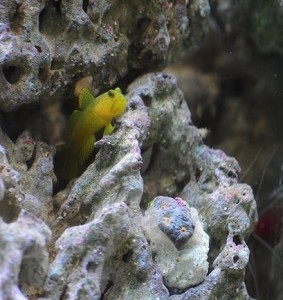
One of my very first corals was a faviid (the species’s common name is “Pot of Gold”). Rare faviids can be expensive, so I bought only four “heads” (the faviid is the bluish/pink splotch below and to the right of Max):
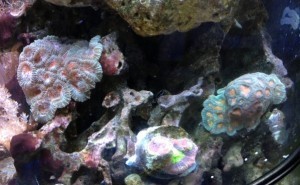
Two years later, the colony has grown substantially larger (it’s the one on the right in the photo below), and shares its rock with two other faviids. The purple and chartreuse beauty in the center is “Dragon’s Revenge” and the blue and red one to its leftone of my favorites – but I can’t remember its name!
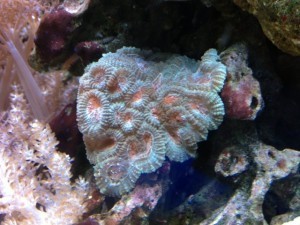
Here’s a closer shot of the blue and red:
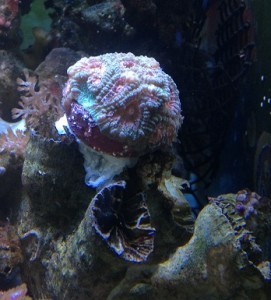
Last weekend I noticed a beautiful new faviid colony at Your Reef (the local reef store where I buy all my corals and fish). The coloring reminded me of a watermelon, greenish around the colony walls and pink in the center (where the coral’s mouths are located). As it turned out, the store’s owner had never seen the species before either – but he sold it to me on the condition that I bring him back a “frag” (the term for a piece of a colony) when it had grown out enough to split.
I gladly agreed, and now I have a new favorite faviid:
My tank may be getting crowded, but there’s always room for something new and special on the reef!
What’s your favorite coral? Did you know about faviids? Would it surprise you to know that the skeleton underneath those colorful mouths is actually hard and razor-sharp – capable of cutting a diver’s hand like a razor?
March 4, 2013
An Interview With Nancy Bilyeau
Please help me welcome Nancy Bilyeau, author of the upcoming historical thriller THE CHALICE (Simon & Schuster, March 5, 2013). I’m delighted that Nancy could join us the day before her release!

Nancy Bilyeau is a novelist and magazine editor who has worked at Rolling Stone, InStyle, Good Housekeeping and, presently, DuJour magazine. It took her five years to research and write her debut novel, “The Crown.” She now lives with her husband and two children in New York City.
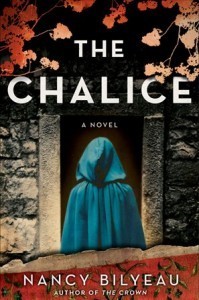
“An intriguing and suspenseful historical novel”–Booklist
1. Where did you grow up? Will you share a favorite story from your childhood?
I was born in Chicago; we moved to Michigan when I was eight years old, to Dearborn and then Livonia, and I ended up going to the University of Michigan. We called it “Michigan squared.”
In the summer our whole family, and our aunts and uncles and cousins, would go to “Camp Dearborn,” which was the farthest thing imaginable from what most people would think of as camp today, particularly on the East Coast. First off, it was only about a half-hour drive from Dearborn, which is a suburb of Detroit. Then each family would rent a standing tent, and the tents were inches away from one another. A loudspeaker sounded very early in the morning and you had to report to the calisthenics area. We all did jumping jacks to a recording called “Chicken Fat.” I still remember the voice bellowing: “Give that chicken fat back to the chicken!” Then during the day, we went to the lake beach and out on the paddleboat. At night there were canteen dances and I remember very clearly watching my beautiful older cousin Nannette curl her hair with huge pink plastic curlers to get ready for the dance. The younger crowd, it was our mission to watch her dance with her friends—and maybe boys!—while undiscovered. We weren’t even supposed to go to the dance. It was a spy mission! Those were wonderful memories.
2. What inspired you to start writing?
I wanted to be a writer from the time I was in the third grade. But it receded for a while; in high school I was in the school plays and wanted to be an actress. Ha. After college I worked in the magazine business, and was focused on that. It was after I had my son, now 14, that I felt this hunger to tell my own stories, to move into fiction.
3. If you could go back in time and share one writing lesson with “new writer you” before starting your first manuscript … what would that be?
Don’t think about giving up! Have confidence that if you keep learning and workshopping your prose will get to where you want it to be.
4. Your new novel, THE CHALICE, is a stand-alone story which continues the adventures of Joanna Stafford (the brave English novice readers met in your previous novel, THE CROWN) who finds herself embroiled in solving a mystery which could save – or destroy – both Henry VIII and Christendom itself. When did you realize that THE CROWN would have a sequel, and can readers expect more novels about Joanna?
I wanted to write a series of books on Joanna Stafford from the very beginning. I love writing this character and can envision all sorts of challenges and dramas and mysteries for her, interwoven with what was really going on in Tudor England.
5. Do you have a favorite author, book, or genre? If so, who (or what) is it, and why?
My favorite authors are the ones I fell in love with when young. Willa Cather says that what you read and who you are from 11 to 15 has the most influence on a writer’s life. That’s when I read historical fiction: inhaled it, really. Everyone from Jean Plaidy to Mary Stewart. But my favorite was Norah Lofts—in fact, I named my daugher Nora. She’s such an insightful writer with an amazing feel for character and description and pace. And she has a cool, sophisticated, nearly debauched view on human sexuality, which you glimpse every now and then. Very discreet.
6. Joanna Stafford, your protagonist, is a nun – in a time when Henry VIII was shutting down monasteries and abbeys after his confrontation with the Catholic church. What inspired you to write from such a unique (and historically significant) point of view?
My first choice was to write a book set in the 16th century because it is my favorite. Then it was a question of what kind of main character? I wanted to write a woman but someone different. I came upon a nun, and thought, “But I don’t know anything about nuns, particular Tudor nuns.” And then: “Well, I will find out.” I ended up learning so much, I developed tremendous sympathy for the women in the priories. And I have a friend who is a Dominican nun today, in an enclosed order. I can visit her in a special room.
7. Do you have a favorite scene or section from THE CROWN? If so (and if you can tell us about it without revealing any spoilers!), what makes that scene stand out for you?
I’m fond of my first few chapters, when Joanna has left the priory without permission to reach Smithfield, for the burning. But my favorite section in The Crown is much later on, when Joanna and Brother Edmund, who are trying to solve the mystery of the book, come to the house of the Howards in Southwark, and they are there to look at a tapestry. They’re “incognito,” they are not wearing their habits. But on that day the Earl of Surrey is holding a masque and everyone has to wear a costume: it’s a party of monastic costumes. You must be a nun, friar, monk. To find the tapestry, they have to sneak into the party, wearing a “costume” that is close to who they really are. The suspense is tight in this scene, and lots of surprises. Joanna has to use her brains to get out of a dangerous situation. But I so enjoyed playing with disguise and identity. Also that section was not outlined or planned. It exploded, fully formed, while I was writing. I am so grateful when inspiration strikes.
8. What is the last book you read, and why did you choose to read it?
I read Ariana Franklin’s last book, “A Murderous Procession.” I read all of her books after I finished “The Chalice.” I didn’t want to be influenced by her series on the 12th century woman who “listens the the dead,” Adelia. I’d heard the books were wonderful—and they were. The last one was hard to read because I knew Diana Norman, the author’s real name, had died, and I didn’t want the series to end.
9. How did you push yourself to get past difficult moments in writing and editing THE CHALICE? Do you have a favorite place to write or to edit your work?
I take long walks listening to music, that helps me through the stressful patches. I wrote the first book on my kitchen table or at Starbucks. The second one, I wrote it at the New York Public Library, I was admitted to a writer’s room. But my favorite writing day was taking my laptop to the Cloisters Museum of the Metropolitan Museum of Art and writing a frightening scene in one of the re-created rooms of a medieval priory, tapping away in the dark corner as long as the battery lasted. The guard didn’t love it, but he let me finish.
10. Do you have any upcoming signings or readings?
“Literary New England Radio Show,” blog talk radio, I’m on the same bill with Richard Russo and Raine Miller; 8 pm Monday 3/4/13. Click here for more details!
Mysterious Bookshop, Wednesday, March 6th. 7 pm. 58 Warren Street. (Reading and signing.)
And now, the speed round:
Plotter or pantser?
I’m more of a pantser than most thriller writers, who don’t sit down to write until they have detailed outlines worked out. I like to let surprises happen as I go.
Coffee, tea, or bourbon?
I depend on coffee AND tea. In large quantities. Not a big bourbon drinker—if I ever make it to the Kentucky Derby, I will drink bourbon there.
Socks or no socks?
SOCKS. No one should have to look at my feet.
Cats, dogs, or reptiles?
DOGS! I like big, sloppy, friendly canines.
For dinner: Italian, Mexican, Burgers or Thai?
ITALIAN. I make a fantastic chicken cacciatore.
Thank you, Nancy, for taking the time to join us on the day before your release! It’s fantastic to learn more about you and about THE CHALICE!
If you’d like to learn more about Nancy and her novels, check out her website or find her on Twitter (@Tudorscribe) or Facebook. You can find THE CHALICE for sale online, in chain and independent bookstores , in ebook format – and wherever books are sold!
February 28, 2013
Do You Know About Genpuku?
Genpuku is (or, more properly, was) a traditional Japanese coming-of-age ceremony for male members of the samurai class.
The timing of the ceremony varied, at the discretion of a samurai boy’s father or the male relative in charge of his training, but it typically took place when a boy was between the ages of 12 and 17. When a samurai youth had attained the requisite skills and maturity to accept the responsibilities of adulthood, he was taken to the shrine of his family’s patron kami (a Japanese term for gods or divinities) where the ceremony was performed.
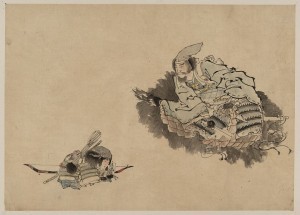
After genpuku, a boy was allowed to wear the clothing, hairstyle, and swords of an adult samurai. His family also gave him an adult name, which he would use for the rest of his life.
In modern Japan, genpuku has been replaced by other forms of coming-of-age rituals, some of which take place in high school and others around the age of 20. These modern rituals focus on the declaration of goals and assumption of adult responsibilities, though they lack the deadly significance of the earlier form.
Once a samurai youth completed genpuku he was an adult for all purposes – not only work and marriage, but also war.
*Image of elder samurai observing younger samurai obtained from the free collection, U.S. Library of Congress, no known use restrictions.
Are you familiar with other coming of age ceremonies, in Japan or elsewhere? Which do you find most interesting? I’d love to hear in the comments!
February 27, 2013
The Publishing Timeline: Submission to Contract Signing
This week, we’re wrapping up our Wednesday series on negotiation with a look at the publishing contract timeline.
Many authors assume that once a publisher offers a deal, everything happens at once. Contracts are signed. Money is paid. Books are published. Authors rejoice!
Not so fast, there, partner.
Traditional publishing takes time, and contracts are no exception. The time from offer to contract signing is usually measured in months, not days.The submission and contract process for traditional publication works like this:
Step 1: Submission. The author (or the author’s agent) submits a query or a proposal to an editor at the publishing house. If the editor likes the proposal (s)he will request the full manuscript. The time between query and request can range from days to a couple of months, and review of the author’s full manuscript often takes longer. Average time on submission: 2-12 months.

Step 2: Offer. The publisher (usually working through the editor who will work with the book) contacts the author or the author’s agent to offer a deal. The parties will discuss the major deal points (advances, expected formats, possibility of a series, etc.) and – hopefully – reach an agreement. Average time in negotiation: 1-7 days.
Step 3: Contract. The publisher (working through its contract attorneys) prepares a draft of the publishing contract and sends it to the author (or his or her representative) for review. Preparation of contracts doesn’t happen overnight. Small presses tend to move more quickly than large ones, but authors often find themselves nervously waiting, hoping the publisher hasn’t changed its mind. Average time between deal point agreement and contract receipt: 1-4 MONTHS. (You read that right – months – especially if the publisher is currently revising its standard contract terms.)
Step 4: Negotiations. The author (with the help of an agent or an attorney) reviews the contract and negotiates any desired points or issues. This may involve telephone calls or email exchanges, as well as revisions to the contract. Average time for negotiations: 1-4 weeks.

Step 5: Success! Once the negotiations conclude, the parties can sign the contract and proceed with the publishing process.
When it comes to timing, “your mileage may vary” but the process always involves these same five steps. Independent authors who submit their work to traditional publishing houses will have a similar experience, though those who self-publish will negotiate (or at least review) their contracts without the lengthy submission times. Some view this as an advantage, but the reality is that independent authors who publish through Amazon or similar online services have far less room to negotiate contract terms – essentially trading speed for lack of control. That isn’t always a bad thing, though.
Like everything else, the publishing timeline is merely one more factor an author needs to consider when choosing a publishing path.
Have you been through the contract process? What was the timeline like for you? If not … does it surprise you to learn how long the process can take?


