L.Z. Marie's Blog, page 13
November 29, 2013
Light & Dark
 These two little words are fraught with BIG symbolic meaning!
We are familiar with the obvious uses: The Light of knowledge or the Darkness of the Soul, but writers can use darkness and light in a myriad of ways!
Light or enlightenment can refer to:
goodness
understanding or knowledge: from the prosaic to the sublime
divinity/cosmic power
morality
truth
vitality/youth
innocence
spirituality
an attitude, emotion, or personality unencumbered with worries
imagination/creativity/inspiration
joy
Darkness can refer to:
evil
corruption/degradation/baseness
netherworld/underworld
lies/falseness
guilt /sin
ignorance, in all its many forms
mystery
fear
an attitude, emotion, or personalty fraught with melancholy or ill will
grief
tainted or impure thoughts
Light and dark symbolism can:
describe a character’s mood or personality
foreshadow a character’s intent
foreshadow an event
indicate a setting’s moral/ethical beliefs
reveal irony
provide (moral/ethical/religious) contrast between opposing characters/themes/events
be a plot device
be a symbol
be a theme
be a recurring motif
Here’s one of my favorite poems about “light.”
The Man Who Spilled Light, by David Wagoner
The man who spilled light wasn’t to much to blame for it.
He was in a hurry to bring it home to the city
Where, everyone said, there was too much darkness:
“Look at those shadows, they said. “They’re dangerous.
Who’s there? What’s that?” and crouching,
“Who are you?”
So he went and scraped up all the light he could find.
But it was too much to handle and started spilling:
Flakes and star-marks, shafts of it splitting
To ring-light and light gone slack or jagged,
Clouds folded inside out, whole pools
And hummocks and domes of light,
Egg-light light tied in knots or peeled in swatches,
Daylight as jumbled as jackstraws falling.
Then everything seemed perfectly obvious
Wherever they looked. There was nothing
they couldn’t see.
The corners and alleys all looked empty,
And no one could think of anything terrible
Except behind their backs, so the all lined up
With their backs to walls and felt perfectly fine.
And the man who’d spilled it felt fine for a while,
But then he noticed people squinting.
They should have been looking at everything,
and everything
Should have been perfectly clear, and everyone
Should have seemed perfectly brilliant, there was
so much
Dazzle: people were dazzled, they were dazzling.
But they were squinting, trying to make darkness
All over again in the cracks between their eyelids.
So he swept up all the broken light
For pity’s sake and put it back where it came from.
Have fun writing light and dark into your novel!
Related Links: Rock Your Writing


November 25, 2013
Word Magic
 Agents and folks in the writing/publishing biz tell wanna-be authors to learn their craft, to learn the magic of words, plot, and voice!
They also suggest reading lots of books in your genre. Well, I can tell you there’s a VAST Grand Canyon-size difference between just reading a novel AND breaking it down to understand the nuances employed by the author to create tone, imagery, allusion, irony, motif and symbol.
Below is an example from Fahrenheit 451 by Ray Bradbury.
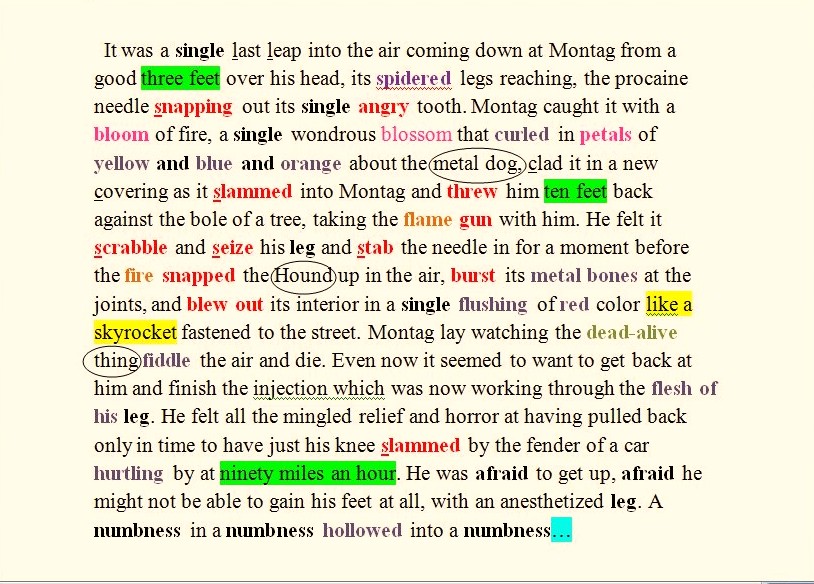
Let’s break it down!
Red font indicates words with a violent connotation or violent diction. Most of them begin with “s.”
Bolded words have been repeated. (3xs makes it a motif). single=4x; leg=3xs; afraid=2x; numbness=3x. The word “single” emphasizes Montag’s one chance to escape.. his life–his freedom–boiling down to this one critical moment in time. It’s now or never! He only gets one shot at changing his life!
Green highlights indicate numerical specificity. Used here, we see exactly how far and how fast.
Pink font are words related to flowers! How fabulous that Bradbury uses the language of flowers to describe fire in a violent scene! Why does he do that? Is it to show readers the character’s “blossoming” intellectual awakening? Is it to reveal the beauty in destroying a mechanism of the dystopia? Is it put in stark contrast natural growth vs natural destruction OR nature vs machine?
Purple font are words that are rife with imagery: spidered, curled, metal bones, flushing, hurtling, fiddle, hallowed—we “see” these words. >>>>Did you notice all the colors used in the paragraph?
Yellow highlight is a wonderful simile with symbolic, foreshadowing, and visual ZING! >>>>The skyrocket might symbolize 1) Montag’s own intelligence being grounded by the dystopia; 2) the new light of understanding sizzling within him; 3) the ironic & fiery beauty of destroying an intellectually crippling society. >>>>The skyrocket also foreshadows the bombs that will destroy the city in the next chapter.
Circled words show the symbolic progression of the mechanical police dog, known as the Hound! Notice the progression from metal dog (a living beast) to Hound (its official name) to thing! Brilliant! The mechanism no longer has power over Montag–and it also foreshadows and mimics the collapse of the dystopia.
Pale green font indicates a oxymoron, Dead alive. (A symbolic punch, folks, and accurate descriptor for most of the characters in the novel.)
Blue highlight brings to light the fabulous use of ellipses! In this case, a sense of the uncertainty… of time passing…what will Montag do next…an example of his own mental numbness…
Did I forget anything??
Word magic! Gotta love it!
And that, I think, is just part of knowing your craft!
~~~**~~~**~~~**Have fun writing word magic**~~~**~~~**~~~
Related Links: Rock Your Writing
November 21, 2013
Imagery
 WE love movies because we can SEE the action and HEAR voices. And until theaters have surround Smell & Touch—as Aldous Huxley wrote about in Brave New World—the WRITTEN word still has the advantage!
In literary terms, IMAGERY is a picture made from words. (Writers, this might be a source of pleasure & joy or frustration & agony). The beauty of imagery is that it creates tone and mood. One can describe creepy things using dark, gloomy words OR NOT.
Don’t forget to include imagery (SHOW, don’t tell) in your work.
Types of Imagery:
auditory (sound): Is it loud, strident, a cacophony, a symphony? Sometime using a simile helps. It sounded like _______. Similes can get old fast, though. Can you turn the noun into an adjective? I once listened to a South American howler monkey call 20 times on youtube before I could describe its unique vocalizations.
EX: Overlaying all this, a soundtrack:choo-k-choo-k-choo-k-choo-k-choo-k–the metronomic rhythm of an Amtrak train rolling down the line to California, a sound that called to mind an old camera reel moving frames of images along a linear track, telling a story.
visual (sight): Too often I see new writers use words like “amazing” or “spectacular” to describe a view. Those words do not help the read see the amazingness!
EX: ”…or the life of him, he couldn’t figure why these East Enders called themselves black. He kept looking and looking, and the colors he found were gingersnap and light fudge and dark fudge and acorn and butter rum and cinnamon and burnt orange. But never licorice, which, to him, was real black.”
tactile (touch): There’s lots of great sites and lists for “touch” imagery. Even a Thesaurus search yields results. Stay away from the banal—a word like rough is vague. There’s 2-day old facial hair rough, sandpaper rough, stucco rough, tree bark rough….
thermal (hot/cold):Remember, heat and cold are connected to emotions. One can be “hot” with passionate or “hot with anger. A person may have a “cold” unemotional personality OR their “cold” actions may reveal cruel intentions.
olfactory (smell): I sniff my spice rack often to get handle on a fragrance I want to portray.
gustatory (taste): It tasted yummy? Oh, please! Use descriptors to bring the flavor & texture of the food to your readers. Have you ever read a novel where you are hungry for the food/drink consumed by the characters? If I’m reading an English novel, I eschew coffee for tea!
EX: ”Tumbling through the ocean water after being overtaken by the monstrous wave, Mark unintentionally took a gulp of the briny, bitter mass, causing him to cough and gag.”
kinesthetic (sensation of movement):“At last, swooping at a street corner by a fountain, one of its wheels came to a sickening little jolt, and there was a loud city from a number of voices, and the horses reared and plunged.”
Organic: Describes feelings, emotions, and intent.
When does one add in imagery? There’s no rule. I add inmagery in the second draft, tweak & fine tune the diction in a 3rd draft–and sometimes toss some of it in a 4th draft because it was unnecessary.
Note: I use a lot of imagery in The Merkabah Series because the protagonist is an empath who is profoundly impacted by senses.
Let’s take a look at two of the masters!
The opening paragraph of Fahrenheit 451 by Ray Bradbury
It was a pleasure to burn. It was as pecial pleasure to see things eaten, to see things blackened and changed. With the nozzle in his fists, with this great python spitting its venomous kerosene upon the world, the blood pounded in his head, and his his hands were the hands of some amazing conductor playing all the symphonies of blazing and burning it bring down the tatters and charcoal ruins of of history. With his symbolic helmet numbered 451 on his solid head, and his eyes all orange flame with the thought of what came next, he flicked the igniter and the house jumped up in a gorging fire that burned the eveningsky red and yellow and black. He strode in a swarm of fireflies. He wanted above all, like the old joke, to shove a marshmallow on a stick in the furnace, while the flapping pigion-winged books died on the porch and lawn of the house. While the boks went up in sparkling whirls and blew away on a wind turned dark with burning.
Here’s another from Paradise of the Blind by Duong Thu Huong:
The song echoed blue and icy through our space. Outside, the sun shone, but here, I could feel the chill of exile under my skin, in my bones. The song resonated like the thinnest thread of silver lost in the blue of the sky. I followed it and felt myself pulled back to the edge of the earth, to a familiar river and beach of blinding white sand. A ripped sail tossed amid the waves, buffeted by the sharp, anguished cries of migratory birds as they prepared for flight.
Have fun getting your readers to SEE, HEAR, TOUCH, FEEL, SMELL your world!
Related Links: Rock Your Writing

November 18, 2013
Homeric Values
 What can we learn about age-old struggles or heroes from Homer? No, not Homer Simpson, Homer, author of the Greek epics ( short for really-really -really long) poem, The Iliad and The Odyssey.
Skip the next several sentences if you remember reading these.
A SUPER quick refresher: The Iliad is about the 10-yr siege of Troy, and the quarrels & battles between King Agamemnon and Achilles. Remember the movie Troy with Brad Pitt? That was the Hollywood version.
The Odyssey is about the warrior King Odysseus (aka Ulysses) as he struggles for 10 years to return home to his wife and son. There was Hollywood version with Armand Assante.
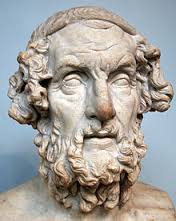 So, what does Homer teach us about struggles and heroes? Let’s take a look at the Trojan prince and greatest warrior in Troy–Hector.
Hector (by the way, his means “defend, or hold fast”):
displayed physical prowess and manliness—arête–courage, bravery, battle-skilled…you know manly attributes.
was honorable. He was esteemed by other warriors and the “little people.”
had minions at his disposal.( The more minions the more power.)
excelled and was better than everyone else.
strove to protect his family, friends, and property.
strove to protect his reputation.
Homeric Heroes are bit different than today’s heroes.
But first, let’s see how they are the same as today’s heroes. They:
show concern for others or their inferiors.
care for the welfare of others.
do not want the ”little people” to suffer needlessly.
are sympathetic to helpless or less fortunate.
do not expect or want praise for the above virtues.
Homeric heroes:
are born into wealth and nobility
possess physical strength and courage
The difference between a Homeric hero and just any average run-of-the-mill hero is that the Homeric hero puts HONOR above all else. A Homeric hero never sacrifices his reputation; for to do so relinquishes his dignity and his effectiveness. No honor = no hero.
Protecting or maintaining one’s honor comes before protecting one’s family. A Homeric conundrum might be: Security & contentment vs honor.
Not exactly a modern day dilemma, where personal happiness and love reigns supreme.
There are 4 great struggles found in Homer’s novels.
•The need to protect one’s family (as found in Hector’s trials in The Iliad)
•The need to maintain ones’ dignity ( Achilles’ struggles in The Iliad)
•The determination to remain faithful and have faith (displayed most ardently by wife Penelope in The Odyssey who faithfully awaits Odysseus’ return for 10 years)
•The struggle to return home (Odysseus took the long route back from Troy)
What Homeric elements does your novel have?
Related Links: Rock Your Writing
FYI: In conjunction with two 5-star novel reviews & an author interview, you can download The Merkbah Recruit FREE on Amazon &
get the 2nd in the series, The Merkabah Deception for 1/2 off!
Click HERE for the link to the EbookEscapes interview and review.
Click HERE for Amazon link.
November 14, 2013
Seasons in Literature
 There is a season…write, write, write—what? That’s not the song’s lyrics?
Before you write that plot, stop and think about season! ( Even Southern California has seasons–sort of).
The symbolism found in seasons has deep roots in literature…and life! That’s because seasons really mattered in ancient times. Agrarian societies depended on seasons ( and weather) to plow, grow, and harvest food. Agriculture united peoples, tribes, and groups. It was a means of achieving wealth. Food is life! So, naturally, seasons, because they are tied to farming and thus food and thus life, were fraught with all kinds of symbolic meanings.
Here’s a few seasonal considerations:
Spring: The cycle of life is beginning
Youth & childhood.
Folks are hopeful, fresh, and anticipatory.
New life emerges from plants. Rain nourishes new life.
Buds, flowers, birds, butterflies, sunshine…all good.
Folks sow seeds.
Think: A fresh start. A new beginning. Rebirth. Resurrection ( Easter)
Summer: Life is in full swing.
Young adulthood
Energy & vitality is abundant.
Romance and passion sizzle during summer’s hot months.
Think: Grease, “summer lovin’ happened so fast..”
Food is plentiful. There are vegetables to harvest and fruit hanging from trees.
In The Great Gatsby, on the longest day of the year and in sweltering heat, love, lust, and passion fare up. Thus,
With increased temperature brings “heated” arguments and boiling tempers.
Love and anger are both “hot” emotions.
Fall: Life is reaped and winding down.
middle age.
Folks are fatigued from the harvest or age.
Harvest is associated with abundance and prosperity.
Folks give thanks to their god/gods for a plentiful harvest
Gratitude for good harvests result in sharing & celebratory feasts.
A time to count one’s blessings.
Winter: Life is dormant or dead.
Old age & death
Often equated with anger, resentment, discontent, or hatred. These emotions are equated with “coldness.” NOTE: Anger can be either hot or cold. Is the person hot-headed, or cold-blooded? The anger differs in intensity and outward appearance.
Worry and anxiety is another emotion associated with this season, because food had to last through the winter. Religious holidays brought joy to the cold dreary days of winter.
There’s a great final scene in the movie version of Phantom of the Opera. The old man places a toy on his beloved dead wife’s grave. There, in the dismal gray setting and in white snow, lies the Phantom’s red rose! A vivid contrast and reminder of passions long ago. The scene would not have been the same had it been any other season.
Season can:
be a plot device
be ironic ( a couple finds love in the dead of winter only to break up in the summer)
be symbolic of a character’s personality; character’s relationship; a theme; a tone; and/or reveal emotions
foreshadow an event, problem, change in relationship
be thematic
be a pattern or mirror someone’s life or plot line.
How effectively are you using season in your novel?
Have fun writing your novel!
By the way, Ceres, goddess of the Harvest, is holding wheat in the picture!
Related Links: Rock Your Writing
November 10, 2013
Themes for Novels
 You wrote a novel! Yeah! Now you have to pitch your fab story to an agent and/or write the dreaded query. In addition to crafting the one-line “elevator” pitch, it is also important to convey the essence or theme of your story.
A theme is the recurring focus or topic evident in your novel or short story. Themes are the basic, central, integral, and often universal ideas explored in a literary work. Most novels have several themes.
Quick story: Me, at a conference, making writer small talk.
Me: What’s the theme of your novel?
Man: It’s a murder mystery.
Me: That’s a genre. What’s the theme…um… what’s the story about?
Man: Love
Me: Love is a subject, not a theme. What point are you making about love?
Man: Everybody needs love.
Me: That’s a statement. The importance of love would be a theme.
Man: What’s your point?
Me: it might help to know the theme before you pitch the agents.
Man: Whatever, lady.
Theme is not explained in ONE WORD. Revenge. Loss. Betrayal. Atonement—those are subjects—and a good place to start.
Themes straddle the line between specificity and vagueness. Fun, right?
Below is a theme primer. It’s a list of abstract concepts designed to help articulate theme. This is not a conclusive list, but merely a springboard of concepts and topics to get you started.
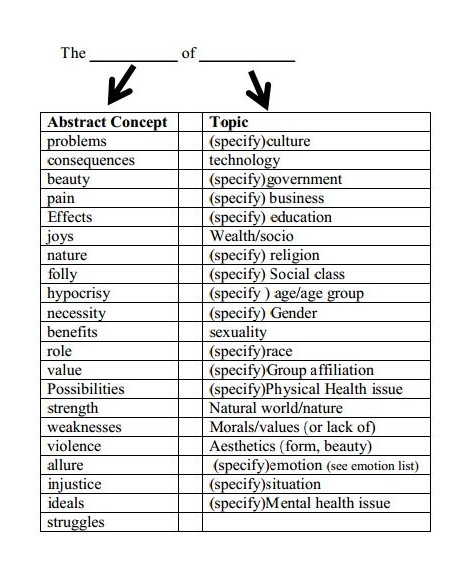
A few examples from literature.
Brave New World: The incompatibility of happiness and truth
Fahrenheit 451: Consequences of an entertainment-driven society
Huck Finn: Hypocrisy of civilized society
The Great Gatsby: Moral depravity of upper class
A Midsummer Night’s Dream: The folly of young love
Here’s a few themes from my own novels:
The Merkabah Series:
Mysteries of a multi-dimensional universe
Commonalities behind ancient mythologies
and from my work-in-progress, The Emperor’s Assassin:
The power of love
The importance of friendship
The gift of redemption
Have fun writing your theme!
Related Links: Rock Your Writing
November 6, 2013
Sex in Literature
 Intercourse. Coupling. Hanky panky. Horizontal mambo. Lovemaking. Copulation. Fornication. Coitus. Carnal Knowledge. To know. Relations.
That’s a small sampling of synonyms–each eliciting a different reaction by virtue of its connotation. Well…as you can imagine, there are just as many reasons WHY sex scenes are included in a novel!
Writing a sex scene is tricky. Warning: This is a PG blog–NO X-rated language here. There’s a wide range of spice levels–from G-rated to X-rated, and so you must ask yourself ( either as writer or reader):
WHY is the sex scene there? Is it advancing the plot? And HOW is it advancing the plot? Is it gratuitous? ( erotica) OR…
Is the sex scene about something other than sex? Is the sex scene, in fact, a metaphor or symbol of a character’s emotional growth or downfall? Is the sex scene a symbol for the characters’ relationship? Is it thematic?
Sex can:
reveal emotional/societal/cultural/gender relationships between characters
foreshadow a change in a relationship
reveal a character’s emotional state. This is a biggie.
be a plot device
>>>Is sex a metaphor for a character’s (finally) allowing themselves emotional/physical pleasure OR does their non-pleasure of the act symbolic of their inability to be intimate or “let go.” Is the character using sex for selfish purposes? In the novel Effi Briest, the married protagonist, has an affair with a married man because she’s bored!
>>>Is the character sacrificing themselves sexually for a cause/purpose–be it honorable or not? In Kafka on the Shore, the protagonist uses sex as a way of sacrificing himself to fulfill a bizarre prophesy.
>>>Is the character using sex to rebel against cultural/family/gender/societal/ expectations or rules? If the act is especially taboo, what is the character’s motivation or reason?
>>>Is sex symbolic of the character’s resigned attitude toward a cultural/family/gender/societal expectation? In The Space Between Us a character from a lower caste has sex with her higher caste employer. She has no choice but to submit to his demands knowing she would be fired for non-compliance.
>>>Is the character the aggressor? passive? the instigator? innocent? experienced? Is the sex act a metaphor for who’s in control? Once again, in Effi Briest, the protagonist is very much the naive innocent who is overcome by the attentions of a notorious flirt.
>>>Is the sex symbolic for their spiritual/emotional enlightenment?
>>>Is sex an act of supplication? Is the character begging/asking for love/acceptance/privilege/favor/ their life?
>>>Is the sex symbolic of the transcendent or divine nature of love? In Like Water for Chocolate, the final sex scene reveals the transcendent power of true love.
If an older, experienced man or woman is having sex with a younger naive person, is sex a symbol for:
destruction of innocence
using power or position to exploit another
blatant disregard for society/people/culture
destroying a life
corrupting their conquests morals/values
Taking all the above into account, the challenge is using appropriate language and tone to convey your true purpose ( the author’s intent) for including THE SEX. Graphic language OR flowery words OR vague diction will contribute to your intent. Have fun ( but not too much, hehe) writing your sex scene!
Related Links: Rock Your Writing
November 3, 2013
More archetypes
 Archetypes are useful when writing a novel. Just don’t confuse them with hackneyed tropes. Archetypes also help readers understand something about themselves.
Remember, archetypes evolved with time, rising from ideas, actions, and images experienced by all humans, becoming part of our collective unconscious (or so says psychoanalyst Carl Jung).
The following is a list of common literary archetypes:
The Innocent: Too trusting, optimistic, and a bit on the needy side. If your protagonist is an Innocent, readers expect spiritual/ emotional growth or loss of innocence somewhere during the course of the story. Innocents help readers realize their own innocence OR allow them to feel superior.
Male Heroes: Click HERE for previous blog
Female Heroes: Click HERE for previous blog
Regular Gal/Guy: These characters are the quintessential ”every man.” They are unpretentious (don’t shop at Gucci) and don’t expect a whole lot from life. They “keep it real,” but are also empathetic. When push comes to shove, they display street smarts and courage. Think, Steve Carell and Tina fey in Date Night. Most of us are “regular people” so we love it when a one of us is victorious over the Bad Guy!
Outlaw/Destroyer: ANGRY and boiling with rage ( even if it’s under the surface), the Outlaw is ruthless in his quest to make right what he believes is socially/morally/culturally/ religiously wrong. Because the Outlaw asks hard questions to which there are often no right answers, he helps readers see a different ( if not tainted) perspective.
Seeker: Regardless of what they claim to seek, the end result is the same. They find knowledge, be it mystical, self understanding, enlightenment, scientific, or religious. Their adversarial personalities make them loners. Seekers allow readers to see another perspective and appreciate our own unanswered questions about life.
Caregiver: Generous to a fault, and often prone to martyrdom, the Caregiver is compassionate and kind, but can be an enabler. Depending on the author’s intent, a reader may feel frustrated, saddened, conflicted, or uplifted by the Cargiver.
Ruler: King. Emperor. CEO. President. It’s good to be King. You know the saying, a lion does not concern itself with the problems of sheep…well, the Ruler inspires readers to take control of one’s destiny and not worry about what others think.
Sage: Calling Yoda! Speak the truth, they do. Yes. Set you free with age-old wisdom, they will. Overcome weaknesses, must you. Sages offer an objective and perhaps metaphysical view of the world. Understand, you will.
Magician: They hold power in their hand (or wand) wielding via science, magic, sorcery, or a bit of all three, transforming situations/people/things in influential ways. Creepy or divine, the Magician inspires readers to use every power at their command to affect change. Most magicians struggle with their power…the temptation to use it for personal gain is often their tragic flaw.
Temptress: Sultry, seductive, sensuous. All the men want her. She’s usually bad news and one reason a hero falls. A Temptress helps readers realize there’s a little bit of Eve in all of us.
Platonic Ideal: Found in the last four Dan Brown novels, the Platonic Ideal is an intellectual match up for the protagonist. It is only by combining their ideas and knowledge that they triumph over the Bad Guy. They offer readers the advantages of both a man’s and woman’s perspective without the sex. And if sex is off the table, the reader can concentrate on the story, as opposed to anticipating a sex scene or romance.
Trickster: A favorite archetype in many myths ( think Puck in A Midsummer Night’s Dream, Coyote in Native American mythology, or Bart Simpson). The Trickster is naughty and mischievous, but ultimately, there’s a lesson to be learned.
Jester: Usually lazy, this fun-loving archetype enjoys life. He shows readers how to get some fun out of their own boring lives or jobs.
Have fun creating your characters!
Related Links: Rock Your Writing
October 29, 2013
Tales of Terror
 Single Sentence Stories of a Scribbler’s Sinister Situations!
1. You pitch to an agent at a conference for the first time! Gulp!
2. You pitched a series at a conference so effectively the agent wants to see the 6-book series synopsis, but you have only one book written and a vague plot ideas for the next 5. YIKES!
3. You forget to save your draft one night, only to find your computer became infected with a virus and everything is GONE! Nooooooo!
4. A beta reader finds a plot flaw that requires a major rewrite. Whaaaaaaaat?!
5. You spill coffee on your laptop and must write on your iPad until the keyboard is replaced. %#!@(*&%^
6. You write your first query.
7. You write your first synopsis.
8. You reread and edit your query for the billionth time, hit the Send key, only to realize, there’s a grammatical error.
9. You have so multiple versions of a query you no longer have any idea which is the best.
10. A book reviewer/blogger agrees to read your novel and now you must wait patiently…and pray to the novel god (Thoth).
11. At a conference, the person sitting next to you laughs obnoxiously and inappropriately loud, but people think it’s you!
12. You realize family obligations during the weekend will prevent you from writing anything all weekend long!
13. You haven’t the faintest idea the subject for your next blog, and it’s due tomorrow!
No! These did not all happen to me!
What’s your 1-sentence Tale of Terror?
October 27, 2013
Female Heroes
 Nothin’ better than a WOMAN hero! Literature, movies, myths, legends, and real life are full of them!
This is part 2 of the Archetype blogs.
Here’s a list of 8 female hero archetypes.
Remember an archetype is defined as a consistent pattern, model or image that recurs so often in life and literature, it is deemed universal !
Boss: She’s a take charge kinda gal and tolerates nothing less than R–E–S–P–E–C–T! She’s goal-driven, can-do, get-outta-my way hero!
Survivor: This gal is often mysterious and devious. Manipulation is her middle name. A tough life made her a survivor. Think Scarlet O’Hara, “As god is my witness, I’ll never go hungry again!”
Free Spirit: Original and playful, this gal may go off on a whim and follow her heart, but her intentions are good–if not unconventional. She means well, but things don’t often go as planned–leaving a trail of misdeeds, mess-ups, and mayhem. Lucille Ball played this role to a T.
Spunky Kid: Not really a kid, this younger female is all the rage in modern novels! She has tons of friends, is always ready to help out, and is a great member of the team. She may not win Most valuable Player of the Year, but she does find her own place in the world.
Librarian: So damn sexy under that buttoned-up blouse, nerdy glasses, and up-do! She’s a brainy chick and proud of it. This hero thinks she has the answers–and probably does–but tends to be opinionated and stubborn. Willow in Buffy The Vampire Slayer or Evie from The Mummy are film examples.
Waif: A favorite of older Disney movies, this is the quintessential Damsel in Distress. She’s a hero who must be rescued—by a “Prince,” of course. Even if she is not innocent, she has an air of innocence about her.
Nurturer: Mom as hero! This efficient, optimistic woman takes care of everyone, and sets them on the right path! Often, she is portrays as peaceful and composed. Think: Mary Poppins.
Crusader: Another favorite of modern novels ( especially SciFi and paranormal). A modern female hero with a street smart, ass-kicking, take-no-prisoners vibe! If you ain’t with her, then you’re against her! Buffy ( natch) and Xena are 2 examples.
Have fun creating your fab female hero!