
Steven Colborne's Blog, page 96
February 25, 2016
Bible in One Year Challenge
When I’m talking to people about Christianity and about why I decided to follow Jesus, I often suggest that they commit to reading the New Testament. I realise that the Bible is a big book (or rather, collection of books) but I tell people that the New Testament is actually relatively short, and could be read in just a few days. I feel that even atheists or agnostics should give this a go, so they can make an informed decision about who Jesus is and His relevance to our lives.
Better still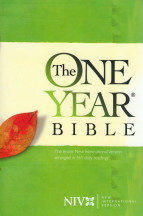 , how about reading the whole Bible in one year? If you are willing to dedicate twenty minutes a day to reading scripture, it’s not such a tall order. There are Bibles available that split the scriptures into 365 daily readings, with each day offering a section from the Old Testament, a section from the New Testament, and a reading from the book of Psalms or Proverbs. You can find such a Bible on Amazon; just search ‘One Year Bible’.
There are many English language translations of the One Year Bible available, so the version you pick depends on what kind of writing style you like. If you like very bold, old-fashioned English, pick the King James Version (also called the Authorised Version). If you prefer something a bit more modern and accessible, try the New International Version. Or you could go with my current favourite, the New King James Version, and get the best of both worlds.
So how about it then? Are you be willing to take up the One Year Bible challenge?


February 19, 2016
My Testimony
When people give their testimonies about coming to faith in Christ there is often a specific turning point or event that they speak of which led them to cry out to God in repentance and faith and accept Jesus as their personal saviour. Often it is the case that conversions happen when people are at their most desperate and can’t see a clear way forward in life.
Some of this has been true for me, but there have been many significant events and turning points on my journey to faith rather than a single ‘eureka moment’. It would be impossible to explain everything of significance that God has brought me through in my life, but I will try to give a brief overview of the main events that have shaped my life and my faith.
I grew up in a divided household. My mother was an atheist and my father a Christian. My father took my sister and I to church some Sundays, and I used to sing in a church choir, but church was always something that I considered boring and irrelevant; I had no real sense of how the gospel message related to me. My parents chose not to baptise me as a child.
As a teenager and then into my early twenties I spent a great deal of time exploring the religions of the world. I was particularly interested in Eastern philosophy (Hinduism and Buddhism) and although I was studying Commercial Music at university, my deeper interest was really spirituality. I was an atheist and became obsessed with the idea of ‘self-realisation’ or ‘enlightenment’ – it seemed to me that it was through this kind of spiritual path that peace could be found.
I was so wrong. Throughout my years spent searching for enlightenment I was deeply depressed and confused. I had been brought face to face with death as I saw my mother pass away after a long and gruelling battle with cancer. I was trying so hard to make sense of the mysteries of life but spent most of my days in a state of mental turmoil.
The atmosphere in which I grew up, with my parents constantly fighting with each other, left a deep impression on me. It wasn’t until I started to attend psychotherapy in my twenties that I began to deal with the emotional hurt I had experienced growing up. Psychotherapy was a tremendous blessing to me, making me more self-aware and mature and providing a space of deep compassion in which I could talk openly about everything for the first time in my life. Lots of healing took place in those sessions.
After graduating from university I took up a job in the music industry. I was heavily involved in music, playing guitar in a rock band and promoting and managing musicians both through work and in my spare time. I had a good job, and a very active social life, but I didn’t have peace. I used to spend lunch breaks and evenings meditating as I was still trying to find that elusive enlightenment that would give me spiritual satisfaction.
Despite many productive sessions with my psychotherapist, my mental health problems intensified. I began to experience delusions and panic attacks alongside a deep depression that made daily life a struggle. Many of my personal relationships began to break down and I became more and more confused, behaving irrationally and worrying others who didn’t really understand what was going on.
Eventually, after years of turbulent mental health, things got so out of hand that I had a serious episode of psychosis and ended up in psychiatric hospital for the first time. The psychotic episode that I experienced was confusing, but also very spiritual. I remember sleeping rough for several days outside a mosque and then finally making my way to the church up the road from the mosque. I believe that during this time God was teaching me about different religious paths and about my place in the grand scheme of things.
All of my four spells in psychiatric hospital have been very spiritual. It is during these times that I have begun to understand more about God by studying the Bible and being immersed in prayer. Some might argue that my belief in God is a delusion and a part of the mental illness that I have experienced. But I promise you, this is not the case. God is real, and when we humble ourselves before Him and repent of our sins, He really does listen and respond.
After my second admission to psychiatric hospital I continued to read the Bible and attend church and I returned to university to study Philosophy and Religion. During a spell of good health I wrote a book about my spiritual experiences and my philosophy. I went to several churches but eventually settled in to attending an evangelical church in central London. It was at this church, in 2010, that I made a commitment to serve Jesus for the rest of my life.
But it wasn’t all plain sailing after that. I continued to wrestle with mental illness and as I continued to explore the Christian faith in depth I discovered aspects of Christian thinking that didn’t sit well with me. I spent several years in a kind of limbo; committed to God but questioning certain aspects of the gospel that seemed to make no sense.
In the end I had to make a difficult decision. Do I commit to Christ despite my problems with Christian theology, or do I abandon the faith and carry on with my life regardless? This was a struggle that weighed heavily on my mind, and I prayed about it constantly. I just wanted God to reveal to me my purpose and His will.
And then in 2015 I was sitting in bed praying one night and the Holy Spirit clearly spoke to me saying ‘You are going to get baptised’ and ‘You are going to take Holy Communion’. I was shocked and overjoyed by the certainty in this message, and I stayed awake all night thanking God and feeling a renewed sense of peace. As the scripture says, “For by grace you have been saved through faith, and that not of yourselves; it is the gift of God” (Ephesians 2:8).
I got baptised on September 6th 2015 and it was a truly special occasion and probably the best day of my life. I am now a committed Christian, attending church every week, reading the Bible every day, and serving on an outreach team to help others to hear and understand the gospel of Jesus Christ. It is nearly three years since my last hospital admission and I am so grateful that God has blessed me with this period of stability.
The theme of this blog is ‘Perfect Chaos’. My spiritual journey has been chaotic, but I am quite sure that God’s guiding hand has been over every event in my life. I have sinned against others and against God, but I know that because of the precious suffering that Jesus endured on the cross I can live under the blessing and favour of Almighty God. I have the hope of forgiveness and of eternal life – is there anything more precious?
Find out more about my books here, and feel free to leave a comment below.


February 12, 2016
The Ten Commandments
According to the Bible, the Ten Commandments (or ‘Decalogue’) were given to Moses at Mount Sinai after he led the Jewish people out of their captivity in Egypt. In preparation for receiving the commandments, Moses fasted (no food or water) for 40 days and 40 nights.
The commandments were inscribed by God on two stone tablets, and would represent the heart of the law that God gave to His chosen people Israel. It is of course no coincidence that Moses’ fast was for the same length of time Jesus spent being tempted in the wilderness, which we now reflect upon during the Lenten season.
The Ten Commandments are listed twice in the Old Testament, in the book of Exodus and the book of Deuteronomy. I will list them below (from Exodus 20), and then briefly discuss the ways in which these commandments might be relevant to Christians today.
20 And God spoke all these words, saying,
2 “I am the Lord your God, who brought you out of the land of Egypt, out of the house of slavery.
3 “You shall have no other gods before me.
4 “You shall not make for yourself a carved image, or any likeness of anything that is in heaven above, or that is in the earth beneath, or that is in the water under the earth. 5 You shall not bow down to them or serve them, for I the Lord your God am a jealous God, visiting the iniquity of the fathers on the children to the third and the fourth generation of those who hate me, 6 but showing steadfast love to thousands of those who love me and keep my commandments.
7 “You shall not take the name of the Lord your God in vain, for the Lord will not hold him guiltless who takes his name in vain.
8 “Remember the Sabbath day, to keep it holy. 9 Six days you shall labor, and do all your work, 10 but the seventh day is a Sabbath to the Lord your God. On it you shall not do any work, you, or your son, or your daughter, your male servant, or your female servant, or your livestock, or the sojourner who is within your gates. 11 For in six days the Lord made heaven and earth, the sea, and all that is in them, and rested on the seventh day. Therefore the Lord blessed the Sabbath day and made it holy.
12 “Honour your father and your mother, that your days may be long in the land that the Lord your God is giving you.
13 “You shall not murder.
14 “You shall not commit adultery.
15 “You shall not steal.
16 “You shall not bear false witness against your neighbour.
17 “You shall not covet your neighbour’s house; you shall not covet your neighbour’s wife, or his male servant, or his female servant, or his ox, or his donkey, or anything that is your neighbour’s.”
Most Christians believe the Ten Commandments are still relevant today. When asked by a man what he should do in order to inherit eternal life, Jesus replied that he should “keep the commandments” (Matthew 19:16-19).
Jesus stated that two commandments were the greatest – “thou shalt love the Lord thy God with all thy heart, and with all thy soul, and with all thy mind, and with all thy strength” (Mark 12:30) and “thou shalt love thy neighbour as thyself” (Mark 12:31). It is interesting that these two commandments do not specifically feature in the decalogue given to Moses and quoted above.
Some Christians believe that the Mosiac law no longer applies today because the teaching of Jesus ‘superseded’ it. Some believe that because of the New Covenant in Jesus’ blood (1 Corinthians 11:25) we are no longer bound by the law, but are now living in a time of God’s grace. This doesn’t mean that there are no morals, but rather that God’s law is now “written on our hearts” when we become believers in Christ (see the prophecy in Jeremiah 31:31-34).
Other Christians, such as those in the Eastern Orthodox Church, hold that the Ten Commandments are still applicable today. Indeed, in confession, penitents are asked to explain which of the commandments they have broken. In the Roman Catholic church it is believed that Jesus freed us from Jewish religious law, but that we are still required to keep the Ten Commandments. There are clearly a variety of views among Christians of differing denominations and persuasions that are practising today.
Are you a Christian? Do you believe the Ten Commandments are relevant to Christians today? Please feel free to add to the discussion in the comments below.


February 10, 2016
Lord Jesus, think on me
Last night I attended an Ash Wednesday service at my local church, which helped to prepare me for the season of fasting, prayer, and repentance, that is Lent. The service opened with a beautiful hymn which doubles up as a prayer, and I found the lyrics to be very powerful.
I believe the hymn was written by Synesius of Cyrene (c.373-c.415), and here it is:
Lord Jesus, think on me,
and purge away my sin;
from earthborn passions set me free,
and make me pure within.
Lord Jesus, think on me,
with care and woe oppressed;
let me thy loving servant be,
and taste thy promised rest.
Lord Jesus, think on me,
nor let me go astray;
through darkness and perplexity
point thou the heavenly way.
Lord Jesus, think on me,
that, when the flood is passed,
I may the eternal brightness see,
and share thy joy at last.
Lord Jesus, think on me,
that I may sing above
to Father, Holy Ghost and thee
the songs of praise and love.


Why is Lent Important?
Today is Ash Wednesday, traditionally the first day of Lent. For me, Lent is about a spirit of gratitude for what God has done for me through His son Jesus Christ. The blessings that God affords us when we are devoted to Christ are so abundant. We gain hope that we will live forever, we are granted the forgiveness of sins, we have access to God through prayer and through His Word, and we have the hope of salvation and a place with Jesus in His kingdom in the life to come. None of this should be taken for granted.
During the Lenten season we remember the time when Jesus was tempted in the wilderness. We are told in Matthew 4 that Jesus fasted for 40 days and 40 nights before being tempted to rebel against God by the devil. So during lent we can think about the temptations that exist in our own lives, and we can commit to fasting – giving up some of our addictions – in order to focus more on our relationship with God through Jesus Christ.
Fasting is a personal thing between a person and God. We can prepare for fasting with prayer, asking God to place on our hearts the specific sacrifices we are to make during the Lenten season. Fasting is not something to show off about; indeed the Bible criticises any public display of fasting, which should really be done in secret (see Matthew 6:16-18).
My challenge to you if you are not a practising Christian is to dedicate some time during Lent to reading the Bible and exploring what God has to say about humility and sacrifice. Maybe try giving up one of your addictions for Lent (tea, coffee, smoking, sugar, meat, sex, etc), but don’t do it so you can boast about it, do it to draw closer to God. In the Bible prayer and fasting go together, so use this season to be prayerful and thankful for all that God has blessed you with. Reach out to God and He will hear you; as Jesus said, “knock and it shall be opened unto you” (Matthew 7:7).
If you don’t have a Bible but are interested to learn more about Christianity, there is a brilliant app available – just go to the app store and search ‘Bible’ – it’s the first app that appears (the picture is of a brown Bible with the words ‘Holy Bible’ on it). If you don’t have access to the app, or would prefer a paper Bible, you can buy one on Amazon or feel free to contact me and I will buy you one as a gift.
May God bless you over the Lenten season!


January 31, 2016
The Role of Women in Church
I’m currently attending a weekly prayer and Bible study group. The group is led by two women, Sarah and Heather. The session lasts for about an hour, and we sing traditional hymns, pray, and listen to Sarah and Heather speaking about Jesus and the Bible.
At the end of one session, a couple of weeks ago, I got chatting to a man who was sitting next to me. He strongly believes that women should not be leaders in the church, and is confident that this is what the Bible teaches.
I know that in the Anglican church there is an ongoing debate about the role of women and I was wondering whether the situation is as black and white as the man from the Bible study group was implying. So I did a little research, and I think the following points are key:
None of the apostles were women. However, we read in Luke that there were some women who supported Jesus and the apostles in their work:
Soon afterward he went on through cities and villages, proclaiming and bringing the good news of the kingdom of God. And the twelve were with him, 2 and also some women who had been healed of evil spirits and infirmities: Mary, called Magdalene, from whom seven demons had gone out, 3 and Joanna, the wife of Chuza, Herod’s household manager, and Susanna, and many others, who provided for them out of their means. (Luke 8:1-3)
When Jesus was crucified, the apostles left but we are told that some of Jesus’ female disciples stayed by the cross to mourn:
55 And many women who followed Jesus from Galilee, ministering to Him, were there looking on from afar, 56 among whom were Mary Magdalene, Mary the mother of James and Joses, and the mother of Zebedee’s sons. (Matthew 27:55-56)
On the day of Pentecost, which was the day the church was birthed, we read that both men and women joined:
14 And believers were increasingly added to the Lord, multitudes of both men and women (Acts 5:14)
All of the above scriptures show that women were certainly accepted into the church, but what does the Bible teach about the specific point of women being church leaders?
In defence of women being church leaders, the main argument comes from the following scripture:
28 There is neither Jew nor Greek, there is neither slave nor free, there is neither male nor female; for you are all one in Christ Jesus. (Galatians 3:28)
The contrary stance, however, is that men and women are to hold different roles in church. We find various scriptures supporting this view in the New Testament. The following scriptures reveal that deacons and bishops are to be male:
12 Let deacons be the husbands of one wife, ruling their children and their own houses well. (1 Timothy 3:12)
This is a faithful saying: If a man desires the position of a bishop, he desires a good work. 2 A bishop then must be blameless, the husband of one wife, temperate, sober-minded, of good behavior, hospitable, able to teach; (1 Timothy 3:1-2)
Perhaps the most controversial scriptures concerning the role of women are those which talk about female submission:
12 And I do not permit a woman to teach or to have authority over a man, but to be in silence. (1 Timothy 2:12)
34 Let your women keep silent in the churches, for they are not permitted to speak; but they are to be submissive, as the law also says. (1 Corinthians 14:34)
An important point which feeds into this discussion is that of the ‘inerrancy’ of scripture. If we believe that the 66 books of the Bible are the perfect Word of God, then we must take the above scriptures very seriously. If, on the other hand, we believe that scripture is inspired but imperfect, then we can consider factors such as historical context when trying to understand the Bible, and perhaps take a more liberal view.
What are your views on the role of women in church? Please feel free to add to this discussion by leaving a comment. I’m sure there are many relevant factors that I have not touched upon in this post.


January 24, 2016
The Embrace of Jesus
I wanted to share with you this moving message from a chap named Charlie Mackesy. It’s 25 minutes long, but captivating, and well worth watching through to the end. It’s about how Jesus offers a warm embrace to all of us, regardless of our broken nature and the messy lives that we all struggle with. The core message of Christianity is not a slap round the face, but a beautiful warm hug from a God who loves us.


January 20, 2016
Colossians 3:12-17
Just a quick post to share with you a wonderful passage of scripture that offers guidance about how we should live our lives. This New Testament passage, written by Paul in his letter to the Colossians, seems to convey the heart of the gospel message that Jesus preached. It also sets an example for how we should behave in our church communities.
12
Therefore, as the elect of God, holy and beloved, put on tender mercies, kindness, humility, meekness, longsuffering;
13
bearing with one another, and forgiving one another, if anyone has a complaint against another; even as Christ forgave you, so you also must do.
14
But above all these things put on love, which is the bond of perfection.
15
And let the peace of God rule in your hearts, to which also you were called in one body; and be thankful.
16
Let the word of Christ dwell in you richly in all wisdom, teaching and admonishing one another in psalms and hymns and spiritual songs, singing with grace in your hearts to the Lord.
17
And whatever you do in word or deed, do all in the name of the Lord Jesus, giving thanks to God the Father through Him.
If you are encouraged by this passage then please do share it. Also, feel free to post a comment below with your reflections on Paul’s words, and what they mean to you.


January 11, 2016
What is Wisdom?
A friend and reader of this blog has asked me to have a go at tackling this question. The dictionary definition of wisdom says it is “the quality of having experience, knowledge, and good judgement.” I will take these three facets of wisdom separately and elaborate a little.
Experience seems to be partly related to age. After all, we wouldn’t say a new born baby has much experience, or a young teenager for that matter. But we hear the expression “old and wise” a lot in our culture, so there seems to be a theme that those who live to an old age have a lifetime’s worth of experience to draw upon, and are therefore wise. The character Yoda from Star Wars comes to mind as an example of how we link age to wisdom.
But experience-related wisdom cannot be solely about age. Often elderly people develop conditions such as Dementia or Alzheimer’s disease, which may affect their ability to reason, and so they might have a wealth of experience but be inhibited from drawing upon it due to ill health. One could argue that their wisdom is affected by these health challenges, although their tremendous value as an elderly person is of course in no way diminished.
We might say that the experience of hard times allows us to empathise with others, and this could be considered a form of wisdom. In my own life I know that my mental health problems and various hospital admissions have allowed me to understand what others are going through when they are mentally unwell. Or to give another example, the experience I have had of attending various different churches has given me a greater understanding of Christianity and allowed me to better understand people from a variety of church backgrounds. So the experience aspect of wisdom is about all that we go through in life, the good times and the hard times.
The second aspect of wisdom, Knowledge, seems to be similar to experience, but has academic connotations. We undertake academic studies in order to be more knowledgable about a particular subject. There is a popular myth in our culture that knowledge is somehow stored in our brains, and that the ability to recall certain things that we have learned depends on memory. We might say that those who have a good memory are able to better accumulate knowledge. It is popularly believed that the brain is like a storehouse for this accumulated knowledge.
I actually believe, contrary to popular opinion, that our memories are not stored in our brains but in God’s infinite awareness and consciousness. The brain, rather than being a storehouse, is more like a conduit God uses in order to bring memories from His infinite awareness into the reality of an individual’s consciousness. I describe why I believe this in my book Ultimate Truth: God Beyond Religion and also in this blog post entitled ‘What is causing our thoughts?’.
The final aspect of wisdom for us to look at is Good Judgement. This seems to be more about the way we live our lives, rather than what we have been through or the insights that we have accumulated. Those who make decisions in courts are called ‘Judges’ and we depend upon their judgments for the good of society, so there is a moral dimension to good judgement.
When we talk about morality, we are concerning ourselves with the idea of good and evil; right and wrong. There are of course myriad opinions regarding how we can and should make moral judgments. As a Christian I believe that the Bible offers us moral guidance. For instance, the book of Proverbs, the Ten Commandments, and the teachings of Jesus provide us with reference points to look to when we are considering how to live our lives. Christians generally believe that the moral teachings we find in the Bible come from God, who is the ultimate authority on matters of good and evil.
There are of course other religious perspectives on good and evil which draw upon different scriptures that are believed to be divinely inspired. And then there are the positions of atheists and humanists, for instance, who might argue that God doesn’t exist and that we should therefore find other ways to be wise in our judgements concerning moral issues. For a great debate between a Christian theologian and an atheist on the subject of good and evil check out this blog post.
My personal view of wisdom is that it is revealed by God rather than learned. I believe God is omnipotent, omniscient and omnipresent, and holds all wisdom within His being. I would argue that none are truly wise but God Himself, and that we can see the whole manifestation, in all its diversity, as an expression of God’s wisdom. Can you imagine writing every book and every song and every theatre production and every poem that has ever been written? That is how wise God is.


January 10, 2016
The Bible and Patience
I have encountered a variety of situations in my life recently which have really tested my patience. Sometimes it is little things that frustrate me, such as people throwing litter onto the street or when people stand at a crossing for ages and don’t press the button, seemingly not realising that the lights won’t change unless they do…
These are petty frustrations, but I have also been experiencing more serious frustrations. People driving recklessly, for instance. On several occasions recently I’ve seen cars drive straight through a red light in a busy area. And in a similar way, it frustrates me when cars stop right in the middle of a crossing, ignoring their duty to ‘Keep Clear’ of certain areas. Where is the common decency?
I have also been frustrated by people acting unprofessionally when they have a duty to be caring. I was in A&E recently and a security guard was flirting with with two nurses for around 15 minutes when they all should have been working (they were definitely not on a break!). In another scenario, there’s a parking attendant at one of my local supermarkets who is constantly on the phone and smoking cigarettes during work time. I don’t want to be judgmental but it seems very thoughtless and unprofessional.
I should point out that I’m aware of how blessed I am in my life and I know there are countless people living with a much deeper level of frustration than I experience. I’m aware that we all have grumbles like those I have mentioned here in our lives. We all have to associate with people who we don’t get along with all the time. And perhaps there are things that I do, even unconsciously, that frustrate others. I know I’m not perfect.
~~~~~
So what are we to do when we’re feeling angry about life’s frustrations? We should surely turn to the Holy Bible for guidance, for this is the Word of God, and as we read in 2 Timothy 3:16, “All scripture is God-breathed and is useful for teaching, rebuking, correcting and training in righteousness”.
And what does the Bible say about patience? Here are some scriptures that I hope are relevant:
“Rejoice in hope, be patient in tribulation, be constant in prayer.” (Romans 12:12)
“And let us not grow weary of doing good, for in due season we will reap, if we do not give up.” (Galatians 6:9)
“Be not quick in your spirit to become angry, for anger lodges in the bosom of fools.” (Ecclesiastes 7:9)
“Love is patient and kind; love does not envy or boast; it is not arrogant” (1 Corinthians 13:4)
“Know this, my beloved brothers: let every person be quick to hear, slow to speak, slow to anger” (James 1:19)
And here’s a scripture that I find particularly helpful:
“Be still before the Lord and wait patiently for him; fret not yourself over the one who prospers in his way, over the man who carries out evil devices! Refrain from anger, and forsake wrath! Fret not yourself; it tends only to evil. For the evildoers shall be cut off, but those who wait for the Lord shall inherit the land.” (Psalm 37:7-9)
I think one of the secrets to being patient is to keep our minds focused on our Heavenly Father and on spiritual things and not earthly things. We should always act in a way that makes us feel as though we are behaving righteously in the sight of God. We should live to please God and not to please others. Even if others frustrate us by their actions, we should lead by example. As Jesus famously said – “Thou shalt love thy neighbour as thyself” (Mark 12:31). And Jesus also taught us to love our enemies (Matthew 5:44).
So the next time you’re feeling angry and as though your patience has run out, remember that God, through His Word, has taught us a great deal about how to handle these difficult emotions. My prayer is that as I continue to follow Jesus, God will shape me and teach me to be a more perfect and patient servant.


Steven Colborne's Blog

- Steven Colborne's profile
- 16 followers

