
Steven Colborne's Blog, page 95
June 26, 2016
Who are the Heretics?
I’m lucky that there’s a library about ten minutes walk from where I live in south west London. It’s not a huge library; I would guess there are about 30-40 books in the Christianity section which is where I was looking when I visited earlier this week.
So I was lucky, then, to find a book that really caught my attention, ‘Reformation: A World in Turmoil’ by Andrew Atherstone. The book is an excellent guide to the Reformation and has already provided me with much food for thought even though I’m currently only about half way through.
One of the things that is standing out for me as I read this book is the diversity of opinions that different Christians held about the key doctrinal issues of the faith. During the Reformation there were many believers who were tortured, burned at the stake, beheaded, drowned, or otherwise executed, for holding opinions that differed from those who were in power in a particular region at a particular time.
I want to quote a short section from page 147 of the book on the subject of heresy and then will make a few comments below. I would love to get your thoughts in the comments at the bottom of this post.
In his treatise, On Heretics, [Sebastian] Castellio argued that Christians spent far too much time arguing about unprofitable doctrines like the Trinity, the work of Christ, predestination, free will, angels, and the immortality of the soul. He maintained that such debates were irrelevant since salvation was achieved not by doctrinal precision but through faith in Christ, as tax-collectors and prostitutes realized in New Testament times. Castellio went further and asserted that it was futile to punish “heresy”, because Christians could not agree among themselves which views were heretical. Surveying the bewildering multitude of Christian opinions in evidence across sixteenth-century Europe, he wrote:
There is hardly one of all the sects, which today are without number, which does not hold the others to be heretics. So that if in one city or region you are esteemed to be a true believer, in the next you will be esteemed a heretic. So that if anyone today wants to live he must have as many faiths and religions as there are cities or sects, just as a man who travels through the lands has to change his money from day to day…
Castellio looked for an emphasis upon Christian morality rather than doctrinal correctness, and maintained: “It would be better to let a hundred, even a thousand heretics live than to put a decent man to death under pretence of heresy.”
In our current age of YouTube videos and the blogosphere there are still debates raging around all the same issues that were being discussed vehemently in Castellio’s day. The plurality of beliefs amongst Christians has not decreased. There are thousands of different denominations in the church today. We may not be burning people at the stake for their beliefs, but we are still arguing about the same doctrinal issues.
I wonder how God views all these different beliefs? Is it really true that just a small number of Christians will be able to “enter through the narrow gate” and be saved? Or is it arrogance to assume that one person’s views about, say, the Trinity, are going to leave them damned to hell while another’s views will carry them to heaven?
If it is true that the Bible is the infallible Word of God, as many Christians believe, does it really follow that there is one correct interpretation of scripture, or should we be more liberal in allowing for different beliefs and interpretations within the church?
Castellio’s view was that we should put morality first. This suggests to me that he believed we should be more concerned about our conduct as Christians than the minutiae of doctrinal differences. Perhaps a good Christian is able to empathise with the views of others, putting himself in their shoes and understanding that despite being different, their opinion may not be heresy in God’s eyes.


June 6, 2016
Open Theism
In this post I will try to explain in a concise and simple way some of the main elements of the theological movement known as Open Theism. Most of my knowledge on this subject comes from Internet articles and YouTube debates featuring leading theologians in this field. I hope that I will represent the tenets of Open Theism accurately, and I will offer some criticisms of Openist theology based on my own beliefs about free will and the nature of God.
Open Theists (or ‘Openists’) use scripture to illustrate the idea that God can change His mind. For instance, I have heard Openists site the Biblical passage 2 Kings 20: 1-4 to illustrate this. In the passage God tells Hezekiah to get his house in order as he is going to die. Hezekiah protests and pleads with God, and in response God agrees to let him live for another fifteen years.
The question here is whether God had decreed these events from eternity past (as Calvinists would claim), or whether God was responding to Hezekiah within time at the moment he pleaded. Openists assert that we have free will, and therefore that God can change His mind in response to actions freely undertaken by human beings.
I would have to take issue with this on the grounds that I do not believe human beings have free will. Omnipresence is an attribute of God, and this being so, He in control of all action in existence. God would have been in control of every aspect of Hezekiah’s life, including his illness, his pleading, and his subsequent recovery following the apparent change of mind from God.
What we need to understand is that God did not create the universe and then sit back and watch it unfold in an automatic way, but rather He actively animates the universe and all its parts in this single eternal moment. God is living. There is no atom in existence which is not under the direct control of God. So when we read this Biblical story about God changing His mind, we have to remember than Hezekiah is just a puppet in God’s great plan, which He unfolds in accordance with His divine will as the centuries go by.
You see, existence is like a game. In Hinduism they have a term called ‘lila’ which doesn’t really have a parallel in English, but the term describes life as God’s ‘play’. God is glorifying Himself through His creation and He is the sole agent that creates, sustains, and acts, in order to express some of the infinite possibilities that are contained within His nature.
Throughout the Bible events are presented as though human beings have free will to which God responds. I believe this free will is illusory. There is a certain mode of thought that human beings have which is like a veil that prevents us from being aware of God, but this veil is part of the way God has created humans to be. God reveals Himself to some people during our earthly lives (we could say He ‘lifts the veil’), and to others He remains veiled; this is all part of the ‘lila’ and God’s plan for mankind.
We can only understand the Bible and the Hezekiah story in this context. The ‘play’ that goes on between God and Hezekiah is completely within God’s control, and all the many instances where there is rebellion against God in the Bible are also part of this divine play.
Keeping all of this in mind, let us look at a few other features of Open Theism. In this YouTube video, using scriptural references to back up his position, Openist Greg Boyd asserts the following things about God:
God regrets (Genesis 6:6-7)
God confronts improbabilities (Isaiah 5:1-5)
God gets frustrated (Ezekiel 22:30-31)
God tests people (e.g. Abraham in Genesis 22:12)
God speaks of the future using subjunctive terms, e.g. ‘if’ or ‘may’ (Exodus 13:17)
All of the above statements are intended to defend the view that God’s will changes as time unfolds. I would agree with the idea that God can change His mind, for He is all-powerful and sovereign and in control of everything that happens. Why shouldn’t He make changes to His plans at any time if He wills to do so?
The Openist belief in free will raises the further question of how God’s will and human wills interact. It is important to ask, ‘What is God doing, and what are humans doing?’. To me it is obvious that God is sustaining me in every moment; He is flowing my blood, beating my heart, blinking my eyelids, controlling my breath, digesting food in my stomach, bringing thoughts to my mind, and yes, even typing these words through me. He is also working in your body and mind as you read, converting markings on a screen into meaningful impressions in your mind. If you consider this deeply, isn’t it obvious that God is making you be? Can’t you see that He is in control?
We do not have free will.
For the Openist, the future is not eternally settled, but is at least partly open to possibilities. God knows all things, including the past, present, and some of the future. God knows all possibilities, but we still have freedom. God is both stable and flexible. God is stable in every respect in which it is virtuous to be stable, but God is flexible in every respect in which it is virtuous to be flexible (the idea here is that free will is a gift given to us by God in order that we may choose to enter into a loving relationship with Him).
This perspective allows the Openist to maintain that God is perfectly loving, in contrast with a Calvinistic worldview, for instance, in which God is in control of suffering. My own view, of course, is that God is indeed in control of all suffering (see this article), but Calvinists affirm we do have free will (see this article), which is why I’m not a Calvinist.
The Openist view is that in any given moment the future consists of many ‘possibilities’. God is infinitely wise and therefore knows every possibility. My problem here is that the Openists seem to divide all activity into events, and seemingly a finite number of possible events. It would be difficult for anyone to assert that God knows infinite possible courses of action in every possible situation, as that gives us infinite infinities, which is a concept that doesn’t really make sense, even if God is omnipotent. In reality, of course, there are no separate events, as so-called events flow into one another. There is only really one eternal event without beginning or end; the eternal now which is not ontologically distinct from God.
So in summary, the Openists defend a belief in human free will and say that God changes His mind in response to human action. There are clearly scriptures that can be used to back up such a belief, but I believe this perspective fails to take into account the true nature of God as omnipresent and therefore in control of all so-called ‘events’.
Feel free to share your thoughts on Open Theism in the comments below. Thank you for reading.


May 24, 2016
Calvinism and Predestination
One of the most important concerns for any Christian is the doctrine of salvation (called “soteriology” by academics). The subject raises important questions: What is salvation? How do I get saved? Can I ever lose my salvation?
In this brief article I want to look at salvation from the point of view of Calvinism and the associated doctrine of predestination. Calvinism is the Protestant school of thought associated with the reformed theologian John Calvin. Predestination is the idea that long before we are born God decides whether or not we will be one of His “elect” who will be saved by His grace during our earthly lives.
I want to discuss five key points of Calvinism, and criticise them with specific reference to my own ideas about free will. I am not going to include scripture references here, but if you want to know whereabouts in the Bible the Calvinists get their ideas from you may like to read this helpful article. I am not claiming to get my ideas from the Bible.
1. Total Depravity
This is the idea that due to original sin we are born sinners and that during our human life we are slaves to sin, which affects our minds, bodies, wills, and emotions.
I have always thought that original sin is a strange idea; that through the disobedient actions of God’s first created man we have all become sinners from our very conception. I know that I am in a sense separate from God, as clearly I am living through an embodied experience with a human consciousness, whereas I believe God has attributes that I don’t possess, such as omnipotence, omniscience, and omnipresence. But Christians tend to understand sin as disobedience, rather then mere separateness.
As I have argued in this article, the ultimate truth is that it is not possible for humans to have fallen away from God as God is, and always has been, in control of everything that happens. We are not free to act in any way that is contrary to the will of God, as God is everywhere. This is a simple attribute of the nature of God.
We do possess the illusion of free will, as God is able to hide His ultimate nature from us during our earthly lives so that many do not realise that we are as puppets in a puppet show and God is the cosmic puppeteer. When I breathe, move, think, grow, digest, or act in any way, it is because God is controlling these activities in the present moment. God is a living God – He didn’t create the universe and then sit back and watch it unfold; but rather He is actively sustaining and developing this vast universe which is not ontologically different from Him. God is all that exists and therefore nothing can happen outside of His will. It seems to me that the idea of Total Depravity in Calvinism ignores this reality.
2. Unconditional Election
This is the idea that we can do nothing to earn our salvation. From a certain perspective this makes a lot of sense to me as if God is always in control, then we do not have free will, and therefore how could we possibly do anything freely to warrant election or damnation? It makes more sense that our cosmic puppeteer would choose whether we are saved based on His will, rather that our own free will which is illusory.
The whole purpose of creation is for God to experience possibility (His own vast nature) in all its fullness; the yin and yang; light and darkness; good and evil; heaven and hell. I have heard it said by one Calvinist that this is indeed the purpose of creation, but to me it seems terribly unfair that some people would have to suffer in hell just so that God can experience that part of His nature. I have speculated in my book Ultimate Truth that I believe God is ultimately merciful and would never let anyone suffer too much, although I believe the Calvinist would argue that those who are not among the elect are damned to hell for all eternity. Would a merciful God really punish people in this way, even though they have done nothing freely to warrant such treatment? It is not for me to judge God, of course, but nevertheless I think it’s an important point.
3. Limited Atonement
This is the idea that Jesus died only for the elect. If life is God’s game and we are all puppets in God’s hands, then I can see that it is possible that as part of the game Jesus came to shed His blood as an atoning sacrifice for the sins of men, as most Christians believe. The Arminians believe that Jesus died for everyone in the whole world, and that each individual has a free choice as to whether to repent and believe and in doing so to get saved.
The Calvinist idea that Jesus died only for the elect seems to make sense only if we embrace the idea that we don’t have free will and that God is controlling all things. You see, if God is in control, then He knows who will be saved, so therefore it becomes possible to say Jesus died only for them. Free will is again the central issue here.
4. Irresistible Grace
According to Calvinism, when God calls the elect, they cannot resist. The implication here is clearly that they don’t have free will. But what confuses me here about the Calvinist position is that they argue the Gospel message is offered by God to all people. I would have to argue that because God is in control, those who reject the Gospel are only doing so by the will of God. Another problem is that in reality there are millions who will live and die without ever hearing the Gospel (unless of course God brings the Gospel to them in another realm that we don’t know about), so in ultimate reality they are damned by the will of God who has not chosen to impart His irresistible grace to them. We might call this “irresistible damnation” (I believe it is also called “double predestination”).
5. Perseverance of the Saints
The idea here is that the elect are eternally saved and can do nothing to lose their salvation. This is a very comforting thought, but in reality our present moment living God can change His mind in any moment, and as He is in control of all things, there is always the possibility that our destiny could change. It may well be that God does choose to save the elect eternally, but we shouldn’t deny that it is within God’s power to change His mind at any moment.
Conclusion
The central problem within Calvinism, and I would argue within the whole of Christian theology, is free will. With an omnipresent God there can be no free will (the two ideas are logically incompatible) and therefore Calvinists are misguided if they combine their doctrine of election, which implies a God who is in control, with the idea that we are free to act independently of God’s will (which is the very definition of what free will is).


May 19, 2016
Christological Conundrums
I have spent some time recently studying Christian apologetics (defence of the faith) and have heard some Muslim scholars raising interesting questions about the Trinity and the dual (human & divine) nature of Christ. Here are a few thoughts.
One Muslim questioner was asking about Mark 11:12-14, which says the following:
12 Now the next day, when they had come out from Bethany, He was hungry. 13 And seeing from afar a fig tree having leaves, He went to see if perhaps He would find something on it. When He came to it, He found nothing but leaves, for it was not the season for figs. 14 In response Jesus said to it, “Let no one eat fruit from you ever again.”
And His disciples heard it.
The questioner was suggesting that if Jesus is God, surely He could have made figs appear on the tree to satisfy His hunger. Why didn’t He do so? Also, if Jesus is God, wouldn’t He have known there were no figs on the tree before He even approached the tree?
I suppose what we’re getting at here is the question of whether Jesus maintained qualities such as omnipotence, omniscience and omnipresence when He took on human form. It seems from this passage that He didn’t, so are we really able to say He is fully God and fully man? I would be interested to get your thoughts – feel free to comment below.
A different but associated question that has been puzzling me is this: Did Jesus will the crucifixion? There seem to me to be two conflicting scriptures here.
Firstly, John 10:17-18 (NKJV):
17 “Therefore My Father loves Me, because I lay down My life that I may take it again. 18 No one takes it from Me, but I lay it down of Myself. I have power to lay it down, and I have power to take it again. This command I have received from My Father.”
Secondly, Luke 22:41-43 (NKJV), in which Jesus is praying to God the Father in anticipation of His crucifixion:
41 And He was withdrawn from them about a stone’s throw, and He knelt down and prayed,42 saying, “Father, if it is Your will, take this cup away from Me; nevertheless not My will, but Yours, be done.” 43 Then an angel appeared to Him from heaven, strengthening Him. 44 And being in agony, He prayed more earnestly. Then His sweat became like great drops of blood falling down to the ground…
Unless I am mistaken, it seems that in the first scripture Jesus is suggesting He has authority over His own life and death, but in the second scripture that He is dependent on the will of the Father. This is somewhat confusing, and so to aid clarification, I’d love to get your thoughts in the comments below. Thanks for reading!


May 10, 2016
‘The Pursuit of Holiness’ by Jerry Bridges (book review)
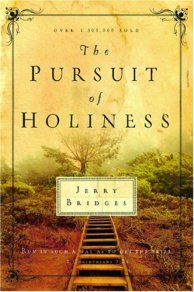 Jerry Bridges is an American author who has written many books about the Christian walk with God. This particular title has sold more than 1,500,000 copies worldwide, and it’s easy to see why. The book is very appealing to the committed Christian due to it’s heavy reliance on scriptural references and the simple and engaging writing style of the author.
Throughout the book there are often scriptural references that are paraphrased with the Bible citation in brackets. I found it helpful to see these citations so I could look up the reference being paraphrased in my Bible. It’s worth pointing out that if, like me, you choose to do this as you read, the book will take much longer to read because nearly every page contains at least a couple of citations.
The book comprises seventeen short chapters, each dealing with a different aspect of holiness. The Christian battle with sin is at the heart of this book, and the author goes to some length to emphasise that holiness is an ongoing battle with our sinful tendencies that is not easily won. In closing, however, Bridges says that the pursuit of holiness is the only real way to find peace and joy in this fallen world.
I am an avid reader, but I must admit I find very few Christian books that I feel nourish me in my walk with Christ and I always find myself being drawn back to reading the Bible itself rather than other books about Christianity. I love reading widely, but I find nothing has the same kind of authority over my spiritual life as the Bible.
Having said this, however, I found Bridges’ book to be very helpful, and I think it’s a book that I would like to keep and read again. I personally feel an ongoing struggle in my life to live in a way that is holy and this book has helped me with that struggle. I would recommend this book to others, and I am interested in reading the sequel, entitled The Practice of Godliness, which focuses on the development of Christian character.


April 1, 2016
Ancient Words
It’s the bestselling book of all time and has been changing people’s lives for thousands of years. The Holy Bible is a truly special book which gives us an insight into the character of God. Within the pages of the Bible we find scripture to encourage, educate, and rebuke. There are wars and kings and songs and stories and miracles. I love picking up my One Year Bible each day and learning a little more about God’s ways.
The song that I’m sharing below is all about the beauty and importance of the Bible. I have embedded a YouTube video of the song below the lyrics. I hope you enjoy the song and that it encourages you on your journey of faith.
Holy words long preserved
For our walk in this world
They resound with God’s own heart
Oh, let the ancient words impart
Words of Life, words of Hope
Give us strength, help us cope
In this world, where e’er we roam
Ancient words will guide us home
Chorus
Ancient words ever true
Changing me and changing you
We have come with open hearts
Oh, let the ancient words impart
Holy words of our Faith
Handed down to this age
Came to us through sacrifice
Oh heed the faithful words of Christ
Holy words long preserved
For our walk in this world
They resound with God’s own heart
Oh let the ancient words impart
Chorus
Ancient words ever true
Changing me and changing you
We have come with open hearts
Oh, let the ancient words impart
Songwriters
FREEMAN, RONNIE C. JR. / WOOD, TONY W.
Published by
Lyrics © Universal Music Publishing Group
Are there any spiritual songs that have touched your heart recently? Feel free to share in the comments below.


March 30, 2016
Being Held by God
Sometimes, life can be a real struggle. I know that I spent many years searching for peace, as I have reflected upon in my book The Philosophy of a Mad Man which is all about spiritual seeking. I used to immerse myself in eastern philosophy as I tried to meditate my way to peace, at that time having had no revelation of the reality of God.
But Jesus said, “Ask, and it will be given to you; seek, and you will find; knock, and it will be opened to you.” (Matthew 7:7). And God the Father said “And you will seek Me and find Me, when you search for Me with all your heart.” (Jeremiah 29:13).
And when it felt as though I had tried everything, when my soul was overwhelmed with restlessness, when I was banging my head against a spiritual brick wall; finally the Lord took pity on me and taught me about the gospel of grace; about the message of salvation through His Son Jesus Christ.
In Jesus, at last, there is peace.
It’s not that suffering ends completely when you become a Christian. Even when we have found God, we still suffer. But Jesus is the lighthouse on the hillside that overlooks life’s seas. He gives us assurance of God’s love for us. Because of Jesus we know that God has chosen mercy for humankind, if only we will trust in Him.
I love these beautiful words from God:
“Because he has set his love upon Me, therefore I will deliver him;
I will set him on high, because he has known My name.
He shall call upon Me, and I will answer him;
I will be with him in trouble;
I will deliver him and honour him.
With long life I will satisfy him,
And show him My salvation.” (Psalm 91:14-16)


March 25, 2016
An Easter Message
Dear friends, I hope you are enjoying the Easter break and are feeling spirituality nourished at this special time. If you need a little inspiration, have a listen to this wonderful message (embedded below) from Holy Trinity Brompton pastor Stephen Foster. The message conveys the importance of Christ’s crucifixion in a clear and relevant way.


March 19, 2016
A Perspective on Sin
While browsing through posts from Christians on WordPress I stumbled upon this insightful video (embedded below). It features the reading of a text called ‘The Curtain Sinner’ by the Puritan Thomas Watson. The text is about sin and the difference between sin in a godly person and sin in an ungodly person.
I remember that my sister once asked me an important question about sin. I was explaining to her how through Jesus’ crucifixion our sins are forgiven, and she asked, “Does that mean that anyone can do whatsoever they please, and be guiltless?”. I think that the video below answers her question rather well.
Please feel free to leave a comment below after listening to the clip.


March 9, 2016
The Grace of God
Oh, most gracious Lord!
You are eternal, unfathomable; mighty beyond measure!
You have created all things and this complex universe is the work of Your hands. So far is Your divine knowledge from my shallow human understanding. I cannot comprehend Your way, oh God!
In this wonderful mess of life, this perfect chaos, You reign; You are sovereign. Heaven and Earth are full of Your glory. Hosanna in the highest!
Thank You, Lord, for the many abundant blessings in my life. Thank You for my body, mind, and spirit. Thank You, Lord, for feeding me physically and spiritually. Thank You for Your forgiveness, Lord, and thank You for Your love. Thank You for the little things and the big things. Thank You for all that You do each day to bless me, help me, sustain me, and grow me.
Thank You, Lord, for listening to my supplications and my frustrations. My God, help me to be patient and to trust in You!
To my earthly mind, all is uncertain and mysterious, yet I believe You are in control. Your mercy is everything to me, Lord, and Your promises are so precious. Please, oh God, help me to pray and be mindful of the prayers I offer up to You. Know that I fear You, Lord, with a great fear!
I do love You, Lord God, even though the way ahead is uncertain. I trust, oh God, that You have clarity where I lack it. Please, Almighty God and Father, though I am a wretched sinner, guide me, and do not withhold Your love and mercy from me!
I crave Your comfort, Your security, Your love, Your hope, Your salvation. I long for You to bring peace to my soul.
Please, Lord, renew my mind and take away my anxieties. Let my faith be so strong, oh Lord, that I never question Your love or Your plan for my life. Be with me, oh God, at the sunrise and the sunset, throughout the day and throughout the night.
I wish to be blameless in Your sight, oh God. Teach me the way that pleases You, Lord, and do not let me stray from the righteous path. Correct me, Lord, when I do go astray. Forgive me, Lord, when I am selfish, conceited, forgetful, annoying, ignorant, or sinful.
Glory to my God, forever! For He has blessed us with a new and eternal covenant for the forgiveness of sins. Please remember Your blessed covenant, Lord, and forgive Your humble servant. Please, oh God, remember the suffering of Your only begotten Son, and do not let your anger burn against me.
Help me to be generous, oh God, and not selfish or greedy. Make my path straight, Lord, and help me to enter through the narrow gate. Help me to serve You all the days of my life.
May my offering of thanks and praise be acceptable to You, oh God, and may the grace of our Lord Jesus Christ, and the love of God, and the fellowship of the Holy Spirit, be with us all, evermore, Amen.


Steven Colborne's Blog

- Steven Colborne's profile
- 16 followers

