Nick Ortner's Blog, page 56
May 14, 2014
Sneak Peek: The Tapping Solution Weight Loss and Body Confidence Chapter 6
 Here’s a sneak peek into the inside of The Tapping Solution for Weight Loss & Body Confidence. Enjoy the entire Chapter 6 below!
The Tapping Solution for Weight Loss & Body Confidence – Chapter 6
The Power of Beliefs
In her book You Can Heal Your Life (which has sold more than 50 million copies!), Louise Hay shares one of her key philosophies: “The only thing we are ever dealing with is a thought, and a thought can be changed.” As we begin looking at how beliefs impact the weight loss journey, we must start by understanding that a belief is a thought we have over and over again.
In this chapter we’ll see how much beliefs impact experience and can limit us (or support us) in the journey toward body con�fidence and weight loss. When a client tells me she hates herself and her body, for instance, she is actually saying that she hates her belief about herself, which might be “I’m not good enough.” This thought, this belief about herself, produces an emotion. That emotion then creates a stress response in her body that makes her belief seem valid.
With tapping, you can change your beliefs by targeting the emotions and the stress response your beliefs create by focusing on the belief itself. Once that stress response is lowered or gone altogether, the old negative belief—“I’m not good enough”—no longer feels true. You can then create a positive belief that does feel true, helps you love yourself, and creates positive momentum for you on your weight loss and body con�fidence journey.
Page 99
How Beliefs Affect Your Experience
Before we discuss beliefs in greater detail, let’s look at the relationship between beliefs and experiences. Louise Hay again sums it up perfectly in You Can Heal Your Life: “No matter what the problem is, our experiences are just outer effects of inner thoughts.” In other words, experiences are refl�ections of beliefs. To put it another way, your beliefs are your blueprint for the world.
If you have a negative belief like “I’m not good enough,” you can’t feel happy or experience real pleasure. Believing that you’re not good enough (or that you’re not beautiful/smart/strong enough) is like giving yourself a life sentence; it leaves no room for any other possibility. With that belief in mind, you unconsciously look for evidence to support that belief and take action (or refrain from action) that supports it. You interpret events in ways that support the belief even when it causes you pain. You also unconsciously seek out or are attracted to people who give you the kind of negative feedback that “proves” your belief.
The idea that beliefs create experience hit home for me one day several years ago when I shared with my friend Brenna what some guy had randomly said to me: “You’d be cute if you lost some weight.” It was yet another cruel and unsolicited comment about my weight, and again I was devastated. Knowing my history of being a target for comments like this, she looked right at me and said, “This is not normal, Jess. People don’t say mean things like that to most people.” As I thought about what she had said, I realized that I had been holding on to a belief in my body that I wasn’t good enough. For years I’d been unconsciously attracting and seeking out people who con�firmed that belief. I also found myself rejecting and playing down compliments and only focusing on the times people told me I wasn’t good enough.
If you believe you aren’t worthy in your current body, you will gravitate toward people who refl�ect that belief back to you. When you don’t believe those things about yourself, you no longer tolerate people who treat you in a disrespectful way. Instead, because you believe you deserve love and support, you’re able to love and support yourself �first and then cultivate a supportive community of people who can also love and support you.
Page 100
When I began tapping on my belief that I wasn’t good enough in my current body, I was able to clear the emotions and stress response this belief had created in me. It didn’t happen overnight. I had to break down all the different events I was using as proof that the belief was true. (You can see in this example what we saw earlier in the Tapping Tree—that symptoms, emotions, events, and beliefs are often interconnected.)
What began happening in the weeks and months that followed was amazing. I started to gravitate away from people who were judgmental and negative and toward relationships that supported the new positive beliefs I had created about myself. My entire life soon began to transform, and the weight began falling off faster than it ever had. And it all happened without focusing on weight loss or feeling deprived. Because I had created a new belief that allowed me to love myself, I was naturally making better decisions and no longer needed dieting and extreme exercise to lose weight and punish my body. Instead, I could trust myself and my body and still lose weight—and that is exactly what happened.
I see this same pattern repeat itself again and again in my clients. They’re amazed by how easy weight loss feels once they’ve used tapping to change their beliefs about themselves, their bodies, and their weight loss journeys.
The Key to Identifying Your Beliefs — Question Everything!
Holding on to negative beliefs is like wearing dark-tinted glasses all day, every day. When we’re wearing them, everything in our world seems scary and threatening. But when we take them off and put on clear glasses—which, in this case, means creating positive beliefs—the world around us seems brighter. Suddenly we feel hopeful, able to naturally seek out experiences that make us feel good.
Page 101
As much pain as negative beliefs can cause, we aren’t always taught to evaluate them. Whether we adopted them from our immediate environment or they were passed down to us from our parents, they often appear disguised as facts. We may question authority and examine beliefs during our teenage years, but as we get older we tend to settle into beliefs and think what we believe is just how the world is—and, more dangerously, This is just who I am.
Targeting a belief begins with fi�rst questioning the way we have been viewing the world and ourselves. When we tap while focusing on the belief, its emotional stronghold weakens and we have the ability to take a step back and ask ourselves, Is this really true? Then we have the freedom to choose a more empowering belief that supports us in creating the life (and weight loss journey) we want to have.
At first, we may resist and distrust the idea that by changing our beliefs we can change our lives. After all, we think, we have so much evidence to prove that what we believe is true. For starters, we’ve never been able to lose weight without depriving ourselves, counting calories, dieting, and subjecting ourselves to extreme exercise that feels like punishment. That is the truth; that is what happened, so why pretend otherwise?
While this seems logical and may initially feel true, that resistance we feel is most often rooted in the stress response that a negative belief has created in us. Until we do tapping to clear that stress response, we can’t create a new experience for ourselves. If we shut out the possibility that weight loss can be pleasurable, for example, we are closing ourselves off to having a positive weight loss experience.
Often when clients come to understand that their beliefs are just thoughts that they can change, they realize that their disempowering beliefs don’t even seem logically true. They’ll often say, “I know that belief isn’t true. I don’t even want to believe it but it just feels so true.” We saw that in the last chapter with Abby, whose cancer diagnosis created a disempowering belief that losing weight and being healthy had led to her illness. She knew that wasn’t the case but couldn’t seem to get rid of the feeling that it was. When she used tapping to clear the emotions and stress response that had been validating her belief, she could let go of it. That same principle applies to everyone: until we clear the emotion and stress response behind negative beliefs, we can’t fully let go of them.
Page 102
The first step in releasing negative beliefs is to identify them, and we do that by learning to question everything, including what we’ve always known as “facts.” That’s what we’ll do next.
So take a moment to ask yourself the following questions. You may want to write them down, along with your answers.
• What negative feedback have I been replaying from others to support my limiting beliefs?
• When did I learn that I’m not (good/pretty/smart) enough?
• What events have I used as proof to support my negative beliefs?
Getting Clear on Your Story
As we begin to identify limiting beliefs, we often �find that we have many of them and that they are spread across different areas of our lives. Over time these beliefs become the larger story we’re telling ourselves about who we are and what’s possible for us. Once we use tapping to address the limiting beliefs that have shaped our story, we can create a new story and make incredible progress in ways that feel natural and enjoyable.
That’s what happened when Lori discovered her own story and used tapping to clear her negative beliefs. “I went from obsessing about weight loss to obsessing about self-love. I realized that self-love was the key. I kept fi�nding ways to take care of myself. Suddenly exercise and eating well became fulfi�lling and exciting. When I changed my beliefs about what it took to lose weight—and more important, what I believed about myself—losing weight and taking care of myself became easy and fun.”
Page 103
Just as you used the Tell the Story technique in the last chapter to clear events, you can use that same technique to clear limiting beliefs. Let’s look at the story you may be telling yourself and then do some tapping to clear the way for new beliefs that support you and your weight loss journey.
DISCOVER YOUR STORY
The first part of this exercise involves writing, and then we begin tapping.
Start by �finishing the two sentences below, which will help you see your own limiting beliefs. Write each sentence down and complete it in your own words.
• I can’t lose weight/be thin because . . .
• I want to lose weight but . . . .
Write down the beliefs you discovered by �finishing these sentences. These are your tapping targets.
When you pinpoint a belief, say it out loud and ask yourself, on a scale of 0 to 10, How true does this feel? If it feels like a simple fact, it would be a 10. Then begin tapping while telling your story. A helpful setup statement may be “Even though I believe (state your belief here), I accept myself and how I feel, and I am open to a new way of thinking.”
We’ll explore the limiting beliefs within your story throughout the rest of this chapter and then learn how to tap on them.
Clients often tell me that when they tap on the story they’ve been telling themselves, they start to see their lives in a whole new way. They realize that they’ve used various events to support their limiting beliefs. Once they use tapping to clear their old beliefs, they can see events in their past in a new light and even discover a valuable lesson or hidden blessing in them.
Page 104
To explore your story in more depth, you also need to look at your beliefs about yourself, your genetics, your body, and your weight loss journey.
Beliefs about Your Genetics
Growing up on an island off Scotland with a population of fewer than 100 people, Marjorie was an anomaly within her family. Since childhood she had been the only one among her seven siblings who was overweight. The consensus within the community was that she had inherited “bad genes” from her aunt, who had also always been overweight. “I felt like I had grabbed the shortest straw in the gene pool,” she explained. Those “bad genes” became part of who Marjorie was, a fact that she didn’t have the power to change.
Many of us who come from families where weight issues are common also point to genetics as the cause of our struggles with weight. “See,” we say, “this is just who I am.” At other times we may blame genetics because we’re tired of blaming ourselves and we feel exhausted by our unsuccessful attempts at dieting. The idea that we are victims of our genetics is not only scientifi�cally inaccurate; it also strips us of the power to change.
Blaming the body is like blaming a car that won’t run when in fact we never bothered to give it the proper fuel and loving maintenance. The truth is that we don’t need to blame anyone or anything for our weight issues; the key is to replace blame with curiosity. Several weeks into my class, Marjorie began to do that and had an exciting breakthrough. By tapping on her beliefs about her body, she realized that she had grown up in a culture and family where food was an expression of love. Her aunt loved to bake, and piling people’s plates high with food expressed how much she cared for them. All these years later, Marjorie realized, she had been “eating” love in the form of baked cookies, scones, muf�fins, and cakes.
Page 105
When we point to a family that is overweight, we don’t need to look at genetics but instead at the food habits within that family. We can then ask ourselves what beliefs we may have unconsciously adopted around eating, food, and weight. When we stop blaming the body, we can change our emotions, stress levels, and behavior as well as how the body functions.
Genetics obviously play a role in the body, but if we believe that we have no control over gene expression, it’s easy to give up and surrender to unhealthy habits that match the disappointment we feel. You have more power over gene expression than you think. Let’s take a look at the science behind that claim.
THE SCIENCE OF GENETICS
“We’re going to miss our flight,” I whispered to Nick Polizzi, director of The Tapping Solution movie and the longtime friend of my brother Nick.
“I know,” he replied, “but this is so worth it.” I nodded, excited to keep going with the interview.
We’d arrived at Bruce Lipton’s house a couple of hours earlier, ready to conduct an hour-long interview with this highly acclaimed scientist who is also a top-selling author. We assumed he’d be stiff and formal—scientist-like—but from the start he was one great surprise after another. He greeted us with a big smile at the front door of his house in the San Jose hills in a T-shirt and shorts. As we started setting up our camera equipment, he turned to me and said, “Let me know when you’re ready to start and I’ll put on a nicer shirt.” I was shocked by how casual and friendly he was—so different from the reserved scientist in a lab coat I had imagined.
I’d done extensive research in advance of the interview and knew how much Bruce’s work has revolutionized our understanding of how beliefs impact the body. In 1967, decades before the rest of us knew what it was, Bruce was already doing stem-cell research. He had started in that field while earning his Ph.D. in developmental cell biology under the mentorship of Dr. Irwin R. Konigsberg, one of the first scientists ever to successfully clone stem cells.
Page 106
The pioneering work Bruce has done in the decades since has shown us that genes don’t predict health, success, happiness, or weight. In fact, gene expression is based on environment. That environment extends beyond particles and molecules to include emotions and beliefs. In other words, we can change how our cells develop and function by changing our beliefs, stress levels, and nutrition.
By the time we left his house, two and a half hours had passed. Every moment we had spent with Bruce Lipton had been amazing. It was, and still is, my favorite interview from the movie. Talking to him was fascinating, and by the end Nick Polizzi and I felt like giant sponges soaked to maximum capacity with incredible new knowledge.
Since we’d already missed our flight home, Nick and I had no choice but to drive six hours to Los Angeles and catch a different one. During that drive, we talked at length about Bruce’s work. It’s really a pretty amazing idea—that our beliefs, emotions, stress, and nutrition can change how cells behave and function. His work shows us that we’re not victims of genetics but instead products of our thoughts. According to this way of thinking, there are only very rare and occasional instances when genetics play a signifi�cant role in our ability to overcome weight struggles. While this puts a lot of power in our hands to change our own lives and, for example, create an easier and more enjoyable weight loss journey, it also robs many of us of the excuse that our weight struggles come from “bad genes.”
Take a moment now to think about the internal environment you’re creating for yourself and your cells. Is your body living in one that is loving and nurturing, or an environment of self-hatred and punishment? Feel free to write down your thoughts.
Remember: the point of this process is not to blame anyone or anything—including yourself—for your past weight struggles. The point now is to get curious about your beliefs and how your internal environment may be impacting your weight loss journey.
Page 107
Keep those questions and your responses in mind as we begin exploring beliefs around weight loss next.
To watch a segment of my interview with Bruce Lipton, go to www.TheTappingSolution.com/chapter6.
Beliefs Around Weight Loss
“I really want to lose weight, but it doesn’t seem worth it,” Polly confessed in our fi�rst coaching session. Losing weight and being thin, for Polly, had always been about deprivation and struggle. After weeks and months of dieting and hard work, the weight would come off, but even when she felt thin she couldn’t enjoy herself. Always obsessing about calories and exercise, she worried about when the weight would return, which it inevitably did. As much as she still wanted to lose weight, she couldn’t stand the thought of going through the process all over again. Absolutely nothing about the experience of losing weight had ever been enjoyable.
Polly’s experience is incredibly common, and like most beliefs, the belief that weight loss is about struggle and deprivation quickly turns into reality. If you believe you must suffer to lose weight, you will either fail to lose it or you will drop a few pounds but regain them soon afterward. I’ll say it again: our bodies can’t be healthy and thrive when they’re constantly being scrutinized and subjected to a stressful internal environment.
One of the most common responses I hear from women who follow my online weight loss program is “I’m losing weight and I don’t feel deprived!” They’re amazed, but why is deprivation-free weight loss such a shock? Since diets typically don’t look at the underlying beliefs and emotions that lead us toward self-sabotaging behaviors, in many ways they set us up to fail. Relying on diet and exercise alone, we’re forced to use willpower as our sole source of motivation, and that makes weight loss feel difficult.
Page 108
If you have a belief that it’s hard to lose weight, you will continue to make it hard. If you have a belief that losing weight can be pleasurable, you can more easily adopt new behaviors such as eating more nourishing meals and exercising regularly. Take a moment now to explore your beliefs about weight loss and do some tapping on it.
YOUR BELIEFS ABOUT WEIGHT LOSS
To begin exploring your own beliefs around weight loss, ask yourself the following question: “What if having a healthy and strong body could be a fun and pleasurable experience?”
Does this idea make you scoff or roll your eyes? Does it make you feel anxious or angry or frustrated? Write down any emotional reactions you have, whether it’s resistance, self-blame, curiosity, excitement, or some other emotion. You can use these emotions that come up as tapping targets, but you can also look to tap directly on your beliefs.
To discover what these beliefs are, ask yourself the following questions and write down your answers.
1. What beliefs do you have about your genes and body?
a) It’s my genetics.
b) I have a slow metabolism.
c) My body is working against me.
d) Other(s): ________________________
Page 109
2. What are your beliefs around what it takes to be healthy and strong?
a) If it’s not hard, I’m not doing it right.
b) I have to deprive myself.
c) I have to eat perfectly.
d) I have to suffer to see results.
e) I have to obsess over calories.
f) I need to criticize myself to “get my act together” and be healthier.
g) Other(s): ________________________
I’ll teach you later how to tap on these beliefs. For now, I just want you to identify them.
Beliefs about Others
To this day Lisa remembers how much it hurt when the skinny girls in high school turned their attention toward her. They always seemed to have so much fun taunting and teasing Lisa about her weight. It seemed like their favorite pastime.
As we tapped on her memories, Lisa was able to release the emotional pain she had been holding inside for all these years. During that process, she also realized that she had formed a belief in high school that all thin women are mean. Not wanting to become “one of them,” she was shocked to realize all the ways she’d been unconsciously sabotaging her own weight loss for many years.
The judgments we make about others, especially other women, often seem like our dirty little secrets. Whether we voice them to a precious few friends or keep them to ourselves, our judgments feel bitter and shameful—but also completely true. It’s not that we want to feel this way, we tell ourselves, it’s that we can’t help but form logical conclusions based on years of experience.
Page 110
When we dig deeper, we see that our judgments are refl�ections of our own beliefs that contribute to self-sabotaging behaviors. I remember rolling my eyes years ago whenever I saw a physically �t woman running. I didn’t understand why you would run unless you were being chased. I judged physically �t women as vain. The truth was that I was annoyed that I wasn’t born with the “love to work out” gene. And if I couldn’t be like them, at least I could judge them. Judging them somehow felt more empowering to me. I �finally realized my judgments were a painful re�flection of the limiting beliefs I had about myself and created a block to my own success.
Are there thin women who are vain and cruel and have a bad attitude and an unhealthy relationship with exercise? Of course there are. But there are also overweight women who are vain and cruel and have a bad attitude and an unhealthy relationship with exercise. There are 8 billion people on the planet. Weight and body mass index do not determine a person’s attitude!
When you pass judgment on someone else, you are teaching your subconscious mind that it’s not safe for you to have what they have because you may be judged in the same way you’re judging them. So when you look at someone’s Facebook picture and pass judgment on how easy life must be for them, you’re telling yourself that it’s not safe for your life to be easy or else you may be judged. Then you’ll unconsciously continue to �find ways to prove your value through struggling.
Instead of being judgmental when you see someone who has more money or a healthier body, get curious. Befriend them. Ask them what motivates them to stay healthy. More important, cheer them on. The more you can celebrate someone else’s success, the more congruent you will be with creating similar success for yourself.
Take a moment now to think about how you judge others, including those little snap judgments you make while in line at the store, in meetings, with your neighbors, or when you see other parents at your child’s school. Do you criticize other people more often than you praise and appreciate them? Do you tend to make big assumptions about who they are based on how they look or on little things they say or do?
Page 111
How Do You Judge Others?
To help you see how you may judge other women, here are some common beliefs my clients have discovered through this process. If any of these ring true, write them down and then write down any others that aren’t listed below.
The judgment: She’s so beautiful. She must be vain.
What your subconscious hears: I can never feel beautiful or people will think I’m vain. It’s not safe to feel beautiful.
The judgment: She might be thin but at least I’m nice.
What your subconscious hears: I either need to be thin or nice—I can’t be both.
The judgment: Skinny bitch!
What your subconscious hears: If I’m skinny I will be looked at as a bitch. It’s not safe to be skinny.
The judgment: Life must be so easy for her because she’s thin.
What your subconscious hears: If I’m thin or if I make life easier, I will be seen as less valuable and I’ll be judged. It’s not safe to be thin. It’s not safe to make life easy.
Page 112
Once you’ve made an initial list of your judgments about others, you may fi�nd yourself discovering new and different judgments you make as you go about your day. There’s no need to feel discouraged by this or to shame or blame yourself for being judgmental. The more aware you are of how you’re seeing others, the more quickly you can uncover your own beliefs, do some tapping on them, and make positive changes in yourself and your life.
Now that we’ve explored how you may judge others, let’s look atwhat you believe about yourself.
Beliefs about Yourself
Every time Isabelle gained weight, she would get frustrated and say to herself, “God, I’m so stupid!” She’d continue by saying, “I know what I should be doing. I don’t understand why I’m not doing it.” I asked her one day why she was so quick to judge herself as stupid. As we did tapping on that, she remembered working in her father’s offi�ce as a child, starting when she was only eight years old. He was a doctor, and every time she made a mistake, he would say, “What, are you stupid?” His words stayed with her into adulthood, and every time Isabelle made a mistake she called herself stupid. Over time, her failure to lose weight had become her biggest “mistake,” a constant reminder of how stupid she must be.
As we did some tapping together to clear the emotions and stress behind her memory and the “You’re stupid” belief it had created, Isabelle’s mood lightened. Once we’d tapped through the emotional intensity of her belief, we continued tapping while asking each other, “What, are you stupid?” As soon as I asked her that, she replied, “No, but thanks for asking.” Her old belief that she was stupid for not being able to lose weight had suddenly lost its power, and after several rounds of “What, are you stupid?” we both broke into laughter.
When we begin looking at how we judge ourselves, we’re often shocked at the beliefs we’ve been carrying around. They’re often things like You’re so stupid. You’re a fat slob. You have no self-control. You never do anything right. You can never stick to anything. You’ll never be good enough. As one client said to me, “My biggest Aha! moment was when I realized that if someone spoke to my �five-year-old daughter the way I speak to myself, I would knock them out, so why am I speaking to myself like this?”
Page 113
Our beliefs about ourselves sometimes leak out at random moments when we fall into old language patterns. One day I was �filming a video with a friend. As she was struggling to set up a light, she muttered, “I’m so stupid.” Without thinking, I yelled, “Hey! Don’t talk about my friend like that!” We both looked at each other and burst out laughing as she pointed to me and said, “Good catch.” We need to do our best to catch ourselves in these moments.
If you look at every time you eat a cookie or skip exercise as a mistake, you’re reinforcing beliefs like I never follow through with things, I can never lose weight, and Losing weight is impossible. Such beliefs keep you locked inside your old self-destructive story. If you �find yourself falling into an old self-sabotaging behavior but have the belief that you are smart, healthy, and worthy, you will quickly align yourself with your positive story about yourself and make a better and more empowering decision.
So what do you say to yourself when you make a mistake? If you respond with negative self-talk, you are more likely to make more bad decisions. Beating ourselves up for emotional eating doesn’t stop the destructive pattern. If we believe these negative beliefs about ourselves, we will use that one binge to prove our point and continue to repeat the same habit because it seems congruent with who we think we are. If we have empowering beliefs about ourselves, we don’t need to judge that experience of overeating. Instead, we can quickly move on to make a better decision.
The words I am are the two most powerful words in the human language. How we end that sentence determines our fate.
Page 114
Research: How Words Impact Performance
In a study done with college students, cognitive neuroscientist Sara Bengtsson discovered a link between expectations and performance. One group of students was given af�firmative messages using words such as smart, intelligent, and clever before taking a test, while a second group was primed with negative words like stupid and ignorant. The group that was primed with positive words performed better on the test.
What’s really interesting is how the better-performing group responded to making mistakes. When the group that was primed with positive words like clever was aware of having made a mistake, they showed increased activity in the anterior medial part of the prefrontal cortex, which is a region in the brain involved in self-refl�ection and recollection. The group that was primed with negative words like stupid showed no increase in brain activity when they made a mistake.
In other words, the belief that each group had about themselves had a huge impact on how they responded to making a mistake. Either the brain became activated to make a better decision next time or it showed no increased activity.
This same principle applies to your own self-talk. If you call yourself “fat” or “stupid,” you’re creating a negative expectation that your brain will make sure you fulfi�ll. When you make a decision that isn’t supporting your goal, you (and your brain) simply surrender to the limiting belief.
Page 115
Beliefs about Your Body
During our long struggle with our weight, many of us have come to see our own body as the enemy, something that needs to earn our love. Because it doesn’t meet our strict and narrow cultural standard of beauty, it has become a source of constant misery, like a defect we can’t seem to hide or �x. Its appearance is so awful to us that being happy inside our current body seems impossible. We have to lose the weight fi�rst, we tell ourselves, and then, once we’re thin, we’ll be able to feel good and enjoy ourselves.
The truth is that we have the process backward. As we’ve begun to see, to experience lasting weight loss—and just as important, to feel body con�fidence—we need to learn to love ourselves and our bodies fi�rst. Let’s begin that process by discussing the negative beliefs you may have about your body.
While there are many different negative beliefs you may have about your body, I’m going to focus on the two most common ones I’ve seen in my clients and students:
• There’s nothing to appreciate about my body.
• I can’t be happy and really live my life until I lose weight.
Carly had lived with both of these body beliefs for as long as she could remember. Her weight loss attempts had been so frustrating that years ago she had undergone a very expensive gastric bypass surgery. While she initially did lose weight, one year later she was right back to her presurgery weight. Feeling like she was out of options, she eventually joined my class.
As Carly began sharing her story, it was clear that her negative body beliefs had been controlling her. For years she had been sitting on the sidelines, unwilling to participate in her own life, refusing to swim with her own kids even though she had always loved to swim. Since it involved wearing a bathing suit, she’d decided years ago that swimming was out of the question until she lost the weight.
Page 116
One day, by tapping on her negative belief that there was nothing she could appreciate about her body, Carly experienced a huge and sudden shift. Before even losing a pound, she shared that for the �first time in her adult life, she felt real love and gratitude for her body. “It’s done so much for me,” she explained. Soon afterward, Carly bought a bathing suit and went swimming with her children. Before tapping this hadn’t felt like a possibility; even the thought of it terri�ed her. A few days after she and I had tapped together on these beliefs, she sent me an e-mail. She wrote, “I feel amazing and brave! I cried because of all the joy I feel. Thank you.”
Since changing her belief, she has spent several days at the pool swimming with her children and is excited about living a much more active life. Last I knew, she had signed up for a 5k race with her sister and had cut her hair short, after years of dreaming about it but never daring to do it.
How often do we put our lives on hold because of our own judgments and insecurities? That pool was always there; that joy was always there. It simply came down to Carly believing that she deserved it right now, not just after losing weight. Her decision to experience life now made it easier for her to take other steps forward in her life.
Take a moment now to think about how your body beliefs may be affecting your life. Are they holding you back, not just in your body con�fidence and weight loss journey but in preventing you from truly living and enjoying your life?
Now that you’ve begun to discover some of the limiting beliefs that have shaped your story, it’s time to begin tapping! The �first step is to tap on a belief, and then once you can say that old belief without feeling triggered, you can incorporate powerful affi�rmations.
Page 117
How to Tap on a Belief
Begin by saying the belief out loud or in your head. For example, “Losing weight is an uphill battle,” or “There’s nothing to appreciate about my body.”
Ask yourself, on a scale of 0 to 10—with 10 being that your belief feels totally true and 0 being that you barely feel it—How true does that belief feel? Give it a number, and then begin tapping as you’re stating the belief. For example:
Karate Chop: Even though there is nothing to appreciate about my body, I love and accept myself. (Repeat three times.)
Eyebrow: There is nothing to love about my body . . .
Side of Eye: Not when it looks like this.
Under Eye: I notice everything that is wrong.
Under Nose: I feel like my body is working against me.
Chin: If only I had been born into a different body . . .
Collarbone: This feels so unfair.
Under Arm: There is nothing to love about my body . . .
Top of Head: This story I’ve been telling myself . . .
When the intensity of your initial tapping target(s) is 5 or lower, you can move on to the positive.
Eyebrow: My body has been doing so well . . .
Side of Eye: Under this harsh internal environment.
Page 118
Getting Specific
As we discussed in Chapter 2, you want to be as specfii�c as possible when you’re tapping. Here are some questions you can ask yourself as you’re tapping on your beliefs:
“Who taught me this belief?”
“When did I pick up this belief?”
“Where do I feel this belief in my body?”
You can say your answers out loud or in your mind as you begin to tap.
Under Eye: It does so much for me every day without my thanking it.
Under Nose: My body does everything to survive.
Chin: Now I give my body the love and support to thrive.
Collarbone: I create a nurturing internal environment.
Under Arm: My body is beautiful.
Top of Head: I’m grateful for my body.
Take a deep breath and check in with how you feel. Measure the intensity again and continue tapping until you experience relief.
Page 119
The Real Proof that Negative Beliefs Are False
If our negative beliefs and feelings were congruent with who we really are, we would feel satis�ed. Instead, the negative beliefs we have about ourselves, our bodies, and our world feel incredibly painful. That’s because they don’t feel right. They are jarring to our soul because they go against our truth.
When I �first heard this idea presented by Carol Tuttle, author of Remembering Wholeness, whom I’ve also interviewed for our annual Tapping World Summit, I was struck by how true it felt.
Think about it. If you really were not good enough, if your weight really was your genes’ fault, and weight loss was biologically impossible, you would be satis�ed with those beliefs. You would �find peace within those beliefs because they would be congruent with who you are. The fact that you are dissatisfi�ed with your beliefs—and the reason that some of your beliefs cause you pain—is that they are not a re�flection of who you really are. So don’t judge or fear those painful feelings; they are simply a signal that you have veered away from your truth.
If and when you take this journey and do the tapping to clear your negative beliefs and emotions, a new story will appear, a story that feels true to who you really are. Within that new story, you will clearly see and feel what you never could before—that you are good enough, and you are worthy. You will see that you have an incredible amount of power to create the life you have always wanted, and that you don’t have to suffer or deprive yourself to get there. While your weight loss journey will become far easier, what will amaze you even more is how different your entire life looks and feels.
Page 120
That shift into a new story often happens while tapping, but we frequently don’t realize its signifi�cance until much later, at the most unexpected moments. One client of mine noticed the shift one day while shopping with her husband. Having always hated her own re�flection, she was surprised to notice herself in a mirror in a new light. “Wow, I look really beautiful,” she said out loud. Her husband smiled, gave her a kiss, and said, “I know, honey. I’ve been telling you that for years.” In all their years together, it was the �first time she had really heard him—and the �first time she’d actually felt beautiful. Her story about herself and what was possible in her life had been rewritten.
That’s what happens when we allow ourselves to create new beliefs that feel authentic to who we really are, and it’s what will happen for you when you do the same.
Page 121
Tapping Script
Letting Go of Limiting Beliefs and Creating Empowering Ones
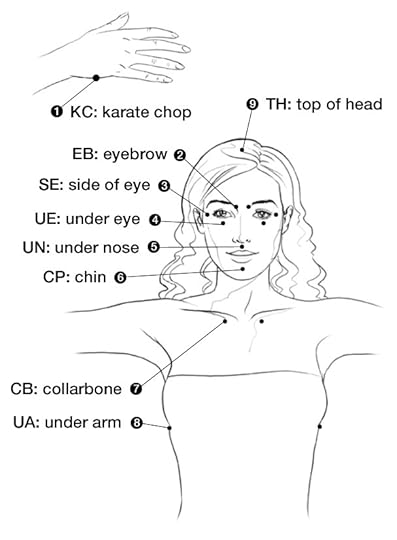
Karate Chop: Even though I’ve held on to beliefs that have held me back, I love and accept myself. (Repeat three times.)
Eyebrow: All these limiting beliefs . . .
Side of Eye: I thought they were�facts.
Under Eye: Many of them have been passed down from my parents . . .
Under Nose: Or from my culture . . .
Chin: “If it’s not hard, it’s not worth it” . . .
Collarbone: “I’m just unlucky” . . .
Under Arm: “I have bad genes” . . .
Top of Head: “I don’t follow through” . . .
Eyebrow: These old beliefs . . .
Side of Eye: I’ve been repeating them to myself.
Under Eye: These beliefs don’t have power.
Under Nose: I’ve been giving them power with my attention.
Chin: I allow myself to question everything.
Collarbone: Is this really true?
Under Arm: Is this really what I� believe?
Top of Head: I stay open and curious.
Eyebrow: I logically know they aren’t true . . .
Side of Eye: But they feel true.
Under Eye: Acknowledging this feeling . . .
Under Nose: I’ve lived with them for so long.
Chin: I thought it was just who I �was . . .
Collarbone: But it’s a feeling . . .
Under Arm: And feelings can change.
Top of Head: I accept myself even with all these feelings.
Page 122
Eyebrow: When I take time to notice these beliefs . . .
Side of Eye: I tap on them individually.
Under Eye: I have the power to choose what I believe.
Under Nose: If that old belief creeps up . . .
Chin: I tap on the emotion this old belief elicits.
Collarbone: I feel calm and con�dent . . .
Under Arm: I remember it’s just a �thought.
Top of Head: And then I choose a� different thought.
Eyebrow: I consciously choose what I believe.
Side of Eye: I believe being healthy is empowering.
Under Eye: Life is meant to be enjoyed.
Under Nose: Health is an expression of that joy.
Chin: I can achieve my goals.
Collarbone: My body is supporting me.
Under Arm: I have so much to be grateful for.
Top of Head: I possess every quality needed to live an extraordinary life.
Fill in the last round yourself! What do you now choose to believe about yourself?
I am . . .
Adventurous
Con�dent
Determined
Enough
Intelligent
Passionate
Smart
Strong
Unstoppable
Worthy
Eyebrow: I am ___________________
Side of Eye: I am ________________
Under Eye: I am _________________
Under Nose: I am ________________
Chin: I am _______________________
Collarbone: I am ________________
Under Arm: I am ________________
Top of Head: I am _______________
Page 123
 Get “The Tapping Solution for Weight Loss & Body Confidence” With The Special Book Launch Bonuses
 Click Here to Learn More About The Book Or Follow The Simple Steps Below To Order The Book Today and Claim Your Free Gifts.
 Click on a button below to order today, at a discounted price, from:

 Return and click here with your order info to claim your FREE GIFTS!
100% of Jessica Ortner’s Royalties on The First 5,000 Copies Ordered Will Go To The Tapping Solution Foundation (Click Here For More Details)
The post Sneak Peek: The Tapping Solution Weight Loss and Body Confidence Chapter 6 appeared first on The Tapping Solution.
Related posts:
The Tapping Solution Sneak Peek! – Chapter 7: Releasing Physical Pain
Weight Loss with Tapping in 2014
An update on The Tapping Solution Foundation from Newtown, CT


May 2, 2014
Who you spend time with…
 Who you spend time with… is who you become.
I first heard this quote and concept over 15 years ago at a Tony Robbins weekend event.
I was there by myself, having seen an advertisement for it while walking the streets of New York where I lived, and knowing I needed to do something different with my life.
Amongst many insights that weekend, “Who you spend time with is who you become” was powerful for me, but I also found it difficult to implement.
You might have heard this quote, or similar concepts, including research showing that your income often has a direct correlation with your five closest friends.
So what’s going on here? And how do we manage choices and decisions about what to do when we have an awareness of this concept?
Here are some of the challenges and solutions as I see them:
1. Maybe the people around you are not the best influence, but you love them, and you’re a good friend, so what do you do?
2. What about family? Does this idea tell you to leave family members who aren’t a positive influence in the dust, because they’re not helping you?
3. Where do you find new friends and positive influence anyway? Is there a special club or secret meeting place?
.
(Continued from Email…)
Ok, so let’s address the different questions:
Question #1: Maybe the people around you are not the best influence, but you love them, and you’re a good friend, so what do you do?

I fully believe in this concept, but I think the key is to address and implement it with moderation and compassion. Too often we learn something like this and see it as a black or white issue. This person is negative, so I’m not talking to them anymore! That friend has really poor beliefs about money, so I’m out!
And the challenge with going all out on it is that often these same people, the ones closest to you, the ones you love, are exactly the ones who can help you grow the most!
For example, let’s say you have a friend who has really negative beliefs about money. You’re trying to change your experience with money, rewrite old limiting beliefs and stuck patterns, (like we’re doing in my 7 week financial program right now – we’re on week 2, but you can still join and catch up, listen later, etc. if you’re interested go here) but whenever you’re around this person, they’re negative, they doubt what you’re doing and it brings you down.
What to do? I think it’s a multi-step approach:
Step 1: TAP on how that person makes you feel.
If they’re really pushing your buttons, it means there are buttons to be pushed! It means some part of you isn’t fully aligned or confident about your new beliefs or ideas. So them triggering you is a perfect opportunity to tap down that fear, stress and anxiety.
A simple way to tap, shortly after a negative experience, is to simply imagine it happening in your mind’s eye again. Hear what they see, feel what you felt, be there, tuned in to your body, and acknowledge what it’s triggering inside you. Keep tapping until you can run the “movie” without emotional attachment. You might even find that the movie changes as you tap along and gain confidence about your beliefs.
Step 2: Pay attention to how circumstances and people change when YOU change.
You’ll often find that after doing the tapping, when you encounter that person or a similar circumstance again, things change! We often have these pre-conceived notions of how people are going to act, what they’re going to say, and that can guide the conversation in seen and unseen ways. Pay attention to how circumstances and people change when YOU change.
Step 3: If you’re still being triggered, consider some space from them.
If you’re doing the tapping, but these individuals are still triggering you too much, still bringing you down, then perhaps it is time to consider some space from them. But here’s the KEY: I want you to make that consideration from a place of clarity, of peace, of compassion…not from a place of fear, of “I have to run away from this person”. Making the choice from a place of peace and clarity will make all the difference in your outcome.
.
Question #2: What about family? Does this idea tell you to leave family members who aren’t a positive influence in the dust, because they’re not helping you?

I had an interesting tapping session the other day, as part of working on my next book focused on pain relief, with a lady who had some neck pain that just wouldn’t go away. She had actually used tapping to completely eliminate back pain she had had for years, but the neck pain wouldn’t seem to go.
After drilling down with some power questions: “If there was an emotion in your neck, what would it be?” “If someone was in your neck, who would it be?” she shared some of the challenges she’s having with her 89 year old father.
She’s his primary caretaker, and they live together, and she shared that whenever she tried to tell him about all the great, new and exciting things happening in her life, he was constantly doubting her, questioning what she was doing, and making her feel terrible.
So what to do here? Kick Dad out on the street because he’s not being positive enough? Of course not. So we tapped! Focusing on the things he said to her, I had her imagine what he would say, and say it out loud, simply tapping through the points, using his tone of voice, using his exact language, and tuning in to how it made her feel.
Point by point, statement by statement, she released all the stress, anxiety, sadness and anger that his statements caused her. As often happens, after the first layer, we found some deeper pain, some real sadness about the relationship and how he was making her feel.
After 10-15 minutes of tapping, she shared how much lighter she felt and how she could now imagine him saying those things, without the same response from her. In fact, she started connecting with the love she felt for him, and you could see a real possibility of the relationship improving just from this small tapping session.
And… the reason we started tapping in the first place, her neck pain, was COMPLETELY gone. Down to a zero, no pain, no restricted motion!
So what does this mean for you?
It means these relationships, this pain, this anger, sadness, betrayal, fear, is a wonderful opportunity for healing. There are absolutely times when people and relationships are simply too toxic and we need to move away from them. There are absolutely times when we need to be aware of who we spend time with, to avoid burning ourselves out, to have boundaries, to make clear decisions about ourselves and our energy.
But what I’m suggesting is that you do the tapping FIRST, clear the hurt, the anger, the sadness, and then, from that place of forgiveness, compassion, clarity and more, from THERE, you make the best decision for yourself.
.
Question #3: Where do you find new friends and positive influence anyway? Is there a special club or secret meeting place?

A. Weekend Getaways Change Lives! Just like that weekend 15 years ago where I surrounded myself with positive people, made new friends and made new decisions about my life, I’ve found that weekend events, when you change your environment for a weekend, get a new perspective, learn new information and more, can be dramatically powerful.
I just spent this past weekend in Ft. Lauderdale and saw it all happen again, not only for the 3,000 people in the audience, but for myself! The Hay House “I Can Do It!” events aren’t just great for me when I’m on stage and connecting with YOU, they also nurture and feed my soul when I get to connect with other speakers and friends.
So make that choice to do something different, to show up for a weekend or a day, and connect with new people. It can be exactly what you need! And it can be a weekend about ANYTHING! It doesn’t have to be about personal growth, whatever your interests are, get out there, out of your comfort zone and go! If you’d like to join me at one of these events this year, I’ll be speaking in Austin (details here), Pasadena (details here), and New York (details here).
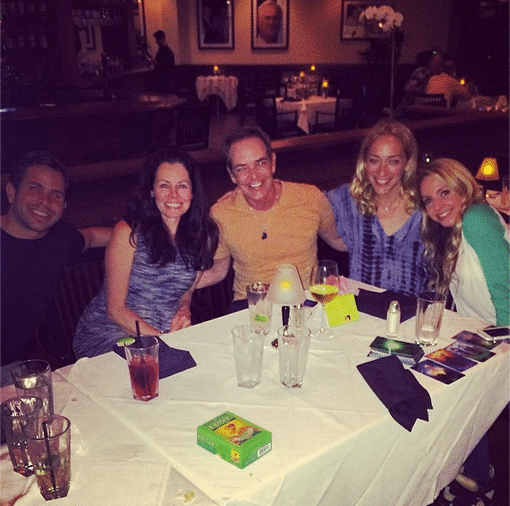
Having dinner at the recent Hay House “I Can Do It” event with friends Cheryl Richardson, John Holland, Kris Carr and Gabby Bernstein.
B. A Getaway On Your iPod:
Surrounded by grumpy people who don’t believe in you and your dreams? Besides doing everything else we’ve talked about, make some new friends on your iPod.
Yes, it’s not the same kind of friendship and relationship, but getting positive, uplifting information can be truly life-changing. I know it has been for me. Besides tapping, I credit my iPod as perhaps the most transformative tool for me, because of the hours, days, weeks, months and years spent listening to positive information.
And hey, I started listening to Wayne Dyer, Caroline Myss, Louise Hay and others on my iPod YEARS before they became my actual, real, huggable physical friends. So who knows what can happen!
C. Give Books as Gifts:
It’s hard to “convince” your friends about your new ideas, and you’re certainly not going to CHANGE them, all by yourself. But you can NUDGE them in the right direction, and books can be a great way to do that.
If you’re looking to lose a few pounds this Spring, and want a friend to support you, pick up a copy of Jessica’s new book (The Tapping Solution for Weight Loss and Body Confidence) for them and read it together (details here or click on the banner below). Start a small book club and find people who will support you in your journey.
.
I hope you found these thoughts and tips helpful. Share your experiences with “Who you spend time with is who you become” below, and let me know what you learned from these tips and any questions you may have!
.
.
.
The post Who you spend time with… appeared first on The Tapping Solution.
April 30, 2014
Tapping video on the pressure of dieting
If you’ve ever looked at a peace of food and thought “I shouldn’t eat that,” even when you wanted to, then you know the stress and pressure that comes with choosing what foods to eat and what not to eat in our diet.
For most people, trying to maintain a healthy diet is a constant struggle that brings with it a lot of every day pressure.
My sister Jessica recorded a great video where she shares how Tapping can help you with the stress and pressure around eating a healthy diet, whether it be for shedding pounds, maintaining a healthy we*ght, or just for overall health.
In the video she also has a great tapping sequence where you can tap along with her to help you with any pressure you may be dealing with around food and dieting. I think that after tapping with her, you’ll feel a little more relaxed.
You can see it here:
What is your relationship with food like? Do you feel stress and pressure around food? How did you feel after doing the Tapping? Leave your comments below.
The post Tapping video on the pressure of dieting appeared first on The Tapping Solution.
Related posts:
This hilarious video has some profound truth…
The Real Deal About Food, Stress, Tapping and more…
This Video is THAT good…
April 11, 2014
The Stories You Tell
On this lovely Spring Saturday in Connecticut, I figured I’d share with you a short excerpt from my NY Times bestselling book, “The Tapping Solution…”
.
“Lauren, a mother of two from Colorado, was struggling with some issues around her marriage, her weight, and generally feeling overwhelmed and depression. She began our session together by telling me what was going on in her life.
For 20 minutes straight, with barely a pause to catch a breath, she told me her story, focusing on a big, dramatic situation around work. I tried to interrupt her a few times to ask her how she felt, but I could barely get a word in.
Eventually, I put my hand up like a stop sign. That got a pause, and I lovingly but firmly said, “Lauren, no more stories. This is all one big, dramatic story, and it’s not you.”
She instantly got it. She stopped, took a deep breath, and said, “Oh, my God . . . all I do is tell these stories.”
The issue wasn’t what she was sharing with me; it was that she was so invested in her story. She had told it again and again—had thought about it over and over—and was replaying the same scenarios each time. She was not connecting with her feelings about the situation, and she was telling the story not from a place of analyzing it or looking for a solution, but rather for the sake of the story itself.
We all get caught up in our own personal soap operas, with their characters, drama, and rights and wrongs. We tell stories where other people have “done things” to us. Where the world is treating us harshly and no justice seems to be served. We tell stories that are full of anger, heartache, jealousy, fear, and every other negative emotion. We tell these stories to validate what we’ve done and what other people have done to us.
But after we’ve told these stories, what do we have? What have we gained?
.
Part Two – Continuation from Email
Lauren’s life wasn’t going to change unless she stopped telling those same stories again and again. Now that she recognized that, we went on to tap on her habit of telling stories—rather than the issue about work, which is what she’d originally come to me about. We used these statements:
Even though I keep telling these stories, and I’m all caught up in the drama, I deeply and completely accept myself.
Even though I keep running the same patterns again and again, I deeply and completely accept myself.
We then focused the tapping on her emotions about the story. It’s not about ignoring the story altogether, it’s about processing it in a positive direction. So when I asked Lauren how she felt about what was going on, she was able to slow down, connect with her heart, and say, “I feel like all this drama is about other people, the things I do for them. I feel resentful. I never put myself first.”
This was a big life issue for Lauren, and we explored other places in her life where she wasn’t taking care of herself, where she was putting others first and both parties were suffering for it. You know how, when on a plane, you’re told to put on your own oxygen mask before helping someone else? It was true in Lauren’s life. She recognized she needed to prioritize herself before giving to others. But would she actually do it?
One of the exciting things about EFT is its flexibility. It can be very successfully combined with other systems and processes, including guided visualization. I decided to try a combination with Lauren.
I told her that it sounded like she was running a computer program called Putting Other People First, and asked her if she would like to install a new program called Putting Lauren First. She instantly connected to the analogy and agreed she was running the wrong program and was ready to try something new.
Through a guided, closed-eye visualization, where she continued to tap through all the points, I took her through “uninstalling” her old program and “installing” the new program. The mind works in mysterious ways; I don’t know why, but again and again, I’ve gotten great results from walking a client through such a process. Step by step, Lauren removed all the old files—her old habits—and installed new, healthier ones.
Did it work? We had met on a Friday, and here’s a portion of the e-mail I got from her on Monday:
It was a great weekend. . . . The coaching session helped catapult me into a new place! I have a new perspective of myself and others around me. It’s like what I know in my mind “meshed with” what I feel in my heart. Some kind of true aligning. Before, I knew a lot in my mind, and I knew what I wanted to feel in my heart, but had a hard time bringing the two together. Now . . . there is no gap between what I know is right for me and feeling it is right for me. The emotion is aligned with the decisions in my head!
Looks like Lauren is telling a different story!
Ask Yourself . . . Questions about Your Story
What are the stories you’re telling that you want to let go of?
What’s the new story you want to tell about yourself and your life?
What are the old programs you’re running that you want to delete?
What are the new programs you want to install?”
The post The Stories You Tell appeared first on The Tapping Solution.
March 27, 2014
The Art Of Being Really Bad At Something
 So many books and blogs are focused on how to be better at something but fail to share an equally important skill, what I like to playfully call “The art of being really bad at something.” ☺
You see, to truly master something we need to be okay with spending time NOT being a master at it. This is where many of us get stuck. We put so much pressure on ourselves to be perfect, oftentimes unconsciously, that we don’t create the space necessary to grow. We also miss all the joy that comes from trying something new.
The Promise…
Two years ago, on my birthday, I told my good friend that I wanted to become a better cook. Sure, I could make simple dishes and feed myself but cooking for a group of people was a different story. So the night of my birthday I promised my friend that before my following birthday I would host a dinner party and cook for all my friends.
The year past quickly and I reluctantly scheduled the party the week before my birthday. The night of the dinner party I found myself standing in the grocery store feeling like the aisles were closing in on me. I felt completely overwhelmed. I walked home empty handed, picked up the phone and ordered delivery.
I made jokes about it with my friends, I talked about how busy I had been and how cooking was just not my thing. The truth was that I broke my promise to my friend (and to myself) and I didn’t feel good about it. I wondered, “Why I am so reluctant to become a better cook?”
The Barrier…
I realized my biggest barrier was my own critical voice. I was scared of being bad at something. If I made one mistake I would spiral into frustration and drain the learning experience of any joy. I needed to learn the art of being bad at something!
That began by using tapping to quiet my critical voice. I would catch my critical voice and simply tap for a few rounds as I stood in my kitchen.
Do you ever notice your critical voice when you make mistakes? Mine would say, “ugh, you’re so stupid!” or “I can’t believe you just did that!” I realized I was letting a mean girl rent room in my head and it was time to kick her to the curb with tapping.
I began by tapping while allowing that mean girl to vent. After a few rounds of tapping I noticed that I could say those words without feeling any stress in my body. From that place I was able to choose a better way of thinking and actually learn something from my mistake that really helped me the next time around.
I bought a bunch of cookbooks and I began practicing my new art, and not just my new art of cooking, but more importantly my new art of being really bad at something! I was really good at being really bad at cooking! ☺ I burned food (and my fingers), I measured things incorrectly and managed to catch a kitchen towel on fire.
And you know what? I loved every minute of it! By quieting my critical voice, letting go of the pressure to be perfect and allowing myself to just be bad at something, I realized I was getting better every day!
Success!
 If you follow me on Facebook you know that I finally did host that dinner party and I had a great time. Was I perfect? Nope.
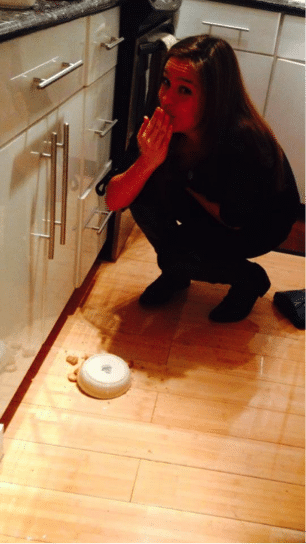
While enthusiastically telling a story I managed to smack the mini apple crisp that was cooling on my counter, leading to it’s untimely death on my kitchen floor (picture to the right). My critical voice didn’t even show up and we all just busted into laughter!
Now I host a dinner party at least once a month. Each time I have my friends together I realize how grateful I am that I discovered the art of being bad at something because it gave me the opportunity to be good at it.
If I had let my own critical voice stop me I would have missed out on all these nights of having friends I love around my dining room table, enjoying a delicious home cooked meal while creating memories that we’ll always cherish.
So I invite you to use tapping to quiet your critical voice and go out and practice the art of being really bad at something!
I think I’m going to try pottery next!
How about you?
.
Tapping Script to quiet your critical voice
(so you can have fun being bad at something!)
To learn the tapping points go here
Karate chop – Even though I’m really bad at this, I love and accept myself and I’m open to making this fun.
Karate chop - Even though I’m really bad at this, I love and accept myself and I’m open to making this fun.
Karate chop – Even though I’m really bad at this, I love and accept myself and I’m open to making this fun.
Eyebrow – I’m so bad at this!
Side of eye - It’s so frustrating
Under eye – I can’t believe I keep messing up
Under nose – I’m so stupid
Chin – It seems easy for everyone else
Collarbone – What’s wrong with me?
Underarm – It’s safe to notice this critical
Top of head – And to let it go
Eyebrow – This pressure I put on myself
Side of eye – This fear of what others will say
Under eye – This fear of my own critical voice
Under nose – This pressure to be perfect
Chin – It’s exhausting
Collarbone – Good never feels good enough
Underarm – When this critical voice is in control
Top of head – I’m ready to take my power back
Eyebrow – I can hear this critical voice…
Side of eye – And simply smile.
Under eye – Because it’s a silly little voice
Under nose – I allow myself to listen to a new voice
Chin – I’m exactly where I’m meant to be
Collarbone – I can enjoy this process
Underarm – It’s fun to be bad at something
Top of head - I enjoy the excitement of trying something new!
Eyebrow – There is power in laughter
Side of eye – I laugh at my mistakes
Under eye – I let go of any frustration
Under nose – And hold on to the lessons
Chin – I give myself permission to be bad at something
Collarbone – And to enjoy the process
Underarm – I am patient and loving
Top of head - I am free to just be me!
The post The Art Of Being Really Bad At Something appeared first on The Tapping Solution.
January 27, 2014
This hilarious video has some profound truth…
 I want to share a video with you today to both make you laugh as well as to make you think about how you process your emotions (or what you do to avoid dealing with them).
This video, which is just under 5 minutes long, has some profound truth, but it comes through a person and a message style that you typically wouldn’t see.
The video is of the comedian Louis C.K. in one of his appearances on the Conan O’Brian Show. Before you watch it though I want to warn you, if you are at all offended by strong language please do not watch this video. Louis C.K. is known for strong and sometimes offensive language, and in this video he lives up to that reputation.
If you like his style, you’ll laugh, and if you don’t, just look beyond his comedic style to the underlying message of how we oftentimes process (or don’t process) our emotions in modern society. Here are some of my favorite insightful lines from the video (these are not the funny ones):
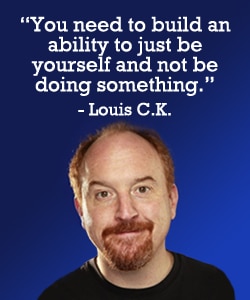
- At around 1 minute: “You need to build an ability to just be yourself and not be doing something.
- At around 3:50: “I cried so much and it was beautiful…It was poetic…I was grateful to be sad, and then I met it with true profound happiness.”
After you watch, read the additional feedback I share underneath the video. I’ll share with you where I agree and disagree with Louis’ take:
A couple of additional comments:
1 – His message at about 10 seconds about kids not having cell phones even though other kids do, although delivered with strong language, is an important one. It takes courage to not just “follow the heard,” both as a parent and as a kid.
My brother recently told me that his son asks him why he shouldn’t eat certain foods (typically sugary processed foods) when all the other kids at school do. And he tells him that it’s because they aren’t educated on what’s in those foods and how it affects their body.
But he makes sure to be clear that those other kids are not wrong, and that his son is not different, but rather that in his family they make different and important choices about taking care of themselves that take a lot of courage to do. He ingrains a belief in being courageous and being willing to go against the trend when needed with his kids. Doing so, takes courage as a parent and as a kid. Being a good parent requires making important decisions for your kids, even when they’re not popular. Just some food for thought for all the parents out there…
2 – While I like what Louis says about taking the time to just be, I don’t agree with several opinions he has like that “it’s all for nothing and you’re alone” or that “life is tremendously sad.”
I do believe that these feeling can of course come up, but that it’s because of underlying emotions of feeling alone, sad about past experiences or current circumstances, or a number of other challenges. You do not have to feel like this though. You can tap through these challenges and connect with yourself, with the people in your life and with God (in whatever form that is for you).
.
What did you think of the video? Do you use texting, social media, food, or anything else to avoid dealing with emotions? Are you taking the time to just be? Are you taking the time to sit and meditate, or sit and tap? Share your thoughts below.
.
.
The post This hilarious video has some profound truth… appeared first on The Tapping Solution.
January 22, 2014
Bits and Pieces!
 I hope you’re having a wonderful week. We’ve had a ton of snow fall here in Connecticut, which makes for perfect book writing weather!
I’ve been working on my next book, The Tapping Solution for Pain Relief, due out in April of 2015. Before then, Jessica will be bringing you The Tapping Solution for Weight Loss and Body Confidence, published by Hay House and released this coming May.
I know how busy everyone is these days, so today I thought I’d share some “bite-sized” bits and pieces of info that you might find useful for your life. Let me know what you think and if you find this format helpful. :)
Let me know if you find this format helpful by commenting below.
.
.
Tapping Tip: Standing Out in the World
 If you want to stand out in the world, prepare to have SOME critics. Especially in this day and age, where everyone online has a voice and can easily spend 30 seconds ranting about what they don’t like about you, it’s going to happen!
And that’s OK, because if you’re aligned with your purpose, with your message, with what you want to accomplish in your life and the world, you can see the criticism as a solid example of the fact that you’re getting out there. You can also use tapping to clear this fear of criticism.
Here’s an easy way:
1. Imagine you are out in the world, the way you want to be. That might mean your book is published, you’ve got that promotion, you’re doing whatever it is you most desire. Imagine it fully and feel it in your body.
2. Pay attention to the “oh, ohs…” that come up when you have this vision. You might see people criticizing you (or it could be a different issue altogether). Tap through the points, simply imagining your goal coming true, and whatever tension or stress comes up in your body when you do so. Keep tapping, imagining, feeling it, until you feel the resistance clear.
What’s getting in your way of success? Have you tapped on it?
.
.
“Fearful Memories Passed Down to Mouse Descendants”
 In what is sometimes considered by outsiders of our “woo-woo” world of healing, we know intuitively the great influence that our ancestors can have on our current experience.
Now science is telling us we’ve been right all along! Use this knowledge to your benefit, tap to clear out genetic imprints!
This means that if you know your mother or father had a particular traumatic experience or time period of fear, scarcity, anxiety or whatever else, you can tap to clear that from your body. Play with it and let me know what you experience!
It’s OK if you don’t know the exact details, just guess at what they may have experienced, guess based on what you know and see what happens. 
Read more here:
.
.
Around the World!
Writing a book and having it do so well is obviously incredibly personally fulfilling, but I think my favorite part is seeing these foreign translations come in! It’s just outright fun!
I never know what the cover is going to look like, what language is next, but I get these little treats in the mail and can imagine people around the world sitting down, reading the book, and tapping.
Here’s a picture of the Bulgarian and Czech editions.

.
.
The Tapping Solution Foundation Update
 This past weekend in Newtown, CT, Dr. Lori Leyden, director of the Foundation, and our lead trainers Jondi Whitis and Jade Barbee, led 27 people through a 2 day training on EFT.
We’ve trained over 150 people directly involved in helping people heal from the tragedy, but this group was an especially powerful one, including a CT state trooper who is going to bring it back to his colleagues, a teacher from Sandy Hook Elementary who is implementing daily tapping in her classroom, local psychologists and psychiatrists and more.
It’s thrilling to see that tapping is being accepted in such a profound way by the community.
In 2014, we’ll be sharing more resources with you as to how to bring tapping into your communities, including information on pilot programs in schools we’re currently running (and how you can run them as well), our work in prisons, and much more. If you’re already making progress sharing tapping with groups and communities like this, we’d love to hear about it! Email Lori@tappingsolutionfoundation.org and let us know what you’re up to. Thank you for your continued support!
.
Leave us your comments below
.
.
The post Bits and Pieces! appeared first on The Tapping Solution.
January 13, 2014
Tapping Script – “I Refuse to Forgive”
 Here’s a tapping script you might find useful on: ”I refuse to forgive them because of what they did to me…”What better way to start off 2014 than by letting go!We all know about the power of forgiveness, but oftentimes our primitive brain, the part of us that is designed to keep us safe, to make sure we don’t get hurt again, refuses to let go.
Here’s a tapping script to help with that. First, identify who or what you are having trouble forgiving. Get really specific on what happened, what they said, what they did, how they acted, and bring that memory to mind.
How do you feel when you think of that? What’s the emotion? Where do you feel it in your body? Give it an intensity on a 0-10 scale, 10 being the most intense. (If you can, write down what you’re feeling and the number, it helps to be able to track your progress)
Then let’s do some tapping! (If you’re not familiar with the tapping process, you can learn more here: http://www.thetappingsolution.com/what-is-eft-tapping/)
Karate Chop: Even though I refuse to forgive them because of what they did to me…I deeply love and accept myself…
Karate Chop: Even though I refuse to forgive them because of what they did to me…I deeply love and accept myself…
Karate Chop: Even though I refuse to forgive them because of what they did to me…I deeply love and accept myself…
Eyebrow: I can’t believe they did that…
Side of Eye: I’m so angry…
Under Eye: It’s not right…
Under Nose: It’s not fair…
Under Mouth: And I refuse to let it go…
Collarbone: All this anger…
Under Arm: All this ____ (fill in the blank with how you feel)
Top of Head: In every cell of my body…
Eyebrow: I just can’t let this go…
Side of Eye: Because they don’t deserve that…
Under Eye: They don’t deserve my forgiveness…
Under Nose: And I refuse to let it go…
Under Mouth: So much anger..
Collarbone: About what happened…
Under Arm: About what they did…
Top of Head: About what they said…
Keep tapping on the “negative” or the “truth,” until you find that the intensity has lessened enough that you can say some positive statements, and have them feel fully or at least somewhat true. We tap on the “negative” first in order to clear this resistance, not to affirm it, but to open up the door for positive thoughts.
Eyebrow: Maybe it’s time to let this go…
Side of Eye: I wonder if I can let this go…
Under Eye: What if I can let part of this go…
Under Nose: Releasing this anger…
Under Mouth: From every cell of my body…
Collarbone: Letting it go…
Under Arm: Letting it all go…
Top of Head: Right now…
Tap through a couple of rounds of positive statements and feel free to add in your own words or affirmations. These are just guidelines to get you started, what’s most important is that you feel the feeling, get specific about what you experienced, and tap until it’s released.
When you’re done tapping, take a deep breath…and let it go. Think of what happened again, and notice how it’s changed. Write down your new number of intensity. Either stop tapping if you’re at a good place, or keep tapping until it’s fully released.
What was your experience with this process? How good does it feel to forgive and let go? Share this with someone that you know needs it. Comment below.
The post Tapping Script – “I Refuse to Forgive” appeared first on The Tapping Solution.
Related posts:
The Real Deal About Food, Stress, Tapping and more…
The ONE most important thing I’ve learned…
The Problem with Patience…
January 3, 2014
Weight Loss with Tapping in 2014
I hope you had a wonderful New Year’s Eve and have had a great start to 2014! I spent a amazing evening with friends and family and am so excited by what 2014 might bring us all.
To help you get started on a spectacular 2014, Jessica has put together a short blog post and a powerful tapping meditation for those of you who are looking to drop a few pounds and get healthier in 2014. It’s a radical new approach that goes beyond resolutions and the usual New Year’s “schtick.”
These 3 simple tips and the meditation that goes with it could make ALL the difference this year. Here’s the full article:
Weight Loss with Tapping in 2014

December is filled with celebratory foods and drinks that are good for our spirit but not so good for our waistline. Come January 1st the joy and carefree spirit of the holidays leave us and a drill sergeant moves into our head and tells us the fun is over and it’s time to diet.
This was the pattern I ran for years… and years. A new year equaled a new diet. Sure, the drill sergeant in my head made me feel awful but isn’t that what it takes to get results? It took me a long time to realize this approach doesn’t flatten my stomach but simply flattens my self-worth. You probably know that. How many times have you started a new year with a new diet only to find yourself in the last few weeks of January saying “I give up. This is too hard. Nothing works for me.” You then feel worse than when you started. The truth is, long-term weight loss is not possible or sustainable unless we make it pleasurable. We can’t make it pleasurable unless we tap away our self judgments and critical voice.
Here are a few tips to help you make 2014 your healthiest year yet.
At the end of this post you’ll find a tapping meditation that will help you incorporate all these tips.
1. Leave the pattern of panic behind
When we begin to panic about our weight the part of our brain called the amygdala begins to fire off the fight-or-flight response. This creates an overproduction of the hormone called cortisol. Studies have shown that an overproduction of cortisol increases appetite, sugar cravings and is directly linked to abdominal obesity. That drill sergeant isn’t helping you, it’s making you fat!
The best way to kick that drill sergeant out of your head is to give it a voice while you tap. It’s really that simply. When you are able to become aware of you self-criticism and tap while speaking it to yourself, you’ll find that you can hear those words without feeling the physical sensation of anxiety. From that place you can choose a more loving thought and action that supports you
2. Forgive yourself
So your biggest arm work out this holiday season was opening a bottle of wine? The past is in the past. Next year you can learn healthier recipes and strategies to help support your body during the holidays. Beating yourself up over your past actions doesn’t prevent them from happening again, it simply robs you of the power in the present moment to make a change. Be gentle with yourself. Forgive.
3. Fall in love with the journey
 If we focus on a strict goal with some made up deadline we then try to panic ourselves there by eating in a manner that’s restrictive and lacks joy. Un-pleasurable equals unsustainable. For real lasting weight loss we need to fall in love with the journey because health isn’t a destination but a decision we make every moment.
This isn’t really about a weight loss goal, this is about you showing up as your best self in 2014. It’s about eating foods that you love and help you thrive. It’s about moving your body because when there is movement in your body there is movement in your life. It’s about taking care of yourself because you have a deep appreciation for the amazing person you are. Once we fall in love with this process the results are better than we could have imagined.
Here is a tapping mediation to help you incorporate these three keys to create lasting weight loss with Tapping in the New Year:
Right click and save here to download this audio
From everyone here at the tapping solution, we wish you a happy and healthy 2014.
With Love,
Jessica
P.S. – Come this May I’m coming out with a new book, “The Tapping Solution for Weight Loss and Body Confidence.” Watch this space. A lot more tapping goodness is on it’s way from me. ☺
The post Weight Loss with Tapping in 2014 appeared first on The Tapping Solution.
Related posts:
Special Tapping Insiders Club Interview with Carol Look
Wedding Bells and Tapping for Jet Lag
What Mindfulness Meditation and EFT Have in Common
November 25, 2013
Our Vets, My Congressman Friend Tim Ryan and Why We Need You!
 If I showed you the picture to the right, would you think to yourself…”That’s obviously a congressman meditating”? Of course not…but it is!
In the past year, through my speaking at live Hay House events, I’ve had the distinct pleasure of meeting a remarkable man, Congressman Tim Ryan (D-Ohio)
(and please ignore the Democrat or Republican aspect of this discussion, this goes WAY beyond that).
Congressman Ryan is the author of “A Mindful Nation,” a beautiful book about bringing mindfulness into our daily lives, into our institutions, even into Congress! (Can you imagine…?!)
And unlike most congressmen, he’d rather you see a picture of him meditating than the regular cheesy and fake political picture. You know…kissing a baby, shaking hands with a president, speaking in front of a podium. All those typical things that make you go “eh…another politician!”
I’ve been sharing EFT Tapping with the Congressman, actually giving him his first experience one late night after a speaking event, in a bar! (You gotta tap wherever you can!)
As a consequence, he’s been a big supporter of our work in bringing this powerful technique to veterans with PTSD.
He even went as far as sending a letter to Eric Shinseki, Secretary of State for Veterans Affairs, suggesting that EFT be adopted by the Veterans Administration (VA) to support the estimated one million US veterans struggling with PTSD. (Click here to read his letter.)
Today I want to share a casual interview with you that my sister Jessica did with Congressman Ryan, about both his new book and about how he wants to change the political landscape. I think you’ll really enjoy this, and again, it’s not about Democrat or Republican, it’s about mindfulness. Here it is:
Click Here to Watch This Video On YouTube
If you want to pick up a copy of Tim Ryan’s great book, A Mindful Nation, you can do so here:
www.thetappingsolution.com/ts/a-mindful-nation
Also, you can listen to a wonderful presentation by Dawson Church that speaks directly to the work that’s being done with veterans, and why tapping is such a powerful tool for treating PTSD:
https://s3.amazonaws.com/vet-stress-project/A_World_Without_PTSD_Dawson_Church.mp3
Dr. Dawson Church and Dr. David Feinstein have done remarkable work the past several years, both on the research side and on petitioning Congress, to try to get EFT accepted on a bigger level.
I’m letting you know about all this for several reasons:
A. I believe it’s inspiring to hear that change is happening, and that this technique that you’re using at home to change your life has the possibility to transform veterans’ experiences with PTSD. You’re a part of something special.
B. If you or someone you love is a veteran suffering from PTSD, Tapping can help. Please see: http://stressproject.org/ for more details or pick up a copy of the documentary Operation Emotional Freedom here:

www.thetappingsolution.com/ts/operation-emotional-freedom
C. The Tapping Solution Foundation is actively working on all these efforts. If you’d like to support it financially so that it can continue spreading this work, you can do so here: www.tappingsolutionfoundation.org/donate/
I hope this inspires you as much as it does me!
Until next time…keep doing your part to heal the world by healing yourself!
Nick Ortner
 P.S. – Speaking of amazing congressman…you might have heard the buzz about best-selling author and speaker, Marianne Williamson announcing her candidacy for the United States Congress!
Now I don’t normally write about politics in any way but with this email I’m talking about two politicians! But the reason I’m sharing is that both of these people are about changing the current political landscape which has become so inhospitable.
I had a chance to sit down with Marianne a few months ago, and she shared with me not only that she was going to run, but shared her vision for transforming politics from the inside out.
I don’t need to tell you about the level of dysfunction that exists in politics, from both sides of the aisle, but I do believe there are always solutions out there (like Congressman Tim Ryan!) and Marianne and her inspiring message and vision can be part of that change.
She’s running as an independent with a fresh message of change, and she needs your support. Take a few minutes to learn more about what she’s doing, and if it feels right for you, donate a few (or many!) bucks to support what she’s doing, volunteer, or find another way to get involved! Just press play below and check out this amazing video to learn more:
Click Here to Watch This Video On YouTube
The post Our Vets, My Congressman Friend Tim Ryan and Why We Need You! appeared first on The Tapping Solution.