Michaela Haas's Blog, page 6
January 7, 2013
The F Word in Buddhism: 'Daughters of the Buddha' Discuss How Buddhist Women Can Achieve Equality
Patricia Zenn already had a religion when she grew up in Malibu: surfing. But as she was constantly teased by her classmates about her family name ("Are you Buddhist or what?"), curiosity led her to borrow a book about Buddhism when she was only 11 years old. To her surprise, she instantly realized "this was it!"
Fast forward to 1977, when she was in her early 30s, the Sixteenth Gyalwa Karmapa ordained her in the Tibetan Buddhist tradition and gave her the Tibetan name Karma Lekshe Tsomo. Very fittingly, "Lekshe" means "eloquent." Venerable Lekshe quickly realized that conditions for Buddhist nuns were dire. She single-handedly started a movement to give Himalayan nuns access to education. At the time, more than 30 years ago, this idea was, at best, treated as a waste of time, or even discouraged by the established monasteries.
"They're telling the nuns, 'Oh, you're so humble, you're not interested in gaining prestige and power like these Westerners,'" Lekshe says with a calm voice but a quizzical look. "Well, I just wonder why they are not telling the monks that. If women are perpetually disadvantaged, this is what you end up with. Surveys show that the nuns' health is by far the worst of any group. Their educational standards are by far the worst too. There is a lot of work to be done, and awareness raising, especially among women."
Karma Lekshe Tsomo set out to develop a network of supporters, even at the risk of her own life and cost to her health. Along with her late teacher Freda Bedi and her friend Jetsunma Tenzin Palmo, she is among the earliest and fiercest advocates for the education of Tibetan nuns. Karma Lekshe Tsomo is the president of Sakyadhita ("Daughters of the Buddha"), the most important international association of Buddhist women, and of Jamyang Foundation, a non-profit dedicated to the education of Himalayan women.
I am often surprised how few Buddhist women know about Sakyadhita, and this is why I write about it here. This week several thousand Buddhist women (and a few men) gather for the Sakyadhita conference in Vaishali, an ancient city in North India that the Buddha visited on many occasions. Every time Sakyadhita chooses a different country, but at every conference they discuss meaningful ways in which Buddhist women can advance their access to education and full ordination (which is not available to women in several Buddhist traditions despite the Buddha's initiative to ordain women). The Sakyadhita conferences have generated a worldwide Buddhist women's movement. "Cultivating confidence," "Buddhism at the Grassroots," "Women Changing Buddhism" and "Women's Stories" from India and all over the world are part of the topics presented at this year's conference. Noted speakers this year include Venerable Jetsunma Tenzin Palmo, whose life story has been told in Vicki Mackenzie's bestselling "Cave in the Snow," and Rita M. Gross, the author of "Buddhism After Patriarchy."
What is the main obstacle? "Sexism," Lekshe candidly sums it up. She is not afraid to use the F-word. "Feminism," she says, delivering the punch line with a coy smile, "has been called the radical theory that women are completely human." The gender imbalance affects Buddhist women worldwide. "We are talking about more than 300 million women dedicated to peace, honesty, loving-kindness and compassion. Certainly we would want to optimize the talents and potential of these wonderful women." In the West, more and more teachers recognize this potential, but "women have almost no voice in Asian Buddhist institutions. For women to move into positions of leadership, they need to be fully educated and trained."
Lekshe, a professor in Religious Studies at the University of San Diego, is confident that things will change: "Why shouldn't women have the same opportunities? More and more, I see it as a human rights issue."

Venerable Karma Lekshe Tsomo, the president of Sakyadhita (Photo copyright: Gayle M. Landes)
An interview with Karma Lekshe Tsomo about her international research:
Fast forward to 1977, when she was in her early 30s, the Sixteenth Gyalwa Karmapa ordained her in the Tibetan Buddhist tradition and gave her the Tibetan name Karma Lekshe Tsomo. Very fittingly, "Lekshe" means "eloquent." Venerable Lekshe quickly realized that conditions for Buddhist nuns were dire. She single-handedly started a movement to give Himalayan nuns access to education. At the time, more than 30 years ago, this idea was, at best, treated as a waste of time, or even discouraged by the established monasteries.
"They're telling the nuns, 'Oh, you're so humble, you're not interested in gaining prestige and power like these Westerners,'" Lekshe says with a calm voice but a quizzical look. "Well, I just wonder why they are not telling the monks that. If women are perpetually disadvantaged, this is what you end up with. Surveys show that the nuns' health is by far the worst of any group. Their educational standards are by far the worst too. There is a lot of work to be done, and awareness raising, especially among women."
Karma Lekshe Tsomo set out to develop a network of supporters, even at the risk of her own life and cost to her health. Along with her late teacher Freda Bedi and her friend Jetsunma Tenzin Palmo, she is among the earliest and fiercest advocates for the education of Tibetan nuns. Karma Lekshe Tsomo is the president of Sakyadhita ("Daughters of the Buddha"), the most important international association of Buddhist women, and of Jamyang Foundation, a non-profit dedicated to the education of Himalayan women.
I am often surprised how few Buddhist women know about Sakyadhita, and this is why I write about it here. This week several thousand Buddhist women (and a few men) gather for the Sakyadhita conference in Vaishali, an ancient city in North India that the Buddha visited on many occasions. Every time Sakyadhita chooses a different country, but at every conference they discuss meaningful ways in which Buddhist women can advance their access to education and full ordination (which is not available to women in several Buddhist traditions despite the Buddha's initiative to ordain women). The Sakyadhita conferences have generated a worldwide Buddhist women's movement. "Cultivating confidence," "Buddhism at the Grassroots," "Women Changing Buddhism" and "Women's Stories" from India and all over the world are part of the topics presented at this year's conference. Noted speakers this year include Venerable Jetsunma Tenzin Palmo, whose life story has been told in Vicki Mackenzie's bestselling "Cave in the Snow," and Rita M. Gross, the author of "Buddhism After Patriarchy."
What is the main obstacle? "Sexism," Lekshe candidly sums it up. She is not afraid to use the F-word. "Feminism," she says, delivering the punch line with a coy smile, "has been called the radical theory that women are completely human." The gender imbalance affects Buddhist women worldwide. "We are talking about more than 300 million women dedicated to peace, honesty, loving-kindness and compassion. Certainly we would want to optimize the talents and potential of these wonderful women." In the West, more and more teachers recognize this potential, but "women have almost no voice in Asian Buddhist institutions. For women to move into positions of leadership, they need to be fully educated and trained."
Lekshe, a professor in Religious Studies at the University of San Diego, is confident that things will change: "Why shouldn't women have the same opportunities? More and more, I see it as a human rights issue."
Venerable Karma Lekshe Tsomo, the president of Sakyadhita (Photo copyright: Gayle M. Landes)
An interview with Karma Lekshe Tsomo about her international research:


December 7, 2012
A Rebel Nun? Rather, an Angel in a Rough Patch of Hollywood!
A visit with Sister Margaret Farrell at the Covenant House in Los Angeles.
On a bright sunny afternoon at two o'clock, a half-naked young man breaks through the electronically secured doors of the Covenant House in North Hollywood. Blood gushes from wounds on his shaved head and neck. Sister Margaret Farrell dashes off to her office. She returns with a stack of fresh towels that she presses against his neck to stop the bleeding until the firemen respond to the emergency call.
Only minutes earlier, the streets had seemed clean, calm and deserted, but suddenly a guy had jumped out of a car to stab Margaret Farrell's client, seemingly out of nowhere. Later she will visit her client in the emergency room and learn that he suffered a bad concussion and a brain trauma. "Gangs," she says knowingly, "Maybe he was just at the wrong place at the wrong time. It is possible that this was an initiation ritual for a newcomer in a gang, or a gang conflict."
Margaret Farrell never knows what the day will bring, but she is prepared for almost anything. Since a visitor once tried to attack her, she has positioned her desk so that she can jump to the door faster than a client. The word "Hope" is nailed to the entrance, and Martin Luther King's "I Have a Dream" to the wall. Her tiny office must be the most crowded 60 square feet on the planet: It is filled to the brim with diapers, teddy bears, sneakers, clothes, makeup, cream, band aids, thank you cards, city forms, latex gloves -- anything a client might need. Especially now, before the holidays when the nights get cold, any and every donation is welcome at the Covenant House and will be used to help the homeless. A photo shows her with a baby girl who was fished out of a trash can in Mexico. Next to the entrance a miniature Rottweiler statue serves as a piggy bank for donations, a bright pink plastic Jesus blesses her desk from above. Visitors may grab from the hodgepodge whatever they need -- except for the Jesus and the Rottweiler. These she won't part with.
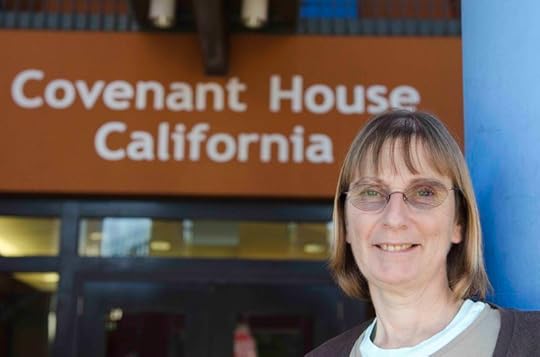 Margaret Farrell at the Covenant House. (Photo: Amy Gaskin)
Little gives away her Catholic denomination: Everybody is familiar with the black and white habit of Catholic nuns, but Margaret Farrell usually shows up for work in a flowery summer blouse and beige pants -- a typical business uniform. "If I wore my nuns' habit, people might be intimidated," she says, "As a community, we wear simple dress." For the last 12 years, the petite sister with the thick Irish accent has helped homeless youngsters in the Covenant House, which was founded by a Franciscan priest. In a way, Margaret Farrell is one of these "suspicious nuns" the Vatican has warned against. In April, the Vatican chastised the Leadership Council of Women Religious (LCWR), in which 80 percent of the American Catholic sisters are organized. Margaret Farrell's order, the Sisters of Charity, is also part of the LCWR. The Vatican criticized the sisters for not speaking out strongly enough against gay marriage, abortion and women's ordination and for spending too much time with the poor, the gay and the unfortunate. Rome even chided the nuns for featuring "radical feminist themes incompatible with the Catholic faith" and punished the organization by subjecting it to the administration of three conservative bishops. Oh, Lord! Radical feminists in a group of ordained whose age averages 73?
Margaret Farrell prefers not to comment on the Vatican's actions, she rather focuses on getting teenagers off the street, but she knows some of the prejudices only too well. "Some say, how can I, as a nun, surround myself with such people -- gays, transsexuals, HIV-positive clients?" she says. "I usually respond: Read the Bible. Look which people Jesus surrounded himself with."
After growing up in Southern Ireland with Catholic parents, Margaret decided to join the nuns at age 22. A novice friend later convinced her to travel to California with her. The friend took one of the first flights back home, and today is married with three kids, but Margaret stayed, because she discovered her cause of heart: helping the needy. The Sisters of Charity that she is part of commit themselves to an extra vow to take care of the poorest, and thus the Covenant House in Hollywood is the perfect place for her: It offers a second chance for young people who ended up on the streets. Every night a van makes the rounds, offering food, water and blankets. Margaret has helped hundreds of people, clients like Octavio Del Castillo, who got kicked out of his house at age 13, when he came out to his parents. He took to the streets, to crack, and then to Sister Margaret. "Without Sister Margaret I wouldn't be alive today," says Octavio who is now, at 25, a successful manager at a sandwich chain. "She is my mother, my godmother, my angel!" he raves. It is ironic that a large percentage of Sister Margaret's clients come from Christian families and were disowned by their parents, when the children's sexuality no longer fit their parents' understanding of the Bible.
Many of her clients, including Octavio, therefore wanted nothing to do with her when they first met the Sister at Covenant House. "But Sister Margaret is different, because she is always there for you. Always," says Octavio who has rediscovered his Christian faith through her and usually joins her on Sunday for church. A whole shelf in Sister Margaret's cramped office is devoted to her clients who weren't as lucky. There's a picture of Ilea who died while riding his bike in Beverly Hills; Michael, who was shot on the street-walkers' patch; and Jesse, who succumbed to HIV at age 20. Sister Margaret collected his ashes from the crematorium because his mother wanted nothing to do with him, even after his death.
Sister Margaret does not say a single critical word about the church. "Jesus does not judge," she says, and therefore she, too, feels she has no right to judge. She is an extremely rare caliber of person, tirelessly devoted to watching out for others. When I ask her what she likes to do in her spare time, she lights up and tells me that her favorite thing is to visit youngsters in prison. She has learned not to wear wire bras, because the metal won't pass the security screenings at juvenile state prisons.
Even the young woman who wanted to physically assault her at their first meeting because she wanted nothing to do with a Catholic nun, has since succumbed to Sister Margaret's kindness. Now the chapel in the Covenant House features that same young woman's testament of gratitude to Sister Margaret: A colorful painting of two hands joining, with the words from Isaiah 41:13, "Do not be afraid, I will help you." If Sister Margaret is a radical, we need more radicals.
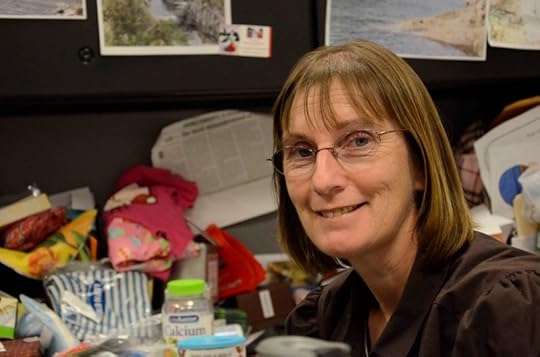 Margaret Farrell at her crowded desk. (Photo: Amy Gaskin)
On a bright sunny afternoon at two o'clock, a half-naked young man breaks through the electronically secured doors of the Covenant House in North Hollywood. Blood gushes from wounds on his shaved head and neck. Sister Margaret Farrell dashes off to her office. She returns with a stack of fresh towels that she presses against his neck to stop the bleeding until the firemen respond to the emergency call.
Only minutes earlier, the streets had seemed clean, calm and deserted, but suddenly a guy had jumped out of a car to stab Margaret Farrell's client, seemingly out of nowhere. Later she will visit her client in the emergency room and learn that he suffered a bad concussion and a brain trauma. "Gangs," she says knowingly, "Maybe he was just at the wrong place at the wrong time. It is possible that this was an initiation ritual for a newcomer in a gang, or a gang conflict."
Margaret Farrell never knows what the day will bring, but she is prepared for almost anything. Since a visitor once tried to attack her, she has positioned her desk so that she can jump to the door faster than a client. The word "Hope" is nailed to the entrance, and Martin Luther King's "I Have a Dream" to the wall. Her tiny office must be the most crowded 60 square feet on the planet: It is filled to the brim with diapers, teddy bears, sneakers, clothes, makeup, cream, band aids, thank you cards, city forms, latex gloves -- anything a client might need. Especially now, before the holidays when the nights get cold, any and every donation is welcome at the Covenant House and will be used to help the homeless. A photo shows her with a baby girl who was fished out of a trash can in Mexico. Next to the entrance a miniature Rottweiler statue serves as a piggy bank for donations, a bright pink plastic Jesus blesses her desk from above. Visitors may grab from the hodgepodge whatever they need -- except for the Jesus and the Rottweiler. These she won't part with.
Margaret Farrell at the Covenant House. (Photo: Amy Gaskin)Little gives away her Catholic denomination: Everybody is familiar with the black and white habit of Catholic nuns, but Margaret Farrell usually shows up for work in a flowery summer blouse and beige pants -- a typical business uniform. "If I wore my nuns' habit, people might be intimidated," she says, "As a community, we wear simple dress." For the last 12 years, the petite sister with the thick Irish accent has helped homeless youngsters in the Covenant House, which was founded by a Franciscan priest. In a way, Margaret Farrell is one of these "suspicious nuns" the Vatican has warned against. In April, the Vatican chastised the Leadership Council of Women Religious (LCWR), in which 80 percent of the American Catholic sisters are organized. Margaret Farrell's order, the Sisters of Charity, is also part of the LCWR. The Vatican criticized the sisters for not speaking out strongly enough against gay marriage, abortion and women's ordination and for spending too much time with the poor, the gay and the unfortunate. Rome even chided the nuns for featuring "radical feminist themes incompatible with the Catholic faith" and punished the organization by subjecting it to the administration of three conservative bishops. Oh, Lord! Radical feminists in a group of ordained whose age averages 73?
Margaret Farrell prefers not to comment on the Vatican's actions, she rather focuses on getting teenagers off the street, but she knows some of the prejudices only too well. "Some say, how can I, as a nun, surround myself with such people -- gays, transsexuals, HIV-positive clients?" she says. "I usually respond: Read the Bible. Look which people Jesus surrounded himself with."
After growing up in Southern Ireland with Catholic parents, Margaret decided to join the nuns at age 22. A novice friend later convinced her to travel to California with her. The friend took one of the first flights back home, and today is married with three kids, but Margaret stayed, because she discovered her cause of heart: helping the needy. The Sisters of Charity that she is part of commit themselves to an extra vow to take care of the poorest, and thus the Covenant House in Hollywood is the perfect place for her: It offers a second chance for young people who ended up on the streets. Every night a van makes the rounds, offering food, water and blankets. Margaret has helped hundreds of people, clients like Octavio Del Castillo, who got kicked out of his house at age 13, when he came out to his parents. He took to the streets, to crack, and then to Sister Margaret. "Without Sister Margaret I wouldn't be alive today," says Octavio who is now, at 25, a successful manager at a sandwich chain. "She is my mother, my godmother, my angel!" he raves. It is ironic that a large percentage of Sister Margaret's clients come from Christian families and were disowned by their parents, when the children's sexuality no longer fit their parents' understanding of the Bible.
Many of her clients, including Octavio, therefore wanted nothing to do with her when they first met the Sister at Covenant House. "But Sister Margaret is different, because she is always there for you. Always," says Octavio who has rediscovered his Christian faith through her and usually joins her on Sunday for church. A whole shelf in Sister Margaret's cramped office is devoted to her clients who weren't as lucky. There's a picture of Ilea who died while riding his bike in Beverly Hills; Michael, who was shot on the street-walkers' patch; and Jesse, who succumbed to HIV at age 20. Sister Margaret collected his ashes from the crematorium because his mother wanted nothing to do with him, even after his death.
Sister Margaret does not say a single critical word about the church. "Jesus does not judge," she says, and therefore she, too, feels she has no right to judge. She is an extremely rare caliber of person, tirelessly devoted to watching out for others. When I ask her what she likes to do in her spare time, she lights up and tells me that her favorite thing is to visit youngsters in prison. She has learned not to wear wire bras, because the metal won't pass the security screenings at juvenile state prisons.
Even the young woman who wanted to physically assault her at their first meeting because she wanted nothing to do with a Catholic nun, has since succumbed to Sister Margaret's kindness. Now the chapel in the Covenant House features that same young woman's testament of gratitude to Sister Margaret: A colorful painting of two hands joining, with the words from Isaiah 41:13, "Do not be afraid, I will help you." If Sister Margaret is a radical, we need more radicals.
Margaret Farrell at her crowded desk. (Photo: Amy Gaskin)
November 19, 2012
It's Called 'Dog Whisperer,' Not 'Dog Wrangler'
This summer, we conducted an unofficial (and involuntary) experiment: Take one unsocialized Rottweiler and see what five different dog trainers will do with it! When we first met three-year-old Molly at a local rescue group, she was wild and completely untrained, but she seemed sweet and longing to please. Apparently, this Rottie-mix had spent the first two years of her life just being chained up in a yard. The shelter volunteer called her a "junkyard dog." She didn't know what stairs were, a mirror, shopping carts. Every moving item sent her into a fit (bicyclists! Trash trucks!). A 10-minute walk with her was a full-body workout, with Molly darting in all directions. We had rehabilitated dogs before, but now we knew we needed professional help.
A rescue group recommended a resolute, but charming, trainer. Though she was expensive, after a thorough interview, her resumé with 30 years of experience, her promise to use "a holistic approach," "the most modern training techniques from around the world" and "positive reinforcement" convinced us. We pictured our dog running happily on her ranch with 20 acres, socializing with other dogs and getting rewarded after learning tricks. We would have loved to visit, but were told this wasn't possible.
Five weeks -- and almost $4,000 -- later, the trainer delivered Molly to our home. The first thing we noticed was how emaciated our dog was: her ribs were sticking out. Molly had lost more than 10 percent of her body weight. The trainer admitted that she didn't feed the dog when it didn't behave well. The trainer also showed us how to discipline our dog: When Molly pulled on the leash, we were to "karate chop" the pinch collar as hard as we could. "Harder, harder," the trainer would say. When Molly inched her paws off the stationing mat, the trainer very forcefully kneed her in the chest. When Molly got a little excited before the walk, the trainer jacked up the shock collar to send Molly wincing and jumping. Dog forgive us, we had made a terrible mistake!
Things only got worse. Molly seemed listless, and spent the first days just sleeping. We were in disbelief of how calm she was, her lack of stamina seemed unsettling. When we took her for walks, she started limping after less than half a mile. Her hesitation to perform a simple command such as "sit!" or "down!" seemed more due to pain than to defiance, all her slow, ginger body movements screamed pain. After a week, a vet confirmed our suspicion: Molly had severe inflammation in both shoulders. The x-rays showed fizzled bone splinters. While the trainer had chopped, kneed and jerked the seemingly stubborn dog, according to the vet our dog had been in "excruciating pain" all along.
We couldn't believe an experienced trainer would not have seen the many signs of illness Molly displayed: the frequent tremors, the listlessness, the limping. On top of it all, Molly's fears hadn't changed, on the contrary, some things had actually gotten worse since the training camp. She still panicked over everything loud, fast-moving or unfamiliar, especially other dogs. She lunged both at the vet and the surgeon. Later, we would learn that one cannot really train a dog unless the underlying issues of pain, fear and insecurity are addressed. Or maybe the pain caused her to lash out?
For the six-week rehabilitation period after a $5,000 surgery on both shoulders, our scooped up Rottweiler bounced off the walls in our apartment. We worked on her obedience and she became a perfectly well-behaved dog when no one else was around -- but as soon as a stranger or another dog approached, she still channeled Cujo. We discussed returning Molly to the shelter, but we knew it would be nearly impossible for such a physically and emotionally challenged dog to find a home. When she had recovered physically, we searched for a different trainer. The first one never responded to our written requests for an explanation, let alone an apology.
Our neighbors recommended Kirstin. Though she was only in her 20s, she already had an impressive resumé and three generations of animal training experience in her family tree. Her grandparents had trained elephants for the circus. Blonde and long-limbed, Kirstin was a Hollywood trainer to the stars. She entered our house under Molly's growling protest. She yelled at Molly to stop barking and growling -- most dog trainers will be careful not to do this: you can't correct a dog when you're already the "target," you need to build a relationship and some trust first. But Kristin asked us to put a muzzle on Molly, and then tried to "dominate" her by grabbing her "power points," the muzzle, the ruff, the paws. Our dog morphed into Voldemort and gave a Hollywood-worthy impersonation of the devil. Kirstin diagnosed "severe aggression," prescribed an herbal calmer for $200 (that proved to be useless) and prepared us for the worst: we might have to put the dog down. We broke into tears. The best thing Kirstin did was not to charge us for this piece of advice.
We are not ones to give up easily. Next, we went to a renowned training center at the other side of town. This, too, wasn't cheap at $150 per hour. Tempting us with waiving the consultation fee, they urged us to sign up for a package of private classes and laid out a detailed training plan for socializing our dog with stable dogs at their center. They would also come to our house where we frequently encounter off leash dogs. We signed. They literally waited until the moment after we had forked over our credit card for the entire package to reneg on the training plan: No, our dog couldn't be trusted to meet other dogs. No, they wouldn't visit our home. We spent three visits mostly parading around their empty parking lot, with the trainers asking us the same questions about feeding methods and toy aggression they had already asked us during the initial interview -- as if they didn't remember anything we had told them before. Very little training happened. They seemed to be more afraid of our dog than interested in helping her. We saw that this wasn't going anywhere and asked to cancel the contract. Surprise: The unused portion of the training sessions were nonrefundable under any circumstances. We should have read the small print.
After a short deviation with a fourth trainer who prescribed agility and attack training for dogs with aggression issues, but failed to show up for scheduled appointments, we felt we had heard it all: Every trainer had an entirely different approach, and the only thing they all agreed on was that the other trainers were wrong.
An unsocialized Rottweiler? Needed "a strong hand" (trainer 1) or "couldn't be rehabilitated" (trainer 2). Handfeeding? Was "essential" (trainer 1) or "dangerous" (3). Tug of war? Was "helpful" for aggressive cases to let off steam or "really dangerous and making matters worse." Collars? After the fourth trainer we had an extensive collection: tag collar, pinch collar, choke chain, Cesar Millan's Illusion collar, three different remote electronic collars, a slip leash, a halti and a gentle leader. I stopped counting after 10. And our dog was still having a nervous breakdown every time another pooch approached, even a chihuahua!

Cesar Millan, Michaela Haas, Junior and Molly at the Dog Psychology Center
We learned that our experience was not at all uncommon. I am writing about our journey because since then I have met many dog owners frantically reaching for "professional" help that is too often unprofessional. The title "professional dog trainer" is not protected in America. Anybody can call themselves a dog trainer, whether they are qualified or not. And as we saw firsthand, while most dog trainers know the basics of obedience training, very few are qualified to handle a scared Rottweiler. They tend to either use undue force or shy away from handling the dog at all. And they defend their various methods as religiously as any political party. When a dog trainer tells you that your dog cannot be rehabilitated, show them the door. Fast.
We had been avid watchers of the Dog Whisperer ever since we had rescued and rehabilitated a badly abused Akita-Chow mix three years ago. But getting Cesar Millan to come to our rescue seemed impossible -- maybe these days that's a privilege reserved for the very rich or famous. I finally reached two trainers who had worked with him and used his methods. Cheri Lucas, often featured on the Dog Whisperer show, and Brian Agnew happened to be in our area, and they came to our house.
When Molly barked and growled, Cheri and Brian didn't back off. They just stood their ground, calmly, neither shying away nor barging forward. They instantly diagnosed Molly as insecure, not aggressive. Cheri crawling into the playpen with our snarling Rottweiler would have been a neat opening for a Dog Whisperer episode. Call that confidence in your assessment! But this was even better: it didn't happen on TV, it happened in our home. After 10 minutes, they had Molly calmly walking on leash. After half an hour, their own dogs, a pit bull mix and a Collie were relaxing in our living room next to Molly. They showed me how to correct Molly when she freaked out: Gently, but firmly. Strongly, but calmly. They pointed out specific warning signals in her body language and the right moment for an acutely timed correction -- when she held her breath or tensed her jaw before the explosion. They used a halti, not a prong collar. When we sent Molly to Brian's home for more socialization, he sent us instagram proof of Molly's progress every day: Molly lying next to a pit bull puppy. Molly walking calmly with four other dogs at his side. We knew she was in good hands, and the progress she was making was amazing.
It wasn't the end of the project. Molly is still work in progress, but we become a better team every day. And recently, Molly even got a chance to go to the Dog Psychology Center and growl at Cesar to show her appreciation.
Cheri and Brian laughed knowingly when we told them about our odyssey. "We hear that all the time," they said, and joked: "The only thing five dog trainers can agree on is that they know more than their client." And I wouldn't even be sure of that.

Trainers Cheri Lucas and Brian Agnew with Michaela Haas and the pack
Photos: Josh Heeren
A rescue group recommended a resolute, but charming, trainer. Though she was expensive, after a thorough interview, her resumé with 30 years of experience, her promise to use "a holistic approach," "the most modern training techniques from around the world" and "positive reinforcement" convinced us. We pictured our dog running happily on her ranch with 20 acres, socializing with other dogs and getting rewarded after learning tricks. We would have loved to visit, but were told this wasn't possible.
Five weeks -- and almost $4,000 -- later, the trainer delivered Molly to our home. The first thing we noticed was how emaciated our dog was: her ribs were sticking out. Molly had lost more than 10 percent of her body weight. The trainer admitted that she didn't feed the dog when it didn't behave well. The trainer also showed us how to discipline our dog: When Molly pulled on the leash, we were to "karate chop" the pinch collar as hard as we could. "Harder, harder," the trainer would say. When Molly inched her paws off the stationing mat, the trainer very forcefully kneed her in the chest. When Molly got a little excited before the walk, the trainer jacked up the shock collar to send Molly wincing and jumping. Dog forgive us, we had made a terrible mistake!
Things only got worse. Molly seemed listless, and spent the first days just sleeping. We were in disbelief of how calm she was, her lack of stamina seemed unsettling. When we took her for walks, she started limping after less than half a mile. Her hesitation to perform a simple command such as "sit!" or "down!" seemed more due to pain than to defiance, all her slow, ginger body movements screamed pain. After a week, a vet confirmed our suspicion: Molly had severe inflammation in both shoulders. The x-rays showed fizzled bone splinters. While the trainer had chopped, kneed and jerked the seemingly stubborn dog, according to the vet our dog had been in "excruciating pain" all along.
We couldn't believe an experienced trainer would not have seen the many signs of illness Molly displayed: the frequent tremors, the listlessness, the limping. On top of it all, Molly's fears hadn't changed, on the contrary, some things had actually gotten worse since the training camp. She still panicked over everything loud, fast-moving or unfamiliar, especially other dogs. She lunged both at the vet and the surgeon. Later, we would learn that one cannot really train a dog unless the underlying issues of pain, fear and insecurity are addressed. Or maybe the pain caused her to lash out?
For the six-week rehabilitation period after a $5,000 surgery on both shoulders, our scooped up Rottweiler bounced off the walls in our apartment. We worked on her obedience and she became a perfectly well-behaved dog when no one else was around -- but as soon as a stranger or another dog approached, she still channeled Cujo. We discussed returning Molly to the shelter, but we knew it would be nearly impossible for such a physically and emotionally challenged dog to find a home. When she had recovered physically, we searched for a different trainer. The first one never responded to our written requests for an explanation, let alone an apology.
Our neighbors recommended Kirstin. Though she was only in her 20s, she already had an impressive resumé and three generations of animal training experience in her family tree. Her grandparents had trained elephants for the circus. Blonde and long-limbed, Kirstin was a Hollywood trainer to the stars. She entered our house under Molly's growling protest. She yelled at Molly to stop barking and growling -- most dog trainers will be careful not to do this: you can't correct a dog when you're already the "target," you need to build a relationship and some trust first. But Kristin asked us to put a muzzle on Molly, and then tried to "dominate" her by grabbing her "power points," the muzzle, the ruff, the paws. Our dog morphed into Voldemort and gave a Hollywood-worthy impersonation of the devil. Kirstin diagnosed "severe aggression," prescribed an herbal calmer for $200 (that proved to be useless) and prepared us for the worst: we might have to put the dog down. We broke into tears. The best thing Kirstin did was not to charge us for this piece of advice.
We are not ones to give up easily. Next, we went to a renowned training center at the other side of town. This, too, wasn't cheap at $150 per hour. Tempting us with waiving the consultation fee, they urged us to sign up for a package of private classes and laid out a detailed training plan for socializing our dog with stable dogs at their center. They would also come to our house where we frequently encounter off leash dogs. We signed. They literally waited until the moment after we had forked over our credit card for the entire package to reneg on the training plan: No, our dog couldn't be trusted to meet other dogs. No, they wouldn't visit our home. We spent three visits mostly parading around their empty parking lot, with the trainers asking us the same questions about feeding methods and toy aggression they had already asked us during the initial interview -- as if they didn't remember anything we had told them before. Very little training happened. They seemed to be more afraid of our dog than interested in helping her. We saw that this wasn't going anywhere and asked to cancel the contract. Surprise: The unused portion of the training sessions were nonrefundable under any circumstances. We should have read the small print.
After a short deviation with a fourth trainer who prescribed agility and attack training for dogs with aggression issues, but failed to show up for scheduled appointments, we felt we had heard it all: Every trainer had an entirely different approach, and the only thing they all agreed on was that the other trainers were wrong.
An unsocialized Rottweiler? Needed "a strong hand" (trainer 1) or "couldn't be rehabilitated" (trainer 2). Handfeeding? Was "essential" (trainer 1) or "dangerous" (3). Tug of war? Was "helpful" for aggressive cases to let off steam or "really dangerous and making matters worse." Collars? After the fourth trainer we had an extensive collection: tag collar, pinch collar, choke chain, Cesar Millan's Illusion collar, three different remote electronic collars, a slip leash, a halti and a gentle leader. I stopped counting after 10. And our dog was still having a nervous breakdown every time another pooch approached, even a chihuahua!

Cesar Millan, Michaela Haas, Junior and Molly at the Dog Psychology Center
We learned that our experience was not at all uncommon. I am writing about our journey because since then I have met many dog owners frantically reaching for "professional" help that is too often unprofessional. The title "professional dog trainer" is not protected in America. Anybody can call themselves a dog trainer, whether they are qualified or not. And as we saw firsthand, while most dog trainers know the basics of obedience training, very few are qualified to handle a scared Rottweiler. They tend to either use undue force or shy away from handling the dog at all. And they defend their various methods as religiously as any political party. When a dog trainer tells you that your dog cannot be rehabilitated, show them the door. Fast.
We had been avid watchers of the Dog Whisperer ever since we had rescued and rehabilitated a badly abused Akita-Chow mix three years ago. But getting Cesar Millan to come to our rescue seemed impossible -- maybe these days that's a privilege reserved for the very rich or famous. I finally reached two trainers who had worked with him and used his methods. Cheri Lucas, often featured on the Dog Whisperer show, and Brian Agnew happened to be in our area, and they came to our house.
When Molly barked and growled, Cheri and Brian didn't back off. They just stood their ground, calmly, neither shying away nor barging forward. They instantly diagnosed Molly as insecure, not aggressive. Cheri crawling into the playpen with our snarling Rottweiler would have been a neat opening for a Dog Whisperer episode. Call that confidence in your assessment! But this was even better: it didn't happen on TV, it happened in our home. After 10 minutes, they had Molly calmly walking on leash. After half an hour, their own dogs, a pit bull mix and a Collie were relaxing in our living room next to Molly. They showed me how to correct Molly when she freaked out: Gently, but firmly. Strongly, but calmly. They pointed out specific warning signals in her body language and the right moment for an acutely timed correction -- when she held her breath or tensed her jaw before the explosion. They used a halti, not a prong collar. When we sent Molly to Brian's home for more socialization, he sent us instagram proof of Molly's progress every day: Molly lying next to a pit bull puppy. Molly walking calmly with four other dogs at his side. We knew she was in good hands, and the progress she was making was amazing.
It wasn't the end of the project. Molly is still work in progress, but we become a better team every day. And recently, Molly even got a chance to go to the Dog Psychology Center and growl at Cesar to show her appreciation.
Cheri and Brian laughed knowingly when we told them about our odyssey. "We hear that all the time," they said, and joked: "The only thing five dog trainers can agree on is that they know more than their client." And I wouldn't even be sure of that.
Trainers Cheri Lucas and Brian Agnew with Michaela Haas and the pack
Photos: Josh Heeren
July 3, 2012
'Pissed Off' in Rural India
Recently
The New York Times
highlighted a subject that, though considered taboo in the West, represents a critical human rights issue in the East: lack of access to toilets. The article, written by Jim Yardley, showcased the novel "Right to Pee" campaign in Mumbai which is working to counter menacing gender discrimination when it comes to public toilet access.
Poor sanitation facilities are a pernicious problem in India, where over half of the population lacks a toilet, and open defecation is the norm. Girls and women are more acutely affected by this issue, as they face danger and harassment when relieving themselves in the open. Furthermore, females are being unfairly and illegally charged to use public toilets by corrupt officials, compounding the myriad problems already facing the nation's poorest women and girls.
But there is an even more compelling case where of lack of toilet access, corruption and gender imbalances conspire to create a devastating situation in India: in its public schools.
When the international non-profit Lotus Outreach first began their Right to Education advocacy work in the conservative, predominantly Muslim district of Mewat, Haryana, the vast majority of schools did not have toilets available to students. "Lack of basic sanitation facilities for girls continues to prove a seemingly insurmountable barrier to their education," says Erika Keaveney, Lotus Outreach' Executive Director, "Studies show that there is a direct correlation between the dropout rate of girls and the availability of toilets in Indian schools. Conservative parents in Mewat understandably do not want their daughters -- particularly adolescent girls -- to relieve themselves in public. It is of therefore of little surprise that the female illiteracy rate in this region was a staggering 96 percent when we first began our work there in 2008."
However, this bleak picture is beginning to change. The program Lotus Education as a Right Network (LEARN) -- which utilizes community mobilization, legal advocacy and public interest litigation to expand access to quality public education in rural Haryana -- has met with tremendous success in ensuring adequate sanitation facilities in Mewat. In 2010 alone, LEARN oversaw the construction of 200 new toilets in public schools in our target area and Erika Keaveney hopes that by the end of this year, each of Mewat's 500 schools will have toilet facilities. The LEARN project achieves these incredible outcomes on a shoestring: their community watchdogs and legal advocates merely serve to ensure that state and federal funding designated for school infrastructure -- including toilets -- ends up where it belongs, rather than in the pockets of government officials with sticky fingers.
The success in ensuring the construction of toilets in public schools is facilitating a sea of change in girls' school attendance in the region. Indeed, several girls in the target area are now among the first girls in the history of their villages to reach the 10th grade, an outcome that wouldn't be imaginable if they were forced to walk five miles home to use the toilet during the school day.
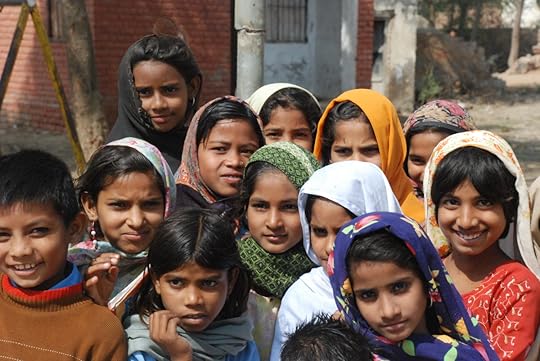
LEARN participants in Mewat, India

These two toilets served around 400 children when Lotus Outreach staff visited Mewat in 2010.

School gets a toilet as a result of a LEARN complaint in 2012.
Copyright: Lotus Outreach
Poor sanitation facilities are a pernicious problem in India, where over half of the population lacks a toilet, and open defecation is the norm. Girls and women are more acutely affected by this issue, as they face danger and harassment when relieving themselves in the open. Furthermore, females are being unfairly and illegally charged to use public toilets by corrupt officials, compounding the myriad problems already facing the nation's poorest women and girls.
But there is an even more compelling case where of lack of toilet access, corruption and gender imbalances conspire to create a devastating situation in India: in its public schools.
When the international non-profit Lotus Outreach first began their Right to Education advocacy work in the conservative, predominantly Muslim district of Mewat, Haryana, the vast majority of schools did not have toilets available to students. "Lack of basic sanitation facilities for girls continues to prove a seemingly insurmountable barrier to their education," says Erika Keaveney, Lotus Outreach' Executive Director, "Studies show that there is a direct correlation between the dropout rate of girls and the availability of toilets in Indian schools. Conservative parents in Mewat understandably do not want their daughters -- particularly adolescent girls -- to relieve themselves in public. It is of therefore of little surprise that the female illiteracy rate in this region was a staggering 96 percent when we first began our work there in 2008."
However, this bleak picture is beginning to change. The program Lotus Education as a Right Network (LEARN) -- which utilizes community mobilization, legal advocacy and public interest litigation to expand access to quality public education in rural Haryana -- has met with tremendous success in ensuring adequate sanitation facilities in Mewat. In 2010 alone, LEARN oversaw the construction of 200 new toilets in public schools in our target area and Erika Keaveney hopes that by the end of this year, each of Mewat's 500 schools will have toilet facilities. The LEARN project achieves these incredible outcomes on a shoestring: their community watchdogs and legal advocates merely serve to ensure that state and federal funding designated for school infrastructure -- including toilets -- ends up where it belongs, rather than in the pockets of government officials with sticky fingers.
The success in ensuring the construction of toilets in public schools is facilitating a sea of change in girls' school attendance in the region. Indeed, several girls in the target area are now among the first girls in the history of their villages to reach the 10th grade, an outcome that wouldn't be imaginable if they were forced to walk five miles home to use the toilet during the school day.
LEARN participants in Mewat, India
These two toilets served around 400 children when Lotus Outreach staff visited Mewat in 2010.
School gets a toilet as a result of a LEARN complaint in 2012.
Copyright: Lotus Outreach
December 8, 2011
Why Giving Matters: How 15 Dollars Can Educate a Girl for a Year
Now it is scientifically proven: Money doesn't buy happiness. Giving does. This is one conclusion to draw from a number of recent studies and surveys. The World Giving Index shows a greater correlation between a person's degree of happiness and giving than happiness and wealth.
Similarly, the University of British Columbia found that the amount of personal spending had virtually no influence on the spender's happiness -- but giving to charity or volunteering for a good cause made the giver considerably more content and happy. Erika Keaveney, executive director of the international non-profit Lotus Outreach, says, "There's plenty of evidence that charitable acts and happiness sustain each other in one big circle. The more we give, the richer we become. Giving a girl the gift of education not only makes a huge difference for the girl and her family, but it creates a remarkable return for the giver too."
Lotus Outreach has known for 20 years that people who give get happier as a result. Especially in developing countries, where a comparatively small amount goes a long way.
I am not against gifts and the joy of unwrapping presents, but let's face it: There are people who need holiday gifts more than we do. Lotus Outreach has created a holiday "wish list" featuring popular consumer products, how much they cost, and how an equivalent cash donation can literally change the world of Lotus Outreach's beneficiaries by improving access to education, health and economic opportunity in a sustainable, cost-effective manner.
Food for thought: as I embark on my Christmas shopping, do I want to give my granny $15 worth of chocolates or spend the same amount on providing 15-year-old Usha, a lower-caste quarry laborer in India, with an entire year of remedial education so she can pursue her dream of becoming a teacher?
I think my uncle will be happy to learn that instead of buying him a $25 Starbucks gift card, I will use the money to provide a widowed Cambodian mother like Chuin Chum Li with a microloan so she can start a small business such as raising chickens.
My teenage niece is old enough to appreciate that instead of spending $50 on a pair of jeans, I have purchased school uniforms for ten orphaned and vulnerable Cambodian girls like 10 year-old Sinha, so she can attend public school.
Instead of giving my nephew a $100 Nintendo handheld game, I will provide a sex worker like Heng with beauty skills training so she can escape the lethal pitfalls of Cambodia's commercial sex industry. One hundred and seventy dollars could buy my sister an e-reader -- or a woman like Kuen Sok basic education and sewing instruction so she and her five year-old daughter can escape Phnom Penh's brothels.
Let's see, for $300 I could send my business partner a bottle of exclusive champagne, or help 16 year-old Anjum delay marriage and childbirth by providing her with daily transportation to and from school until she graduates high school.
Five hundred dollars buys one Power Wheels truck or gives six rural Cambodian girls heavy terrain bicycles so they can traverse the considerable distance to the nearest school house each day.
For myself, instead of $1,000 dollar diamond studs, I have asked to use that money for a donation to provide a full scholarship -- including tuition, housing, meals and school supplies -- for a young Cambodian woman like Sima for an entire year while she pursues university education. My holiday shopping is done -- and my presents will have created more happiness for my family and others. This seems a bargain to create happiness for several people at once -- the giver, and the recipients.
The National Retail Federation predicts Americans will spend over $465 billion dollars on holiday shopping this season, over twice what they donate to charitable organizations in a given year. Giving the gift of hope to the world's least fortunate will not only change a life, but will provide the gifter and giftee alike with something that -- up until now -- money couldn't buy: happiness.
About Lotus Outreach: Lotus Outreach is a California based 501(c)(3) non-profit organization dedicated to ensuring the education, health and safety of at-risk women and children in the developing world. Lotus Outreach's unique approach to tackling poverty and its tragic consequences involves working with grassroots organizations in its target countries (India and Cambodia). For more information and photos visit the Lotus Outreach Website.
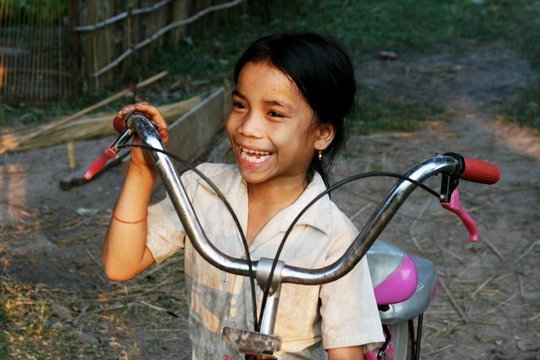
Lan Chin safely gets to school on her "Lotus Pedals." (Copyright: Lotus Outreach)
Similarly, the University of British Columbia found that the amount of personal spending had virtually no influence on the spender's happiness -- but giving to charity or volunteering for a good cause made the giver considerably more content and happy. Erika Keaveney, executive director of the international non-profit Lotus Outreach, says, "There's plenty of evidence that charitable acts and happiness sustain each other in one big circle. The more we give, the richer we become. Giving a girl the gift of education not only makes a huge difference for the girl and her family, but it creates a remarkable return for the giver too."
Lotus Outreach has known for 20 years that people who give get happier as a result. Especially in developing countries, where a comparatively small amount goes a long way.
I am not against gifts and the joy of unwrapping presents, but let's face it: There are people who need holiday gifts more than we do. Lotus Outreach has created a holiday "wish list" featuring popular consumer products, how much they cost, and how an equivalent cash donation can literally change the world of Lotus Outreach's beneficiaries by improving access to education, health and economic opportunity in a sustainable, cost-effective manner.
Food for thought: as I embark on my Christmas shopping, do I want to give my granny $15 worth of chocolates or spend the same amount on providing 15-year-old Usha, a lower-caste quarry laborer in India, with an entire year of remedial education so she can pursue her dream of becoming a teacher?
I think my uncle will be happy to learn that instead of buying him a $25 Starbucks gift card, I will use the money to provide a widowed Cambodian mother like Chuin Chum Li with a microloan so she can start a small business such as raising chickens.
My teenage niece is old enough to appreciate that instead of spending $50 on a pair of jeans, I have purchased school uniforms for ten orphaned and vulnerable Cambodian girls like 10 year-old Sinha, so she can attend public school.
Instead of giving my nephew a $100 Nintendo handheld game, I will provide a sex worker like Heng with beauty skills training so she can escape the lethal pitfalls of Cambodia's commercial sex industry. One hundred and seventy dollars could buy my sister an e-reader -- or a woman like Kuen Sok basic education and sewing instruction so she and her five year-old daughter can escape Phnom Penh's brothels.
Let's see, for $300 I could send my business partner a bottle of exclusive champagne, or help 16 year-old Anjum delay marriage and childbirth by providing her with daily transportation to and from school until she graduates high school.
Five hundred dollars buys one Power Wheels truck or gives six rural Cambodian girls heavy terrain bicycles so they can traverse the considerable distance to the nearest school house each day.
For myself, instead of $1,000 dollar diamond studs, I have asked to use that money for a donation to provide a full scholarship -- including tuition, housing, meals and school supplies -- for a young Cambodian woman like Sima for an entire year while she pursues university education. My holiday shopping is done -- and my presents will have created more happiness for my family and others. This seems a bargain to create happiness for several people at once -- the giver, and the recipients.
The National Retail Federation predicts Americans will spend over $465 billion dollars on holiday shopping this season, over twice what they donate to charitable organizations in a given year. Giving the gift of hope to the world's least fortunate will not only change a life, but will provide the gifter and giftee alike with something that -- up until now -- money couldn't buy: happiness.
About Lotus Outreach: Lotus Outreach is a California based 501(c)(3) non-profit organization dedicated to ensuring the education, health and safety of at-risk women and children in the developing world. Lotus Outreach's unique approach to tackling poverty and its tragic consequences involves working with grassroots organizations in its target countries (India and Cambodia). For more information and photos visit the Lotus Outreach Website.
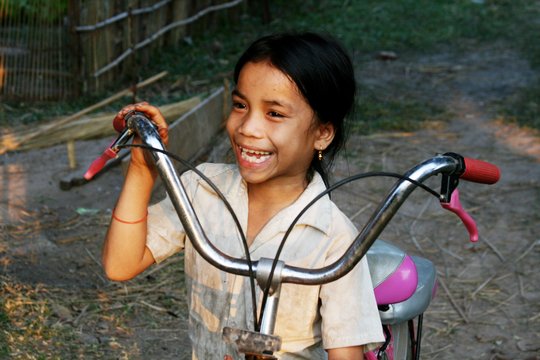
Lan Chin safely gets to school on her "Lotus Pedals." (Copyright: Lotus Outreach)
October 13, 2011
Unleashing The Power of The "Girl Effect"
Many of us in the charitable community have already heard about the Girl Effect, a ground-breaking campaign launched by the Nike Foundation to bring attention to the unique role adolescent girls play in facilitating the development of third world economics.
But a recap never hurts, so here are some compelling stats to help set the stage:
• Today, women are the backbone of developing economies. They perform 66% of the world's work and produce 50% of the world's food supply.
• When a girl in the developing world receives seven or more years of education, she marries four years later and has 2.2 fewer children.
• An extra year of primary school boosts girls' eventual wages by 10 to 20 %. An extra year of secondary school: 15 to 25 %.
• When women and girls earn income, they reinvest 90 % of it into the health, nutrition and educational needs of their families (as compared to only 30 to 40 % for men).
• A child born to a mother with elementary school education is only half as likely to die before the age of 5.
Despite these facts, 70% of the world's 130 million out-of-school children are girls. And the situation gets worse as a girl reaches adulthood: women bear 70% of the world's poverty, earn only 10% of the world's income and own only 1% of the worlds land. (sources: girleffect.org, joinfite.org, unesco.org).
Girl Effect is designed to bring critical awareness to these facts, and educate the general public on the unique role adolescent girls can play in eradicating global poverty. Their campaign has met with breathtaking success, and in a few short years concerned global citizens have invested nearly $700,000 in the Girl Effect Fund to improve the health, education, training and economic opportunities of adolescent girls around the world--reaching them at the critical crossroad between childhood and womanhood.
The Girl Effect Fund, launched in partnership with GlobalGiving, is the Girl Effect's way of turning the inspiration the campaign has generated into action.
But this fall, Girl Effect and GlobalGiving have gotten even more creative in channeling this energy. Beginning October 15th, approximately 50 organizations around the world will compete in a month-long challenge to earn six of twelve featured spots on the Girl Effect Fund page. Girl Effect will select an additional six of these pre-screened projects to benefit from the fund based on their unique approach to empowering girls in the developing world. These twelve organizations will then receive an equal share of contributions to the Girl Effect fund throughout 2012.
One participating project, the Blossom Bus, provides daily transportation to and from school for adolescent girls in rural India who are left with little choice but to drop out after primary school because secondary schools are too far to commute to by foot. "Many of the girls participating in the project are the first girls in the history of their villages to reach grades 9 and 10," says Erika Keaveney, Executive Director of Lotus Outreach International, the organization responsible for the Blossom Bus project. "In fact," she shares, "a startling number of these girls narrowly escaped childhood marriages--often arranged once they turn 12 or 13 years old--as a result of the project."
True to the spirit of the Girl Effect, a mere $150 can help these girls not only escape child marriages, but become trailblazers for women's empowerment in their communities.
The challenge begins on October 15 and wraps up on November 15, and the top six organizations to recruit the greatest number of unique donors will become Girl Effect Fund partners for the entire 2012 year. To learn more, visit: the Girl Effect website, the Girl Effect Fund, GlobalGiving.org, and the Blossom Bus project page.
Watch the Girl Power video:
But a recap never hurts, so here are some compelling stats to help set the stage:
• Today, women are the backbone of developing economies. They perform 66% of the world's work and produce 50% of the world's food supply.
• When a girl in the developing world receives seven or more years of education, she marries four years later and has 2.2 fewer children.
• An extra year of primary school boosts girls' eventual wages by 10 to 20 %. An extra year of secondary school: 15 to 25 %.
• When women and girls earn income, they reinvest 90 % of it into the health, nutrition and educational needs of their families (as compared to only 30 to 40 % for men).
• A child born to a mother with elementary school education is only half as likely to die before the age of 5.
Despite these facts, 70% of the world's 130 million out-of-school children are girls. And the situation gets worse as a girl reaches adulthood: women bear 70% of the world's poverty, earn only 10% of the world's income and own only 1% of the worlds land. (sources: girleffect.org, joinfite.org, unesco.org).
Girl Effect is designed to bring critical awareness to these facts, and educate the general public on the unique role adolescent girls can play in eradicating global poverty. Their campaign has met with breathtaking success, and in a few short years concerned global citizens have invested nearly $700,000 in the Girl Effect Fund to improve the health, education, training and economic opportunities of adolescent girls around the world--reaching them at the critical crossroad between childhood and womanhood.
The Girl Effect Fund, launched in partnership with GlobalGiving, is the Girl Effect's way of turning the inspiration the campaign has generated into action.
But this fall, Girl Effect and GlobalGiving have gotten even more creative in channeling this energy. Beginning October 15th, approximately 50 organizations around the world will compete in a month-long challenge to earn six of twelve featured spots on the Girl Effect Fund page. Girl Effect will select an additional six of these pre-screened projects to benefit from the fund based on their unique approach to empowering girls in the developing world. These twelve organizations will then receive an equal share of contributions to the Girl Effect fund throughout 2012.
One participating project, the Blossom Bus, provides daily transportation to and from school for adolescent girls in rural India who are left with little choice but to drop out after primary school because secondary schools are too far to commute to by foot. "Many of the girls participating in the project are the first girls in the history of their villages to reach grades 9 and 10," says Erika Keaveney, Executive Director of Lotus Outreach International, the organization responsible for the Blossom Bus project. "In fact," she shares, "a startling number of these girls narrowly escaped childhood marriages--often arranged once they turn 12 or 13 years old--as a result of the project."
True to the spirit of the Girl Effect, a mere $150 can help these girls not only escape child marriages, but become trailblazers for women's empowerment in their communities.
The challenge begins on October 15 and wraps up on November 15, and the top six organizations to recruit the greatest number of unique donors will become Girl Effect Fund partners for the entire 2012 year. To learn more, visit: the Girl Effect website, the Girl Effect Fund, GlobalGiving.org, and the Blossom Bus project page.
Watch the Girl Power video:
September 7, 2011
Turning the Tables on Domestic Violence in Asia
In America, every 15 seconds a woman is beaten by her husband or domestic partner. Domestic violence is the leading cause of injury to women between the ages of 15 and 44 -- more than car accidents, muggings, and rapes combined. I always thought these figures were shocking, especially since they have been slow to change over the years.
However, I was even more stunned when I recently learned that 30 percent of women in Cambodia suffer from domestic violence. Every third woman in Cambodia gets abused? How could that be?
I put this question to Erika Keaveney, the executive director of the SoCal based non-profit Lotus Outreach, which has been working in the poorest regions of Cambodia and other parts of Asia for almost two decades. "Many women in Cambodia don't even know that they have rights," she explained. "Divorce carries an enormous social stigma in Cambodia, and so many woman literally have no way to escape a dangerous situation."
But she also told me the story of Goong Mouey, a beneficiary of the organizations's Consoling Through Counseling project, which highlights just how far a small amount can go to help women escape from domestic violence.
Mouey may have survived decades of war and genocide in Cambodia, but she didn't emerge unscathed. The Khmer Rouge completely shut down the public education system in the late 1970s, and 90 percent of all teachers were summarily executed. Mouey is a part of an entire generation of women to grow up completely illiterate, and with little to no economic opportunity. Escaping her abusive, alcoholic husband and unable to provide for her five young children, she turned the children over to an orphanage for two years. "This was especially painful for me," she shares, "but I had run out of options."
Since coming into contact with the counseling and reintegration program that was supported by Dining for Women, the tables have turned for Mouey. After spending some time at Lotus Outreach's safe shelter, Mouey received $20 in start-up support along with a $120 small business grant and now runs a highly successful vegetable grocery business near Poipet city. Her business allows her to earn about $50 per day -- over 20 times the per capita income in Cambodia -- and she has since been able to resume caring for her children.
"I did have a small vegetable stall earlier but it was not enough to live on. The grant allowed me to offer five times as much variety and volume," Mouey shares. "Now I can afford pretty much whatever the children need to be well nourished." Mouey's 16 year-old daughter, Srey Mom, pipes in as well: "Previously I didn't have the money I needed to pay for school tuition or buy food and medicine, and now we do."
Because divorce carries such an onerous social stigma in Cambodian society, Mouey opted to try again when her husband came skulking back -- to her vastly improved financial situation. This time, however, he did not dare to abuse her physically any longer. "I control the money in the family now," Mouey says proudly. "Though he is verbally aggressive, he no longer hits me." Recognizing the cultural factors working against sufferers of domestic violence in Cambodia, Lotus Outreach hopes to implement men's anger management courses in the near future to give women who do return to abusive marriages the very best chance at a safe, healthy life.
With a $39,000 grant this year from Dining for Women, Lotus Outreach will help dozens of families like Mouey's get back on their feet through shelter assistance, start-up financial support, vocational training and small business grants.

Mouey now holds the purse strings -- and the power -- in her home.
Copyright Lotus Outreach
However, I was even more stunned when I recently learned that 30 percent of women in Cambodia suffer from domestic violence. Every third woman in Cambodia gets abused? How could that be?
I put this question to Erika Keaveney, the executive director of the SoCal based non-profit Lotus Outreach, which has been working in the poorest regions of Cambodia and other parts of Asia for almost two decades. "Many women in Cambodia don't even know that they have rights," she explained. "Divorce carries an enormous social stigma in Cambodia, and so many woman literally have no way to escape a dangerous situation."
But she also told me the story of Goong Mouey, a beneficiary of the organizations's Consoling Through Counseling project, which highlights just how far a small amount can go to help women escape from domestic violence.
Mouey may have survived decades of war and genocide in Cambodia, but she didn't emerge unscathed. The Khmer Rouge completely shut down the public education system in the late 1970s, and 90 percent of all teachers were summarily executed. Mouey is a part of an entire generation of women to grow up completely illiterate, and with little to no economic opportunity. Escaping her abusive, alcoholic husband and unable to provide for her five young children, she turned the children over to an orphanage for two years. "This was especially painful for me," she shares, "but I had run out of options."
Since coming into contact with the counseling and reintegration program that was supported by Dining for Women, the tables have turned for Mouey. After spending some time at Lotus Outreach's safe shelter, Mouey received $20 in start-up support along with a $120 small business grant and now runs a highly successful vegetable grocery business near Poipet city. Her business allows her to earn about $50 per day -- over 20 times the per capita income in Cambodia -- and she has since been able to resume caring for her children.
"I did have a small vegetable stall earlier but it was not enough to live on. The grant allowed me to offer five times as much variety and volume," Mouey shares. "Now I can afford pretty much whatever the children need to be well nourished." Mouey's 16 year-old daughter, Srey Mom, pipes in as well: "Previously I didn't have the money I needed to pay for school tuition or buy food and medicine, and now we do."
Because divorce carries such an onerous social stigma in Cambodian society, Mouey opted to try again when her husband came skulking back -- to her vastly improved financial situation. This time, however, he did not dare to abuse her physically any longer. "I control the money in the family now," Mouey says proudly. "Though he is verbally aggressive, he no longer hits me." Recognizing the cultural factors working against sufferers of domestic violence in Cambodia, Lotus Outreach hopes to implement men's anger management courses in the near future to give women who do return to abusive marriages the very best chance at a safe, healthy life.
With a $39,000 grant this year from Dining for Women, Lotus Outreach will help dozens of families like Mouey's get back on their feet through shelter assistance, start-up financial support, vocational training and small business grants.

Mouey now holds the purse strings -- and the power -- in her home.
Copyright Lotus Outreach
August 26, 2011
Pedaling Back to School: How Bicycles Bridge the Gap in Education Access For Girls in Rural Asia
Every morning, a small yellow school bus stops in front of my house to pick up the neighbors' kids. Grabbing their new book bags, they lament the end of the summer break, while showing off this year's school clothes to their friends.
At the same time but on the other side of the world, hundreds of thousands of kids in India and Cambodia will be oblivious to the start of the academic year as they begin another day at work, perhaps picking through garbage dumps for recyclables or hauling goods back and forth across the border to Thailand. According to the World Bank, an estimated 750,000 Cambodian children under the age of 12 were working in 2006. Most of these were girls.
Study after study reveals that all over the world, education is the single most effective catalyst for reducing poverty and remedying its myriad consequences -- from lower life expectancy to maternal mortality to malnutrition. Deep-rooted gender biases, extreme poverty, the family's need for an extra income, and the cost of books and materials are a few of the reasons why Cambodian girls so often work instead of going to school. Though there are seemingly countless reasons for gaps in education access in the developing world, transportation is often the single largest gap and -- thankfully -- one of the simplest to fill.
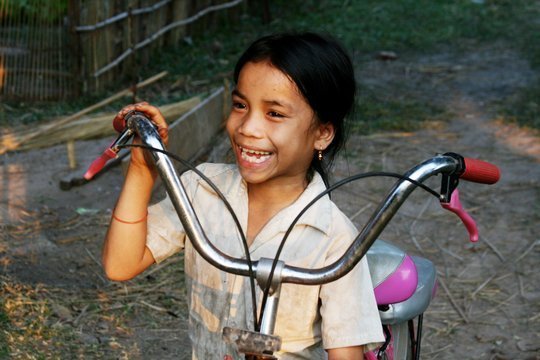
International nonprofit Lotus Outreach has efficiently bridged the distance with all-terrain bicycles, distributing them to several hundred of the most vulnerable girls in its program areas in rural Cambodia -- those on the brink of dropping out. Moreover, many children give their friends or neighbors rides to class, increasing the impact of each bike. The program, called Lotus Pedals, also provides repair kits to ensure the bikes can continue to be used year after year.
In developed societies the reliable operation of a safe, publicly-funded school bus that takes children from their doorsteps to the classroom is often taken for granted. Nothing like this exists in rural Cambodia, where 78 percent of the population resides. Thousands of children drop off the rolls each year for want of a means to travel a few miles. Walking unsupervised up to several hours a day is incredibly risky for a child, especially girls; rape is rampant, and rarely punished.
The most susceptible period for a girl is the transition from primary to secondary school; fewer secondary schools mean they often lie beyond her home village. Too often, this is where her formal education will end; 20 percent of Cambodian girls who complete primary school will not continue on to lower secondary school, with dropout rates increasing as they transition to high school. Lotus Pedals targets the most marginalized of these young women -- the daughters of sex workers, ethnic minorities, and the economically bereft.
With one simple gift, Lotus Pedals simultaneously combats gender inequality, economic disparity and the vacuum of formal learning that paralyses Cambodia's development as a nation. Bicycles alone will not solve any of these problems, but for $60 each they offer an affordable piece of the answer. "It is amazing to think that something most of us consider a recreational device can mean the difference between whether or not a girl in Cambodia can achieve the promise of education," says Erika Keaveney, Lotus Outreach's Southern California-based Executive Director. "We know that there are hundreds of girls literally sitting at home right now instead of going to school for want of a simple bike."
More recently, Lotus Outreach also began providing bus transportation to adolescent girls in rural India who live too far from the nearest secondary school to commute by foot. The story of 16-year-old Arastun illustrates how something as simple as a ride to school can offer new hope. A spinal cord injury meant she could no longer commute by foot, and her family lost hope for her education. The program, called the Blossom Bus, changed her fortune and the lives of the other 450 children it transports to school every day -- all of whom would otherwise never learn to read and write and would surely (like their parents) confront a life of subsistence labor in the local fields or brick kilns.
At the same time but on the other side of the world, hundreds of thousands of kids in India and Cambodia will be oblivious to the start of the academic year as they begin another day at work, perhaps picking through garbage dumps for recyclables or hauling goods back and forth across the border to Thailand. According to the World Bank, an estimated 750,000 Cambodian children under the age of 12 were working in 2006. Most of these were girls.
Study after study reveals that all over the world, education is the single most effective catalyst for reducing poverty and remedying its myriad consequences -- from lower life expectancy to maternal mortality to malnutrition. Deep-rooted gender biases, extreme poverty, the family's need for an extra income, and the cost of books and materials are a few of the reasons why Cambodian girls so often work instead of going to school. Though there are seemingly countless reasons for gaps in education access in the developing world, transportation is often the single largest gap and -- thankfully -- one of the simplest to fill.
International nonprofit Lotus Outreach has efficiently bridged the distance with all-terrain bicycles, distributing them to several hundred of the most vulnerable girls in its program areas in rural Cambodia -- those on the brink of dropping out. Moreover, many children give their friends or neighbors rides to class, increasing the impact of each bike. The program, called Lotus Pedals, also provides repair kits to ensure the bikes can continue to be used year after year.
In developed societies the reliable operation of a safe, publicly-funded school bus that takes children from their doorsteps to the classroom is often taken for granted. Nothing like this exists in rural Cambodia, where 78 percent of the population resides. Thousands of children drop off the rolls each year for want of a means to travel a few miles. Walking unsupervised up to several hours a day is incredibly risky for a child, especially girls; rape is rampant, and rarely punished.
The most susceptible period for a girl is the transition from primary to secondary school; fewer secondary schools mean they often lie beyond her home village. Too often, this is where her formal education will end; 20 percent of Cambodian girls who complete primary school will not continue on to lower secondary school, with dropout rates increasing as they transition to high school. Lotus Pedals targets the most marginalized of these young women -- the daughters of sex workers, ethnic minorities, and the economically bereft.
With one simple gift, Lotus Pedals simultaneously combats gender inequality, economic disparity and the vacuum of formal learning that paralyses Cambodia's development as a nation. Bicycles alone will not solve any of these problems, but for $60 each they offer an affordable piece of the answer. "It is amazing to think that something most of us consider a recreational device can mean the difference between whether or not a girl in Cambodia can achieve the promise of education," says Erika Keaveney, Lotus Outreach's Southern California-based Executive Director. "We know that there are hundreds of girls literally sitting at home right now instead of going to school for want of a simple bike."
More recently, Lotus Outreach also began providing bus transportation to adolescent girls in rural India who live too far from the nearest secondary school to commute by foot. The story of 16-year-old Arastun illustrates how something as simple as a ride to school can offer new hope. A spinal cord injury meant she could no longer commute by foot, and her family lost hope for her education. The program, called the Blossom Bus, changed her fortune and the lives of the other 450 children it transports to school every day -- all of whom would otherwise never learn to read and write and would surely (like their parents) confront a life of subsistence labor in the local fields or brick kilns.
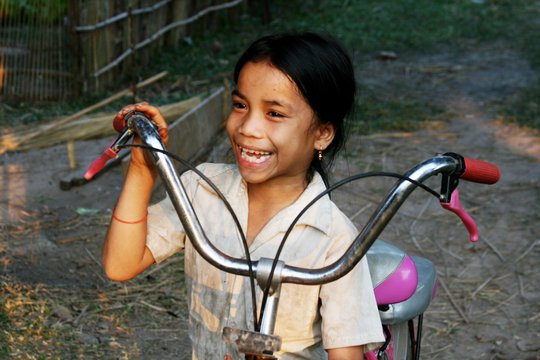
June 26, 2011
Oh, Boy! The Anti-Girl Bias Is in Fashion
If you could only have one child, would you prefer it to be a boy or a girl? Honestly? Here it is: 40 percent of Americans prefer to have a son and only 26 percent a daughter. This is the result of the Gallup poll of 1947 and -- hold your breath -- of 2011. The Gallup researchers have asked Americans a variation of this same question ten times since 1941, with little variance in the result. Oh, boy! Do prejudices ever change? Let's take a closer look: In 2011, 49% of men want a boy, women essentially have no preference. So, it's a guys' thing, is it? Shockingly, it's also an age thing: Americans who are younger than 30 say they would prefer a boy to a girl by a 54% to 27% margin. That boy-preference gap declines to 12 points among those 30 to 49, to 5 points among those 50 to 64, and finally to only 2 points among those 65 and older.
The anti-girl bias is in fashion -- not only in America, but around the globe. It is unclear how far Americans are willing to go to act on their gender preference, but new technologies such as artificial insemination and in vitro fertilization make it as easy as stock picking for hopeful parents to choose their favorite sex. Thus far, most attention has been focused on Asia, where, by the sheer population numbers, these kinds of decisions have a devastating effect in tilting the global gender balance. Last year, the Economist reported a "war on girls," counting 100 million missing baby girls worldwide. Recently, the Philadelphia Inquirer pointed out that the demographic shift will have major consequences in the decades ahead.
I think we need to ask a broader question and understand the reasons: What's behind it? Why, sisters, why?
Let's take a look at Asia, where the girl bias is most obvious, and most deadly. As its latest 2011 census reveals, India counts 914 girls younger than six years for every 1,000 boys. If nobody interfered, only a few more boys than girls would be born. If I do the math right, this means that in India alone, 500,000 girls are not allowed to live -- every year. The numbers in China, with its strict implementation of the one-child-family, are even worse.
These are staggering figures, and a rather recent development. In India, it is the flipside of an emerging India with a new middle class, a higher literacy rate, better health care. Until the sixties, the girl ratio in India was almost even. Now millions have new access to modern diagnostics, and this blessing can come with a curse. Middle-class parents get to know the gender of their baby through prenatal ultrasound, and they have a choice -- do they want to abort their baby girl and try for a boy instead? Economists thought that gendercide would decrease as the wealth in Asian nations increases, but the recent Indian census and other studies reveal the opposite: more and more parents opt for a boy. The truth is: it is not getting better for girls, it is getting worse.
"The problem is much greater than economics, education and lifestyle," says Glenn Fawcett, Field Executive Director of the nonprofit Lotus Outreach, who has worked in some of Asia's poorest regions for almost two decades. India has long banned gendercide, but law and family pressure are two different categories. Often, the pregnant women are pressured by their families to abort if they expect a girl -- especially if it is a first born. And even if they don't abort -- girls are less likely to be taken to a doctor when they get sick or get a good meal when food is scarce. Thus the girls' mortality is far greater than the boys'. In some cases, they are literally left to starve and die.
Glenn Fawcett suggests in Indian society the risk and burden of raising a girl is greater, no matter what caste or economic class. There is the dowry problem, but also a general view of seeing girls as less valuable, more of a liability than an asset. It is the boy who is expected to stay home, take care of his parents when they are elderly, bring home a good wife, and run the family trade. Girls, however, leave the house to take care of their husband's family, and if they elope or get pregnant before their marriage is arranged, the whole family's reputation is irreparably ruined.
While traditional customs and values are hard to shift, it is comparatively easy to suggest creative solutions in Asia. Lotus Outreach tries to change perception from the ground up: its programs specifically target girls' education. Every Indian girl who earns her own dowry is tipping the table. Every woman who gets a secondary education and thus a good job is the pride of her family. Every daughter who is able to support her family is a living proof that the girl bias is outdated. It can be done: South Korea, once boasting a girl ratio as bad as China's, has profoundly transformed itself and is heading towards equality now.
Yet, as the Gallup poll shows, the rift goes much deeper, beyond India's dowry customs and China's one-child policy. We just don't value girls as much, whether in Asia or America. Traditional perceptions in Asia might be hard to shift and easy to condemn, but with no dowry system and equal education access in America, why do American parents prefer boys, too?
Do parents feel more confident a son will care for them when they are old and bedridden? Wrong turn. As Nancy Folbre showed in the New York Times, daughters are more likely to be there for them. Are American parents afraid their daughter will get pregnant early? We don't know. Is it because American women are still likely to earn less than their male counterparts? You got a point there, but this is yet another argument for equal wages, not fewer girls. It is a puzzle, and a baffling one. We have more questions than answers. So, let me ask you, Americans: Why do you prefer boys? Or, what's so special about having a baby with a penis?
The anti-girl bias is in fashion -- not only in America, but around the globe. It is unclear how far Americans are willing to go to act on their gender preference, but new technologies such as artificial insemination and in vitro fertilization make it as easy as stock picking for hopeful parents to choose their favorite sex. Thus far, most attention has been focused on Asia, where, by the sheer population numbers, these kinds of decisions have a devastating effect in tilting the global gender balance. Last year, the Economist reported a "war on girls," counting 100 million missing baby girls worldwide. Recently, the Philadelphia Inquirer pointed out that the demographic shift will have major consequences in the decades ahead.
I think we need to ask a broader question and understand the reasons: What's behind it? Why, sisters, why?
Let's take a look at Asia, where the girl bias is most obvious, and most deadly. As its latest 2011 census reveals, India counts 914 girls younger than six years for every 1,000 boys. If nobody interfered, only a few more boys than girls would be born. If I do the math right, this means that in India alone, 500,000 girls are not allowed to live -- every year. The numbers in China, with its strict implementation of the one-child-family, are even worse.
These are staggering figures, and a rather recent development. In India, it is the flipside of an emerging India with a new middle class, a higher literacy rate, better health care. Until the sixties, the girl ratio in India was almost even. Now millions have new access to modern diagnostics, and this blessing can come with a curse. Middle-class parents get to know the gender of their baby through prenatal ultrasound, and they have a choice -- do they want to abort their baby girl and try for a boy instead? Economists thought that gendercide would decrease as the wealth in Asian nations increases, but the recent Indian census and other studies reveal the opposite: more and more parents opt for a boy. The truth is: it is not getting better for girls, it is getting worse.
"The problem is much greater than economics, education and lifestyle," says Glenn Fawcett, Field Executive Director of the nonprofit Lotus Outreach, who has worked in some of Asia's poorest regions for almost two decades. India has long banned gendercide, but law and family pressure are two different categories. Often, the pregnant women are pressured by their families to abort if they expect a girl -- especially if it is a first born. And even if they don't abort -- girls are less likely to be taken to a doctor when they get sick or get a good meal when food is scarce. Thus the girls' mortality is far greater than the boys'. In some cases, they are literally left to starve and die.
Glenn Fawcett suggests in Indian society the risk and burden of raising a girl is greater, no matter what caste or economic class. There is the dowry problem, but also a general view of seeing girls as less valuable, more of a liability than an asset. It is the boy who is expected to stay home, take care of his parents when they are elderly, bring home a good wife, and run the family trade. Girls, however, leave the house to take care of their husband's family, and if they elope or get pregnant before their marriage is arranged, the whole family's reputation is irreparably ruined.
While traditional customs and values are hard to shift, it is comparatively easy to suggest creative solutions in Asia. Lotus Outreach tries to change perception from the ground up: its programs specifically target girls' education. Every Indian girl who earns her own dowry is tipping the table. Every woman who gets a secondary education and thus a good job is the pride of her family. Every daughter who is able to support her family is a living proof that the girl bias is outdated. It can be done: South Korea, once boasting a girl ratio as bad as China's, has profoundly transformed itself and is heading towards equality now.
Yet, as the Gallup poll shows, the rift goes much deeper, beyond India's dowry customs and China's one-child policy. We just don't value girls as much, whether in Asia or America. Traditional perceptions in Asia might be hard to shift and easy to condemn, but with no dowry system and equal education access in America, why do American parents prefer boys, too?
Do parents feel more confident a son will care for them when they are old and bedridden? Wrong turn. As Nancy Folbre showed in the New York Times, daughters are more likely to be there for them. Are American parents afraid their daughter will get pregnant early? We don't know. Is it because American women are still likely to earn less than their male counterparts? You got a point there, but this is yet another argument for equal wages, not fewer girls. It is a puzzle, and a baffling one. We have more questions than answers. So, let me ask you, Americans: Why do you prefer boys? Or, what's so special about having a baby with a penis?
June 12, 2011
World Day Against Child Labor: From Brick Kiln to ABC
On World Day Against Child Labor on June 12, the international nonprofit Lotus Outreach will celebrate 400 child workers in India who enrolled in school for the first time in their lives. While Lotus Outreach has many projects designed to keep children in school and out of work, the brick kiln kids illustrate this reality most starkly. As many as 80 million children work in India, many of them in 14 hour shifts with no shelter from the sun. While many of them never learn to read, these 400 children will have a happier future. I hope you will take the time to remember the faces and families you see here.