
Pamela Richards's Blog, page 7
January 20, 2013
Greek Culture in The Last Four Beatitudes from Matthew 5
 This post is part of a series which study the Beatitudes of Matthew 5 from the perspective of ancient Greek Culture.
If you're just joining us, the study begins here.
In ancient Greek medicine, eight conditions of human illness are recognized. Each of the eight beatitudes describe one of these extreme conditions. The first four Beatitudes are based on an absence of air, water, fire and earth. The second four center on an excess, in the same order: air, water, fire and earth.
The first Beatitudes, each exhibiting an absence of one of the four elements, illustrate aspects of our personal relationship with God. By contrast, the second four focus on an overflow of these same elements. The excess of these elements are illustrated in four attributes which affect others, allowing us to share with those around us the benefits of a restored relationship with God.


January 10, 2013
Unusual Appetite
 This post is part of a series which study the Beatitudes of Matthew 5 from the perspective of ancient Greek Culture.
If you're just joining us, the study begins here.
In ancient Greek medicine, eight conditions of human illness are recognized. Each of the eight beatitudes describe one of these extreme conditions. The first four Beatitudes are based on an absence of air, water, fire and earth. The second four center on an excess, in the same order: air, water, fire and earth.
The Fourth Beatitude
"Blessed are those who hunger and thirst for righteousness, for they shall be filled."
Appetite is a natural, persistent, and healthy urge which helps us sustain the vitality of our bodies. But when we lack earth, how will we grow food to eat? The history of the sustenance of Athens was a story of feast and famine.
Early in her campaigns, Athens had sacrificed her surrounding farmlands to the cause of her wars. Siege was a deadly technique of warfare directed at civilians, cutting off access to food and supplies and slowly starving the population of a city into submission. Athens besieged enemy cities without mercy, and her own enemies inflicted the same punishment on her in turn. Since the beginning of the Peleponnesian wars, Athens had depended on her superior fleet of graceful and swift triremes for access to food and supplies.
Without her ships bringing sustenance from afar, Athens would never have survived those years. Her citizens would not have had food for the table, and Athenian high society would not have been able to offer the hospitality of the symposia: dinner parties offered as feasts for both the body and the mind. No one entertaining in Athens forgot the spirits, either--plenty of wine was served at a symposium.
By 405 BC, Sparta had at last developed a naval force to exceed that of Athens, and for once the warring city of Athens faced a siege both by land and sea.
When the Peloponnesian wars finally drew to an end in 404 BC, it was because large numbers of Athenians were dying of starvation daily.
The very wealthiest and most influential in Greek society--those who excelled--the best of the best, or as they thought,the most favored by the gods--were described as "makarioi." This is the same word that Jesus used for "blessed."
Jesus uses a word that we translate somewhat optimistically as "hunger"--the English word might indicate no more than an ordinary healthy appetite, contrasting with the Greek term used, "peinotes," more accurately suggesting one famished, pining, suffering want, needy--impoverished. The Greek word we have translated as "thirst"--"dispsao," likewise carries a connotation of suffering.
The word Jesus uses for "satisfied" swings to the other side of the spectrum, which is one reason why I find the Beatitudes so passionate. The Greeks, it was said, loved moderation, but Jesus loved extremes. "Chortazo" means not just having enough, but more than enough. Filled, fattened--simply having no more room for another bite.
Because Athens lacked the earth to feed her citizens, she provided sustenance for them by way of her navy. The symposia of the upper classes offered food for the body, conversation for the mind, and wine, it was said, for the spirit.
In the fourth Beatitude, Jesus points out that those of us who overlook our starvation for righteousness neglect the deepest needs of our souls, which he more than satisfies.
January 9, 2013
Two Ways to Grow a Rose
 This post is part of a series which study the Beatitudes of Matthew 5 from the perspective of ancient Greek Culture.
If you're just joining us, the study begins here.
In ancient Greek medicine, eight conditions of human illness are recognized. Each of the eight beatitudes describe one of these extreme conditions. The first four Beatitudes are based on an absence of air, water, fire and earth. The second four center on an excess, in the same order: air, water, fire and earth.
I happen to be writing about the Beatitudes as a focal point of my work in progress, Walk Through the Valley. These studies of Greek culture in the Beatitudes are a separate work and convey some of my own reflections on the subject which have developed in the years since Richard's death. The main body of Walk Through the Valley , unlike these studies, is composed of stories from the lives of people who lived out the Beatitudes: Jesus Christ, Francis of Assisi, and my friend Rich Mullins.
Initially, I noticed the Beatitudes describing these eight extreme conditions using Greek culture as a common factor influencing both Christ's audience and today's. From my experience as an interpreter, I speculated that there might be several commonly known myths, stories or histories in Greek culture that would tie the themes of the Beatitudes together.
Once upon a time I majored in Ancient Near Eastern Studies, but it's been a while. Over the holiday, I happened to watch an old BBC special on the history of ancient Greece which seemed to confirm my theory. At least, now I can point to several landmarks of Greek history and philosophy which were no doubt familiar to Christ's audience and seem pertinent to the themes of the Beatitudes.
And so this series of blog posts was born. I find it fascinating that most of the historic events we will briefly examine took place in the ancient city of Athens, a center of Greek culture and the location of the great temple of Athena. This connection would have been no secret to his audience. I take this common factor as an indication of Jesus' boldness in challenging Athena--the goddess of wisdom of the ancient Greeks.
Pericles (495-429 BC) had towering ambitions for his city. He wanted Athens to become the wealthiest and the mightiest city in the Mediterranean basin, not only in his lifetime, but beyond. By his influence as an orator, he kindled a fire in his fellow Athenians to engage enemies as diverse as Sparta, Persia, Sicily and Syracuse in the Peloponnesian wars for ever-greater control, power and wealth.
Throughout long years of war, Pericles kept his city focussed on battle. Here is a quote from one of his speeches:
"Remember, too, that if your country has the greatest name in all the world, it is because she never bent before disaster; because she has expended more life and effort in war than any other city, and has won for herself a power greater than any hitherto known, the memory of which will descend to the latest posterity."
from Pericles' Third Oration according to Thucydides
Appropriate to the third Beatitude, in the winter of 430 BC, Pericles delivered a funeral oration for the heroic soldiers who had fallen in wars to advance Athens. Proudly, he stated:
". . . For heroes have the whole earth for their tomb. . ."
from Pericles' Funeral Oration as recorded by Thucydides
Months later, in the summer of 430 BC, the city of Athens broke out in a devastating epidemic characterized by fever. No one today knows the name of the disease, or where it came from. It left families bereaved by the wars even further decimated. Two of Pericles' own sons were claimed by the fever. At last Pericles himself fell victim to the epidemic.
The Third Beatitude: "Blessed are the meek, for they shall inherit the earth."
The very wealthiest and most influential in Greek society--those who excelled--the best of the best, or as they thought,the most favored by the gods--were described as "makarioi." This is the same word that Jesus used for "blessed."
"Praeis" in the medical context describes a fever that has broken-in the ancient system of medicine, indicating an absence of fire. "Kleronomesousi" describes a portioning-out; "gen," earth.
Jesus reminds us that it is not the ambitious who inherit, but the meek--those whose fevers to possess more, to gain more power, have been broken. The earth, the stars, the sky, the Sun and Moon live so much longer than any human that there is no point trying to own them. It is the living, the content, who remain above the earth to share and enjoy it--not those who have paid with their lives the price for a measureless tomb.
Two ways to grow a rose: either from beneath the earth, or from above it.
January 8, 2013
God Returns His Calls
 This post is part of a series which study the Beatitudes of Matthew 5 from the perspective of ancient Greek Culture.
If you're just joining us, the study begins here:
In ancient Greek medicine, eight conditions of human illness are recognized. Each of the eight beatitudes describe one of these extreme conditions. The first four Beatitudes are based on an absence of air, water, fire and earth. The second four center on an excess, in the same order: air, water, fire and earth.
The Second Beatitude: "Blessed are those who mourn, for they will be comforted."
The very wealthiest and most influential in Greek society--those who excelled--the best of the best, or as they thought,the most favored by the gods--were described as "makarioi." This is the same word that Jesus used for "blessed."
The word "pentheo" describes the activity of mourners at a funeral: in ancient Greek culture, grief was a loud, vocal process. Any family who could afford them would hire professional mourners to swell the sound and ensure appropriate decibels at the death of a loved one.
When someone weeps, we get them a drink of water. Between loud continuous wailing and countless tears shed, the Greeks may have considered mourners to suffer from a lack of water .
In Greek culture, there were several versions of accounts of death and the afterlife. One of the most widespread may have been the cult of Orpheus. The myth of Orpheus says he was the greatest musician and singer in ancient history. When his bride Euridyce died on their wedding day, Orpheus was heartbroken. He was determined either to bring her back to life, or to join her in the underworld. He descended to the underworld, taking his lyre with him. He intended to use the gift of music the gods had given him to turn their hearts. Orpheus' spectacular solo won the gods over, but he was only allowed to bring Euridyce back to life one condition: he must lead her back home without turning around to see if she had followed him. In this he failed, and Euridyce was returned to the underworld.
The Greek mystery cult of Orpheus was said to involve rather elaborate rituals to ensure the safe passage of the dead to the afterlife. After cycles of thousands of years of reincarnation to purifiy the spirit's contamination by the flesh, the Greek followers of Orpheus hoped at last to become gods.
Just one of many Orphic instructions to the dead soul follows: the departed soul is instructed to call out to the keepers of the underworld, "I am a son of earth and starry sky. I am parched with thirst and am dying, but quickly grant me cold water from the Lake of Memory to drink. . ."
Jesus describes our own exchange with God as a much simpler and more direct interaction, but one that opens the way for an ongoing relationship. In answer to our mourning Jesus offers "parakaleo," the same word as used for the action of the Holy Spirit. It describes being called beside, for the purpose of offering comfort. When we cry out to God in mourning, he responds by calling us back--into his presence once again. In response to the mourners' lack of water, "The Spirit and the bride say, “Come!” And let the one who hears say, “Come!” Let the one who is thirsty come; and let the one who wishes take the free gift of the water of life."
"Antipohonal" is a term musicians may know that comes from Greek. It describes an audible signal from one party followed by an audible response from another party. Antiphony describes the action of the second Beatitude: when we mourners cry out to God, he calls back to us in turn.
The simple but unqualified condolence of Jesus seems to suggest that God matches our intensity--he misses his loved ones, too. When we are absent from him, he mourns for each one of us just as deeply as we miss our loved ones who have passed on, and calls out with the same passion as we do.
January 7, 2013
Lose the Olympics, Gain the Sky
 In ancient Greek medicine, eight conditions of human illness are recognized. Each of the eight beatitudes describe one of these extreme conditions. The first four Beatitudes are based on an absence of air, water, fire and earth. The second four center on an excess, in the same order: air, water, fire and earth.
The First Beatitude
The Greeks were dedicated to sports, and they permitted free men of any social class to compete in the Olympic games. Athletes were highly regarded in their society. Kings could compete against blacksmiths or wealthy landowners against merchants. Their lore told them that the Olympic games were established by the gods and the mighty hero Hercules. To excel in the Olympic games was to enjoy the favor of the gods--or to beome a hero: in a sense, godlike.
One aspect of the Beatitudes that is difficult to convey is the humor and intricacy of the word play Jesus used in the Greek. The first Beatitude starts out: "Blessed are the poor in spirit . . ."
The very wealthiest and most influential in Greek society--those who excelled--the best of the best, or as they thought,the most favored by the gods--were described as "makarioi." This is the same word that Jesus used for "blessed."
The Greek word, "pneuma," similar to the Hebrew word, "ruach," meant air, spirit, or breath. To be lacking air, as the Beatitude suggests, in the context of health or illness would equate to being short of breath.
One paraphrase might be, "Most greatly favored are the short of breath:" in Olympic terms, losers. The short of breath not only wouldn't have won, they may not even have finished the race.
So why does Jesus call them favored?
". . . For theirs is the kingdom of Heaven." I'd like to look at that phrase in the Greek--belonging to the Kingdom of Heaven is the equivalent of being a citizen of the sky. We have to bear in mind that ouranos means both heaven and sky, but in the spiritual sense "air" refers here to spirit. Where is there more air than in the sky? In case you missed the pun, Jesus is offering us all the air (spirit) anyone can breathe, and more.
What are the poor in spirit experiencing, in spiritual terms? They aren't spectators, or they wouldn't be out of breath. They're in there, trying. They are giving their best to the competition but it just isn't enough. They don't have what it takes and when they have to fall out of the race, they realize that. They aren't going to become heroes or gods thanks to their own efforts. We would say, "they're only human."
But Jesus would say that's what makes them his favorites.
They are not full of themselves. Whatever their failings, they do not have an ego that would prevent them from relying on Jesus. "I can do all things--through Christ, who strengthens me." *
This establishes a theme that repeats thoughout the Beatitudes: Jesus never tells us what we expect to hear. He doesn't just say, "There, there. Poor human, you'll get through this somehow. You'll feel better tomorrow. Keep trying." He avoids superficial philosophical palliatives. He consistently offers something much better--an advancing relationship with divinity, in return for facing the worst conditions humans can endure.
There are two reasons Christ can offer these counterintuitive consolations: first, because he lived through each of these difficult human predicaments himself. Because he is divine yet he walked in the way of humanity, each step we take on the steep path of human experience brings us into God's presence. The second reason he can list these inexplicable, irrational consequences is because he declared them to be so. The Hebrew concept of blessing is, "to vocally call into existence the power for something to become what it was meant to be." If Christ were only human, we would perhaps complain his blessings sound like the incantations of a magician. But since he is also Divine, to us they sound like the Creator speaking his will with power. And so they are.
*The emphasis here is mine.
January 6, 2013
Jesus Challenges Greek Culture in the Beatitudes
 Like all scriptures, the Beatitudes Christ declared in Matthew 5 as part of the Sermon on the Mount can be studied from many points of view. I'm excited about gaining another perspective by looking at them through the lens of healing.
Greek culture dominated the audience of the Sermon on the Mount, which was from the Jewish population of the Decapolis. Romans ruled the area with military might, but Rome adored the culture of ancient Greece, so the people of that region had looked to Greek culture for generations. The concepts of healing familiar to them were based on Greek medicine.
Here in America, we have something in common with the people of Decapolis: we have been exposed to an admiration for Greek culture, too. We have developed an entirely different system of medicine, but our nation has likewise looked to the ancient Greeks and built upon Greek values, as have most democracies of today's world.
Jesus had not much use for democracies nor republics either. If such governments exist to help people cooperate, they are seldom successful. His was not an earthly kingdom, yet Jesus had in mind to show us how to bring the Kingdom of Heaven to earth: "The kingdom of Heaven is within (or among) you." In other words, the solution to man's inhumanity to man isn't in our governments. It's in our hearts.
The Greeks loved independence, individuality, competitiion, achievement, moral excellence, art and art objects, wealth, wisdom, and retribution. They longed to become divine through human effort.
Do any of those values resonate with us today?
The next eight blog posts will take a look at the Beatitudes from the Greek perspective.
January 1, 2013
FAQ about Rich Mullins
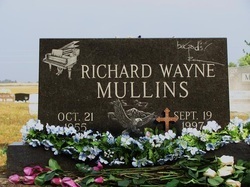 Richard Wayne Mullins 1955-1997 I wish everyone the best possible blessings of the New Year!
 I just updated the FAQ about Rich Mullins, in case you haven't seen them yet. There's a place on the page to contact me if you would like to ask a question--one I can answer, anyway.
I won't speak as though I know as much about Richard as he did about himself, because that would be presuming far too much. Instead, I can share with you what I saw in him.
December 26, 2012
FAQs about Singing from Silence
 Ever wonder about the difference between memoir and biography? What to expect to find in Singing from Silence? If you have questions about Rich Mullins' life, do you know how to find the answers?
 Click here to enter the new FAQs page on Singing from Silence. If you don't find an answer to your question, you can send me a line.
I'll look forward to hearing from you! Best blessings! -Pam Richards
December 22, 2012
Demolishing the Law: Tear Down this Temple
 Deconstruction is a process of breaking down symbols in well-known phrases and sayings while overturning the system of opposites they are presumed to represent. This modern concept is often applied to literature, law, ethics or even politics.
 I've been told my gift as a writer is deconstruction. I'm not sure it's true, but if it seems to be, I think I know who started me in that direction. We're told deconstruction dates to the mid-twentieth century, but a study of the Beatitudes shows it's not really new.
I doubt if I can definitively claim that Christ was historically the first deconstructionist. I'm not enough of an expert on the wide range of ancient literature and philosophy to say so. But Jesus clearly knew it would be necessary to dismantle the existing order to build the new one in its place.
"Destroy this temple, and I will raise it again in three days."
By declaring eight simple but counterintuitive statements invested with the transformative power of blessings, Jesus pulls the structure of the Law apart and reassembles instead a system beyond ethics, beyond healing: in fact, I believe he outlines step by step a means of imparting divinity to broken humanity. For good measure, he gets in some signifcant digs to Greek culture, too.
Even more remarkable is that Jesus lived out in his life every one of the Beatitudes he taught, deliberately choosing the most vulnerable and broken experiences mankind can go through. As a result, no matter how bad things are for us, each of us can say that God has been there before us.
Rich Mullins and I centered on the topic of the Beatitudes for years, but our discussion was more than a conversation. We believed we could learn more from scripture by living it than by reading or talking about it. As we set out to find examples of the Beatitudes in our lives, we consciously sought fulfillment of the blessings they promised. Walk through the Valley is a compilation of stories from the lives of people who lived out the Beatitudes: Jesus Christ, St. Francis of Assisi, and my friend Rich Mullins.
December 20, 2012
The Kingdom of the Little Child
 If you've ever had the mixed blessing of being closely involved with a celebrity, you know the circle keeps expanding, and you've seen how ugly things can get when followers lose confidence that their friendship is appreciated. Being around the best people can bring out the worst in human beings. Transparent bids to make others look bad and covert power plays are sadly inevitable, it seems.
Jesus was looking over the shoulders of his disciples as they argued. He watched as a child, looped around with ropes of lilies, played in a puddle fed by the spring rains.
His followers began to exchange verbal blows, each seeking any foothold, any leverage to make himself look better than the rest. Finally the tensions bubbling between the disciples surfaced as a question: "Teacher, who is the greatest in the Kingdom of Heaven?"
Jesus broke away from the circle of disciples, dropped to his knees, and stretched his arms out to the child. The little boy ran to Jesus, who swooped him up and spun him around, kicking in the air and shrieking with laughter. The little one slipped his handmade crown of lilies on Jesus' brow, where they dangled lopsided over Jesus' left eye, gloriously spilling diamonds of raindrops down Jesus' beard to sparkle in the golden dust covering his robes. The child took in the vision in silent delight and Jesus took him by the hand.
Jesus stood the child before his disciples and stooped down to child's-eye level. “Truly I tell you, unless you change and become like little children, you will never enter the kingdom of heaven. Therefore, whoever takes the lowly position of this child is the greatest in the kingdom of heaven. And whoever welcomes one such child in my name welcomes me.”
In their lowly state, what do children have that gives them privileged access to the kingdom of heaven? They lack cynicism, unbelief, and callousness. Little children do not find in others what they themselves lack.
I learned from my friendship with Richard that those who see only guilt misunderstand the best intentions of faith; those who see only fear misunderstand the best intentions of hope; those who see only greed misunderstand the best intentions of charity; but those who find the best intentions in others see only God.


