
Pamela Richards's Blog, page 4
December 25, 2013
Ragamuffin Legacy Part Four: Both are Bards
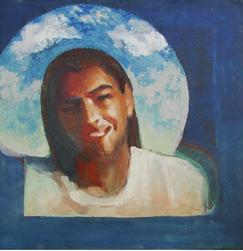 A Tribute to William Butler Yeats by Richard Wayne Mullins
“In the summer of 1976, Richard hitchhiked across the country. He was left-handed, so to avoid smearing the page with ink, he sent me a letter that had been written completely backwards like Lenardo DaVinci's notebooks. I had to hold it up to a mirror to read it.
I wrote Richard a poem in response. I answered a deep need I knew he felt for someone to affirm more than his incredible skill and talent--he needed to be loved for the totality of who he was, complete with his quirks and failures, in spite of the interference of his public persona.
My poem to Richard contained the line:
‘Though we're strangers I still love you
I love you more than your mask’”
--Rich Mullins Peace (A Communion Blessing from St. Joseph's Square)
Singing from Silence, p.54
Knowing Richard as I did, I had struck on a motif that Irish poet laureate and Nobel Prize winner William Butler Yeats (1865-1939) had used throughout his literary career: the mask. Yeats’ concept of the mask seems to have been an outgrowth of his deeply held sense of personal dichotomy as an artist and an individual. As a prophetic performer with a very private personal life, duality was an experience Richard would bear in common with Yeats throughout his life.
Richard later offered a tribute to Yeats by including my line and naming his corresponding song Peace--the title of one of Yeats’ most famous poems.
The rest of the title, A Communion Blessing from St. Joseph's Square, refers specifically to a location in Dublin, Ireland—a city Yeats had inhabited, and quite possibly a place Richard visited when he shot his video for The Color Green.
The writings of Both Yeats and Mullins are derived from life experience. As a literary leader of national standing, Yeats felt drawn to evoke and breathe a national spirit into the country of his birth through his poetry. To the end of shaping the destiny of a nation, Yeats carefully defined the meanings of his metaphors and blended ancient Irish legends with his personal view of unfolding history.
Mullins, on the other hand, aspired to a transpersonal level of communication. While some of Mullin’s metaphors carry a consistent significance in his work, in his sojourn as a troubadour he encouraged variance in his listeners’ interpretations of his songs. Taking on the role of bard to the Holy King of Israel, Mullins welcomed variety in the interpretations given to his songs by his audience. He meant Americans, Irish, Quakers, Catholics, and Protestants alike to be able to find themselves in his songs.
So in his concept album, A Liturgy, a Legacy, and a Ragamuffin Band, Richard’s Quaker Irishman kisses his father’s grave in the Irish homeland and sets sail for America, where he slips into a cathedral to receive a Communion Blessing that rings all the way back from Dublin, Ireland. Here on this side of the Jordan, we Quakers don’t ordinarily practice the sacraments and Catholics may or may not hear the rocks cry out in worship of the King—unless we’ve discovered a New World transcending time, space, and limiting theologies: like the one where Mullins carries us in his songs. In an recent interview with Reed Arvin, Christopher Marchand said this about the world Richard transported his listeners to:
"A classic album makes the listener feel as if the music has always existed, but that also feels as if it came from another world altogether. A Liturgy, A Legacy, & A Ragamuffin Band is one of those albums for me."
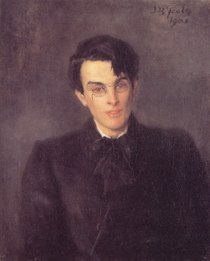 William Butler Yeats Yeats and Mullins were both creators of new worlds who employed ancient legends as a means of constructing those worlds. Yeats wrote his poem Peace about his reunion with Maude Gonne, a woman he loved from whom he had been separated for many years because of her marriage to another. This was a life experience Yeats and Mullins shared. Many literary anaylists have found a metaphor for Yeats’ frustrated relationship in one of his legend-based plays, Deirdre.
In the legend of the same name Yeats’ counterpart is a gifted songwriter, Naoise, who has captured the heart of his love Deidre through music. But since infancy, her hand has been promised to a desperately jealous king. The setting of Mullins’ song Peace may loosely allude to Deirdre. At the king’s invitation, the unsuspecting couple enters a fatal prison where a table is spread with the ruined tokens of a communion feast. Deirdre’s musicians sing: “. . . love longing is but drought for all the things that come after death.” The inspired songwriter King Solomon could hardly have said it better.
The play, like the legend, ends in tragedy. On her way to her death, Deirdre pleads with her singers to “. . . set it down in a book, that love is all we need. . .” a sentiment Mullins was later to echo.
In his tribute to W.B. Yeats, Mullins has deconstructed the Deirdre story line and retained the concept of reconciliation found in Yeats’ famous poem: Peace. By keeping the framework loose, he draws attention to Yeats’ primary motifs: mask, prison, and drought, yet allows us the latitude to identify parallels for these metaphors in our own lives.
The uplifting effect of Mullins’ Peace owes partly to its dark prison setting. Despite the dismal milieu, the songwriter finds hope in Christ, whose outstretched arms still have the “strength to reach beyond these prison bars and set us free.” Mullins offers this benediction: may His peace “rain down from heaven . . . on these souls this drought has dried.
Peace of Christ to you. . . ”


November 27, 2013
A Ragamuffin’s Legacy Part Three: Legends Live
 Irish Leadership
Had he known his ancestral line included Irish kings, I don’t think Richard would have allowed it to change him much. The integrity of his message came first:
“. . . if they fed me like a pauper, or dined me like a prince I don’t care . . .”
Rich Mullins, Elijah
The ancient chieftains of Ireland were not like later imperial kings who owned the very land their subjects subsisted on. Each of the counties of Ireland was owned by the clan who inhabited it. The ancient Irish king was truly a servant of his land, his family, and his allies. And if he was not, he would not long remain king of his clan.
Perhaps the Irish value of humility in leadership is the reason fellow Irishman Steve Stockman was so impressed with Richard’s style of leadership:
“. . . we got there just in time to hear a Navaho (sic) High School Choir who were nothing short of awful. It was this that left me with my most challenging memory on the life of Rich Mullins. I turned to Rich at some stage to give him my short and to the point review of the choir. He agreed with my conclusions but went on to inform me that he was going sing "Awesome God" with them and they hadn't rehearsed and it was going to be with a backing track. And so he did. Now why? Why would a man of this stature risk a ropey performance? It seems that it was more important for Rich to give these school kids the thrill of their lives and the sense of dignity of singing with him than it was for him to sound good. It was the first becoming last that the last might somehow be first. It is an act of sacrifice that still slaps the face of my selfishness. . .”
Irish Legends Brought to Life
An ancient Irish King wasn’t necessarily wealthy, but he had a luxury few of us can afford; he had publicity managers who were artists, called bards. Bards observed battles and other newsworthy events, like news journalists sometimes do today. A bard was an expert in the lore of his land who could affect the education and attitudes of others through the skilled use of poetry, storytelling, or song. A king was a man with power, but his actions must make a good impression on his public relations man. The bard could reflect the king’s image back like a mirror and add luster, or focus a light on his actions to reveal flaws. Frequently, the songs and storytelling of the bards were repeated often, and traveled to many counties. A single song could make or break a king.
When history goes back far enough, facts become impossible to verify; the tales repeatedly told tend to crystalize on the deeper truth of the story and over time, these ancient stories are transformed into legends. Yet, behind the potency of legend lies the fact that it condenses a description of human experience we can all find in ourselves, and for this reason it lives through the ages.
I think the thing that would have intrigued Richard most about his kingly tribal line is the rich vein of lore and legend running through it from generation to generation. Scientists may have little use for legends, but they represent great wealth to artists, storytellers and songwriters—those who strive to connect with an audience through the heart.
The legends and lore of Richard's indigenous Irish ancestors are so numerous, with a quality of such depth, that I am only able to briefly recount a few of them here.
* * * * * * * * * *
Amairgin, First Bard of Ireland
Among the earliest of the native Irish named is the legendary first poet of Ireland, Amairgin.
The story is told that he arrived on Ireland by ship. When embarking for the first time upon the island, he celebrated his connection with Nature in this, historically known as the first Irish poem:
The Mystery
I am the wind which breathes upon the sea,
I am the wave of the ocean,
I am the murmur of the billows,
I am the ox of the seven combats,
I am the vulture upon the rocks,
I am a beam of the sun,
I am the fairest of plants,
I am a wild boar in valor,
I am a salmon in the water,
I am a lake in the plain,
I am a word of science,
I am the point of the lance of battle,
I am the God who created in the head the fire.
Who is it who throws light into the meeting on the mountain?
Who announces the ages of the moon?
Who teaches the place where couches the sun?
(If not I)
This isn’t a very Christian poem, but recalling that it has been dated to 1000 BC and that St. Patrick didn’t step foot on the island until about 416 AD, it could hardly be otherwise. It does express a profound empathy with nature, to the point of expressing religious belief. Some believe the degree of nature connection found in indigenous tribes like the native Irish may have taken the form of a shamanism similar to that more recently found in native American tribes.
Richard also was known for his ability to feel the touch of God’s hand in the warmth of a patch of sunlight, or to see the painting of the great Artist in the shade of green He’d chosen for the fields:
“Be praised for all Your tenderness by these works of Your hands
Suns that rise and rains that fall to bless and bring to life Your land
Look down upon this winter wheat and be glad that You have made
Blue for the sky and the color green that fills these fields with praise”
The Color Green, Rich Mullins
* * * * * * * * * *
Tara
Here in America, most of us are familiar with JRR Tolkien’s trilogy, The Lord of the Rings. Tolkien’s Middle Earth was based on the legends of many cultures, from Norse to Anglo Saxon to Germanic. And there is one location in Middle Earth that bears a certain resemblance to an ancient Irish site: Tolkien’s description of Rivendell may have been based on Tara.
Tara of legend served both as the administrative capitol of Ireland, and a center for the arts: it was known to be constantly attended by the Irish songwriters and historians known as bards, musicians, and poets. Its Gaelic name, Te-mur, translates to “Wall of Music,” describing the music of the harp. Its ancient monuments are still to be found just northwest of Dublin.
This passage describes the artistic character of Tara:
“The Dinn Seanchas, or history of noted places in Ireland, compiled by Amergin Mac Amalgaid, in the year 544, relates that in the time of Geide, monarch of Ireland, "the people deemed each other's voices sweeter than the warblings of a melodious harp, such peace and concord reigned among them, that no music could delight them more than the sound of each other's voice: Temur (Tarah) was so called from its celebrity for melody, above the palaces of the world. Tea, or Te, signifying melody, or sweet music, and mur a wall. Te-mur, the ‘wall of music.’ This extract contains the earliest allusion to the harp, which Mr. Hardiman has met with. There is an ancient Gaelic poem which used to be sung in the Highlands of Scotland, in which the poet addresses a very old harp, and asks what has become of its former lustre. The harp replies, that it had belonged to a king of Ireland, and had been present at many a royal banquet; and had afterwards been in the possession of Dargo, son of the Druid of Baal — of Gaul — of Filan, &c. &c. . .”
The harp was not one of the many instruments Richard was known to have mastered. But the notes of the hammered dulcimer, although more staccato, unfold the lingering sustain that builds a similar “Wall of Music” effect. Although the hammered dulcimer is not considered a Celtic instrument, here in America its distinct tones are often heard as representative of both Appalachian and Irish sound.
* * * * * * * * * *
Lugaid Loigde and the Loathly Lady
“. . . the young knight must answer the question "What do women most desire?" The answer, he learns from the old hag, is sovereignty over herself. However, in gaining the answer, he is forced to marry the hag. She then offers him the choice--to have her be pretty and unfaithful, or old but a faithful wife. He wisely allows her to choose, thus demonstraiting (sic) the concept of soveriegnty; at this point, she declairs (sic) that she will be both beautiful and faithful. . .”
“. . .In the older versions, usually found in Irish, the old woman represents the sovereignty of Ireland, and he who submits to her becomes the high king, and marries the sovereignty in a type of hierogamy. There is often a drink involved, which may be connected to the mead and horse cults, as alluded to in various texts, even as late as Gerald of Wales in the 12th century. Here, the sovereignty is a horse goddess who has a cup, often of mead, which she offers to the king; his accepting of the cup seals his kingship and their marriage. . .”
Source
The Legends of the Grail
In the years when I knew him, it seemed to me Richard carried with him his own set of myths and legends, which he would willingly unpack and inhabit in order to bond with those who appreciated them. His timeless sense of connection with legend is one of the themes I’ve attempted to convey in Singing from Silence.
Richard had a lifelong habit of dubbing his close friends with nicknames. He gave me one back in 1974 when we first met. At the time, Wagner’s more updated version of the Loathly Lady was the only one I knew:
“Spooky! I begged him to reconsider the nickname, because everyone else on campus was a Christian and I made no secret of the fact that I was not. I was already standing target practice for the Christian Soldiers who felt a need to practice their evangelism skills; I had no wish to be the subject of a witch hunt.
‘I’ll just tell them I call you that cause you’re so pale,’ he said. And he went on and did just as he pleased.
So when Richard insisted on calling me Spook, I called him Parsifal. I was confident he had enough classical music background to know the story; and he did.”
Singing from Silence, p.20
Back in 1974, I didn’t realize the oldest versions of this tale are told in ancient Irish lore of Richard's ancestral clan:
“. . . in his (Perceval’s) own story there is also a Loathly Lady, though she does not become the Grail Knight's wife; instead, she is often the bearer of the Grail, as well as the chastizer of Perceval for losing his way in the quest. . . ”
This tale is one of the legends of the Grail, a subject of great interest to Richard Mullins in the years when I knew him. Those who have read Singing from Silence will know why I find the Loathly Lady in the Grail legend particularly poignant. The story of Loathly Lady and the Grail King is probably the major theme underlying the book.
From a different time, another continent and a distinct and monotheistic religion, the story of the Song of Songs mirrors the Loathly Lady motif in the reluctance of the Shulamite as she complains about her appearance. She lacks confidence in her worthiness to marry the king so exercises her sovereignty in escaping the palace, only to be mistreated without his protection. At last she realizes she has been in love with the King in disguise as a lowly shepherd all along. And spiritually, this is the story of all of us who exercise our free will by running our own way, only to discover our fulfillment is found in receiving God as our lover and King, not in hiding from him.
The final blog entry in this series is a discussion of a tribute to Irish poet laureate and Nobel Prize winner William Butler Yeats in one of Richard Wayne Mullins' songs, and the ancient legend behind the song.
November 19, 2013
A Ragamuffin's Legacy Part Two: Irish Identity
One Ancestral Line of the Legacy
Here in America, most of us have the experience of representing several mixed nationalities in our bloodlines. Yet of all the lines of ancestry he might have claimed, from French to English to Welsh to anything else, Richard Wayne Mullins consistently identified himself with Irish heritage. Yet we have discovered some surprises in his genetic roots. Which raises the question: how Irish was Richard, really? It was a question native Irishman Steve Stockman had raised in his interview about Richard on the Homeless Man documentary:
Steve Stockman: "This idea that he was Irish. I've no idea where it came from. I think it was half Irish and half everything and half about five different things, which you can't be half of, but he wanted to have a claim to it. And I'm not sure if that was his name Mullins or whether it was coming to Ireland and seeing it and falling in love with some kind of mythology of it. But certainly ‘The Color Green’ was an Irish song and the Chieftains I know influenced that, and he played the hammered dulcimer I'll bet like the Chieftains would if they'd ever seen a hammered dulcimer."
--The Homeless Man, Documentary
Was Rich Mullins a son of Ireland through his blood, or were his connections with the land and her stories merely the product of his creative genius? The most recent research on his yDNA line suggests a surprising answer to a great many questions about Richard’s Irishness, and his deep love of the legends and lore of Ireland.
I knew from our friendship that Richard was perfectly content with imperfect ancestors. I’m sure he would have agreed with biographer Jim Smith that having a King or Queen in the family line isn’t important: in fact, he didn’t hesitate to point out the flaws of his forefathers, if only to create a bond with the rest of us:
". . . Then the conversation turns to Richard's description of his ancestry. 'I've got both saints and sinners in my family line,' he announces, buttering his toast. 'I have Quakers on my mother's side, and moonshiners and counterfeiters on my father's side. My great-grandfather,' he added, 'died in Federal prison. He was in for counterfeiting. . .*’”
". . . Instead of being intimidated by Richard's genealogy that day, the rest of us were enthralled with his candor. . . I have never met anyone who used his ancestry so effectively to form bonds with his fellow man. But bonding was what Richard consistently worked to do, whether through his music, his lyrics, his honesty, his storytelling, his laughter, or his everyman approach to genealogy. . . "
--Singing from Silence, p. 44, 46
*View this page for Gary Mullins' contribution from his notes on "Andy" Mullins
Paternal DNA Test Results
When Richard died in 1997, the option to examine his genetic background did not exist. But beginning in about 2003, the new and evolving science of genetic genealogy has given us a glimpse through a widening window into our ancient past.
The latest research reveals Richard’s ancestral family, now known as I L 161, lived not only in Ireland, they also inhabited England, Scotland and Wales. Of course, these island countries were not referred to by the same names as long as 5,000 or 6,000 years ago, so we refer to this tribe as the “Isles”people. Richard's subgroup is I2a, and his specific subgroup is A, among the most ancient of Isles tribes.
Bernie Cullen, administrator for the Family Tree I haplogroup adds this note about the small surname cluster who share Richard’s ancestral line:
“In general, all three families (Mullins, Adkins, O’Driscoll) belong to the I-L161 and more specifically "Isles-A" branch. From new SNP tests (L1498 and PF4135) we know that Isles-A is not closely related to other I-L161 people in Britain/Ireland or in Europe. It seems to be a rare branch that survived only in Britain/Ireland but not on the continent, and which had a small population boom recently. Part of that population boom was part of whatever led the O'Driscolls to becoming one of the dominant families of part of Cork, and another part of the population boom was the Mullins/Adkins etc. being earliest settlers of Virginia etc. and going west.
“BritainsDNA.com calls all of I-L161 the Deer Hunters, meaning they were hunter gathers in Britain/Ireland thousands of years ago and I think that is probably right.”
In order to specifically identify the deep ancestry of Richard Wayne Mullins, we have the opinion of the foremost worldwide expert on the I halpogroup, Kenneth Nordtvedt, who was kind enough to identify the y-DNA results of Rich Mullins’ relative David Mullins, son of “Old” Booker Mullins. He offered his opinion:
“Most of Isles A, like the rest of Isles (B,C,D). . . looks like Ireland and then Scotland and then England as place of origins. I put Isles A in the British Isles five or six thousand years ago. . .”
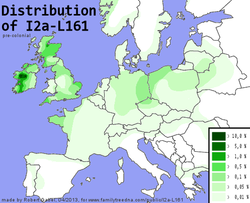 So, the best likelihood is that on his paternal line, Richard’s earliest ancestors were Irish, just as he expressed in his music. Mullins researcher Gary Mullins, who is also the Family Tree administrator for the Mullins Y DNA project, adds:
“Isles A has an ancient Irish past . . . (and an) affiliation with the pre-gaelic celts known as the Erainn. Certainly, the Driscolls have an ancient history that claims they were 'of the Erainn.'
“Additionally, the existing accounts we have of the Erainn and other pre-gaelic celts by and large describe them as small dark people w/black hair and blue eyes. . . ”
Richard’s eyes were brown, but at 5” 6’ or 7’ with black hair, a dark complexion and a light build, the description otherwise holds.* Richard was confident of his Irish heritage during his lifetime. Now on the other side of the Jordan, he is well-acquainted with his ancestors. With all due respect, perhaps it’s only Steven Stockman who will be surprised.
*A person’s appearance is determined by autosomal DNA, which combines traits of both parents. Still, this description points out how his genetic line might differ in appearance from what Steven Stockman may have been looking for in a fellow Irishman.
The Rocks Cry Out
So how did Richard express his own sense of Irishness in his life, and in his art? Here’s one brief example of Richard’s use of Irish legend in his songwriting, with more to follow in the next post:
“And on my way to early meeting
I heard the rocks crying out
I heard the rocks crying out”
The Color Green by Rich Mullins
Most of us easily identify the allusion to Christ’s entry into Jerusalem:
“When he came near the place where the road goes down the Mount of Olives, the whole crowd of disciples began joyfully to praise God in loud voices for all the miracles they had seen:
‘Blessed is the king who comes in the name of the Lord! Peace in heaven and glory in the highest!’
Some of the Pharisees in the crowd said to Jesus, ‘Teacher, rebuke your disciples!’
‘I tell you,” he replied, “if they keep quiet, the stones will cry out.’
Jesus may have been referring to more than one scripture: Psalm 68:19, which describes the adoration of all creation, and/or Habbakuk 2:11, a warning to humankind against oppressing our fellow man.
Likewise, Richard may have had more than one allusion in mind when he referred to the rocks crying out in “The Color Green.” The lyric implies that God himself is the true King of Ireland by describing the coronation of ancient Irish Kings:
“. . . The third of Tara's wonders was the Lia Fail or Coronation Stone, on which the ancient kings were crowned; and the wonder of this was that it uttered a shout whenever a king of the true Scotic or Irish race stood or sat on it. And it was from this stone that Ireland received the old poetical name of Inisfail, that is, the Island of the (Lia) Fail. . .”
http://www.libraryireland.com/Wonders...
This acknowledgement of the royalty of God, King of all Kings and over all nations, stands as an echo and restatement of the lyric in Here in America:
“. . . and the Holy King of Israel loves me here in America. . .”
Rich Mullins, Here in America
We may wonder whether Richard consciously included the legend of the crying stones of Tara in his song. Even if he had, he couldn’t have known that his ancestral connection to the spot would be confirmed more than a decade after his death. Yet the allusion takes on a surprising resonance when we consider that Richard’s paternal genetic tribe encompasses the ancient Kings of Tara, who also made the rocks cry out.*
*The King’s return was a repeated theme in Richard’s songs, beginning with his 1976 Cincinnati Bible College concert, In Worship of The Coming King. You can see the illustrated libretto Richard had me create for the concert here.
Many thanks to genetic researchers Kenneth Nordvedt, Bernie Cullen, Gary Mullins, Robert Gable, and all the folks over the pond at MyFamily I-L 161 for their tireless assistance with this article!
Here in America, most of us have the experience of representing several mixed nationalities in our bloodlines. Yet of all the lines of ancestry he might have claimed, from French to English to Welsh to anything else, Richard Wayne Mullins consistently identified himself with Irish heritage. Yet we have discovered some surprises in his genetic roots. Which raises the question: how Irish was Richard, really? It was a question native Irishman Steve Stockman had raised in his interview about Richard on the Homeless Man documentary:
Steve Stockman: "This idea that he was Irish. I've no idea where it came from. I think it was half Irish and half everything and half about five different things, which you can't be half of, but he wanted to have a claim to it. And I'm not sure if that was his name Mullins or whether it was coming to Ireland and seeing it and falling in love with some kind of mythology of it. But certainly ‘The Color Green’ was an Irish song and the Chieftains I know influenced that, and he played the hammered dulcimer I'll bet like the Chieftains would if they'd ever seen a hammered dulcimer."
--The Homeless Man, Documentary
Was Rich Mullins a son of Ireland through his blood, or were his connections with the land and her stories merely the product of his creative genius? The most recent research on his yDNA line suggests a surprising answer to a great many questions about Richard’s Irishness, and his deep love of the legends and lore of Ireland.
I knew from our friendship that Richard was perfectly content with imperfect ancestors. I’m sure he would have agreed with biographer Jim Smith that having a King or Queen in the family line isn’t important: in fact, he didn’t hesitate to point out the flaws of his forefathers, if only to create a bond with the rest of us:
". . . Then the conversation turns to Richard's description of his ancestry. 'I've got both saints and sinners in my family line,' he announces, buttering his toast. 'I have Quakers on my mother's side, and moonshiners and counterfeiters on my father's side. My great-grandfather,' he added, 'died in Federal prison. He was in for counterfeiting. . .*’”
". . . Instead of being intimidated by Richard's genealogy that day, the rest of us were enthralled with his candor. . . I have never met anyone who used his ancestry so effectively to form bonds with his fellow man. But bonding was what Richard consistently worked to do, whether through his music, his lyrics, his honesty, his storytelling, his laughter, or his everyman approach to genealogy. . . "
--Singing from Silence, p. 44, 46
*View this page for Gary Mullins' contribution from his notes on "Andy" Mullins
Paternal DNA Test Results
When Richard died in 1997, the option to examine his genetic background did not exist. But beginning in about 2003, the new and evolving science of genetic genealogy has given us a glimpse through a widening window into our ancient past.
The latest research reveals Richard’s ancestral family, now known as I L 161, lived not only in Ireland, they also inhabited England, Scotland and Wales. Of course, these island countries were not referred to by the same names as long as 5,000 or 6,000 years ago, so we refer to this tribe as the “Isles”people. Richard's subgroup is I2a, and his specific subgroup is A, among the most ancient of Isles tribes.
Bernie Cullen, administrator for the Family Tree I haplogroup adds this note about the small surname cluster who share Richard’s ancestral line:
“In general, all three families (Mullins, Adkins, O’Driscoll) belong to the I-L161 and more specifically "Isles-A" branch. From new SNP tests (L1498 and PF4135) we know that Isles-A is not closely related to other I-L161 people in Britain/Ireland or in Europe. It seems to be a rare branch that survived only in Britain/Ireland but not on the continent, and which had a small population boom recently. Part of that population boom was part of whatever led the O'Driscolls to becoming one of the dominant families of part of Cork, and another part of the population boom was the Mullins/Adkins etc. being earliest settlers of Virginia etc. and going west.
“BritainsDNA.com calls all of I-L161 the Deer Hunters, meaning they were hunter gathers in Britain/Ireland thousands of years ago and I think that is probably right.”
In order to specifically identify the deep ancestry of Richard Wayne Mullins, we have the opinion of the foremost worldwide expert on the I halpogroup, Kenneth Nordtvedt, who was kind enough to identify the y-DNA results of Rich Mullins’ relative David Mullins, son of “Old” Booker Mullins. He offered his opinion:
“Most of Isles A, like the rest of Isles (B,C,D). . . looks like Ireland and then Scotland and then England as place of origins. I put Isles A in the British Isles five or six thousand years ago. . .”
So, the best likelihood is that on his paternal line, Richard’s earliest ancestors were Irish, just as he expressed in his music. Mullins researcher Gary Mullins, who is also the Family Tree administrator for the Mullins Y DNA project, adds:“Isles A has an ancient Irish past . . . (and an) affiliation with the pre-gaelic celts known as the Erainn. Certainly, the Driscolls have an ancient history that claims they were 'of the Erainn.'
“Additionally, the existing accounts we have of the Erainn and other pre-gaelic celts by and large describe them as small dark people w/black hair and blue eyes. . . ”
Richard’s eyes were brown, but at 5” 6’ or 7’ with black hair, a dark complexion and a light build, the description otherwise holds.* Richard was confident of his Irish heritage during his lifetime. Now on the other side of the Jordan, he is well-acquainted with his ancestors. With all due respect, perhaps it’s only Steven Stockman who will be surprised.
*A person’s appearance is determined by autosomal DNA, which combines traits of both parents. Still, this description points out how his genetic line might differ in appearance from what Steven Stockman may have been looking for in a fellow Irishman.
The Rocks Cry Out
So how did Richard express his own sense of Irishness in his life, and in his art? Here’s one brief example of Richard’s use of Irish legend in his songwriting, with more to follow in the next post:
“And on my way to early meeting
I heard the rocks crying out
I heard the rocks crying out”
The Color Green by Rich Mullins
Most of us easily identify the allusion to Christ’s entry into Jerusalem:
“When he came near the place where the road goes down the Mount of Olives, the whole crowd of disciples began joyfully to praise God in loud voices for all the miracles they had seen:
‘Blessed is the king who comes in the name of the Lord! Peace in heaven and glory in the highest!’
Some of the Pharisees in the crowd said to Jesus, ‘Teacher, rebuke your disciples!’
‘I tell you,” he replied, “if they keep quiet, the stones will cry out.’
Jesus may have been referring to more than one scripture: Psalm 68:19, which describes the adoration of all creation, and/or Habbakuk 2:11, a warning to humankind against oppressing our fellow man.
Likewise, Richard may have had more than one allusion in mind when he referred to the rocks crying out in “The Color Green.” The lyric implies that God himself is the true King of Ireland by describing the coronation of ancient Irish Kings:
“. . . The third of Tara's wonders was the Lia Fail or Coronation Stone, on which the ancient kings were crowned; and the wonder of this was that it uttered a shout whenever a king of the true Scotic or Irish race stood or sat on it. And it was from this stone that Ireland received the old poetical name of Inisfail, that is, the Island of the (Lia) Fail. . .”
http://www.libraryireland.com/Wonders...
This acknowledgement of the royalty of God, King of all Kings and over all nations, stands as an echo and restatement of the lyric in Here in America:
“. . . and the Holy King of Israel loves me here in America. . .”
Rich Mullins, Here in America
We may wonder whether Richard consciously included the legend of the crying stones of Tara in his song. Even if he had, he couldn’t have known that his ancestral connection to the spot would be confirmed more than a decade after his death. Yet the allusion takes on a surprising resonance when we consider that Richard’s paternal genetic tribe encompasses the ancient Kings of Tara, who also made the rocks cry out.*
*The King’s return was a repeated theme in Richard’s songs, beginning with his 1976 Cincinnati Bible College concert, In Worship of The Coming King. You can see the illustrated libretto Richard had me create for the concert here.
Many thanks to genetic researchers Kenneth Nordvedt, Bernie Cullen, Gary Mullins, Robert Gable, and all the folks over the pond at MyFamily I-L 161 for their tireless assistance with this article!
November 9, 2013
A Ragamuffin's Legacy Part One: The Sojourn (Corrections by Gary Mullins)
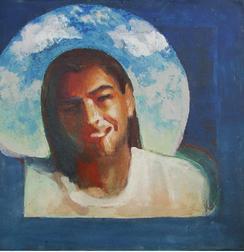 Ancestry was a subject that fascinated my friend, Richard Wayne Mullins, not only for the sake of knowing his family's background, but also as part of his journey of self-discovery. He stated, "I realize now that until you come to terms with your heritage, you'll never be at peace with yourself. . . .So, I needed to come to understand the Appalachian life, so I could know more about my father."
An interest in discovering our deep ancestry has been shared for several decades by scientists who ponder how our DNA may function to preserve critical memories. They have speculated that memories about survival in turn can help us and our families continue the journey our ancestral legacy has begun.
http://epages.wordpress.com/2008/10/13/deep-dna-memory-theories-can-we-remember-our-ancestors%E2-lives/
Perhaps we all have moments that prove the scientists' theories of ancestral memories: those transcendent moments of connectedness with our past, our roots, our families, and our homeland. Those are the moments that keep genealogists awake at night, tracking down one more document on a paper sojourn that rewards them with the riches of being a part of an incrementally increasing family.
Richard Mullins was a genealogy enthusiast, so I know he understood those feelings. Richard's ability to bring us along on his journey was one of the elusive qualities I have attempted to convey in Singing from Silence. Thanks to the eloquence of his lyrics, we can each experience a personal version of his journey.
". . .Once I went to Appalachia, for my father he was born there--
And I saw the mountains waking with the innocence of children
And my soul is still there with them, wrapped in the songs they brought. . ." Rich Mullins, Here in America
Documentation proves that Richard descends from this Letcher County Mullins line:*
Richard Wayne Mullins
son of
John A. Mullins, Jr.,
son of
John A. Mullins,
son of
David C. Mullins,
son of
Andrew Jackson "Andy" Mullins,
son of
David Mullins,
son of
"Old" Booker Mullins (and I'll stop here for now).*
*Noted Mullins researcher Gary Mullins has kindly corrected the line described above to the best of his knowledge after thirty years of study of his family line, for which I am grateful.
"And the lady in the harbor
She still holds her torch out
to those huddled masses who are
yearning for a freedom that eludes them. . ." Rich Mullins, Land of My Sojourn
The new science of genetic genealogy has developed to the point of providing highly precise confirmation of deep--some call it "tribal" ancestry. For this we rely on the genes that have been transmitted from father to son on the yDNA segment. Follow this link to a description by Elizabeth Shown Mills of both methods: the paper trail, and the genetic techniques used by researchers to establish an individual's origins. This article was recently published in the New York Times:
http://www.nytimes.com/2013/11/06/booming/advice-on-how-to-research-family-history-part-1.html?pagewanted=all&_r=1&
The immediate connection Richard expressed in A Legacy, A Liturgy, and a Ragamuffin Band is with America, which all of us here can appreciate. The ancient connection Richard expresses in this album is to the country of Ireland; the future homeland, the Kingdom of Heaven.
“And on my way to early meeting
I heard the rocks crying out
I heard the rocks crying out”
--Rich Mullins, The Color Green
Genetic genealogy was not around while Richard was alive, but the yDNA of some of his male Mullins cousins has been tested. The results have not been without surprises, which you can read about here:
*http://www.familytreedna.com/public/mullins/default.aspx?section=results
Gary Mullins is himself the administrator of this project. From these tests, we conclude that Matthew Mullins cannot possibly be part of Richard's paternal genetic line, due to a non-parental event in the early 1700's. Richard's not related to "Irish Jim" Mullins, either.
Each of us here in America mix many lines of national heritage. Of all the lines of ancestry he might have claimed, from French to English to Welsh or anything else, Richard consistently identified himself with Irish heritage. So with these surprises in his genetic roots, how Irish was Richard Wayne Mullins, really? It was a question native Irishman Steve Stockman had raised in his interview about Richard on the Homeless Man documentary:
Steve Stockman: "This idea that he was Irish. I've no idea where it came from. I think it was half Irish and half everything and half about five different things, which you can't be half of, but he wanted to have a claim to it. And I'm not sure if that was his name Mullins or whether it was coming to Ireland and seeing it and falling in love with some kind of mythology of it. But certainly "The Color Green" was an Irish song and the Chieftains I know influenced that, and he played the hammered dulcimer I'll bet like the Chieftains would if they'd ever seen a hammered dulcimer."
--The Homeless Man, Documentary
Was Rich Mullins truly a son of Ireland, or were his connections with the land and her stories simply the product of creative genius? The most recent research on his y-DNA line reveals a surprising answer to a great many questions about Richard’s Irishness, and his deep love of the mythology of Ireland. I’ll be discussing those questions and the most updated research findings in my next post.

*Thanks to Gary Mullins for his corrections.
* Thanks to my dear friend Beverly Walker for her encouragement.
A Ragamuffin's Legacy Part One: The Sojourn
Ancestry was a subject that fascinated my friend, Richard Wayne Mullins, not only for the sake of knowing his family's background, but also as part of his journey of self-discovery. He stated, "I realize now that until you come to terms with your heritage, you'll never be at peace with yourself. . . .So, I needed to come to understand the Appalachian life, so I could know more about my father."An interest in discovering our deep ancestry has been shared for several decades by scientists who ponder how our DNA may function to preserve critical memories. They have speculated that memories about survival in turn can help us and our families continue the journey our ancestral legacy has begun.
http://epages.wordpress.com/2008/10/13/deep-dna-memory-theories-can-we-remember-our-ancestors%E2-lives/
Perhaps we all have moments that prove the scientists' theories of ancestral memories: those transcendent moments of connectedness with our past, our roots, our families, and our homeland. Those are the moments that keep genealogists awake at night, tracking down one more document on a paper sojourn that rewards them with the riches of being a part of an incrementally increasing family.
Richard Mullins was a genealogy enthusiast, so I know he understood those feelings. Richard's ability to bring us along on his journey was one of the elusive qualities I have attempted to convey in Singing from Silence. Thanks to the eloquence of his lyrics, we can each experience a personal version of his journey.
". . .Once I went to Appalachia, for my father he was born there--
And I saw the mountains waking with the innocence of children
And my soul is still there with them, wrapped in the songs they brought. . ." Rich Mullins, Here in America
Documentation proves that Richard descends from this Letcher County Mullins line:*
Richard Wayne Mullins
son of
John A. Mullins, Jr.,
son of
John A. Mullins,
son of
David C. Mullins,
son of
Andrew Jackson "Andy" Mullins,
son of
David "Spotted Dave" Mullins,
son of
"Old Booker" James Mullins (and I'll stop here for now).
As we trace back, the identity of the immigrant of Richard's Mullins line is hotly contested and remains unproven: he is thought to be either Abraham Des Moulins, of French extraction, or Matthew Mullins, of Ireland. Not enough information has yet been uncovered to say which of these lines represents Richard's pedigree.
http://members.iinet.net.au/~gmullins/firstfamilies.html
"And the lady in the harbor
She still holds her torch out
to those huddled masses who are
yearning for a freedom that eludes them. . ." Rich Mullins, Land of My Sojourn
In these unsolved cases, we can turn to the developing science of genetic genealogy for highly precise confirmation of deep--some call it "tribal" ancestry. For this we rely on the genes that have been transmitted from father to son on the yDNA segment. Follow this link to a description by Elizabeth Shown Mills of both methods: the paper trail, and the genetic techniques used by researchers to establish an individual's origins. This article was recently published in the New York Times:
http://www.nytimes.com/2013/11/06/booming/advice-on-how-to-research-family-history-part-1.html?pagewanted=all&_r=1&
Richard's possible ancestor Matthew Mullins is thought to have been Irish. His mother's Lewis line is Welsh, her Harlan line is English. Abraham Des Moulins, if he is part of Richard's heritage, was a Frenchman. The immediate connection Richard expressed in A Legacy, A Liturgy, and a Ragamuffin Band is with America, which all of us here can appreciate. The older connection Richard expresses in this album is to the country of Ireland; the future homeland, the Kingdom of Heaven.
“And on my way to early meeting
I heard the rocks crying out
I heard the rocks crying out”
--Rich Mullins, The Color Green
Richard's yDNA hasn't been tested, but the yDNA of some of his male Mullins cousins has been. Their results are discussed here:
*http://www.familytreedna.com/public/mullins/default.aspx?section=results
The results show that Matthew Mullins cannot possibly be part of Richard's genetic line, starting with Richard's ancestor "Old Booker" Mullins. Richard's not related to "Irish Jim" Mullins, either.
Of all the lines of ancestry he might have claimed, from French to English to Welsh to perhaps a tinge of Cherokee, Richard consistently identified with Irish heritage. So with these surprises in his genetic roots, how Irish was Richard Wayne Mullins, really? It was a question native Irishman Steve Stockman had raised in his interview about Richard on the Homeless Man documentary:
Steve Stockman: "This idea that he was Irish. I've no idea where it came from. I think it was half Irish and half everything and half about five different things, which you can't be half of, but he wanted to have a claim to it. And I'm not sure if that was his name Mullins or whether it was coming to Ireland and seeing it and falling in love with some kind of mythology of it. But certainly "The Color Green" was an Irish song and the Chieftains I know influenced that, and he played the hammered dulcimer I'll bet like the Chieftains would if they'd ever seen a hammered dulcimer."
--The Homeless Man, Documentary
Was Rich Mullins truly a son of Ireland, or were his connections with the land and her stories simply the product of creative genius? The most recent research on his y-DNA line reveals a surprising answer to a great many questions about Richard’s Irishness, and his deep love of the mythology of Ireland. I’ll be discussing those questions and the most updated research findings in my next post.
* Thanks to my dear friend Beverly Walker for her research on this line. This material is taken from her book, Going Home: A Soujourner's Appalachian Roots. You can read about Beverly, a dedicated genealogist who is related to Rich Mullins on five of his Letcher County, Ky. lines, here and here.
October 14, 2013
Doorways to Love
 The instructions we are given in the eight Beatitudes each resemble doorways. Every closed door, every obstacle in our path is transformed into an opportunity when we become open to God's spirit working in us. True, even when we ask, seek and knock, the unknown lies beyond the door. Sometimes our fears of the unknown still prevent us from pushing past the threshold--even though perfect love waits patiently behind the door, entirely capable of casting out fear.
 Once we open to love, we rename our obstacles, and we rename ourselves, too. Maybe that's why the early Christians took new names when they converted. Transforming the limiting beliefs we have about ourselves is a vital step on the path to wholeness. I think this is part of what Jesus tells us in the Beatitudes.
We may have begun as lacking in spirituality; when we open the door to God's love, we are lifted and filled with a heavenful of his spirit.
We may have begun as grieving and torn, yet when we open up to God's call, we recover from our shattered loneliness in the loving comfort he offers us.
We may have begun as simple seekers grasping for more belongings to add to our sense of worth, but when we open the way to God's love, we find every priceless thing has already been passed on to us.
We may have begun as famished, without any goodness to point to in our lives, but when we open ourselves to God's love, we find we are satisfied, with enough goodness to share.
We may once have pleaded for mercy, but when we open the door to God's love, we extend compassion to our enemies no matter what we once imagined they deserve.
We may once have found fault in ourselves or others, but when we open up to God's love, we find only the best motives and suddenly God appears wherever we look.
We may once have found ourselves entangled in outward conflict, but when we open the way to God's love, we allow him to overcome the enemies within and as his obedient children, we lay our weapons down.
We may have been misunderstood, bullied, or attacked because of our response to God's love, but if in our openness we have acted in Jesus' character of reconciliation--that is, in his name--we've planted a little heaven on earth. Eternal gain is worth the temporary pain.
September 21, 2013
2013 Yahrzeit
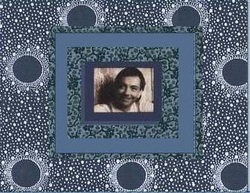 On the anniversary of a loved one's death, the Jews practice Yahrzeit, a beautiful tradition of honoring the dead by giving a donation in the name of the one who has passed on, placing a stone on their grave for a memorial, and lighting a candle in honor of the life lived.
This year, I found myself wondering whether the candle should burn for the full twenty-four hours to memorialize a life that ended far too soon. The answer that satisfied me was that all of us are given a lifetime, no matter how long or how short. Richard never hesitated to live each day as though it might be his last. Of course we miss him, but we need to be glad for his life--not unhappy for its brevity.
Perhaps it was just because I still miss him, but as I waited by his grave for a while, it seemed as though Richard told me a humorous story:
"A man was frustrated and sad about his life, having lived many years without understanding his purpose. He pleaded with the Lord to give him a vision so he could know the meaning of his life. The Lord gave him a powerful vision, one that shattered his expectations and left him trembling with amazement. But when the man tried to explain his vision to other people, words failed him. Time and again, the same thing happened. Once again he became frustrated and sad. This time he pleaded with the Lord to tell him how to communicate his vision to others.
God chuckled and said, 'Remember? That's what I gave you a life for.'"
This year's Yahrzeit donation was a giveaway of Singing from Silence on Goodreads.
September 6, 2013
The Man in the Tree
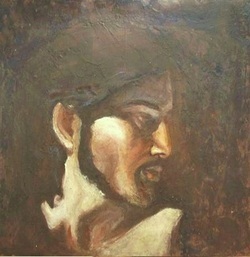 Now that summer break is over, more of my time is going into writing. The work in progress is Walk Through the Valley, about
learning the Beatitudes from the examples of those who have lived them out. Jesus gives us the best example of living the Beatitudes that I can imagine. Here's an excerpt:
"Blessed are the meek, for they shall inherit the earth.
The Man in the Tree
As Jesus enters Jericho during his ministry, there is a man in that city by the name of Zacchaeus. As the chief tax collector, he is wealthy.
His neighbors avoid him like the plague.
He has built his personal empire on falsely inflating his neighbors’ debts to Rome, through the years stealing from the rich as well as the poor. Zacchaeus now possessed all the Empire a man could ask for, and more. But he had never grasped the riches of the Kingdom of Heaven. He learned that the more empire he owned, the more his empire owned him. With every extension of his holdings, he became more enslaved.
He has heard there is a great man who has something Zacchaeus could never own. The man has no home, pays his taxes by means of a miracle, sleeps outdoors like the foxes, eats from the heads of wheat growing on the leavings at the edges of fields--yet is so beloved the crowds follow him everywhere he goes. Whatever he needs, God provides. This man Jesus is just the opposite of himself, it seems. Jesus lives the faith that he had never dared. If the stories are true, Jesus connects with God’s creation and with others in a way that can only make him wonder.
He has heard it is so, but being a rational man, he needs to see this Jesus for himself. So when he hears Jesus is on his way, he runs to meet the forming crowd. He’s too short to see around his neighbors. He tries to muscle his way to the front, but when they identify him, his former friends elbow him to the back. Whatever else his neighbors owe, they don’t owe him any kindness.
Still, he must see Jesus. . . . (more)
July 5, 2013
Family Matters: Why I Went to Cincinnati Bible College
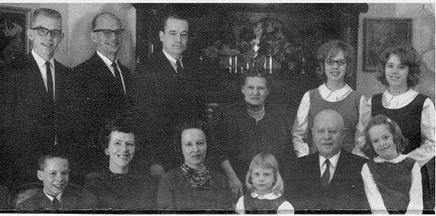 This is a family photo of my mother's side of the family taken in 1965. Three of the men in the photo were in the preaching business. Two were also professors at Cincinnati Bible College, which was at that time known as Cincinnati Bible Seminary. The only man who wasn't a preacher or a member of CBC faculty was my father. All the women or girls pictured married Christian Church preachers, except my mother and me. All six grandchildren pictured attended Cincinnati Bible College, as did my mother and my grandmother. Here's a link to the Christmas letter that was sent out with the photo above by R.C. Foster, my grandfather. The last line reads: "As I look at the picture in this letter, each one of my grandchildren seems to be a prospective student in my class-room in the years to come. . . " This letter went out to hundreds of CBC supporters. After her fathers' death in 1970, my mother made it her personal mission to bring R.C.'s prophecy to life.
 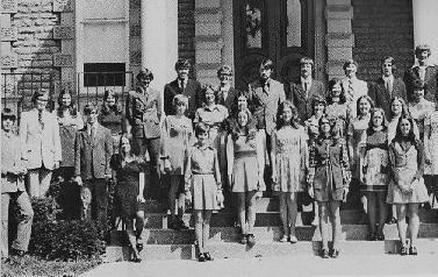 Ten years later: from the 1975 Nautilus, p. 52. Caption reads: "Second generation students share a common background: their parents are C.B.S. alumni. These students bear witness to the esteem in which their parents hold their alma mater . . . " You will find me on the first row, the short girl wearing a black dress, bearing witness to the esteem, etc. This is the only short dress I owned. I was informed the photographer insisted everyone wear dresses above the knee to keep the look of the photos consistent. Since there was a Dean of Women whose full-time job it was to measure hemlengths and send short-skirted or low-necklined offenders to change their clothes, I found it ironic I was required to change into a short dress. Life is stranger than fiction.
July 1, 2013
Peace/Reconciliation
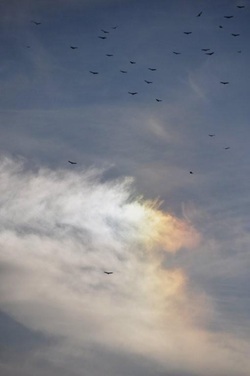 June is National PTSD Awareness Month
During the month of June, several posts centered on healing traumatic memories. Blessed are the peacemakers, for they shall be called the sons of God.
Here's an index of posts from this series for those who'd like to look them over.
Exponential Forgiveness
When Memories Hurt
Calming the Storm Within
My prayers are with everyone who reads this and is making peace with themselves, their memories, and their lives and their God.


