
Pamela Richards's Blog, page 10
August 21, 2012
Faith Works! Barnraising October 19, 20, 21, 2012
 News from Revelation Ranch in Letcher County, Kentucky
We have the horses, God has provided the 40 acres, and all we need now is a barn! Mark your calendar and bring your hands and feet to our barnraising on October 19, 20 and 21 in Letcher County, Ky. These horses--and all the rest--will be glad to greet you and grateful for your labors. Other activities will be provided for children and those whose skills are inclined to giftmaking rather than barnraising.
If you want to show your support of our efforts but can't attend, donations can be made to Boggs' Builders Supply in Whitesburg, Ky at 606-633-8446. Speak to Julie! She will be glad to let you know what we need and will accept your donation to our non-profit organization.
More information about our permanent location will be coming soon. It's a done deal--God has provided generously, and we hope you will join our prayers of thankfulness and prayers for guidance as we begin to settle in to serve here.
--Peri and Ricardo Pardo
**Revelation Ranch is the ministry of Peri and Ricardo Pardo. In an effort to support their work for the benefit of the children of Letcher County, I am pleased to keep you updated about their ministry on my blog. I don't live in Letcher County, but I sure will be attending the barnraising! --Pam Richards


August 16, 2012
Revelation Ranch Faith Works! Weekend: Oct. 19, 20, 21
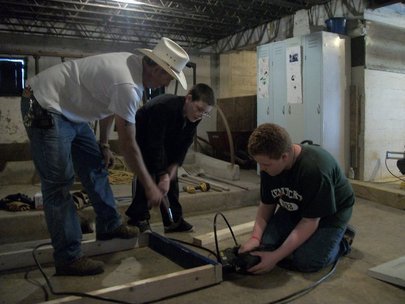 Everyone knows there's more work on a ranch than just two people can do! We are responding in faith to God's call for the Revelation Ranch to move to a more self-sustaining location, and now your help could make all the difference!
In the spirit of St. James, who wrote: "Show me your faith without works, and I will show you my faith by my works," the Ranch is holding a Faith Works! Weekend.
There will be plenty for everyone to do. Those who are strong and clever, those who are wise and have skillful hands, even
children who want to learn Sign Language can all participate. For more information about the weekend, click here.
October 19, 20, and 21 will be the height of Fall color in the Appalachian mountains. We plan to provide live music, a visit with the horses, home cooking, a witness from the Revelation 22 Drama Team, and more!
Follow this link to find a form you can print out to invite friends, family, and church.
We'd love to see you this Fall! Come make yourselves at Home!
If you are unable to attend but would like to contribute, donations to the Building Fund are gratefully accepted. Revelation Ranch is a non-profit organization. To support our move, please make checks out to Revelation Ranch and note Building Fund.
Revelation Ranch
PO Box 304
Blackey, Ky
41804
August 10, 2012
Singing from Silence Goodreads Book Giveaway
.goodreadsGiveawayWidget { color: #555; font-family: georgia, serif; font-weight: normal; text-align: left; font-size: 14px; font-style: normal; background: white; } .goodreadsGiveawayWidget img { padding: 0 !important; margin: 0 !important; } .goodreadsGiveawayWidget a { padding: 0 !important; margin: 0; color: #660; text-decoration: none; } .goodreadsGiveawayWidget a:visted { color: #660; text-decoration: none; } .goodreadsGiveawayWidget a:hover { color: #660; text-decoration: underline !important; } .goodreadsGiveawayWidget p { margin: 0 0 .5em !important; padding: 0; } .goodreadsGiveawayWidgetEnterLink { display: block; width: 150px; margin: 10px auto 0 !important; padding: 0px 5px !important; text-align: center; line-height: 1.8em; color: #222; font-size: 14px; font-weight: bold; border: 1px solid #6A6454; -moz-border-radius: 5px; -webkit-border-radius: 5px; font-family:arial,verdana,helvetica,sans-serif; background-image:url(http://www.goodreads.com/images/layou... background-repeat: repeat-x; background-color:#BBB596; outline: 0; white-space: nowrap; } .goodreadsGiveawayWidgetEnterLink:hover { background-image:url(http://www.goodreads.com/images/layou... color: black; text-decoration: none; cursor: pointer; } Goodreads Book Giveaway
 Singing from Silence Rich Mullins by Pam Richards
Singing from Silence Rich Mullins by Pam Richards Giveaway ends September 09, 2012.
See the giveaway details at Goodreads.
Enter to winAugust 5, 2012
Much Obliged for the Kindness
 Much obliged for the kindness. . .
 Gratitude is a central part of our experience as children of God. Clearly, there are some ways of expressing gratitude that are more useful than others.
Saying the magic words, "Thank you," and experiencing heartfelt gratitude are not the same thing, but sometimes it's reassuring to imagine that they are. Although we've all been taught from an early age promptly to thank people who give gifts or favors, there are times when we prefer to remain indebted than to thank verbally and profusely. To be truthful, when we thank someone promptly and emphatically, often we are effectively cutting off the bonds of obligation that bind us to them.
Ignoring the significance of a gift is not healthy for our spirits. Mothers instictively know there are many good reasons to teach a child to say, "Thank you." We've all watched a mother coach a child to thank a stranger, and seen the obvious relief of tension the mother feels when the child finally complies. The mother is not instructing the child to experience a deep bond of gratitude toward a stranger. In this instance, the words, "thank you" are a formula that serves to release the child from his bond to a stranger who has given a gift.
Thanking is for strangers. Obligating is for those we wish to deepen our bonds with.
We obligate ourselves to those we are prepared to act gratefully toward. Obligation is more than talk, it's a promise that we'll do something about our thankfulness.
There are some cultures that prefer not to thank--both American Indian cultures and those of some Southern areas of the United States come to mind. This is not an indication of rudeness. It may be based on a belief that thanking is only appropriate for limited life-giving occasions, or a preference to deepen bonds of obligation within a community.
Jesus taught us to pray, but he never taught us a prayer with the phrase "thank you" in it.
So many of our more superficial prayers begin, "Thank you, God for. . . "
I wonder what would happen if we stopped treating God like a stranger and prayed, "I am obliged to
you, God, for . . . "
And then if we began to act on our obligations, what would happen next?
August 4, 2012
Benjamin A. Simpson's Review of Singing from Silence
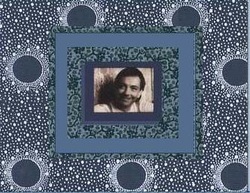 Benjamin A. Simpson impressed me as someone with a deep understanding of and appreciation for creativity and spirituality. He agreed to review Singing from Silence, and I am thankful to have his well-balanced remarks. You will find them published in full on his blog. Here is an excerpt:
". . . Richards tells of Mullins' deep love for God, the ways in which this expressed itself in his relationships to other people, and how the intersection between the two informed his music."
"This book provides a perspective on Rich Mullins I had not encountered. For fans of his music and those interested in his life, Richards gives us much to consider, both in specifics relating to Mullins, but also more broadly with regard to art, the Christian life, truth, relationships, and hope."
To read more reviews, click here.
July 28, 2012
A Page from the History of Higher Love
From a Circular Letter by Jordan Ashley, 1854 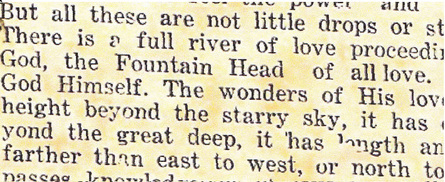 Elder Jordan Ashley was an Old Regular Baptist circuit-riding preacher in Southeastern Kentucky. He wrote this letter, which was circulated to the churches he served, during the time leading up to the Civil War. ". . .There is a river full of love proceeding from God, the Fountain Head of all love. Love is God himself. The wonders of His love! It has height beyond the starry sky, it has depth beyond the great deep, it has length and breadth farther than the east to west, or north to south. It passes knowledge; no tongue can fully declare it. . ."
I had trouble telling Jordan Ashley's complete story when I first posted this, but I am moved to add that after he wrote this letter, Elder Ashley lost three sons in the Civil War. He was said to have died of a broken heart before the war was over.
But what he said in his letter is true. I have seen that same river, and I can see it still.
I imagine Elder Ashley drinking freely from those waters with his sons, and God healing the old man's broken heart. God has this river that can heal us all. . .
And maybe it's no coincidence that there is a stream of that river that keeps flowing in Letcher County where this letter was first circulated so long ago. Maybe that's how God planned to raise churches and ministries in those mountains that are steeped and flowing with the Love of God.
And maybe it's an example of how art--a piece of art, like this letter, can leave a legacy after we're gone from this world.
Elder Jordan Ashley was an Old Regular Baptist circuit-riding preacher in Southeastern Kentucky. He wrote this letter, which was circulated to the churches he served, during the time leading up to the Civil War. ". . .There is a river full of love proceeding from God, the Fountain Head of all love. Love is God himself. The wonders of His love! It has height beyond the starry sky, it has depth beyond the great deep, it has length and breadth farther than the east to west, or north to south. It passes knowledge; no tongue can fully declare it. . ."I had trouble telling Jordan Ashley's complete story when I first posted this, but I am moved to add that after he wrote this letter, Elder Ashley lost three sons in the Civil War. He was said to have died of a broken heart before the war was over.
But what he said in his letter is true. I have seen that same river, and I can see it still.
I imagine Elder Ashley drinking freely from those waters with his sons, and God healing the old man's broken heart. God has this river that can heal us all. . .
And maybe it's no coincidence that there is a stream of that river that keeps flowing in Letcher County where this letter was first circulated so long ago. Maybe that's how God planned to raise churches and ministries in those mountains that are steeped and flowing with the Love of God.
And maybe it's an example of how art--a piece of art, like this letter, can leave a legacy after we're gone from this world.
July 25, 2012
Defining Compassionate Art
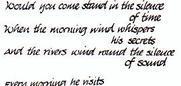 Lyric @ rmullins On Higher Art: From Conversations with Rich Mullins
It touches hearts.
It changes perspectives.
It reflects our humanity.
It creates bonds with the audience.
It creates bonds with fellow artists.
It propels other artists to create new works through obligations of mercy and gratitude.
It reciprocates the role of the prophet; instead of reflecting God's communication to mankind, it reflects mankind's response to God.
It is fueled and sustained by Spirit, not money.
The is the task of the compassionate artist to reflect the Kingdom of Heaven on Earth, through his works and through the bonds he creates with his audience and his fellow artists.
Because compassionate art is both spiritual and material, it requires both Spirit and money to create it. But the balance is delicate, and must be considered at all times. The artist's motivation is critical--that which is born of Spirit is spirit, and that which is born of an intention to produce cash flow is flesh.
The material means of creating a work of art are outgo and income. The spiritual means of creating compassionate art are mercy and gratitude. The ethics of producing compassionate art are the ethics of gift-giving, not the economic laws of the marketplace.
When the production of art is motivated by the laws of the material economy, it is at risk of becoming sterile at best and lifeless at worst--a piece of entertainment, meant to tickle the ears and incapable of motivating any new works. The bonds formed by a work of compassionate art within the creative community are to be valued above money.
Image from the libretto, In Worship of the Coming King
Lyric from Pictures for a Friend in Summer @rmullins 1977, calligraphy @Pamela Richards 1977
July 19, 2012
Introducing Hands, Feet and Wings
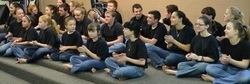 When I went to Revelation Ranch, I hoped to find a ministry that could use a little support from a friend. But I found that visiting Revelation Ranch can be a one-of-a-kind experience. When you leave these mountains, your soul may still be with them, wrapped in the songs they brought. . .
A new portion of this website is opening to describe the ongoing work of supporting these young artists who touch hearts, and to invite you to join in lending your hands and feet to give wings to their ministry as God leads. Please visit http://handsfeetandwings.candletothesun.com for regular updates.
Excerpt from Fearless Review of Singing from Silence by C. Matthews
 "Singing from Silence leaves the reader convinced of God’s great love for humanity and how it is played out in the lives of those who may not realize at the time how their words and actions will go on to demonstrate God’s redemptive love to others. . .
Singing from Silence testifies. . . how poignant yet exhilarating it is to know that death itself has no hold over us as long as we are joined together in the creative power that is God’s love." --C. Matthews
Click here for more reviews
July 16, 2012
The Ethics of Supporting the Arts: or, Thomas Aquinas, I Beg to Differ!
 The Ethics of Supporting the Arts: or, Thomas Aquinas, I Beg to Differ!
Funding artists is eternally problematic. Art demands a high degree of freedom of thought and expression to keep it alive; a hefty payment can dampen that freedom in a moment, often leading to works that may acheive some semblance of entertainment, but which fail to compel us on any deeper level. Complete failure of funding leads to the extreme of starvation--or, in many cases, a second job. The internet age has led to some innovative options in funding the arts. I'm sure I'm not the only one who finds all the possibilities intriguing. But which options are most ethical, most likely to produce the spiritual results we long for?
I'm speaking as an artist, not an academic. So you won't find me citing academic authorities. I have read the original source documents described here, researched the original languages when I find the meaning obscure, and applied the sense my spirit makes of these works. I apologize more for my ignorance than for my lack of convention. Please bear in mind that my opinions on these works may change at some future point when more becomes clear to me. This essay will be published in four installments: The Problem of Patronage, The Morgue of the Marketplace, The Fallacy of Fanfare, and Render to God that which is God’s.
With all due respect to Thomas Aquinas, whose later works touching on creativity fascinate with the breathless quality of ecstasy, I beg to differ on the subject of supporting the arts, which he lays out in his Commentaries on Aristotle's Nicomachean Ethics. And since he is a saint, I'm sure he will forgive me if I've misunderstood him.
The Problem of Patronage
There are those who glorify the Middle Ages as a period when art achieved its highest purpose: to instruct the common man about God and spiritual life. To a great degree, this is true. For the ninety-nine percent of that day, most of their information about God came through the arts, although the men of power and influence within the Church seem to have kept a stranglehold on the subjects of these works. The Church promised rich, influential men that they were storing up wealth in Heaven when they contributed to the beauty of the Church’s art objects here below. As for the one percent, the patrons whose fortunes funded cathedrals, choral works, the copying of manuscripts—what did they learn about spirituality from their contributions to the arts?
I'm guessing not much.
Patronage, puffed up and full of pride, is a spiritually bankrupt system built on sand and leaning hard into moral collapse. Who told the rich man he could buy his way into the Kingdom of Heaven by funding a work of great beauty? Not Jesus: “It is easier for a camel to go through the eye of a needle than it is for a rich man to enter the Kingdom of Heaven.”
Patronage is the wealthy man’s answer to acquiring status in exchange for a portion of his riches. As Christians, we do not demand equal footing with the wealthy or the powerful. We do not seek status. We do not purchase worldly power. We realize that looking good and being good are two different things. There is only one who is good, and that is God. We are each equal in God's eyes with every other human being. We each look our best when we tell the truth about ourselves and our own need for grace. Then we are poor in spirit. Then we belong to the kingdom of heaven. We bring heaven to earth when we acknowledge that every good and perfect gift comes down from above.
The spirit of patronage is in direct contrast with the radical attitude of the Beatitudes, poverty of spirit. God himself did not stand on his dignity, his pride, or his honor. Only God stoops so low as to humble himself, making himself nothing so that we can bond with him. God is born a puking, helpless infant in a barn, surrounded by beasts, endangered by the rage of a deadly King. He's not asking us to do anything he hasn't already done.
When he teaches us to be poor in spirit, Jesus does not ask us to beat ourselves up because we are so bad. He only asks us to follow his example because he is so good.
The Spiritual Conundrum of Riches
The moment Christianity became a legally endorsed religion in Rome in 313 A.D., I expect wealth became a spiritual conundrum. Jesus taught his followers to pay Caesar what was due him, and to pay God that which is God's. He taught his followers not to hold on to wealth--he even told a wealthy young ruler to give up everything he had to follow him. The Roman Emperor, on the other hand, didn’t especially care what people did with their wealth, as long as they paid their taxes and refrained from funding an insurrection. Obviously, as much as Constantine admired Christianity, he had no intention of giving up his own wealth to follow its teachings. In fact, the stability of the Roman Empire rested firmly on the riches of the Emperor, and his solid relationships with the wealthy citizens of Rome. Naturally, the new state religion stopped short of demanding that its most powerful citizens share their riches with all.
Most likely, the newly political Church was not inclined to share the teachings of Jesus about wealth. The dichotomy between Christ's concepts of spirituality and wealth and Constantine's remained unexplored. Over time, a new path was forged. The Church followed the Virtues of Aristotle, which had been uniformly respected and taught by the Greeks for centuries. They insinuated that the well-to-do need not give up their wealth, but simply to selectively share their riches with the public by supporting religious art.
In Jesus’ day, there were several gates to Jerusalem that merchants could pass through. When entering through the wide gates, a tax was due, based on the amount of goods being carried into the city for exchange on the market. Those who were savvy could use a narrow breach in the wall, called “The Eye of the Needle,” to escape these taxes. There was only one catch, if you’ll excuse the pun: a heavily laden camel could not pass through this passage. Only the lightly burdened beast could scrape through the gap. Over time, art patronage became the eye of the needle wealthy church members were encouraged to pass through to enter the Kingdom of Heaven. But because the system of patronage permitted their pride to remain unchecked, wealthy patrons may still have eluded the true spiritual objectives expressed in the Beatitudes. Art patronage might carry their status-seeking worldly values to the gates of the kingdom of heaven--but not inside them.
When I attended the Art Academy of Cincinnati in 1975-76, I encountered an updated system of patronage with a new twist: it was called conceptual art. The work of the artist was to convince the public that purchasing his art would enhance the patron’s status, regardless of the technical or objective value of the work. Artists who engaged in this form of art guffawed loud and long on their way to the bank—or planned to while washing dishes for a living. I was never fond of conceptual art. I called it “con art.” After many conversations with Richard Mullins about the Beatitudes and art, I returned to the Bible College the following year. I had become sure, partly because of Richard’s example, that there must be something better an artist who is a Christian can do.
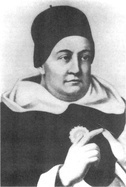
St. Thomas Aquinas, patron saint of scholars, philosophers, and theologians, solidified the convention of mixing two contrasting approaches in the Commentary on Aristotle's Nicomachean Ethics. These ten scrolls blend Greek ethics with Christian teachings such as the Beatitudes. The teachings of Aquinas ultimately produced a culture dominated by art and architecture produced in the name of the Church. This period of history, known as the Middle Ages, flourished for centuries and effectively transmitted faith to the masses by means of art.
Although many artists benefitted from patronage, artistic geniuses like Michelangelo and Da Vinci found the system repugnant. Despite being stifled by their patrons’specifications, each of them invented ways to rebel against the Popes who commissioned their works. Their acts of defiance against the system of patronage can still be detected in the art they produced.
With all due respect for the triumph of art carried out through the culture of the Middle Ages and the spiritual wisdom of St. Thomas, a distinct tension remains between the Virtues of Aristotle, which depend on mostly on wealth, and the Beatitudes of Christ, which call simply for a Godly outlook--which any humble human can afford.*
The most important objective in supporting the arts is not to divest the wealthy of their riches, but to give artists the opportunity to share their gifts. The artist believes that the true and highest value of art lies in its spiritual ability to touch hearts and lives. The artist knows that over time, art can shift the perspective of a culture. To create a lasting and powerful work, the artist must not be too concerned about commercial success. By its very nature art that moves us will be controversial, perhaps disturbing. The artist will face criticism from those who are not immediately gratified by his message. Still, the change in perspective effected by a work of art is priceless. It can never be compensated by money.
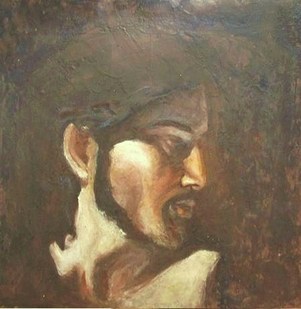 Head of Christ after Caravaggio @ Pamela Richards 2011 *A case can be made that Jesus was ripping on the Aristotelian Virtues line for line when he declared the Beatitudes. His audience was primarily composed of Hellenized Jews who had been raised on the Law, the Prophets and Aristotle. The odd-couple marriage of Aristotle's Virtues and the Beatitudes of Christ is celebrated in Dante's description of Purgatory in The Divine Comedy. Dante's version of the Beatitudes is torn out of the context of the Gospels and re-interpreted in light of Aristotle's Virtues. Not only does Dante describe spiritual torture, his instructions on the Beatitudes provide it. Not that he failed to produce art. Art frequently results from, and causes, a human response of pain. Aquinas' well-intentioned attempts to unite the Virtues and the Beatitudes--the basis of Dante's work—failed to resolve the irreconcilable differences between the two. Purgatory was surely the best Dante could make of what he had to work with.

