
Lynne M. Spreen's Blog, page 9
October 14, 2016
What We Can Learn from Oldchella

A dream lineup of aging rock gods might change the way we look at older people in this country.
You’ve probably heard of Coachella, the super-successful multi-weekend music festival held each year in the Coachella Valley (the Palm Springs area). It was so successful the promoter, Goldenvoice, invented a second festival, Stagecoach, for country music fans. And that was so successful, they cooked up a third festival, geared toward the Baby Boomer demographic.
Called Desert Trip, but swiftly labeled Oldchella, tickets sold out in two hours. Goldenvoice had to add a second weekend. Same result. And the tickets weren’t cheap.
At this concert, the amenities are impressive: actual chairs to sit in. Five-star dining. Good wines. Fancy bathrooms.
In spite of the fact that they’re paying top dollar to the bands, the promoters are making money hand over fist.
As I write this, the inaugural weekend of Desert Trip just ended and the second starts today. Here’s one big difference already between it and the younger concerts: one-fifth the number of arrests and citations for the usual bad behavior (public intoxication, drug use, illegal parking, etc.) At Oldchella, the festival-goers are so tame, the cops are probably sitting on the hoods of their cars, enjoying the music.
One thing you might take away from the success of this event is that we should rethink how we advertise to older people. There’s more to us than wearing diapers, consuming prescription meds by the handful, and needing help to get up—although those things might also be true, just as they are of other age groups.
Advertisers should raise their sights. There’s money to be made here, Corporate America, if you set aside your ageist prejudices.
As to the calmer behavior, I love youthful hijinks as much as the next grandmother, but I’ll bet the people who run the city of Indio are happy to have the Geritol set sitting quietly in their molded-plastic chairs, nodding enthusiastically along with the music.
My point is, every age has its goods and bads. How about we celebrate youth for what it is, and older age for what it is, (and all the ages in between like those hardworking parents with dependent kids), and not make it a zero sum game anymore. What do you think? Could we do this?
Programming note: I was approached by journalist Holly Whitman to write for AnyShinyThing. Holly is a millennial who lives in D.C. After checking out her writing, I thought it might be fun to ask her to weigh in on certain topics from her youthful perspective. You should be seeing a post from her in the near future. I can’t wait!


October 7, 2016
The Feminist Fight Club by Jessica Bennett; A Book Review
 You’d think, fifty years after the Equal Rights Amendment was killed by Phyllis Schlafly and her ilk, women would be on a level par with men in the workplace. Surprise.
Millennial women are dealing with a new reality: a more passive-aggressive, or even unconscious, sexism. Used to be, when a male coworker wanted to act like a sexist pig he’d ask you to go make copies for him and pat you on the butt as you went by. These days, it’s way more subtle, and so baked-in that both victim and perpetrator may be oblivious.
 The Feminist Fight Club is a human-behavior manual for surviving the workplace, and life generally. It’s funny and useful, with lots of tips for dealing with certain scenarios where men (and often, women) react to female coworkers out of what we’ll politely call unconscious bias. Although sometimes it seems pretty darn conscious. In so doing they happily impede or destroy your plans for having a nice little job or dazzling career.
The idea for the book came about because Jessica Bennett and her “Fight Club” – a group of women friends – would gather regularly to discuss work. They’re all in sophisticated New Yorky jobs so that added flavor to the anecdotes. Anyway, they’d bitch about such obnoxious male behavior as:
How do you get the guy who always interrupts you in meetings to shut up without seeming defensive or overly sensitive?
What do you do when a male presents your idea without giving you credit?
What do you say when a guy in the meeting casually asks if “you’d mind taking notes?”
 So Bennett put it all together in a funny, snarky, painlessly educational book. She offers dozens of such situations as the above, and for each, suggests four or five defensive strategies. Right there you can imagine how much guidance is packed into Feminist Fight Club.
One of the strategies that’s getting a lot of air time right now is amplification, which first came to my attention in this article about how the women at the White House are conducting a quiet revolution in intergender communication.
As a sixty-something woman who cursed and threw things when the Equal Rights Amendment went down in flames, I appreciated Bennett’s numerous shout-outs to us old chicks who helped get things moving towards equality.
Also, I admit that today’s workplace looks pretty scary. Discrimination has gone underground. When it’s above-ground, it’s very polished and slippery. The woman who IDs it and objects is ridiculed as hypersensitive. Wow, what an effective way to keep her in her place. Bennett has done us all a favor by writing this book. I want to give it to my 16-year-old granddaughter but it might be too soon, and I’m afraid of looking wild-eyed. (See? Even me.)
The book is so full of examples of sexism both on the job and in our culture generally that it’s enough to make you sick, but it’ll raise your awareness and your defensive stance. It may help change the workplace – yes, I’m optimistic, because if younger women are on to this, they can finally fight back. Five stars and a big thank you to Jessica Bennett.
If you didn’t see it earlier, here’s the video that started it all. It’s hysterical. Enjoy!
September 30, 2016
Age Denial is a Prison
 There it was again: another supposedly independent thinker crowing to the world.
“I don’t think of myself as old…”
The woman in the photo, Connie Britton, was 49 when she said that. I admire her determination, but it’s foolish. Here’s why.
When you say, I don’t think of myself as old, or I don’t act old, etc., you’re judging “old” in a negative way. Fine, that’s your prerogative.
But one day you won’t be able to deny it any longer. When you can no longer reject the proof in the mirror, what will you think of yourself? After a lifetime of teaching yourself to reject old, to negate its signs in yourself because apparently it is something bad…there it is. There you are. OLD. And OLD=BAD.
What a pity not to spend the years of your young old-age learning to value yourself in the second half. Growing more powerful mentally.
If you can’t embrace old, at least become neutral about it. It’s a word related to a number, a quantity. Why do we run shrieking from it? I mean, we all know the answer, but think about it.
We color the word with a certain value judgment, and then we protest that we’re not that. We’re not that thing. Even if we are, we try not to act it, so we can still live in denial, which makes us feel safe. But what if we were stronger than that? What if we weren’t afraid?
To be defiant about age may be better than despair – it’s energizing – but it is not progress. Actually, after fifty, aging can become an exciting new period; it is another country.
– Gloria Steinem
What if you grew beyond that childish, western-culture, fecundity-is-all mode of valuing human life?
Then instead of stamping your pretty little foot and declaring you’re not old, you could be old and it would be no big deal. And you could go about enjoying your life.
Without fear.

September 23, 2016
Reinvention and Risk: Writing Romance After 60

Marj Charlier, Author
My friend, author Marj Charlier, is branching out. Her energy and can-do attitude inspire me. Here’s her story.
Marj: As a writer who is well into my seventh decade, I’ve started taking more risks.
I don’t mean taking physical risks (like jumping off cliffs into the ocean, which I SO wanted to do when I was younger) or stupid risks (like walking down dark alleys at night, which I’ve never wanted to do anyway). Neither am I taking big financial risks. I’m not selling my home and joining the Peace Corps. (Hey, do you think they’d take me?)
But the older I get, the more I am willing to take risks with my writing.
Let’s face it: putting your first book out into the world to be evaluated, criticized and judged by total strangers is darn scary. Now I have published six novels, putting nearly two million words out there to be ripped apart, I’m starting to get comfortable with that fear.
 Now I’ve taken on a new risky venture: The other day, I published my first romance. (One Way to Succeed, on Kindle). All of my novels have had some love interest, but this was the first time I wrote a novel that adhered to the “boy meets girl, girl meets boy, and in the end boy and girl are together” formula. I’m calling it “smart girl” romance, because I made the “girl” smart and career-oriented, and I set the novel in a business environment. But, whatever qualifications I may make, it’s still quite clearly Romance with the capital “R”.
Given that romance is the top-selling genre for self-publishers and especially e-book publishers, why is this risky?
Here’s why:
A publisher once told me to never confuse my readers about who I am as a writer and what I write. ‘Stick to your genre and never leave it’ (until you’re John Grisham, and they’ll buy anything you write), she told me.
Second, I used to work with a woman (she was an accountant by day) whose agent dropped her because her romances changed from sunny to dark, and her agent “didn’t know who she was anymore.”
And third, a successful romance writer I met at a conference relayed how she introduced some minor mystical elements into one of her Highland Romance (a subgenre of romance) novels. Her readers sent her angry letters for violating their trust and said they’d never buy another book she wrote.
Clearly, dipping my toes into the romance waters risks confusing my writers about who I am as a writer. Up to now, my novels have rested comfortably in that broad category of contemporary women’s fiction. But it’s a risk I’m willing to take now that I might not have before. What’s the difference between now and then?
As I thought about taking this “risk,” I realized as I’ve gotten older, I am less concerned about not living up to other people’s expectations. I’ve got a new perspective on risk: after menopause, health issues, big financial losses, and long-term unemployment—not to mention watching jowls form under my jaw and bags under my eyes—many bad things I used to worry about don’t seem terribly scary anymore.
Here’s an example: The other day, a friend asked me if I’d be willing to talk to a USA Today reporter about ageism. My first reaction was, “God, no! What if I say the wrong thing?” And then I remembered: I don’t have to worry about saying the “wrong thing” anymore. I used to worry that I could get fired, or not be considered for the next job I wanted. But now that I’m retired? Damn the torpedoes; full speed ahead!
Likewise, when it comes to writing romance, what do I really have to lose? Suppose no one likes the novel, and it never gains readership. Well, then, no one’s perception of who I am as a writer is going to change. Or, suppose it gets a big readership and suddenly, everyone thinks of me as a great romance writer. Hmmm…. Somehow I don’t see that as a great big problem either. I’ll just write a sequel!
Lynne here: Marj and I meet for lunch occasionally and we can’t stop talking about the craft and business of writing. It’s very exciting to both of us, and I’m lucky to have a friend who inspires me. What about you? Have you found yourself taking more risks now that you’re older? In what way?
More info about Marj
Her romance novel is published under her new romance pen name: Marjorie Pinkerton Miller, a combination of her name, her mother’s maiden name, and her grandmother’s maiden name.
Her Facebook page is here: www.facebook.com/marjcharlier
And her website is here: www.marjcharlier.com
September 18, 2016
Fighting Workplace Sexism with Humor
Because ageism is so closely related to sexism, you’ll want to learn this amazing technique for making your voice heard.
This is hysterical. The technique is called amplification. I laughed out loud at the video, and will report back on the book, the Feminist Fight Club: An Office Survival Manual by Jessica Bennett. And here’s the story in USA Today that started it all (thanks to my smart feminist husband, Bill, for the heads-up.)
September 16, 2016
Why We Love to Talk about Our Aches and Pains
 When I was a young person I would watch older people get together and talk, and I saw they frequently talked about their maladies. I thought, “How boring!” You probably did, too.
And didn’t you vow never to be like that when you got older?
Come on, fess up.
So now, it’s us.
A few days ago I was at lunch with my friends, one who is eighty years old and the other in her late fifties. We’re all writers, so we talked about writing for a while, and that was fun, but then we started yakking about our aches and pains. And it hit me. Oh, no, I sound like those old people!
Yeah, like I’m not.
But the truth is, we got comfort from each other. We weren’t trying to belabor or celebrate our problems, or one-up each other with our aches and pains. It was comforting to share what we’re going through, because so many of us at this age are having weird, unpleasant things happen.
The problem is, no matter what we look like on the outside, somewhere in our minds we’re still sort of young-ish, and thus we cannot BELIEVE the crap that’s happening. I mean, we are incredulous. Next time you see a group of older folks talking about their health or surgical complications, look at their faces. Guaranteed, you’re going to see at least one that reflects this sentiment: “I almost died!”
My husband, who ran a car dealership and loves everything about cars, is big on automotive analogies. He says if you’re a car with 150,000 miles on you, things are going to happen. Some of the seals will give out. Some of the lines are going to start leaking. The frame squeaks. The leather cracks. 
It’s inevitable and unavoidable. The question is, how are you going to deal with this shocking new development?
One of the things you can do is talk about it. And that’s not bad. Actually, for women, that kind of discussion generates oxytocin, a healing chemical released in our bodies when we bond and commiserate. Often in a group, fear and commiseration turns to acceptance and even humor. The best dark humor is that cooked up by older people, I am sure.
(One evening, after saying goodbye to guests who stayed far too late, I was helping my 90-year-old Mom clean up. We were exhausted, but just happy they’d finally left. All of a sudden a car pulled up out front. We thought they were back! As I peered out the window, Mom hollered, “Oh, my God. If it’s them, tell them I died.” )
When you get older, you’ve been through the mill, and you develop solid coping skills. One of them is the “organ recital.” Regardless of how cliched, boring, and unimaginative it may look to young people (or older people in denial), it can serve a useful purpose, as long as it’s kept in proportion. Remember to change the subject after a while, so as not to become tedious. Expert communicators recommend the following stalwarts of good conversation: how stupid the presidential races are getting, how stupidly they make clothing these days, and how stupidly everybody drives now that they’re all texting.
September 9, 2016
She Published Four Books in Her Seventies
 One of the greatest things about being a writer is meeting other writers, and feeling inspired by them.
At a meeting of the Inland Empire Writers’ Club, I met Libby Grandy. I was doing a talk about using social media to build your author platform, and Libby had a keen interest. Turns out, she was published and actively marketing her work, and wanted to learn more. She defied the ageist stereotypes that say otherwise. She inspired me, so I asked if she’d like to talk with us here at AST. Here are my questions in bold, and her responses. Enjoy.
Is writing something you wanted to do all your life, but couldn’t due to work pressures? And if so, how did you keep the dream alive during your career years?
During my career years, I wrote whenever I could, most often late at night or on weekends…In all honesty, however, it was never a dream of mine to publish my work.  I believe many writers write a long time before thinking about publishing their work. At least that was true for me…I took a writing class at Mt. SAC in my late forties. When the teacher gave me an A+ for a short story, I was stunned. The first novel I attempted to write was actually based on the character in that short story, Lydia. It became the second book years later in the Haverford Trilogy. I didn’t even think about publishing until I retired. Writing was simply something I enjoyed doing.
What is your writing routine? What does your typical day look like?
I write on my laptop, propped up on my bed, in our bedroom. I can envision myself at ninety in the same spot as long as my fingers still work. (My husband suggested that it might be good if my brain was also working.)
If I’m writing a novel, I try to write a few hours each morning. I read the last few pages of a chapter written the day before and then begin the new chapter. In the afternoon I read and edit what I’ve written—if I have time. When I’m not working on a novel, I write whenever I feel like it. One thing I do that may be different from some other writers is write a scene when it comes to my mind, such as dialogue between my characters. Later I insert it at the appropriate place. (LMS: what a great tip.)
What is your greatest challenge vis-à-vis the writing life, and what gives you the greatest satisfaction? Is there a particular high point you’d like to tell us about?
 One day I received a call from a lady that the magazine she worked for, Mature Living, wanted to publish my article entitled, “Who is that Old Woman in the Mirror.” We had a wonderful conversation about my article. She said they sat around a table listening to someone read it and nodding their heads in agreement as I talked about the process of aging. The ensuing published article was beautifully formatted and even had the title on their cover page. Of course, seeing my books in print for the first time was special and wonderful (and) gave me the encouragement I needed to see myself as a “writer.” Before I just thought of myself as someone who loved to write. (The article is on my website.)
I suppose my challenge, like most writers, is marketing. Writing is fun. Marketing . . . not so much.
Now that you’ve written four books in four years what is your secret to productivity?
That is something I would like to clear up. I didn’t write a novel a year and then publish it. I edited novels I had already written. I did some major rewrites and added many scenes but didn’t create from scratch. For example, I chose to publish my mystery, Desert Soliloquy, first. I had written it and had it critiqued, but it wasn’t the first novel I wrote.
Right now, I’m working on another novel. It probably won’t be published for a year or two. I’m taking a chapter a week to my critique group (then will) probably query agents and that will take months. If I get one, it will be months more. If he or she is unsuccessful, I’ll self-publish. My suggestion to new writers is: take the time needed to produce a quality product. Don’t rush or write something you feel is commercial and will make you a best-selling writer. Write from the heart. The rest will evolve, as it did for me.
How do you reinforce the craft? Do you take classes, watch YouTube videos, attend writing conferences, subscribe to Writer’s Digest, ???
 I consider my critique group and writing friends who read the final drafts of my novels as the best arena for honing my writing skills. We have excellent writers in our group who catch every nuance of a writing scene and make good suggestions. Most of the other avenues, such as conferences, have to do with the marketing process. I continue to educate myself about marketing as it is an ever-changing arena.
What would you say to aspiring writers who want to write but can’t due to current obligations (usually child rearing and/or demanding careers)?
Just write when you can, a few minutes here, a few minutes there. Or write in your journal and lament the fact that you don’t have time to write. It’s cathartic and you suddenly realize that you’ve just written for thirty minutes and could have used those minutes to work on your novel. It’s surprising how much you can accomplish when you write for short periods of time. I would often write a few paragraphs during my lunch time at work.
Who is your typical reader? (or who do you think most appreciates your writing?)
I basically write women’s fiction. Not romance but stories that focus on relationships and how the characters evolve through their experiences. My mystery, Desert Soliloquy, is more mainstream but the protagonist is a woman…I have a fan who lives in India that I met when he visited his son in California. He found my book in a local library, loved it and had his son contact me. We met for lunch, and he told me that after reading my novel, he understood better how women think. We keep in touch by email. He is also a writer, but his books in India are written in Hindi. He hopes to translate one into English and send it to me. I also have male readers who like ghost stories like Promises to Keep.
Do you use social media to build your platform? If so, which network(s) do you enjoy using the most?
 I use Facebook, Twitter, Linked-In, my website and my blogs. Whenever I post, there is always a link to Amazon and my books. I enjoy Facebook the most. Writers should remember that everything they post online will show up on Google. If you type the words Libby Grandy in Google, you will find most of my writing, interviews, etc. Social media is a vast arena for writers. That is why writers should brand their name, not their books. Who is the world is going to remember the title, Desert Soliloquy (or be able to spell Soliloquy)? But they just might remember the two words—Libby Grandy.
Libby’s last words on the topic:
I sincerely believe we writers are blessed. We are able to get our thoughts, factual or imaginary, down on paper for others to read. Readers may be inspired or comforted or just entertained. What could be more satisfying? Having said that, I also believe that a writer does not have to be published to experience deep satisfaction.
That comes from simply writing.
LIBBY’S BIO:
Libby and her husband, Fred live in Claremont, California. They have two daughters, three granddaughters, and five great-grandchildren. She retired from the Dean of Students Office at Claremont McKenna College. Before CMC, Libby was employed at General Dynamics in Pomona, California, acting as a liaison with state colleges and universities. She also worked several years as a consultant, conducting workshops on Behavior Modification and Stress Management.
Libby facilitates a weekly critique group and belongs to the Inland Empire Branch of the California Writers Club. Her novels are available on Amazon: The Haverford Trilogy (Promises to Keep, Lydia and True Abundance), as well as a mystery set in the high desert (Desert Soliloquy). Libby is presently working on her new novel, The End is the Beginning. The link to her website and blog is www.libbygrandy.com, and her twitter handle is @LibbyGrandy.
Lynne here: When I was a younger person, I despaired of ever following my writing dream, but I was still drawn to writing. So I took Saturday and night classes, subscribed to Writer’s Digest magazine, and wrote a hundred first chapters of never-to-be-published novels. When I could finally chase my passion in earnest, I had ideas and skills that would not have happened otherwise. Libby did the same. So for everyone, there is a message in this post: don’t give up. Keep at it. Life is about more than duty, work, obligation, and necessity. Save a little part of your heart for dreaming.
Did this post resonate for you? Do you have your own story about never giving up?
September 2, 2016
The Future is Bright for American Women
In 2000, Hillary was running for senator. While she ran around NY state campaigning, the wisecracking journalist and historian Gail Collins followed her. Collins wrote:

Gail Collins, NY Times editor and writer, best-selling author.
“The thing I remember most about those trips from Oneonta to Cooperstown to Horseheads — besides the tedium — was the intense reaction she got from middleaged women, who yelled and waved and begged for autographs,” says Collins. “They were the ones who remembered what it was like when the newspapers had separate ‘help wanted’ columns for men and women, who needed a male cosigner when they got their first car loans. I suspected that a lot of them, like me, still had credit cards in their husbands’ names because that was just the way things worked when they first began to charge stuff…
“…Hillary Clinton represented the possibility of a second act. The country was full of women who had come of age with the women’s revolution, who had tried to have it all, raising children while having good — but maybe not spectacular — careers.
Now there was the about-to-retire first lady, in her new persona, suggesting they might be able to start a whole new episode in life.
 “Driving around through upstate New York, Clinton was in the home territory of Susan B. Anthony and Elizabeth Cady Stanton, who had broken the old rules about staying home, rearing the kids and then retiring to a rocking chair. Stanton (1815-1902) in particular argued that instead of the end, middle age could be a jumping-off point for adventure. You could do all the things you weren’t able to do when the children were young — you could travel, make speeches, start newspapers, lead rallies.
You could do things no women had done before in the public arena, because you looked mature and trustworthy and people could see you had paid your dues.
“The prospect was so exciting, women began writing paeans to menopause as a time for ‘superexaltation.'”
I enjoyed the underlying message of this book, that women have always been strong, broken barriers, forged new pathways. How wonderful and comforting to think women were discussing the possibility of midlife accomplishment in the late-eighteen hundreds in America.
As a Female-American in my seventh decade, I know from personal experience how far we women have come. I remember growing up in a sexist society, and am grateful it’s changing. But now, I’m pissed off that it’s ageist, and all my old buttons are being pushed.
Let’s fight ageism together. Instead of moaning about the ravages of old age, let’s celebrate our superexaltation. We “look mature and trustworthy” and people can see we’ve paid our dues. This can open a lot of doors.
I feel stronger now. I sense the possibilities, the new opportunity for the attainment of goals in older age, for the pursuit of dreams in the second half of life. It’s what our foremothers dreamed of and fought for. I want to make them proud. So I’m writing and learning piano and started a Writers’ Guild in my city. These are my dreams. What are yours? Are you pursuing them? Any progress to tell us about? Share your thoughts, so we can all be lifted up. Here’s to the dream, Sisters.
July 22, 2016
Grief about Turning 50
I spoke recently with a group of women in their fifties, and we talked about some very deep issues facing this decade.
They were having a hard time staying positive with all the physiological changes going on. How do you hold your head up when you’re old enough to be a mother to the people you work with? How do you compete for sexual or romantic attention when you don’t feel especially gorgeous anymore?
Although we celebrated the positive, tears were shed. Angst was expressed.
 I wondered if grief might be a necessary stage for transitioning to the second half of life? My friend Dixie writes inspirational little books, and in her latest, “The Oldness Club,” she says,
“I believe we walk through the stages of grief (denial, anger, bargaining, depression, and acceptance) when changes occur in our lives. I think we cycle in and out of those feelings as we learn to embrace the older years…”
As I listened to these women, I felt sympathetic. The fifties is a rough decade, isn’t it? This is when most of us are grappling with the reality of menopause and all the loveliness that entails. It’s quite frightening at times. In my own situation, I developed such severe uterine fibroids that I almost couldn’t leave the house. I became pale and weak, and one day I thought I was going into shock from loss of blood. I finally had surgery, and then I wondered what the aftereffects of THAT would be. In the absence of my ovaries, uterus, and cervix, would my remaining organs reorganize? Without ovaries, could I still have fun in the sack? Would I even have the desire to try?
After growing up into all the parts you were given, what do you do when they slow down or get removed? And this on top of wrinkles, bad knees, new aches and pains, hair loss and growth (both in all the wrong places)…Is this something that could make you freak out, panic, wail, and grieve?
This decade of transition, as rough as puberty and just as influential, can make you frightened and discouraged.
You wonder how you are going to function–who you are going to be–during and after it. I don’t remember anybody telling me, ten years ago, that it was okay to grieve, but I think it would have helped.
In your fifties, you need more than happy talk, so here are my answers to the two questions at the beginning of the article. I hope those of you who are over 60 and reading this will add your thoughts.
How do you hold your head up when you’re older than everybody at work?
Take care of your health and appearance, stay current with your profession, build your confidence (see below), and then act confident (i.e. don’t apologize for or make jokes about your maturity. Act like it’s a benefit. Younger people don’t know any better and you’ll blow them away with your calm strength.) They don’t respect fear, and they don’t respect older people pretending to be young. If you disrespect yourself, they will, too. And how is anything ever going to change if we all worship at the altar of youth? Be a model of kick-ass aging. Find a way to make them jealous that you’re older. It’s not about looks. It’s about class and self-respect. (PS I regret the way I phrased this. “How do you hold your head up…”???? Why the heck wouldn’t you hold your head up? It’s not like you have to be ashamed. Chalk up that misstep to my having been culturally brainwashed.)
How do you compete for sexual or romantic attention when you don’t feel especially gorgeous anymore?
My skin is crepey all over and I have turkey neck. My stomach is a train station, with surgical scars crisscrossing my navel. Yet, I do like to look good, especially when I speak to groups. (Luckily, I get to do that with clothes on.) My appearance affects my confidence. So here’s my answer in four parts:
1. I take care of my body and mind. Five years ago, I joined Weight Watchers and lost twenty pounds, and I kept it off. I exercise, meditate, and most days, get enough sleep. Maintain your machine, ladies.
2. I like style. I enjoy it. So it’s fun for me to visit a number of websites regularly to get ideas for how I might jazz up my wardrobe. I see what might be fashionable, funky, and fun for a woman my age. I get ideas, and then I personalize them.
Here are some sites, but you could Google “fashion over 50 blogs” and see more:
http://www.over50feeling40.com/
http://fashionoverfifty.com/blog/
http://bagandaberet.blogspot.com/
Another note about fashion: I am a little braver now about fashion, because I am a little braver about everything. Also, I am sick of not wearing my special items just because I never go anyplace where they really work. So, although it might look silly to wear black pearl earrings or colorful scarves or Skechers platform dress sandals to the grocery store, I do it.
3. I do things to build my confidence. Here are two blog posts where you can read about what I’ve said in the past on this topic.
http://anyshinything.com/inspiration/life-hack-boosts-confidence and
http://anyshinything.com/life-wisdom-tips-strategies/confidence-is-a-choice
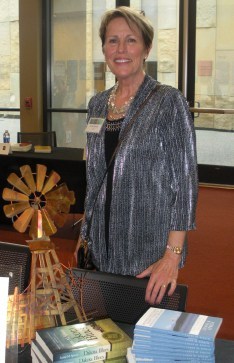
When they took this picture, I took pains to stand up straight. It felt a little rigid but looks great.
4. I put myself in a target-rich environment (TRE), one where I’m likely to achieve my purpose, and then I have fun. I live life, there in that environment, with my nice outfit and my confidence. If I were single and looking for a mate, this is where I’d stop looking and start living, and if the right guy showed up, he’d be attracted to me. Since I’m not single, my TRE is a book signing or public speaking. I’d feel good knowing I took control of my life and gave myself the best chance at happiness.
I also believe that once we get older, we are more likely to feel grateful for what we have rather than lament what we don’t, but I don’t know if that change happens while you are still only in your fifties. Because I think in your fifties you are reeling from stuff.
But science now tells us that your brain changes later in life to allow you to feel more settled in many ways. You are not quite as likely to panic about certain dramatic developments. At least for the majority of us.
I now think there really has to be a period of adjustment and acceptance, possibly even grieving, to transition beyond the fifties. It’s a time of change, and becoming. Like a little girl going through puberty, you are tortured for a few years, but once things settle down, it’ll be better than you can imagine.
I would love to hear from my friends who are over sixty. What tips can you offer our younger sisters who are finding their way through this transition stage?
July 15, 2016
Are Young People Messing Up Our Self-Image?
 Where does all this negativity about old age come from? I have a surprising idea.
Our American culture is more youth-centric and ageist than ever, in spite of the rising number of older people. Why is that? Here’s my hypothesis:
Ageism is rampant in the workplace, especially in media and tech. It’s the hardest form of discrimination to prove, and the most common. So after you, Corporate People, run off or choose not to hire older folks, and only youngish people are left to run things, what’s going to happen? One point of view will dominate. Youngish people will decide which stories have value and should be broadcast or published, which films should be made, and whose voice or perspective should be heard.
As a result, their decisions shape our national view of ourselves. We’re all brainwashed, even if we think we’re impervious.
However, young adults are the most unhappy of all age groups. This has been proven scientifically across the globe (see Happiness U-Curve).
So if they’re painting the picture of how we see age, it’s going to skew negative.
I give the kids the benefit of the doubt. They can’t help it. They see life through morose-colored glasses. To their thinking, old age could only be worse!
Knowing this, we can rise above the negativity about our age group. We can stop moaning about our looks, and celebrate positive brain changes, for example.
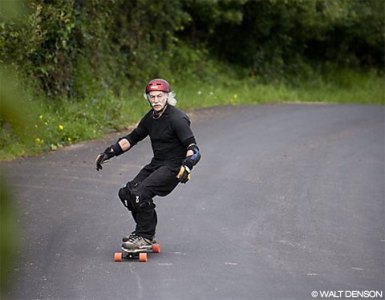
Photo by Walt Denson
We can stop awarding gold stars to old people based on how young they act, and instead, let every age group radiate goodness based on its particular outstanding qualities of the moment.
As a kindness, you might educate the young people around you. Tell them it will get better. Express your appreciation for their labors, because they’re working their asses off even though they think it’s going to go downhill from here. (That’s pretty heroic. Do you remember being in that place? I do. It was tough.)
The kids are burdened now, but all science points to a mood upswing at about age fifty. So love them, but don’t believe them, because their viewpoint is kind of messed up. That’s my hypothesis, anyway. What do you think?


