
Lynne M. Spreen's Blog, page 7
August 4, 2017
Warren Adler is an Inspiration


July 21, 2017
Where are You in Adult Development?
Where are You in Adult Development? (and free book giveaway – hurry!)
June 23, 2017
Giving It All Away–The Generosity of the Aged
June 9, 2017
Empowering Thoughts about Aging
June 2, 2017
An Older Person’s View of Politicians
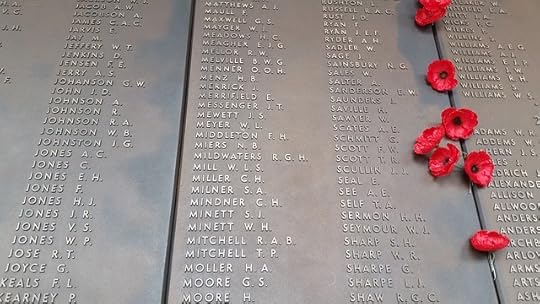 On Memorial Day, I attended a holiday event. It was somber, patriotic, and emotional, but something happened that bothered me.
A poem was read about thanking a soldier, reminding us that we should always be grateful for their sacrifice. Absolutely. I agree.
What bummed me out was that the poem repeatedly contrasted the soldier (courageous and heroic) with the politician (anything but.)
Stanza after stanza repeated the contrast. At the end of it, I wondered why anyone would want to go into public service.
Politicians can be skeezy lying jerks. But often they’re not. Yet we paint them with this brush of hatred.
If nobody ever took those roles, a lot of work wouldn’t get done. Many of us shake our heads and say, damn, I’d never run for office. I’d never want to be a politician.
But somebody has to be. Aren’t you glad somebody steps up?

The poem I heard on Memorial Day described politicians as cowards. I wondered what the poet thought of John Adams, Thomas Jefferson, Benjamin Franklin, George Washington, and Abraham Lincoln. Or Indira Ghandi, Golda Meir, Margaret Thatcher, and Ellen Johnson-Sirleaf.
Of the 535 men and women of the House and Senate, there must be dozens we could appreciate. As a moderate/lefty, I’ve complimented politicians when they stick up for the poor or the health of our planet, and I don’t care what party they belong to.
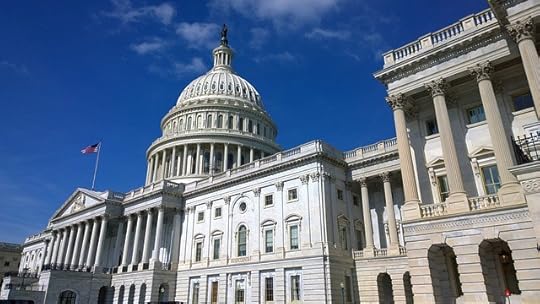
There are people right now on your city council, county board of supervisors, or school board who serve because they are trying to help the community. Some of them are making personal sacrifices to do so.
If all the politicians left their jobs tomorrow, tired of being pelted by rotten tomatoes as a matter of course, we’d be in a fix.
I’m tired of all the negativity, and that poem stuck in my craw. Why was it necessary to kick somebody in order to raise somebody else up? That’s the fog we’re in right now. It’s red against blue, Paris against Pittsburg.
But I have a solution in mind. There are 100 million people in the U.S. who are our age. People who are old enough to know how to mend and fix relationships. Old enough to know how to nurture, how to build up. How to get the most or best out of people.
Knee-jerk negativity is popular right now, but it’s a bad habit, a slouchy, lazy habit. We can change that.
We could offset the negativity by recognizing the good in people more often. We could diffuse the polarization everybody complains about, by demonstrating the courage of an open mind and independent thinking. We could judge people by their actions, instead of their jobs or creed or age.
We could stop marching in negative lockstep.
We could. We older people. We’ve seen so much; we’ve seen it all. We’ve been through enough heartache to be compassionate. We’re strong. We’re generous. We know what’s important.
Our country needs us now, more than ever.
Thanks for listening.
May 19, 2017
Internet Will Be Priced Like Cable TV If We Lose Net Neutrality

Can you imagine the internet being priced like a cable TV package? Let’s say you want to keep using Google. Or Facebook. Or Netflix. Would you be happy if your Internet provider wanted to charge you $50 a month for each of them?
That could happen if the FCC succeeds. Driven by overwhelming greed and less than no concern for average Americans, the FCC just took the first step to canceling Net Neutrality.
One of the likely scenarios is that big Internet Service Providers (ISPs) like Time Warner, ATT, Verizon, Fios, Charter, etc. will be able to price your internet access like they do cable TV, with tiers.
Jeez, they must be salivating.

More money for them, less for you. I mean, if you’re the CEO of Charter, you’re barely scraping by on $98 million a year.
Want access to your WordPress blog? Maybe you’ll be told you have to upgrade to Tier 2! Fifty extra bucks a month, honey. (But it’ll be worth it, because they’ll bundle it with Candy Crush Unlimited and streaming episodes of The Real Housewives of Moscow.)
This would apply to phone apps, too. You know how you’ve come to rely on GPS in your car? How would you like it if Verizon decided that’s Tier 3, an extra $75 a month?
Oh, hell yes, they can! These are all likely scenarios if Net Neutrality is rolled back. Unless we all yell to the rooftops.
This matter seemed to be settled a while back but under the new administration (“Looking out for the little guy”) it’s open season again.
This is going in the wrong direction! Many rural areas have no internet, or inadequate internet. With reasonably priced, wide-open internet, a woman in Appalachia might sell her crafts online and make a few extra bucks? Or a disabled or housebound person might attend online classes, or receive the benefit of remote medicine. Isn’t that more important than squeezing the little guy more? We need to expand access and cut the cost, not make it harder to get!
I’m so upset about this. (Can you tell?) I had a wonderful, uplifting, happy, empowering blog post to share with you but now it just doesn’t seem important.
Because if I have to pay to blog, I probably won’t. And you wouldn’t pay to read it anyway. Maybe that’s Jane Q. Citizen’s ace in the hole: if we have to pay to use Facebook, we’ll drift away, and FB will cease to exist.
But what about all the little business people who have websites and depend on traffic to make a buck? They can’t afford to pay more…or may choose not to. I know a lot of “mommy bloggers” who blog about domestic issues, making their blogs so useful and helpful that they can actually earn money from ads placed on their sites.
Goodbye to all that, as well.
The new director of the FCC, Ajit Pai, is, like so many Trump appointees, hostile to the mission of the agency he was chosen to lead. He moved quickly to start this effort to dismantle consumer protections.
If you have a chance, please learn about this, talk it up, share, and object. This is yet one more area where we need to stand together for the common good. Common as in anybody not making $98 million a year from bleeding the little guy.
Here are some articles about it: http://www.npr.org/sections/thetwo-way/2017/05/18/528941897/fcc-votes-to-begin-rollback-of-net-neutrality-regulations
https://www.usatoday.com/story/tech/news/2017/05/18/fcc-votes-overturn-net-neutrality/101828412/
And now, back to our regular programming. For as long as it lasts.
May 5, 2017
Are Older People Becoming More Relevant?
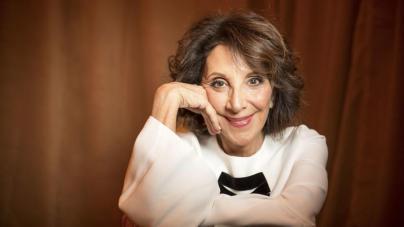
Andrea Martin, Actress
Are things beginning to change in the way we see older folks in our culture?
Last Sunday, the LA Times served up three articles relating to older people thriving in their very visible professions. Three! and it wasn’t even National Gerontology Month or Hug a Grandparent Day or anything.
Whenever I see such articles, I wonder if the culture is shifting beyond the negation of older people to a place where we’re seen as more relevant to society in general. Wouldn’t it be nice if that pervasive ageism were fading away?
Relevance in TV
Andrea Martin, pictured above, is seventy years old and working harder than ever as an actress. More than four decades into a prolific career in film, TV and theater, she’s productive, professional, and inspiring. I liked her energy and her humor. She’s been curious and brave all her life, and she is not slowing down. You can read more about her here. And by the way, of all the series that have been canceled or not renewed lately, Grace and Frankie is starting its fourth season, streaming on Amazon. Go, older peeps!
Relevance in Politics

Maxine Waters, Congresswoman
Maxine Waters, age 78, may be the most outspoken member of Congress. She’s unhappy about the way things are going in this country, and she’s not afraid to tell you about it. She’s becoming a rock star with the young, who call her Auntie Maxine for her no-shit bluntness. Politicians are so bland, the only thing coming out of their mouths is the chapter and verse designed to help their parties. Not Auntie Maxine. She says, “Some people see me as a rabble-rouser…I often get a feeling most people don’t know who I am, or have a clue, and I live with that. I don’t try to prove anything by talking.” That’s the confidence of maturity. You can read her story here.
Relevance in Music
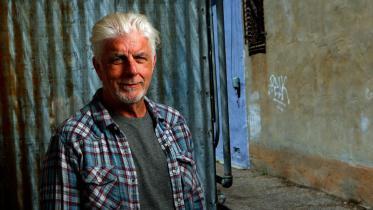
Michael McDonald
I have to confess, I’ve never been a great fan of Michael McDonald’s singing, but he is popular and respected. At 65, he’s working more than ever, frequently sitting in with younger acts. The latest was at the just-ended Coachella Music Festival with his friend Thundercat, who says about Michael, “Sometimes these older cats get jaded–they start thinking kids are stupid. But the Michael I’m seeing is the same guy I would’ve seen 30 or 40 years ago if I’d been around.” You can read more about him here.
One More Story about Freakin’ Amazing Old People
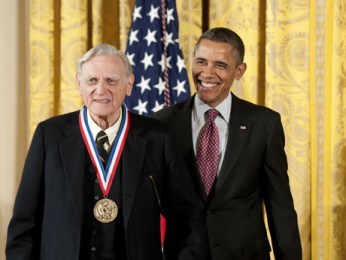
The 2011 National Medal of Science Laureates and 2010 National Medal of Technology and Innovation Laureates receive their medals from President Obama in the East Room of The White House on February 1, 2013. Ryan K Morris/National Science & Technology Medals Foundation.
John Goodenough is a 94-year-old inventor who is setting “the tech industry abuzz with his blazing creativity.” If his new battery works as well as expected, gas-powered vehicles will disappear. “We tend to assume that creativity wanes with age,” says the writer, Pagan Kennedy. “But Dr. Goodenough’s story suggests that some people actually become more creative as they grow older.”
But we knew that, because we talked about it in an earlier post in which researcher Gene Cohen, who studies the connection between art and neurons, said
The brain’s left and right hemispheres become better integrated during middle age, making way for greater creativity…The neurons themselves may lose some processing speed with age, but they become ever more richly intertwined…”
Such integration led one researcher to say that our higher thinking in older age “approaches the level of art.”
You can read the whole story about Dr. Goodenough and his invention here.
I hope you enjoyed this collection of profiles about inspirational older people. Maybe we’re becoming more positive about the way we see them, and ourselves, in older age. I sure hope so! What do you think?
April 21, 2017
Cool Poetry about Life in Your Eighties
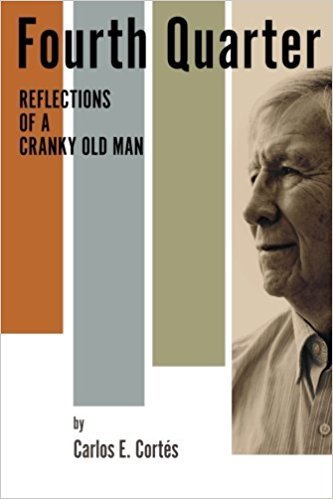 “I’m so old I remember/Where I was when I heard/the Japanese bombed Pearl Harbor…” Thus begins a great book of poetry, Fourth Quarter: Reflections of a Cranky Old Man, by Carlos E. Cortés. His work is funny and light, but also realistic, as with this:
…I wouldn’t call them the ‘good old days’
but I sure enjoy remembering them
maybe even more than living them.
Which of course is the truth of the good old days. And that’s what Carlos talks about: truth. Truth about aging, about youth, about America, about history.
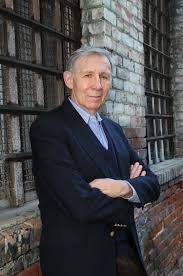 Carlos is Dr. Carlos Cortés, professor emeritus of history at the University of Riverside, California. His book is all about reflecting on life through the lens of a guy in his later years.
I had the pleasure of meeting Carlos recently. He got in touch after this article about me appeared in our local paper. We enjoyed sandwiches at Jammin’ Bread Bakery in Canyon Crest. I couldn’t quit smiling, partly because he’s an upbeat guy, and partly because I had this weird sense that we were family. He grew up in Kansas City, Missouri; I have relatives there.
Carlos puts the lie to our culture’s low expectations of older people. He described his frustration with a recent celebration of age by Poets & Writers Magazine, wherein people over 60 were excluded from consideration. Carlos says people in their eighties are marginalized. (That article is here.)
But with Carlos, as with my other friends in their eighties and nineties, the fourth quarter of life is a brilliant period. For example, the good professor is so busy, it was a challenge just setting up lunch. Although theoretically retired, he’s an award-winning civic figure and lecturer, and he has an office at UCR. He and his wife go to the gym religiously, and they enjoy the cultural life of the community.
 Now he’s writing for fun (he wrote and contributed to scholarly publications during his tenure as professor, but I mean to distinguish from that.) He also wrote Rose Hill: An Intermarriage Before Its Time, about his mom and dad. The book description begins,
Dad was a Mexican Catholic. Mom was a Kansas City–born Jew with Eastern European immigrant parents. They fell in love in Berkeley, California, and got married in Kansas City, Missouri. That alone would not have been a big deal. But it happened in 1933, when such marriages were rare. And my parents spent most of their lives in Kansas City, a place both racially segregated and religiously divided…
Rose Hill is a fascinating memoir. My review is here.
As I sat across from Dr. Carlos Cortés at lunch that day, his energy motivated me. Our rapid-fire, funny, and at times wry conversation dabbled with ageism, but we didn’t dwell on it. He’s too intent on wringing the most out of his life, and I wondered again—this is something I often think about—how it must feel to be shunted off to the sidelines by the culture, when in fact this demographic is contributing more than ever. Getting to know Carlos was a treat. He exemplifies life as it really is now for people in their fourth quarter: the game is still on.
April 4, 2017
Three Views on Aging — Which Do You Hold?
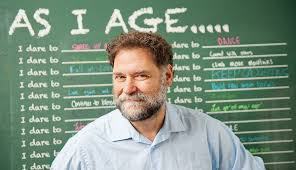 I just read a great article by Dr. Bill Thomas, who’s bringing so much energy to the debate on how to age well in the 21st century.
He says:
In the first camp are the “denialists,” who collectively pump billions into “age-defying” products, pretending old age won’t happen to them. “Realists” are in the second camp. They don’t deny aging but hope that between lots of kale, yoga, and active living, they won’t have to deal with it for a while. In the third camp are “enthusiasts,” people like Thomas and Applewhite, who actively embrace aging, acknowledging its beauty and possibilities, as well as its potential challenges.
Whenever I call myself a positive aging writer/thinker/blogger, I worry that people think it means I advocate facelifts, etc. Maybe in the future I’ll change it to “aging enthusiast,” because that describes it better. The rest of the article is here.
What about you? Are you a denialist, a realist, or an enthusiast?
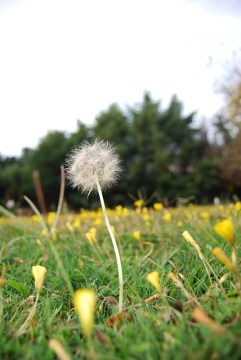
How do you see this – as a flower or a weed?


