Max Carmichael's Blog, page 30
November 2, 2018
Deep Time Traveling
After my adventure in the blizzard, I was kind of shaken up, and more than a little frustrated. My fall camping trip had started out with a big dose of stressful driving, and no camping. But there were supposed to be a few more prehistoric rock art sites that I hadn’t seen yet, in pretty wild country, far to the north. I hoped there’d be plenty of camping up there. I could even return to a site I’d used a couple of years ago, in the same general area.
First, and it would be a long drive, I’d check out one famous site at the eastern edge of the territory of the people they call the Fremont, the ancient culture I’ve recently become obsessed with. It was supposed to feature the famous “Barrier Canyon” style of painting, the most beautiful and mysterious style of prehistoric art in North America. It was just a few miles off the interstate, so not a place to camp, but it’d be an easy in-and-out from which I could proceed on back to the truly wild country.
As it turned out, the art was amazing, but the easy access meant there had been severe, tragic vandalism by Americans, both historic and modern. No different than the bullies I’d grown up with back east, kids who’d never been taught to respect beauty, kids so insecure they could only respond to mystery with violence.
Heading west on the interstate, I saw stacks of bundled firewood outside a gas station and, learning my lesson about fall camping in the high country, picked up a couple bundles. It was poor quality and way overpriced, but it was something.
I kept checking my maps, and determined that all the rock art sites near the interstate were on “high clearance only” roads. It was already mid-afternoon and I was still a couple hours away from the next accessible sites, and I didn’t want to be looking for a campsite after sunset. So I left the interstate and drove north up a long gravel road through sagebrush-and-mesa country toward where I’d camped two years ago.
I crossed the old bridge over the San Rafael River, there at the massive sandstone wall, and entered the big canyon with an hour or more of daylight to spare. My old campsite turned out to be taken by another solo man in a compact truck with funky camper shell, but I found an even better one, hidden in a grove of pinyon and juniper out of sight of the road. I suited up for a freezing night, got a fire going, and cracked a IPA. I set up camp at a leisurely pace, and cooked a fairly ambitious plate of food. Only one other vehicle passed, and then it was full dark down there in the big canyon.
Camping is a lot less fun with chronic pain. I’m still trying to sort that out. I can be athletic as ever, to a point, but then something happens and I’m a cripple for a while. My night in the canyon started out pretty uncomfortable, but I eventually found a position my body didn’t hate too much. Thin clouds kept drifting over, then clearing off. Cygnus was in view early, her wings spanning the dusty trail of the galaxy, then later Casseiopeia, Pegasus, and finally Orion and the Moon herself. Somewhere in there I managed to get a decent night’s sleep.
Campsites in this canyon all seem to be sunset camps, benefiting from late afternoon light but sunk in the shade of those thousand-foot walls for most of the morning. Bedding doesn’t air out, and your ground cloth is caked with red clay mud until late morning when you can finally lay it out in the sun. I had no plan for the day, but it’d been over a week since I’d been able to hike. So after everything was dry, I packed the truck, loaded my pack with warm clothes, water, and snacks, and crossed the dry creekbed to hike up into a shallow side canyon. I knew it’d likely be a short, steep hike unless I could find a way up the rimrock to the plateau on top. But at least I’d get a workout.
Of course, with my slow-healing injured foot, I’m not even really supposed to be hiking off-trail. But the only “trail” in this canyon is the 4wd road up the major side canyon, probably a 6-mile branch, and that was a ranch road, through an area that might be heavily grazed. I wanted more of a wilderness experience. When I made it up into my side canyon, I spotted a possible route to the top, and started climbing.
It was such a beautiful day, and such a beautiful place, I threw caution to the wind. I ignored my injured foot and scrambled up slopes of clay and loose sandstone that would’ve been dangerous even when I was in my best shape. I did some technical rock-climbing moves that, if unsuccessful, could’ve killed me. And of course, the most dangerous climb on these slopes is the down climb. But I made it halfway up the thousand-foot cliff, got to see an eagle and some crazy lichen, and returned safely to the valley floor by early afternoon.
Back at the truck, I debated staying another night in this idyllic place. But the weather made my mind up for me. Storm precursor clouds were blowing over, and a strong wind was moving down the canyon. I realized it’d been totally still since I’d arrived, but no more.
I drove on up the canyon and spotted a sign for another rock art site that I’d missed previously. When I opened the door to get out, the wind almost tore it off. It was gusting well over 50 mph. But the prehistoric art made it well worth the stop, and I encountered a big flock of some of the coolest birds I’ve ever seen.
There I was, in the middle of a vast wild area, with storm clouds filling the sky, a howling wind, and little more than two hours till sunset. I was near the head of the canyon, about to emerge onto the rolling plateau where there was little cover. I decided to drive to town, more than an hour away, and spend some time researching my next move.
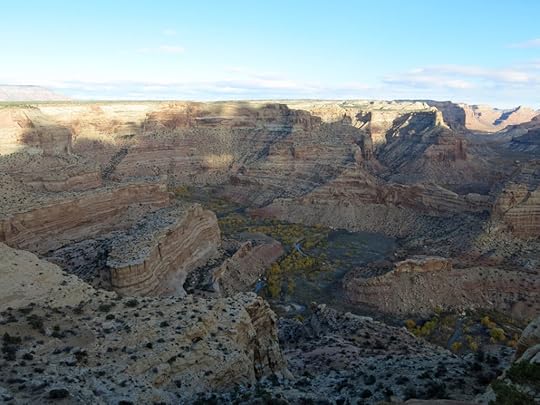
But along the way, I got distracted by some intriguing signs. And I discovered one of the most amazing, and little-known, canyons in North America – the “Little Grand Canyon” of the San Rafael River.


Fall 2018 Part 1: Impassable When Wet
For this year’s fall camping trip, I had a vague plan to revisit Southern Paiute territory in a counter-sunwise direction, from northeast to southwest, from southeastern Utah (the Colorado Plateau), through southern Nevada, to southeastern California (the Mojave Desert). In Utah and Nevada, I hoped to seek out places and prehistoric rock art sites more remote and obscure than the ones I’d previously found.
I took a few dozen maps that I’d collected on previous trips, showing varying degrees of detail, but I had no preconceived schedule or itinerary. I wanted to make each day’s plan on the spot, based on the weather and the way things looked at that time and place. I was starting by heading north, from late October into early November, so I was prepared for cold. But my trip would later take me south to the Mojave, so I had to bring shorts and a lightweight sleeping bag. A wide variety of gear! And for the first part of the trip I’d be in very sparsely populated country with virtually no place to buy groceries, so what I took with me from home had to last a week or more.
It took me two days of driving just to get to the start of the trip. I was still recovering from my latest episode of severe lower back pain, but I had a good lumbar pad that made it possible to endure the long drives in my little old hard-sprung truck. Something I hadn’t got used to yet, or found a remedy for, was the crippling pain in my upper right arm that I’d had since last winter. That made it really difficult to shift gears. But I was excited to be on the road again, headed to some of my favorite wild country. The sky was clear for the first two days, but on the third morning, a storm front started moving over from the west.
I’d gotten it into my head to try to explore a vast, high, forested ridge of red sandstone that I had passed below and admired from a distance for decades. My previous focus had always been the canyons in the mesa below the ridge, rich with cliff ruins and rock art. But recently, the entire area had been designated a national monument, and it had been named after a pair of distinctive peaks near the south end of the ridge.
As I drove toward the ridge from thirty miles away in the east, I could see those peaks under the low mass of clouds that was spreading from the west. Rain was forecast with this storm, and temperatures were in the forties. I knew that throughout this area, unpaved roads were posted with prominent signs warning “Impassable When Wet,” and the road I planned to take up the ridge was one of those roads. But my maps showed that it was also a “backcountry byway” which was presumably maintained for tourism by car. Oh well, I thought, if I get caught in the rain, I’ll just have to pull over and make camp. Sure, I never bring a tent – I’ve camped in the rain many times by wrapping a waterproof poncho or tarp around my sleeping bag, like a cocoon. But if that didn’t work, I could always spend the night sitting up in my truck seat. No worries.
When I found the road and left the pavement behind, it started out pretty good. They’d laid down a thick layer of gravel and it was a wide road. But when it began to climb the side of the ridge in steep, twisting switchbacks, it turned to red clay – the fine powder eroded from sandstone over eons – and got narrow, with a sheer dropoff on one side and a deep, narrow ditch on the other.
I drove up about a thousand feet, with spectacular views all the way, then topped on a rolling ledge forested with pinyon and juniper, with pulloffs to undeveloped campsites on each side. There was standing water in the roadside ditches – it must’ve rained last week – but the clay road itself was dry and hard as rock. I could see the twin peaks up ahead, and after a few miles, the road began climbing again, to a notch between them. Passing through it, I looked down across the ridge proper, a high, rolling plateau of alternating sagebrush meadows and mixed pine and fir forest that stretched dozens of miles to the horizon. The peaks were roughly 9,000′ elevation and the ridgetop plateau was roughly 8,500′.
Up here, there were patches of snow beside the road, and more snow on the northeast side of the peaks. And as I drove down onto the plateau, I passed large pools of muddy water in low places, and shady patches of road that were still flooded and muddy. It must’ve really rained last week.
But the cloud cover overhead kept breaking up and revealing blue sky, and by and large the road was still hard as rock. I figured the temperature was in the 30s up here, and the road must be frozen from hard freezing overnight. I wasn’t worried. Even if it rained, surely the road would stay hard.
I passed turnoffs for side roads to trailheads. Off to my left, in the north, I knew there was a huge wilderness area encompassing a canyon system that I’d tried to reach from its mouth, far to the northwest, years ago. It really intrigued me. The maps showed a trailhead located on this very road, about 20 miles northeast, and I hoped to camp there and hike a few miles down into the wilderness.
I passed grazing cattle, corrals, and stock ponds. I passed a couple of big utility trucks, but I didn’t see any other campers. I came to an overlook where I got a glimpse of impressive canyons and distant tall mountains, far in the east.
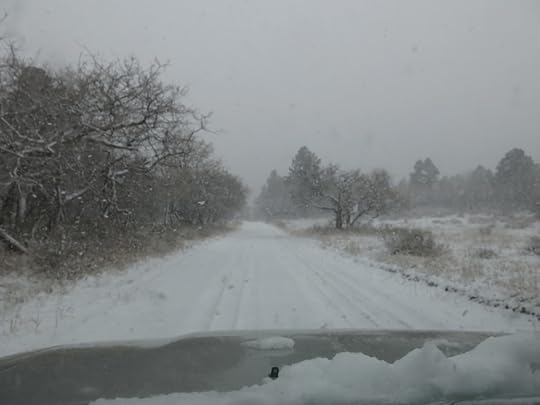
Then the road branched off and turned north, and snow began falling. Of course! At this elevation it wouldn’t rain, it would snow. As long as it didn’t accumulate more than a few inches, I was sure I’d be fine. It was cold enough that it’d be dry snow, no problem for my rear-wheel-drive truck with poor weight distribution. I could always let some air out of my tires for better traction. And the road was already frozen solid so no problem with getting bogged down in mud. I might have to camp out in the snow, but I’d done that just a few years ago and had a great time.
Mile after mile, I twisted and turned, up and down through tall trees, past the occasional small, overgrazed meadow. Snow fell heavier, but it wasn’t sticking. I reached a major trailhead with a big parking area and lots of informational kiosks, but it was a 4wd trail. The forest got heavier, and I continued for another 10 miles or so. I was inside the cloud now and couldn’t see more than a few dozen feet from side to side. Finally I drove down a steep grade, and at the low point there was a small sign: “The Notch”. I couldn’t see anything, but apparently it was a narrow pass with steep dropoffs on each side. And there was the trailhead I’d been looking for.
I parked and suited up in my winter gear. Snow was falling heavily but still wasn’t sticking on the road. I watched for a while to see if the flakes were melting as they touched the clay. Yes, they were. My theory of a frozen road turned out to be wrong. My heart started racing, just a little bit.
I love snow, so I was excited, regardless of what was to come. I started hiking down the trail into the head of the famous canyon. I made it a few hundred yards before I realized that the snow was rapidly turning into a blizzard and accumulating on the trees and the ground. I climbed back to the road, which had developed a half-inch layer of white. I knew I was in trouble, here, 30 miles off the paved highway and 70 miles from the nearest town, with no cell coverage if I needed help. Part of me had known from the beginning this was a bad idea.
Although I’d never driven these powder-clay roads when they were wet, I’d read accounts of what happened to them, and seen the aftermath. They instantly turned to a sticky bog with the consistency of mashed potatoes that accumulated on your tires, turning them into giant mud donuts, until even high-clearance 4wd vehicles bogged down all the way to their engine blocks. When the clay dried you’d be fossilized in the road itself like a woolly mammoth in the Tar Pits. 4wd trucks that were foolish enough to drive these roads before the clay completely dried, created ruts a foot or more deep that were nearly impossible for others to navigate afterwards.
But now, the snow was only a half inch deep, and the clay surface was still hard. I drove carefully up the grade into the forest, my heart in my throat. As long as I kept rolling and stayed in first gear, I seemed to be okay. But the snow was falling heavier and I had 30 miles of this to go. I really didn’t think I could make it.
I soon found the limits of my traction. Even at low speed, in first gear, there were places where I just lost control and started sliding toward the deep, flooded ditch at the side of the road. One tire in that ditch and I’d be immobilized. But the tires always caught just before the ditch, and I continued my agonizingly slow progress across the high plateau.
What I feared was the climb up the grade to the notch between the namesake peaks. I was sure I’d lose traction there, but even if I made it over, there was the steep grade down the other side, without guard rails and a sheer drop of 500′ or more, instead of just a ditch, when I started to slide.
Mile after mile through the blizzard, losing traction again and again, sliding toward the flooded ditch, only to regain my grip and progress a few more miles. Finally I felt I was on the final short down slope to the big meadow just before the climb to the notch. I very carefully slowed to a stop on that down slope, figuring I would scout on foot for a place to pull over and camp in the snow if I lost traction and couldn’t climb the grade ahead. But as soon as I stepped out of the truck, my feet slipped out from under me. The road, under the 2 inches of snow that had now accumulated, was a completely frictionless surface. By sticking to rougher ground at the edge, I was just barely able to walk a dozen yards down to the meadow. I had no idea how I’d been able to drive this far on this road in these conditions! I could barely even walk it!
Through the cloud off the side of the road, I suddenly saw a bull elk with a huge rack, making his way through the high sagebrush. He turned and saw me, and then I saw the others, a herd of cow elk following him. They began walking uphill toward the notch. Behind them, there was a side trail, of sorts, leaving the main road for a short distance just above the meadow. It was rough and there was no place to camp. I walked off the road, under the big trees, and felt the dead branches near the ground where the snow hadn’t yet reached. They were all drenched. There’d be no dry firewood anywhere on this ridge. It was clear that if I pulled off there, I’d be stuck in the cab of my truck, without fire, maybe for days, until somebody showed up to rescue me. So I carefully made my way back to the truck, determined to try driving up the grade. Just keep trying.
Somehow, I made it to the notch between the peaks. And down the grade on the other side, which wasn’t as bad as I remembered, to the long ledge with all the primitive campsites. Hey, it wasn’t snowing so bad down here, and it hadn’t started accumulating on the road yet. I started looking at those campsites and thinking I might just stop.
Then, at a low point in the clay road, with deep flooded ditches on both sides, I suddenly lost traction again. I let my foot off the gas, kept the clutch engaged, and let the engine idle just apply some gentle rotation to the rear tires. They spun freely in the wet clay, and me and the truck drifted, oh so slowly, toward the nearest ditch, which was at least two feet deep.
I gently maneuvered the steering wheel, trying to use the front tires as rudders, but with virtually no effect. My truck was like a hockey puck. Just drifting to the edge of that ditch, agonizingly slow, then hovering, then drifting a little ways back toward the crown of the road.
This went on forever! Literally, for between 5 and 10 minutes, the truck rotating, drifting to one side or the other, the wheels slowly spinning, the hideous gaping maw of that deep muddy ditch getting inches nearer or inches farther away, with me seemingly helpless to influence my fate.
Then finally, I felt something change. The wheels were again in line with the road, and I had a measure of control over steering and speed. I gave up on those campsites. I realized I had the thousand feet of really steep grade, with its nightmarish dropoffs, still ahead of me.
Before I got there, the road actually became dry. And I pulled off into the trees just before the down grade, and found what would normally, in benign conditions, be an amazing campsite, with unbelievable views out across the endless mesa. But there was no dry firewood here either, and I had no idea how long the storm would continue. I could still easily get stuck up here if it kept snowing overnight. So I left the ridge behind, amazed that I’d been able to get out. To return again in warmer, drier weather.
This is a vast area, and the storm had only been forecast to cover the southern part of it. My next logical destination lay to the northwest. It was still just mid-afternoon, and I thought if I kept driving I might get to a dry area where it’d be possible to camp.
And I did eventually emerge out from under the storm, but there was still standing water everywhere from last week’s big downpour. I’d never seen anything like it. Mile after mile, I pulled over again and again, but couldn’t find a usable road or a dry campsite. It was bitterly cold and my arm was really aching. The sun went down, and after dark, I arrived in the only tiny hamlet in the middle of this huge landscape, where I spent the night indoors, in a fairly dismal but not nearly cheap enough motel room.
Impassable When Wet
For this year’s fall camping trip, I had a vague plan to revisit Southern Paiute territory in a counter-sunwise direction, from northeast to southwest, from southeastern Utah (the Colorado Plateau), through southern Nevada, to southeastern California (the Mojave Desert). In Utah and Nevada, I hoped to seek out places and prehistoric rock art sites more remote and obscure than the ones I’d previously found.
I took a few dozen maps that I’d collected on previous trips, showing varying degrees of detail, but I had no preconceived schedule or itinerary. I wanted to make each day’s plan on the spot, based on the weather and the way things looked at that time and place. I was starting by heading north, from late October into early November, so I was prepared for cold. But my trip would later take me south to the Mojave, so I had to bring shorts and a lightweight sleeping bag. A wide variety of gear! And for the first part of the trip I’d be in very sparsely populated country with virtually no place to buy groceries, so what I took with me from home had to last a week or more.
It took me two days of driving just to get to the start of the trip. I was still recovering from my latest episode of severe lower back pain, but I had a good lumbar pad that made it possible to endure the long drives in my little old hard-sprung truck. Something I hadn’t got used to yet, or found a remedy for, was the crippling pain in my upper right arm that I’d had since last winter. That made it really difficult to shift gears. But I was excited to be on the road again, headed to some of my favorite wild country. The sky was clear for the first two days, but on the third morning, a storm front started moving over from the west.
I’d gotten it into my head to try to explore a vast, high, forested ridge of red sandstone that I had passed below and admired from a distance for decades. My previous focus had always been the canyons in the mesa below the ridge, rich with cliff ruins and rock art. But recently, the entire area had been designated a national monument, and it had been named after a pair of distinctive peaks near the south end of the ridge.
As I drove toward the ridge from thirty miles away in the east, I could see those peaks under the low mass of clouds that was spreading from the west. Rain was forecast with this storm, and temperatures were in the forties. I knew that throughout this area, unpaved roads were posted with prominent signs warning “Impassable When Wet,” and the road I planned to take up the ridge was one of those roads. But my maps showed that it was also a “backcountry byway” which was presumably maintained for tourism by car. Oh well, I thought, if I get caught in the rain, I’ll just have to pull over and make camp. Sure, I never bring a tent – I’ve camped in the rain many times by wrapping a waterproof poncho or tarp around my sleeping bag, like a cocoon. But if that didn’t work, I could always spend the night sitting up in my truck seat. No worries.
When I found the road and left the pavement behind, it started out pretty good. They’d laid down a thick layer of gravel and it was a wide road. But when it began to climb the side of the ridge in steep, twisting switchbacks, it turned to red clay – the fine powder eroded from sandstone over eons – and got narrow, with a sheer dropoff on one side and a deep, narrow ditch on the other.
I drove up about a thousand feet, with spectacular views all the way, then topped on a rolling ledge forested with pinyon and juniper, with pulloffs to undeveloped campsites on each side. There was standing water in the roadside ditches – it must’ve rained last week – but the clay road itself was dry and hard as rock. I could see the twin peaks up ahead, and after a few miles, the road began climbing again, to a notch between them. Passing through it, I looked down across the ridge proper, a high, rolling plateau of alternating sagebrush meadows and mixed pine and fir forest that stretched dozens of miles to the horizon. The peaks were roughly 9,000′ elevation and the ridgetop plateau was roughly 8,500′.
Up here, there were patches of snow beside the road, and more snow on the northeast side of the peaks. And as I drove down onto the plateau, I passed large pools of muddy water in low places, and shady patches of road that were still flooded and muddy. It must’ve really rained last week.
But the cloud cover overhead kept breaking up and revealing blue sky, and by and large the road was still hard as rock. I figured the temperature was in the 30s up here, and the road must be frozen from hard freezing overnight. I wasn’t worried. Even if it rained, surely the road would stay hard.
I passed turnoffs for side roads to trailheads. Off to my left, in the north, I knew there was a huge wilderness area encompassing a canyon system that I’d tried to reach from its mouth, far to the northwest, years ago. It really intrigued me. The maps showed a trailhead located on this very road, about 20 miles northeast, and I hoped to camp there and hike a few miles down into the wilderness.
I passed grazing cattle, corrals, and stock ponds. I passed a couple of big utility trucks, but I didn’t see any other campers. I came to an overlook where I got a glimpse of impressive canyons and distant tall mountains, far in the east.
Then the road branched off and turned north, and snow began falling. Of course! At this elevation it wouldn’t rain, it would snow. As long as it didn’t accumulate more than a few inches, I was sure I’d be fine. It was cold enough that it’d be dry snow, no problem for my rear-wheel-drive truck with poor weight distribution. I could always let some air out of my tires for better traction. And the road was already frozen solid so no problem with getting bogged down in mud. I might have to camp out in the snow, but I’d done that just a few years ago and had a great time.
Mile after mile, I twisted and turned, up and down through tall trees, past the occasional small, overgrazed meadow. Snow fell heavier, but it wasn’t sticking. I reached a major trailhead with a big parking area and lots of informational kiosks, but it was a 4wd trail. The forest got heavier, and I continued for another 10 miles or so. I was inside the cloud now and couldn’t see more than a few dozen feet from side to side. Finally I drove down a steep grade, and at the low point there was a small sign: “The Notch”. I couldn’t see anything, but apparently it was a narrow pass with steep dropoffs on each side. And there was the trailhead I’d been looking for.
I parked and suited up in my winter gear. Snow was falling heavily but still wasn’t sticking on the road. I watched for a while to see if the flakes were melting as they touched the clay. Yes, they were. My theory of a frozen road turned out to be wrong. My heart started racing, just a little bit.
I love snow, so I was excited, regardless of what was to come. I started hiking down the trail into the head of the famous canyon. I made it a few hundred yards before I realized that the snow was rapidly turning into a blizzard and accumulating on the trees and the ground. I climbed back to the road, which had developed a half-inch layer of white. I knew I was in trouble, here, 30 miles off the paved highway and 70 miles from the nearest town, with no cell coverage if I needed help. Part of me had known from the beginning this was a bad idea.
Although I’d never driven these powder-clay roads when they were wet, I’d read accounts of what happened to them, and seen the aftermath. They instantly turned to a sticky bog with the consistency of mashed potatoes that accumulated on your tires, turning them into giant mud donuts, until even high-clearance 4wd vehicles bogged down all the way to their engine blocks. When the clay dried you’d be fossilized in the road itself like a woolly mammoth in the Tar Pits. 4wd trucks that were foolish enough to drive these roads before the clay completely dried, created ruts a foot or more deep that were nearly impossible for others to navigate afterwards.
But now, the snow was only a half inch deep, and the clay surface was still hard. I drove carefully up the grade into the forest, my heart in my throat. As long as I kept rolling and stayed in first gear, I seemed to be okay. But the snow was falling heavier and I had 30 miles of this to go. I really didn’t think I could make it.
I soon found the limits of my traction. Even at low speed, in first gear, there were places where I just lost control and started sliding toward the deep, flooded ditch at the side of the road. One tire in that ditch and I’d be immobilized. But the tires always caught just before the ditch, and I continued my agonizingly slow progress across the high plateau.
What I feared was the climb up the grade to the notch between the namesake peaks. I was sure I’d lose traction there, but even if I made it over, there was the steep grade down the other side, without guard rails and a sheer drop of 500′ or more, instead of just a ditch, when I started to slide.
Mile after mile through the blizzard, losing traction again and again, sliding toward the flooded ditch, only to regain my grip and progress a few more miles. Finally I felt I was on the final short down slope to the big meadow just before the climb to the notch. I very carefully slowed to a stop on that down slope, figuring I would scout on foot for a place to pull over and camp in the snow if I lost traction and couldn’t climb the grade ahead. But as soon as I stepped out of the truck, my feet slipped out from under me. The road, under the 2 inches of snow that had now accumulated, was a completely frictionless surface. By sticking to rougher ground at the edge, I was just barely able to walk a dozen yards down to the meadow. I had no idea how I’d been able to drive this far on this road in these conditions! I could barely even walk it!
Through the cloud off the side of the road, I suddenly saw a bull elk with a huge rack, making his way through the high sagebrush. He turned and saw me, and then I saw the others, a herd of cow elk following him. They began walking uphill toward the notch. Behind them, there was a side trail, of sorts, leaving the main road for a short distance just above the meadow. It was rough and there was no place to camp. I walked off the road, under the big trees, and felt the dead branches near the ground where the snow hadn’t yet reached. They were all drenched. There’d be no dry firewood anywhere on this ridge. It was clear that if I pulled off there, I’d be stuck in the cab of my truck, without fire, maybe for days, until somebody showed up to rescue me. So I carefully made my way back to the truck, determined to try driving up the grade. Just keep trying.
Somehow, I made it to the notch between the peaks. And down the grade on the other side, which wasn’t as bad as I remembered, to the long ledge with all the primitive campsites. Hey, it wasn’t snowing so bad down here, and it hadn’t started accumulating on the road yet. I started looking at those campsites and thinking I might just stop.
Then, at a low point in the clay road, with deep flooded ditches on both sides, I suddenly lost traction again. I let my foot off the gas, kept the clutch engaged, and let the engine idle just apply some gentle rotation to the rear tires. They spun freely in the wet clay, and me and the truck drifted, oh so slowly, toward the nearest ditch, which was at least two feet deep.
I gently maneuvered the steering wheel, trying to use the front tires as rudders, but with virtually no effect. My truck was like a hockey puck. Just drifting to the edge of that ditch, agonizingly slow, then hovering, then drifting a little ways back toward the crown of the road.
This went on forever! Literally, for between 5 and 10 minutes, the truck rotating, drifting to one side or the other, the wheels slowly spinning, the hideous gaping maw of that deep muddy ditch getting inches nearer or inches farther away, with me seemingly helpless to influence my fate.
Then finally, I felt something change. The wheels were again in line with the road, and I had a measure of control over steering and speed. I gave up on those campsites. I realized I had the thousand feet of really steep grade, with its nightmarish dropoffs, still ahead of me.
Before I got there, the road actually became dry. And I pulled off into the trees just before the down grade, and found what would normally, in benign conditions, be an amazing campsite, with unbelievable views out across the endless mesa. But there was no dry firewood here either, and I had no idea how long the storm would continue. I could still easily get stuck up here if it kept snowing overnight. So I left the ridge behind, amazed that I’d been able to get out. To return again in warmer, drier weather.
This is a vast area, and the storm had only been forecast to cover the southern part of it. My next logical destination lay to the northwest. It was still just mid-afternoon, and I thought if I kept driving I might get to a dry area where it’d be possible to camp.
And I did eventually emerge out from under the storm, but there was still standing water everywhere from last week’s big downpour. I’d never seen anything like it. Mile after mile, I pulled over again and again, but couldn’t find a usable road or a dry campsite. It was bitterly cold and my arm was really aching. The sun went down, and after dark, I arrived in the only tiny hamlet in the middle of this huge landscape, where I spent the night indoors, in a fairly dismal but not nearly cheap enough motel room.
October 10, 2018
Wisdom vs. Happiness: A Eulogy for James Sayre
House in Rockridge
In summer 2011, I had my last phone conversation with my old friend James. He was ten years older than me, and had had a profound influence on me when we first met, more than thirty years earlier, so that I came to consider him part of my small circle of honored elders and mentors.
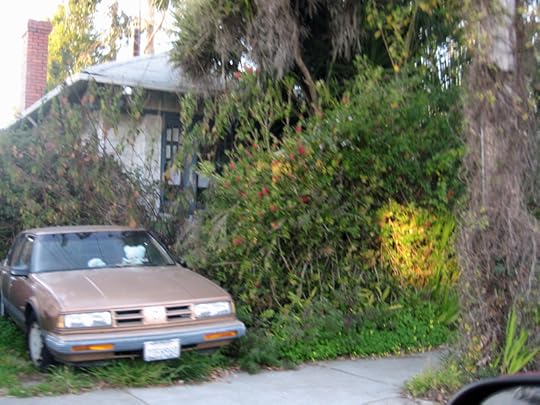
In the early 2000s, James had moved into the dilapidated house in Oakland’s Rockridge district where his younger brother had committed suicide, and within a few years James had contracted diabetes. The interior of his house had become a dusty maze of clutter, combining odds and ends he’d picked up at yard sales with stacked boxes of the books he’d self-published but couldn’t sell. There was only a narrow path between the clutter allowing movement between rooms. When I visited, we sat in a tiny cleared space in front of the fireplace, as James broke up pieces of old furniture to burn, to take the edge off the chill, since he was no longer using the house’s heating system.
In keeping with his lifelong practice of “voluntary simplicity,” James refused to fix things when they broke. The kitchen sink leaked, so he’d taken to washing dishes in the bathtub. His focus was on the small yard outside, the tiny patch in front and the larger, fenced area in back. There, he cultivated a profusion of exotic vegetation, including his beloved Australian eucalyptus, a jungle that was gradually engulfing the house and hiding it from the street. Some of it was edible – he had a rapidly expanding blackberry patch.
The mainstay of James’s diet had always been the heavy unleavened bread, full of nuts and dried fruit, that he had baked as long as I’d known him. On his weekly forays to libraries and yard sales by bike and public transit, he carried chunks of this bread in his pockets, so that he was always snacking for sustained energy instead of concentrating his intake at regular meals. Self-reliance and thrift were a family tradition, part of James’s DNA.
We’d both maintained regular contact over the years, through frequent emails, regular calls, and sporadic visits. I moved to New Mexico in 2006, and on my first visit back to the Bay Area, I called to arrange a visit.
When I showed up at James’s house, his parents’ old Buick was in the driveway, but there was no response to my knocks and shouts at the door. I kept trying for a half hour, then left. And shortly after I drove off, my cell phone rang. James apologized, saying that he no longer felt able to allow people into his house. He seemed embarrassed, but otherwise in good spirits.
We continued emailing and talking regularly, and James seemed a little more down, a little more discouraged, each time. His family were all dead, and he’d gradually lost touch with all his other friends – he got in an argument with the last of them, a former Stanford classmate who was a computer consultant in Berkeley, and stopped communicating. I was the last friend standing. By 2011, he admitted he was running out of the last of the money he’d inherited from his parents, and he didn’t know what he was going to do to survive. And after that last call in the summer, he stopped responding to my calls and emails. His web site went offline, and when I called a second or third time, his land line had been disconnected.
I called a friend who lived nearby and asked her to check out James’s house. She reported that there were young people living there now, so I really freaked out. I sent a letter to his address requesting information, but shortly afterward, I called his number again, and got his answering machine. And his web site was back online.
I continued to send email inquiries and leave occasional phone messages, and I downloaded his web site to my hard drive in case it went offline again. But I never heard from James after that.
I visited the Bay Area several times, always stopping at his house, pounding on the door and yelling his name. My neighborhood friend had apparently gone to the wrong address – James’s house never changed, always hidden behind a screen of vegetation, always silent, with the old Buick parked in the driveway. I was of two minds about harassing someone who’d chosen to be a recluse. Should I respect his decision and leave him alone? But I always left a note saying I missed him.
Every six months or so I did a Google search on his name and location. He continued with his practice of writing letters to the editors of the Berkeley Planet and San Francisco Chronicle, fighting capitalism, imperialism, and corruption, through 2012, but after that there was nothing. Finally, before visiting the Bay Area in 2018, I did an online tax search in county records and found that someone had paid a big supplemental tax at his address, indicating improvements to the property, which I knew James would’ve never done. A friend did a real estate search and found that his house had indeed been partially renovated, and it was listed for sale at $1.2 million.
We drove over, and a neighbor informed me that James had died a year earlier from complications of diabetes. I took BART to the Berkeley Court House and waited an hour to request probate records that ultimately put me in touch with James’s nephew, the son of his younger sister who had died much earlier.
Voluntary Simplicity
I met James because Pake, my best friend in grad school at Stanford, had met him earlier, and had stored his belongings in the attic of James’s group house while we were tramping through Mexico and Guatemala after finishing our studies. James let me store my stuff there, too, and when I returned months later, let me camp out in his attic. I came up with the idea of building a new room, an extension on the back of the house, and James thought it was a great idea. He showed me where to steal used lumber, late at night, from the site of a building that was being demolished a few blocks away.
James and I had both studied engineering at the graduate level at Stanford, but ten years before me, he’d dropped out to help organize anti-war and environmental movements. Like many in our society, James was addicted to politics, but he was also suspicious of those who seek or hold power, and was more comfortable with local, grass-roots, communal efforts. Politics on higher levels was a game to him, a spectator sport just as entertaining as baseball. He had an old black-and-white TV in his room and we roommates could hear him yelling behind his closed door, throughout the day and night, but we never knew if it was sports or politics that were setting him off. Whatever – he nudged me out of my long academic isolation, just as our world really seemed to be going crazy.
Within a few weeks after I moved in and finished building my room, there was the People’s Temple mass suicide, followed immediately by the Moscone/Milk assassination, and then the Three Mile Island nuclear meltdown. James enlightened me about the shameful hidden history of our society that we’d never been taught in school, what Howard Zinn would summarize in his People’s History of the United States a few years later. The brutality of capitalism that made people poor and drove them into cults like the People’s Temple. The brutality of imperialism that had caused generations of suffering in Central America, with death squads, revolution, and civil war in our own time. James and I went to what Ralph Nader called the largest-ever anti-nuclear protest, in San Francisco’s Civic Center. My art and music changed to reflect the current events, and the history behind them, that James was educating me about.
James was a tall, dashing, long-haired hippie who looked like a swashbuckler out of Elizabethan times, but he introduced me and my friends to punk music and changed the course of my life. I’d grown up in a small, conservative farming community in the Midwest, and until I finished grad school, I remained uptight and inhibited, isolated from and oblivious to much of what was going on the world. James became my first guide to this new world. I remember when I first heard the Modern Lovers and the Ramones playing behind the door of his room, and got a history lesson on the Velvet Underground and Iggy Pop. The Sex Pistols followed shortly afterward, and there was no turning back.
Stealing lumber in our affluent suburb was only part of James’s larger program of sticking it to the Man, exploiting the loopholes of capitalism, and living simply and cheaply. He got me started dumpster diving for food at the upscale supermarket a couple blocks from our house, and within weeks I was getting most of my sustenance for free. There were now five of us living at the group house and rent was super cheap. James taught me and my friends his Book-of-the-Month Club scam. Using a transparently false name like Bill Melater, he’d join the club and receive a box full of free books and records “on approval” which he would immediately sell at local used bookstores, raising $100-$200. The club would then send invoices for a few months before giving up, and James would start over again under a new phony name. With a cheap enough lifestyle, you could live like this indefinitely.
Inspired by the news, the history, and the punk music James had turned me onto, I joined the post-punk arts underground. I rented a loft in San Francisco that my roommates and I – a group house inspired by James’s – turned into an underground arts center. James collected admission at my experimental band’s first show, and he was a frequent visitor at our loft throughout the 1980s as he came and went between his travels across the world.
From the beginning, even before I moved into James’s group house, I was the beneficiary of his torrents of correspondence. I have more letters and packets of clippings from James than from anyone else, including my family. For more than thirty years, James sent me postcards and letters continually, sometimes several times a week, from wherever in the world he happened to be, always signing them “Love, James.” He was interested in almost everything, and everywhere he went, he protested against corruption, capitalism, and imperialism. He collected folk and ethnic music and dubbed it from vinyl to cassette – I have James’s compilations of Tahitian music, Australian country and western, etc. etc.
To support my creative work, I’d landed a very flexible job with an engineering firm, and in the mid-80s when James needed more funds for travel, I hired him as a clerical assistant. There really wasn’t much for him to do, but he did it conscientiously and it allowed me to take more time off for my band. Later, as the digital and dotcom industries took off, he found work as a tech writer in Silicon Valley.
In the 1990s, his younger sister and brother died, and James met a new girlfriend who encouraged him to write and publish. His first book, on bird names, was well-received, so he wrote and published a second, on herbs, that resulted in neither reviews nor sales. That experience, and James’s frequent letters to the editors of local newspapers, inspired me to share my own writing for free, to sidestep the competitive, hierarchical culture of capitalism and consumerism and stop dreaming of stardom in the market economy.
A lifestyle of self-reliance and voluntary simplicity meant that James, by dropping out and setting an example wherever he went, did more for society and the environment than many people who seek to “make a difference” through the use of money and power. He certainly did more, by consuming less, than people who buy electric cars and fantasize that they’re “saving the planet” through increased consumption of electricity and the energy and raw materials that go into advanced technology.
By thinking beyond the cliches of liberalism and patriotism, by opposing war and imperialism and speaking truth to power, James reinforced the lessons I’d gotten from earlier mentors, like the radical pastor who’d encouraged me to question authority and think critically, and the radical college professor who encouraged me to challenge the fundamental assumptions of our society and culture. Unlike many of my well-educated friends, James never stopped thinking critically and questioning authority, and to the end, he resisted the capitalist consumer lifestyle and addiction to technology that they all ultimately accepted.
Wisdom vs. Happiness
A few years ago I was visiting an old friend when he said he needed to have a heart-to-heart talk with me. He sat me down and told me that there must be a flaw in my criticisms of our society, because my conclusions had brought me nothing but loneliness and unhappiness, and my life had become a miserable failure.
I try to avoid knee-jerk reactions and remain open to my friends’ feedback, so instead of responding directly, I continued to reflect on what he’d said. None of my other friends had said anything like this – most of us had lively discussions, learning from each other and agreeing on many points. I eventually concluded that my friend’s “heart-to-heart” said more about him than about me.
But there was a belief nested within his message that seems widely held and is worth examining: that true wisdom, true enlightenment, bring serenity. And the converse, that the lonely, unhappy person has failed to find the wisdom that would enable him or her to be content.
Beyond this, there’s the unspoken assumption that individual happiness is the goal of life, and the acquisition of wisdom is just the means to that end.
All of these fundamental beliefs can be traced back to Aristotle, the ancient Greek philosopher I studied in my freshman year of college. Some people now replace “happiness” with “well-being,” but in our individualistic society, the emphasis is always on the individual.
There are actually people who live such cloistered lives that they believe true enlightenment can protect us from suffering. As if the desperately poor, the sufferer of chronic pain, the tortured prisoner, the victim of rape or other violence, can be happy and serene in the moment if they’ve achieved true wisdom.
I thought of all this as I contemplated James’s final years. We have no way of knowing how he experienced them, but what impact did his withdrawal have on his friends and neighbors?
I remember dilapidated, “haunted” houses from my childhood, old widows and widowers who were recluses, and eccentric outsiders and outcasts who came and went in the background. People who would now be considered dysfunctional or mentally ill in one way or another. Was it that they’d turned their backs on the community, or that the community had let them down in some way?
In any event, we could say these dysfunctional recluses were setting a negative example. Don’t let yourself end up like them, lonely and miserable! But there would be a lingering curiosity, especially as we all age and develop more and more doubts about our own paths through the rat race. Withdrawing from the world could have its attractions. I have a reclusive older neighbor who admits he’s happy by himself – not miserably lonely as you might expect.
Peaceful societies like the Amish and the Ifaluk place their emphasis on the well-being of the community rather than the individual. If the community is not thriving, how can an individual member be happy? If the individual’s environment is full of dysfunction and suffering, how can wisdom bring him or her happiness? Many of my urban friends move daily through streets reeking of piss and teeming with diseased homeless people, breathing polluted air, their ears assaulted by mechanical noise. Can they tune all of this out by meditating? Should they?
Following James’s example, I eventually decided that happiness should not be my primary goal. As an artist, I need to see things as they are, no matter how ugly or frightening. I want to understand what’s happening, no matter how discouraging. What I see and understand will not make me happy. Enlightenment will not bring serenity, and if you keep saying things that make people uncomfortable, you may end up alone. So be it.
June 23, 2018
Summer Solstice 2018: From Flowers to Flames
I was heading home, but it was still morning, and I didn’t want to leave the mountains yet. I scanned my trail guide and found a trail that was kind of on my way, but also deeper into the mountains. And even the rather dryly worded Forest Service guide suggested it might be special.
But when I got there shortly before noon on this Friday, there were already four other vehicles at the trailhead, one of them parked so as to block half the parking area.
The trail followed a stream, the West Fork of the Black River, out of the high alpine meadows into its canyon, between steep slopes alternately forested and scarred by fires. Above the stream and the trail there was an old “railroad grade” – presumably the bed of a narrow-gauge track built to haul logs out of the forest in the 19th century. Now, this valley was a site for wildlife habitat restoration – the reintroduction of the endangered native Apache trout. As I walked through this lush protected area, I tried to imagine the scene more than a hundred years earlier, when crews of dozens of workers with heavy machinery were blasting and gouging away at the hillside above.
Despite the burn scars, the valley was a paradise of flowing water, lush vegetation, endless wildflowers, butterflies, and broken volcanic rock. My passing flushed two herons in a row out of the streamside vegetation. The first hikers I came upon were an elderly pair of naturalists poking their way through the thick riparian vegetation, wearing unfashionable khakis and those huge funny-looking hats they sell at REI. I later discovered they were the ones who’d blocked the parking area with their new SUV.
Then I came to the restoration area, where workers had built two small dams in a row to block invasive trout from swimming upstream. I passed three college students, two boys and a girl, returning up the trail, glowing with good cheer. I was feeling pretty good, too. On this trip, I’d been able to hike more than at any time in the past year. Hiking is my way of learning about nature, but it’s also my stress relief. Up until this trip, I’d been hit by one source of chronic pain after another, and I felt like I was losing control. Each time I began to recover from one disability, another would appear. This trip had been like a moment of grace in a long ordeal.
I came to a seep where water flowed out of the hillside and into the stream, and crossing it I glimpsed a tiny, fast-moving snake, smaller than a nightcrawler. I came upon recent trash left by other hikers, and stuffed it in my pocket. Then I came to a campsite in a grove on the bank of the stream.
It immediately seemed strange. This was the third time in the past two years I’d encountered backpackers camping next to a trail and within less than a mile of a trailhead – things nobody in my generation would’ve done. All these new-style backpackers are in their 20s. I wondered where they’d learned to backpack like this.
Four men, they were sitting in camp chairs carrying on an animated conversation, with a tent and two hammocks set up behind them, literally on the bank of the stream. Since I was passing so close I waved, but they ignored me. It was less than a mile from the trailhead, but I’d only intended to scout the trail and file it away for future reference, so I only continued a few hundred yards farther to a point where the floodplain opened out, then climbed up to the railroad grade to backtrack. On the way back, I encountered three more young people, high school aged, sitting in the shade of a fir tree eating sandwiches. An area both beautiful and popular.
When I got back to the truck, I checked the Forest Service trail guide. Sure enough, they tell people to camp out of sight of trails, and at least 200 yards from streams and bodies of water, to protect habitat and wildlife. I passed a small herd of elk out in the open meadows on the way to the paved road. I had to drive through a heavily used recreation area surrounding a big reservoir, and coming upon the RV dump site, I was faced with the deepest butt crack I’ve ever seen on a man wearing pants, on the backside of the maintenance guy bending over in his truck beside the road. Oh, the horrors.
I drove east through the rugged mountains with their swath of alpine forest along the highway that had been protected from the massive wildfire in 2011. A convoy of fat, leather-jacketed bikers suddenly thundered past on choppers with deafening pipes, their women holding on tight behind. I already knew that tough guys can’t prove their toughness without machines that go fast and make a lot of noise. I didn’t know they needed to prove that in the middle of an alpine forest, but we all have our insecurities.
When I regained a signal on my phone, I called the Forest Service office and reported the outlaw campers. After all, these selfish jerks were setting a bad example for all the other young people using this popular trail. Basically, what they’d done was carried their packs less than a mile from the trailhead, picked the most beautiful spot on the bank of the stream next to the trail, set up their gear and started partying, all before noon. They might’ve even arrived the previous afternoon, which would make it even worse. Apparently they intended to just sit there for the whole weekend, with everyone else walking past them. I call this new trend “slackpacking.”
In the meadow upstream from Luna Lake, a reservoir outside Alpine, I spotted between 50 and 100 elk grazing, the biggest herd I’d ever seen. Then, after crossing into New Mexico, coming down the grade between Luna and Reserve, I saw smoke rising from a wildfire somewhere up ahead.
South of Reserve, twisting and turning downhill through the forest, I caught glimpses of a helicopter spiraling above the column of smoke. Then I came to a stop behind a couple of other waiting vehicles. It was at the dirt-road turnoff for Pueblo Park recreation area, before the climb to Saliz Pass, where there’s an old burn scar. About a quarter mile ahead of us, white smoke was climbing steep forested slopes toward the west. There were some official vehicles milling around, and some utility trucks passed us, heading toward the smoke. We waited, and more vehicles arrived and lined up behind us.
I could see the fire growing up the slope. Suddenly a tower of black smoke rose up amidst the white – the fire had reached a vehicle, a cabin, or somebody’s fuel stash. A whole tree – maybe killed by bark beetles – turned into a bright red torch at the upper edge of the fire.
Then one of the official vehicles pulled out and led us in a convoy up the road toward the fire. This is the narrowest, twistiest part of the road, and we were driving close together, so it was hard to shoot any pictures without running off the road or hitting the vehicle in front of me. I glimpsed the silver flash of a small plane circling overhead. Suddenly we came upon a long line of pea-green trucks labeled as “Globe Hotshots,” “Payson Hotshots,” and others from locations in both New Mexico and Arizona, and then we were in the fire. Young men in bulky yellow suits worked alongside the road, amid ashes, smoke, glowing embers, and bursts of flame. Fire trucks hunkered on side trails behind old-growth ponderosa pines.
Out my side window, I caught glimpses of active burning, in a dense cloud of smoke up the steep western slope right above us. The forest up there was shrouded in billowing smoke. We passed the shaded gate of the Apache Plume Ranch, up in the middle of the burn area. The area around the gate had been protected from the flames, but I didn’t know what lay behind it in the steep forest – maybe whatever had caused that tower of black smoke.
Then we came out of it all, and we all continued in a convoy toward Glenwood, spread out at safe distances except for the jerk in the big old Buick that tailgated me all the way to town. Two college girls had died in a head-on collision on this dangerous stretch of road just a few months ago.
The gibbous moon was rising over the tall Mogollon Mountains east of us. The same moon was waiting over my house when I finally got home, at the end of another very long day. And as I drove over the final grade into Silver City, the next tune came up in the random shuffle in my truck, and Coltrane’s “Lush Life” was playing as I arrived home.
I normally honor the solstice by taking stock of my life and giving thanks for the lessons and benefits that have come to me in the past half-year. This time, I started the trip in pain and under considerable stress, and ended with an adventure. I can’t seem to avoid adventure – it’s the inevitable result of exploring the world, putting yourself out there to learn new things. As time goes by, and we civilized humans keep consuming the natural world, there’s less and less of it to explore and discover. Kids grow up in the city, lacking the freedom and immersion in nature that I used to take for granted. We raise generations of timid slackpackers. Forgetting what came before, many believe this to be progress.
June 21, 2018
Summer Solstice 2018: Return to the Cloud Forest
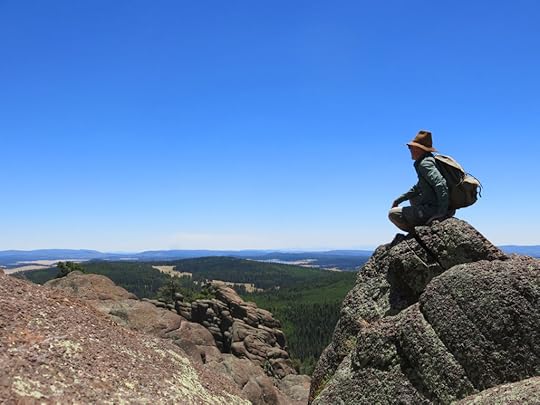
Woot! Longest hike since my foot injury, over a year ago – 6 miles round trip, with about 800′ elevation gain.
First time I visited this magical place was during monsoon season, three months before my hip surgery in 2015. See the dispatch from that trip for the difference between wet and dry. Back then, despite my disability, I made it almost all the way to the top, twice as far and twice as high, using a walking stick.
Despite it being a Thursday, and very dry, I ran into a lot more people on the trail this time – two other groups of 3 or 4 each, all in their 20s. I also saw the smoke plume from a new wildfire, about 40 miles to the east, continuing on the theme of yesterday’s dispatch.
We all need to spend more time in places like this, with infinite views, to stretch our eye muscles. I’ve been doing that for decades in the Mojave Desert, to counteract the damage done by living in the city and staring at screens. It works. You can actually see the curvature of the earth from this trail.
June 20, 2018
Summer Solstice 2018: Into the Burn
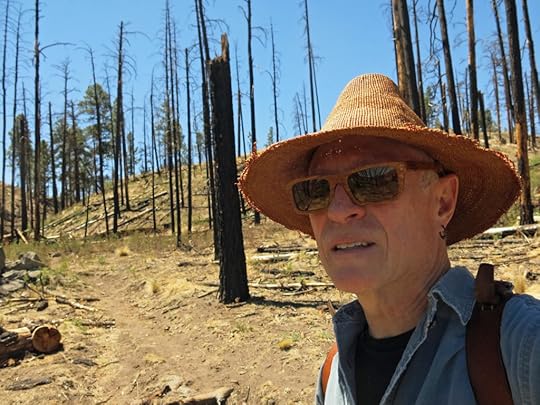
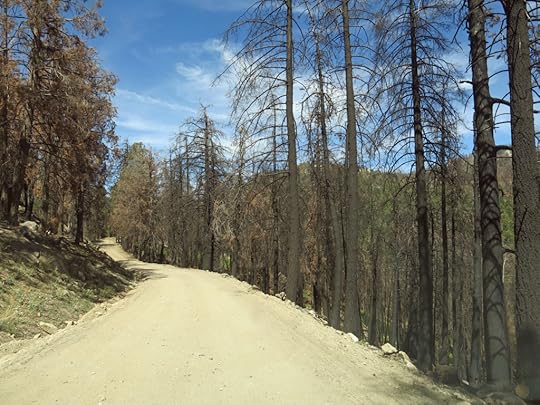
On the day before the solstice, I wanted to try a short hike on a new trail. But all of the nearby trails were closed due to extreme fire danger, so I drove east to the South Fork of the Little Colorado, an area I’d never visited. The trail started in the shade of a beautiful forest beside a tumbling stream, but as I hiked beyond the human infrastructure that fire crews defended aggressively, I emerged into the heart of the most intensely-burned zone of the 2011 Wallow Fire. It continues the theme of wildfire and habitat destruction from my previous post, but this was my first hike through this kind of devastation, and I was shocked at how little the habitat had recovered in seven years.
The Wallow Fire was the biggest wildfire in the history of the Southwest. It consumed 538,000 acres, or 840 square miles, of the best wildlife habitat in our region – an area more than twice as big as the county I grew up in back east.
It’s hard to believe it’s been 7 years – I can still remember the smoke plume and the choking pall that lay over us when the wind blew out of the northwest. The White Mountains of Arizona have been my favorite local getaway since I moved to New Mexico, and it broke my heart to know they were burning.
The fire was started by two campers who let their campfire get out of control. But that was just the proximal cause. Like all our really destructive wildfires, it was really caused by Western Civilization – European culture – and its Biblical mandate of man’s dominion over nature, inherited by “secular humanism” during the 18th century “Age of Enlightenment” and adopted in the 20th century as “scientific resource management.” The machinery first invented during the Enlightenment has enabled us to replace most of the best habitat in North America with cities, reservoirs, industrial farms, and energy infrastructure, and that European drive to engineer our environment was behind the Forest Service’s policy of wildfire suppression, resulting in disastrous buildups of forest fuel.
As I walked up the stark, sunny canyon past the skeletons of torched pines, it was easy to visualize the cool, shady forest that had been here seven years earlier. I tried to imagine what it would’ve been like in the midst of the inferno, with walls of flame pouring down toward the stream from the ridges above where the heat was most intense. Imagine being thrust into a furnace!
Animals, unlike civilized humans, are resilient. They live lightly on the ground, adapting and migrating when necessary. Catastrophic change is a driver of evolution as well as of extinction. Many species are still hanging on here, but in the canyon I hiked – formerly a lush refuge of high water table, low temperatures and high humidity – they’re struggling in a much dryer environment with much fewer cool, wet refuges and much higher average temperatures, now that we’ve killed the great trees and their protective canopy.
May 30, 2018
Consuming the Final Frontier
Space vs. Earth
Some advocates of space exploration and colonization are also concerned about the damage caused by humans here on earth. Some of them believe we can give the earth a break by moving our civilization elsewhere. Others believe it’s too late to fix the earth’s problems, but now that we know better, we can move to another planet that’s in better shape, and start over, avoiding the mistakes of our ancestors.
Still other space nuts don’t care – they just want to hang out with all the cool aliens they’ve seen in Star Wars movies. Terrestrial life is passé – they’ve been there/done that on TV nature shows.
People who lack passion for either space or the earth may say “Why can’t we have both?” The answer is easy for the few of us who know where our resources come from. It takes big, energy-guzzling machines made on earth to study or explore space, and machines are non-renewable – every machine humans make comes out of a hole in the ground that used to be wildlife habitat. Space isn’t harmed by studying the earth, but the earth suffers when you study space.
Meanwhile, while living their lives as consumers, in cities far away from the ecological impacts of their consumer lifestyles, each generation of humans unknowingly destroys more of the earth. Even if climate change were somehow stopped, or even reversed, the endless demand for consumer resources results in relentless industrial sprawl and conversion of wildlife habitat to toxic wasteland. The next generation has no idea of what the earth was like for previous generations. If they experience rural environments at all, they view these now-degraded places as “nature,” just as city dwellers view their pocket parks full of imported vegetation as “nature.” In their ignorance of ecology, it looks fine to them – it has pretty flowers, and places to let their pets run off-leash – why should they worry about the loss of a few species halfway across the globe?
Sky Island on Fire
Returning home from a distant city, I decided on a whim to take a back road. The back road took me past a mountain range I’d flown over many times and had always been curious about. I knew there was a road to the top of it, where an astronomical observatory was maintained. In my homeward momentum, I drove past the turnoff, but a few miles farther, without making a conscious decision, I pulled over and checked my map. How far would it be? There were no services up there at all, but I had plenty of gas, a water bottle that was almost full, and a partial bag of trail mix.
This is perhaps the penultimate Southwestern “sky island” – an isolated mountain range that rises 7,000′ above the surrounding desert, allowing you to travel from the arid scrublands of Sonora to the alpine forests of the Canadian Rockies in just a dozen miles. It shelters species that have been isolated from their kin in other mountains since the last Ice Age, so that for those of us who love the earth, it’s a true frontier, a place with hidden wonders waiting to be discovered. But unlike most of these ranges, it has a paved road that goes nearly to the top.
A road that passes a Federal prison, at the northern foot of the mountains. A road that turned out to be perhaps the most dangerous paved road I’ve ever traveled. Narrow, and with more hairpins than any other I’ve seen. And you know those white lines they paint along the edge of the pavement? On this road, in many, many places, if you happen to cross that white line on the edge, your vehicle either disappears into a seemingly bottomless hole, or it falls hundreds of vertical feet down the side of the mountain. No shoulder and no guard rail, and in some places even that white line is crumbling.
The road’s so dangerous because this is one of the steepest mountain ranges I’ve ever been in. Even at the top, there are no large meadows or internal valleys. The paved road ends at 9,000′ elevation and turns to steep, twisting, washboarded dirt, and I followed it to its end. The entire mountain consists of precipitous slopes, with just a handful of tiny patches of grass on less steep slopes that are generously termed “flats.”
When I crested the first ridge it was all I could do to keep my truck on the road, because the views from this mountain range are mind-boggling in all directions. I could see the outline of the state prison way down there at the southern foot of the mountains, mirroring the federal prison on the north. But I was also surprised to enter a fresh burn area. At first I figured it to be a couple years old, but then I came to stands of slender fir, their blackened, drooping branches still holding charred needles. Later I passed slopes that were mostly clear except for big trunks white as bone, killed by a much older fire. The whole top of the mountain had burned in patches, at different times, and now, in springtime, the slopes were blanketed by virulently green ferns.
It was the day after Memorial Day. That’s one reason why I’d come up here – I figured all the vacationers would be gone by now. I had the mountain mostly to myself. I got to the small reservoir near the end of the dirt road, and the only people in the large campground there were a young couple taking a romantic stroll. Even the Forest Service information center was closed, but I did meet three kids playing blissfully in the forest outside the compound of staff housing. A tiny minority of children in our “advanced” society still get to experience a degraded form of what all our ancestors once enjoyed.
On the slopes above the road loomed rock outcrops and pinnacles, and throughout the shadowy forest rose the primeval shapes of lichen-encrusted boulders. Ribbons of water tumbled down from the peaks. Birds were everywhere, wildflowers were rampant. This magical range, isolated in the desert, is known to host the densest population of black bears in North America.
On the slopes that had been fully incinerated by the recent fire, it was easy to see why it happened: all the trees were spindly and had grown close together, a sign of generations of fire suppression by “experts” who were as ignorant of ecology as our city-dwelling consumers. This whole, beautiful, damaged mountain range with deep-space telescopes on top and mirrored prisons at its feet was like a textbook case study of the cascading failures of Anglo-European society and its institutions.
Science vs. Nature
I only spent a few hours up there, so I’m by no means an expert. But I’ll try to summarize the story as it’s recorded by Forest Service ecologists and local historians.
For generations, white Americans stocked unsustainable herds of cattle on these slopes, overgrazing the forage and destabilizing the soil. They logged the old-growth timber while suppressing fires, encouraging dense stands of smaller-diameter trees. To get to the forage and timber, the road was built, and scientists – astrophysicists like media darling Neil deGrasse Tyson – began to covet that peak high in the desert sky as a site for the “world’s most advanced telescope,” to look deep into time and space to the beginnings of the universe itself. While Native Americans hold peaks sacred, white people see them as jumping-off points for their ambition to “conquer the cosmos.”
But environmentalists – that dying breed of obsolete earth-lovers – pointed out that the peak sheltered an endangered subspecies of squirrel, and a battle between scientists began. It became evident that astrophysicists are not conservationists. Different kinds of scientists have different values.
To most science buffs, this is inconceivable. At a time when science is under siege by right-wing fundamentalists and climate-change-deniers, scientists should close ranks! Science is science, and all science is good (except maybe those guys who work for Monsanto, and the oil companies, and pharma, plastics, the arms industry, those scientists who get paid lots of money to do nasty stuff that we don’t want to think of when we’re Marching for Science). Earth and space can live together in harmony – right?
Unsurprisingly, the astrophysicists – who by the nature of their work are always on the side of power and money – won. A compromise was reached, because one thing you can never stop is “development” – i.e. replacing natural habitat with roads and buildings – and the astronomical observatory rose on the peak, with a few provisions to protect the squirrels.
It was then that the first fire hit, in 2004. Firefighters, being humans themselves, were naturally keen to protect the observatory, but not so much the habitat of the squirrels.
And last year, the second fire hit, spreading all over the mountaintop, decimating the squirrels. They are now expected to die out completely, unless extreme measures can somehow be politically justified.
Squirrels are cute, but we white people already have enough of the little buggers in the tree-lined streets of our clean, safe urban neighborhoods. Not so much in the dirty, dangerous areas where the darker-skinned people live, but they just need to work harder and become more like us, then they’ll have plenty of squirrels! And meanwhile, our kids will be on Mars, enjoying the much cooler Martian wildlife!
January 9, 2018
Winter Trip 2017-2018
Prologue
I’d been in chronic pain for 3 years. Hiking was my stress relief, but I’d lost the ability to hike. I’d spent the past three months forcing myself to stick to a rigorous 3-hour-per-day home therapy regimen which hadn’t yet seemed to make much difference, and I’d attended 6 weeks of physical therapy that didn’t do me any good at all. I was so frustrated that I’d succumbed to several uncontrollable outbursts of anger in public, and felt on the edge of some sort of breakdown.
The winter solstice was approaching, and right after it, my annual holiday visit with family back east. After 25 years of faithful personal solstice observations, I’d had to ignore the winter solstice completely for the past few years while dealing with my physical problems and meeting my family obligations. The solstice observation was an important part of my identity, a way to connect with natural cycles and take stock of my life and the changes of the past year, and I really needed to resume this long-standing practice, especially now that my sanity, or at least my emotional stability, was in question.
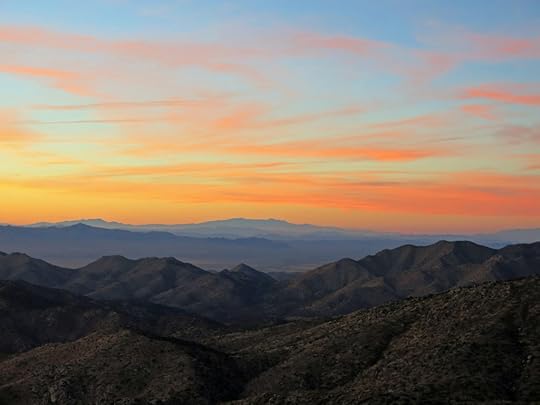
The solstice observation is something I need to do in nature, in a place where I can observe the sunrise and sunset – preferably from an elevated place, like a peak. My preferable location is in my desert, in my mountains, either on our land or at the sacred Native American site nearby. So despite the fact that long-distance hiking is the main thing I do out there, and in my present condition I wouldn’t be able to hike more than two miles, I decided to drive out there for the solstice, camp for a few days, then drive to Las Vegas and fly back east for the family holidays.
On my return after the holidays, I could spend more time in the desert, or just drive back home. I’d prearranged to meet a friend in the mountains, but he had to cancel, and my itinerary was now completely up for grabs, except for the flights I’d booked from and to Vegas. I love not having plans, and being able to do just what I feel like doing from day to day, ready to take any back road and camp anywhere at any time. The weather forecast for the Southwest continued to be warmer than usual, and dry. At worst I could expect nights in the high 30s and a day or two of high winds which might force me to seek shelter in town.
Sunday
I have a tendency to rush the packing process and get stressed out, so I forced myself to pack slowly over a two day period. But on Sunday, my day of departure, I woke to a snowstorm, and two inches had accumulated by afternoon. Even an inch of snow on the roads will disable my 2wd pickup. Up to the minute I left, I was unsure if I could get away, but when the storm cleared up in the afternoon and snow melted off the roads, I loaded my remaining bags in the truck and headed north.
Despite my efforts to stay relaxed before leaving, I was so wound up and distracted on the lonely drive north through the mountains, I momentarily lost control of the truck at one point, on an icy stretch through a high pass, and barely avoided hurtling off into a ravine. And then when I encountered traffic in the little mountain towns, I overreacted when other drivers displayed little rudenesses like cutting in front or failing to use their turn signals, and I had to struggle to avoid road rage – a typical sign that stress has taken over and you’ve lost control of your feelings and your behavior. I was really afraid that I was on the verge of losing it, and that something terrible would happen on this trip – especially with my family, because we regularly have traumatic conflict during our visits. In the meantime, I made a little sign saying “DON’T REACT!” and stuck it next to my speedometer.
Leaving Sunday afternoon, I knew I’d have to stop for the night somewhere east of Flagstaff, where I was planning to shop for the camping trip. But from past experience I was not looking forward to the lodging and dining options in the towns along the way. With that in mind, I’d done a little research online, and found a restaurant on the far side of Holbrook that seemed to be a local favorite. After arriving and checking into a cheap motel, I found the restaurant, a “gourmet Italian” place that turned out to be staffed by friendly Navajos and had a small wine list featuring cheap California wines I’d never heard of. I ordered spaghetti and meat balls, which seemed to be the safest bet, and a glass of cheap pinot noir that turned out to be surprisingly good. Finally, a decent place to eat in Holbrook!
Monday
Shopping in hectic, upscale Flagstaff on Monday was stressful as usual. In search of a new liquor store, I got trapped in a series of detours through a downtown construction zone, with the resulting traffic jams, finally giving up on my search and making my way through congestion and urban sprawl to the westbound interstate. I’m always relieved to put Flagstaff behind me, but there seemed no relief in sight for my stressed-out, distracted condition.
The high-desert miles flew past. I stopped in Kingman as usual for dinner at El Palacio, then ended my day with a drive west to Needles, where I arrived after dark and stayed in one of the least-bad chain motels next to the interstate. The slowly dying town of Needles has dozens of cheap motels, none of them particularly good, and one ridiculously overpriced Best Western that I’ve never been willing to try.
Tuesday
Throughout the drive west I’d been trying to decide where to camp first in the desert, and where to spend the solstice. Now I had to decide. I wasn’t really excited about any of my options, primarily because I’d had so much trouble with my truck on recent trips, destroying tires on remote back roads. I had a feeling it was really dry out here, resulting in poor traction in the sand, and increased potential to get stuck many miles from help. I had provisions for increasing my traction and getting unstuck, but the possibility was still adding to my stress. As usual, I’d be completely alone out there, 20 miles or more from maintained roads and other humans.
I’d also been losing interest in my property as a destination, as my passion to learn about native prehistory rekindled. There are native sites near my land, but I’ve explored them thoroughly already, and in any event they require more hiking than I’m capable of now. And as a biologist friend points out, our land is trashed with unsightly mining and ranching ruins.
Nevertheless, out of all my options, our land was the only place I was relatively confident of being able to drive to and from without getting hopelessly stuck, so that’s where I headed on Tuesday morning.
The first surprise I encountered was in the ghost town a few miles off the highway that used to be the gateway to our side of the mountains. Last spring I’d discovered new, distinctive graffiti on the ruined buildings there, and the artist had been back since with at least one friend, adding art all over the abandoned, wrecked tungsten mill. I haven’t been able to locate the artist online, but I wonder where they’ll take it from here, since they’ve covered almost all the available surfaces at this point.
The first half of the road to our land leads to a natural gas pipeline, where there used to be a pumping station that was dismantled and removed a few years ago. And as usual, I’d forgotten that since the gas company no longer needs to maintain this part of the road, and it runs up an alluvial fan, crossing hundreds of natural drainage channels, it’s deeply eroded and a very slow road to drive. Whereas we used to be able to drive it at 50mph, now you have to stick to less than 15mph, the same speed that’s required on the abandoned mine road beyond. Hence, what used to be a 45 minute drive from the highway now takes about two hours.
When I got to the turnoff to our land I could really see how deep the drought has become out here. There was one deep, apparently recent, set of tire tracks, coming up from the south, which I attributed to the son of the local rancher who occupies himself by driving back into all the drainages around the range, crossing wilderness boundaries, and our property, to inspect the springs and wells, despite the fact that they’re no longer used by his family. His tires had thrown up tall banks of deep, dry sand, that I had to plow through with my little low-clearance truck. But as usual, I’d lowered my tire pressure before entering the mine road, and was able to back up, build up some speed, and bounce through.
It was a mild afternoon, clear, with temps in the upper 60s, when I arrived in camp. I’d opened and started on a new IPA from Flagstaff upon entering the mountains, and after parking, I immediately started hiking toward the shade house back in the side canyon, but only made it 2/3 of the way before I had to turn back to keep from straining my injured foot. I found that the rancher had indeed driven all the way into the gulch, and I found a single set of footprints leading up to the shade house, which were suspiciously exactly my size and shape. The rancher is much bigger than me, and in any event only leaves his truck to open and close gates. Could my footprints from last spring still be here, uneroded by wind or rain?
The day was short this near the solstice, and the sun was setting as I returned to camp. I realized that it had been many years since I’d camped in the desert in the winter time. Firewood is scarce and precious out here, and my desert shopping list includes firewood, but being out of practice, I’d ignored it. My friends all bring firewood when they come out here, and there was still some around camp that I could take guilty advantage of. As I wandered around gathering up a few pieces, I noticed bees following me, and one landed on the back of my hand at one point. But as the sun went down the temperature dropped quickly and they disappeared. I lit a small campfire for warmth, and by the light of my old kerosene barn lantern, chopped garlic and serrano chiles, which I added to a mess of bacon ends I’d picked up cheap back home at the Co-op and browned them all in my cast iron skillet. I warmed a can of black beans to mix the seasoned bacon in. I had a second beer with dinner, unusual for me, but I was still so stressed out, I seemed to need it to unwind. It was a simple but delicious dinner, with plenty of leftovers for the next night.
It got cold that night, and I was so wound up with stress and tension that I couldn’t sleep, tossing and turning there on the ground in my too-warm down bag and watching the progress of the constellations and the Milky Way. Orion rose in the east soon after sunset. Cygnus was setting in the west, and Cassiopeia was directly overhead, with the Milky Way connecting them all in a dusty trail from horizon to horizon. I’d brought my field glasses to bed, and spent some time resolving the Pleiades and trying – but failing – to locate the fuzzy spot of the Andromeda Galaxy near the trapezoid of Pegasus.
Wednesday
When the sun did rise, I watched and waited for its light to creep down the peak behind camp and touch my sleeping bag before getting up and struggling, stiff and sore, into my thermal pants, sweater and jacket. With cold hands, I filled and lit a burner under my little enamel coffeepot, dumped granola into a bowl and sprinkled pomegranates from my bush back home over it, and began grinding coffee beans.
After breakfast I decided to hike out into the central basin, across the rolling ground of the bajada, toward a giant boulder pile on the other side where I knew there was a good resting place with shade. I didn’t think I could make it with my injured foot, but at least it was something to do with my time. That’s the problem out here for us civilized people. There’s nothing to do but hike, especially if you’re alone with no one to talk to.
While I was loading my pack, I heard a screech, and looked up to see two redtail hawks wheeling over the peak behind camp, one following the other. I quickly realized they were male and female, courting. I’d never seen this up close before, and they stayed nearby for a half hour. The male was distinctly smaller than the female, something I’d never been able to observe before, and another joined them for a little while but was driven away by the first male. Unfortunately, I was still so stressed out that I couldn’t figure out to get my camera to focus on them, and although I tried to take a video of them, I later discovered the camera had been set on low resolution. I’d been so distracted I hadn’t even thought to check.
Leaving the hawks to their love affair, I started walking out across the bajada, down into gullies, up onto rises, and around shrubs and cacti, and made it about 2/3 of the way to the boulder pile before my foot began to get tender and I knew it was time to turn back. So frustrating! Despite the drought, there were both annuals and perennials blooming, phainopeplas were active everywhere, and I encountered hummingbirds near camp, but couldn’t get my camera to focus on them.
By the time I arrived back in camp, my foot was really sore, which freaked me out, because I’d worked so hard for the past few months to eliminate all swelling and tenderness and encourage healing, and I was afraid I’d reversed those months of progress in just a couple of hours. I’d brought a cold pack in my ice chest, and I immediately sat down and set my foot on it. As I sat there, a bee started circling me, buzzing loudly and acting aggressive. I needed to use my bone stimulator device, and as I retrieved it from the truck I noticed more bees buzzing around the area. A couple more followed me back to the chair and started exploring the sweaty boots I’d taken off and set beside the chair. By the time the bone stimulator was finished, there was a swarm of bees around my closed water jug, on the tailgate of the truck. The spout is watertight and had been sitting there long enough to evaporate any spillage, but there must’ve been a trace amount of vapor they could detect – or had they become familiar with water jugs in general? After being chased out of camp by bees last spring, I was spooked and paranoid. More bees were arriving by the minute. Soon they would fill the campsite.
Trying to avoid any rapid or threatening movements, I gathered up my gear and loaded it into the truck and the truck bed, staying as far away from the swarm around the water jug as I could. Then I got in and started driving away, moving slowly so the water jug wouldn’t tip off the open tailgate. I drove like that halfway out of the mountains, then stopped to see if the bees had followed. They hadn’t, so I was able to close the tailgate and get everything better organized. Bees had chased me out of the mountains the last two times I’d tried to camp in this range! I’d been told by the BLM that all the bees out here were Africanized by now, and during a volunteer effort years ago, I’d been taught by rangers that they were extremely dangerous and could easily kill you if they caught you in a swarm. I’d started this trip dangerously stressed out, and now I was afraid I’d permanently lost my sacred place on earth to lethal Africanized bees.
Alone and feeling vulnerable, I kept driving out of the mountains, until I reached the main track, where at first I turned right toward the highway as if I were heading to town. But then I had second thoughts. I can’t even remember what I had in mind, but I backed up into our side road, then turned left into the deep ruts left by the rancher’s truck and immediately got stuck, half-burying the rear tires in the sand.
Of course this is the eventuality I’ve learned to plan for. I had scrap plywood in the pickup bed and a camp shovel. I dug out behind the tires for a yard or so, then muscled a piece of plywood under each of them. And backed right out onto more solid ground, and turned around to head out of the mountains as originally planned.
As soon as I got a phone signal, I called my co-owner to report on the bee situation. Unfortunately, he reacted, as he often does, by questioning my experience, insisting in a patronizing manner that I’d encountered wasps or hornets instead of bees, and repeating the insistence later in an email. After all, the thing whose buzzing around my face had awakened me on my first morning in the mountains, thirty years ago, had probably been a wasp or hornet, not a native solitary bee looking for its burrow as I’d observed at the time. The damaged hive with dripping combs that I discovered at the Native American shrine the following year hadn’t been a bee hive but a nest of hornets, just like the hives I discovered in early years on our land and at other springs and seeps around the range, and have revisited over the decades. All the bees I’ve found year after year rolling in cactus flowers in the springtime, their legs heavy with pollen, were no doubt wasps, and the young grad students I got to know in recent years at the ecological preserve were most likely studying hornets, not bees as they claimed, in the microhabitat of larrea. To have my experience questioned this way is something I’ve come to expect of my harried, citybound partner – to compensate for his own insecurities, he habitually attempts to undermine the confidence of others – but it was coming at the worst possible time.
Depressed, I refilled my tires with a 12 volt pump in the ghost town, and drove back across the desert to Needles, where I wanted to check with the BLM. There was nobody onsite who could advise me about bees, but the clerk at the counter referred me to Mystic Maze Honey, a quaint operation just down the road, where I found an old beekeeper who dismissed the whole Africanized bee phenomenon. He said he’d never run into aggressive bees in the desert, but he confirmed what I’d read about bee foraging: bees in the desert don’t normally venture more than about two miles from the hive, and he’s seen bees die of thirst five miles from a hive. In our mountains, during this severe drought, the drying up of historically perennial water sources now means that hives are likely to be isolated from each other, and knowing where the water is means knowing where the bees will be. I suspected that his business agenda might bias his observations, but I did feel better to hear that the BLM’s warnings about lethal behavior might be exaggerated.
What to do now? Tomorrow would be the Winter Solstice, the goal of my entire trip. But the day was already late, and I didn’t know where I could safely camp at this point. Whatever plan I had was in shambles. Still depressed, I checked into one of the cheaper and less comfortable motels of Needles to punish myself for my failure. At least I had last night’s leftovers to warm up for dinner on my camp stove in the room, to compensate for Needles’ lack of a decent restaurant.
Thursday: Winter Solstice
On the morning of the solstice, I thought what the hell – before giving up on the desert completely, I would try the other side of the mountains, the sacred Native American site, which I doubted that I could even reach with my truck in this severe drought. At least I could console myself that I’d tried.
After the 25-mile drive down the rolling, bumpy, deeply eroded dirt-and-sand powerline road, there are two ways to access the sacred site: a shorter uphill track through sand, and a longer, slightly less uphill drive that’s only partly through sand. The shorter road twists and doesn’t allow me to get up enough speed to carry me safely through the sand, so I thought I would try the other. And after letting air out of my tires yet again, I was able to make it, by speeding through the sandy part, bouncing and sliding around bends, surprising a roadrunner, until I finally reached the high end of the alluvial fan at the foot of the mountains, and more solid ground. I knew there was a campsite there, the only good campsite on this side of the mountains, which had already been occupied on my previous visit. Maybe I’d get lucky and have an actual campsite for solstice night. But on the other hand, I also knew this campsite was directly below a major spring that had a long-established hive of Africanized bees. This would be a further test of the new reality in my mountains.
There was yet another challenge on this solstice: wind. A high wind advisory had been in the forecast for today, supposedly dropping by mid-afternoon. It’d been windy all the way out from Needles, and temperatures had dropped twenty degrees since yesterday. After parking outside the gate of the sacred site, I had to put on all my thermals, my shell, knit cap, and snow gloves to keep warm outside in the wind. I knew two of my best friends, old desert rats, had been driven out of the desert previously in conditions like this, but I was hoping the wind would die down soon.
I started off on a hike to revisit some rock art in a side basin, a half mile away. It was farther than I thought, and I turned back after reaching the first rock art panel. Then I cut across a deep ravine to the sacred site. I made my obligatory visit, but neither my mind nor my heart was really there. I was just cold, frustrated, and depressed. I ate a sandwich and walked back to the former campsite of the caretaker, an old desert friend, but it was stripped and lonely, so I returned to the truck to head over to the public campsite.
The campsite, east-facing, was already in shade, and bitterly cold in the still-strong wind. At least I wouldn’t have to worry about bees – they couldn’t leave the hive in this weather. But I realized that after remembering about the need for firewood the day before yesterday, I still hadn’t picked up any in town. This being a popular campsite, I certainly didn’t want to collect wood in the vicinity, but without firewood, there was no way I could camp here in this wind and cold. My solstice was just thoroughly doomed, so I decided to drive to Boulder City, outside Las Vegas, to get another motel room and wait for my flight back east.
Friday – Saturday
My time in Boulder City was spent reading in the motel room. The important thing about the Winter Solstice is the night and morning after – the longest night of the year, and the first sunrise, marking the turning from its southward swing back toward the north, with days growing longer again and life renewing. I spent that night and that morning in my room, meaninglessly, alone and disappointed.
I emailed my desert friends about the bees, and heard back from a scientist who said a friend of hers had been chased out of the desert by bees that were desperate for water in a dry year. I began to suspect the drought, and the bees’ desperate thirst, was the problem, not “Africanization.” I realized that some hives were probably dying out completely as their water source dried up, and I remembered having seen something like that happen long ago, without really understanding it. In humid climates, we think of bees as drinking nectar and collecting pollen from flowers, not relying on water sources.
My flight was scheduled for 5:45am Sunday, in the darkness before dawn, so I had reserved a room nearest to the airport, in a Best Western situated in an industrial no-man’s-land next to the economy parking lot, for Saturday night. I did laundry in Boulder City, then drove over the pass into Las Vegas and parked in the economy lot. I left all my camping gear in the truck, with my ice chest, water jugs, and gas can outside in the bed, and caught a shuttle to the terminal with my travel bags. There, I called the hotel shuttle, and learned that it would start running in the morning at 5:30, too late to catch my flight.
But on the ride to the hotel, the shuttle driver showed me how I could walk from the hotel to the terminal in the morning – a little less than a mile through the industrial wasteland.
I’d cooked a meal in the Boulder City motel, with leftovers planned for Saturday night, but I’d forgotten and left them in the ice chest, in my truck, so there I was stuck in an industrial wasteland with nothing to eat. I walked out of the hotel, and found a bizarre cavernous liquor store hidden behind a postal distribution yard, completely isolated from the street and any other retail, so at least I could get a good can of beer. But my only food option was an Arco station, where I ended up getting one of those frozen microwave burritos. Everywhere I went, even around the airport, hung the smell of cigarettes. Vegas, last bastion of the Old West.
Sunday: Christmas Eve
When leaving the parking lot on Saturday evening, I’d noticed big signs at the exit warning patrons not to leave anything visible in their vehicles, so in my already stressed-out condition, I began to worry about theft. I’d taken pictures of all my stuff on Saturday, just in case, and realized that some of my gear, like the old Swiss Army surplus backpack, was irreplaceable, and the rest of it, although acquired cheaply long ago, could be very expensive to replace. The economy lot was open to anyone from outside the airport and virtually unsupervised. So on Sunday morning, I got up before 3am, walked over to the lot, and transferred my truck to the parking garage next to the terminal. I’d end up paying about $60 more, but the peace of mind would be worth it. And then I checked in, and boarded my flight.
Christmas – New Year’s
I always look forward to seeing my mother in Indianapolis, but I dread sharing a cramped house with my morbidly obese, emotionally volatile brother, trying to occupy the long days with no space or privacy, and trying to sleep in the overheated bedroom. And this visit would be worse than usual because of my own limited mobility – I wouldn’t be able to get out and relieve my stress with long walks.
But it turned out even worse than expected. After arriving on Christmas eve, sharing dinner and Christmas breakfast at restaurants with my little family, I came down with my dreaded winter respiratory infection on Christmas night, and knew I would be miserable for the rest of my visit.
It was as bad as ever, and on the second day, my mom took me to an urgent care facility, where I was prescribed an antibiotic (to treat the sinus infection that always follows the virus) and some codeine cough syrup, which turned out to be most essential after I returned to the desert more than a week later.
While I was sick, the usual traumatic conflicts arose, with both brother and mother, and afterward, as I reflected on what really happened, I realized they all happened because of my stressed-out condition. I had been lying upstairs in bed, sick, moping about how everyone made life hard on me, but I had brought my own problems from out west.
When I visited them at Thanksgiving, my mom had seen a Monopoly game in a store and wanted to get it. It hit me that she saw it as the perfect family activity to keep us engaged and prevent us getting on each others’ nerves. It was her brilliant idea. So I had ordered Monopoly for her as a Christmas gift, and we played a few games while I was there. And it really helped.
Eventually, I got well enough to get dressed and leave the house, just as temperatures in Indianapolis dropped below zero. We fell to eating TV dinners because it was so hazardous to go out. I received another email rejection of my book project from the last of the literary agents I’d submitted to; people just weren’t interested in a story about artists in the 80s.
Wednesday after New Year’s
Since I was flying nonstop into Vegas instead of trying to make connections through to Silver City, I’d been able to reserve an afternoon flight and didn’t have to get up hours before dawn as usual the day of my departure from Indianapolis. But in the airport, I was shocked and saddened to see dogs everywhere, from the ticket counter to security and even the gates. It seemed that about ten percent of travelers were traveling with pets. We’re not content with our own escalating consumption, we have to increase the human ecological footprint even more with domesticated animals. Originally developed for hunting, herding, and pest control, the current ecological role of pets is destructive – as consumers of resources, producers of waste, and predators on wildlife – and their dysfunctional social roles range from living toys to surrogate children. Few of their owners can be bothered to train them or give them adequate exercise, many of them end up neurotic or obese, and more and more of them end up abandoned on the streets, abused and feral. Bred for an unhealthy master/slave relationship with humans, they are now replacing the wild animals we never see anymore and are driving to extinction. This is not the kind of world I look forward to living in.
The afternoon flight got me into Vegas in the dark of early evening, and I drove back to Boulder City and another motel room.
Thursday
I might’ve been back in the desert, but I was by no means free. My truck was overdue for an oil change, so after breakfast I located a nearby shop, which agreed to take me in a half hour. I quickly packed and drove over. And in the waiting room, they had a museum of film cameras.
I drove from the auto shop past Boulder City and south across the Hoover Dam into Arizona, ostensibly heading home, but once across the dam I realized I wasn’t ready to leave the desert. My trip had been a disaster, and I had unfinished business. I pulled off the highway and unpacked my maps to refresh my memory of options.
The stark, colorful mountains and canyons around the dam have always intrigued me, but I’ve always passed through there intent on getting somewhere else. To the south, between Boulder City and Kingman, there was a mountain range I’d often wondered about. And the map showed a dirt road that climbed to the top, where there appeared to be campgrounds.
I had no interest in campgrounds – my experience is that they tend to be occupied by giant RVs running noisy gas generators to power their owners’ massive stereos that blast all over the landscape. But that road might be a novel way to see a new desert mountain range up close.
It turned out to be easy to find; there was a sign along the highway listing the campgrounds and distances. And it was a well-maintained dirt road, although as it rose toward the ridge top it became much too steep for RVs. That was a good sign.
What I found was a surprise in many ways. It was a true sky island, with an unusual road running along the ridge at 6,000′, with views to both sides for a hundred miles over the desert. And the vegetation was characteristic of much farther south, with desert chaparral (scrub oak and manzanita) covering the upper slopes, between stands of pinyon and juniper, with frequent boulders and outcrops of metamorphic and igneous rock. My botanist friend tells me it represents the northern limit of the characteristic vegetation of the Mogollon Rim. It was beautiful, and according to the guest books I saw, seldom visited despite its closeness to cities.
Signs indicated a peak trail at the end of the road, past the campgrounds, so I kept going. The campgrounds appeared beautifully sited, and the trailhead was like the portal to wonderland, leading down into an intimate grove like a tunnel. Most of the trail ran on the east side of the ridge, and I was able to hike 2/3 of the 2-1/2 mile distance, with an elevation gain of about 700 feet, before I had to start thinking about my foot. On the way, I kept watching a plateau on an outlying ridge several miles to the east, a hanging valley with meadows and surrounding forest that was hidden from the desert below. I wanted to go over there and check it out!
It was still only early afternoon when I returned to the truck, but I was so excited by my discovery of this place, there was no way I could leave. I decided to check out the campgrounds.
The first was called Windy Point, on a point of ridge to the west. You really felt like you were on an elevated platform thousands of feet above the desert, but the boulder-strewn point was covered with sheltering groves of pinyon and juniper, and as I drove around the loop, I could see that each campsite was well sheltered. There were two small vehicles parked at the back, and although none of the campsites appeared to be claimed, I saw some retiree types wandering about. I had passed a site at the entrance that appeared to be the most private, so I returned to that and parked. The site had been designed so that the parking space at front was isolated from the actual camping area at back by rocks and trees, and I realized that the whole campground had been designed strictly for tent camping.
When I walked out to register and pay my fee at the kiosk, I encountered the retirees. Two older men and a women, they addressed me as “youngster,” and explained that they didn’t have the money to pay the $8 overnight fee. Later, unloading my truck, I waved to them as they drove off in their ATVs. They were apparently the people staying in the big RV I’d passed down in the foothills, before the road got steep. I had the entire top of the mountain range to myself.
I explored around camp, read, warmed up a can of beans (since I hadn’t planned on camping, that and granola for breakfast was all I had with me), and after sunset I took my flashlight and walked around, exploring the other campsites. It turned out they were all very isolated from each other and private, and most had even more separation between parking and camping than mine, with beautifully laid out paths up or down through the groves to intimate dining and sleeping areas on different levels. It was the most beautiful campground I’d ever seen – and it was administered by BLM.
It was cold that night, but not windy like I’d feared, and when I got up to pee long after midnight, it was completely still and even seemed warmer than when I’d gone to bed. I had a wonderful night’s sleep, and enjoyed waking occasionally to watch the constellations change overhead, from my cozy pallet on top of the mountains.
Friday – Saturday
I had a leisurely breakfast and took my time packing in the morning, since my sleeping bag was damp with dew and had to wait for the sun to dry it. Spotted towhees, cousins of my friends from back home, foraged energetically around me in the understory. Then I drove back, stopping to explore the other, much smaller, campground, wedged into a narrow gap at a high point on the ridge.
Leaving the mountains, I stopped at El Palacio in Kingman for lunch, then located the BLM field office, hoping to get better maps of the mountains I’d discovered. In the lobby was a live exhibit of venomous desert reptiles, including a Mojave green rattlesnake that looked just like the snake I’d encountered on a field trip with wildlife biologists more than a decade ago. I’d asked the others if it was a Mojave green, and the oldest snapped “Of course not! That’s just a common mitchellii!” That’ll teach me to depend on a bighorn sheep specialist for reptile identification.
Nobody appeared at the BLM counter, so I rang the bell, and a man came out who was apparently very lonely, because he wouldn’t stop talking. I told him I’d camped in the mountains last night, and he asked me about the condition of the road and campgrounds, and where I was going next, and went on to advise me about restaurants in Flagstaff, where I wasn’t even intending to stop. I kept trying to get away and he kept coming up with new questions and advice. Finally I just said goodbye and pushed my way out the door, waving, as he kept talking behind me.
I drove straight across northern Arizona, passing Flagstaff, but making a mistake at Holbrook, where I drove south through Show Low and Pinetop/Lakeside instead of east toward St. Johns. I was hoping to spend the night in the White Mountains, but that corridor is choked with nasty traffic and from Show Low on, it’s one continuous strip mall until you reach the Apache Reservation at the end. I’d been thinking of staying in a motel along there, but ended up continuing to the isolated resort village of Greer, my familiar weekend getaway destination. The backroad to the White Mountains campgrounds was closed for the winter, so I ended up unwinding in the motel there for two nights, savoring my memories of the desert.
Sunday
On Sunday morning, as I was leaving Greer, the road dipped through a ravine, and over my shoulder, I glimpsed stone cliffs that reminded me of the Arizona Game and Fish presentation I’d seen last summer. The rangers had talked about their recent reintroduction of Rocky Mountain bighorn sheep to this gently rolling plateau, and how the sheep gravitated to the ravines because their rocky cliffs provided the only available “escape terrain” to get away from predators.
Just after having that memory, I saw something out of the corner of my eye – animals grazing at the top of the cliff, hundreds of yards away. At first I assumed they were cattle, but then as I continued up the road, had second thoughts. So I turned around, went back, and found a place to pull over and take pictures across the ravine – unfortunately with a telephone line in the way. I’m used to seeing bighorn in the steep, sparsely vegetated rocky terrain of the desert, so it always surprises me to see them in forested country like this.
Epilogue
Will Max regain the use of his injured foot and overcome his chronic pain?
Will he find other ways to reduce his stress, and find peace with his family?
Will he ever get a better vehicle for exploring the desert?
Will bees and their hives survive in the desert despite worsening drought, and will Max and his friends find a way to coexist with them?
Who are the ghost town graffiti artists, and what will they do next?
Stay tuned…
September 14, 2017
Limping Across the West
The Legendary Ordeals
I put a lot of miles on my aging body while exploring the wild places I report on in these Dispatches, and in the past three years, I’ve started to discover that my body isn’t really built for this kind of abuse. I started life as a relatively weak, undersize boy who was often sick and didn’t qualify for sports. Instead, I came to rely on my head and heart, developing into an artist and scholar. It wasn’t until I was almost 40 that I started strengthening my body, developed a fitness regimen, and entered the physically active phase of life I’ve come to treasure.
With this gain has come an increasing level and frequency of pain, and accumulating damage to my joints. In 1990 a poorly-advised strength training regimen resulted in a stress fracture to a sesamoid bone in my left foot. Pieces of the bone were surgically removed, but the pain has recurred periodically. In 1999 I developed acute lower back pain, due to damaged lumbar discs, and this has become chronic. When I started rock climbing in 2000 I noticed limited range of motion in my right hip, and in 2007 I developed acute pain there, which was eventually diagnosed as a minor congenital deformity, requiring surgery. Beginning in 2009, I had recurring episodes of plantar fasciitis in the right heel, and after recovering from the latest bout early this year, I had a recurrence of the sesamoid problem in the left foot, which become acute and brought my activity to a halt for the fourth time in two years. Finally, in the meantime, I suddenly developed tennis elbow in my right arm, which involved sharp pain that was pretty much constant.
So far, these conditions have all been treatable, but the frequent pain puts me under chronic stress, while often depriving me of the means to relieve it by doing what I love – hiking in wildlands. Less of my time is spent doing what I love, and more of my time is consumed by maintenance: physical therapy, icing, stretching, foam-rolling, etc. And my local, rural, small-town healthcare system has proved itself inadequate to address the problems of an aging athlete. I’ve had to take matters in my own hands, seek outside help, and sometimes develop my own diagnoses and treatments. Part of the problem is poverty – New Mexico is one of the poorest U.S. states – and practitioners are simply not used to seeing active older adults. Their experience is dominated by the health problems of poor Americans: drug abuse, malnutrition, obesity, diabetes, and lung cancer.
When the sesamoid problem recurred this spring, our local podiatrist was unable to help me, and I had to do a nationwide search for specialists in this rare condition. I eventually found Dr. Richard Blake in San Francisco, and arranged a road trip to the Bay Area, during which I’d also have the chance to visit old friends, both coming and going. I was in the midst of my epic book project, which was only one scene away from its first major milestone, but I’d have to put that on a frustrating hold for a few weeks. In the end, this trip became an adventure full of ordeals that tested me, my friends, and our relationships, in the midst of natural spectacles that spanned the continent: a solar eclipse, a record heat wave, and catastrophic storms. In the end, I found the proverbial rainbow in, of all places, Las Vegas, and realized that as hard as it’s become, my life in rural New Mexico is still much healthier than it would be if I lived in a big city.
Everybody Hurts
Over the past thirty years, my weekly fitness regimen evolved into six workouts per week: two peak hikes totaling ten miles with 3,000′ elevation gain, two one-hour strength-training workouts focusing on core, and two one-hour stretching sessions. After hip surgery and the recurrence of foot problems, icing, stretching and foam-rolling became a daily requirement, taking up to three hours per day, and my visit to San Francisco added another hour and a half of foot treatment. This all adds up to nearly forty hours per week on physical maintenance (not counting personal hygiene). The goal of all this maintenance is to keep me active as I age, but clearly, I wouldn’t be able to do it if I had a normal job or a family to take care of. So at this point, fitness is my full-time job, and pain is the new normal.
But as I’ve become mired in my physical limitations and the treatment of them, my friends face their own formidable challenges. In one home I visited, household clutter had grown until the only open space consisted of narrow pathways between dusty piles of accumulated debris. Some homeowners expressed admiration for the “tiny house” movement, while renters were forced by the astronomical cost of urban housing into cramped apartments that wouldn’t accommodate everything they needed. Like so many urbanites, they had to commute to a distant storage locker that housed the essentials they couldn’t fit in their apartment.
Back home, I’d already come to view pet ownership as an epidemic disease after failing to get neighbors to take responsibility for their barking dogs. But on my trip, I found that more people are coming to accept pet urine and feces on the floors of their homes, because they’ve taken on pets that are either non-house-trained or incontinent. One friend was recovering from a series of battles with pneumonia – no surprise since she inhabits a dusty, cluttered, cat-frequented house. I’m allergic to cats, but almost all of my friends have at least one feline in the house, so I always have to travel with antihistamines and steroid nasal sprays. Pet ownership is at an all-time high, increasing our ecological footprint, displacing wildlife, and harming society as owners fail to train or otherwise take responsibility for the impacts of their pets on others.
Friends in the city were suffering under increasing financial stress and abuse from their jobs, in addition to air pollution, noise pollution, light pollution, and the dangerous traffic they endure in their commutes. Many burden themselves daily with TV news about a world gone mad and the reckless antics of the rich and famous. Since I don’t watch TV at home, I felt bludgeoned by broadcast media, encountering the new head of state moving and talking onscreen for the first time, and it was not an edifying experience. Stressed-out white people come to feel threatened by immigrants, other races and ethnic groups, differently-gendered people, criminals, and the poor, blaming them for society’s problems as well as their own. Like my father in his declining years, some perceive the world around them as a seething mob of evil-doers barely held in check by our valiant police and military.
I also encountered and was impacted by depression, alcoholism, and drug addiction throughout my journey – and who could blame these disorders on people living under such stressful conditions? As I navigated apocalyptic traffic across the city and its suburbs, I saw, over and over, grotesque affluence flaunted alongside nightmarish poverty. My friends are among those who’ve benefited from the gentrification that contributes to homelessness, but the homeless continue to haunt them like living dead.
The Unforgettable Super-Mega Eclipse of 2017
On the way to the Bay Area for my foot treatment, I stopped to visit one of my favorite families, a botanist and ecologist who are raising their kids in the wildfire-ravaged Sierra Nevada foothills. We enjoyed an idyllic three days hanging out in the Merced River, walking their country lanes, and witnessing the solar eclipse, before I left to face the trials of the city.
Into the Maelstrom
I knew nothing of heat waves or hurricanes when I planned my trip, but I was reluctant to return to the soul-numbing congestion, gross economic inequality, and oppressive man-made landscape of my old home, the San Francisco Bay Area. The only saving grace, beside the hope of medical treatment for my foot, was the hospitality, generosity, and good fellowship offered by my hosts. By the nature of this trip, I ended up missing most of my Bay Area friends this time around – hopefully they’ll be able to join me in New Mexico sometime soon.
The medical part of the trip quickly grew in proportions far beyond what I’d anticipated. I ended up having to drive to San Francisco’s Nob Hill from the suburbs on four separate days over a week-and-a-half period, for visits at a sports medicine clinic with a foot surgeon, a non-operating podiatrist (Dr. Blake), the radiology department, and a physical therapist. The surgeon and podiatrist ended up giving different opinions on my treatment and chances of recovery, but on my second visit with Dr. Blake, he gave me a new set of orthotics that enabled me to walk normally for the first time in months! I actually danced a jig in front of my friends that night.
I was in culinary heaven from the start, eating spectacular Ethiopian, Indian, and Thai food on successive nights. Friends took me to my old favorite museum, the Oakland Museum of California, and on shopping excursions in search of things I can’t get back home. One errand on my list was to visit an Alfa Romeo dealer to look at their new SUV, but in the end, all I had time for was a glimpse of the back of the vehicle through a dark showroom window.
My Berkeley hosts pointed out the unusual homeless encampment near their house, which they said had been established last winter and accepted by the city because the residents were self-governing, prohibiting panhandling in the vicinity and contracting for the removal of their waste. The neat, well-ordered camp included a manned information booth, and there was a free clinic nearby where residents could go for checkups.
I savored an evening with one of my old roommates from the Terra Incognita loft, and it turned out his sons, who grew up in Ireland, had arranged a viewing of the Mayweather-McGregor fight. While not a boxing fan, I enjoyed the well-played spectacle, a public ritual like something out of ancient Greece or the Roman Empire, in which the blond, tattooed Celtic challenger appeared as a Viking berserker while the African-American champion entered wearing a midnight bondage jacket and mask like a tribal fetish from the land of his ancestors. The patterns of dominant societies play out over and over again throughout history.
At the end of my stay in Berkeley, I was invited along on a sailing race in the Bay. I hadn’t sailed in over fifteen years, and I was really worried about risks to my foot, but the boat people assured me I could sit down somewhere out of the way, wouldn’t have to work, and this race would be “casual” anyway. As it turned out, all three were wrong. Anxious crew members shouted back and forth constantly and climbed over each other in the crowded boat to tack or avoid collision. I had to continually shift position in my heavy boots on a surface that leaned precipitously, as I twisted and stumbled trying to get out of someone’s way. I was suddenly put in charge of something I didn’t understand, and the stranger I partnered with yelled unfamiliar commands and abused me for making mistakes. I had moments of exhilaration, but my injured foot was strained by all the desperate maneuvering, aching more than it had in months.
One secondary mission of my trip was to find a solution for my beloved wooden sunglasses. A hinge wore out months ago, and repeated attempts to get them repaired had failed. I spent hours roaming the cities in search of either repair or replacement, and on the verge of giving up hope, finally discovered a guy who fixed them while I waited, for $25. He even used a laser! Check it out: All-American Eyeglass Repair, in Hayward.
Just as Hurricane Harvey was flooding Houston, a record heat wave hit the Bay Area, and I ended up staying with friends in a house without air conditioning, sharing some great conversation in front of a fan, and taking my first lengthy walk in the new orthotics in 105-degree weather. It was so muggy that I actually spent two straight days sweating continually, an experience I’ve never faced back home in the mountains of the Southwest.
The primary goal of this trip, medical care for my injured foot, achieved mixed success. After reviewing the MRI, both doctors say I have arthritis in the metatarsal and an incompletely healed stress fracture of the remaining sesamoid. They both prescribed a bone stimulator, an ultrasound device which is supposed to encourage bone healing but remains somewhat controversial, although they disagreed on the long-term plan and chances of recovery. The surgeon said the likelihood of needing surgery was 50% and a decision should be made after three months of treatment, while Dr. Blake wants me to use the bone stimulator for nine months, with a follow-up MRI after one year. Only one such device is FDA-approved, making its manufacturer a monopoly, and it threatens to cost me thousands of dollars out of pocket – how much is still TBD.
The pain I had after sailing was relieved by a physical therapist during my last visit to the clinic, when he demonstrated a series of exercises and manipulations I could do at home. So now, in addition to the time-consuming physical maintenance I’ve been doing in the past year, I have another hour and a half of work to do on the foot, each day. Hopefully there’s a light at the end of this increasingly narrow tunnel.
Escape to the Countryside
On the third day of the record heat wave, as the heat began to subside, I left the Bay Area and headed across the Central Valley to visit an old friend at the base of the Sierra Foothills. I’d already walked more during the heat wave than in the previous three weeks of milder weather, and by the time I reached my friend’s place my left foot was sore in an unaccustomed place. We went for yet another walk, again in 100-plus temperatures, and by the time we reached our destination my foot was red, swollen, and in considerable pain. And we still had to walk back.
The foot throbbed all night, and in the morning I emailed Dr. Blake, who suggested it was gout. Great! I still had at least a week of planned visits before returning home, and now I could barely walk. I reluctantly left my friend, whose tiny apartment made it difficult for me to take care of the foot, and drove two hours up to Lake Tahoe in the mountains, where I found a motel, crawled into bed, and began applying ice.
The swelling and pain subsided a bit by the next morning, and I drove down the Eastern Sierra, under storm clouds and through scattered rain, to visit more old friends, the expert on bighorn sheep and his physician wife. As I continued to ice my foot, we had some great talks about wild sheep, prehistoric tribes, and a half-dozen other topics of mutual interest, as on the other side of the continent, Hurricane Irma approached Florida, leaving a wake of destruction in the Caribbean. I drove up on the nearby volcanic tablelands to revisit some prehistoric rock art. But my friends were busy and distracted, and I was too crippled to hike, so after a couple days I continued on to Las Vegas.
Rainbow Over Vegas
With hurricanes in the South and a heat wave on the West Coast, Las Vegas had its own extreme weather – in this case, thunderstorms and heavy rain, with unseasonably cool temperatures. I was actually greeted by a rainbow when I arrived at the UNLV campus to meet my friend, another wildlife biologist. My sore foot continued to improve, and in between thunderstorms, my host took advantage of the rare cool weather to show me some beautiful springs in the low desert around Lake Mead. Although we were mainly looking for the endangered relict leopard frog, I also got to see the mysterious, almost microscopic springsnails, also endangered, and poorly known to science. So now, in addition to the biological soil crusts that recently captured my attention, I have a new tiny, humble, easily-overlooked desert life form to admire. As paleontologist and natural historian Richard Fortey has observed, it’s often the humblest and least aggressive life forms that persist, while powerful species like ours quickly rise, briefly dominate, and collapse into ruin.
No Place Like Home
I’d planned one more stop after Vegas, but at this point, I really needed to get home and start treating my foot. The swelling and pain had subsided but were still there, and I didn’t know whether I had the dreaded gout or not.
I took a detour on the way back so I could traverse the White Mountains plateau in Arizona, and my foot was feeling good enough when I got there that I went for a short hike – two or three miles at 9,000′ elevation – through the lush post-monsoon meadows and cool, fresh alpine air. After all that time in cities, finishing my trip in nature was the perfect way to restore balance.